|
| |
|
Related Articles: Puffers in General,
Puffer
Care and Information,
Fresh
to Brackish Water Puffers, Burrfishes/Porcupinefishes, Tobies/Sharpnose
Puffers, Boxfishes,
Pufferfish
Dentistry By Kelly Jedlicki and Anthony Calfo,
Puffer
Care and Information
by John (Magnus) Champlin,
Things That My Puffers Have Told Me by Justin Petrey,
Related FAQs: True Puffers 1,
True Puffers 2, True
Puffers 3, Tetraodont Identification,
Tetraodont Behavior,
Tetraodont Compatibility,
Tetraodont Selection,
Tetraodont Systems,
Tetraodont Feeding, Tetraodont Disease,
True Puffer Disease 2,
Tetraodont Reproduction,
Puffer
Identification, Puffer Behavior, Puffer
Compatibility, Puffer
Selection, Puffer Systems, Puffer
Feeding, Puffer Disease,
Puffer Dentistry,
Puffer
Reproduction, True Puffers,
True
Puffers 2, True Puffers 3,
Freshwater Puffers 1,
FW Puffers 2,
FW Puffers 3,
FW Puffer Identification,
FW Puffer Behavior,
FW Puffer Selection,
FW Puffer Compatibility,
FW Puffer Systems,
FW Puffer Feeding,
FW Puffer Disease,
FW Puffer Reproduction,
BR Puffer Identification,
BR Puffer Selection,
BR Puffer Compatibility,
BR Puffer Systems,
BR
Puffer Feeding, BR
Puffer Disease, BR Puffer Disease 2,
BR
Puffer Reproduction, Green Spotted Puffers, Burrfishes/Porcupinefishes, Tobies/Sharpnose
Puffers, Boxfishes
/The Conscientious Marine Aquarist
"True"
Puffers, Family Tetraodontidae, (except
the Tobies/Sharpnose Puffers, Subfamily Canthigastrinae)
|

|
|
By Bob Fenner |
Arothron hispidus Hawai'i
|
This is the most notable group of puffers known for their ability to
"puff up" when alarmed or challenged. This is actually done by rapidly
ingesting large quantities of water into a distensible part of their stomachs
(the ventral diverticulum). Both the true puffers and Sharpnose Tobies also have
characteristic teeth plates that look more like beaks. Other characteristics
include the more posterior position of their unpaired fins (like other
tetraodontiform fishes; triggers, Boxfishes... used for slow, exacting
locomotion) which are w/o hard rays, a lack of ribs and scales (hard to blow up
with them), and slit-like gill openings.
Tetraodontidae is the "true"
puffer family to many; it contains all the non-spiny, non-armored, non-deep-bodied
puffers. These animals can really inflate their bodies, to a few times "regular"
diameter; their bodies are either naked or dotted with short prickles. The viscera,
particularly the gonads of puffers is toxic, the tetrodotoxin poison at times fatal to
sushi bar goers and hapless predators. Twelve freshwater species (in the genera Carinotetraodon,
Chonerhinos, and Tetraodon); nineteen genera and 121 species overall, two
subfamilies: is the "true"
puffer family to many; it contains all the non-spiny, non-armored, non-deep-bodied
puffers. These animals can really inflate their bodies, to a few times "regular"
diameter; their bodies are either naked or dotted with short prickles. The viscera,
particularly the gonads of puffers is toxic, the tetrodotoxin poison at times fatal to
sushi bar goers and hapless predators. Twelve freshwater species (in the genera Carinotetraodon,
Chonerhinos, and Tetraodon); nineteen genera and 121 species overall, two
subfamilies:
Again, on the negative side for aquarists is these fishes
possession of tetrodotoxin, powerful poison to ward off would-be predators. A
problem at times for ones that die, dissolve w/o notice in aquariums, and at
times simply release same into their waters. Do not disturb.
The Tetraodontinae appear broadly rounded
in cross section. Of the eighteen genera, only Arothron is regularly sold in the
west. This genus has nothing but exemplary, personality species. Most often available are
the guinea fowl (A. meleagris), bulldog or black-spotted puffers (A.
nigropunctatus), in black, gray, golden forms, or a splotchy mix thereof. The
Indo-Pacific stars and stripes puffer, A. hispidus is found now and then and is
also excellent.
Here we'll highlight the most commonly
available species of "true" Puffers used in the aquarium interest.
| Amblyrhynchotes honkenii (Bloch 1785), the Evileye
Blassop. Indo-west Pacific, from South Africa to China. To twelve inches
in length. |
No pic |
| Amblyrhynchotes rufopunctatus Li 1962. Western
central Pacific and South China Sea. |
No pic |
| Arothron caeruleopunctatus (Matsuura 1994). Indo-west
Pacific. To thirty two inches in length in the wild. |
No pic |
| Arothron carduus (Cantor 1849). Eastern Indian Ocean. |
No pic |
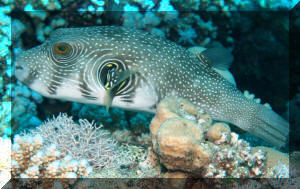
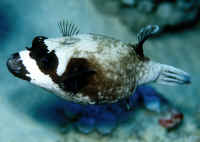
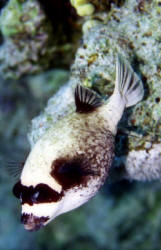
| Arothron diadematus (Ruppell 1829), the Masked
Puffer. Western Indian Ocean and the Red Sea. An expensive look-alike to
the Indo-Pacific Arothron nigropunctatus. Both to about a foot in
length and hardy in captivity. This one in the Red Sea. |

|
| Arothron firmamentum (Temminck & Schlegel 1850),
the Starry Toado. Indo-west Pacific around edge of South Africa into the
Atlantic. To fourteen inches in length. |
No pic |
| Arothron gillbanksii (Clarke 1897). South-western
Pacific. |
No pic |
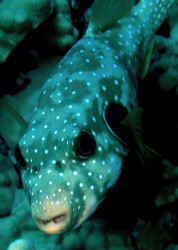
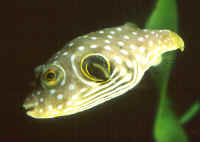
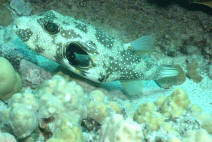
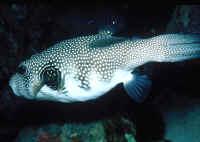
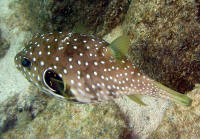
| Arothron hispidus (Linnaeus 1758), the White-Spotted
Puffer. Indo-Pacific, Red Sea, east African coast, tropical east Pacific
coast. To twenty inches in length in the wild. Cute when small, and very
hardy... just big eaters and mess makers. At right, one
in the Galapagos, below are pictured a four inch
juvenile in captivity, one in Hawai'i, a one foot specimen in the Red Sea, and a fifteen inch
mottled or "koi" one in the Seychelles. |
 |
| Arothron immaculatus (Bloch & Schneider 1801),
the Immaculate Puffer. Indo-west Pacific, Red Sea and east African coast.
To twelve inches. Pic by BobF. |
 |
| Arothron inconditus Smith 1958. Southeast Atlantic,
off South Africa. |
No pic |
| Arothron leopardus (Day 1878). Indian Ocean around
India. |
No pic |
| Arothron manilensis (de Proce 1822), the Narrow-Lined
Puffer. Western Pacific. To a foot in length in the wild, about half that
in captivity. Infrequently offered out of the Philippines and parts of
Indonesia. One in an aquarium, another in Mabul, Malaysia. |
 
|
| Arothron mappa (Lesson 1831), the Map Puffer.
Indo-Pacific. To twenty-seven inches. This gentle giant is best supplied
with plenty of rock cover to hide amongst (they're shy), and fed
sparingly, but to fullness a couple of times a week. Here are images of a
juvenile in captivity and N. Sulawesi and two foot individuals in Pulau Redang, Malaysia
and Bunaken, Sulawesi, Indonesia. |
| Arothron meleagris (Lacepede 1798), the Guinea Fowl
Puffer. This is a "standard" offering in the pet fish trade, in
black and white, golden and mottled color morphs. Found throughout the
tropical Indo-Pacific. Below, first row are images of a "normal" individual
in Hawai'i, a xanthic "gold" one in captivity, and a
mottled "koi" one in Cabo San Lucas, Mexico. Second row, some
examples of the species in the Galapagos. To twenty
inches long in the wild. |
| Arothron nigropunctatus (Bloch & Schneider 1801),
the Blackspotted Puffer. Indo-Pacific. To thirteen inches long in the
wild. Likely a top-contender for the most commonly sold puffer in
the aquarium interest. A great addition for a fish-only system. A
"normal" and "koi" variety in Bunaken, Indonesia, and
one sleeping on the bottom at night in Fiji. |
| Arothron reticularis (Bloch & Schneider 1801), the
Reticulated Puffer. Indo-west Pacific. To sixteen inches in length. Here's
one hiding behind some algae in N. Sulawesi. |

|
| Arothron stellatus (Bloch & Schneider 1801), the
Starry Toado. Indo-Pacific, Red Sea, east coast of Africa. To forty eight
inches... not a misprint, yes, four feet in length. For huge systems
only... and devoted puffer lovers. A captive specimen of about ten inches
length and two individuals in N. Sulawesi and Gili
Air, Lombok, Indonesia. The last of much larger size (about two feet overall). |
|
Chelonodon laticeps Smith 1948, the Bluespotted
Blassop. Western Indian Ocean (South Africa) and Papua New Guinea. To eight
inches. Brackish to Marine.
|
No pic |
|
Chelonodon patoca (Hamilton 1822), the Milkspotted
Puffer. Indo-Pacific. To eleven inches long. Prized by some Japanese as a food
fish.
|
No pic |
|
Chelonodon pleurospilus (Regan 1919). Southwest Indian
Ocean (river mouths of South Africa). To eight inches in length.
|
No pic |
Contusus brevicaudus, Hardy 1981. Southwestern
Pacific: known from southern Australia. To ten inches in length.
Nocturnal.
|
No pic |
Contusus richei Freminville 1813, the Prickly
Toadfish. Indo-west Pacific. Temperate. To ten inches.
|
No pic |
Contusus richei Freminville 1813, the Prickly
Toadfish. Indo-west Pacific. Temperate. To ten inches.
|
No pic |
Feroxodon multistriatus
(Richardson 1854), the Manystriped Blowfish. Indo-West Pacific:
northwestern Australia and elsewhere in the region but mainly southwest
Pacific. This puffer is responsible for clipping off swimmer's toes!
|
No pic |
Guentheridia formosa
(Gunther 1870), the Spotted Puffer. Eastern Pacific: from Costa Rica to
Ecuador. To ten inches in length. Carnivorous.
|
No pic |
Javichthys kailolae
Lagocephalus (13spp.)
Marilyna (3spp.)
Omegophora (2spp.)
Pelagocephalus marki
Polyspina piosae
Reicheltia halsteadi
Sphoeroides (18spp.)
Sphoeroides annulatus (Jenyns
1842), the Bullseye Puffer. Eastern Pacific; California to Peru. To nearly
eighteen inches in length. Off of Cabo San Lucas, Mexico's
Baja, and in the Galapagos.
|
 
|
Sphoeroides lobatus
(Steindachner
1870), the Longnose Puffer. Eastern Pacific. California to the Galapagos.
To ten inches. One in the Sea of Cortez at Punta Chivato,
another in the Galapagos.
|
 
|
Sphoeroides spengleri (Bloch
1785), the Bandtail Puffer. Central and western Atlantic. Brackish and
marine. To seven inches long. This one about four inches, in Tobago.
|

|
| Sphoeroides testudineus (Linnaeus 1758), the
Checkered Puffer. To a foot in length. Live in shallows, in seagrass beds.
Burrow in sand to hide, ambush prey. St. Thomas and Moody's Water Gardens
in TX pix. |
 .JPG)
|
Takifugu (17spp.)
The fugu puffers,
genus Takifugu
The
Takifugu spp. puffers are important primarily as food fish rather
than aquarium fish, with several being cultured on fish farms or caught
in the cool waters off China, Korea, and Japan to supply discerning
gastronomes with the famous fugu. As is well known, fugu
requires careful preparation, because some of the internal organs of the
fish contain a deadly poison, tetrodotoxin. Takifugu puffers are
also widely studied by biologists because they have remarkably small
genomes, making it much easier for scientists to study their entire
sequence of genes than is the case with most other vertebrate animals.
Humans, for example, have a genome about seven times larger, and even
that of the humble danio is more than four times larger than that of
Takifugu rubripes.
Most likely as a by-product of the abundance of these fish in the
aquaculture industry, a handful of Takifugu puffers are now
appearing in aquarium shops with some regularity. The peacock puffer is
particularly common, and being brightly coloured and not too large, it
would seem to have great potential. However, it does have the reputation
for being rather delicate, with many aquarists considering it impossible
to keep alive. At least part of the problem would seem to be
inappropriate water conditions: these are subtropical fish that normally
live in estuaries. They cannot be kept in freshwater aquaria
indefinitely, and they should only ever be kept in relatively cool
aquaria. A water temperature of 18-20˚C (64-68˚F) is ideal. A higher
temperature reduces the amount of oxygen in the water while increasing
the metabolism of the fish, the result being a fish that dies from slow
asphyxiation.
Besides temperature, the other big issue with these fish is water
chemistry. All Takifugu live in marine habitats, either in the
open sea or in coastal waters and estuaries. At least two species are
known to spawn in freshwater though, Takifugu obscurus and
Takifugu ocellatus, and as a result these species are sometimes
traded as freshwater fish. While they can survive in fresh water for
months, perhaps longer, both will be much healthier if kept in at least
brackish water. Takifugu ocellatus should be maintained in
brackish water at a specific gravity of about 1.010-1012, while
Takifugu obscurus can be kept either in similar brackish water
conditions or in normal seawater. Takifugu niphobles is best
considered only a temporary resident of fresh or brackish water, and
needs fully marine conditions to do well over the long term.
Takifugu ocellatus is the most widely seen
of the two species. It is easily recognised by its vivid colouration: it
has a metallic green body with bright orange markings on the back
between the pectoral fins and at the base of the anal fin. In terms of
behaviour, this species is unpredictable. It is not a fin-nipper, at
least, but it can be aggressive towards conspecifics. Because it needs
subtropical conditions, standard brackish water fish from warmer waters
do not make ideal tankmates. One exception is Scatophagus argus,
which ranges north into Takifugu ocellatus territory, and the two
might be maintained at 20˚C (68˚F) without problems.
Takifugu obscurus is a much less
attractive fish but is, perhaps, a better bet for the home aquarium. It
has a greyish silver body with a yellowy band running from the mouth
along the flanks to the base of the tail. Above and slightly behind the
pectoral fin is a large black eyespot ringed with pale grey; the belly
is off-white. Like Takifugu ocellatus, this is a euryhaline
species that lives in the sea but breeds in fresh water. Juveniles are
believed to live in rivers for about a year before swimming downstream
to mature in the open sea. Takifugu niphobles is a similar
species and can be confused with Takifugu ocellatus, having a
similar black patch behind the pectoral fin. Its body is a much darker
grey though, and the entire upper surface is peppered with small white
spots. A giant among pufferfish, it can reach lengths of up to 80 cm,
but even specimens only half as large will still require massive
quarters with excellent filtration. All in all, not an ideal aquarium
fish, despite the fact that it has proven to be quite hardy and easy to
care for.
This genus of pufferfish includes a number of small, strictly freshwater
pufferfish from South and South East Asia. Apart from their size, the
most characteristic feature of this genus is pronounced sexual
dimorphism: the makes are usually much more brightly coloured and
invariably posses erectile ridges along the belly and back. In fact, the
scientific name of the genus, Carinotetraodon, comes from these
structures, karina meaning ‘keel’ in Greek. When males are
displaying to females, or threatening one another, they raise these
keels, presumably to make themselves look more imposing. Both sexes can
puff themselves up in the normal manner when alarmed, just like other
pufferfish.
Although Carinotetraodon spp. are territorial and snappy towards
one another, like most other pufferfish, their small size makes it
possible for multiple specimens to be accommodated in a sufficiently
large aquarium. Under such circumstances, males and females will
eventually pair off, and following some fairly rough courtship behaviour
they will spawn, often in a thick mass of Java moss. The male will then
drive off the female and guard the eggs until they hatch, which normally
takes about three days. Once the fry are free swimming, after another
couple of days, they will accept tiny lived foods, such as microworms,
and after a week or two they can be weaned onto newly hatched brine
shrimp and small Daphnia.
There are three species of Carinotetraodon regularly traded, of
which the most common is probably Carinotetraodon travancoricus,
an Indian species often simply called the dwarf puffer. It is indeed a
tiny fish, barely 2 cm long when mature, and a densely planted 40-litre
(10 gallon) aquarium will comfortably house a single make and three
females without much risk of aggression between them. Unfortunately,
males and females are very similar when young; so sexing the fish in
your retailer’s tanks is difficult. However, once mature, sexing them is
quite easy: while both fish have a dark band along the ventral surface,
the male’s is much darker. Males may have stronger overall colouration
as well, particularly when spawning, but this is an unreliable indicator
because there is so much variation in the colouration of these fish
anyway. Besides variation between specimens, individual fish can also
change their colours depending on their mood.
Carinotetraodon travancoricus are
confirmed fin-nippers, and keeping them with tankmates such as small
tetras or barbs is a bit of a gamble. On the other hand, they generally
get along well with dwarf suckermouth catfish (Otocinclus spp.)
and freshwater shrimps (Caridina spp.). As far as feeding goes,
these fish are very adaptable, and will take all kinds of live and
frozen foods, including small snails, bloodworms, clean Tubifex
worms, and Daphnia. Brine shrimp are a good treat and willingly
taken, but their nutritional value is low so they shouldn’t be used as a
staple. One nice thing about Carinotetraodon travancoricus is
that it is predominantly day-active, and is in fact remarkably outgoing
given its size. It is also very tolerant of water chemistry, doing
equally well in both slightly soft and acidic conditions and moderately
hard and alkaline ones. As with all pufferfish though, it does not
appreciate rapid changes in pH and hardness, and is very intolerant of
nitrite and ammonium. Provided they are kept in a well-filtered, mature
aquarium, these are lovely fish, and excellent oddballs for the aquarist
with only limited space.
Less commonly encountered is the red-eye puffer, Carinotetraodon
lorteti. Found throughout much of South East Asia it has been known
to the hobby for decades, often being traded under an old name,
Carinotetraodon somphongsi. Though well know, its availability has
been patchy, almost certainly because its high level of aggression and
persistent fin nipping make it impossible to keep in a community tank.
In terms of basic requirements, this species is comparable to the dwarf
puffer in most respects, though being a larger fish it does need a
bigger aquarium. A matched pair may be housed in a 40-litre (10 gallon)
aquarium. Males are easily distinguished from females by their colours;
males are basically brown with mustard yellow stripes across the head
and back. The belly is cream-coloured belly except for a reddish stripe
across the keel running from just behind the mouth to the base of the
anal fin. The tail fin is greenish-blue and fringed with a thin white
band. Females are attractive but in a different way, sporting a mottled
pattern of light and dark brown above and off-white below. Both sexes
sport red irises, from which comes their common name.
The
least widely seen of the three popular Carinotetraodon species is
the red-tail puffer, Carinotetraodon irrubesco. It is sometimes
muddled up with the red-eye puffer, and females of the two species are
virtually identical, the only obvious difference being that female
Carinotetraodon irrubesco bear thin brown stripes on the belly that
female Carinotetraodon lorteti lack. Male Carinotetraodon
irrubesco can be immediately recognised by their red tails, but they
also have red dorsal fins and the lighter bands on the dorsal surface
are tan coloured rather than yellow. While it is a toss-up which of the
two species is the more attractive, Carinotetraodon irrubesco
definitely has the advantage as far as personality goes. It is
relatively peaceful and can be kept with a variety of other fish,
provided slow moving species with long fins are avoided. My own species
seem to get along well with cardinal tetras, gobies, Otocinclus,
and juvenile halfbeaks.
Two
additional species of Carinotetraodon are traded very occasionally, the
Borneo red-eye puffer, Carinotetraodon borneensis, and the banded
red-eye puffer, Carinotetraodon salivator. Male Borneo red-eyes
are similar to C. lorteti but the with greenish-yellow banding
instead of bright yellow and they also have a distinctive blue tail.
Female Borneo red-eye puffers are essentially identical to female C.
lorteti, though the colour banding on the back may be a trifle more
yellowy. Banded (or striped) red-eye puffers are easy to recognise
because of the vertical banding on the head and body. These bands vary
in intensity, being most obvious on spawning males, but even on
quiescent males should be apparent. Female striped red-eye puffers look
a lot like female Carinotetraodon irrubesco. Unfortunately, males
of these two species are extremely aggressive, both towards
females and other fishes in the aquarium. Aquarists intent on spawning
these fish, should they be lucky enough to obtain them, will almost
certainly need to condition the female apart from the male, and only
introduce the male when she is carrying eggs. Even then, there are no
guarantees that they will spawn, and separating the fish if things turn
nasty will be essential. |
Tetractenos (2spp.)
Torquigener (19spp.)
Torquigener brevipinnis
Regan 1903, Indo-West Pacific; Indonesia, GBR to S. Japan, Noumea. To 8.4 cm.
N. Sulawesi image.
|

|
Torquigener flavimaculosus
Hardy & Randall 1983, Western Indian Ocean; Red Sea, Seychelles,
escaped into Mediterranean. To 13 cm. Red Sea image.
|

|
Torquigener florealis
(Cope 1871), Western Central Pacific: Hawaii to Japan and the East China
Sea. To seven inches in length. This image made in Shark's Cove, Oahu,
Hawai'i.
|

|
Torquigener
hypselogeneion (Bleeker 1852), Indo-Pacific; South Africa to Samoa. To
four inches in length. This image made in captivity.
|

|
Tylerius spinosissimus
Xenopterus naritus
Brackish to Freshwater Puffers:
(See Separate Section)
Bibliography/Further Reading:
Debelius, Helmut. Undated. Pufferfish in
the marine aquarium. Aquarium Digest International #27.
Debelius, Helmut. Undated. Boxfish- those
fascinating marine oddities. Aquarium Digest International #36.
Michael, Scott W. 1997. The puffers; unique in many ways. AFM
8/97.
Nelson, Joseph S. 1994. Fishes of the
World, 3d ed. John Wiley & Sons, NY.
Quinn, John R. 1986. Puffers &
friends; a look at the pros and cons of keeping the popular puffers. TFH 5/86.
| |
|