|
|
| Home | Marine Aquariums |
Freshwater Aquariums |
Planted Aquariums |
Brackish Systems |
Ponds,
lakes & fountains |
Turtles & Amphibians |
Aquatic Business |
Aquatic Science |
Ask the WWM Crew a Question |
| Please visit our Sponsors | ||||
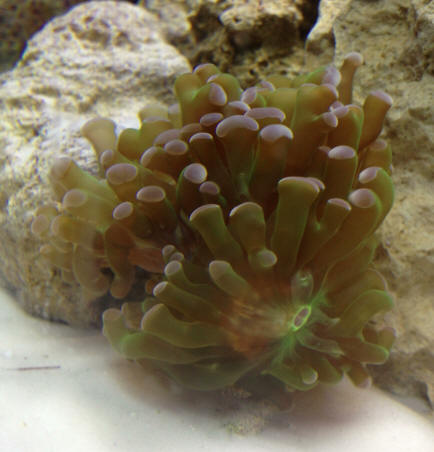
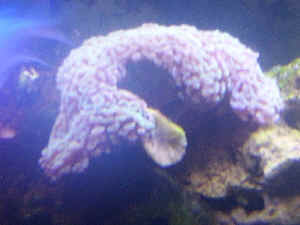
Torch coral showing some skeleton
4/6/20
Quick Question - Euphyllia Nematocysts on their polyps?
1/16/14 Euphyllia glabrescens... gen., fdg.... hlth.,
rdg. 1/9/12 Wonky tentacles on my new Euphyllia coral, horrible water
change, bump in B2's head/neck 05/23/08 Hi! <And
you> First of all - thanks for your quick responses - they have
placated my extremely anxious and worrisome paranoia many a time!
<Good> I recently bought a lovely green/yellow tipped Euphyllia
coral. "Noodles" seems to be happy and healthy (just judging
by tentacle extension and colour and "juiciness"). I've
noticed that quite a few of the tentacles are "wonky"- that
is some of them have little bumps on them that look like thorns. It
appears to be part of the tentacle rather than something on the
tentacle. Some of them also have several bubble heads on the same
tentacle (like a Y shaped tentacle). And some of them look like they
have been severed but are still attached and otherwise healthy looking.
I even saw one with two bases and one head! Is this just due to natural
variation or indication of some other problem? <Is mostly natural
variation... the "wonkiness" can be due to change-able
conditions, "stress"... generally solves itself in time with
good care. No worries. Bob Fenner> Onto another issue (NB: the wonky
tentacles were there before this disaster). This morning I (tried to)
clean my tank. I went to a different shop to my local LFS and bought
some "seawater". I asked what was the pH and salinity etc of
this "sea water" and rather stupidly trusted them. The
salinity was abit low (1.018) but I used it anyway since I needed to
top up for evaporation anyway. Unfortunately when I was putting the new
water in my pH meter indicated to me that the pH had dropped down to
7.8. After testing this new seawater - I was shocked to find that it
had a pH of 7.4! I furiously (but carefully) used Reef Buffer (Seachem)
to adjust it back up to 8.2 (and didn't go over thankfully).
Luckily none of my fish seem to have died (yet), but I was wondering if
a sharp drop in pH for some 10 minutes followed by furious pH adjusting
will be fatal to beloveds (clownfish, cleaner shrimp, euphyllia, red
Indian starfish)? I noticed B2 (one of my clownfish) when I inspected
him today had one single bump on his head although it could have been
there before (could this be a stress reaction? Or something more
sinister that I should worry about?). Sorry about this
multifaceted question but that stupid fish shop (who I incidentally
note has horrible, mean and judgmental staff) has caused me so much
stress today. Thanks for listening to that little rant, Lai Hammer coral Question 8/21/07 Hey Crew! <Josh> Just a quick placement question. Recently I received a free wall hammer coral from my LFS because it had a small section maybe the size of a quarter in one small section was dead. I know the mortality rate of these once they are damaged, however... I have had alot <No such word> of good luck in the past bringing sick corals back to life and having them prosper and flourish. <Good> There is a small section where the tissue is damaged. It looks like where the tissue was separated, the tissue on each side has healed, however not growing back together... just healed and rounded itself off. Where should I place this in the tank. <Where you have appropriate light, circulation...> Its a 150 gallon reef with 2X 250W MH and 350 watt PC's. I know there placement is usually lower in the tank with medium current. Since it is slightly damaged, would you recommend putting him higher in the tank towards the light? How about water flow? Any recommendations on Iodine or any other medications? <Posted...> Thank you all very much for the help and I hope that this little guy can repair himself and I can save him. Josh Henley <Please read here: http://www.wetwebmedia.com/marine/inverts/index.htm the tray for Stony Corals, Caryophylliids... Bob Fenner> Plerogyra Questions 3/29/06 Hey guys. Love your site---Very comprehensive and informative. I just have some questions about the elegance coral Plerogyra sinuosa. <Plerogyras are "Bubble Corals", Catalaphyllia is the Elegance...> I'm planning a reef set-up, and I'd like to know how big these corals get. <Very> Also, given the fact that they have nematocysts, would they wage chemical war with an anemone like a BTA? <Oh yes> Lastly, I've heard Jawfish are prone to deaths by anemone-is the same true with these corals? <Can be> Thanks a bunch and keep doing what you're doing---it makes research so much easier. <Is this search or research? Please see WWM re your questions above. Bob Fenner> Corals/Elegance Coral ... beh., gen. 3/16/06 Bob, <James today. Bob is bored to death in Hawaii> <<Heeee! Am not. RMF>> Yesterday we purchased a green w/purple tips elegance coral from the LFS. It was healthy looking in the LFS tank, with tentacles all open/out, mouth small. I spent a good hour yesterday acclimating it to the new tank. Our tank is an established several year old 150gal, MH 250/actinic 40, with good water flow, good parameters ; nitrate low, ph=8.3, Ca 410, temp =82. This morning the coral tentacles are retracted. We are keeping it in a low-lit <Do like moderate light.> portion of the tank, on the bottom where there is less flow and will do a water change and feed it. <I wouldn't feed until it is acclimated well.> I have a few days before the LFS will say, sorry bud...you bought it, too late. Do you have any advice on what to look for or do in the next 48hrs to get our new specimen to open up and be happy? Has this coral gotten so hard to care for that I should send it back today? <I'd make sure you place it on a soft/fine substrate. Rougher substrate can/will irritate the fleshy underside of the coral. Also read here for additional info. http://www.wetwebmedia.com/elegance.htm James (Salty Dog)> Jim in Va Euphyllia cristata and Echidna nebulosa... and Aiptasia control - 02/20/06 Dear Mr. Fenner or crew member that answers, <Jessica> Just a couple of follow up questions. Regarding the below mentioned E. nebulosa, what would you consider the minimum for housing him indefinitely? <... 150, 200 gallons plus, uncrowded...> It is possible that I could trade in a few of my smaller tanks (and there are plenty) that have housed freshwater fish over the years for a predrilled standard 125 (I have been collecting tanks and freshwater fish since the ripe old age of 8). I would probably have to use cinder blocks for a stand (it would look like my neighbors car), <Heee!> or wait until I can next get to my dad's shop to build one, which could take a while, but would the tank work no matter what I set it on? <? As long as the stand/support is stable, strong, planar, level...> I have read so many different minimum requirements, 50 gallons on DrsFosterSmith.com, 60 in the article on WWM, and all sorts of variations up to a recommendation of 100 gallons on other places on the web. I am thinking the 125 will work, but I want to be sure first. What are the ideal dimensions for housing such a beautiful species? <The bigger the better...> Could I fill it 3/4 of the way (which would render the pre-drilling useless, unless I lower the overflow boxes somehow), with a cover and still have a happy eel? <Not indefinitely... which was your question/concern> I am thinking that with the lowered volume, maybe I could simulate intertidal pools for him to get into (the overflow boxes), maybe place some treats in there from time to time. Also, on a side note, I obtained the below mentioned E. cristata/divisa from my friend, and it looks great in the rocks, half way up, right under a 175w 10000k MH lamp and very near an 800 gph powerhead (the powerhead is on the back of the tank, pointed at the front and makes a nice sweeping current through the tank, the coral is in the direct path of the ricochet current). I still do not notice sweeper tentacles, and I wonder if I should? <Not necessarily... but might at night, after feeding if you looked... and very likely if you placed another cnidarian close... or it chemically influenced the system> It seems to eat if I place meaty food on its tentacles (formula one, prime reef, or Mysis and human grade shrimp, scallops and squid, all used in Mr. Fenner's marine mash recipe from CMA) Is there any way to tell which coral I have without dissection/microscopic investigation? <Euphyllias are rather distinct... usually just looking at the polyps will give you a species ID> Not that it makes that big a difference to me, but I would like to label my display museum style so when the nieces/nephews/friend's children come over I can encourage them to read/learn for themselves, much as you do here on WWM. Is it possible that I have the wrong genus in identification, since there are no sweeper tentacles? <Not likely> (I have looked at all the pictures I can find on the net, I am certain it is a Euphylliid, but I am no expert.) Another side note, I have found a useful strategy for removing Aiptasia from my rocks that doesn't involve chemical or biological controls. With great patience, I have shaded the Aiptasia from the light. While they may be less light demanding than their more desirable counterparts, in my experience, they are no less light loving. <Agreed> I have found that the shading makes them migrate to the substrate, where I simply use tongs to pluck them from the aquarium. I often have had to "redirect" the anemone's path with more shading or by turning or moving the rock, but I have successfully removed 14 Aiptasia anemones this way (over the course of about 1 1/2 months). I also have not seen a mass reproduction that I was wary of after reading about chemical controls or other methods like scraping. Once they were plucked, they were gone. I now have an Aiptasia free display, in case anyone is interested. I harbor some of them in a 20L under regular fluorescent lighting to play with. It is interesting to watch them eat bits of shrimp or whatever I drop in there. In a sense, I have a dedicated display for anemones, as they are the only thing there, except a few rocks. I will remove rocks and said anemones when I next QT something. I just wanted to enjoy having an anemone for a while, and Aiptasia has been suggested by some on WWM (not without hesitation). <Thank you for this> One last thing. My fish (green Chromis and a firefish) have been eating the meat that I am feeding the coral. Can I just feed them the marine mash (every other day or so), or should they have flakes and pellets, too? <No need for the latter> I believe the flake and pellet food for the fish is producing phosphates in the aquarium, and I do have some algae growth that I could live without. Thank you for your investment in my tank's well-being. You folks are the greatest. Best regards, Jessica Groomer <Bob Fenner> Coral/Frogspawn 2/18/06 Howdy <Hi Jeff> I have had a frogspawn about a week now and I have not seen it open/expand. The fragment has a few dead polyp/heads on it and the others are fairly small. How can I nurse this thing to life? <You don't mention water parameters, lighting being used, etc. Was the frag healthy/opened up when you got this? Reply with more info please. James (Salty Dog)> Thanks much! J Re: Hammer/Frogspawn Coral? 2/22/06 Here is the info you wanted. <Who? Where is the prev. corr.?> 75 gallon tank w/90lbs live rock. Lighting is good - 4 96 watt coral life power compacts (2 actinic, 2 white). Water is as follows Calcium is high at 920ppm, <No...> Phosphate 0.2ppm, PH 8.4, Nitrate 10ppm, Ammonia 0ppm I have been recovering from an algae bloom and employed over 100 sails to help out... they are munching and I have removed a lot mechanically and changed filter media and stepped up to a new and better skimmer (from a crappy Sea Clone to a Aqua C Remora) I actually have both running and producing at this time. I do have some Cyano also but not really too bad. Thanks for the help! Jeff <... see WWM re Euphylliids... Bob Fenner> Euphyllia Issues 1/7/06 I am having a problem with several species of Euphyllia corals in 2 of my 3 tanks. Both tanks are primarily Acropora "themed" but have a few LPS specimens for some flow and flash. My problems started in my 210 with a very large hammer coral I have had for about 15 years. It WAS about the size of a basketball until recently. In several places the coral has started to peel from the skeleton in the corners. I have seen this before and have read that it is frequently caused by strontium deficiency. <Strontium and Moly are a must.> Every other time I have seen it, (not in this specimen however, I work in an aquarium store and see it occasionally in customers tanks) it has looked more like the flesh just peeling out cleanly but this is rotting as it peels out and very slowly and in small sections. It seems to stop for awhile, heal, and then resume again periodically. No jellying has been seen. This has been going on for a couple months, the colony now about 2/3 its peak size. Now just within the last week or so 2 other pieces in another tank, a 135, have just stopped expanding and have remained closed. I see no peeling or decay but they are shut up tight. These specimens are also about 15 years old. Tonight I came home and a small torch, a paradivisa I believe, in the 210 is just gone. The only thing that has changed, and it was about the same time, were I did a SLIGHTLY larger water change than normal, I was setting up a new tank and wanted to use this water. I typically do about 10-15% changes a month and I did about 25-30% on this occasion. <Shouldn't cause the problem> I did also change the brand of calcium I was using, I have since changed back just in case. All other corals, mostly SPS and a few leathers look phenomenal. Both tanks are set up in similar fashion....both have Berlin style sumps, Euro reef skimmers, cal reactors (which can't keep up hence the additional supplements) halide / VHO lighting and heavy water flow. <The Euphyllia family prefers moderate water flow.> Chemistry ..... Ammonia & nitrite 0 of course, Nitrate a trace, KH 12-15, calcium 380-420, Magnesium about 1200, temp 77. <You didn't mention SG, should be kept at 1.024/25 for corals.> I only have a few fish and feed very sparingly. Since these are more turbid water corals is it possible I am starving them? <They do benefit from weekly feeding of DT's and/or Cyclop-Eeze plankton, etc.> I have never directly fed them but why would they have a problem with that now? <Don't know> I use phytoplankton rarely on the order of perhaps once a week.<That's not rarely, recommended> Is it possible they didn't like the new brand of calcium? <Unlikely> On the off chance there was some thing in it they didn't care for I did put in fresh carbon and poly filters but if its a nutrient deprivation that could have made it worse. I did change the VHO bulbs about 4 weeks ago. Halides are about 10 months old and due. These specimens are located on the ends of the tank and lower down so they aren't getting blasted by the flow. Enough to move the tentacles but far from whipping in the wind. Sorry for being so long winded. Any help would be greatly appreciated. I have had these guys a long time and hate to lose them. <You may want to dose trace elements on a weekly basis. Poly Filters, carbon can remove some of these. helps you I like keeping a log on my system, noting everything done whether a change in flow rate, salinity, chemical media, lighting, etc. Then if something changes I can go back and see if it relates to anything I've changed/added. Hope this helps you out some. James (Salty Dog)> Mike Knight, Tampa FL. Thanks for the addendum but I don't think that is a possibility. The problem is affecting several specimens in, oddly enough, 2 different tanks. In most cases the affected specimens, or areas of said specimens showing problems, are no where near competitors. After doing more research ran across something about problems with chloride based calcium supplements. Had changed brands about the time this problem began to manifest. Have always used Tropic Marin bio cal to supplement my reactors since they can't keep up. I tried a new Red Sea product I was given by the vendor. No ingredients are listed unfortunately. Coincidence?? Thanks again!!!! Mike Torch
Coral Sting 4/28/05 Hi, During routine cleaning, I accidentally
touched my torch coral several times with my left hand. I have been
experiencing numbness in the hand since then. I understand that this
coral has moderately potent stinging capability. Are my symptoms
normal? I have no redness or swelling, and no pain. Thank you, Matthew
W. Stone R.T.(R) Cardiac Cath Lab Lead Tech <Some folks can be
quite sensitive to coral stings. Symptoms typically range from minor
irritation to redness and welts. Severe sensitivities and allergies are
rare but do occur. Since you work in a hospital, I would suggest that
you ask some of the physicians (especially ER) for any suggestions. In
the future, I would suggest that you wear gloves when working in the
tank if you have symptoms of more serious allergic reactions, seek
formal medical advice. Best Regards. AdamC, CCP
Perfusionist.>
Weird Growth on Frogspawn II sponge 3/11/05 Hey boss, I've got some clearer shots, thanks for the advice, if they're still not clear enough Ill sacrifice a pig to the digital picture gods and see if they approve. Incidentally I cant really get closer to the tank since the lens on my camera is for macro photos. <actually mate... much better. The growth is clearly a sponge :) As for the minimum distance with your macro, do consider if your lens will take extension tubes. It will get you much closer to your subject... and allow you to better fill the frame with your subject. Anthony> <Marina - still looking for photo> Treating a sick torch coral Hi, crew. Back again with a question. I have a torch coral that suddenly went from looking happy and lush to having 3 of its branches covered in nothing but that brown jelly I have seen described on your site. << Frustrating thing to have happen. >> Based on a search of similar problems on the WWM site, I moved the torch to a QT tank, and am on my way to buy Lugol's solution and give some dips a try. My question is, how long of a process is this? << Wow, risky. I'd say it is only takes a couple days in a hospital tank to make or break the coral. >> Any special instructions? When do you know if the coral has turned a corner and/or should be returned to the tank? << You never know, but I think lighting is so important that I'd move it back after one day. >> And what would cause such a sudden event? It's not a new coral, nor have I added anything to the tank in several months. I need to know if I'm doing something wrong or what things to investigate. << I'd check water quality of course, as well as water motion and the health of all other corals. >> Thanks, as always. Will let you know either way what happens. Laura << Blundell >> Dying Euphyllia I have a wonderful reef tank that has been up and doing very well for over a year and a half. << Great to hear. >> My tank is doing so well that my two Mandarin fish only eat off of my live rocks and have no desire for any other food. << Mandarin fish rarely eat prepared foods, which is why they have an abysmal survival rate. >> A few days ago I purchased an Euphyllia ancora. As I went to acclimate it I saw quite a bit of slim but a lot of my corals have slimmed in transportation from the pet store to my home. << This is quite common. >> Now my anchor coral is starting to deteriorate. Is there anything I can do to save it? << Well I'm not sure what the problem is, but good water quality and plenty of light are a good starting point. >> I have it in a spot in my tank that has moderate light and low water movement. Last night one tentacle stretched to about an inch and a half but it was just one of its many tentacles that did this. I tried feeding it some Microplankton to encourage it that its new home was inviting, safe, and that it would have plenty of food. Today when I woke up it seems that it is still deteriorating. Can you give me any advice on what is happening, why, and what if anything I can do? << I would try to mimic the conditions of the aquariums it came from. Otherwise, if you really think you'll lose it, I would take it to a friend or store to hold for you. >> Thanks in advance! Stephanie White << Blundell >> Why does my frogspawn close up during the day? Hi ya all! My new tank set up has been going good so far and I have finally added my first new coral too it =) My set up is a 40 Gal with 20 Gal sump/ref. I also have a Fluval 203 canister filter with half the media removed. My lighting is a PC 2x96 watt fixture which runs for about 10~12 hours a day...still fiddling with the timer. << This lighting is okay, but you may want to consider upgrading if you want a wider selection of corals. >> I also have 20 lbs of live sand and 20 lbs of aragonite sand" non live" I also have 40 lbs of live rock in the tank. So far as inhabitants go I have 12 hermit crabs and 20 Nass.. snails also 2 peppermint shrimp ( I had a Aiptasia problem on one of the rocks but it is gone now). All the parameters in my tank are checking out good everything from calcium to Ammonia. However I have never had a frogspawn before and its behavior is weird to me at least...It will open up in the morning (not very big as it is only one head and about an inch or so across) wave around for several hours but then about mid day it goes back into its hard shell and will reside there for the rest of the day...today I tried an experiment and half way through the day when it went back in I turned the lights out for two hours, when they came back on it came back out and waved around for the rest of the time the lights were on... << I'll say it is feeding, and closes up when there is not food present. Try adding phytoplankton and rotifers to your tank. >> It is closer to the bottom of my 40 Gal tank in mid current... Is it normal for frogspawn to do this or is it getting too much lighting? << Definitely not too much light. >> The LFS had it under 4 fluorescents but it was much clearer in color when I bought it then what it is now...Is it possible that it is not acclimated to my lights or what else could be an issue? << Yes, it could be "sun burning" under your lights, and taking a while to adjust to the spectrum and intensity. >> I want to make sure that my frogspawn thrives as it is one of my favorite corals but this behavior is not common to me as I am more used to softies =) thanks for the help << Not uncommon, and I wouldn't worry too much. Just keep watching it for a few weeks. >> James << Blundell >> Bubble Coral feeding I've recently added to my aquarium a bubble coral. My question is how to feed it? I was told once a day to feed it phytoplankton 1tsp per 15 gallons of water (my tank is 20 gallons). <I personally think that's a bit much. Would probable do it ever other day or so.> The way I administer the food is pouring the 1tsp in the tank around 5 or 6pm just below the filter so the phytoplankton will flow out. Am I feeding the right thing? <They can also eat a larger piece of meat, so you could add something a bit larger occasionally directly to it.> Should I feed at a different time? Am I administering the food correctly (under the filter)? <As long as the flow goes directly to the coral should be fine so it gets some of the food. Good luck, MacL> BUBBLE CORAL Hi there! <Hi Julie, MacL here> I love your site...very informative for us newbies to the hobby.. ok, I have inherited a bubble coral that isn't doing well...minimal bubbles have been out in the week we have had it..<Is it a pearl bubble? One that has the tiny bubbles?> now our bubble is big and beautiful...<Julie I'm sorry a bit confused here, after a week are you saying its gotten better with you? Or are you saying yours that your bubble you have already have is doing well.> water parameters are fine...as well as all the fish and other corals...I am feeding it with zooplankton as well as frozen meaty foods just as I do my bubble...<Sounds like you are doing exactly as you need to with him Julie. Obviously you know what you are doing since your original one is flourishing. It might have been best to put the new one in quarantine so it doesn't spread something to the new one but for now you should be able to tell how its doing by judging by yours. They do take some time to acclimate to new waters, is that possibly what is going on?> how long can it take before I know if it will make it?? <Depends on the individual coral.> or how will I know if it wont?? <They fade very fast, often producing the brown jelly when fading, if you aren't seeing that it is possibly coming back very well.> thanks for your time....Julie <Julie please let me know how it is doing. I'm guessing its just a matter of time before it responds to the better situation.> Hammer Coral Problem <Hi Ken, MacL here> Sorry. <No biggie> I hit the send button prior to getting the message ready. Quick question for you. I have a problem with my hammer coral bailing out of the skeleton. <Not good at all.> I have good water quality with 0 nitrates, PH at 8.4, calcium at 380-400 no ammonia and no nitrates. I have been using a Kent calcium additive and I am wondering if perhaps I over did it in the past week. I put 1 teaspoon in on two separate days. I also feed the corals brine shrimp/small arctic shrimp (don't remember the name) combination about every other day. Last night the hammer looked like it was feeding well but then this morning I noticed that it was bailing out. <Sounds possibly like an infection to me. Is it also getting any kind of jelly looking thing? Honestly sounds like it might need to be dipped. I personally have had good luck with coral reef dip by SeaChem for a commercial product and there's a great dip listed on the WetWebMedia website.> Any ideas? Thanks, Ken <Try the dip on WetWebMedia Ken and good luck! MacL> Nano selections 4/28/04 Hi Anthony! Thanks for the expert advice. <always welcome :) > I was planning to buy a small hammer coral to place in the tank to be the only coral inhabitant, but I'll follow your advice not to buy them. <Hmmm... if it will be the only coral, and you get the phaceloid/branching form and not the wall form, then you may be able to keep it after all. It would kill other corals attempted in such a small tank... but yet could be trimmed easily if branching> Those were the only corals I saw available from different LFS here in the Philippines, and I haven't seen button polyps, which was my 1st choice. A lot of anemones here, but as they are very hard to take care, and I have a nano, I didn't consider. <very wise my friend> I spoke too soon about the skimmer. It did perform its job, was collecting foam with yellow-brown gunk. <good to hear... do try to adjust it to produce dark coffee colored skimmate. If its too light like tea colored, then the air or water flow is up a little bit too high> I'll wait for the clowns to get well. I've completed their malachite green treatment, but I think I may have stressed out the 2 false Percs, as they are not eating. They have no visible specs or mucous. The saddleback is eating a lot. I'm offering them TetraMin flake food, very small pieces of shrimp and squid. Thanks again for all your help! Romel <wishing you the best. Anthony> When Corals Attack! (Pt. 2) Hi Scott! <Hello again!> Thanks for all the help ! <Glad to be of service!> I went to the LFS last weekend, and sad to say they don't sell mushrooms or button polyps. They only have hammers, bubble corals, and flowerpot corals. <All of which can be both challenging and fascinating!> I've read the articles and FAQs in the site, and I may consider the hammer coral, since bubble corals get big, and flowerpots are hard to take care of, as my tank is a tiny 2 month old 10 gal nano-tank. <Yikes! If you are going with a hammer coral in a nano- I'd avoid any other corals. This is a rather small volume of water, and the potential allelopathic competition would be pretty tough!> I'm starting to stock corals while my fishes (2 false Percs and 1 black Sumatra saddleback) are in QT, recovering from ich. They're now ok, but I'm still observing them. <Be patient...you did a good job on beating the disease; no sense rushing them back into their home> I'll be buying thick long gloves for the hammer coral. Thanks again ! Romel <Keep up the good work! Regards, Scott F> Bubble Coral Damage 4/5/04 While working in my tank tonight I bumped my bubble coral. A small portion got crushed against the sharp shell. There is definitely some tissue damage. It pulled into its shell right after, and has not come out for an hour or so. Is this likely to regenerate, or did clumsiness just kill my bubble coral? Thanks! -Ken <while even some hardy LPS corals are very sensitive to tissue damage, Bubble corals are not.. really durable and resilient! With good water flow, water quality and adequate feeding/light, I suspect this coral will recover very soon. No worries. Anthony> Turning my green eyes pink 4/2/04 Hey crew, I tried searching this but had no luck. I have two different frogspawn morphs, one with pink tips and one with green tips. They are close to each other, to the point where occasionally the tips of the two different frogspawn touch. I have noticed that some of the green tips are now turning pink. Some are completely pink, others are half pink and half green (like a yin/yang symbol). Are the tips of the green frogspawn becoming "infected" with the pink zooxanthellae? <There are no pink zooxanthellae. Zooxanthellae are army green to brown. The bright greens, pinks and other colors we see in corals are the result of pigments.> I would think that if this is the case that the transmission would occur both ways, not only from pink to green, but also from green to pink, however this is not happening in this case. Both colonies seem happy otherwise and I just found this interesting. Thanks in advance. Steve <I have seen many frogspawns that exhibit the mixed coloration you describe, including one in my own tank. Many things stimulate color changes in corals including lighting, alkalinity, nitrate, etc. It is likely that your coral had the "potential" to exhibit the coloration that it does, but only does since some environmental change occurred. I would guess that the coloration of the adjacent coral is coincidental. Best Regards. Adam> How to feed a bubble coral 3/22/04 I have a bubble coral (Plerogyra sp.) and have had it for about4 months. it used to open up every day and here lately I have noticed that it doesn't open up as much anymore. How and should I go about trying to feed the coral. <Your bubble and open brain will benefit from feedings of small (BB-marble size) pieces of meaty food. Simply place the food onto the corals when their feeding tentacles are extended, which is usually at night.> I also have a brain coral that was opening up well and now he doesn't open up as much (expand or get fleshy). what can I do. my water quality is good sp 1.024, calcium 450, ammonia 0, nitrite 0, and nitrates 0.25. my setup is a 15 gallon high tank with 72 watts of lighting (actinic bulb, and combo actinic with 10,000 daytime bulb, power compact). <My first recommendation would be to do a water change and/or run some carbon. Both of the corals you mentioned can be quite sensitive to water quality, and there are a lot of things that affect water quality that we can't test for. Best Regards. Adam> Bubble coral 3/19/04 Hi Sorry to trouble you <Hi Sandy. No trouble at all! That's what we're here for.> but I have had a reef tank up and running for 6 months or so - all seems well, pulse coral that is propagating itself - mushroom that we have propagated and they seem happy. I have a pearl bubble coral that once a week enjoys a small piece of shrimp that it devours. Today just as it was shutting down for the night, it's mouth became apparent and it seemed to purge a large piece of its insides out of the mouth, it then shrunk back inside the mouth but did this several times before it settled for the night. Is this usual? Many thanks Sandy <This sounds normal. Corals only have a mouth, and it has to serve as the way food comes in and waste goes out. If the coral expels large pieces of undigested food, the pieces may be too large. Bubble corals are pretty voracious though, and should be able to handle whole shrimp or silversides. Large polyped corals will often expel excess zooxanthellae. This usually looks like brown stringy snot. Some coral will also occasionally expel and re-ingest mesenterial filaments (digestive organs). This can be a sign of stress, but if it passes and the coral returns to normal without any other signs of ill health, it is nothing to worry about. Best Regards. Adam> Coral feeding - 3/17/04 I recently was given a few corals and am trying to figure out what to do to feed them. <Depends on the corals of course.> I only took corals that I knew were going to be reasonably easy to care for, but I have a question about the bubble coral's exact needs.<OK> I see that bubble corals need to be fed. <In my opinion they do.> Some things I read say to feed meaty foods, and others say they need zooplankton. <Maybe a mix, but more likely of the meatier variety> I have been feeding it by squirting a little Hikari Mysis shrimp <good> or blood worms <not so good> (I alternate every other day for my fish). I feed it about three times a week. <excellent!> It seems to eat it. Are these small enough for a bubble coral, or will it regurgitate these pieces? <I think mysids should be fine but if the pieces are too large than it might regurgitate. Have you noticed this? You could try Cyclops-eeze, baby brine, enriched brine (Spirulina enriched) and other frozen fish preparations> Would I be better off buying one of those liquid zooplankton supplements? <Unless you have other corals that could make use of the zooplankton I would save your money and buy fresh or frozen preparations as noted above> I do not have a refugium, so I doubt I have enough in the water to sustain the coral. <Most of us even with a refugium sometimes still don't have enough natural foods alone, to maintain corals. The use of frozen or fresh preparations seem to assist our abilities. Thanks for your question. ~Paul> Thanks! -Ken Unusual Hammer Polyp Expansion 3/11/04 As you can see from the attached picture, one of the tentacles of the polyp is expanded to the fullest where you can actually see the skeleton, can someone tells me why this happen, is it a good or bad sign. <its not clear... although not uncommon either. Aquarists have sometimes observed this in concert with a pending release of the tentacle in a possible reproductive strategy (the tentacle may stick to another rock and settle)> The expansion is like a bubble it has been like this for a few weeks, getting bigger, even with the lights out the bubble is still there except that it is smaller. You can see the expansion on the left side of the right coral somewhere in the center of the picture. Appreciate you comments. Thanks. DK <the coral overall looks good - color and polyp expansion. No worries at this point. But please do keep taking pictures. If you have any original, hi-res images of this event... I'd like to ask your permission to use them if you will send/share them? (future article or book). If so, please feel welcome to send them to me at readingtrees@XXXX, Thanks kindly, Anthony Calfo> Unusual Hammer Polyp Expansion Redux 4/19/04 Dear Anthony, <cheers, Daniel> if you remember I asked about the hammer's unusual large polyp expansion and you have asked me for a picture which I have sent. <yes... thanks kindly> Since then, the bubble disappeared and the single polyp became THREE, you can see from the picture attached. if you want a higher resolution shot please let me know. What happened was that the polyp did not bail out, it expanded/or stretching the membrane causing/creating the "bubble", so when this bubble shrink, the membrane separates the single polyp into 3 parts/polyps, see picture. <very interesting> The bubble is just like a bubble gum, stretched and contract, when contract it split the polyp. Hope you can understand what I say in so many words! Regards, Daniel <fascinating nature... thank you for sharing my friend. Anthony> Unusual Hammer Polyp Expansion II 3/17/04 Dear Anthony, <cheers> It's a pleasure to hear from you. I have just received your book on Coral propagation, fantastic book with a lot of invaluable info. pity the print is not big as a result it looks cramped. <good point indeed. In fact, I was concerned to make the book any longer for fear some folks would be too intimidated by its size to read it :p> You should get someone to finance publication of your book like Bob's so that your book can reach a wider audience. <perhaps> I have noticed there is another "bubble" coming out. I will take another picture over the weekend and have them posted to you. >much thanks for this my friend> the higher resolution shots are in excess of 1mb, is it Ok with you, I can send you a few if you don't have a limit to file size. <please do send... but just 2 or 3 at a time. We get so much mail that even my/our 25 meg mailbox gets clogged fast!> I have no problems for you to use the pictures. <thanks kindly... this will be a help to any> Regards, Daniel Kong <kindly, Anthony> Frogspawn vs. frogspawn? Naw, the family gets along fine...
(03/04/04) Hey crew, <Ananda here helping out...> I have two
different frags of frogspawn, one has pink tips and the other has
green. My question is will these two morphs sting each other if placed
in close proximity (<6" apart)? <I've seen several sorts
of frogspawn in a tank, living happily together. Well, as happy as
corals get, anyway. I've seen frogspawn next to hammer corals with
both doing well.> Thanks. Steve
Is The Fox Finished? (Damaged Fox Coral) Hi, I recently bought a large fox coral off of liveaquaria.com, and it arrived with one half of the tissue gone. That is, that it died and fell off. The colour was bleached white on the areas where their was no tissue. Is there any way I can feed it, so that it can re-grow over the dead areas? I tried feeding it, but the food just floated off. And the "ribs" were exposed. If you do not know what I mean by ribs, you know how on bubble corals, there are large round plate like things? That is what I am talking about, only an a fox coral. <I understand what you are referring to...Good description!> It is at the bottom of my reef aquarium. It didn't seem to open well under direct light. Anyway, can you help me out? Thanks, Adam <Well, Adam- assuming that you are providing appropriate environmental conditions, it is certainly possible for recovery to occur. Not an everyday occurrence, but it is worth not giving up. The most important thing is to provide stable, healthy parameters, and feed as often as possible. Don't give up yet! Regards, Scott F> Back from the dead! Hammer Coral 2/12/04 Hello all! <howdy> You probably don't remember this with the large volume of emails that you get, but a while back I emailed you about a problem with a hammer coral. The coral was mysteriously losing polyps every few days. When the last polyp was dying, I noticed that a chunk of it was missing. It appeared that my coral was being eaten, but I never found the culprit. <OK> Since the coral was gone, I moved the skeleton to the back of the tank to make room for other corals. That was over a year ago. This week I was surprised to find a tiny bright green polyp poking up from the back of the tank where the old skeleton was leaning up against the glass. I turned the skeleton around, and found what appears to be two small polyps that somehow survived all this time. They must have been microscopic when I put the skeleton back there! <sort of... many LPS corals have living tissues unseen deep within the corallite. Some will even begin to decalcify and feed the growth of new buds (anthocauli) from a seemingly dead parent "skeleton". I wrote an article about this with Steven Pro here on WetWebMedia.com if you care to look back in the archives (under Trachyphyllia)> The larger of the two new polyps is only about the size of a pea. Should I start feeding them? If so, what should I feed them? <enriched baby brine shrimp or better, Cyclop-eeze ASAP> I used to feed my hammer coral very small pieces of meaty food, but I don't think I can chop the food up finely enough for these tiny polyps to eat. I have lots of copepods, etc. in my tank, which they must have been living off of all this time. Is that a sufficient source of food until they get bigger? <perhaps but not for long> Another related question for you... My old hammer coral was white with a slight greenish tint. These new polyps are fluorescent green. Can polyps from the same colony have different colors? Or were these new polyps just hitchhikers on the original? <the former is correct... and the recovered polyps are simply responding to the change/difference in light. Some bleached/stressed corals can in fact pick up different strains of zooxanthellae too> Thanks! <kindly, Anthony> Euphyllia 2/8/04 Hi !! <howdy> I have a Euphyllia Divisa in my tank and I noticed the other day a brown stringy substance coming off of the polyps of one branch. Just wondering what this might be? <likely excrement... but if the coral is new and/or the lights are new (bulbs) then it could be light shock and the expulsion of zooxanthellae> I also just added fish to my tank for the first time two clowns. I was leaving my metal Halides on for 10 hours and my actinic blues on 24/7 should I now turn the actinics off a couple hours after the others? <10 hours is on the long end for halides... if these lamps are bigger than 175 watts, then you may have too much light and be leaving them on too long.> do the fish need darkness? <absolutely!... please keep a consistent light cycle... ~8 hours... 10-12 hours fluorescents, and 12 hours darkness> Thanks, Rob <Anthony> What's That On Your Hammer? Eeewww!!! Hi, I have a tri-color hammer branch that had been doing quite well for a couple months (that's about how long I've had it) but then I added in a frogspawn coral on the other side of the tank and started adding in calcium and iodide in moderate quantities. Since then, the hammer has been almost completely closed up. The frogspawn, meanwhile, is flourishing. Over the last week or so, I've noticed that long stringy brown algae has been growing on the hammer and I started moving it away but probably not very effectively because it always came back. Someone at my LFS recommended using a turkey baster which appeared to literally blast away all the bad algae and maybe some brown stuff that seemed to be inside the hammer. That very night (yesterday), the hammer started coming out again, probably to about 50% of what I've ever seen it at but then stopped and I noticed some small pieces of algae growing on the edges. I blasted those away too (though rather gently so as not to harm the hammer) though the hammer didn't come out any more. However, this morning, more brown stringy algae was on the hammer and the hammer had pulled back into itself. Is my hammer damaged or diseased? Is there a way to get rid of the algae from growing on it? I'm relatively certain that if I could get the algae to go away, the hammer might come back out as normal. I have 3 blue-leg hermits, one Astrea snail and one turbo snail, but recently (last couple weeks) I have noticed that the brown algae on the glass seems to be a little out of control as well as some red slime algae on the substrate. Thanks for all your help! Veronica <Hi Veronica, The algae (which I'm guessing is Cyano bacteria from your description) is growing on a dead surface, meaning that the hammer is most likely dead in the areas which the algae is growing on. Your regular additions of iodine may have caused this, as well as moving it. I would recommend you purchase an iodine test kit and test for your iodine levels. You should always test for anything you're adding. Blasting the Cyanobacteria off the hammer is a good idea. Cyanobacteria (or, also referred to as Red Slime) is usually caused by lack of currents and extra nutrients. Overfeeding could possibly lead to the Cyano taking over corals. Phosphate will also elevate your Cyano levels. For now, I would continue to blast the algae off the hammer and discontinue dosing iodine until you've tested for it. I would also look into feeding less and adding more current to your aquarium to prevent further Cyano build up. Take Care, Graham> -Dead portions of hammer- Hello again, I just have a quick question for your fine staff. I have a three fingered HAMMER CORAL. Unfortunately, one of the fingers seems to have died. Their is no sign of life. However, the other two fingers are flourishing. Can I cut off the dead finger or what would you suggest. <Absolutely, provided there is no live tissue connecting the dead head to the live ones.> Their is some brown slime starting to form on the dead finger. <Definitely remove this dead one, it would also be good practice to give the other heads an iodine dip, do a search on this site for info how. Good luck! -Kevin> Thanks again for your hard work and dedication, Jose - Fragging - Hello again, I would appreciate your expertise
with a three fingered HAMMER CORAL. One of the fingers seems
to have died while the other two fingers are thriving. Is
there a way I can cut off the dead finger without damaging the other
two. <Yes... with needle-nosed pliers or I've seen some use
tin-snips - just cut that one arm as close to the base as possible.
Should be no problem.> Your assistance would be greatly
appreciated. Also, would a lawnmower blenny and a Kole Tang
help with the removal of green hair-like algae that is growing in may
tank. <The blenny would likely help with some of it.> I realized
that my lights were on too long of a period. Thanks for providing a
great service to us, Jose
Bubble Coral Excrement 11/22/03 Hey there crew! Thanks to all of the advice I have read and received from you guys I think my tank is doing very well. <good to hear> I recently added my first LPS coral, and it is a small green bubble. <a good and hardy choice> I have two other soft corals pulsating xenia and metallic green star polyp, both are doing excellent. The bubble appears to be doing ok so far (day two) but I did notice that out of an opening in the top the first day and just a minute ago, the coral excreted stringy brown stuff. Is this normal? Is it waste matter? <likely so... unless the acclimation to new lights was shocking (shallow water under new halides?). Else likely fine> Could it be stressed? I haven't started feeding it, <do so soon please... this hardy coral does still need fed several times weekly unless the fish/feces load is naturally very high> the only food I have on hand is frozen krill. Would that minced be appropriate for this coral? <yes... one good food. Do mince fine (1/4 bits). Most any meats of marine origin will do for variety. Find some frozen Mysid shrimps and feed them whole... very god stuff> I have no fish and although ammonia appears to be somewhere between 0 and 0.25 ppm the other water params are good as far as my test can determine. I placed the coral low in the tank in an area of moderate current. I can move it to a place of lesser current if you think it would be better suited. Thanks for any info, I hope that I do ok by this guy. <nope... best to leave it be so it can adapt. It is very stressful to corals to move them around repeatedly in the first week. No worries. Anthony> Bubble Coral Polyps Appearance 11/15/03 Hi WWM Crews, <hello, Manus> I got a bubble coral for about half year. I guess it is doing fine but got a very strange look (pls see attached). <it appears to be healthy... good pigmentation and polyps extension is fine> Are there any way I can control how it looks? <water flow: manipulate is slightly (direction and volume). Just be sure to feed this coral small amounts weekly for long term success> Thanks and regards, Manus <kindly, Anthony> Bubble Coral Hi There, <Hey! Scott F. with you today!> I have an x-large bubble coral. It has white spots on the bubbles. It is not opening up the way it did before. I wasn't feeding it formula one until recently. It started opening up better after I started feeding it but wasn't sure if it got weak and fell ill because of malnutrition. Are there any antibiotics that might help if it is a fungus? I don't know which ones might help............ Chet <Well, Chet - lots of possibilities here. I don't like the idea of medicating unless you know exactly what your working with. This may not even be a disease. If you suspect that it is- and, if you deem it appropriate, you could employ a dip in saltwater with Lugol's solution (iodine in potassium iodide) may be effective, but it can be dangerous if the coral is left in too long. The recommended concentration is usually 5-10 drops of 10% solution per liter of water, and the coral can be left in for about 10 minutes. Again-if you go this route- watch the coral carefully. This is not a panacea, but it can be effective at reducing some pathogenic microorganisms. Alternatively, you could use a freshwater dip, with similar cautions. All in all, I'd recommend watching the coral carefully for a while before embarking on a course of treatment that could be more problematic than effective! Good luck! Regards, Scott F> Crazy Clownfish... Hello All, <Hello there! Scott F. at the keyboard tonight!> I have a nutty full grown tomato clown of two years (he is full grown at two right?) <Pretty darn close, if not full grown...> I don't keep anemone's because they are near impossible to keep and sting everything. <Not true all the time, but I sometimes wish more hobbyists would share your "phobia", for the sake of anemones!> My tomato stays directly above the bubble coral (softball size) and bobs and weaves like some drunk bi-plane pilot. I know he enjoys the "current" and the coral but... Is he destined to croak being the daredevil he is? Thanks in advance. Steve in California <Well, Steve- those clowns are a wacky bunch! I would not be overly concerned. However, the Bubble Corals do possess some rather aggressive stinging tentacles at night, which could pose a threat to the fish. However, I think that the fish will probably avoid sleeping there...Personally, I'd be more concerned about the potential damage to the coral caused by the fish's antics! Keep an eye on things...Don't go crazy, though! Regards, Scott F> - Euphyllia in a 20-gallon Mini-Reef? - Hi folks! I just started reading WWM a few months ago, and I've decided to set up a mini-reef tank. Here's my setup so far (it's been going for about 2 months): Standard Top Fin 20 gallon tank 96w Aqualight PC hood (2 10,000K and 2 Actinic) < I wasn't aware that they made a 4 lamp 96w Aqualight, are you sure it's not just a 2 lamp unit? Power compact lamps at first look like a double lamp, but they're simply one long thin tube bent in half w/ pins on only one end.> HOB filter with floss and carbon 25lbs live rock ~18lbs "live" (wet-bagged) sugar-fine aragonite sand <I personally love this stuff, nothing worse than the classic week-long cloud from un-washed sugar-fine aragonite!> Yellowtail Damsel 3" Bubbletip Anemone Cleaner shrimp Emerald Crab 2 x Astraea Snails <Wow, somebody finally spells Astraea right!!! You win... well... nothing, but cool nonetheless!> Various small hitchhikers PH 8.2 Alk "Med-High" (according to test kit) <Sounds like you need a new kit, get one that gives you readings in alk or dKH.> Temp 80 degrees Calcium 450 Ammonia 0 Nitrite 0 Nitrate 0.1 Weekly 10% water changes, monthly carbon changes <If you run carbon monthly, only leave it in for a few days (a week at most). It absorbs and adsorbs just about all it can in short order and can re-release...>, trace elements and iodine additives, small amount of reef builder in top-off water (trying to get that coralline to grow). :) Anyway, after much deliberation and research I've decided to trade in the BTA for some kind of centerpiece coral. I've got a 2.5" Yellowstripe maroon clownfish in my quarantine tank right now, itching to get in the main tank (not literally, thank goodness). I'm considering getting some kind of Euphylliid, probably a hammer coral since there is a beautiful 4" or so specimen at my LFS (Pet Kingdom here in San Diego) and I'm hoping my clown will host with it. <It might, although it's almost guaranteed to pair up with your BTA> I'm also planning on adding a Skilter 250 with air stone within the next week or so and turning the HOB filter into a mini-refugium. <Eh, even with the air stone, the Skilter would still be a bit cheesy. How 'bout a Seaclone (gasp!) or even an AquaC remora run by a Rio 800 instead of the MaxiJet?> Will a hammer coral or frogspawn do ok in a 20-gallon tank? <Sure, go with a frogspawn so you can break parts off if it gets too big, this is very risky with a hammer of the classic growth form.> Also, what other types of corals would you recommend, and how far should they be from the Euphylliid? <Hehe, you'd be surprised how long the sweeper tentacles can get. I'd wait to see exactly how bad they are before choosing a neighboring coral...> I was thinking some zoos, mushrooms, and maybe some yellow or green star polyps. Or... would I be better off with a finger leather for the centerpiece? <That's up to you, a leather coral would be a less aggressive centerpiece though.> I know they're easier to take care of, but I feel confident that I can care for the hammer coral, if the tank size is acceptable. <It's fine, just plan ahead for growth.> I also plan on upgrading to a 50-75 gallon tank within a year, to account for growth and so I can get more fish and corals, maybe start trying to breed maroon clowns. :) <Excellent, have you purchased Joyce Wilkerson's clownfish book yet?> Anyway, thanks for putting together such a great website! It's like having a second, much smarter brain! <Haha, I wish! -Kevin> Jarin Bubble Coral color 9/9/03 I have a bubble coral that had a 1/2 exposed skeleton when I bought it. I have been feeding my coral 1/4'" pieces of shrimp. For a while after feeding the coral was growing and looking great. <excellent and as it should be. Kudos> It is now starting to get a red tint and some bubbles stay small and week looking. I also add BioPlankton every other day. Is this anything to worry about and if so do you know what I can do to help the coral. Thank you, David <no worries... the pigment does not sound at all problematic. Variation is quite common Plerogyra... blue and green individuals too. A function of light quality and feeding/foods. Keep feeding well and regularly and all will be fine. Best regards, Anthony> Bubble in LPS coral tissue 7/15/03 Hi all, just a brief
question. My candy cane coral has formed a bubble on one of the polyps.
Any idea what this means or why this happened? <It is never a good
sign when they appear, but it is not often/always fatal either. The
least worrisome explanation is that a polyp ball is forming for polyp
bailout due to another coral stinging it or simply being placed too
close. A bigger concern is if they coral is suffering light shock from
being new and placed too bright or too shallow without proper
acclimation... or... if it is established, but the tank has seen a
sudden increase in light (fresh carbon, large water changes, cleaning
dirty lamps or lenses/canopies, new bulbs, etc)> Other than this it
seems to be doing ok. Tentacles extend at night.. has multiplied nicely
over the year. Thanks Angelo <no worries... but do watch closely and
try to determine the cause to prevent reoccurrence. Anthony> |
|
|||||||||||||||||||

|
Features: |
|
| Featured Sponsors: |
.jpeg)