|
|
| Home | Marine Aquariums |
Freshwater Aquariums |
Planted Aquariums |
Brackish Systems |
Ponds,
lakes & fountains |
Turtles & Amphibians |
Aquatic Business |
Aquatic Science |
Ask the WWM Crew a Question |
| Please visit our Sponsors | ||||
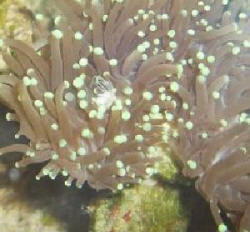
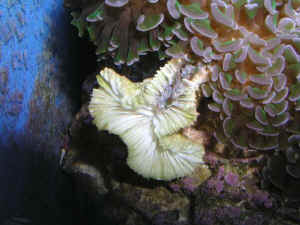
What's That On Your Hammer? Eeewww!!! Hi, I have a tri-color hammer branch that had been doing quite well for a couple months (that's about how long I've had it) but then I added in a frogspawn coral on the other side of the tank and started adding in calcium and iodide in moderate quantities. Since then, the hammer has been almost completely closed up. The frogspawn, meanwhile, is flourishing. Over the last week or so, I've noticed that long stringy brown algae has been growing on the hammer and I started moving it away but probably not very effectively because it always came back. Someone at my LFS recommended using a turkey baster which appeared to literally blast away all the bad algae and maybe some brown stuff that seemed to be inside the hammer. That very night (yesterday), the hammer started coming out again, probably to about 50% of what I've ever seen it at but then stopped and I noticed some small pieces of algae growing on the edges. I blasted those away too (though rather gently so as not to harm the hammer) though the hammer didn't come out any more. However, this morning, more brown stringy algae was on the hammer and the hammer had pulled back into itself. Is my hammer damaged or diseased? Is there a way to get rid of the algae from growing on it? I'm relatively certain that if I could get the algae to go away, the hammer might come back out as normal. I have 3 blue-leg hermits, one Astrea snail and one turbo snail, but recently (last couple weeks) I have noticed that the brown algae on the glass seems to be a little out of control as well as some red slime algae on the substrate. Thanks for all your help! Veronica <Hi Veronica, The algae (which I'm guessing is Cyano bacteria from your description) is growing on a dead surface, meaning that the hammer is most likely dead in the areas which the algae is growing on. Your regular additions of iodine may have caused this, as well as moving it. I would recommend you purchase an iodine test kit and test for your iodine levels. You should always test for anything you're adding. Blasting the Cyanobacteria off the hammer is a good idea. Cyanobacteria (or, also referred to as Red Slime) is usually caused by lack of currents and extra nutrients. Overfeeding could possibly lead to the Cyano taking over corals. Phosphate will also elevate your Cyano levels. For now, I would continue to blast the algae off the hammer and discontinue dosing iodine until you've tested for it. I would also look into feeding less and adding more current to your aquarium to prevent further Cyano build up. Take Care, Graham> -Dead portions of hammer- Hello again, I just have a quick question for your fine staff. I have a three fingered HAMMER CORAL. Unfortunately, one of the fingers seems to have died. Their is no sign of life. However, the other two fingers are flourishing. Can I cut off the dead finger or what would you suggest. <Absolutely, provided there is no live tissue connecting the dead head to the live ones.> Their is some brown slime starting to form on the dead finger. <Definitely remove this dead one, it would also be good practice to give the other heads an iodine dip, do a search on this site for info how. Good luck! -Kevin> Thanks again for your hard work and dedication, Jose Is The Fox Finished? (Damaged Fox Coral) Hi, I recently bought a large fox coral off of liveaquaria.com, and it arrived with one half of the tissue gone. That is, that it died and fell off. The colour was bleached white on the areas where their was no tissue. Is there any way I can feed it, so that it can re-grow over the dead areas? I tried feeding it, but the food just floated off. And the "ribs" were exposed. If you do not know what I mean by ribs, you know how on bubble corals, there are large round plate like things? That is what I am talking about, only an a fox coral. <I understand what you are referring to...Good description!> It is at the bottom of my reef aquarium. It didn't seem to open well under direct light. Anyway, can you help me out? Thanks, Adam <Well, Adam- assuming that you are providing appropriate environmental conditions, it is certainly possible for recovery to occur. Not an everyday occurrence, but it is worth not giving up. The most important thing is to provide stable, healthy parameters, and feed as often as possible. Don't give up yet! Regards, Scott F> Back from the dead! Hammer Coral 2/12/04 Hello all! <howdy> You probably don't remember this with the large volume of emails that you get, but a while back I emailed you about a problem with a hammer coral. The coral was mysteriously losing polyps every few days. When the last polyp was dying, I noticed that a chunk of it was missing. It appeared that my coral was being eaten, but I never found the culprit. <OK> Since the coral was gone, I moved the skeleton to the back of the tank to make room for other corals. That was over a year ago. This week I was surprised to find a tiny bright green polyp poking up from the back of the tank where the old skeleton was leaning up against the glass. I turned the skeleton around, and found what appears to be two small polyps that somehow survived all this time. They must have been microscopic when I put the skeleton back there! <sort of... many LPS corals have living tissues unseen deep within the corallite. Some will even begin to decalcify and feed the growth of new buds (anthocauli) from a seemingly dead parent "skeleton". I wrote an article about this with Steven Pro here on WetWebMedia.com if you care to look back in the archives (under Trachyphyllia)> The larger of the two new polyps is only about the size of a pea. Should I start feeding them? If so, what should I feed them? <enriched baby brine shrimp or better, Cyclop-eeze ASAP> I used to feed my hammer coral very small pieces of meaty food, but I don't think I can chop the food up finely enough for these tiny polyps to eat. I have lots of copepods, etc. in my tank, which they must have been living off of all this time. Is that a sufficient source of food until they get bigger? <perhaps but not for long> Another related question for you... My old hammer coral was white with a slight greenish tint. These new polyps are fluorescent green. Can polyps from the same colony have different colors? Or were these new polyps just hitchhikers on the original? <the former is correct... and the recovered polyps are simply responding to the change/difference in light. Some bleached/stressed corals can in fact pick up different strains of Zooxanthellae too> Thanks! <kindly, Anthony> Bubble Coral Damage 4/5/04 While working in my tank tonight I bumped my bubble coral. A small portion got crushed against the sharp shell. There is definitely some tissue damage. It pulled into its shell right after, and has not come out for an hour or so. Is this likely to regenerate, or did clumsiness just kill my bubble coral? Thanks! -Ken <while even some hardy LPS corals are very sensitive to tissue damage, Bubble corals are not.. really durable and resilient! With good water flow, water quality and adequate feeding/light, I suspect this coral will recover very soon. No worries. Anthony> Hammer Coral Problem <Hi Ken, MacL here> Sorry. <No biggie> I hit the send button prior to getting the message ready. Quick question for you. I have a problem with my hammer coral bailing out of the skeleton. <Not good at all.> I have good water quality with 0 nitrates, PH at 8.4, calcium at 380-400 no ammonia and no nitrates. I have been using a Kent calcium additive and I am wondering if perhaps I over did it in the past week. I put 1 teaspoon in on two separate days. I also feed the corals brine shrimp/small arctic shrimp (don't remember the name) combination about every other day. Last night the hammer looked like it was feeding well but then this morning I noticed that it was bailing out. <Sounds possibly like an infection to me. Is it also getting any kind of jelly looking thing? Honestly sounds like it might need to be dipped. I personally have had good luck with coral reef dip by SeaChem for a commercial product and there's a great dip listed on the WetWebMedia website.> Any ideas? Thanks, Ken <Try the dip on WetWebMedia Ken and good luck! MacL> Treating a sick torch coral Hi, crew. Back again with a question. I have a torch coral that suddenly went from looking happy and lush to having 3 of its branches covered in nothing but that brown jelly I have seen described on your site. << Frustrating thing to have happen. >> Based on a search of similar problems on the WWM site, I moved the torch to a QT tank, and am on my way to buy Lugol's solution and give some dips a try. My question is, how long of a process is this? << Wow, risky. I'd say it is only takes a couple days in a hospital tank to make or break the coral. >> Any special instructions? When do you know if the coral has turned a corner and/or should be returned to the tank? << You never know, but I think lighting is so important that I'd move it back after one day. >> And what would cause such a sudden event? It's not a new coral, nor have I added anything to the tank in several months. I need to know if I'm doing something wrong or what things to investigate. << I'd check water quality of course, as well as water motion and the health of all other corals. >> Thanks, as always. Will let you know either way what happens. Laura << Blundell >> Dying Euphyllia I have a wonderful reef tank that has been up and doing very well for over a year and a half. << Great to hear. >> My tank is doing so well that my two Mandarin fish only eat off of my live rocks and have no desire for any other food. << Mandarin fish rarely eat prepared foods, which is why they have an abysmal survival rate. >> A few days ago I purchased an Euphyllia ancora. As I went to acclimate it I saw quite a bit of slim but a lot of my corals have slimmed in transportation from the pet store to my home. << This is quite common. >> Now my anchor coral is starting to deteriorate. Is there anything I can do to save it? << Well I'm not sure what the problem is, but good water quality and plenty of light are a good starting point. >> I have it in a spot in my tank that has moderate light and low water movement. Last night one tentacle stretched to about an inch and a half but it was just one of its many tentacles that did this. I tried feeding it some Microplankton to encourage it that its new home was inviting, safe, and that it would have plenty of food. Today when I woke up it seems that it is still deteriorating. Can you give me any advice on what is happening, why, and what if anything I can do? << I would try to mimic the conditions of the aquariums it came from. Otherwise, if you really think you'll lose it, I would take it to a friend or store to hold for you. >> Thanks in advance! Stephanie White << Blundell >> Saving a Hammer My question is to whomever can help with this issue. My Hammer coral fell on my Galaxea today and it doesn't look good. Is there anything I can do to possibly save it? Thanks <be sure the Hammer coral is returned to its exact former place, set securely (use underwater epoxy if necessary), maintain very good/strong random turbulent water flow, add small daily doses of iodine to the water (regular weekly dose just fractioned for daily application) and observe carefully for necrosis or infection in the tissue. Extra water changes may be necessary to reduce mucus shed from stress. Best regards, Anthony> Trapped gas in Euphyllia? Hi guys, I have a question about my Euphyllia. It was sold to me as a branching hammer coral and it's been absolutely gorgeous up until now. I did a water change on Tuesday and now on one of the branches in the middle of the of the branch near the mouth there are like two bubble looking things, they look like air pockets. <Arghhh... not good> The only thing I can think of that might be a possible cause is the water temp. The water may have been a little colder than the water in the tank. I can't get a clear photo of it because of the angle, but it just looks like two little air pockets on either side of the mouth. Any ideas? Thanks, Arthur <you are correct... the sudden mixing of cold and warm/hot waters can cause this condition (like an embolism). It is also caused by microbubbles that supersaturate the water as when aspirated through a pinhole leak in the return pump plumbing. It is also caused by excessive illumination (recent upgrade of lights or changing of an old lamp). And lastly, air is sometimes ingested deliberately by some SPS with or without food (perhaps for the proteins attracted to the surface of each air bubble). The last event is the least common and seems to occur most often captivity (not on a reef so much). All other explanations here are unfavorable but not fatal. We simply must give it some time to see if it will pass (week+) or lance it if necessary (interferes with normal polyp cycles). Best regards, Anthony> Pearl bubble Hello to you all, <Hellooooooo Helene!> I have read all over the WWM site and still can't seem to figure out what to do for my Pearl Bubble. <flowers, soft music and candlelight always make me feel better. That and a fifth of brandy. Do consider... for the coral, that is... not for me. I can take care of myself> All seems well in the kingdom for the all other life but the pearl just keeps on shrinking... <do you play Mariah Carey a lot?> I have been trying to tempt him to eat with a little direct feeding of zooplankton and phytoplankton mixture. <good with the zoo... but don't waste your time on the phyto with this species. Form follows function, and this coral has huge feeding tentacles designed to catch large zooplankton. No plant matter here> Even tried a little of my home recipe clam, shrimp, fish etc frozen stuff. All to no avail...he is in the middle of the 75 gal, decent water activity and not too near to anybody else. <all good> Water quality is good although we did have a nitrate spike a while ago when we lost a few little fishes and couldn't find them.... <no biggie> these were new fishes and had been quarantined but alas who knows.... <understood my friend> Any ideas? <yep... I think we should send Weird Al Yankovic to Iraq to counter the threat of chemical weapons by the tyrannical regime in power (the oil companies that is)> Or once again not enough info.... <regarding the bubble, it sounds as if you have done all you can. You may need to pull the coral to a bare bottomed QT tank to determine if the irritant is in the tank itself. 4 weeks as usual in QT> I will continue to try to feed him. Hard to catch him when his feeders are out.... <good, but don't wait...put a tablespoon of meaty juice in the tank 15 minutes prior to feeding and the tentacles should come out> I think that he may be getting too weak to extend them. <I assure you that is not so> The addition of zooplankton is new.....think that might help? <Oh ya! it is the only food this coral eats. If you have been using phyto only up to know, your coral has been starving. Bubbles are meat eaters> Anyway, thank you for all your help......Helene <best regards, my friend. Anthony> Dead Euphyllia ancora and ick Dear Craig: Hello! How do you do? <Hi Mimie, I'm alright, a little jet-lagged after returning from Florida> Well, some bad news, my hammer coral died yesterday. Don't know why, everything seemed perfectly in order waters param.s etc. It started dissolving after you told me to give it full-spectrum lighting. Not pointing the finger at you but I guess it started to die once I placed it in my tank. But for the life of me, I don't know why. Oh, and my fan worm died too. However, the other corals and fish are doing fine, except that the Sailfin tang has gotten an ick infection which I thought I completely eradicated months ago. I am very dis-spirited now. <Uh-oh. Sounds like something happened here. Any sudden temp or other changes that maybe happened unbeknownst to you that also set the ick off? This usually happens with a temp drop or maybe came in with the hammer, which may have been sick or infected already. These corals also are susceptible to brown slime bacterial infections and such. Tube Fans are sometimes difficult to keep for extended periods due to their filter feeding requirements.> Anyway, I started feeding it garlic soaked Mysis shrimp. He's not really taking it, kinda nibbling on it. It seem really bad in the morning but disappears during the day. The fire shrimp too seem to be helping out by cleaning him. A strange observation. <Try to find Tetra anti-parasite medicated food, this works well for those spot attacks before they get going.> Well, that's the latest. I know that my water is top-notch...I do 20% changes weekly. Can't do any better than that. I don't know...Best, Mimie <Make sure your water changes are temp/pH/SG matched as this could cause some of your problems. Sorry to hear of your difficulties, don't feel alone, we all have these things happen sometimes. My Best, Craig> Euphyllia Ancora Hi Craig !!!!!!!!! Thanks for the advice on timers, you're like my piscatorial guardian angel! <Hi Mimie!> I recently purchase an Anchor coral for <cheap>(like the budgie!) and it is a beautiful addition to my tank. I love the metallic green that seem to stand out in the actinic light. Prior to buying it, I did some research on your site and am a little quizzical on the aspects of water movement and lighting because of the conflicting notes on the articles and the FAQ section. I've got mine wedged between some LR about 4 inches from the surface, close to the powerhead. (I have a 2X55W PC unit but only turn on the 10000K actinic lamps. The other is a 7100K lamp. Photoperiod is 12 hrs.) Also offered some Mysis shrimp soaked in Zoecon but it did not consume it. Of course all filtration and powerheads were turned off. <I purchased a bleached Hammer because it was a deal too:>) They like full spectrum lighting (50/50 actinic and white) so turn on all of your lights, perhaps over a few days, and try to match the lighting intensity from the store at first. It will likely be alright where it is, light wise. The Tentacles should gently wave in the current, nothing too vigorous. This family of corals have hard skeletons which can bruise or cut the soft tissue in too-strong current. It would likely not open or stay open. I don't target feed my hammer, which has grown considerably and recuperated nicely from it's former condition, but I feed my fish a large variety of natural foods which indirectly feeds the hammer.> Also got a juv. Zebrasoma Velifera who just loved the shrimp but hasn't sampled the Gracilaria algae in my tank...although my Mexican Turbos seem to munching on it throughout the day. <Note: I will be moving the tang to a 135G FO system I am getting for Xmas *smile*> Please advise. Just me, MER <Wow, my advice? Have fun! Enjoy your hammer coral, with the proper light, a moderate current and fed fish it should do just fine. Some people target feed their LPS corals, there is more on this at WetWeb, in Anthony's book, Bob's book or the new Invert book coming out soon. Remember, LPS corals need adequate calcium and alk levels as well. Bye for now, Craig> Anchor Coral Problem I've been having a problem with my
anchor coral for the past couple of weeks. Let me start from
the beginning. I bought the coral 5 months ago. About 2
weeks after I bought it, one of the polyps shriveled up and died in a
24-hour period. I attributed this to the fact that I
probably scratched it while I was feeding it. <hmmm...
this reminds me to warn you to be careful not to feed large foods...
never larger than 1/4" bits (minced). Even though this blind and
sightless animals will sting and draw any large chunk of dead fish or
shrimp in... it doesn't make it smart or safe. Many coral are
harmed or killed by feeding large krill, shrimp or fish chunks> About 2 weeks ago, for no apparent reason, another polyp shriveled up
and died in the same way. <more symptoms needed here...
any evidence of necrosis, change of color... waning over what period of
time, etc?> Yesterday, one more polyp started
shriveling. (This last polyp was connected to the
previous polyp by tissue, so I'm not sure if this polyp
is dying because it was connected to the other.) <not
likely over this period of time (no pathogen)... more likely suffering
the same physical imposition (feeding, water quality or predator)>
My water parameters are all fine, <fine relative to what... numbers
please> and I can find no exterior signs of infection or
parasites. The coral was doing fine for a long time after I
bought it, <months? still not long if starving (regurgitating large
chunks after dark)> so I'm not sure how it could have been
infected. <almost certainly not infected/pathogenic over
this period of time> I have 2 polyps left on the coral that seem to
be doing fine, but then again the other polyps looked fine before they
mysteriously died. <how fast/sudden? Perhaps there is a
fish in the tank nibbling at night. Fish list please> My other
corals and fish are not showing any signs of
stress. I've seen postings about a Malachite Green dip,
but I could not find the exact recipe. <Good heavens no! No organic
dyes or metals on invertebrates please. Very dangerous... and you
don't even have an infection (no mention of necrotic tissue!)>
I'm not even sure if the dip is the appropriate action to
take. Can you help? Thanks for all of your help
-- past, present, and future! <a picture please if possible. With
kind regards, Anthony> Unhappy hammer- coral aggression My hammer coral was looking good until I placed a purple torch next to it. They were about 2.5 inches apart, I increased the separation to ~4 inches. <very good move but not enough. The "rule" is 6-10" minimum between all coral... more between aggressive species. These two coral mentioned are VERY aggressive (modified tentacles at night and chemical exudations shed> The hammer's polyps are semi-retracted, sometimes completely retracted. Both corals are stetting on rocks on the bottom of a 29 gal tank. I've had the hammer for about two months, everything was fine, its been about four days since I got the torch. What should I do? <more space and good water flow. Aggressive skimming and weekly changes of carbon will help temper the aggression too. Best regards, Anthony> Bubble problems.. <cheers, Brett> Hello Wet Web Staff,
> I have a problem with a Plerogyra sinuosa. It was doing
great for a period of a year or so. It has been a gracious host to a
clown fish for all of that time. <ouch... Scleractinia hosting
clowns usually means trouble for the coral. Repetitive and unnatural
abrasion of soft tissue against its own skeleton from the guest
(clown). Wounds and tissue recession are inevitable in time> From
readings on your site I found that I haven't been feeding it
enough, but it was being fed periodically cut pieces of whole shrimp.
<yes... please do feed minced (smaller pieces) several times weekly
for the coral doesn't consume itself (attrition) in time> It
also always gets floating brine shrimp that go uneaten by its finned
tankmates. <Hmmm... adult brine? Very hollow food (almost no
nutrition here... animals starve to death on this.). Try Mysis shrimp
instead. Many other possibilities too... Gammarus, Pacifica plankton...
anything but brine shrimp!> My problem is within the past week the
bubbles are separating from the base. <not good indeed> The coral
still balloons and otherwise looks normal. It's just that half of
it is free from the stony base. What's your prognosis?
<it can survive... will take a few months... the clown must be
removed and food particles have to be 1/4 or smaller (tiny) to prevent
internal damage> I'm hoping maybe this is normal, however,
I'm doubtful since I see no other queries stating this type of
problem. <correct, my friend... it is not a good sign at all.>
Tank chemistry parameters show no anomalies in any readings and are all
within ranges that are considered healthy. The tank has been running
for years with no real changes in chemistry. Lighting is 4 96 watt pc.
bulbs two actinic two bright, running 12 hours a day. The
specimen is located about 12" below the surface, midway up a live
rock wall and has never been moved. <all good as per above... must
have been starvation or abrasion from the clownfish> Thanks for your
time. Brett <best regards, Anthony> Spots to left of me, bubbles to the right - 2/6/03 Hi to all, <Huuulllllooooooo.> I'm wondering if the brown, translucent spots on my white bubble coral are of any concern. <Sounds like a Planaria infestation, but could maybe be the start of some sort of "Brown Jelly" issues maybe? Other than the spots, are you noticing any disintegrating tissue?> The tank is 6 months old, water parameters are great, temp 80, sal. 20, <Do you mean 1.020?> lighting is a 48"PC <what kind of light? Just curious> which are on 8-9 hrs daily, water changes are 3-5% wkly <Mmmm.....maybe 5-10% weekly would be better> and the tank is 55glns. The coral is a little more than half way down, the brown spots started about two to three weeks ago and is covering approximately 75%. <A picture would be really helpful here, but if it seems that these are small irregular looking spots some darker than others, then try gently blowing bubble coral with a turkey baster. See if these "spots" come off or move.> Its fed twice a week with Mysis shrimp and a home blend food which includes garlic, serving size is less than 1/4" or smaller. <Could be fed more. Is it still eating currently?> There is a torch coral, <Be sure that the Torch is far from the Bubble as they have a tendency to use their feeding or err....."sweeper" tentacles to wage war on other corals, animals, and yourself <G> when not feeding with them> purple mushroom, buttercup and a plate coral <Be sure this coral is not too close to anyone either. As a matter of fact be sure they are all pretty far apart if not already ;)> in the tank with it. <Do any other corals have any "spots"?> I do have two gold band maroon clowns in the tank which don't bother it at all, actually I don't see any of the fish bothering it. Any thoughts? < Hard to say. See above suggestions. I would check here also: http://www.wetwebmedia.com/pestflatwrmanthony.htm http://www.wetwebmedia.com/flatworms.htm http://www.wetwebmedia.com/corldisfaqs.htm Hopefully something in there will help identify the issue. Let me know if I can be of more help. If you have the means, please send a pic. Paul > Sick Euphylliid Coral 6/28/03 I have been having a problem with my frogspawn and torch corals. About four months ago, for some reason, the polyps on my frogspawn and torch would draw in, and within 24 hours the polyp would be shredded and falling off of the skeleton. <many possible reasons for this... could be pathogenic from adding non-quarantined organisms (Euphylliids are quite sensitive to bacterial infections> I did numerous water changes, with quality salt, and deionized water, and the problem went away. It is happening again. All water parameters are great. <which I cannot confirm or deny/help you... will take your word on it> I use a calcium reactor, and a deionized water for top off. As for the species of corals in the tank, I have numerous species of hard and soft corals. I use large amounts of carbon, in numerous bags, and change them out at alternating intervals. <the info provided is too general, alas to be of much help... no list of number/qty of corals, size of tank, husbandry schedule, detailed symptoms (mucus or know, sloughing, etc?).> I am wondering if the problem could be with the manner in which the deionizer is recharged. <not likely at all... recharge then purge with a few gallons of water then all is fine to use. If there is any problem it is from improper preparation of DI water (no aeration or buffering for 24 hours prior to salting or use). Also have fear/concern that you are putting that Di is being used raw for top off (Yikes!)> I use lye for one cartridge and Muriatic acid for the other, as per the instructions. <quite normal and appropriate> The unit is a Kent Deion 200r. I run about 20 gallons of water through the units before putting any of the water into the aquarium. <wow... way more than you need to make it safe... but fine> I have never felt right about putting water into my aquarium that has been exposed to such chemicals, in any way, but that's what Kent says to do. <a better understanding of chemistry would reassure you just how safe and easily neutralized these chemicals are... no worries> I am at a loss. Any help would be greatly appreciated. My alternative is to not have any large polyp corals. <do read through our archive on wetwebmedia.com regarding quarantine protocol... if the problem is not water quality... I suspect a pathogen was brought in with a new fish, plant, algae, other coral, live rock, etc. Best regards, Anthony> Torch coral shedding tentacles 6/13/03 Feeding my torch coral recently with a baster, I noticed some tentacle tips drifting free. I gave it a good blasting to free all the dead tips, there were a lot of them. The 'dead' tissue is the ball-shaped tentacle tip with about 1/4 inch of tentacle tissue. It appears to replace the shed tips, since its overall appearance hasn't changed, it still looks good. I can't detect any tentacles with missing tips. Q: Is this normal? <hard to say from your description... tentacles can be shed as a natural reproductive or defensive strategy, or (more often) as a sign of poor health/infection> This specimen is sitting about 6 inches below PC lamps (8000K and actinic), these lamps are about 10 months old. I feed it Tropical Crisps or other flake foods ground into powder, and sometimes Kent Microvert. <do send a picture if possible. Close up to see if there is any necrosis in evidence. Else we can only speculate from the general description I fear. Best regards, Anthony> Euphyllia parancora question 6/11/03 hello there, <howdy!> I have a 120g tank with mixed soft corals and a few hard corals. Everything is fine except I have spotted that my beautiful and large Euphyllia parancora which is expanding very well and swelling enormously seems to have a part of the skeleton exposed. <the swelling large could be a bad sign if water clarity or light intensity have degraded over time. Causes corals to pan for the waning light yet give the appearance of "good health"> Now all around the colony the flesh of the coral does not simply come out of the ridges but extends further down each coral head also I can see a demarcation where the flesh starts even when the coral is 'resting' - although it never retracts its tentacles. One small section of this ribbon of flesh that extends for about one inch around all the coral heads appears missing and I can see the whiter skeleton. Extension is very good all over the colony but this thing bugs me. Could it be the start of something more sinister? In that case what precautions should I take? Tank you very much for your ever speedy responses. Massimo <its difficult for us to say with little information on your tank/history/husbandry and no picture provided. Do consider the overextension issue raised above if your lights are over 10 months old, if the lamps or lenses are not cleaned of dust and salt creep weekly, and/or if water clarity (lack of weekly/monthly water changes and carbon). Do send a pic if you can. Best regards, Anthony> Frog spawn total polyp bail out 6/5/03 Bob, I have a
frogspawn (grape I believe) that went through total polyp bail-out.
<yikes! quite stressed to do so> I have recovered the polyp heads
and am trying to get them to attach and re-calcify. They detached about
a month ago. <indeed slow about it> The polyp heads are doing
great, have good color and are extending nicely. I have the smaller of
the two inside of an old open clam shell and covered with a piece of
fruit net to keep it in place. The other is moving itself around the
tank. Is there anything that I can do to speed up the re-attachment
process? Thanks, John <definitely... feeding small/tiny calcium rich
foods... shell-on crustaceans usually do the trick (Mysids and Pacifica
plankton are good to start with). Feeding weekly or more often is key
here. Best regards, Anthony> Navigating WWM archives... and Coral Polyp bailout 6/10/03 Anthony, Thank you for all your help. I will make use of your archives on the site. I guess sometimes it's easier to ask someone of knowledge then to surf the FAQ's and try and make sense of them. <no worries, mate. And do refine your search technique for speed. Play around with rather specific keywords using the Google search tool for our site... and one of the best tricks to help you find what you are looking for on a given long FAQ page: copy and paste the page into a WORD document... then use the "find word" feature in WORD to ferret out the keyword that brought you to that page> My bailed out frogspawn had a mishap yesterday. Got home and found it sucked up in the strainer of a power head. Not a pretty site. <Yikes... for future reference... place polyps, soft frags, cuttings in a shallow cup (like a Kool-Aid plastic scoop) and cover the top with bridal veil or fruit netting until the polyp attaches> I removed the strainer and removed what was left of the polyp (of coarse it was the largest with two heads). I was getting ready to toss it in the trash but instead decided to give it another try back in the tank. <hmm... do be careful here... without the use of a proper quarantine/hospital tank, the stressed/injured polyp runs the risk of contracting a contagious infection that could spread to other healthy coral in the tank. I cannot emphasize the need for QT or new or stressed animals strongly enough> The tiny blob started to expand last night before lights out and was looking pretty good considering. Are these things that bullet proof? <coral reefs are dynamic environments... many hardy corals indeed> Hope it will recover! <please do take some pics for before and after... would love to see you share them with us and others later> If it does I will contain it as I did the other one. I did see some small parts scattered in the tank. Do you think these will grow? <possible but not as likely as with SPS splinters> Thanks again, John <kind regards, Anthony> Bleached hammer coral Hi I have a 29 gallon mini reef that has a branched hammer coral that turned white a few months ago. <likely from a attrition (starvation from lack of light and/or lack of target feeding) or salinity/temperature shock. The latter can occur and not effect all coral... different tolerances with each. Do you recall a sudden increase in heat or a lapse in evap top off followed by the dumping of a sudden large amount of freshwater in to compensate? If not... the coral was simply starving... very common. Many poorly lit or underfed coral can go 6-12 months before finally waning noticeably> It doesn't open as large as before but otherwise it seems fine. It has been like this at least 6 months. <Yikes> The mushrooms and other corals seem fine. Water quality is fine. I have one power compact SmartLight and one 20 watt triton regular fluorescent about 4 inches above the glass top. <that's your first problem, my friend. All fluorescents need to be 3" or closer to the water to be remotely useful. Your lights are already modest and the glass canopy filters even more light... especially if it has had salt creep or dust on it prolonged. Not enough useable light has been getting to this animals to help it feed itself photosynthetically. See this article here: http://www.wetwebmedia.com/marlgtganthony.htm Furthermore these Euphyllia species need more food than most coral to support symbiosis. Feeding 3-5 times weekly with fine meaty food is necessary... see this article here: http://www.wetwebmedia.com/fdreefinverts.htm> Any idea what might be wrong or what I can do to get some color back in it? Thanks . <the main thing is to use fresh bulbs (6-10 months old, keep clear water (carbon changed monthly is not small amounts weekly) and feed daily in small amounts until color returns and then you can back off just a little. Best regards, Anthony>
Pearl bubble health question Finally, not a lighting question
from me! :) <I'm not betting on it until I finish reading the
whole message <G>> I recently installed a large pearl bubble
coral into my 75 gallon reef tank. I went through what I thought was a
good acclimation process, and I expected him to take a while to
acclimate to the tank. He seems somewhat OK (it's only been 3 or 4
days, so as well as can be expected after the move),
<agreed> but last night I thought he was dying - he started
emitting streams of a gooey-looking substance through slits in his
body. <two things it could be... simply excrement (usually dark in
color), or Zooxanthellae packets (symbiotic algae) from stress... often
luminary shock (lights too bright). Acclimation to bright lights takes
weeks.. a drawn out process with shade screens atop the coral, etc. Do
you recall the synopsis for doing that from my lighting article, bud?
NO worries anyway... it still may be excrement. Was there a recent
large feeding? Bubble corals need to be fed finely minced meaty foods
4-5 times weekly minimum. Daily would be better> I was about to
remove him from the tank entirely, into quarantine, but I noticed that
he didn't actually look like he was on his last legs, but the
emissions disturbed me. They went on for about an hour, not
continuously but every once in a while. This morning, he looks like he
always has. I'm keeping a close eye on him, but would like to get
your input. <excellent... as per above> My lighting is a pair of
250W MH (as if you guys haven't heard enough about *that* recently)
and 4 55W actinic PCs. I'm acclimating him by lowering the MHs to 3
hours a day and working back up to 9 hours over a 10 day period, but
I'm wondering if he's just having a bad reaction to the change
in light (although he'd been under lower-intensity MHs prior to
entry in the tank). <this is a bad habit and an inappropriate
acclimation technique. Even if it is the only coral in the tank. And
when there are other corals... this means every established coral in
the tank will be deprived of light every time a new coral is added?
Yikes. Do read my acclimation technique using screens at the bottom of
this article (excerpted from my coral book):
http://www.wetwebmedia.com/acclimcoralslight.htm
> Thanks... Arthur
<best regards, Anthony> More on coral meltdown Hi there, a good friend of mine has a nasty problem. In about 24 hours a huge frogspawn melted down to the skeleton, forming this brown goo that smells like death (brown jelly disease?). All hammers and frogspawn in the tank seem to be affected to some degree (there are about 5-6 of them), the brains and Blastomussa as well as a couple of softies seem ok for now. Corals were dipped in Tech-D last night and will be freshwater dipped today. He put in additional skimming, carbon and a PolyFilter. We're looking for advice on how to avoid a total meltdown. >Thanks Stephen ><Besides what you've done....water changes, water changes, water changes. Like 10-25% a day. I wouldn't do anymore stressful treatments. Test water parameters and make sure they are within the norm. Also watch temp...this is most likely environmental. QT all new corals. Best of luck! Craig> <Hi Steven, I looked into this further (in Anthony Calfo's great book!) and he advises removing all infected corals from the display in a plastic container, then removing any infected, dead and necrotic tissue with a stream of water and then with a toothbrush down to healthy tissue, then placement in a QT tank, perhaps with iodine/Lugol's in known doses. As a last resort fragging/separation of healthy tissue from infected. Discard all operation/rinse/cleaning water and lift corals from display in container to prevent stress and contamination. Iodine may be used as a dip and in the working containers. Time is of the essence. Good luck, Craig> Frogspawn and flatworm Hey there, I took a look at the Frog Spawn and the purple spots moved around when the coral came out. Could it be a flat worm? Could it be harmful to the coral? Thanks for your help, Anthony >> Could be a flatworm, could be harmful... but not much you can/should do to remove them at this point (as they don't sound like they're causing trouble). You can read some of the going info. on their control (biological and chemical) at my wetwebmedia.com site under the heading "worms"... There are some wrasses that will try them out (Pseudocheilinus), hermit crabs (Dardanus spp.)... depending on what species the worms are, how hungry the predators might be... Bob Fenner Corals are starting to die off. I have power compacts for
lighting (4 55 watts bulbs) I just changed my bulbs about 2 months ago.
As for corals, I have: colt open brain green torch frog spawn
hammer finger leather several mushroom/polyps My test results: PH
8.2 specific gravity 1.022 ammonia 0 nitrite 0 nitrate 1.0 Phos 0.2 Ca
450ppm Sections of my hammer and torch would look brown and the next
day it would just fall off. I don't know if that made any sense.
the only fish I have are a lawnmower blenny and sleeper goby. I
clean the glass once a week. I also do a 20% water change once a month.
I use B-Ionic, Iodide, Reef Vital DNA and Strontium. >> A few
things might be at work here... the most likely of two are a low
alkalinity condition (less than 3 milliequivalents per liter), which I
would get a test kit for and counter your calcium concentration by
buffering it (the alk.) up... and lowering your calcium (this will just
happen in reactions to the increased alk.) to maybe 350-400 ppm. The
other is a bacterial infection... I would remove the affected corals
(genus Euphyllia) and dip them in a slightly lowered specific gravity
(just a couple of thousandths) of your seawater with a bit of
freshwater added... and a "dose" of malachite green (from
your fish store... sold under this name and other generic) of about
twice the labeled concentration... for ten/fifteen minutes... and
toss/throw away the dip water. This is a standard practice in the
trade/business of ornamental aquatics with these corals. Bob Fenner Anchor Coral not opening I am about to give up on my Anchor Coral. It is a beautiful piece that I have had for 4 months (solid Base and large). It is not opening well anymore. It show no signs of deteriorating though. I have other LPS corals in the tank that are doing great. It is by itself in the corner. I have a frogspawn that is at least 8" away even when both are fully open. Mushrooms are now on other side of tank. I increased the current over it and moved it and both have not helped. No one else is anywhere near it. My water is good, No Nitrate or phosphate, Calcium 380 (thanks to you) and Alk 10DKH. I have 330 watt VHOS 3 months old. I am using Carbon, phosphate guard and occasionally a PolyFilter. Any suggestions would be greatly appreciated. >> Do try this technique before giving up altogether on this Euphyllia ancora... Prepare a freshwater bath of about the same temperature, put in about a teaspoon per gallon of baking soda in the dip/bath, and a few drops (three let's say) of a stock solution of malachite green (the principal ingredient in freshwater Ich medicines). Place the Anchor Coral in this solution for ten minutes or so, and then return it to the main tank, near the middle (length and depth). Wait three days, if the animal doesn't appear vastly improved, repeat this procedure... Not to be mysterious here (or ever) this family (Caryophylliidae) frequently has infectious and parasitic problems from the wild... and can be miraculously (okay, I used the term) recovered through this process. Bob Fenner Dying Frogspawn Bob, Help! About a week ago I purchased a frogspawn coral and installed him my tank. Within two hours he was fully open and beautiful. Over the last two days, however, he has degenerated: two of his four polyps weren't opening all the way, and today, one of them has turned brown and dissolved away, leaving an empty husk. As far as I can tell, my water is in good shape - nitrites and nitrates undetectable, phosphates < 0.2 ppm, calcium just over 400, alkalinity over 4, pH at 8.3 - what can I do to help this guy? I read over the FAQs about Euphyllias, and I see you recommend lowered S.G. malachite green baths, does this apply in my case? I don't want him to lose any more polyps - and can the one he lost ever grow back? <Yes, this specimen is a prime candidate for this treatment. Do it soon, as in NOW. And yes, the lost tissue (and more) will grow (back).>Should I move him closer or farther away from the lights? <After effecting the dip, yes and apply a bit more circulation> Could the one blue striped mushroom I've installed since his purchase cause a problem? <Really only if it is/was placed very near the specimen> Any help you can give would be greatly appreciated. Josh <Bob Fenner> Hammer coral Hi Bob; I have a green hammer coral that I
received as a gift, Much to my dismay. I've only had the thing for
about a week and the tissue is falling out of the skeleton. My water
parameters are good but my nitrates may be a little high for coral, but
not skyrocketed. Any way I've heard of disinfecting coral using
iodine. I have Kent concentrated Iodine on hand, any idea of how I
would prepare and conduct a dip or bath using this product for the
coral in case this is bacterial related? <I do endorse, use, train
collectors/wholesalers to use iodide (this is what it is...) solutions
(pretty concentrated compared to "supplementing" dosages) and
hyposaline solution (dilute seawater) on arrival for such purposes...
But not once the specimens reach this far, long. Please do read over
the FAQs files on Stony Corals, particularly the family Caryophylliidae
(this is a member of that family) archived on the site:
www.wetwebmedia.com on the use of malachite dips in these cases....
Have seen MANY such cases resolved with such treatments. Do this NOW.
Bob Fenner> Branching Euphyllia glabrescens Hi Bob, I need your help with one of my corals. I have a 120 Gal reef tank. Amonia:0, nitrites: 0, nitrates: 0. Temp: 79F, Alk 4 meq/l and PH: 8.05. I have 2 Acroporas and some other SPS. I too have a E. ancora, and a E. divisa. All of these are doing quite well. 3 weeks ago, two tentacles of my torch did not fully expand, and have not since. Other polyps (In other branches) are doing OK, and expanding really huge. The polyps that don't expand look ok otherwise: they are not dissolving, and are not fully retracted either; but since this is the 3rd week they are this way, I looked much closely, and found that this two polyps are "bailing out" leaving the skeleton exposed. Some parts of the polyps are still attached, but I can already see the center of the corallites, and the digestive filaments from the underside of the polyps. They are not budding, since they are not growing another skeleton, outside the polyp, but the whole polyp is detaching. I fear that if I leave them this way they will end up going in the current and dying. Do you know what might be going on here?, and what can I do from preventing this from happening on the other 2 polyps?. This is a very nice coral and I feel very frustrated to lose it like this. Thanks a lot, Norberto. <Could be evidence of a reproductive mechanism... maybe there is some influence... too much of something, too little... involved... do you supplement iodine in some format? I would. Use zooplankton, other small foods? I would. Add a vitamin supplement to the water weekly, like Selcon? I would. Perhaps there is an infectious agent involved... but I would not "treat" the colony at this point (see the family Caryophylliidae scant coverage and FAQs on the www.WetWebMedia.com site... I will get to placing my version of the current "coral books" there in a few months. Bob Fenner> Anchor Coral Problem Dear Mr. Fenner I have a question regarding an anchor coral I recently purchased. I bought it about a week ago and now it appears to be dissolving. I have tested my water parameters and they're all perfect (PH, Ammonia, Nitrite, Nitrate, and Calcium). When I first bought it I put it near the top of the tank because I was told this coral needed strong lighting. I have 4 55w power compacts 2 are 10k whites and 2 are actinic blues. I was also told this coral didn't like strong current. So I put it between two rocks and not directly in the way of any power heads. Since the purchase I have been feeding my tank Kent Marines Phytoplex and Coral Accel about 2ml of each every day. The coral seems to be dissolving at the ends and working their way in towards the middle, even though the middle looks pretty healthy. My system is only about a 2 months old but has been cycled for about a month now. I have a green star polyp that is doing incredibly well. Any insight you might have would be greatly appreciated and thank you in advance for your guidance and wisdom. Thang Nguyen <Perhaps too much light, too soon... and this animal's genus (Euphyllia) do appreciate considerable water movement... and perhaps a negative biochemical reaction with your established polyps... but much more likely what you're seeing/evidencing is the repercussions of "collecting, shipping shock"... and perhaps secondary microbial involvement. Please read over the family Caryophylliidae section on the site: www.wetwebmedia.com and do consider applying the malachite green dip remedy detailed there... this may be the only thing to arrest the dissolving at this point. Bob Fenner> Anchor Coral Regeneration Bob, I recently used your malachite dipping method to stop a bacterial infection in my anchor coral. I believe that the infection has been stopped because the coral is no longer receding. Will this guy re-grow the tentacles that were lost while the infection was going on? <Yes... likely so. In time> If so, is there anything I can do to help the process or do I have to just let Mother Nature take its course? <A bit of both. Keep your system optimized and stable... an eye on alkalinity, biomineral content, use iodide and vitamin prep.s about once a week...> Thanks for your help and the cure! Chad <You're welcome my friend. Congratulations on your success. Bob Fenner> Please reply ASAP if you can please (Sick Euphyllia, spacebar finger) Bob After a fresh water dip my Anchor coral still looks like it rotting. All of my water parameters are excellent as with all of my other corals. I also added iodide and Selcon per reading the info on your site. Is this coral a lost cause?? <No, not necessarily... did you try the 1/2 malachite dip as suggested on our site?> Please advise ,I really don't know what else to do. Is this parasite going to finish off my coral? I have tried turbulent current, and slow current. Out of what was a large size Anchor from FFExpress there is only about 3 inches left with tissue on it. Thanks <You might be better off fragging what's left of the live portion. Do you have Eric Borneman's Aquarium Corals book? You would do well to enrich your background here. Bob Fenner> Air pockets in coral Hi Bob, I have a cup coral and a
frogspawn and they formed air bubbles/pockets inside the coral. The cup
coral one day formed a hole and some of the air escaped but another
area still has an air pocket. this hole seems to be spreading. the
frogspawn is still ok but still has the air pocket. what should I do
and what causes this? <Could be an infection... but more
likely a dysfunction of these animals Zooxanthellae... the
endosymbiotic algae... they're being overstimulated, otherwise
being overactive, producing too much gas> how can I prevent this and
will this cause the demise of my coral? <Depends on the cause/s... I
would be checking my water chemistry, supplement practices...> I
also have a anchor coral that one day seemed to not extend and now 90%
of the tissue deteriorated. I'm not sure why since everything else
seems to be doing well (xenia, bubble coral, Fiji leather),
capricornis, scroll. I'm running 110w pc for 10hrs at night in my
30gal. please advise, thanks in advance for your time Jackson
<Yikes... a thirty gallon with all these disparate life forms in it?
An "answer" to the cause of your troubles is the mis-mixing
of these incompatible types of cnidarians... you might be able to get
by with chemical filtration, very frequent water changing... but there
is likely a great deal of chemical and physical interaction going on
betwixt all... and some are winning... others are on the other side.
You need a larger tank, and/or to separate some of the stony from soft
corals. Bob Fenner> Bubble Coral Dear Mr. Fenner, I am writing to ask about the
behavior of my Bubble Coral. I bought this coral yesterday and it was
as healthy as can be (very confident in my LFS, all coral and rock from
Walt Smith.) I have the coral housed at the bottom center (on top of
some live rock) on my 75 gallon aquarium. Yesterday it had it's
bubbles full and was waving happily. I know they go through a change at
lights out. All their little tentacles out-and-about. What I was
unprepared for was the following: When the blue lights came on for sun
rise the coral was barely inflated. Many looked a sickly yellow
(yesterday a very luminescent pink.) When the white lights went on it
perked up some but a few bubbles still were flat and yellow. As time
goes on they seem to improve. Is this all natural? <Yes my friend...
just a bit of "settling in" period> Also I have (thought
he had past away months ago) a peppermint shrimp out at night. Will the
two get along? <Hopefully> Three green Chromis, one Yellow Tang.
85lbs LR, 70lbs LS. Ammonia 0, Nitrite 0, Nitrate 12ppm, Ph 8.3, Alk
3.5 mill, Ca 450, good water motion and 380watt PC lights on 12 hrs a
day. Temp 78-81 degrees, SG 1.023 If I am being paranoid (I know this
is a rather hardy coral, that's why I picked it) please let me
know. :) <Yes a hardy genus (Plerogyra) of a family of notable tough
species of stony corals (Our coverage here:
http://www.wetwebmedia.com/caryophyllids.htm> Thank you sooo much
for you help! It is wonderful to be reassured by an expert. Josie
<Just a fellow aquarist who has been around a bit more my friend.
Bob Fenner> Pearl bubble coral question Hi, <Anthony Calfo in your
service> My pearl bubble coral (had it for 2 years and
growing/eating ok) has developed today something quite unusual. At
first I thought it was a bit of algae or something stuck in it but when
I looked better it looked like 2 stalks of tissue protruding at each
end of it dark in color and quite long and straight/still, not like the
ones with nematocysts seen mostly at night) and culminating in a small
transparent pocket. Never seen anything like it before. I thought it
might be reproducing... Any ideas as to what it might be? <several
things... a photo might help too if you can. LPS corals commonly
produce polyp balls as a reproductive strategy. A modified tentacle on
a polyp becomes incused with a calcareous nodule. This daughter
satellite continues to grow until the calcareous "stone"
inside becomes sufficiently mature and weighted to tear away from the
parent and begin life as a free living division, soon to attach to the
reef (hopefully). The event could just as easily be stress though most
often from a change in lighting (sudden change of carbon/chemical media
after a long period without which suddenly improves water clarity and
light penetration, cleaning salt creep on lenses or bulbs, and of
course new lamps). Excessive illumination may cause photoinhibition or
the excess production of O2 in the tentacle by over stimulated
Zooxanthellae. Indeed... there are several possibilities. Time will
tell... do consider the above and possible light shock just the
same> Thanks, Massimo, Brighton UK <kindly, Anthony Calfo>
Brown Jelly and Hammer Coral I have lost the last three
hammer corals I purchased. Each lasted approx. 4 weeks. They all
succumb to brown jelly infection. All my other LPS corals are doing
well i.e. frogspawn, torch, Candycane. Have you experienced this or
heard of this problem as of late? I am wondering if it from collection
methods etc. The so called hardy hammer may be coming more like the so
called hardy elegance. <Yes... not an uncommon occurrence. Please
read through here: http://www.wetwebmedia.com/caryfCorlsaqs.htm re what
folks in the trade do for preventing this largely bacterial complaint.
Antibiotic and dilute seawater dips... Bob Fenner> Any help greatly
appreciated. Melting Xeniids & Flatworms Galore Hi there WWM Crew. <Hey, Mike G with you tonight> Have been enjoying your site and links but have run into a couple of problems. To begin, let me give you the stats on the tank: <I personally thank you for giving me the stats on your tank. Out of many, many emails I have answered today, you are the first to provide such information. :-) > SG 1.025 <Fine> pH 8.0 in the morning (before lights come on) and 8.2 5 hours after lights on.. <You might want to find a way to remedy this. That is a large pH swing, and would cause undue stress to your pets.> NO2 (0) <Perfect> NO3 (20) <Okay, but it could be a bit lower> NH3 (0) <Perfect> Tank is set up with l MH l4000K and 2 65W 03 actinic along with a Bak Pak 2R protein skimmer that's skimming l/2 C of green stuff a day. Tank temp. fluctuates between 77.5 to 80F degrees lately. Water change weekly 15 gals. Sometimes time doesn't permit, and water gets changed every 2 weeks. <Sounds fine. I am left wondering how large your tank is, though.> Problem l: For some reason, my pulsing xenias are dying (melting) and I can't figure out why. Have had these Xenias now for almost 2 years pulsing and dividing away and now... What's going on here? <This is a common problem with Xeniid corals, they seem to "melt" when in unfavorable conditions or after drastic changes in water parameters. Take a gander at the following link, namely the topic "Xenia Health" about 3/4 down the page. http://www.wetwebmedia.com/xeniidfaqs3.htm > Problem 2: My frog spawn frag (originally only 2 heads - now 6 heads) has been invaded with oval shaped pumpkin colored flatworms - have no idea where they came from as I do quarantine any and all going into the main tank. I've read that they come and go But, now they've migrated to my pagoda coral and I really don't want it to take over the whole tank (60 gal)! <Ah, there we go, 60 gallons. Flatworms have a habit of overrunning marine aquaria.> On my next water change or sooner, can I do a fresh water dip or Lugol's iodine dip on these two corals without harming them and hopefully getting rid of the flatworms? <That is exactly what I would have recommended you do.> Thank you for your help/advice. <Best of luck, Mike G> |
|
|||||||||||||||||

|
Features: |
|
| Featured Sponsors: |