|
|
| Home | Marine Aquariums |
Freshwater Aquariums |
Planted Aquariums |
Brackish Systems |
Ponds,
lakes & fountains |
Turtles & Amphibians |
Aquatic Business |
Aquatic Science |
Ask the WWM Crew a Question |
| Please visit our Sponsors | ||||
Common in pet fish and souvenir trade alike, the
Chocolate chip star is quite well known to aquarists as well as to
people not associated with the hobby. Nonetheless, much misinformation
or misunderstanding exists with regard to this interesting and
decorative (at least when alive) species. Its biology and successful
aquarium care based on observations in nature and in captivity are
summarized here. Natural occurrence
Chocolate chip sea stars inhabit mostly sandy to
muddy lagoons and seagrass beds, they are more rare in reefs themselves
and seem to prefer the back reef area. Typically they are found in
rather shallow depths of 1-30 metres (3 to 100 feet), juveniles are
most common in depths smaller than 2 m (7 feet). About 30 specimens are
generally found in an area of 100 m? (1100 square feet) in their sea
grass biotopes. This species occurs in many parts of the tropical
IndoPacific: Eastern Africa including Madagascar, Sri Lanka, Indonesia,
North to the Southern parts of Japan and South to the tropical Northern
coast of Australia as well as some island groups of the Southern
Pacific. Regionally it can be a very common sea star and is often
collected, dried and sold as a souvenir.
Systematics and physiology
The Chocolate sea star was among the first animals
to achieve a scientific name. It was named by Linne himself in 1758. An
alternative common name often found in literature is ?horned sea star?.
The chocolate chip star is part of the star fish family Oreasteridae.
This family consists of rather stout species with thick, but short
arms. Other members of the family like the sometimes traded
Protoreaster linkii and Pentaceraster spp. have needs
quite similar to the Chocolate chip star, their aquarium care is
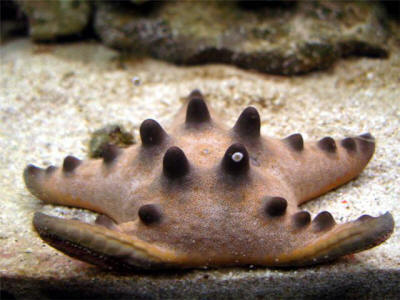
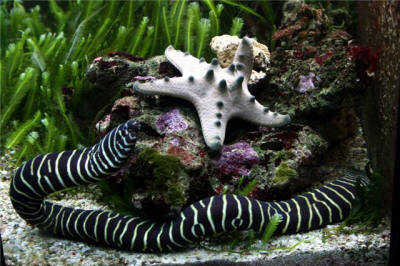
comparable. The eponymous chocolate chips or thorns found on
the aboral (=not the side with the mouth) surface of Protoreaster
nodosus are thought to deter at least some star fish predators from
eating this species. Sadly, it is quite useless with regard to humans
collecting and buying this species as a dried souvenir.
Following literature, the central disc can reach a
diameter of up to 12 cm (5 inches) and the arms a length of about 14
cm (5.5 inches). Consequently the entire star can reach a
diameter of up to 40 cm (16 inches). These maximum sizes are rarely
reached in nature as well as captivity. Most Protoreaster
nodosus do not grow larger than 20-25 cm (8-10 inches). Even
specimens larger than 14 cm (5.5 inches) appear to be rare at the
Philippines (perhaps due to collecting). In this area the mean diameter
of adult specimens is 10 cm (4 inches), the mean weight is about 250 g
(1/2 pound). The stars are a little larger at Palau with mean diameters
of 14-16 cm (5.5-6.5 inches). Chocolate chip stars reach their adult stage (with
working gonads) with a diameter of about 8 cm (3 inches). At this point
they are about 2-3 years old. Typically sold specimens of about 10 cm
(4 inches) are about 5 or 6 years old and specimens of 14 cm have an
estimated age of 17 years. It appears to be unclear if the large
specimens (40 cm or 16 inches) found in older literature are erroneous
records, other species wrongly identified or simply very old stars with
a good genetic basis, which grew up in biotopes with ideal food
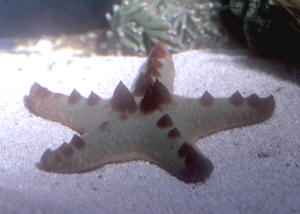
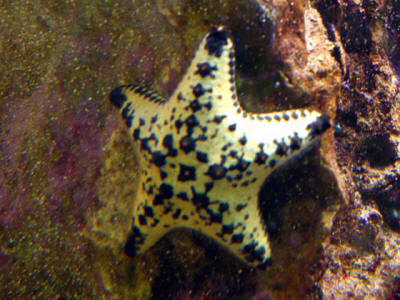
supply. The colours of the Chocolate chip star are quite
variable, the background colour can be white, yellow, brown, red and
even bluish. The ?Chocolate chips? are mostly grey to dark
brown. The physiology of Protoreaster nodosus is
in line with other well known sea stars. Food and waste enter and exit
the same opening, the ?mouth?. Water is pumped into the vascular system
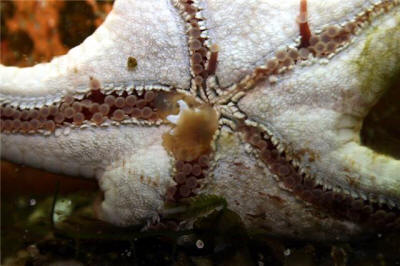
by the madreporite, a small off-centred, wart like structure on the
surface of the sea star. The madreporite supplies various canal systems
in the star and is inevitable for locomotion as well as the
functionality of the mouth. Air trapped inside this system can result
in a sea star unable to move and consequently dying. Therefore, the
stars should not be taken out of the water too suddenly, they need time
to close the madreporite. If they leave the water by themselves, this
is not a problem, because the vascular system will likely be closed
already. In nature Chocolate chip stars can be found in the intertidal
areas exposed to air and sunlight at low tide without being
harmed.
The vascular system of sea stars is filled with
salt water. Due to the osmotic pressure, because of different
salinities and temperatures at the pet shop and the home aquarium it is
advised to acclimate sea stars slowly. The larger the difference in
salinity and temperature, the slower the acclimation process should be.
Half an hour to one hour are sufficient using drip acclimation in most
cases. Most interestingly these stars seem to possess
some kind of memory and apparently are able to be trained to be fed at
a specific point at a specific time. Given their simple nervous system
lacking a brain per se this is a tremendous
effort. In the 1980s Chocolate chip stars were in the
scope of the biochemical industry. Several interesting molecules like
saponins, sterols and steroids have been found in them. This interest
seems to have been discontinued in the last
decades. Spawning takes place from March to May, the more
shallow depths of their habitats are avoided during this time. Males
are about as common as females and cannot be sexed externally.
Synchronous spawning of the entire population happens at full moon and
coincides with increasing water temperature and a decreasing salinity.
It has happened in the aquarium, too. The eggs are about 200 um small.
The larvae are planktotrophic (feeding in the plankton) and can be
expected to be notoriously difficult to raise by the hobbyist. The
floating larvae are found more close to the bottom than to the surface
water, which is a quite unusual behaviour. They stay planktonic for
10-14 days until they settle to the ground and start a benthic life.
Protoreaster nodosus larvae are spread in much smaller areas
than other planktonic larvae. No report exists of this species with
regard to reproduction by splitting as it is known from many other sea
stars. Easy or difficult? ? Nutrition gives the answer Quite a number of hobbyists consider this sea star
as hardy and easy to feed, although it is equally often stated that the
success rates with this species are rather poor (e.g. Goemans, 2007). I
believe this is highly dependant of the aquarium system and available
foods. This species cannot squeeze into narrow gaps like
Brittle stars, food items sinking into such crevices are lost for this
species. So, it mostly depends on the rockwork of the aquarium if the
sea star is useful as a cleaner organism at all. In addition, it does
not eat most types of nuisance algae and undesired bacterial films
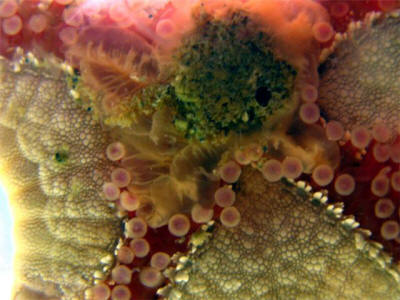
(Cyanobacteria). Chocolate chip stars eat by expelling their orange
coloured stomach (to be more exact this is one of their two
stomachs) and digesting their prey. Thus, it is quite easy to observe
what they eat. Captive Chocolate chip stars are reported to consume
sponges as well as other benthic sessile and vagile invertebrates such
as soft corals, bivalves, slow snails, bryozoans, feather dusters,
anemones, slow urchins, sea stars and even small fishes (if they can
get them) as well as fish feces, carrion and sea grass. Interestingly,
their natural diet was documented by more recent studies to consist
mostly of meiobenthos (diversity of small benthic animals between 0.063
mm und 1 mm) and microbial/microalgal films (Scheibling & Metaxas,
2008). Consequently, it is well possible that the macroscopic foods
these stars generally consume in captivity are ? at least in part ?
just surrogate foods.
Consequently, Chocolate sea stars do best in
systems with high water quality, but enough detritus and small benthos
available. Tanks without skimmers or mechanical filters seem to be
ideal, but are more difficult to keep in top condition with regard to
water quality and can only be recommended to the advanced hobbyist.
Deep sand beds commonly result in abundant benthic invertebrate life
and, if well populated, will be a tremendous help with the nutrition of
a Protoreaster. Over-cleaned stony coral reef systems do not
resemble their natural environment and generally have too little
adequate food to offer to a Protoreaster. Equally inadequate are
fish only tanks with little surface to graze on, no benthic life and
high nitrates. It's no real surprise that Chocolate Chip stars do best
if their tank is similar to their natural environment. FOWLR systems
with some macroalgae appear to be the best systems for Chocolate chip
stars. As a minimum tank size for a 9 inch or smaller
Chocolate chip star 50 gallons are recommended if pristine water can be
guaranteed. For specimens growing beyond 10 and up to 16 inches larger
tanks of at least 100 gallons, preferably more are
needed. General water parameters recommended are a
specific gravity of 1.022 ? 1.027 , a temperature of 22-27?C (72-81?F),
a pH of 8.0-8.4 and nitrates << 20 ppm. My own approach to this species is a tank with
live rock, a 4.5? well populated DSB, only a few medium sized fishes
specialized on larger pieces of food (no grazers or plankton eaters)
and various green and red macro algae instead of corals. The tank has
no skimmer or mechanical filtration. The Protoreaster feeds
mainly on biofilms in the tank (also at the water surface), small
benthic invertebrates like tiny snails, worms, arthropods and leftovers
from feeding the fishes (varied diet of various types of shrimps,
pieces of various mussels, small pieces of fish filet). While this star
has consumed soft and stony corals in the past, it did not eat several
types of sponges and only partially digested a hydroid colony. It did
not eat Aiptasia anemones, but consumed a Thalassianthus,
which has a potent sting. The speed with which a wound from an tumbling
rock accident in its former tank healed indicates that this systems
seems to be sufficient. In addition, the star shows slow growth similar
to what is found in nature. In tanks with mechanical filtration, skimming and
more fishes the Chocolate chip star may need to be fed specifically
(can be done by carefully placing the star onto a piece of food),
because it may not find enough food or have to much competition by the
fishes. This may work, but likely is less ideal, because the star will
not be able to choose its diet from what is offered by the
environment. Disease
Protoreaster spp. are able to recover from
severe wounds given chemically and biologically pristine water quality
as well as appropriate food, but they can fall prey to heterotrophic
bacteria infecting small scratches in dirty water with high nitrate
concentrations and bacteria counts. Enemies Sea stars can be severely hurt by triggers,
puffers, parrot and box fishes. Not every specimen of these groups is a
sea star predator, this mostly depends on the experiences and character
of the fish specimen in question. Other sea star predators include
shrimps from the family Hymenoceridae like the often traded Harlequin
shrimp (Hymenocera picta and H. elegans). Last but not
least it has to be noted that larger sea stars can be
cannibalistic.
Tank mates
In nature Protoreaster nodosus are often
found accompanied by the glass shrimp Periclimenes soror, which
live on the sea star and adapt to its colouration. Although this
co-existence or even possible symbiosis might be a highly interesting
subject to study in the adequate home aquarium, the stars are
practically always imported without the Periclimenes, which are
rarely found in trade, due to the collection process and because they
would be eaten by many reef tank fishes. Other naturally commensal
animals include Polychaete worms (?bristle worms?) living on the star
without hurting it, but given common territoriality shown by aquarists
towards bristle worms, I doubt they will have great survival rates in
captivity. What about keeping Chocolate chip stars as a
group? Protoreaster nodosus seem to restore their density in
nature following experiments by placing more individuals into a given
area. Therefore, it may not be wise to permanently overstock them the
aquarium, because this will create a situation where the animals will
be uncomfortable and always try to get a larger distance to each other.
A Protoreaster nodosus will occupy an area of roughly 3 m? (33
square feet) in nature, which is much larger than what we can generally
offer in the average home aquarium. Only a tank with a length of more
than 3 metres (10 feet) and a width of more than 1 metre (3 feet) will
be sufficient if one wants to duplicate the natural habitat with more
than one star.
Closing words In an adequate tank the Chocolate chip star can be
a hardy as well as decorative pet, a much more delightful sight
compared to dried conspecifics on the bookshelf. Literature
Erhardt, H. & Moosleitner, H. (1997):
Meerwasser Atlas, volume 3, 1328 p. (in German). Goemans, B. (2007): Marine invert of the month ?
Protoreaster nodosus (Linnaeus, 1758).- TFH, 56(1) September 2007, p.
76. Bos, A.R.; Gumanao, G.S.; Alipoyo, J.C.E.;
Cardona, L.T. (2008): Population dynamics, reproduction and growth of
the Indo-Pacific horned sea star, Protoreaster nodosus (Echinodermata;
Asteroidea).- Marine Biology, 156(1), p. 55-63. Scheibling, R.E. & Metaxas, A. (2008):
Abundance, spatial distribution, and size structure of the sea star
Protoreaster nodosus in Palau, with notes on feeding and reproduction.-
Bulletin of Marine Science, 82(2), 221-235. Riccio, R.; Zollo, F.; Finamore, E.; Minale, L.;
Laurent, D.; Bargibant, G.; Pusset, J.(1985): Starfish saponins 19. A
novel steroidal glycoside sulfate from the starfishes Protoreaster
nodosus and Pentaceraster alveolatus.- Journal of Natural Products
(Lloydia), 48(2), p. 266-272. Crandall, E.D.; Jones, M.E.; Munoz, M.M.;
Akinronbi, B.; Erdmann, M.V.; Barber, P.H. (2008): Comparative
phylogeography of two seastars and their ectosymbionts within the Coral
Triangle.- Molecular Ecology. 17(24), p.
5276-5290. Hartmann-Schrer, G. (1984): 2 new commensal polychaeta of the genus Hololepidella polynoidae from the Philippines.- Mitteilungen aus dem Hamburgischen Zoologischen Museum und Institut, 81, p. 63-70. |
|

|
Features: |
|
| Featured Sponsors: |