|
FAQs about the Clownfishes & Anemones,
Hosts 6
Related FAQs: Clownfish/Anemones 1, Clownfish/Anemones 3, Clownfish/Anemones 3, Clownfish/Hosts 4, Clownfish/Hosts 5, Clownfish/Hosts 7, & Clownfishes in General, Clownfish Identification, Clownfish Selection, Clownfish Compatibility, Clownfish Behavior, Clownfish Systems, Clownfish Feeding, Clownfish Diseases,
Brooklynellosis,
Breeding Clowns,
Related Articles: Clownfishes, Clownfish
& Anemone Compatibility By James Gasta, Maroon Clowns, Anemones,
|
|
 |
New Print and
eBook on Amazon:
Anemone Success
Doing what it takes to keep Anemones healthy long-term
by Robert (Bob) Fenner
|
Looking for a
suitable host! Clowns Hey Crew, Thanks to all of your help both
directly and through other postings on your web site, my tank is
looking better than it ever has! I've had saltwater aquariums for
about 6-7 years now and over the course, I've had several types of
clownfish. Unfortunately, I've never been able to get a pair that
had any interest in an anemone. I just bought a pair of tank-raised,
juvenile, mis-barred Perculas and would like any suggestions as to what
anemone would be the most likely candidate and if there are any tricks
to teach them to host in it. Any help would be greatly appreciated!
Thanks, Will <Posted... but a bunch to read through. I'd try a
tank-cloned Entacmaea... and add, at least temporarily, a third
"whipping boy" Amphiprionine/clown... not necessarily the
same species. This will 'drive' the current clowns... Bob
Fenner>
Raggedy Clownies...
stung introductions Hey there! <Hi Tina> First off, thanks
for providing this immense resource. I have learned so much from your
site...I am a newbie to the saltwater hobby and couldn't have
started without you! <Welcome> I have a 90 gallon reef tank that
is about 2 1/2 months old. I run a DandD skimmer in the sump.
<Hee... I read this at first as a "Dandy" product...> I
use filter fiber to help pull particles out of the stream but don't
use charcoal. There are about 90 pounds of live rock in the tank. Tank
parameters are great: SPG 1.0024, <One decimal place off...>
ammonia 0, nitrates and nitrites are 0, temperature 78. I have two
false percula clownfish (juveniles) and 1 yellow Coris wrasse so far. I
feed the fish pellets, Mysis shrimp, and brine shrimp. <Mmm, not too
much of this last...> I also have a T. crocea, a sea urchin, emerald
crab, many hermits and snails, 2 peppermint shrimp and a coral banded
cleaner shrimp. Corals include xenia, elegance, candy cane, and very
small frog spawn frag. So that's the inventory so far. The xenia is
pulsing like mad, so I don't think water quality is an issue. My
problem is that the clownfish have back fins that are looking ragged,
and are slowly getting worse. They seem to be eroding away! I noticed
this morning the pectoral fins are starting to look bad too. I
don't think this is clownfish disease or another parasite, by all
accounts these diseases move quickly and would have killed them by now.
<Yes> I should note that they were in a quarantine tank for 3
weeks before I added them to the main tank, and I noticed a slight
raggedness to the fins even then. I suspect a bacterial infection but I
don't know how to treat it. Any suggestions? Your help is greatly
appreciated, I don't want to lose the little cuties. Tina Henry in
Connecticut <I fully suspect that your Clownfishes have been trying
to establish relations with one of the Euphylliids... the Frogspawn or
Elegance... with not much "stinging" success... Either the
cooperating parties (the Euphyllia hopefully) will "partner
up" and your clowns will heal... or they may be consumed or too
damaged by coming in contact with the Catalaphyllia... I would somehow
screen this last (maybe with a plastic "berry box" inverted
over it... to keep the Clowns away... Please read here:
http://wetwebmedia.com/clnfshanmfaq5.htm and the linked files above...
and maybe re the olde family name Caryophylliidae re Compatibility...
or the search tool (linked on the left shared border on the root and
all subwebs re "Ask the Crew A Question" re "Clowns,
Hosts, Disease" and read the cached views. Cheers, Bob
Fenner>
Clownfish Behavior
10/30/07 Hi all, I had two quick questions regarding two 2"
Perculas in my 65gal. 1. They both are trying to host a Mushroom (its
about 4" across), and since they began that a few days ago, it
hasn't properly opened. Any suggestions on this, are there any
other corals that serve clowns better that I could get? 2. Also, they
both have taken to hanging around a flat bottomed cave in my LR, and
lay on it day and night for the most part, but still come out to eat
and swim around occasionally, and to bug the mushroom. I haven't
seen any eggs in there, is behavior normal? Thanks, Dan <<Dan:
The Perculas are irritating the mushroom. That said, mushrooms are
hardy and there is probably no long term impact. Perculas will also
host in a Frogspawn, and Hammer Coral (members of the genus Euphyllia).
Because your clowns are the same size, it seems doubtful that they are
breeding. Females are usually larger than the males. They might like
the cave because it reminds them of the protection they would get from
an anemone. Many clowns that don't host tend to swim at the top of
the tank and sleep next to powerheads. I think its more natural that
yours are hanging out around the cave. Best of luck,
Roy>>
Clownfish And
Atlantic Flower Anemones? -- 10/10/07 Hi- <<Hello>>
I've had a species tank set up for a little while now with live
rock, sand, macroalgae, and mangroves. <<Neat!>> A week or
so ago I added 3 Florida rock flower anemones (each around
3-3.5"). <<Hmm, likely Epicystis crucifer...some I've
seen are quite striking>> A few days ago I got caught up in the
purchase of a true percula clownfish that I fell in love with over the
weekend. <<Mmm, you do realize there are no Clownfish indigenous
to the Atlantic Ocean? He seems happy in the tank- however, I'm
wondering now if it's a bad idea to keep him in this tank with
these anemones. He is about 1-1.5" and very healthy and active,
but I don't want him to get stung and eaten if he decides to play
house with my hungry hungry hippos... er, anemones. <<Ha!>>
Do I have reason for worry, or should he be okay? <<Mmm, hard to
say. It is probably no riskier than placing Clownfishes with Atlantic
Condylactis Anemones...I have heard of the two taking up with each
other just fine...I have also heard tales of the Condy eating the
Clownfish...but what the percentages of one versus the other are I have
no idea. Soooo...I guess what I'm saying is, it's a bit of a
crapshoot and the decision to play is up to you>> Thanks, V
<<Wish I could give a more definitive answer. Regards,
EricR>>
| Missing Clownfish -- Anemone in
a New Tank -- 9/24/07 Hello, <Hello, Brenda here> Your
site has proven to be invaluable and I have searched it for days
just for fun. I am brand new to this so bear with me. I have a 65
gallon tank with 62lbs of LR. I have 3 peppermint shrimp, 3
yellowtail blue damsels and 2 false percula clownfish and 1 LTA.
<Your tank should be a minimum of 6 months old for an anemone.
One year old is best.> Yesterday, after ridding my tank of a
couple seemingly destructive crabs, I noticed one of my clownfish
had mysteriously disappeared; mind you this was in the middle of
the day. I figured well maybe it didn't like me poking around
and went hiding. After several hours it was still missing. I looked
behind the tank, behind the rocks and it is nowhere to be found.
The other clownfish was as normal as can be and it seemed to care
less about me poking around, didn't even swim away. The damsels
of course immediately go into hiding. When I woke up today both
clownfish were missing. <Have you checked your overflow box and
sump? It may have died and your clean up crew may have taken care
of it. What are your water parameters? Were all of your fish
quarantined? Were the damsels being aggressive towards the
clownfish? > At first I thought ALL the fish were gone because I
couldn't find the damsels either until I moved the rock around.
They were hiding a little more effectively than usual. I am afraid
there is a very sneaky predator in my tank that I cannot identify.
<It is possible.> Do you have any ideas? <Try looking at
night with a flashlight for predators.> Now there are an unknown
number of crabs, maybe 2 starfish, a very small sea cucumber, and
maybe 2 hermit crabs that hitch-hiked on the live rock when I
bought it. Any ideas, and how do I progress from here? <Crabs
have been known to attack fish.> I don't want to add more
fish knowing that there is something out there. You don't think
it is the anemone do you? <Not likely unless the clownfish were
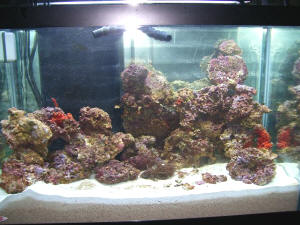
ill.> Attached is a photo of my tank, and the anemone. <Hope
this helps! Brenda> |
|
|
Yellow polyps +
Percula clown? -- 07/18/07 Hi there! I have a 30g reef. 2 Percula
clowns, one skunk cleaner, one small colony of yellow polyps, and one
small colony of green star polyps. Recently the smaller of the two
perculas has taken residence in the yellow polyps. <Happens> He
has developed three black spots, and one of his eyes is a little bit
darker then the other. The bigger clown is perfectly fine. Can the
polyps be effecting him? <Possibly, yes... and can/could mal-affect
the water quality period... Effect all more indirectly> Parameters =
Ammonia=0 'trites=0 'trates=0-5 temp=78 salinity=1.025 phos=0
calcium=425-450 <Please read here:
http://wetwebmedia.com/polypcompfaqs.htm and the linked files above.
Bob Fenner>
Coral Host for
Clown 7/17/07 Hi WWM, <Hi Mike, Mich here.> I am
looking to add a second fish to my system, since I added my firefish a
couple months ago. My tank is 36 gallons with a 5.5 gallon refugium
underneath my tank, and with 45 pounds of live rock. I was considering
adding a Percula Clown, either orange or black. My tank is not very
suited for an? anemone, the lighting is T5HO and the tank is 7 months
old. <I would highly recommend avoiding an anemone. Your system is
much too small and these animals can be real problems in my opinion.
These lovely creatures really do best in a species tank with an
aquarist dedicated to their care.> I have a trumpet coral, and some
mushrooms (frilly and hairy). What type of coral could the clown
possible host off of, or just use as a safe haven or home? <There
really is no need for the clown to have a host in captivity. Some
clowns will host in other corals, but some clowns won't host in the
anemone they are supposed to host in. All depends on the individual
fish. More here: http://www.wetwebmedia.com/clownfis.htm > I was
looking to put it on the opposite side of the tank, since my firefish
has his rock or hole he normally spends his time around, and I
don't want any aggression happening. <I don't think
you'll have problems here.> Any suggestions <Clowns will
sometimes host in other corals, the families Trachyphylliidae and
Caryophylliidae are quite common, but again this really is unessential
in captivity.> Thanks <Welcome! Mich> Mike
| Crab ID and Clown/Anemone Question --
07/03/07 Crew, Sorry to lump two different subjects in the same
e-mail, but thought it would save you some time. I purchased 65lbs
or live rock (50 lbs Fiji/Marshall and 15lbs Florida) about 5
months ago. In the last week or so, I noticed two crabs that
hitchhiked in. My face is pressed against the glass every night, so
I'm really surprised I haven't seen these crabs until
recently (although my tank is 110g). I have attached pictures.
I'm pretty sure the first picture is of a sponge crab, genus
Schizophrys. It is pretty small and is covered with pieces of
orange sponge. The second two pictures are of the same crab.
It's hard to get a good shot of it, but it is pretty small
(maybe 1/2") and relatively flat with hairy legs. It's
claws are pretty small. I've searched the web and WWM but
can't find a picture that looks like either of these crabs. My
closest guess on the second is the Schizophrys aspera. <Appears
to be...> Should I remove these? <Mmm, not yet> Currently,
I don't have much in the way of fishes or inverts. One gold
banded maroon clown, one BTA, two cleaner shrimp, a pretty good
sized clean-up crew, and a sailfin tang in QT. I intend to stick
with smallish fish (but not tiny) and some soft corals. When I
bought my clown, he was loving life in a BTA. Since I've had
him, though, he's spent much of his life in a hospital tank
while my display went fallow for 4+ weeks. I recently introduced
him back into the tank and he shows no interest in my BTA.
<Takes time...> My BTA is tucked under a rock at the bottom
of the tank, but definitely visible, flowing, calling out to his
friend, but the clown seems totally uninterested. I find this
strange since he was in a BTA when I purchased him. I would love
for them to have a hot, lovely relations. Do clowns find anemones
by scent, sight, some combination of the two, or none of the two?
<Good question... I don't know... perhaps a bit of both...
It is known that the fish DO communicate with the Anemones
chemically> Are clowns fickle, or can it take weeks or longer
for the clown to settle in and accept a BTA? <I suspect both...
plus a bit autistic... have short memories...> As always, your
thoughts are appreciated. Andy <Welcome. Bob Fenner> |
A suggested corr.
<Hexacorallians of the World> 7/2/07 Dear Bob, Thanks
for finding that! It is people like you who keep us honest. <Always
glad to add my dos centavos> Hexacorallians of the World is built
exclusively from the published literature -- nothing is original with
me except for what I have published. <It is a wonderful tool. I
thank you for your efforts> When I went into the guts of the
database to search for the source of this record (I employ
undergraduates, mostly, to enter data, and they sometimes select the
wrong name), I could not understand the logic of that particular part
of it. My systems administrator is on vacation at the moment -- as soon
as he returns I will track down the source of this record and get back
to you on it (and correct it if it does not accurately reflect the
publication). Sincerely, Daphne <Real good... BTW, do you collect
corrections to you and (Gerald) Allen's "Clownfish and
Anemone" tome? There are a sprinkling of errors, disagreements for
instance with the posted known symbionts there and your URL. Cheers,
Bob Fenner, WetWebMedia> Daphne G. Fautin Professor, Ecology and
Evolutionary Biology Curator, Natural History Museum and Biodiversity
Research Center University of Kansas website www.nhm.ku.edu/~inverts
Suitable clown --
06/28/07 Hi, In my 130 gallon tank, among others, I've kept a
pair of Ocellaris and E. quadricolor for over 2 months, but Ocellaris
would not host the anemone. <Happens... maybe later> So I've
been thinking of adding another clown that would be more likely to host
the anemone. <... better not to mix clown species...> Which clown
would you recommend for that? (after reading those comments on FAQ, I
am afraid to buy the readily available Clarkii's and Tomato's)
Thanks, Andrius <Please read here:
http://www.wetwebmedia.com/marine/inverts/cnidaria/anthozoa/anemones.htm
See the chart re naturally occurring relations? These are better bets.
And read the linked files above re Clownfish and Anemones. Bob
Fenner>
Will a Clown Host
in Button Polyps? Maybe 06/08/2007 Dear Crew <Hello Tuscan, Mich
with you tonight.> First let me start by saying how much you have
helped me with my freshwater tanks. Without your wonderful website I
don't know where I'd be. <Glad you have enjoyed the website
and found it helpful.> I was hoping for your advice with a question
that I have concerning a saltwater tank. I am hoping to start a 20 gal.
long saltwater aquarium with a pair of tank bred ocellaris clowns, 2
skunk cleaner shrimp, and possibly 1 tank bred neon goby. I realize
that clownfish don't need a host anemone but I would still like to
see them hosting something. I also realize that anemones are difficult
to keep for even an expert so I was thinking I would get a coral
instead. I have read "Clownfishes" by Joyce Wilkerson and was
ready to choose frogspawn as a surrogate host but then I walked past
some button polyps and became increasingly interested in them, but I
have been unable to find any information on clownfish hosting them. My
question is simple, would a tank bred ocellaris clownfish host button
polyps or should I get frogspawn instead? <A difficult question to
answer. Kind of like offering a hungry vegetarian a steak or lobster
dinner, you never really know what they might pick or the meal may be
outright refused. My guess is the clown would be more likely to host in
the frogspawn. But if you really like the button polyps give it a try.
You might get lucky. In the same respect some clowns don't host in
captivity, so even if you placed the frogspawn or anemone for that
matter, it doesn't mean the clown will form a symbiotic relation
with it. It is hit or miss, even more so with captive bred clowns as
many have not observed this behavior.> Sorry for such a long letter
and thank you for your input. <No worries! Hope this helps. Mich>
Sincerely, Tuscan Thompson
|
Re: Tank Upgrade, Critter ID and
Clownfish Question. 5/24/07 Hi
Justin and all at WetWebMedia its Ben here from the UK, I hope
you have had a good Easter and haven't eaten too many
chocolate eggs. <I didn't even get one!> Am not sure if
you recall me saying that I am looking to upgrade my 45litre tank
to a 3ft 100litre tank at the end of the month and after looking
at the FAQs about upgrading I thought I would just run past you
how I plan to make the change. I think I am going to set the new
tank up in its new space and fill it up with about 60 litres of
bought salt water and leave it overnight to warm the water to as
close to the main tank as possible. How does this sound so far?
<I would actually first fill it with freshwater only... to
test for leaks, levelness, hook up all the gear, make sure
it's functional... leave this go a day or two...> My next
question is in regards to substrate. I currently have 20lbs of
CaribSea live sand in my main tank and am wondering if it is
worth buying another pack of the same sand to place in the new
tank or should I just buy plain marine sand and then seed it with
the established substrate? <Either one...> How much would I
need to add to the new tank? <Posted... read here: http://www.wetwebmedia.com/marine/setup/index.htm
scroll down to the greenish line... on Marine Substrates> Once
the water in the new tank is at the same temperature as the main
tank I intend to start adding water from the old tank to fill it
up, before doing this would it be best to add all of the live
rock or is it best to fill the water up and then add everything
all at once? <... also posted... Please learn to/use the
indices, search tool> My LFS has said that it is best to add
everything all at once, they have also recommended that I
purchase SeaChem stability and SeaChem prime to add to the new
tank for the first few days, does this seem ok? <Sure> Once
everything has been added to the new tank I would like to
purchase more live rock, I think I will gradually add 1 small
piece every 1-2weeks just so that it will hopefully keep any
spikes to a minimum. I think those are the only questions that I
have regarding the tank move, if I have missed anything important
out please let me know. <Just reading... there is much
ancillary/related material you will encounter by investigating
thus.> I feel I should mention that I am going to be using the
same AquaMedic BioStar flotor from the main tank so hopefully the
bacteria will still be present. My next subject (sorry about
this) is in regards to a naming a creature that I have found on
my live rock, Am not sure if you remember me saying about this
creature in my first emails (it resided directly below my leather
toadstool) I have hopefully attached a picture of it for your
perusal, at present it does not seem to be causing a problem, am
fact I quite like the little guy, under actinics the tentacles?
fluoresce a nice green colour. <Mmm, looks to me like a
Zoanthid> Lastly I have one other question for my own interest
really, its nothing serious its quite amusing I think, have you
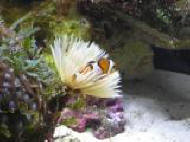
ever known a clownfish to host a feather duster? <Yes> As
mine has decided that he likes to sleep and wriggle inside the
head of my white feather duster, he loves it. Is there an
explanation for this behaviour or do I just have a really
friendly clownfish :). Again I have attached some photos for you
to see. <Are close symbionts in the wild... or consumed...
with Actinarians... look for substitutes in captivity> I thank
you again for all of the help that you have given me over the
last 6 months and I hope you can help again. All the best to you
all Ben Sandford
<Be chatting, reading... Bob Fenner>
|
|
|
| Clownfish disease - Brook?
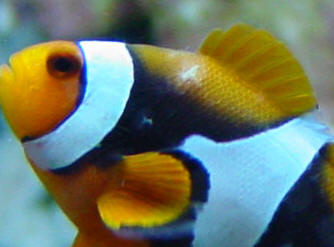
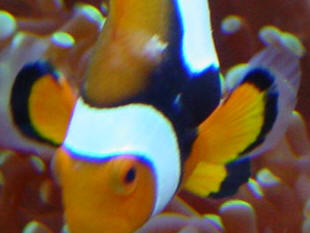
5/12/07 Hi Bob, <Kari> I got a new pair of true perc
clownfish last Thursday (5/4/07). <... these appear to be
wild-caught (as opposed to tank bred and reared) specimens...>
On the following Tuesday (5/8/07), I noticed the male has this
strange lesion on the upper half of his body (see photos attached).
He was swimming, eating, and breathing fine though. I wasn't
sure what it was (could be a sting from the frogspawn they hosted
to? <Yes> Could the female be nipping him? <Not likely
from this appearance> Could be a disease?). I thought I'd
wait to see if conditions worsened. <Maybe> Today, Friday
(5/11/07), I noticed the female had 3 spots on her as well. See
attached photos. However, they are both still swimming,
acting, breathing, and eating normally. <For now> I'm
concerned it is Brooklynellosis, but from what I read, it sounds
like if it was, the fish would be breathing hard, lethargic, and
the male would be dead (or close to it) since its been 3 days.
<Sometimes takes a while to "take hold"> I had a
hard time finding photos online of various marine diseases. Does
this look like anything to you? <Does appear these two are
"breaking down"... not able to discern if this is
subsequent from capture/holding/shipping, the interaction you
mention with the Euphylliid in your tank (likely), or parasitic at
this point> The areas in question are white, swollen (or bumpy),
and sometimes have a stringer coming out of it (looks like flesh).
Thanks! Kari <... Am in the process of re-sorting the 15
Clownfish Disease FAQs files... into quite a few categories... for
ease of review by browsers... First, you are to be admonished for
buying non-captive produced stock here, secondly... no quarantine?
(You'll learn, are learning), lastly, a referral to WWM:
http://www.wetwebmedia.com/clndisfaqs.htm and the linked
files above, so you can make up your own mind re how to proceed
here. Bob Fenner> |
| Re: Clownfish disease - Brook?
5/13/07 Thanks for getting back to me.
<Welcome> You mentioned below that this might likely be an
interaction with the Euphylliid in our tank (the frogspawn they are
"hosting" to). This morning I woke up and the female now
has torn pectoral and the back half of her caudal fin is really
thin and has a hole in it (see attached). I am beginning to think
this might be a bacterial infection <Rare as first order courses
of disease...> instead of Brook, or could this still be a result
of the frogspawn? <Oh yes. Associations with "usual"
Actinarian hosts as well as other cnidarians takes some time,
effort to develop... the Euphylliid is very likely stinging,
burning the heck out of the clowns presently> They are still
acting normal, for now. The LFS I bought from said they quarantine
their fish for 2 weeks. Sigh. I know now not to trust and always
best to do it myself. <Yes> I will set up a hospital tank
today. I still can't tell though if I should treat for Brook w/
formalin or with an antibiotic though. Any suggestions would be
appreciated. Thanks for your time. Kari <I would not
"treat" with formalin... but might try the/an antibiotic.
Do be aware (and test for nitrogenous accumulation) of the
disposition for these to subtend nitrification. Bob Fenner> |
|
|
Maroon Clownfish Beating up
LTA -- 5/6/07 Well I have a 36 gal that is my second
tank. It houses a Maroon Clown 2 years old, a large long
tentacle anemone, (home to the clown), And a banded coral
shrimp. Nitrite, nitrate, ammonia are all at
zero. PH 8.3, Salinity 1.023. <Salinity is a bit low for
an anemone. I recommend gradually bringing it up to
1.026.> Well the last few times I have done water changes afterward
the clown gets crazy and starts ramming the anemone all over the tank
and into the live rock. <Ouch!> The anemone will close up and
turn a sort of green color and he just doesn't look good. <I can
imagine.> Eventually this will cease but it seams like the clown is
getting worse and worse each time. My question is, is this
normal or is he going to kill my anemone soon? <Quite
possible! Maroons are well known for abusing an
anemone. It is recommended that the anemone be at least 3
times larger than the clownfish. How long have you had the
anemone? Is it healthy? I suggest separating the
anemone from the clownfish until it gets much larger. I
would also increase the feedings to get it to grow faster.> Please
help. Thanks for a great page <You're
welcome! Brenda>
Can a clownfish be too big for
an anemone? Yes. -- 4/28/07 I recently purchased a RBTA <Rose
Bubble Tip Anemone?> that is about the size of a golf ball. It
appears to be doing well in my tank, and my very small F.P. <False
Percula?> clown has taken up residence. I also have a larger G.M.
<can't figure this one out -- something Maroon?> clown
(approx 1 1/2"-1 3/4") in my tank. The G.M. clown (Cletus)
has never been aggressive to the F.P. clown (no name), and even allows
him to be the main resident of the anemone. Cletus does however feel
the need to at least visit the anemone every time he swims by. He will
lay down in it or "wallow around" for a minute or two and
then leave. He is about the same size as the anemone head, and the term
"bull in a china cabinet" is fitting. Is this damaging to the
anemone? <Yes, this can be damaging.> How can I tell if the
anemone is being stressed? <If it does not fully extend as normal,
or does not continue to appear to do well. You may need to
separate them until the anemone grow more and has a chance to settle
in. http://www.wetwebmedia.com/marclnbehfaqs.htm http://www.wetwebmedia.com/btadisfaq2.htm Also, please
don't abbreviate except for easily recognized terms, or at least
spell it out once. I still can't figure out what a G.M.
clown is. Cheers, Alex>
Anemones and Clown Fish..
host/symbiont def.s 3/16/2007 Bob and Crew,
Not a question, more of a comment brought on by
my ADD. In the Clown Fish/Anemone Relationship, the Anemone
is the Host and the Clown Fish is the symbiont. It just
drive me crazy to read that "My Clown Hosted the BTA". Thanks
for letting me vent Roy <Heeeee! Okay!
BobF>
Clown fish Digging to
China -- 03/09/07 I did a Search of the data base, and
saw very little mention of my problem. <Hello, Brandon here
tonight.> I have a yellow striped maroon clown, and a BTA in a 125g
tank.<Hope you matched the clown to the anemone.> I
have 5 inches of sand, and the tank is reef on right and reef on left,
open in the middle. <Sounds like a nice set
up.> This is where the clown and BTA
occupy. My problem is, the clown has dug a hole, to the
bottom of the tank (Glass), and keeps pushing the BTA into the
hole. <If you want to keep the anemone you need to take
the clown out pronto.> I'm not sure if the BTA is
happy there, <They like to go where they want, without an
over amorous Clown Fish shoving them to and fro.> and if he
wasn't, it would be hard for him to move to a spot he likes better,
due to the Clown pushing him to and fro. <Yes it would
be.> Is this normal behavior? <Not really, it does
happen in aquariums though.> If I add a male clown of a
smaller size (the one I have now looks to be female (larger and dark
maroon)), would that pre-occupy her?<No, please see above, Re: Get
the Clown out now.> Can I place large base rock under the BTA? or
from your experience, would the clown just push the BTA to another
sandy spot? <Take the Clown out, and give the BTA a
chance to settle down where it likes. After a few weeks, try
reintroducing the Clown. If it is still harassing the BTA,
then take the Clown back to the store, and try another one, or move the
clown to a separate tank, and enjoy your Clown less
Anemone. The truth is, in captivity Clown Fish tend to do
more harm than good.> Hope you have a suggestion. <Please see
above. Brandon.> Scotty
SICK maroon clown, please
help. 2/23/07 Hello: <Hi there> I
just realized both of my maroon clown fishes are sick. They eat ok
and all, but there are white stuff growing on them. It is not ICK.
I have ick in the tank, but that is not what this is. I have photo
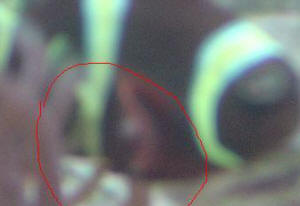
of their spots. The spots only appears under the pectoral fin. If
the fishes hold the pect fin to their body, you will not see
anything. <Appears to be a "reaction" to something...
your pix are very blurry... but this looks like aggregated
"slime"... from... toxicity due to?>
There are 2 other fishes in that same tank,
but they are not showing those spots at all. The white spots are
too big to be ick. It almost look like the spot came
from underneath their skin. <Yes> If you have seen this,
please help. Yili
<Have you put chemicals of some sort in this system? Bob
Fenner> |
| Re: SICK maroon clown, please help.... and host
beh. 2/24/07 I really appreciate the
answer. I am not very good at taking photos, those 2
pictures were the best of the 40+ pics I took. <Mmm, take a read
through the manual you got with the camera... I carry mine along on
trips... and am continuously surprised (and delighted) to learn
here> I have not added any chemical in the water at
all. The only change in that tank is the removal of
their RBTA. <Ahh!> The light was not good for the anemone in
that tank and I moved it to my other tank. I put a
trumpet coral in there. The clowns are hosting in it,
<Another ahhhh!> I was wondering if that is what's
bothering them. <Very likely so... one, the two
"blame" each other for the loss of "their"
Entacmaea... next, a more toxic substitute is working them
woe...> I will observe them for a couple of days, I started to
soak their food in garlic juice. <... not efficacious> If
things look worse, I will get them out and medicate
them. I have the medication called proze pro,
<Prazi... also not useful here> I think if what ills them is
parasitic or fungi in nature, the meds will heal them. Have a nice
day. Yili <I'd move one or both to wherever the RBTA is, or
fix the previous system and return it to them... Bob
Fenner> |
|
|
Clownfish No Need for
Anemone. - 02/21/07 Hello I am a 15 year old just starting my
own tank. <Hi Ryan, welcome to the briny world, Mich here with
you.> It's a 29-gallon salt-water tank. I
successfully cycled the tank with 5 pieces of live rock getting plenty
of growth. I also have 4 hermit crabs and two snails. I just picked up
a Chromis and a yellow belly damsel at the LFS this weekend and they
seem to be doing great. If these two stay healthy for another week or
so I would like to purchase another fish. Which FINALLY
brings me to my question. I have read up on clown fish and would like
to get one for my tank. But as this being my first tank I would like to
steer away from the anemone. <I think you are most wise here my
young friend. These creatures can cause many a problem.>
My question is will the clown fish still be content/happy in this tank
without an anemone. <Most certainly. There is no need for
an anemone.> The only reason I ask is because I don't want to
have a stressed out fish because it doesn't have proper living
situations in my tank. <Many clownfish are captive breed, meaning
they have never lived in the wild and most likely have never seen an
anemone. This would be an excellent choice for your tank and
should be relatively easy to find.> Thanks again.
<You're welcome! -Mich> -Ryan
Re: Clownfish No Need for
Anemone. 2/22/07 <Hi Ryan, Mich here.> Thank you
very much, and to be honest I was hoping that was your answer because I
really want a clown. :] <You're welcome!> Sorry to nag but
just one more question, for the two fish in my tank currently I am
feeding them brine shrimp and some pellets brine at night pellets in
the morning. Anyways both foods tell me to feed them at least 3 times a
day. Is this like the "rise and repeat" on the back of the
shampoo bottles, or is 3 daily feedings really necessary? <Depends
on the fish, not the food. I would recommend something
besides brine shrimp, which isn't very nutritious. Many
like New Life Spectrum brand food, some folks even make their own
food! But as a general rule small frequent feedings are
preferred to large single feedings. Three times a day is not
unreasonable, just use a very small quantity. More here:
http://www.wetwebmedia.com/feeding.htm http://www.wetwebmedia.com/ca/cav1i3/Progressive_Recipe/Progressive_Recipe.htm >
Thanks again and sorry to be such a nag. <No worries, not a nag,>
Ryan <Cheers! -Mich>
Double anemone hosting
2/19/07 Hi WWM Crew! I have been using your site for a
while since i am fairly new to the hobby, but i have one question
that i can't find an answer to on this site. I have a rose BTA
and just a regular brown BTA. i just barely got what the LFS said
was a mated pair of Maroon Clowns. They are gorgeous! Well, after
one day, the female started snooping around in the Rose BTA and
after about 10 minutes just fell in love with it! Then she
let the male in and they were so cute hosting together in the Rose
BTA. Well, the next day I woke up and everything was cool, i went
to work and came back, and the Rose BTA was a shriveled up
from going to the bathroom, and they were hosting the other
regular brown BTA. I thought to myself, oh how cool! They are
hosting both anemones! i thought that they might get into some
sort of cycle and go from one to the other, but when the Rose BTA
bubbled up again she couldn't make up her mind, she went back
and forth and just went from one to the other. It looks like she
finally decided on the regular brown BTA, since i think that its a
little bigger and she fits more inside of it, but now the male
wont host in it with her, he hosts the Rose BTA by himself! Is
this bad? Will they still like each other and maybe some day have
babies? Or will they avoid each other and just host their own
anemone's? Also, i just set up a new 175 gallon reef tank, i
have a sump and lots of Rios going through making good current,
its been a week cycling, i put in some bio-Spira, about 100 pounds
of cured live rock, some rubble from another well
established decease free tank, and some water from the same tank.
I have a current lighting system with three 150 watt metal halides
and those other fluorescent lights. About three days after adding
the water, gravel and live rock, i came home one day to find that
half of the live rock and the top of the sand was all covered in
this brown/ maroon covered algae! it was everywhere! what is this
stuff? how do i get rid of it? I think that its a type of
algae, will it go away, turn into another type of algae? or is
this just part of cycling? My ammonia after one week tests 0 ppm,
nitrites are 0 ppm and nitrates are about 15 ppm and ph is about
8.2- 8.4. Any help would be greatly appreciated! Thank you so much
for your help! Chris. <<Chris: I have 2 species of
clowns that regularly move back and forth between 3
anemones. Usually, however, each clown has its favorite
anemone to sleep in. If they have mated in the past, they
are likely to mate again. If you want to learn more about
breeding Clowns, take a look at these WWM pages http://www.wetwebmedia.com/clnfshbrdfaqs.htm I suggest you
consider buying Clownfishes by Joyce D Wilkerson. Regarding your new
175 tank, the brown stuff is most likely diatoms and the reddish stuff
is most like Cyano algae. Both are common in new
tanks. As your water parameters stabilize, they should
minimize. Cyano tends to build up in areas of low
flow. If you haven't added one already, you should now
consider getting a cleanup crew for the tank. I mostly use
different types of snails and Asterina starfish. Best of
luck, Roy>>
Clown Hosting
2/14/07 Hi <Hello.> First let me say I love your site and I
have found some very useful info there. <Great.> I recently was
given some new fish to add to my tank, one of which is a beautiful
maroon clownfish. My question is I wanted to get a bubble-tipped
anemone for him. What is the best way to introduce the two? If I buy
one will the fish just naturally go to it? Thank you
for your help! <There are no guarantees that the animal will take to
the anemone, especially if it one that was reared in captivity. Only
time...patience will tell.> Egan Koenig
<Adam J.>
| Clownfish in danger?
2/12/07 Hello Crew, <Lisa> I have a specific
issue (by way of a story) that I would like to present to Bob
Fenner (if possible) who had addressed the member below (I cut and
pasted his email as a reference so allow me to apologize ahead of
time for such a lengthy message). By the way, Bob, for
Valentine's Day my husband is gifting me your book, which I
requested months ago. <Heeee! How romantic!> I cannot wait to
read it cover to cover...... <Am sure you will enjoy, gain by
its perusal> Anyway, I had an unfortunate incident with a small
Puffer Fish munching on and subsequently killing my big, beautiful
Long Tentacle Anemone. <Yikes... happens all too often... twixt
Puffers, Actinarians> My Seabay Clown, Sassy, has had several
small LTA's and one Seabay Anemone who all eventually passed
due to poor quality lighting. <Ditto> After investing heavily
in a really nice metal halide set-up I felt secure to purchase the
lovely LTA (the poor creatures demise already
stated). When I removed the poor, dead, slimy thing my
devastated Seabay was still clinging to it and had to be flicked
away with my finger. She then went into a phase of
grieving that made it the third saddest animal/death incident I
have ever witnessed (the first two not fish
related). Sassy started to wildly circle the area where
the LTA had been rooted. She then started to nuzzle into
the crushed coral as though it was still there. Thinking
of a distraction I decided to feed her and the rest of the
tank. The poor clown was grabbing up the food, not
eating any of it, but rather dropping it off to one of the my
cleaner shrimp. She then started to nuzzle up against
the same shrimp (which, of course was thrilling to the shrimp, but
sad to witness nevertheless). I had never seen her
respond this way to any of the other anemone deaths and felt that
this fish was sufficiently stressed and that I needed to take some
action. I went immediately to my LFS to see if
they had any new long tentacle anemones. They only had a
small one that didn't look too healthy and I wasn't going
to see another LTA turn to mush in my tank! However, the
ATLANTIC Anemone looked marvelous and for only ten dollars I
thought it was worth an experiment. <Mmm... well... can work>
After all, the poor Seabay is feeding and rubbing up
against a shrimp!.....So I purchased the Atlantic
Anemone. Upon placing it in the tank Sassy swam up right
away, circling it and defensively chasing off the other
fish. When I put food in the tank she also fed
it. I thought she was going to dive in but she only
hovered over, taking little nips at the ends of the tentacles then
quickly swimming off. She then started picking up small
pieces of crushed coral from the base of the creature in her mouth
and carrying it in a circle around a big piece of live rock, then
dropping it down next to the Anemone exactly where she had picked
it up. She began fanning away crushed coral from its
base in quick swishing motions of her tail (exactly what she did
for the previous creature). She almost dove in a few
times and then stopped. <Yes... there is a sort of known,
"fixed action pattern" for Amphiprionines/Clowns
"getting acquainted" with intended host Anemones> I
observed that she was rather obsessed with the thing and thought it
would be interesting to see how the drama unfolded over the next
several days. I had read that the clown fish can
sometimes be fooled into crossing over to the different species and
thought that this might happen with my very needy
fish. Sure enough, when I looked in the tank after
"lights out" Sassy was snuggled into her new
companion. Several weeks later, the two seem to be
inseparable, although I notice at night, she sleeps next to it, not
actually in it. All that being said, I felt very
disturbed (and moved to write in) after reading the trials of Randy
(below). Bob, you seem to be in agreement so here's
my question..... Did I just "luck out" with the pairing
of these two or will this relationship (at some point) turn ugly?
<Not likely to turn... but become more firmly established>
Also, I don't actually know if this Atlantic Anemone is a
Condylactis. Could it be a different, more harmless
species that I need not worry about? Please give me your
thoughts. Thanks, Lisa <Would like to see a photo before
rendering an opinion... Thank you for sharing. Bob Fenner>
Condylactis and Captive Clowns Greetings Bob, Anthony and
crew. I am writing not with a question, but to share some
observations I have made regarding captive born clowns and
Condylactis anemones. I am hoping to clear some confusion some
readers might have about the notion that captive bred clownfish
will take on almost anything as a host, and that Condylactis being
cheap and easy to care for would make a good host. <I have
stated... many times... a few decades back that this mix (though it
can happen in captivity) is ill-warranted... and often leads to
trouble (as in ingestion of the Clowns, death of the anemone)>
In general, Condylactis do not host clownfish. In aquariums,
Condylactis anemones can be a threat to clownfish. Clownfish can be
an equal threat to Condylactis anemones. I have attempted to keep
two separate Condylactis anemones with my captive reared maroon
clown, with the same results each time... a dead anemone. (Resist
the urge to comment here and read on.) <Oops, okay> I have
witnessed my maroon clown take each anemone as a surrogate, a
somewhat commonplace among captive clowns from what my research
shows. In close observation of this relationship, it is easy to see
that this is by no means a symbiotic affair. My clownfish eager for
a safe host, instantly warms up to the Condylactis. The Condylactis
however, shows no shared emotions for the clown. The anemone
withdrawals tentacles touched by the clown, and exhibits a general
dislike of the clowns affection. Over the course of a
few days my clown becomes aggravated and forceful toward the
anemone. The anemone responds to the pushing and poking by becoming
more withdrawn, closing up for hours. The clown persists on any
given chance that the anemone is open. After a few days I find a
limp, deflated Condylactis with a torn foot on the bottom of my
tank. This is the second time this has happened to me. The first
time the anemone was torn closer to the outside ring of tentacles.
I would like to note that in both instances the anemones were on
live rock surfaces that may have had sharp areas, so I am sure that
the clown did not bite or otherwise intentionally kill the anemone.
The tear wounds were rather long unlike a fish bite or a hermit
claw, and consistent with having been rubbed against a somewhat
sharp surface. I theorize that some Condylactis may take a kill or
be killed attitude towards this abuse, and this could explain the
reports of clownfish being eaten by Condylactis anemones. After my
experiences I would have to disagree with Joyce Wilkerson's
suggestion that a Condylactis may be an acceptable surrogate for
Clownfishes. If readers must witness fish swimming through their
Condylactis anemone without being devoured, I suggest they ignore
clownfish altogether and go for a diamond blenny. Otherwise, forget
keeping the Condylactis and get a tank raised bubble tip. That is
assuming of course one has the proper equipment to care for it. If
anyone disbelieves what I have observed, I am sure I can repeat
this behavior and document it, though I would rather not risk
another anemone. To sum it all up, Condylactis + Clownfish = Bad
Idea. Readers be warned. -Randy <Thank you for your input. Bob
Fenner> |
| Re: Clownfish in danger? attention Bob
Fenner 2/12/07 Hello Bob, I attached a photo of the
Atlantic Anemone (hope this file size is not too
big/small. If the size is unacceptable please let me
know and I will resize and
resend). So? Condylactis or other? <Is a
Condy> Thanks for putting my mind at ease! <Welcome... the
example, old FAQ you sent was re a Maroon/Premnas... much more
"mean"...> Lisa BTW - Gifting of any aquarium items
for Valentine's Day is VERY romantic (according this fish crazy
person, anyway!) <Ahhh! BobF> |
|
|
|
|

