|
Related FAQs: Clownfishes, Clownfishes 2, Clownfishes 3,
Clownfish
Identification, Clownfish
Selection, Clownfish
Compatibility, Clownfish
Compatibility 2, Clownfish
Compatibility 3, Clownfish
Behavior, Clown
Behavior 2, Clown Behavior 3,
Clown Behavior 4, Clown Behavior 5, Clown Behavior 6, & Clownfish Systems, Clownfish Feeding, Maroon Clownfish, Maroon Clowns 2, Clownfish Diseases 1, Clownfish Diseases 2, Clownfish Diseases
3, Clownfish Disease 4,
Clownfish Disease 5, Clownfish Disease 6, Clownfish Disease 7, Clownfish Disease 8, Clownfish Disease 9, Clownfish Disease 10, Clownfish Disease 11, Clownfish Disease 12, Clownfish Disease 13, Clownfish Disease 14, Clownfish Disease 15,
Clownfish Disease 16, Clownfish Disease 17, Clownfish Disease 18, Clownfish Disease 19, Clownfish Disease 20, Clownfish Disease 21, Clownfish Disease 22,
Clownfish Disease 24,
Clownfish Disease 25,
Clownfish Disease 26,
Clownfish Disease 27, &
Brooklynellosis, Breeding Clowns,
Clownfish
Reproduction 2, Clownfish
Reproduction 3, Clownfish
Reproduction 3, Clownfish Breeding 4, Clownfish Breeding 5, Clownfish Breeding 6, &
Clownfish and
Anemones, Clownfish/Anemones 2, Clownfish/Anemones 3, Clownfish/Anemones 4, Clownfish/Hosts 5, Anemones & Clowns 1, Anemones & Clowns 2, Damsel Selection, Damsel Compatibility, Damsel Feeding, Damsel Disease, Damsel Reproduction,
Related Articles: Maroon Clowns, Brooklynellosis,
Damselfish,
Anemones,
Premnas Pix,
/The Conscientious Marine
Aquarist
The Clownfishes,
Damsels of the subfamily Amphiprionae, Part 1
To:
Part 2,
Part 3,
Part 4, Part 5,
Part 6, Part 7,
Part 8
|
|
|
By Bob Fenner
|
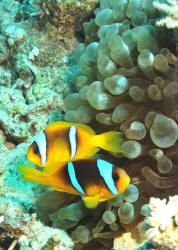
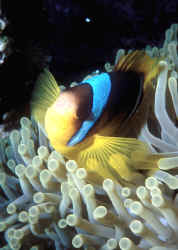
Amphiprion
bicinctus
|
"Oh my gosh! That plant is eating that fish!"
You know it's got to be a neophyte observing a member of the clown
or Anemonefishes subfamily Amphiprionae, in the Damselfishes family
(Pomacentridae), cavorting amongst the tentacles of a host anemone.
Prized for their bold and bright color patterns, comical
behavior, and ability to thrive in captivity, there is much
disinformation regarding the selection and care of clown-anemone
fishes. This sub-Section attempts to present straight-forward
information on how to be successful with the damsels we call
clowns.
Classification:
Is still a jumble. There are about twenty six valid
species, all but one in the genus Amphiprion; with one member in the
genus Premnas. These are further lump-able into four
"complexes". Ho-boy.
Unfortunately for aquarists, Anemonefishes are very
frequently misidentified in our trade/hobby, and share the same four or
five common names. Notable species, grouped by similar appearances
include:
1) Multiple-striped orange to tan to brown
clowns: Amphiprion ocellaris, variously sold as
"Percula" clowns from whom they can usually be distinguished
by the presence of thick black bordering on the white bars of the
"true" Perculas, .Amphiprion percula. Other similarly
marked species include Amphiprion clarkii, Amphiprion
bicinctus, Amphiprion chrysopterus and the rare
Amphiprion sebae ("C-bay"), more often than not a
misidentified Clarkii clown. Oh yes, and the tear-shaped, saddle-back
clown, Amphiprion polymnus, the Wide-Band Anemonefish,
Amphiprion latezonatus. There are others...
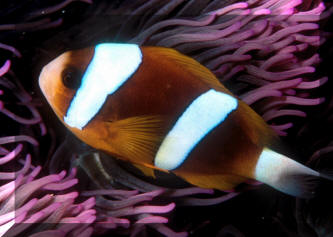
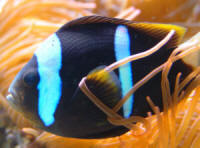
| Amphiprion akindynos Allen 1972, the Barrier
Reef Anemonefish. Great Barrier Reef and Coral Sea. To five inches
long. Similar to Clark's Clown but has wider white bars and
more consistent dark brown body color. In a Heteractis
crispa symbiont off of Heron Island, GBR, Australia. |
|
Bigger PIX:
The images in this table are linked
to large (desktop size) copies. Click on "framed" images
to go to the larger size. |
|
|
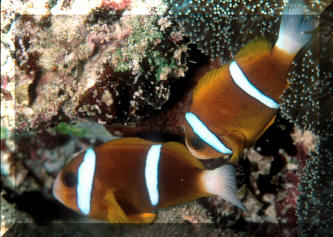
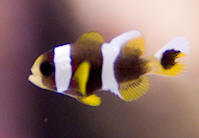
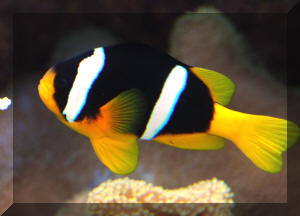
| Amphiprion allardi Klausewitz 1970,
Allard's Anemonefish. Similar to A. chrysopterus but with a
more pale tail color (to white) and widely separated distribution.
East Africa coast; Kenya to Durban. To five inches in length. Pix
of an adult and juvenile by Calvin Jennings |
  |
Bigger PIX:
The images in
this table are linked to large (desktop size) copies. Click on
"framed" images to go to the larger size. |
MD.JPG)
MD.JPG)
MD.JPG)
 |
| Amphiprion chagosensis Allen 1972, the
Chagos Anemonefish. Light to dark brown overall, with two narrow
white body bands, whitish tail. To four inches in length. Found in
the Chagos Archipelago and the upper Red Sea reportedly. |
No pic (got to keep my eyes open!)
|
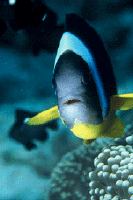
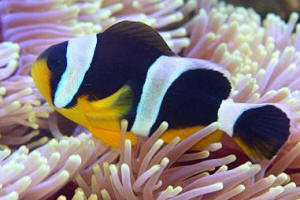
| Amphiprion chrysogaster Cuvier 1830, the
Mauritian Anemonefish. Very dark base body color, with yellow
underneath and dark tail. Confined to Mauritius and Reunion Islands
in the lower Indian Ocean. Photos by Christopher Waters and Marina
Peters. |
|
Bigger PIX:
The images in this table are linked
to large (desktop size) copies. Click on "framed" images
to go to the larger size. |
|
%20MD.JPG)
|
To:
Part 2,
Part 3,
Part 4, Part 5,
Part 6, Part 7,
Part 8
|
|


.JPG)
.JPG)
.JPG)