|
|
FAQs about the Clownfish
Identification
Related FAQs: Clownfishes 1, Clownfishes 2, Clownfishes 3, Clownfish Selection, Clownfish Compatibility, Clownfish Behavior, Clownfish Systems, Clownfish Feeding, Maroon Clownfish, Clownfish Diseases I & Clownfish Diseases 2, Clownfish Diseases 3, Brooklynellosis, Anemones & Clownfishes, Breeding Clowns,
Related Articles: Clownfishes, Brooklynellosis,
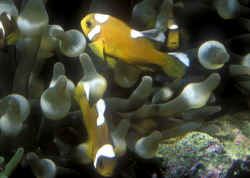
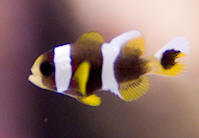
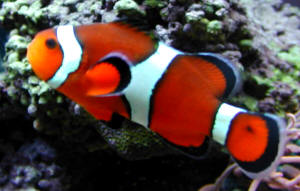
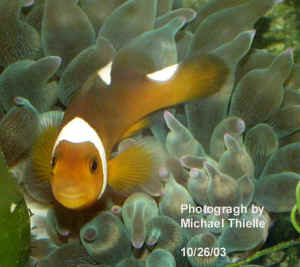
Some tank-bred A. polymnus in a BTA.
|

|
|
Aquacultured Clowns from Thailand
6/1/13
Bob
Take a close look at these clowns bred by the Thailand aquaculture
authority and let me know what you think.
<Percularis... cross twixt A. percula and A. ocellaris. Appear to be in
very good condition. B>
Perry
|
 |
Re: Aquacultured Clowns from Thailand
6/1/13
Bob
I was wondering why they bother breeding hybrids. Do they do better in
aquariums?
<Some do... this one is very hardy. B>
Perry |
|
Common Ocellaris or Percula? 4/26/13
I'm having a hard time identifying my new tank members. The LFS called them
Ocellaris. I'm not so sure they're right.
<I'd label this fish as a Percula... but it might be a cross... a Percularis
so to speak>
These fish seem a bit darker with thicker lines.
They don't hold still enough for me to count spines, and that's if they even
put them up!!!!
Help!!!!
Thanks so much.
<Welcome. Bob Fenner>
|
 |
|
Confirming Identification of Clown
9/7/12
Hello All,
<Hi Tom>
I am a long-time freshwater hobbyist (Malawi cichlids) and have recently
converted my 55 gal to a FOWLR.
<Nice.>
Have been enjoying and gleaning all kinds of information from your site.
Keep up the good work! To my question, I recently purchased two
juvenile "maroon clowns" from my LFS.
<Beautiful but aggressive.>
After doing some more research on your site and a few others I am pretty
confident that what I have are actually two black & white ocellaris.
<Somewhat difficult to confuse the two.>
Mainly I see no cheek spine on either and coloration and the forward
bulging middle band match what I have seen for identification of the b&w.
I attached a pic of one of them and was hoping to defer to your expertise to
confirm identification.
<You are correct on all points. I would think twice before taking any sort
of advice from said LFS. I'm at a loss as to how they could mistake your
clown for a Premnas>
Regards,
Tom
<Jordan>
|
 |
|
Re: Confirming Identification of Clown 9/7/12
9/9/12
Jordan
<Tom>
Thanks for such the quick response and confirmation. I didn't plan to
get maroons going in and was not familiar with their characteristics but
they were the most active/healthy looking out of the various clowns the
LFS had.
After doing my research (a little late!) on the maroons I am glad they
are not what they were labeled. Guess I lucked out as the green Chromis
in my main tank prob would not have liked their new neighbors.
<A little luck goes a long way.>
Thanks again,
<Anytime>
Tom Myers
<Jordan>
|
|
Just looking for an identification – 07/26/12
Is the clown Sebae or Bicinctus?
<I think the latter. See here:
http://www.wetwebmedia.com/clownfis.htm
Picture was taken in Fiji is why I ask. I have
owned a Bicinctus and they look very close. The mid body bar is
narrower on the Bi. The body is rounder on the Bi.
[frmReadMail_Attachment.aspx?folder=Inbox&uid=90411&partid=4&filename=image001.jpg&user=crew&mapped=False
]
Kind Regards,
Erik Hayes
<Cheers, Bob Fenner>
|
 |
<<Erik... summat kept bugging me re this image/Fiji...
got on the Net, took a look under Fishbase for A. bicinctus... NOT found in
Fiji (search under Island/Country... And having dived the islands there a
few times over decades... NOW think this is actually A. chrysopterus...
Sheesh! And sorry re. BobF>>
Re: Just looking for an identification – 07/26/12
Thanks Bob. What the heck is it doing in Fiji? I thought they
were only in the Red Sea.
<!? Of all the... just sent you a note/correction re... A trip this AM to
the Birch AQ/SIO gave me the "whack" I needed this AM... and perhaps mas
cafe! Cheers! B>
Re: Just looking for an identification – 07/26/12
Thank Bob.
Sincerely,
Erik Hayes
<Welcome... amazing; you'd think (I do) that after collecting so many
too-large Clowns from FJ that I'd be able to tell... Cheers, B> |
|
Clownfish I.D. 12/27/11
This clownfish was sold to us as a Picasso Clarkii in Phoenix,
Az.
<... what's in a name?>
The retailer took it in as a trade so I am unable to track down
any info on the lineage or original purchase info. Picasso
Clarkii's aren't exactly available, so I am curious about
the identity of this clown. I have already asked ORA if this
could be one of their 'Spotcinctus' variants and they
were unable to confirm, stating they thought it may be a
Bicinctus/Clarkii hybrid.
<Could be>
I plan on adding this clown to our broodstock and would
like to have a better idea of what species or possible
hybrid/variant he may be and a suitable mate for him. Any ideas
or educated opinions would be very helpful. The more I search,
the more questions I have.
Thank You,
Tosh @ The Clown Factory
<Mmm, your pix are too small, only a handful of Kbytes per...
Need one well-resolved image of moderate size to be surer...
However, the only real way to be assured of the genetic make-up
of this specimen is DNA analysis... not hard, or expensive. Bob
Fenner>
The Clown Factory
http://theclownfactory.com
|
|
Full size pic.
|
|
Clarkii? ID and Name of Mutation
2/27/11
Hello Crew!
<Renee!>
Thanks, in advance, for your expertise.
<Welcome>
I have acquired a pair of clowns, and I'm not sure what kind
they are, but I believe them to be Clarkii. I have never owned
Clarkii before.
The questions are: Can you tell me if the Female's mis-bar is
normal mis-bar or if it's a mutation? The ring and looped
stripe, to me, looks very unusual.
<Mmm, well, this species of Clown has the widest range of
natural colour and barring... this one is unusual still>
What would you call this mutation?
<Sure>
Are these indeed Clarkii? I have searched the site.
<I do think they are>
Is this a common mutation or more of a rare one or is it a
mutation at all?
<Not too uncommon>
They are a mated pair, brought to our local shop today, and I
couldn't resist them. I got them to host my Sebae and they
went right in. It is H. Crispa.
The purple one from earlier this month which Bob had fun IDing
with me. :)
Thank you in advance once again, for your expertise.
Renee
<Thank you for sharing. BobF>
|
|

|
| Amphiprion perideraion nee
pacificus Allen, Drew & Fenner, 2010, another
"new" species from the Central Pacific. This one in
Fiji. |
MD.JPG)
|
| Bigger PIX: The images in this table are linked to large
(desktop size) copies. Click on "framed" images to
go to the larger size. |
|
MD.JPG)
|
|
|
Amphiprion pacificus, mis-id'ed
2/12/11
I am pretty sure the pictures you have on the following page are
not of Amphiprion pacificus.
http://www.wetwebmedia.com/clnfishart2.htm
I have attached the original description to this email and you
can see that the pictures in the description do not have the face
stripe like the pictures you currently have.
<I do see the absence of the vertical>
I believe the pictures you currently have are of the Tangerine
Skunk, which is currently considered a variant of Amphiprion
perideraion*.*
Thank you,
Doran
<Thank you. Will correct. BobF, abashed>
|
Re: Identification, naming Clownfish sports, Percularis
repro.! 2/7/11
Hi there everyone at WWM !
<Hey Mich!>
This is just a follow up... we all type our "problems in need of
solutions" to you, lol.. so I thought it would be nice to
share a happy follow up. Here is the latest video to my
"Percularis" babies :)
http://www.youtube.com/watch?v=fgoAHpIWU-c
<Neato! I esp. like the piano accompaniment>
As from what Mr. Fenner stated in previous email - that the young dying
(may) be related to the cross of the ocellaris /percula.... here are
the details thus far....
Total larvae caught night of hatching: 22 (this clutch was a small
one)
Had 16 for quite awhile :)
Now - I have "9" happy baby clownfish, 17 days old today, I
am very pleased with this being my first successful batch, and the fact
that Mr. Fenner feels the survival rate may be affected by the type of
breed so to speak... then I am very happy to have 9 survive thus far
:)
They are on otohime A dry food - only. I will introduce the
Cyclops-eeze when possibly a bit older, don't want to
'jinx' my luck.
Just felt like sharing, as he was the one who gave his thought on the
type they were, and everyone who has heard this has sided with his
guess as well.... so Thank You Bob :) I will be calling my Mamma &
Pappa Clowns "Percularis" from now on :)
<Okay!>
(also recently picked up a pair of baby Picassos..... so will be
breeding them when they decide they are ready :) just curious, as they
are not "graded" ...purchased them from a LFS who did not
know the grade, and contacted the supplier themselves.. not able to
tell the grade... so how would I go about having this done when they
get old enough to breed? Is it the black lining/patterns that determine
the grade? )
<I don't know... maybe give a ring/email to the fine folks at
C-Quest and/or ORA re>
Thanks!
Have a great day everyone- again your efforts are appreciated -keep up
the good work!
Michelle Yingst
<Thanks; we're trying! BobF>
Re: Identification 2/7/11
Re: Picassos-Cool- will do .... have a Facebook friend from ORA I
recently acquired- will send him a few pics.
(these were purchased from Proaquatix by one of the LFS)
<Ahh, both good outfits in my estimation>
Re: the baby Percularis - Thank you again- hope to send another follow
up in about 6 months, lol...of happy healthy juveniles :)
<Please do>
Have a great evening :) Stay Happy & Healthy :)
Chelle
<And you. BobF>
Re: Identification 2/8/11
Ok- came across this on YouTube... question for the experts, lol:
What exactly is a Fudge Glazed Clownfish?
<Yummy, sounds delicious!>
http://www.youtube.com/watch?v=oQD4dtC_gNw&feature=related
This looks similar to what I have.... (my Percularis).... is Fudge
Glazed basically just a name someone came up with for their
'own' fish? Or is this an actual name that you know of, like as
in platinums... nakeds... etc?
<Exactly... these names are "made up"...>
Haha.. I kind of like the name ...but curious if it is real 'in the
clownfish world' , lol
Chelle
<There is only one Clownfish world... the human part is, as usual,
simply attempts at successive approximation to the truth of it. Cheers,
B>
Re: Identification, Clowns 2/8/11
Thank you again- as usual you are quick to reply, much thanks :)
I may think on the name in the future, lol...depending on how the
babies look :)
But as far as keeping records for when I apply for my aquaculture
license...I think I shall stick with Percularis... simple...to the
point... basic... like nature :)
<And us. B>
Re: Identification 2/27/11
Good evening to all !
Just wanted to drop a line, to thank you again for the input on the
previous messages.
<Ah good>
My Percularis babies are now 36 Days Old today (soooo
happy about this!)
Unfortunately, of the 9 that had survived..... I am now down to only 6.
But they are very strong swimmers, and seem to be good eaters.
<Good>
So cute the way they smooch their little faces to the front of the
glass when you walk up to the tank- they know it's feeding time,
lol!
Anyway- just wanted to include a pic I took of them this evening for a
friend on Facebook (Rod's Foods ) - and wanted to share with you as
well.
<Mmm, no pic attached>
I am still feeding Otohime A only- but will be introducing Cyclopeeze
in a week or two... to see their reaction to it. Not wanting to press
my luck
:)
Have a great weekend.
'Chelle
<Cheers! BobF>
|
clownfish ID 1/2/11
Hello again. Picked these up at the local fish store as a mated
pair.
They sold them as Dark Iron clowns but I can't find any info
on the web for this name. Can you let me know what the real name
is?
<Real? See here: http://wetwebmedia.com/clownfis.htm>
I love them and hopefully they will mate for me.
Thanks in advance!
Tammy
<Welcome. Bob Fenner>
|
|

|
|
Re: clownfish, ID 1/3/11
Thanks for the info. What I meant by "real" was what
kind of clown they were. Thanks again.
Tammy
<Both scientific and common names are posted where you were
referred to. B>
|
|
Identification, Clns. 1/1/11
Hello there (love you guys)
I am in need of your assistance / expertise please.
I am in the process of raising clownfish (still have the training
wheels on, learning as I go.)
~~~~~~~~~~~~~~~~~~~~~~~~~~
Just had a large batch hatch on 12/30/2010, several feedings of
rotifers throughout the day on 12/31/2010,
and when I tried adding a tiny, tiny bit of probiotics to the
rotifers (
http://www.practicalfishkeeping.co.uk/content.php?sid=2737
)
I went back for the next feeding and the entire batch was gone -
all dead.
(have you heard of any good things coming from using
probiotics?)
<I have not. Frightening... don't know what the connection
(if any) might be between these acts>
~~~~~~~~~~~~~~~~~~~~~~~~~~
Now for the ID part.... I will try to include a good pic of my
pair. I bought them 3 years ago, sold as "Common
Ocellaris" - a very small size, maybe an inch each.
(originally bought 3 but 1 did not survive the other two). They
are now close to 2- 2 1/2 in for the male and maybe over 3"
for the female.
I have thought all this time they were just "darker"
than others I see in the store, but someone told me that they are
NOT Ocellaris, and now I am trying to find out just what they
are.
I like to have everything in my records, and if they are
something else, I would like to correct my info.
They are mated (of course) - they are darker on the top half of
their bodies, with lighter bellies.
The male looks like a cross between the true black onyx and a
true percula (www.aquacon.com) his stripes connect and the female
looks like she could be a cross between the teardrop and a
percula (again www.aquacon.com ) as her bar does not connect and
is a teardrop shape- Not sure. When I try to
Google, thousands of photos come up, but no real description of
mine.
Any ideas or opinions as to what type they are I would
appreciate. Thank you.
Wishing you and the crew a Very Happy New Year!
Michelle Yingst
I can take a quick video and send it if it helps - thanks!
<I do think these fish are crosses...
"Percularis"...
Read here: http://wetwebmedia.com/clownfis.htm
and that perhaps the young dying is related to this cross. Bob
Fenner>
|
|

|
|
Re: Identification 1/2/11
Mr. Fenner
<Hi Michelle>
For starters - thank you for responding so quickly. Much
appreciated.
<Certainly welcome>
So...do you think that the young will ever have a chance? I am
determined to master the rearing - and have been following forum
members (Tal Sweet www.fishtalpropagations.com ) and Patricia via
Facebook (Booyah's Reef) (Sissy McAvoy/Facebook...and a
secret unnamed source at ORA...) trying to get advice/tips that
are not in Joyce Wilkerson's book, or that of Martin Moe.
<Good sources... and yes... I do know of such apparent crosses
producing viable young in turn. The first few "batches"
of Clownfish young by new pairs are typically ... fragile. I
would not be discourages>
I am hopeful - but you have the experience...do you feel this is
something (the cross breeding that is) that is going to
continuously cause me stumbling blocks?
<I do not know, but definitely hope not>
In past hatches I was able to get up to the 1st week post
hatch... then lost them.
<Mmm...>
What tricks of the trade do you know of off hand that will get
past this hurdle, to see if in fact it is (me and my newbie
raising skills) or if it is the mixed breed?
<Look into aspects of water quality, particularly
near-seawater strength Spg, AND doing what you can to bolster the
health of the breeders, through feeding, supplementing
foods>
I appreciate the feedback - and am THRILLED that you were the one
to respond, lol - although I love everyone's answers - the
WWM is a great source.
Thank you again - have a great evening :)
-Michelle
<Thank you! BobF>
Re: Identification, ID, repro. f's
1/3/11
Thank you again for the reply... I will continue to offer a
varied healthy diet to my brood pair, and I will continue to work
on the babies... if I have any success, I will send a follow up
email. :)
<Thank you>
Here is a quick link to my last hatch...12/30/2010, prior to my
adding the probiotics to the rotifers :(
http://www.youtube.com/watch?v=djxhkn3dSn4
Again, thank you for responding, much appreciated!
Have a great week-
Michelle
<Thank you Michelle. BobF>
|
|
Clownfish ID 12/13/10
Hi guys!
<Daniel>
Question here from the Marshall Islands. I know this isn't a
strictly aquarium related question, but I was hoping you could
help me out real quick. There's this clownfish (I've
ID'ed it that far at least :p) that I often see when I go
diving. I regularly dive this one spot, and I am sort of curious
as to what species this is. I can recognize most clownfish, and I
know that Amphiprion clarkii is supposed to stay a bit farther
west than the Marshall Islands, but something about this guy
(girl I guess with their hermaphroditism)
<Yes>
looks like a clarkii. It's probably just a regular old
Amphiprion tricinctus, and I'm used to seeing those, but I
was wondering if you could give me an opinion due to the
popularity of Clark clownfish in the aquarium world.
<Mmm, need a closer pic, more resolution. Could be a
Clark's, three-stripe... even a cross>
I'm sorry that the pic isn't too good, underwater
photography isn't my thing yet :(. Anyway, this is on the
outer reef slope on Majuro Atoll in the Marshall Islands. The
anemone is maybe about 20 feet down. Pics of this clown are kind
of hard to come by; it's the only camera-shy clown I've
met.
The third stripe (caudal stripe I guess you call it) continues up
onto the top of the caudal fin. It doesn't wrap all the way
around, just tapers off around the midway point of the tail. The
anemone doesn't show up too well, but I'm pretty sure
it's a Stichlodactyla or however you spell that genus.
<Is this... S. mertensii>
I've been Googling Clark clownfish and Three-stripe clownfish
but there's a lot of obvious mistakes, like pictures of
Premnas showing up as Amphiprion :) Poor guys.
Oh yeah, let me know if you guys ever travel through here.
Awesome diving around here :)
Regards,
Dan
<Thank you for sending this along Dan. Hope to see you in
Majuro. Bob Fenner>
|
|
Wrong Anemone for A. sebae
|
|
Clownfish ID 9/3/10
I got this clownfish about a week ago and am unsure of what
species he is.
The picture isn't the greatest so I will try to give you the
best description as I can.
http://i1011.photobucket.com/albums/af233/fursprizzle/Tank/082820100921.jpg
- His nose is yellow, and this yellow coloration extends onto
his
underside
and ends at the pectoral fins.
- The pectoral fins have some black at the base but are mostly
yellow
- The pelvic and anal fins are black and have some iridescent
yellow hues.
- His second stripe extends onto his soft dorsal fin.
- He has a third white stripe at the base of his caudal fin, and
this stripe extends to the end of the caudal fin. So the dorsal
side of the caudal fin is white, the majority of the fin is black
and there is a hint of yellow
on the bottom.
I have been trying to ID him since I got him and I think I have
narrowed it down to three species (even though I could be
completely wrong). I have been unable to find a clear source and
am having difficulties differentiating the 3 species.
1) A. polymnus (Unsure because his 2nd stripe is thinner and
caudal fin doesn't seem as round)
2) A. sebae (Unsure because of the third stripe and black pelvic
and anal fins)
3) A. clarkii (Unsure because his caudal fin is mostly black, and
he seems to have a more streamline body shape than the few
clarkii I have actually seen in real life)
<The Clark's Clown is my guess as well. This might be a
cross...>
It is difficult to distinguish the species due to the extreme
variation found in all of them.
<The Clarkii in particular>
Thank you very much for your help!!
-Katie-
|
|
Re: Clownfish ID, A. allardi
9/3/10
Thank you very much for your response!
<Welcome Katie>
I actually think I figured it out! The male on this thread is
almost an exact match to mine.
http://www.reefcentral.com/forums/showthread.php?t=968451&page=2
Thanks again!
<Ahh! Well, you are able to see what you have up close and
personal...
Thank you for sharing. BobF> |
|
Tomato, Cinnamon...Lasagna? -- 03/23/10
Good evening.
I purchased about 5 weeks ago these little dime sized clownfish
being sold as Tomato Clowns (Amphiprion frenatus), but after
seeing pictures of other Tomatoes and Cinnamon Clowns (Amphiprion
melanopus) as well, I'm a bit stumped. They seem to have the
broader bars like the cinnamon clowns but the coloration of
tomatoes I've seen. There were other fish in the tank at the
LFS that were in between the size of the larger one and the
smaller ones that had the fading of the secondary stripe which
I've heard is a tomato thing but not so much a cinnamon
thing. I am enclosing pictures of them with their BTA after
graduating QT. Can you help me identify this species?
<Mmm, judging simply on the basis of the width of the white
head bands, I'd say these are A. melanopus... however, as
generations of A. frenatus have been serially cultured, their
markings have become quite variable... Bob Fenner>
|
 |
Re: Tomato, Cinnamon...Lasagna? --
03/23/10
Thank you for your reply Bob.
I think some LFS name the fish Tomato because they get them as
"misc tomato complex".
<Ahh! A safe moniker. Both species are cultured in good
numbers... and it is entirely possible that they've been
crossed. Have encountered both with "aberrant"
markings... multiple to no barring...!>
I believe there were multiple species in the tank, mostly because
even though they were all similar in appearance, some of the fish
older than my 2 smallest had their secondary bars vanishing, where
mine don't have them present or faded at all. At worst, do all
three at least look to be the same species and that I will be
feasibly be able to form a pair from these juveniles?
<Yes.>
All this talk about tomatoes and cinnamon has got me a bit
hungry.
Thank you for your help.
Keith
<Heeeee! Welcome. BobF> |
|
True Percula - Black Onyx?
3/21/10
Hi!
I'm writing as I think that our two True Percula Clowns may
be Black Onyx Percula Clowns?
<Look to be the sports called thus>
When we purchased them nearly 4 months ago there was not much
black between the stripes but now the largest one has lots and
the smaller one is not far behind.
I have attached some photos taken today, I'm just concerned
as I would like to make sure that there is no other reason they
are turning black?
<Mmm, no. Genetics, developmental expression. No
worries>
Thank you in advance for all your excellent help and advice
Kind regards
Nicki
<Welcome! Bob Fenner>
|
 |
|
Re: True Percula - Black
Onyx? 3/21/10
Hi Bob
Thank you so much for your reply, it is very exciting -
especially as they were purchased as two 'regular'
percula clowns, to find out they are even more special.
Kind regards
Nicki
<An instant bargain again! BobF>
|
|
Clown id 3/5/10
Hi Crew!
<Sal>
Hoping you can clear this up for me and, presumably, thousands of
others.
I bought a pair of clowns, separately. They were both sold to me
as A. ocellaris.
<Mmm>
In the few months before I got the second, I wasn't sure if
it was an ocellaris or a percula. I did a fin-spine count to be
sure when I bought the second fish so at least they match. After
a little under seven months, they began spawning in January. With
spawn comes more research, and I'm more confused than I was
before. My research uncovered four different pictures and three
different spine counts for each species. I find it hard to
believe that so many online resources are confused and/or
conflicting.
Check out
http://animal-world.com/encyclo/marine/clowns/truepercula.php(aw-perc.jpg)
and
http://animal-world.com/encyclo/marine/clowns/ocellaris.php
(aw-fake.jpg)
and also slides two and three of
http://saltaquarium.about.com/od/anemoneclownfishprofiles/ss/sbstruevsfalsep
erc.htm(ab-perc.jpg and ab-fake.jpg). Several other sites have
these switched, and many online vendors are selling both fish as
A. ocellaris. So.... which is which?
<Am wondering how to put this succinctly: These fishes/species
are often mislabeled as each other, and there are numerous cases
of crosses/hybrids between them (and even other species of
Amphiprionines)>
Is there some type of identification search engine that you know
of? Would be a great thing... (hint?)
<Not comprehensive, no. Fishbase.org has the largest reference
system... to scientific literature, but this as yet is not linked
for free with the lit. itself... the journals, indexing tools
have to be paid somehow>
Not a great picture, but the last one is my pair.
<And these are obviously not the same species, cross either.
The lower fish appears to be a A. ocellaris, the upper some sort
of hybrid>
Obviously, the focus was on the eggs and not the fish. The male
has become quite orange, and the female has darkened considerably
since the first spawn. I will snap a better photo if necessary.
He was fanning the eggs and she was driving off the Sailfin,
<<That shows signs of advancing HLLE>>
so we had a lot of movement in addition to bad camera
angle.
Many thanks in advance,
-Sal
<I have a collection of crosses in this subfamily, some of
which are posted on WWM... Perhaps you can/will start an
"All Clown" site to expound on these questions, issues.
Bob Fenner>
|
 |
|
Re: clown id, www.breedclownfish.com --
03/05/10
Hi Bob-
<Hey Sal!>
Thanks for the in-depth analysis. The lower fish (male), which
you believe is an ocellaris, most closely resembles the
ab-perc.jpg image in my first email (the True Percula, according
to About.Com). I took a cruise on Fishbase.org (GREAT site --
works partially for free) and eventually linked up to a few
museums. A unanimous consensus among several authorities I chose
in the Indo-Pacific area agrees with your assessment of A.
ocellaris.
No doubt many are mislabeled -- apparently not in my case. The
upper fish on the other hand, because of her coloring, is closer
to the aw-fake.jpg
image. I'd say those two images could be color variants of
the same species. I'd also say the first and fourth images
look like two different species.
<Mmm, could be>
I am aware of the many hybrids (caught beautiful pics of some
moolaris on your site, btw!), but I disagree with your opinion
that the upper fish in my photo is a hybrid. I think she's a
color variant ocellaris.
<A possibility>
I'm getting viable fry from every spawn out of these two.
Also, as I mentioned previously, she has darkened since she began
to spawn. I've never heard of a fertile hybrid. I think
Darwin even forbids it, but I'm not sure.
<Oh, Darwin does not... assuredly. There are many such
"apparently between distinct species" viable
crosses>
BTW, there is an "Clown Breeding" site, which I've
just discovered recently at www.breedclownfish.com. There is some
great information about rotifers (never knew about them --
it's all so secret) and also a forum which is quite helpful.
I don't think there's an "Everything about
Clowns" site out there, but it does sound like an
interesting little (?) project.
<Heeee!>
Maybe after Spring cleaning you can remind me about it;)
Thanks,
-Sal
<Thank you Sal. BobF>
|
|
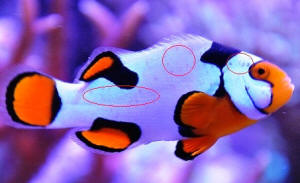
Clownfish has grey spots 1/25/2009
Hi guys,
<Donald>
Recently my clownfish has started having grey spots on her body.
Attached is a picture.
<I see>
Other than the spots, she seems fine. She has been eating
voraciously and swimming about. No labored breathing or change in
behavior.
The other clownfish I have doesn't have the grey spots
either. It seems that she only has these grey flecks on the white
portion of her body.
What is it? I don't believe its Brooklynella, correct?
<Could be a few things, but not Brooklynella no>
My parameters:
ph: 8.5
sg: 1.025
nitrite: 0
nitrate: 0
ammonia: very close to 0
<Most likely some aspect of water quality... like NH3... or
mal-interaction with a Cnidarian...>
I also did a 5g water change yesterday on the tank (34g).
Any insight would be very helpful.
Thank you,
Donald
<Read here: http://wetwebmedia.com/clndisenv.htm
and the linked files above. Bob Fenner>
Query pertaining to "grey spot" on clownfish
<id>, Bob's input 1/26/10
Hey Bob, and crew, hope everything is well with everyone! I must
first start by saying, as usual, a BIG thank you goes to everyone
here for making the marine hobby attractive and not rocket
science!! My question is simple, in the dailies yesterday {1/25},
there was a pic of a clownfish with apparent grey spots, tis the
neatest clownfish I've seen in a while.
Was this a "Picasso/true Picasso" clown?
<Yes; tis labeled so>
I couldn't find a real good match but the ORA sight had a few
resembling the one from the query. I know that no two Picassos
are marked the same but couldn't tell enough either way. Bob,
thank you for any input you can provide. I might want to
"repick" the type of clownfish I go with to whatever
this was. Hope everyone has a great day.
Jeremiah
<And thou. BobF>
|
 |
|
Can You Help Me Know Which He Is?/Clownfish ID
9/26/09
Hello Crew;
<Hello Cathy>
I got this clown fish with my tank and would like to by
<buy> him a friend.
But I'm not sure which I can buy because I cant tell which he
is. lol.
Any info you might have would be wonderful.
<Your dealer didn't know??? With the black bands missing,
it's likely a variety of Amphiprion ocellaris, this species
likely a tank bred juvenile Black And White Ocellaris. See
attachment.>
<<Not posted... a commercial pic... RMF>>
Thank you.
<You're welcome.>
I'm also attaching a critter I can't identify, which also
came with the tank. I think this guy can be bad for my tank if
it's an assassin snail.
I just found him last night while taking pictures of my
clown.
<Assassin snails are typically freshwater snails. I'm
thinking what you have is a Tulip Snail which feeds on other
gastropods and is not safe in your
tank. I will ask Lynn for her input as she is more knowledgeable
in this subject than I.>
Again, thank you for any information you might have on it.
<You're welcome. James (Salty Dog)>
With Love, <and kisses too??>
Candy Albertson
|
 |
|
Re Can You Help Me Know Which He
Is?/Clownfish ID 9/28/09
<Hi Candy>
Thank you so much for this help. He is a fun Clown who eats out
of my hand. I think it will be nice to get another one and
hopefully they bond.
<You're welcome, and thanks for the kisses. James (Salty
Dog)>
With Love, (and kisses too, lol)
Candy Albertson
|
True Percula ID, Ocellaris comp. 11/25/08
Hello crew, Shea here. <Hello Shea.> I have a question about my
false Percula Clownfish (or so I thought). I can't get a good
picture of him or her but it is about 2" long, a red-orange color,
with bold black borders around the white stripes. I am fairly certain
that it is a True Percula that got mislabeled at my LFS. I want to get
a mate for it but I am unsure of what kind to get now. If I buy a True
Percula and it turns out to be false, will they get along and pair up?
<There should be no compatibility issues whether you get a True
Percula or false.> Thank you, <You're welcome. James (Salty
Dog)> Shea
Re: True Percula ID... actually comp. 12/1/08
Thank you for the response James. <You're welcome.> I went
out and purchased a false Percula because I counted 11 spines on my
original one. They paired up immediately. My problem now is that the
male (new one) keeps harassing my Blue Spot Jawfish. Tonight he bit his
tail and took a good sized chunk out of his fin!! Is this typical in
male clowns? Will this initial aggression subside? <How did you
determine it was a male? Anyway, there will more than likely be a few
skirmishes but it should subside. I'm guessing the Jawfish has his
burrow set up near the clownfish's territory. You didn't
mention the size of your tank so I'm thinking it is under 55
gallons and confined space can add to this aggression. Sometimes
rearranging the rock will/can help in this matter.> Thanks,
<You're welcome. James (Salty Dog)> Shea
| Unknown Clown -09/01/08 Hi, I bought maybe a
clarkii clown. But now, I don't think it is. The color is all
black with white stripes. The nose and fin periphery are yellow.
<It's difficult to see the fish well in the photo. But it
looks more like a black percula clown to me.> Thanks. <Best,
Sara M.> |
 |
|
Clownfish ID 4/9/08 Hi Crew, <Hello
Delia> Thank you for having such a great website, <Thank
you, we are proud of it.> even though I tried to look on many
of your FAQ, I can't seem to identify my black with white
clown fish. I think it's either percula or ocellaris (Is
there any true or false percula clown in black variation).
<Yes, it appears to be an ocellaris with a dark color
variation. See here. http://www.wetwebmedia.com/clownfis.htm>
I tried to count by his fin (9 to 11) to identity. However, I
still have no luck in identifying it. He's about 4 years old
and very happy. About 3 months ago, I recently upgraded my tank
to 86 x 60 x 30 cm (custom build tank). I think it's about 40
gallons? and move the clown fish to the bigger tank. My question
is, I would like to get him a clown mate. Should I add another
two at the same time (to give the odd number?) <I would just
add one.> Does it have to be another black colour? <Same
species will work.> I've had a bad experience with the
current black clown fish being attacked until all of his fins are
gone, leave with only a rounded looking clown fish after just 24
hours of putting an orange clown fish (not sure again if it was
ocellaris or percula) before I quickly took it back to the store.
So, Can I put an orange and black clown fish in the same tank (as
long as they are the same type?) or should I just buy the same
colour, same kind to minimize the stress. If this is the case,
please kindly help me identity the type, so I can buy him a
friend. I have also attached a picture of him. <Another
Ocellaris Clown will work, but I would look for another black one
just for the overall look.> Thanks in advance. <You're
welcome. James (Salty Dog)> Best Regard,
Delia
|
|

|
|
Ocellaris or percula? 01/21/2008 Hey guys,
<<Hello Oscar, Andrew here>> I haven't been able
to ID this fish properly, my sister finally got a good pic of it
and I can count 10 dorsal spines so I assume it's an
ocellaris, just making sure. <<The attached picture is a
false percula, or correctly known as Amphiprion ocellaris. More
information can be found at
http://www.wetwebmedia.com/clownfis.htm >> I've had a
BTA (E. quad) for about a week now and he's not taking to it
(it can take a while I know, and he probably won't if
he's a percula), do I need a partner for him to take to it
(which I'll be getting when more come my way regardless)?
<<With clownfish, there is no guarantee, with this variety
of clownfish that it will host an anemone, even if you go out and
buy another clown to pair with the existing one. Thanks guys,
Oscar. <<Thanks for the questions, A Nixon>>
Re: ocellaris or percula? 01/21/2008 Thanks
heaps for confirming that for me :) <<no problem at all,
its what were here for Oscar>> When a clown does take to an
anemone as its host, will I see some interaction for a few days
leading up to it, or will the clown just decide to swim in? The
anticipation is killing me (even though it may not happen haha).
<<They usually do spend a little time swimming through the
anemone, getting used to it before hopping on board and hosting
it. Its great to watch them in the initial period where they are
effectively "testing the water".. Enjoy>> Thanks
again.
<<Thanks for the follow up. A Nixon>>
|
|

|
Identifying Gender of Cinnamon Clownfish
12/11/07 Is there a way to figure out the sex of a clownfish, my
clownfish is around 2 years old, I just got him an anemone around 3
months ago and it has grown significantly (about 1-2 cm). Is this a
sign that it turned into a female, or could it be that it is just
eating more? -- Maria del Mar Alvarez Rohena <Mmm, both... A clown
of this size, age is likely a female. Cheers, Bob Fenner>
Clownfish <ID mostly> and stocking questions.
Reading 9/23/07 Hi, I've had my tank since June and
currently only have one fish, a firefish. The tank is 37gallons,
<Mmm, are really social animals... and need more room...>
sumpless and skimmerless. I'm planning on getting a midas blenny, a
pair of clowns, and maybe a royal Gramma. <Trouble here... likely
the Gramma, blenny and Dartfish will not happily coexist> I will
also have corals. <... what species?> I think I am going to get a
pair of sebae clowns, and I'm wondering how you tell them apart
from clarkii clowns. <Good question... not easily discerned, but
gone over on WWM, fishbase.org...> I haven't found any
information on this, only that Sebaes have more black, but it also said
there are many color variations. So is there any way to tell them apart
that will always work? <It's likely safe to state that it is
VERY unlikely you'll find "true" Sebae clowns...> I
also have a few other random questions... I have relatively low
lighting, 130 watts of PCs. Could I have toadstool mushrooms and
zoanthids with that lighting? <... you should read re these groups
of Cnidarians... they're too toxic for your use in this small
volume IMO> Those are my two favorite corals. <... and
they're not "corals"...> And do feather dusters need
any light? I'm thinking about getting a few of them and putting
them on the bottom, if they won't be affected by the low light they
would get there. What should I feed them and how often? Thanks for the
help. <Read on my friend... the indices, search tool... BobF>
Clown fish - pairing, ID 5/17/07 Hi there:
<Neil> Well after several days trawling through all your
informative advice I have been unable to find an answer to my question,
probably due to my now tired eyes!! <I hear, read you> I have
recently set up a new marine tank and have finally purchase my first 2
fish, clown fish. It is only when getting them both home that I think I
may have one true and one false clown fish. They have identical
markings except that one has much thicker black lines on the edges of
all its fins, whereas the other one has very thin black lines around
the fins. <Mmm...> Not that I am in the position to, nor will I
be for several months to begin breeding, I was wondering if the true
and false clown are capable of breeding together?? <Can in some
instances, but... you likely have two A. perculas... they do have
variable dark markings... which A. ocellaris lacks entirely>
Thanking you in advance. Neil Rennie <Welcome! Bob Fenner>
True or False? Clown ID/Selection 2/2/07 Hello, <Good
evening, Nick. GrahamT with you tonight.> Thank you in advance for
your help, it is much appreciated! <Don't mention it, I enjoy
what time I can devote to helping.> I have a 55gal. tank that housed
a pair of clowns as well as a few other fish. Well, the other day I
noticed the female was missing. <Mmmm... missing? Like APB?> Her
therapy must not have been going so well <LOL> as she decided to
jump, landing in my bucket of top off water sitting next to the tank.
<Oh, man! At least you can appreciate her sense of self-preservation
in finding the only source of water to land in... but maybe not.> I
guess you could say she got the ultimate "freshwater dip"!
<I could, but you already did!> I was quite upset because she was
a really beautiful fish. <I'm truly sorry, Nick.> Now I am
wanting to add another clown for my remaining male but I am not sure
whether my clown is a true or false perc. <Am sure there are some
posts here on WWM on the differences, regarding number of spines/rays
in anterior dorsal fin, thickness of border on bars, etc.> I have
attached an image contained in a word doc. (about 763KB). <Got it,
but the color and detail is hard to make out. Recommend you use a
program like paint shop pro (jasc.com) or the like for the processing,
and save as a .JPG. (I have edited it to boost the colors and
brightness and saved as a .JPG) It is still hard to say, since I'm
not sure if I got it closer to actual, but if so, I would say this is
an Ocellaris clown (Amphiprion ocellaris).> I tried to compress the
file but couldn't figure out how to do it. If you need me to resend
it let me know. <Why don't you try to send another picture in
JPG-format?> Also, the little guy doesn't stay still, so it may
be a little blurry. If you can tell from the pic what kind of clown he
is I would greatly appreciate it. <Guessing, but looks like an A.
ocellaris based on the (seemingly) bright color and thin border. I
would say I am only 60% sure of that, though.> Also, I am planning
on adding a black and white clown this time for some diversity. From
reading in your archives I concluded that since he is a male, it really
shouldn't matter what size the new fish is.... Am I right here?
<Depends on how long you keep the little guy alone. Clowns are
hermaphroditic, and can change sex as appropriate for their
environment/needs. I would try to get a similar-sized clown.> Thanks
so much for your help! <Mmm, thank me later. Send some more pix!
-GrahamT>
-Nick
"Black Percula"? identification
12/15/05 Hello WWM crew, My wife and I have been trying to
get a black percula clown for our 75 gallon fish tank. We
have ordered them from our favorite LFS, and after 4 months finally get
a call saying that they had received some. We went and
looked at them we found that they look like perculas more than the
other clowns I have commonly seen, but there are some
differences. One, the middle white band slants towards the
tail at the top of the fish. Second, the pectoral fins are
yellow at the ends. Third, the third white stripe by the tail extents a
little around the edge of the top and bottom of the tail
fin. Another thing is that their faces are a pale yellowish
white. <These are almost certainly Amphiprion ocellaris, the
"False Percula" and the fish most commonly sold as a Black
Percula. It's a popular color morph being very heavily produced by
the captive breeders.> Looking at the clownfish identification on
your site, the pattern of the white stripes resembles *Amphiprion
chrysogaster*, but they do not have the yellowish orange
belly. They also resemble the black and white pictures of
*Amphiprion polymnus*, but most of the rest of the pictures of the
saddleback clown I have seen only really have two white bands, with the
middle one not going all the way down to the belly. <The
captive-produced Clownfishes exhibit all sorts of variations in banding
and coloration, and in some cases facial structure. Some folks feel
it's unfortunate that these are not 'culled'. In any case,
choose carefully. What you see is what you will get.> I will have to
try to get a picture of them, but from the description what does it
sound like these clownfish are? Are they possibly perculas
like the LFS supplies sent them as? <Almost certainly they are
captive bred ocellaris, a perfectly good aquarium fish.> <<Yes
to being ocellaris... are naturally occurring color morphs... from
Shark Bay in Australia originally if memory serves. RMF>> Thank
you again for your help. You guys are awesome. <Cheerio!
Zo> Andrew Searching for a Clownfish <?> 7/20/05 Hi
Bob, <Amy> I'm wondering if you can solve a mystery for me. I
grew up in Townsville, with frequent holidays to Port Douglas. <Ah,
yes... is this about "hanging rock?"...> Both my parents
dive, as do most of my adult relatives. I seem to remember (quite
vividly) a fish, bright blue, with bright yellow markings (not
outlined). Basically, it looked like a common clownfish except instead
of orange, blue. And yellow stripes instead of white. Now, my problem
is, I've been searching for a picture of this fish for 2 years (not
constantly, but still.) I thought I would have found it by now. I
can't find anything like it in internet searches and I'm
starting to doubt it exists. My question is, do you know of a blue and
yellow clownfish, or is it a different fish altogether that just looks
like a clownfish? In case it helps, the fish in question was in a
display tank in a shop window at the Port Douglas wharf. I hope very
much you can help me in regards to this, Amy Gibson <Mmm, nothing
comes to mind... bright blue bodied with said stripes? Perhaps a damsel
species of another sort. Not a Clownfish. Bob Fenner> - Yellow
Percula Clownfish - Salutations! <And good day to you.> I
have recently obtained two juvenile A. percula clownfish. One has a
bright orange body and the other has a bright yellow body. Is a yellow
body common among the species? <I've never seen one... sounds
very attractive.> Is it likely to turn orange with age or remain
yellow? <I'd expect it to slowly turn orange, but mutations do
happen so perhaps it will stay yellow and unique.> Both are
beautiful and the color variation makes it easy for me to tell them
apart. :) <Certainly.> Thank you, Lindsay <Cheers, J --
>
Clown Fish of a different colour G'day Bob,
<Michael> Twenty years ago I was scuba diving in a remote part of
Vanuatu and came across an anemone with a group of about six clownfish,
one larger and the others smaller. What was striking about these is
their main colour was a dark royal blue, their black bands were similar
to other clown fish I have seen in books and diving but the colouration
I have not seen since ( I cannot recall for certain, but I think they
also had a VERY fine band of white along each side of the band,
separating the dark blue from the black). Unfortunately I did not have
a camera with me at the time to document, the larger fish was quite
aggressive with the smaller ones keeping very close to the host
anemone. Have you seen these type before? <May be a variant of
Amphiprion polymnus... take a look/see on WWM, Google Images,
fishbase.org re the species... click on the pic and look at all
they've got posted... Did the fish's stripes look like this?
This is the only species I've seen (that's described...) that
has a bluish body in places. Bob Fenner> Michael
Re: Clown Fish of a different colour G'day again Bob,
<Michael> Thanks for your prompt reply. Your site is a great
resource for all who are interested in fish. <Welcome> I have
gone through the picture database on WWM, Google Images and Fishbase
and have not seen anything of even remotely similar colouration. The
patterning of the fish I saw were similar to the Fishbase picture of A.
percula (that is the main pic). Difference being that the fine black
stripe on this was white, the orange areas were Dark Royal blue and the
white areas were black. <Mmm, interesting. Have you tried your
question with Dr. Gerald Allen or Dr. Jack Randall? Pix would really be
helpful... but they are the very best folks to query here> As I said
this was in a remote area of Vanuatu, which was rarely visited by
outsiders, so it may be that this has not been described at this point.
Oh for a camera when you want one!!! Michael <Heee! Or in my case,
oh for a camera, skill to use it, clear water, cooperative subjects...
Bob Fenner, out filming, diving in Hawai'i>
Clownfish and Anemone care 2/28/05 Hi, Which Clown has the
dark patches on it the Amphiprion ocellaris or the Amphiprion percula?
<The "true" percula clownfish, A. percula, generally has a
lot more (wider) black color/bands> Also what is the minimal
lighting requirements for a healthy BTA? <5 watts per gallon of
water at 6500-10k K lamp color over less than 24" of water would
be a safe and healthy minimum light scheme for Entacmaea quadricolor.
kindly, Anthony>
Clownfish question At LiveAquaria.com, is the Sebae clownfish
they sell really Sebae or is it Clarkii? <Hello Jahner. I
would contact LiveAquaria.com and ask them this question. I
have no way of knowing without contacting them myself. James
(Salty Dog)> Jahner <<To toss in my dos centavos: Actual
Amphiprion Sebae clowns are extremely rare in the trade... 99 plus % of
those sold as such are Clarkii's... I have hundreds of pix of this
very wide-spread species, but none (!) of the Sebae... RMF>>
Sexing clownfish how to tell a male from a female. <The
females are usually much larger than the males. Most people
recommend getting two of the same size and letting the one change to
female. Take a look at this http://www.wetwebmedia.com/clownfis.htm Good
luck, MacL>
Clownfish ID Greetings Crew! <Ray> Sorry to keep
bugging you but I have a question that I hope you can clarify for
me. Attached is a pic of one of my 2
Clownfishes. I bought it as a false Percula
clown. <Is a true Perc> I am planning a breeding
tank(s) for some clowns (planning on Maroon and black perculas) and
I have been doing a lot of research on them as well as the
equipment setup (you'll probably be hearing from me on that
later when I hit a snag). Anyhoo, from what I have been
reading in books and on the web, there is a disagreement on what
species I currently have. Is Toni a "false
Percula" (aka Ocellaris Clownfish...A ocellaris) or is she a
True percula (A percula)????? <The latter> I am
curious. Toni is not the one I plan to breed as she and
her mate are staying put in my main display tank. Thanks again and
have a great New Years. -Ray PS. My hopes and prayers go
out to all those affected by the disaster in SE Asia. I
hope none of the WWM Crew was in the area.
<Only in our hearts and minds. Bob Fenner> |

|
Clown With Strange Stripe? Hi <Hi there! Scott F. here
today!> I've just added 2 new clowns to my tank. One of the
clowns appears to have a white strip around its mouth-almost like
another stripe. It doesn't seem to be affecting it now but I'm
worried it may develop into something sinister. Its not a single spot
but a definite line. The water quality is fine, done all testing. Any
ideas? Cheers Belinda <Well, Belinda- it could be
anything from a color variation to an injury, or even an external
parasitic infection. However, I would not rush to the conclusion that
there is a problem of any sort. Keep observing the fish carefully,
provide excellent water conditions, good food, and stability, and be
prepared to take action if necessary. In the absence of other
"standard" disease symptoms (difficulty in breathing, lack of
appetite, external symptoms, like spots or mucus), I'd just keep an
eye on the fish. Regards, Scott F.> Grouping of A. nigripes
Hi Bob, <Phil> I was checking your website the other day and
noticed on one page (I can't find it again to let you know which
one) you had the clownfish species listed into their complexes.
<Here: http://wetwebmedia.com/clownfis.htm>
I noticed (at least on this page) that you had grouped A. nigripes into
the "tomato" clown complex rather than in the
"skunk" clown complex. <Yes, on the basis of the solid
color other than the white head vertical band> After having a pair
myself for a short period of time and seeing a few at wholesalers, I
began to think that they looked very much like a pale A. melanopus
rather that any of the skunk clowns. Is there new literature that puts
A. nigripes in the tomato complex or is having them there something
that made more sense to you. Thanks for your help, Phil Henderson
<If memory serves (less and less), I "borrowed" this
classification scheme from Daphne Fautin and/or Gerald Allen. And I
think... it's something of a "convenient taxonomy"... an
artificial assemblage that serves to "key" or segregate the
Amphiprionines for ease of identification only. Bob Fenner>
Funky Striped Clown >Crew, >>Person... >I just
got this new (false percula) clownfish and it has a strange stripe. On
one side the stripe doesn't connect; it's like two half stripes
with orange in the middle. >>Likely a captive bred and raised
specimen. Good on YOU and the shop that carries them! This change in
coloration has been seen in many animals; horses, cattle, sheep, goats,
and even foxes many decades ago when captive breeding was attempted.
The foxes developed white tips on their tails that is entirely
unwanted, and no solution was ever found. This is why foxes must be
trapped from the wild even today. >The clownfish seems healthy and
everything, I was just wondering if this is normal, or if I have some
cool one-of-a-kind fish. >>No, more and more common with all
captive-bred Clownfishes. >I've looked at tons of pictures of
clownfish trying to find a fish with similar markings, but so far I
haven't seen any. >>The variabilities are, well, variable!
Your fish is fine, but always unique, just like you. Marina
Maroon...Tomato....Marato? Hi all! I just love this website.
My tank is 6 months old. Its an 18 gallon with some live rock, three
crabs, an anemone, and a clownfish. When I bought the clownfish my LFS
said he was a maroon, and since he was a baby he looked like a normal
maroon with 3 strips. As he's grown he's lost the last 2 strips
and has turned black like a tomato clown. Basically I'm wondering
if maroons can lose their strips or if tomato's can be mistaken for
maroons? If in fact my "Nemo" fish is a tomato, what is their
temperament compared to the maroon. Can I put other fish with him?
I've looked around the site a bit, but theirs not a whole lot on
tomato clowns that I found. Thanks. Amy <Mmm, no... a Tomato is a...
excuse me, Maroon's do change "their stripes" and color
quite a bit at times... mostly keyed with change in sex (turning into
females)... Yours has the prominent "cheek spine" still I
take it? It's a Premnas (biaculeatus). Bob Fenner>
Re: Maroon...Tomato....Marato? No actually it doesn't
have the cheek spine...unless its so small I can't actually see it.
But he or she is about 2 inches long now. So if he/she doesn't have
the cheek spine, did my LFS lie to me? <Mmm, can't say from
here. Do take a look on fishbase.org (click on the pix shown after
looking up the species by common or scientific name)... the spines are
very small when the fish are small. Bob Fenner>
Clown of A Different Color? Hi, <Hi there! Scott F. with
you today!> I purchased two juvenile percula clowns via mail order.
I have had them 1 week. They are brightly colored, very active, and
eating normally. I noticed the day after they arrived that one of them
has a small round white area in the middle of the top fin. It is not a
lesion , nor does it look like a grain of salt or a bump, or any of the
other commonly described diseases. It looks like its internal (under
the skin). It almost looks like a color variation. Does this occur with
percula clowns? There has been no change to the spot or in the behavior
of either fish for the entire week. Any thoughts? Thanks, Laurie
<Well, Laurie, it is entirely possible that this is simply a random
genetic color variation. Many of the clownfish sold in the hobby are
captive-bred, and such "sports" or "anomalies" do
happen from time to time. As long as your a convinced of the health of
the fish, It should be fine. I would not, however, allow a fish with
such a color anomaly to breed, so that the "integrity" of the
species' gene pool is maintained. Enjoy! Regards, Scott F.>
Clownfish ID w/photo Hi, <Howdy> I
was hoping that you could confirm ID of this
Clown. Is it is an Amphiprion Bicinctus or
two-banded? <Does look like a bicinctus... unusual in that the
second band is present on juveniles in the wild at all sizes:
http://www.fishbase.org/Photos/ThumbnailsSummary.cfm?ID=11837
But...> I have looked on your site and the internet, but, I
can't seem to find a photo of one with a tail like my
clown. (with those, for the lack of a better term
"streamers" coming off the top and bottom of his
tail) Great technical description, huh ?! He
is a great little fish and takes excellent care of "his"
anemone. <Sounds good> Also, he has an additional partial
white band/dot on left side. Do you think that, once identity is
confirmed, it would be acceptable to add another of the same or be
better to leave him/her as the only clown in the tank? <A much
smaller individual (in a large system) would likely go along
fine> Thank you in advance for your help! Cheri
<Thank you for your query. Bob Fenner> |
|

|
| Amphiprion chrysogaster pic by Christopher
Waters Hi Bob, Sorry this has taken so long, if you want
anything else let me know. Regards Chris <<Amphiprion
chrysogaster.gif>> Regards, Christopher Waters <Thanks
for sending this along. Will post it with credit to you. Bob
Fenner> |
|

|
Tiny Little Baby Clowns >Yesterday I bought a pair of tank
raised percula clownfish. They are just tiny little
babies. Right now they have one white stripe and the rest of
there bodies are orange. I am wondering if they will gain
more stripes as they mature. >>Yes, they
should. However, know that tank raised clowns tend to show
anomalous striping (rather as what happened when we began to
domesticate foxes for the fur trade - we discovered that if we wanted
the fine fur of a wild fox they had to remain wild. For some
reason breeding domestically produced foxes with white patches!)
>Thanks for the help again. Scott >>You're
welcome for the first time from me, Marina.
| True Clowns?? 1/1/04 (See
attached file: clowns.bmp) Hello Chaps and Happy New Year from
England.. <Happy New Year to you!> Just a quick one if you
can possibly help. I have had the two clowns as seen attached for
two months but I'm still rather confused about their identity
even after reading up on your wonderful site. Are these true clowns
or false. They have the dark markings of the true but these
markings are not as defined as all the pics I've seen. Also, as
you can see the larger of the two is developing a very fine white
line around the outside of the black on her tail. I have not seen
this on other clowns. Is this normal? <It is hard to tell from
your picture, but I would lean toward A. Percula (true
percula). The markings you are describing is
normal. Fortunately, the care is the same for A. Percula
and A. Ocellaris. A definitive ID for the home aquarist
is difficult, but if you can get a good close up of the dorsal fin
and count fin rays, you may be able to nail it down that
way. Consult Fautin and Allen's excellent
Clownfishes book for which species has what number of fin rays.>
Thanks in advance. David <Hope this was
helpful. Adam> |
 |
 |
Amphiprion chrysogaster pix Do you need some photo's of
this? I have some in my collection. Regards, <Could use a decent pic
(or two). Please do send along and we'll post with credit to you.
Thank you, Bob Fenner> Christopher Waters
| Amphiprion thiellei, nomen nudum? Hello,
<Hi there> I thought you'd be interested in knowing, that
over the years, I've received between 20 and 30 examples of the
clown in question. I've also discussed with Dr. Burgess the
widespread misconception that "Thielleii" is not a valid
species. This opinion seems common amongst aquarists, not
ichthyologists. Dr. Burgess is a respected man in his field and
stands by his description. There are several fundamental
differences between all of the clowns mentioned at your website and
Thielleii. I've attached a photo that I recently took at my
store. This guy is alive and well today. If I can be of any further
assistance, please do not hesitate to email me. Regards, Mike
Thielle <Umm, I thought this was agreed (at least by some folks
"in the know") was a resultant cross between two other
Amphiprionae species. I myself heard this on asking none other than
Daphne Fautin its status. Do you have a reference we can direct
folks to (in print, on the Net)? Bob Fenner> Mike Thielle |
|

|
Thielleii manuscript Bob, I forgot that I had this saved on a
disc. If you can't open and read this attachment, let me know and
I'll fax it tomorrow. Mike <Got it... as "pix" of a
manuscript by WEB. Will read through on the way back on Monday. Be
chatting. Bob Fenner> <Am back, and read through the Burgess
paper you sent along (a draft of the work that went into his
description of this "species" back in 1981). And I see
fishbase.org relate this as a species: http://www.fishbase.org/summary/SpeciesSummary.cfm?id=11847
based on two specimens supposedly from Cebu, PI... But Fernando
Nosratpour of the Birch Aquarium (San Diego) has "reproduced this
hybrid"... and Wilkerson (1998) and Fautin and Allen (1997) list
it as a likely hybrid... Mike, has their been a further collection of
this "species" since the two in the NJ store were found? Bob
Fenner>
|
Sebae Clown? Hello Crew, sorry to bother you yet again,
but was hoping to have something cleared up. A while
back I bought what was supposedly a Clarkii clown
pair. I got them home and then noticed that the female
looked different than the male. She only has two
vertical bands and a completely yellow tail. The male
on the other hand, had three bands, one of them being at the base
of the tail. So, I started looking at pics of
clowns. I'm thinking that the female is a Sebae,
rather than a Clarkii. <Agreed. It may well be> I looked at
fishbase.org, but the picture is slightly
different. Mine is almost totally brown/black with
yellow on the pectoral fins and a yellow tinge to the edge of her
anal fin. The one on fishbase has mostly yellow on the
bottom half of the body. I also looked at Live
Aquaria's pics and they're a little closer to mine, but
still slightly different. Anyway, sorry for my
rambling. I've attached a picture (not the
greatest) of my clown. Would you be so kind as to tell
me if it is a Sebae or not. Thanks Please refer again
to these areas on fishbase.org for the sebae:
http://www.fishbase.org/Summary/SpeciesSummary.cfm?ID=11846&genusname=Amphiprion&speciesname=sebae
and Clarkii: http://www.fishbase.org/Photos/ThumbnailsSummary.cfm?ID=5448
As you'll see, the range of coloration and markings of
Amphiprion clarkii are HUGE, and encompass your specimen. Note
the geographical distribution and narrow range of host
(Stichodactyla haddoni) of the "true" sebae... this is
the better part of the reason why this species is so scarce in
the hobby. It does appear to me that your pictured fish is indeed
a sebae. Bob Fenner>
|
|

|
True Sebae Clowns <Anthony Calfo in your service>
Hello! How rare are sebae clowns really? <less common but not
rare by any stretch of the imagination. They should not cost much more
than a comparable Clarkii> I went to fishbase but hey had no pics.
My LFS has some in and I am sure they are sebae because they are
reputable and sell Clarkiis separate from true Sebaes. Is it worth it
to buy them? I don't have a price on them yet, but I will call soon
to ask. <some wild caught color morphs are quite striking! Good
luck, Anthony>
Odd Clownfish Ok Steven. If it may be an abnormality, and I
know that the second bar disappears with age, so would any of the
three stripes remain? <Hard to say. My best guess is that the stripe
directly behind the eye will remain and the others fade.> I also
kind of doubt it is a tomato as the body is more elongate than a
tomato. I might get it if it's a kind of clown not frequently
imported, or if it's just an oddball tomato. <There are three
fairly similar clownfish that are commonly available to the trade.
1)Tomato A. frenatus, 2) Cinnamon A. melanopus, and 3) Red Saddle Back
A. ephippium If the LFS had it labeled as a tomato and it is captive
bred, it probably is just an anomaly of captive breeding.>
Cool Clown Hello once again Anthony. <You actually caught
me (Steven Pro) on my shift.> I have a question about a tomato
clown. You see, the LFS had one that was a juvenile, but it didn't
have one bar, or two bars, but three. Is this normal? <Probably a
product of captive breeding programs. Tomato clownfish usually have a
second bar as juveniles that fades as they grow.> I am definitely
sure it isn't a maroon because maroons have a distinctive head and
body shape. Know of any other clown this could be? It was bright
red.
Mistaken identity? (Clownfish identification) Hi. I purchased
two supposedly maroon clowns 2 months ago. The larger one (about 3
inches) is dark maroon and I have no doubt it is indeed a maroon clown.
However, the smaller one (about 1 inches) is more of a dark orange than
maroon. My LFS owner told me it is a male maroon clown, but
unfortunately I don't trust he knows enough. The following are
reasons why I question if my smaller fish is a maroon: 1) he does not
have a spine at his cheek like the bigger one which maroon clowns
supposed to have right? <Yes, maroons must have a spine on their
cheek. It starts below and slightly behind the eye and proceeds
horizontally past the gills.> 2) its been two months and the bigger
maroon is still attacking the smaller one. <Not unusual with this
highly aggressive species even if they are the same.> 3) he
doesn't look maroon but dark orange. <Your dealer is right about
juveniles/males being brighter/lighter in color.> Can you please
help me determine what kind of clown fish is my smaller? <Take a
look here http://www.wetwebmedia.com/clownfis.htm> And if he is not
a maroon clown, should I remove him from the tank? <If he is not a
maroon or if the aggression does not subside, remove the smaller
one.> Thanks, Karl
<You are welcome. -Steven Pro>
| True and False "Percs" Hi once
again Bob! Can you please tell me what is the difference between
Amphiprion Ocellaris and Amphiprion Percula, are the differences
obviously visible and which of the following are better suited for
a carpet anemone? A. ocellaris A. percula A. polymnus Thank you
very much!! <<Okay, the first (A. ocellaris), sometimes
called the "false percula" lacks the dark (but variable)
bands around the white body bars of A. percula (the
"true" one)... and has one or two more (11,10) dorsal
spines... than the latter. I really like the Saddleback Clown, A.
polymnus, but I would go with the true or false perc that were tank
bred/raised over it. Bob Fenner>> |

|
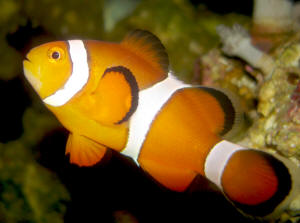
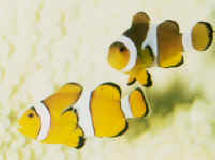
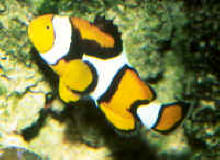
| Above: the Ocellaris
(aka "False Percula"), and real thing, "true"
Percula (Amphiprion percula) below. |
|
|