|
|
| Home | Marine Aquariums |
Freshwater Aquariums |
Planted Aquariums |
Brackish Systems |
Ponds,
lakes & fountains |
Turtles & Amphibians |
Aquatic Business |
Aquatic Science |
Ask the WWM Crew a Question |
| Please visit our Sponsors | ||||
Carbon filter, SW use 6/20/12 Phosban Reactor and Carbon Reactor (Runtime) –
02/23/12 Additional carbon use, re
Cnidarian Allelopathy, ongoing corr. 5/5/11 Chemical media vs. Water Changes
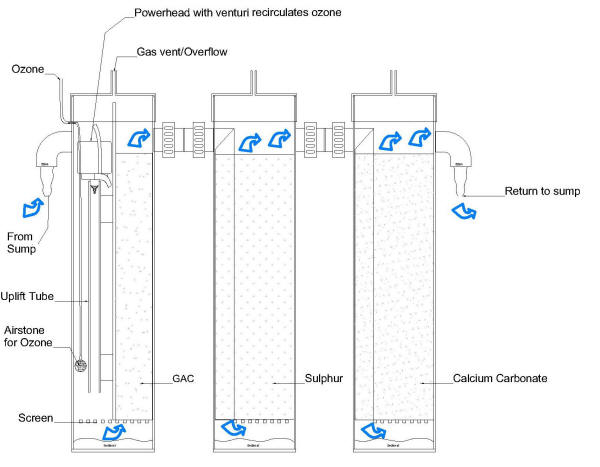
12-23-09 Use of carbon in reef tanks - 4/17/03 Thanks very much, Paul. <You are very welcome.> Would you mind elaborating on the use of carbon most of the time? <Well it is very well documented on various reef sites, a great many books, as well as here on WetWebMedia, but here is my take on it. I advocate the use of carbon in small CORAL reef tanks. (Yes, that is emphasis on corals.) For one main reason - allelopathy (http://www.colostate.edu/Depts/Entomology/courses/en570/papers_1998/lindberg.htm) - the ability for corals to use noxious chemicals (or the use tentacle aggression which I don't believe applies to the use of carbon and only slightly in the term allelopathy) as defense mechanism against encroaching corals or other predators. The allelochemicals produced seem to inhibit the growth and development of other corals in the surrounding area. Not necessarily the only use of noxious chemicals and sweeper tentacles but one that does frequently occur in reef tanks. (some other uses are still unknown)> I'm usually an advocate for not using carbon except when all else fails. What about depletion of major and minor trace elements when using carbon? <Not likely an issue here. Please read this link as it sums it up best (especially the last quarter or so.) http://www.wetwebmedia.com/chemFiltrMar.htm. There are some faq links if you want to see what others are doing or if similar concerns are being raised but overall, I believe with regular water changes, and the continuation of your additive schedule you will not have a problem. Basically, I would use it for maybe two weeks on and two weeks off as this is a nice middle ground to work with. Thanks for the inquiry.> -Chris. The color of water I have a nano reef at my office and the water always seems very yellow within a few days of a water change. What could cause that? Ana M. Saavedra <Likely an accumulation of "organics"... easy to do in small volumes. I encourage you to get in the habit of using a small (a few ounces) or activated carbon in your filter flow path (you can buy a small re-useable Dacron filter bag for changing out) and regularly (weekly, biweekly...) changing this with other routine work on the tank. Bob Fenner> Point-Counterpoint... Thanks for your time on this. <Our pleasure- we love this stuff! Scott F. here today> I have been doing a lot of research on marine aquariums (books and internet searches) and what I am finding is that there are a number of diametrically opposed views about the aquarium. <Different views? On marine aquarium keeping? Really? LOL> I have read enough articles on WetWebMedia to know what you believe and I would like your opinions on some of these differing thoughts. <Sure- I'd be happy to!> 1) It is a universally accepted principle that aggressive protein skimming is a must (1 cup a day) for nutrient and allelopathy export. In addition, to successfully grow corals, micro-organisms such as zooplankton, phytoplankton, etc., (whether grown in a refugium, a reactor and/or green water additives) is also a must. However, protein skimming removes these micro-organisms from the system and there some thought that protein skimming is as harmful as helpful. The no-protein skimmer belief rests upon refugium/Caulerpa/seagrass and/or clams as a more natural mechanism. Plus, there are less impellors killing the organisms (including powerheads). <Well, I am of the opinion that a well-tuned protein skimmer is absolutely essential for long term success in closed marine systems. I have heard from a number of people who yanked their skimmers-some have been successful for a while- many have gone back to skimmers. I like to think of the long-term with reef tank maintenance. Skimmers remove many noxious compounds and dissolved organics before they have a chance to degrade water quality. I have yet to see a very successful reef system that has been maintained for years without skimming. I do not consider one or two years a success...The bottom line on skimmer use, in my opinion, is that if you are going to omit skimming, then you need to compensate somewhere- either with a much lower bioload, very aggressive water change schedule, alternative "filtration" techniques (like Steve Tyree's Sponge/Sea Squirt Cryptic Zone concept, etc.). It is a trade off, and one that I do not feel is worth it. As far as the impellers in pumps destroying valuable plankton is concerned- I have heard a lot of thoughts on this, and, quite frankly, I feel that the threat-although legitimate, is highly overstated. Most reef systems simply don't grow and support large enough populations of plankton for this to be a legitimate concern, IMO. Even with productive refugia and other supplemental systems, I just don't think that the impact is there> 2) To remove allelopathic compounds from the system, weekly carbon changes are suggested. However carbon also leaches vital trace elements out of the system. Once again, harmful and helpful. <I am a firm believer in the continuous use of small amounts (like 2-4 ounces per 100 gallons of tank capacity) of high quality activated carbon. Good grades of carbon, such as those offered by Seachem (my personal favorite), Two Little Fishies, or ESV do not leach phosphates into the system. Yes, carbon can remove small quantities of trace elements from the system. However, if you are following one of my other favorite practices in marine husbandry, frequent small water changes- you will be replacing trace elements on a regular basis. In fact, you will probably not experience a deficiency in trace elements if you practice these water changes> 3) Another universally accepted principle is weekly water changes. When you have a 55 gallon tank, a 10% water swap is no big deal. When you have a 125 with a 30 gallon refugium and 10 gallon sump, it is a much greater effort, requiring a large garbage can sitting in the living room overnight to allow the salt to fully aerate and mix before doing the swap. Plus the swap tends to be somewhat stressful on the fish. I am planning on buying a 300 gallon at the end of the year and turning the 125 into a large DSB/Live Rock sump. A 10% water swap on 425 gallons will be a huge effort! <As a fanatic about regular small water changes, I can tell you that the process is simply not that difficult. One of my systems has about 200 gallons total capacity. I change 5% of the water twice a week. This amounts to 2 10 gallon water changes, which I perform on Wednesday morning before work, and on Sunday mornings (unless the surf is good- in which case it's usually Sunday afternoon!). I will generally mix up the saltwater in a Rubbermaid container about 24-48 hours before, and then perform the change. I also perform minor maintenance tasks, such as a little extra algae scraping (if needed), coral pruning, etc. on Wednesday. This will take about 20-30 minutes to perform. On Sunday, I take a little more leisurely pace, and will clean the skimmer, replace carbon or Polyfilters if needed, change micron socks, or any other little things that have to be done. Maybe it takes about 45 minutes to an hour of pleasant labor. I have always done the additions of new water "manually", by pouring it into the tank from a pitcher. If I really wanted to do it quicker, I'd hook up a Maxijet 1200 powerhead to some 5/8 ID tubing, and "pump in" the replacement saltwater...it's a lot quicker. Frequent small water changes need not be a chore. Rather, look at them as an opportunity to regularly assess the situation in your tank. Anyone who maintains their own garden can relate to the labor involved. It is part of the "price of admission", IMO, and is simply not that difficult. And, when you see the difference in your animals, you'll realize that it's all worth it!> Lastly, I have and read about many a aquarist who has been very successful for years with minimal swaps, minimal effort by maintaining proper trace elements/calcium/alkalinity. <I have to quote Anthony on this: "Even a blind squirrel finds a nut sometimes!". It's just not something that you'd want to do. We are talking about living creatures here- which require us to provide the highest level of care. Closed systems are just that- closed, and unlike the ocean, do not afford the animals a constant influx of clean water. To those hobbyists who think that water changes are not required, I respond, "You wouldn't let your dog live in the same room for 5 years without cleaning out the waste, would you? Don't do it with your fish!"> 4) Bio-wheels and Bio-balls are sold in virtually all LFS and internet dealers. They add a tremendous amount of stability to the system but also contribute nitrates because there is no anaerobic area for denitrification. Once again, stability vs. water quality, harmful and helpful. <These media are, in essence- "victims of their own success": They are so good at removing nitrites and ammonia, that they cannot provide a bacterial population to keep up with accumulating nitrate. Yep- it is a tradeoff. Frankly- I like to keep things simple, and use a more natural approach: Let the live rock and sand do your filtering, along with use of macroalgae in refugia, and protein skimming, water changes, and regular use of carbon and/or PolyFilter media.> 5) Allelopathy is another subject, not discussed at LFS trying to make a sale. Some people claim that pictures of beautiful coral displays that are all over the internet will be very different a year from now because of allelopathy and others claim success for years in spite of pictures showing many corals side by side, touching each other. Another subject in dispute. I have purchased very aggressive corals (not knowing better at the time). I have multiple leathers, Ricordea mushrooms, 5" genitor, frogspawn, colt and bubble corals. Is this a toxic soup, a ticking time bomb, or as others claim, no big deal. <Well, I would not call it a ticking time bomb, but it is not an ideal situation. This is an aggregation of animals that are rarely, if ever found in close proximity to each other on natural reefs, so there will be a certain amount of allelopathy. However, these animals can be maintained together in a certain "stand off" with use of aggressive nutrient export mechanisms (the aforementioned skimming, water changes, and use of chemical filtration media). It's much more ideal to develop a stocking plan that utilizes animals that live together in nature. However, as we often state, this is a closed system that we're talking about. It can be done-and done with some possible success, but it is not ideal. I have seen many successful "garden" reef systems over the years, so I can't say that it's not possible to do this. just not recommended!> As I plan for a big expansion of my system, these are the thoughts that come to mind. Natural (refugium/Caulerpa/seagrass and/or clams) vs. mechanical (protein skimming). I currently have both. Is chemical filtration needed? <I believe that a "natural" approach, with a few technical props (skimming and chemical media) is the best approach for most systems> Are water swaps absolutely mandatory, which would dampen my enthusiasm for a larger tank. Would removing some of the aggressive corals reduce the allelopathy problems or would the bigger tank mitigate them? <Yes, removing some of the aggressive corals could help, as would reducing the proximity between corals. However, it is still important to change water. I would have to say that it's mandatory! Please understand that it just is not that daunting a task...Small amounts often is not that difficult!> Long email. Apologies. Thanks for the time. <My pleasure! These were some excellent, thought-provoking questions that have stimulated many a late-night fish nerd conversation at a MACNA conference! I hope that you will be in this year's MACNA in Louisville so that we can discuss these things in more detail! Good luck! Regards, Scott F> Protein Skimming or Activated Carbon...Or Both? Does carbon treatment and Protein Skimming do the same thing? <Good question. They both do assist in removal of dissolved organic compounds. However, carbon can also remove substances that discolor the water, such as tannins, some dyes, etc. Protein skimming does a great job removing many of the same substances, but uses the principle of electrostatic attraction to "grab" dissolved organics and "stick" them to the surface of bubbles. A good skimmer will remove a tremendous amount of materials from the water, and, unlike carbon, a skimmer does not have a "useful life". However, in order to do the best job possible, a skimmer needs to be cleaned regularly (like weekly or more often). Ironically, the very "crud" that a skimmer removes so well can accumulate and inhibit foaming! By keeping your skimmer clean, you're assured that it will perform at its best at all times. In the end, I think that a marine system should be run with BOTH carbon and skimming. Hope this helps! Regards, Scott F.> Tap Water FAQ (more on chloramine concern) Here's another tidbit of info I found: Nice to know if you are planning on using a new filter anyways: "Advantages of running carbon include removal of unwanted colors (usually yellow), unwanted odors, and removal of other miscellaneous organic waste products. Carbon also removes chloramine (overnight), but only when the carbon is new (less than 48 hours old). Still, this can be an advantage if your tapwater contains chloramine." <I've added quotation marks... and would like to add a note to you re "testing". There are (relatively) simple colorimetric assays (test kits) for chloramine. I suggest you get and use one to satisfy your curiosity re the issues of dissipation through time and carbon removal. No need/use in being confused, unclear here. Prove to yourself what works, does not. Bob Fenner> Re: Tap Water FAQ Here's another good resource, it turns out the activated charcoal approach leaves ammonia in the water. http://www.csd.net/~cgadd/aqua/art_chlorine.htm <Thank you for this. Will post. Bob Fenner> Carbon in AquaC Remora Pro Hello there: Does anyone know of a way to "jury-rig" some carbon on/in the Remora Pro skimmer? I tried Mr. Kim, but I don't want to bother him more than once about something that his product wasn't meant to handle. Thanks, Rich. <What is your intent here? To reduce the smell of the skimmate?... if so, you might place some carbon in the collector cup... otherwise if you want to use activated carbon as a chemical filtrant of your water in general I would place it in a Dacron bag (can be bought pre-made) and place this in turn in any convenient part of your filter flow path. Bob Fenner> Supplements, coralline algae and carbon 9/20/04 Hello WWM Staff, My name is Jim. I have a 90 gallon reef tank that is 8 months old. I have a UV, Protein skimmer and wet/dry (Removed bio balls). I use the following Seachem supplements as per GARF website. (3) TBS Reef Plus 2X week (3) TBS Reef Complete 2X week (3) TBS Reef Calcium 2x week (1) TBS Reef Advantage Calcium makeup water 2nd and 4th weeks (1) TBS Reef Builder makeup water on the 3rd week. My Question is. I am having a tough time getting coralline algae to grow. My LFS sold me Seachem Reef Kalkwasser. They told me that would bring down my Phosphates and help grow coralline. <Hmmm.. did you test for Phosphate? Did they? What was the result? What are your Ca, Alk, Mg, Po4, Salinity, temp, lighting and water movement. All of these will affect coralline growth. What is your water change routine? All of the listed additives are perfectly fine, but they should be dosed according to the demands of your tank (determined through testing), not a "standard recipe".> The problem I have is I'm not sure if I should stop adding the calcium supplements listed above and use the Kalkwasser in there place and in what amount? <If proper water changes are carried out (20% a month or so), Kalkwasser is usually the only supplement needed. It will supply calcium and alkalinity in a balanced fashion. All other "trace elements" will be supplied through water changes. If you make the change to Kalkwasser, do be sure to continue to measure Ca and Alk to be sure you are meeting your tanks needs.> Also do u suggest using any Activated carbon in a reef tank. Thanks for your help! <Carbon helps keep the water clear and will remove the noxious defensive chemicals produced by corals. I personally don't use carbon often, but it has it's place. Please do use small amounts and change it frequently rather than large amounts left for long periods. Also, rinse it well before use. Best Regards. Adam> Carbon (use?) formula 7/10/05 Hey there- I'm trying to find a formula for TriBased carbon weight per cubic foot. I have a 190 gallon tank with a 50 gallon sump tank. THANKS <... for what? How much to use? I would start with a few ounces... in a Dacron bag... in your filter flow path... Bob Fenner> Will GAC in Ozone reaction chamber effluent support bacteria? Mmm, maybe 12/16/06 Hi folks, <Robert> I understand from my readings that: 1. Effluent from an ozone reaction chamber is likely to have a very high RedOx reading of 600mV plus <Yes> 2. This effluent will contain a toxic level of dissolved ozone and ozone byproducts such as hypobromite <Mmm, can, yes> 3. Activated carbon in regular reef water quickly becomes colonized by bacteria <Very often the case... within a few days... populations climbing under various conditions...> 4. Activated carbon can remove the ozone and byproducts BUT 5. Activated carbon does not affect the RedOx of ozone chamber effluent <Mmm... actually... can to a degree> 6. Very high RedOx potential (much over 450mV) in water is toxic to life <Higher, but yes, there are practical limits> So, if I pass the effluent of my ozone reaction chamber into another chamber containing activated carbon, can I assume that no bacteria will colonize the activated carbon due to the high RedOx in that effluent water? <Highly likely that their metabolism, reproduction would be greatly attenuated... Might I ask... as you have given obvious thought to this "question"... How might one test for this hypothesis?> Many thanks in advance, Rob from Cape Town <Bob F in San Diego> Re: Will GAC in Ozone reaction chamber effluent support bacteria? 12/18/06 Hi Bob, <Robert> Many thanks for your reply. <Welcome> In answer to your question: >>> <Highly likely that their metabolism, reproduction would be greatly attenuated... Might I ask... as you have given obvious thought to this "question"... How might one test for this hypothesis?> >>> I presume an answer would be to look for metabolic byproducts, probably carbon dioxide. <Perhaps something else... with a tracer or immunofluorescent properties> The flow rate through this chamber would be low, so there should be plenty of time to accumulate CO2 measurably. Two tests, one before and one after the GAC should show whether the carbon chamber is producing CO2. CO2 would drop the pH, so a pH test could possibly be used instead of a dissolved CO2 test. Although, now that I think about it, residual ozone reacting with the GAC would also produce a little CO2. <Yes, especially "when new"> I was hoping to use four reaction chambers in series, namely ozone, GAC, elemental sulphur, calcium carbonate. The ozone would produce nitrate from ammonia and nitrite and oxidize DOC to bacteria-edible smaller molecules. The GAC (I was hoping) would support sufficient bacteria to break down the oxidized DOC further and consume much of the remaining oxygen. The bacteria in the sulphur chamber would remove the nitrate, and I would need less sulphur than the recommended 1% of tank volume since much of the oxygen would already have been removed by the GAC chamber. Finally the calcium carbonate would dissolve to correct the pH and add some calcium. <Sounds like a very nice plan> None of this will work if the water flowing through the system has a poisonously high RedOx level. Do you have any suggestions as to how to fix it? <I think the measure you're talking about will actually work... the RedOx potential won't be so high...> Should I just split the chambers up? Ozone and GAC together and sulphur and calcium carbonate together? <Mmm... I'd keep these separated... for removal, inspection... ease of manipulation> I feel somewhat disappointed. They seemed to work together in such a complementary fashion until I thought about the RedOx problem. Thanks again for your help and apologies for the length of the mail, Rob <No worries re the length of mail... Important to make known what we want. Bob Fenner>
Ozone parasite carbon 3/21/07 Hi crew, <Mohamed> Is there a ratio as to how much carbon is required when using ozone or can the same assumption be used 1L carbon per 1000L aquarium water? <Mmm, good question... requires more "knowing" or additional input to make use of a response... That is, other factors, like "bio-load", foods/feeding, the use of other gear (principally skimming...) will/could greatly skew any effect of whatever quality carbon with actual ozone input...> Does one require separate carbon for the tank and the output of the skimmer using ozone or can the carbon for zone usage be sufficient for the entry tank? <I'd say this latter> Will the use of ozone kill off all parasite that eat/kill SPS? <Decidedly not... though it will aid in the prevention of infectious pathogens (bacteria, fungi et al.) indirectly, by improving water quality mostly> Must the effluent from the skimmer pass thru carbon? <No. Though some folks like this arrangement to remove excess O3 that may be liberated, and (IMO) "stink"... there is generally very little of such excess ozone> Thanks Mohamed <Bob Fenner> Carbon Filtration'¦Do I need It? -- 07/14/07 I have a 55-gallon fish only saltwater tank. I was wanting to add about 50-lbs of live rock. <<I would add a bit less (30lbs) and see how things go'¦is important to leave swimming room for the fishes>> Should I keep the charcoal in my filter or does this even matter? <<Small amounts of carbon changed-out every couple of weeks are beneficial most any marine system in my opinion>> If I decide to add corals later does this make any difference? <<Will become even more important, yes'¦do have a read here: http://www.wetwebmedia.com/chemFiltrMar.htm>> A guy at my LFS told me to take it out, but I wasn't sure. <<I do not agree with this. Chemical filtration, while not always a requirement, is most surely always of some benefit>> Thanks. <<Regards, EricR>> Activated carbon/ ozone bob, Is it essential when running ozone, that the returning water from the skimmer be run under carbon???? This seems like a controversial subject. Thanks again. Lee <Not essential in almost all cases... part of an ongoing "urban myth" in the hobby (along with the lack of necessity of thermal acclimation, floating livestock polyethylene bags... please stop me). There is so little O3 produced by corona discharge hobby units there is exceedingly small likelihood of ozone "poisoning" (and extremely tiny chance of "space poisoning" the area around the aquarium/s it's used in...). If curious, get/use a conductivity or Redox meter and measure the change in water quality in/about the use of this ozone-generating device. Bob Fenner> Slight Discoloration in water Bob, I have been reading your posts and have been impressed with your depth of knowledge. <Pet-fishing is about all I know anything about... and not much of that.> My question is simple. I have a 55g FO set-up with a live sand bed (3 inches) that has been running for 1 year. I have most of the original fish. (Yellow Tang, Flame angel, 3 green Chromis and a tomato clown) I consider the tank fully stocked. Nitrates have always been <10 and all other parameters are 0 (PH is 8.3). My water however has a slight greenish tint. <This happens... especially when viewed through glass tanks (the glass is slightly greenish)... and accumulation of "wastes"... easy to get rid of with a bit of activated carbon in your filter flow path... Read: http://wetwebmedia.com/carbonfaqs.htm > I run a Turboflotor skimmer 7/24 and it collects about half the collection cup of pea soup every week. I have tried running carbon, but I cannot get the slight green tint out of the water. <Try another brand... like Boyd's Chemipure...> It can only be seen from the end of the tank, looking through 4 feet of the water. Is it the sheet algae that I put in for the tang and flame angel daily? <Hmm, possibly this is adding to the color> Any ideas how to clear this up. <Growing purposeful macro-algae, either in a sump and/or the main tank would help...> Thanks for your help Geoff Goodfellow <Be chatting, Bob Fenner> Activated Carbon in a Reef Tank I know that this question has been asked a million times, but here goes: In a reef with a mix of LPS and soft corals, do you recommend running Activated Carbon 24/7? <Yes and changing often.> Why or why not? <For the why, I am going to refer you to the various FAQ files for further reading.> Thanks! Adam <You are welcome. -Steven Pro> Carbon Steven, Your mind has changed, as in prior faq emails you suggest using it once or twice a month for a few days. Why the change in opinion? <Not really sure I have had a change of opinion. I cannot recollect all the emails I have answered, so I looked over the FAQ file on carbon at http://www.wetwebmedia.com/carbonfaqs.htm None of the replies were from me, but they all said to use carbon 24/7.> Also, how often is "often" for changing it while running 24/7? <At least once per month, maybe more often depending of bioload. I like and use Chemi-Pure and Polyfilters.> Thanks! Adam <You are welcome. -Steven Pro> Carbon Hi there, I have two questions for you: 1. Can I use carbon to break up the bond between chlorine and ammonia rather then using conditioners (de-chlor)? <Yes> And how long should I wait, 24 hour? <Should be sufficient.> 2. My brother asked me a silly question, do fishes know their owner (I think he meant the person who feeds them)? <Fish can definitely learn who feeds them and respond by coming to the top of the tank. -Steven Pro> Sour-smelling marine tank? Hi, <Hi...> What
could cause a marine tank to smell sour? <Egads... sour?> I have
smelled before the "fishy" smell tanks get if their chemistry
is off, but I have never had a tank smell sour. <Not sure I would be
able to discern the difference... sour/fishy - both I would classify as
"bad" smells, but I don't have an incredibly sensitive
nose. I've heard of rotten eggs before [hydrogen sulfide] but
sour??? Could probably be a couple of things - look for something dead
[snail, etc.], or if you are feeding any bottled food, perhaps smell
that stuff to in case some of it has gone bad. In all cases, run some
fresh activated carbon and that should nip it in the bud.> Thanks,
Patrick |
|

|
Features: |
|
| Featured Sponsors: |