|
FAQs about Bristletooth Tangs, Genus
Ctenochaetus Identification
Related Articles: Ctenochaetus, Naso,
Related FAQs: Ctenochaetus Tangs 1, Ctenochaetus Tangs 2, Ctenochaetus Behavior, Ctenochaetus Compatibility, Ctenochaetus Selection, Ctenochaetus Systems, Ctenochaetus Feeding, Ctenochaetus Disease, Ctenochaetus Reproduction, Surgeons In General, Tang
ID, Tang
Behavior, Compatibility, Systems, Feeding, Disease,
|
|
Surgeonfishes: Tangs for Marine Aquariums
Diversity, Selection & Care
New eBook on Amazon: Available
here
New Print Book on Create Space: Available
here
by Robert (Bob) Fenner |
 |
|
Tang id please 01/17/19
Hi crew,
<Hi>
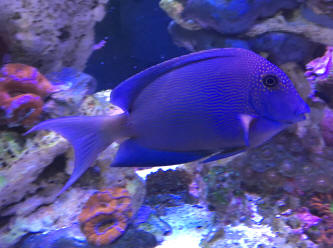
hoping you can help me out with a tang id. I recently acquired this tang from a
friend who could only tell me he believed it to be some species of Bristletooth.
I've searched through hundreds of tang photos this week and can't come up with
anything solid.
Maybe you recognize him?
In the photos he looks rather blue or purple but I would describe the colour
more as smoky grey with very subtle orangish spots on the face and even paler
stripes on his body, and some orangish/yellowish on the pectoral fins and along
the top of the dorsal.
His tail is a slightly lighter grey than the body. He's about 6" long from nose
to tail.
Closest fish I have found is a young lavender tang but I'm almost positive
that's not the answer.
<It appears to be a Two-spot Bristletooth Tang (Ctenochaetus binotatus.)
Thanks in advance for your help!
<You´re welcome. Wil.>
|
 |
|
Re: Tang id please 01/17/19
Thank you for the prompt reply.
May I ask what makes you think that?
<That was my first guess, because of the blue shades on your photos but I may be
wrong.>
I just looked at pictures of two spots and while I can definitely see some
similarities in my opinion the colour
is way off and the two spots seem to have a blue ring around the eye, which
mine is lacking.
<Well, another possibility here is the Orange Stripe or Striated surgeonfish
(Ctenochaetus striatus).>
<Hope this helps. Kind regards. Wil.>
|
|
I.D help
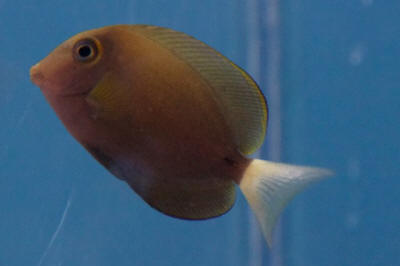
I've been seeking a Ctenochaetus flavicauda for about a year now and a
friend called saying he got 2 small ones in. They are both under 3
inches but aren't colored like the adult I had previously which I
understand changes with many species as they grow and get adult
coloration. Either way it looks like an interesting and unusual
addition to the collection but I hate not knowing exactly what something
is. Tangs aren't my strong point but looking around online the
only things I've seen with white tails are odd thompsons and the
whitetail bristiletooth. Any idea what species this is?
https://sphotos-b.xx.fbcdn.net/hphotos-prn2/1075769_408453985941387_1448820734_n.jpg
<Looks to be a juvenile C. flavicauda. See here:
http://www.wetwebmedia.com/ctenocha.htm
Bob Fenner>
|
 |
Re: I.D help
Sweet thanks for the quick response. That's what I was thinking it was
but wasn't really familiar with the juvenile coloration and when I poked
around on RC got some responses indicating it might not be and I don't like
to get new additions unless I know what is is.
<I don't use bb's... even our own. Check through Fishbase.org...
BobF> |
|
Tang ID And Writer May Have Been Taken For A Ride
1/16/10
Hi
<Hello Darren>
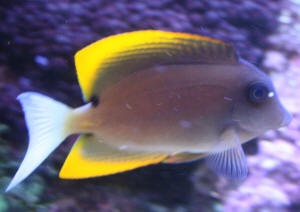
I am looking for help identifying a tang I bought as a Gold Rim
Tang.
Looked up and doesn't really match.
Hope you can help
<I sure can Darren, what you have is a Tomini Tang. You may
have been taken to the cleaners depending on what you paid for
it, as a 2-3" Gold Rim Tang (Acanthurus nigricans) generally
etails for about 70 bucks, while the same 2-3" size in a
Tomini Tang (Ctenochaetus tominiensis) runs around 50 bucks
keeping in mind that pricing will vary among etailers.
The Tomini Tang is relatively hardy and a little more disease
resistant than the Gold Rim Tang, at least in my
opinion/experience.
I have had my Tomini now for close to three years now and it
really is a beautiful fish who gladly accepts my offerings of New
Life Spectrum Pellet Food, a highly nutritious formula. James
(Salty Dog)>
Darren Coughlan
|
 |
Re Tang ID And Writer May Have Been
Taken For A Ride 1/16/10
Thanks,
<You're welcome.>
paid about 25 pounds for when it was a little smaller.
<Mmm, 40 bucks isn't too bad a price considering where you
are located.>
Very lively, inquisitive and active.
Happy to know and look forward to looking after it
Quick response genuinely appreciated knowing how many questions you
must get.
Keep up the great work.
<Thank you, we will try our best.>
Thanks again,
<You're welcome. James (Salty Dog)>
Darren Coughlan |
|
Re: Unknown Tang 8/29/2009
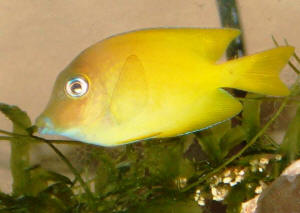
I finally managed to capture a picture of my elusive little guy,
the unknown Tang. Hopefully its clear enough for you to help me
identify him. In the pictures that I have attached it appears
that he has a hint of blue in his eye and around his mouth and
between his mouth and pelvic fins but this isnt visible normally,
I think that it might just be an affect of the flash. But the
blue trim on the edges of his anal and dorsal fin are there
normally.
Thank you once again,
Antonio Ovalles
<Is a juvenile Ctenochaetus sp... Likely either C. strigosus
or C. flavicauda. Bob Fenner>
|
 |
|
Tang ID Please 09/04/08 Hi Crew, <Hi
Campbell, Sorry for the long delay. I had hoped to find a little
more info for you, but I came across a lot of roadblocks.> How
are we all today? <Well thank you!> I have been looking for
a Kole Tang (C. Strigosus) and have been offered one as Kole Tang
but I don't think it is a Kole Tang. <I am finding this
called an Indian Ocean variant. You can see it in Scott
Michael's "Marine Fishes" on page 384. However when
checking www.fishbase.org they say that distribution range for
Ctenochaetus strigosus is questionable in the Indian Ocean.
<<? I've seen, photographed this fish in the Maldives.
RMF... but do agree, fishbase.org does not show it any place
other than the W. Pacific. RMF>> Perhaps this fish was
reclassified, but I'm not finding any info that states such.
So, not sure what to tell you other than it is a beautiful fish
and if you like it, it would be worth purchasing.> I vaguely
remember reading somewhere about a Tang that in it's juvenile
stage resembles a Kole but for the life of me I can't find
this info again. <I do not think this is a juvenile.> So I
was wondering if you could ID this Tang from the attached photo
please? <Hope this helps.> Thanks in advance,
<Welcome,>
Campbell
<Mich>
|
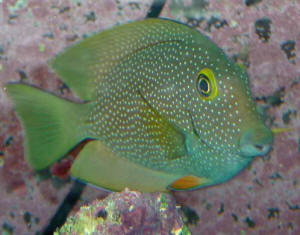 cf. strigosus. RMF cf. strigosus. RMF |
Tang ID Please... C. Strigosus Indian
Ocean Variant now C. truncatus Hi Mich, <Hi
Campbell,> Thanks for your reply, although I was beginning to
think you guys had got lost. :0) <Just lost in cyberspace...
Sorry!> Since I emailed you last I have been scouring the
Internet and I believe I have found the fish ID. It's appears
to be an Indian Gold Ring (C. ) <Does look to be so!
http://fishbase.org/Summary/speciesSummary.php?ID=59487&genusname=Ctenochaetus&speciesname=truncatus
> and it used to be one of four species in the Strigosus Complex
described by Randall in 1995. Although I am not sure what the
current status of the Strigosus Complex is but the info I found
speaks of the Complex in the past tense. <Thank you for the
information. I suspected that something like this could have been
the case but had trouble locating info verifying it. I will share
this info.> The four fish in the Complex are, or were, C.
truncatus, C. cyanocheilus, C. flavicauda and of course C.
strigosus <Very good.> I do like the fish and I picked him up
yesterday, he really is a beauty. :0) <I would definitely agree
with you on that! Enjoy him!> Regards,
Campbell
<Cheers, Mich> |
|
Tang Question, Re: C. truncatus... strigosus complex
f' 10/10/08 Dear Mich/Bob, I was reading today's
FAQs and saw the posts/pic regarding the Indian Ocean Gold Kole
Tang. This is an absolutely beautiful and unique looking fish.
Kole Tangs are close to my heart and I had an absolutely gorgeous
specimen before my power went off for 5 days while on vacation .
. .. I am definitely planning to add another once my tank is
stable and re-matures, but I am picky about coloring-- I need one
that is a deep shade of maroon, with noticeable stripes and
bright yellow rings around the eyes. The problem is that such
specimens are hard to come by. Anyway, I digress. I would love to
get my hands on the Indian Gold. Do you know if these are
commonly available in the trade? <I have never seen it in the
trade in the west (only in diving in the Maldives)... Had seen
this "species" there and quite a few "color
variations" of other Ctenochaetus spp. around the tropical
central to west Pacific, I.O. and Red Sea though... On an
unrelated note, I am becoming concerned about the subject of my
LFS owner's constant rant. He claims that many people
anticipate that the East Coast will experience regular rolling
power blackouts in the next few years due to population expansion
and poor infrastructure. <Mmm, doesn't seem too
far-fetched a possibility to me> He claims that reef tanks may
be a thing of the past for most people if this prediction comes
to fruition because no one will be able to keep a tank alive
unless a serious generator is employed. <I suspect, or would
press more on the likelihood that such "avocations"
(hobbies) will become less common (as they have actually) amongst
"middle and lower class" folks period, as a function of
our failed/failing economy, loss of personal prerogative (funds)
and perhaps a continuing shift (for service companies) to there
being a bit more "kinetic art" set ups for wealthy
folks, their habits (e.g. expensive restaurants)... Though
"pet fish" and "booze" have been pretty much
"recession proof" in past years, the current impending
depression (devaluation of currency and value of hard assets...)
will indeed have a profound effect on our hobby interest> Have
you heard about this concern around the Country? <Here and
there, speculations> Just curious if those in the
know/focusing on the hobby might have heard about/studied this
issue? <Mmm, study? Unlike gov't workers... we've got
to work... pay for them, their "entitlements" (e.g.
lifetime pensions, medical... COLAs... I don't think for long
though.> Thanks for your time. Andy <And you for yours. Bob
Fenner>
Re: Tang Question 10/10/08 Thanks for the
info and thoughts, but I don't know what you mean by your
reference to economic woes :-). The DOW is down only 600 points
and it's only noon. <Heeeee!> It's a shame that
fish isn't available, as it's truly gorgeous. <Mmm, is
a very long way away... the cost would likely be prohibitive...
but... if there's a "market enough"... I remember
(back in the sixties) when fish from the Red Sea were
astronomically priced...> The crash of my tank and loss of
everything in September (my own economic depression) has given me
an opportunity to reevaluate stock/stocking and to reflect on/use
all the info/education I have gained from my experiences and your
wonderful site. I made some poor choices when I started a year
and a half ago, and, although everything did well while they
lasted, I am going to take a more practical approach this time.
<Ahh!> I've also decided that I am going to go very
slowly (letting my tank go fishless for 4 months) and be very
picky about my additions. I wouldn't be nearly the hobbyist I
am without your help and the info available on WWM, so thanks for
that. I look forward to meeting you in April when you visit the
Chesapeake Marine Aquaria Society. <I as well> Take care!
Andy <And you, BobF>
|
|
Tang ID 09/12/08 Thanks to everyone there for
providing such a great resource for all of us in this hobby. I am
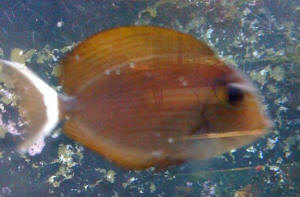
hoping you can help me identify this tang. <Mmm, pretty sure
this is a Ctenochaetus flavicauda> Sorry for the photo
quality, it was taken at my LFS on my camera phone. I'm
trying to research this tang before I possibly purchase it and am
not exactly sure what it is. I have looked at many photos,
including ones you have here on this site and am still not quite
sure I'm finding one that seems to match it with the
horizontal lines and white on the tail, maybe due to it's
level of maturity vs. the level of maturity of the fish in the
photos I'm looking at. <Yes... is young. Looks like a
healthy specimen... and this is a "tough" genus>
This photo is somewhat overexposed, the tang is actually a fair
amount darker. The fish in question is approximately 3" to
4" long. The store has it listed as a black tang and the
only other info is that it is possibly from Sri Lanka. Thanks for
any help you can provide and for the immeasurable help you
already have! Joan
<Welcome! Bob Fenner>
|
 |
|
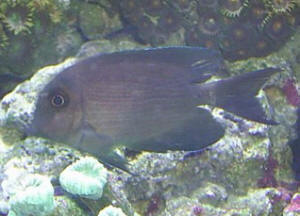
ID on tang 8/14/06 i have been after a Kole
tang for a while and was assured that this was a juvenile.
<Mmm, I think not> After several attempts at trying to get
it identified which has brought about a lot of conflicting advice
i am hoping that you can enlighten me thanks Jase <Is a
Ctenochaetus, likely a striatus. See here: http://www.wetwebmedia.com/ctenocha.htm and the
coverage of the genus on fishbase.org
Bob Fenner>
|
|
|
|
Impulse Buying = Gambling, Lucky This Time,
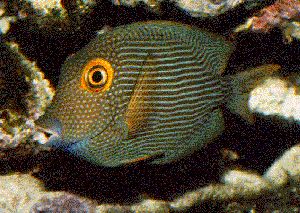
Tangs (Ctenochaetus sp.) 10/27/05 Hi <Hi Nicole.> I
bought this pretty fish at a pet store but I don't know what
it is called! <Nicole, your {Is "you're" -
contraction of "you are"} supposed to ask what it
is and how to take care of it before you buy it not after.
Impulse buys are notorious for getting folks into troubleyou got
lucky this time. <<But has the fish??>> You
actually ended up with a specimen that is quite hardy and long
lived in the right conditions. You have a surgeon fish on your
hands, a Kole tang (Ctenochaetus strigosus) to be exact. Read
here as to more info on their care: http://www.wetwebmedia.com/ctenocha.htm
. Keep in mind they are herbivorous and you will need to provide
vegetable matter for him such a dried Nori sheets and Spirulina,
this specimen will also need at least a 75 gallon tank as an
adult with a 90 gallon being preferred.> Please let me know!!!
Thank you, Nicole Rubio <You're welcome, and next time be
sure to research beforehand, Adam J.> <<How did you
know what fish she bought? Marina - Never mind, found it in the
deleted folder.>>
|
|
|
Re: Impulse Buying and not Quarantining And the Trouble it Causes
(Please Research) 10/28/05 Thank you! <Quite Welcome.> I
noticed early this morning that he has this white stringy stuff on his
body <Hard to say without a picture, could be Lymphocystis or
flukes, look these up via WWM.> I have a small 1 1/2 trigger fish
<I hope you know the potential size and behavior of this
creature.> that is perfectly fine though. <Are they together,
then Im guessing the Kole was not in a quarantine tank. Please read
here: http://www.reefkeeping.com/issues/2004-10/sp/feature/index.php
.> What could I do to get the white stuff off of the Kole tang?
<If this is a display tank with other fish I would not medicate it,
Adam J.>
Unknown Ctenochaetus Species 7/24/05 Hi crew~ <Aaron>
About a month ago my LFS received a tang that the importer had only
listed as Unknown Tang Species. Its clearly a variety of Ctenochaetus;
its extremely similar to Ctenochaetus strigosus, except it lacks the
horizontal pin striping. Instead, the fine spotting that occurs on the
face of C. strigosus is spread across the entire body. The color
patterns are exactly the same otherwise. I have found one reference to
this fish before, but all I could find out is that it was previously
classified as C. strigosus, but has since been recognized as a
distinct, undescribed species. That's it. So I'm wondering- how
do I find out updated information on something like this? <Mmm, Dr.
Randall has recently added a few species to this genus, and produced a
book on Acanthurids...> I would love to know if it was indeed given
a separate name, and if there are defining characteristics other than
the pattern, since I know pattern alone is generally a lousy tool in
taxonomy. <It is indeed with this genus.> Any suggestions for me?
Its a great fish- eats everything that comes near it, and has settled
into his tank beautifully, I'd just like to know What he is.
Thanks! ~Aaron, Columbus OH <Take a look through fishbase.org, the
link there per species to Google Images, here on WWM: http://www.wetwebmedia.com/ctenocha.htm
and the newest books on the family by Dr. John Randall, and Rudie
Kuiter. Bob Fenner>
Re: Unknown Ctenochaetus Species 7/25/05 Hi Bob~
<...> Thanks for the fast response about the oddball tang. The
book you mentioned was actually that 1 reference I had found to the
fish. Imp not sure how the process of fully describing a species goes,
but is there a journal or something you could recommend that may
provide updates on matters like this? <You've look at the
listing of the 13 species on Fishbase? http://www.fishbase.org/ NomenClature/ScientificNameSearchList.php?crit1_fieldname=SYNONYMS.SynGenus&crit1_fieldtype=CHAR&crit1_
operator=EQUAL&crit1_value=ctenochaetus&crit2_f
ieldname=SYNONYMS.SynSpecies&crit2_fieldtype=CHAR&crit2_
operator=contains&crit2_value=&group=summary&backstep=-2
You've looked for Jack's latest?> Sorry to bother again; it
(sadly) drives me nuts when I have cases pop up like that where I cant
ID an animal or be sure on its proper husbandry. Thanks again, Aaron
<You're getting closer to the actual process of discovering,
describing new species... BobF>
Re: Unknown Ctenochaetus Species 7/25/05 Right! Thanks for
that. I had searched WWM and the net in general, but for whatever
reason, missed the fishbase reference. C. truncatus it is! <Ding,
ding ding ding! We have a winnah! And named by none other than Jack...
in 2001~!> Just realized your from San Diego; Ill be heading there
this Tuesday for my first real vacation to Cali. <Mmm, am out
tomorrow for the Big Island (HI), elsewise I'd show you about... do
try to take in the Birch Aquarium at UC... and the fine public library
done to the west of it for that matter> Look forward to seeing the
city (and some of the wholesalers up in LA; esp. Aquamarines). Thanks
again, Aaron <Cheers, BobF> Unknown tang Hello Bob I was
wondering if you could identify my tang if i were to send you a photo
or can direct me to somewhere where i can get it identified. <Will
try. None other than Dr. John/Jack Randall can be asked to take a
look/see...> I do know that he is a juvenile bristle mouth and was
told that he may even be an orange lined bristle mouth? Do you have any
photos or a website that I can look to to possibly identify him myself.
Hope to hear from you soon. Cindy Schultz <We do... use the indices,
search tool... for the genus Ctenochaetus... or bristlemouth tangs...
Bob Fenner>
| Blue-eyed Kole Tang? Hi everyone at WWM,
<Hello David> Love the site and recommend it to everyone I
see or talk to for that matter. I have recently purchased a new
tang. It was labeled to the LFS as Blue-eyed Kole tang. I have yet
to find a picture of a juvenile that looks like it. Could you
please look at the picture and tell me your opinion. It has the
basic body structure of a Kole tang, with the same shape to
it's jaw structure and eating habits seem to be similar (he is
eating algae from the wall and rocks not food I am feeding) The
colors are the main thing, He is brownish red with blue highlights
(probably the lighting there ) but has a yellow tail and yellow
lower fins. He does have the sturgeon spine on his tail and does
seem to be timid as most do at first. I placed him and a
Yellow-eyed Kole together in a 55 gallon frag tang to help control
algae. The water parameters is Ph 8.0-8.1, Alk is 10 and Calcium is
400 ppm, 0 on nitrate, nitrite, and ammonia. All is good with the
health of the animal but I was hoping to see what I could expect as
a long term size and care requirement. I can move him to a 160
gallon that I already have running a reef if he grows very large.
Thanking you in advance for all the help, You always are the first
place I start and usually end up finding all my questions and
answers. Thanks David <The genus Ctenochaetus has recently
undergone renovation by Dr. John/Jack Randall... with the addition
of species. I think what you have here is a C. binotatus, but do
take a look on fishbase.org under the genus for your own
comparison. Bob Fenner> |
|
|
Are there two species of "Kole" tangs? one with yellow
eyes and one without? <Hmm, nope, just the one, Ctenochaetus
strigosus... sometimes C. striatus is mis-sold as the Kole or Yellow
eye... article and pix of both at the site: www.wetwebmedia.com> The
FSG at my LFS told me that they're the same fish -- when they grow
older the yellow around their eyes turns brown? I thought they were two
different fish, but of course, maturing color changes are pretty
common... ?? <Hmm, to some degree... but age/time not as big a
factor in eye color as environmental (foods, feeding, water quality,
social issues... ) factors> Furthermore, now that the Kole (?) is
established, I'm thinking of adding an Achilles. Comments? <Not
a big fan of this species of Acanthurus Surgeons... soft-bodied, and
prone to damage, easy susceptibility to disease high... most succumb
within a few weeks of capture/shipping from (mainly HI) the wild.>
And, here's another Q. Has anyone tried to keep more than one of
the SAME species of Centropyge in a tank before? I've a Atlantic
cherub pygmy angel in a 155, and I'm thinking of adding a 2nd.
<Yep, a few, for ornament and in attempts at establishing breeding
harem/communities... for small fishes need BIG spaces (100s of
gallons), and a sharp-eyed concerned keeper to prevent world war X
problems...> thanks, Paulo <My dos centavos, Bob Fenner>
Ctenochaetus tominiensis or binotatus? (the latter) Thank you
so much for providing so many people with help! I am in need of a
little assistance also... I recently ordered a Tomini Bristletooth Tang
(Ctenochaetus tominiensis). <Neat! A species I really would like to
photograph> When it arrived I was sad to see that it looked nothing
like every pictured I'd seen. I checked Dr. Burgess Atlas and it
had juv. and adult images that looked totally different. <There is
quite a bit of variability in some Bristlemouth Tang species...> The
fish I received has blue eyes and a bright yellow tale that is forked.
It also has light blue spots ( mostly around it's face but
extending threw it's body - almost in rows) with a rust/orange body
color. It also has two dark spots above and below it's fins. I
sounds just like a blue-eyed or two spot tang! <Yes. Agreed> So
after doing some research I sent them an email and told them about the
mistake. They sent me a new one without any questions asked. The new
one they sent was the same fish! What should I do? Am I wrong? This is
a picture of the Tomini
http://www.peteducation.com/article.cfm?cls=16&cat=1875&articleid=2031
as a juv. and this is a picture
http://www.fishbase.org/Summary/SpeciesSummary.cfm?genusname= as an
adult. That website also mentions that it's the "Only species
of @Ctenochaetus@ with angular dorsal and anal fins." What does
that mean - they all look angular to me... Any ideas? <That these
fins are obliquely pointed... in relief... that they look like
angles... I think because of the yellow highlights. Take a look at
fishbase.org's image here:
http://www.fishbase.org/Summary/SpeciesSummary.cfm?ID=6016&genusname=
A rare species in the trade and wild. Bob Fenner> Thanks so much!
-Scott
Surgeonfishes: Tangs for Marine Aquariums
Diversity, Selection & Care
New eBook on Amazon: Available
here
New Print Book on Create Space: Available
here
by Robert (Bob) Fenner |
|
|
|


.jpg)


