|
FAQs about Bristletooth Tangs,
Genus Ctenochaetus 2
Related Articles: Ctenochaetus,
Related FAQs: Ctenochaetus Tangs 1, Tangs/Rabbitfishes & Crypt, Chevron Tangs, Kole Tangs, & Ctenochaetus Identification, Ctenochaetus Behavior, Ctenochaetus Compatibility, Ctenochaetus Selection, Ctenochaetus Systems, Ctenochaetus Feeding, Ctenochaetus Disease, Ctenochaetus Disease 2, Ctenochaetus Reproduction, Surgeons In General, Tang
ID, Selection,
Tang
Behavior, Compatibility, Systems, Feeding, Disease,
|
|
Surgeonfishes: Tangs for Marine Aquariums
Diversity, Selection & Care
New eBook on Amazon: Available
here
New Print Book on Create Space: Available
here
by Robert (Bob) Fenner |
 |
Hey Bob, just IMed you on Facebook about my tang.
12/12/12
<Ah yes, howsit?>
My tank is 45gal high with just the tang and a true Perc clown. They
have been tankmates for 5 years. I use to have a way bigger tank, but
had to tear it down. They have been in the 45gal for about a year.
I use 12 stage filtered ro/di water with Instant Ocean salt. I tested
the water and everything is normal. The Clown is also acting completely
normal.
Tang is a two spot bristle tooth. I've had him for 5
years with no issue, about 6 days ago he Stopped eating his green Nori
and Barely eats the frozen (san Francisco omnivorous and carnivorous). I
also feed with Instant Ocean Marine Pellets(with Dried Krill).
He use to love those, now he just spits them out.
<Mmm>
He's also not exhibiting his normal skittish behavior.
All the time I had him, he would always hide in his cave if anyone
walked up or came near the tank. With the exception of me at feeding
time. Everything I've ever read on these two spot tangs seem to suggest
this is normal for them.
<Is usually>
But Now..he's just swimming leisurely around and not phased by anything,
kinda how I always wished he was.lol. But not normal for the way he's
been for the past 5 years.
His color and looks are normal. He doesn't look sick. I have no idea
what could be wrong with him. Thanks for the Help!!! Gino
<My first and best guess is that this fish bit into something that
doesn't agree with it... like a Bristleworm... could be a deficiency
syndrome, or a long-term disease issue otherwise, but I'd just keep
offering the foods it used to take and maybe add Spectrum pelleted to
the menu. Bob Fenner>
|
Re: Yellow Tang Compatibility, now Tomini hlth.
7/9/12
Hi Bob,
<Laura>
I got my Tomini Tang yesterday from Divers Den at Live Aquaria.
Everything went very well with the acclimation and putting the fish in the
tang.
There was absolutely no aggression whatsoever from any of my livestock,
including my yellow tang. The Tomini went straight into the
rockwork and hid.
Later, I saw it found a cave for itself right near the cave my yellow
tang resides in. Lights went out for the night. All was well.
Today, the Tomini ventured out of hiding. It swam very cautiously
through some of the tank. I fed the tank both Spectrum Thera-A pellets
in and Spirulina Flakes. When the pellets when in the morning,
the tang was in it's cave, so I am sure she did not get any. I
fed the Spirulina flakes in the afternoon, when it was out in the
open. The minute the flakes went in and the other fish started
zooming about, the Tomini got scared and zoomed to the cave she had
established (she's there now). I am writing because she is thin,
and I was actually quite concerned about how thin she actually is -
both body wise and behind the head. My service guy for the tank
checked her over before she went in after she was drip acclimated, and
agreed she was definitely thin, but not any more thin than many fish
get after the stress of being in holding tanks and shipping. He
said fish often go a couple of weeks without eating in these
instances.
<This is so>
I understand that, but being
that the fish is shy, not eating yet, and very thin, I am concerned that
she may not last until she adjusts. I guess only time will tell on
this issue,
<Yes; generally not an issue>
but wanted to run it by you. The good news is that no one is
harassing her, causing undo stress, and she was out for a period of time
today (picked a bit at the live rock), which I felt were good signs.
Laura Garmizo
<Patience here. BobF>
Yellow Tang Compatibility 7/9/12
Hi Bob,
<Laura>
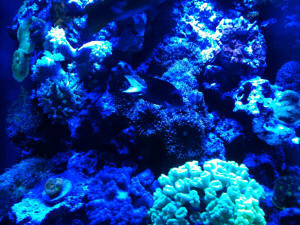
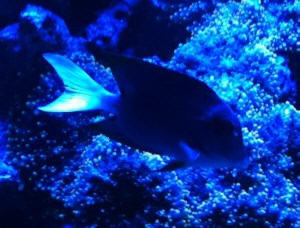
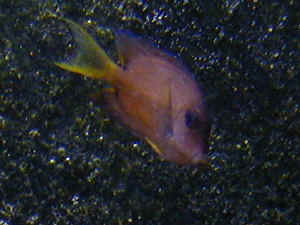
I know this is really hard to see, but attached is a picture of the new
Tomini Tang.
<The pic is poor, but the fish appears as you stated; fine behaviorally, but
emaciated>
Again, for the first full day in the tank, I thought being out in the
open like this for a bit was encouraging. I am hoping you can
see what I mean about the weight of the fish and behind the head area.
Laura Garmizo
<Same opinion from me. B>
|
 |
Re: Yellow Tang Compatibility 7/9/12
Hi Bob,
<L/D>
Thanks for the input. Tomini out today, under caves, but out.
He ate Cyclop-eeze and some Spirulina flakes this morning. Seems quite
hungry, picking on rocks, so he is not "off feed" in the tank, which is very
encouraging.
No one bothering him. I think with time, fish will be bolder,
and things should go in a positive direction. I'll feel much
better when/if he takes some Spectrum pellets. That will really cinch
the deal for me.
I am just curious about your thoughts on Divers Den at Live Aquaria
shipping me an obviously emaciated fish. What is that about?
<I count this biz (DF & S's) as one of the very best of their kind... their
animals are almost all from great sources... Quality Marine/LA
principally... Folks, get what they get... all along "the chain of
custody"... as prev. mentioned, wild-collected and to a smaller degree
captive produced are not fed/nourished ahead of shipping...>
I thought the entire point of using them was to get a healthy
specimen, and, in my opinion an emaciated specimen does not exactly
fall into this category. I would have certainly stayed away from
it in a LFS, so this just surprised me.
<... Mmm, such transshippers (what Live Aq. is in essence for their
wild-collected fishes) don't have the time, money to fatten up their
transient livestock>
At any rate, I do think things will work out here.
<Will most likely>
Thanks, Bob,
Laura
<Welcome. B> |
|
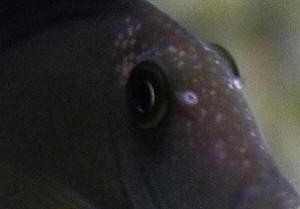
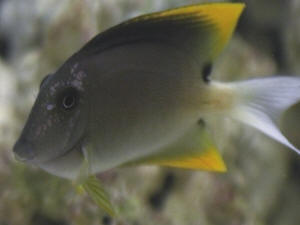
Skin Disease? Photos Attached
2/4/12
Hi,
<Hello Lar>
Trying to identify the skim problem with this Tomini tang which
is completing week 6 of a hypo treatment for Ich in the display
tank. The 2 other tank mates (yellow watchman goby and a pj
cardinal) do not show symptoms. The tang is eating well and
otherwise acting normally.
<... "classical" HLLE... Please read here re:
http://www.wetwebmedia.com/HLLESWCauseF.htm
and the linked files above re cures...>
I started Melafix 3
<Worse than worthless>
days ago but cannot yet tell if it has done anything.
Thanks,
Larry
<Welcome. Likely the move to the main display, concurrent
improvement in water quality, nutrition will see a reversal of
this neuromast destruction syndrome. Bob Fenner>
|
  |
|
Re: Skin Disease? <no>
Photos Attached, and Mud use disc.
3/1/12
Hi Bob,
<Hey Lar>
Thanks very much for taking the time to identify the problem
(HLLE) and write. Here's an update on very
a very positive turnaround and some follow-up questions.
<Ok>
The Tomini tang is greatly improved (sorry no photo
attached) with only a very small area now affected, he
seems well on his way to a good and full recovery. This was
accomplished by addition of Selcon and the reintroduction of
frozen Hikari Spirulina Brine Shrimp along with judicious dosing
of garlic to each feeding.
<Good>
At the same time, the salt level (following hypo for Ich)
has just recently been returned to normal 1.024/5.
The salt 'normal' for just a few days, I did see the HLLE
symptoms diminishing at least a week ago. So the turnaround
has been fairly rapid. Again, thank you for the
diagnosis.
<Welcome>
Here is why I am writing now:
During the hyposaline treatment for Ich in the display tank (with
coral and inverts removed), the refugium rock and rubble was
transferred to the coral holding tank (coral doing great!).
Of the original
Caulerpa and Chaeto refugium macroalgae, only the Chaeto
survived.
<Just as well>
I've only recently read that the Caulerpa is sensitive to
changes in salinity.
<Can be>
In retrospect, I'd been smarter to have removed it
before starting the hypo. That damage done, I'm
reassessing how to redo the refugium section (11.75" x
8" x 9.5") in my sump.
As I have more than ample live rock in the 65g display, I am
inclined not have substrate (mud or sand) in the refugium.
Yesterday, I saw an established tank (at least 5 years old) and
have spoken to different hobbyist - they both swear by Miracle
Mud. The hobbyist swears the Miracle Mud keeps his fish
healthier.
<Have seen this as well. The originator/owner, Leng Sy is an
old friend>
I've also seen on WetWebMedia where you have endorsed Leng
Sy. And, I've read Ecosystems claims regarding their
mud and HLLE.
<Ah yes>
There's still as much and controversy on the mud vs. sand vs.
bare bottom refugium as there is about brands and types of
substrates.
My questions:
- Is Miracle Mud really any better or more effective than using
CaribSea Mineral Mud or Walt Smith's Fiji Refugium mud?
Is mud necessary or very beneficial?
<Have read accounts praising all, but I have not seen any
actual scientific testing, comparing these various products...
But do know where I'd first look for such input. From the
various bb, hobbyist forums... from actual users>
- Given large amounts of live rock in the display tank, is there
any significant benefit to using any substrate in the
refugium?
<Mmm, yes; for sure there can be. What often happens in all
types/kinds of human culture systems is "something"
becomes rate limiting... having "mud" present can make
up to large degrees by providing the chemical somethings,
including rates of reaction/catalyst compounds. Think on this...
for planted aquariums, dogs kept in kennels, canaries in a
cage...>
- Maintenance seems easier without the refugium substrate, so I
am not seeing the benefit outweigh the disadvantages. And,
assessing the advantages of one method over another seems mind
boggling given how controversial this topic seems.
<Mmm, am happy for the discourse>
Thanks for advance for considered reply as well as your patience
and dedication to science and hobby!
Larry
<Certainly welcome. Bob Fenner>
|
Jagged Fins on
my Chevron Tang -- 11/02/10
Hello Team,
<<Hey Matt>>
I have a strange problem I'm seeing in my 300 Gallon mixed
reef.
<<Oh?>>
Along with other marine fishes housed in my tank, I have four Tangs:
Purple, Yellow, Tomini, Chevron and Kole.
<<Umm, per "my" calculation, that be five! [grin] And a
nice mix too (I have five tangs from four genera in my own 375g reef
display)>>
All these tangs are relatively small (3 to 4 inches or so...). All my
fishes are healthy, good color and eating well (Rogger's Food
almost exclusively)
<<I keep hearing about this "Rogger's" stuff -- may
have to give it a try>>
What I have started noticing (and this began almost 5 months ago) is
that the rear fins of the Chevron and now the Kole Tang appear a bit
jagged... Not like their being eaten, torn or attacked, rather oddly
jagged.
<<Hmm€quot;>>
The other tangs; Yellow, Purple and Tomini are all fine. The
Chevron's rear fins used to look smooth but are now quite jagged
and edgy... I apologize for not having any pictures to attach... I
guess if needed I can take a shot and send it in. Does what I'm
describing sound familiar..?
<<Yes€quot; But I get the feeling you have already
dismissed aggression/nipping>>
Do Chevron or Kole Tangs have a disease or are they prone to this type
of fin deterioration as a species?
<<As a species? No€quot; At least, not that I am aware/have
ever heard>>
Nitrates or something else they might be more prone too?
<<Less-than-great environmental conditions could certainly be a
root cause here. If these two are the subordinate Tangs in your system,
it is entirely possible that symptoms would manifest with them first --
due to the imposed stress>>
I'll look forward to hearing back your thoughts.
<<If no obvious signs of disease are present, if water quality is
on par, and the other Tangs/other fishes are not picking at the fins of
these two, another possibility is there is something lurking in the
rocks where these two fishes spend their nighttime hours>>
Thanks in advance,
Matt Kantz
<<Happy to share€quot; Eric Russell>>
Re: Jagged Fins on my Chevron Tang -- 11/03/10
Thanks so much for your reply.
<<Quite Welcome>>
I guess I'll keep an eye out for nipping and or aggression... The
jagged edged fins just seem odd. Normally when nipping occurs it leaves
the fins torn or tattered...
<<Depends on who/what is doing the nipping€quot;such an
"aggressor" need not be bigger and more powerful>>
In this case it seems more like the fins are actually growing this
way... Odd€quot;
<<Indeed€quot; I suppose this could be a case of "fin
rot" (and if so, likely a result of some sort of physical trauma),
and just a coincidence that the two Tangs affected are of the same
genus. If the system is healthy/the environment is in balance such a
malady is rare, even if there has been some aggression/fin nipping from
others in the tank (unless extremely overt). But do give a search of
our site re "tang fin rot" and see what you think>>
Thanks again,
Matt
<<Always welcome€quot; EricR>>
Flame fin tang with white
"spots" 9/12/10
I have a 100 gallon live reef tank with 3 blue damsels, 2 percula
clowns, 5 green Chromis, one pajama cardinal, one coral banded shrimp,
one Sailfin tang
<What species of Zebrasoma is this? The striped two get too large
for this volume>
and one flame fin tang.
<Ctenochaetus tominiensis>
Earlier today, I noticed some white spots on the flame fin.
<Of the fish species you list, this is the more/most susceptible to
the typical external protozoan scourges of marine tropical
fishes>
There are two on one side and one on the other side. They are very
small and look similar to someone having a splinter in their finger...a
little raised under the skin, but white. I just had my tank serviced
yesterday and know that my calcium is somewhat low (375) and am adding
calcium booster to it to get it to an acceptable level. I¹ve had a
rapid expansion of purple coral
<Coraline... as in encrusting red algae I'll take it>
from my live rock onto some lace rock lately and that appears to be
what is zapping the calcium. Other than that, all water levels are fine
and all the coral and live rock look good. The flame fin is still
eating (Edible Entree supplemented by sun dried seaweed on a clip)
and swimming like usual, but the spots definitely are something
new.
Ideas and/or suggestions?
<Time going by, steady, optimized conditions, and reading here:
http://wetwebmedia.com/reefparfaq2.htm
and the linked files above... to the extent you understand your
situation and options. Bob Fenner>
Tomini tang with Ick - wont
eat 3/12/10
Hi there!
<Hello Raquel>
I am at my wits end, so I figured I'd ask the pros.
I have a small Tomini tang who has been in my care for about 2
weeks.
I put him directly into my reef tank, as he will be the only fish. He
was eating algae off the rocks with gusto, but didn't show any
interest in the seaweed salad or various prepared foods. He did like a
few bits of the frozen Emerald Entree cube.
After about a week and a half, he started showing signs of Ick - so
I've removed him to a QT with malachite green treatment.
<Mmm... I don't like to use such on Tangs... Please read
here:
http://wetwebmedia.com/crypttangsf4.htm
and the linked files where you lead yourself>
He seems alert and is swimming well, no signs of distress - but, he
will not eat much.
<Exposure to the Malachite, general stress at work here>
A couple nights ago he ate a few flakes of Tetra Veggie.
Today I have tried Chaeto, lettuce, brine shrimp, squid, flakes and
more of the Emerald Entree. He ignores all of it. I could sacrifice a
couple pieces of live rock but I doubt he will find much to eat on
them...
What shall I do? He still has a few spots of Ick on him, and I think I
need to keep him in QT for a while longer....
<I'd rethink, use other means of treatment... and read here as
well:
http://wetwebmedia.com/ctenofdgfaqs.htm>
Thanks!!!
Raquel
<Welcome! Bob Fenner>
Tang health not quite right
-- 04/07/09
Hi Crew,
<Campbell>
How are we all today.
<I'm fair to middling, thanks>
I have a fish health question and I hope you can help. Currently I have
a C. Truncatus Bristletooth Tang in quarantine these past 6 weeks. He
has been absolutely fine up until now. What is happening is that he
is
not passing solids faeces anymore, only a light colored liquid, he
seems very agitated but is hanging about in one part of the tank
whereas before he'd be all over the place. Also, he is twitching
occasionally as if something were really irritating him.
<Likely some aspect/s of the quarantine. Most likely either overall
stress or his reflection in the system side>
He has eaten all the algae from the back panel of the QT and gets fed
Ocean Nutrition Formula1, Forumla2, Spirulina and Prime Reef flakes as
well as OSI Spirulina and Omega Super Veggie Kelp flakes. Normally he
vacuums all this flake food up with apparent glee but now he has
ignored it and it's lying on the bottom of the tank.
<Very bad... I would move this fish to the main/display
stat.>
He is a very young fish, I got him when he was about 1 inch and looked
for all the world like an Atlantic Blue juvenile, minus the blue eyes
and in the past 6 weeks he has more than doubled in size and is well
on
the way to full adult coloration.
This change in behaviour and the liquid faeces issue only started
yesterday, until then everything appeared to be fine and there has been
no sign of any disease or infestation of parasites. He is not bloated
in anyway, just looks nice and plump like a normal healthy Tang.
Can you shed any light on what may be his problem, especially the
liquid faeces thing?
Thanks in advance,
Campbell
<Move this fish now. Bob Fenner>
Chloroquine phosphate
usage/dosage 2/13/09
I acquired a Kole recently, and put him into quarantine where I've
noticed two relatively small white patches on him.
About one month ago after reading Bob Fenner's writings here, I
acquired some Chloroquine phosphate from a Canadian pharmaceutical
company. It came in 250 mg tablets.
My question is how to go about trading him. The fish is in a 10 gallon
quarantine tank with a seeded filter, but I know that frequent water
changes will be necessary. Specifically, how do we administer the does
which I believe is 10 mg/liter (380 mg/10 gallon tank)?
<You could "grind up" the tablet/s... with a pill
crusher... or have a pharmacist do this for you (grind, weigh)...
"guess"/measure as to about the right amount
otherwise>
This drug is not like copper. We have no way of testing its level. As
we will need to do water changes from time to time, how can we be sure
that the level is correct?
<One can only "guess-timate" presently. There is a broad
range of efficacy, safety>
Your advice will be greatly appreciated as we would very much like to
save this fish.
Thank you,
Jeffrey Castaldo
<And re the "patches" period... I would not likely treat
for this/these... better to dip/bath and place this Ctenochaetus in
your main display. Bob Fenner>
Re: Chloroquine phosphate
usage/dosage - 2/13/09
Based upon a dosage of 10 mg per 1 L, which is what I have read here,
380 mg (1.5 tablets) would be correct, and easy enough to attain
accurately with a pill cutter.
<We are in agreement>
However, having just acquired this fish, I am curious as to why you
recommend to just dip/bath the fish and place it into my main display
tank without the usual 30 day quarantine I usually adhere to, and what
is normally stressed here on WWW.
<This genus is "touchier" than "average"... and
that you state you have only a ten gallon to quarantine it in... My
high confidence opinion is that there is much less likelihood to be
transmittal of pests, parasites (excluded through preventative bath)
than subsequent damage to this specimen in a months isolation
there>
Without a photograph, are you able to give me some insight as to what
those patches are?
<Mmm, only guesses in either case. I have collected Combtooth tangs
in a few countries, though primarily in HI... these are often
hand-damaged through moving from hand netting (off a barrier, mist net)
to collecting/decomp. buckets... and later processing... Often what one
sees here are actual "fingerprints" on the fishes'
sides...>
And when you recommend a dip/bath, are you referring to plain buffered
(8.4) freshwater, with Methylene blue, Formalin, or?
<I am referring to all of these possible protocols. I would use pH
adjusted FW, some MB and Formalin... the last with heavy
aeration>
Also, I am still uncertain as how to go about keeping the dose
therapeutic when I need to make frequent water changes. I suppose I
could use Prime, but I am uncertain as to how to incorporate that into
the treatment.
<A good question. I don't know either. Maybe ask the folks at
FishVet (.com)>
I am sending this follow-up because I do not fully understand, and want
to administer the proper treatment.
Thank you very much for your assistance.
Jeffrey Castaldo
<A pleasure to conspire with you, BobF>
Re: Chloroquine phosphate
usage/dosage - 2/13/09
Thank you for clarifying this to me, and for your excellent advice and
honesty. I realize that there is no clear-cut solution for all
situations; many times we must learn through trial and error.
Best regards,
Jeffrey Castaldo
<Ah, yes... am doing my best to share, warn folks of my too-many
errors... so they can avoid these trials. Cheers! BobF>
Yellow eye tang with puffy lips, crap
English, no reading - 09/07/08
hi crew, my name is dj. i have a yellow eyed tang that i have had now
for about 3-4weeks. and have noticed that his lips seem to be swollen
alil. is this something i need to worry about or is it just from grazin
on the rocks or what?
thanks
dj
<... see WWM re Ctenochaetus species period, the Kole... Bob
Fenner>
Kole Tang, dips,
hlth. - 05/31/08
Hello Bob and crew,
<Don>
My 210 saltwater tank had Crypt so I did the 6 week fallow
protocol.
That was 2 months ago. I have in there now a Foxface, Tomato clown and
a couple damsels and no sign of Crypt for the last 2 months. I set up
my 20 gallon long QT completely cycled and went and bought a Kole Tang
since they seem pretty hardy from the WWM website. Well of course after
I got it I read the FAQ the other day and got the end of the one where
you said you
wouldn't QT the fish. I did give it a 5 minute FW dip as standard
protocol cause I have read every article I possibly could and try to
follow your own rules as you would do to best I can.
<Yes, agreed>
He hides in the PVC all the time in the bare bottom QT and I want to
know if you would put the Kole in the main tank or now leave in
quarantine for a couple weeks.
<I would summarily (re)dip/bath this fish and move it>
I have been fighting Crypt a couple times this year and have really
been doing dips/quarantine and I just seem to not really get it to be
successful. I bet I am one of the best to break down a 210 in an hour
to get the fish. So I'm be very cautious and quarantine everything
and now I'm lost once again. Thanks for your time and I hope you
have/had a great time in Germany.
<Oh, did so>
Don V.
<No real harm in continuing the Ctenochaetus in quarantine... do
continue so for peace of mind. Bob Fenner>
Kole Tang Question, Ctenochaetus acclimation,
lack of quarantine 5/28/2008
Dear
Crew,
<Andy>
I was reading up on Kole Tangs because I'm thinking of
purchasing one for my 110g display and I noticed in the article
written by Bob
(http://www.wetwebmedia.com/koletang.htm) that he generally
advises against quarantining this species and instead using an
extended pH
adjusted freshwater dip (how long is "extended"?).
<Five or so minutes... w/ constant observation,
"swirling" of water or the use of mechanical aeration
(a "bubbler")>
Has anything changed/is this still good advice?
As always, thank you!
Andy
<Is still my opinion. This pc. was penned w/in this last
year... maybe should have incept. dates... Cheers, Bob
Fenner>
Re: Kole Tang Question
Thanks Bob. I agree that dates on the articles
is a good idea--that
would be very helpful.
<Will endeavour to add going forward...>
Would you add in Methylene blue to the
freshwater dip, or just pH adjusted freshwater?
<I would add the Methylene Blue... I see you have a follow up
question, input re... will answer there>
Thanks again. I can't
wait to get my hands on the new version of CMA--June 3.
Andy
<Ahh! Have heard Champion Lighting has it, will be showing
this wknd. in Chicago at IMAC. BobF>
Re: Kole Tang Question
Bob,
<Andy>
Sorry for the double-post, but I thought of something that I
meant to
ask you. I asked whether you would add Methylene blue to the
pH
adjusted freshwater, but my more basic question is "would
you add
anything to the pH adjusted water, e.g., Methylene blue,
formalin,
etc.?" I have bottles of both Methylene blue and Rid-Ich+
(malachite
green and formalin).
<Would be careful re the Malachite (only "regular"
dose)... but yes to the formalin. Please read here:
http://wetwebmedia.com/dips_baths.htm
and the linked files above. BobF>
Re: Kole Tang Question
Thank you very much. I have read
the dip articles, but because this question was so specific to a
particular animal I just wanted to be safe. I get really nervous
adding any animal without a 4+ week quarantine. I'm sure you
don't remember, but when I got back into the hobby about a
year ago I was stupid and suffered, with your help, through ich
and all the hassles that it brings, 6 weeks staring at an empty
tank, fish dying, etc. At your suggestion, several month back I
did add a Copper Band Butterfly that I had in QT for only 10 days
because it showed signs of Lymphocystis, and all worked out
wonderfully--healthy eater (including a few Aiptasia that I had
on my LR), bright and happy. I'll stop bugging you now!
Cheers,
Andy
<Always best to be cautious... rely on your own intuition,
choosing ultimately... My "input" is borne generally of
many personal and second hand experiences; including reading. In
the case of Tangs of the genus Ctenochaetus, it has been my
overwhelming experience that dips/baths are more efficacious than
these AND/OR quarantine alone. RMF>
Re: Kole Tang Question, Ctenochaetus
acclimation, lack of quarantine
Hey guys (again),
<Tom>
I read the below on the FAQ today. Why exactly does Bob recommend
not QTing the Kole tang?
<Probability, borne of experience, dictates that much more
damage and loss is likely to occur from doing so than skipping...
dip/bathing instead and placement>
Reason being is, as I've talked about in other emails, that
I'm planning on the purchase of an Atlantic Blue Tang. The
last one died in QT, which was a 20g with a live rock and sponge
filter, after a week. We previously discussed that, and came to
the conclusion that the fish was sick prior to purchase, but I
digress. The new tang, once purchased, will hopefully be 4 to 5
inches instead of the smaller one I purchased last time. I have
hesitations about QTing this sized fish in a 20g, so naturally
this email below caught my eye. What's the thoughts?
Thanks again
Thomas
<This species of Acanthurus as well I would skip
quarantining... A. coeruleus is not usually a strong
"carrier" of external communicable parasitic disease...
Bob Fenner>
|
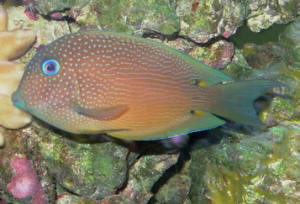
Ctenochaetus binotatus, Nets
1/17/08
I have wanted one of these fish for quite some
time, and finally received one now almost a year ago. He has been
living in a 72 bowfront quite happily. I would like to catch him
however and move him to my 220 cube. I have been reading that it is
very dangerous to use nets with these guys for fear of damaging
their specialized mouthparts. Do you have any recommendations on
something different to use that I wont have to worry about hurting
him? I have attached a picture of this beautiful fish for your
enjoyment.
<Crystal, I'd use an Ulti Net, available at Foster And
Smith. They are made of very soft material and should suit your
needs just fine. See here.
http://www.drsfostersmith.com/product/prod_display.cfm?c=3578+3728+3861&pcatid=3861>
Thank you,
<You're welcome and thank you for the photo. James (Salty
Dog)>
Crystal
http://i120.photobucket.com/albums/o172/cl2ysta1/blueeye002.jpg |
|
|
Distressed Tomini Tang... yes, exposure to Malachite,
Formalin 12/7/07
I appreciate the time. I will try to
keep as short as possible.
I've had a Tomini Tang that I got as a birthday gift 3 weeks ago.
The first 2.5 weeks went great, he was eating up everything in site. In
the last couple days, he has started to show some white spots on his
fins and now on his body.
<... a pic?>
I gave him a Furan-2 bath plus QuICK Cure (LFS recommended) for about 2
hours
<! I hope not too concentrated... the "Cure" is toxic,
very>
with water from the tank. I put him back in and after a few hours he is
looking worse.
<Formalin burned little doubt>
I also did a water change just in case, but not sure what to do next.
He is breathing fine, but his appetite is nowhere what it once was.
<Poisoned...>
I'm not sure if this is a parasite, Cryptocaryon or protozoan?
<Me neither... again, an image... Please try to put yourself in
my/our place... this is a bad guessing game>
His mouth also is white (not sure what that could be from).
<Some specimens just are... others from rubbing in bags,
tanks...>
There is no scratching at all, so can I cancel out ick?
<... how would I be able to tell?>
All other tank mates look fine.
<This is a good sign... Likely nothing contagious...>
Any help would be much appreciated!
Thanks,
Neil
<Careful observation... only at this point. Please show this note to
whoever advised the hours long Malachite Green/formalin exposure... NOT
TO DO! Bob Fenner>
Blue Eyed Surgeon - 10/22/2006
Hello, back to you again
with some issues with my new blue eye tang (one month with me). Finally
I'm seeing him eating Spirulina flakes but to this time no pellets,
he take them but then spits them) and also goes crazy picking at New
Life Spectrum H2O stabilized tablets are supposed to be good options
for grazing herbivorous fish?) that I soak in Zoe, Zoecon and Garlic.
So far I have not seeing him take pieces of the tablets but I do watch
him graze at those tablets constantly.
<I'm sure he's getting some from them. Might be that he
likes the Zo?and garlic.>
Also I roll green algae from my refugium inside sheets of dried seaweed
and flake food with the above mentioned vitamins and tie it on a piece
of live rock. Not only the tang graze at it but also the lawnmower
blenny actually this is the only prepared food I see the blenny
consuming).
<Its great for the lawnmower so that's good news.>
I was thinking that everything was ok until I started to notice some
small lesions on one side of the blue eye tang. So far they only
appeared at one side but I'm not sure if it's not HLLE
developing in him or lesions that occurs when he goes between the live
rock looking for food, some times at very tight places.
<Most likely that's it. Young tangs are klutzy in my experience
and always try to go where they shouldn't or they are a bit spooky
and run into things.>
How can I confirm if it is HLLE? If it is, what can I be doing wrong? I
thought I was feeding it correctly in fact he doesn't look skinny
and is very active. Please give me advice, this is a very interesting
and nice fish.
<Sounds like you are doing great. I know lots of people don't
like flake foods but I do find them good for supplementation purposes
and there are some great frozen foods that are basically different
types of Caulerpas that are good for him as well. And speaking of
Caulerpa, that's an amazing food for them. Something I highly
recommend, and most pet stores that understand salt water fish are
carrying Caulerpas as well. A varied diet has got to be the best for
all fish. Watch your fish closely for signs that the marks are what we
both think they are and of course if they show signs of infection or
growing we need to address that. Good luck, MacL>
Blue eyed surgeon 10/29/06
Thanks!
Actually, the lesions are completely cured now, in less than a week the
marks healed!
<Signs of a good healthy system. Congratulations.>
Also suddenly he started taking new life spectrum pellets (marine
formula and Thera-a as well as bio-blend for herbivorous fish) with
great interest and mega-marine algae (frozen food).
<I really like the Thera A pellets a lot and my fish pig out on them
and the Boyd's pellets as well.>
My concern here is water quality because I am actually soaking all the
food offered daily in Zoe, Zoecon and garlic on daily basis to the dry
seaweed, and any dry food offered), is this required to keep the blue
eye tang healthy or can this be done more sparingly, lets say one or
twice a week?
<You can do it less often, and still have it fine. I would only add
that many additives if you have an ongoing problem and then be prepared
to do the water change that is going to come with the
additives.>
Are these additives good?
<I've used them all, if you use too much garlic your house tends
to pick up that garlicky smell.>
In another issue, are blood shrimps more sensitive to water quality or
changes in water parameters than the regular skunk cleaner? I tried to
introduce one this weekend, I acclimated it for an hour adding small
quantities of my tanks water every 15 minutes and lost it in less than
12 hours (an expensive lost).
<They are very sensitive to water conditions in my experience. There
are a variety of reasons you could have lost it varying from it being
ill, it not eating before you got it, or it trying to molt the first
night and not being able to do that successfully. You know, this goes
against what people suggest but I usually recommend adding these guys
early in the morning so that I can watch them throughout the day. I
also usually don't recommend getting one that's just come into
my local store. I want to see them acclimate at the store slowly and
eat, preferably something like Mysis or pellets.>
I had only one previous shrimp (skunk cleaner) that was acclimated the
same way and I had it for a little more than a year before it died when
my chiller broke down and the water temp climbed to 90
deg.
<Check your nitrate levels. Also, I find it a good idea
to know what my iodine levels are when I add a shrimp of some
kind. I personally do water changes the day before I add a
creature to my tank just to make my tank as good as possible for my new
addition. Good luck, MacL>
Ctenochaetus flavicauda avail./use -
8/9/2006
Hello there,
Congratulations (again) on your site and work.
Just a couple of questions as regards Ctenochaetus
flavicauda: I've rarely seen any info on this fish, not
even in your website.
<Is now... thanks to your prompting: http://www.wetwebmedia.com/ctenocha.htm>
Is it because it's not found in the trade?
<Mmm, yes... restricted to areas that aren't generally collected
from:
http://fishbase.sinica.edu.tw/Summary/speciesSummary.php?ID=59589&genusname=Ctenochaetus&speciesname=flavicauda
Chip Boyle is "about it" in Roratonga... the
French-"protected" islands are too expensive...>
Is the collection forbidden? If not, do you if this particular fish has
any specific particularities as regards the other members of the family
?
<None that I'm aware of... I would say all Ctenochaetus have
similar husbandry>
I want a Ctenochaetus for the importance of its feeding habits in a
reef tank and this one could be THE piece of jewelry for my 210G tank (
if impossible to get, I'll have either a strigosus or a
hawaiiensis).
Thanks in advance for the reply
Best,
Jo? Monteiro
<Have never seen it offered in captivity. Chip fishes for only about
three species... high dollar, deep water... Bob Fenner>
Re: Ctenochaetus flavicauda 8/10/06
Bob
Fenner,
Thank you for your prompt reply.
This fish is a bit like the Chevron (and the humans, anyway): much
prettier in its younger stages.
Bearing that in mind and that I wouldn't be able to find one here
in Portugal, I may opt for the Kole.
Regards,
Jo?
<C. strigosus should be much easier to find/secure. Much wider range
and many more collectors/collecting companies about its distribution.
Cheers/Salud, Bob Fenner>
Kole Tang Run in with Tunze….once an accident, twice a mistake,
but more get a clue? 7/25/06
Hi there:
<Hello>
My Kole Tang has been a super tough guy since I got him in December or
so. Always big and fat and eating. But on day 2 for reasons unknown I
had to free him from the overflow intake. Hmmm... Then in
January, he twice was stuck to the intake of a Tunze 6060 rotating on
Sea-Swirls.<Poor guy> That was odd indeed. Second time
he was on it for a while, seriously tattooed on one side.
<Hmmm I probably would have done something creative to keep the fish
from the intake and overflow the first time there was a problem.
Perhaps the pumps are to strong or the fish weak for some unknown
reason.>
Recovered from that though too.
<Lucky fish>I target fed to make sure he ate well and frequently,
at least 3x a day. Starting maybe in March, I'd say every couple
weeks I'd arrive home to see that the scales were missing in a
splotch on one side, almost always on his left side. In
fact, I think always….that is the side he was stuck on that last
time on the Tunze.
<I wish you were kidding but I have a feeling you’re not.
Seriously you need to do something to keep that poor fish off the
intake of that pump. 4 months every 2 weeks…. so the poor fish
has been injured at least 8 times in the last 4 months, not including
his original 3 injuries. How many times does it have to happen before
you do something about it?>
Anyway, I'd always target feed and he'd always eat and it would
always clear up within a couple of days.
<Very resilient. It’s great that you are taking such good care
of him after he is injured but some prevention would go much further.
One of these days the poor fish will not be so lucky.>
I'm thinking, tough guy.
<Perhaps initially but every time he gets hurt he is probably
getting weaker, with a good chance of some permanent damage to that
left side.>
Now I am not so sure. Tonight he is deep within the rockwork, not
breathing hard, but hiding. I can see that the scales are
missing between his eyes right on his head, and a bit on the side of
his mouth. Hard to tell much else as it's dark in there, even when
the lights are blasting away! Not a chance of getting a
picture. Most worrisome is he didn't come out when he saw me or
when I fed the tank and that is an absolute first.
<Indeed, not a good sign.>
That has me concerned in the morning he'll be gone.
<As you should be, there is a good chance he could be. I would try
turning the lights off and doing a water change.>
When I say the scales are missing is I see white flesh. I figured
wounds somehow against the rocks or maybe he picked a bad fight, though
with whom given my stock I haven't a clue. He should be
the boss.
<Hard to say given you have not listed the tankmates. Less dominant
fish will often pick on injured or weakened fish.>
Anyway, white flesh is apparent now on his head similar to in the past
when always on his body.
<Perhaps this was his last run in with the power head intake. If not
and he survives you need to do something with that Tunze intake>
Any ideas what this could be or what I could do???
<Sounds to me like he had yet another run in with the Tunze. If you
can gently get him out of the tank, you could try putting him in
another tank to recover….. a hospital tank where he is safe from
the Tunze and other fish. Set it up similarly to a quarantine tank with
hiding places. Keep the lights off and water quality good. If he
survives PLEASE do the poor fish a favor and do something with that
pump intake. Build a mesh basket around it or place a sponge over it.
We do this all the time in seahorse tanks. It’s really not a big
deal. It may not be esthetically pleasing and the sponge will need to
be removed frequently to be cleaned, but at least the fish will be
protected from further trauma. This may sound harsh, but needs to be
said… once an accident, twice a mistake but really 3 and on up
times is irresponsible to say the least. You really should have done
something a long time ago. It is your responsibility to protect the
creatures in your care from harm as best you
can. Leslie.>
Re: Kole Tang Run in with Tunze….once an
accident, twice a mistake, but more get a clue? (continued)
7/25/06
No, you have totally misunderstood. I
don't know how you misread that but sorry for my part.
<I apologize for the misunderstanding>
Anyway, the Tunzes are out. I now have modified MaxiJet
1200s on the swirls, he's never had a problem with them.
<That’s good to hear>
These wounds are not the wounds he had when stuck in the pump, and
began to appear months after those incidents, which have not recurred.
This is not a pump issue. Something else is going on.
I have a pic now at www.ostrows.us/sickkoletang.jpg
I'm wondering if there is some parasite or bacterial disease that
could do this?
<It’s possible but hard to say for sure. Those are good-sized
white patches/wounds. It is really hard to tell from the photo if they
are actually wounds with broken skin or white patches. In my experience
white patches of bacterial and parasitic etiology are not usually that
size when first noticed. There is usually some indication something is
going on earlier, before the patches get to that size.> Tankmates: 2
green Chromis, 1 royal Gramma, 1 percula, 1 hepatus, 1 scribbled
rabbit, 1 mandarin goby, 1 Flamehawk. He's the biggest except for
the Rabbitfish.
<I am going to guess that perhaps he injured himself on the rock or
was injured by the venomous spiny rays of the Rabbitfish. If he seems
to be holding his own in your display tank and none of the other fish
are bothering him I would leave him where he is and keep a close eye.
In addition I would recommend a water change, maintaining stable and
pristine water quality as well as the addition of a vitamin like Vita
Chem to a healthy varied diet. I would also add some Bets Glucan to his
food. You can get this at most health food stores. Beta-Glucan is a
potent immunostimulant that provides important health benefits for
fishes. Research indicates that it helps prevent infections and helps
wounds heal more quickly; it is safe to use in conjunction with other
treatments and has been proven to increase the effectiveness of
antibiotics; is known to alleviate the effects of stress; and to help
fish recover from exposure to toxins in the water (Bartelme, 2001)
.
For more information on Beta Glucan for aquarium fish, please see the
following article: http://www.advancedaquarist.com/issues/sept2003/feature.htm
If he does not appear to be doing well in your display tank and the
other fish are harassing him. I would remove him to a hospital tank and
follow the above directions. If the wounds appear to be getting worse
you may want to consider the addition of medication.
I hope this helps, Leslie>
Re: Kole Tang Run in with Tunze….once an
accident, twice a mistake, but more get a clue? (continued)
7/29/06
Guess who is all healed ... again.
<Wow, that's amazing and great to hear.>
I'm half expecting that within 10-14 days he'll have whatever
"it" is even worse, and that is going to be hard indeed to
witness. I sure hope I'm wrong, <Me too.> but this has been
on a steady schedule and progressive.
<Hopefully this is the end of it. As previously recommended do keep
up with the water quality please do try the previous suggestions for
Beta Glucan and Vita Chem. Best of luck to you and Mr. Kole,
Leslie>
Kole Tang Run in with Tunze, once an accident, twice a
mistake, but more get a clue? (continued 7-31-06)
I'm using
Selcon regularly.
<That's great! Vita Chem has additional nutrients. It might be
nice to rotate the 2 supplements. Rotating supplements is another way
of varying the diet so your fish get a variety of nutrients.>
I have Beta Glucan around (are you Puffer Queen in another world?)
which I have used in an anti-ich food recipe that works wonders for
me.
<Nope, not the Puffer Queen in any world, more like the Seahorse
Queen in this world. I do have Puffers though (not in the same system
as my seahorses>
Maybe I'll try that.
<That should be fine as long as there are no medications in your
anti-ich food recipe. Take care, Leslie>
Re: Kole Tang Run in with Tunze, once an accident,
twice a mistake, but more get a clue? (continued 7-31-06)
Thanks.<Your welcome>
There are medications in the ich recipe. I'd just use Beta Glucan
for this, though an antibiotic is going to be tempting if it happens
again, given the seeming risk of infection with that size wound.
Hopefully your ich recipe does not contain any antibiotics, since ich
is a parasite and antibiotics will have absolutely no effect on it. The
problem with the indiscriminate or inappropriate use and inadequate
dosing of antibiotics and other medications is that this causes the
organisms to build up resistance creating super strains of organisms.
These resistant organisms do not respond to the traditional medications
in the traditional doses thus making treatment difficult and limiting
treatment options. I am sure you have heard the expression "An
ounce of prevention is worth a pound of cure." There is a great
couple of article about disease prevention in the marine aquarium
please do have a look at this here....
http://www.wetwebmedia.com/mardisease.htm
Take care and best of luck with your Tang, Leslie>
Bristle-Tooth Surgeon Fishes
Hello from sunny
Fla! I just recently saw a reference/link to a page you wrote on
WWM about The "Bristle-Tooth" Surgeon Fishes.... I saw that
you wrote that the Tomini is the most difficult to keep. What makes you
say this?
<Just the current sense, sample size of specimens... I rate all the
Ctenochaetus highly for survivability, adaptability to captive
conditions in general>
I have one that I had sent from Utah about 4 months ago.. he is doing
fabulous.. eats well.. and is a model citizen, except for a little
occasional picking on my lawnmower blenny.
<Typical... these fishes, groups do some such interaction in the
wild... eat the same foods...>
I think this is because they share an interest in algae, and algae
based food. It's never violent.. just a few pushes, which the
blenny just sits there, turns his head to the side, and takes it. Thank
you so much, if you have time to respond to this, Carole.
<Thank you for your input. Bob Fenner>
Ctenochaetus binotatus
Hi
<Hello>
I picked up a very small tang last weekend. He/she is about an inch,
and bright yellow with a blue rim.
<An inch? Wow, small>
Astoundingly for one so small he looked in good shape, perky and
feeding, and now he's in QT in a 20 long tank with some Sarcophyton
frags. All is looking good, he's taking flake, nibbling on the
algae in there, and no signs of disease. If anything happens the
softies go out, salinity goes down fast. Anyway, he's looking
good. At first I assumed Acanthurus pyroferus, but now I'm thinking
Ctenochaetus binotatus after looking on FishBase. My question is, how
quick will he grow, and how big/old when he will start to change
colour?
<Good questions (as I don't really know...)... but likely will
be a good three inches a year from now, five in two years... in your
good care... and not grow much beyond this. Bob Fenner>
After QT he's off to a 250 litre.
regards, Wayne
Re: Starting again
Mike,
Took your advice and added some hermits etc. (no Kole yet ... mixed
views in my LFS, some people say no, they are very aggressive with
other tangs, other people say the opposite!). Pulled out loads of
Caulerpa, tank looks good. Signs of it beginning to grow back but
I'm cutting the food down to see if the tangs etc will have a go at
the fronds as they start to emerge.
Thanks for the advice ... good stuff as ever.
Brian
<Brian, I am glad to hear that everything is starting to work
out. Kole tangs can be aggressive sometimes but, I have
found that generally they are not. Remember, there is more
than one way to keep a reef tank and that there are many different
opinions out there. Happy to hear all is getting better.
MikeB>
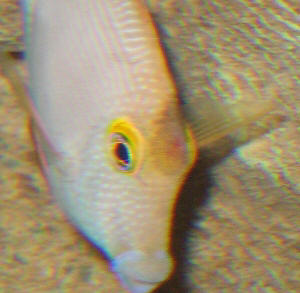
Ulceration on Tang
Hello, <Hi Jim, MacL here
tonight with you>
I've got a Kole Tang that has gotten very pale and has a Brown
Spot on his head and near one of it's gills. Initially, I
thought it was just stressed, but after 2 weeks of observation,
I've noticed the spot getting larger, and beginning to turn red
from it scraping on the rocks. <Its hard to tell from the
picture but it looks like its either bumped it and created an ulcer
or it has some type of parasite that is trying to come through.>
Tests show that my water has a PH of 8.0, 0 Ammonia and Nitrites,
and 5 ppm on Nitrates, and I keep the temperature at about 82
degrees. <I'd really like to see you get the nitrates to
zero.> It is eating well, but I would like to quarantine and
medicate to address the problem, only I have no idea what it could
be. <If you can find some medicated food that might be your best
option since we know it is eating. Thinking that it
might be a parasite your best bet for the hospital tank might be to
use copper, as much as I hate using it. You'll also need to use
an antibiotic either in the meds as previously discussed or in the
water. I know some people who have been very successful
using MelaFix although I cannot say that I have personally used
it.> I've attached a photo to show you. Please
help if you can. Thanks. <Jim, your fish is really
way to light so obviously way stressed out. I think you need to do
something pretty fast on this. Please let me know which way you
decide to go. MacL>
Jim |
|
|
Kole Tang!
Hi MacL, <Hi Jim, sorry about the delay,
I've been dealing with soccer ARGH lol>
I took your advice with the quarantine tank. <They really do come in
handily.> It didn't take 10 minutes after I put the Kole Tang in
and it's brown color came back. <GREAT! That's a very good
sign.> The only thing that I think affected it's color was poor
water conditions in my primary tank. <Truly that's usually the
reason.> I was going to let my weekly tests dictate when to change
my water. <Either that or set up a more frequent change
schedule.> The tank has been cycled for two months, and I really
haven't changed the water. <Eeek, really just a series of
partial water changes is all that's necessary. Perhaps 20% every
couple of weeks is best.> I've read your articles
about water changes, only to find that my practice wasn't a good
one. <No worries, you are learning still. We all had to learn.>
Anyway, when I changed my water, it was very
yellow, and I noticed the surface of the tank having a haze to it.
<That's generally a sign of ammonia or an algae
bloom.> I moved some powerheads close to the surface so
that it would cause a good amount of waves, but that hasn't cleared
things up. <Your water changes will I'm guessing that it may be
related to protein issues. <Very possible but remember that water
changes will take a lot of that out of the tank.> I had a
Skilter 250 protein skimmer, but even with the recommended
modifications, it doesn't clear up anything. <Anything that
stirs water is good but I think you will find other skimmers make a
huge difference.> After reading some more articles on your site, I
ordered an AquaC Remora skimmer. <Lovely choice, there are many good
ones out there.>
However, I will need a biological filter since I have a fish only tank.
<The live rock serves as your biological filter if you have any live
rock in the tank.????>
Will the Skilter's biological abilities be enough for my 46g bow
front? I have a Millennium 2000 that I'm using for my
freshwater tank, but I can easily swap if you think that's a better
approach. I'm really trying to only have
"hang-on" filters. Anyway, please provide any
information on anything I've listed, so I know if I'm heading
in the right direction. <You are right on in your
thinking. If you add the live rock it takes care of the biological
aspect of this. Its really about the "type" of tank you want
to have. You should be proud of yourself, you are really
learning quickly and what you learn are helping others.>
Thanks for the help!!! <Good luck and let me know how it
goes!>
Learning the Hard Way <The way nonetheless. RMF>
Feeding a Kole tang
Dear WWM crew, Adam & MacL!
<< Blundell here. >>
Thanks for your help. My hair algae is receding, thanks to the Kole
tang.
<< Wonderful fish. >>
He is fat and healthy looking. I QT'd him for 2 days and then
impatiently introduced him in to the display out of frustration while
dealing with the hair algae issue. It's almost 4 weeks and I seem
to have lucked out. Unfortunately, I fear that the tang may
succumb to HLLE! He has shown no interest in Nori or Mysis or pacific
plankton or pygmy angel formula or marine angel formula that I feed the
clown and the fridmani Pseudochromis. << Wow, try live brine or
Cyclop-eeze. Very rare for fish to turn them down. >>
All he eats is hair algae! Any suggestions? I'm going to try
soaking the Nori in garlic. << I don't think the garlic will
help. Also, if he is fat and happy, I wouldn't worry too much.
>>
He is still frightened of me. although after a few minutes he will come
out and go about his business. He seems to be more observant of new
things. It takes him longer to come out if there are two people
or if I move a chair to a different spot and sit in it, turn on lights
that are not usually turned on etc. ???? << Typical. >>
Thanks, Narayan
<< Blundell >>
Feeding a Kole tang continued
Thanks Adam. But regarding
your statement that if the tang is fat and happy then leave him alone,
I'm just concerned that he is not getting a varied diet... <<
Yes that is a concern. But when most fish get malnutrition
their behavior changes. They become lethargic and
irritable. A varied diet is best, but I still wouldn't
worry. >>
Narayan
<< Blundell >>
Kole Yellow Eye, feeding stones
I read your article on
wetwebmedia.com and I was particularly interested in the section on
feeding. I have a yellow eye that caught ich but I was able to treat
him in a quarantine tank for a few weeks. He has been back in my main
75 gallon reef tank for three weeks but seems to be on the skinny side
and very pale. I was interested in the sentence that you stated
"My favorite "gimmick" with these fishes is to utilize
an algal covered "feeding stone" as a site for engendering
food-taking behavior".
What exactly is a feeding stone and where might I get one? If you have
any other advice on getting him enough food would be greatly
appreciated.
Thanks!
Cauley
<"Feeding stones" are actually made by the aquarist...
either in an aquarium (sans algae eaters) or in other containers (like
large jars near a window), but you won't want to wait to make
these. Do look into buying some palatable macro-algae... either from an
online vendor like Inland Aquatics or Indo-Pacific Sea Farms, or
perhaps a local retailer or hobby-club member. Bob Fenner>
Questions - Yellow-eye Tangs (5/15/2004)
We've recently
started a 50 gallon saltwater aquarium and have a variety of marine
life living quite happily-We just lost 2 yellow-eyed tangs, <Sorry
to hear it. I assume you mean the tang Ctenochaetus strigosus. More
than 1 in a 50 gallon aquarium would overcrowding them> the third is
doing fine, we have a butterfly fish, <What species? Most butterfly
fish have very specific diets and can be hard to feed in captivity>
a crab, a starfish, a cleaner shrimp and a bunch of snails and little
hermits.
We have a never-ending battle with red, stringy algae growing all over
everything. <Most likely Cyanobacteria, technically not an algae>
The ammonia, nitrite, and ph are all good (according to our
supplier and to our own tests) but we don't know what happened with
the tangs or why we have the algae. <What are your
nitrates\phosphates? What do you mean by an "Ok" reading?
Numbers would be helpful :) Cyanobacteria is often caused by excessive
dissolved organics, nitrates, and phosphates. Try doing weekly or
bi-weekly partial water changes with a water source that is known to be
free of phosphates and nitrates. Use a chemical media such as
Seachem's SeaGel or Poly-Bio-Marine's PolyFilter to remove any
excess DOCs, as well as phosphates and nitrates. Do you have a protein
skimmer? If not, I highly recommend you obtain one. Definitely do a
search of our FAQs regarding Cyanobacteria removal)
If you have any recommendations, we'd love to hear them. <I
wouldn't add any more fish to your aquarium, as your tang will
reach 6-8 inches by itself. M. Maddox>
Kole Tang Recovery (3/6/04)
Hi Everyone, <Steve Allen
tonight.>
I have written you in the past regarding my Kole Tang and
his battle with ich. I treated him with Cupramine for the
last fourteen days in a QT. His problem now is that he looks
terrible. His skin is blotchy and he is really
pale. The good news is that he has ended his hunger strike.
<Always encouraging.> I am feeding him foods soaked in
Selcon. <Good.> Will this help him look normal again
or can I treat him with anything (antibiotic)? Thanks.
<Sorry for the delay. One of the crew is out and I'm helping
clear his inbox. I suspect your Tang is suffering from the rigors and
stress of his illness and treatment rather than a bacterial infection.
It is wise to enrich his diet. I'd add a quality vitamin too. Also
make sure he gets a lot of vegetable matter. Sea Veggies on a clip
would be great and can even be obtained at Petco these days. Even
better would be fresh Gracilaria if you can get it somewhere. It might
even be worth ordering some of this "Tang Heaven" at
www.ipsf.com As for antibiotics, I would defer unless he
appears to have a bacterial infection. Pristine water conditions will
help immensely.>
Kole Without Appetite?
Hi Everyone,
<Hey there! Scott F. with you today!>
I bought a Kole Tang about a week and a half ago. I brought
him home and he began to eat. A couple of days later, he
developed ich. I treated him with Cupramine in a
QT. Since then, he won't eat.
<Not uncommon with tangs. They don't always do well with it.
I've experienced this myself many times. Be very careful when
treating with copper, as these fish have delicate digestive fauna,
which can be damaged by prolonged exposure to copper. This will often
diminish their appetite, among other things. I'd follow the
manufacturer's instructions to the letter, and monitor the copper
level continuously during the process. If the fish shows serious
distress, do discontinue copper use. Often, once the copper level is
lowered, the tang will begin to feed again. In the future,
Formalin-based treatments might be a better route if you keep
tangs.>
I have tried everything, from frozen brine shrimp to flakes to Formula
Two frozen to Nori on a clip. Is this a result of the
copper? What else should I offer
him? Thanks.
<Well, besides lowering the copper concentration at some point, you
could try a piece of fresh live rock for him to "graze" on.
Sometimes, this can tempt an otherwise fussy fish to eat. Also,
consider the use of a liquid vitamin supplement, such as Vita Chem,
administered right into the water Observe the fish carefully. Good
luck! Regards, Scott F>
Kole Kwestions!
Hi guys,
<Hey there! Scott F. your guy tonight!>
I have been browsing your site for quite some time now. It is
great.
<Thanks for the kind words! We're glad that you enjoy
it!>
I have a question, which I could not find an answer to anywhere. I
have a Kole Tang, which started getting some strange
spots/blemishes/smears of brown color, which are not protruding or
elevated. They look as if someone took a crayon and drew them
on
the sides and on the nose underneath one eye. I thought that they
were some kind of physical damage and they would go away, but
recently saw that there are some new ones. They are in no
particular shape or form. He seems to occasionally bounce off the
gravel (scratching as I understand), but does it quite seldom and
has been doing it since I got him about a month ago without any
outbreak.
<Hmm...Sounds to me like it could be either some sort of trauma,
as you considered, some type of harmless pigment migration, or even
the beginnings of an environmentally-caused disorder called Head
And Lateral Line Erosion. Usually, this "disease" can be
cleared up by maintaining excellent water conditions and providing
quality food. In the absence of other signs of disease or
discomfort, just maintain excellent conditions and provide quality
food.>
My only other fish is Tomato Clown and he has no signs of these
brown marks. My tank is quite new - about 4 months. I have a
persistent Brown Slimy algae (sorry I don’t know the correct
term) which I can’t get rid of - could that be Tang’s
problem?
<Probably not>
I am doing regular water changes and all parameters are fine. One
thing that concerns me is that he has never touched Nori
that I offer to him, does not accept flakes that I feed to the
Clown, and did not touch broccoli - all he eats is green algae of
the glass and picks off the rocks (but there is not much on the
rocks as I see it - tank is new). Could a bad diet be the cause of
the brown spots?
<One of my possible theories. Please avoid terrestrial greens
like broccoli, as they are minimally nutritious for marine fishes,
and they can impart tremendous amounts of undesirable nitrate into
the system water. Ctenochaetus species of tangs, such as your Kole,
tend to rasp diatoms and liberate detritus from substrate and rocks
with their specially-configured mouthparts. They are very adept at
this type of feeding. You could supplement with some fresh
macroalgae, such as Gracilaria, but I have found that they tend not
to eat this with the same enthusiasm as other tank species. I'd
avoid excessively cleaning the substrate and rocks, to give them
some foraging>
If yes, how do I get him to take Nori?
<Personally, I have never found these species to be fond of
Nori, but it's worth a shot. You can rubber band it to a rock,
or attach it to a feeding clip>
Are there different kinds of Nori?
<Well, yes...>
Could he like one type and not the other?
<It is possible>
Otherwise he seems active. I am attaching 2 pictures.
Sorry for the long e-mail. Thank you so much!
Artemia.
<didn't get the attachments, Artemia, but if he appears
otherwise healthy, I'd just keep an eye on the tang and go from
there. Good luck! Regards, Scott F.> |
|
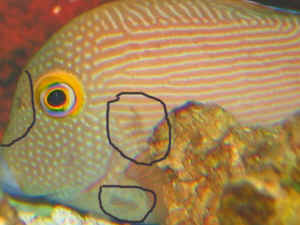
|
- Brown Spot -
Hi. The spots appear to
be going away slowly BUT there is a new event. Now, at the front
bottom of one side, not far from his gills he has a little tiny
patch of something externally, looks kind of brownish. Very small
right now so it's hard to tell. Let me know if this
"sounds" like something I should watch, like a
fungus....Thanks as always!! <Anything that seems foreign should
be watched - I don't know exactly what this is, but can say
with some certainty that this is not fungus - could be bacterial -
but fungus typically only shows on fish once they are long dead and
forgotten in the corner of the tank.> I tried to catch him to QT
him for a little while and maybe treat him but I can't catch
the little sucker... he is calm but the minute I put a net in
there... he is super freak. <Might need to use two nets - one to
distract and one to scoop.> I stood perfectly still at the tank
with the net submerged for almost an hour hoping he'd get used
to it and I could sneak up on him... didn't work. <Sometimes
is does, sometimes it doesn't.> If this sounds like I should
QT him, any ideas on how the heck to catch him? <Well, for now,
I wouldn't quarantine, I'd just keep an eye on things. AS
far as catching the fish - if you can, try to get a second set of
hands in there and they can help you steer the fish into the net.
If that's not an option, consider draining a portion of your
tank into a trash can - with one of their degrees of freedom taken
away, fish are much less creative at escape and you should be able
to get scoop out the fish. Once caught and placed in the quarantine
tank, you can refill your main tank and call it a day.>
appreciate your advice. Heather
<Cheers, J -- > |
Yellow eyed-tang
Hey guys,
I recently bought a yellow-eye and he seems to have splotches on him
and he looks like he is bouncing on the top of the water.... have you
seen this before ?
<Yes. Sometimes just resultant stress from shipping, handling... but
can be indication of other (environmental, parasitic...) disease.
Please read through www.WetWebMedia.com re the genus Ctenochaetus
tangs, Tang Disease... and where you lead yourself through the linked
files (at top, in blue). Bob Fenner>
Paul Rawlings
Re: Yellow eyed-tang
FW dip ? I have heard of this....
Freshwater and de-chlorinate it ???
<Time to send you back... to www.WetWebMedia.com, please use the
search tool (bottom left) on the homepage, with your terms
"freshwater dip". Bob Fenner>
Paul Rawlings
|
Blue-eyed Kole Tang?
Hi everyone at WWM,
<Hello David>
Love the site and recommend it to everyone I see or talk to for
that matter.
I have recently purchased a new tang. It was labeled to the LFS
as Blue-eyed Kole tang. I have yet to find a picture of a
juvenile that looks like it. Could you please look at the picture
and tell me your opinion. It has the basic body structure of a
Kole tang, with the same shape to it's jaw structure and
eating habits seem to be similar (he is eating algae from the
wall and rocks not food I am feeding) The colors are the main
thing, He is brownish red with blue highlights (probably the
lighting there ) but has a yellow tail and yellow
lower fins. He does have the sturgeon spine on his tail and does
seem to be timid as most do at first. I placed him and a
Yellow-eyed Kole together in a 55 gallon frag tang to help
control algae. The water parameters is Ph 8.0-8.1, Alk is 10 and
Calcium is 400 ppm, 0 on nitrate, nitrite, and ammonia. All is
good with the health of the animal but I was hoping to see what I
could expect as a long term size and care requirement. I can move
him to a 160 gallon that I already have running a reef if he
grows very large. Thanking you in advance for all the help, You
always are the first place I start and usually end up finding all
my questions and answers.
Thanks
David
<The genus Ctenochaetus has recently undergone renovation by
Dr. John/Jack Randall... with the addition of species. I think
what you have here is a C. binotatus, but do take a look on
fishbase.org under the genus for your own comparison. Bob
Fenner>
|
|
|
The Kole That Won't Keep His Mouth Shut!
Good day Wet
Web Crew:)
<Scott F. at your service today!>
I was wondering why my Kole tang always has his mouth opened but he
shuts it when he grazes on the algae. He's a pig, eating algae on
my live rock. Does the open mouth while he's swimming mean
anything?
<Well, I was looking at my Kole just now- and he tends to keep his
mouth open, or at least, opening an closing- most of the time, and
he's very healthy...Unless you detect an injury, and the fish is
not feeding, I'd have to say that this is a more-or-less normal
trait of these endearing fishes!>
I've enclosed a picture of him. Truly one of the prettiest fish
ever brought to the fish tank.
<Agreed! I love 'em myself! Just learn to recognize a fish with
a damaged mouth, and you'll be assured that you're on the right
track here...See the "Ctenochaetus Tangs" section on WWM for
some pics...Good luck! Regards, Scott F>
Tang vs. Angel
Hi guys,
<Hi David, PF here tonight>
Quick Question...(I think)
<It's the quick ones that turn into War and Peace... ; )
>
I have a 800 litre tank with the following fish:
Yellow Tang
Bristle Tooth Tang
Coral Beauty
Clown
Damsel
Emperor Angel
The Emperor is the latest addition and has only been in my system for
two days, the Tangs are giving him a hard time particularly the bristle
tooth. The Bristle tooth is a real menace and I have taken many fish
back to my LFS because of him.
I have about 60 kg.s of live rock in the system and if anything I
thought the Emperor would put the Tang in his place. Emperor is about
18cm.
This morning I noticed a small hole in the side of the Emperor, funny
enough just the size of a Tang scalpel.
The question is do I rush home and remove the offending tang and in the
process rip half of my tank apart or will they sort themselves out.
Thanks in advance.
David
Cape Town
South Africa.
<Well David, I think the answer boils down to whether or not you
want to keep the tang or the angel, one of them needs to go. You can
let them sort it out, but the tang to me sounds like a trouble maker.
It could also be the presence of two tangs that is causing the
aggression, tangs generally don't get along with other tangs.
Have a good evening, PF>
Feeding a Finicky Kole
Hi guys how are you?
<Doin' Great! Scott F. with you today!>
Question for you , What are some recipes for the creation
of good fish food. I have a Kole tang that is loosing weight
and getting bone thin. What can I do to bring him back to a healthy
weight. He is in a 72 gallon reef tank with about 70 pounds of rock he
grazes all day but there is insufficient algae for him.
<Well, one of the easiest things you could do for him would be to
purchase or "cultivate" some "feeding rocks" with
have lots of microalgae on them, and rotate them into his tank a couple
of times a week to supplement his regular feeding.>
Another concern I have is he attracts ich easily I battled ich by
taking all the fish out of the tank and setting them in a hospital tank
for a month, they had all lost the parasites after a couple of
treatments of copper. Reading a article you have on ich I decided to
break down the 72 gallon tank and give it a cleaning, using about half
of the existing water I also removed half of the aragonite sand bed
permanently and the other half was washed and returned to
the tank. The only other thing I noticed is my other fish are not
effected by the parasites no visible white dots or white spots on their
fins. Could you please tell me another way of possibly treating my main
tank and bringing my tang back to health.
<Well, the "easiest" way (I guess "easiest" is a
relative term here!) is to let the tank run fallow, without fishes, for
about a month, to allow time for the parasite population to crash for
lack of hosts (fish). This method is quite effective at reducing or
eliminating the parasites from your tank>
I have heard Nori is good but I can't find it anywhere and I have
tried to feed them romaine lettuce but he doesn't even touch
it.
<I wouldn't waste your time with lettuce. It really has very
little nutritional value and can potentially leach lots of nitrates
into the water...Nori is available at most Asian markets; it's
used, among other things, for sushi. Another good food for tangs in
general is the macroalgae Gracilaria parvispora. Called "Ogo"
in the Islands- it's probably THE food for most herbivorous
tangs...You could get it from places like Indo-Pacific Sea Farms in
Kona, or Mary Middlebrook's site in CA. One caveat, however- the
Kole is the most "detritivorous" type of tang- versus the
more herbivorous Zebrasoma species. As such, it does rasp algae and
diatoms from rocks and substrate, but it will also derive a substantial
portion of its diet from typical prepared fare, such as Mysis,
"Formula" foods, etc. It may try the Gracilaria, but usually
will take prepared foods over the macroalgae...>
I feed them blood worms Flake food with Spirulina angel formula also
dried pellet food but they don't seem to like it anymore.
Thank you Stan N. Edmonton Ab Canada
<Stan, do try the frozen foods mentioned above...they are an
excellent dietary supplement! Good luck! Regards, Scott F.>
- Kole Tang Changing Colors -
Hi there how are you? <I
am well, thanks for asking.> I have a question or two for you. I
purchased a Kole tang about a week ago at a local pet shop it looked
healthy it was continually eating algae off the live rock in the tank
and with further inspection I took him home. After a day or so it
started to eat I tried a variety of foods including dried see weed,
brine shrimp, blood worms and a frozen seaweed variety angel formula.
<As an FYI - Angel Formula is actually a sponge based food for
larger angels... not so much sea weed in there.> After about four
days I noticed some blotches on his sides I have had many battles with
marine ich before and I know this isn't it. <Could be for a
variety of reasons, but I suspect your problems with Ich would be due
to the fact that you didn't quarantine your fish before placing
them in the system. Please read up on this here: http://www.wetwebmedia.com/quaranti.htm >
These blemishes seem to be below the surface mostly seen under bright
light, these blotches have spread to the head area as well they
don't fall off and they don't look fuzzy like fungus. <These
fish can change their colors depending on mood, time of day, etc...
most likely it is under stress from the move to your system and is just
feeling out of sorts. It will take a couple of weeks to a month for
this fish to feel at home.> The tang is still very active but is a
finicky eater it seems to be feeding off the rock and some areas of the
glass where algae has started to form. I am wondering if It is Stress
that is causing this any suggestions. <Yes... stress - give it time,
be patient.> He is housed in a 72 gallon tank with a Lemonpeel
angel, a blue devil damsel, two common clowns about an inch long, a
purple Pseudochromis small as well, and a very small tomato clown. It
seemed to quarrel with the blue devil damsel for a while but now it
seems ok. All other fish in the tank are feeding and have a clean bill
of health. If you have any suggestions please E mail me back.
Thank you
Stan N.
<Cheers, J -- >
Kole On The Decline?
I just purchased a Kole Tang one
week ago, and everything was fine except that she wouldn't eat the
sea weed either from the veggie clip or when floating around the tank.
The Kole Tang was eating Spirulina flakes with vigor just a few days
ago. Yesterday, I noticed that she had some light blotches on her
forehead and stayed completely hidden (under a large rock) and
didn't come out for food at all.
<Hmm, not a great sign, huh?>
Her mouth was open and looked fine although I'm not sure if it was
swollen.
< Do confirm this with careful observation. Sometimes, Ctenochaetus
tangs do occasionally suffer from "collection traumas" and
other injuries to their mouths, and these visible problems should
disqualify a specimen from selection for your tank. When the mouthparts
of these fishes are damaged, they rarely recover. Not trying to paint a
"gloom and doom" scenario here, but, based on your
description, there is a possibility that the fish may be damaged in
this manner..>
This morning, I used a flashlight to examine her in her little cavern
and it looked like maybe the white blotches might be HLLE. Since I have
not seen any pictures of this on the internet I cannot diagnose
properly.
<Well, HLLE symptoms usually include a "pitted" appearance
to the head of the fish. White blotches sound more like a fungus or a
bacterial malady of some sort. It sounds to me like this fish needs to
be moved to a "hospital tank" for observation and/or
treatment. Do read up on the wetwebmedia.com FAQs on disease to confirm
what it is you may be dealing with. With quick, decisive intervention,
you may be able to save this fish (assuming that the mouth is not
damaged, as discussed above).>
Is it time to heat up the frying pan or can I still save my Kole?
Tank specs.
Tank:100GAL
Sump: 40GAL (approx 17GAL full)
PH: 8.3
Ammonia: 0
Nitrite: 0
Nitrate: 0
ALK: Normal
Temp: 80.5
SG: 1.024 (using the plastic Coralife Hydrometer with the arm)
I do not have a grounding probe and the other fish in my tank are a
blue damsel and a three stripe damsel. The tank is three months old and
has approximately 30lbs of live rock in it. Thanks, Peter
<Well, Peter, it sounds like your tank conditions are okay...I get
the feeling that you're not dealing with HLLE here for a number of
reasons, not the least of which is the very rapid onset of the
symptoms. In the future, please "play it safe" and quarantine
all new arrivals for a minimum of 3 weeks before releasing them into
your main system. Tangs, in particular, are notorious for contracting
diseases during collection, shipping, and acclimating, and quarantine
gives you the opportunity to observe, "harden", and treat the
fishes if necessary without incurring the added stress (for both you
and the fish) of removing it from the main tank, or spreading disease
to your other fishes. Take quick action with this fish...Good luck! Let
us know if we can be of further assistance. Regards, Scott F>
Kole On The Decline? (Pt. 2)
Thanks for your response, I
examined the Kole Tang again most of the night and she seems really
slow and unresponsive. Not like when she was purchased. At this point
it looks like her mouth rarely closes if at all. She did come out to
eat, although not with the same vigor as last week.
<The fact that this fish is eating is a good sign!>
Do you know of any successful treatment if this is mouth trauma?
<Well, if the mouth is damaged, it's unlikely that a medication
could help. However, if the fish is "gaping" due to a
bacterial infection, then a medication could perhaps work. Impossible
for me to diagnose here, so you'll have to really take a look at
this fish and review the disease FAQs on the wetwebmedia.com to try to
verify exactly what you're dealing with. Try to verify if the mouth
is actually "injured", versus swollen.>
Some type of antibiotic, or, medication to help her through this?
<Well, I'd go for a broad-spectrum antibiotic, such as Maracyn
2. The administration of the medication should really take place in a
separate aquarium. At the very least, freshwater dips may help if
you're hesitant to try a medication. This is a more manageable, but
possibly less effective treatment, if a "hospital" tank is
not available.>
At this point I do not have a quarantine tank set up. But after this
experience I will in the future. Peter
<Certainly a great idea! You'll definitely reap the rewards of
this practice down the line! Good luck! regards, Scott F.>
How often to feed Kole Tang?
Hi.
<Hello!>
I have a 55 gal. reef with 50 lbs. of live rock. The rock
has quite a bit of hair and bubble algae. I just bought a
Kole Tang. I know he will eat he hair and may help a little
with the bubble.
<Maybe. Fish don't read books very often so they don't
always respond to things the way we think they will/should but
alas...time will tell. I hope that you're right>
My question is, how often should I supplement his diet with Formula Two
if I expect him to successfully graze?
<I suggest that you consider growing some Gracilaria in the tank (if
possible) and feed this guy with the Formula 2 a couple to three times
a week. You might consider adding Selcon or any vitamin supplement that
contains a stabilized form of vitamin-C to his rations. You can also
feed Nori from the Asian section of your supermarket. Try to get the
dried kind instead of baked. If he really does chow down on the bubble
and hair algae I would feed even less until the nuisance stuff is
gone>
I don't want him to get lazy. My guess is every other
day, but I need a "gut check."
<You're on the right track!>
Note - I also have two clowns and a watchman goby that I feed once a
day with a variety of frozen foods (Formula B, prawns, clams
squid.). I expect the Kole will eat that as well.
<Guaranteed! They need protein as well>
Thank you, Rob Fox
<No problem! David Dowless>
Sick Tang?
Hi all, Happy Turkey Day.
Sorry to bug you on the holiday but take a look at the attached pic
and tell me if you think the Kole is sick and if so recommended
treatment. I looked at the disease articles and could not find
any
pics that look like this and I don’t want to treat until
identified. This fish is in quarantine with sponge filter,
powerhead , heater, and skimmer. I had it in the dark for the first
5 days and then put a 40w NO light on the tank (20L). It looks real
pale in the am but I thought this was normal.
<At times the species, actually genus and whole family will
"pale" if stressed>
It is swimming around, is active, fins are not clenched and
breathing is not rapid. I have added some
Caulerpa and Ulva and a piece of live rock, 3” PVC T. I have
been feeding Mysis (never seen him eat any) and Spirulina. This it
attacks violently. Whaddya ya think? Thanks in advance, Don
<It does appear mostly okay to me from your pic, and very much
so from your description. I am inclined to give it a clean bill of
health. Bob Fenner> |
|
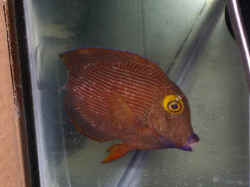
|
Disease ID on Kole Tang
<Cheers, Richard>
Hello Bob, I have been having some type of disease problem with every
Kole tang that I have brought into my store. I have attached some pics
of an affected fish in hopes that you can help me identify the disease.
It usually starts as a brownish or pale colored patch on their side and
eventually spreads around the head area. So far the disease has never
spread to any other fish
in the tanks. Your help is greatly appreciated. Thanks, Richard
<the species specific nature of the pathogen is not a surprise... we
have seen this with butterflies and dwarf angels just the same. It is
not exactly clear from the images what the primary cause is, but I see
a hint and suspect the fishes die with full blown hemorrhagic
septicemia (you see bloody ruptures under the skin or even open
lesions?). If not, then we make look towards complications from
Brooklynella which is all to common in Hawaiian imports. I assume that
this is a central system. My advice would be to stop putting tanks in
this system for 2-4 weeks minimum and ozonate it (or ozonate it
better). At the same time, import just a few more to place
into an off-system QT tank to see if the problem is the shipper or a
bug in your tank/system. Treat the new import in QT with daily formalin
(use Aquarium Products Formalin or "Quick Cure [malachite with
formalin]) daily for 5 to 7 days consecutively. A small daily water
change for that first week from the bottom would be nice too. Stable
temp in qt (2 heaters, 78-80F... no higher). And observation for a
total of 2-4 weeks. This will indicate to us where it is coming from
and how we can treat it. I strongly recommend properly dosed ozone in
commercial systems... there are so many benefits beyond disease
control. And UV is almost useless on central systems (too high flow,
too high organics and particulates, etc... just useless for most).
Ozone with effluent passed over carbon is fool proof. A RedOx
controller running it will be a tremendous investment in the quality
and health of your fishes. Best regards, Anthony>
Kole Tang
I recently purchased a Kole Tang (1 week ago),
and it's swimming up and down repeatedly in the same area. It
appears to be "afraid" to eat, and will come out rarely with
the exception of the above described swimming pattern.
<<I get the sense that you did not quarantine this fish. One of
the best reasons to do this is to help the fish get used to the idea of
captive living and your feeding schedule, away from other
fish.>>
Is there anything that I can do for the fish? What is causing this
behavior? <<Stress, most likely although most tangs are constant
swimmers... they really like to cover a lot of ground. If it appears
that the fish is doing this in response to its reflection in the glass
[which isn't uncommon] then you might try leaving the tank lights
off for a couple of days to help the tang get used to that other tang
that keeps swimming back and forth with it.>>
Will it die?
<<Uhh... that is kind of open-ended... if it doesn't eat,
yes.>>
Please Help!!
<<Be patient, consider a quarantine tank for this fish to have
some quiet time to itself.>>
Sonya
<<Cheers, J -- >>
Kole Tang Eating habits and LR Cycling
Hello there,
I have a funny question...being a guy (last time I checked) I like to
laugh at things gaseous, smelly and loud...so in a related topic, I
noticed that my Kole Tang eats my other fishes' poop (yellow tang,
4 damsels - all provide the Kole with freebies). Now, one of my dogs
has been doing this for years, with no obvious health consequences
other than bad teeth and horrendous dog breath, but I was wondering if
this is unhealthy for a fish. <<Interesting question... for your
dog, this is only a throw-back to the wolf gene all dogs carry. Wolves
often bring food home to the den only to offer it back to the pups in a
semi-digested form. Fish on the other hand... who knows. This is an
observed and documented behavior in several species of fish, and is
really quite normal.>>
Is this behavior normal for a Kole Tang.
<<Not sure about the Kole tank in particular, but I'm
not surprised.>>
I alternate feedings of Formula 2 and Nori everyday with Mysis
shrimp (when I feed the anemones and polyps), and I see it grazing on
the algae covered rocks and glass. It constantly has a full stomach (of
what... I hasten to guess).
<<let's not go there... oops, too late.>>
My other question concerns my LR. I put in my "pre-cured
rock" after ammonia readings were <0.1 and three weeks of
re-curing in a 40 and 20 gallon bin with skimmer and two power heads.
It went into my established (for about 10 years) 55 gallon with fish. I
worried that weekend, and feared that I put it in too quickly...I did
not test for nitrites, foolishly. Today, in the late afternoon, I
tested the ammonia, which came up as zero, or close to it from what I
can tell off the color chart. It hasn't been a month, but is there
a chance that the ammonia will spike up again or re-cycle?
<<I don't think so, you are likely fine.>>
I have an Aqua-C Urchin in a ten gallon sump, built-in overflow,
bio-balls, Chemi-pure, and two sweeping power heads in the tank. Do you
think that the tank was capable of taking care of the stress from
adding 45lbs of rock at one time since it had already been through its
cycling, many moons ago? <<Well, that and you did pre-cure the
rock...>>
All inhabitants are doing fine, with no casualties since January,
except for my cinnamon clown who thought it was superman and leaped out
last week...probably got disgusted at the sight of the Kole eating
poop. <<perhaps.>>
Thanks, Randy M. Yniguez, MA
<<Cheers, J -- >>
Surgeonfishes: Tangs for Marine Aquariums
Diversity, Selection & Care
New eBook on Amazon: Available
here
New Print Book on Create Space: Available
here
by Robert (Bob) Fenner |
|
|
|

