|
|
| Home | Marine Aquariums |
Freshwater Aquariums |
Planted Aquariums |
Brackish Systems |
Ponds,
lakes & fountains |
Turtles & Amphibians |
Aquatic Business |
Aquatic Science |
Ask the WWM Crew a Question |
| Please visit our Sponsors | ||||
The Smaller, or Dwarf-Dwarf Angels of
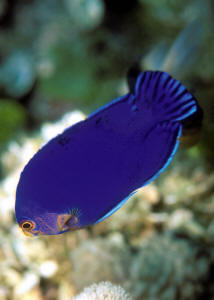
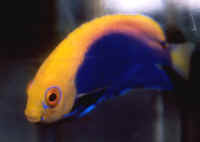
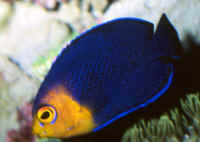
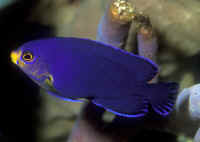
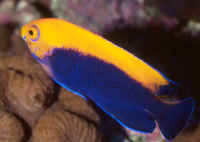
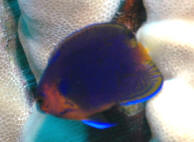
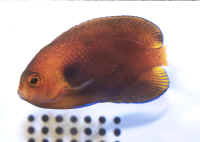
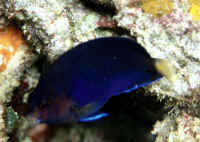
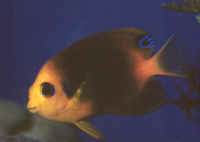
the Genus Centropyge Bob Fenner There are a handful of "the smallest of the small" pomacanthids in
the world’s tropical oceans, most all beautiful, ultimately all
captivating. These Centropyge of an inch, two to three at most are
amongst the "best available, most appropriate" reef aquarium livestock.
Most can "get by" in as small a volume as twenty-thirty gallons... for
the most part they won't harm any purposeful tankmate... and to top off
other beneficial characteristics, they're hardy and accept most all
prepared foods. Like the other, larger members of their genus,
these dwarf dwarf Angels prefer well-established systems with plenty of
cover and live rock. Unlike their hit or miss larger congeners they
rarely bother cnidarians they're housed with. The Dwarf Dwarf Centropyges:
Compatibility: These diminutive Angels are about the easiest
going of their family... and this can be saying a bunch. This being
stated, they are still aggressive for their diminutive proportions...
and can hold their own against fishes a good-sized larger. As with most
site-dominant species we utilize as marine ornamentals the dwarf dwarf
Angels should be placed last in your stocking plan, giving less "fast
and smart" fishes and motile invertebrates a chance to establish
themselves, and "learn the lay of the land/tank". Selection: Picking out healthy specimens of these species is
not difficult. For the most part, all that survive the rigors of
capture, holding and transport (thus far, all but the Multicolor are
entirely wild-collected), are generally "good to go." Do assure yourself
that the individual/s you're interested in are eating and clean however,
by having your dealer feed them and catch and show you this in a clean
specimen container. Systems:
What is the point? These fishes need plenty of
cover... as in as much as you can provide. The more this material is
based/situated on hard substrate, the better. The matrix of living and
non-living material serves an as critical role as a source of food... as
these fishes are constant pickers of algae, small invertebrate animals
during light hours. Foods/Feeding/Nutrition: The actual feeding of the smaller Centropyge is
identical to the larger species... In the wild they principally feed on
filamentous algae and organisms associated with this (small worms and
crustaceans principally). In captivity it is prudent to house them with
good quantities of healthy, diverse (i.e. not too "old") live rock,
supplementing what they will find and ingest with occasional sinking,
small meaty food items. Prepared algae in the form of sheets and tablets
is rarely taken, but growing your own "algae rocks" elsewhere and
placing them in the display with these fishes will prove effective. Disease/Health: Though they're small, the littlest Centropyges get
parasitized, fall subject to poor environment and suffer nutritional
difficulties as much as their larger kin. Cryptocaryon and Amyloodinium
are easily treated with prudent use (and measure) of copper (chelated is
better) compounds. Internal parasites are rarely so debilitating in
these fishes as to compromise their health in otherwise optimized,
stable settings. Reproduction: Baensch (2003) gives an account of successful
breeding and rearing of a few Centropyge species, including Fisher's and
Multicolor. He states that the principal hurdles to captive production
of the genus are the larvae's small size at hatching and their primitive
physiology. He has overcome these obstacles and has commercially
produced young of a few Centropyge species for the ornamental trade. Centropyges are broadcast spawners... releasing
eggs and sperm simultaneously in the water column... The fertilized
eggs, averaging about 7 mm in diameter, float to the surface and hatch
in about a day... becoming part of the plankton and feeding there... and
slowly growing till (hopefully) happening upon a patch of shallow reef
on which to settle and metamorphose. First foods utilized in Baensch work included
trials with Rotifers and Ciliates (both unproductive) and tow collected
copepod larvae and eggs (with success). See his site (link below) for
more, up to date information/news. Cloze: At WetWebMedia.com we see a good deal of "can I
fit this or that animal" type questions, including a fair percentage of
folks who'd really like to "squeeze" a marine angel (or a few!) into a
too-small system. Practically speaking, the only Pomacanthids that can
be kept healthy long-term in anything smaller than sixty gallons are
these dwarf dwarf Centropyge. But don't be discouraged by this
limitation... these fishes are very nice to keep... They are colorful,
intelligent, playful... and hardy and long-lived, given a stable setting
with plenty of cover and a paucity of more aggressive tankmates. Bibliography/Further Reading: Frank Baensch's site:
http://rcthawaii.com/ Allen, Gerald R. 1985 (3d Ed.). Butterfly and Angelfishes of the
World, v. 2. Aquarium Systems, OH. 352 pp. Allen, Gerald, Roger Steene & Mark Allen. 1998. A Guide to
Angelfishes & Butterflyfishes. Tropical Reef Research/Odyssey Baensch, Frank. 2003. Marine copepods and the culture of two new
pygmy angelfish species. FAMA 7/03. Debelius, Helmut & Hans A. Baensch. 1994. Marine Atlas, v.1. MERGUS, Emmens, C.W. 1985. Smaller Pacific angelfishes. TFH 6/85. Fenner, Robert. 1998. Perfect little angels (Centropyge). TFH 4/98. Gaither, M.R., Schultz, J.K., Bellwood, D.R., Pyle, R.L., DiBattista, J.D., Rocha, L.A. and Bowen, B.W., 2014. Evolution of pygmy angelfishes: recent divergences, introgression, and the usefulness of color in taxonomy. Molecular Phylogenetics and Evolution, 74, pp.38-47. Kuhling, D. Undated. Centropyge, dwarf angelfish who must eat
their greens! Aquarium Digest International #38. Kuiter, Rudie H. & Helmut Debelius. 1994. Michael, Scott W. Fishes for the marine aquarium; pts. 16 &17: Pygmy
angelfishes- diminutive, but beautiful; Some possible pygmy angels for
your marine tank. AFM 1,2/96. Moenich, David R. 1987. Angel food; the most important single factor
in keeping marine angels healthy is a varied diet. TFH 6/87. Moenich, David R. 1988. Pygmy angelfishes: the genus Centropyge.
TFH 1/88.
Steene, Roger C. 1985 (2d. ed.). Butterfly and Angelfishes of the
World, v.1. ( Stratton, Richard F. 1994. Practical angels. TFH 9/94. Taylor, Edward C. 1983. Marine angelfishes- thinking small. TFH 5/83. Thresher, R.E. 1984. Reproduction in reef fishes, pt. 3; Angelfishes
(Pomacanthidae). TFH 12/84. Wrobel, David. 1988. Dwarf angels of the genus Centropyge. SeaScope
Spr. 88.
|
|

|
Features: |
|
| Featured Sponsors: |