|
FAQs on Marine Environmental Disease:
Physiological Issues; Metabolites, Toxins, Venoms, Allelopathy,
Stinging...
Related Articles: Environmental Disease, Establishing Nutrient Cycling,
Marine Water
Quality, Maintenance,
Related FAQs: Environmental Disease 1, Marine Environmental Disease 2, Marine Env. Disease 3, Marine Env. Disease 4, Marine Env. Disease 5, Marine Env. Disease 6, Marine Env. Disease 7,
Marine Env. Disease
8, Marine Env. Disease 9,
Marine Env. Disease 10, Marine Env. Disease 11, Marine Env. Disease 12, Marine Env. Disease 13, & FAQs on
Environmental Disease By Cause/Types: Environmental Deficiencies, Oxygen/Gas Problems, Poisoning, Mis-stocking: Psychological Challenges, (
Aggressive
Behavior, Territoriality, ),
& Troubleshooting/Fixing,
|
Got a plan? Know what you're doing? Don't
we wish we could package "patience" and sell it in a
bottle? Few good things happen quickly with aquatic systems...
When, where in doubt, wait.
The list of stinging, venomous, poisonous
livestock... is VERY long... study, know your livestock.
Overt troubles? Water changes as a rule are a good
idea. Real overt troubles? Moving expensive livestock immediately
if not sooner.
|
|
Salt water fish tank problems; cycling/env.
12/14/19
Hello,
My name is Mason,
<Hello Mason, Wil here.>
I have a salt water fish tank that has been problematic from the start (July
2019) despite everything we have tried to fix it, but our fish keep getting sick
and die.
<Did you cycle this tank?>
We started with a 29 gallon bio-cube tank some live rock, sand and salt water
from one specific store.
<Live, cured?>
We then found another store where we had gotten a watchman gobi <Y> and a royal
gramma to start our tank.
<These fish are not adequate to cycle a tank>
About 10 days later the gramma passed away.
<Did you quarantine the fish?>
After further water testing trace amounts of copper was found in the water. We
then called the original store and found out that their live rock supply is
mostly from broken down tanks.
<Mmm… I see>
We immediately removed the old rock and treated the tank with Triton Detox
(recommended from the new fish store) and a poly filter for after treatment. We
have had weekly to bi-weekly water testing all of which the parameters have been
good.
<Could you please send us the current test readings?>
We do bi-weekly water changes and test the salinity often, we have a protein
skimmer and heater in the tank that is set to 79.3 degrees. The problem that is
still occurring is that fish keep passing away. The watchman
gobi is still alive but since the first royal gramma we have lost 2 more and 2
bi-colored blennies, 2 peppermint shrimp, 1 tail spot blend, 1 carpenter wrasse,
1 cleaner shrimp, 1 coral beauty and countless Nerite snails all of which have
lasted for 3 weeks then perished. We had a Banggai cardinal fish that was
returned to the store because we thought maybe he was being a bully and put in a
Talbots damsel. The damsel we have now is currently growing some kind of fungus
on it and we really can not figure out what is happening to the tank, the
parameters are always good the salinity is fine, no one is being a bully. Our
current tank occupants are the watchman gobi, pistol shrimp, Talbots damsel, 2
turbo snails hermit crabs and Nerite snails. We also have coral that is doing
fine, growing and flourishing. Basically we are at an impasse and have invested
a lot of time and money into this tank and its been stressful and we are about
ready to give up.
<You should have invested more in reading ahead of buying fish.>
We recently tried General Cure by API but there is no change. We have a carbon
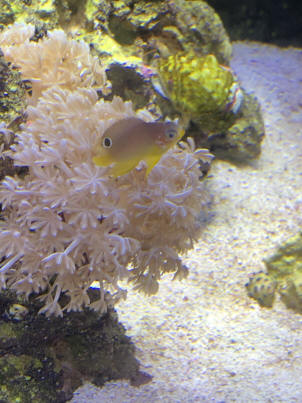
filter and a poly filter in the tank currently. I have attached a photo of the
damsel. If there is anything else that we can do please let us know
<I recommend you stop adding new livestock and do a good reading, please start
with the following links and related
http://www.wetwebmedia.com/estbiofiltmar.htm>
Thank you
Mason Truelove
<You are welcome. Wil.>
|
 |
Thermal shock symptoms
12/5/19
Hey bob,
<Bobby>
Could you tell me what some of the symptoms of temp shock are?
<Most often, fishes (and invertebrates) "sink" to the bottom, low to in-active,
fins clamped... give up eating>
Did a water change on my quarantine tank last night. About 75 percent on 20
gallons to get meds out.
In my new water , I had heater in there set for same temp, and did water change.
(78)
After I did change, my tank temp dropped from 78 to 72,turns out I never had
heater plugged in and assumed it was on and close to temp.
I have a bellus angel laying on ground, and a watanabei swimming vertically.
Does that sound like temp shock, and if so is it too far gone at this point?
Thanks, Bobby
<Mmm; I would not give up. This degree of change does occur in the wild at
times. Bob Fenner>
Re: Thermal shock symptoms
12/5/19
Thanks bob. Just to clarify, the new water change water must have been in the
60s, because my display tank instantly went from 78 to 72, 6 degree drop in a
matter of 20-30 seconds.
<Yeah; have been out diving when very much colder water flowed out of rivers,
lagoons... happens>
Looking now I doubt the bellus has a chance, laying in side hasn’t moved really
and gills are moving. The watanabei will go from completely upright at the
surface , swim fine for a few minutes, and head back the vertical position.
<These shocks take a while (days, weeks) to correct. I like a model of
impairment of protein/enzyme function... >
I’ve had far worst luck with quarantine then the days of dipping and dropping
display .
<Patience. BobF>
Thanks again.
Re: Thermal shock symptoms
12/5/19
Hey bob, sad to report both fish did not make it. Came home from work and they
were dead on the bottom.
<Ahh!>
Is it safe to blame the temp drop? My fear is something else was a miss, ad this
just out the nail in the coffin. Or could it very well be some fish just can’t
handle the drop?
<As previously stated/postulated, the thermal drop/stress is likely a
complimentary negative influence here; along w/ some other factor/s; this did
likely lead to their loss. Bob Fenner>
Elegance coral, dying in/comp.
11/18/18
My Elegance Coral died so I removed it and did a water change. Same
night I lost 80% of snails then 5 days later 2 clowns and a blenny
started to act funny then passed. Do you think the Elegance dying could
have created that or a chemical. (all crabs and shrimps not affected)
<Almost certainly it was caused by toxins released by your Elegance
coral dying; do a large water change,40-50% and use a Polyfilter pad
combined with a high grade activate carbon or ChemiPure, a couple of
days later try adding some "test" fishes like bluetail Damsels
(Chrysiptera sp). Please keep us posted on how it goes. Wil>
Question about transferring marine fish
11/15/18
Dear Crew:
<Cynthia>
I read your website and questions and answers all the time.
I think you folks are fantastic.
<Well, Thanks!>
I have just one question, and I have read a lot of conflicting information about
it.
<Will do my best to dispel any doubt>
I don’t have any tanks set up at this time, but after many years of freshwater
experience and breeding cichlids, I am starting to set up a saltwater aquarium.
This is my question: regarding marine fish, if you have to transfer a fish from
one tank to another or from the bag he/she came in to a tank, and you’re in a
hurry (let’s just say the sky is falling) what parameter is the most important
to match between the water you’re moving from and the water you’re moving to?
Is
it the salinity or the pH or both or temperature or something else?
<The three of them are very important, but I would say Ph adjustment is the most
critical, since this parameter is the one that causes stress shock in newly
acquired/acclimated fish; secondly I will put salinity, fish are reasonably
tolerant to slight variations. And lastly, water temperature; this one may be a
bit different (preferably warmer) than the water containing the fish.>
Thanks very much,
Cynthia White Vancouver Island
<Welcome. Wil>
Mushroom killing bacteria?
8/21/17
Hi Crew! I am at a total loss, I need help.
I run 2 tanks, my main 75 gallon display tank (established 3.5 years) and a
newer (7/8 mth) 55 gallon 'frag tank'.
I am a big mushroom enthusiast, but also keep a variety of other soft corals,
Zoanthids, lps and a couple small easy sps (birdsnests, montis).
<Mmm; you likely have heard/read that Zoas and Shrooms often "fight"
chemically; more than most stony corals>
You'll hate to hear this but I have never been big on testing, I simply rely on
frequent small water changes via drip, and constant observation for anything
looking 'off'. I have a low fish stock in both (maroon clown, starry blenny,
azure damsel, pink spotted watchmen and an unknown Anthias in the 75, and a
small clarkii clown and azure in 55).
<I'm of the same "practice">
Up until recently both tanks have thrived, very minimal coral or fish loss over
the past few years. Everything has always seemed very stable and well balanced,
no issues with algae and in fact immediately before my current
issue my display tank looked the best it ever had.
But we all make mistakes, and I always learn from them, but in this case I think
it's too late. I know I should have been quarantining everything and I have
learned and now have a quarantine tank set up but as I said, too late.
<Mmm>
So on to my issue. A few months ago I purchased the coral contents of a fellow
reefers tank with plans of fragging and reselling the corals. The vast majority
were Euphyllia (torches, hammers, frogspawn, as well as a favia, large brain and
some others) I placed them all in my frag tank, except one large plate that I
didn't have space for that went into my display.
<The Euphyllias rank near the top for allelopathy amongst Scleractinians...
Oh how I wish you'd slowly acclimated the new to the established as gone over
here:
http://www.wetwebmedia.com/cnidcompppt.htm
Within 24 hours the brain and plate both looked ill
<Losers to the mentioned combatants; classical>
and eventually started melting, and were covered in the dreaded brown jelly.
Never having dealt with brown jelly before it was a great learning experience. I
promptly removed both corals but the brown jelly didn't take long to affect the
other Euphyllia (i suppose since they were not well established and under
stress). I saw no ill effects on any corals in my main tank, assuming because
they were well established and healthy. My attempts at fragging off dying
pieces, treating in a separate tank with furan 2, dips with revive, rinsing in
fw etc all failed. In the end i lost
the vast majority of Euphyllia that I had purchased, aside from the frogspawn
which never seemed effected.
<More reading:
http://www.wetwebmedia.com/envdisphysiof.htm
A few weeks later and all the Euphyllia in the frag tank were gone besides the
frogspawn, and everything seemed back to normal, so I resumed my normal
practices. I fragged some Rhodactis mushrooms in the frag tank,
<... Yeeikes; not in the tank; not this soon>
and to my surprise they melted. I have never had issues with fragging any
mushrooms in the past. At the time I did not think it could be related, (and am
still not sure it is) maybe I had just 'butchered' them or they weren't well
established, so I simply decided to hold off on any fragging for a while. At
some point I moved some mushrooms into my display, considering them quarantined
and healthy. Weeks went by with no issues, now the nightmare starts.
A few weeks ago I lost one of my prize Rhodactis in my display. It had been
doing amazing and was growing rapidly, and then didn't open fully for a couple
days, then suddenly melted within hours. Since then many healthy
mushrooms (some that I have had for at least 3 years) have just suddenly melted
away.
<A familiar "cascade" event>
Some first detach from the rock then disappear, some start expelling their guts
then begin oozing from their mouths till they melt away, the odd one simply
begins oozing from an outside edge then melts. These are healthy mushrooms, not
recently fragged or damaged in any way. I have learned to syphon them out now as
soon as i see it beginning, but I need to find a way to stop this!
<For now; just time going by: NO CHANGES>
So far it has only affected Rhodactis and Discosoma, I haven't lost a single
Ricordea, or any other type of coral for that matter. The mushrooms that die are
all in random places in the tank, it doesn't necessarily travel from one and
then directly to it's neighbour. I even accidentally damaged a hammer coral
while moving it (it and an anemone were getting dangerously close to each other
) and it has recovered quickly and without incident.
I've done large water changes and added carbon with no luck, just in case it was
allelopathy.
<Ah, good>
I apologize for the long story, but I feel all details are necessary.
<They are; no worries>
Please help guide me, what steps should I take next? I have spent 3.5 years
building my mushroom collection, this is devastating to me. I am normally very
good at researching and problem solving on my own, but I feel I have
hit a dead end.
<IF you have other well-established systems to move some stock to, I would.
Otherwise, no further additions or fragging here for a few months>
The last thing I would like to note is that the only other major change I had
made around the time this started was that I began feeding Reef Roids to the
tank, although I am sure this is merely coincidental.
<Agreed. Bob Fenner>
Green Hairy Mushroom blues...
Hi gang,
<Chuck>
I've got a 225 gallon reef, with lots of (probably too many) LPS and
softies... the latter mainly zooanthids and pulsing xenia.
<Yikes... very allelopathogenic groups>
Down on the bottom of the tank, I've had a horde of green hairy (frilly?)
mushrooms
<Yowzah! The triumvirate!>
that have been bent-on-world-domination for a while.
<Heeeee!>
I trade them in at my LFS in batches... when they get out of control...
which has been a regular occurrence two or three times a year.
No issue until last week... when I couldn't pay attention to the reef
for a few days. Suddenly... all my green hairy mushrooms were shrunken
and pale... down to maybe 10% of their normal size... and looked like
they were dying.
<Yikes!>
I did a quick water change...
<And activated carbon...>
I've admittedly been negligent lately...
dosed some iodine... strontium... and later magnesium. The green
frillies seem to have stabilized... and when I pull one up, it's got
only its normal -- slightly noxious -- smell. They're still firm to the
touch, and none are dissolving into moosh. All other corals look fine.
For now...
The mushrooms seem to have stabilized... are firm to the touch, and some
have begun to regain a bit of their normal color, and extend
bits-of-frilliness outward again.
I've got another batch of water prepped... and will do a few more
changes in the short run.
<Good>
My question is this:
Since they all declined so rapidly, is this likely to be a
coral-chemistry allelopathy issue... or a lack of trace-elements... with
some critical element suddenly in short supply?
<My bet is the first>
I've admittedly got an awful lot of purple tip frogspawn and grape coral
in this tank... plus lots of xenia.
The only other thing I can think of is I've been giving my tangs quite a
bit of blanched spinach lately... since they'd been on a dried nori diet
for too long, and fresh seaweed has become unavailable at the LFS's
lately... I know for humans spinach is considered a decent dietary
source of copper, and wonder if this could be the problem.
Thanks in advance for any help on this...
Chuck
<Whatever the trigger... am glad you appear to have arrested this
"cascade event". Do see here re others experience:
http://www.wetwebmedia.com/toxicwipeoutf.htm
Bob Fenner> Stkg. FOWLR..., thermal stress losses
4/11/13
greetings
Hi Bob, I hope you're well.
<Thank you Peter; yes>
I still miss my Condylactis, but the aquarium today was at 88F which,
from my reading, it would not have tolerated. I can usually keep it
below 90F by closing the window sash. The Cardinals, damsels, and clowns
have tolerated it well over the years. I think I lost a couple of coral
beauties to the temperature before I realized it was a problem.
<Ahh>
Can you recommend any invertebrates for a tank that gets warm?
<Only ones... species, specimens you might find/collect in a tropical
lagoonal setting/environments where it does get this warm>
Also, is there a resource for what species of fish tolerate higher
temperatures?
<A good idea; I don't know of any though>
I got a green scat to replace a blue devil who appeared to have been
crushed by a falling piece of coral. He's fun, and I think he'll handle
the temperature,
<Yes; Scatophagids are often found in highly variable water
conditions... including temp., pollution, salinity>
though I'm keeping the salinity high. I understand it keeps his colors
vibrant, although he prefers brackish water. He seems quite happy.
<Can be kept in near full strength seawater continuously; no problem>I
also got a watchman goby, but he disappeared into the coral and I have
only seen him while cleaning the tank. I also got three common Atlantic
snails who help control algae. I assume they'll be okay.
<Likely so>
Anything you'd suggest?
<To keep searching.>
Best regards to you.
<And you, BobF>
Thanks, Peter
New sump setup 1/13/13
Dear WWM
<Phil>
I have an Sps Reef system that have been running for 6 months with only
4 small fish inside.
37G display and 29G sump. 2 days ago i decided to re-do the sump.
After plugging everything up yesterday, i noticed the corals are dying
and there is a foul smell in that room.
<... bad>
The water test i did did not help (ammo-nitrite-nitrate) my test must be
out of date.
I added 25g ro/di new mix water slowly in the display until the sump was
full.
The skimmer is going crazy and i cannot figure out what is wrong!
<Protein, possibly other, extraction... some life in your system dying,
decomposing>
The silicone was cured for 24h in a dry room.
Here is the mistake i did. In the old sump, i had a small clay pot with
6 inch of sand topped with macro.
In the new sump, i took a 3g aquarium that i filled with sand, miracle
mud in the middle and topped everything with 1inch of the old sand :(
So, last night i did another w/c, added carbon, Phos-remover and
poly-filter.
Should i remove the 3g and hope for the best with another 5-10g w/c?
<Worth trying. I would>
Should i place every coral in a 10G with new water until the system has
cycled?
<If I had one that was stable, I would>
Other important information: i been dosing vodka since the beginning and
i did not dose the main tank for 2 days.
<Fine; I wouldn't>
Thank you
From someone who should of known better
<Now you've got the Beatles song/refrain going through my/me he/ad...
And I do, yeah yeah yeah, and I do... Bob Fenner>
|
Clownfish eye problems
6/26/12
Hello Mr. Fenner,
<Jeff>
I have an ocellaris clown that is having some troubles with it's eyes
that first started 5 days ago. I noticed a white pimple like bump
on the right eye of the fish with some slight cloudiness. This
bump stuck out noticeably when looking from the front or top of the
fish. After reading on your site I figured this was an injury
since it was only on one side of the fish, so I did a %15 water change
and waited it out. The eye cleared up on its own after 3 days
which made the injury theory seem more likely. However on the 3rd
day I noticed the same type of white pimple looking bump on the fishes
left side about half way down below the second dorsal fin. I have
seen Ich and Oodinium before and this looked much larger and stuck out
noticeably from the fishes side. The white part of the bump was
gone the next day with just a slightly raised area left however there
was another bump right next to it on the side. This one also
cleared to only a small raised area in about 12 hours. Then this
morning I woke up to find both the eyes have this same white bump with
the right eye cloudy and the
left eye clear. I am now confused as to what this might be.
<I agree closely w/ your observations and speculations thus far...>
I wanted to get your advice before I start any treatment. The
reappearance of this makes me think it isn't just an injury and that
there is something else in play here.
<Might be... what else is in this tank?>
I have had this fish and its female mate for over a year now. They
both went through a quarantine as well as all my other fish and corals
<Ahh!>
and I have added nothing to my tank for over 3 months and about 6 month
since the last new fish. All other fish have no signs of any
problems and the tank parameters check out good. Nitrite and
ammonia undetectable, nitrate around 1 ppm. I have a wide range
medications on hand but am hesitant to treat anything unnecessarily.
Could this be coming from the
torch coral that the clowns host in?
<Oh yes>
Or just some sort of injury?
<The same in this case... a sting, burn to the eyes by the Euphyllia>
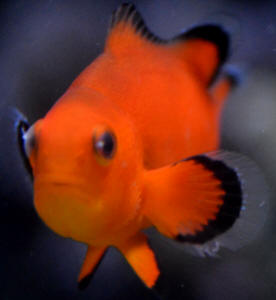
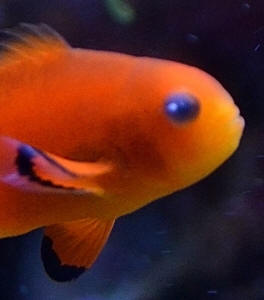
Or is this more likely an infection of some sort? I have attached a
few pictures of the eyes so you can see what I am referring to. In
the picture you can
also see a little bit of a damaged pectoral fin. Could this be
part of the same problem?
<VERY nice images>
Any advice would be greatly appreciated.
<Mmm, well, I would move these clowns to another established system if
you had one... but otherwise, the eyes should clear up on their own in
time; as the clown and host "get to know each other better".>
Thank you for your help.
Jeff
P.S. I really enjoyed your talk a few months back at the Southern
California Reef Keepers meeting. I hope they get you to come back
to talk to us again sometime.
<Ahh, I as well. Cheers, Bob Fenner>
|
 |
Cloudy water, BTA closed
6/25/12
Crew,
<Jeff>
Thank you for all you do! I have a 6x2x2 tank that has been set up
about 6 months. The setup includes a lot of live rock, a 55 gallon
sump with skimmer and a 20 gallon refugium. All fish are currently
in a QT tank due to an Ich outbreak. I am on week 8 of the 10 week
fallow period. The occupants of the DT are multiple hermit crabs,
a couple cleaner shrimp, a BTA and the following corals:
Hammer coral (Euphyllia parancora), Torch coral (Euphyllia glabrescens),
Tooth coral (Galaxea)
<These three rank near the top in terms of allelopathogenic
"strength"... Winners... see WWM re>
and a Tree coral (Paralemnalia). Since these corals are pretty
aggressive there is plenty of room between them. Everything was
looking good and healthy on Saturday night. I dosed
calcium, iodide and an alkali buffer
<Mmm... depending on the make up of the first and third... trouble>
due to my pH getting around 8.0 (have a pH probe for constant readings).
Usually I don't dose all of these at once. On Sunday when my
lights turned on the tank was cloudy and BTA was completely closed up,
all corals looked good and open. The pH had dropped to 7.9
(confirmed with pen style pH meter and pH buffers) so I dosed more
alkali buffer
<Don't as in Do Not add this directly to your system; instead, mix-into
new water to be used as change out>
and took water quality tests: Ammonia = 0, Nitrite = 0, Nitrate = 30 (I
know this is high but I have never been able to get my nitrates low,
even with no fish and very light feeding of the shrimp and crabs.
<...?>
Any ideas on this?),
<Yes: See WWM re... the search tool, indices>
Calcium = 400, kH = 10. I did a search on WWM and saw a post where
the cloudy water was coming from dosing calcium and buffer at the same
time.
<Not uncommon>
I figured I'd leave it for a day to see if it cleared up. Today
(Monday) the tank is still cloudy, the BTA is still closed tight, and
now my Torch coral is looking shriveled up. The pH is still 7.9.
I did a 20% water change a week ago and will need a day to make RO water
and mix the salt before I can do a another water change. Am I
missing something here?
<Likely (my fave term) a "cascade event"; with a chemical/physical
challenge to your Cnidarians; their in-turn reacting, poisoning/fighting
each other...>
Any other steps I can take?
<Start mixing water for a massive change out... looking for established
space to move/separate them>
One more thing, my pH has always been around the 8.1 range and I
can't seem to keep it higher consistently. Any ideas on this?
<... the usual ref. to having you, others search, read, use WWM... No
sense myself, the rest of the Crew re-writing, revisiting,
reiterating... the 30-40k people per day who use the site... join them>
Thank you!
Jeff
<Welcome. Bob Fenner>
Substrate, SW, olde tank syndrome 6/25/12
I think I'm experiencing "old tank syndrome" Is there such a
thing?
<Ah yes... substrates losing solubility (and its beneficial
effects), accumulating metabolites, "heavy water", low RedOx...>
My fowlr tank has been experiencing higher nitrates & we can't figure
why?(40+ ppms )
<Mmm, read here:
http://www.wetwebmedia.com/nitratesmar.htm
and the linked files above>
Its a 300 gal w/ 100 gal sump. I' m guessing we have 500-600 pd.s
of rock
<How olde? Some of this should be traded out every six months
or so>
& 2-3 inch sandbed. 10 fish (smallish) & 1 eel. I only feed 1 a day, maybe
every other?(eel 1 a week) We've had the tank 6-7 yrs.
Filtration/ 2 proteinskimmers-3g & 4 gx, sedras, overflow in tank , sock
& circulation.
Water changes/ 2 monthly @ 100 gals total. We stir & suck up the sandbed
every other time. I always use stability with the changes. My LFS guy
suggested "new" sandbed.
<Would help; yes>
Take all the old out & all new in?
<May be>
He also said we should remove some of the rock, about 1/3.
<This too>
I'm also thinking some macro & microalgae? Help???.....
Renee Jones
<Search on WWM re Ozone use... for this volume... I would definitely be
using... Inexpensive means of preserving water (and system) quality. Bob
Fenner>
Mysterious death, Hawk, un-rinsed new sand
1/20/12
HI,
<Car>
So, I have had my 60 gallon drilled acrylic tank up and running with
fish and corals doing fine for 5 months. I FINALLY got around to adding
the sump underneath.
<Good>
I poured in that sugar fine sand
<Ohh, needs to
be rinsed first>
you can get at Petco (says no need to rinse)
<I disagree>
and added water to pull the volume up (obviously I added SALT water). I
get the system going, and notice there are a lot of micro bubbles,
which I took care of.....
So this morning (tank now using sump/refugium 20 long for about 24
hours) I noticed my pixie Hawkfish sitting in the corner, which is odd
for him (OH... ( DID remove about 20 lbs of live rock, still have
plenty in the tank to a QT tank for some new fish I ordered). Anyhow,
the Hawkfish died about an hour ago, and I found the body of my royal
gramma.... no decay as of yet at ALL. What the heck?
<Mmm, likely this loss is related to the sand
addition...>
The refugium had had about 2 days to cure (silicone II).
<Mmm, should be fine>
My ammonia is 0, Nitrites, 0, and Nitrates maybe 5 to
10.
<What re pH and alkalinity? Ca and Mg? These may have been
"thrown off" by rapidly/soluble parts of the new sand>
I put in SeaGel and Polyfilter.
<These as well>
ALL my corals are closed, including the Zoanthids. I
have a 10 gallon that I have had up and running with the same
parameters that I may put my corals in.
<Oh! These may well have been
"challenged" by the new substrate, reacted chemically
(allelopathy) and poisoned the Hawk>
My Picasso pair and mocha clown pairs are sort of okay, not really
happy, and will eat the Mysis a little. I wonder if I should take them
out and put them in another tank.
<I would move them . NOW, if you have another established system>
I just have NO CLUE... I am guessing maybe the silicone?
<Not likely the sealant. I have used it/this many times, allowing
only a day or two to cure... w/ impunity>
If so, any suggestions or thoughts.
<Please do move your fishes, and read here:
http://www.wetwebmedia.com/cnidcompppt.htm
for a general review of allelopathic phenomena; and here: http://www.wetwebmedia.com/envdisphysiof.htm
for some accounts of such "cascade events".
Bob Fenner>
Thanks!
Re: Mysterious death, now asserted Silastic issue? 1/20/12
Hi
<Car>
First.... Silicone must be cured for 2 weeks or it will poison
the tank....
<What reference do you have for this? Again, I've used the GE,
Dow-Corning products for decades and had no such
problem>
Read on, that sentence is for people looking for a quick answer that
maybe not want to read all of this! I know what happened. First, my ph,
Alk, etc were fine, I didn't mention those since I didn't feel
it was important.
I have a friend who owns oceanpro aquatics, mike has been in the biz a
long time and he has built many a refugium with glass tanks and glass
dividers like this one I built. After consulting with him, I believe it
is the sealant.
This was not aquarium designed silicone, just from home depot.
He told me the ammonia that is released from the silicone would not
register on the test since it is a different compound or type of
ammonia.
I am assuming he meant not from rotting bodies but a chemical. It did
have a strong smell. Now, if I had not caught the problem, then
the resulting deaths would have produced the type of ammonia that would
register!
<? See your statement below (now above, posted on WWM); you state
the NH3/NH4OH was 0>
out of desperation I still put in a product that eliminates ammonia
nitrate and nitrates, and that actually seemed to help the problem.
Thend clowns looked better and started acting better. I still moved my
Picasso pair and my corals to another tank that I had set up.
<Good>
He said they would wait 2 weeks before using any tank that was used for
a refugium. They also would rinse it 4 times. He also thought maybe the
sand as well but I told him that there were absolutely no particles
floating around or getting into the gills, plus that would affect the
clowns in the same ways, but being damsels, well they toughed it
through.
I have actually used this same sand in the past without rinsing it with
no problems to an established tank.
Ammonia from the silicone caulk makes sense, since with every tank
problem like this, usually it is the clown fish that survive! I have to
sadly admit that I recalled another time I did the exact same thing
with another tank years ago and had a few fish die before I caught it.
That situation I used rinsed sand and it was not sugar fine.
Lesson is...... Do not use a freshly silicone tank unless it is 2 weeks
old or it is aquarium tank silicone. I do a lot of reading and this
tidbit of information was not stumbled upon! I feel like a fool for
this, yet I suppose we all have made mistakes when attempting a new
venture.
It kills me to admit this, but if this helps someone else from the same
problem, I'm all 4 people knowing about it.
<Thank you for sharing. Will accrue. BobF>
re: Mysterious death 1/20/12
Please try reading thoroughly before putting in commentary. The
ammonia WAS 0, again chemically it would not register.
<... there is no such thing as "other ammonia"...
See the net, textbooks re basic aquarium water chemistry. I taught H.S.
chemistry, physics and bio...
B>
Re: Mysterious death... Silicone? 1/20/2012
Sorry, I meant to simplify, and used an incorrect analogy. Correct,
there is only one ammonia. Point was the chemical released from the
uncured silicone causes death, which would not register as ammonia,
would kill, which would cause ammonia from dying creatures.
<Stop this nonsense. READ the manufacturer's recommendation for
using, curing their product. It's been used for decades, by myself
since the late 1960's... >
I am sorry I am not a chemist and insultingly correcting me on the main
point is not professional.
<... are you being charged for these corrections, input?>
You could have easily stated, "although the silicone didn't
produce ammonia, the poison could have killed weaker fish, which would
have lead to it if unchecked". BUT, why dis adding a product like
prime help
the situation? So maybe I speculated, so reason to be rude. I put this
on to warn others, against my better judgment, so next time I will not
bother you with my stupidity.
<READ where you were first referred. The likelihood here is
that the Zoanthids were "disturbed" period, and the
"cascade event" led to poisoning of your system.
B>
Mass loss after 3 successful years
1/17/12
This first part was written a week ago in a forum so I copied and
pasted, then below the last line is the current situation.
<Ok>
-----------------------------------------------------------
I have a 75 gallon with a 20 gallon sump, skimmer, ~75lbs live rock,
some coral, and 5 fish. All has been running fine for 3 years, and the
last two without any changes in fish or corals. Everything has been
very healthy.
Torch coral growing huge, Anemone split twice and is now
3.
<Some question of allelopathy here>
Coral banded shrimp molted several times. Everything doing good.
About 1 month ago I noticed a lot of hair algae
starting, and my sand was starting to grow a layer on it
faster than my hermits could clean it. I figured my RO system was due
for filters so I planned to change them out but hadn't done it yet.
About 2 weeks ago I noticed the anemone and the corals were not opening
like normal and the algae had really taken off to the point it was
trying to plug my overflow box.
<React!>
Thinking my phosphates were probably high, and I had some water already
mixed in my QT tank, I did my normal water change. (consists of mixing
10 gallons of RO saltwater
<What brand?>
in my QT tank with nothing in it. Let it circulate for a week or so,
then drain 10 gallons out of the main, put this back in and all is
good.)
The exception this time is the water had been circulating in the QT for
3 weeks. Nothing else in it, just water, salt, and a HOB filter to
circulate it. When I shut my system down to do the water change, the
main pump didn't restart like normal, but it had done this once
before and did restart about an hour later. This time it went all night
without restarting. By morning I had lost one clown and the rest were
looking stressed. I did a quick check of water temp and tried to get
the pump going, but had to get to work so I hung the HOB filter on the
side to create some movement.
When I got home, the other two clowns were at the top of the tank and
not looking good. The tang and the angel looked stressed, but was
acting fine.
I checked my water parameters and all was at or near 0 and well within
range.
I did another 10 gallon water change to try and minimize anything I was
not seeing, got the pump working correctly and tried to clean some of
the algae from the sand bed and sides. Thinking with all of this, it
would help things out.
I got up this morning, and 3 more fish were gone. I don't
understand what went wrong with this water change as I have done plenty
of changes this same way.
<The root problem is not the water, changes>
The ONLY thing I know that was different was that my mixed water was
circulating in the QT for 3 weeks instead of my normal 1 week. Would
this cause my issues, or was it more the hair algae and phosphates
getting out of control more of the issue?
<Most likely a "cascade event" w/ the conditions
worsening, algal proliferation (possible toxicity here), then the pump
being out... triggering a chemical duel twixt the Euphyllia and
Anemones: the aforementioned allelopathy. Read here re: http://www.wetwebmedia.com/cnidcompppt.htm
and the linked files above, particularly for the species involved
here>
I don't check my water parameters often as I do not add any
chemicals. I monitor appearance, and check parameters occasionally if
something looks off. Every time I do check them, everything is right
where I want it, so I don't disturb anything by adding stuff.
Everything normally looks great, is clean, healthy and growing. I do
slack on my water changes and have went several months without any, but
within the last year I have been doing better with one every 4-6 weeks.
Still, all looked good until a month ago when the hair algae started
growing, and within the last week or two was beginning to get out of
control. It's a 3 year old tank, with no changes in the last year
at all.
As of last night, I have lost everything (3 clowns, 1 keyhole angel, 1
yellow tang, small frogspawn, 2 anemones, 1 large (8-10") torch
coral, hundreds of mushrooms, several snails and hermits) except 1 tiny
anemone, 1 large snail and a large coral banded shrimp that was my
first ever tank mate that is almost 4 years old now and was large when
I got it. Amazing it has survived this long.
2 questions: 1. Would the water change be the factor, or was something
else like an anemone starting to die and releasing toxins causing
problems?
<The latter more likely>
At what point does the anemone release toxins when they die?
<Do so when stressed period, much more so on decomposing>
2. Now that almost everything is gone, would I be better letting it set
fallow for a month or two and do some water changes before I try adding
any fish, or would it be better to drain the water, clean everything
and refill fresh?
<I'd drain, bleach-wash all; start completely over>
I am limited on space to keep the live rock during this, but I think I
could manage. I really wouldn't look forward to that task, but if
that is best then I will.
<I see.... then I'd drain, gravel vacuum, refill and leave
fallow for a month or more. "Test" w/ a bio-assay organism
ahead of re-stocking>
Thanks in advance, this really bothers me that everything was so good
for so long and then all of a sudden everything is gone.
Kenneth
<Cheers, Bob Fenner>
Re: Mass loss after 3 successful years
1/17/12
Thank you very much,,,,, I think you are right about what happened, and
I will definitely take action quicker next time, as well as try to
eliminate the issues ahead of time. I have replied to your responses in
brackets [*response*].
<I see. Thank you for this follow-up. BobF>
Thank you again!
Kenneth
Subject: Mass loss after 3 successful years This first part was written
a week ago in a forum so I copied and pasted, then below the last line
is the current situation.
<Ok>
-----------------------------------------------------------
I have a 75 gallon with a 20 gallon sump, skimmer, ~75lbs live rock,
some coral, and 5 fish. All has been running fine for 3 years, and the
last two without any changes in fish or corals. Everything has been
very healthy.
Torch coral growing huge, Anemone split twice and is now 3.
<Some question of allelopathy here>[I think you may be
right about this. Since it was the same anemone that split, I figured
they would get along, and all 3 remained close to each
other.]
Coral banded shrimp molted several times. Everything doing good.
About 1 month ago I noticed a lot of hair algae starting, and my sand
was starting to grow a layer on it faster than my hermits could clean
it. I figured my RO system was due for filters so I planned to change
them out but hadn't done it yet. About 2 weeks ago I noticed the
anemone and the corals were not opening like normal and the algae had
really taken off to the point it was trying to plug my overflow
box.
<React!>[I did, but it was too little too late. I
didn't realize algae was creating a chemical issue, I figured it
was mostly a cosmetic issue.]
Thinking my phosphates were probably high, and I had some water already
mixed in my QT tank, I did my normal water change. (consists of mixing
10 gallons of RO saltwater <What brand?> [Instant Ocean brand is
the 5 gallon bucket. Is there a better option I should look into?] in
my QT tank with nothing in it. Let it circulate for a week or so, then
drain 10 gallons out of the main, put this back in and all is good.)
The exception this time is the water had been circulating in the QT for
3 weeks. Nothing else in it, just water, salt, and a HOB filter to
circulate it. When I shut my system down to do the water change, the
main pump didn't restart like normal, but it had done this once
before and did restart about an hour later. This time it went all night
without restarting. By morning I had lost one clown and the rest were
looking stressed. I did a quick check of water temp and tried to get
the pump going, but had to get to work so I hung the HOB filter on the
side to create some movement.
When I got home, the other two clowns were at the top of the tank and
not looking good. The tang and the angel looked stressed, but was
acting fine.
I checked my water parameters and all was at or near 0 and well within
range.
I did another 10 gallon water change to try and minimize anything I was
not seeing, got the pump working correctly and tried to clean some of
the algae from the sand bed and sides. Thinking with all of this, it
would help things out.
I got up this morning, and 3 more fish were gone. I don't
understand what went wrong with this water change as I have done plenty
of changes this same way.
<The root problem is not the water, changes>
The ONLY thing I know that was different was that my mixed water was
circulating in the QT for 3 weeks instead of my normal 1 week. Would
this cause my issues, or was it more the hair algae and phosphates
getting out of control more of the issue?
<Most likely a "cascade event" w/ the conditions
worsening, algal proliferation (possible toxicity here), then the pump
being out... triggering a chemical duel twixt the Euphyllia and
Anemones: the aforementioned allelopathy. Read here re: http://www.wetwebmedia.com/cnidcompppt.htm
and the linked files above, particularly for the species involved
here> [I think you nailed it with this. It all makes sense
and matches the timeline of what happened.] I don't check
my water parameters often as I do not add any chemicals. I monitor
appearance, and check parameters occasionally if something looks off.
Every time I do check them, everything is right where I want it, so I
don't disturb anything by adding stuff. Everything normally looks
great, is clean, healthy and growing. I do slack on my water changes
and have went several months without any, but within the last year I
have been doing better with one every 4-6 weeks. Still, all looked good
until a month ago when the hair algae started growing, and within the
last week or two was beginning to get out of control. It's a 3 year
old tank, with no changes in the last year at all.
As of last night, I have lost everything (3 clowns, 1 keyhole angel, 1
yellow tang, small frogspawn, 2 anemones, 1 large (8-10") torch
coral, hundreds of mushrooms, several snails and hermits) except 1 tiny
anemone,
1 large snail and a large coral banded shrimp that was my first ever
tank mate that is almost 4 years old now and was large when I got it.
Amazing it has survived this long.
2 questions: 1. Would the water change be the factor, or was something
else like an anemone starting to die and releasing toxins causing
problems?
<The latter more likely>
At what point does the anemone release toxins when they die?
<Do so when stressed period, much more so on decomposing>
2. Now that almost everything is gone, would I be better letting it set
fallow for a month or two and do some water changes before I try adding
any fish, or would it be better to drain the water, clean everything
and refill fresh?
<I'd drain, bleach-wash all; start completely over>
I am limited on space to keep the live rock during this, but I think I
could manage. I really wouldn't look forward to that task, but if
that is best then I will.
<I see.... then I'd drain, gravel vacuum, refill and leave
fallow for a month or more. "Test" w/ a bio-assay organism
ahead of re-stocking> [This is likely what I will go for. I
need to build a sort of vacuum that I can use to clean my sump since it
sets on the floor anyway. This will be a good time to do it.]
Thanks in advance, this really bothers me that everything was so good
for so long and then all of a sudden everything is gone.
Kenneth
<Cheers, Bob Fenner>
Re: Sump/Refugium Question. Now chilled
reef 1/17/12
Hello Mr. Fenner,
<Msieu Dai>
Last weekend, I had the crew from the LFS came over and transferred the
new 210 gallon tank to the living room to replace the old 130 gallon
one.
<Good to have competent (and strong!) help>
I was concerned about the cold water but before I could say something,
they had transferred all my fish to the new tank with the water
temperature of 65 degrees! (We had a cold front coming through
the night before). Needless to say all the fish were stressed and I
have been keeping my fingers crossed since then. Yesterday (24 hours
later), the flame angel went into hiding but he did perk in and out of
the rocks for few seconds. I would like to know if this is due to
fright or being sick from such drastic, no acclimation introduction.
The pajama cardinal did the same thing. When the bristle worm was
brought into this condition, it immediately died on the spot! I am very
concerned for my fish because I hate to lose them after they have been
thriving in my tank for the past four years. Is there anything I can do
now to help them out at all?
<I see this below... I would have pre-warmed the water of
course>
Currently, the temperature is at constant 78 degrees.
My Powder blue, hippo tank, fox face, 4 tomato clowns, 8 damsels are
doing well at this time. Thank you for your time. Very worried DP.
<Only time can/will tell here Phan. Hang in there. BobF>
Woke up to my reef at 90 degrees
-- 1/3/12
Hi, I did some maintenance on my tank last night and must have
accidentally bumped the heater on my reef up to 90 degrees. Woke up
this morning and my tank looked horrible. The tank has dropped to
around 81 since, but some of my corals look pretty bad. The worst ones
are my Xenia and finger leather.
Also, my bubble coral seems to be releasing something into the tank.
What should I do?
<Pre-mix and store as much water as you can... Anticipate at least
one large change-out... Also see WWM re Chemical Filtrants>
What are the chances of my tank making a full comeback?
<Hard to say... could be 100%>
Thank you guys/gals for your expertise!
<Welcome. Bob Fenner>
|
Help with a few fish, SW env. issues
3/30/11
Hello,
Thanks for the great site and all of the time you spend answering
questions and providing information for this hobby.
<Welcome>
I own an aquarium maintenance company as a side job and recently
had a customer that decided to leave the hobby.
After a few weeks of not being able to sell his tank, he offered
it to me at a very discount rate so I took it off his hands.
He had always kept it overstocked against my advice so before I
ever moved it I sold 4 fish out of it to someone who had
a bigger tank. That left 5 fish in a 210, which is much better
than 9. The remaining 5 include a large Golden Puffer, a Naso
Tang, a Magnificent Foxface, a Humu Trigger, and a Koran Angel.
All of the fish are pretty large with the two smallest being the
angel and the trigger at about 4". The fish have been
together for at least two years and have shown no signs of
disease although I know they had been being tortured by a large
Clown Tang. I moved the tank last week (quite a task) and noticed
a rise in Ammonia (.25 ppm) for about two days after moving it,
no Nitrites, Nitrates have always been high due to
overstocking/feeding. I did a couple of 50 gallon water changes
and now the Ammonia reads 0. I hope to continue this and get the
Nitrates in a more reasonable range soon.
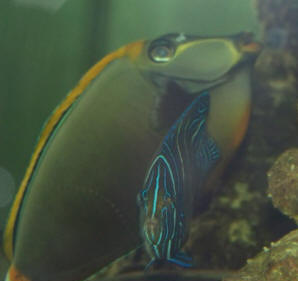
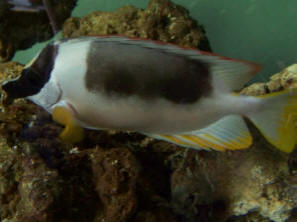
The reason for the email is that I have noticed some cloudiness
on the eyes and fins of the Humu, Foxface, and Naso, and even
"fuzzy" lips on the Naso as well.
<I see all this in your images>
The Foxface seems to have some small bumps on his side, they
don't look like ich in person but in the photo they do, spots
look dark in color in person. The main reason for not thinking
that it is ich is that the fish were in a much more stressful
environment prior to the move, it seems like if ich were present
it would have manifested then. Just wondering if you had any idea
what
<Mmm, not Ich/Crypt... but environmental of some
sort/s>
could be going on, if this was likely related to the Ammonia
spike and would possibly go away with time, or if you recommended
action now.
Would a dip do any good?
<No>
I would rather not move them to a QT due to the size of the fish
(I only have a 40 breeder to do this with). Also, <Nor moving
these fishes to quarantine. Their "world" needs to be
improved... Some new/fresh live rock, activated carbon, better
food/s (Spectrum pellets is what I recommend)... Do you have an
Ozonizer that could be applied here?>
the Puffer hasn't eaten since the move. He is very fat though
so I am hopeful he will come around. Any suggestions there?
Any advice would be appreciated.
Jeremy
<Bob Fenner>
|
|
|
|
Re: Help with a few fish, SW, env. dis.... rdg.
4/1/11
Thanks for the reply. I have done another water change and the
Nitrates now test at 40 ppm,
<Still about twice as high as I'd allow. See WWM re NO3
control>
they had been well over a hundred for a couple of years. The fish
don't seem to be any better.
<Recovery from such environmental stress/disease takes weeks,
months>
I have noticed a few of them "scratching" and
"twitching" (makes me worry of Ich),
<Not likely... where would this come from?>
at times they appear "dusty", but they are still eating
well. The puffer still hasn't eaten and it has been a week
since I moved the tank.
<Not to worry>
I know he can go a while without food but I would feel better if
he were eating, he seems to have a "dusty" look on some
of his fins as well. I am attaching a couple pictures of his
mouth to see if you think it may look swollen, could it be
possible he was stung by the Foxface?
<Would probably be dead if so>
He shows no interest in shrimp on a feeding stick
<... see Tetraodont feeding on WWM...>
. These fish have way less stress/aggression and better water
quality than they have seen since the ocean so it puzzles me why
all of this is happening now. I don't have an ozonizer but I
will continue to try and improve water quality and keep them
eating. I feed the spectrum pellets as you have recommended.
Thanks for all of your help, I know you are a busy man.
Jeremy
<Keep reading. BobF>
|
|
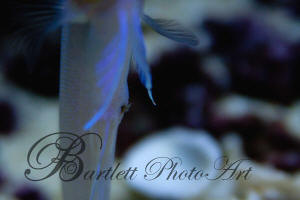
My Pearly Jawfish has something sticking out of its
side! (resent) 3/27/11
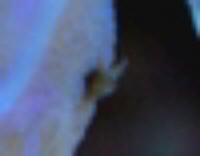
Hi guys - I have replaced the 100.2k photo that was attached in
case that is what caused the original email to be not answered. I
have resized the photo which of course caused loss of detail, but
it now meets the 300pixel requirement. The link at the bottom of
the original email (below) is to the high resolution photo of the
protrusion.
<I see this...>
It's now been 5 or 6 days since I noticed the original
discolored area & bump and 3 days since it appeared that
there was something sticking out of it. Not much change from
then. There does still appear to be something sticking out from
the area, and it kinda looks like an Aiptasia even though that
makes no sense to me.
<Does look something like a child's "jack" as in
the four pointed toy one picks up in quantity while bouncing a
ball>
Typically one of the jawfish will get a little bruise & it
will go away in a day or 2, so I'm very concerned for this
fish. He still acts okay & is eating & swimming normally.
If there is anything I can do to help him, please let me know.
Thanks again!
<Mmm, t'were it me, mine, I just might carefully net this
fish out and try to grasp this object, pull it out. Bob
Fenner>
[Original email]
Subject: My Pearly Jawfish has something sticking out of its
side!
Date: Fri, 25 Mar 2011 22:36:49 -0500
It's been quite a long time since I've had to write in
with an issue & will thank you in advance for your help - you
guys do an amazing job here! My system is generally quite
healthy, and that is due in large part to your wealth of
information.
My system consists of 150g & 75g display tanks, each with
closed loops & 2-3 Koralias, a 55g sump/refugium, approx 225g
total water volume, approx 250# live rock, a DIY algae scrubber,
Aqua C Urchin Pro skimmer, 2LF Phosban reactor containing
RowaPhos, 3 heaters, chiller, T5 lighting (except on scrubber).
The 150 is set up as a jawfish species tank with a 6-7" dsb,
6 jawfish that are 1 year old, a Dartfish, a neon goby & a
six-line wrasse (moved about a month ago from the 75 to eat
flatworms in the 150), a dozen or so Ricordeas, yellow polyps,
button polyps, gsp, 2 small & 1 large serpent starfish, 2
scarlet hermits, about 15 Nassarius snails, 12 Astrea snails,
Stomatellas, micro stars, a bunch of flatworms & Aiptasia.
There may also be some Berghia Nudibranchs in the tank. Other
system inhabitants are 2 ocellaris clowns, another neon goby, 2
blood shrimp, a brown urchin, a flametail blenny, mushrooms, a
toadstool, some anthelia, Halimeda & Chaeto. Parameters are:
PH 7.99, ammonia & nitrite 0, nitrate between 0 & 5,
phosphate between 0 & .25, spg 1.026, dkH 6, calcium 400. I
typically feed them NLS flakes or pellets (including Thera-A),
but occasionally they get frozen mysis & bloodworms (&
yes I overfeed, hence the Aiptasia & flatworms, but we're
working on getting them eradicated). We do about a 10% water
change weekly & use Instant Ocean.
Several weeks ago we had an issue with our skimmer which resulted
in the salinity dropping to around 1.022, but we added saltwater
instead of fresh for make-up & so it slowly moved back up to
1.026 & has been there for the past week or so.
A couple days ago, I noticed a brown spot on the lower left side
of one of my jawfish. I figured it was a bruise & didn't
think much more about it, as occasionally one or two of the
jawfish will pop up with a small injury that heals in a couple
days. Today, it appears that there is something protruding from
that area - almost looks like a little Aiptasia - I'm
attaching a photo that is about as good as I can get (he simply
won't hold still & pose for me ;) - plus the injured area
is only a couple mm wide).
He acts healthy, eats, covers his hole at night, etc. After their
dinner this evening, it looked as though the area was flat &
not protruding any more. Can you offer any suggestions as to what
this might be? I'd really like to hope that it's just a
bruise & a flap of skin/scales that will heal on its own - I
can't imagine trying to get any of these fish out, since they
dart in their holes & stay there if you are doing anything in
the tank
(except feeding them!), but if it's a parasite or something
that can be healed/fixed with a special food or something,
I'd really like to keep Jeffrey Jawfish alive &
healthy!
Thank you so much for your help! Lillian
(FYI - if it would be helpful to you, there is a much higher
resolution photo here:
http://bartlettphotoart.smugmug.com/Fish/My-Tanks/IMG7647w/1228640433_SKu6Y-M.jpg
|
|
  crop crop
|
|
Re: My Pearly Jawfish has something sticking out of
its side! (resent) 3/29/11
Update: I got your response but don't feel confident about
netting the fish - I'm afraid I would hurt it more in the
process.
<Possible>
I added some Epsom salts to our regular water change yesterday in
hopes of encouraging some healing, since yesterday the area
looked the same as in the photos I took last Friday. I became
quite concerned this morning because there was no sign of
activity at Jeffrey's burrow, but was later relieved to find
that he has just moved, as he is now hovering over another
fish's burrow on the other side of the tank. The injured area
now looks more like an open sore with a bit of a bump, but
nothing sticking in or out of it (thank goodness). Could the
"thing" possibly have been skin/scales sloughing off
from a deeper bruise?
<No>
I am hoping this will go ahead & heal on its own.
<I as well>
I am also now wondering if the bruise is a result of some mating
behavior (two males vying for one egg-laden female?),
<Mmm, it's a "something" that I can't
recall... biological... like a "sticker"
terrestrially>
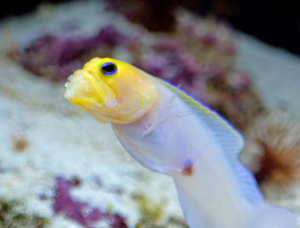
as a female jawfish appeared to be carrying eggs, and this
afternoon Jeffrey had them in his mouth!
<Neat!>
I'm guessing he subsequently swallowed them since they're
not in his mouth anymore & his belly is fat. I understand
that this can be normal for new jawfish parents-to-be, and this
was our first spawn.
<Yes>
Attached is a shot of Jeffrey holding the eggs this afternoon, so
he obviously is not too much under the weather as a result of the
injury.
<I see>
If there is any other type of reef-safe additive to promote
healing, let me know.
<Mmm, none that I would/will recommend presently>
Thank you again. Lillian
<Welcome. BobF>
|
|
|
Fish problem, Possible Marine Disease
2/13/11
Hi:
<Hello>
I have a problem in my tank which just appeared. We have 6 fish in a 30
gallon tank with about 8 corals. Two of our fish developed a disease on
and around their lips. One was a blue velvet damsel and it's lips
turned white and actually fell off in one day. It's breathing is
also very rapid The other is a box fish we have had for 3 weeks. It has
with tissue looking material on either side of it's mouth which
doesn't seem to be affecting it yet. The rest of the fish seem
fine.
I'm sure we have lost our damsel, but is there anything we can do
to help our spotted box fish?
Tina Miller
<Usually symptoms like these are environmental in nature, check that
your water parameters are in line. It may be necessary to remove the
sick fish and treat with antibiotics in a hospital tank.
http://www.wetwebmedia.com/ca/volume_6/volume_6_2/mycobactera.htm
>
<Chris>
|
Saltwater Tank/Ridiculous Stocking Levels
12/4/10
<Hello Amber>
We had a 5 yr old 55 gallon established saltwater tank in good
shape with a small grouper and 2 larger(@ 8inches) and a larger
Volitans Lion fish. We needed to go bigger because our fish had
grown. We bought a used 90 gallon tank which had been used to
raise plants for a company who sets up and maintain tanks for
offices, hospitals etc.
<Increasing the length and width of a tank when upgrading are
much more important than just increasing the depth. You have
provided very little improvement for these fish.>
We switched everything over (original water, live rock, gravel
and fish). Then added enough saltwater to fill up the tank. That
was about 2 months ago. We have tried about everything and cannot
get it to
straightened out. The pH, nitrates, nitrites and ammonia went
through the roof.
<The fish load in this tank is ridiculous and am not surprised
that readings have gone "through the roof".>
We were told replace your bulbs because the spectrum has gone bad
(done that).
You need a protein skimmer (done that). You have an old out dated
filtration system (got a new canister filtration system for up to
110 gallons plus was using the 2 out dated filters (for up to 130
gallons).We are using reverse osmosis water now (was told it
would straighten out our problem) instead of well water which
always worked in the 55 gal tank. It will be clear as day at
night time and early morning but after the lights come on (about
3,4 or 5 hours later) it looks very brown and cloudy. We were
told water changes and a lot of them.
Done that lots and lots. We were told it keeps cycling since
after we do a water change it is clear for a day or so then it
goes right back to the same brownish cloudy state after the
lights have been on for a few hours. The fish quit eating for
awhile but now are back to having a large appetite. Haven't
lost any fish but it looks terrible. We have Googled this and
looked at everything and talked to people who do this for a
living and tried everything. We have gotten the water tested
professionally. The last time they said we have no nitrites but
the nitrates are back through the roof. Can you offer any
advice?
<I am surprised that no one ever told you your tank is
overstocked and is the major cause of your problem. Three
groupers and a Lionfish produce a huge amount of waste that your
system cannot deal with, it's crashing, big time.
The Lionfish alone is a bit too large for your system. Sounds to
me like these "experts" were more concerned with
selling you equipment rather than seriously addressing the real
problem. My advice is
to find homes for these fish and fast. Secondly, I would tear
this tank down and wash the substrate thoroughly and start anew
with fish that are suitable for your tank size. Research fish
before you buy, ensure you can provide the requirements needed
for keeping a particular species. James (Salty Dog)>
|
|
  Yuck! Yuck!
|
|
Re Saltwater Tank/Ridiculous Stocking Levels 12/4/10 -
12/14/10
To James (Salty dog);
<Hi Amber>
Mr. Salty Dog, I don't consider myself inept. I have been a
hobbyist for 5 yrs and I do know my species well. These fish we
have now did exceptionally well in a 55 gallon which was thinner
and shorter. I understand these fish will become quite large.
This is a transitional tank. Plans for at least a 150 gallon
tank in the works. I believe my mistake was not rinsing the
substrate when changing tanks.
<And not telling me that this was a transitional tank. None
the less, much too small for the size of its occupants.>
I had sand mixed in as well. I simply took from one to the other.
Added enough premixed RO water to top off the tank. Recently
discovered the Ro process with out the DI filtering doesn't
remove nitrites, phosphates or silicates. So algae freaked out.
Had well water and RO tested. Well water better.
Got a UV Sterilizer for suspended algae and started using well
water in tank again. In less than 8 hrs the water is clear.
Everyone in tank including crabs are very active and eating well.
The tank has remained crystal clear for a week.
Thank you for kind direction. Will be keeping our fish
<You're welcome. James (Salty Dog)>
fish hobbyists
|
All My Polyps are Closed!!? Anomalous Xeniid
crash 5/24/10
Hello Crew,
<Jonathan>
I have been a big fan of this website for years, and I come here
whenever I have an easy or tough question to answer. The wealth of
knowledge on this site is second to none, and I appreciate having this
resource available.
Here's my most recent issue:
I've had a reef tank set up for a little over 3 years (50 Gal
display with 30g sump), with various polyps, and other soft corals, as
well as some fish, snails, etc. Everything has been doing well, but I
recently switched two things to my tank, and ALL my polyps have been
closed since. It looks like the Pom Pom Xenia are all either dead or
dying, as well. I'm hoping someone can help...
<Do be ready to scrape, remove the Xeniids if they're
collapsing... or take out all else to some other system>
I have always had perfect levels (8.3, 0 nitrate, 0 phosphate, 480
cal., etc.), but was still having an algae issue. To combat that, I
decided to add a Vortech MP10 to make sure I didn't have any dead
areas (Have been running a Mag Drive 12 as main return with a SCWD,
with a Maxi Jet with 1600 attachment in the tank). I also added two
boxes worth of Hagen BioMax Filter Media in a section of my sump, just
before the return pump.
<Both these changes, additions should be fine>
My goal with those was to get rid of any "crap" that kept
getting pumped back into the main tank by the return pump. My levels
are still pristine, algae is pretty much under control, and the clarity
of my water is much better.
But, my polyps remain closed!?
Any ideas?
<Something else... but Pulsing Soft Corals can/do at times undergo
population collapses... and the resultant chemical stew can be very
toxic to other Cnidarians, fishes even>
Have I "purified" the water too much with the BioMax?
<No... this is a chemically inert material... for bacterial
housing...>
I've tried different speeds with the MP10, and no change. I've
also tried putting Coral Frenzy in a few times, and no change.
Any help is Greatly Appreciated.
<Again, the removal of the Xeniids... or all other livestock
elsewhere... Water changes, use of carbon, spiffing up your skimmer can
only do so much>
(if this helps, I also have a small amount of carbon filtration, Nova
Extreme T5's, a protein skimmer, and a good amount of live
rock)
<Do/es help>
Thanks,
Jonathan
<Bob Fenner>
New Lights ....Sudden Death 5/17/10
Hello ..
<Hello Paul>
My lights (Lunar Aqualight Compact Fluorescent) went dead on our 125
gal tank (half of the tank). I changed out within seven days with a
upgraded system (2 Halide and 4- T5's) Now I'm seeing leather
withdraw/ flop, have had two fish die. Is this from light cycle stress
or reaction to the different bulbs?
<Corals can react to an increase in light intensity, especially with
a seven day term of reduced lighting, but it is highly unlikely fish
would die from the increase in light intensity. Your ammonia level is
high and I'm betting the fish deaths were caused by the ammonia
spike. Do read here on light acclimation.
http://www.wetwebmedia.com/acclimcoralslight.htm>
Only thing out of the norm is the ammonia at .5
We did do a filter change with a new pad (Poly-Bio-Marine) prior to the
light system change.
Any ideas?? Our Starfish is unhappy too and our Foxface seems to be in
a marathon molt.
<All can be a reaction from the ammonia spike, ammonia level needs
to come down to 0ppm pronto.
James (Salty Dog)>
Paul
Should I add the cleaner or not?! Water quality
troubles, SW 4/27/10
Hello again crew!
<Hello Terry>
I am contacting you today with a question concerning my 500 gallon swim
tank. Recently I have noticed that my Pinktail and Niger triggers have
gotten this cloudy film over their eyes. Also my orange shoulder tang
is scratching a lot. I immediately checked water quality and everything
was perfect except for nitrates at 80 ppm.
<There's your answer.. water quality. Get this down,
fast>
I have observed these fish trying to get my queen angel to clean them
(sometimes he does).
<Mmm, maybe a secondary parasitic infection, but how serious this is
not yet evident>
My main question is this, I have a cleaner wrasse in another system
which I wanted to know if it would be a good idea to introduce since
the fish are wanting cleaned.
<Possible, although it is well documented that Labroides are not
good survivors. http://www.wetwebmedia.com/labroide.htm
. I would be more inclined to try Lysmata shrimps here
http://www.wetwebmedia.com/marine/inverts/arthropoda/shrimp/cleaner.htm>
<<Food here. RMF>>
In my 500 gallon system I have around 30 fish and all of them are
eating, I just don't know if I should add the cleaner wrasse
because I have read that sometimes they can irritate injured fish, and
I do believe this is some type of bacterial infection which I don't
know if the cleaners can help with or not?!
<I agree, that your first course of action is to improve the water
quality, and see if that leads to a cure. Without doing this, all other
courses of action are hindered, or not necessary at all>
What would you do?
<Posted>
Thanks in advance,
<No Problem at all>
Terry
<Simon>
A Couple Questions from a Noobie. Wherefore art
thou skittish SW fishes? 3/8/2010
Hi WWM,
<Scott>
Thanks for the service you provide for concerned aquarists and the
critters that they keep. Your website is a wonderful reference for a
hobby that surprisingly doesn't have many reliable resources to
rely on.
<Welcome>
I have a 47 gallon column tank with two false Perculas, one multicolor
dwarf angel, and one cleaner shrimp. I've noticed that all three
fish will randomly dart around while swimming as if they're being
shocked. Is there any explanation for this other than stray
voltage?
<Yes... can be a matter of "something/s" missing or two
much in the water, and biological interaction ("stings") from
incompatible forms of life present (and quite common) on/with live rock
and such>
I'm particularly worried about the dwarf angel. It was added to my
tank about a week ago and in addition to when it "darts around as
if being shocked" it also shakes every once in a while in short
bursts. I've also noticed it rubbing on the live rock--I've
only seen this happen three times over a span of a couple of days. I
thought maybe it might have ich so I started adding Garlic Xtreme to
its diet. But I'm concerned it might be flukes.
<Mmm, not likely a trematode species affecting all here>
I noticed a small white spot on one of its eyes. It also has some tears
in its fins, but I believe those are from one of my false Perculas
attacking when the angel ventured into the corner of the tank
they've claimed as their home.
<Also quite common, particularly in a small volume of the tall-high
make as yours>
The angel is readily eating meaty flakes and picking off algae/sponges
on my LR. It and my clowns don't seem fond of Mysis shrimp for some
reason.
They'll take a couple bites of the Mysis but then seem
uninterested, which is surprising given that they love the meaty
flakes.
One of my clowns has a black spot that has appeared on its side. I
think it may have been because it rubbed up against a frogspawn coral,
which I have since removed from the tank.
<Ahh! This Euphyllia could well account for the darting behavior and
more here>
I have no other coral in the tank and I'm assuming the spot will
eventually go away. Is this correct?
<Yes, should>
But I'm more concerned about some white/translucent spots that
appear on the head of the clown at night. I've seen the spots
during the day but most of the time they're only visible at night
and are limited to just the forehead/nose area of the clownfish. It
looks like white/translucent acne.
Is this just the result of stress that will disappear with time or
should I be treating for something?
<Can't tell, but I would be adding a good deal of activated
carbon, likely a pad of PolyFilter in your filter flow path here to
discount possibilities>
My last question concerns the water quality. My water appears cloudy
and I think it might be a mixture of both algae and bacterial bloom. My
tank is about seven weeks old.
<!? This is very new... likely not "totally" cycled at
this point>
I used a clarity product but it hasn't helped much. I have a
Aquaclear 110 HOB filter (rated for 90G) with just the filter sponge in
the chamber. I also have a Filstar XP1 canister filter (rated for 45G)
with just activated carbon and granular ferric oxide in it.
<I'd ditch the latter for now>
I have fine sand substrate and I wonder if this might be a part of the
problem?
<Mmm, from being stirred up?>
How can I get my water crystal clear and are all these problems
interrelated?
<Read here: http://wetwebmedia.com/CloudySWF.htm
and the long stretch from which you lead yourself through linked files,
learning>
Thank you for your time and patience with all these questions.
Best,
Scott
<Thank you for sharing. Bob Fenner>
Secondary Infection to Popeye... SW 101b
9/21/09
Hello WWM-you guys and gals are amazing and I have forever bookmarked
your website!
<Mmm, well, till the next hard drive crash... or ding dang Net virus
perhaps!>
I have a question regarding my Clarkii Clown, but first I'll give
you my history and stats...
<"I was borne a poor pet-fish aquarist...">
I have always had fresh water tanks, and (silly me) figured saltwater
wouldn't be too much different... just add salt, right? (wrong)
<You're so right>
My friend had a 75 gallon FOWLR tank that she got from another friend
who got tired of it. It came to her with a snowflake moray eel, a three
stripe damsel and one other fish that she quickly killed off...she
quickly tired of it and talked of getting rid of it-I said I would take
it if she were ever serious. She called me one day and said come and
get it. So I did, stopping at PetSmart to get a couple books on my
way...
So the tank came with:
the eel and the damsel
about 60 pounds of live rock
a DSB, about 3"
<Mmm, I'd add an inch or two too. Toodle loo!>
Rena Filstar XP2
a heater
a sand/gravel vacuum
a non functional power head
some food
a swing arm hygrometer
some salt
and that's about it
After reading about the importance of skimmers, I bought the only one
Petsmart had-the SeaClone100
<Ugh! See WWM re>
I added some airstones along the back wall, a new power head and got a
full line of water parameter testing (both the API Reef Master and the
Aquarium Pharmaceuticals, Inc. Saltwater Master-both liquid kits)
(The skimmer never seemed to do anything. Up until this recent
"disaster" I thought it was just because I did a good job of
keeping a clean tank...ha!!
<Heee!>
I ended up pulling it off and not even using a skimmer. Once the
"disaster" occurred, I traded it in for the identical model,
hoping this one would do better.
<Nah!>
And it actually does, but still not as good as I have read it
should.)
All the life rock was covered in a THICK green carpet, that I naively
thought I could brush off, just like I did with all my freshwater
ornamentals!
<Ooohhh pretty!>
OBVIOUSLY I had no clue, didn't even know what live rock meant!
Since I could not brush it off, I got a Foxface Rabbit Fish and a
Yellow Tang and a Sailfin Tang, and they did an awesome job of cleaning
it up! It was fun to watch the rocks come back to (healthy) life with
all the beautiful colors and little life forms!
So, I studied, took notes, read, looked up and had a quite happy little
tank for the past three years. No fish deaths, other then my eel
getting a little big for her britches and eating over 100$ worth of
fish over the course of a week. (She has since been rehomed! lol) I
also lost a sandsifter starfish (high nitrates?) and had a couple
scallops that lived for quite a while, then I found their shells one at
a time (puffer fish??)
<Quite possibly>
I am interested in "upgrading" to a sump with/and
refugium...doing some homework on that now. I also would like to get
more live rock, to make a total at about 110 pounds (money, money,
money...) and OF COURSE I need a better skimmer...
My water parameters historically:
Ammonia: 0
Nitrites: 0
Nitrates: high (40-80)
<Whoa>
5 Phosphorous: 5
<Double, make that trip whoa!>
Specific gravity: 1.023
Carbonate Hardness: 14-16
pH: 7.8 (I can't seem to get it to stay any higher, which is weird
with the super high Carbonate Hardness-idea's???)
<All sorts... Read on WWM: http://wetwebmedia.com/calcalkmar.htm
and the linked files above>
Initially, I attributed my high nitrates to the fact that I filled the
tank with hose water in the beginning (stupid! stupid! stupid!) But one
I learned the error of my ways, I did massive and frequent water
changes trying to dilute out that original water. Nitrates have always
remained high, I'm guessing just a high bioload and no system in
place to removed them (I'm thinking time for a refugium and some
plants!)
<Will help for sure>
So...life happens, I had a baby and wasn't as vigilant as I should
have been...wasn't testing, cleaning my filter or doing water
changes as often (about every 4-6 weeks, when the algae would build up
and start looking bad)
About 6 weeks ago, I noticed my blue hippo tang was hiding more often
and not eating as much. I watched her for a few days and felt certain I
wasn't making things up. Did a cleaning and 25% water change and
kept watching her. Then I thought my Clarkii Clown was acting a little
odd. He was eating great, but swimming a little differently, keeping to
one corner in the tank and swimming up to the top.
Everyone else in the tank seemed fine and was eating great and active.
So I just kept watching. Then I thought maybe my Foxface Rabbit Fish
was being more shy then normal and not eating as well, but still
eating.
The Blue Hippo Tang was definitely looking skinnier, and since I had
worries about a couple other tank members, I decided to throw caution
to the wind and treat THE WHOLE tank with Erythromycin.
<Mmm, should have just fixed the environment...>
I was "slightly" aware of the damage that it would cause to
my nitrogen cycle, but thought if I had a bunch of waters prepared and
really stayed on top of testing, and added an ammonia absorbing media
to my filter, I could keep the dreaded ammonia spike to a minimum. I
was wrong...so wrong. And so stupid. Lesson learned. Never again.
I was horrified when my ammonia levels read 1.0. It was also the end of
the recommended 4 day treatment and was supposed to do a 25% water
change, but I did a 50% water change. Dumb move again. My Blue Hippo
Tang died that night, and so did another fish, my Flame Angel, who had
been doing totally fine and I was not concerned with him at all! So
sad.
Well, the ammonia continued to spike, got to 3.5 even, so I went to my
LFS (45 minutes away), had them test my water and talked to them about
other ideas. I had already been adding Liquid Vacuum and Top Fin's
Bacteria Supplement as well as API's Stress Coat (figured that one
couldn't hurt...they were stressed...), but they also suggested to
stop feeding my fish, except a small amount every other day (duh! why
didn't I think of that) and adding another media to my filter. I
don't recall the name, but they are these blue rubber, kinda star
shaped pieces that also came in a liquid bacteria supplement that would
help jump start the nitrification in my tank again.
AND, he recommended I drop the SG to 1.019 in my tank because of the
opportunistic bacteria that will hang around in the higher SG. He said
I don't need it that high since it is just a Fish and Live Rock, no
reef tank.
<... I would not do this>
So, speaking of opportunistic bacteria...this is where that discussion
came from and the root of my question for you...
My Clarkii Clown that was acting just a little odd, but still eating
well, stopped eating during the antibiotic treatment (and poor water
quality stress?)
<Yes; almost certainly>
But here is the kicker... when I did my massive water change and
cleaned my hood and was putting the glass lid back on, I dropped one
piece of the glass that fell on another and broke it into three large
pieces. One piece fell right to the bottom, not bothering anyone else.
Another slowly glided down and pinned my Porcupine Puffer to the
ground. It really was quite comical, as he just sat there, content to
wait for me to help him out. Not comical, however, was the third piece
that appeared to just bump the Clarkii on it's descent. He swam to
the other side of the tank and hung out there for a while. Once I
picked the pieced up, I went over to check him out and his right eye
looked weird-The eye itself looked fine, no sign of injury except for a
tiny little air bubble INSIDE the eye. Not around, not above, not
behind, but IN the eye. I immediately looked up anything I could find
on the web and didn't find any matches. Saw tons of pictures and
references to popeye, but this was not that. The little bubble was in
the eyeball itself.
<Happens... again, stress in a word>
The next day it was gone. Then about two days after that, it started
swelling up, really quickly, now resembling the pictures of popeye I
had seen. All I read, was that if it was from an injury, then it should
heal itself, just keep excellent water parameters. I was doing my best
with the water, but it was still far from normal. They eye got bigger
and bigger and then a few days after it first started swelling it
looked like it was actually exploding. I could see tissue leaking out
from around where it could stretch no more.
<See WWM re unilateral exophthalmia... physical trauma>
At that point, I cracked out the QT and started him on Maracyn 2. I did
a 6 day treatment of that, also using Epsom salts and keeping pristine
water parameters with daily water changes. The eye did not look any
better, but after a few days on the antibiotics, he would eat a little
food out of my hands. He has really been quite social and always swims
to the top of the tank anytime I open the hood and looks at me with his
good eye! He ate for a couple days, then stopped again. After the
treatment, I switched to Terramycin and just finished that 6 day course
two days ago.
<... gots to stop being a good western consumer... and fix their
world>
He is still not eating, but the swelling is finally, completely gone,
back to normal size. What is not normal is how the center of the eye
(or what used to be an eye) has purulent discharge and is constantly
bleeding a little (just read that Tetracycline is contraindicated in
such cases. Nice to know now...) I have been scouring the web for any
reference to using topical antibiotics and/or injectible. I am a CVT
and have access/knowledge in that area pertaining to our terrestrial
friends, but can't find anyone with a clue on fish.... until
YOU!!
The sore is obviously not healing and he is not eating, so I am
wondering what the next step needs to be. I am able to gently debrade
the eye with a Q-tip (the same as we do with dogs and cats with a
corneal abrasion) and applied a drop of NeoPolyDex drops on it for a
couple days now. He is such a friendly little guy and so cooperative. I
feel so bad for what I have put him through and really want to make it
up to him, so, thanks in advance for the life saving advice you will
offer!!
Another note: yesterday I noticed his fins and around his gills are
reddish tinged. The water is very red from the Tetracycline and even
the silicone in the corners appears to have taken a pinkish tinge, so I
am not sure if that is what it is from. I have read about Septicemia,
but not really thinking that is what it is, but can't find any pics
to compare with.
BTW the main tank is back on track and thriving once more, as far as
ammonia goes-back to zero!! Nitrates are still very high (80) and
Phosphorous high (5).
<These are indicative of the source of trouble here... What is
adding to and allowing the persistent nutrient uber
concentration...>
So addressing that is my next challenge. I am ready to dive back into
my tank be dedicated to making my fishy friends the best home possible.
The deserve it and depend on me-I'm not going to let them down
again!
(And to think i thought about a reef tank! lol-I am SOO not ready for
that!)
Thanks again Team!!
(PS-you said to be thorough and that I should not worry about giving
too much information...but I even feel this was a little excessive!!
sorry!!)
Lots of love from the Soldati Animal Kingdom-
Aimee Anne, Brent, Ariella Rose, Mickey (Noodle-Poodle), Minnie
(Mama's), Daisey-Maybel, Mallorie-Mariah, Birdie, Mango,
Lilly-Lou-Lou-Belle and the salt water fishes!
<Ummm, see WWM re... Maybe start here:
http://wetwebmedia.com/nutrientcontrol.htm
and ALL the linked files above. Then we'll talk if you have further
questions. Bob Fenner>
Tank Crash 7/7/09
Clear DayHey everyone! I haven't talked to you guys since I used to
answer questions along side of you!
<Hello Jen!>
Still extremely busy here and now planning a wedding. Hope everyone is
doing well!
I am absolutely stuck. Completely confused, and utterly devastated! OK
- my tank (before crash):
**29 gal, 5 gal sump, live sand, live rock - up and running for about 5
years.
**Parameters: 1.025, 8.3pH, Ammonia, Nitrate, Nitrite at 0. Temp varied
around 82 degrees. Alk 12 dKH
**Corals- leather, mushrooms, and some kind of non-branching Xenia that
spread EVERYWHERE.
<As it's wont to do>
Condy anemone.
**Livestock- 1 true perc (lost one about 3 months ago, but they were 5
years old), a convict goby, and a 6-line wrasse. Various snails,
hermies, micro stars.
Here's the problem. On Saturday I treated with Marine Clean -
I've been using it about every few months for a year plus w/o any
issues. Nothing else added. I came home from fireworks on the 4th to
see all the Xenia looking like limp spaghetti!
<Also not an uncommon event>
So at 2am I did a 10% water change just to make sure. Test water,
everything as above. Then went to bed.
Woke up Sunday to all 3 fish dead. Remove fish, test water, parameters
still as above. Used my spare master kit, tested again, parameters the
same. Xenia still looking pretty poor. Did about a 10 gallon water
change. My fiancé had custom made a external filter with
10lbs of carbon (he does environmental water filtration), so we decided
to set this up now - just in case some other kind of toxin that I
cannot test for is the issue.
Runs fine, boost the pH to 8.4 though.
Over the course of the day I check the tank. Xenia still looks
horrible! and by the end of the day there is a half inch accumulation
of dead brittle stars on bottom of sump. Eek!
By this morning I've lost the anemone (which by this time I was
expecting), the Xenia still looks just as bad, and the nitrate and
nitrite levels are through the roof! I assume because of all the
die-off.
No ammonia though. Did another 3 gal water change.
So I guess my questions are this:
I can seem to figure out what triggered it -
<... perhaps the "Marine Clean", could be simple
"stress"... but whatever "it" is, further
triggering the Xeniid melt-down... then on to all else>
I've done so many tanks, still own and operate a side business that
is all tank maintenance and have NEVER seen anything like this!
And what is the best course of action now?
<Best? IF a business, I'd dump, clean, re-set up... fastest,
surest direction>
I was thinking continued water changes to bring down nitrate and
nitrite levels - have no hopes of saving Xenia either. Then do I just
re-cycle?
<Yes>
Maybe buy a few more pieces of live rock to re-seed bacteria and little
critters?
<Sounds good>
I am completely at a loss and very upset! Help! Any insight would be
great!
Thanks guys - again!
Jen
<Good to hear from you... even under the circumstance. Cheers, Bob
Fenner>
Re: Tank Crash 7/7/09
Bob,
<Jen>
Thanks so much for the insight. Its a mind blowing experience to just
not be able to figure what triggered an event so catastrophic. Oh well.
I do know it happens! Considering this is my personal tank, I will
probably just cycle and basically leave fallow for a few months then
give it a go and see what happens with VERY slow stocking. Not sure I
want to completely take apart and start over........ Yikes!
<I'll say!>
Thanks again, hope everyone at WWM is doing well! I miss writing with
you all, but simply do not have the time!
Again, Thank you!
Jen
<Welcome... be seeing you, BobF>
saltwater tank crash... Troubleshooting
Reef/Cnid. losses 6/23/09
Hello, I am sorry to have to bother you but I am truly at a loss. I
went on vacation from 6/11-6/15. Upon returning all of my coral was
dead. I quickly ran my tests:
ammonia-0
copper-0 ( I check this in the case that my ro/di could be failing)
phosphate-0
iron-0 (I do add iron but haven't gotten a reading yet, started
about 2 months ago)
ph-8.3
iodine-0.01 (began adding this with the iron)
alkalinity-3
<... low>
kh-12
calcium-400
silicate-0
nitrate-1.5
salinity-1.025
temp 82 ( I keep my tank at a stable 82 rather than let it rise and
fall)
My tanks set up is as follows:
system has been set up for 3-1/2 years
90 gallon reef set up with 100 lbs live rock and 100 lbs Australian
gold sand
2-150 halides, 2 90 wt fluorescents, 4 moon lights
20 gallon sump with live rock--mega flow all-glass model 3, with a
phosphate/silicate removal bag inside ( I have always kept one in
there, switching it every 6 months)
PM skimmer
ro/di water system in basement
I add iodine, iron, a+b, ph 8.3
My fish eat many different kids of flake food.
<Not completely nutritious, useful>
I lost all my xenia ( acquired 5/07), which covered top 1/3 of
tank.
I also lost all my red mushrooms and my green star polyps ( acquired
3/07). The only thing left is one green Ricordea mushroom, so far. My
fish are as follows:
bicolor Foxface (6/06)
blue spot Kole tang (10/06)
yellow tang (10/06)
Hawaiian hawk fish (7/07)
black Sebae clown fish (3/08)
lunare wrasse (1/09)
I did have someone watching my tank and they said there was no power
outage or temperature spike while I was gone. As a side note, the day
after I returned there was an overflow from my sump. After watching for
a few days, I realized that the dead corals were jamming up a pad (no
chemicals) that was in the sump tray. Thus the sides were overflowing
when the water was at the full line. Just a fun little addition since I
keep my lighting under there as well. Good times.
<No thanks!>
So I did a water change of 10 gallons and siphoned some of the dead
xenia up, but couldn't get much. My plan is to do a larger water
change and try to pick up more. The reason I write to you is more than
my confusion as to what happened. This morning I noticed my clown
lingering near the bottom. I cannot sit by and lose my fish. I have had
them forever. I am devastated as it is, but losing the rest of my tank
after so much time, love and money would just kill me. I am truly
perplexed. Is there something else I should be testing?
<Mmm, no... just massive water changes, use of chemical filtrants,
keeping your skimmer spiffed up>
I thought about taking the water to the LFS but they actually run less
tests than I do. I wish I had more for you but the truth is not much
changed. Thanks for anything you can offer,
Jill
<Likely some sort of "cascade event" with one group of
Cnidarians poisoning the others... a clue that your fishes weren't
offed... Please read here:
http://wetwebmedia.com/cnidcompppt.htm
and the linked files above. Bob Fenner>
Re: saltwater tank crash 6/23/09
Thank you very much for your help, Jill
<Welcome Jill... Please do read up at your earliest convenience, do
the water changes..., keep an eye on all... Cheers, BobF>
Frustrated 04/24/09
Hi. My name is Bryan and I am a relative new-comer to this hobby
(almost 7 months). I read extensively about setting up and maintaining
a new aquarium and think that I did almost everything correctly as far
as I can tell. Cycled the 55-gallon aquarium fully as a FOWLR until
nitrates accumulated and brown algae appeared on almost everything. Got
3 smallish Damsels (cyanea, Dascyllus, and yellow-tail cyanea) that
have always been doing great, with the exception of some minor
in-fighting. The Damsels have never been a problem. So I figured that I
could start buying some other fish that I really desired.
<Hmm... uh, with 3 damsels and an anemone, the tank might arguably
be considered already fully stocked. These fish will get larger and
more aggressive (poor choices for a 55g tank. Please see here:
http://www.wetwebmedia.com/NotesLivestockingArt.htm>
My first was a medium-sized Yellow Tang that I named Harold. Harold did
well for a while, but started getting red splotches on his sides, not
eating much, and breathing heavy. I researched this and found that the
water quality and diet needed improvement (Nobody at the pet store ever
said anything about the special needs of Tangs, other than to include
algae sheet in his diet, and I did ask.). I had been feeding him mostly
Emerald Entrée and algae sheets (which is what the pet store
recommended). I performed the recommended 20% water changes every 2
weeks and always checked levels with my test kits, including nitrates,
nitrites, ph, and salinity. Kept nitrates between 10 and 20, usually
closer to 20. Kept ph between 8.2 and 8.4. Kept salinity at 1.022 to
1.023 and temperature at 78F. Did all this like I thought I was
supposed to, but Harold got the septicemia (red splotches). So I upped
the ante and quarantined him for a while, then figured he was better
off in the tank when he looked a little better (there's no algae in
my quarantine tank), then got vitamin supplement (Zoe) and garlic to
help him fight off whatever was ailing him.
<What are you using for filtration? Do you have a protein
skimmer?>
He looked great the night before he died - swimming around freely in
the tank, color was no longer red but deep yellow, grazing on brown
algae, breathing slowed. He had eaten some algae sheet with the vitamin
supplement and garlic that day and loved it (as did the Damsels, which
usually don't bother with the algae at all). I did a 1/3 water
change (33%) that night before he died and checked everything. Nitrates
were around 15. Nitrites were zero. pH was in the range of 8.3 to 8.4.
Lowered the salinity to around 1.019 to 1.020 to help matters a
little.
<Bad idea... dropping the salinity like that only causes
stress.>
He looked great for several hours before I went to bed that night. Then
I woke up the next day and he was dead, laying on the bottom of the
tank, being eaten by my Ophiolepsis superba named Patrick (cute name,
huh?). Patrick is a brute and fights me for food sometimes. He's a
monster, but only about 4" across from arm tip to arm tip. He
never bothers the fish with the lights on, even when they hover within
range. The Damsels were noticeably stressed that morning, too, hovering
much more than they usually do.
So my question is - what the heck happened?
<You added too much too fast, you didn't research these animals
enough before you bought them, you used damsels to cycle your tank...
>
How could a fish that looked great and showed so much improvement go to
dead in less than 8 hours? And what made the 3 Damsels stressed?
They're very durable fish from what I've seen. I've had
them for months with no problems while the Tang was dead in only a
month. So what happened there? Any ideas?
<See above, your fish are suffering from poor water quality,
possibly some overcrowding.>
I also had a small Lemonpeel Angel named Petey that never ate a blessed
thing I gave him, God bless him. I was impressed by this fish and did
everything I could to accommodate him, but alas he never took to eating
prepared foods. He picked at algae, but never ate anything I offered
him. The Damsels completely ignored him and the Tang was his buddy,
following him around slowly while they grazed together. I thought he
would be fine because he never showed any ill signs until about a day
before he died. Petey started breathing heavy and stayed curled to his
left side while hovering on the bottom of the tank most of the time. So
I quarantined him and he died in less than a day without eating
anything at all. My QT tank has no algae for him to eat, so I was torn
between leaving him in the main tank and putting him in the QT, just
like with my Tang. I've heard that Lemonpeel Angels are notorious
non-eaters, but I can't help but feel like I did everything I
could.
<No, you didn't. It is *your* responsibility to research an
animal's needs before you purchase them. Though it's nice if
LFS employees are knowledgeable and can help you, ultimately, it's
your responsibility to be informed.>
So anyway I'm really frustrated. I did everything I thought was
right in my best judgment to get the tank ready for the inhabitants
that I wanted
<Again, I would not say this is true... but, you have not given me
much information about your system.>
(I never really wanted the Damsels, but they helped cycle the aquarium
and I like them a lot now.),
<A poor practice... you should never use live fish to cycle a
tank.>
but they both died. I spent a lot of time, money, and effort getting
ready for them and trying to rescue them, but the tang lasted only less
than a month and the angel less than a week. If I didn't have the
Damsels and 2 sea-stars, I would empty the friggin tank and give it
away - I'm that frustrated. So where did I go wrong?
<See above... poor planning, poor livestock selection, impatience,
what else? I don't know much about your system/filtration.>
P.S. - I also had a Condylactis anemone named Anna that shred about 80%
of her tentacles and nearly died, then recovered and started re-growing
her tentacles, then a few weeks later curled up and never came back
out.
<Dying anemones can definitely spoil water quality.>
She was mostly white, except for some tan on the ends of her tentacles,
which I found out is bad, but I hand-fed her krill to try to help
supplement her diet. She curled up in a ball and I thought she was
dead, but I've seen her come out before when I thought she was
dead, so I left her there but she never came back out and eventually
disappeared. Maybe the sea-stars ate what was left of her - ? Not sure
what effect this would have on anything, but it might be worth
mentioning. The history went something like this (times are
approximated):
3 Damsels and 1 serpent sea-star (Patrick) living in a fully-cycled
aquarium - no problems
Anemone (Anna) introduced
1 week later red brittle star (Scruffy) introduced (he hides and sticks
upside-down on stuff and walks up the sides of the tank way-up,
he's a good hider - can't find him half the time)
2 weeks later Tang (Harold) introduced
1 week later anemone dies
1 week later Angel (Petey) introduced
1 week later Angel dies
1 week later Tang dies
3 Damsels and 2 sea-stars living in an aquarium....
Tang lived a month, angel a week.
So in the last month, I've had a Condylactis Anemone, a Lemonpeel
Angel, and a Yellow Tang all die on me despite my doing everything I
could for them. I swear that the nitrates were never over 20, even
though they were usually over 15. And I kept a close eye on pH,
salinity, and temperature. I understand that the Condy needed ultra-low
nitrate levels (<10 is supposed to be preferred) and was probably
bleached, but the Tang and the Angel deaths are a mystery to me. Never
saw any of them fight at all (except the Damsels between themselves,
but they're still alive). What happened? Please restore my faith in
this very frustrating hobby that was supposed to help me reduce my
stress and bring me hours of satisfaction. I'm at my limit. Your
help is very greatly appreciated.
<This might not be what you want to hear, but marine aquarium
keeping is just not an easy hobby. Most people give up after 6 to 8
months. Those of us who stick with it until we get it right are usually
quite passionate about it (maybe obsessed even). Only those who really
do their research, take the time to learn, go slowly, and have the
patience, sincere interest... end up being successful.>
Thank you.
<De nada,
Sara M.>
Help ? Missing Echidna... env.dis...
3/12/2009 Hello again, thanks for a real quick response last
time. This one is a good one! My 220 salt fish only, is missing 2 of my
3 small snowflake morays.!@ <Mmm, either eaten, hiding... on the
floor... carried away by pets?> The tank has been set up for many
years, currently it houses 3- 4 inch lion fish , 1 - 6 inch beta, 1-6
inch soldier fish , 1 - 5 inch porcupine puffer, and one 12 inch wolf
eel . <Mmm... the puffer is the prime suspect here> All have been
doing great for months , water param.s are fine,. The problem , 4 days
a go I fed them all chopped squid stuffed and fine , I noticed one of
the snowflakes moray went down the mega flow over flow and went through
my home made trickle filter of 2 5 gallon pails and was in the sump and
i left him there! My return pump does not have a screen on it before it
meets up with the other sump then a little giant md4 pumps back up, I
wasn't able to check tank for two days and then I noticed that two
of the 3 lion fish have their TAIL 3 fins like melted off and are very
pale . <Mmm, I don't like this... maybe just consequent of the
squid, perhaps the eel perishing... water quality issue most likely>
I did a 50 gallon water change added poly filter and checked all levels
fine, ph a little low 8.0 .The Coralife skimmer wasn't really
overreacting. The lion fish all 3 are still eating fortified krill as
the other fish minus 2 eels? Im very concerned about the lion fish ,1
however has perfect fins but is also pale. Do you think the eel has
been blended up? <Too likely so> The water is very clear and
tightly covered on tank P.S. I noticed during feeding the moray
that's still in tank would bite the other ones , but they bite
back. thank you Tony <Stay vigilant here... water quality test,
chemical filtrant use... pre-made water available for change-outs. Bob
Fenner>
|
My Butterfly Died 2/16/09 Hey Guys,
<Keith> I have been looking at your website for several
weeks now and it has been very helpful. I do have a question
about one of my fish however. I have a 75 gallon FOWLR and
everything seemed to be going find for the last few months.
Ammonia, Nitrates, Nitrites all 0, according to my test kit. I
think I had an ick outbreak and went to my LFS and bought some
stuff called Ick Attack. <Mmm... see WWM re> The Ick Attack
seemed to work, I guess, and all of my fish seemed to be doing
fine. I used it twice a day for 2 weeks with my skimmer off and
all of the carbon out of the system, when the 2 weeks were done I
did a 20% water change and added the carbon back. I have 2
Clowns, a Velvet Fairy Wrasse, a Green Watchman Goby, a Three
Striped Damselfish, about 15 Red Leg Crabs, a Cleaner Skunk
Shrimp, and a Yellow headed Jawfish, and at the time I also had a
Threadfin Butterfly. Things seemed good after the treatment until
about a week later, I came home from work and my Butterfly seemed
to be bleeding and looked like he may have been missing a scale
on his side. <I see this> I looked on your site and the
general answer to questions regarding this was to give it time to
heal and keep an eye on it. I thought it was getting better,
until yesterday. He seemed to have some red streaks on him, and
was not near as energetic or aggressive with his eating. I came
home from work today and had plans of setting up a hospital tank
and treating from there and he was laying by some rocks breathing
really heavy. I was in the process of netting him and he swam
fine, just looked very bad, but by the time I had the hospital
set up he was gone. Some other things about my tank, I have about
60 pounds of LR and I just put sand in it about 2 weeks ago, it
had CC to begin with but it was only about 2 inches deep so I
added about 100 pounds of sand on top of the CC. I have a
BioWheel 350, a H.O.T. Magnum, and an All Flow Freedom
Filter/Skimmer combo. I thought maybe my test kit might be bad,
but I took water samples to two different stores and both told me
my water was fine. From the picture do you think you can tell me
what happened, if it is internal or external, should I worry
about the remaining fishes, if you think I should treat the
water, what would you suggest to use? <Nada> I have only
ever seen my cleaner shrimp on the butterfly, should I worry
about him or do you think he will adapt without having someone to
clean? <Will adapt> You can see that it seems his tail has
been attacked or picked on a bit it was not like that when I left
for work this morning. <Likely unrelated> Sorry for jumping
around so much, I'm trying to answer all of the questions you
guys typically ask and it seems to be coming out pretty chopped
up. Thank you in advance, Keith P.S. Today in your daily FAQ you
had a piece on about using garlic to treat Ick, do you think that
would be a good option for me seeing as it seems my whole tank
may be infected? <Do think this alternative
"medicine" has something going for it... This Auriga
likely died from "stress"... the Kordon
"medicine" exposure, the new sand... Not a
biological/pathogenic disease here. Else-wise, your other fishes
would be involved. Bob Fenner>
|
 |
Re: My Butterfly Died 2/16/08
Thank you Mr. Fenner, <Welcome Keith> Both of my Clowns
seem to have some white spots on them again. Do you think it
would be best to stop adding anything to the water and put the
carbon filters back in? Two things I forgot to tell you, my PH is
8.4 and I am currently running the temp. at around 82. Thank you
for the quick response, I know that I have lost this one but I do
not want to lose anything else that is currently calling my tank
home. Thanks again, Keith You guys are great <... you need to
move the fishes (all) to another system for treatment if
necessary. I strongly suspect the Kordon product has poisoned the
present one... and that the "stress" of being there is
leading to the cascade event of parasitic disease you're
experiencing. I would add the carbon back, but I fear your fishes
will perish none the less if not moved, post haste, to new water
en toto. BobF>
Re: My Butterfly Died 2/16/08
One other question, please <Sure> The store that I
purchased the butterfly from told me, after the fact, that they
use Kordon products in all of there tanks every day as a
precautionary treatment. <Mmm> Do you think it would be
best to look elsewhere for a LFS as it seems I might be getting
animals that are already poisoned? <Too likely so> About
the poison, if I take the fish out to help them, the products
will still be in my LR and sand, right? <I don't think
so... Have been over with the old owner... this organic mix does
degrade> Is my rock and sand in need of replacing or will a
good washing get the majority of the products off of and out of
it. <Just time going by methinks> Thank you for all of your
help Mr. Fenner. Your help is greatly appreciated, even though
I'm not sure the outcome will be favorable. Thanks again,
Keith <Welcome Keith. BobF> |
Re: Strange Wipe Out 1/2/09 Hi James,
Thanks for your speedy response and the pointers. <You're
welcome.> So trying to get to the bottom of this disaster. We took
levels that morning and there was no ammonia spike, pH was 7.9,
nitrites negligible and the same for nitrates. <OK.> So I
don't know whether that rules out the possibility of a decaying
cowry body. Cowry was only about 2cm big, we thought that one of the
hermits may have killed and eaten it. The water was cloudy though so
maybe another bacterial explosion that lead to the fish death? The tank
has been stable more or less since we started and we have never had an
ammonia spike or high nitrites. We have a large amount of live rock and
live sand which we use as biological filtration plus several hermit
crabs and snails. In the Fluval filter we use bio-max, clearMax and
opti-carb. The Wreckfish (sea Goldie) also known as Lyretail anthias we
have often seen in aquaria shops and is bright orange, maybe this
isn't the same fish you mention? <Was not, but anthias do
require a larger tank than what you have.> Any ideas about what
could have caused this? <You mentioned no toxins could have entered
the tank. Doe this include hand contact with the water, nothing on your
hand that may be toxic to fish (Windex, etc)? Thanks for your help.
Really confused. <Yes, I'm puzzled also. I'm thinking the
dead cowry may have had something to do with this or possibly a toxin
getting into the water unknowing to you. You may want to read here and
related articles/FAQ's, something may ring a bell here for you.
http://www.wetwebmedia.com/toxictk.htm James (Salty Dog)>
Natalie
Big problem for me, another day at the office for
you. Cascade event... Something to BGA to Cnid.s to All
10/24/08 Hi guys. <Jason> I don't write in unless
I'm sick to my stomach and need a fast answer, so here goes. This
is two weeks in a row now I've experienced major bad news just
after a water change. Here's my information... 125 with a 30 gallon
sump. EuroReef skimmer, (very tough to behave due to fluctuation in
water level in sump, <Mmm, easy to remedy this by "backing
up" the water in a section... with baffles...> but skims over
or under none-the-less). Tank has been running for about 3 months with
all of the 150 lbs of live rock and most of the live sand coming from a
tank that had been up for a year. <May be time to replace, add some
to... see WWM re> 3, 150 watt halides with 2, 96 watt actinics about
9 inches off the water. Two large Brain corals, one large Bubble coral,
one Frogspawn, one Galaxia, trumpets here and there, one Merulina, one
Pagoda, one Montipora Capricornis (small), one rock of Zoanthids, and a
couple other small Sps corals. Last week I had 9 Domino Damsels of
which all died but one after last weeks water change of 15 gallons.
<!?> My Yellow tang looked at the time like he was next but
pulled through and is fine now. I had at least 8 Turbo snails that now
are mostly all laying on their sides. <Summat bad going on
here...> I think one of my three Cleaner shrimps have just died, not
molted and one of my three Fire shrimp is seriously considering dying.
He has been lying on his back for awhile until just now one of the
other alive Fire shrimp came upon him, woke him up to mess with him,
they tussled for a few seconds and the week one fell off a rock and
tumbled to the "ocean" floor, again upside down. Currently
all of my corals are extremely retracted and I'm assuming most are
on the way out. I also forgot to mention I have three very small Xenia
corals that crashed after last weeks water change, were fully revived,
and now again look even worse this time. <A cascade event... some
errant poisoning, causing sufficient stress to have your Cnidarians in
turn poison all> I have Chaetomorpha doing fine in my sump, shall I
say a nice salad bowl full. My water temperature is 77 degrees. It goes
from about 76-79 on a typical day. I know 2 degrees should be the max,
but hey, c'mon. S.G. is 1.024 PH is 8.1 Nitrate 20 <High for a
reef> Nitrite 0 Phosphate .5 <Also> Ammonia 0 I have a 1800
gph mag drive in the sump running my returns, with currently three
Koralia powerheads of which two are the 600gph variety and one is the
1,200gph. So, the problem. Last week and this week I did identical
water changes of about 15 gallons like usual. The only real difference
from other times was I got smart and have eliminated the use of buckets
and simply drain my water using a 20 foot tube that is new, then
refilling with the same tube from my Rubbermaid garbage can via
powerhead in the can run to my tank. Works pretty slick. I even use a
small powerhead to get the siphon going out of my main tank to start
the drain. During the process, as always, I stir the sand bed a bit and
get any Cyano <This could be an/the issue> I can see and other
detritus. Now during the filling the tank back up part, I did sort of
"spray" off some of my rocks and corals with the incoming
water to clean them up a bit. This was a little different from the past
with buckets because with that method it's just dump and whoosh. I
noticed as I sprayed the Galaxea in particular, at that point it
retracted and hasn't come out since. (24 hours now). <Oculinids
are amongst the greatest "stingers" on the reef... see WWM
re> Just to clarify the "spray" thing, this is simply just
directing with tube in hand the made up saltwater coming into the tank.
Not coming in super fast either mind you. It took about 8 minutes or so
I would say to fill back up the 15 gallons or so that drained. Of
course I use RO water and my saltwater is always made up a week ahead
of time under constant aeration and same temp as main tank. <Mmm,
then doubtful this is/was trouble> I have been using Kalkwasser and
other additives all along for my make up water. I will be discontinuing
the use of these soon as I see they are really mostly unnecessary and
more often than not, doing more harm than good. I don't believe
they are my main problem here even though some of those additives are a
couple years old. I'm keying in on massive disasters following my
water changes. I've changed even more water than this in the past
without problems. I'm doing all that I know to be the correct way
of doing things. Now I'm to the point of being afraid to do water
changes. Everything was fine until then both last week and this week.
Last time I lost 8 Dominos, this time my fish are fine, but my corals
are all maybe dead as well as my three clams that look pathetic now.
What in God's name is going on? <Some "one" in the
system "melting down", taking your other stock with it... but
the root cause?> One other item to mention, I have been dealing
with, (like a lot of people), Cyanobacteria issues. <Yes... again, a
very real possible factor> It has been accumulating on the sand bed
on rock work but I have been keeping up on it. It's not terrible
right now. However, my nose knows something is out of whack. You know
how that stuff smells right? <Very bad if you can detect this by
smell> It has its own unique smell. I think it smells like when you
have water short out a power strip and you get that electrical burn
smell. I've had that before too so I'm familiar with that, but
hopefully those problems are fixed. But anyway, I notice my whole
basement, (location of "reef") has that strong Cyano smell. I
can even smell it when I come in the house from the upstairs Now
it's now overwhelming and keeping me out of the basement or
anything, but I can sure smell it anyway when I sniff the water and
can't help but to think it's related in some way to my problems
too. But I can't figure out what could be causing this crash right
after a water change two weeks in a row. My Galaxia was even starting
to spread to the next rock, my Xenia was spreading as well. Everything
again was looking really good. Now I'm sick. I'm just going to
guess and say you will say it is warfare with the corals. <All of a
sudden though? W/o adding new life? Not likely... Perhaps a simple
guess at a scenario... the skimmer (a good make BTW) can't do its
job due to fluctuating water level... the BGA gets going too much due
to high, available nitrate, phosphate... it poisons some of the
Cnidarians, who in turn release chemical, physical "weapons"
into the water, poisoning all...> If this is true, would this affect
the snails and shrimp to the point of death as well? <Could, yes>
Oops, I have to make a correction, now as I look at my tank, another of
my Cleaner shrimp has stopped moving and is decided whether to hang on
to the rock its on or fall off. Oh the humanity. Please advise, do your
worst. Thanks, Jason <Mmm, you need to read (and quick) re BGA, its
consequences, control: http://www.wetwebmedia.com/bluegralgae.htm and
the linked files above. And skimmer placement in sumps/refugiums: the
second tray and Cnidarian Compatibility:
http://wetwebmedia.com/cnidcompppt.htm and the linked files above. Bob
Fenner>
Caulerpa prolifera, bad exp. related 2/16/08 Hello
Crew, After reading many of the WWM Caulerpa prolifera links and
FAQ's I would like to share my experience with this macroalgae.
Tank: 29 gallon - BioWheel filter, 3 powerheads bounced off walls and
moved 1-2 times/week, Fluval canister - carbon and sponge media rotated
weekly. Water parameters test normal - Ammonia 0, Nitrates always under
10, Salinity 1.023-.025, Temp - 79-80 F. Do not dose - weekly 4-5
gallon water changes with Instant Ocean salt. Excellent LFS test my
water for other parameters that I do not test for and all are within
normal range. (Because I don't dose, I don't regularly test for
Calcium, phosphates, other trace elements - rely on the water changes
and the LFS for tests every 1-2 months). The inhabitants are 2 false
Percs., a mating pair (4 clutches of eggs since Dec. '07) and they
have been the only 'fish' inhabitants for 2+ years. Until
recently, I had 4 hermit crabs (some 2 years old as well) and an
emerald crab, happily there for almost a year. Tons of purple coralline
everywhere, about 25 lbs live rock, several forms of red macroalgae, 3
thriving colonies of brown polyps and one lone mushroom (Ricordea) -
polyps and mushroom also 2+ years in this tank. Several other types of
macros - mostly red and not nuisance (Identified on your site -
thanks!) Now to the Caulerpa prolifera - On January 2, 2008, I added a
handful of the weed into my tank, along with a properly acclimated
cleaner shrimp from my trusty LFS. The shrimp very sadly died within 48
hours - like it was being poisoned. I did water changes immediately and
did not want to introduce another shrimp or any other creature. Within
10 days, my emerald crab was MIA and now presumed deceased. I am down
to 2 hermit crabs. Polyps and mushroom are shriveled up and only
partially extend after the water changes. Thankfully, the clownfish
seem fine - still producing a clutch - but not like they were prior to
the introduction of the Caulerpa prolifera. After reading everything I
can find on your site and from the countless hours monitoring the
health of my little tank, I think the Caulerpa is killing my inverts.
Plan to carefully remove all of it today, followed up with even more
rigorous water changes and increased carbon. I'll keep you posted
on the progress. With a 29 gallon tank, the Caulerpa may be too great a
risk - simply not enough water volume to handle any toxins released -
even with water changes. Any thoughts on this matter? <Is a
possibility here for sure> The recent problems in my tank brings me
to another question. I do not have a protein skimmer because of the low
bioload and frequent water changes and because the original inhabitants
have been thriving for so long. <Mmm, would help> However, recent
events have changed my mind - scared me, really and I'm going to
purchase an HOB/HOT skimmer. Choices are the Tunze Nano or Aqua C
Remora Nano (rated for 25 gallons). There are many reviews on your site
- any personal preferences? <Both are excellent here> Do you
think the Aqua C Nano is sufficient? <Yes, likely so> Is the Aqua
C Pre-bubble box required? <Might be... try it w/o and see> (I
don't plan to add anything else except 2-3 hermits and a cleaner
shrimp if and when the polyps unfurl/things get healthy again) Thanks
for this site and all your work. Cheers, Kellie McIvor <It will
likely take a few careful vacuuming/water change procedures to rid
yourself of the Caulerpa... but I'd proceed. I do encourage you to
skim out the weedy bits, turf them into your garden and not down the
sanitary sewer... if yours discharges more/less directly to the sea...
as this noxious weed can be too-easily transplanted in this fashion.
Bob Fenner>
|
Linckia Starfish And Possible System Poisoning
-- 02/15/08 Dear WetWebMedia crew (what should we do without
you?), <<Hello Michael>> I have a question concerning
my Blue Linckia starfish. <<Mmm, okay'¦but be
advised, this is a species better left in the ocean>> I
have been reading a lot of FAQs concerning starfish, and I must
say that I am a little worried. <<Indeed'¦these
starfish have a dismal survival rate>> I have an 80 G reef
tank, with various fish and corals. I also have 2 Seastars, a
Blue Linckia and a Fromia. <<The latter is a much more
aquarium hardy species>> But for what I have been reading
my tank is too small for a Linckia, <<Yes'¦but
only one of many issues re the survivability of this starfish
species>> and that if it dies it can wipe out my entire
system? <<Can decompose and pollute a smallish system very
quickly'¦and not likely to be quickly
consumed/appreciated by the scavengers available in your system.
But I'm doubtful of an entire tank wipeout
here'¦though this is much dependent on existing
filtration>> Should I remove it? <<Is up to
you'¦maybe you can return it for store credit>> I
have had it for 10 months. <<Well, I must admit this is
surprisingly long'¦especially considering the size of
your system>> Thank You, Michael Fick Denmark <<Happy
to share. Eric Russell'¦South Carolina>>
Re: Linckia Starfish And Possible System
Poisoning -- 02/16/08 Hello Eric, <<Good morning,
Michael>> Thank you for your reply. <<Quite
welcome>> Eric, let me ask you more directly. Would you
remove the Linckia, if it was your system? <<Hmm'¦
Well Michael, considering this animal has been in the system for
ten months now'¦with a good protein skimmer installed, I
would leave it be unless it is showing or begins to show signs of
decline (degeneration/loss of limbs)>> My system (my first)
is a year old. <<I see'¦and was (still is) much
too new when you introduced 'this' starfish. Yet, it is
still alive after ten months in your system so I'm guessing
you got one of those 'very rare' individuals that make
the adaptation to captive life'¦and'¦you are
doing something/there is something about your system that is
keeping this animal healthy>> The plan is to upgrade the
system to 140-150 G. <<Sounds great... Am sure you are
aware but, do be cautious during the move and reacclimation to
prevent exposure of the starfish to the atmosphere>> But
that is not before in a year's time. <<Ahh, the
anticipation'¦and good time for researching the
livestock you think you might want'¦before you buy
[grin]>> Thanks, Michael Fick Denmark <<Happy to
help. EricR>>
R2: Linckia Starfish And Possible System
Poisoning -- 02/16/08> Hi Eric, <<Hello
Michael>> Thanks again for your (quick) reply.
<<Always welcome>> Yes, you're absolutely
(unfortunately) right, I knew very little about this starfish
when I bought it, which is why I was a little reluctant to write,
because I knew that I could come in "trouble" for that.
<<Ah, yes'¦but only a minor scolding this
time'¦just make sure you learn from the incident and
don't become a 'repeat offender' [grin]>> But
you are absolutely right, I should never have bought it without
doing research first, and then I should still not have bought it.
<<Untold animal lives and hobbyist anguish could be spared
with but this one simple rule'¦and oh yeah, a
comprehensive application of prophylactic freshwater dips for our
piscine friends'¦>> And that is one of the reasons
I really like you guys, I can trust you, you are not trying to
make a buck off me. <<Indeed'¦and 'thank
you' for the vote of confidence>> I am very happy that
I stumbled upon this site four months ago, purely by accident;
you have saved me a lot of grief, a thousand thanks. I am very
grateful. <<We too are pleased you have found us and to be
of service>> Michael Fick Denmark <<Be chatting, my
friend. Eric Russell>> P.S Do you know when the new edition
of Bob's book is out? <<Hmm, I believe I saw where he
stated it had gone to the publisher some weeks ago'¦so
maybe soon. Perhaps Bob will see this and elaborate.
EricR>> <I know naught... should be any time now...
RMF>
|
Porcupine Puffer Help... actually, just reading re
mis-stocking, maint. of FO sys. 7/4/08 Ok, will start with my
set-up. 65 Gallon, <A Diodontid needs more room than this> have a
CPR BakPak and Red Sea Prizm Skimmers. Filstar Canister Filter rated to
75 Gallons, currently filled with live rock as the media. 2 Powerheads.
Have 60-70 Pounds of Live rock and about 50 pounds of live sand. System
has been running for about 6 months with 2 Volitans lionfish. <These
also...> I had my water tested before adding my little porcupine and
it read 7.9 pH, <Too low...> 10 Nitrate, 0.2 Nitrite, and 0.2
ammonia, <... both deadly toxic> Salinity was 1.018. <Too
low...> The puffer is only about 4" right now. I am planning on
getting a bigger tank, probably 125 within 6-8 months. <Too late>
So I figured water was at good quality before adding my puffer, and I
had time before getting my bigger tank for him to grow a little. I have
had my porcupine for about a week now. The first 4-5 days he was fine
and healthy just swimming about the tank checking things out. The sixth
day was when he finally ate something, just a couple of krill.
Couldn't get him to accept the silversides. On day 7 I woke up to
the blue in his eyes gone, they are also larger than normal and
slightly hazy, he also had a film coming off his spikes and around his
eyes. <Good observations> He was swimming around bumping into
everything as if he couldn't see. When he wasn't swimming and
was laying on the sand he is breathing heavy and appears to
"cough" every 5-10 seconds. Before today I had been doing
about 5 gallon water changes every other day. I panicked a little and
did a quick 7.5 gallon water change before testing the water. I then
ran to my LFS to grab some meds. <... environmental> I was given
a Malachite Green and some Maracyn-Two. I came home, set him up in a
freshwater bath with the malachite green for about 20 minutes. While
this was going on I tested the water. pH 7.9, 0.2 Nitrite, 0.15
Ammonia, 40-50 for Nitrate, and 1.023 for salinity. I then did another
7.5 gallons of water change. Put puffer back into my main tank and
added the recommended dosage of Maracyn-Two to the tank (2 Packets per
20 gallons, so I added 6 packets). Also every water change has been
with mixed RO water and salt to a 1.025 Salinity. The 2 lions seem to
be in great health still. That's the story up to today. I think I
have solved the stuff that was found on his spikes. As he coughs he is
blowing the sand up around and onto his back. So it seems to be just
stuff he is kicking up out of the sand. My question is this. How many
and how frequent water changes should I be doing from this point
forward to get him healthy again, should I be doing a daily freshwater
bath with the Malachite Green, and should I continue with the
recommended five day dosing of the Maracyn-Two. Any other meds you can
recommend? Your help is appreciated. <... No "meds"
needed, nor desired. But reading (by you) is... see WWM re the Systems
for these species, Ammonia, Nitrite... You're headed for
disaster... at a fast clip. Bob Fenner>
Ich on corals? Cnid. allelopathy, esp. dangerous in smaller vol.s
3/28/07 Hi guys! I'm hoping you can help me out of what I'm
afraid might be my 1st experience with Ich (or marine velvet). I have a
24g Nano with MH lights, temp=80, spg 1.025, ph=8.3-8.4 (depending on
am or pm measure), calcium=450, nitrites, nitrates and am=0. I do 3g
H2O changes weekly. We have 2 true Percs, a royal Gramma, 2 peppermint
shrimp, assorted snails and hermit crabs. Corals include Blasto,
assorted mushrooms, Zoas, sun coral (my favorite), toadstool and Plays.
<Yikes... trouble with all these disparate Cnidarians down the
road... with growth... do settle on not adding any more species... and
DO be diligent re maintenance> I noticed white spots on our palys 4
days ago, and they have gotten worse. I removed and gave to a friend to
put in his hospital tank (I am getting one tomorrow!). <Good
moves!> Now I noticed that the Gramma is looking beat up. and
scratching itself on the live rock. He's not breathing heavy,
though. I think I see 2 pinhead white spots on the fin of 1 of the
Percs. I plan to take all 3 fish and put in hospital tank as soon as I
have it set up, but I'm wondering if the corals are at risk of this
parasite, since it seemed to start on the palys. <Mmm, not likely a
parasite... of any of them... But very likely a matter of the fishes
being exposed to types of chemical warfare twixt the stinging-celled
life... "Caught in the cross-fire" so to speak"> I
have had them for 1 mo already. I just don't want to treat the
fish, and wind up with all the corals getting this white stuff too!
Please advise! Thank you!! -Debbie <Please read here: http://wetwebmedia.com/cnidcompfaqs.htm And the linked files
above... Perhaps my write-up on Tom Walsh's small systems from
years back... The "Garden Mix" of Zoanthids, Scleractinians
et al. you list is possible, though not really practical in small
volumes... these sessile animals species have varying, but highly
effective strategies for "saving space", hogging light,
gathering food exclusively to themselves... These potent stinging,
poisoning, over-growing mechanisms easily play havoc in small captive
systems... As you are experiencing. There are a few strategies for
limiting the morbidity and mortality here... Read on. Bob
Fenner>
Sea Apple = A-Bomb 03/25/07 I am completely
heartbroken and devastated. All the fish in my main saltwater tank (135
gallons) were just killed by a Sea Apple that eviscerated while I was
at work except for three fish. <Unfortunate, but all too common. I
am sorry for you loss.> Only two paired Ocellaris Clowns and one
Blue Green Chromis survived. Fifteen others sadly died, including four
cleaner shrimp. Apparently this happened when my local electric company
temporarily terminated electricity and my equipment turned off. I came
home to find the devastation, dead fish everywhere and the worm-like
insides of the Sea Apple were all over the tank. <Such is the risk
of keeping Holothuroids in a populated tank. Evisceration is really
more of an eventuality than a risk. It most likely WILL happen and at
an inopportune moment.> By the way, there were all kinds of
unidentified creatures in the tank that I have never seen before, some
were crab-like, others had shapeless forms and were about a half inch
wide, what are these things? <Various Polychaete worms, and other
crustaceans most likely. Impossible to say for certain without a photo,
even then exact I.D. is hit or miss.> Fortunately I had a second
tank where I put the three fish (24 gallon Nano). They seem to be doing
OK. <This is a good thing. Why don't you have a Quarantine
tank?> Unfortunately, I have a pair of established Tomato Clowns
that immediately started hassling the Ocellaris' and the Chromis so
I caught one of the Tomato Clowns and put him in a ventilated breeding
unit to isolate him from the others. I am working on catching the other
which is hiding in his Bubble Tipped Anemone, I hate to have to do this
but I want the stressed fish from the other tank to be able to relax
and de-stress without being chased all over the tank. <Another
reason to have the quarantine tank.> Do you think this is a good
idea? <Would be better to have a quarantine tank. Go purchase a 10
gallon tank, and a heater and filter. Place some established media from
the Nano that you have into it's filter. Then place your stressed
fish into it. This is much better than hassling an established
environment.> I need advice on what to do now with the main tank.
<Siphon out the remaining viscera, and about 70 % of the water. Over
the next few days do a 20% water change each day. This should dilute
the poison. Make sure that you get ALL of the dead animals. They will
be broken down as part of Nitrification, and will pollute your
tank.> I will remove the dead fish but what do I do with the corals,
they seem to all be fine, will they survive? <Hard to say. Time will
tell.> Should I remove the corals immediately to plastic container
with chemically adjusted RO water? Or should I risk putting the corals
in my 24 gallon Nano? <I would follow the water change plan firstly.
Then if the corals start to degrade I would consider moving them. You
don't want to do anything drastic that might crash the Nano
too.> Would that possibly poison the water in the Nano? <I would
think that the increased bioload would cause problems.> I also have
two Crocea Clams, will they likely survive? <Again time will tell.
Please see above Re: Water Changes.> After I remove the corals and
snails or anything else that is still alive what should I do with the
water? I would assume I should completely drain it, is that correct?
<Please see above. I would NOT drain all of the water.> What
about the live rock and live sand, what should I do with them? How will
the worms die and how should I get rid of them? <Not really sure
what you are asking. I was under the impression that these worms were
already dead. If not, then NO LEAVE THEM ALONE. They are GOOD for your
system, and are present in all healthy systems.> Are these worms
toxic themselves and if they remain alive in the rock after the cleanup
are they harmful to the tank? <No. They are your friends. Likely
came out because they sensed carrion which is what they eat.> After
a complete water change which I'll assume I should do, how soon can
I replace any fish and corals? <Do not do a complete water change. I
would do one large change and then a few days worth of 20% changes, and
then a weeks worth of small 5-10% changes. Start adding fish one at a
time and QUARANTINE them. I would say one fish every two weeks.>
Should I treat the tank in any way? Do I have to completely recycle the
tank? Could you please take me through the proper steps I should take
at this time, I need help. <If you don't change all of the water
at once you should be fine. There are obviously some creatures that
survived.> When I eventually pick myself up and slowly add fish back
to the tank I vow to always listen to the advice of the WetWebMedia
crew. You guys know what you are talking about. <Thank you for your
kind words.> My story is probably a typical one; I asked about Sea
Apples from a LFS and was told that they were harmless filter feeders.
<More or less true, unless you irritate one.> I was attracted to
their bright colors and figured I could trust the store owner. I
didn't do my research and found out a few days later through your
site that Sea Apples were potential killers and should be avoided.
<Doh! You should always research before purchase.> I contemplated
returning the Sea Apple and was strongly leaning toward doing just that
until I did some further research with obviously less well-informed
'experts' that theorized that a tank wipeout was extremely
unlikely. <They obviously have not kept Holothuroids for extended
periods of time'¦> They also said that most of the fish
would survive even if it did happen and there likely would be time to
get the fish out. <Again Holothurin/Holotoxin is a very powerful
neurotoxin. It also depends on the kind of Holothuroid that you have.
Some are worse than others.> Unfortunately, you were right and they
were dead wrong and my fish paid the price. <Sad to hear this
really.> I feel responsible because I was forewarned by you after I
bought the Sea Apple. I had a healthy thriving tank with no deaths for
seven months. The water was good, I was doing routine water changes,
all the fish were healthy and I had the Sea Apple for about six months
with no problems. I have learned a painful lesson and I vow to be a
more conscientious fish owner from this point forward. <We all learn
from our mistakes. Everyone was new to this at some point.> I
usually follow your advice to the tee but all I takes is one major
mistake. I also learned to never trust my LFS without doing research
before hand. I know this is a touchy subject but what would you do in
this situation regarding the LFS that sold me the Sea Apple. What
action and I don't necessarily mean legal action would you take.
<I would make my situation know to them. If they seem unconcerned or
callous about your plight, I would further go to the local Marine
Aquarium Society. I would tell them what happened and ask that they not
patron this establishment. You could put up a blog to share this
experience, etc.> I am curious to read your response. In the
meantime I can really use some immediate help with this mess ASAP.
<I hope that this helps.> Thank You, <You are welcome.>
(please feel free to post this for others to read in the Marine
Aquarium articles) <This correspondence, like all correspondence to
WWM will be posted. Brandon.> Have you received this, I
haven't seen a response. 3/26/07 <Yes this was received.
Should be an E-mail in your in box waiting on you. I have a copy of the
response that I sent. Let me know if I need to resend it.> Where
will I see a response, I could use some help with my problem. <You
have received an E-mail, and you can check the response on the daily
FAQ section of the site as well.> Thanks <You are welcome.
Brandon.> Death of LTA Causing Pollution -- 3/29/07 Hi crew,
<Hello, Brenda here> I haven't written in a while, but have a
somewhat urgent question that I can't find the answer to. I had a
purple long tentacle anemone that mysteriously decided to leave his
spot in a rock and apparently somehow tore his foot in the process. He
actually looked as if I had forcibly moved it. I never touched it by
the way. <Did it come in contact with a power head?> Anyway it
was injured and then began to go downhill and within a couple of days
totally disintegrated, died and had to be removed. In the process of
removing it, it pretty much came apart and many parts of it (very small
parts) went everywhere throughout the tank. <Yikes!> The tank is
150 gallon with a large ASM skimmer so I wasn't too concerned and
figured that the skimmer would take care of getting the stuff out of
the water, along with the crabs. <Not necessarily fast enough. I
suggest a large water change also. I also don't recommend crabs
with anemones. Crabs have been known to pester and attack these
creatures.> I have no idea what happened to make him move or why he
died, but my question really is this: I have a tube anemone that I have
had about two weeks. <Your tube anemone is likely the reason your
LTA decided to move. You should not house two anemones in one
system.> He has been very active and healthy, stays totally open all
the time and looks gorgeous; he has never closed since I have had it.
This morning I get up and the tube anemone is TOTALLY closed. <Check
your water parameters.> I have not seen this at all since I got it.
Last night he was wonderful and seemed normal. Could he be suffering
some sort of reaction to the death of the purple anemone? <Yes, from
the pollution.> I have heard something about toxins getting in the
tank when anemones die. Would this have happened and caused the other
to have problems? <Yes, ammonia is extremely toxic.> My water
parameters were tested the day before the purple anemone died and they
were all perfect. No ammonia, no nitrates, nitrites, phosphates,
SG1.024, <Salinity at 1.026 is best for anemones.> Temp is always
78-81 night to day and I have lots of light MH and actinic, lots. The
calcium is steady at 440 to 460 and the ph 8.4. These tests were the
day before the purple anemone death; I have not tested this morning.
Any help or insight into this would be most helpful. I don't want
to lose this other anemone too. <You definitely need to monitor your
water parameters closely after something dies. Have saltwater ready at
all times in case of an emergency.> Thanks, Debi <You're
welcome! Brenda>
Sea Apple... dying, removal, potential 8/7/07 Help
Please, <Will try> I have a 160 gallon salt water tank. The tank
is 34" tall. I have a sea apple that apparently is starting to
die. <Yeeikes> I've had it for 9-10 months It usually stayed
out in front, moving around normally, but has now moved to a cave and
has gotten smaller. I can see pieces of it starting to deteriorate,
however it's color is still pretty good. I cannot reach it to
remove it without moving a 100 lbs of rock and upsetting the rest of
the tank. Is there anything I could/should be doing during the dying
process? <Yes... carefully remove it... and the water around it>
All other corals and fish are exceptionally well at this time and I
want to really avoid a major crash. Any suggestions would be greatly
appreciated. Thanks <Tongs, a small net and definitely a good
large-diameter siphon... and the use of a good volume of high quality
carbon. Please read here: http://wetwebmedia.com/cukecompfaqs.htm and
the linked files above. Bob Fenner> Rich Sarno
Sarcophyton leather toadstool (and the near death of my tank) -
04/16/06 Hello, <Hi, Leslie here with you today> Maybe
I'm an idiot but I learned a important lesson this week, thought it
would be a good idea to share this with people. <I doubt that .
Admitting and sharing our mistakes so others can benefit from them is a
very honorable gesture. Thank you! > I took my leather toadstool out
of the tank and thought I would propagate it by cutting it in half.
Well when I cut it open a massive amount of " juice " came
out (no big deal) I rinsed it off with saltwater and put it back into
my tank. Well within 5 minutes my fish were going nuts, my Kole tang
turned so pale he was almost white and was instantly covered with
spots, my Clownfish was breathing very heavy, my Bubble Tip Anemone
looked completely dead and my finger leather closed completely.
Needless to say I freaked out and did a quick search on Sarcophyton
being toxic to fish, yup found out the extract can kill your fish in 30
minutes. I quickly went to the LFS I work at (no one that works there
knew this was a deadly procedure) and picked up 15 gallons (55 gallon
tank) of water and did a quick water change (and dumped the toadstool).
My bubble tip immediately looked completely normal, the fish resumed
breathing normally and other than an ich outbreak everything was fine
the next day. Anyway just wanted to let people know that if you are
going to do something like this make sure you have a really good carbon
filter that moves a lot of water quickly, and I would definitely not
attempt doing cutting one up in your tank. Found it interesting that
everything that I read about propagating a leather said nothing about
it being toxic, found out that there are actually 50 toxic chemicals in
a Sarcophyton leather toadstool (after the incident of course). Like I
said, maybe I'm an idiot but I just wanted to get this out there so
people don't repeat my mistake. <You made a mistake. I know for
a fact you are not the first and you will not be the last. We all make
mistakes. It seems to be the theme for today's queries. I have
certainly made my fair share. An idiot most likely would not have acted
as quickly as you did to resolve the problem. Your quick thinking and
action hopefully saved the rest of the creatures in your tank. Fingers
crossed that they recover from the ich. I don't do any propagating
myself but most of the folks I know that do use separate propagation
tanks.> Thanks. <Thank you for sharing your story. Best of luck
with your tank, Leslie>
Toxicity of Cyanobacteria... can be extreme 8/27/06 Hi Crew,
<Thomas/Tom> I have developed what I believe to be a
Cyanobacteria problem in a 30 gallon with 2 Gobies, 2 soft corals, and
1 Fireshrimp. This algae is purplish in color and sort of thread-like,
forming masses that hold together reasonably well. <Is likely a
BGA> I have found several suggestions on your site about how to go
about correcting this problem, which I will get to work on. But I still
have a question. Prior to water changes, I have been attempting to
break up this algae to syphon at least some of it out during those
changes. I have noticed my Fireshrimp suffering after water changes
(looks bad, like he might not survive). In today's change, I
noticed that he looked bad, before the new water goes in, which is why
I started to suspect this had something to do with what I was doing to
the algae. <Mmm, either this and/or some part/aspect(s) of the new
water... Both very common> So, can disturbing Cyanobacteria release
toxics into the water that serious affect a Fireshrimp, but not Gobies
or soft corals? <Oh yes. Bob Fenner, touching on this subject today
at a presentation to the NJRC in Pt. Pleasant, NJ> Thanks, Tom
Urchin mysterious death-poisoning of tank 02-05-06 Dear Crew,
<Dawn> My tank recently crashed. Most everyone was saved, except
the fish, who perished very quickly. It happened while I was at work;
my housemate reported tank looked great at 3pm. It was cloudy / milky
by the time I got home 3.5 hours later, fish were dead, and most
everything else was severely stressed. I suspect the death of a Diadema
setosum or Antillarum (not quite sure which it was) is what triggered
the crash. <Could, yes> I think it died, (it hadn't been well
for some time, it had dropped it's spines 3 times in recent
months), and in turn created a toxic soup that caused tank crash. I do
not have good facts for this, just my suspicions. I've been
researching for info re: toxicity of urchins in the tank once they die,
but having very little success. I did find this on WWM, but little else
in the Urchin articles and FAQs - "There are no absolutely reef
safe urchin species IMO... too much chance of mysterious
death-poisoning of the system" ~ Bob Fenner. My questions: What
leads Mr. Fenner to the above conclusion? What can you all tell me
about the death of sea urchins poisoning a tank? Could you point me in
the direction of additional information? Thanks in advance and kind
regards, Dawn < http://www.google.com/custom?q=urchin+poisoning&sitesearch=wetwebmedia.com
Bob Fenner>
Re: Urchin mysterious death-poisoning of tank 2/6/06 Thank
you for your quick reply. <Welcome> I had done that particular
search (and others as well) on WWM and read the articles / FAQs that
came up prior to posting my question. The first hit on the search
results is the one from which I drew Mr. Fenner's quote. I have in
addition done much looking on the web, thinking it must be common
enough that I would find many sources of info. There is a great deal of
info surrounding being poisoned by mechanical injuries involving
urchins, but I am having difficulty finding info about the death of an
urchin poisoning a tank. I've also approached local LFS', all
of whom profess they've not heard of such a thing as a dead urchin
poisoning a tank. Would it be possible to give a quick outline of your
understanding of the issue of urchin death poisoning the tank? Thanks
again, Dawn <Just this: that these events are positively correlated
anecdotally. Bob Fenner>
Sea slug Toxin? Oh yes 02-05-06 Morning guys! <Too
cheerful...!> Just found your web sight and it's now booked
marked! <And the site too?> I've been searching all over the
web trying to find an answer to my problem! About a month ago I
purchased a beautiful sea slug. A week later I found it dead, caught in
my filter. <Yikes... am trying to put away the pix from the last
trip... and am on to the Opisthobranchs... and reading re just how
toxic some of them are... no wonder they can be so gorgeously colored
and not predated, eh?> A week later all my fish except for one
damsel were dead! ( Niger Trigger, reef beauty, butterflyfish,
cardinal, yellow tang) I forgot to mention that my tank is a combo
reef/fish 50 gallon. My soft coals and one Anemone were not affected
nor were the cleaner shrimp, hermit crabs and turbo-snails. I
immediately suspected the death of the sea slug and sure enough read
that these slugs secret a defensive toxin. <Yes... but not so much a
secret to the fishes they're found with... just in the confines of
an aquarium...> I performed a 50% water change and replaced all my
filters. I let the tank "stand" for 3 weeks then introduced
one blenny to the tank. Within 36 hours it died! It's skin was
sloughing off and fins looked as if they were dissolving. <Yep>
My question is; should I completely start over with new live sand and
live rock??? ( the rock is still very purple in color) or let the tank
recycle for a longer period of time???? HELP! Great sight, Jim <Mmm,
if it were me, mine I'd try adding a good quantity, quality of
activated carbon in your filter flow path, let another few weeks go by
and try some other "test fishes". Bob Fenner>
Sudden Fish Loss, BGA wipe-out 7/18/05 Yesterday I
experienced sudden fish loss which freaked me out. My system has been
up and running for 3 years with no major problems. 46 Gallon About 70
pounds live rock 5-6 inch fine sand bed AquaC HOT skimmer Magnum 350
canister (for Carbon and Mech. filt.) A couple power heads Medusa Temp
controller (hooked to small fan and heater) Ground probe Live stock:
Regal Tang (I know, too small a tank but didn't do my homework when
I first bought him) 2 Ocellaris Clowns 1 Chromis Coral: Bubble, Candy
Cane Yellow polyps, and a few mushrooms. 4 Turbo Snails Have not done
any tests in a while, SG 1.026 I am currently going through a Cyano out
break and got lazy the past week or so and let it build up on the
glass. I used the Magnet and cleaned off most of it from the glass, of
course there was a ton of it floating around the tank so I reached my
hand in and took the screen off the canister filter intake so it
doesn't get clogged and it can suck up the floating blue-green
algae. About a half hour later I glanced at the tank and noticed the
Chromis was dead and the other 3 fish were gasping like crazy. The
clownfish were on the bottom gasping and having trouble staying
upright, the tang was gasping also but seemed to be handling a bit
better (I guess because he is a lot bigger), The starfish then ate the
dead Chromis. I had no reserve saltwater so I hurried and mixed a batch
of fresh saltwater, (obviously you are supposed to let it mix for a
couple days in normal situations) the salinity was a bit off cause it
was the last of it (about 1.023), I put the worst of the clownfish in
there but he didn't last long and died. I then put a fresh batch of
Carbon in the canister filter <Which I hope/trust you rinsed of the
Cyano> and let the remaining 2 fish stay in the tank. <No... move
them from the toxified water> The 2nd small clownfish died overnight
I think. I believe the starfish ate him too because the central disk
was a big bulge this morning . The Regal Tang seems kind of OK, it
looks pretty lethargic but I put a few flakes in this morning and it
did eat. Also he is not gasping like crazy anymore. The coral and
polyps seem to be ok, they extended there tentacles last night to go
into feeding mode. The starfish is fine I assume, especially since it
ate 2 fish. I did do an ammonia test this morning and results showed no
ammonia (old Salifert test kit though not sure how accurate it is
anymore). So could have the tons of Cyano floating around have caused
the sudden fish loss? <Oh yes> I don't think it was me
putting my arm in the water, I don't recall handling any chemicals
or anything that would be toxic. I am at a total loss here. There is
also a couple Caulerpa (I believe) stalks growing not sure if that
could be hazardous in any way. I do have a small toadstool mushroom
that is being taken over by blue green algae, could it have released
some kind of poison? <Possibly> The system has been running just
fine for 3 years and all of a sudden this happens and I have no idea
why. Its kind of discouraging, I wanted to replace with a bigger tank
at some point <Much more forgiving...> but am now re-thinking
that idea. So any ideas? Thanks. Angelo <The BGA is likely the
primary culprit here... need to be diligent about keeping it steadily
kept down... A larger system, with a sump/refugium will be much more
stable, easier to maintain. Bob Fenner> Cowfish Poisoned Tank
Hi Bob, <George> I have a 120 gallon tank I converted to salt
water about 4 months ago and went through the cycle and all my fish
were doing fine. About every other day I checked the salinity, nitrite,
nitrate, pH and ammonia and they are always perfect. I had 2 Yellow
Tangs and A Powder Blue Tang <Not easily kept> and a few Damsels
and about 2 weeks ago I purchased a cowfish. The aquarium store I
purchased it at didn't tell me the fish was poisonous and if they
had, I wouldn't have bought it. <This is mentioned several
times, places on our site: http://www.wetwebmedia.com/boxfishes.htm> It
seemed to be OK for a day or two and then it kinda started just
floating around in the tank, swimming a little every now and then. I
told the pet store I purchased it at and they said that it was just
stressed because it was in a new tank and that it would be OK in a few
days. I believed him and then the next afternoon when I came home from
work it was hung behind one of the decorations I have in my tank and it
was dead. I carried it back to them and they gave me a different fish
to replace it. When I got back home about 3 of my other fish were dead
and the others were swimming around with hardly no life at all. Then,
the next afternoon they all were dead. I found out that if the cowfish
becomes stressed before it dies it releases a poison that will kill
everything in the tank and it did. I went to a "Barnes @
Noble" book store and after looking through all their Aquarium
Fish books and reading about the cowfish they all said that it was
poisonous and it will release a poison if it becomes stressed and it
will die instantly and poison the entire tank, and it did. Over the
past two weeks since this happened I have changed about 50% of the
water 3 times and one time I changed about 75% and each time I did a
test on the water and it was all perfect. <I would change ALL the
water... in fact, if this were an account, I would drain it all,
re-fill it with fresh and lightly bleach (acid) wash all... yes,
killing all biota, oxidizing the ostracitoxin> I have also replaced
the carbon in my two filters every other day as I was advised by the
aquarium store. I have added a few damsels to it and they have all died
after being in the tank after about 2 days. Every time they died I
purchased 3 more damsels and about 2 days later they died. They all
seemed to be doing well and then the next morning when I turned the
lights on they were all dead. I am trying everything I can think of. I
would appreciate any suggestions you have before I recycle my tank.
George <Sorry to hear of the losses here. Please refer to
WetWebMedia.com re how to thoroughly clean your system... and start
over from "square one". Bob Fenner>
Sea apples -Nooooooooooooooooooooo!!!!!!!!!!!!!! - 11/24/03
Hello I believe I have a Australian Sea Apple, and the other day it was
secreting yellow little balls, possibly eggs. <Possible...either
way....not good!!!> But the next day 2 of my fish died.
<Craaaaaap. Sorry to hear about that. Yes, well, this is why these
are not good in mixed aquaria. Either dedicated tanks or not at all my
friend.> I was curious if it was from eating those balls.
<Absolutely, but just being in the tank with this noxious material
would be enough to kill everything in the tank! Doesn't even take
eating it. Do read about this on our site.> I did a 90% water change
<More frequent water changes with about 30-50% daily might help. 90%
percent was probably necessary though. Do read up before purchasing any
inhabitant you are to take into your charge. Good luck ~Paul>
|
- Sudden Fish Losses - Bob, <Actually, JasonC here this
morning...> I must say, your writings have been a Bible for my
husband and I when it comes to our 185 gallon reef tank. I wanted
to ask you a question as we value your opinion. Over the last 3
weeks we've lost a massive amount of fish. Our water
conditions are Perfect! We do our water changes, test the
chemicals etc... our tank is well established and has been up and
running for about 6 months. We noticed some symptoms of what we
believed to be Ich. The fish had white patches (some had small
white spots), were flicking themselves on rocks (scratching),
BUGGING our cleaner shrimp way more than normal and they would
completely lose their appetite. Once we noticed the symptoms, we
would remove the fish from the tank and freshwater dip them. We
would also put them in our quarantine tank (a 55 gallon) with
medication if necessary. We were using the Mardel-Two. A few died
in the medicine tank, I am assuming because of the stress of
moving them (two tangs and a blue Angel). Slowly though, all of
our fish died: Emperor Angel, Coral Beauty, 2 Clown Fish, 2 Zebra
Damsels, a Hippo Tang, a Brown Tang, a Black Velvet Angel, a
Lemon Peel Angel (of which we still have not found the bodies of
the Black Velvet or the Lemon Peel). The only survivors were 3
Blue Damsels. Now though, we are getting VERY worried as it is
happening really fast with the NEW fish we just got! I know that
when you move fish from your quarantine tank to the
"Final" tank that it will cause stress and could cause
fish to possibly die (although we are extremely careful).
<Uhh... I don't agree with that. The fish have already
been through their original capture and transport which is very
stressful. Transfer from quarantine to the main tank might be
stressful but not nearly as much as some other things - like
overcrowding.> But, we are seeing fish healthy, happy, eating,
not scratching.... dying within a few hours! Just tonight, I fed
the fish and our Blue Spotted Angel, came out and ate. Just 15
min.s. ago, I saw him being pushed around the tank in the
current, then falling to the bottom, barely breathing. I
immediately removed him, put him in a 5 gallon bucket with an air
pump and covered the bucket with a clothe to make sure he
wasn't disturbed by any light. When I put him in, he flipped
out, tried jumping out of the bucket a couple of times (scared
the death out of me because I don't know where the
"spurt" of energy came from). He died a few minutes
later. <It sounds to me like some contaminant has gotten into
your tank - perhaps a household cleaner... does anyone in your
house smoke cigarettes? Or as another example of cross
contamination, if you put flea and tick medication on your dog,
then scratch/pet the dog and then place your hands in the tank...
bad news. Please read here: http://www.wetwebmedia.com/toxictk.htm
> We have a Tube anemone that yesterday was trying to eat a
Yellow Striped Maroon Clown. The fish was dead but he had about
1/2 of him in his tube. This worried us because, we don't
know if the Tube Anemone maybe stinging our fish and maybe this
is a cause of the deaths. We have other corals. We have a
Frogspawn (2 of them), a Torch, an Elegance, Xenia and a yellow
polyp. They are all doing great, fully expanding etc.... <As
backwards as it might seem, many invertebrates are actually more
tolerant to environmental pollution than are fish - mostly
because they can't move, they've developed a tolerance,
whereas fish who can usually 'run away' in this
circumstance cannot, so... you need to look for things around
your house that may have got this problem started.> Again, we
just don't know what is going on or what we should do!
<I'd start by running activated carbon inline with your
filter system.> Have you ever heard of a Tube Anemone doing
something like this? <Sure.> Or do you think our tank is
diseased? Either way, what would you suggest doing? <Some
large water changes along with careful investigations as to the
source of the problem. Do you have a protein skimmer on this
tank? Has the skimmate changed or is there more 'stuff'
coming out of it?> Thank you so much for your time. We have
consulted all of our books etc... and we have tried the
freshwater baths, the medicines, we practice quarantine our new
fish etc.... and we just have no idea what is going on or what to
do. I am so worried about the fish that we have in there now.
Again, thank you for your time, Danielle <Cheers, J -- >
- Sudden Fish Losses, Follow-up - Thank you very much
for your response! <My pleasure.> Our skimmer isn't
producing more than they normal amount of waste but, obviously
that doesn't mean that it is not contaminated. We are going
to do our water changes and put some fresh carbon etc... to clean
this things up. We have the Protein Skimmer and an External
Filter. We are going to do the water change in just an hour or
so. Do you think that the fish we have in there now should be
removed and placed into our other tank? <I'd actually hold
off... as long as they aren't expensive fish, I'd leave
them in there for the canary in the coal mine factor, if you know
what I mean.> Also, with the Tube Anemone, fish obviously swim
by him and I am assuming that maybe that's when they are
getting stung. <Most likely at night, when they can't see
the anemone so well... you would think they would know
better.> Can you tell me what the signs/symptoms are when a
fish gets stung by a Tube Anemone? <Outright death... have not
ever seen a fish survive this.> Again, thank you so much for
your help! <Cheers, J -- >
|
|
Plankton outbreak Hi Bob, I have a 75 gallon reef, I just
have a problem I hope you can help with. A week and a half ago, a
pet store gave me a sample of DT's Phytoplankton to try, the
dosage on the bottle is 2 cups per 100 gallons, they gave me a
cup, I put it in my tank and it turned green and boy do I mean
green, now I can't get it out it keeps blooming. If I turn
out the lights it get a little better, but I can't leave the
lights out for long as I am afraid it will kill my corals ( which
are doing fine). I have VHO lighting, filtration is a Fluval 300,
3 power heads, a skimmer, and a hang on the back filter loaded
with carbon ( which was suggested that I do to pull it out ( no
luck) Now it is suggested that I put on a U.V sterilizer, but
won't that take out all the elements that I have put in? Can
you help? JoAnn >> Think so... I would install a pad of
PolyFilter at this point... that will slowly remove some of the
necessary nutrients for the phytoplankton, and your system will
clear in a couple of weeks. The UV would work as well, but the
sudden release of materials bound up in the algae will cause
other problems for you... Bob Fenner
Plankton outbreak Hi Bob, Thanks for the reply, My
corals are starting to suffer from insufficient light if it takes
a couple of weeks, do I risk losing my corals? This stuff is
thick I think the light can't get through. JoAnn >>
Hmm, in that case, do ask the store if they'll lend you a
"diatom filter" (Vortex Innerspace Products)... have
them charge it with media, and show you how to set it up and run
it... or if they have a "skid unit" with a few micron
mesh cartridge system that they can run for an hour or two...
Either of these will filter out most of the single cells for
now... Otherwise, the low light condition should not kill your
corals. Bob Fenner
|
Question "help", shipping water? My question is: I
set up my 55 gallon tank about 10 weeks ago and have added about 70 lbs
total of live rock. I currently have a leather coral, and 3 sea
anemones. When I fist started my tank I added about 7 damsels, and
since have taken them back to the pet store and added different fish
clowns, Banggai Cardinals). After several days of adding the new fish
they died. I went to the pet store and they recommended I treat the
tank with Tetracycline to see if that would help. I treated the tank,
did a 50% water change. and after a week I added 2 Percula Clowns and
they died 3 days later. I have checked the ammonia and nitrates, they
are both 0. Some of the fish, before dying, hover at the bottom and
look as if they are gasping for air. Others look liked their skin was
being peeled off a little at a time (No white dots, but looks like they
have been scraping themselves on the rocks. I added an airstone to the
tank before they died thinking maybe they did not have enough oxygen,
but they still died. Currently, I have a 50/50 bulb, an actinic bulb, a
protein skimmer, a power head, and an Emperor 400 to filter the water.
Do you have any suggestions as to why the fish continue to die, and
maybe any suggestions as to what I can do? I am not sure what to try
next to see what is going on. Thank you very much. >> Thank you
for writing... Did you happen to pour any of the shipping water into
your tank? This situation sounds like one or more of your anemones has
"shed" enough (cnidocytic) material in the water to render
the observations you're relating... There are a few things I would
do at this point. If you can mix up enough synthetic seawater, a
massive (80% or so) water change. And the addition of a Polyfilter pad
to your filter flow path... and take all your filter material out and
thoroughly wash it in hot, freshwater... thoroughly wipe down the
inside aquarium panels (glass or acrylic) then wait a good month, and
"try" another "tester" damsel... Bob Fenner
Tank death Hey there, It's me again. Remember the Tang.
He past away the day I talked to you about feeding him. Yesterday I
lost the rest of the fish in the Tank. No Illness signs at all. My main
tank and the secondary tank in unaffected with this problem. I check
the water and everything is fine, except the ammonia way in the low-mid
level range. Could it be reef disease??? If so what can I do to clean
the tank??? <Hmm, disconcerting... and I don't remember much
about my emails... many going through every day... But anomalous losses
are a source of concern/worry to me... Generally attributable to a
"hobbyist" poisoning input... like errant metal
contamination, spray cleaners in the room, mis-use of
"additives.... or an internal job of algae, sea cucumbers... some
combination of interactions... But, other than idle speculation, what
can be done at this point? Typically, near total break downs to massive
water changes and use of chemical filtrants (carbon, resins), followed
by slow addition of "test" organisms to re-stocking...>
The last question, in my main tank I have 5 kinds of mushrooms. All
died except the hairy Tongo. What could cause their deaths. When I
notice a signs of coral problem I change 5 gallons of water from the
tank with 2 day old RO sea water. I also lost the green star polyps
also. My collection of Xenia is doing fine. I will be doing a partial
water change again tonight. I'm also running carbon to help filter
out poisons that may be present. Any Suggestions?? Water quality is
fine except Ammonia slightly present in the water. Only have a Mandarin
goby and a Clark Basslet. <Oh, here come the clues... yes to the
biological chemical warfare possibility alluded to above... The
winner(s) are usually the better part of the cause(s) of these sorts of
wipe-outs.... And sort of like re-doing your computer's main
drive... start with these "winners" and add more
software/livestock that are compatible with them... You shouldn' t
have any ammonia... this is a residual of the die/kill off and ongoing
skirmishes... Wait till it's all gone, develop a stringently
regular water changing, chemical filtrant use program (monthly)... and
a careful re-stocking plan> Thanks, Anthony
Thermal Shock... downward Hi, I'm working to the Quebec
aquarium, and one of my lionfish got a thermal shock last week. The
temperature normally at 25 degree Celsius, fell to 18, and the fish
turn over. Is not dead, but he look bad on his back. He don't eat
anymore. Can you help me to help the beautiful fish? Thank you for your
help!!! Geneviève Poulin
>> With luck this specimen will recover... even if it
doesn't eat for a few weeks (not a typo). Try to keep its
environment stable, and be patient.... I know of worse cases that have
turned out okay. Bob Fenner
A real mess... thermal stress plus? Dear Bob, I'm mailing
you from Adelaide, Australia with a nasty dilemma. I have a 5ft marine
tank containing 12 fish from damsels to clowns to a golden headed
sleeper, approximately 20kg live rock, an anemone and a painted
crayfish. I've noticed over the last few weeks large white/light
brown growths on some of the fishes faces. My local fish shop suggested
it was white spot and so I've been using MYAZIN once a day, which
is supposed to be OK for the anemone and Cray. I've also increased
the temperature to ~29degrees C and the salinity is low. However, the
fish show no change. I've lost a tang and bicolour angle, both I
found on their sides gasping. Some of the other fish are now doing a
lot of scratching. I've recently moved (three weeks ago) and in the
process managed to crack the tank which has made my trickle filter
inoperable, so I've been relying on an undergravel filter and an
internal powerhead with some filter media attached. Help? Patrick Sim
>> Yikes, a whole lot going on here! Can you characterize these
markings on your fishes faces? I suspect this is really not a parasitic
infestation at all, but likely a stress reaction from... the high
temperature... and??? What I would do is stop with the treatments
(likely related to your losses... and the scratching behavior) and look
into ways to lower the temperature of the system, get that crack
fixed... Maybe leaving the lights off by day... perhaps rigging up a
fan to blow air across the top during the day... maybe even floating a
frozen plastic jug of water in the system on the hottest of days...
But, let's get the remaining life into another system so you can
effect the repair (maybe just siliconing a bit of thin acrylic sheet
over the cracked area...) and the wet-dry sump up and going. Bob
Fenner
Sick Tank, Animals, or both? I have a 55 gallon tank with
about 20lbs of live rock in it. The tank is two weeks old, but I
've had the live rock for a week. Problems arose as I noticed that
two of my four striped damsels were suffering from scale loss and fin
decay (I noticed little white particles on their fins). To tell you the
honest truth I really could care less about the damsels. I moved them
to a 15 gal tank along with my ten hermit crabs (after freshwater
bath). I pretty much narrowed the cause down to a bacterial infection
of c. columnaris, streptococcus, or Vibrio. I ordered some Ampicillin
and will begin treatment when I get it. my question is (finally)
suppose that my diagnosis is correct and I cure my fish. the 15 gal
tank is clean of infection but what about the 55 gal tank? there's
nothing but live rock in there and I plan on adding medication to the
tank anyways to prevent a second infection. will the medication kill
the 'good' bacteria in there? <Probably the new tank was the
real cause... and I would just let the 55 "go fallow" for a
month... and not worry otherwise> what about the live rock, will it
'buffer' some of the 'bad' bacteria and protect it from
medication (absorbed into the pores)? your help would be nice but its
not an emergency. by the way your site rocks, I appreciate your
unbiased opinions on all subjects. <No worries my friend. Go ahead
with your livestocking plan in about a month. Bob Fenner>
Depressing start, please help. Hello, I recently bought a 92
gallon corner tank with a bio filter, protein skimmer, and canister
filter. It was stocked with 88 lbs of live rock, and three days later I
added 6 fish to begin the cycle. 3 green Chromis and 3 of the NOT TRUE
Percula clowns. <Yikes... should have waited...> 3 days after
that a clown has just died, and for about 2 hours went all around the
tank upside down and banging into things. He seemed to be fine the
first couple days, although none of the clowns like to come out of
hiding, even when feeding. The green Chromis are quite energetic
though. <Stress, and all induced...> Please let me know if that
death was "normal" or have I selected incompatible specimens.
I hope to avoid any ignorant mistakes in the future. <Very normal...
Patience my new friend...> PS: Live rock seems to have so many
problems... anemones, worms, etc Why don't people start out with
sterile rock and build it up without the pests? <Good idea... we
have a few thousand pounds that we do just this for... and "cycle
it out" for new about every six months...> THANKS, Michael
<Do read over the set-up sections posted on the www.wetwebmedia.com
site and give your system a month or two holiday from stocking for now.
Bob Fenner>
Carnivores won't eat 8/5/05 Hello gang, I've a 125
gal marine tank, with 50-70lbs of live rock, currently housing, amongst
others, a Dendrochirus zebra, and a Diodon holocanthus. Not quite 2
weeks ago, the lion stopped eating, and the porcupine followed 3 days
ago. <Bad sign...> Both had previously fed with considerable
gusto on krill, ghost shrimp, pellets, and the odd bit of chopped table
shrimp. <Bad diet...> Both fish attempt to eat, but either turn
away as soon as they reach the food, or spit it out as soon as they get
it in their mouths. None of the other fish (lunar wrasse, 2 Fiji blue
devils, 1 domino damsel, powder blue tang, Foxface lo, snowflake moray,
ocellaris clown) exhibit this behavior, and usually rush in to take
what the other two ignore. Also, the lion's gills seem to be a bit
puffy. All water chemistry checks out ok, save a very high nitrate
level I've been fighting with. <Bingo... need to fix this>
I've tried other foods (silversides, Mysid shrimp, crab, and squid)
but have had no luck. Anything you could suggest would be very helpful.
Thank you, Jacob <Fix their environment Jacob. Read here please:
http://www.wetwebmedia.com/nitratesmar.htm And the linked
files above. Bob Fenner>
Goin' On A Hunger Strike - 08/11/2005 I have a 150 gallon
marine tank. My dwarf lion (D. zebra) has not eaten in a month (frozen
krill). <Disturbing....> Have tried many ghost shrimp, crab,
shrimp, etc. to no avail. My 8" snowflake eel seemed to be having
trouble eating also and recently died. <A major concern....> He
did not seem thin and actually seemed swollen. <An excellent
clue....> My 5" porcupine puffer quit eating for 3 days but now
is eating fine. frozen krill). My powder blue tang and other herbivores
seem to be unaffected. No change in appetite or behavior. The lion
appears to try to suck in the food but cannot. My water quality seems
good. <Seeming good is not enough info.... Be certain ammonia and
nitrite are ZERO, pH 8.3, salinity 1.021-1.024....> But my nitrates
are high. <Also of concern. How high? Above 20ppm can be an
issue.> I have done additional water changes (more than normal), I
run a UV sterilizer, protein skimmer and do regular filter changes.
<Try to find the source of your nitrates.... I would be concerned
that the tank may be overstocked if you cannot keep nitrate down with
reasonable water changes.> No fish in the tank have bad fins, color
or any abnormalities. And there have been no recent illnesses or fish
additions. I would appreciate any suggestions. <My first guess is
purely environmental issues. Get more water changes done, pronto, if
anything is mildly amiss there. Try feeding foods soaked in garlic
extract to stimulate an appetite. If still unsuccessful, you might want
to consider the possibility of internal parasites.... the swollen eel,
after having not eaten, may be an indicator, here. Are any of the fish
excreting long, clear-ish strands of poo? You might consider offering a
food medicated with Metronidazole or Praziquantel, or treat these fish
in a quarantine tank with either of those in the water.> Thanks.
<Wishing you well, -Sabrina>
|
|


