|
|
| Home | Marine Aquariums |
Freshwater Aquariums |
Planted Aquariums |
Brackish Systems |
Ponds,
lakes & fountains |
Turtles & Amphibians |
Aquatic Business |
Aquatic Science |
Ask the WWM Crew a Question |
| Please visit our Sponsors | ||||
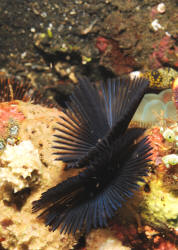
Feather Duster <Hi Cesar, MacL here> My question is if the feather duster live without light and if they do some think to improve the quality of the water. <Feather dusters are amazing creatures and the FAQ file about them on wetwebmedia is wonderful, let me suggest you start at http://www.wetwebmedia.com/feather.htm. Feather dusters improve the quality of water simply by the fact that they are filter feeders and eat what's in the water. As for lighting they need reef conditions to survive so no they really won't thrive without light.> Feather Duster Tube Hi, <Hi Tom> I have a 10 gallon salt tank with a Millennium 200 (+ phosphate sponge), 18" 50/50 bulb, crushed coral, a clarkii clown, a blue damsel, a pink Condy anemone, tiger shrimp, emerald crab, and 4 hermit crabs. I also bought a feather duster 2 or 3 weeks ago, and its doing great, I'm feeding him ZooPlex and he gets some stuff from frozen brine shrimp everyday, my question was, which I can never find clearly answered, what is happening on the end of a tube worm? In the store, and still, the end splits into two parts....one is translucent with gas bubbles inside, its not too squishy, the other half is covered in coral, I'm guessing that may have stuck to it? The guy at the store said that those were parts of the tube it didn't use anymore. So If that is true, could I break them off? <While they often decide to move out of their tubes themselves, it is best to leave their tubes alone. You can put them in the sand if necessary to hide the tubes or between rocks.> If so where would it be safe to break the tubes? Right now I have him sitting in a cave of live rock, I usually do a 40% water change every week, everything from pH to nitrate is almost always perfect. <Very nice, but you don't have to do quite so large a change every week unless you prefer it that way. Generally when people do the changes every week they do make it a smaller percentage.> And real quick, I had a second question. I put in some nice pieces of Fiji live rock, and I like to put those together in a rough stack so my tiger shrimp can be really comfortable with the area....the problem is, he for some reason is piling crushed coral on a large area of the rock, most is well above the surface, and a lot of the color is gone, and what's worse, on the undersides of these rocks, they look completely different, with the same bright white texture of Tonga rock, and I've heard tiger shrimp can bore into rock, but did he strip it completely? <If the rock is out of the water it will basically strip its self with die off. It is common for shrimps to move rocks around and make themselves their own lil place in the world.> Thanks, Tom <Good luck Tom. You are doing a good job. MacL> - X-mas Worms - Any suggestions on how to keep a Christmas Tree rock alive and happy? I add a basic Kent A&B as well as iron and a phytoplankton diet to the tank. Anything else I should include? What about light needs (time wise). Just want to keep them healthy and happy. <Unfortunately, all too often the needs of the Porites (the coral that forms the "rock" that the tube worms live in) is neglected, which slowly dies. Porites is considered a SPS coral, and needs good water flow, high and stable calcium and alkalinity levels, and high light levels (preferably metal halide). The worms derive some health benefit from the Porites (they often die should the Porites die) and will be quite content to live on phytoplankton that you add, as well as naturally occurring microscopic floating goodies. That said, the duration of the lighting should not be taken into account with individual corals, but rather with the whole tank in mind (don't exceed 12 hours, I keep mine at 10 hours). I hope this helps! -Kevin> Thanks Fan worms out of control! What do I do? - 4/27/04 Hi, I have a two month old FOWLR tank with a fan worm epidemic. <Maybe perhaps there are high nitrates in the tank or much left over food> A month ago, I noticed what looked like a blue fan worm growing on one of my scarlet reef hermit's shell. <One of many place you can and will fine them> I was excited at first, <I would be> but all of a sudden these things were everywhere. <Not unheard of at all> Covering my snails, and crab shells. I sent pictures and contacted the company that I bought my snails from and they said it was Aiptasia and to get rid of it ASAP. <WHAT?! Big difference here in my opinion, but I am sure there is more to this diagnosis than I am hearing...anyhoo...> My scarlet reef's were dying from an unknown cause at the time, <In my opinion, these are not exactly as hardy as the other hermits offered to the trade> so I believed them and thought the Aiptasia was doing it. Therefore I scraped all these "things" off everything I could find. <Ahhh....too bad.> Recently I have been doing some more research and discovered they were fan worms. The little calcareous serpulids, and fan worms were not Aiptasia. <Exactly> I was devastated, knowing I had killed such beautiful creatures. <Well, more will appear> I only had one that had any color, and it was a beautiful blue. HOWEVER....., I have been noticing that these things are still everywhere. Growing and reproducing at an alarming rate. Unfortunately none are blue like my favorite, but they still are beautiful. <I agree> My question is, should I limit their growth? I have hundreds of practically microscopic ones on my snail and crab shells, but there are still more than a couple dozen on my live rock that are starting to grow quite large. <Won't hurt a thing. I would leave them, but do be aware of water quality. There proliferation is sometimes less enigmatic and more an indication of water quality going awry> Will this overgrowth of fan worms be okay? <Sure. Doing what they do best. Feeding out of the water column> Is there such a thing as too many? <Not in my experience> I have been told that this means the water quality is good. <Not really. Proliferation of macro life is more an indication of water quality....that is true. Good or Bad is a relative term. Do research our FAQs on fanworms> Trust me, after all I've been through, I am definitely patting myself on the back, but should I be more concerned at their numbers? <Not their numbers but do go through some water testing to make sure that something isn't headed in a bad direction> Please let me know what your thoughts are. <You got 'em> Thank you so much again for the absolutely wonderful help.<What we do!> You guys are the greatest. <So our all our readers. Thanks for being part of it all. ~Paul> Nutrient Control Issues hello; i have a problem with an exploding population of these snails. could you suggest a safe method of extermination? a fish only tank with lots of live rock and a few anemones...thanks! mark s <Hi, Ryan with you today. These guys are small dusters/worms which form calcareous tubing on the glass of an aquarium. My guess is that they're multiplying in vast amounts because of large amounts of unnecessary nutrients in your water. They're stationary, filter feeders. As soon as their food supply is exhausted, their population will follow. Are you overfeeding? Ryan> Polyps, Worms, and Coral... OH MY! Hello again WWM staff. Is Bob STILL on vacation?;-) <yep... I'm guessing that he is stripped to the waist, wearing a grass skirt and making risqu?shadow puppets on a beach by firelight as we speak> Hope this finds you all well. <well... thanks. As good as I can be without being on that beach> Thanks for your prompt answer to my last question. Just wondering if it is possible to have too many Feather Dusters in a tank at one time? <generally not... they are fine filter feeders. But their presence and proliferation indicates that you have a nigh level of dissolved organics in the tank which can be a problem in the long run> It appears mine are multiplying and we already have several tiny ones. Due to the fact that Sun Polyps also inhabit this tank I am sure they will not die of a lack of food. <ahhh... understood and very fine> What are the draw backs to so many Feather Dusters? <the possibility that they will form a Union> How do we know when it's too many? <when the family dog is missing> Also, is it possible to overfeed Sun Polyps? <very unlikely... each polyp head needs fed almost daily for optimal health> I understand the repercussions of too much food waste in the tank itself but as long as that is under control can the polyps themselves overeat? <unlikely> Just a few more while I have your attention: We recently bought a potentially sick Hammer Head (coral-I think is the proper title, versus anemone, right?). <correct... a stony coral (scleractinian)> His name is Sigmund Freud, and he seems to be thriving now. Has grown to at least twice original size. <not grown my friend... polyped out. I suspect that his corallum (skeleton) has grown little if at all> Will he remain in his "shell" if he continues to grow? <it grows with him> Still some room for growth in that one. Or will we suddenly see baby Freud's popping up to play with our Feather Duster's? <have you been drinking tonight?> We learned, from experience, unfortunately, that Freud has a very nasty sting. <it is a serious issue with human health! Enough repetitive stings to your hand (or any other body part regularly dangling in the water) can induce anaphylactic shock in time. Serious indeed> Will this affect the fish in any way or only careless anemone's? <they are aggressive and will sting and kill more animals than not. Still... most are smart enough to stay away> Thanks again for all of your time and advice. Respectfully,Wylde_At_Heart <Humorously and sincerely, from "Runs_in_tight_shorts" (formerly Anthony Calfo) sitting here answering e-mail with my cat "Dances_with_mice" (formerly Zorro)> Calcareous Tubeworms Is there any scavenger or treatment I can do to get rid of *some* of those calcium tubeworm things. I have millions in my tank. On the glass, rocks, etc. Thanks! J <the problem isn't that the tank needs a scavenger (which might starve after the worms are controlled)... that would only treat the symptom. The best and easiest solution is to simply control the nutrients which are causing them to grow (better skimming., water changes, careful feeding, lighter bio-load, etc). They will then die back and wane naturally and for good. Any predator that would eat them anyways would also destroy your live rock and other inverts likely. Best regards, Anthony> Calcareous Tubeworms blooming from excess nutrients You mean that my protein skimmer should fill up weekly. Mine doesn't. <I could probably guess your skimmer brand too. Seaclone... Prism...? Hmmm... at any rate, yes my friend: a well tuned and well designed skimmer should yield a full cup of dark skimmate daily in a tank that is stocked and fed well. 3-5 cups weekly is a minimum necessary from any tank and may not even be enough (as evidenced by algae blooms or blooms of filter feeding Syconoid sponges or worms as you have seen in your tank)> Should I do weekly water changes? I haven't been. <monthly is a bit frugal but can work if large enough (30-50%) and carbon is used weekly, tank is lightly fed, lightly stocked, skimmer works well...etc. Else, do consider small weekly water changes (10-25%)> I change carbon monthly. <excellent. Its even better to change 1/4 weekly (same monthly amount of carbon... just changed more often for improved water quality). So much has been written about nutrient control and skimmers in our archives... please do browse on wetwebmedia.com. Best regards, Anthony> - Feather Duster Question - <Hi Greg, JasonC here... if no one has ever told you, typing in all caps makes people thing YOU ARE YELLING AT THEM. It's also hard on the eyes.> I HAVE A LARGE AMOUNT OF HAWAIIAN FEATHER DUSTERS IN MY 50 GAL. MARINE TANK. i HAVE FOUR ANGEL FISH, A TOMATO CLOWN, TWO DAMSELS, FOUR SHRIMP, SNAILS, AND HERMIT CRABS. THE DUSTERS SEEM TO BE TAKING OVER THE TANK. SHOULD I REMOVE SOME OF THEM? <Not unless they bother you.> WILL THEY BE HARMFUL TO THE FISH? <No.> CAN I GET TO MANY OF THEM? <Not sure I follow...> NEED SOME HELP <Just turn off the caps lock and you're all set.> THANKS, GREG <Cheers, J -- > Gettin' rid of dusters? Thank you for your response, sorry about the caps, didn't know that meant yelling. <No problem. It's just very hard on the eyes> The part of my question that you didn't understand was that the dusters are growing and multiplying like crazy. They are growing and multiplying on all of the rocks, floor of the tank, and the side glass. They are actually making the bottom of the tank look dirty. <I wish I had this problem. I love the little dusters. If you don't want them, gently siphon them out> How can I remove them to give some away? Will exposure to the air kill them? <Siphoned them into a bucket or get a fish that will eat them. I would avoid all contact with air as the air can get trapped in the duster's tube> Thanks again for all of your assistance. <The pleasure is mine! David Dowless> - Excess Feather Dusters - Thank you for your response, sorry about the caps, didn't know that meant yelling. <No worries.> The part of my question that you didn't understand was that the dusters are growing and multiplying like crazy. <I understood that perfectly - some people would kill to have this problem. It's like the definition of a weed - any plant that becomes a pest. Some people think dandelions are a weed, others make wine out of them. Most people wouldn't find feather dusters to be a pest.> They are growing and multiplying on all of the rocks, floor of the tank, and the side glass. They are actually making the bottom of the tank look dirty. <If you say so.> How can I remove them to give some away? <With your hands into plastic bags without taking them out of the water.> Will exposure to the air kill them? <Yes.> Thanks again for all of your assistance. <Cheers, J -- > Featherduster Worm Question I added a featherduster worm to my 115 gallon reef a few weeks ago--he was one of our first livestock purchases for a new aquarium. He was perfectly happy and always visible from the time we put him in. This weekend, I upgraded to VHO lighting, and he disappeared. I surmised that he is light-sensitive, and moved him lower in the tank- <Yes, good move> -but he still rarely emerges and when he is out, he is very sensitive to any vibration or movement, and often disappears for hours at a time. <Agreed... good behavioral traits...> We also added three tangs this weekend--so there's also a lot more activity in the tank than before. I suspect he will adjust to the lighting and extra fish activity and be fine and I should just not worry about him, as based on the other FAQs I've read, these are very hardy and can take a lot. <I concur> However, would he be happier if he were relocated in a cove out of the direct light? <Would seek a compromise positioning where you could enjoy seeing this tubiculous worm and it can be more out of the lime light> Thanks for any insight you can provide! James A. Deets <Be chatting my friend, Bob Fenner> Featherduster Worm II Latest on the featherduster worm--I had moved him lower in the tank a few days ago, as I mentioned. However, I was going to move him to an even more shady spot under a rock this morning. When I tried to dislodge him from the large rock where he'd taken up his latest residence, his tube slipped off! Will he make a new tube? <Yes, likely... there is a bit "more" of this animal in the old tube...> Any chance he'd go back into the old one on his own? <Not likely> After he was "disrobed," he worked his way deep into the hole on the rock--so he appears to be relatively well-protected at this point--but moving him off the rock now would be impossible and probably attempting it would tear him in half. (Based on the turn of events, I also won't be alarmed and send a panicky email if he sheds his feathery head from stress, and for protection, since he's not able to fully retract his feathers into the rock with his body. . .) James A. Deets <Read through the Featherduster Worm FAQs stored on the site: www.WetWebMedia.com for solace. Bob Fenner> Featherduster Question Hi there. Hopefully you can answer a
question that I've been unable to find the answer to. <I'll
try> I've read the article and FAQ on www.WetWebMedia.com (GREAT
site, BTW) on featherdusters, but couldn't find anything that
directly addressed this. I have 3 featherdusters, two of which blew
their crowns after a nasty sea cuke accident. When I was reaching in
there to clean up some bits of "leftovers", I knocked one of
the dusters off of the live rock I had set it on (fairly new and
hadn't attached yet). When picking it up, I noticed that the tube
felt very flimsy. Curious, I felt the other one I got as well as the
established one, and those were flimsy as well, not like the
established one felt like when I placed him in the tank. Any guidance
on this? Could it be a lack of calcium or something? Do the tubes
deteriorate? <The tube-building polychaete worms do indeed require
good water quality and ready silicate, carbonates, protein to build
their homes... the basic guidelines, levels for reef aquariums for
water are fine here, in addition to regular feeding. Bob Fenner>
Thanks. |
|

|
Features: |
|
| Featured Sponsors: |