 |
|
| Home | Marine Aquariums |
Freshwater Aquariums |
Planted Aquariums |
Brackish Systems |
Ponds,
lakes & fountains |
Turtles & Amphibians |
Aquatic Business |
Aquatic Science |
Ask the WWM Crew a Question |
| Please visit our Sponsors | ||||
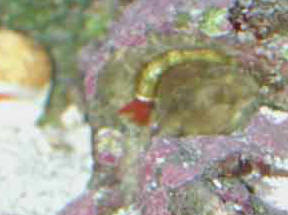
What Is This? (A Fan Worm) - 06/10/05 I have purchased this tank privately and have noticed this creature. I have been told it could be Aiptasia. Is it? <<Not at all. What you have is a small tube/fan worm. May/may not survive depending on the maturity of the system and the availability of adequate food/bacteria in the system. Will cause no harm.>> Thank you, Kathy <<Regards, Eric R.>>
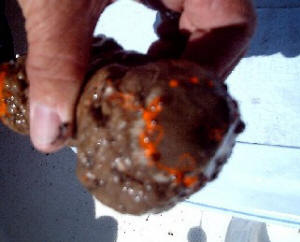
Neon Orange Feather Duster??? I have never sent a message to WetWebMedia before by I can not tell you how many pages I have read off the site. I love it and when ever I really want to get down to what is going on I always know I can trust this site. The question I have posted on some forums several times. I am really worried I am going to kill this thing before I get to id it. I've been told it's just another feather duster. I've been to many many sites and never seen a feather duster as brightly colored as this thing. The color is neon orange. Very very unlike the brown orange I've seen in other dusters. I wonder if it is in fact a duster of some sort and if there is anyone who can tell me more about this specific species. <Mmm, don't know the species, though have seem many beautiful types of sedentary polychaete worms in aquariums and the wild> This is what I have posted in forums. (I am sorry for the lengthy e-mail and I did not attach a photo because I didn't want it to decrease the chances my e-mail would be read): <Mmm, we read, respond to all. Please do send along your pix> The below photos is of the 'thing' in my tank. It looks just like a feather duster and moves slightly in the water like one. I assume it depends on light as after I left for a week and my father turned the light on sometimes, it looked unhealthy by the end. When a hermit, fish or what ever comes near by just as a feather duster it recedes back, probably into the rock. It is mostly a ghostly white with orange at the tips and an orange base. This isn't a normal giant orange feather duster. This is an almost neon orange, looks like it would glow in the dark and is made of plastic. I hope someone can ID this or point me in the general direction for info. If needed a full size photo, in which you can see a lot closer is on my website at http://www.gordonious.com/H2O/SaltWater.html just click on the image to enlarge it. (full photo is at http://www.gordonious.com/H2O/SaltWater/HPIM1299.JPG) Jonathon Gordon <Thank you for this. Have posted all my pix of identified tubeworms here: http://www.wetwebmedia.com/feather.htm There are thousands of others... and there are scientific treatises that cover their identification... though these are difficult to assess, read through... Perhaps you will run across others of this
Tube Worm ID First off, thank you for all the help you've provided in the past.<Sure, no problem.> I don't know if I would have made it this far in the hobby if it weren't for all of you. Awhile back, I purchased a button polyp colony at the LFS. The salesman noticed what he mistakenly called a Christmas tree worm on the back of the rock when he was bagging it up and seemed excited. I thought nothing of it at the time. A couple weeks later after actually purchasing a rock with three Christmas tree worms on it I returned to the original rock to try and determine what I had on the first rock. The tube is about 1 cm in diameter, somewhat translucent with what appears to be the head of a worm at the top. I've noticed it spewing mucus from the head in the past and was somewhat worried after reading that this is often a sign distress or sickness.<You are correct.> Tonight, however I witnessed the worm actually consuming the previously expelled mucus with attached particulate matter. The mucus is acting like a web that the worm expels and then consumes again. Have you ever heard of anything like this. I tried doing several searches on the site but tonight the search feature doesn't seem to be working. Any help is much appreciated. Thanks <Hello, MikeB here, would you happen to have a picture available to help identify the worm that you have. It could be a tube worm or possibly some type of crinoid. I mucus membrane can act as a "net" to catch food to be consumed. But, I would not be able to identify what exactly you have until I see a picture. Good luck. MikeB> Spontaneous feather duster generation- Hey, I have been noticing tube worms forming on my live rock. They have white calcareous tubes and their "feathers" are a deep red color. The tubes are about 1/4" and they are slightly curled. I have Googled the site but have been unable to find a definitive ID. Any idea what these are? If so, how big could they get? Thanks,<They are just small feather dusters that seem to reproduce readily under ideal conditions, Enjoy these small magnificent creatures, Good luck, IanB> Steve
Tiny New Ones >I am curious about small creatures emerging from my live rock. They appear to be similar to a feather duster in appearance. Their casing (1mm diam.) is white and is growing about 2mm weekly. The filter is slightly purple in coloration and is almost jellyfish-like and when extended is about 7mm diameter. The 75 gal marine tank with about 100 lbs live rock has been set up since Sept 03 but these critters have just started to appear. Any thoughts? Bill (cafacman) >>Hhmm.. I would guess (without any pictures to help with identification - NOT that I'd necessarily be able to identify with a picture anyway) that they are a worm of some sort. Beyond that, I couldn't begin to venture a proper guess. However, as to the relatively recent population boom, I would surmise that it is one of two scenarios, or a combination of both, those being that A: tank conditions are only just now "right" for them to repopulate (remember, you wouldn't get them if there weren't at least a few to begin with), which would make some sense as the tank's only now just beginning to mature; or B: they've been there in small numbers, and population density has now hit levels at which they're more noticeable (think "real estate"). Know that this sort of thing is entirely common. Marina Live Rock Denizens (1/11/2004) I purchased some live rock from my local pet store and saw several things that looked like extremely tiny red anemones, actually more like a very small feather duster. The base is red along with the "tentacles" that come out. I never see them go into the base/tube but they do "flow" in the current like a duster would. The self proclaimed fish expert at this store called them Spaghetti worms, but I have never seen a Spaghetti worm that looked like these. Any clue as to what they are? Any info will be greatly appreciated. Thank you.... Steve <Hard to say for sure without seeing them myself, but they do should like tiny Sabellid fanworms by your description. Look here for more info: http://www.wetwebmedia.com/feather.htm http://www.wetwebmedia.com/polychaetes.htm Hope this helps. Steve Allen> Fun with Larvae Hey WWM. Thanks for the quick response last time. Anyway, I looked in my tank this afternoon to find perhaps a hundred tiny (1/4 of a pinhead) white circles stuck to the front glass. They are attached by the central disk, and have 6-12 radial tentacles, each about equal length to the diameter of the body-disk. The tentacles seem to just float free. They are shaped like a button, not like a feather duster, and the tentacles do not withdraw if touched. I am think they are some sort of larvae. The inverts (that I know about) are a few Hawaii Featherdusters, 8 Astrea snails, some tiny Turbo snails, a little sea urchin, two colonies of Cluster Dusters, a Elephant snail (antipodes), and a Cerianthus tube anemone. About a week ago I observed the Cerianthus producing a slime/mucus containing small black specks (eggs?). Any ideas? <<Scrape one of them off with a fingernail - if it feels like a tiny rock, tightly glued to the glass - it is indeed a feather duster. Related, obviously, to your large Hawaiian residents, but not the same thing. The bloom is very, very common in aquariums, usually between 3 weeks and 6 months from initial setup. It will subside with in a week or two, and you may see an occasional "dot" now and then from here on out. If it's very soft, and slides right off the glass, then we can think of something else, but I doubt it. Cheers! Zo>> Thanks for your time, Simon Luffman There are tubes on my snail! Greetings all, <Good day, Philip, Don today> I've been reading your site for the last couple of months, and I'd like to give a big THANK YOU to everyone here. <and a huge 'Aw, shucks' from me> I have a couple of problems today: First, the basics: It's a 2 month old setup, just now finally settling down. No Ammonia or Nitrites, pH is 8.3. Nitrates are around 10-15. Two weeks ago, I got my last bit of live rock in. I won't go into the tale about the 2 mantis shrimp. I still haven't gotten those things out. Here is the deal, though: Something appeared on one of my Astrea snails. It looks like a worm, but I'm not sure. It's white, it's a spiral, and it is attached to the shell of the snail. It has the appearance of a ribbon; it's in a circular vortex pattern. There is also another one attached to a piece of live rock in my tank. The live rock came from the Gulf of Mexico, maybe that might help in it's ID. It's very difficult to describe this, and I don't have a digital camera as of yet. Do you guys have any idea what this might be? Thanks, Philip <What you describe Philip, a hitchhiker of sorts that came in on the rock/snail/both. You are seeing its calcareous tube/home. Good sign the rock is 'coming back' from the trauma of shipping. Many kinds, but watch as a head of some sort will likely appear. Keep watching as you will be amazed on a regular basis. Don> - Things on the Glass - Hello again guys! <Hello, JasonC here...> Yippee!! I have made it a whole month without asking and pleading for advice. I think I'm getting the hang of this saltwater thing! My question is this... upon close inspection of the glass on my tank, there are all these little white curly-cue thingies starting to sprout up all over. When I checked 'em out with a magnifying glass, they almost look like a snail all curled up. They are small, white and round and you can see a "circular" type pattern to them. And they do not seem to come off when I clean the glass with a magnet. A couple of weeks ago there were only a few, maybe a little bigger than the head of a pin. Now there are 3 times as many in different sizes on all sides of the glass. And they don't move at all. Any ideas? <Yup, it's a calcium-based tube worm who's name escapes me at the moment, but they are perfectly harmless and a sign that things are moving along well in your system.> Thanks again. Hope I make it another month before I have to write again. Maureen <Cheers, J -- > Critter Identification Gentlemen: <Okay> Hopefully I can describe this without requiring a picture; it's some odd little growths that came on my live rock. They really resemble feather duster worms except they are about .5cm tall and almost translucent. (I say except because I didn't think those worms were that small) you have to study the rock carefully to see them waving around. Just like the worms, they have a short tube .25cm plus the "fronds" that spread out in a circular fashion. Anyway, hope you can identify. Thanks! <These are almost assuredly some species of "Featherduster" Sedentariate polychaete Annelidan (worm). Please see here re: http://www.wetwebmedia.com/feather.htm and the linked Related FAQs files (in blue, at top). Bob Fenner> Fan Worms? Hi! As with Aquarium ID, I have these white tube-like creatures (about 0.3-0.6cm) growing off the sides of my marine tank for the past few weeks. (I keep an anemone and a few small hard corals, and a few Clownfishes, small crab and prawns.) They don't seem to disappear though. Could they be some coral babies or some parasites? <Likely just calcareous tube worms; harmless little guys in calcium based homes. Those are just a few of the many different odd-ball things you'll see popping up here and there. They're likely fan worms, so look for a "feather duster" type crown sticking out of them.> Could not find anything about them from the web, please advice. Thanks! <Enjoy the worms! -Kevin> Eudriz Re: yes, definitely feather dusters... 07/25/03 <Hello again> To PF...(told you I go on this site every day) and Kevin (Saltwater Newbie), thank you for your concern with my tank. I followed the link provided and they are indeed feather dusters...looks like Bispira brunnea...and a lot of them. They mostly remain open unless a fish swims by. However, I am not supplementing them with any individual feeding. Should I be and what would you recommend?...thank you in advance for your reply... <Well, we really don't understand what they eat. OTOH, if they are breeding in your tank, then I would say they're finding what they want. Many dusters shed their crowns and grow new ones to accommodate the available food in the aquarium. Sounds like a nice looking setup. Have a good weekend, PF> Re question on feather dusters 07/23/03 This is for PF (Michael Bloss), <and here I am> PF, today someone wrote in about a large growth of "feather dusters" in their tank. It doesn't look like they sent a picture, but could this also be Aiptasia. From reading many of the FAQs, I have noticed that sometimes Aiptasia is mistaken for feather dusters by people. Just a thought. I didn't want the poor aquarist to have a possible Aiptasia epidemic and think things were fine in his tank but start missing livestock. Thanks for the great information and effort you all put into this site. it is a huge asset. Kevin (SaltwaterNewbie in the forums) <Well Kevin (weird to be dealing in real names :) ), it may be Aiptasia, but most new tanks get blooms of small feather dusters. To amend my earlier advice, check here: www.wetwebmedia.com/marine/inverts/cnidaria/ Anthozoa/Aiptasia/aiptasia.htm and make sure the feather dusters don't look like that, but like this: www.wetwebmedia.com/feather.htm . Hopefully that clears matters up. I'd lay odds its a population surge of little dusters though, I've had that with all my tanks.> Unidentified critter What creature is building an elongated tube-like structure from bits and pieces of the coral rubble and sand substrate in my tank? It measures about 5cm long by 0.5 cm wide, is hollow and arises from the sand. I have a 75gal with 80# live rock that has been up for about a year. There are plenty of tube worms on the rock and some sponge growth also. I assume this is some invert that came in with the live rock, but have been unable to ID (or see) it. Should it be removed? Thanks Ross Siemers >> Most likely this is a close relative of the other tube worms you have... some make calcium carbonate based tubes, others are more leathery... and some attach bits of gravel, shell as you're seeing... There are some other animals that do this as well, the vast majority are innocuous... I wouldn't worry or remove the animal. Bob Fenner Feather worm ID I have a very small bluish worm attached to the hard part of a brain coral. When I looked at it with a magnifying glass I could see what looked like a feather duster at the top of it. Is that what it is or is it something I need to get rid of. Thanks >> Probably is some sort of feather duster (Sabellid polychaete) worm... and I wouldn't get rid of it... not really a problem, and a neat animal to have, look at. Bob Fenner Something Strange Today I found something strange in my tank, partially buried in the substrate. It looks like a transparent white tube, about 3/4" long and 1/4" wide. Both sides are flat and brownish, but one has a segment near the end. There are white lines that run along the tubes exterior, but what disturbs me is the small black worm-like creature inside. I am assuming it is some egg-like contraption laid by a creature in my liverock. Do you have any idea what it could be? I am, of course, assuming it's a worm of some sort, but I thought bristle worms laid their eggs in small white lumps on the rock. Besides, if something laid this tube it would have to be HUGE! Anyway, I was just wondering... -Matt Lindstrom >> I'd bet almost anything this is one of the MANY Sedentariate polychaete worms (as opposed to the MANY Errantiate polychaete worms... many of which are termed "bristle worms") that builds its own home... some out of sand, others out of chitinous material, still others out of.... carbonaceous matter. And no problem really. Some times in the wild you can see tentacular feeding apparatus of some types of these "Spaghetti Worms" (pic at my www.wetwebmedia.com site under "Worms" in the Marine Article Index), and the popular "Featherduster Worms" or "Bisma rock" Worms are of this category... not dangerous. Bob Fenner Fish Show Hello there Bob, Question: Do you know of a marine fish/reef show in the Chicago Area? <Am sure there is at least a "tank tour" type of one... have you contacted the local society? URL is on the Links pages on www.WetWebMedia.com> Question: Growing from my live rock, several critters with a tan center tube with several upward pointed filaments at the top end. Whole thing is about 3/8-1/2 inch long. Any idea what it is? <Sedentariate polychaete annelid worms... types of feather dusters... see the above site for pix, more> Question: 72 gal reef, 70 pounds live rock, trickle filter and protein skimmer. Water quality excellent. Current stocking: 4 False Percula Clowns (Amphiprion ocellaris), 1 Lunare Wrasse (Thalassoma lunare), 1 Sailfin Tang (Zebrasoma veliferum), 1 Lawnmower Blenny (Salarias fasciatus), 1 Royal Gramma (Gramma loreto), 1 Rainford's Goby (Amblygobius rainfordi), an assortment of hermit crabs, turbo snails and 2 Tonga Abalone (Haliotis sp.). I would like to add one bright blue fish and a couple of cleaner shrimp. Think I can do it? If so, any recommendations? <See the WWM site... about the Cleaners, Fish Selection, and that Abalone...> Comment: A reader recommends Chicagoland LFS, Living Seas and The Sea Shell, two very good shops. Would also recommend Scott's in Westchester, Illinois, less of a selection, but good hearty stock. <Okay, thanks for this... will post for others use.> Love your web site, and keep up the good work. <Thank you my friend. Bob Fenner> Regards, Frank Canzolino Live rock question hi Robert, I have newly discovered your site and find it very interesting and helpful. <Glad we have found each other> I am just starting up my saltwater tank and had a question for you. I'm hoping you can help me out on the problem of (and am not sure exactly what they are) but they're thin white almost transparent worm looking things that come out from my rocks and collect sand from the floor and make tunnels all over my rocks. Are these sweeper tentacles? <Mmm, no. Usually called tentacular/feeding crowns. Of tubiculous (tube-building) Sedentariate (they don't move about) polychaete (lots of bristles as opposed to Oligochaetes "few bristles" like earthworms) annelids (segmented worms)...> Are they harmful? and if so, how do I get rid of them? <Not harmful, likely will pass on their own. More beneficial as filter feeders, food for your livestock. Just keep the viewing panels wiped clean of them and enjoy.> I hope you know what I'm talking about, thank you, Joe <Very common, no problem. Bob Fenner> Mystery Creature Dear Mr. Fenner, <Jodie... Anthony Calfo sitting in for the traveling Bob show> I am new to the aquarium scene. I've had my 55-gal set up and cycling with 2 yellow-tailed blue damsels for about a month. I recently bought a very (I mean very) small piece of live rock from Fiji. After about a week of introducing it to my tank, I have noticed an unusual creature. It is only about a centimeter in length, and clear bluish "petals" that shoot back into its tube when I shine a light on it. I've taken a magnifying glass (it's right in the front of my tank -- easily visible) and I can see two tiny black dots moving around inside the "petals" or tentacles. I was excited thinking I'd gotten a free feather duster, but after reading about some nuisance anemones that retract into tubes, I'm concerned. <not an Aiptasia at least... they are not tube animals> I've looked all over the net and can't seem to find any pictures about this creature. <search this and other sites better for pictures of "feather" worms using the keyword like "fan worm" (more specific and likely in your tank than a large "Feather Duster" species> I read every letter in your Aiptasia section, just to end up more confused. I just need to know if I should be excited, or worried that my tank has cancer. <relax... most likely another treasure of the sea> Any info you could give me would be greatly appreciated! Thanking you in advance, Jodie PS You seem to be a great source of knowledge! Is there anything you don't know? =) <if you can send a digital picture, I'm sure I could help with the identification of the mystery animal...regards, Anthony> Fanworms and a Healthy Malu Anemone! <Greetings Benji... Anthony Calfo here for Bob while he is undercover as a park wiener vendor for the CIA...or was it the NSA, hmmmm maybe the FBI (no... not the Full Blooded Italians, the Federal Bureau of...oh, never mind> Attached are some pictures of some critters that I have in my tanks. I'm not sure if they are Aiptasia or some other harmless type worm. <the latter, goombah. They are sexy and desirable fanworms. Nice to have around although a bit prolific> They are very sparse in my main tank, but very heavy in my 29 gallon cycling/quarantine tank. It is most likely the total lack of any other tank mates in the 29 gallon that lets them get their numbers so high there. <nope... other reasons like dissolved organics/sediments, etc> Also I have attached 2 pictures of my anemone. I have only had him a few weeks now, but he is much more brown than when he first arrived. How much more color will he gain or does he look pretty ok. Thanks for your time. <Browner would be much better with dark purple tips. To often these "Malu/Singapore" anemones arrive yellow or white with pink tips and even sell at a higher price... pretty ironic for a bleached, starved and unnaturally colored animal that will almost certainly die within a six months to a year! Anthony> Hey, Buster- What's That 'Duster? (Tubeworm ID) Hello, <Hi there! Scott F. here today!> I want to say thank you to everyone on this site for giving such helpful advice. <You're quite welcome! We have a blast being here for you every day!> I have three feather dusters, one of the normal ones, not exactly sure what type. Two large Hawaiian feather dusters- one brown, the other white. I'm feeding them different live food and they all seemed to be doing fine. The large brown Hawaiian feather duster seemed to have two mouths. I didn't pay much attention to it, thought it was just the way he was shaped. This morning, it lost it's gills/feathers. I know they lose their feathers when stressed and I had done a 25% water change the previous morning, so I figured he'll grow it back. I've had them lose their heads on occasion before. This one however kept trying to crawl out of it's shell, which I had also had them do before. What was strange though is when the second one came out, a good deal smaller but still pretty big and he was white instead of brown. I slipped the brown one back into it's shell and put the other one in a small holding tank inside my larger tank with some live rock and sand in it. It doesn't have a lid on it but I figured it would keep the crabs out of it. I figured the brown one might stay in his old one since the other one is out now. The white one looks a lot like a feather duster worm only it doesn't have any of the little spines on it. What do you think it is? Any help you could provide me with would be much appreciated! :) Thanks, Crissy <Well, Crissy, I'd be really hard-pressed to make a good ID for you without a picture. I'd suspect that it may be just a variation of a common Sabellastarte worm, but a photo would be the best way for me to tell. Sorry that I couldn't be more specific than that. You might want to do a search on the 'net under that genus name to see if yours is a member. Good luck with the search! I hope that your 'dusters make spectacular recoveries! Regards, Scott F.>
|
|
|||||||||||||||

|
Features: |
|
| Featured Sponsors: |