|
|
| Home | Marine Aquariums |
Freshwater Aquariums |
Planted Aquariums |
Brackish Systems |
Ponds,
lakes & fountains |
Turtles & Amphibians |
Aquatic Business |
Aquatic Science |
Ask the WWM Crew a Question |
| Please visit our Sponsors | ||||
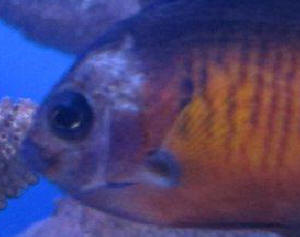
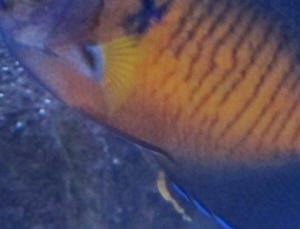
sailfin spots on fin 7/12/12
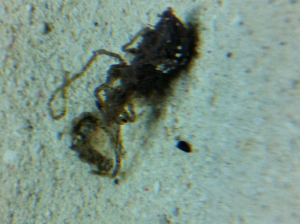
Identifying Parasites from FW Dip
2/14/11
Stringy Feces and Dewormer Meds 12/20/04 I recently added a small Naso tang to my 90 gal reef tank to control Dictyota... worked like a charm. I know the tank is too small in the long run so the Naso is slated to be in a 200 gal in a few months. "Blondie" has been happy, hungry and healthy for 6 weeks now when today I noticed a really long white feces strand. <hmmm...> I also noticed on one of its sided 2 small raised marks for lack of a better description. the Naso is pigging out as usual on Nori and macro from my sump. I'm concerned about the stringy poo, what should I do?? <do play it safe and feed a dewormer. Seek Praziquantel (Prazi-pro at Drs Foster and Smith online). It can be fed in food or given as a long term bath as per the following dosages: bath 2 mg of Prazi per liter of water to make a bath to dip the fish for 1-3 hours, you can repeat after one week... or feeding Prazi inside of food, add 50 mg of Prazi per kilo of fish (your specimen) Anthony> Queen Angel gill parasites 2/10/05 Hello Guys, <Howdy!> I'll make this short. My Queen Angels color has started fading and she's only using one gill. <Clear sign of gill parasites. Get this fish into a QT tank ASAP and treat with formalin based medication> The only thing that¹s out of order is my nitrates they are at .20ppm. <No biggie> For the past two weeks she has been flashing but no signs of ich on any of the other fish or the Angel. <Could be things much worse than ich, mate... Oodinium, Brooklynella, etc> Also she eats fine but does hide more than normal. What if anything can I watch for or do. I will have a hard time catching her but I will if need be. <No hard time at all... do some key-word searches for "catching fish" in the Google search tool and see a description at length for the fast drain and fill to catch fish safely and easily. Morning is the best time. Anthony> A " Lumpy" Griffiths Angel Hi <Hello> I have a question for you, which I think I know the answer to......But I need to ask. <Okay> In my store, I have many large reef display tanks. One of these is a 400 Gallon, very well stocked reef. I only have a few fish in there. a small yellow tang, medium purple, a combfish, a fourline red sea wrasse, a multicolour angel, medium Black Tang, and a 3.5" Griffiths. I love the Griffiths, and I got a few with my last shipment from Hawaii. <Mmm, you mean "through" Hawai'i... not found here> I chose one to keep, isolated him for 2 weeks, then put him in the tank....everything went well for a few days, but now he appears to be a bit lumpy....like he has a dozen or so small bumps on each side of him....he eats readily, and I feed Live Brine, and some Tetra marine pellets 3 times a day, but in small quantities. In fact, he seems to be first to the food. Question....what is it?, and if I soak a few pellets for a moment in the "yellow-green" water....and almost hand feed him......will these antibiotics kill my reef in such small doses? <Not likely> I know you won't want to put this on your site as it might encourage a lot of people to do the same, with disastrous results. <We post all> My system has a 4 inch DSB, 200kgs of quality Live rock, and a heavy duty H&S skimmer, as well as a trickle filter and a little activated carbon. I use natural sea water which I UV, skim and O3 before lab testing and adding to the systems Normally I wouldn't worry too much about the fish, as most seem to heal very quickly in this tank, but I'm sort of attached to this guy regards JD <I too like this genus of Angels... What yours is exhibiting is very likely some sort of worm infestation... subdermal... nematodes, maybe acanthocephalans... Not treatable, not likely "too" debilitating, not catching. Bob Fenner> Internal parasites or bacteria infection Hi Guys!! I have a major problem with my supermale lineatus wrasse. He is apparently not a happy camper. He has white feces or shall we call it stringy white poo hanging out of its anal area. <Either one> The tank is a 55 gallon with a UV, all water parameters are normal. When I first got him, he was always swimming around eating like a pig. Now he is hiding in his cave, has no interest in food, he always has his head out looking around except he hasn't swam or ate in 3 days. I am very concerned. Since my tank isn't a reef, I treated my tank with Maracyn and Metronidazole from SeaChem. I noticed his white stringy poop is getting longer, it looks like he is desperately trying to expel the waste from his anus. Am I taking the right approach? <One way, yes> The diet I was feeding him was that Canadian Mysis shrimp. It has high protein at 60%. Couple times a week I add Selcon to it. He shares a home with a flame wrasse, and a laboutei who are all doing great. Do you have any other suggestions on how I can speed this process along or is he doomed since he isn't eating? <This fish was/is very likely internally parasitized from the wild... and in too small a system, and lacking "reef circumstances", definitely a shortcoming... Do you have another, larger, more "reefy" setting to move it to? I would add the Metronidazole to its food... This is posted on WWM... and treat only for a few days. Bob Fenner> Cloudy eye on yellow tang Quick question I hope you can answer for me <Will try> I purchased a yellow tang about 2 weeks ago and after several days he developed a cloudy looking eye with a small bubble on it. Some of his fins also seemed a little torn. I first thought it was due to new rocks I added causing him to injure himself <More likely poor, diminished water quality... perhaps related to the new rock> however I asked the man at the store and he told me to dip him in freshwater which I did. When I dipped him little white "discs" fell off of him. <Good observation> He looks a little better now but I'm not sure what else I should do. Your help would be appreciated ! The water has been tested and is perfect in all aspects. The only other fish are 2 clown fish . I also have 6 snails and am purchasing a cleaner shrimp today. I feed them pellet crumbles and occasionally dried seaweed. Thank You <Wish you had a small power microscope... could look at these discs, maybe send a pic along... Very likely what you observed was flukes of some sort... You can read re these, their avoidance, treatment on WWM... use the search tool there, the indices. Bob Fenner> My fish are being invaded by worms!!! HELP 8/20/05 My poor fish are dying:( I have a 125 gallon salt water tank that I set up a year and a half ago, and well... everything was fine until a week ago. First of all, one of my fishies was acting funny (breathing rapidly). It died:( Then secondly, I started seeing worms on the bottom of the tank (overnight). These worms are reproducing so rapidly that within a few days there were at least 1000 of them! Now it has been a week I must see at least 5,000 of them, and 3 more of my fish have died:( I am so overwhelmed! I am thinking about just starting over, because my other fish are now breathing heavy. My eel looks and acts ill. I am sickened! My only surviving fish left is a clown fish, and another starter fish. Is it possible to save these fish or are they already contaminated too? Dennis <... it, the worms are very unlikely the root cause of your problem/s here... but are simply eating the fish/es, remains and reproducing opportunistically as a consequence... There is instead something likely amiss with your system, water quality... I would test this, perform large water changes, move the remaining livestock to other quarters... There is much to relate to you re potential troubles, current deficiencies in your knowledge... please take the time to search through WWM re your set-up, maintenance... Bob Fenner> Anthias with worms? Human influence opportunities... Important! 03/22/07 Hello again guys / gals. I notice my Ventralis Anthias has clear / white feces and am guessing he must have intestinal parasites. <Ahh... so wonderful to be able to influence such young, growing minds/awarenesses...> I was considering different medications to use and would appreciate your input on what would work best for my situation. The medications I am looking into are: Fenbendazole at 7.6 Mg per gallon Metronidazole Praziquantel and Paracide D Any suggestions would be wonderful, the fish has not lost weight, however he is obviously losing nutrients somewhere. Thank you so much, Brian Crenshaw <My REAL (why not?) advice is for you instead to invest in a copy of Ed Noga's "Fish Disease, Diagnosis & Treatment" (expensive, I know... and have chatted w/ him re... Maybe get the fish store to buy a copy for your use as well as theirs...) AND a QX-3...4...5? Microscope... and to LOOK here, way before dumping such medicines on your livestock... Much knowledge, discovery awaits you... which I'm sure (very) that you'll be sharing. BobF> Things on Goby? 5/9/07 I just received a red banded antennae goby from a distributor, and I noticed that the little guy has two red, sausage looking blobs on either side of his body. They are not on his head or gills, but rather about halfway down his body, right behind his stomach/intestinal area. One blob is about a millimeter, the other slightly smaller. They are red, but still semi transparent. When you look closely, you can see something undulating inside of them. It is a bottom to top motion, no squirming or writhing inside. Also, the larger of the two sausages has a small yellowish "string" coming from the top of it. I do not have a camera here (I'm at work) so I cannot attach a picture. <Rats!> I was looking through all our fish books and cannot find an external parasite picture that matches these things. My question is, any idea what it is? <Yes... very likely either a crustacean or worm parasite... Not uncommon> It almost looks like the little guy's organs are on the outside of his body! Especially as the two are directly across from each other, one on either side of his body. Any help would be appreciated. I do not want to put the poor thing in any of our tanks until I'm 110% what it is. Our quarantine tank is way to big for him, I'd never find him or he'd get eaten by the puffer we have in there. Thank you! -Erica <Mmm, I suggest serial administration of an anthelminthic (my choice? Praziquantel), and an Organophosphate (something like Fluke Tabs)... Please read here: http://www.wetwebmedia.com/gobydisfaqs.htm re related, cautionary remarks/matters. Bob Fenner> Parasitic Worm? Hi guys, got a question for you regarding my adult Imperator Angel. I noticed some bumps under his skin that have been there for a week or so, small and irregular in shape. It appears that one of the bumps has broken through the skin and is white in color. I was thinking worms, but have not been exposed to them before so I am clueless. Any help would be greatly appreciated. Thanks Sean <Sean... we have yet to complete a parasitic worms section for the WWM archives. Its not something we can briefly describe or ID from the description given either. Do seek some disease reference material like Untergasser's "Handbook of Fish Diseases" for photo references. Else, we'll need more history, description and a close clear photo to fairly ID this for you. If you research it well and decide to write an article on the topic... we'd love to post it here. You'd be doing many aquarists a great favor in sharing what you learn! Best regards, Anthony> Intestinal Worms? Hi Bob, <Scott F. here with you tonight!> First of all I would like to say thank you on writing such an excellent book! (The Conscientious Marine Aquarist). My fish store recommended this book above all others and I have learned more from it than anything else. <I read my copy so much it started to fall apart! I agree with you-it's a great book!> I am just setting up my first 55 gallon saltwater aquarium (with the help of the store of course) and I am having the following problem. I bought two clownfish, one flame Hawkfish and an Orchid Dottyback about 8 days ago. Everyone seems to be doing fine except for the Dotty. Over the last two days I have noticed that he has had some discoloration on the lower part of his abdomen and today after watching him for quite a while I come to the conclusion that he has some sort of worm/internal parasite. The discoloration seems to follow a "wormlike" pattern throughout his lower body and his stomach seems a bit enlarged. The clincher though was the small white being that poked it's head out the fish's vent for a brief time. That's a worm, huh? <Hmm, could definitely be some type of intestinal parasite. Treatment is really contingent upon you ascertaining what type of parasite it is. Assuming that it's a tapeworm (Cestodes) or nematode, you can use some of the commercial "anti-worming" fish foods that are out there. On the other hand, sometimes these conditions can improve through maintaining very high quality water conditions. There are a number of commercial products available for this type of parasitic infestation. Often times, however, the chemical "cures" used to treat these problems can cause more damage than the parasite, so do read the WetWebMedia.com disease FAQs to get more information.> What do I do? I have not bought a quarantine tank yet (don't have the $$$ right now because every last cent has been spent on the main tank) but I don't want to lose my Dotty. <I understand, but I really think that the modest amount that you'll need to spend to acquire a simple quarantine set-up (5- 10 gal tank, heater, sponge filter) will save you potentially hundreds of dollars down the line. You really need to quarantine all new fishes, and you should treat all sick fishes in a separate tank. If you look for used equipment, you can save more money on this stuff> He seems very distressed though and his tail fin is fraying. What advice can you give? Will my fish live? <It depends on the type of parasite that you're dealing with, and the apparent severity of the damage it's causing.> Should I remove him? <I would definitely attempt treatment with medications only in a "hospital tank"> Will the other fish acquire this worm as well? <Hard to say, but it seems somewhat unlikely that this will happen> I don't want to lose my little Dotty!!! Help! Christy <Well, Christy, just hang in there, read up on parasitic infestations, and take appropriate action. I think you'll be fine! Good luck! regards, Scott F.>
Black spots on a clownfish >hi, >>Hi, Ben. >I had a quick question. I've got a percula clownfish that over the last week has developed a bunch (10+) black spots all over it's body (some up to 3 mm). No particular location - just all over. Besides these spots, the fish seems quite healthy and has a voracious appetite, swims normally, and hangs out in a colt coral it has hosted to. The only thing that has been different recently is that I installed 2 new lights about a week ago (2 x 96W PCs, one 6500k and the other an actinic). Could the fish be 'sunburned'? >>You know, I've never heard of a fish being sunburned unless it was actually out of the water. This sounds more like a disease that's much more common on tangs, especially yellow tangs--black spot disease. It's a parasite, and very easily dealt with via freshwater dipping. Just be sure the water is matched for temperature and pH, and all should go well. Minimum dip time would be on the order of 5 minutes, but I always watch the fish (they can often go longer). Erect fins are a sign it's time to pull them out of the freshwater dip, but they will breath rapidly and "lose their balance", all common with f/w dipping. >Although I had decreased the photoperiod from 12 to 8 hrs, some polyps didn't like the change and they retracted until they were relocated to the bottom of the tank. Have you seen this before? >>To be expected with the inverts, they do indeed tend to "burn", so reduction of photoperiod OR moving the lights and/or the inverts away (then moving closer/increasing photoperiod as they adjust) until everything has adjusted is the order of the day. >thanks, Ben >>You're quite welcome, and best of luck to you. Marina <Might be flukes, possibly Paravortex, even Microsporideans... RMF> Weird Bumps On Yellow Tang I bought a yellow tang which is about 2.5" in size. It's been feeding very well, but I've noticed that the fish has some bumps randomly all over its body. It doesn't look like Ich... the bumps look like some kind of rash... under the skin and are only visible when the fish is at certain angles to the light. Then, they look like the bumps are a bit whitish... the difference between those and Ich is that ich looks like grains of salt outside... these look like tiny mosquito bites under the skin... The fish is also scratching a lot...I was thinking that maybe its body flukes. <Could be...Or some other type of parasitic invasion...> I gave the fish 5min bath in FW today. The bumps are still there, nothing changed... <Not a bad idea...I'd still give it a couple more tries, to see if this will do the trick> What do you think this is? What treatments would you recommend...? <Well, for a parasitic infection, copper or Formalin preparations would work. There are other commercial products better suited for "flukes", however...Visit a few of our sponsor's web sites for various products and their applications> BTW, for body/gill flukes, what is better: copper (just like the treatment for Ich or velvet) or Formalin/malachite green ? <Do make positive ID on what you're dealing with there, just to make sure. Check the disease FAQs and see if you can find an example of something that looks like what you're seeing. Or, if you can email a digital photo, we can possibly help make a better ID...> Thank you, Luke <And thank you for stopping by, Luke! Regards, Scott F> - Wasting Disease - <Hello, JasonC here...> Hi crew, have a problem I haven't been able to find much on. Have a Sebae clown, wild caught, about 4 years old; always been in perfect health. Recently, I moved him to a larger tank, fish with some inverts, no anemones (yet). About 2 weeks later he developed Popeye, one eye, which I successfully treated with Epsom (thanks!). He still has a good appetite, even still has that pearly iridescence around the white bands that fresh-caught clowns have, BUT, he is beginning to lose mass; first, developing the typical pinched forehead, now progressing rearward both above and below the lateral line; no other clowns in the tank, other specimens unaffected. He eats and comes out less but is otherwise still pretty normal. <So you do see the fish eating... it would seem to me with the other occupants, this fish might be getting less that its fill.> His offered diet hasn't changed, if anything is better because I am feeding a large French and Atlantic blue tang, and very wary of HLLE, so they eat better than I do. My past experience is that this guy is headed for checkout, but its been a while, and if there is anything I can do I want to do it, so, suggestions? <Well, isolation might help - make sure the fish is eating well and without competition from the larger fish. Also, because this is a wild fish, it is also more likely that it has an internal parasite (or two) that are competing for the same nutrients, quite possibly nematodes or Cestodes [tapeworms]. Both can be treated - you should be able to obtain Praziquantel [for the Cestodes] and/or Fenbendazole [for the nematodes] from your local veterinarian. I would work with one of these at a time, and administer in baths for 2-3 hours. More information on these treatments can be found in the Edward Noga book, Fish Disease, which while expensive is very complete... and an eye-full.> Thanks, Steve J. <Cheers, J -- > - Fluke on
my Foxface? - Hello WWM Crew! <Hello.> I love
your website and have learned a tremendous lot from it! <Glad to
hear.> Thanks so much for helping us 'newbies.' I
have a 120 gallon aquarium that's been up and running for almost 4
months. I have recently added a Foxface Lo and an algae
blenny as my first additions. I also have a few frags of
corals (zoos, a frogspawn and a couple xenia.) My problem is
that I had an outbreak of what I presumed to be ich in my display due
to foolishly not quarantining my two new fish. I now know
better and will not repeat this mistake. When I noticed the
signs of ich I immediately removed both fish and treated with
hyposalinity for 30 days. I have returned the fish to the
display and there seem to be no signs of ich so far - it's been
about 4 days. However, my Foxface has a 'bump' on
his dorsal fin near the base that I would describe as looking like a
clear to whitish 'bubble' of maybe 1-2 mm in
diameter. It's round to slightly oval and appears to
have a whitish line or segment cutting near the center. It
was most certainly not there yesterday and is there clear as day
today. The fish appears healthy and is eating
well. My research on your site has led me to suspect this
may be a parasitic fluke. <Could be.> Any way to know for sure?
<Closer examination... magnification.> However, the treatment of
this problem is not crystal clear to me. Is a routine of
freshwater dips in order? <Would be a good start.> Formalin?
<Only if the dip doesn't affect the cure, but could also try
some of the anti-parasitic foods like the New Life Spectrum Thera+.>
Thanks for any help you can provide! Cheers, |
|

|
Features: |
|
| Featured Sponsors: |