|
Related FAQs: Marine Life
of the Tropical West Atlantic, Tropical West Atlantic 2,
Related Articles: TWA
Invertebrates, Algae, Vascular Plants, Introduction to Fishwatcher's Guide
Series Pieces/Sections, Lachnolaimus maxiumus/Hogfish, Hogfishes of the Genus
Bodianus,
The Tropical West Atlantic:
Bahamas to Brazil, Part 3
To: Part 1, Part 2, Part 4,
Part 5, Part
6, Part 7, Part 8, Part 9,
Part 10, Part
11,
|
|
| Bob Fenner |
|
Grammas, Family Grammatidae. Grammas are confusingly termed
"Basslets", and though related to the Basses (same Suborder),
make up their own distinct family. An indispensable, stock aquarium
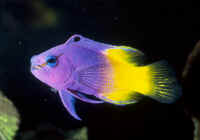
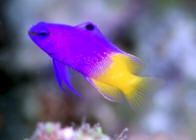
species, the Royal Gramma, Gramma loreto (1), is an archetypal
aquarium species. Descending into greater depths in similar
environments you'll find the more expensive Blackcap Basslet, G.
melacara (1) (60-400 feet) and Yellowcheek Basslet, G.
lincki (2); the latter and one other grammatid rarely
offered in the trade.
Ecotype: Vertical walls under overhangs and within caves, often
upside-down.
|
There are but a couple of grammatids that are
highly prized in the aquarium hobby. Gramma loreto, the
Royal Gramma is the Basslet or
Gramma to many. Colorwise it's front half varies from purple
to violet, with the back half a bright yellow. The second in
Bonaire.
|
|
Bigeyes, or Catalufas, Family Priacanthidae. These fishes are
often listed by wholesalers and dealers as "Soldiers" or this
and that "Squirrelfish", which they do resemble with their
shiny reddish coloring, large eyes, and shy, nocturnal habits. But
priacanthids are not really closely related to the holocentrids. Two
species are commonly brought out from the TWA for our aquaristic
interest. The Glasseye Snapper, Priacanthus cruentatus (2) is
the larger, attaining a foot in length. The aptly named Short Bigeye,
Pristigenys alta (2), grows to about four inches.
Ecotype: Reef and rocky areas with plenty of nooks and crannies to
hide in.
Cardinalfishes, Family Apogonidae. Other authors list more
than the two TWA Cardinal species that I've regularly across in the
trade. The Flamefish, Apogon maculatus (2), and very similar
Twospot, A. pseudomaculatus (2) are all I've seen on the
U.S. west coast in any numbers. Both are quite hardy, especially given
their timid, fragile appearance, and make good additions to peaceful
marine set-ups of all kinds.
Ecotype: Reefs in crevices by day, coming out to feed at night.
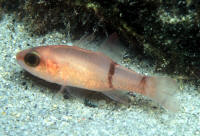
| Apogon binotatus (Poey
1867), the Barred Cardinalfish. West-Central Atlantic; Florida to
Venezuela. To four inches in length. Bonaire pic. |
|
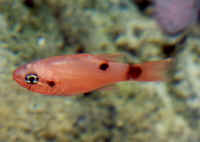
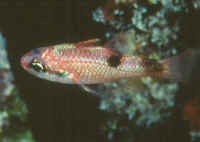
| Apogon maculatus (Poey 1860), Flamefish.
Western Pacific, Massachusetts to Brazil. To four or so inches in
length. Here are images of the species in the Bahamas during the
day and night. 2-60 feet. |
|
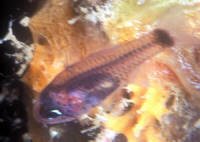
| Apogon quadrisquamatus Longley 1934,
Sawcheek Cardinalfish. Western Pacific; Florida to Venezuela. To 7
cm. in length. Bonaire pic at night. |
|
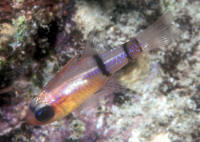
| Apogon townsendi (Breder
1927), the Barred Cardinalfish. West-Central Atlantic; Florida to
Venezuela. To 6.5 cm. in length. Bonaire pic. |
|
Hawkfishes, Cirrhitidae. There is but one species in this
family in the TWA, the Caribbean or Redspotted Hawkfish,
Amblycirrhitus pinos (1). Like other hawks, this is a shy
retiring animal that spends most of its time stationed on a prominence
watching the world go by.
Ecotype: Coral reefs, resting on top of coral or hiding under.
Remoras, Family Echeneidae. The one common species in the
TWA, the Sharksucker, Echeneis naucrates (2), is found worldwide
and collected from the same. This is a really tough animal that does
well without a "traveling companion" to stick to. In fact,
one must take care to not constantly overfeed remoras, as they grow
very quickly; and this species gets more than three feet in length.
Ecotype: Found attached to larger sharks, boats, swimming free for
an opportunistic clean-up meal.
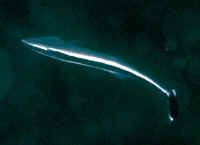
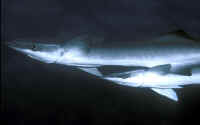
| Echeneis naucrates Linnaeus 1758, the Remora
or Sharksucker. Circumtropical. To 110 cm. in length. Most noted
for their modified dorsal fin attachment organ, by which they join
temporarily with a variety of hosts (whales, dolphins, ships,
divers...). Even used by humans for a fishing tool! A free-swimming
small individual in Fiji and a larger pair swimming about in the
Bahamas. |
|
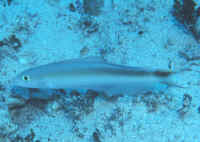
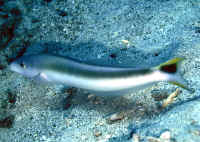
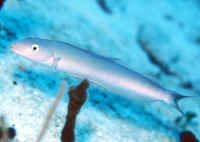
Sand Tilefishes, Family Malacanthidae:
| Malacanthus plumieri (Bloch 1786), the Sand
Tilefish. Tropical West Atlantic; Carolina to Uruguay and Ascencion
Isl. To twenty eight inches in length. Bahamas, St. Thomas and
Cozumel pix of six and ten inch individuals. |
Grunts, Family Haemulidae (Pomadasyidae). Named for the
audible grunting noises they make, only two species of haemulids are
regularly utilized from the TWA. Thank goodness, they're more hardy
stock than most of their non-Atlantic brethren. The French Grunt,
Haemulon flavolineatum (2) and Porkfish, Anisotremus
virginicus (2), should be familiar to you if you've been
"in the life" for long. I'd like to give a
"plug" to some of the other grunts hailing from the TWA if
you don't mind. IMO, the Cottonwick, H. melanurum,
Bluestriped, H. sciurus, and White Grunts, H. plumieri
deserve a try (all 2's) '¦ among others. They're
medium-hardy, good looking, there are bunches of them, and they're
easy to collect.
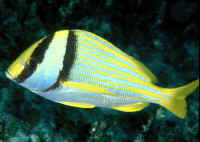
| Anisotremus virginicus
Linnaeus 1758, the Atlantic Porkfish. The most commonly offered
member of the family (that lives... see the Sweetlips section
below). Tropical West Atlantic. To fifteen inches in length. A nice
addition to a peaceful tropical Atlantic biotope presentation.
Bahamas pic. |
|
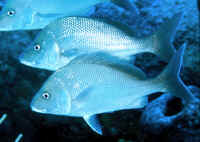
| Haemulon album Cuvier 1830, the White
Margate. Tropical West Atlantic. A food and game as well as
occasional pet-fish... Grows to about two feet maximum length. This
one photographed in the Bahamas. Yes, those are two Royal Grammas
hanging upside down under a ledge with the Margate. Bahamas
image. |
|
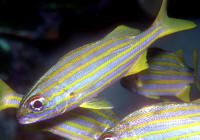
| Haemulon chrysargyreum Gunther 1859, the
Smallmouth Grunt. At nine inches maximum length, a far easier fish
to keep than its larger kin. Tropical West Atlantic. |
|
| Haemulon flavolineatum (Desmarest 1823), the
French Grunt. Another common "Grunt" offering out of the
tropical West Atlantic. This one part of a typically large school
in the Bahamas. To one foot in length. |

|
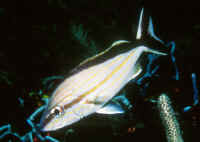
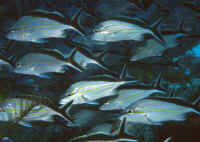
| Haemulon melanurum Linnaeus 1758, the
Cottonwick Grunt. Tropical West Atlantic. To thirteen inches in
length. An image of a single and school of Cottonwick Grunts in
Tobago. |
  |
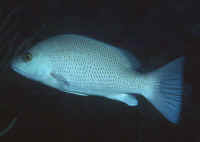
| Haemulon parra (Desmarest 1823), the
Sailor's Choice Grunt. West Atlantic. To sixteen inches in
length. Not a great beauty, but at times collected for the pet-fish
trade. |
|
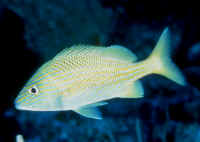
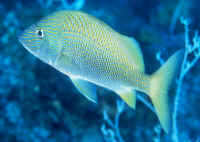
| Haemulon plumieri (Lacepede 1801), the White
Grunt. Tropical West Atlantic. To eighteen inches in length. Again,
another occasional ornamental aquatic out of the Caribbean. |
  |
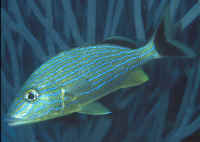
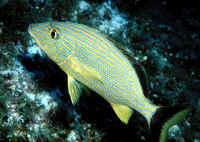
| Haemulon sciurus (Shaw 1803), the
Bluestriped Grunt. To eighteen inches in length. A species
that ought to be used more in the aquarium interest, though it can
grow to some eighteen inches in length. Bahamas pix. |
|
To: Part 1, Part
2, Part 4, Part
5, Part 6, Part
7, Part 8, Part
9, Part 10, Part
11,