|
Related FAQs: Marine Life
of the Tropical West Atlantic, Tropical West Atlantic 2,
Related Articles: TWA
Invertebrates, Algae, Vascular Plants, Introduction to Fishwatcher's Guide
Series Pieces/Sections, Lachnolaimus maxiumus/Hogfish, Hogfishes of the Genus
Bodianus,
The Tropical West Atlantic:
Bahamas to Brazil, Part 7
To: Part 1, Part 2, Part 3,
Part 4, Part
5, Part 6, Part 8, Part 9,
Part 10, Part
11,
|
|
| Bob Fenner |
|
Wrasses, Labridae. Mirroring their importance and abundance
on the reef, the wrasses of the TWA make up a sizeable part of the
pet-fish shipped from there. These stalwarts are amongst the
hobby's "best" and "most popular" animals.
Ecotype: Several; mainly in shallow to mid-depth reefs, associated
with the bottom.
Hogfish is the name we apply to a group of the wrasses as an
affectionate moniker describing their appearance (and eating habits).
Three of the best "hogs" in the trade come from here; The
Spotfin or Cuban Hogfish, Bodianus pulchellus (1); Spanish Hogfish, B.
rufus (1), and Highfin or "just" Hogfish, Lachnolaimus
maximus (1). The first two are facultative cleaners when small, picking
off ectoparasites and dead tissue from grateful hosts. Be aware that
these fish-only system wrasses get to be rambunctious when larger (to
1,2 and 3 feet respectively).
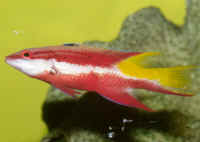
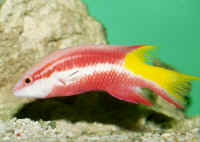
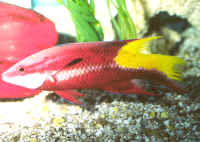
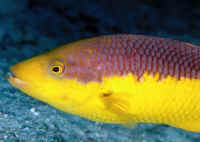
| Bodianus pulchellus (Poey 1860), The
Spotfin or Cuban Hogfish. Tropical West Atlantic; South Carolina to
Venezuela. To about eleven inches total length. Exemplary
aquarium species. Small (3"), medium (5") and large
(8") images of Bodianus pulchellus (Poey 1860), the Cuban
(Spotfin to science) Hogfish. All aquarium images. |
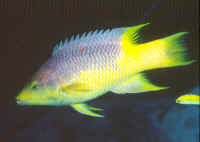
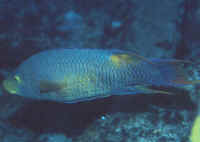
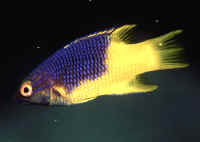
| Bodianus rufus (Linnaeus 1758), the Spanish
Hogfish. Western Atlantic; Bermuda to Brazil. To sixteen inches
maximum length. In the wild eats mollusks, urchins, Brittlestars,
crustaceans, and juveniles act as facultative cleaners. Hardy
aquarium species. Below: Medium (5") and a large (16")
and about same size mute-colored images of Bodianus rufus. Bahamas
images. One inch juvenile at right in Cancun. |
|
|
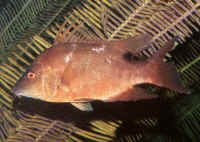
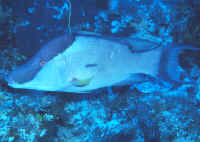
Lachnolaimus maximus
(Walbaum) 1792. Most often sold as the Long-Fin
Hogfish is a real beauty from the western Atlantic. It is
unmistakable, distinguished by it's first three greatly
prolonged dorsal spines. Be aware if you pick one of these up
that they get BIG; Randall lists the largest he collected at 32
inches and 14.4 pounds. Here are images of a ten inch juvenile in
captivity and a two foot specimen in the Grand Bahamas
Channel.
|
|
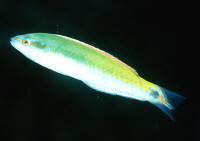
The Bluehead Wrasse, Thalassoma bifasciatum (2) is a staple
item in our livestock arsenal. This is actually the last or terminal
phase of the species; the yellow undifferentiated and female members
that turn into these green and blue bolts are rarely offered in the
trade. In the wild they exist in harems with one alpha male (photo),
with the next strongest female converting to a Bluehead for
replacement.
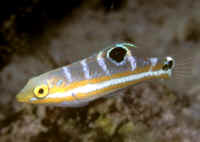
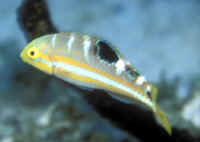
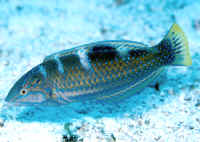
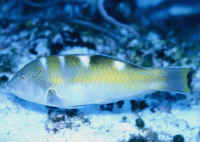
There are several wrasses of the genus Halichoeres found in the TWA
that are suitable for aquarium use (especially when small). A few are
"old-timers" to the trade like the Pudding Wife, (H.
radiatus) (2) and Slippery Dick (H. bivittatus) (2). Others
are welcome newbies, like the Lightning or Yellowcheek (Halichoeres
cyanocephalus) (2) and Neon or Yellowhead (H. garnoti) (2).
There are others long-deserving of our attention.
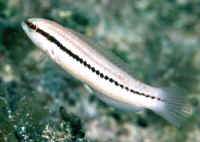
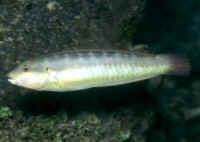
| Halichoeres bivittatus (Bloch 1791), the
Slippery Dick Wrasse (2), is a standard item offered out of the
tropical western Atlantic and an anomaly to me. This fish is
neither really very attractive or relatively hardy in captivity. To
almost nine inches in length. Bahamas, Cozumel, St. Thomas pix of
juvenile and initial phase individuals below. Terminal/male phase
at right in Bonaire. |
|
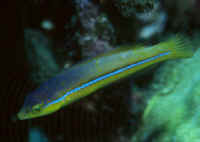
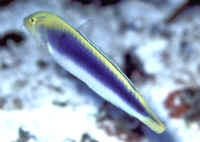
| Halichoeres cyanocephalus (Bloch 1791), the
Yellowcheek Wrasse. West Atlantic. To six inches in length. This
terminal phase individual off of Cozumel. |
|
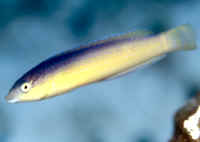
| Halichoeres garnoti (Valenciennes 1839),
the Yellowhead Wrasse (1) is another new choice out of the tropical
western Atlantic. To about seven inches long. More and more
available in the trade, and a beauty. At right a terminal phase
individual in Cozumel. Below are images of juvenile, initial
and terminal phase/male individuals. Second in Cozumel, all others
Bahamas. |
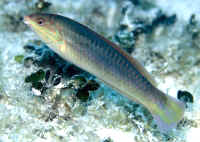
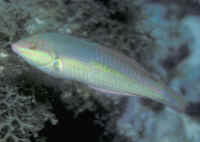
| Halichoeres maculipinna (Muller &
Troschel 1848), the Clown Wrasse. West Atlantic; Carolina to
Brazil. To 18 cm. Initial phase individual off of Cozumel and St.
Thomas. |
|
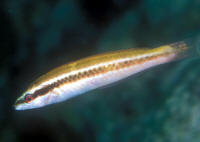
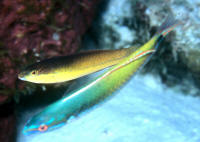
| Halichoeres pictus (Steindachner 1867), the
Rainbow Wrasse. Tropical west Atlantic; Florida to northern South
America. To 13 cm. in length. An initial phase individual and pair
in Bonaire. |
|
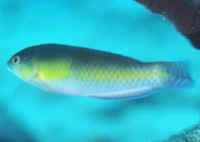
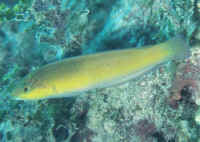
| Halichoeres poeyi (Poey 1860), the Rainbow
Wrasse. Tropical west Atlantic; Florida to northern South America.
To 13 cm. in length. Found in shallow muddy bays and grass beds.
Photo at right of an intermediate phase individual in the
Bahamas. Below: Juvenile, intermediate and terminal phases in
St. Thomas. |
|
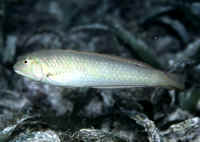
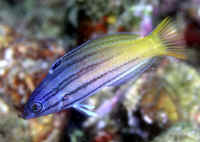
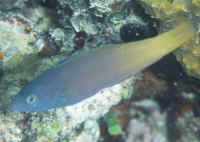
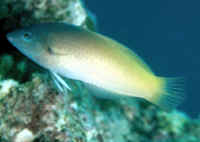
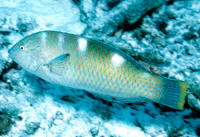
| Halichoeres prosopeion (Bleeker 1853), the
Two-tone Wrasse. Western Pacific. To five inches in length. An
occasional import from a few countries. N. Sulawesi, Fiji and
Australian photographs of very young, juvenile and adult. |
|
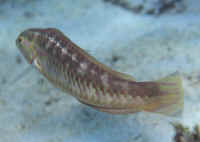
Halichoeres radiatus (Linnaeus 1758), the
Puddingwife Wrasse (2), is another old standard from the tropical
west Atlantic. Good looking when young, keep in mind this fish
grows to twenty inches in the wild. Juveniles in Cozumel,
sub-adults in St. Lucia and Cancun, Initial Phase off Cozumel. 2,
3, four, five and twelve inches respectively, and one off
Bonaire. No terminal phase pic?
|
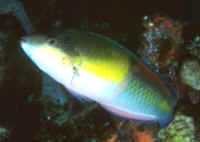
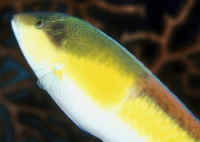
This is a wrasse? The genus Clepticus:
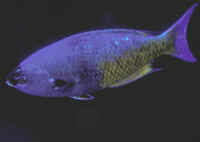
| Genus Clepticus: Here is another species we'll
mention, the Creole Wrasse, Clepticus parrae (Bloch &
Schneider 1801) (3), simply because it (mis)enters the trade from
time to time. This reef roamer is not often identified as a wrasse
at all, as it cruises above the reefs of the tropical western
Atlantic. The Creole Wrasse almost always dies in route from being
shipped from the wild. To one foot in length. This one in Cancun,
Mexico. |
|
Lastly, a quick mention of the wrasses, like the Pacific Dragon or
Rock Mover, called Razorfish. The ornamental marine livestock industry
generally sells these TWA sand divers as generic "Razorfish",
Xyrichtys sp. (2). These need a thick sand bottom to dig in.
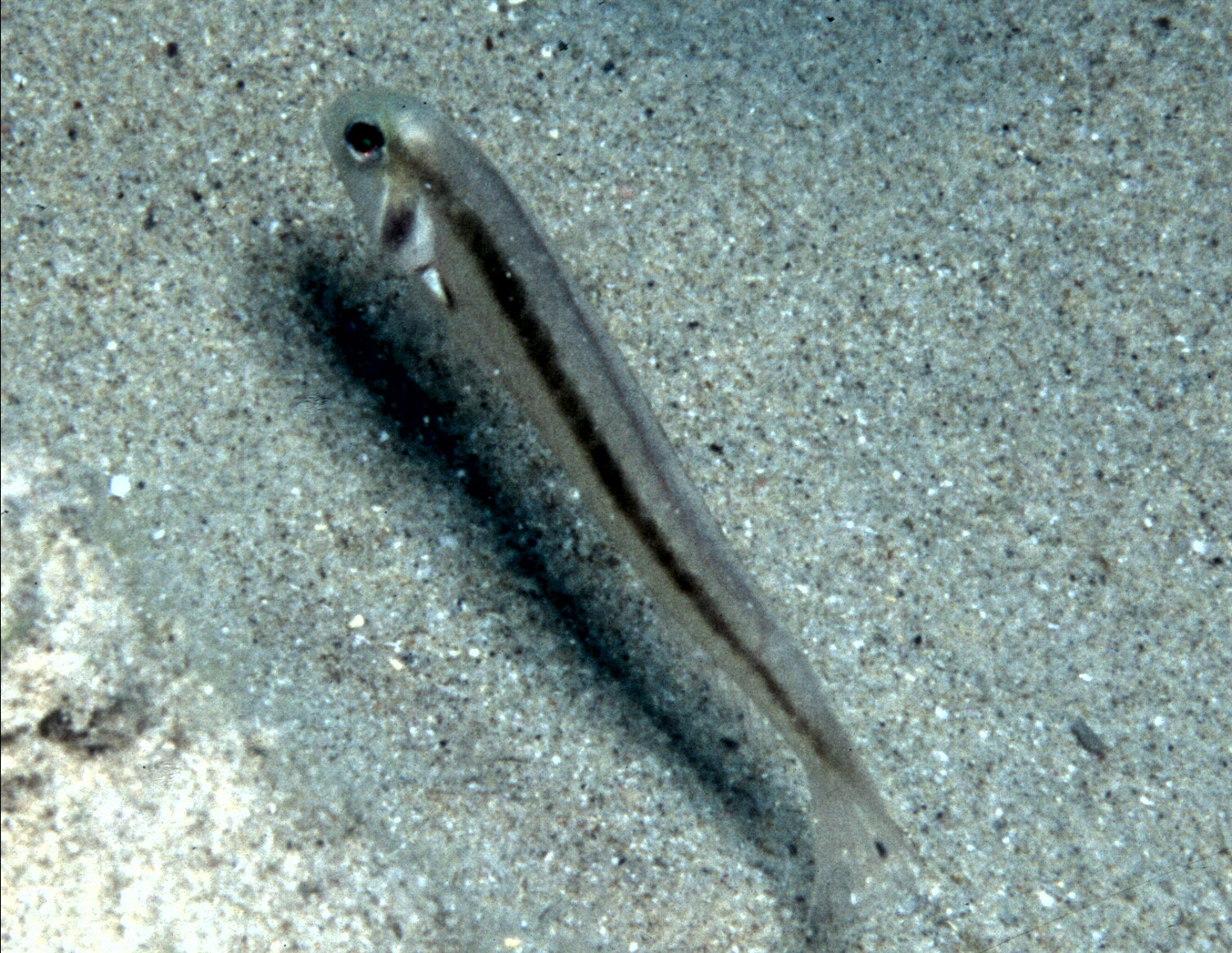
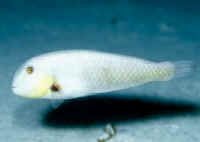
| Xyrichthys martinicensis Valenciennes 1849,
the Rosy Razorfish. West Atlantic; Florida to South America. To six
inches in total length. A terminal phase (male) individual here off
Cozumel, and initial and terminal phase individuals below in
Bonaire. |
|
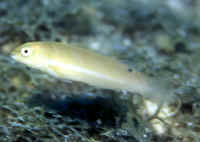
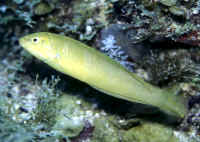
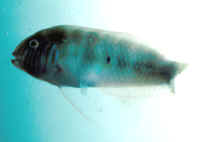
| Xyrichthys splendens Castelnau 1855, the
Green Razorfish. Tropical West Atlantic; Bermuda to Brazil. To a
mere seven inches in length. Commonly found in seagrass beds and
surrounding sandy areas. Terminal phase aquarium image at
right. Below, juvenile, initial phase/female and terminal
phase/male off of Cozumel Island, Mexico. 4-30
feet. |
|
To: Part 1, Part
2, Part 3, Part
4, Part 5, Part
6, Part 8, Part
9, Part 10, Part
11,
|
|