|
|
| Home | Marine Aquariums |
Freshwater Aquariums |
Planted Aquariums |
Brackish Systems |
Ponds,
lakes & fountains |
Turtles & Amphibians |
Aquatic Business |
Aquatic Science |
Ask the WWM Crew a Question |
| Please visit our Sponsors | ||||
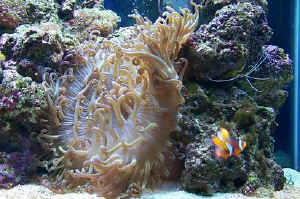
Long Tentacle anemone changing color? Reading 5/26/10 Good afternoon! First off, thanks for all that you do, I have spent hours upon hours on this site, and have learned so very much. <Thanks, so have I> I'm writing today about my long tentacled anemone, I'm worried about him. I've had him for awhile now, (maybe 5 years?), <Impressive!> and he's done awesome. He opens up to the size of a dinner plate, stays put in his corner of the tank, and is just a huge part of why I love this hobby. <Anemones are also some of my favorite invertebrates...I have a carpet anemone I've had for almost 2 years that's taking over my tank!> In the last 2 weeks, he has stopped opening up much... his clowns are hanging around him less... they're not feeding him at all, and he has backed up between 2 pieces of live rock. He isn't getting as much light as before, since he's wedged in there, but I don't know how to get him out. Or if that is even his problem. <Have you tried feeding him, preferably with minced, raw meaty seafoods, soaked in Selcon?> Regarding the rest of his habitat : It's a 240 gallon tank, I do 25 gallon water changes weekly, salinity stays at 1.025, temp stays between 77.5-79, nitrite, nitrate, phos, and ammonia are all zero. Ca+ is around 400, pH is around 8.1, Mag is around 1200, dKH is around 14. I'm running a wet/dry and an AETech skimmer that puts out about 3-4 cups of dark skimmate a week. Metal halides used above the tank. Nothing is new, the bulbs are about 3 months old, no new inhabitants in the tank. The 2 clowns that live with him have been around for about 2 years. <All good, though pH could be bumped up a bit> Other tankmates are a yellow tang, blue hippo tang, 6 damsels, and a snowflake eel. Lots of corals, but nothing within 8 inches of him. <What species?> Substrate is 3 inches of powdery extra fine white reef sand. I've been target feeding him brine shrimp soaked in Selcon, but he doesn't seem to eat. In the past, as soon as the feeder dispenses, the clowns would take him their first few bites. Now they don't. <Clowns are fickle, and can't be relied upon to feed the anemone. Definitely switch to something other than brine shrimp, which has little nutritional value. Go to your grocery store and buy some raw shrimp, crab, and shellfish and feed this instead, in small (5mm) pieces)> Let's see, what else might you need to know? The water changes are done with RO/DI water that is circulated for 24 hours and heated to 78 degrees. I had a feeder malfunction a few weeks ago that resulted in massive overfeeding, so now I've got a diatom bloom. Could that be his issue? <The associated water quality dip could be...how long as this been going on?> If I need to help him get closer to the light, how do I move him? <Don't worry about this right now> I have about 180 pounds of live rock in the tank, so to clear the area around him I would need to sacrifice some rock, and my QT tank is currently housing a dwarf angel with crypt for a friend. <No worries as of yet> Thanks for whatever suggestions you may have! <Anytime. Let me know what the coral tankmates are, and how long the problem as been occurring> Christina <M. Maddox> Re: LTA acting odd? 3-15-09 Re: LTA moving around -02/20/08 Thank you again for your help, James. This site is truly amazing in the amount of info found here. I only whish I heard about it earlier. <Never too late.> I do have another question for you about my Tomato Clownfish. As I said before, the female of the pair likes to waft and dig with her tail all around the host LTA. It would be pretty interesting, if she did not bury corals without regard, cloud up my water, move my sand bed around (which is really bad for me because I have a DSB and the anemone has been moving so she basically ruins the filtration efforts ((denitrification)) of the sand bed), etc...etc...etc... <Normal behavior, not going to change.> She is about four inches long and in the past 7 months has constantly gotten darker and darker on her sides. <Normal.> She was bright red when I got her so I know she is not a Cinnamon(?) <spell checkers work wonders here.> Clownfish, anyways I believe she is at least a couple of years old. Last night, since the LTA moved again ( but now to a good spot for him) I have been constantly rearranging for the corals health. So she goes on her usual rampage of cleaning around the anemone, although she has done this for the whole time in my tank and still have yet to see some eggs, and throughout the night I had a rock tumble as a direct result. I lost my 2 big colonies of Acropora in the sand that I had to dig out, and a big rock fell not so much directly on the anemone but close enough to cause damage to my female who was in a slumber at the time I am guessing. I saw the tumble had happened 2 hours before the actinics come on so I turned them on, restacked (hopefully a little safer this time) and turned the light back off so everything could calm down. During this I noticed my female had some scratches on her side, slime coat issues, and would not leave the cleaner shrimp alone unless he was cleaning her. I also noticed that she will not go anywhere near her anemone the male is still in there and will not leave it no mater what). #1 Am I getting too worked up too soon about the female? will go back in time) <Nothing you mention sounds unusual, nature will take it's own course here.> #2 Should I be worried about the stress factor of this whole episode? <I would as this behavior isn't going to change. is why anemones and clownfish should be kept in a system by themselves.> #3 Is there any other way to get her to stop doing this other than taking her out? I have tried strategically placing rock rubble around the LTA so her tail will hit the rock instead of the sand and that seems to work for a while until she moves the rock. Obviously you cannot train a fish, so I hope this does not seem like a stupid question. Also I know I should not even have the LTA in the system to begin with. Maybe I am looking for an answer I will never get. <I think so my friend.> Maybe I should be saying to myself, you created this problem, now you deal with it. <Bingo, lack of reading/learning before the purchase.> I just love all the corals that I have and would love to not have to remove anything, but it is pretty much down to this: either pull out the clown/anemone/select corals or shut up and deal with it? If it is not to much of a problem I was going to list all the corals and you could recommend which to remove so everything is not always competing chemically. Keep in mind I run a lot of activated carbon 100% of the time to help with the allelopathy. <spell checker?? Let's not go through this again, please. Forget which corals to move, your best choice is removing the LTA and the clownfish to a separate system, there you will have the benefit of enjoying both worlds.> large Goniopora, green flower pot, very big (Skelton about half the size of a beach ball and expands longest tentacles almost a foot) LTA 14 or so inches across Bali Green Slimmer <Never heard of a slimmer.> (size of a fist) Turbinaria Sp. about the size of a coffee cup. Acropora <&%$%^@> yellow with geen <what color is geen, close to bue?> tips (little smaller than a baseball) Pearl Bubble Coral 15 heads of Frogspawn F Brain Coral 4 heads of Branching Hammer Coral Around 100 heads (split in 2 colonies) of Metallic Green Trumpet Coral Hydnopora <A new family of Hydnophora?> (size of a hand) rock with 13 orange Rhodactis Mushrooms piece of Tonga with 20 green Mushrooms (rock also has two half dollar chunks of some kind of hitchhiking crustacious yellow/tan SPS. 1 beautiful purple/blue with green Clam (grows at an amazing rate) I also have a couple of hitchhiking corals that I have let go but are very small and they include a tiny chunk of toadstool , that I took out months ago, but where it grew its base to another rock that I had to carefully pry off, is now growing. There is also some kind of crusting soft coral (resembles glove polyps or something, but that is about 2'' by 6'' patch). also little tiny chunk of Pocillipora, and this little guy that the best I can come up with is a plate coral (the size of a dime). <Nope, do search/read here.> One more question: Along with those corals I have five fish that I will list so you don't have to revise. Pair of clowns, female is full grown, 1 ODS Goby, 1 Six-line Wrasse, and a Lavender Tang. I feed 1 cube Spirulina enhanced Brine Shrimp one day, Omega-3 Brine Shrimp the next, and Emerald Entree the following day on a cycle. All by San Francisco Bay Brand (Sally's). Mixed in with that I feed DT's Live Phyto every couple of days, and also alternate between (Sally's) Reef Plankton, and Cyclops. Does this sound like too much/not enough, or even the right type of food for my fish/corals? (The fish always eat everything in at least 2 min.) <Might want to mix in some New Spectrum dry food. Am trying a sample out now and the fish really like this stuff. Also consider adding Selcon vitamin supplement to the food every other day. Too many spelling/grammar errors, when to use to's and too's. Queries like this usually go on the back burner, get answered last. Please consider our volunteered time which is minimal, not an 8 to 5 job. Thank you. James (Salty Dog)> Long Tentacle Anemone
Eggs - 6/6/07 Hi guys, <Hi Emily> I have had my new long
tentacle anemone for several months now (my previous anemone got to be
about 14 inches in diameter, <Wow!> so I replaced it with a
smaller one). Earlier today hundreds of these little green things that
look like eggs came out it, and the fish went crazy eating them.
<I'll bet!> Then, it shriveled up and pulled itself into a
little ball. I've never seen anything like it before, are they
eggs? <Yep, either that or waste, but I'm betting on eggs.>
Is everything okay? <Most likely. This happens now and then. If you
have any clouding of the water, you might want to use some carbon or
PolyFilter. By the way, heres a site I ran across that shows a long
tentacle anemone releasing what looks like.. yep, little green eggs!
http://www.rl180reef.com/pages/corals/anemones/longtentacle.htm >
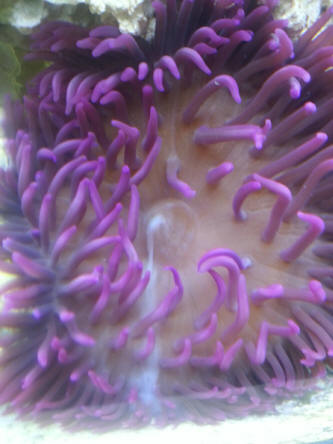
Thank you, Emily <You're welcome! -Lynn> M. doreensis (LTA) moving around 4/3/07 Hello WWM Crew, <Hello Dean. Brandon here.> I hope all is well! I have some questions regarding an LTA in my 210g tank. <Shoot.> I have had this anemone in my tank for about a year. <This is good.> Happily, he appears to be doing great. He has (IME) tripled in size (his oral disk appears to be about 12" when fully flat, and his column is about 12" when he is fully upright and extended). With that being said, he has been in very few locations in the tank over the last year. <Moving is a bad sign. Means that it is not getting something that it needs/wants.> For about 4-5 months he was in a cave with his column buried in the sand (3-4" DSB). <Hmmm. Needs light. A cave is not the right place.> Then he moved out a bit, still with his column in the sand out to the front of the tank, he had been like that for about 6 months. Over the past two months, he found a cozy place in the back corner of the tank where he seemed happy. (I suspect that he moved there as the flow is weakest there and as I understand, LTAs don't like / need a lot of flow.) <Like/Need moderate flow. Don't like to be tossed about.> Two nights ago, he decided that an adventure was in order and actually moved to the top of a section of LR and attach. Ok now I am thinking does he want more light? <Tis' possible.> (I currently have three 250W, 10,000K metal halides and the bulbs have been recently changed.) <Need more in a tank this size. I would say two more halides.> I also feed him every 2 days with small pieces of silversides or shrimp. I am a little concerned, because it bumps into 'things' (i.e. Xenia, LPS, SPS, clams, when it moves) and actually settled on a small colony of 'Waving Hand' Xenia. <This is why WWM never recommends keeping ANY Zoantharians with other livestock. The potential for disaster is very high.> I have tested my water (per Salifert kits; pH - 8.3 day / 8.1 night, Alk -10DKH, Calcium 400ppm, Nitrates, Nitrites, Ammonia, all 0, SG 1.025) Here are my questions; 1. I know that mobile anemone is an unhappy anemone, but is the amount of time between moving considered excessive? <Nope. It just didn't feel like moving. Too many factors to consider. For example, did it get bigger/more pieces of food in location x? Did it get supplemental feeding from water flow in location y?> 2. Being a LTA, and the natural behavior being to bury its column, can it injure itself attaching to rock? <Possible, but it will attach where it wants to.> 3. Is it possible that it is being underfed and it is 'hunting'? <These creatures do not "hunt" they are ambush predators that "trap" food when it is close enough.> 4. The Xenia at present seems ok, but can I expect long term damage to the colony? <No real way to tell other than waiting. I don't think that I would want this to happen again though. I would move the Anemone to a separate species tank.> Thank you in advance for your assistance. P.S. the *Amphiprion perideraion* that is being hosted would probably appreciate his house not moving anymore. <This is a possibility as well. The M. doreensis could very well be getting irritated with the A. perideraion that is living with it. Anemonefish most often do more harm than good in home aquaria. You might want to take this fish out for a while. I would still consider increasing the light, and a possible purchase of a LUX meter. This will tell you without doubt how much light the tank is getting.> Best Regards, <Good luck with this. Brandon.> --Dean Oliver LTA behavior, health, systems 2/2/06 Hi guys! wonderful site, great advice! Like many before me and very unfortunately many after me in July 2005 I made an impulse purchase, I purchased a long tentacle anemone. Everything was fine till about a month ago. Here are parts "article" I wrote for my website (to read it all www.homereefkeeping.com) it will explain my predicament: <Thank you for this> We bought an anemone in July of 2005. We got our Long Tentacle Anemone (LTA with a bright red stock) along with 2 True Percula Clownfish. The first mistake we made was not researching anemones and finding out how to care for them prior to making our purchase. Our second mistake was buying it on impulse. <Very common> It lived in its cave for a while it would expand and half went from a pale cream color to a dusky pink, the other half being sheltered from the bright metal halides stayed the pale cream color. In mid October it moved from the cave to an opening in the rock on the left hand side of the tank. It would expand to the size of a typical dinner plate. We would feed it medium/large sized (about 1/3 of a shrimp) pieces of raw, thawed shrimp every 5 days or so.. It would take the food readily, fold back on itself, and would ingest the food given. The entire anemone turned a healthy dusky pink <Yes... thank goodness energy/food provided by you through feeding... inadequate light response> Todays date is January 28, 2006 and since December (unfortunately I did not keep records, or dates) the anemone had been acting strange for the last month. It would no longer expand fully, it had become difficult to feed, would retract on itself. It hasnt completely lost its color. <Yes, bleaching...> Approximately 5 days ago the anemone fell through the rocks, for about a day it hid under the rockwork; 3 days ago it moved to the back of the tank where it has been laying on its side. I thought it had died and tried to move it only to find out that it has attached itself solidly onto one of the rocks. For the last 2 days Ive been feeding the anemone shrimp (that I put through the blender) and Mysis with a turkey baster. Heres where opinion vary; where I had read to feed the anemone large meaty chunks, on another site it said to feed it small shredded pieces of meat. After a bit of consideration and seeing what wed been through with our anemone I am most certainly starting to think that the shredded option makes a lot of sense. If you feed pieces of food that are too large the anemone cannot digest them and slowly expels the food. Thus making the anemone slowly starve, and all the while you think youve been feeding it. <Mmm, as long as the food is taken, ingested...> Well we are now Jan 31st, the anemone has gone back under rocks where I can't get to it's mouth, it inflated it's stock huge today and seemed the have some kind of line down the middle, now (4hrs later) it's slowly deflated itself. yesterday I saw its oral cavity and it was huge, much bigger than I'd ever seen it, today I can't see it so I don't know. Because it's under rocks I can't tell for the life of me if it's splitting, dying or just taking me for a ride on a nasty roller coaster (worried it's dying, then it looks "ok" then it disappears) Has anyone ever seen an anemone split? <Oh yes> How does it act before splitting? <Sometimes "out of the ordinary"... often not> what else could be wrong with it? <... a lack of light, circulation, metabolite poisoning, a dearth of biomineral, alkalinity...> I have a 65 gallon tank, 80lbs of Live sand, 120lbs of LR, a galaxy coral, a frogspawn coral, <... Oh, and allelopathy... chemical competition. These animals are problematic in the same water> 2 true Percs, a lawnmower blenny, 2 cleaner shrimp, scarlet crabs, blue legged crabs and an assortment of snails. The shrimp molt almost every 2 weeks. My water parameters are as follows : ammonia: 0, nitrite: 0 nitrate:0 phosphates:0-0.5 (gha prob...) ph: 8.0 to 8.3 depending on the time of day, temp: 79F salinity: 1.025 other than a drop in phosphates the water has been stable since it cycled in May 2005 I have a protein skimmer, 3 powerheads, a PhosBan/ROWAphos fluidizer (long cylindrical thing for active carbon and phosphate remover) up until 3 days ago had a Eheim canister filter (stopped it to see if it was the cause of high phosphates and my phosphates have dropped from 0.5 to 0) Thank you for all your help Catherine <Needs to be in a different system (w/o the Oculinid, Euphylliid) and more light... at least. Bob Fenner> LTA 12/9/05 Hi, <Hello Rhonda> My LTA has disappeared and there is no fowl smell <Did you mean smell like a chicken or "foul" smell:)> to the water and no change in any chemicals. I have a clown that was very attached to the LTA and he seems to be lost. I have had the LTA for over a year without problems. Any ideas where it could be? Also, will my clown survive without it? <It has to be in there somewhere, my guess is its under a rock. You may have to remove some of the rocks to find it. If death occurs, the results could wipe out your tank. Clownfish do not need an anemone to survive.> Thank you, Rhonda Vela <You're welcome and Happy Holidays to you. James (Salty Dog)> New Long tentacle anemone 11/23/05 Great site!, but need further clarification on this please. I have a 20 gallon tank with 110w from a power compact. I just bought a LTA yesterday, acclimated it, placed it in the tank and it isn't attaching to anything, it was attached to the tank in the pet store, I checked it's foot while in the bag and didn't see any tears, should I bury the base of the foot in the sand/fine crushed coral? <Worth trying> I want to do what is best for this little guy, 2 percula clownfish as tank mates are not bothering it from what I have seen, since I had watched it for hours last night. I just didn't know if I should dig a small hole in the sand and place its foot on the glass bottom, or just enough to where the foot is anchored down so it won't get blown around by my power head, which I have moved to create less current where the anemone is but enough where the tentacles move with the current. This morning it is still looking deflated, maybe a little bit bigger not much though, has since I got it home. I assume the base of it's foot is still sticky because it has sand covering the bottom. I have read that they prefer to be in the sand bed and not on rocks. I had a Condy that was very sticky and attached it's self to the live rock the minute I put it in the tank, <Its chemical "presence" in the tank may be at play here> I know all species are different. I had the Condy for about 5 months then I had to move myself and it didn't make it during the move. I have as of last night placed it in the sand just enough around the sides of it to hold it in place, this morning it is still in the same spot. Just need to know if I'm doing what needs to be done or if I'm just freaking out over nothing and should let the anemone do it's thing, and hope it attaches eventually and finds a place that it likes. <Hopefully. Bob Fenner> -LTA and scratching fish- First off I wanted to say thanks for all the VERY useful information you have provided all of us aquarium enthusiast over the years...Very much appreciated! <Hi there, Kevin here> My problem/concern is two fold. I have a 370 gallon tank in which most of the creatures (rock and all) have been in there or another tank for the last 3 years. <Well done!> pH is at about 8.2 as far as I can tell (old test kit) <Chuck it and get new reagents. Test kits are only good for a year.> Ammonia, Nitrite and Nitrate are all at the very low end of the spectrum ( don't remember the numbers exactly). Salinity is at 1.023 or so. I am in Colorado and have been told that at the higher altitudes I don't need the salinity as high?? <Not sure about that, but 1.023 isn't going to hurt anything.> I can't tell you what alkalinity is but I have been adding the two part B-Ionic solution regularly. <Read this and now you can! http://www.wetwebmedia.com/calcalkmar.htm If you plan on adding a calcium and alk supplement, you should understand what they do and test for both of them> Lighting is provided by 175 watt Metal Halide lamps. One concern is this: I recently added a large long tentacle anemone and it seems to be doing ok. It moved around at first but now has picked a place and is staying there. I have a tomato clown that has moved in and they seem to be getting along just fine. The problem is that the tentacles on the anemone have pretty much stayed curled since I have had it. <Nothing wrong with that, many display this curved tentacle shape.> I also noticed that at night when the lights are off, the tentacles are completely extended and its disc is more slightly upright and you can see its foot more. <In a better position to capture food and just doing it's nighttime thing.> Whereas in the day it is flattened out but with the curled tentacles. <In a better position to catch light. Pretty much every coral and anemone will display a different form from day to night.> What could be causing this? And how do I fix it? Second concern is this: All my fish inhabitants look great and have a good appetite but they will occasionally rub themselves real fast on the rock or sand. My tangs specifically will turn sideways and rub themselves on the sand. In my research I have found that fish will sometimes do that if the pH is too acidic. As far as I can tell though, it is right on??? <Usually an indicator that the fish may have the beginnings of parasitic infection. Your pH appears to be right on, but since the kit's old, it has no merit.> If you have the time, please let me know what you think. I am always concerned about giving these guys the best life they can have so please help me do that, if you would please. :) <Keep an eye out for any white specs on the fish, cloudy eyes, or a powdery glaze. I'd suggest soaking the food in garlic as an easy "herbal" type of preventative medicine. Good luck! -Kevin> Thanks again for all your help!! Kyle Anemone question Hi I need some help please , my long tentacle anemone is growing a bubble on its base. It looks like it strangled it self, but it feels hard. Could it be ill or is it splitting?. Thank you. <most likely splitting Best, Chris> Long tentacle Anenome 08/27/03 Hi My name is Adam <Hi Adam, PF with you today> I am new to this hobby, but am very impressed with your site! This is the deal, I kind of adopted a small reef tank (25Gal) from an Air force buddy of mine who had to move to a new location. It only has 1 Anenome and live rock, lots of bristle worms, red and green algae and a clown fish. Is it normal for the Anenome to just crawl inside itself. It did this about 2 hours ago. The suspense waiting for it to come back out is killing me. I know enough about salt water to check all the primary water conditions and to do make no sudden changes specific gravity changes etc. The water is perfect except for a low SG 1.020 , To correct this I have been replacing evaporated water with SG correct water 1.024 at about 1 qt per day. Is every thing Ok or Is it going to die? <Well, I closely monitor the SG situation, but you're doing the right thing by bringing it up. If the Anenome is really unhappy, it will start to wander around. Did your friend give you any feeding instructions for it? Here's an article on anenomes http://www.wetwebmedia.com/marine/inverts/cnidaria/anthozoa/anemones.htm, start your reading there. I would recommend picking up Michael Paletta's New Marine Aquarium. After reading that, and getting the concept down, I'd advise Bob's The Conscientious Marine Aquarist also. Lots and lots to learn about your new hobby and new charges. Good luck, and remember, we'll be here to help if you need it.> Long Tentacle Anemone Eviscerating? >Greetings, >>Hello. Marina today (and sorry for the delay in reply, just found this in another inbox, he's having computer troubles I think). >I am having problems with a long tentacle. First off my tank is an older Dutch 55 gal., 39 wide 16 deep 24 tall. Pump is a MagDrive 350 and two powerheads, one on each side of tank. Lighting is power compact 2x96 watt 10,000k and a blue actinic. I don't use the protein skimmer in the Dutch but purchased an Excalibur hang-on-tank skimmer. I have about 15 pounds of live rock in tank currently and about a 3/4 inch sugar fine sand bed and Greenstar polyps. SG is 1.021-1.022, pH is 8.4. I purchased a long tentacle yesterday and did not do enough research before doing so. >>Uh oh, well, at least you know your mistake. Let's see if we can rectify (although you've given no other parameters, and I don't know exactly what "older" means). >The long tentacle is white with pink base. After reading several articles I realized that when they are white they do not have any of their algae. I acclimated it for a hour prior to releasing it to tank, I put it in the corner and it started inflating and moving around the tank. This morning when I check on it, I noticed a hole near the tentacles on the back side and it seems to be puking its guts. I'm sure it's stressed. >>If you're positive these are its innards, and not just a mucous slime, then this is called evisceration, and yes, you're right, this indicates real stress. In such a situation, you must remove it immediately, or it will die and likely foul the entire tank. A small (ten gallons or so) hospital tank can be set up for observation. >What can be done to help? The tentacles are still up but not real full, the clown tries to stimulate him while swimming but his mouth still open. Should I wait and see or will this be terminal?? >>When it comes to anemones, wait and see is NOT the best approach. The clown is only stressing it more, assuming it's not attached the best course of action is to remove it. You should also line the vessel you place it into with well washed Astroturf (this is to facilitate easy removal without tearing the animal up should it recover). I believe you should also test your basic water parameters, as even trace ammonia and nitrites can be sufficient stress here. >Thank you for all your advice, Joel >>Hopefully this message isn't getting to you too late, best of luck. Marina Long tentacle Anemone problem? 1/6/03 I have not written for help in about six months. Everyone has been very helpful in the past. I have a 90 gal reef tank which was setup on 1/10/03. Lighting is 2 175w MH and 2 48" VHO actinics which are on 11 hrs per day. I have a U.V. sterilizer, protein skimmer, 2 Mag 350's with carbon changed monthly, 2 powerheads and a little giant pump for a flow of about 1600gph. There is also a heater/chiller unit. <Sounds very nice!> Water parameters are as follows: S.G.- 1.024, temp- 76F, nitrates- aprox. 2, pH.- 8.4, salinity- 34, alkalinity- 200 ppm., ammonia- 0, nitrites- 0, phosphates- 0, and ca- 400. I use LaMotte test kits for all above parameters. <All sounds appropriate.> I have 125 lbs Kaelini/Tonga rock, 11 different corals, an asst of snails, crabs and 2 starfish. Fish is as follows: 1 coral beauty, 1 flame hawkfish, 1 yellow tang, 3 beryl Anthias and pair of true perculas. The last fish was added in October 2003 and the last corals were added at thanksgiving of 2003. The end of August 2003 I added a Long tentacle anemone. It quickly found its home, and until today seemed to be doing great. It had grown to about 15" in diameter with very long tentacles that flowed easily in the water. The clownfish hid and played easily in it. All day today the anemone has shrunk to about 8" in diameter. The tentacles have shrunk with the tips being very skinny and dark green. The clownfish cannot fit in it and it seems to be very stiff as the tentacles are not waving at all. Do you think he is in trouble or could this just be part of his personality? I do not recall seeing him like this. What if anything should I be looking to as possibly causing a problem with him? <Most anemones shrink and expand fairly regularly. There are many theories on why this may be the case, but it is totally normal. The appearance you describe sounds a bit unusual, but I wouldn't worry unless this state lasts more than a few days and/or the anemone starts to "disintegrate".> As far as any changes all I can think of is I have always used instant ocean but I changed to reef crystals. I am almost done with the 200 gal pail and I was going back to the instant ocean. Could this be a problem? <I doubt it. If you had changed to a questionable brand of salt, I might suspect it, but RC is a reliable brand. If you do think of an other changes, please do write back. Best regards. Adam> Thanks for all your help
Mystery marine creature... is it safe? I have seen a very small creature sticking out of one of my live rocks. sorry I have no picture at this time I will do my best to get one if it is needed. This creature is like a very small feather looking thing that is what appears to be white in color with small black rings on it. I don't know if this is the actual creature or just what it uses to feed itself. There are a few other creatures that I'm not for sure what they are. they are small round hollow looking tubes that look to be attached to one of my live rocks. three are yellow in color, one is a blue-ish color, and the other is white. they have a lot of little hair like things that stick out the front and form a circle like a feather duster but they are too small and attached to the rock to be feather dusters. <Many, too many creatures like you described to guess. Nearly all are harmless and signs of good tank health.> Another question is how long does it take a long tentacle anemone to be comfortable in a new aquarium and is there anything I can do to speed the process. I purchased one a week ago and it seems to be very stressed. it gapes from time to time but not for long periods of time. it also swells the top of itself up and retracts it tentacles. is this normal or is there something I might need to change. by the way I have them in a 5 g aquarium for the time being the one I had broke and these are the ones that survived. for the time being I have a 50/50 bulb on them no more than 3 inches above the water behind a plastic shield (does the shield need removed or replaced with glass) a 2 stage BioWheel filter, 50 watt heater, and a 7 inch bubbler. I add a few supplements every other day. for instance iodine, calcium, strontium & molybdenum, and essential elements. Plus I have a 50 watt halogen that points toward the tank from about 2 feet from it. if there is anything you can do to help me it would be appreciated. <Your anemone does sound stressed. It is very unlikely that a 5g aquarium can be equipped to care for it. Biowheel filters are not really suitable for reef tanks as they tend to promote the accumulation of nitrate. The lighting you described is probably also not adequate for anemones (at least strong VHO required). Controlling salinity in such a small tank will be difficult as well. Please discontinue any supplements except for calcium and alkalinity (buffer). Iodine, Sr and Mb can all become toxic very quickly in such a small tank. I would recommend that you test Nitrate, Salinity and alkalinity and take steps to correct any of those that are out of range. For the well being of the anemone (and any other animals in the 5g), please replace your broken tank ASAP.> thanks Dustin sweet <Best Regards. Please do write back with any more questions. Adam> A bit of advice for an LTA Good evening! <Hello> First of all, I have to say that I love your site. It has helped me a great deal in creating my saltwater aquarium. <Thanks!> I have a few quick questions about the newest member of my tank. My tank is 55 gal, it has a protein skimmer, a power head, 25 lbs of live rock (I know I need more, but sheesh that stuff is expensive), sand substrate about 3 inches deep, 2 "false" percula clowns, yellow tale blue damsel, Hawaiian tang, 5 red-tip crabs, 15 turbo snails, and of course my new pride and joy a purplish LTA. I placed the LTA in my tank 3 days ago and my clowns are slowly starting to take to their host; however, the LTA doesn't seem to be acclimating to his environment very well. He is still "wandering" around the tank and has not 'planted' a firm spot. The LTA at least accepts food, which I hear is quite the task for most anemone enthusiasts, but mine has a great appetite, grabbing the food with his tentacles and working it into his mouth (I know you know how it works, I just fine it so fascinating!). LTA's mouth is great, no cuts or swelling and it never "gapes" open unless he is opening it to eat or excrete something. The body seems to be a "textbook" orangey-red color with no wounds. So my question is, why hasn't he found a "spot" yet? Am I just being impatient? Please any comments or suggestions you might have would be much appreciated. <I honestly wish I can give you an exact answer to why you're anemone is moving. Unfortunately, I can only guess why. First of all, Anemones will move to find a perfect environment to live in. Anemones have no central brain so they cannot adapt to an environment which is "almost" perfect. The anemone could be moving for simple reason, such as a bit too much current coming from the right, or possibly from larger reasons such as lack of lighting or improper water conditions. Overall, it's normal to have an anemone moving around in its new environment. However, if your tank does not meet the standards set by the anemone, the anemone continue moving around until it dies. In my opinion, intense lighting is one of the keys to success. Why do I say that? Because from my experience, Anemones have done the best under more intense lighting (such as Metal Halides), however, I have had several species of anemone do perfectly fine under power compacts. There's really not much you can do for the anemone except to continue feeding it. Eventually (hopefully), it should find a good area and settle down. Hope this helps. If you have any further questions, please feel free to email us back anytime. Graham Stephan.> Thanks, Jess LT Anemone Hi there! <Hi there, Nicholas!> Hope you can help us, we find your site SO helpful! <Thank you!> We recently (last Thurs.) purchased a Long-Tentacle Anemone that is a few inches in diameter at her base. She is a salmon-red color at her base with pinkish tentacles & is rather large when "open." When we put her in the salt tank, she seemed to be fine & buried herself in the sand the next day. Just yesterday we unburied her & placed her on a rock & she attached. <...bad idea. I should point out that many Long Tentacle Anemones are naturally found with their foot buried in the substrate. Removing it can be extremely stressful for the anemone.> Last night, we noticed a ball of mucous like slime (looks like its loaded with tiny brown tentacles) coming out of her side. She hasn't let go of it yet but will make it smaller at times. This morning, she was more on her side & we noticed that on the bottom of her base, she had 2 more of these masses, one is actually fairly large & had brown algae between the mass & the rock. Is this waste? Or is she slowly dying? <I can't accurately tell you what it is without seeing a picture of the anemone. However, from the way you described it, I can say that most likely this "mass" is from either from Massive amounts of stress, Lack of food (lack of nutrients), poor water conditions, or that the anemones base was torn somehow. I have a feeling that the combination of removing the anemone from the sandbed and possibly tearing its base was the cause of this. As stated above, a picture would greatly help.> Her mouth was also open wide this morning. Is she starving? We were told to feed her brine shrimp, along with liquid supplements & are now reading differently. <A gaping mouth is not a good sign -- possibly another stress factor (or lack of nutrients) is contributing to this. The Long tentacle anemone does best with meaty foods such as krill, squid, shrimp, diced fish, silversides or lancefish. I would first try the "trail-and-error" method to feeding your anemone: First try feeding one type of food at a time. If the food triggers the nematocysts (stingers located at the tip of each tentacle), the anemone will hang on to the food and pull it to its mouth. If the food does not trigger these nematocysts, the food will eventually float off the anemones tentacles with passing current. Take note of which foods the anemone does/does not accept. Feed only the foods which the anemones consumes. If you find that the anemone has "thrown up" its food within 24 hours, try feeding the food in smaller quantities.> We're so unsure! I can send photos if needed. <Yes, please send pictures of the anemones base. That would help out a lot.> Thanks so much for your help! <Take Care, Graham.> The Gilmores. Long Tentacle Anemone question 2/26/04 Hi, We bought a LTA just a few days ago, it seems to like it spot that we placed it in the aquarium. My question is that every once in a while the tentacles will turn purplish and it will curl itself up into a ball. Is it eating, are the conditions wrong for it? <I don't know, what are the conditions? High light (at least mod metal halide), moderate current and placement on sand or sand/rock interface is appropriate. Salinity should be 1.025.> I read two different books and the have a difference in water temp. one says 71 degrees another says no lower than 77 degrees. <Hmmm... 71 is way too cool. 80-82 is probably ideal.> Since the clown fish is a host to the LTA and it says the water temp should be between 77-82 degrees that is where I have it. Any input? Thank You Al <Your temp is ideal. If you are concerned about other conditions, please describe them in detail and we can go over them. Best Regards, Adam.> LTA post feeding behavior Hi Bob, <Adam here today, at your service.> I have an LTA. I have had it for a couple of weeks. My Tomatoes are very attached already and are loving it. Last night all of a sudden when the MH turned off, (The actinics then continue for one hour), decided to shrivel up 50% of his tentacles into thin horrible looking threads. I watched for 10 minutes and they returned back to normal. admittedly I just fed him a piece of fish! He looked fine for the rest of the night. <Sounds completely normal to me.> This morning he looks a bit different. His entire base is stretched out flattish like leather and his tentacles do not look fully inflated even though they are not shriveled. His colour hasn't changed. <Still sounds normal. Many anemones close and re-open after feeding or disturbance and often take a couple of days before they look "normal" again.> My nitrates are around 20, KH 14, everything else good. Any ideas? I doesn't seem right. What is the feeding regime best for an LTA? Regard, Craig. <I would try to track down the reason for the high nitrates (though 20 is not too big of a deal). I generally suggest feeding a grape sized chunk of meaty food at least a couple of times a month, but not more than a couple times a week. More feeding will lead to faster growth. Best Regards. AdamC.> - Long Tentacle Anemone Hiding - ok well I've had my LTA and he's been doing really great since the addition of a skimmer. he's been in my 25gal for 4 months with 1-96 watt quad SmartPaq (10k/460nm blue) lighting. <Would love to hear the story of how you upgraded the size of this tank...> I'm not worried about lighting being the problem but I think the schedule of when the turn off could have sent him into hiding. I recently switched my schedule form 10 hours a day to 8 because of some red slime algae I wished to cut back on. <Perhaps it is hiding because of the chemical changes brought on by the red algae... would propose you take more active steps to remove this stuff... please read here: http://www.wetwebmedia.com/algaeconMar.htm > Maybe I should have eased into this change but lesson learned. What could be the reason why this anemone has chosen to be in a dark place? <Could be reasons other that what you think.> Why do they do this?? <Most often because they aren't truly happy with the current conditions, so they move in hope of finding conditions more favorable. Would encourage you to read all the LTA articles and FAQs on WetWebMedia to get a better understanding of these animals.> thank- Adam <Cheers, J -- > - Long Tentacle Anemone Hiding, Follow-up - well it looked like I jumped the gun in thinking there was a problem. BTW it sounded like you were unhappy with the size of my tank??? <Not unhappy, per se... just would like to see you in something larger. In marine systems, stability comes with size... that is all.> the size of my tank ill have you know is not the problem. <If you say so.> but any who I forgot to mention that I had changed the position of my powerhead. my LTA was simply adjusting himself to a more comfortable spot. thanks any who <The IM language does not become you... Cheers, J -- > LT anemone following Ref. light? Hello. I've had a LTA in my tank for about three months now. He wandered a little in the first few days, but has essentially been in the same spot for the whole time. He has grown slightly larger. Last night just after the lights went out, he detached from his usual spot and floated up and over some rocks and slowly, over several hours made his way to the darkest corner of the tank. Do the prefer to move at night? <Usually not> The only thing I can think of that may be desirable about that place is that it is the closest part of that tank to the refugium. The refugium is beside and below the tank and it's light is on at night. <Ahh> Could the anemone be trying to reach this other light source. <Good speculation. This morning, he opened us as wide as his confined space would permit. He's getting very little light now. I wonder why he would look for a perch at night when he can't follow the brightest light. Will he have enough energy to find a decent spot tonight? Should I move him? <Mmm, no... but maybe you should look into better lighting> He usually accepts and closes around any food that I feed him or that falls into his grasp. Should I try to feed him? <Yes... Please read here: http://www.wetwebmedia.com/anemonefdgfaqs.htm and the LTA FAQs (linked above)> He seems to like his base covered but obviously likes strong light and flow. Since these are fairly specific demands for my small ecosystem, I wonder is moving him might be the best thing to do. <Not a good idea... please read... if the animal wants... it will move itself...> My tank is 55g. I have a 192 Watt PC fixture that is half actinic and half 10K that stays on for 14 hours. I will be moving him to a new tank with better lighting in about 6 weeks. What should I do? Thanks, Justin <Wait for the month and a half, taking care that your LTA doesn't get sucked up against an intake... switching out one or both of the actinics if you have other lamps... Bob Fenner> One last LTA question Hi Bob, I wrote you the other day concerned about my abilities to keep an LTA after surviving a horrible hair algae bloom, etc. etc.. Your final response was in regards to finding a good LTA. I ordered a beautiful purple one from Dr. Mac and Sons and it appears to be doing quite well in my tank, aside from the fact that it will not put its foot down. I aqua scaped around the LTA to keep it from being blown around and I think the foot has attached to a bit of rock now. My question is in regards to the attachment. In all my research I find that they bury the foot in the sand, but do they live happily with it attached to rock as well? <This species sometimes attaches to rock under the (apparent) sand, but is indeed found in sandy substrates, often with nothing else> Anyhow, thanks for your reassurances the other day, it definitely got me motivated. Anyhow, it's an amazing LTA. I'm sure you have seen them all, but if you want a pic I'll gladly send you one. <Please do send along if you have> Thanks again, Jeff <Bob Fenner> Long Tentacle Anemone/Not Attaching Hello WWM Crew, <Yo!> I love your website. I have and continue to learn more and more about my marine ecosystem. Thank you! I have a 120g set up with 2 perc clowns, 2 fire fish, royal Gramma, and three anemones. My Long tentacle anemone I have had for about 3 months and he has never attached himself. <Not a good indication... very likely resultant from an injury to the "foot" during extraction/collection> Occasionally he will float with the current get wedged somewhere, then in about 2 weeks do it again. He eats great (I feed them all shrimp 2-3 times a week) and appear to be good in color and activity. Should I attempt to get it to stay put in one spot. My fear is that we will bang heads (tentacles) with my bulb or magnif anemone....What should I do? <Mmm, I would try to settle the animal in a spot it is likely to adhere to... rather than risk it being blown about, perhaps on to another organism, or against a pump intake. Bob Fenner> LTA behavior okay 10/3/05 Hello! Thanks for the help with the lighting. <You're welcome> I had a quick question. I recently got an LTA about 5 days ago and it has been moving around the tank a little bit but it keeps going over to a piece of my live rock and turning on its side and putting its tentacles in it. Is this behavior normal? Should I be concerned it really hasn't found a spot yet? Again thank you for your help. <Should have found a "home" by now but wait a few more days, see what happens. Google search "LTA" on the wet web media for FAQ's of a similar nature. James (Salty Dog)> LTA deflated Tentacles / Cyano Problems 11/7/05 Good Afternoon, I have a couple of questions regarding my 55g reef. I believe I may have a problem with my tank as I am experiencing some Cyano problems. Currently my water parameters are as follows: Salinity 1.026 pH 8.2 Ammonia .5 -1 <Trouble> Nitrite 0 Nitrate 0 Phosphate 0 KH 10 My anemone will open it's mouth everyday expelling a slimy substance and it's tentacles are deflated. <A good clue... something is amiss> It seems to almost flip inside out almost everyday. I know an anemone in general is hard to keep, but it was fine for the first two months with the water chemistry not changing much. My maxima clam and pipe organs are doing just fine though. Everything else in the tank is fine except a yellow tang that has died recently from unknown causes, my best guess is starvation as the seaweed I've been trying to feed her is getting taken away by my Clarkii clown. I actually only have about 25lbs of live rock and 15lbs what was sold as live rock but seemed like base rock. So if I count them, it'll be 40lbs which is probably too little for a reef tank. <Is fine for this size, shape, type system> I also have about 30lbs of Lava Rock <This may be problematical... I would at least have the water tested for iron content> I hope will eventually become "live." Should I buy more live rock? <Would help, yes> And if so, where can I purchase it at your site? <Mmm, we don't sell anything (other than the books, pix we produce...)> Here is my tank set up. Standard 55 gallon 80lb live sand 260w power compacts with 130w 10,000k and 130w actinic Tidepool I Mag Drive 7 AquaC Urchin with Maxijet And its inhabitants: 2 Damsels Clarkii Clownfish Fire Shrimp 3 peppermint shrimps 2 conch 1 brittle star 15 blue leg hermits 10 red leg hermits 15 Astrea snails 2 emerald crabs bubble coral Maxima Clam Pipe Organ LTA Rusty gorgonian Various feather dusters Thanks for all your help! <I would keep an eye on the anemone, be ready to siphon/vac it out if/when it dies... something is awry in your system chemically... I would remove the lava rock precautionarily (is this a word?), <<Not that I can find (other than a specific use in translated online Islamic texts), but we get your meaning. Marina>> and look |
|

|
Features: |
|
| Featured Sponsors: |