FAQs on Marine Water Quality involving Nitrites 3
Related Articles:
Nitrite, Ammonia,
Nitrates, Establishing Cycling, BioFiltration,
Phosphate, Silicates, Phosphate,
Related FAQs: Nitrites 1, Nitrites 2, & FAQs on Nitrite: Importance, Science,
Measure, Sources, Control, Chemical
Filtrants, Troubleshooting/Fixing
& Nitrates, Ammonia, Phosphate, Silicates, Chemical Filtrants, Some fishes, non-fishes are far more sensitive to
nitrite poisoning...
|
|
Stubborn Nitrites... Another case of zip [HPO4]
5/8/17
Hello Crew! Thank you for all of the advice over the years. Your site
has been an invaluable resource.
<Ah, good>
I'm having a problem with stubbornly high Nitrites after (during?) a
cycle for a quarantine tank and I'm out of ideas.
<Well; quarantine systems tend to be unstable, disallowing establishment
and ready metabolism of beneficial microbe populations... Do you have
sufficient biomedia, circulation about it to sponsor nitrification?>
QT is 20g, HOB BioWheel filter with bagged carbon and GFO
(there was a Phosphate issue from uncured dry rock in the display tank).
<Is there still "some" soluble phosphate present? You NEED some
for microbial conversion of Nitrite to Nitrate... Re-read that last
statement>
Also has a small skimmer as I intend to follow the mantra "Quarantine
everything, corals and all" with this new display tank (150g). QT is
bare bottom except for some pieces of pvc for hiding spots and tests at
0 Ammonia, 20 Nitrates, 2 Nitrites, 0 Po4,
<Bingo: Here's at least part of the problem. Remove most/all of the GFO>
480Ca, 9dkh, and 1250mg.
We use water from the display tank for water changes (was an attempt to
seed, but also a way of acclimating the critters to heir eventual
conditions. Currently the only inhabitants are 3 Scarlet Reef hermits.
Nitrates are coming down (artificially high from early on when the both
tanks were showing 100+ Nitrates.... DT now shows zero after water
changes and a little impatient Vinegar dosing).
<Won't help>
What is NOT moving however are the Nitrites. They've been floating
between 2-3 for weeks. The QT has been running for almost 2 months and
they just won't come down. I've tried everything. I've even added
SeaChem stability to the area behind the Filter wheel in an effort to
directly add <sic, aid?> the bacteria necessary. It just won't come down
(but isn't going up either). We are doing water changes, but only @10%
weekly. I know that a
bare bottom tank takes longer to cycle, but this just seems absurd. I
would have expected a spike and then drop over a longer time. Not a
constant 2-3ppm with no movement. The kit is Salifert, brand new, and
tests fine at 0ppm on the DT as well. I'm completely out of ideas. Any
thoughts? I know Nitrites are not as bad for marine organisms, but I'm
not relishing the thought of subjecting a really cool frag to Nitrites
just because I can't get this thing to fully cycle.
<Your situation is very commonly misunderstood. "Some" phosphate
is absolutely necessary to all life... part of DNA, RNA,
Phospholipids in every cell... ADP, ATP energy transfer molecules... AND
conversion of NO2 to NO3... The (over) use of chemical filtrants has
killed more livestock than pathogenic disease. Remove the rust and you
will find your nitrite gone in short order>
Thanks again!!
~Frank
<Glad to help Frank. Bob Fenner>
Re: Stubborn Nitrites 5/17/17
Hi Bob!
<Hey Frank!>
Thanks for the help. Rust is out of the quarantine tank (Still have it
in the DT as I believe the dry rock that was uncured is leaching
phosphate into that system and I’m showing near perfect water parameters
there so not too worried about it … unless you think I should be).
<As long as there is "some" HPO4>
I’m still reading no PO4 in the quarantine a week after removing the GFO
and the Nitrites are still up at 4. Nitrates, however, have spiked
dramatically. 100 or so was the last reading.
<Yikes; change water... daily>
Tell me if I’m wrong here, but with the spike in Nitrates, I’m thinking
that something is definitely converting the Nitrites but the population
just isn’t large enough to consume all of it.
<Yes>
The skimmer on the QT is weak but pulling out some gunk (not dark green,
but still tan). The only source of ammonia is the 3 hermits plus
whatever food they don’t eat. We don’t feed very much at all and ammonia
is still at 0. Is this just a “more patience required” issue or am I
missing something else?
<Can't tell from the data available>
I am about halfway to throwing a small sponge filter in the sump of the
main tank for about two weeks before popping it into the QT in case this
doesn’t come down.
<Oh, good idea>
Thought it might help now and in the future. I don’t really think I’m
going to attack the Nitrate issue until I’ve dealt with the Nitrites
because they’ll just come back.
In answer to your question about bio media/flow, there’s a small Hydor
powerhead in the QT and the HOB BioWheel style of filter so I can’t
imagine there isn’t enough flow/media. I am still running carbon in the
back of that filter but will remove if you think that’s causing an
issue.
<If it's old... more than a few days... I'd leave it>
We do have a small diatom bloom going on in the QT right now that
happened after the GFO was removed. I suppose it’s possible that they’re
consuming all of the PO4 and that’s why it’s showing undetectable. Have
turned out the lights temporarily to see if starving them leads to an
increase in PO4 and a drop in the muddy river look. We had a diatom
bloom earlier which I dealt with through water changes and killing the
lights, but I assumed that was from using diatom infused water from the
DT that was a green/brown soup at the time (crystal clear now).
Not entirely sure all of that was relevant to this problem, but thought
more information might help determine the causes/solutions. Thoughts?
<Keep your beer in cool, dark places>
~Frank
<BobF>
Nitrites after feeding 11/9/14
Hi. I currently have a 5x2ft tank that's been running for over a year now.
It's is housing a 1 inch porcupine puffer, 2.5 inch Foxface, a tiny blue tang
and a lawnmower blenny. Everyone gets along fine and I carry out 20-25% weekly
water changes. I feed the puffer every second day and others are fed daily.
<What sorts of foods?>
After feeding I notice a small increase in nitrites. Around 0.15 with the API
test kit. It will then decrease back to 0 by the next day. I have two other
tanks and this doesn't seem too happen.
Is this something to worry about? Is it only caused by over feeding?
<Mmm; well; likely either insufficient filtration/circulation, OR a deficient
test kit. I'd try another brand of the latter... But do please write back re
spec's for your gear. Bob Fenner>
Re: Nitrites after feeding 11/12/14
i bob, thanks for your quick reply.
I feed the puffer prawns and squid, alternating with feeds.
<Umm, no bueno. DO read on WWM re these foods, the nutrition of Puffers.
Too much chance of Thiaminase issues>
And the others receive a small amount of seaweed extreme pellets and brine
shrimp/seafood mixture I blend myself.
I have a 3x1.5ft sump. It has filter pads, bio balls, ceramic noodles and
matrix.
<How much of this last? Can't be too much... any space to add a DSB of size?>
I am also running a large Aqua one protein skimmer. Tank would have approx 25-30
kg.s of live rock.
After receiving your previous email I upgraded my sump pump as I realised it was
too small for the aquarium size. It resolved my problem immediately.
<Ahh!>
Thanks for your help. If you have any more information to give me about the way
I am running my system regarding filtration or anything else. I will definitely
take it into consideration.
Thanks. Tim.
<The Thiaminase, puffer reading... Cheers, Bob Fenner>
Re: Nitrites 9/21/14
Got It
I totally understand. Honestly, I'm brand new to this site, and hadn't
really looked around before emailing you.......my bad.
<Hotay!>
I've just spent several hours reading posts and responses, and I get it.
I'm still thinking that at this point, having had large biotowers built
and installed, it's simpler to just use the bioballs on the fish-only
systems rather than convert them to a refugium with a dsb.
<Up to you>
Water goes through a prefilter before it hits the bioballs, and these
systems get a 25% water change every month anyway.
<I'd change this amount weekly>
As far as my coral tanks go, I have 90 gallon tubs filled with live rock
under the four 90 gallon systems, and I'm going to install lights over
these tubs, and intend on adding macro algae to them as well.
Enjoy your time in Bali, and I'll let you be.
<Am just back... and bushed>
Thanks so much for your input. I'll try to research a topic more before
bothering you in the future.
<Not a bother Rob>
Rob
Seascapes
<Cheers, Bob Fenner>
urgent help... Killing marines through NO2 poisoning...
8/18/14
Hey Bob-
<Robert>
Since speaking to you a few weeks ago, I think I have had my worst time with
fish keeping. Since restarting my tank using bacteria (I attempted to
treat fish in 100 gallon trough), I have lost 16 of 19 fish.
<?!>
Last night I had 6 fish, however, sometime during the overnight, I lost a 7 inch
orange shoulder tang, 4 inch desjardini sailfin tang, as well as a fire clown
fish.
I immediately measured water quality (1.023 sg, 82 degrees Fahrenheit, 0 AMM,
5 nitrites
<NitrItes? Incredibly high... WHY are you placing fishes in an uncycled system?>
) I understand the nitrites are high, but they have been high since I restarted
the tank after putting fish in it. On Friday I did a 50 gallon water change,
(1/3 water volume) and added more stability bacteria.
Do you believe in fact the elevated nitrites are what is killing these
fish?
<.... Robert; are you joking? IF so, this is NOT funny>
Upon inspection of fish prior to last night, I noticed a string, white substance
attached to the orange shoulder tang, as well as the clownfish.
The orange should also had blotches on him, it was not ich.
My lfs, upon similar description I am giving you, thinks its bacterial, and I
should use formalin or quick cure. If it is nitrites, I know letting it run will
eventually bring it down. If it is bacterial, when tank does cycle out,
when does one know it is safe to add fish?
<.... ? Disappointing. LEARN TO USE WWM>
Also, if bacterial, will flipping on uv light help any? I have left it off in
effort to help speed cycle tank, but I also understand where there is good
bacteria growing, there could also be bad bacteria.
I am beginning to think I had way to many fish in a tank before, and that was
the root of my issues. Going forward, if there is a such thing, I may just opt
for less fish, more of the eye catching fish. Eel, lionfish, etc.
Thanks
<Read here:
http://wetwebmedia.com/marcyctrbfx2.htm
and the linked files above. Yes; all of them. Bob Fenner>
RE: urgent help 8/18/14
Bob,
Well, no this is not a joke. I attempted a quarantine/hospital environment, and
failed miserably keeping ammonia manageable. I simply had to
<too>
many fish. I attempted to eradicate the ich, restarting the tank. I felt, at the
time, by best interest was to get the bigger body of water (my tank) up and
running, use as much bacteria as I possibly could, and get them back in there
tank. This was not by design. I would never advocate doing this, but given I had
no where else to go with them, I had to do what I thought was right. My lfs
would NOT take them in, and I do not know anyone well enough in my area to spare
my fish.
With that said, and again, I know it sucked, and wasn't ideal whatsoever, moving
forward, do these symptoms sound like velvet, brook, etc, or is that simply the
byproduct of high nitrites? (again no ammonia) For what its worth, and maybe
this is incorrect, according to an article by Randy Holmes Farley, nitrites in
saltwater are not nearly as toxic as freshwater, and some fish can live
in nitrites in the 100's.
<Not NitrItes; NitrAtes. KEEP READING>
My dilemma, or oncoming dilemma, is, is this a disease, that needs to be treated
again, or something that needs time to cycle out and stabilize.
The highest ammonia level I have seen, measuring once per day the last two
weeks, was .5, and it lasted 3 days, in which all of the remaining fish lived
thru. Again, I know I screwed up horrible, should have let the fish and the ich
be, and not attempt to keep that many fish in an uncycled environment. Moving
forward, how do I know if right now I am dealing disease or new tank syndrome?
Thanks
Part two: Transient NO2; SW; tied in with gravel vacuuming
7/9/14
In the past I have written to you about a small nitrite reading in my
mature fish only system. The tank had been running for ten years
or so, and I seemed to get a .5 reading.
<Strange... and you've checked the test kit>
I did as you suggested, water change, not feed until reading came down ,
but surely the next time I checked there would be nitrite.
This has been going on for 6 months or so. I finally stumbled on what
may be my issue, could be a coincidence as well. I perform all water
checks and tests a few hours following a water change. This is when I
would see nitrite. 20 percent change, or 50 percent water change to
remove nitrate., it didn't matter I would test positive for nitrite. I
then started testing water in between changes. As I do them every 7 to
10 days. So let's say I would test after 3 days post water change.
I would test zero.
<Ahh!>
My guess is, by siphoning my sugar fine sand, and moving it around
through vacuuming, I was disturbing bacteria, and creating a nitrite
spike. Is this possible?
<Oh yes>
I always thought it was good to vacuum fine sand, even when it looked
not needed.
Is this typical?
<Not greatly unusual>
And if so, should I halt the siphoning, and just rely on power heads to
keep debris and detritus off the bottom? Thanks bob,
<My usual suggestion to only do "one side" vacuuming per period... the
other half next time>
Robert
<BobF>
nitrate question; SW; rdg.
1/29/14
Hi again, Bob. I had another question which I felt was better not
crammed into my shark question. Given the set-up I have, 155
bow, 50 gal sump, mtc protein skimmer, two return pumps
providing nearly 1400 gallons an hour combined. 80 lbs total live rock,
in display and in sump, siphon cleaning sand every two weeks, weekly 15
percent water changes, what next gradual step should I do to eliminate
nitrates.
<Not likely to eliminate, but help reduce/control... there are a few
possible avenues... avoidance by stocking, feeding... absorption,
export, denitrification... all gone over on WWM. Use the search tool or
indices>
I have an API test that shows 40, and another test that shows 20. I do
get 80 readings from time to time, but after retesting, it shows 40
(looking into getting the most accurate, consistent test, if one does
exist to the home aquarist)
<Check what these kits are actually measuring... some do "Nitrogen as
Nitrate"... rather than [NO3] itself>
The sump has two sections, a trickle down part, with bio balls, <Part of
your/the induced problem. See WWM re this media... change it out for
something else>
where the in sump protein skimmer exists (water is pushed in protein
skimmer, via return pump) and then the return section. The only
mechanical filtration is tank are the two sponges (socks)
<These need to be cleaned/switched out for pre-cleaned daily>
in the over flows (one in each over flow) as well as a block pad that sits
in between the sump divider. (water has to run through it in order to
make it to the return section. (I clean these weekly
<Need to be done every day>
during water changes with seawater to maintain bacterial colonies.) My
skimmer is always on, and produces maybe a cup a week.
I do not really have the space for a refugium, and was told by various
lfs owners that Chaeto would not solve my problem.
<Could help though... this and/or Ogo/Gracilaria would be my choice/s>
Should I start with some sort of carbon source?
<Not likely helpful in the long/er term>
I also read vodka dosing is risky, and also not a long term solution to
my issue. They also market a block that is 8x4x4, that supposed to be
good for growing the denitrifying bacteria to rid nitrates. Any word on
these?
<Can help IF your issue is carbon limitation>
As far as detritus is concerned, about 6 weeks ago I swapped out my
crushed coral, which was nearly ten years old, for sugar sand in
anticipation of the marbled cat.
<A good move for sure>
To prevent detritus from entering the water column, I removed all the
fish I had at the time into a garbage can, with 50 gallons of seawater
from tank, along with live rock. Once they were out, I drained out 100
gallons of tank into drain, till there was nothing left in tank. I then
used clean seawater to wipe clean tank of debris. I placed new sand in,
and added 100
gallons of new water (water I would normally do a water change with,
temp was spot on, salinity etc) added fish and live rock in, and finally
the 50 gallons that was holding the fish. I also siphoned out debris in
overflows as well as the little detritus that was in sump. Whole process
took me about two hours. as I wished to maintain bacteria in sump, pumps
etc as
much as possible.
<Sounds/reads great>
So there is little to know detritus in tank now that I would think could
fuel nitrates. I do not think my situation is a problem, it is well
maintained, however in the long run I wish to lower them as possible.
Thank you, Bob
<Try the reading for a bit; keep good notes, and we'll
be chatting. Bob Fenner>
bio balls follow up 1/29/14
Hi bob. I agree 100 percent with what you said about the bio balls
possibly being a factor in my nitrates. However, the sump I have, which
was custom built folwr by MTC (marine technical concepts) is completely
sealed, with no access to them. I suppose the only way would be to cut
the sump open itself (not sure if that ever is a good idea)
<Up to you; denitrifying media can/could be placed downstream...>
With that said, are they that detrimental, that a new sump should be in
the works?
<Depends... as nitrate is produced; is that an issue?>
I can tell you when I observe the bio balls with a flash light, they are
as blue as they were the day they went in there, with no build up of
detritus. There is no pad above the balls, so the flow that goes to them
is heavy water, which according to MTC, helps prevent dirt from settling
on them. Detritus does build from time to time, but it is under the bio
balls after already falling through them. What do you think?
Respectfully, Bob
<... Posted. B>
help needed; Formerly nitrate question; SW; rdg.
1/29/14 Now, NO2 poisoning... 1/30/14
Hey Bob, its bob again. Yesterday was the day from hell, I had
mentioned the new lionfish has passed the night before, which
was in my tank for four days, and never ate. Chalked it up to stress,
non-eating specimen. Coming home from work that night, I noticed
my grouper, who was eating krill like a champ, dead under the rock. Upon
observation, he had no signs of fighting on him, and you can
tell he had some girth to him and he was a strong feeder. Later
that evening, my rainbow wrasse, was laying on side, occasionally
flapping his tail. Didn't think anything of it, because I know
wrasses like to perch and lay, but a day later, and he is still in same
position, with minimal movement.
Had my parameters checked again last night, no ammonia, trace amount of
nitrates, where my trusted lfs said he believed that would not kill a
fish.
Nitrates between 20-40.
<...?! What is your dissolved oxygen here. ONE last time: CHANGE
WATER. Add aeration, slightly depress (a thousandth or two) spec. grav.
DO add activated carbon or such product (Chemi-pure e.g.)>
What step should I take from here. All other fish are doing really well,
eating, no signs of distress other than my rainbow wrasse flapping under
a rock. My lfs said to dose copper in there, seeming to believe it is a
parasite.
I have not done anything yet. Could it be flukes that killed the
grouper and killing the wrasse? (maybe that is wrasse behavior,
not sure)I purchased some SeaChem stability last night because of the
small spike in nitrite, but have not used it. Could it help/hurt?
<Not at all likely. B>
Thanks
RE: help needed 1/30/14
never measured dissolved oxygen before.
<See WWM re DO>
I have two return pumps running at combined 1500 gallons an hour. I did a
15 percent water change Tuesday night, I can do another if you recommend
tomorrow.
As far as trace nitrates, I meant trace nitrites. Less than .5. And
through no implication, do not add copper correct?
<I would definitely not>
puzzled fish loss... Ongoing... NO2, 3 f's
1/31/14
Hey bob. As I said two days ago, I lost a new lion fish, (believed to be
stressed, small and not eating) and lost a 3 inch miniatus grouper two
days ago as well. Was eating like a horse, then dead. My gf, who felt
bad, took it upon herself to get me a 1.5 inch miniatus grouper as well
as a medium 4 inch lion fish yesterday. The grouper died within hours, I
did not see it,
but my mom said the trigger (humu) chased him non stop until he
was dead.
<... likely>
I came home and removed him, and you can see physical wounds. Too small
for tank, my gf did not know any better, was trying to be nice.
Today as I was observing the tank, the bigger lion, who went from
swimming around one minute, to literally upside down within 5 minutes of
me seeing him swim.
I checked the parameters again, and everything was fine, with
exception of .25 nitrites.
<? Toxic. Why would anyone add to this trouble?>
That is four fish lost (rainbow wrasse is still laying on bottom
flapping occasionally) I told all members of the household no more fish,
or replacement of fish till we find out what is happening.
<Yay>
My other fish, sohal tang, clown tang, spiny puffer (burr fish),
humu trigger and marbled cat shark are all fine. I have made the
decision to remove the sohal, and trigger tomorrow and return them to my
lfs. I believe the grouper was killed by trigger, and also believe sohal
chasing everything is adding stress.
<I agree>
I will wait at least a month before adding anything at all. Question is,
are these mystery deaths just fish not meant to be, or do you believe
there is a parasite lurking in the water. I would have thought if it
were a parasite, all fish would have been affected.
I am really puzzled, and my lfs shrugs his shoulders when I tell him. I
know I can not use copper with presence of shark. I did add some carbon
matrix to sump, as well as pulling some water from tank and replaced
with r/o water to lower salinity. Which is now a 1.24 from a 1.26.
<... missing a zero>
What else can I check for? I did do a 10 percent water change this
morning.
Really struggling and frustrated.
Thanks in advance.
<ORP, TBC. B>
RE: puzzled fish loss 2/1/14
ORP oxidation reduction potential. I know what it stands for but don't
know anything about it in relative terms to my tank. Or what that means
going forward.
<... use the search tool... found on every of the 14 plus k pages on
WWM>
As far as the .25 nitrites, that is what they tested today after the
dead fish were removed from aquarium. They were checked daily the passed
month, and did not see any spike in that nor ammonia. I would not
blatantly add fish to my tank with toxic byproducts.
And what is TBC? To be checked? not familiar with that acronym.
<Total bacteria count... A very interesting proposition with aquariums:
Just how much role does a given concentration of "bacterial
population/s" play in determining, influencing livestock health in our
systems? Their metabolites, analogs... just the bit they add as BOD? I
have oft-wondered if microbial content period was important in such
cases as yours... Oh, and this measure and CBC are often gen. measures
of potable water quality>
Lastly I wanted to ask you, at night when the lights go down, (I lower
led lights to 0 white light, 5 percent blue light for an hour, then
totally off) my shark over the past few nights is starting to show more
of himself.
<Ah good>
Is now the time to stick feed, since is barely visible during the day?
Part of me says if he's hungry he will come out, the other part of me
says I need to be proactive.
<Not until there's no detectable nitrite>
And yes, I did forget the 0. it is now a 1.024 sg.
Thanks, Bob
<Welcome. B>
RE: puzzled fish loss... NO2, 3 2/2/14
Will certainly look into that.
<Oh yeah; reading>
I received this email this morning, so last night the shark actually
came out and was swimming around the live rock. I tried stick feeding a
silver slide, which he ignored, but then I tried a piece of cut scallop,
and he nibbled on it a bit. I then turned the room light off and walked
away.
After reading what you just said about waiting for nitrites to go away,
I will do so now and wait till its 0. I decided to keep feeding minimal
until it clears out to play it safe.
Also, I will search the WWM site again, but do you have an opinion on
the MTC HSA 250 Becket style protein skimmer? I am not getting much
skimmate at all weekly, maybe a cup or so, and my lfs said he had those
skimmers before on his display and reef tanks, and threw them out. He
said I should look into getting a reef octopus. Any thought?
Thanks
<See WWM re skimmer selection (FAQs)>
|
Ammonia Cycling Problem 8/31/13
Dearest Crew,
<Hey Joe (where you going w/ that fish net in your hand.... JimiH)>
Thanks again for the wonderful service that you provide!
<A pleasure>
I'm having a problem cycling my new 155 in-wall reef tank. I
have been using Dr. Tim's nitrifying bacteria and have
attempted to contact them without luck.
<Mmm, knew Tim Hovanec in college (SDSU); and seen several times since he
joined the industry years back... He's usually diligent. I'd try again;
but, let's see what you have here>
I've followed the manufacturers directions by adding the bacteria
followed by the ammonia chloride. I've been keeping my ammonia
at about 2ppm but have had my nitrites skyrocket. The test kit
goes to 5ppm (API) but it seems that the color is at or above this. I
have been doing 15% water changes (more challenging in the new tank then
in my old 54 gallon!) but the levels do not seem to be dropping.
<I'd stop the water changes... likely this is not helping... indeed
maybe sub-tending the completion of cycling.>
I'm confused as to what steps I should take to correct the problem. Should
I continue keeping ammonia at above 2ppm or continue water changes to
get the nitrites down?
<I'd also stop w/ the addition of ammonium chloride... AND add "a pinch"
of dried/flake food, or pellets; even a stinky shrimp (yes; cocktail
type) to offer an ammonia and more source>
The cycling started about 2 1/2 weeks ago and the manufacturer claimed
that it should be completed in less then a week.
<... sometimes takes longer>
Lastly, the tank is has about 100 lbs dry rock and about 15 lbslive
rock.
I'm currently running the skimmer.
<Again; to review: Stop changing water, adding NH4Cl, add an organic
source of carbon/amino acids. Got it? Oh, and the universal (and oh so
challenging at times) ingredient, patience. Cheers, Bob Fenner>
Very confused here.
Thanks!!!
Joe W.
Wichita, KS
Re: Ammonia Cycling Problem 8/31/13
Thank you Bob,
<Welcome Joe>
Always a pleasure to chat with you. You don't know how many times I've
had the Hendrix comment made to me! Luckily that's one of my favorite
tunes!
<Ahh! People think Hendrix was talented with a guitar, playing it inverted
and all; they've not seen me w/ a siphon!>
I was under the impression that the high nitrites were poisoning that
necessary bacteria and must be lowered. I'll go ahead and add the
cocktail shrimp and halt on the water changes.
<The high [NO2] will abate on/of its own... Think it might not serve to
elaborate more here; I assure you, the simple changes, addition
mentioned will "do the trick" here>
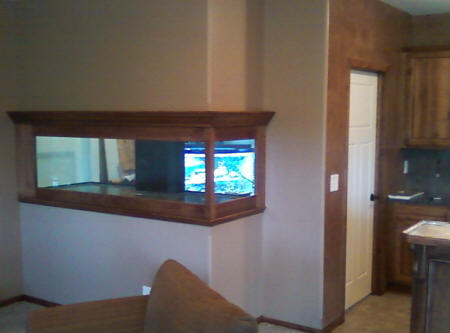
I've attached a photo of the tank before it was filled with water. The
contractor really did a nice job with the exterior.
<Ah, very nice; yes. I especially like/d the wood trim as I downloaded the
pic>
Thanks!
Joe W.
<Again, welcome. BobF>
|
 |
Fwd:
WWM query mentioning you 8/31/13
Thanks Bob for the referral.
<Ah, welcome Tim>
Dear Joe:
Not sure how you tried to contact us as we have no record of a phone call or
email.
In any case you did not follow the directions we have on the website.
You are not suppose to 'keep" your ammonia at 2 ppm =- that is too much
ammonia which has resulted in the high nitrite level.
You need to do a water change asap and get the nitrite down. The
faster you get the nitrite down the faster the system will cycle.
Once you get the nitrite down you need to add ammonia and wait 24
hours before measuring. Measure and if ammonia and nitrite below 0.1
then add some more ammonia. Do not add more if either it above 3-2 ppm
wait another 24 hours.
<Cheers, B>
Re: Fwd: WWM query mentioning you
9/1/13
Thank you so much Bob,
<Ah, welcome Joe. It is my practice to "cc" all that are mentioned in
conversations; to elicit their personal input if possible>
Very kind of you! Have a relaxing Labor day holiday!
<Ahh, very enjoyable. You as well. BobF> |
nitrite help
2/6/12
Hello,
My tank has been established for a few months
now
<... evidently not>
but all of the sudden the past few days I have been getting a nitrite
reading that is a little high, between .75 and
1.25. I did a water change of about 15% less than a week
ago. Should I be concerned?
<Yes; toxic, debilitating>
If so should I change the water again or should I just wait a few
more days and leave everything alone?
<... Quit feeding, start reading... is this freshwater or marine?
Let's assume FW: http://www.wetwebmedia.com/FWSubWebIndex/NO2ContrF.htm
and the linked files above. Bob Fenner>
Thanks,
Erik
Re Nitrite help... SW 2/8/12
Hello,
<Hello Erik>
Sorry I didn't specify. I have a 30 gallon salt water
tank. About 30lbs LR, 30lbs LS, a few fish and some
inverts. I read what I could on Wet web I think said I should try
not feeding for a few days and doing a water change. Is this
correct?
<Did you do an ammonia test? It's possible your nitrite
test kit could be giving you a false reading.
Might want to take a water sample to your dealer and compare his test
results.
My tank has been established for a few months now but all of the sudden
the past few days I have been getting a nitrite reading that is a
little high, between .75 and 1.25. I did a water change of about
15% less than a week ago. Should I be concerned?
<Yes, as above compare readings with your dealer. Anything
over 0.2ppm is not good.
If so should I change the water again or should I just wait a few more
days and leave everything alone?
<I'd wait until you verify that your reading is correct.
If so, I would not feed for a day or two and do
a 20% water change and retest the following day.
Overstocking can lead to high nitrite readings. You did not state your
inhabitants and their size, a "few fish" doesn't tell me
much.>
Thanks,
<You're welcome. James (Salty Dog)>
Erik
Re: nitrite help 2/9/12
Thanks for your help and quick response. I didn't feed for a
day and my nitrate <nitrIte> seems to be back to 0. I am
going to retest tomorrow and test my water at my LFS.
Thanks again
guys,
Erik
<Welcome, BobF>
Extreme nitrites no matter what
(RMF?)<<>> 5/20/11
Hi guys, I started a 10 gallon QT tank and have a hang on power filter
with a fiber square that is to hold the biological stuff. I started out
by put<ting> the filter in the sump of my 220 gallon cycled tank.
After a week I put it back into the QT power filter. I was not around
to feed any ammonia to the QT for 6 days and had nitrites off the
charts high, like 50ppm.
<Seriously? What do you have in there, an alligator?><<Not
possible... summat is off here... Either the test kit is for Nitrate or
N2 as NO3... or it's reagents are bad... or... Reality: go try
another NO2 kit and/or known sample (distilled) with the present
one>>
I started feeding the tank with 3 ppm ammonia each day and in 4 hours
the ammonia was non-existent and the nitrites still off the charts.
<How's about scaling things RIGHT back. Give the aquarium a
complete water change. Rinse of the biological media in some of that
aquarium water. Then, stop with the ammonia -- my guess is you're
adding too much -- and instead just add a pinch of flake food: 2-3
flakes 5 mm square would be ample,
i.e., about as much as you'd add for a couple small fishes. Then
repeat this daily. Do 20-25% water changes every couple days.>
Three more weeks have gone by feeding ammonia every day
<<How much and in what format? Methinks this system has been, is
being poisoned by over addition>> and two 50% water changes from
my display tank and yet nitrites still off the charts even right after
WC. For the last three days I have done 90% water changes each day and
get the nitrites done to 5ppm but it goes right back up into the red
zone off the charts. I am using SeaChem's tests and the highest
reading is a medium pink but I end up with almost red. I tried feeding
triple dose of ammonia
<<Again... w/ what? Industrial/cleaning NH4OH? At what
concentration? Try diluting same and reading what you get on your test
for ammonia>>
and its gone in 8 hours but still no nitrates, or none that can
be detected because testing is done with the same nitrite test results.
the tank has nothing but a airstone in it and that's only been for
the last week. Can you tell me what I can do to finish cycling this
tank? The water parameters are 80*, 8.3 PH, 11 dKH, Ammonia 0, Nitrite
approx. 40-50ppm, Nitrate 0. Its been a little over 4 weeks since
starting with filter from my display tank which has Ammonia 0, Nitrites
0 and Nitrates 1. Thanks Randy
<Do as stated above. You should find after a few days ammonia will
rise to about 1-2 mg/l, and then drop down. Nitrite will follow, and
both should reach zero within 3-6 weeks depending on the situation, and
at that point, you should be able to add a few hardy fish. Allow the
tank a good 8-12 weeks to settle in before substantially raising the
fish population or adding delicate species such as Neons. Cheers,
Neale.>
<<I agree w/ Neale. You need to dilute (through massive water
change/s) the current amount of NO2... down to a few ppm... it's
otherwise forestalling through poisoning, the useful microbes that
allow conversion to NO3. Bob Fenner>>
Re: Extreme nitrites no matter what (RMF?) 5/20/11
The tank never had anything in it, I bought it new, cleaned it and
filled it with my display tank water, that's it! . I presumed that
the bio filter pad got loaded with bacteria when I had it in my sump
and that the high nitrites came from that bacteria dying off due to the
fact that I had not fed it any ammonia for 6 days.
<Hmm'¦ no. Dying bacteria at this sort of population size
should have minimal impact. In fact, in the absence of ammonia the
nitrifying bacteria are more likely to go dormant than to die.>
When I started feeding it I did use food pellets but since that seem to
make no change
<It takes a few days for saprotrophic bacteria to start the decay
process, i.e., from flake food to ammonia. But it will, must
happen.>
I then started using bottled 10% ammonia
<<This is VERY concentrated relative to what aquatic life
produces... only takes part of a drop per ten or more gallons to start,
sustain nitrification. B>>
without colors or soaps. Its just yesterday that I put more
triple ammonia dose in to try to shock it to make a change and it just
ate it up quickly, lol. Thanks, Randy
<I would not be using any sort of household ammonia for now. Unless
you know what you're doing, it's easy to produce all sorts of
craziness. Almost by definition, a pinch of flake will produce about
the same amount of ammonia whether it goes through fish or saprotrophic
bacteria. So while it's an old school approach, the flake feeding
method of cycling tanks is at least logical and effective. Do also
review whether the filter is adequate to the tank, whether you're
maintaining filter media appropriately, and whether anything added to
the tank or used for cleaning might be killing the bacteria. Cheers,
Neale.>
<<It assuredly is>>
Re: More : re: Extreme nitrites no matter what (RMF?)
5/20/11
I just took the whole quarantine tank apart and cleaned it, now it back
up and running. No ammonia, no nitrites and the 1ppm nitrate due to the
water coming from my display tank. The walls of the glass had a coating
of slime all over which turned white when I cleaned the tank with
bleach solution and so did the inside of the power filter. I never
added any thing but the Ace Hardware Janitorial Strength Ammonia,
contains 10% ammonium hydroxide,
<Yes... NH4OH>
meets commercial & institutional specs, no additives, color or soap
and it does not foam when shaken. Since the tank is 10 gallons I had
been dosing 1ml a day
<!... too high>
which computes to almost 3ppm. I have 3 different testing kits, all
Seachem, one is just for nitrites and nitrates and all read the same!
BTW, I use RO/DI water. I'm not new to this but this one really
bewildered me.
Thanks, Randy
<Am amazed at the 50 ppm NO2... I would do as Neale says, add some
source of proteinaceous food (flake, pellet, part of a shrimp... sans
cocktail sauce) and naught else. BobF>
Subject: More : re: Extreme nitrites no matter what (RMF?)
Extreme nitrites no matter what (RMF?)<<>>
Hi guys, I started a 10 gallon QT tank and have a hang on power filter
with a fiber square that is to hold the biological stuff. I started out
by
put<ting> the filter in the sump of my 220 gallon cycled tank.
After a week
I put it back into the QT power filter. I was not around to feed any
ammonia to the QT for 6 days and had nitrites off the charts high, like
50ppm.
<Seriously? What do you have in there, an alligator?><<Not
possible... summat is off here... Either the test kit is for Nitrate or
N2 as NO3... or it's reagents are bad... or... Reality: go try
another NO2 kit and/or known sample (distilled) with the present
one>>
I started feeding the tank with 3 ppm ammonia each day and in 4 hours
the ammonia was non-existent and the nitrites still off the charts.
<How's about scaling things RIGHT back. Give the aquarium a
complete water change. Rinse of the biological media in some of that
aquarium water. Then, stop with the ammonia -- my guess is you're
adding too much -- and instead just add a pinch of flake food: 2-3
flakes 5 mm square would be ample, i.e., about as much as you'd add
for a couple small fishes. Then repeat this daily. Do 20-25% water
changes every couple days.>
Three more weeks have gone by feeding ammonia every day <<How
much and in what format? Methinks this system has been, is being
poisoned by over addition>> and two 50% water changes from my
display tank and yet nitrites still off the charts even right after WC.
For the last three days I have done 90% water changes each day and get
the nitrites done to 5ppm but it goes right back up into the red zone
off the charts. I am using Seachem's tests and the highest reading
is a medium pink but I end up with almost red. I tried feeding triple
dose of ammonia
<<Again... w/ what? Industrial/cleaning NH4OH? At what
concentration? Try diluting same and reading what you get on your test
for ammonia>>
and its gone in 8 hours but still no nitrates, or none that can be
detected because testing is done with the same nitrite test results.
the tank has nothing but a airstone in it and that's only been for
the last week. Can you tell me what I can do to finish cycling this
tank? The water parameters are 80*, 8.3 PH, 11 dKH, Ammonia 0, Nitrite
approx. 40-50ppm, Nitrate 0. Its been a little over 4 weeks since
starting with filter from my display tank which has Ammonia 0, Nitrites
0 and Nitrates 1. Thanks
Randy
<Do as stated above. You should find after a few days ammonia will
rise to about 1-2 mg/l, and then drop down. Nitrite will follow, and
both should reach zero within 3-6 weeks depending on the situation, and
at that point, you should be able to add a few hardy fish. Allow the
tank a good 8-12
weeks to settle in before substantially raising the fish population
or
adding delicate species such as Neons. Cheers, Neale.>
<<I agree w/ Neale. You need to dilute (through massive water
change/s) the current amount of NO2... down to a few ppm... it's
otherwise forestalling through poisoning, the useful microbes that
allow conversion to NO3. Bob Fenner>>
Re: More Re: Extreme nitrites no matter what
(RMF?) 5/21/11
I tend to believe that I must have not cleaned the tank well enough in
the beginning or due to the fact that I did no cleaning of the power
filter box created this issue. The nitrites were off the charts way
before I started using the ammonia and there was no keeping them down.
Hopefully I have rectified the issue and just have to cycle again and
learn a lesson from it! Thanks Guys!
<Welcome... am (still) wondering what the source of the NO2 would be
here... B>
Re: More : re: Extreme nitrites no matter what
(RMF?)
Too high?
<... Rand 3 ppm is too high... can/does actually suppress the
metabolisms, kill off the desired microbes>
I had gotten results from ammonia tests 15 minutes after dosing the 1ml
and it showed 3ppm every time and I thought that was the amount
needed.
So does the NH4OH the cause of the slime or is that just something
else? I have the uncooked frozen shrimp, so I will just use it, for a
ten gallon tank how often should I replace the shrimp? Thanks!
<... please do a bit of searching, reading on WWM, the broader
Net... one shrimp, no replacement. B>Nitrite Spike
11/5/10
Hi all
<Hello Jim>
Have just tested nitrites in my 15g quarantine and they are 2ppm.
Naturally a bit shocked as I thought I had cycled the tank.
I have added a Polyfilter to the power filter and have executed a 25%
water change. I have a Flame Angel in quarantine and am wondering
whether to keep him in the QT now as these figures are worrying.
Ammonia is zero by the way.
Should I keep up with the water changes? Next one being 50%? I use only
Ro water for all water in my QT and display tanks.
Thoughts please.
<I would first ensure your test kit is accurate by comparing your
nitrite readings with your LFS's test kit. Did you test for
ammonia? James (Salty Dog)>
Jim
Re Nitrite Spike 11/5/10
Hi James
<Jim>
Yes the nitrite readings are accurate. Tested my main tank and other
water...no nitrites. My flame is only in quarantine another 3 weeks. As
stated ammonia is zero.
<Tank likely hasn't completed cycling yet.>
Many thanks
<You're welcome. James (Salty Dog)>
Jim
Re Nitrite Spike 11/5/10 - 11/7/10
Yes your right it hasn't stopped cycling. Angel was taking gulps of
air from the tank surface (indicative of nitrite poisoning). So I took
the step of putting him in the display tank.
Will make sure I leave the QT tank to cycle for my last fish
addition.
<OK. James (Salty Dog)>
Jim
Nitrites 9/10/10
Hi
<Hi Benita>
Tank Info
75L with in tank filter and skimmer Salt 1025, Temp 26 ph 8
nitrates
<?>
water changes 10% per week LED KR91 lights
10kg Live rock
2x clowns
1 x Bi-coloured Blenny
1 x damsel
Pom Pom crab
3x Sexy shrimps
2 x Cleaner shrimps
2 x Hermits
8 x different snails
3 x soft corals
Zoas and Rics
Hope someone can help
<Ok>
In July i <I> went away for a week leaving the tank (75L ) with a
friend to feed and keep an eye on temp (it was very hot here hit
40°) he struggled to keep the temp down so added cooler pre
mixed water to help, anyway when i <I> came back I found he had
also added lots of RO water so the salt level was down, plus the lights
had failed. (didn't receive a new one for 3 weeks used old T5 set
until than)
<Oh dear.. I had a friend that this happened to recently>
I cleaned the tank up, gradually brought the salt back up using the
water i <I> had pre mixed, only found out there was a problem
when i <I>
lost a crab and tested the tank to find that i <I> had 0,05
nitrites
Could not understand why - thought first of all i <I> might have
been the crab but i <Arghh!> had taken it out the day it died,
did further water change still no difference, so out of curiosity
tested the tank with pre mixed water - Nitrites off the scale!!
<Mmmm>
throw all the water and made up new batch in new container tested no
nitrites being doing the changes every week, since but still as today
have a reading of now 0,01 what is going on?
<you have had a die-off as well due to this contamination of poor
source water.. contributing..>
have also now lost, last week my conch , yesterday one soft coral the
others are healthy and growing well, fish all fine.
Have just set up a new 135L tank with sump and would like to transfer
all the live rock and stock over but am now worried there is a problem
with the live rock, will it leach Nitrites into the new tank?
<No. More likely ammonia from any die-off in/ on the rock that is
being converted to nitrite. But I would not be too concerned that this
will be a long-term problem>
Was going to us the old water but not now and some of the old sand to
seed it. i <I> can not get my head round this can you help.
<Not much you can do here save continue with the water changes, use
some carbon to remove any noxious substances that are contributing to
the further die-off of animals. I would still transfer all to the new
system, but don't add anything else'¦ with the added water
volume you should overcome this more easily. Please try to capitalise
properly and use proper sentencing etc. should you write again>
Benita pullen
<Simon>
Re: Nitrites 9/13/10
<Hi Benita>
Do I use the old water as well? Or just dump it
<I would use a little of it, enough to cover all, then top up with
new, temp & pH adjusted, aerated for at least a day>
Thank you for your quick response
<No worries>
Benita
<Simon>
Nitrite goes marching on --
2/3/10
Hello,
<Hello Jesse>
Thanks for providing such a great service to myself and my fellow
aquarium addicts!
<'Tis a pleasure>
I recently had to QT my entire tank due to an ich outbreak. I know it
could have been prevented and I have slapped myself on the wrist
several times for not QTing coral before bringing it in to my
system.
Anyways since I had to pull all 5 of my fish out I went out and bought
a more appropriately sized 40 gallon breeder for a QT tank as my 20g
was no where near enough for a Kole Tang, Foxface, 2 small Clowns and a
Dragon Goby (RIP Obi Wan the Goby). So I brought over my filter for my
20g that was running for 2 months prior, and water from my display,
which I know does little good but any little bit helps.
<Ok>
I started out doing small 15% water changes to begin the hypo salinity
process every 12 hours.
<Mmmm, I would have dropped this immediately were it me doing this
treatment, but this treatment would not have been my choice
either>
All of this time my nitrites were high (I never paid attention to the
numbers but its pretty much always the 2nd or third level in the API
Test Strip).
<Ok. What about ammonia?>
After reaching my desired level of salinity I was hoping things would
level off but they have not. I am trying to avoid constant water
changes because my assumption is that the tank is going through a
cycle.
<Water changes are necessary here>
How is this when the media, a Marineland with 2 bio wheels/media
chambers, was running for two months and was already well past its
cycle?
<Hmmm, this filter came from the 20 you say and not your display?
Did this aquarium have fish inside? The bacteria level in/on a filter
media will only be capable of nitrification for a certain bioload. I
would say you have exceeded this filters capability here. Alternatively
something has knocked back the bacteria, could have been the salinity
drop, or chlorine if you were using tap water>
I am very concerned about my fish and although they have seemed to have
turned a corner and everyone is eating I believe these nitrite levels
are still stressing them out.
<yes, although nitrite is not as worrying as ammonia, yet you make
no mention of this>
Any suggestions what to do? Do I just wait this out? Put in some live
rock? Sand?
<No, at this salinity it will just cause die-off w/ increased
ammonia/nitrite>
I have dosed with BioSpira which seemed to have no effect.
<Hmm, did you check the expiry date? Try Hagens
'cycle'>
Thanks in advance, the life you save may be my precious fish's
<let's hope so!>
Jesse
<Simon>
Re: 03/02/2010 Nitrite goes marching on
Simon,
<Jesse>
Also on a side note I use RO/DI water for my water changes. The water
is premixed for 2-3 days before its used.
<Good practice, it should be heated as well>
Thanks!
<No problem!>
Jesse
<Simon>
Nitrite Level High 1/28/09 Hi !!
<Hello Jim> I'm taking care of a 150 gallon saltwater tank
for someone that has been set up for six months. <The tank or the
person:)> The system has a wet/dry filter with a large area of bio
balls, protein skimmer and UV sterilizer. The carbon is changed monthly
and filter pads. <Pads need to be changed more than once monthly.
The waste may be out of view but it is still in the water.> The tank
only has a few fish in it 2 damsels and 2 clowns (that is all that will
survive). The problem is the client doesn't want me to do any water
changes. <Why keep him as a client, if I could not maintain a system
properly I'd opt out, would not want the responsibility.> Since
that tank was started the levels have been fine until last week. Three
tangs died last week that I put in (probably due to not changing the
water) - no surprise. <Environmental stress, nutritional deficiency
likely.> Nitrate levels finally started going up - Nitrate was 10
mg/l, the Nitrite was 0.2 mg/l, and ammonia was 0. Why is the Nitrite
still "up" seeing how the bio balls used were from the
previous tank the client had? I did a 30 gallon water change last week
for the first time because the levels were up and that still didn't
change anything. <I'd try a different test kit, compare results.
Generally, when nitrite is up, some ammonia should be detected also.
Have you tested for ammonia at the time?> Thanks for any advice.
<You're welcome. James (Salty Dog)> Jim
High NO2 1/28/09
Hi guys <Hello, Jessy here> I have recently lost all the salt
water fish in my tank. I had a beautiful yellow tang, two ocellaris
clowns, a Klein's butterfly and a blue ring angel. They died due to
a nitrite spike and although I did a 80% water change advised by the
LFS they still died. <So sorry to hear that. Although, I would
assume that your fish died from high amounts of Ammonia in your tank.
Nitrite (NO2) is created from Ammonia (NH3 + NH4) in a process called
Nitrification.> My tank is still up and running with no fish. I have
one bleached anemone that has been bleached for months but with regular
feeding he is still hanging on. I have had my tank for a year now and
my concern now is why I have nitrite issues at least once a month. My
poor fish had survived many of them and my LFS is just as confused as
me. < I know the frustration personally> I have an 80 litre tank
with lots of live rock. I have a brown algae outbreak at the moment so
I have removed all the gravel and rotated the rock so the algae is
receiving no light. <While the die off of anything in the tank will
lead to water quality issues, I don't think your algae die-off is
going to cause huge issues. But I would like to tell you to err on the
side of caution and make sure to do extra water changes during the
period of time that you are trying to kill off this algae> I 25%
water change and gravel vac every two weeks and keep my tank very
clean. I'm scared to buy more fish in case this happens again. Do
you think live sand would help my water quality? <It sounds like
you're doing well with the water changes, and while I personally
don't disturb my substrate (live sand), I've heard of people
that do use a gravel vac for other substrate. I can only advise you
from my personal experience with your substrate. I do think that adding
live sand to a system helps with Nitrogen Cycle of a tank. My tanks
have all had a healthy amount of live sand, live rock, and a refugium
to help export waste from the water, and to date, I've been
successful. Without going into the many suggestions one could have
about adding such measures to your tank. I would first fun tests to
find an unknown source of Ammonia getting into your tank. What water
are you using to supply your water changes? Check the source water for
impurities of all kinds (Ammonia, Chlorine, etc) Check your tank for
sponges or other media that can be building up with waste over time.
Make sure that you don't have something dead and rotting in the
tank under rocks. Make sure there isn't something environmental
happening around the tank...like someone cleaning a window with Windex
or something around the tank. It is important for you to run through
all these tests to find a source before you try to fix it with things
like refugiums and more substrate as this will only band-aid the
issue> Regards <Hope that helps, Jessy> Rebecca
Re: High NO2 1/29/09
Thanks for your quick reply. I think I may have found a possible source
of the ammonia in my tank. I clean the benches around the tank with
Windex and wasn't aware that this could have such a drastic effect
on my water quality. Thanks again. Rebecca <Rebecca, you don't
know how happy I am that you figured it out! Keep the cleaning products
far far away. Jessy>
Wits end with Nitrate and
Nitrite 6/16/08 I am at my wits end with what is going on with
my nitrite and nitrate levels'¦ <We all have these
times/phases.> I have a 54 gal corner marine fish only aquarium. I
have a Megaflow 1 sump which uses the pre-filter media then lava rock
instead of bio balls. <Not my first choice.> I also have a
protein skimmer and a UV sterilizer. The protein skimmer is doing a
good job of removing tan/yellowish color liquid. <Good.> My
ammonia levels are staying at zero, but I cannot figure out why my
nitrites/nitrates are not leveling out. It has been a good 2-3 months
now since I have set up this tank. I have done a few series of 10 gal
water changes'¦. Have tried a dose of TLC (live bacteria).
<Little to no benefit, much better off seeding with live rock.>
My salt is at 1.024; pH 8.4; ammonia 0; nitrite .50; and nitrate 10.
Any advice would be appreciated'¦. <A few things here.
First, after a few months you should obviously see no nitrite. The fact
that you are indicates either insufficient filtration or high nitrite
the water you are using, assuming your tank is stocked appropriately
both for its size and age. Regarding the filtration, lava rock is not a
great choice. It can leach contaminants into the system. Live rock or a
man made biomedia are far superior choices, in that order. The nitrate
will not go down on through traditional biofiltration. You will need a
DSB or macroalgae refugium if you wish to combat nitrate in ways other
than water changes. A bit of tweaking and time and all will be well.
Good luck, welcome, Scott V.> Quarantine Maintenance -
6/10/08 Hi nitrites in a Quarantine tank Hi crew, <Hello
there!> A quick question: I have a 10 gallon saltwater quarantine
tank set up with a small canister filter (mechanical filtration only),
a heater and a nano hydrolia. I used it to quarantine 5 blue green
chromis 4 weeks ago with no problems. It has been running empty now for
two weeks, that is until I introduced 2 ocellaris clowns on the
weekend. Since then nitrites have been going sky high (between .2 and
close to 1). I have done several water changes which helps a little but
not enough....any advice? <Well, part of this is the two fallow
weeks. During this time your nitrifying bacteria have diminished. Many
quarantines are run with little biological filtration, relying on
frequent cleaning of mechanical filters and water changes to maintain
water quality. I would advise water changes to maintain low nitrite
levels until you biological filter stabilizes.> Is it too much of a
risk to move them into my large tank yet? <Yes. Quarantine should
last at least 2 weeks, preferably 4-6.> They seem to be quite alert,
active and eating well, though one did seem quite lethargic this
morning. I'm new to this game and am probably making rookie
mistakes but I don't recall reading much on managing a quarantine
tank in any of the books I've read, only how to set it up. <This
is a flaw with much literature. Quarantine methods are diverse,
however. If your quarantine is unmedicated and stable, biological
filtration will improve over the quarantine period. Until then do
continue daily water changes to keep the nitrite low- and understand
that should your fish require medication that wipes out this biological
filter the water changes will become your only method of water
maintenance.> Thanks, Robert from Newmarket Ontario. <No problem!
Benjamin>
Nitrate/nitrite 12/17/07
Gentlemen, <Hello> As always, I'll start with a thank you for
all the useful information. I have a bit of a dilemma on my hands.
I've been away on business for a few months and my wife was caring
for my 75 gallon FOWLR. She did a great job I might add because there
are also three little ones running around my house. The tank has been
running for two years. At the time I left, my nitrites, nitrates and
ammonia levels were zero. During the time I was gone, the tank
experienced a bloom of red slime algae and green algae. The red slime
algae is under control and the green algae is getting there. Upon my
return, two days ago, I did a large water change (30 gallons).
<Good> In the past I did 10 gallon water changes every other
week. After the water change, my levels went up. <Suspicious.>
Nitrites - .25 ppm, nitrates - 10 ppm, Ammonia - 0 and PH - 8.0. I have
1 blue damsel in the tank (lost a Naso Tang and Yellow Tang before I
left and didn't want to replace them until I returned) and a number
of hermit crabs and snails. Does this mean the tank has to cycle again
? <No> Do I stock the tank with damsels or Chromis for cycling
purposes or do I wait this out ? <Only if you want those particular
fish.> Was it my water change ? <It sure sounds like it. Your
numbers were higher after the water change. If that is indeed where the
nitrite came from I would expect it to be processed by your live rock
fairly quickly. As for the nitrate, keep up the water changes, after
you test your make up water and source better quality water if need
be.> I have a wet/dry 150 gallon filter. <Could possibly
eliminate the biomedia to help with the nitrate issue. How much live
rock do you have? Best Regards, Scott V.>
Re: Nitrate/nitrite 12/18/07
About seventy pounds of live rock that was once covered with coralline
algae. Unfortunately, that beautiful pink/purplish color has faded to
white/grey in many areas. <It will surely return. I would pull any
biomedia out of the wet/dry.> A good portion of it still has a
greenish /brown colored "hair" algae on it. Is that an
indication of something I could attempt to fix or has my live rock died
off ? <Indicates your nitrate is high. You are measuring 10 ppm and
that is just what the algae has not used.> Does live rock die off ?
<Possible, doesn't sound like the case here.> I apologize for
the basic questions but I still consider myself a beginner and really
want to get this right. With only one fish (the blue damsel) left in
the tank I'm open to any suggestions. I certainly don't want to
add any fish until I know it's safe. Thank you for your time and
patience. <Water changes and time. As you get the water quality
under control and the algae dies off it will necessitate more water
changes. So in a way you are curing your rock again. Please test your
source water and feed the remaining damsel very sparingly. Best
regards, Scott V.>
Nitrite in Quarantine 5/25/07
Hey Crew! <Don> I have a
tomato clown that's about 2 inches in a quarantine tank that is 20
gallons. I had an ich outbreak and now promise myself to quarantine all
fish from now on. My issue though my quarantine tank has
above 3mg nitrites. <Yikes!> When I set it up I had my 802 aqua
clear power head quick filter in my sump that I'm using and my 20
gallon hang on top fin filter also from the sump of my display. I used
all original tank water and now I am doing water changes everyday both
tank water and new and it's not helping. <Need to change
more...> If I keep up water changes like this I'll have to use
all new salt mix water <Bingo> cause i would run out on tank
water because I was planning on leaving the display tank fallow 45 days
with water temp at 83 degrees. So besides breaking down the quarantine
daily any advice? Thank you. <Please read here: http://www.wetwebmedia.com/mardisindex.htm
The files linked below re Nitrites, Quarantine Systems and their
Maintenance. Bob Fenner>
| Sand and Nitrite, DSB Woes 4/17/07
James' go Hey guys. <Hi, whomever you are.> I have a
problem here right now. Nitrite level is at 0.25ppm and my fishes
died one at a time. It's really that horrible. Are fishes
really that sensitive to nitrite level? <Is this a typo and
meant nitrate?> I know that this is normally caused by increased
in bioload. Let me update on some of my recent activities in the
tank. Add in some snails recently and 4 of them died causing a foul
smell in my tank. <This did not help matters any.> Then I
introduced 4 new fishes into my tank. I have a DSB of 7inches in my
refugium and it is supposed to be able to support my tank (no sand)
of 50gallons. <Do not follow...DSB of 7 inches, (no sand)> I
did a change of biological filter medium recently before addition
of fishes. I took out the old ones and replace with better ones.
But I didn't replace all of them at once. <Mmm, any live
rock in the system?> I leave <left> out some old ones
behind so that the bacteria are still around. I thought that the
DSB will be able to support the tank but to my surprise, my nitrite
level went up to 0.25ppm. I think the bioload possibly increased
due to the demise of my snails and fishes. <Definitely helped
the problem along.> And sadly, I am left with only a few fishes.
The corals are intact. My clams and shrimps are all good and alive.
No sign of Ich showed on my Powder Blue when it died. But some dark
spots can be seen. <Tank would have been too small for this guy
even if it were small, as they do require plenty of swimming
room.> I still have a Powder Brown in my refugium but have
placed it in a separate container of newly-prepared water.
<Container sounds small, the fish probably won't last too
long in that environment.> There are some color changes in my
DSB. Some sand changes from yellow sand into grey color. I have
included a picture on that. Is it caused by anaerobic bacteria?
<Yes, can be caused by such.> When I try digging into the
grey area, a lot of air bubbles coming out of the sand.
<Nitrogen gas or hydrogen sulphide gas. Does the
sand/gravel have a rotten egg smell to it? Pick a small
handful up and give a whiff.> Despite having years of experience
in reefing, this is the first time I see a change in coloration of
my substrate. What caused that exactly? I do dose in medication for
my fishes. <Not good, you are adding to your
problems. In my opinion, medications should only be used
in quarantine tanks. No effective pathogen/bacterial
medication is completely safe irregardless of what it says on the
bottle.> What I concluded and think is that the change of filter
medium caused a breakdown in biological filtration with the
addition of fishes and the demise of one after another, the
biological system cannot support and thus increasing in nitrite
level. But what I am more worried and suspicious of is that of my
DSB, I fear that the bacteria are dying and that contributes to the
reason why the DSB can't support my tank anymore. It spells
trouble for me. <First, stop medicating and do read here and
related links, so you have an understanding of how these systems
work when set up properly. http://www.wetwebmedia.com/deepsandbeds.htm> I will
<would> like to hear you out on that and some of your
<your> opinion. I'm not adding anymore stuffs in until I
have find a solution or answer for that. <I wouldn't add any
more stuffs either, but also would not add any more fish or
invertebrates.> I am afraid the medication and ozone are causing
the lose of bacteria. <You do not sound like you have years of
reef experience. Some of the problems you have mentioned
should not have happened to an experienced
aquarist. Please read above, my friend. I
could not open the picture files, maybe Mr. Fenner can. <James
(Salty Dog)> |
| Sand and Nitrite 4/17/07 Chris' go
Hey guys. <Hello> I have a problem here right now. Nitrite
level is at 0.25ppm and my fishes died one at a time. It's
really that horrible. Are fishes really that sensitive to nitrite
level? <Yes, is quite toxic, nitrate is much less
toxic, and the next step in the nitrogen cycle.> I know that
this is normally caused by increase in bioload. <Or
overfeeding, or a crash of the bacterial population brought on by
many different factors.> Let me update on some of my recent
activities in the tank. Add in some snails recently and 4 of them
died causing a foul smell in my tank. <Decaying organic matter,
probably the source of the nitrite.> Then I introduce 4 new
fishes into my tank. I have a DSB of 7inches in my refugium and it
is supposed to be able to support my tank (no sand) of
50gallons. <Do you have LR, generally a sandbed alone
will not have sufficient surface area to do all the biological
filtration.> I did a change of biological filter medium recently
before addition of fishes. <Probably added to the
decrease in biological filtration capacity.> I took out the old
ones and replace with better ones. But I didn't replace all of
them at once. <Need to space this out over weeks most
likely.> I leave out some old ones behind so that the bacteria
are still around. <But it needs time to recolonize
the new media.> I thought that the DSB will be able to support
the tank but to my surprise, my nitrite level went up to 0.25ppm. I
think the bioload possibly increased due to the demise of my snails
and fishes. <I think you have unrealistic expectations of what a
DSB is capable of. Only the top inch or so of the DSB
will help in Ammonia - Nitrite conversion. Any deeper
and there is not enough oxygen to accomplish this. This
is where the DSB can convert nitrate to nitrogen gas and keep
nitrate lower. Are you confusing nitrite and nitrate
maybe?> And sadly, I am left with only a few fishes. The corals
are intact. My clams and shrimps are all good and alive. No sign of
Ich is showed on my powder blue when it died. But some dark spots
can be seen. <May just be stress or death markings,
hard to say.> I still have a powder brown in my refugium but
have placed it in a separate container of newly-prepared
water. <Filtered hopefully.> There are some color
changes in my DSB. Some sand changes from yellow sand into grey
color. I have included a picture on that. Is it caused by anaerobic
bacteria ? When I try digging into the grey area, a lot of air
bubbles coming out of the sand. <Could be areas of hydrogen
sulfide, but you would smell it, smells like rotten
eggs. Hopefully just Nitrogen gas and the color changes
just the waxing and waning of algae living along the glass.>
Despite having years of experience in reefing, this is the first
time I see a change in coloration of my substrate. What caused that
exactly ? I do dose in medication for my
fishes. <What
medications? Why? What are you trying to
treat?> What I concluded and think is that the change of filter
medium caused a breakdown in biological filtration with the
addition of fishes and the demise of one after another, the
biological system cannot support and thus increasing in nitrite
level. But what I am more worried and suspicious of is that of my
DSB, I fear that the bacteria are dying and that contributes to the
reason why the DSB can't support my tank anymore. It spells
trouble for me. <The DSB works just like a shallow
bed as far as nitrite reduction is concerned. DSB used
mainly for nitrate reduction.> I will like to hear you out on
that and some of your opinion. I'm not adding anymore stuffs in
until I have find a solution or answer for
that. <Good.> I am afraid if the medication and
ozone are causing the lose of bacteria. <Adding
medication to the main tank is never a good idea.>
<Chris> |
 .jpg) |
Hello...? Justin... You've gots to make,
re-place the titles... So I can find the ongoing corr. and place tog...
RMF - 1/18/07 My water has been changed and the bio balls have been
cleaned 2 times and filter changes, <Bioballs need to be cleaned
weekly, or very close to, as I stated previously.> have had the tank
2 1/2 months and about the lighting I did give the wattage new one
power Glo is 40 watts and the one I originally had in there was the
coral Glo actinic 03 with the marine blue one. <If you read how you
phrased the original question about the lighting, it read like you had
a 40 watt bulb already, then purchased a new fixture with a different
type of bulb, and did not list the wattage.> <....Please...
Proper punctuation... I don't even know where to begin on
correcting this!> The ammonia was 0.0 and the nitrites were 0.1 I
tested the nitrites not the nitrates as I could not figure out the
tester. <You should have a professional at a local fish store or
otherwise show you how to use such.> and I will do another water
change tomorrow and I thank you very much for all your help, and I will
just enjoy and keep a close eye on the water changes. I feed my fish 1
time a day now, was feeding 2 times a day. <You need to identify,
and remove, the source of your nitrites. Your nitrites are slowly
poisoning your livestock, anytime there is any present. Once again, I
IMPLORE you to PLEASE read over our query conventions -- we simply do
not have enough time to correct these grammatical errors! http://www.wetwebmedia.com/QueryCorrsRefPg.htm http://www.wetwebmedia.com/faqstips.htm
http://www.wetwebmedia.com/WWMAdminSubWebIndex/question_page.htm
-JustinN>
Those Pesky Nitrites - 11/12/06 Hi Eric,
<<Hi Ken>> How is the diving? <<It's excellent
mate! We did a 118' dive at Two-Step a few days ago to
see some Bicolor Anthias and Stenopus shrimp, and we just came back
from a dive at Kaloko a couple hours ago. Air temperature is
averaging about 87-degrees, water temperature is 81-degrees (even at
depth)...amazing>> Hope all is going well for you. <<Indeed
it is...!>> Well, I am still waiting for the nitrites to read
zero. <<Patience, Grasshopper>> In my past experience, once
they drop, they drop like a rock and that's it. <<Perhaps
something deep in the rock...>> The tank has been set up for 2
weeks and 2 days. I still have low levels of nitrite.
<<Will pass in time...cycles can be as long as 8 weeks or more
sometimes...especially if the rock has not been pre-cured>> On
LaMotte Colorimeter, which has a digital readout, it says I have .040
ppm. This is expressed as Nitrite Nitrogen (NO2-N). To get
ppm nitrite (NO2) you have to multiply the test results by 3.3. So, my
readings over the last few days have been .046, .037, .040 (NO2-N).
Multiplied out I get: 0.1518, 0.1221, 0.1320 ppm (NO2). Is it normal to
still have nitrites at this point? <<Oh yes>> I thought
with live rock all is cycled in about a week. <<Absolutely
not. This is a possibility, but certainly not an
absolute. Perhaps this rock was not as "mature" as
you thought/were told>> Does this say anything about the quality
of the rock? <<Hard to say... Very good rock, if fresh
from the ocean, would have a considerably longer cycle period than
not-so-good rock that has been sitting in a dealer's tank for a
couple months>> Any reason you can think of why it has stayed at
basically the same level for many days? <<Mmm...the presence of
decaying organic material in the rock>> Also, which is the
correct way reading the result, NO2 or NO2-N? <<Can use either,
the goal still is to reach 'zero' regardless>> In other
words, when using other test kits such as Fastest, Salifert, etc, which
way do they use so that I can compare apples to apples.
<<NO2>> I used Fastest today as well and there was a very,
very faint tint of pinkish. <<I'm not a big fan of these test
kits (Fastest), but even so...still pink <grin> >> My
nitrates are 1.89 ppm Nitrate Nitrogen (NO3-N). I have to
multiply by 4.4 to get Nitrate (NO3). This is then 8.31 ppm.
Typically which way is used to read nitrite: (NO3-N), or (NO3).
<<NO3>> Same question for nitrate. I am trying
to figure out my readings. <<Understood>> By the way, is it
a good idea to put any flake food or frozen food in the tank to
continue the cycling? <<Not necessary...is obvious to me the rock
is still producing/processing decaying matter>> Thanks and
regards, Ken <<Two weeks is not a long time for a tank to be
cycling/to be where your tank is now. Typically, 4- to
6-weeks is "very" common...it will 'get
there'. Eric Russell>>
Re: Those Pesky Nitrites - 11/13/06
Hey Eric, <<Hiya Ken>> Sounds nice. <<Yes
indeedy>> I travel to Asia and Southeast Asia about 4 times a
year for work. I had a couple days off in may and went to
Phuket, Thailand. <<Cool...Bob was just at Chiang Mai a few weeks
ago>> The water temp was similar to where you are.
<<Neat...forgot to mention also, visibility is about 100'...I
think I'm spoiled>> I guess I read too much about reef tanks
cycling within a week. <<It can/does happen...but is not the
"norm">> You are correct though about the
rock. The rock that I got was not cured, but was pretty
clean. <<Not a problem...just needs time to cure>> I got to
the fish store as they just received 3 boxes of rock from Newark
Airport. <<Best way to do it in my opinion>> I picked about
90% of my rock from those boxes. <<Excellent!>> They had
airway billstickers from LAX and also said New Zealand
Airlines. I would imagine that the rock was cleaned somewhat
overseas plus whatever died-off in transit and my bringing it back home
and cleaning/putting in my tank. <<Agreed. The extent
of "cleaning" by collectors will vary. Some have
systems where the rock is placed on racks and sprayed continuously with
saltwater to rinse away dead/dying/decaying organisms, others don't
go to such trouble and will have varying degrees of attention to the
rock after collection>> The rock didn't smell bad, but it did
not smell cured. The rock does not have that smell any
longer. By the way, I did add some CaribSea Aragonite
"live" reef sand yesterday. I did not want a deep
layer. I put in about 30 lbs. Just enough to give
me a little depth and to go around the rock but not underneath it.
<<Sounds fine>> Thanks for the help. <<Always
welcome>> Regards, Ken <<Be chatting, Eric
Russell>>
R2: Those Pesky Nitrites - 11/13/06 Hey
Eric, <<Ken>> I usually stop in transit in Chiang Mai on my
way from Hong Kong to Bangladesh. <<Wow...long flights,
eh?>> I have an unrelated question for you. <<Okay>>
Is it possible for a tank to be over skimmed? <<Not really...in
my opinion. Installing a skimmer bigger than
"needed" may not make "economic" sense, but I
don't think it is deleterious to your system>> I know
skimmers have ratings (accurate or not), <<The better skimmer
manufacturers are pretty close on the suggested ratings)>> but if
I put a big and very efficient skimmer on a tank that is rated much
higher than the tank volume (example: 100 gallon tank and 700 gallon
skimmer), is it detrimental to the tank? <<Not in my opinion, but
you will find the difference in price between a 100g-rated skimmer and
a 700g-rated skimmer, among the high-end skimmer manufacturers, will
likely cause you to rethink this strategy>> Will you pull out the
good stuff from the water along with the bad? <<The size of the
skimmer has nothing to do with this ratio. Any skimmer will
remove a certain amount of "good stuff", but the advantages
of these devices far outweigh any perceived disadvantages in my
opinion>> I had also seen some information about K+ deficiency
with regards to over skimming. What are your thoughts on
this? <<Potassium? Same as with the possible removal
of trace elements by these devices...all easily replaced with frequent
water changes>> Thanks and regards, Ken <<Always welcome,
EricR>>
Help With A Nitrite Reading...More Biofiltration -
05/22/2006 Good morning Bob, <James today. Bob is out
in sunny HI.> I was hoping you could answer a question for me. On
one of my customer's tanks, she can't seem to shake a nitrite
reading. I have had her replace the test kit 3 times, trying a
different kit each time. Every time she tests her nitrites, she usually
gets a .25 reading. Sometimes however, it is as far up as 1 ppm. I am
well aware of how dangerous this level is, and I have had her doing
partial water changes on a consistent basis to try to control this.
Nothing seems to work however. Here are the tank specs: It is a 75
gallon tank. There are 3 fish in the tank, an Auriga Butterfly, a Coral
Beauty Angel, and a chromis. The tank is fed moderately every other
day, and water changes are being done anywhere from one to two days
every week (because of the nitrites). The tank has been set-up for 6
months. I just can't seem to figure out why the nitrites keep
spiking. The only main problem with the tank is that there is not much
live rock. There is only 10 lbs. <I think you've answered your
own question here.> I have her curing 70 lbs. as we speak, but for
the time being, I would still love to have her get rid of these
nitrites. The weird thing is that she never has any detachable ammonia
reading. Every time she tests the water, ammonia is always 0 and
nitrite is .25 or 1ppm. The tank was properly cycled, and there is a
Whisper hang-on filter on the tank, as well as a Visi-Jet skimmer.
<Poor choices for filtering and skimming on this size
tank. The tank needs more biofiltration. The
Whisper isn't going to help in that regard. I'm sure
that once the additional 70 pounds of live rock is added, nitrites will
drop to 0 shortly after. I would not have added sensitive fish like the
butterfly and angel to a tank without an efficient bio-filter.> Any
help you can provide would be wonderful! Thank you! <You're
welcome. James (Salty Dog)> Sincerely, Ryan No
nitrites - 05/16/2006 Hello, and
thanks for all the great reading and help. My set up is as follows: 90
gal reef with 20 gal sump. 220 lbs of Australian gold sand (dreaming of
a dusky jaw) and 115 lbs live rock. My equipment is 3 maxi-jet
1200's inside main tank and a PM bullet 1 skimmer in sump. I have
no livestock at all, trying to cycle naturally.
My lighting is 2- 150w MH, 2-96w blue actinics
with 4 lunar lights. My tank has been set up like this since April
13th, starting the process about a week before that. I believe I need a
fan over my sump as my temp. goes from 80.4' to 82.4' during
the course of the day. I only keep my MH's on for 6 hours, actinics
for 10. I do have a built in fan under lights in canopy. From what
I've read here I should try fanning my sump.
I recently (5 days
ago) finally had an ammonia spike of 1.0, this was quick--
basically waiting for weeks and then bam, here and gone. My ammonia is
now 0. My nitrates are only 5-10ppm (I have only done 1 water change
due to too many diatoms, 3 weeks ago) . I have not seen a nitrite
reading at all. I know my test is working property as I cycled my
quarantine just fine. I presently have 2 clowns
in my quarantine waiting, and I'm wondering--did I miss the nitrite
spike? I test about every 4 days. I'm not sure how long I should
wait. Thanks I know this is ridiculously long,
I truly appreciate it. Jill <<Jill: How long have the
clowns been in QT? What is the SG of your tank and
QT? Before you add the Clowns to the main tank, I would make
sure that they are healthy and eating. It's a lot harder
to catch a fish in a tank with a lot of rocks. At this
point, since you already have the clowns and you believe that your tank
has cycled, you can consider adding them to the
tank. However, if you really want to play it safe and avoid
introducing fish diseases into your main tank, you should QT the clowns
for at least 6 weeks with at an SG of 1.009 measured with a
refractometer. While the clowns remain in QT, you can
consider getting some snails, etc to add to the tank. Best
of luck, Roy>> Nitrite reading - 1/6/06 Hi,
<Hello Dave> I have a relatively new 50 gallon marine
set up with two small clowns a medium size yellow tang and a small
royal Gramma the set up is about 8 weeks old and had fish in
for about 2 weeks. The protein skimmer is not working properly but I am
in contact with the supplier in the US to replace the water pump. My
problem is I am getting 0.25 reading of nitrite and even lower reading
of ammonia, is this normal in a new set up, do you think its because
the skimmer is not working,<No> I have just done a 15% water
change. <In reading your "PS" below, yes this is probably
the reason. I am assuming that you are treating with copper
which will dramatically reduce the bacteria required for biological
filtration. It is important at this time to keep the tank clean and do
not overfeed. James (Salty Dog)> Thanks Dave PS I am
currently treating the tang and Gramma for white spot. Could this be a
reason for nitrite readings? Nitrite reading Hi, <<Dave,
forgot to mention that you should seriously consider a Quarantine tank
both for quarantining new arrivals and for the treatment of diseased
fish. James (Salty Dog)>>
The Simple Approach To Nitrite Reduction!
12/29/05 Hey there, <Hi there! Scott F. here, back from the
limitless void> I have wrote to you all about my 75 gallon saltwater
tank that was inherited. It came with about an 18"
zebra moray. Here is my question. I have a
Seaclone skimmer that was cleaning pretty good, a Rena XP2 filter, and
about 40-50lbs. of live rock. Due having my fish (small
Clown, juvenile Blue Tang, juvenile Niger, and sm. Dottyback, and Eel)
in a small tank while the big one cycled; I put everything in the big
once all my chemical levels zeroed. Now my nitrites are
about .25 and everything else is good. Sorry to ramble...I
have been doing about 5 gallon water changes very regularly to help
with this, but nothing seems to work. Any suggestions?
Thanks, Rob <Well, Rob, nitrite in any system is indicative of an
"immature" or disrupted biological filtration capability. By
doing water changes, you may actually be disrupting the very process
that you are trying to foster. My solution to your problem is probably
this most simple of all...Don't do anything at all! Just let nature
complete the cycle. Given time and a little patience on your part,
you'll see the nitrites drop to undetectable levels. Best of luck
to you! Regards, Scott F.> Ammonia and Nitrite - 12/26/05 Hi,
<<Hello>> I find your website very very interesting for
beginners in saltwater aquarium hobby. <<That's
great!>> I have a 66 Gallon tank. I have 2 power filters, one for
the skimmer (it's a quite a big skimmer) and one to get a good
water circulation. I also have a canister filter (1100L/H)
and a heater. I have used saltwater water direct from the
sea but conditioned. <<Not the best way to go. Too
much risk of introducing pollution/parasites, along with a very
weak/short-lived buffer capacity.>> I have dead corals, dead
rock, sea sand and a bit of crushed coral sand in the
tank. My tank looks great with the crystal clear
water. Now I want to start my cycling process.
<<Mmm...the cycling process started once all was added to the
tank.>> So 3 days after setting up the tank when all my equipment
were running well I introduced 6 Damsel Fish (4 Domino and 2 Blue
Damsels) <<Sheesh...I know this is a somewhat accepted and often
used method, but I just think there are better ways to introduce
nitrogenous compounds/waste to a tank for cycling
purposes. Aside from the obvious stress and distress caused
to these fishes, many times aquarists find they don't want these
fishes/can't keep other fishes due to the damsel's nasty
dispositions (the Domino damsels will grow in to real terrors,
magnified by the confines of this tank). It is my opinion
that the same result can be achieved when cycling a tank by adding a
"small" amount of fish food every few days...or better yet...
a couple small bits of uncured live rock.>> when I checked my
Ammonia, Nitrite & pH values on the 5th day it was as follows;
Ammonia (mg/l) = very close to 1.0, Nitrite (mg/l) = 0.2 --
0.5. My questions how can I get both the Ammonia and Nitrite
readings together like this? If I am correct I should get
the Nitrite reading after the Ammonia reading is zero right?
<<Not correct. You have insufficient bacteria growth
yet in this system, along with a very heavy fish load for this tank and
its current stage (one damsel would have been plenty). As
such, you are going to have measurable amounts of ammonia, nitrite, and
nitrate in this system. Please do some reading here and at
the indices in blue at the top of the page: http://www.wetwebmedia.com/estbiofiltmar.htm >>
Is there something wrong with my tank condition? <<Nothing
unexpected...you are experiencing the nitrogen cycle...please do some
reading up on this, much info re on our website.>> My fish seems
to be fine for the moment but I am worried please let me know your
view. <<You have my view on this. Regards,
EricR>> Thanks Akila
Re: Ammonia and Nitrite - 12/25/05 Hi Eric
<<Hello Akila>> Thanks for your quick and valuable
response. <<You're very welcome.>> By reading your
reply and also the recommended information on the cycling process I
have decided that patience is virtue here. <<Indeed>> So
I'll be doing the tests regularly and see what's happening.
<<Very good>> Also could you please let me know what
exactly buffer capacity is? How you do measure your buffer? What effect
does that have on fish, water quality and bacteria? <<Buffer
capacity, simply stated, is a measure of your tanks ability to
neutralize acids while resisting change. Do some more
reading here for further explanation: http://www.wetwebmedia.com/calcalkmar.htm >> I have
placed my tank outdoor. But when I researched so many
articles say to keep your tank out of direct sunlight. Why
is this? <<This is generally to reduce/prevent heat
buildup.>> I actually don't have direct sunlight to the place
where my tank is but I get somewhat more sunlight than keeping it
inside the house. <<If the tank is not overheating it is likely
fine. Rodney Jonklaas did just this many years ago with his
fish only tanks in Ceylon.>> Please let me know what effect
sunlight has on the tank water quality, fish and
bacteria. Up to now I don't seem to have a problem.
<<Then I doubt you will...no need to worry.>> Appreciate
your response. Thanks Best regards, Akila <<Cheers my friend,
EricR>>
Re: Ammonia and Nitrite II - 12/29/05 Dear Eric
<<Hello Akila>> Thanks again for your valuable information.
<<Always welcome my friend.>> I live in Ceylon too.
<<Cool! Maybe someday I'll come visit, go
diving...>> I have no overheating problems because as I said
although the tank is outdoors the tank is not exposed to any direct
sunbeams. <<Sounds fine>> But my concern is algae.
<<Likely of little "concern" if the tank does not
receive direct sunlight.>> I heard when the tank is outdoors you
are more likely to get algae problems in your tank. <<A lighting
(sunlight) issue...doesn't seem to be the case here.>> What
kind of algae are these? <<The same that occur under artificial
lighting.>> And how do you remove them if a problem occurs?
<<The same way you do for those that occur under artificial
lighting. Here's some more reading for
ya: http://www.wetwebmedia.com/algaeconMar.htm
>> Oh, and also by keeping my marine tank outdoors, will my water
turn into brown or green color like the common problem in freshwater
tanks? <<If neglected, yes.>> What are hair algae that
everyone talks about? <<Just that...long, stringy, filamentous
algae that resembles, well...hair...usually a sign/result of
overstocking/feeding, excess nutrients, insufficient export mechanisms,
etc..>> Because my tank is a Fish Only tank is this something to
be worried about because I read many articles say that the problem
exists in Reef tanks. Why is this? <<Mmm...this algae
can be/become problematic in any system (FO/FOWLR/REEF), if not
properly maintained. But is possibly encountered more/most
often in reef systems due to the higher intensity lighting associated
with same.>> Also please let me know some tank cleaning animals
(like scavenges in freshwater tanks) that will control the algae over
growth. Are Shrimps & Gobies good for this
job? Or are there any other kind? <<Turbo and Astrea
snails are considered good algae grazers by many, though I honestly
have my doubts as to their utility re. Some blennies, some
tangs, are good grazers...as are urchins of the genus
Diadema. I've also heard tell of a small (3")
tropical Pacific Abalone that is supposed to be a good algae grazer,
but I've not yet been able to acquire any to see for
myself. A Google search for "algae grazer" should
provide some other ideas/examples as well. But whether or
not you can have some of these critters will depend on the fishes in
your tank.>> Sorry to trouble you with so many questions almost
everyday. As I am new to this hobby I am still confused.
<<No trouble at all.>> Thanks for your help. Appreciate
your response. Happy New Year to youj)))) Best regards, Akila
<<Happy New Year to you too
Akila! EricR>>
Re: Ammonia and Nitrite III - 01/01/06 Hi Eric
<<Hi Akila>> Thanks again for your valuable information and
also if you do come to Ceylon I'll sure help you out with your
journey. <<Sounds good my friend.>> My current condition of
the tank is at expected levels. Now my ammonia level is
dropping and the nitrite is sky high. <<Yes, as expected with a
tank that is cycling.>> Anyways I have some more problems that I
need your views on. <<Okay>> When I replace the evaporated
water, is it alright to refill it with Chlorine-less tap water or
should I have buy purified water all the time?
<<Depends on your tap water ultimately, but for a fish-only
system this is usually fine.>> Do I have to add some saltwater to
the tank when replacing the evaporated water (Ex: when replacing
evaporated water should I add 75% fresh and 25% saltwater).
<<Nope...maintain your salinity with frequent partial water
changes.>> And what about saltwater that goes out with the
protein skimmer should I replace that water with saltwater?
<<Monitor salinity and adjust as explained.>> Also it is
alright to use normal very clean salt (NOT MARINE SALT) that we use in
our kitchen to balance the salinity of the water (at very urgent
situations only)? <<I wouldn't...best to use a proprietary
salt mix here.>> Monthly when maintaining how much water
(Percentage) should I take out to replace with new saltwater
<<Twenty percent monthly is a good starting point...can be
increased if necessary.>> and does this reduce the nitrate levels
in the tank? <<Yes, as well as reducing other pollutants, and
replenishing trace/earth elements.>> Or are there any other ways
to reduce nitrate levels? <<For your situation I think frequent
partial water changes will serve well.>> Thanks for your help.
Appreciate your response. Best regards, Akila <<Always welcome,
EricR>>
High Ammonia and Nitrite 11/25/05 Hi guys,
unfortunately my ammonia levels spiked after I put some Blade Brush
plants in my tank. I had poly filters in for two days, and the ammonia
level is still high, so is the nitrite levels. I ran out of poly
filters, and I don't know what else I can do. I replaced them
with regular sponge filters. any advice? I'm a little
stuck. ~Sam <You could use Amquel to drop the ammonia in
this emergency, but you must also figure out why your biological
filtration did not handle these wastes. Please see these two
links for more information: http://www.wetwebmedia.com/ca/volume_2/cav2i5/Filtration/Filtration.htm
http://www.wetwebmedia.com/marsetupindex2.htm > P.S. I have
a Picasso and a tusk, and they both seem to be more inactive since the
spike in ammonia. <No doubt! In the short term, I would
suggest using Amquel to reduce the ammonia and then performing a couple
of large water changes. DON'T do water changes while the
ammonia is high!! The high pH of newly mixed saltwater makes
the ammonia more toxic. You don't provide much
information about your system (age, filtration, live rock, etc.), so I
can't make specific recommendations, but the two links above should
provide you with plenty of good info to be sure that you are providing
the basics for marine aquarium filtration. Best
Regards. AdamC.> <If one keeps pre-mixed,
aerated/circulated saltwater on hand, one ought to do water
changes. It's only newly mixed saltwater that is the major
concern, here. -SCF>
High Ammonia and Nitrite part 2 12/04/05 Hi, I
emailed you guys on my high ammonia levels. I was told to use AmQuel.
Someone said I needed to be more specific about what's in my tank,
so I wanted to let you know. I have a 90 gallon with about 75 LBS of
live rock. I have a wet dry filter, Fluval 304, two powerheads, and a
Aquawheel filter. <The live rock and wet/dry should each be able to
handle quite a bit of ammonia on their own, and it is hard to imagine
what is producing so much ammonia that they are both overwhelmed. I
would suggest verifying your ammonia reading with another test kit
(preferably new and a different brand).> I don't have any carbon
in right now as a matter of fact because I have been treating for ich.
A crazy strain of it. It's been in my tank for about a month. I
treated for 3 weeks with SeaCure copper treatment. I then got a UV
sterilizer, I think I might of recently got rid of it. Anyway, yes a
Picasso, and a tusk are the fish I have in my tank right now.
<Copper should never be used in a display, especially with live
rock. It can harm the critters living in the rock as well as reduce the
population of bacteria that process ammonia. It is possible that these
treatments damaged your biological filtration and caused the ammonia to
rise, but it is also possible that the copper itself (which is easily
overdosed) is causing your fish to look bad. Any drug treatment should
be carried out in a hospital tank, and the instructions for copper must
be followed carefully.> Will carbon help me lower my high ammonia
levels that I have. should I just stock up on more PolyFilters? thanks,
Sam <Carbon will only reduce ammonia in so much as it acts as a
place for bacteria to colonize. Poly filters are probably only slightly
more effective. I would suggest using AmQuel and feeding very lightly
in the short term (a few days), while your biological filtration
catches up. Best Regards. AdamC.> The Disappearing Nitrite
Mystery 11/3/05 Bob -- <Chris> First, I must say that I
thoroughly enjoy your site and want to thank you for all the great
information it has provided me in starting this great hobby.
<Welcome> I'm cycling a 30g marine tank and it's nearing
the end of the cycle (yay). I started with 30lb of mostly cured live
rock from the LFS, but with enough dead stuff to kick up a short
ammonia spike. This has made the whole "cycle" go really fast
(2 weeks, rather than 4) since I was essentially seeding the system
with *some* bacteria. <Good> Anyway, my nitrites have been off
the chart, while ammonia settled down to about .1ppm ... Which was a
good indicator that I did indeed have healthy bacteria on the live
rock. Nitrates slowly came up to about 10ppm and the nitrites have
remained steadily "off the chart". <Happens> I did a 5g
water change 2 days ago. Last night, I tested the tank again... Ammonia
had settled to 0 (yay, again), but surprisingly, nitrites jumped down
to .25ppm! Surprisingly, nitrate is still at 10ppm. SO... This leaves
me with a puzzling question... Where did all those nitrites go??
<Converted! Like a football touchdown!> <<Somewhat,
however, this conversion always gets you the two points. MH>>
One possible answer... The 5 gallons of new water (DI water) was
treated with Amquel+, and of course, allowed to "brew" for a
few days with a heater and airstone for circulation. I highly doubt
that the 5 gallons treated with Amquel+ (1/2 tsp) would have enough
kick in it after a few days to clear up all those nitrites in a 30g
tank. <Mmm, the Amquel could be masking some here, as well as giving
you a "false negative" on your nitrite tests... but all is
likely cycling... and nitrites should be negligible soon> So...
I'd just like to figure out where all those nitrites went. I
don't want to incorrectly assume that my cycle is finished, because
I would expect to see the nitrates rise as the nitrite falls. <Mmm,
they have...> At least for the next few days, I'll be watching
the nitrites to see if they remain steady, or rise back to cycle
levels. Nitrates, of course, are still at 10ppm where they've been
for a while. <May be about here for a while/ever> BTW,
I've got a blue-legged hermit and a small snail that came as
hitchhikers on the rock, plus the typical amphipods, a few bristle
worms, small sponges, 1 small coral, and some coralline algae (which I
hope will grow over the next few months). Best, --Chris in Goffstown,
NH <Bob F, back in sunny Southern Cal.>
Nitrite Rise ! 9/28/05 Hello WetWebMedia,
<Sam> I have a standard 4ft tank and have just changed the gravel
from shell grit to coral sand. after a few days I noticed that the
nitrite was at 0.5 and still is. <Mmm, not unusual> Is this just
a temporary rise and if it is how long do you think it will take to go
back to 0. <Hopefully temporary... would take action if approaches
1.0 ppm... likely to drop in a few weeks... maybe sooner. There are
articles, FAQs files on nitrites, biological filtration, substrates...
on WWM. Bob Fenner> From Sam Nitrite rise after substrate change
9/26/05 Hello WetWebMedia, <AdamC. Here today!> I
have a standard 4ft tank and have just changed the gravel from shell
grit to coral sand. After a few days I noticed that the nitrite was at
0.5 and still is. Is this just a temporary rise and if it is how long
do you think it will take to go back to 0. From Sam <This
rise is probably due to the disruption in your biological
filtration. Depending on your other filtration (live rock,
power filters, etc.), it should return to zero in a few
days. Best Regards. AdamC.> Can't get
rid of the nitrite First of all I would like to thank you for all
the information that you guys have given. <You're
welcome> I'm having a problem with my 65 gallon
saltwater tank. I have been in the hobby for about a year
now and am still learning as I go. As I said my tank is 65
gallons, with a wet/dry filter, a canister filter, about 20 lbs of live
sand (sitting on top of some none live sand) and 40 lbs of LR for
filtration. My problem is that I still have nitrite in the
tank, around .15 ppm (although if fluctuates b/w .15 and .25 ppm), with
the ammonia reading zero. <mmm unusual. Have you tried
another nitrite test kit?> I let the tank cycle four about four
weeks with some LR in the tank, and I did get the nitrite down to zero
at one point in time. My LFS is not sure what could be
wrong, though they have made many suggestions but nothing seems to
work. I know that there is nothing died in the tank and I am
sure that I am not over feeding the fish. I make regular
water changes every two weeks, about 15-20 gallons each (is this to
much at one time?), using ro/di water. <Twelve gallons every two
weeks is sufficient, preferably six gallons per week.> I
use to siphon the sand during the water changes but was told by my LFS
to leave it alone. Is this good advice? <If you don't
have any sand sifting creatures, I would vacuum during water
changes. You will be surprised at the detritus that is
removed.> I'm trying to start a reef tank and already
have a couple pieces of corals in the tank. There seems to
be nothing wrong with them, although like I said I am a beginner and
not completely sure about some of the behaviors of the corals on a
regular basis.<You need to go to the Wet Web Media, keyword
"Corals" and read, know what you are getting into and the
requirements that have to be met.> The fish also seem not
be suffering from the nitrite also. I guess what I am
looking for is any possible solutions that you may have to fix this
problem. Thank you very much. <I'd
start by trying a different nitrite test kit. Take your
sample somewhere mid tank, not the surface. James (Salty
Dog)>
Nitrite safe in a marine aquarium 8/17/05 Hello,
<<Hello Jonathan. Ted with you today>> I had a colleague at
a pet store that I work at, tell me that nitrite (with an 'I')
is nontoxic in a marine aquarium. I know that in a
freshwater aquarium, medicinal aquarium salt can be used to relieve
nitrite poisoning, so it seems logical. I found one website
that stated due to the high pH and salinity of a marine aquarium that
nitrite isn't toxic to fish, and they can be seen swimming in 25
ppm with no stress. I can't find too many sources on
google that say any more to confirm this, or WetWebMedia. <<Are
you sure someone isn't confusing nitrite with nitrate? Nitrite at
the level we're discussing is toxic>> Off course as a
concerned hobbyist we should strive to ensure that the tank reads zero
on the nitrite scale. And having detectable nitrite in
someone's aquarium concerns me that the have possibly had a surge
of ammonia, or damaged their biological filter which could lead to
ammonia poisoning. <<A increase in nitrite, especially in an
established system would be a concern.>> In a practical sense, if
nitrite was nontoxic to fish in a marine environment. That
means when someone cycles their tank the old fashioned way with
damsels, they can breathe a sigh of relief when they've gotten past
the ammonia part of it. (Though I would never recommend to add more
fish until the cycle is complete with no nitrite and little bit of
nitrate)<<And don't forget to quarantine before adding more
livestock.>> And if for some reason they have it present in an
established tank, I could address the problem as; trying to find out
why they have it, advising daily water tests for ammonia and nitrite,
and if ammonia becomes visible to do a good sized water change / and or
apply SeaChem Prime<<Agreed>> If ammonia is
'nontoxic' to fish in a marine aquarium I wouldn't have to
treat it as in freshwater, where a high nitrite level can kill, and is
just as serious as ammonia.<<But we know that ammonia is
toxic>> Which, as a follow up, would mean possibly the same in a
brackish tank? Or a salted freshwater aquarium? (Which I dislike the
practice of)<<I'm not sure what you mean here.>> Thank
you for time and furtherment of the hobby, <<You're
welcome.>> p.s. If possible could you pass this email around, I
love second opinions, ha, regards, Jonathan <<Cheers -
Ted>>
Re: Nitrite safe in a marine aquarium 8/18/05
Sorry to over-elaborate. Let me rephrase. <<No
worries.>> Someone told me that nitrite is nontoxic in a marine
aquarium. Is this correct?<<That is incorrect. Nitrite
is less toxic than ammonia but it is still toxic.>> We know that
nitrite in a freshwater aquarium is toxic, and high enough it can
kill. I suppose I assumed it's the same thing in marine,
especially considering how sensitive marine fish are compared to
fresh.<<Correct. Nitrite is toxic in marine aquaria and will kill
when found in high enough concentrations.>> If Nitrite was
nontoxic in a salt water aquarium, then when I test someone's water
who hypothetically could have 0 ammonia high nitrite (4 ppm) low
nitrate I could just advise them to do nothing, and let bacteria
readjust, keeping a wary eye out for ammonia. <<What do you mean
by 'low nitrate'? In a newly establishing system with an
idealized nitrification cycle, 0 ammonia and nitrite of 4ppm might be
found around 21 days into the cycle. At that point, nitrate would have
an expected value of around 10ppm. If this scenario were a newly
cycling tank, I would expect nitrate values of 10ppm or more and I
would advise monitoring of the nitrite so verify that it has peaked and
the nitrite level is diminishing. At the same time, monitor the nitrate
level as it should continue to increase. If this were an established
system, I would wonder what happened (what died?) to cause a spike in
nitrites. You are right, eventually, the bacteria should readjust the
nitrite levels.>> Where as a freshwater tank with those readings,
I'd have to tell them to do a water change or prime stat or death
could be the result.<<To be clear, an increase to 4ppm of nitrite
in an established marine system is cause for concern, needs to be
monitored and might require water changes also.>> Do you
understand my line of reason? If I explained well enough,
I'm kinda jumbled.<<I think I understand you reasoning except
the premise is wrong. Nitrite is harmful in marine systems. Please do a
search here at WWM on "nitrification". There is a lot of
information available on biological filtration, cycling, etc. Cheers -
Ted>>

