 |
|
| Home | Marine Aquariums |
Freshwater Aquariums |
Planted Aquariums |
Brackish Systems |
Ponds,
lakes & fountains |
Turtles & Amphibians |
Aquatic Business |
Aquatic Science |
Ask the WWM Crew a Question |
| Please visit our Sponsors | ||||
|
To drill or not to drill? 9/29/05 Awesome site guys!!! Great info!!! First a horror story.... I have a 95 gallon 36x24 tank that is not drilled that has a converted 29 gallon sump. < Everyone I talk to wishes they had taken the time to have the tank pre-drilled. I'll bet that is where your story is going. > I was in the process of setting it up with a CPR 150 and the bubbles and micro bubbles where killing me from the sump back up to the tank. Last night the 29 gallon cracked and now have to start over. < Not what I was expecting to hear. > Ok time for the questions... Should I drill the tank at the top with 90 elbows straight down. < I prefer to drill the tank near the top, but not at the top. I'd recommend at least two 1.5 inch holes that are about 3 inches from the top. > Will this cut down on the bubbles and all getting rid of the CPR overflow? < Yes, but the return pump is a bigger source of bubbles, and should be the area of concern. Bubbles from the overflow can be prevented by adding baffles to the sump. > Make it quieter also... If so what size holes should I drill? < Yes quieter, and at least two 1.5 inch holes. > I am wanting to keep sps and am using a dart with 2 sea swirls. Just want to cut down on the bubbles and get the most flow for the buck. If drilling is the answer that is the way I will go if you say so. < Drilling is absolutely the way to go. I don't think anyone regrets having it done. > Thanks for all the info!!!! << Blundell >> "U" Tube overflows 9/2/05 Hey guys. I spent hours on your site last night reading the FAQs on overflows. I' ve come to the conclusion that the overflows with the U-shaped siphons are a no no. The problem is, I have a 55 gal fish and LR 'glass' tank running on a sump with an overflow box and a U-shaped siphon. Ever since I got my tank I've spent countless hours worrying that one day the overflow is going to fail. <These have their disadvantages, but are widely used without too many problems. That said, I sleep better at night knowing my tanks are drilled!> Here are my questions. Is there any way to drill holes in this tank w/o having to upset my tank environment or will I have to completely empty out the tank in order to get it drilled? <I suppose the tank could be drilled without a complete tear-down, but I would not recommend it. For a tank this small, it should be fairly easy to move all of the animals and contents to a couple of plastic bins, drill the tank and then return the animals. The whole job could be done in a couple of hours.> Can a glass tank be drilled w/o breaking the glass? Can I make this a DIY project or does it have to be done professionally? <Yes, the tank can be drilled and if you have a drill press (especially a very small portable one) it is a fairly simple DIY project. There is a small risk of breakage, but slow steady drilling pressure minimizes the risk.> Final question...do you guys have a link to a place on your site where I can get a DIY plan on drilling holes in my glass tank and attaching the overflow? <www.aquaticecosystems.com has the bits and coolant for drilling tanks as well as bulkhead fittings. They also have an outstanding technical support staff who can instruct you on the use of these items. These fittings install like a nut and bolt... no plans needed. Good luck! AdamC.> 150 gallon reef ready tank... not ready aquarist 1/18/06 Hey guys I have a question I just picked up a used 150 gallon reef ready tank and it has 3 holes drilled in it and I wanted to know which ones were the intake and witch <With a broom?> was the outtake? <Mmmm> There is one in the center and the other two are in the corners( left and right). And also it looks like the two holes in the corners used to have the plexi glass boxes around them witch are now gone, where can I find new ones and do I even need them? <Good questions... answered on WWM... Depends on the size, the flow rate, circulation you want... it might turn out that you want all three as intakes for instance, and to return water over the top edge... Give the plumbing, et al. set up parts of WWM a read over cowboy, and we'll see you at the corral, yee hah! Bob Fenner> A question re: tank over flow Hi Bob! Arnold here, just a question re: over flow. I cant find any of them at the FAQS. Is there any thing to consider when it comes to making a tank over flow? sort of; size of the hole (bulk head), line down to the sump etc.. But I'm afraid that this local glass shop can bore 3/4" only:( if I go 3/4",how many holes should I need? I'm thinking of drilling that hole(s) at the back wall of my tank. Do I need to build a box for this? again my tank was 72"Lx18"Dx19"H. Please elaborate.. <Thank you for this reminder... am going to put a reminder on my laptop and finally (! he writes with conviction) produce some sort of general, definitive piece on marine aquarium plumbing (no applause please). Yes, to respond to your queries, there are quite a few seminal factors to bear in mind with the making of a tank overflow... for instance, to use an after-market "box" or to drill a hole/s... in the back, bottom? How many? What size? Most folks here (WWM) seem to be "rather" negative toward hang-on boxes... I am not so much so... with larger systems, employing two such devices virtually assures that one will have one going all the time... Holes in the tank? Most people are better off with ones in the back (or sides) rather than through the bottom... just something about gravity and the propensity for wet floors here... The placement of holes should be down a couple (as in two generally) inches from the proposed water level (this can be "adjusted" with threaded elbows on the inside of the tanks bulkhead/thru-hull fittings being turned...) Size? As large as you think you'll ever want to accommodate water through them... there are tables for such configuring, though, other important factors like "horizontal run" and induced drag are rather difficult to elaborate here/now... and "when in doubt, up-size" should be a guide/spiel. Do you know much re quieting down the at times incredible "gobbling" noise of such plumbing arrangements? There are a few techniques here... but suffice it to state, the larger diameter fittings and plumbing directing water from your tank to out... are easier to fit with noise-reduction. In your circumstances, I would look around for another glass shop... 3/4" holes are not of much use in a six foot long system... I would go with at least two 1 1/2" overflows (near the back corners... and likely two or three 3/4" returns... spaced about equally in the upper back. Bob Fenner> Bulkhead and flow rate...vs. gravity fed flow rate? Hello, Quick plumbing question here. I currently am running a successful reef 90g. I want to add a small ...40 gallons prop tank beside it. <Neat, sounds good> I intended on feeding it through a section of U-shaped pvc at 1/2" in diameter, <Mmm, stop! Do make that larger diameter, at least one inch, and double them (use two), lest one fail due to... many possibilities!> and have a small return pump in the prop tank to return water back to display. Can anybody help me to figure out the GPH of a 1/2" GRAVITY FED U tube....siphon started. As well would this be the same gph if a 1/2 bulkhead were placed here at the side wall of the aquarium? thanks in advance. <Mmm, there are formulae for calculating probable water level differences (what I suspect you're really after), but I would not be concerned with these... Other issues (like screening, figuring how to prime lines (with slip caps no doubt), and taking care to make the "U tubes" deep enough (for water changes, evaporation...)... are more important. Bob Fenner> Re: bulkhead and flow rate...vs. gravity fed flow rate? ok, I think I am confused....If I started a siphon by just sucking on a 1/2 inch tube....the flow would probably be fast correct. In that a small pump, like a maxi jet at 200-300 gph might not be able to handle the return quickly enough....whereas if I used a bulkhead, it would be a slower rate....though if I put a t on the outside for air induction, wouldn't that too speed it up? For example I have an outside overflow box with a one inch drain that handles a mag 18 with a final rate of about 950-1000 gph due to head pressure. So I was thinking to get or make a u-tube,....hang it on the side of tank....suck on it into my 40 or 50 gallon PROP tank....and put a small pimp in there to return right back to display. <Uhh... do not, DON'T try what I think you're proposing unless these tanks are at about the same level. Please read here: http://www.wetwebmedia.com/plumbingmarart.htm and on to the MANY marine plumbing Related FAQs (linked, in blue, at top). Bob Fenner> again , be so kind as to provide me with your educated thoughts. I am rather well versed,....but kind of stumped here----- Taking The Plunge! (Cont'd.) I would rather go with the internal drilled overflow but am not sure if I'll be able to get the tank drilled. If I am unable to get my tank drilled will these 2 things reduce my risk of flooding the room? The LFS doesn't drill tanks here. I haven't checked with glass companies yet, but my thought is they won't guarantee it. <Well, the potential for failure is higher on the over-the-side overflows. If the siphon breaks, you can burn your pump out. And it is true- some LFS's and even glass places won't drill aquariums. Perhaps the dealer can return the tank to the manufacturer for drilling there?> 1. My sump is large enough to hold the amount of water that the overflow could siphon into it if the return pump fails. <Good. That takes away one major concern right there!> 2. Put a float switch in the sump so if the water level gets to a low point, which means the tank is getting really full, it shuts off the pump until the water level has returned to a 'safe point'. <Float switches are favored by some, but they are not foolproof, either. They can clog with debris or coralline over time, and can fail. Much better to rely on a well though-out plumbing scheme...> The only problem I could see happening then is the float switch failing. <Yep!> Then Again, I could set the return line at a level in the sump so if the water level went below it, air would just be pumped.... Not good on the pump, but would save me from a flood. <True...But could lead to a fire...! Sheesh- I'm painting a grim picture here, huh?> Am I missing any scenarios that could make me think I'm on Noah's Ark when I wake up in the middle of the night? <I think that you pretty much covered them!> Thanks. Bill <My pleasure. Regards, Scott F> To Drill or not to Drill 1/15/03 Dear Crew, I need to know if I can drill a hole( bottom or side) in a 125 gal. O Dell tank. I bought it about 3 years ago used. I don't know how long they had it. Would you be able to help me with this (temper or not). The company is no longer in business. Thank you! Tom <Hi Tom, Adam here today. As you probably know, drilling tempered glass can be very dangerous. As a general rule in larger tanks, if any of the panels are tempered, it will be the bottom. In such a large tank, it is unlikely that the sides are tempered, but I would want to be sure before drilling. You might be able to tell if the glass is tempered by looking at it through a diffraction grating. Tempered and non-tempered glass will show different patterns when viewed this way. Check with a local glass shop for help. As an aside, this is why you see a pattern in automobile glass if you look at it with polarized sun glasses. HTH. Adam> Planning A Tank For Maximum Performance! Hello again, <Hi there! Scott F. with you today!> Thanks for the info. I purchased a 75 gal. tank! I have also located a glass company that will drill the tank. The plan is to use a 1 1/2" bulkhead, I am guessing that this would provide a max of 1500 gph? <I think that you might want to use two 1 1/2" bulkheads, just to be safe> I have read that the bulkhead should be place 4" below the top but not sure on the horizontal position? <If you are using an overflow box to house the bulkheads (which I prefer, myself), then the bulkheads are in a vertical position> I am also considering building a manifold out of 1" pipe with 3 outlets. I used the head calculator on Reef Central and looks like this would output around 750 gph with a Mag 9. The intent of the tank is FOWLR at first and to add coral after the tank has established. Would the 750 gph be enough for the corals or would it be better to have 2- 1 1/2" bulkheads, bigger return pump and add more outlets to the manifold? <Yep! Bigger is better, when it comes to flow, IMO! You can always cap an unused manifold or bulkhead. it's much tougher to drill a tank once it's up and running> Question on the overflow plumbing. I plan to have a tee come out of the bulkhead and cap the top end. This should quiet the overflow? I have also noticed that some folks have mentioned ball valves and gate valves. Where should these be placed in the plumbing to and from the sump? <All sorts of options. If it were me, I'd look into a "Durso standpipe" as an option. This is a great way to quiet overflow noise! Do a search on the 'net under "Durso Standpipe" for more details> The skimmer will be in-sump. Many of the DIY sump plans seem incomplete for me. <Yep- I prefer manufactured skimmers, myself!> Thanks again for the info. I just want to avoid as many mistakes as possible because it seems that once it's up there's no turning back. Sincerely, Doug R <Agreed, Doug. Take everyone's advice with a grain of salt, including mine! I'd get more opinions from fellow reefers (use the WWM Forum or Reef Central), and talk extensively with the people who are making/seeing you tank! Good luck! Regards, Scott F.> Re: Bye-Bye Bulkhead? Scott, <At your service...!> I
thought of another question...sorry. You recommended to
switch the order in the filter from live rock/skimmer to skimmer/live
rock to get the most nutrient-rich water through the skimmer first. I
thought of that, but this filter has a lid for the first chamber that
has the bulkhead built into it. The skimmer is too tall to fit under
that lid. Would it be okay (safe-I have to keep things safe
as possible with 7 kids!) to not use the lid for this chamber and just
let the inlet hose from the display tank sit directly in the chamber
(not connect it to the inlet bulkhead)? <Well, to give you my
blessings on disregarding the bulkhead would be irresponsible on my
part, but...I think that if you could properly attach the inlet hose to
the inside of the sump, so that it won't pop out, it could work out
okay...Just be careful> I would have a pump of some size running the
skimmer. The guy I bought it from had a Rio 2100 running it,
but I plan to use an equivalent sized pump of another brand...maybe the
mag drive. I was also told that the Dolphin pumps are
good...know anything about them? <I have not used them myself, but a
number of my friends have, and they find them to be quite reliable. Do
a little research on the options that you have, and select the pump
that will best do the job. Good luck!> Thanks, Paul |
|

|
Features: |
|
| Featured Sponsors: |
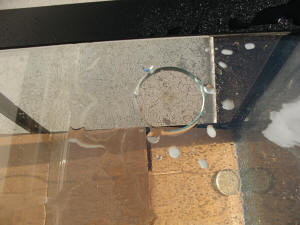 Drilling... easy to do... even fun.