 |
|
| Home | Marine Aquariums |
Freshwater Aquariums |
Planted Aquariums |
Brackish Systems |
Ponds,
lakes & fountains |
Turtles & Amphibians |
Aquatic Business |
Aquatic Science |
Ask the WWM Crew a Question |
| Please visit our Sponsors | ||||
Puffer tank sizes
2/11/16 Arothron not eating... stocked w/ another... ?
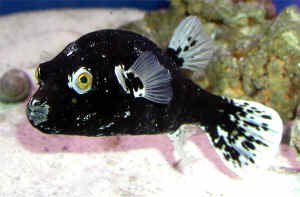
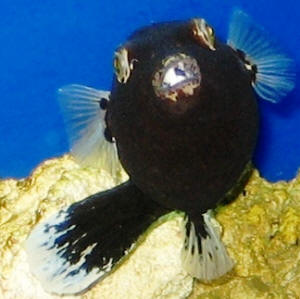
2/16/12 Dog face puffer (weird) 11/2/08 I have a dog face puffer and have noticed that he is tucking his side fin in. <Something they seem to do. Check to see if it looks "sore" or otherwise damaged, but if all seems well, don't worry about it. Many puffers seem to have a tendency to rest their fins from time to time. Put it down to the sheer quirkiness of the family Tetraodontidae, and why aquarists love them so very much.> We thought that he was missing one, but seconds later it popped out of his side and was back to normal. We have noticed him doing this and were wondering if this is normal. If so what does it mean? <Not much!> Thanks, Have a Great Day !!!!! Erin <Cheers, Neale.> The Tooth Fairy visited my Black Dogface Puffer 10/24/08 My happy and very healthy, Black Dogface decided to shed one of his four fused teeth yesterday; upper row, left side. <Mmm> Actually, it is a "break" and not a "shedding". I can see where the break occurred within his mouth if I get a good viewing angle. There is a jagged edge to see if I can look far into his mouth. It is difficult to see. He has lost a lot of tooth! The remaining three teeth (or bones), appear to be in good condition and length. Fortunately, I don't believe he can pierce his own skin by biting it...I hope! My puffer, "Blackjack", has been with me for almost five years now. He has never had physical problems except for a rare case of ich last year. His appetite is what you would expect for a Dogface with a diet consisting of Frozen Formula I and II, krill, plankton, silversides, shell fish. I never had to consider filing his (or her!) teeth down because of excessive length, he has always done a fabulous job maintaining them by nibbling on the food, substrate and the rocks throughout the years. So, in a nutshell, what do you think? Do I need to do anything? Do I need to remove him from the show tank or add a broad-spectrum antibiotic? <Mmm, no need to "do" anything... very likely the tooth will regenerate in time... months, perhaps a year or more> His behavior appears to be normal and so are his eating habits. I do not see any signs of infection. The remaining tank mates are unremarkable and have been coexisting for over a year; no problems at all. Water parameters are normal. Ironically, he looks perfect for the Halloween season only having 75% of his teeth! <Heeee!> Any insight would be greatly appreciated. Thanks! PD 135GAL FOWLR - Black Dogface (12"), Harlequin Tusk (10"), Lion (6"), Sweetlips (6"), Rainbow Wrasse (10"), Tassel Filefish (6"); 40GAL WET/DRY. RODI-H2O. <Mmm, just time going by, your good care here. Bob Fenner>
Dog faced puffer 12/29/07 Hi was hoping to be able to ask you a question regards my newly acquired Dog faced puffer. <By all means do so! But a few basics: Arothron hispidus is a fairly large (30 cm+ in captivity) species with a generally placid temperament but not suitable for reef tanks given its invertebrate-eating habits. Like many other Arothron spp., juveniles commonly inhabit brackish, and occasionally freshwater, habitats but adults are more or less marine. This makes them relatively hardy animals for the fish-only brackish/marine system above SG 1.012, but their large size does demand a big tank with a good filter system and lots of water changes. Because of their hearty appetites, a protein skimmer is probably essential. Do see here: http://www.wetwebmedia.com/tetraodontpuffers.htm Bizarrely enough my first pufferfish was this species bought as "spotted freshwater puffers" from a tropical fish shop where a bunch of juveniles were being sold as freshwater fish. While they do tolerate freshwater for long periods, they can't be kept as freshwater fish indefinitely, but in high-end brackish or marine tanks these are very robust animals. Cheers, Neale.> Tetrodotoxin 4/19/07 Just a short note: While reading the daily FAQs (as usual) I recognized in a mail I answered the name of a puffer toxin has been changed from "Tetrodotoxin" to "Tetraodotoxin". I am aware that the name should be derived from Tetraodon (four teeth), which is the scientific name for a puffer genus, but the scientists, who discovered the toxin in 1909 named it "Tetrodotoxin" (they were Japanese and Tetrodon was used in that time just as often as Tetraodon). So, this is the official name of the substance used in toxicology internationally. When talking we use the abbreviation TTX anyway. Cheers, Marco. <Thank you for this Marco... Little doubt this error is of my origination, perpetuation... I likely accepted a mis-spelling into this computers spellchecker dictionary. Bob Fenner>
Stars and Stripes Puffer Hello, I have searched through the FAQs and can't find any problems that match up with mine exactly, hope this isn't a duplicate. <Okay> I am purchasing a tank from another hobbyist and he is including all livestock in the tank. Everything is eating and looking good except for the puffer. It is a Stars and Stripes puffer and he has a larger lump or bump or bubble under his chin. Also, the current owner says he hasn't eaten in almost 4 weeks. He appears to be swimming quite well and active around the tank, but won't eat. I can not see anything wrong on his skin, although the current owner says he sees patches (I just don't see them). The only thing the current owner has been feeding the puffer is dried krill. I went and bought some frozen shrimp and fish that the LFS recommended and I will try that on the puffer tonight. I will also try to test all water conditions ASAP on the tank (I am still in the process of buying the tank). <Okay> Do you folks have any recommendations of where to start trying to help this fish? Symptoms to look for or the next best step with this limited information? I'll attach a picture of the fish, although it doesn't show the lump under his chin very well. <I would not be (overly) concerned re the bump/cyst... will come/go or not of its own accord. I would try adding a bit (a level teaspoon per ten gallons) of Epsom Salt to the system, offer some other foodstuffs as you've done... opened clams, mussels, claws/legs of crabs, lobsters... soaked in Selcon or equivalent... Is this tank too small for this specimen, species? This could likely be a factor here as well.> Is there anything I should try when I move the tank this weekend or next? Halting the move is not an option since the seller is moving in 2 weeks. If water conditions are bad, is it terrible to do a full water change with the filtered sea water I can get in San Diego? <Not a tremendous problem... there are shops that sell same, or will sell you water out of their systems... Go see Ron Elander of Octopus' Garden and mention my name if you have difficulties> Thanks for anything you can offer! David <I would buy and move all w/o reservation. Bob Fenner> Puffer question Hey Guys, <Joe> Love your website. I have had a Mexican (Arothron) puffer for about three months now. "Puff Daddy Pig" is about a foot long and its age is unknown. My question is will it turn into a golden puffer? <Mmm, not likely... A. meleagris are one, the other, or mixed... genetically> He is about 20% gold now and the rest of him is brown with white dots. I have not noticed much change in his coloration since purchased. I read that puffers rarely change into one of there three color stages in captivity. Is this true? <As far as I know, yes> Thanks for doing what you do! Joe <Thank you. Bob Fenner> Arothron Reticulated Sourced Do you think that you can help
me find an AROTHRON RETICULARIS? I have come to the conclusion that
this fish is commonly confused with the HISPIDUS. <Yes> I already
have almost all the other AROTHRONS finding them has had there
challenges but this one I am running in to a lot of brick walls is this
found under any other names .... toadfish puffer pufferfish. Any help
would be great. Thanks again Bunkley <I encourage you to seek
out the resources, personnel of the larger online marine livestock
etailers... Dr.s Foster and Smith, Marine Center... (.coms)... contact,
and ask them specifically to search out this puffer. Bob
Fenner> Puffer Compatibility We finally purchased our "last" addition, a dogface puffer (Arothron nigropunctatus) to our tank (50 gallon, running for a year now). <You need at least a 125g for all of these fish> This has always been my favorite fish, and I waited until I was absolutely sure the tank was set before purchasing him. The tank mates are: Huma Trigger (Earl), True Perc (Charley) (currently on his way to his own tank), and a Foxface (Frances) (Siganus vulpinus). We had expected some "difficulty" from our Huma, but the trouble has been with the Foxface. He has always been such a docile fish, but not anymore. He will display his fins whenever the puffer is around and chase him literally all around the tank. The puffer has been eating extremely well, and has been acted quite curious in his new tank. Meanwhile, the Huma could care less about this new addition. We were told by our LFS that these guys would be okay together. My question is this, is the behavior of the Foxface due to the addition of the puffer and nothing more? (We've had the puffer now for four days) Or do we have something to worry about? The Huma, Foxface, and Puffer are pretty much all the same size - 3.5". <If you were to get a larger tank that territorial behavior would most likely disappear. These fish tend to want to establish their won territories which could be large in size. Good Luck! Heather> Pardon the "hurricane" names, but with the exception of the puffer, the rest of these guys made it through the four hurricanes here in Florida! Thank you for your help. Allison D. Fralick Peacock Puffer & Spotted Puffer 9/4/04 <Hi, Pufferpunk here> I have a 50 gal talk with four happy inhabitants, Scott's fairy wrasse, a pair of perculas with their maroon ritteri and a 10 inch wolf eel. Recently I found at my local aquarium store four 3 inch peacock puffers and I immediately wanted to inform you and ask a few questions my self the manager noted theses were very peaceful puffers and only would double in size I have a spotted fresh water puffer and even though he is 4 inches he is the king of his domain. Could the peacock puffers be so docile and if so is there a chance they could be an easy snack for my wolf eel. <There seem to be an influx of these "peacock puffers" (Takifugu ocellatus), available in the aquarium trades lately. It's a shame really, since there has never been anyone (even the best puffer experts, Robert T Ricketts, a puffer keeper of over 40 years & Dr Klaus Ebert, author of The Puffers of Fresh & Brackish Waters) able to keep these puffers alive more than a few months. RTR said, "I have tried 4 of them, various times and various water conditions. My shortest-lived was on the order of a week, the longest did grow a fair bit, but was still only a handful of months at the most - I don't have the exact figures handy. All were definitely still juvenile fish, all ate, all were active to hyperactive, and all died." With that in mind, it would be best not to buy these puffers, as it will continue to deplete the natural populations, only to have the fish in a tank for a very short while. It's such a shame that collectors have no idea--they are taking them out of their home, to certain death! I wanted to also write to you about your "FW" spotted puffer. If your puffer is a green spotted puffer (Tetraodon nigroviridis) or GSP, Then it is not a FW puffer. It needs high-end BW when younger & prefers SW as an adult. At 4" it should already be in a SG of around 1.018. Please read: http://www.wetwebmedia.com/BrackishSubWebIndex/gspsart.htm ~PP> Re: more on Narrow lined Puffers!!!!! Hi again, <Howdy, Magnus here to help.> Are the narrow lined puffers more suited to a tank with smaller fish like Chromis, damsels and clownfish? <most puffers of the Arothron genus really should go with happier community fish rather than aggressive. The only problem is that I have seen clownfish really boss around a weaker puffer. Just make sure the puffer is eating okay.> The puff would be in a 70 gallon tank and I think that it would give the puff its room. I was told in my last email that they only get 6 inches. <Actually these fish get about a foot in the wild. I had seen one about 7-8 inches but it was in a 200 gallon display tank and I feel that the owners took better care of that then most people do of their children. 70 gallon is probably on the small side of tanks for a fish like this. but, it should work if you make sure to keep the water clean and all the fish well fed and happy.> Thanks for all the info <Glad we could help. -Magnus> New Dogface! (4/5/2004) Hi <How goes it? Michael here today> I have really enjoyed reading your website but I have a couple questions about a my new Dog Face Puffer Fish that I just bought today but have not taken it home yet from the pet emporium because I want to make sure that my water levels are perfect. <Good idea> I have a 92+ tank that I just bought a few days ago that has been established for at least 1.5 years and it has a 100 lb of live rock in it. It came with a yellow tang and a little fish about 2 to 3 inches long that changes colors and I don't know what type it is. <"Changes colors"?> I have been searching the site to get more info on the care and the size of a Dog Face puffer fish but aren't really getting the answers that I need so I was wondering if you can help in any way. How big will a Dog Face get? <Close 10-12" in captivity with a good diet and room to swim> Will he get along with my Yellow Tang that is about 6 inches long? <Shouldn't be a problem> Will he eat my little fish? <How little are we talking about? What species of fish?> With the size of my tank, what fish would you recommend so that I don't get into some of the situations that I have read about on your site, with too many fish or fish that will hurt each other? <I wouldn't add much more biomass after the tang and the puffer> Should I buy a coral rock just to prevent my puffer from getting lock jaw or too long of Teeth? <Feed him snails and he should be fine, you can always trim his teeth if it becomes a hazard to his health> I would really appreciate any answers that you can give to me. Let me add that I had my water checked two days after putting it up and the store said that the water was almost perfect and they have not seen that from a moved tank set up by an amateur. <What are the numbers that "almost perfect" translates to? You want a fully cycled tank for a dogface, e.g.. 0 ammonia, 0 nitrites, 0-20 nitrates> I just have always wanted a saltwater tank for so many years that now that I have it I don't want to make a careless mistake seeing that nothing in a saltwater tank is cheap especially the fish! <An admirable concern and you've found the right place for info> Thanks for your time and patience. You really seem to care about your site and that in its self can be rare. <Thank you, we try. I love the site also!> Tammy from St. Louis, MO <Have fun with your new Puffer, they're my favorite fish. Just make sure you have a good amount of filtration, as they're messy! M. Maddox> Takifugu ocellatus 3/31/04 <Hi, Pufferpunk here> First, thanks for providing what I consider the most comprehensive captive aquatic information source there is! :) <Awwww shucks, thanks a lot!> My question regards a puffer I found on your site: Takifugu ocellatus is this puffer available in the US, and if so, under what common names? <Personally, I have never seen it available for sale in the US. It's common name is ocellated/peacock puffer. I did recently hear of someone on my puffer site that found one in Florida, but I'm not really sure about the ID. Here's the thread: http://puffer.proboards2.com/index.cgi?board=marine&action=display&num=1080532270 > I wasn't able to find much information about it, even on Fishbase. How large does it get? <It's cited in Dr Klaus Ebert's book, The Puffers of Fresh & Brackish waters to grow to 6".> What water parameters does it prefer (if I'm even able to acquire one). <Here is what Dr Ebert says about this puffer: "This exceptionally attractive marine puffer is imported from China. It is a lively swimmer & neither a fin-biter nor aggressive towards conspecifics (it's own kind). Unfortunately it has proven tricky to maintain. No long-term data are available. It is hoped that this attractive puffer will be imported again so we can discover the optimal maintenance conditions for it & so that interested aquarists have a chance to try & breed this beautiful fish". I assume it eats foods and has habits similar to other puffers. Thanks for any info. Michael <You're welcome. Definitely not a fish for keeping in captivity, as even Dr Ebert couldn't maintain one. There are other nice fugus available though, like the one the guy has at the end of the thread I sent you. ~PP> Tetraodon Mbu Injury Question Hi, <Hi! Ananda here this morning, digging out from under the pile of so big dirt...> Firstly I just spent a while reading through your greatly informative website - congratulations on creating a handy and friendly database. <Thanks -- credit goes to many people.> My question refers to my buddy, Uncle Remus, who is a two year old Tetraodon Mbu freshwater puffer approximately 280mm in length. <Big guy!> I've just returned from vacation to find that he has a small 'jelly-like' lump on his back, near his tail fin. He is eating fine (he was fed every two days whilst I was away) and is his usual happy self - but it's hard to tell if the lump (approx. 8mm in diameter and maybe 3mm in height) is a growth or an injury. I'm thinking it's an injury from one of his food hunting missions around the tank, where he might have cut himself on a log we have in the tank. If this is the case, is there anything I should do to speed up his recovery? <A few drops of tea tree oil, or something like Melafix, wouldn't hurt -- but I would like to see a photo of this before guessing what the cause is.> The last thing I want is for the injury to get infected or enlarged. <Agreed.> Also, his beak could maybe do with a 'clean and trim'! He has a black mark between the 'teeth' and the beak is maybe a little long... Aside from giving him cockles in shell (which he has most days), is there anything else I can do to keep things in check here? <If he is not being fed daily, I would do so... smaller portions, more frequently, may help. And make sure that everything he gets has some sort of shell, even if it means you take empty shells and fill them with food for him.> I can't see how I'd be able to get him to keep his mouth open for me to file the beak by hand - especially without him biting me!. <You would need to put him under anesthesia -- MS222 and clove oil are the ones I know of that have been used successfully. If you decide to do this, do let me know and I will dig up more info.> Any advice would be much appreciated. Thanks again, Chris (London, England) <You're quite welcome. --Ananda> Puffer Problem Hi -- I stumbled across your site looking for information about my golden Tonga puffer, Ralph. <Hello, Sabrina with you today, hoping to help you and Ralph> I need some help with his breathing--I've had him a month short of two years and have treated him for gill flukes at least twice with Paragon with good success. This time he's not responding at all, I've done four rounds and sometimes he will move it a bit but never really open it at all. <By 'it' you mean his gills, right? Well, gill flukes usually cause fish to gasp and have rather labored breathing due to the parasites causing damage to their gills, so the fish can't absorb oxygen from the water as well. So far, this doesn't sound like flukes to me.> He's about ten inches long, six around and is in a fish only tank of 80 gallons with a pair of fire clowns, a squirrel fish and a coral beauty. I'm running two emperor 400 hang on filters with activated carbon and a remora protein skimmer in addition there are two air pumps in his tank and I do at least a ten percent water change weekly. <Sounds good, perhaps increase the amount of water that you change weekly, and be sure to check your water parameters, make sure everything checks out okay. You're also going to want to consider going larger in tank size soon....> What would you suggest I do next for him? He's just not a happy puffer--he no longer wiggles and splashes when I come home but is still eating his shrimp like a pig and some algae but not as much. Any advice or suggestions would be greatly appreciated, he's my big yellow baby and I'm just desperate to maximize his life span. When I travel I even have my family come over just to talk to him, he likes company! Thanks so much, Janine <It may very well be that the very active squirrelfish is stressing your puffer out, and may be that your puff's just pouting about it, trying to let you know. Keep us updated - hope Ralph perks up for ya!> Dogface puffer not eating (07/24/03) <Hi! Ananda here with the puffers today...> My dogface puffer that I have had for 2 years has stopped eating for about a week. <Hmmm. It is not unheard-of for these fish to go on a "food strike". What are you feeding him?> All my tank stats are where they should be and no signs of parasites or bacterial infection. I tried feeding him different foods but he just doesn't seem interested any suggestions would be appreciated <Do check out our assorted Puffer Feeding FAQs, starting here: http://www.wetwebmedia.com/pufferfdgfaqs.htm ...also, check the length of his teeth! If they are overgrown, so that your puffer cannot open his mouth very far, you may need to do some puffer dentistry. If that's the case, let us know... --Ananda> Skittish Puffer! (7/3/03) I recently purchased a porcupine puffer, and he seems to be very skittish. He tends to hang out around the back of the tank and when I am in the room, he will keep one eye on me, and swim slowly up and down the length of the tank. He hardly eats when I am in the room but when I come back the brine shrimp, mussels or krill that I leave for him is gone. (I doubt that my only other fish, a domino damsel is eating it all.) His appetite is very healthy, and in general he seems to be very healthy. He has been in my tank for about 2 weeks and I wanted to know is this common with newly introduced puffers? Is there anything I can do to make him less skittish? <Just give him time and substitute something like Mysis for the brine as the brine has very little nutritional value. Cody> Thanks. Kevin Dalmatian Puffer? Hope all is well to the whole Wet Web Media crew! Your help is always much appreciated!<thanks>The reason I am contacting you is my girlfriend and I visited our LFS this past weekend and saw some unusual puffers that we have never encountered before! The body structure is like a Dog Face but the color is what is unusual! The color on some were like a Dalmatian dog but more black than white kind of swirled all over its body. <Either Arothron nigropunctatus or an Arothron meleagris species puffer fish> Others were just straight black but with white fins with black spots. The LFS called them Dalmatian Puffers but when I asked about them they did not know anything about them.<have seen these "Dalmatian puffers before"> I don't even think this is the correct name for them. Well anyway, we ended up buying one because it was an unusual type of puffer plus my girlfriend fell in love with it because every time she walked up to it would come to the front of the tank to greet her. <Puffer fish tend to be very social animals> If you need a picture E-mailed I can probably do so.<ok>I would just like to know the proper name for this puffer.<again, either Arothron nigropunctatus or an Arothron meleagris species puffer fish> I would also like to know if it changes appearance during different stages of its life.<Do read more on our puffer fish webpage http://www.wetwebmedia.com/tetraodontpuffers.htm> One other question that I have been wondering about is I was debating on whether to get a Red Emperor Snapper as a new addition.<This fish grows to more than 3 feet in the wild> Right now I have a porcupine puffer, that other puffer that I have described above, and a Huma Picasso trigger. All these fish are fairly small in size and have a lot of growing to do the only draw back is I know the snapper grows rapidly.<It sure does>My question is how fast do Triggers, Puffers, and the Red Emperor Snapper grow? <depending on how they are fed, fast or very, very, very fast> Well have a good day and thank you for your time it is much appreciated. <would not go with the snapper, will grow too large for any but the largest of home aquariums (couple hundreds of gallons, plus) Good Luck, IanB> Dogface Puffer Problem >I have searched through your site, but I have a couple different symptoms, although I fear it may be too late. I have a dog faced puffer (about 8-10") in a 40 gallon tank, which I have had for 5 years, I have been using the same bottle of prime for this entire time. Once the Prime Dechlor has been opened, does it have a certain amount of shelf life? >>I can only assume that it has a limited useful life, but I couldn't say that it would do anything worse than be ineffective. I'd treat it like certain toiletries, give it anything from one to three years (?), just a guess. >Since it always smells bad, its hard to tell if it's actually "gone bad". His usual diet is tiger shrimps and smelts (which I now realize is likely not a good enough variety. I used to give him scallops too, but his teeth started overgrowing, and his increased size also made it harder to feed them to him). He recently has slowed down on eating, over the last month to only about once a week. (I had been on holidays with someone caring for my tank, and when I returned there was a slight elevation in ammonia and nitrites, which was quickly alleviated with a water change) He seems to be breathing differently, and over night his eyes have sunken in. His teeth don't seem to be overgrown, although his lips seem to be 'pulled back', and I'm not sure about the lock jaw, he kinda holds his teeth open, but I think he can close them if he needs to. I usually do a water change of 5-6 gallons every 2 weeks, I had done one last Saturday, and am doing another tonight. >>First thoughts are that he's reached the limits of suitability in housing. I really think your fish needs a tank at *least* double the size currently housed in. Also, you can do larger, more frequent changes, they never hurt (as long as you're not going vacuum-mad on the gravel). >While I live in a city where there is no one that has saltwater knowledge, I visited a larger center today, and the sales rep didn't think I had anything to worry about yet, although at that time I hadn't noticed his eyes to be sunken. At the same time I bought a new bottle of Prime, and I think there is a slight difference in the smell - could this be the problem? I asked the rep if liquid vitamins would help if he has a vitamin deficiency, and he didn't feel they would do much good. >>It is my opinion that the sales rep was remiss for discounting the true importance of nutrition. I feel that you should use supplements, especially on this fish. There is one (available online) that is *very* good, called Selcon. Other folks also speak (and there does appear to be some proof validating the claim that garlic (or extract thereof) induces feeding response in poorly feeding fish. It is indeed known for the antibiotic properties of Allicin within garlic. You can crush it, and soak food in it, see if it inspires any increased interest in food. >If they would help, is there any substitutions since its unlikely any pet store here would have them? Would it be worth it to try to force feed him, or with the sunken eyes is it already too late? >>I'm honestly unfamiliar with anything other than malnutrition that would cause a fish to look like that. I might suggest a parasitic infection, for which garlic is also purported by some to have internal anti-parasitic effects. Since this message is a few days old, please email me back so I have time to do some research, and to see how he's doing right now, then we'll move on. Marina >Thank you for your help, Shawna Ogonoski
Arothron hispidus in brackish water system? (03/19/03) <Ananda here today...that's the white-spotted puffer, in case y'all were wondering.> Thank you very much for this wonderful site. I've learned a great deal over just the last few days. <You're quite welcome...I keep learning stuff, too, as we keep adding to the site.> I have looked for an answer to the following question but found none here. <Me neither. But then, we can't cover everything right away... :-) > In the Brackish Water Aquarium FAQ at http://users.macunlimited.net/n.monks/brackfaq.html (section (7a)) Arothron hispidus is mentioned as a puffer that adapts well to brackish aquaria. <I'd forgotten that part. Required reading, btw, for anyone interested in brackish systems.> However, most of my research tells me they require full marine conditions. What do you think? <When in doubt, search Fishbase: http://www.fishbase.org > How about other Arothron species, e.g. the commonly available A. meleagris and A. nigropunctatus? <Nope, neither of those two. But some of the Arothrons wander into estuaries... A. immaculatus, A. manilensis, A. reticularis, and the giant A. stellatus (that guy gets as long as a 55 gallon tank!). Of those, A. hispidus and A. reticularis sound like the most likely candidates for a high-brackish/near-marine system.> Thanks for any advice. Until I learn more, I will not subject any Arothrons to less than fully marine water. <Sounds like a plan to me. Keep us posted on the WWM forums.> Sincerely, Nick Tempe, AZ Deadly pufferfish tested as painkiller Bob, This is the most up to date article out there, notice the headline. <I believe it. Bob F> Mark Deadly pufferfish tested as painkiller: Toxin, 3,000 times stronger than morphine, could be of benefit to cancer patients The Ottawa Citizen Wednesday, February 12, 2003 Page: A12 Section: News Byline: Darrin Denne Source: The Ottawa Citizen Pufferfish, the dangerous delicacy that is the last meal for about a half-dozen Japanese diners every year, could hold the key to relief for cancer patients with untreatable pain. Across Canada, clinical trials are under way to assess the optimal effective dose of a highly purified form of tetrodotoxin, the poisonous substance found in the internal organs of the pufferfish. Dr. Neil Hagen, head of the cancer pain clinic at the Tom Baker Cancer Center in Calgary and principal investigator for the study, says that up to 90 per cent of people with a cancer diagnosis have pain, sometimes severe, but 90 per cent of the cases can be controlled with existing medications. "Some of the time, the minority, the standard approaches appear not to work very well. And this can be pain from the cancer or due to the treatment of the cancer, which itself can be quite toxic," he said. What excites researchers such as Dr. Hagen is that tetrodotoxin is 3,000 times more powerful than morphine, is non-addictive, appears to have few side-effects when given in small doses and targets only the nerve fibers that conduct pain. Tetrodotoxin is known as a sodium channel blocker. Electrical signals are carried from nerve to nerve in the body by many kinds of sodium channels. The nerves that transmit pain have slow sodium channels. While a channel blocker such as Lidocaine affects every sodium channel -- the reason your facial muscles feel both numb and weak after dental surgery -- tetrodotoxin blocks only the slow channels, preventing the transmission of pain signals. The toxin has no effect on sensation signals. "Imagine that you didn't feel it when you were being cut with a knife, but you knew you were being touched," Dr. Hagen said. "That would be what could happen if there was blockage of slow sodium channels on pain fibers." Vancouver-based International Wex Technologies Inc. has developed the drug, known as Tectin, with its associate laboratories in China that conducted much of the initial research on tetrodotoxin. Pufferfish are harvested twice a year from the South China Sea, where the most deadly varieties are found. They are also raised in fish farms. One fish can produce 600 doses of the drug. The company has just partnered with Esteve, a Spanish pharmaceutical company that will foot the bill for taking Tectin to license in Europe. The bittersweet taste of pufferfish, or Fugu as it is known in Japan, is a culinary favourite in Japan and must be prepared by specially licensed chefs taught how to properly separate the organs and tissue that carry the toxin before the fish is served. Done improperly, the customer can die within four to six hours. Medical use of tetrodotoxin stretches back to just before the Second World War when Japanese researchers used a crude pufferfish extract to treat menstrual cramps and migraines. Wex became involved after initial studies in the early 1990s at the University of Beijing indicated that the toxin was an effective and non-addictive treatment for heroin addicts. In 1999, an initial test was run on a small group of Chinese metastatic cancer patients to see what effect the drug would have. The patients reported virtually no pain for up to three weeks from the three-day treatment. The current study, involving 36 patients in Saskatoon, Edmonton, Calgary, Montreal and Toronto, is expected to be completed this year. Wex officials hope Health Canada will quickly approve Tectin for use as an end-of-life care product for patients who may not be concerned about long-term side effects. The prospect of providing relief to these patients is also what drives Dr. Hagen. "A natural product that might relieve pain is exciting," he said. "Cancer pain is very common and can be severe and to find ways to help patients who are trying to live well despite their symptoms is really important." Meanwhile, pufferfish toxin has already been tested in China to ease heroin withdrawal symptoms, and there are plans to run similar trials in Canada, said Howard Milne, a spokes-man for Wex. Puffer Fish for Cancer Pain http://www.imagequest3d.com/pages/general/news/puffertoxin/index.htm Hey Bob, I thought you may find this interesting. Trials are currently being conducted in Canada and Asia using the poison from the puffer fish. The drug has two indications one is for severe cancer pain and the other is for heroin withdrawal. One researchers involved said that the drug appears to be a medical breakthrough. The link above is to a U.K. image bank company that took an article about this project and surrounded it with pictures, you will love it. <Thanks for this. Bob Fenner> The name of the company conducting the trials is International Wex www.wextech.ca I work with the company in the area of communication and happen to be a hobbyist. I'm hoping you would write something about this project and post it on your site. Whatever you can do to draw attention to this product would be appreciated. United States trials will commence in the next 4 months. Regards Mark Butler Green Spotted Puffer Mr. Fenner, Sorry to bother you yet again with one of my questions. I've been reading over the FAQs re: brackish puffers. I have a green spotted puffer about an inch long. I got him at Petco from one of the marine tanks. I knew he was a brackish puffer, but they had had him/her...it for about two weeks in the marine tank before I bought him. I've had him for about 5 weeks now, and is doing great. He actively swims, eats like there's no tomorrow, and before they died, harassed my domino damsels. Is it OK to keep him in my marine aquarium. I keep my SG about 1.023. Like I said he seems to be doing fine (getting fat). Once again, great website and thanks! <Please do take a look here: http://www.wetwebmedia.com/FWSubWebIndex/fwpuffers.htm re a positive identification of your fish. I have seen brackish water species kept for good long periods in "straight" seawater with no apparent harm, HOWEVER they almost all "do south quickly" losing weight, setting at the bottom, perhaps dying of physiological difficulties within hours to a day or two... so, do keep a close eye on yours, and be ready to move it (in the hopes of its recovery) should you see it suffering, or dead. Bob Fenner> Vince Gibbens Fin stuck in gill Hi, My gold puffer has his fin stuck in his gill. Otherwise, he appears to be fine. He is about 8". I would appreciate any advice you can give. Thanks Kelly <I would intervene here... by catching the fish, holding it tightly in the net with a wet towel between you, the net and it (to prevent thrashing, you getting bit)... and pulling the fin out of its gill opening. Bob Fenner> Re: fin stuck in gill Hi Bob (good to hear from you), Well, with my husbands help. I managed to get the puffer out of the tank. <Yikes... would have been better to just do all in the tank... at the waters edge> My husband had his finger in the wrong place (BIG OW!!!). <Yeeikes! This can really hurt!> While the puffer was on my husbands finger, I pulled out his gill--the puffers gill ;). Puffer is fine now and my husband has a Band-Aid. Thanks for your help Bob. Do you have any idea what caused this to happen? Kelly <Glad to hear all is well. Must have been some wild movements for all! Bob Fenner> Re: Puffer Unable to Open Mouth Hi Again Bob, So sorry to keep bugging you :/ <No worries> Re: the force feeding of this very beautiful and stubborn DF Puffer, who is taxing and my patience and frozen training skills like no seahorse ever has.......I have a few more questions. At least Puffers are heartier than WC seahorses!!!! We both have that in our favor!! <Yes> Gullet?.....? Not sure what/where you mean......if this guy is say 3.5 to 4", excluding his caudal fin, how far into his oral cavity should I shoot for, just a rough estimate? <Just until the tip of the plastic feeding tube is inserted... the animal has rear-facing projections, a muscular sphincter to prevent egestion> I would like to get a general idea about how much volume he can accommodate at one feeding. Any idea how big his stomach might be or what volume it would comfortably hold? I am guessing based on what my other 2(about the same size) eat about 2 to 3ccs perhaps, 4 max? <Actually, these animal's have enormously distensible fundi... no worries re overstuffing. In the wild I suspect that they only come upon large amounts of food on occasion... and when they do, engorge themselves> I read somewhere many moons ago that a fish's stomach is about as big as their eye. Now I have a feeling this is not true in the DF Puffers case. I have 2 others and I see what they consume and how their bellies bulge after a good meal. <Yes> If I am going to get past my trepidation and squeamishness to actually do this I want to be sure I do it right and feed him enough. I certainly don't want to waste my efforts and stress him out just to under feed the poor guy. <I understand. As you've stated, if the specimen is eating now, I would not attempt to force it...> How many days would you recommend I do it for and should I continue to offer him live and/or frozen foods simultaneously 2 times a day as I have been. <Continue offering the frozen/defrosted foods, any live as you have been... if the animal goes off feeding, appears dangerously thin, I'd commence force-feeding it... daily till it takes food on its own> Just how nasty is a bite from one of those beaks? Have you ever been bitten by one this guy's size? I am a tad nervous. <Have been bitten... painful... though not as bad as a dog or Psittacine (parrot-like) bird> When I tube fed the seahorses I had a really clear picture of their anatomy in my mind? Hehehe, by the way it is not all that hard if you have the right size tube, a pair of magnifying reading glasses and a helper....that long straight snout is an easy target :). I feel a bit blinded in this situation, as this is a new species for me and although I have done a lot of research I am no where near done. The seahorse's GI tract is quite simple and from my understanding and observation LOL, a bit different than most other fish, would you say these guys (puffers) have a more typical anatomy? <Puffers are very similarly arrayed... a short, straight tube more or less, for fast processing> Do you have any recommendations for appetite stimulants........I have the following which have been recommended to me.......Vita Chem, Kent Marine Garlic Extreme and Kent Marine C.? Would any of these be appropriate, or do you have a product you have had good experience using? <The Boyd Product (VitaChem) and Selcon are my favorites> OK one more sort of dumb question......they can't aspirate like a human could, can they? Is there any harm I can cause him or is there anything I need to be careful/aware of during this procedure. <Not to worry> I will let you know how it goes if you like. Thank you and have a great day!!! <Real good. Life to you my friend. Bob Fenner> Leslie Puffer Unable to Open Mouth Good Evening WWM Crew, <Leslie> Leslie here. Your very knowledgeable and dedicated crew has helped me out many times before. I need help with a Dogface Puffer tonight. I wrote not to long ago about this fish, a smallish one 4" or so. He didn't eat in the LFS for the first few days, but he ate while I was in front of the tank 2 days in a row, in the LFS, so I thought he might be OK.......silly me. He is in a 25g Q tank. He got a touch of ich which I successfully treated with a few FW dips, elevated temps and hyposalinity. I have had him about 5 weeks. I was hoping that eating in the LFS, after a few days of not, was a good sign. He has only picked and nibbled at his meals since I have had him. I have tried all the tricks, as well as every food item recommended on your site. I even resorted to the creepiest of all.......a live crayfish, which btw will not die. He nipped at it a few times, but that is about it. He has been a bit on the thin side all along but far from emaciated. He seemed to be maintaining his weight, just not putting any on, up until a couple of nights ago when he started eating even less and to appear thinner. I was using Chem Vit in the tank once a week, because he would not touch any food item that had any sort of supplement on it. The last 3 days he has eaten less than he usually would nibble at. Tonight when I fed I noticed he was not eating at all and that he will not/or cannot open his mouth. His beak has never appeared overgrown. He is active, has good color, clear eyes and gets excited when I come into the room and appears to be hungry because he gets even more excited as soon as the food is placed into the tank. What causes this inability to open the mouth, if it is not related to overgrowth of the beak and is there anything I can do for him. Could the Crayfish have injured his jaw, or mouth. This is really very sad. I feel horrible about this poor fish and would like to something to help him. <Have witnessed this a few times... perhaps a trauma in collection, being moved about... Maybe a deficiency syndrome, something/s missing in the animal's recent diet...> Thank you so much for your help, Leslie <I would try "force feeding" this specimen at this point, with ground up (to hamburger consistency) meaty foods, holding the animal underwater with a damp towel (after netting it), using a plastic turkey baster type of tool. Bob Fenner> Puffer species comparison Well, my partner has been wanting a puffer for months now, and we have even set up a small tank in anticipation of getting a baby - with plans for a much larger (125-180) tank for a future home. He had been mostly attracted to the dog faced variety (nigropunctatus), but these suddenly became scarce in our area after we got the tank ready. After waiting for our LFS to special order one, he finally came home with what they got him last night - not a dog face. After searching your site and FishBase, I am fairly certain it is a white spotted (hispidus). It has the regularly sized and spaced white spots over a gray mottled background, although none on the tail/fins. It has pinkish lips, and thin gold rings around the base of the clear pectoral fins. There are no bars or stripes. This seems to be within the variation range I have found in pics. I will try to count rays on the fins tonight I guess. He seems to like the fish, although it is bigger than we anticipated at about 6-7". So far I have learned that they grow bigger in the wild than the dog face - 20" compared to 13". How big should we be prepared for in captivity? Also he has proven quite noisy at night, making grunting and clicking noises, and splashing water in the tank. Should we assume this will continue? <Arothron hispidus (Linnaeus 1758), the White-Spotted Puffer. Indo-Pacific, Red Sea, east African coast, tropical east Pacific coast. To twenty inches in length in the wild. Cute when small, and very hardy... just big eaters and mess makers. Here are pictured a four inch juvenile in captivity, a one foot specimen in the Red Sea, and a fifteen inch mottled or "koi" one in the Seychelles. He will likely get at least 2/3 his wild size. He may settle in and some of the activity subside, but he is a puffer! They are very intelligent and engaging.> What other considerations/surprises are there with this species compared with the dog face? <They are both big mess makers, have very good filtration and regular water changes.> We have the option of returning him and waiting for another specimen, but that's not really fair to the fish or the dealer. I can already see that owning this puffer is going to be a rather more engaging experience than with most fish. Mike <Like a water dog. Make sure you get the bigger tank underway ASAP. Enjoy! Craig> Re: dogface puffer (please help) I have nothing but problems with this puffer. OK, salinity is .20 <.20? What unit of measure are we using?> and nitrite and ammonia are fine as well. Just added small a LIONFISH and was wandering if the lion could sting the puffer? <doubt it, although puffers are known to pick on/at lions.> The puffer has had white spots on his fins and cloudy eyes. First treated with copper then treated with antibacterial. Well he started eating again ( picky) but came home today and found him w/ a large bump on his lower jaw. Kinda under on the side. He looks like he has a small pimple ( just one) on his upper belly. Did a water change about a 3 weeks ago and fixing to do one again . Would a fresh water dip help this problem? <possibly> And what is with that bump under his chin? When I put feeder fish in there he will go after them slowly but turns a dark color right of the bat. Is my fish on the verge of death, I hope not . I have invested a lot of money in fixing him but nothing seems to be working. When I first got him about 2 months ago he had a near death experience. Could this be the cause for his troubles? <stress in the past, never fully recovered? possible.> Sorry this is long , but the fish has got me aggro. <Imagine how he feels.> Thanks for the help! <This fish should be moved to quarantine and treated there. Freshwater dips will help, try adding some Quick Cure or something similar (malachite & formalin) to the dip. If you have any more questions please let us know, and please provide your water parameters, ammonia, nitrite, nitrate, ph, etc, the more info the better. Best Regards, Gage http://www.wetwebmedia.com/pufferFAQs.htm > Puffer troubles Hey Guys <whassup?> got a mystery here on my end. I have a dog face that I just adore. Boyfriend owns a pet shop that specializes in fish ( been doing it for 35 yrs.) and he has never seen this before. All the level in my tank are right on the mark all the fish seem fine. Puffer eats great... he actually looks like the Pillsbury dough boy... But he get this rash once and a while. <wow... so many jokes, so little time here> Its like an indention in his skin, odd shapes, different sizes and place with large white almost like pimples spot inside them. They are there one min. and gone the next. <the rapid appearance and disappearance of symptoms is strange. In fact, its strange enough that I would almost like to rule out a pathogenic organism (few if any can wax and wane so quickly). More likely something to do with the puffers ability to produce (sometimes copious) mucus. Still... if you are sure that this is not mucus/particle related... it may be the expression of a viral condition. Little tubercles (?)... pustules (?)... Bob, help me here... the water {among other things} is getting deep> <<I would have said about the same... not as well though. Likely viral>> My boyfriend the professional can't even figure it out. Any idea's, I love puff he the star of the tank don't know if I'm being a worry wart or not. <<Telling...>> Please get back to me if you've heard or know anything about this one. Thank a MILLION and have a super day. <thank you for caring my friend. I will copy this to Bob and beg his input as well. Best regards, Anthony> <<Antoine, this is what I would have said... plus maybe some comment re viral mediated conditions... and their variable expression re environmental input... that maybe they could boost the animal's immune system with improved water quality, nutrition. Bob Fenner> Re: Titan Trigger Hi Rob, <Hello Kel> You think I should try and put my gold puffer with the Titan? The scientific name that you mentioned below for the puffer is xanthic Arothron meleagris, correct? The puffer is 8 inches. :) Kelly <I would likely try this... for both their company, interaction... Both about the same in terms of nutrition (messy, meaty...) and temperament. The scientific name for the Guinea Fowl Puffer is A. meleagris, the term xanthic ("yellow") refers to an absence of melanin (black color) in your "sport mutation" specimen. Bob Fenner> Puffer troubles Hey Guys <whassup?> Got a mystery here on my end. I have a dog face that I just adore. Boyfriend owns a pet shop that specializes in fish ( been doing it for 35 yrs.) and he has never seen this before. All the level in my tank are right on the mark all the fish seem fine. Puffer eats great... he actually looks like the Pillsbury dough boy... But he get this rash once and a while. <wow... so many jokes, so little time here> Its like an indention in his skin, odd shapes, different sizes and place with large white almost like pimples spot inside them. They are there one min. and gone the next. <the rapid appearance and disappearance of symptoms is strange. In fact, its strange enough that I would almost like to rule out a pathogenic organism (few if any can wax and wane so quickly). More likely something to do with the puffers ability to produce (sometimes copious) mucus. Still... if you are sure that this is not mucus/particle related... it may be the expression of a viral condition. Little tubercles (?)... pustules (?)... Bob, help me here... the water {among other things} is getting deep> >My boyfriend the professional can't even figure it out. Any idea's, I love puff he the star of the tank don't know if I'm being a worry wart or not. Please get back to me if you've heard or know anything about this one. Thank a MILLION and have a super day. <thank you for caring my friend. I will copy this to Bob and beg his input as well. Best regards, Anthony> Re: Help with Dogface Puffer Hi Bob, Leslie here. <Hi Leslie, Craig here> You helped me a while back with a tank that had unsuccessfully gone through treatment for Amyloodinium infestations on 3 successive occasions. I asked about microwaving the contents of the tank, my Dad's suggestion..... since I had tried everything else I could think of to kill the darn bug. <I can relate to the desperation!> Anyway...... I have had my Dogface Puffer for about 6 weeks. He is a real looker. Pitch Black with clear black speckled fins and a white caudal fin with black speckles. Several weeks ago he developed some of what I believe to be Ich spots on his pectoral and dorsal fins. I saw him flash a couple of times, nothing continuous. He developed an occasional spot on his body which have disappeared. This is a FO tank 50g. I know small for him, but he is only 4" at this time. I have plans for a bigger tank. The thought of investing in a huge tank for this fish, after all those tank crashes didn't seem to sensible. I figured I will get the BIG tank if I can keep him alive long enough to need one. I hope not a stupid mistake. At the suggestion of a highly respected published friend in the marine community I have been using something called OST....osmotic shock therapy. Are you familiar with this? If so what are your feelings about using it prophylactically in a Q tank as well as to treat parasites? <Lowered SG in conjunction with copper and temp raised to 83F in a QT is the preferred treatment. This is fine if done over time....days.> The recommended specific gravity for FO tanks is 1.010. for 3 to 4 weeks. So I had this guy at that specific gravity for about 3 weeks, when I slowly slowly increased the specific gravity to 1.018 the spots began to appear. He otherwise looks and acts very healthy. The spots have been quite stubborn. I panicked at first because the Amyloodinium outbreaks started like this. I have since increased the temp of the tank....slowly to 80 to 81 degrees, fed garlic laced food and treated the tank with a product called Stop Parasites. The spots look about the same. One of the spots on the pectoral fin is a bit bigger, perhaps looking like 4 or 5 coalescing spots, but not as bright as the other spots. On that fin there is a tiny area at the fin tip directly in line with the bigger spot, that looks like it is worn away, just a very small area. I placed a 15w UV unit with a 90gph flow rate on the tank 3 days ago and FW dipped him last night for 15 min. He did very well......not even phased by it. They look a bit better today. Is it possible this is not Ich or perhaps something in conjunction with Ich? What else would you recommend I do for him. Thank you so much for your help :) Leslie <Yes, remove to quarantine tank and treat with copper @0.25 ppm free copper as above. For more on this go to WetWebMedia.com and enter "copper" into the Google search. I wouldn't advise any of the stop parasite type treatments. Craig> Dogface Tummy Ache? My dogface was sick and is still sick, think velvet ( little white spots, but been treating for ick with copper sulfate) and he did not eat for a month and a half . Finally he ate some lettuce and then little fishes(10) and then two days later he ate some live brine. I was told that since he went for so long without eating that his stomach would deteriorate and if he did eat after so long it would kill him. <Hooey> Well my puffer eats and now he seems to be lazy, turning dark, just sitting on a rock some them swim some, and just looking very ill. DO you think he will make it and what advice do you have for me? We gave him a few freshwater baths and in the bottom of the clear tub you could see little grains of yellowish color stuff about the size of grated pepper or large salt. <Much of your puffers problem is environmental. Given a proper environment and diet your puffer should improve. You don't mention your treatment length, copper levels, water parameters, etc. Please go to the Google search at the bottom of WetWebMedia.com and type in "dog face puffer", "disease" and "quarantine". Follow all of the links and read the FAQs. All of the information you need is at your fingertips! Craig> Dog Days... Hi WWW Crew....Bob...Anthony...Steve.... or Hmmmm .... <Scott F. here tonight!> Leslie here again. This time with a Dogface Puffer dilemma. I have done my homework. I read through everything on WetWebMedia re: marine puffers as well as anything else I could find elsewhere....which is not much :(. I still have a few questions and I am concerned about this new beauty. He is still small 4", white with yellow fins, a yellow mask, and beautiful yellow eyes. <They are adorable fish!> I got him 6 days ago. He had been in the LFS 3 days when I first saw him. He looked fine with the exception of being a bit thin. He was active but calm, with no outward visible signs of disease. His coloration bright and clear with bright alert eyes. They said he had not eaten. I asked them to try.....well low and behold he nibbled at some frozen ocean plankton. I watched for a while and he continued to nibble. I took this as a good sign although he didn't eat with the gusto of others I have seen. I went back the next day and he again nibbled even a bit more. I knew it was a sign and he wanted to come home with me ;-/. Maybe a bad decision, but none the less I brought him home. I just could not leave him there. <That's a familiar feeling for a lot of us! Good that you asked to see him eat something> He is in a 25g Q tank in a quiet room. <Great procedure> The first day he puffed up every time I came into the room.....freaked me out......I am sure he was as well! He spent most of his time "pacing" up and down in the back corner of the tank for the first day. I kept the lights dim. He got progressively calmer over the first 2 days, but was not eating. By the third day he was calm, alternating between swimming normally and resting, had stopped puffing up and began nibbling on his food. Today is day 6 he seems "excited" when I come into the room now or place food in the tank, but he is still only nibbling at Mysis out of the water column or krill suspended from a piece of cotton thread.. He does not appear to have lost any more weight. I have tried....cockle, krill, shrimp, and a mussel. He seems to like Mysis the best. <Then I'd push the Mysis at this point. A varied diet is important, but if he's a bit tentative in the feeding dept., I'd make sure that he eats as much as possible. Try enriching with vitamin preparations or Selcon.> I guess I assumed once he calmed down and started nibbling he would just start eating. Is my impatience showing here or am I appropriately concerned at this point? <Well, it's always cause for concern when a fish does not eat, so certainly not an over-reaction on your part.> I have no experience with puffers on hunger strikes. My other guy always ate with great gusto. OK so here are my questions..... Would you consider this nibbling as interest in food and a good sign or is he still possibly doomed to starve himself to death? Do you have any idea, in your collective experience, how long it might take him to really chow down? <Unfortunately, it's impossible to generalize and create a timetable for when a fish will start eating. There are numerous factors which influence a fish's appetite, particularly when you take into account what he's been through lately: the rigors of capture, shipping, handling, etc. Sometimes, it simply takes time for a fish to "settle in" and be comfortable enough to start feeding, sometimes other factors are involved (illness, injury, water parameters, etc.> >How long can he survive nibbling on Mysis, before I need to worry and/or panic, as I am already concerned? Most of my Marine experience has been keeping seahorses and their tankmates, as I am sure you are well aware seahorses do not fare well in the face of poor appetites and hunger strikes for very long at all. Even though I know this is a different fish with a more developed GI system, my experience has me perhaps viewing this thru a tainted screen. <Your experience is a great ally for you in this! As you know, it's a good sign even if he nibbles on food- a fish that eats is in an infinitely better state than one who doesn't. And these puffers do need to eat quite a bit, so don't give up.> When he is swimming towards the surface and oriented in the water nose up, his belly sags anterior to his anal fin. Just for a visual......it looks as if he swallowed a marble or is VERY constipated. Is this normal in a thin puffer? <I would keep an eye on him...Hard to say if this is abnormal from here.> The skin of his belly is also very wrinkled. Is it possibly due to the frequency of puffing during the first 2 days? Here is a link to photos of the sweet boy.......so you have an idea about how thin he is, can see his wrinkled belly and the "mass" above his anal fin...... > http://community.webshots.com/album/54332564yqDMXK On day 4 several Ich spots appeared on his pectoral fins. They looked a bit better the next day and again today. They are however not yet gone. I really want to avoid the stress associated with a FW dip, for fear of a set back in the hunger strike department, since he is not thrilled about eating yet. So, am I OK to just watch these spots and leave him as long as they do not get worse? <I usually recommend immediate action in treating ich. Given his possibly weakened condition, keep a close eye on this condition. If it progresses or continues, do begin treatment.> >What temp and specific gravity would you recommend for this fish in a Q tank to treat Ich, should I need to? Do you think I should start that now, to avoid a full blown infestation or wait a bit? Do you ever use this prophylactically in Q tanks? <I personally use a "normal" specific gravity in quarantine, or during disease treatment, but it is a common and perfectly acceptable practice to employ lower specific gravities during these periods> I have a friend in the seahorse community who is well respected, as well as published many times over the years. He is an uses a rather unconventional and perhaps controversial treatment called OST or Osmotic Shock Therapy, to treat parasite/protozoan infestations. The abbreviated version of the instructions are......to place the fish into water with a specific gravity of 1.010 to 1.011 immediately following a FW dip. The fish is maintained at this specific gravity for a period of 4 weeks at which time the water is slowly returned to normal marine salinity. Are you familiar with this treatment? <As indicated above, "hyposalinity therapy" has been used successfully by many hobbyists, wholesalers, etc.> Would you be interested in the rest of the information I have about it.....maybe not to use necessarily, but just for informational purposes? There have apparently been some 3 year studies done with very good results. I would be interested in your thoughts about it. <Certainly a practice that has worked for many people. I have always favored copper sulphate, but, as you pointed out, this treatment can be successful!> Thanks for your time, dedication and help as always!! Leslie <Leslie, I'm sure that you will succeed in getting your puffer to eat and in licking this ich infection. Be diligent and patient, and don't give up. Consider using the old standby of vitamin preparations to stimulate his appetite, feed carefully, and feel free to contact us again if we can be of assistance!> Porcupine Puffer I have been sifting through your website trying to find a good diet for my puffer. I keep reading that these fish are supposed to eat snails, crayfish, and other hard-shelled crustaceans, but my puffer does not seem to want to eat anything other than guppies and goldfish. I have tried cutting up squid, silversides, and shrimp. He will not eat anything that is not running away from him. Any advice? <I would first try some live ghost/grass shrimp. These are excellent. You could also probably get some small snails from your local fish store. These many times come in as unwanted hitchhikers on freshwater live plants. I also like to develop a routine for feeding finicky fish. Keep any live food in a separate container. That way the fish can only eat when you feed it. Then use a net to scoop up an add its favorite food, in this case guppies or goldfish. After they associate the net with food and come running whenever they see it, slip some other items in there. Many times they are so excited they swallow anything. I have used this method to train lionfish to eat prepared cubes of frozen foods. -Steven Pro> Puffer injury Thank you, but this is coming from his insides... it is not on the flesh at all but something that comes from in the mouth or the intestines?? <wow... my apologies. I'm way off here. I misunderstood from your message and the picture was not clear enough to reveal this for me. Wow... this is highly unusual and I must say that my previous advice in retrospect is unlikely to help. I thought the growth was topical. We will post this again to see if any of the daily readers have had any experience like this they can share. Please do read the dailies (FAQ page) this weekend (Sat/Sun) for possible insight. I must say that I do feel helpless but indeed, a wormy mass coming from inside the throat/mouth is highly unusual. In the meantime, do try to take a clearer photograph if possible and we will send it around. Best regards, Anthony> Do I put this swab inside the mouth?? Thanks again, Lynn Re: puffer with stringy growth and re-growth Lynn... in the meantime, let me suggest for you to simply do a topical swab of the area. They are no fun for you, but very direct and helpful for many fishes. Net the puffer underwater in a large nylon (white not green) net and wrap him up tight to limit his movement. You will need a second person to help with this. Cover the eyes of the puffer with some of the bunched net or another clean towel wet with aquarium water. Keep the puffer submerged as much as possible, but don't freak out if you need to pull him out of the water and he suck in some air. They most always can purge it or can be burped later. We are working fast anyway. Have some dipped cotton swabs ready and waiting aside with mercurochrome/Merthiolate or iodine. I like Merthiolate best for this application. Expose the effected portion of the fish from the net and slip it slightly out of the water/ Pat the area dry and then stain it with the medicated swab. be generous but avoid getting the meds near the eyes or gills. It may be necessary to sink a small clean dish towel under water to wrap the fish and hold it well. One person will obviously be holding the fish and the other will do the "surgical" work. Rest assured that this is very worthwhile for your pains. Best regards, Anthony> Thanks for sending it to her. But I'm afraid she still hasn't answered back and I think time is running out. Lynn Pufferfish, Huffing and Puffing Hey Bob, thanks for the advise on my parasite problem, but I have one more question. I have a stars and stripes puffer. When I first got him he would blow up every so often when I would get up on the tank to look at him. But now, about 2 months later, he is fine. Now he will go to the top of the aquarium waiting to get fed. <A very common, and endearing-puffer behaviour!> My water tests fine except for some copper left in the tank. <Please do try using PolyFilter media in your system, they really work well at removing copper from your system, and change color to let you know that they are working. It's really not in the best interest of your fish in the long term to have copper lingering in your tank.> Just the other day I saw him puff up more than I ever thought he could for know reason. I was wandering if they do that every so often to stretch or something. Just a little worried, thank you....Steve <Puffers do inflate themselves to different degrees in response to situations where they feel threatened. Perhaps he was startled, maybe he was agitated by a tank mate-hard to say. As long as he is able to deflate, and continues to eat well, I don't think there is any cause for alarm. Scott F.> Puffer Pics Mr. Fenner, I was looking through your pictures, and noticed that you do not have pictures for a lot of the puffers. If I can take a decent picture of my South Americans, dwarves, and green spotted puffers (t. nigroviridis), would you want them? <Yes, thank you for your kind offer. We will gladly post these, credit you by name, link to your email if you'd like. Bob Fenner> Sincerely, Lori More Sick Dog Face Puffer Thank you so much! I just wanted to comment, that this 200 is the quarantine tank. <Wow, so how big is your display tank?> I just thought I would automatically treat with hyposalinity instead of just waiting and watching and then probably more likely doing it anyways. <Ok> Does it not count as a quarantine tank because of it's size? <It would not count as a quarantine tank if it is not set up like one, bare bottom, no calcareous media, no other fish or inverts, etc. Please see here for more information http://www.wetwebmedia.com/quaranti.htm> I got the information on the dip from Bob Fenner's book. I would just like to ask "what you would do"? <My SOP is to quarantine and begin daily water changes. It is very effective against Cryptocaryon and has other beneficial effects (maximize water quality, spur the immune system of the fish, and mildly effective against bacterial secondary infections).> Today he looks and acts totally normal. <That is good.> Thanks again, Lynn <You are welcome. -Steven Pro> Dog face puffer Hi! I have just found your site and would like to ask you about a dogface puffer (grey). I have just got this puffer and he/she seems very happy, eating well, and very active, but has turned dark brown and curled up a little in a corner. And I am a bit worried about him. Do you have any advice for me? <I would double check water quality, first. Also, know that puffers are sensitive to metals and many medications, in case you are using as a prophylactic.> I have had puffers for a while but not marine just fresh. <Take a look here for additional insight, http://www.wetwebmedia.com/tetraodontpuffers.htm > Thanks for any help, Donna <You are welcome. -Steven Pro> Dogface Puffer treatment Hi, I have a dogface puffer (3.5") or so. I bought him 10 days ago. He was at the LFS for one week prior to my purchasing him. He looked healthy and was eating well. <Let me guess, this is a lead in to "So, I did not quarantine him."> I placed him in a 200 FOWLR tank with a few other new fish. I started the hypo-salinity on the tank and got it down over a period of 4 days. <This would have not been my course of action with a Puffer.> I did notice some spots show up on him during this time. This morning I noticed he looked listless and had his mouth clamped shut. On it or coming out of it was kinda a stringing type of ??? about a inch long and covered in tiny air bubbles or white dots? I couldn't see them clear enough. I got a FW dip ready, matching my temperature and pH. Put a airstone in it and added some "quick cure" (ingredients are -tri-chelated formula of 99% formaldehyde and .75% malachite green). <I know the product. Again, that would not have been my choice.> I kept him in it for 13 minutes. After which I replaced him into the tank. Within a hour he was eating and looking better. My question to you is, would you know what that was on him? <No> and more importantly should I continue doing these dips? <They make me nervous for a Puffer.> or leave him if he continues to look and act well? <I would have quarantined him and all new fish for one month.> If I do more dips, how often and in what? Lynn <The best advise I can give you is to start here http://www.wetwebmedia.com/mardisease.htm and begin looking around. -Steven Pro> Sick Dog Face Puffer II Hi thanks for getting back to me so quickly, I have been and looked in his tank and have found some lead weight in it (holding some plant down) and have taken it out. Hopefully this is the cause of it. <This is a saltwater tank, right? Lead weights are usually used for freshwater plants.> Thank for you help, Donna <You are welcome. -Steven Pro> Re: dog face puffer Yes this is a saltwater tank, but the man in Maidenhead Aquatics (Shepperton) said they use them all the time for there plants (in saltwater tanks) so I got some, this is where I got him from. As I said this is my first saltwater puffer and I'm still learning and am very grateful for your help. <No sweat. That is what we are here for. I would still double check all your water quality parameters to make sure nothing is off; pH, ammonia, nitrite, nitrate, salinity, temperature, etc.> They also told me to feed him river shrimp, beef heart, and blood worms but I have given him winkels and mussels which I give to my Mbu puffer. Donna <I would stick to a diet of marine origin foods. Clams, mussels, whole shrimp, and even some formula foods. A good reference for the first time marine aquarist is Mike Paletta's "The New Marine Aquarium." -Steven Pro> Explanation accepted Hi Bob; I just wanted to apologize for this morning's email. I wrote to you about my dogface puffer that I got 10 days ago?? well, I feel really bad that I didn't thank you! what happened was that I was writing away and my husband opens the front door and yells for me (horses are loose!) well I kinda panicked and signed my name and pressed "send". I was a bit horrified after I got back in and realized that I sent it without a thank you!! So, thank you very much. I've learned so much from your website! Your book "conscientious marine aquarist was my first introduction to this wonderful hobby. Just love it!! Thanks again, Lynn McKinney <No worries, no slight suspected. Be chatting, Bob Fenner> |
|

|
Features: |
|
| Featured Sponsors: |