 |
|
| Home | Marine Aquariums |
Freshwater Aquariums |
Planted Aquariums |
Brackish Systems |
Ponds,
lakes & fountains |
Turtles & Amphibians |
Aquatic Business |
Aquatic Science |
Ask the WWM Crew a Question |
| Please visit our Sponsors | ||||
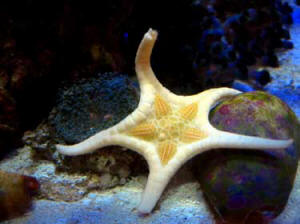
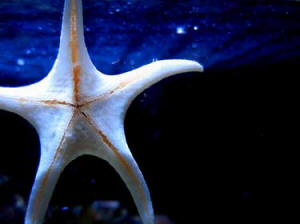
Starfish ID...Fromia Maybe? - 10/21/06 Hello WWM! <<Hey there Ana!>> I bought a sea star recently that is a creamy white color and has a star shape on the top of it in a darker brown color. <<Cool!>> I looked through your site and saw someone with a similar question, but had no luck in trying to identify it. I have searched high and low on Google and have not found anything like it. It also does not hang out on the sand. It is usually found stuck on the glass or grazing on a rock. I have attached some pictures hoping that it will help with the identification. <<I see them...beautiful specimen. It looks to me to be a species of Fromia (its behavior would suggest same)...perhaps a "variant" of Fromia monilis or Fromia nodosa, or an altogether different species within this genus>> Thanks in advance! Ana <<I'm happy to try to help. Eric Russell>>
ID on a Starfish with a "Star" Marking - 08/16/06 Hello, I bought a medium sized white starfish with a star shape in the middle of its body from a local store. I have never seen anything like it. I haven't been able to identify it and the store wasn't able to identify it either. Any idea what it is called? Thanks! Lisa <<Well Lisa, is only a guess but I think what you might have is Astropecten polyacanthus, the Sand-Sifting Starfish. Try a Google search using the scientific and common names and see if you agree. If it is A. polyacanthus, you will need a very large system (hundred gallons or more) with a deep, mature sand bed to sustain this creature for the long term. They are voracious predators on the infauna of the sand bed and can/will decimate populations quickly. Another possibility is that this starfish is a (rare?) color morph of the genus Fromia. Some species of this genus display the "star" marking that you describe...though I don't recall ever seeing a "white" one. Regards, EricR>> Re: ID on a Starfish with a "Star" Marking -
08/16/06 Hi Eric, <<Hello Lisa>> Thanks for the
response. <<Quite welcome>> It's definitely not a sand
sifter, we've had one of those before. <<Ah, okay...(and I
did catch the 'past' tense)>> I haven't seen any
white Fromias with the markings either. It is a smallish to medium
sized flat whitish/crème color with a brown star that looks
like it was stamped on it. The white on the star is very
flat with no lines or any kind of marking on it. Maybe it is
a Fromia morph of some kind. <<Mmm, indeed...but the species
I'm thinking of have a bumpy/pebbly appearance (Fromia monilis and
Fromia nodosa)>> Thanks again! If you think of
anything else it might be, just let me know. <<Afraid I don't
know...perhaps Bob has some idea...>> <Mmm, nope! Many
possibilities. How about a pic? RMF> I hope we're taking care of
it correctly. <<Impossible to say without knowing the
species>> We have a 72 gallon with lots of sand and
rock. But it has stayed on the same one rock with only a
little movement for the last 3 days since we bought it.
<<Hopefully just getting "adjusted">> What would
be our safest bet to feed it? <<Again, without knowing what it is
I can't say with any certainty. Abundant live rock for
grazing is a good start. You might also try small pieces of
marine fish flesh and/or shrimp. And if this is a reef tank,
keep a very close eye to see that it doesn't decide to dine on your
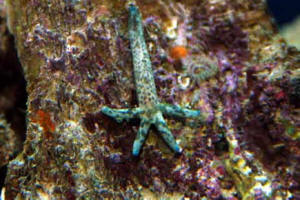
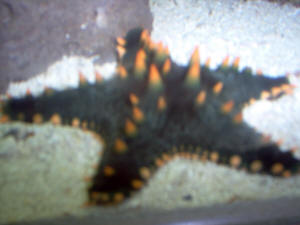
corals>> Lisa <<Regards, Eric Russell>> "Baby Starfish" 7/12/06 Hello WWM Crew, I am a Marine Hobbyist. I have a 75 gallon reef tank. Learning things all the time. Loving it. Tried to search the web on this new issue, but can't find my answer. Did find you, and I'm hoping you have the answer. I'll only mention in this e-mail what I think is relevant to keep this short for you. I have a relatively big (hopefully fully grown) gray (with stripes) serpent starfish, and also an orange starfish (don't know the species off hand--slow moving, smaller). Anyway, this evening I saw a tiny baby starfish in the tank. It moved fast like the serpent. Looked like somebody had tried to take a bite out of a couple legs. It didn't have any color though--just white. I was trying to figure out how the starfish reproduce. Everything I found on reproduction talked about splitting, which didn't happen here. Is it possible my single starfish laid eggs and fertilized itself? They don't cross breed, right? And are they "born" white and color up as they age? And while I'm writing. <No mystery here! The tiny brittle stars are a separate species and were probably introduced with live rock or corals. They often reproduce prolifically in reef tanks. The reproduce by splitting and by direct development (brooding) of young. The are a joyful and beneficial addition!> I lost my very large (7 or 8 inches) Mr. Goby. And then I lost my cleaner shrimp. My daughter thinks the serpent star ate them. Although the coral banded shrimp may have taken the latter. Do you think that is possible that the serpent star ate my fishes? <It is possible, but not likely. Generally, smooth armed (serpent) starfish are considered safe while spiky armed (brittle) starfish, especially the green ones are considered at least risky to small fish and inverts.> I have not been feeding him frozen fish because I was afraid of how much bigger he could get, but maybe I should feed him frozen to keep him from eating everything else. What do you think about that? Thanks in advance for your wisdom. Vickie <As these animals get larger, it gets harder for them to get enough food. Feeding it small bits of food will not only help prevent it from resorting to predation, but will more simply save it from starving. If it eventually outgrows your system, you can either trade it or use it as an excuse to get a bigger tank! Best Regards, AdamC.> Starfish/Reef Compatibility 4/28/06 Hello Crew - got another question: <Shoot> I have a red sea star who engulfs/feeds on my colony yellow and star polyps. It was doing this even when there is abundant algae that it normally eats. I thought this star fish is reef safe (according to LiveAquaria.com). <"red sea star"? That is like asking if anyone saw a brown dog. Please be specific in species name as there are many red sea stars with different feeding habits.> What and how do I spot feed it or take it out? I tried Nori seaweed but it let it go. <Anthony, please send us the species name so we have something to go on.> Thanks, <You're welcome. James (Salty Dog)> Anthony Re: Red Knob Sea Star / African Sea Star - 4/11/2006 Hey, thanks for the reply! One more question: I have seen these starfish with different coloring. I have seen them with a very light grey (almost white) color and the red, and I have seen them with a dark tan/light brown and the red. Why the difference? Thanks again! <Just individual variation, perhaps "genetic drift" expression here. Same species. Have also seen these differences in the wild and captivity. Bob Fenner> Starfish question 11/20/05 I have a quick question for you. I have a Euphyllia paradivisa going through quarantine. I've noticed that it has two small sea stars (1/2" across) attached to it. I've looked through numerous books and haven't been able to properly identify them. The closest picture I can find is in Bob and Tony's book excellent book, Reef Invertebrates, on page 353 of a Oreasteridae sp. I'm concerned they might not be reef safe. Should I remove them or let them be? <I don't have the book so I can't reference that. But, I'm thinking they are probably Asterina stars. Not good to have as some do feed on coral tissue and multiply rapidly by fission. James (Salty Dog)> Thanks for your help! <You're welcome> Tiny white ...starfish? 11/12/2005 You guys have the best aquarium site on the whole entire planet. I have learned so much, including the fact that I am crazy for having a teeny tiny 6 gallon nano reef, but, hey, the Marineland Eclipse setup at Goodwill was only ten bucks so I thought I would give it a go. All is well and has been so for 4 months. <Heeeee!> I have a Bluetail damsel, a peppermint shrimp (thanks to you, no more glass anemones), a Cerith snail, and an emerald crab. 8 pounds of live rock. My friends think I have lost my mind as I invite them to look at it close-up with a magnifying glass, but soon enough, they are enthralled. <Great!> I saw tonight a tiny 5 legged.. starfish? slowly climbing around. It was no more than a quarter inch in diameter, and appeared to be covered in debris, much like a decorator crab. Suddenly it jumped free of the rock and went surfing to a higher perch. I looked around to find what it could be but no luck. I would have stayed up and watched it some more but girl's got to go to bed sometime. <Is likely a "recruit" from your LR... an Asterina species... Please see here: http://www.wetwebmedia.com/asterinafaqs.htm. Bob Fenner> Linckia Stars Dear Crew; I have searched your website many times over the years and I think it is an awesome site. <Thank You> Anyway, my question is what kind of sea star do I have. I purchased a sea star a couple of days ago that the dealer said was a Blue Linckia and I suppose it could be. But it is not blue it is a bluish green color with some mottling on it and blue tips on each of the arms. Otherwise it does look like a Linckia sea star but I don' t know if it actually is Linckia laevigata. Please help. The sea star is fine by the way. <There are many types of Linckia stars. Without a pic of it I could not give you a good answer. Do a search on the WWM, keyword, Linckia starfish, and see if you can find a pic of it. James (Salty Dog)> Thanks, James <Nice name> Sea star ID Hello, In my reef tank I have found a tiny sea star which I have been looking up in the web but I have seen no pics at all, the more similar pic was one of a Asterina sp but from the bottom. <Very common> Unfortunately I have no pic of it but hopefully with the description it would be fine. The animal has no more than 2cm width, from top is of a blue grayish colour with a red/orange ring around the madreporic plate, it has 5 or 6 legs depending on the reproductive stage, which is very often. And I have tens of it. Any idea which species is? <... some Asterina species fit this description closely... Please see the Google Pix here: http://images.google.com/images?q=asterina&hl=en&lr=&sa=N&tab=wi> By the way I have white tiny sponges that I have seen pics of them in the web any idea about the name? <Nope> Hope you could help me, as soon as I get pics I will send them to you Lots of thanks <Even photos make it hard to discern these groups of animals to much more than family level... even for experts in their fields (of which I am not)... Require microscopic examination, sacrificing (taking apart). Bob Fenner> Starfish ID and health 10/14/04 Hello Crew I am an avid reader of your site and have benefited greatly from your advice. Honestly, everything just sort of came together and started working for me when I read and followed the suggestions on your site for frequent small water changes. It is truly nice to have someone to turn to for help who is not taking your money. For some reason, an open cash register seems to magically change a tanks stocking limits and fish temperament /compatibility. Thank you. <Basic care and a little research prevent and solve a lot of problems! Glad you have benefited from what is here.> On to my question... I am trying to get a positive ID of a starfish that I have had for over a year. I was told by the LFS that it was a common red star. But mine doesn't seem to match pics that I have seen on the web. Hopefully you can help. Here's a couple of pics. <Looks like Fromia sp.> Also what information do you have about the life expectancy of this animal? <Should be many years, but it is impossible to know how old the animal was when captured.> He has started acting "weird" and I am wondering if he may be nearing his golden days. His appearance has not changed but I noticed him lying on the sand with all of his legs pointing up several times lately...something he has not done in the past. Also, he was hanging by only one arm from the glass at the top of the tank and just sort of let go and fell to the bottom. I have seen this before but this time he just laid there all crumpled up for a long time before ~slowly~ righting himself. <Could be age, but it really sounds like a water quality issue.> All water parameters are in spec and I have not deviated from any of my normal maintenance routines. <Always list the results of your testing. Trace ammonia, and pH or salinity slightly out of range (especially if sudden) can be very harmful to delicate echinoderms. Salinity in particular should always be near NSW values (1.024-1.026)> I am sure he is not being picked at. <With that big mean harlequin tusk, I wouldn't be so sure!> Any help is greatly appreciated. Thanks again. Kirk <Hope this helps! Please do reply with water quality tests and the brand of salt that you use, and perhaps we can get to the bottom of this. Best Regards. AdamC.> Seastar ID (9/15/04) I have a starfish that was called a north Atlantic star. I haven't found any info on it. The star is black with orange short points all over and orange feet and around its mouth if you have any info please let me know, thanks <I am not familiar with an exact species for that common name. The problem is that common names are not standardized and one cannot be certain what species is being referred to. If it is really from the North Atlantic, then it needs to be in a chilled tank and will die in a tropical tank over time. Can you send a digital picture that I can compare to the many pix I have in several books. If so, please take care to get good focus (using macro mode and no zoom seems to help) and keep the file size to a few hundred KB. Steve Allen.> Miniature skinny seastars I have a 55 gal marine tank.... I have some worms in the bottom sifting thru the live sand and crush coral bed that I have. I have noticed something a little weird... I have seen 5 or so starfish shaped worms in the sand. They are very thin and small.... about 1/2 cm to 1 cm. White color.... 5 legs.... They look exactly like miniature starfish. << Indeed that is exactly what they are. Beneficial and good to see in a tank. >> Any idea of what these are. << You may find them in Calfo/Fenner's book Reef Invertebrates. I'm the lab right now, and not at home where my book is. I'll bet you can find all the info on them you need in there. Just keep 'em growing. >> Thanks Michael Linkous Bluefield, WV << Blundell >> Starfish From Live Rock (6/28/04) Hello I have never bought a starfish but have about 10-13 of them and they are not brittle starfishes. Its been about 4 years since I bought live rock. They are tan in color and not all legs have formed. I'm just wondering. Thanks <Although you do not mention size, I'm guessing these are Asterina stars that seldom exceed 1/2" in diameter. The often proliferate from live rock and are harmless, though there sometimes gets to be way too many (hundreds) in some tanks. You can learn more about them by searching WWM. Steve Allen.> |
|

|
Features: |
|
| Featured Sponsors: |