|
FAQs about Sea Star Identification
4
Related Articles: Sea
Stars, Brittle Stars,
Asterina Stars,
An Introduction to the
Echinoderms: The Sea Stars, Sea Urchins, Sea Cucumbers and
More... By James W. Fatherree, M.Sc.
Related FAQs: Sea
Star ID 1, Sea Star ID 2,
Sea Star ID 3, Seastar ID 5, Seastar ID 6 & CC Star Identification,
Linckia Identification,
Sandsifting Star
ID, & Sea
Stars 1, Sea Stars 2, Sea Stars 3, Sea
Stars 4, Sea Stars 5, Brittle Stars, Seastar Selection, Seastar Compatibility, Seastar Systems, Seastar Behavior, Seastar Feeding, Seastar Reproduction, Seastar Disease, Asterina
Stars, Chocolate Chip Stars,
Crown of Thorns Stars,
Fromia Stars,
Linckia Stars, Linckia Stars 2, Sand-Sifting Stars,
|
|
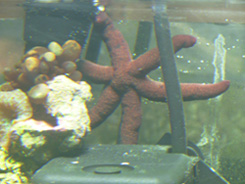
Can you identify this sea star? Fromia
indica 3/31/07 I took this picture in the Great Barrier
Reef recently <Wish I was there!> and I'm curious what
kind of sea star this is. I can't find it in
my reef identification book: http://www.pbase.com/image/76435956 <Does look to me
like a Fromia indica. More here: http://www.wetwebmedia.com/seastars.htm and links in
blue.> Thanks.
<Welcome. Mich>
Doug Sturgess |
|
|
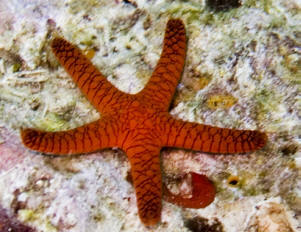
| Oreaster reticulatus...? (Protoreastor
I Think) - 02/28/07 Hello, <<Howdy>> I am in search
of some Sea star identification. A photo of the sea star
that I have is attached. <<Ah yes...good photo...and a
beautiful starfish>> It is currently living in a reef
environment (20 gallon). <<Not a reef-safe specimen>>
At first, I thought it might be the non-reef safe Bahama sea star.
<<This one is a different genus I think (Protoreastor), but
just as non-reef-safe>> All of the photos and descriptions I
have found, however, describe it as red in color. <<Mostly,
yes>> In addition, color aside, the spikes on mine appear
larger, less abundant, and further spaced apart than the typical
Bahama sea star photos I've seen. Any ideas on what
this little 3" guy might be? <<I don't think yours
is a Bahama sea star (Oreaster reticulatus), it looks more to me
like a Protoreastor species...perhaps a variant of P.
lincki>> Thank you in advance for any help! Christopher
Buehler <<Hope I've been helpful. Eric
Russell>> |
| Re: Oreaster
reticulatus...? (Protoreastor I Think) - 02/28/07
Well that's another thing. I have searched for
photos of the species you have suggested and I still cannot seem to
find any sort of photo for it to confirm. Any ideas?
<<Nothing short of a trip to a large university library for
some research...though even then, your sea star could be a
geographical variance of a common species and not habitually
photographed/easily found>> <<Eric Russell>> |
|
Re: Oreaster reticulatus...? (Protoreastor I
Think) - 03/02/07 I have another question for you regarding
this starfish (see your response below).
<<Ok...shoot>> You say he is not reef safe.
<<Yes>> I won't be able to get him to a better
home until the end of next week. I have been keeping
an eye on him and so far he just cruises around the bottom of the
tank and doesn't seem to be bothering anything.
<<Mmm...for now>> What kind of problems should I be
out on the lookout for with this little guy? <<Protoreastor
species will eat sessile invertebrates, becoming more destructive
as they grow/mature. But feeding this small star a few
pieces of meaty foods of a saltwater origin (fresh/frozen shrimp,
clam, scallop...from the local grocer) over the next week
"may" keep it away from your corals until you can
relocate it>> Thank you. <<Happy to assist, Eric
Russell>>
|
|
|
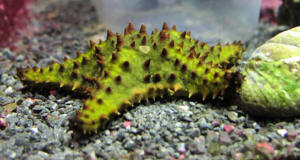
Starfish ID (Fromia sp.?) - 02/28/07 Can you
identify this starfish? <<Looks like a species of Fromia to
me>> I thought that it is a Burgundy Linckia Sea
Star. Is it? <<I don't believe it is,
no>> Thanks. <<Welcome>> Hope that the photos can
help you to identify. Or is it a Nardoa species?
<<Another possibility...try a search of the net re these
genus names (Fromia, Nardoa) and see what you think>> Is it
Reef safe?
<<Is likely so. EricR>> |
| Re: Starfish ID (Fromia sp.?) - 03/01/07
Thanks for your help and I have identified the starfish.
<<Excellent!...and you are welcome>> It's a Fromia
indica. <<Neat...thought it might be>> It looks
different in different region. :) Or it may be a subspecies of it.
<<Possibly... EricR>> |
|
R2: Starfish Identity, RX - 03/02/07 Sorry about
the mistake. I made a mistake. <<...?>>
It's actually a Nardoa galatheae. <<Ah okay, no
worries...you are in the best position to tell>> They look
a bit similar but actually are not. <<Agreed>>
It's a Nardoa star and it eats algae and detritus.
<<Excellent>> It can also help you to eliminate SPS
eating starfishes. <<Really?>> :) Have a nice day.
<<Same to you>> It's doing great in my tank now.
<<Is a beautiful specimen, do enjoy. Eric
Russell>>
|
|
|
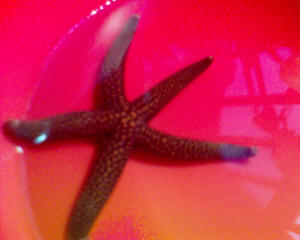
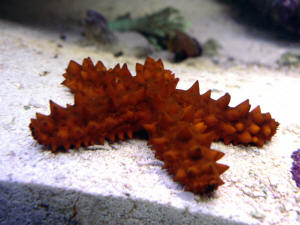
Red Thorny/Knobby Star (Echinaster echinophorus)
Best Left in the Ocean. 2/22/07 Hi Bob, <Hi
K.B.! Mich with you tonight.> My compliments to you
and your staff for the great job you do and your dedication to
education with regard to marines. <Thank you for your kind
words. It is nice to be appreciated.> Quick
identification question for you. Attached are a couple
pics of a red thorny/knobby star that I'm told is
reef-safe. I've searched the web for this star and
have found many similar but cannot confirm its
species. Would you be so kind as to identify the species
and whether or not it is reef-safe? <Does appear to be
Echinaster echinophorus which has a poor survival rate in
captivity. It is believed that the natural diet is
comprised of sponges, but have read reports of it eating meaty
foods in captivity. Reports to be reef safe, but short
lived.> Many, <You're
welcome! -Mich>
K.B.
Re: Red Thorny/Knobby Star (Echinaster
echinophorus) Best Left in the Ocean. 2/22/07
Thanks Mich. I found what I thought was this star in my
research, and I trust now that it was judging by the information
you provided here. <Glad to help.> Thanks again.
<You're welcome. -Mich> |
 |
|
|
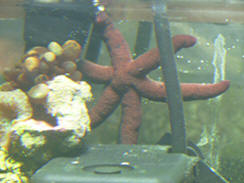
Starfish ID 2/11/07 <Hi Kevin,
Mich here again.> Hmm, I sent 2 pictures but only 1 much of went
through? <My bad. Sorry! The second photo
did not come up on my computer, but must have been accessible to
others as it has been posted on today's
FAQ's. My apologies!> Let me try and send you it
again. It's a front view but not super close up. It has 6 legs.
<I do think this is a Linckia species, which generally don't
do very well in captivity. Some reddish looking Linckia,
typically speckled, not solid red (Linckia multifora) may do better
than the Blue Linckia (Linckia laevigata). Thanks
<Welcome! -Mich>
Kevin |
|
|
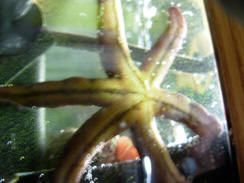
Starfish Id ...Photo of Underside ...More
Conscientious in the Future - 02/11/2007 <Hi Kevin! Mich
here.> I bought this starfish the other day from the LFS and
they didn't know what kind it is. It has 6 legs and looks
similar to Linckia so it has been assumed that it is reef safe.
<Assumed!?!? Better to know, than to assume.>
<<Sabrina F here, pointing out the fang blennies that look
like cleaner wrasses, but most assuredly do not have the same
feeding behaviors.... -SCF>> Is it reef safe?
<Can't tell from looking at it's backside.> Will it
harm my T. Crocea clam ? <Hopefully not, but a picture showing
it's front side would be much more helpful.> I really
don't want anything to happen because of this new starfish.
<My friend, I urge you to use this situation as a learning
experience. In the future I would suggest you be more
conscientious and know the care requirements and compatibility
issues before making any purchases. There are many
starfish that don't do well in captivity. For many,
the nutritional requirements are poorly understood and the
beautiful creatures slowly
starve.> Thanks
Kevin
<Welcome. -Mich> |
|
|
|
|

