|
|
| Home | Marine Aquariums |
Freshwater Aquariums |
Planted Aquariums |
Brackish Systems |
Ponds,
lakes & fountains |
Turtles & Amphibians |
Aquatic Business |
Aquatic Science |
Ask the WWM Crew a Question |
| Please visit our Sponsors | ||||
Falling Spines/Teeth on
Sea Star 11/7/10
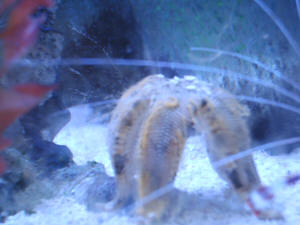
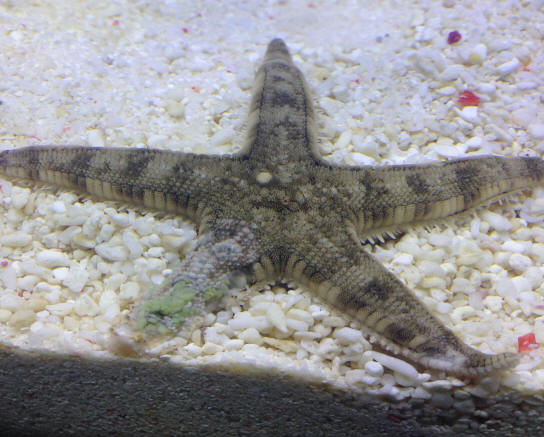
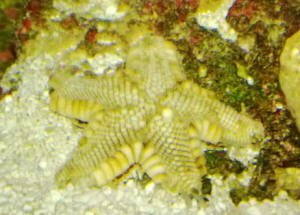
Sand sifting star rotting leg...PLEASE HELP!!! 9/16/06 HI, <Hello> have a 55 gal. tank, 70+ lbs live rock, 4+ inches of sand coral mix a few blue leg crabs and turbo snails. The reason I write is my sand sifting sea star is starting to, well, come apart. His leg became white & finally, I guess, rotted off in about a 24 hour span of time. <Very bad...> He is new to my tank. It's a tank I bought recently & relocated (water & all) after they sold the fish out of it. It was set up for about 3 years. My salinity & PH & everything else was absolutely perfect. I bought this star at the local pet shop & the guy running it told me to acclimate for 15 min... I had never heard of such, so I was going to go longer like I had read in the past online (2-3 hrs). but the bag sprung a leak after I got home & he only got about 45 min. Is this the problem or do you suspect something else? <This animal is almost assuredly dead by now, or soon...> How long before he regenerates - if he can... The leg turned white & began to burst at the edges & then appear to rot off about 24 hrs after introduction to the tank & the process of loosing the leg took about 24 hrs more before it was completely gone. He moves about the tank but has a gross stump with fingery brown stuff hanging out of it.. Suggestions and info about the how it happened, why it happened & what now appreciated greatly. Should I return him or wait it out or what? <Return? Please read here: http://www.wetwebmedia.com/sndsftstrfaqs.htm and the linked files above, particularly on Asteroid Disease/Health. Bob Fenner> Best, Brian Steward Archaster typicus, sys., dis. 8/13/06 Hello WWM: Thank you for posting this life saving web site! <Welcome> I was "sold" a rather small Sand Crawler Starfish for my 20 gal. <Yikes... too small to sustain a specimen of this species food-wise> I was shocked to see the tips of this poor invertebrate decaying. Thanks to your FAQ section, I immediately ran out and purchased a turkey baster (sorry no syringes available) and loaded it up with "Mysis" frozen shrimp. Injected the thawed mixture, under the sand, near the starfish. What are the odds of survival if I continue this process through perpetuity?? Feeling guilty in Fishers, IN. <Better than without your careful, compassionate input here. Do keep close tabs on your water quality. I wish you life. Bob Fenner> Re: Archaster typicus-addendum It's "Mysis" shrimp, not "Mysis". Sorry about the miscue on the food. <No worries, understood> Data on tank: 20 Gallons-Hexagon Rena Canister filtration Aquarium Systems skimmer Blue Damsel Purple and Yellow Damsel Cardinal Fish Small live rock All fish healthy: Brine, Bloodworm and Mysis diet. Help save "Star" the Starfish (my 10 yr. old named him/her/it)! <Bob Fenner> Archaster Star corrosion, Aiptasia removal success 4/20/06 Hi there! I was looking for information on why my sand sifter star seems to be losing the tips of his legs (29 gallon tank, has been set up for 20 months with one complete disassembly to move it downstairs). <Too small a space for this species... not enough room for endogenous food production> I finally found the information on your site, along with the information that I have too small a tank - and I really appreciate how you answer all those emails. You have also in the past had great information on getting rid of Aiptasia anemones (I managed to get over 72 of them in my tank - that was just what I could count!). I ended up removing the various shrimps from my tank, added 4 peppermint shrimps, and later 2 Berghia nudibranchs (although once they disappear in your live rock tank, it is impossible to find them again). The last few tenacious anemones I was able to get rid of by either covering them with a thick Kalkwasser paste (just thin enough to squeeze out of a syringe needle tip) of injecting them with lemon juice (I eventually went with this because I thought it was slightly less dangerous to the tank). I have finally gotten rid of all the Aiptasia, and so my corals are very happy...will be resolving my Sandsifter problem soon I hope. Thanks again for all your help, Kerstin DeRolf:-) <Bob Fenner> Re: Sand Sifting Star, Archaster typicus fell apart! Resurrected! 4/25/06 I was cleaning out my email and stumbled on this! I thought to myself "Maybe I should follow up with Bob, Anthony and Crew. They probably don't get enough good news!" <We don't> It seems that whatever did the first one in (I still say it was a Mithrax crab that has since passed on; I'm guessing of old age, I'd had him for about 3yrs) has passed on. The remaining Archaster typicus, the one that had the pinched tip in a later email (I was worried about him as well; not sure if Anthony will recall that, probably not with the volume you guys get! :)) recovered completely and still skitters around my tank 2+ years later. <Antoine's no longer about these parts> I figure with all the dreadful requests for help you guys get, an organism thriving instead would be something you'd like to hear about. :) Bob, Anthony (et al), thanks so much. You folks provide an invaluable resource to all aquatic hobbyists of all skill levels. Jeff <Thanks for this. Bob Fenner> Sand Sifting Star fish...dying? Hi, I have a 55 gal FOWLR and some inverts - cleaner shrimp, peppermint shrimp, snails and hermit crabs, and two sand sifting stars. One of them is acting odd. It is rolling over exposing its underside. It's legs aren't really twisted or curled much. Not much movement on it's suction thingies either. But if I flip him he'll move around a bit and flip again. I can't compare him to the other, because I can't locate him. I do a 20% change every week to 2 weeks. My nitrates hover around 20 to 25, but other than that my readings are all right on. My cleaner shrimp molted last night, so I think the water is okay. I did recently loose a urchin. My yellow tang picked the spines off and finally ate him. Some of those spines are still mixed in the substrate. Is it possible that the star 'stung' himself? Will those spines break down and raise my nitrates? Have any thoughts on getting them out? Tweezers? I also just recently added two large wads of Caulerpa, but the star (my son calls him Patrick - from Sponge Bob) was acting odd before that addition. Thanks for your input, Mike <I would advise you lower your nitrates to accommodate inverts. Check any sponges, filters, etc. and clean regularly (at least weekly). You don't mention the type of substrate, but if it is coarse and can trap a lot of waste, take care of that. Do test for ammonia and nitrite.... I would remove the spines, perhaps with a net? Maybe think about adding live rock and sand to keep inverts with lower nitrates. Hope this helps! Craig> Falling Star? Hello gang, <Scott F. your man tonight!> Our sandsifting star lost the tip of one of its legs. He is healthy and happy. I have not taken the tip of the leg out of the tank yet. I was wondering will that little bit of leg regenerate into another star or is he not the species that does that? <Well, most starfishes display remarkable regenerative processes, and with steady, high water quality and careful observation, the animal should be okay...If it really starts to decline, you will want to remove the animal to a separate aquarium for more intensive observation and possible treatment with antibiotics to avoid infection as a result of the damage. Also, re-check all water conditions in your tank to make sure that environment did not play a factor in this problem, or think about the animal's companions in the tank...could any of them have harassed the animal to the point where it suffered this damage?> I know he will regenerate his leg if we take good care of him. Thanks Very Much. David and Christy Evans <I'll bet that it will, too! Good luck! Regards, Scott F.> David W. Evans Sand-Shifting Star Issues (8/17/04) Hello Crew, <Hi. Steve Allen tonight.> I have a question, Is it normal for a sand sifter Starfish To climb the tank and glass. <I would not consider it abnormal, but it may mean that it's not finding enough food in the sand. These voracious eaters can rid a sandbed of all life other than bacteria, though yours ought to be big enough to keep up.> I have 140 Gal, 1 year old. 150 lbs of rock, and I see copepods like you see ants on a hill. They are all over. <Are they on the sand too?> Every so often he climbs the tank. I also will see little white bugs on the glass. <Could be he senses them and is going after them. Or maybe he just wants to see the world. ;)> Also are you supposed to try to feed it shrimp? LFS said to put it on a piece of shrimp, tried it once and he ran away from it and does not eat it. <Stars often do not like being handled and will run away as soon as you let go. However, I hand feed all of my big stars. (I have no Archaster, however.) Sometimes they eat and sometimes they don't. A couple of them seem to have specific tastes. Perhaps it would take mussels or squid or something else. Perhaps it is getting enough already--many folks do not hand feed Archaster typicus. I would not worry about its wanderings as long as it appears healthy and is not wasting away.> Also , I have a Bubble tip Anemone, I feed it shrimp with Secor (Sometimes with Secor) but every 3 days he eats, was doing good. for 5 days now he has been hiding behind a rock with the clowns, it is like he is hiding from the light. <Not a good thing. They generally like lots of light--need it to survive/thrive.> Have not changed any lighting or anything in the tank Readings are all normal, He will not eat but I still see he is alive. <Hard to say what the trouble is here. I have not kept anemones because of my personal opinion that they should be left in the sea because too many die in tanks. I would recommend you read the anemone articles and FAQs on WWM, check for articles at www.reefkeeping.com and look for the article on BTAs published a few months back in Aquarium Fish Magazine at your local library. If you do not find these helpful, submit a new query about the BTA only and I will see to it that it gets routed to someone with more experience. Your query came to me because I'm into echinoderms.> Than you for your help <I hope this does help.> Sand sifting star is dying Hello. << Hi, Blundell here. >> My husband and I got a sand sifter starfish 2 days ago. << I'm not a fan of these guys, I hope he does well for you. >> I noticed after one day that one of the legs of the star had been chewed off, at least it looked that way. << Hmm, not sure what would eat them, so I'm surprised here. >> Here is my setup and I am wondering who the culprit is. 72 gallon with LR, fine sand substrate and the following: Percula clown fish scooter blenny six line wrasse << That would be a stretch, but a long shot possibility. >> 2 cleaner shrimp 1 coral banded shrimp << Another possibility. >> 2 sally Lightfoots 1 emerald crab assorted corals The only one that I can think of that may do this is the six line wrasse but I haven't found anything out there saying a six line and a starfish are not compatible nor have I seen him near the star. << Yah, I would think a water condition is much more likely. >> The starfish isn't looking so great and I am not sure what to do for him. Also, I am wondering if his detached leg will regenerate. << I would think so. >> This sounds odd to me but I think I read somewhere that the leg may be able to regenerate if some of the body was attached...if not, should I remove the leg? Not sure if I need to catch six line and put him in time out. Any ideas on this one? << I would just wait it out. Anything you do to the star could cause excess stress. And why would anyone take out their Sixline wrasse? I mean come on those are some way cool fish. So I wouldn't do anything in this case. >> Water Chemistry: 0 - Ammonia, Nitrite, Nitrate. Ph-8.2; Salinity - 30 SG: 1.022 Any help you can provide would be much appreciated. Thanks. << Those stars require a lot of microfauna to survive. They need many pods, so that is your best bet for keeping him alive and thriving. >> Michelle Peralta << Blundell >> Melting Star (8/31/04) Hi crew, <Hello! Steve Allen today.> I have a sand sifting star in my QT, that's losing an arm per day (it's down to 2 now). It's still alive (I turn it over, and it turns itself back). Oddly enough, another sand sifter I have in the same tank is perfectly fine (I also have a maroon clown in there too). I do 20% water changes from the main tank every other day, water quality is fine (all zeros nitrate/nitrite/ammonia, ph 8.2, 1.024 specific gravity). My questions are: what's causing this, will it affect the other star, and will it effect the clown, and, frankly, should I just remove the affected star? <Hard to be certain, but it is often a bacterial infection or "rot" that is seldom reversible.> Also, I'm running a UV sterilizer in the QT (which I only use for the QT when I'm quarantining, otherwise it's off, so bulb life hopefully shouldn't be an issue), and the affected star in question had a white bead embedded in its center disc (best way I can describe it) ever since I bought it. <Uncertain what this could be.> Not sure if that information will help, but figured I'd add it anyway :) Thanks in advance, Rob <Well, most of these problems remain a mystery. Whatever it is, the UV isn't helping. I'm impressed that your water quality remains high. (Of course, there may be other toxins in there.) Stars do need very stable water conditions, especially pH and SG. Personally, I'd remove the star. At this point, there is little hope of it recovering, and its ongoing disintegration is a constant threat to water quality.> Taking Care of A Sick Starfish I recently received 3 sand sifters 2 are doing fine, but 1 is loosing its appendages. Water is 125 gal FOWLR 55# live rock tank is staffed with 2 small percula clown and a goby with 25 snails( 10 Nassarius 9 turbo and 6 margaritas) ammonia 0.0 nitrite .2 ppm nitrates 0 ph 8.3. What is wrong with the star and is it contagious? <Well, your water conditions sound just fine, so it's probably not an environmental problem in your tank. It could have been caused by a trauma of some sort, or, more commonly, by Vibrio bacteria infection.> Should I get him out of the tank or is this something he will heal from. He lost the tip of one and most of a second. As always I love reading your faq but find nothing on the star. <I'd remove the injured specimen to a separate aquarium for possible treatment, as well as a precaution against possible pollution if he dies undetected. Furan-based medications or antibiotics can help treat these problems. If you do effect a cure, the animal has amazing regenerative capabilities, and there is a good chance that it will grow back the missing sections of it's legs. Give a treatment tank a shot...Good luck! Regards, Scott F> Starfish Questions (2/7/04) Hi there (whoever is filling in, or if you are), <Steve Allen tonight.> You guys have been so helpful in the past, thank you for the great site. <Great to hear. This site helps me everyday too.> I looked through the website but nothing answered my questions directly, perhaps I missed the answers. I had sent an email concerning sumps, anemones and something or rather but did not receive a reply, not sure when I sent it (about a week ago), just wondering if you got it. <I haven't seen it myself. If you still need an answer, re-send.> Today (Thursday, Feb. 5th) I found my starfish dead Sandsifter). <Sorry to hear.> Two of the legs looked as though they had melted and the center (at the anus) had caved in. <Yuck. They do decay quickly when dead/dying.> I tried to supplement it with food but it wanted nothing to do with anything I tried. It had been acting really strange as of late, but was fine when I fist got it. It acted normally for about a month, then in 4-5 days just stopped moving. <Sounds like some sort to toxin or bacterial infection. Stars are particularly vulnerable to both.> I have a 90 gallon tank with ~40 pounds of live rock so far, 3 clowns, 1 algae blenny, 1 coral banded shrimp and 12 hermit crabs. The parameters of the tank were, when I found it dead: pH 8.2, ammonia 0 ppm, nitrite 0 ppm, nitrate 10-15 ppm and salinity at 1.0205. <Do you mean 1.025? Better to keep it at this level (and very stable) for stars. They need normal seawater SG and are very sensitive to fluctuation.> I was just curious as to what may have happened and if the other inhabitants can catch it?? <If a coin, others could be vulnerable. Bacterial infection, not really. Echinoderms don't have as much immunity as fish do. Consider a water change (& slowly increase SG to 1.024-1.025 range) and carbon/PolyFilter.> I also had a couple of questions concerning clownfish behavior which I wasn't able to find through your website. At night the 3 clownfish kind of float on their sides at the top of the tank in the corner closest to the skimmer and heater, is this normal?? <Yes> They swim around all day and seem to be acting normal. They have done this since day 1. <No worries> Also one of the clowns keeps "picking" at the one of the other ones, sorry I don't know how else to describe it. <Typical. Threesomes don't work for clownfish. The one that is being picked on is doomed eventually. I'd get it out of there and into a safer place before it is damaged or killed.> Finally I read that clownfish are not able to inhabit an anemone if they have been raised away from one. <Not true exactly. Probably less likely to, but even old ones sometimes never do wither in the artificial, small environment of a marine tank.> My clowns are Amphiprion ocellaris which were tank raised. If I introduce an anemone to the system some time in the future will they be able to inhabit it?? <Perhaps (but only a pair). However, anemones are VERY difficult to care for and should not be mixed with corals and limit your fish choices to. Best to avoid until you've been at this for a couple of years, if ever.> Again, thank you very much for all the help, Todd Hawman <Hope this does.> Questions about Sandsifter Starfish (9/16/04) This is a picture of my Sandsifter that I have had in my 100 GL aquarium for at least two years. <Nice picture.> I have never seen him/her exhibit this type of posture/behavior. I have been noticing him in this position (off and on) for about the last three days. Is this something I should be concerned about? Thank you for your input! Donna Albright <This is a posture that many types of stars assume when eating corals and bivalves. As to why your Sandsifter is doing this, I cannot say. As long as it is moving around normally and shows no wounds or blemishes, I doubt there is reason for concern. Steve Allen.> Sandsifter Starfish Follow-up Unhappy follow-up! The starfish in question died Saturday. I think that there possibly wasn't enough for him to eat in my tank. Is there any additional additives I can feed to the starfish when they run out of natural foods? I have another star of the same type that is about twice as large as this one. Thanks! Donna >>>He Donna, I would stay away from sand sifting stars, as it's very difficult to provide them with enough food over the long haul. 100 gallons is a relatively small tank. Jim<<< Super Sick Sea Star >Hello hello! >>Hello. >Ok, background...um, I have a 55 gal salt tank, probably 50 or 60 pounds of LR, ~120 pounds of LS, a skimmer than I run sporadically. >>Curious as to why sporadically, unless you're also running a good refugium. >A good filter and all tank specifications are good except recently I noticed a tad of ammonia in the tank about (.25ppm) so I did a water change and the ammonia didn't get any better... huh ponder ponder, sure enough the tap water itself has ammonia issues. >>Damn! Good backtracking, though. >Ok, so I have fixed that issue and now the water I use for changes measures in at 0ppm for ammonia. The tank is also registering 0ppm. The ammonia problem actually occurred maybe two weeks ago and sometime around then my starfish - Archaster typicus - >>Commonly known as a burrowing star, or white burrowing star. >..began slowly falling apart. >>This is NOT good. >In my mind these events only very roughly happened about the same time, but ammonia is a huge player in tank problems so it's worth mentioning. >>Absolutely, and it's enough to send the animal over the edge. >Anyway, I think he may have been injured by another fish (taste-testing maybe?), it started as almost a bite-sized piece missing out of one of his legs, I am almost certain that none of the fish are picking at him anymore (I have never once seen them take a shot at him, although that doesn't mean they don't do it anyway) >>Not unlikely, but just as likely that the animal is dying, as it would look just as you described. >..but this little bite-sized hole has spread, and his body is systematically falling apart. It's very odd, I mean I can tell you exactly which piece will fall of next, it has a definite pattern, the "skin" stops fitting his legs closely, and then the little "bumpers" on the sides of his legs fall off and then a few days later the boning structure that supported it all, falls off. >>Once you've seen enough starfish go, it's not odd at all. Disheartening, but not odd. >It's definitely not the work of another fish at this point...He's moving around like normal but right after the first little spot was missing I did notice that he acted a little sick...I read your FAQs but most people either weren't working with the same species I have or they described his legs as being mushy in appearance, his legs are definitely not mushy, they are like normal, except all the components of his legs are dis-associating...it's very sad to see, I've had this guy for a year come December. He hasn't been moved recently, and the tank has been stable in its animal life (excepting the addition of a pair of scarlet cleaner shrimp), so there's really been nothing new to stress him. I would normally guess the ammonia caused his problems, but the scarlet shrimp have been breeding continuously through the ammonia problem and ever since, having larger and larger broods, while this poor star has been getting worse and worse -- even though the ammonia is gone. I don't know whose indicators to trust when I'm trying to figure out the problem! I'm so sorry this is so long, and thank you so much for your patience and advice, it's very much appreciated. :) Rachael >>Rachael, other inverts are not always the best indicators of water quality when considering starfishes. They're definitely more delicate than the shrimps, and I'd wager the ammonia problem touched off a bad series of events. However, if it's still alive all is not lost. I would set it up in a small hospital, and try Spectrogram. I've seen this stuff pull other starfish looking VERY bad back to the land of the living (at Long Beach Aquarium of the Pacific, MUCH to my surprise, as I thought they were GONERS). So, give this a try, use water from the main system, mixed half and half with newly mixed water. Plan on doing large water changes daily, so a 2-5 gallon bucket should work just fine for the starfish. Hope this has gotten to you in time, and I do hope it helps! Marina Sand Sifting Starfish Hi Crew...I hope this finds you doing well. Bob, if you are around, it was quite an honor to meet you and hear you talk at the MARS meeting in November. Thank you! <A pleasure to share> My question is in regard to my sand sifting starfish. I have had this animal for about 3 1/2 years, and until just recently it has been great. Last night, however, I noticed that is not looking good. It is still active, but it is definitely skinnier and several legs look damaged. <Not good signs... typically nutritionally related, but could have summat to do with water quality as well... or?> Two legs are shorter than the others, and one is crooked...almost like it has been broken. I recently added a green carpet anemone to this tank (100g with 2x250 MH and 4x55w PC) and suspect that it could be involved (like it may also be involved in the disappearance of one of my skunk cleaners). <Yes> Water param.s are all great with the exception of a moderate level of NO3...I'm working on that...but I don't think that is the issue as this tank has habitually had detectible NO3. Could it be that my starfish is getting old? <Mmm, not likely. Turns out some investigators consider the group of spiny-skinned animals (echinoderms... urchins, sea cucumbers, crinoids...) immortal... that's right, beyond senescence. They don't "get old"> What is the suspected lifespan of this animal? My first thought was that it was starving, but it has never been interested in any food that I offered so that avenue is a brick wall. Any suggestions? Once again...thanks! Jason <I would move this Archaster to another system if you have one... most likely solution to whatever might be "ailing it". Barring this I would switch out or add more/new live rock (a good general cure-all...). Bob Fenner> Sand Sifting Star, Archaster typicus fell apart! Howdy guys! <howdy> Once again, thanks for the awesome site Bob and Crew! Hours and hours and hours of excellent reading! Always an education. :-) <for us as well> I have a 70g new-ish reef (<1yr), 90lbs of excellent live rock, 60lbs live Carib Sea Sand, Pro Clear 150g wet/dry sump w/ skimmer, Eheim pump (700gal/hr), Current USA Orbit Quad Dual (10000K White / 6700K, Dual Actinic - 7100K Blue / Actinic 03) power compacts, Ebo Jager 250w heater. I add ESV B-Ionic 2-part Alk/Calc buffer system and Magnesium daily. Water: Ammonia/Nitrate/Nitrite - 0, SG: 1.0245, Calc: 460, dKH: 11, Alk: 3.1, <easy on the calcium my friend... 460 is too high and the very reason why your ALK is low/flat. Aim for more even keeled ranges. 350-425ppm Ca and 8-12 dKH ALK... but neither high at the same time> PH: 8.3, Phos: <0.1, Temp: daily low/high: 79.4-80.2. I do about a 20% water change monthly currently, but have thought about doing 10% twice a month instead. <much better... or more> Livestock: 2 False Clowns (Amphiprion ocellaris), 1 Scooter Blenny (Synchiropus ocellatus), 1 Rainford Goby (Amblygobius rainfordi). That's it fish-wise. Inverts and other stuff: 3 Emerald Crabs (1 BIG one; ~2.5-3" across including legs), 1 Sally Lightfoot Crab, 3 Hermit Crabs (1 red-legged), 2 Fire Shrimp, 10 various snails, 1 Abalone, 2 Sand Sifting Stars (Archaster typicus). <yikes... your tank and sand bed (depth) is not large enough to sustain even one Archaster sand star for even six months. They will starve to death... needing DSBs of 4-6" and tanks over 100 galls minimum (over 8 sq. ft of open sand min.) to have a prayer of surviving> I had 3 Stars, hence this email. About 3 or 4 days ago, one started visibly "falling apart". A chunk of a leg, then the whole leg. Today it started coming apart from the center and would not turn over when flipped on it's back, though it's "feet" were still barely moving; I thought a sure sign it was dying so I removed it immediately and put it in my QT tank. It died (at least I think it did) shortly there after; went rigid and non-responsive. I, of course being as paranoid as I am, panicked and checked all of the water, filtration, my fish, the other stars and all the livestock I could see (the crabs like to hide during the day). As far as I can tell, everything is hunky-dory except for that Star. I hadn't had it for long, a few months tops, but it seemed fine up until a few days ago. <they are poor shippers... it could be that simple> There was no necrotic or dead/hanging tissue, so I was really puzzled. Immediately I blamed "Hulk" (the big Emerald crab) as it seemed like the only critter capable of doing it. <this is true/possible> Just wondering if you guys could lend any insight here. Thanks! :-) ~Jeff <many possible reasons... without knowing how long you've had any of the three stars, I cannot say if it was attrition or not. I can say that you need not buy any more. Arriving healthy, they WILL starve to death in a short while. Most Asteroid species need 100-200 gall tanks min. Without them you get stories like this one or hear the blue Linckia stars are "hard to keep". Ahh... not so. Just not adaptable to small/home sized aquaria. Best regards, Anthony> Re: Sand Sifting Star, Archaster typicus fell apart! Ah, a nightcrawler like myself! ;) <actively writing... nicely quiet time :)> Thank you again, Anthony for the reply. I appreciate your time, indeed. <always welcome> Unfortunately, another one is starting to shed the tip of it's leg. I contacted my friend at the LFS (they generally have outstanding stock) and he said he'd be happy to give me store credit on the healthy one (as this one is shedding it's tip, it probably isn't considered "healthy"). So I guess I will just have to ride it out with this last one that's losing it's tip. I can't very well give it to someone when I do not know what's wrong with it. <you might consider rotating specimens between friends/tanks in the local/regional hobby club> I tried to take a picture of it, though it's difficult to focus that small. This is about the best I could do: http://65.124.75.190/starfish1.jpg You can see the tip of one arm starting to "pinch" and come apart. That's how it started with the other one. <a very bad sign indeed> I cannot put it in QT at the moment either. My old QT tank sprung a leak. I picked up a new combo setup (stand/tank) and plan on taking the 20g out of my main tank when I do the water change this weekend and putting it in the QT tank. So it would be at least Sunday before I could QT it. <Ack... no, mate. Anything that holds water can be a QT tank. Tupperware, Rubbermaid containers, etc... hang the power filter on or drop the sponge filter in, etc. Place heaters inside of PVC tubes so as not to melt the sides of the vessel, etc> I tested my Alk/DKH again this evening and it came back as such: 3.77/10.6, using the Salifert test kit. Is this closer to my target? I am doing a water change Sunday (my change water has been circulating with a powerhead in a Brute garbage can since Wednesday). I have about half a bucket of the Oceanic Natural Sea Salt (had the name wrong) left. If this is an inferior product I have no problem ditching the remaining and getting something else. What would you recommend? <like most salts... it requires water testing and adjusting to suit your specific needs. I'd recommend Tropic Marin sea salt above at currently> I'm also preparing my water with the Kent Marine Ammonia Detox. <I would not recommend this... not needed> I know a lot of people do not like Kent Marine, <bingo> but I've thus far had no problems. <OK> I will likely just use up this bottle and move to Seachem next. I do not have an RO/DI unit, but I do have a central water softener (Potassium Chloride). The water where we live is outstanding (very rural area) as it is drawn from an enormous aquifer deep underground here (the Edwards Aquifer). <very nice... the water softener may not even be needed> I plan on getting an RO unit eventually, though I'm not sure I need it. <agreed> What should I be looking for when I test my plain water pre-additives? <look for phosphates and get a bead on hardness for adjustment> Not sure if I mentioned this earlier, but I am using the ESV 2 part B-Ionic buffer for Alk/Ca. <very fine... but be sure to shake all such supplement vigorously before every use... else they may get dosed imbalanced> I've backed off on the Ca additive until I get it down to where I want it (not sure if that's the right thing to do or not, but it made sense to me). <correct... or simply add some calcium hydroxide or Chloride to get on par then carry on with balanced 2-part mixes> I also add a little Magnesium (per the dosage req.) and Iron once a week (very small amount, the min recommend, which is 8 drops). Both are ESV products. <a fine company> Thank you again, Anthony! I need to send you guys some Xmas presents. :D <your success with healthy animals is the best gift of all. Anthony> Sand Sifting Star, Archaster typicus fell apart! III 11/1/04 Thank you again for the thoughtful and insightful reply! :) <always welcome> One thing is different with this particular specimen. The other Archaster lost the tip, then the rest of the arm very quickly. This one has not lost the tip. As a matter of fact, the "pinch" has been reduced. It almost seems to be re-attaching (if that's even possible)! Could this indeed be an injury from a full-grown Emerald Crab (approx 2.5" across)? <yes... most crabs are ultimately not safe in reef aquaria. They are opportunistic> I have found homes for both of them and will be moving them in the next week. One is going back to the LFS where my buddy Jason has a large tank that they grow Caulerpa racemosa and mexicana in (close to 400g I believe; the tank was damaged high up on the glass, so they fill it about 1/3 of the way and cultivate Caulerpa in it now). It's got a fairly DSB (probably 2-3") and I'd imagine they'll be happy in there. He agreed to take the possibly "sick" one as the tank is isolated from the main system in the store. <excellent> Can you recommend a Calcium Hydroxide or Chloride product for Ca balancing? <many good ones out there. Seachem for quality overall. B-Ionic too... very good> Once I am through with this bucket of Oceanic, I will give Tropic Marin a shot. <TM is the top shelf brand and well worth it IMO> I've not had any problems with Oceanic and it seems to dissolve really well, but I'm always game for improvement. :) Thanks again, Anthony. :) -Jeff <kindly, Anthony> Sand Sifting Star, Archaster typicus fell apart! II 10/29/04 Thanks for the quick response, Anthony! :) <always welcome> My sand bed is about 4" thick uniformly. The tank is a 70g tall: 36x18x251/2. I bought extra sand just to have a thicker bed. <good depth as a DSB for NNR... but still too small for a sand sifting starfish. The footprint here is VERY small... and rocks cape covers even more of it. There is absolutely no way a single Archaster could live in this tank long term> The stars are have been in the tank for ~3.5 mo.s tops. I will not get anymore, as I don't think I could support them and have no desire to buy things I'm just going to kill due to malnutrition. <good to hear my friend. Bob and I do cover this subject (Asteroid stars) in great(er) depth in "Reef Invertebrates" (2003)> The one that died was (I think) full-grown; approx. 3.5" across. The two remaining are much smaller; 2-2.5" across. <please do trade or sell them ASAP. They really cant see more than 6 months if that on a bed this small> I had concerns about my calcium, so I've been working on getting it down with water changes. <good move> I was shooting for 420ish (or is that still a bit too high?). <no worries... 420 is quite fine... and expect ALK to run8 at 8-10 dKH> I figured my inverts must be loving it, the Fire Shrimp and Sally Lightfoot have both molted numerous times in the last six months. I use Oceanic Instant Ocean salt. <this sea salt "cheats" in giving the illusion of high calcium with really quite poor ALK in many folks opinion. Do test your ALK on a new batch of seawater and you will see.> There's a few spots that I allow some hair algae to grow on some of my live rock for my Blenny and Goby (as they enjoy nibbling in it). The stars occasionally seem to enjoy it as well. Is this a sign of starvation or they're just expanding their palette a bit? <tough to say... perhaps the latter as many/most are adaptable and not obligate> Also, on a slightly different yet related note, I've had a semi-recent explosion of Copepods. Well not explosion, but quite a few (hundreds probably) are easily visible on all glass surfaces. I have some Caulerpa mexicana and Caulerpa racemosa attached to fist sized pieces of live rock that came from a mature refugium to jump-start pod production for my Goby and Blenny (among other things). The majority of my live rock also came from a mature reef system that was torn down and sold. I had some pods immediately, but it seems in the last two weeks or so, the growth has been exponential. <very nice> I guess I just wanted to make sure that there's nothing wrong with this and I shouldn't worry about it. <no problem at all... a benefit, indeed> My fish seem to be enjoying it. They are both noticeably growing and somewhat "chubby". Thanks in advance for all your time, Anthony! :) You guys rock. :) ~Jeff <kindly, Anthony> Re: Sand Sifting Star, Archaster typicus fell apart! Actually, that would be a relief really. :) <Good to hear/read> I was starting to worry about all these Archaster's. As an update, the one with the "pinched tip" on it's arm is still fine! The tip has not fallen off, it is still appearing to mend. :) Thanks! <Good. Bob Fenner> Sick Starfish You guys are great. I'm having a problem with my starfish. I had 3 sandsifting stars and all there legs started to fall off and eventually they died. I also had a red Bali starfish that I ordered on line. It was doing fine until a couple of days ago when it was missing a leg. I noticed that the tips of the legs are turning white and almost disintegrated. What causes this and what can I do about it? <Please read here: http://www.wetwebmedia.com/stardisfaqs.htm and the linked files above (in blue)> 29 gallon tank that's a little over a year old. Checked all levels and everything was zero except for ammonia - 0.25. So I did a 25% water change but he's getting worse. How can I save him. Is he contagious? Tank mates are 1 yellow tang, 2 true Percs, 1 damsel, 1 algae blenny, hermit crabs, snails, and 2 cleaner shrimp & 2 peppermint shrimp. Any help would be great. Thanks <Your system is too small... there's not enough to eat... these animals are not easily kept... Bob Fenner> Sand Sifting Seastar - Adam Cesnales' Reply 1/31/05 I have some question regarding a sand sifting sea star. I just recently set up a 37 gallon tank with about 2 inches of sand in the bottom and a nice lonely 4 # piece of live rock (that stuff is expensive!!). <...But worth its weight in gold! The stability that comes from 1/2-1 lb per gallon or so of live rock will save you hundreds of dollars or more in livestock. Add more with caution... if it has not been well cycled, it could cause a dangerous ammonia spike.> I have one blue damsel and a coral beauty (so beautiful). I have had my tank like this for about 3 weeks and the sand started to get a little dirty looking. So I went to my local aquarium store and they told me that I needed a clean up crew. So he goes off and gets me 3 snails and 3 crabs (the ones that are in the shell). <These are reasonable numbers. Usually, cleanup crews are way oversold.> I figured this was all well and fine and then he told me I should get a sand sifting star. I asked him "isn't my tank to small" and he told me that he has been doing this for like 7 years and it will be fine. <These sand sifting stars feed on the critters that you paid all of that good money for when you bought live sand. Sea cucumbers are much better choices for keeping the sand clean without destroying the beneficial critters.> He puts his hand in the aquarium, grabs the sea star with his bare hands, takes the star out of the aquarium so the star makes contact with the air (thought you weren't supposed to do that) and he puts him in a baggy with some water from the tank. <This is sloppy, but probably not lethal.> I asked him why one of his arms was half missing and he told me this is how they reproduce. So I decided I would take his word for it and go with getting the sea star. <Yikes! This is absolutely false. Sea stars with such physical damage on arrival very rarely survive. They can often endure it if they are well established and well fed, but not with the added stress of shipping.> I took him home and did all the stuff that I normally do to introduce a fish. Put the bag in the water for like 15 minutes. Open the bag pour out a little water, Pour in a cup from my tank, wait 15 minutes a repeat 3 times and then put him in the aquarium. <This sounds fine to me, although many aquarists suggest a prolonged acclimation period for sea stars.> Well I put him in the aquarium last night and he just burrowed himself into the sand and I've never seen him since. My question for you is first of all should I have even gotten a sand sifting sea star? <It is normal not to see these guys for several days at a time. I personally do not recommend these to anyone.> Is my tank to new to have introduced him? <Even assuming that you want it at all, I would say yes.> Is my tank to small to have him? <Even when it is well established, probably yes.> Was he lying about the reproduction thing? <Although some sea stars reproduce by fission, this is not the case with these sand sifters. Let's give him the benefit of the doubt and assume he was just mistaken, but not intentionally lying.> Should they ever contact open air? Will I ever see him since he is in the sand? And if I can't see him how will I know he is still alive? This is my first visit to your site and I am new to salt water. Thank you so much for having such an informative wonderful site <If it is still alive, you will see it occasionally. You will also see disturbed sand where it has burrowed underneath. If you don't see such evidence after a week or two, it has probably died. Glad you found the site! It is full of good info, so dig in! Also consider buying "The Conscientious Marine Aquarist" by Bob Fenner and/or "The Reef Aquarium" Vol.s 1 and 2 by Delbeek and Sprung. Best Regards! AdamC.> Sand sifting sea star Hi. Just want to say your site is the Best!! I read your FAQ as a favorite pastime of mine. Wish I had found it before I purchased some of my equipment, though. Guess that's why we always upgrade, huh? Okay, now to work. I have a 92 gallon saltwater aquarium, Filstar Xp3 canister filter, protein skimmer, power sweep power head, 2 large bubble wands, 400 watt heater, 30 lbs. Tonga deep water live rock, 3 inch sand bed..1-2mm grain size, Coralife 192 watt light fixture, with 10000K and Actinic bulbs. Water parameters are excellent.. Ammonia, Nitrite, and Nitrates are all 0. Salinity is 1.023, pH. is 8.2. I have 2 True Percula Clowns, 1 yellowtail Damsel, 1 Bicolor Pseudochromis, 1 Regal Tang, 1 Yellow Hawaiian Tang, 25 Cerith snails, 30 small hermit crabs, 2 Scarlet Skunk Cleaner shrimp, and 2 sand sifting sea stars, which are about 3-4 inches in diameter. About a month ago, I added the stars to sift the sand, and now after reading your site, I have probably made a mistake. They have acted fine until yesterday, one of hem came to the top of the sand, and has yet to bury himself. He is staying pretty well in the same 5 inch area, and assuming some weird "hunching" position. I have tried placing food under him, worrying he is starving to death, and he moves away from the food (very slowly), but not far. Just 1 or 2 inches. What is wrong with him? <Maybe parasitized, damaged in shipping, collecting... One thing though, I would slowly raise your spg to 1.025 for most of your invertebrates here, and endeavor to keep it there... using pre-mixed, matched water> He looks very healthy, but isn't moving from this one spot, and hasn't went underground for 1-2 days now. The other star is still active, coming up every hour or so to find a new spot to clean. I may have made a mistake getting these guys, but I do like them, and I sure don't want them to die. Please help me. Thanks so much, in advance. I have attached a picture of the "hunching" position for you. Christy <Bob Fenner> Sea star and white bugs 6/31/05 Hi. Thanks for your reply to my starfish earlier this week. If you don't remember me, I have the 92 gallon saltwater tank, and a sandsifting sea star that won't go under the sand. He still has not went back under the sand, but is moving a few inches here or there. Well today I noticed there are thousands of white bugs crawling all over the glass in my aquarium. The live rock was quarantined and "cured" for 3 weeks in a 30 gallon trash can (don't laugh, it was much cheaper that way, and very easy). It has since been in my tank for 2 to 3 months. I just noticed these bugs, but they are EVERYWHERE on my glass. Could this be why the star is staying on top of the sand? <Yes, probably feeding on the pods.> Do they eat these bugs? <It's on their menu.> The bugs, which I have been reading on, could be copepods,<I'm sure they are pods.> but I'm not sure. They are tiny, white bugs. They crawl very quickly, have antennas, and what appears to be a tail? It is hard to tell exactly what they look like, for they are very small. Would my rock have already created these guys? <They were present in the rock.> Do I need to buy some fish to control them, like a mandarin fish? If so, by the time I quarantine him won't these bugs really be out of control?<Mandarins do enjoy the pods, and the more pods the merrier. Problem is that once the pods are gone the mandarin starves as they are difficult to acclimate to other foods.> Please help me, I have read all about copepods on your site, but don't feel satisfied that this is what is in my tank. I also checked another site trying to figure this out, and it said they may be parasitic, but I see no evidence of them on any of my fish. Do I already have something in my tank that preys on these things? To refresh your memory I have a 7" Regal Tang, 3" yellow tang, 2" and a 1" True Perculas, 2" yellowtail Damsel, 3" bicolor Pseudochromis, 2 Scarlet skunk cleaner shrimp, 2 sand sifting sea stars, 1 fancy red sea serpent star, lots of crabs and snails. Please help me, I was just sick at work today worrying my tank is going haywire!! It just ruins my day if I think something is wrong in there. Thanks so much for your wonderful site. I think you guys are the best out there. Sorry to be such a bother, too. Christy. <Christy, no need to worry. They are a very good food source and they will disappear shortly as some of the inhabitants will consume them. James (Salty Dog)> LED Lighting, Sandbeds, Worms?, and Starfish legs 7/7/05 Hi! Four quick questions: 1) What's the latest on LED Lighting for reef tanks? Any major developments? I bought an LED flashlight a year or so ago and was amazed at how much light they can put out with relatively low power consumption and seemingly little heat. Seems ideal for our hobby. < There is no update here yet. But Tullio is going to be talking about this at MACNA this year. So far they are the ideal light source that isn't available. > 2) What's the latest philosophy on sand bed depth? Last I heard, everyone was talking four to six inches. The other day a guy at my LFS said deep beds are out ("they're fine for three or four years, then they crash.") and one inch is now the preferred depth. < I've always been a fan of 3 inches, and still think that is the most recommended option out there. > 3) My small salt water tank has been running for about three years (oops! and it's got a three inch sand bed....see question #2!!!) and is doing great. < Then don't worry about anything. > When I put in any kind of meaty foods such as freeze dried brine shrimp, dozens of almost clear hair-like filaments one to two inches in length come out of the live rock and sand, groping for the food. What the heck are they? Nobody at the LFS seems to know exactly what they are, but everyone thinks they're a good thing and indicate a healthy tank. < I agree. Don't worry just enjoy. > 4) A second sand-sifter starfish in my tank is losing it's legs. The first one unfortunately didn't make it. Is something eating them? < More likely a starvation problem. I don't recommend them in a reef tank and I think they are hurting your tank. I wouldn't be surprised if this second specimen is suffering from the lack of food due to the first specimen. I'd either directly feed it, or remove it. > What's going on? I have some red-leg crabs, one emerald crab, Turbos and some Nassarius. Fish are Chromis, clown and a lawnmower blenny. Nothing aggressive. Water quality, temp, etc. is all within acceptable limits. It's amazing how many "experts" there are at the LFSs.... but everyone has a different answer! This website is a fantastic service. Thank you guys so much for donating your time and your expertise to his hobby. < You are certainly welcome. > < Blundell > Sand-Sifting Starfish Disintegration 10/10/05 Ok, here is my second of two questions. I asked about the Bristleworms yesterday. Thanks, that was super helpful. <Welcome.> You guys truly rule. 55 gal ~100lb of live rock pH: 8.2 at night, varies by <.2/day Ammonia: 0 ppm Nitrite: 0 ppm Nitrate ~0 ppm (might be /slightly/ higher than 0ppm, but less than .05, I'm partially color blind, so it's tough to tell sometimes) Calcium: 400ppm Temp is about 79-80 degrees (I know a little warm, but it gets really hot under my lights during the summer, and I can't afford to keep the house at 70 degrees to cool it off) Specific Gravity: 1.020 Lighting: AquaClear 300 light strip with (2) "10,00k 65w Daylight," (2) "True Actinic 03 Blue Lights" and (4) blue LED moonlights The tank is 24" high. (mechanical) Filtration: (1) AquaClear 300, (1) Fluval 204 (which I think I shouldn't have purchased after reading your website) and (1) CPR "BakPak" protein skimmer thingie (I'm going to lose the AquaClear and Fluval, per your advice in previous email) <Good idea.> I have read over your website, and I haven't really seen too many postings about Sandsifter Star disintegration. <Echinoderms, especially Stars, do tend to be prone to disintegration due to bacterial infections or possibly starvation. Likely the issue here> Most of the starfish questions are Bristle Stars...which I am morally opposed to since one ate my favorite Peppermint Shrimp last year... <Brittle Stars are a diverse bunch... Some, especially the Green ones, are active hunters. Most others, in my experience, are fine, notably the plain brown ones. Big ones are generally a bad idea, though.> Anyway, I came home last night and my Sandsifter Star was sort of holed in a corner of the tank, and to my horror its skin/scales were falling off of it. It was just disintegrating. It was fairly obvious that it was in the dying process, so I attached some pictures of it after I pulled it out of the tank. <Again, cannot view pics. Luckily this problem is common enough that it does not need any.> It looked like its skin was just falling off of these dark green things inside the legs. I'm guessing the green things were the Star's nervous or skeletal-type system (they tracked what would be its spine/femurs if it had such bones). <Yep, more or less.> The Star had been in this tank for about 9mo w/no problems. <Getting enough food? Sand-sifting stars need a lot to function, and most sandbeds simply don't contain enough biodiversity to sustain them for an extended period of time.> I am a tax attorney, so forgive me for not knowing the anatomy non-spine type creatures. <You have my forgiveness.> Anyway, I was pulling the live rocks out of the tank the night before because my Tang got Ich, and the Goby (the only other fish in my display tank) wouldn't come out of the rocks to let me move him to the quarantine tank. <Welcome to the world of fishkeeping.> Well, so you know how cloudy the water gets when you start taking live rocks out, so during this process I looked down and it looked like one of the rocks had fallen on the head/center part of the Sandsifter Star. <Could very well have led to a bacterial infection, then disintegration.> That was almost exactly 24 hours before he (it?) started disintegrating. I confirmed from your website that stars don't get Ich, so I assume it was the fallen rock that killed my star? <Indirectly, yes. The rock cut/bruised the star, opening it up to bacterial infection.> I assume it was the rock, but if there could be something else, I would like to know that before I start working on putting corals/anemones back in the tank. I guess the green tentacle-type things inside its body were what concerned me. The green things were wriggling around independently of the star, so I was afraid this could have been some sort of parasite or something. <As far as I know, there are no such parasites.> More likely it was a part of the Star that was just in a lot of pain. So sad... Rusty, Columbus, Ohio <Indeed. Unfortunately, odds are good that the star is already long gone once it begins to disintegrate. Best, Mike G> <<Please note: these invertebrates do not have the type of nervous system that would "allow" them to feel pain as we higher order vertebrates would/do. Also, seastars can be treated for bacterial issues, often effectively, if they are separated and treated early on. Google "Marina, Spectrogram, starfish/seastar" on WWM. Hit the "cached" |
|

|
Features: |
|
| Featured Sponsors: |