|
|
| Home | Marine Aquariums |
Freshwater Aquariums |
Planted Aquariums |
Brackish Systems |
Ponds,
lakes & fountains |
Turtles & Amphibians |
Aquatic Business |
Aquatic Science |
Ask the WWM Crew a Question |
| Please visit our Sponsors | ||||
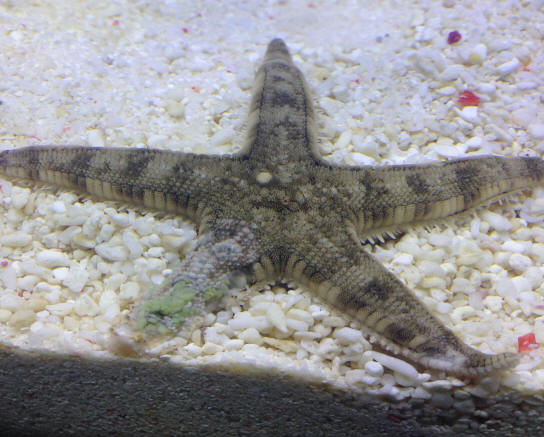
Sand-sifting Star
transport 4/25/11 Falling
Spines/Teeth on Sea Star 11/7/10 Sand Sifting Starfish and
Crushed Coral -- 10/28/2009 Snowflake eel; comp; now sand sifting star and cheap live rock -- 03/03/08 Wow thanks for the quick response. <No problem, Jiahua.> Yeah, I thought as much (but I don't think I have seen an adult moray). It was only a spur of the moment thing when I go to my LFS and see new things. And for your concerns referring to my system and star, I got the sand and live rock first and let it sit there for about three months (long enough?), before getting the moray and I have around 2-3 inches of sand for my star. <If it is well populated (worm burrows etc.), it should be okay. Personally I tend to wait almost a year before getting sand sifting sea stars. Also I personally prefer deeper sand beds (DSB) to help with denitrification. Compare: www.wetwebmedia.com/deepsandbeds.htm .> Oh yeah, one more thing: No matter where I look, live rock is always $6.99 a pound and I think it's a lot of money especially that I'm only a senior in high school and going to college. This was originally a huge project for school, but it grew into more of a hobby. Do you have any suggestions as to where I can find good deals for live rock? I want my snowflake to have more spaces to hide than just one rock and some PVC. <I've had both, very good and pretty bad experiences with live rock from fellow hobbyists selling their stuff online. It is usually at least half the price, sometimes cheaper. However, it is without a doubt preferable to see the rock and select the best pieces. For high quality live rock the price you noted above is reasonable in trade. Don't put too much live rock into a running system at once to avoid a mini cycle. Dead reef rock is much cheaper than live rock and provides the same cover, but it won't provide as much biological filtration. I'd prefer live rock and add new pieces whenever money allows.> -Thank you, Jiahua <Have fun. Marco.> Sand sifting star and nano tank -11/17/2007 These are probably really stupid questions and I fear this one may make your "funkiest query of the day!" <Just hope Bob is too busy... ;-)><<As usual. RMF>> Please refer to me the archives if I missed something in searching. You guys/gals have answered lots of questions for us over the last four months as we have upgraded our 90 to a 240. We are STILL in process of doing the upgrade and I have yet another question. We have a sand sifting star in the 90 with a DSB. <Ugh> We have only just over an inch of sand in the 240 gallon and then a DSB in the fuge. Despite their great reputation for starving and decimating the sandbed, s/he has actually grown over the past year and seems to be ok. <Unfortunately, many marine animals can take a very long time to starve to death. If yours is growing, then I suppose it's not starving... yet. However, I suspect your sand bed has suffered dearly. And once it can no longer maintain the star fish (an inevitability), it will slowly die.> Does the star stand a chance in the 240 without a DSB assuming the tank has several months to establish fauna in the sandbed before the star makes the switch from the 90? <Sure, it would probably live longer. But again, you're just delaying the inevitable. And what of your poor sand bed?!"> Okay, on to the stupid part...my husband is the reefer and I merely stare at the pretty fish and read your FAQs, but I am trying to do an informed Christmas present. (Hope he isn't reading the FAQs today!) I want to get him a nano tank for a shrimp/goby combo. Due to the instability in this volume, I was hoping he could just plumb it in line with his main tank <good idea> since he already has lines going everywhere under the floor because the sump and fuge are in a different room from the main tank. Plus, he loves such DIY projects. Is this reasonable? <I don't see why not. In fact, I frequently recommend this to people who want to keep a nano tank and already have a more "regular sized" system.> If so, would one of the 24 gallon Nano Cubes be an option, or is it impossible to modify their set up? <I've never had a nano-cube, but from what I hear, I don't think they're so easy to set up this way (because of the hood mostly I think). How would you get the plumbing in/under the hood?> Surely you can at least add a sump and/or fuge to the setup??? <Of course you can.> Is there a different brand you would recommend over the Nano Cube? <Again, I'm sorry I've never personally had one of these. But if it were me, I'd simply go buy a small glass tank and proceed as if it were just another remote sump or refugium (as you put it). However, I'd do a little more of your own research on the Cube. It might work just as well, I honestly couldn't tell you for sure. I'd only wonder about how you'd get around the top of it.> Thanks for any information and I apologize if I missed answers in the archives. Your time is always appreciated! Michele <De nada, Sara M.> Sand Sifting Starfish Hi Bob Please could you help me, as I feel that I may have been wrongly advised I have a 50gal tank which has been set up for five weeks, (set up with RO water ... been testing... all is well) I recently went to buy something to help with a coating of brown algae on my 3inch sand bed, I was sold a Neon goby and a sand sifting starfish I looked on your website to read all relevant info on sand sifting stars, now I'm worried that my tank is to small and to new to keep it well fed I also have 2 turbo snails, 1 bumble bee snail, 1 shrimp and some live rock, (no fish yet) I run a Prizm skimmer and external Fluval 404 I have had the starfish for a few days .... so far all is well, Please advise Many thanks Sam >>>Greetings Sam, Your tank is indeed MUCH too small to keep a star such as this alive long term. Besides, it doesn't eat detritus, it eats the sand bed fauna that we work so hard to establish. Back to the point, it will slowly starve to death after it has depleted your sand bed of food. You need at least 12 square feet of sand bed to sustain one of these stars. Again, you don't really want one in your sand bed anyway. You need to look to nutrient export to get a handle on your algae issue. Cheers Jim<<< Sand-Sifting Starfish (Needs Lots of Space!) - 07/16/05 I was thinking about purchasing a Sand-Sifting Starfish, and I was wondering if it would harm other star fish? I have a brittle starfish and a chocolate chip star fish. I also was concerned if it would harm a scooter blenny? <<As a rule no, it won't harm the organisms you mention, but do research/rethink this purchase (start by having a read here: http://www.wetwebmedia.com/sndsftstrfaqs.htm). These creatures can/will deplete the biota in a sand bed very quickly. This in itself is not good for your tank, but bodes even worse for the starfish. Unless your tank is large (125g or more) with a mature DSB, this animal will likely starve to death within a year. Regards, Eric R.>> Astropecten polycanthus...Not For A 29 Gallon Tank - 11/10/05 I recently purchased a Sand Sifting Star. I notice the second day that it had lost two of its arms. I have a 29 gallon tank with one Coral Beauty Angel, live rock and sand. The water tests fine with the nitrate a little high <<how high is "a little?">> with everything else in the normal good range.... Do you think the angel got it or is the nitrate level? <<Could be the nitrates...doubt it is the angel. More likely, the starfish was already sick/injured when it was purchased.>> Thanks for you advice Sandy <<Please do be aware, injured or not, Astropecten polycanthus will not survive in your tank...it is much too small. These animals need much more substrate than your tank can provide in order to find enough food, and even then, will quickly decimate the biota in the sand bed. Regards, EricR>> White Sifting Star question Have a 55gal
tank with a 10gal (refugium/sump) established for about 1 ½
years with 50lb of live rock and 40lb of live sand with a
snowflake eel, a harlequin tusk, <This fish needs more
room> a cardinal, 1 ocellaris and 1 blue damsel fish. Also some
coral/inverts like a crocea clam, frogspawn, green Goniopora, yellow
polyps , some xenias, red mushrooms and a speckled leather coral, a
couple of hermits and snails for clean up and 2 white sand sifting
stars. I think because of the refugium, which has Caulerpa and 4
mangroves plants a good supply of what I think are amphipods have
developed (I even discard some when changing the filter pads). The
reason for this post is that after reading some pages of the Marine
Invertebrates book in which mention that 1 sand star will require 6
square feet to sustain it I wonder If my 2 stars are slowly
dying. <Mmm, evidently not... some systems (like yours apparently)
have much more food...> To me they look ok, they move around,
burying and emerging form the live sand and even one of them re-grew
one of its arms after the harlequin attacked it. I have had them for
around 10 to 14 months. What do you recommend, taking out
one of them and maybe put it in the fuge or give it to a fellow
aquarist or keep both of them. <I would get a larger system
period... if you can afford and fit it in... Bob Fenner> |
|

|
Features: |
|
| Featured Sponsors: |