|
FAQs about Stony Coral, Cnidarian
Identification 4
Related FAQs: Stony Coral ID 1, Stony Coral ID 2, Stony Coral ID
3, Stony
Coral ID 5, Stony Coral ID 6,
Stony Coral ID 7, Stony Coral ID 8, Stony Coral ID 9, Stony Coral ID 10, Stony Coral ID 12, Stony Coral ID 13, Stony Coral ID 14, Stony Coral ID 15, & Cnidarian
Identification, Stony FAQs 1, Stony
FAQs 2, Foods/Feeding/Nutrition, Disease/Health, Propagation, Coral Compatibility, Stony Coral Behavior,
Related Articles: Stony
Corals,
|
.jpg)
|
| Coral ID Favia and a Brain Coral
4/15/07 Hello I am Lucino from Roma. Can I know the species of
this coral? Thank you, ciao. <Ciao Lucino, Mich with you
today. Both corals are in the family Faviidae, one
appears to be of the genus Favia, identification to the species
level is barely possible when using taxonomic references to compare
skeletal structures, from a picture alone it is not
possible. The other coral appears to be a brain coral,
perhaps of the genus Leptoria or Platygyra. Hope that
helps. -Mich> |
|
 
|
Open Brain ID? - 04/10/07 Guys,
<<Jorell>> You all are a blessing, thanks for all the
fantastic help you have given people like me over the years.
<<Is our pleasure to assist>> I am writing in after a
couple of years, though I do browse the site quite often.
<<Excellent>> I recently found this unique open brain,
the colour is fantastic and I have not seen one like this.
<<Mmm...a couple possibilities come to mind>> The photo
does not do it justice; the pink has got certain iridescent
qualities the photograph does not capture. I was
wondering if you guys could help me out with identifying the exact
species of this open brain. <<Not so sure about being
"exact" (unless Bob can make a definitive ID),<Mmm,
no...not w/o references and the skeleton... RMF> but I think I
can give you a few leads to run down to see what you
think. My first instinct (mostly due to the color) upon
seeing the photo is Trachyphyllia geoffroyi, but in my experience
these are usually more figure-eight shaped and not quite so
convoluted as this specimen...though this could well be a
geographic/environmental variant of the species or simply an
"abhorrent" growth pattern. My next guess
would be Lobophyllia hataii. And my last guess; though I
feel it is also the least likely due to its more meandroid
structure, would be Symphyllia radians>> Also attaching a
picture of my Angel (Well Behaved so far) had him for about 4 years
now. <<Very nice>> Regards,
Jorell
<<Cheers, EricR>> |
| Re: Open Brain ID? - 04/11/07 Dear Eric,
<<Jorell>> Thanks very much, I hope Bob can ID the
Coral for me. <<Unfortunately no, as stated in his reply
posted in the dailies...>> The reason I would
like to know, because of compatibility, I would like to buy a few
more Open Brains and lay them besides/close to this one. Regards,
Jorell <<Well Jorell, I can say with confidence that
'compatibility' for this coral would be much as it would be
for any Trachyphyllia or Lobophyllia species...aka "open brain
coral." But even so, positioning them
'next' to each other is not wise. These corals
should never touch one another, and should be placed far enough
apart to prevent the possibility of sweeper tentacles or
mesenterial filaments from these corals reaching each other
(4'-6' usually), though opinions seem to vary whether these
corals actually "possess" these
weapons. Still, some physical separation is
recommended...otherwise 'mixing' the different 'open
brain' species in the same tank should be fine. Eric
Russell>> |
|

|
Can you ID this
coral? Fungia 4/9/07 It was a hitchhiker
<A nice gift.> and looks to be a young Fungia, <I would
agree. More here for your edification:
http://www.wetwebmedia.com/fungiidae.htm >
When I first found it growing on a the side of a zoo rock it was
smaller then a dime, <Tiny!> I glued it to its own rock so it
would get better lighting. <OK.> It is now the size of a
quarter <It's happy!> and if it's a Fungia I
don't think gluing it was such a good idea. <Mmm, no
probably not.> Can you help ID it <Your ID is correct.>
and what should I do, try to unglue it? <No, I would leave well
enough alone. It is growing/thriving. The
Fungia's ability to move serves it well in its natural
environment, but is less essential in an aquarium
setting.> Thanks, Diane
<Welcome, Mich> |
|
|
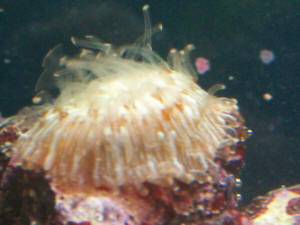
Coral Identification: Hydnophora
2/24/07 Hi, <Hello Iain, Mich with you tonight.> First of
all many thanks for your website - it's a real oracle of useful
information. <Glad you think so!> My reason for writing is
for a Coral ID (see attached photo and film). <Got the photo,
but was unable to open the movie.> I bought the coral in one of
my local shops (in the UK) and they said that someone has brought
it in as it had become too large. They suggested that it is a
Pocillopora but after consulting several books, websites etc
I'm not so sure as I haven't found anything that seems
similar. <Mmm, don't think it's a Pocillopora.>
It's skeleton, is white, branching and very fragile but most of
the time the polyps are out so it's hard to see. The polyps
extend 8 to 10mm during the day and come out to the point of making
the coral look like it's been veiled in a light velvet cloth.
It looks great and is growing well but I've never seen an
example of it before or since. Any ideas ? <I believe it is a
Hydnophora, also known as a velvet horn coral. More
here: http://www.wetwebmedia.com/merulinidae.htm > Many
thanks,
Iain |
|
|
Terminological confusion ... A-hermatypic...al
2/22/07 Hello Crew, <John> I'm curious to have a precise
and accurate understanding of the term 'ahermatypic', if
for no reason other than to impress and amaze
the less-knowledgeable. <Heeee!> The term
is used in differing ways by differing people, all apparent
experts. <Love that term... Ex= "previous", Spurts?> On
the WWM site, the term seems to be consistently used to
refer to those corals that possess no zooxanthellae. <Mmm,
yes... a common "understanding"...> But, for example,
fishbase.org explicitly defines 'ahermatypic' as "non
reef-building" (this at http://www.fishbase.org/
Glossary/Glossary.cfm?TermEnglish=ahermatypic). <This is the more
formal... correct meaning of the word> Even more confusingly,
on the NOAA (National Oceanic and Atmospheric Administration)
website (specifically at http://www.photolib.noaa.gov/reef/reind4.htm) Tubastraea
is called ahermatypic in virtue of its having "no
zooxanthellae algae in tissues and [being] non-
reefbuilding". I sure hope my tax dollars aren't
financing the spread of ignorance... <Heeeee! Too late...
D'oh!> I can tolerate a lot of confusion, but this is really
getting to me! Now, I'm sure the WWM crew is
correct, but could you say a bit about what makes your usage
correct (by reference to etymology, perhaps, or terminological
history). <Careful here... I am a huge fan of "word
origin" discussions, games...> Thanks for any information, and
thank you very much for maintaining WWM -- it has been a valuable
source of information on all aspects of the hobby. -John
from Minneapolis <Well... I'll give this query a stab... A=
ablative, Lingua Latina, meaning "away from"... hermatypic
corals! Okay, am cheating... (means "like stone"... see here,
young man: http://phoenixandturtle.net/excerptmill/Gasper.htm)
these are the Scleractinia that don't produce much of (yes,
with/in conjunction with those endosymbiotic (Shades of Lynn Margulis!)
algae... those large, clunky carbonate skeletons... giving them (as it
turns out, falsely) the big credit for "reef building" (a few
algae, mostly rhodophytes deserve the props here)... Enough already?
BobF>
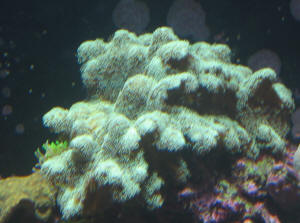
| ID acropora, nee... Pocilloporid... Cat's
Paw, Meow! Or a Merulinid? - 1/22/07 Hi! I need your help
with an id. I have this acropora (the blue/green one), the seller
told me it was a kind found in deep water, but I would really like
to have it's scientific name to make some research thanks !!
Marie-H. <Mmm... this looks to me to be a Pocilloporid... maybe
a Stylophora... S. pistillata? Perhaps a Hydnophora... Bob
Fenner> |
|

|
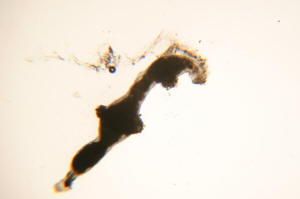
| To Bob Fenner please (micro-organism
ID) 8/27/06 Hi Mr. Fenner, <Dom> Hope
you're well. I recently got a new Montipora capricornis and it
seems to do doing very fine overall. I already see some growth and
the already nice colors are improving. But, in a specific area it
started to bleach slowly. It's still progressing and I saw some
1-2mm pure white threads on the bleached areas. I cant see them
moving. I took a sample and made a picture under microscope (please
see attached file, magnification 40X). It doesn't move much
under the microscope, only what I presume to be the head (top right
corner on the picture) was doing a slow searching motion from side
to side. Obviously its a worm and it looks a bit like a lamprey
(the mouth for example) and it looks like it has a bunch of eggs
attached on two points along the body. Can you ID it and can you
give an advice on how to deal with it? Can it parasite a fish as
well? <Highly unlikely> Many thanks! Dominique <Mmm, might
be a trematode... maybe an "intermediate" form of a
polychaete species. Predaceous, not parasitic if so. There are
quite a few possibilities:
http://64.233.161.104/search?q=cache:9XOLiCgqBC4J:www.advancedaquarist.com/issues/apr2002/appendix.
htm+worm+predators,+parasites+of+montipora&hl=en&gl=us&ct=clnk&cd=5
Based on its apparent morphology... The "basic" or S.O.P.
for removal and prevention of such predators is best outlined here:
http://www.liveaquaria.com/general/general.cfm?general_pagesid=351
Bob Fenner> |
| Re: To Bob Fenner please (micro-organism ID)
8/27/06 Hi Mr. Fenner, I did a Lugol's dip and
discovered the real culprits: Nudibranchs (the worm I sampled
probably has nothing to do with my problems after all,
coincidental...(?)). They look exactly the same as those on the
link you sent me. <Ah, yes... what you had thought were
"eggs" were actually "naked gills"> I did a
search on the net and found quite a few info but not very
encouraging. In a forum Eric Borneman said there is no solution at
all to that problem and that even Levamisole or Tetra Oomed
doesn't really work. Some say they do work so I was willing to
try anyway but they are both impossible to find. If you have a
different opinion or hints please let me know. Thanks again !
Dominique <Physical removal and the search for a designated
predator... Bob Fenner> |
|
|
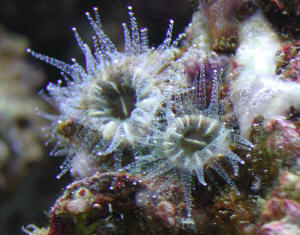
| Hello! Could you please help me
identify this picture? 7/11/06 <Yes>
Is it Aiptasia? <Mmm, nope... can you make out the
skeleton of the individual corallites underneath the
azooxanthellate tissue? I can. These are Rhizangiids... stony
corals... Gorgeous and nice pic> Your help is
greatly appreciated! Dan Mack. <Use your search tool with the
family name... Thank you for sending this along. Bob
Fenner> |
|
|
Coral ID 6/27/06 Hi crew hope you are all fine,
Been a few months since I last spoke to you. I have set up a 120G (UK)
tank with a 65G sump to have as a reef. Tank has been cycled and has
been officially running for 4 months. I added 100lbs of new Fiji
liverock and left the tank free of fish for 3 months to build on the
pod population and various algaes to grow. Of which I have an abundance
of scroll algae (beautiful) and alot of Caulerpa racemosa and a tiny
amount of Halimeda. My parameters have never been so steady, sg 1.024,
temp 78F, ammonia 0, nitrate 0, nitrite 0, calcium 390, pH
8.2 (reverse photo period), alk 9.6. Anyway to the point, I have
attached an image to the email, it was a piece of live rock which I
could see was an old coral skeleton, I looked and guessed it may have
been a Stylophora but I am no expert yet! The rock has a lot of tiny
holes which I guessed would be where the polyps would come out from
when it was alive. Since being in the tank now for 4 months it appears
that there is some orange growth of I guess flesh although firm to the
touch and as you will see from the picture tiny white dots which I know
are polyps as they come out during day and night, these are small about
an eight of an inch across. Could you shed some light and tell me what
it is? It's located 12" from the top of the water surface, in
medium flow water with 2 x 250W MH. <Do not see any photo
attachment, Dave. James (Salty Dog)> Many thanks
Dave G (UK)
|
|

