Become a Sponsor

 
Home
Information Pages:
Marine Aquarium
Articles/ FAQs
(enter words you'd like highlighted in this page)
Freshwater Aquarium
Articles/ FAQs
Planted Aquarium
Articles/ FAQs
Brackish Systems
Articles/ FAQs
Popular Pages:
Features:
Daily FAQs
FW Daily FAQs
SW Pix of the Day
FW Pix of the Day
Conscientious Aquarist Magazine
New On WWM
Helpful Links
Hobbyist Forum bb.WetWebMedia
Ask the WWM Crew a Question
Calendars
Search Feature
Admin Index
Cover Images


FAQs about Stony Coral, Cnidarian Identification 9

Related FAQs: Stony Coral ID 1, Stony Coral ID 2, Stony Coral ID 3, Stony Coral ID 4, Stony Coral ID 5, Stony Coral ID 6, Stony Coral ID 7, Stony Coral ID 8, & Cnidarian Identification, Stony FAQs 1, Stony FAQs 2, Foods/Feeding/Nutrition, Disease/Health, PropagationCoral CompatibilityStony Coral Behavior,

Related Articles: Stony Corals


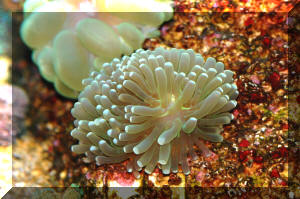
Euphyllia cristata
Chevalier 1971, Grape Coral. Colonies of 1-2 inch diameter. Large, circular polyp tentacles with round to flattened knobbed ends. 

Unidentifiable Coral -- 11/09/2009
<... why don't folks follow directions when asking our help? Why are you sending 16 megs of pix? Ho buoy!>
I have asked the owner, I have asked ReefCentral, and I have asked TheReefTank.com, and I have yet to get a straight answer.
<Mmm... what's the question?>
I have this beautiful coral which I believe is LPS, but could POSSIBLY be SPS.
<An artificial designation... of limited value>
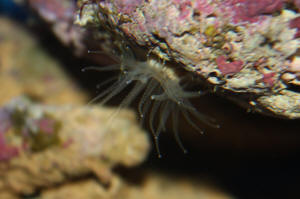
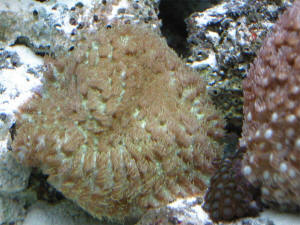
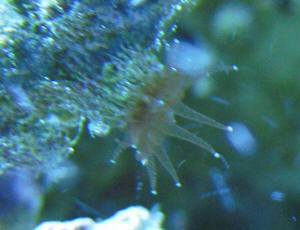
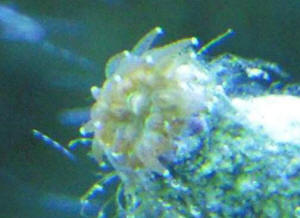
I have a couple of different pictures of it.
The first is of the coral about 1 hour after it was first put in the tank.
The second picture is of it when it's completely and fully extended.
The third picture is another picture of the coral when it's completely and fully extended, but you can also see the corals calcium skeleton, I think that may help some?
The last picture is of it at night (lights out).
The best answers I have gotten are Tongue Coral and Encrusting Hydnophora.
<? I don't think so>
But it's still a small specimen and very hard to tell what it is.
It's about the size of a half dollar coin and is a lightish pink color.
Please and thank you!
-Zack
<Looks to be some species of Symphyllia... a Mussid. Bob Fenner>

Re: Unidentifiable Coral -- 11/09/2009
I apologize about the pic size!
I guess I forgot about that rule.
<Heeeee! We're fresh out of disk space!>
But do you have a good comparison picture?
<Mmm, I'll look>
I searched for Mussids and Symphyllia on Google images and got nothing that looked like it.
<Mmm, no... just looked... All mine are large specimens, during the day, with flesh retracted. BobF>

LPS ID and phytoplankton product use  – 10/26/09
Hi Grew,
I'm one more person, who would like to say how great and informative your site.
<We share!>
I'm new in the hobby. My tank is 6 mo, however thanks to all your advices, everything is doing well. I read your articles almost every day.
I have a question regarding LPS ID. I found it in one local fish store under name Neon Green. A salesman could not give me any additional info. It covers a life rock, polyps a small about 3 mm in diameter and 2-3 mm tall. They retract when disturbed. Is it kind of Turbinaria?
<Mmm, need either better vision (no doubt actually) or a bit larger, more-resolved image here, but I am pretty sure this is a Goniopora (commonly called "Flowerpot") coral. Please see here: http://wetwebmedia.com/gonioporapix.htm
and the linked files above re this genus' care>
And one more question. In most of your articles you mentioned that corals eat zoo-plankton.
<Most all do to extents... along with no to some variable amount of photosynthesis>
What kind of coral eat phytoplankton?
<... actually very few of what passes as "corals", definitely not Scleractinians/Stonies consume much of any phyto>
An instruction on bottles with phytoplankton says, that it is food for filter feeders and corals.
<... A good point, statement... Most all such material is of limited (to the extreme) use in hobbyist systems. The bulk is taken out via skimming... Some soft coral groups (Alcyonaceans) consume "some" species, sizes of phytoplankton... and adding such products can lead indirectly to "better conditions" in captive systems... but most of it is a placebo>
Thank you for you time.
Igor
<And you for sharing. Bob Fenner>

Another hitchhiker ID please - 10/06/2009
Hello crew,
<Howdy>
First, thank you for your previous help on IDing Dendros on our LR. We have been feeding them daily and they are growing. We counted about 20 total!
After we started getting a handle on the Dendros we noticed that another coral on the same rocks (3 rocks, each rock has both types of coral, not present anywhere else in the tank but these 3). When we first put it in
the tank we thought they were skeletons, but they have begun sprouting tentacles. After our Dendro experiences we experimented with feeding them directly as well and sure enough they are now growing. We would like to see if we can figure out what these are so that we can take care of them properly as well. We are not sure if they are photosynthetic or not.
Thanks for your help,
Nicki
<... this is quite unusual... I do think this may be a Blastosmila. Is that a big ole crab claw in the backgd.?
Bob Fenner>

Re: Another hitchhiker ID please   10/7/09
Yes that is a Emerald claw in the background
<A big boy!>
. He got moved to the fuge. We got him to take care of some bubble algae.
He was eating that plus things we really did not want him ripping off the rocks. Those emeralds really like tubes. He would grab them by the clawful and throw them into the air. Amusing, but not reef friendly.
<Ah yeah. My long-standing position re Mithraculus/Mithrax>
The mystery guest looks a lot like Archohelia rediviva,
<Mmmm, maybe>
but that is supposed to be extremely rare in tanks
<Is>
and the color is black instead of brown like we have. However if you took black and white photos of the 2 they look exactly the same. It has also now been suggested that is might be cladocora. Cladocora has the correct coloring, but the shape is a little off. If you combined the shape and tentacles of the AR with the color of the cladocora it would be it. When I searched Blastosmila I only found pictures of skeletons. Do you know what the coloring usually is on those and if they are photosynthetic or not?
<Unfortunately, no>
Thanks for your help on our mysterious hitchhiker,
Nicki
<A keeper in any case! BobF>

Help with coral ID – 08/14/09
Hi Bob,
<Chris>
A friend gave me the coral in the attached pic, but I am having a Dickens of a time ID'ing it. I'd appreciate any help (family, genera, etc) that you all can provide.
Best,
Chris
<A Pectiniid of some sort: http://wetwebmedia.com/pectiniids.htm
BobF>  

Coral ID 5/21/09
Bob,
<James here, for the vacationing Bob, mixing work with pleasure.>
We received another shipment from Jakarta, and the packing slip was very vague on descriptions(Acropora Exotic was most of the id's.) If I sent you guys some close-up photos, is there someone in your crew that could ID them for us.
Any help or direction would be appreciated very much.
<Likely, you will be able to ID going here.
http://www.wetwebmedia.com/acropori.htm. If not found there,
go here. http://www.livestockusa.org/CORALS.html James (Salty Dog)>
E & T Rood

Live Rock ID 5/5/09
Hi Crew,
<Roxanne>
I've read your web site for months as we set up our saltwater tanks.
We've had tanks for about 35 years on and off, but things have changed dramatically. That's most likely from folks like you who have disseminated useful and valuable information to this hobby. Kudos for the great work.
<Thank you>
Now for my question.......
I purchased some live rock which I think came from the Florida Keys.
It's filled with polyps, sponges and the critter I'm trying to ID here.
They stand about 1/4 inch off the rock, though the smallest are still barely above the surface. Even the smallest send out the polyps you see in the 2nd picture. I'm just curious if you have any idea what they may be? (Sorry, if the pictures are too large. Making them small lost all detail - hindering ID.)
Thanks for your help.
Roxanne
<Mmm, given your clue as to origin... and the prominent/distinctive features of the corallites (deep pits, alternating protruding and smaller septa...) I do think these are Hidden Cup Coral, Phyllangia americana
(family Faviidae)... Is mostly found "under rocks and ledges" in the wild, and often has more color... reddish-brown. Bob Fenner>

Mystery Sac I.D. 04/29/09
Good Morning,
I am hopeful you can identify this mystery sac, that , on closer inspection, seems to have a string (of eggs) inside it.
<In my opinion, no, this is not eggs. To me, this looks like a "swollen" feeding tentacle with a mesenterial filament.>
It is attached to what I believe may be a dead chalice coral (free with purchase of neighboring coral!). I've inset a closer view, but it is quite transparent, about an inch long, with a small opaque tip and it is
difficult to photograph.
Thanks for your kind assistance. I tried Googling 'sac of eggs' or 'sac of water' without any good results, as you well might imagine.
<Again, to me, it looks like a swollen feeder. But I don't know why the tentacle might be swelling like that (maybe irritation, stress, etc...or maybe just no "good" reason at all). Some Euphyllia sp (and other) corals
do release eggs from their tentacles (which you can actually see in the tentacles before they are released). However, that's not what this looks like to me.>
Reef Tank residents: 2 juvenile Picasso Clowns, 1 Midas Blenny, 1 Blue Spotted Jawfish, 2 Cleaner Shrimp, 3 Glass Shrimp, 1 Lettuce Sea Slug, 1 Turbo Snail, 1 Tonga Fighting Conch, 1 Blue-legged Hermit (uninvited), 1 uninvited crab of unknown type, and about 7 corals of various types.
P.S. If this coral is indeed dead (my LFS did not know), I assumed it would begin to degenerate, and I would then remove it, but it has looked unchanged for about two months now, as I decided to wait and watch. Is this prudent?
<Yes... for now, the coral does not look unhealthy to me.>
Thanks again for any suggestions you might have.
Lianne
<De nada,
Sara M.>

Coral ID - Catalaphyllia jardinei or not Catalaphyllia jardinei? 4/29/09
Gentlemen!
<Mmm, have sent to SaraM for her better analysis>
Please find attached a few pictures of a species that I think may be Catalaphyllia jardinei. I am however seeking your view on its identification.
<Mmm... might be, but I don't think so>
The block of heads is circular with a diameter of 2 inches. The heads are very close together and have individual heads with diameters of 1/3 of an inch. The discs are all uniformly bright green and the tentacles are grey to white in colour. The tentacle tips are white under my lighting conditions.
There is a sharp septa between each head, which is only visible when the discs are very retracted or out of the water.
This species is placed about 3 inches under the water surface.
<Not the habitat of Catalaphyllia...>
The light is a combination of 10,000k VHO (2 x 24W) and white and actinic LEDs. Water circulation is strong for the size of the tank, but does not hit the species directly. Water quality is pristine (dixit my tests) with regular water changes and overskimmed with ozone. The species had been thriving in my tank for over 6 months, not being specifically fed,
<Needs to be>
but grabbing a Mysid or Artemia shrimp on occasion.
Your help in identifying the species is greatly appreciated!
Thank you &
Best regards,
Tim
<Appears to be a starved Duncanopsammia axifuga to me more than anything...
I'd be reading re its needs, meeting them. Bob Fenner>

Re: Coral ID - Catalaphyllia jardinei or not Catalaphyllia  4/29/09
jardinei?
Hi Bob,
<Tim>
Thank you for your reply. However, my expectation is for Duncanopsammia axifuga to have stem/trunk where each of the heads individually attaches, like hammerheads.
<You are correct. Both are meandroid in morphology>
This is not the case with the species in my tank: every head is closely attached to the other and only separated by a sharp septum, and the coral attaches directly to the rock.
<Oh! Sorry re... Is not obvious to me in the images>
But here again, I am a total beginner in coral taxonomy!
The other comment that I would make is that the species is very high in the tank because that is where I chose to put it - and it does seem to be faring quite well so far. Anyway, I will do more research into Duncanopsammia axifuga.
Thank you &
Best regards,
Tim
<Let's wait on SaraM's better experience here. In the meanwhile, If you can send along a larger image (1 mb let's say) better resolved... perhaps taken from the surface down... with the pumps shut off temporarily. Bob Fenner>

Re: Coral ID - Catalaphyllia jardinei or not Catalaphyllia jardinei? Sara M and Jake Adams input  – 4/29/09
Hi Bob,
<Tim>
Thank you for your reply. However, my expectation is for Duncanopsammia axifuga to have stem/trunk where each of the heads individually attaches, like hammerheads.
<You are correct. Both are meandroid in morphology>
<<Hmm... I don't think this is a Duncan, but I do agree with Bob that it does appear meandroid. Maybe a Platygyra sp.?>>
This is not the case with the species in my tank: every head is closely attached to the other and only separated by a sharp septum, and the coral attaches directly to the rock.
<Oh! Sorry re... Is not obvious to me in the images>
But here again, I am a total beginner in coral taxonomy! The other comment that I would make is that the species is very high in the tank because that is where I chose to put it - and it does seem to be faring quite well so far. Anyway, I will do more research into Duncanopsammia axifuga.
Thank you &
Best regards,
Tim
<Let's wait on SaraM's better experience here.>
<<Ha. I'm a "beginner" in coral taxonomy myself... but I think better pictures (ones of the coral completely retracted, showing the skeleton better), would be helpful. Till then, my "best guess" is Platygyra sp. If only I had my Veron books handy here... bunk!>>
<In the meanwhile, If you can send along a larger image (1 mb let's say)
better resolved... perhaps taken from the surface down... with the pumps shut off temporarily. Bob Fenner>
<<Ditto. Sara M.>>

Ok... forget what I just said. I just asked Jake Adams for help. He says it's a Hydnophora pilosa... and unless pics of the skeleton show any different, I have to agree with him.
Cheers,
Sara M.

Re: Coral ID - Catalaphyllia jardinei or not Catalaphyllia jardinei? – 4/29/09
PIC4
<Tim, please see my last e-mail. You absolutely must resize your images to ~500 KB. I've had to delete your original images -- all of them -- because they're blocking our 10 MB e-mail allowance. In doing so, they're bouncing back other people's messages, which isn't fair. Resize your images, and then send them again. We do specifically ask for this from everyone who writes, as you'll see on the page where you got the Crew e-mail address.
Cheers, Neale.>

Re: Coral ID - Catalaphyllia jardinei or not Catalaphyllia jardinei? – 4/29/09
Apologies for this,
I sent the pics in large format as requested by Bob in his earlier email,
<<This is so. Sorry, I should have asked for just one image... or had you send them to my personal email... which you eventually did. RMF>>
but will get them resent to you in a smaller format ASAP.
Best
Tim
<Hi Tim, one big image isn't so bad, but eight of them, each over 4 MB
each, simply blocks everything else getting to us. For screen work (as
opposed to print) then 72-96 dpi is fine, and resized to 640 x 480 or 800 x
600 should be ample. If all else fails, crop away everything that isn't
relevant. Thanks for understanding. Cheers, Neale.>

Re: Coral ID - Catalaphyllia jardinei or not Catalaphyllia jardinei? – 4/30/09
I went to look at pics of H pilosa, and it does look very similar
(http://www.meerwasser-lexikon.de/tiere/657_Hydnophora_pilosa.htm). In my situation, it is an encrusting type of LPS.
I am currently not in a position to send resized pics now, but will do so at the earliest opportunity.
Best regards,
Tim
<And you. BobF>

Re: Coral ID - Catalaphyllia jardinei or not Catalaphyllia jardinei? – 4/30/09
Resized pics attached. reasonably sized...
Best
Tim
<Ah yes... I clearly see the skeletal hydnophores here. Bob Fenner>

What is this coral?  4/2/09
Hello,
<Hi there Teresa>
I have read on your site extensively. It has helped me in so many ways, I am truly grateful. I purchased this coral and I did not research it before hand. I know I should have but the pet store man who is their saltwater specialist has sold me most of my tank inhabitants and is usually right on. The trouble is I forgot the name of it and cannot find it on the site. I think it maybe so sort of Porites.
<Perhaps>
I remember it started with a D but I would love to know how to feed it and care for it.
<Please read here: http://wetwebmedia.com/poritidfdgfaqs.htm>
He said it was not aggressive so it is in the middle of a 155 bow with mega flow 2 sump 3 250w MH and 6 blue bulbs. I feed oyster eggs and rotifer 2x a week. Tank numbers are good.
Thanks for any help you may have
Teresa
<If you have time, interest in a more sure answer/ID, please make and send along a more-resolved (larger file, close-up) pic. Bob Fenner>


Re: What is this coral?  04/02/09
Thanks for your reply Bob, and I hope you are doing well today!
<Thank you my friend. Am trying. BobF>
Here are a few more pictures in hopes you may be able to name this critter.
Thanks Teresa
<Oh, sorry re the incomplete resp... These new pix... the coral polyps... the arrangement of the skeleton... Could still be a Poritid, but... I can't say definitively if it is or not... I would proceed with care per this family however. Bob Fenner>

Live Rock Critter Question - Not A Critter, A Coral, Perhaps A Fungiid 03/19/2009
Hello.
<Hi there, Mich here.>
This little guy is growing out of a piece of live rock in my tank.
<I see.>
I am not sure what it is. Can you help?
<It looks to be a coral>
It appears to be some sort of anemone, but not sure what kind.
<Don't think so.>
Its "body" has a hard shell similar to a volcano, and the tentacles go into the rock and come back out.
<If it has a skeleton, which it sounds and looks like it does, it is not an anemone.>
Three other "volcanoes" have formed on this same piece of live rock. But I haven't seen any "anemone" arms pop out of it yet.
<Ok.>
Is it some type of coral?
<Likely so, perhaps a baby Fungiid. More here:
http://www.wetwebmedia.com/fungiidae.htm >
Thanks!
<Welcome!>
Scleractinian for sure. RMF

Coral Identification - Goniopora 3/19/2009
Hello.
<Hi there, Mich with you.>
Can you tell me what type of coral this is?
<Yes it is a Goniopora, commonly called a flowerpot coral, and they typically don't do well in captivity as each and every individual polyp needs to be fed, ie each of the little "flowers". It is generally not a
coral that should be tried by a beginner. Please don't take this the wrong way, but if you don't know the name, it is not an animal you should be keeping. You should always know the care requirements of any creature for which you assume responsibility and if you don't know what it is, you are not likely to know the animals care requirements. The animal is at your mercy. I implore you to learn about the needs of any animal in your custody. Not knowing is irresponsible. I am hoping you are in the researching stage and this is a photo from the LFS, which is where this coral should be left in my opinion. More here:
http://www.wetwebmedia.com/gonioporapix.htm >
I cannot find a picture of it anywhere to identify it.
<Hope this helped.>
Thanks.
<Welcome!>

 
Anemone identification 2/14/09
Any idea what genus/species this anemone is? It showed up in some live rock after about 6 months in my tank (that I could see anyway). Thanks for all you guys do!!!!
<Mmm, an Aiptasiid... a Glass Anemone... Read here re: http://wetwebmedia.com/marine/inverts/cnidaria/anthozoa/aiptasia/aiptasia.htm
and the linked files above... BobF>


Daily Questions, Anem./Scler. ID  – 02/14/09
Dear Crew,
I was reading the daily questions today and wanted to offer my thoughts on one of the ID requests. In "Anemone identification 2/14/09", Bob suggested that the creature in the picture was a glass anemone. I don't think so--I
think it's a non-photosynthetic stony coral that comes on a lot of live rock, like the one featured at the top of this page:
http://www.wetwebmedia.com/stonycoridfaq.htm
Andy
<Thank you for your input Andy. Will accrue. BobF>

Coral and Anthias ID    1/17/09
Hi,
Can you please ID the coral and the Anthias?
<I believe the this is a Dispar Anthias (Pseudanthias dispar). More here:
http://www.wetwebmedia.com/anthiina.htm
http://www.wetwebmedia.com/anthiinFAQs.htm and related links in blue and the coral looks like Galaxea fascicularis to me. More here:
http://www.wetwebmedia.com/oculinidae.htm >
Regards
Beta M
India
<Cheers,
Mich L
in warm and sunny Los Angeles>


Hitchhiker... Single polyp, Scleractinian    12/10/08
I have a hitchhiker coral on a piece of Tonga branch I have been trying to identify it for a couple of months now. It has been in the tank for about 4 years but it has not grown much, I started to spot feed it and has now spawned into to 3 polyps. It looks like it might be Rhizotrochus???
<Mmm, maybe... definitely a Stony... my bet is on the genus Balanophyllia, a Dendrophylliid here. BTW, the emergence of such animals is testament to your good care>
but I am not sure. It is very hardy from what I can tell, it has what looks to be a mouth in the center and the tentacles are white tipped and a light brown see-thru. See attached photos they are only about a 1/4 inch so it is hard to get the details in a picture.
Thanks in advance
Nick
<Should you have one of these polyps perish Nick. Please do try, make some close up pix of the skeleton and send them along. Cheers, Bob Fenner>

Thanks in Advance - 2 quick...? questions, Scler. recruitment   11/17/2008
Gang (think that covers both genders),
<Okay>
I have 2 questions I was hoping you could shed some light on. The first is a mystery that seems to be repeating itself. I first noticed about 9 months ago that I had what looked like 1 -2 small pink Pocillopora (sp?)
<Mmm, Pocillopora?>
polyps growing on my return. High up many feet from my colony. I thought it was odd. About a month or so after that I saw a path growing on two other rocks also a good distance from that. Again after some time I saw a patch growing on my glass of my tank on the opposite side of the other action. Now I have a 2-4" multi arm colony growing on 2 of my rocks,
<Usually discoid...>
on my return, a 2 inch disk growing on the glass and notice that at the water line along the back of my tank, on other live rock and on different sections of my returns I have new little growths... My question is what is going on?
<Asexual repro.? Or... possibly another organism/species... phylum altogether>
If it was already on the live rock, fine, but not the glass of my tank. If was displaced when I had an algae issue and was scrubbing rock a year ago, OK, but how is it spreading now? Is it reproducing?
<Or just growing...>
I can't imagine that. Could my urchins be spreading it?
<Mmm, doubtful>
I am at a loss... a happy loss, but thought I would ask.
<A photo (or three) please... something close up, well-resolved...>
My second question is star polyps... They are getting close to my corals and onto larger rocks I don't want to pull out... can I control them or should I get the out now before it is too bad?
<Up to you... there are many instances of adaptation twixt Clavulariids/Stoloniferans and other Cnidarians... learning to "get along" well enough... but if it were me/mine... I'd keep them separated...>
(ok worse.) Also where they are on big rocks can I fight back? Who will win when they hit my birds nest?
<The Polyps>
Tooth coral?
<Here too>
Lastly, since I am cleaning them out. I put some on the back wall of the tank (on the glass) it too is spreading. Should I get rid of that too?
<Up to you...>
Thanks, counting the number of question marks, I think I may have exceeded two....
Jim
<Do read here: http://wetwebmedia.com/polypcompfaqs.htm
Bob Fenner>

Re: Thanks in Advance - 2 quick...? questions 11/18/2008
Here are some photos. One from Top of the tank fuzzy sorry water reflection. Another of the largest new piece. One on the side of the tank.
One of the newest small piece. One on the return and one of the tank...
just for fun.
<Mmm, do look like colonies of some stony coral. B>

Re: Thanks in Advance - 2 quick...? questions

One with the wife's Camera... better I think. This is a piece that started as the small one in the last set. It has been about 9 months to get to this size maybe less.
Again and always. Thanks
<This as well... I'd leave as is... enjoy. B>

Re: Thanks in Advance - 2 quick...? questions
any idea how they got there?
<Yes... very likely "recruits" from some errant (as in wandering) polyps on your live rock or base/s of other hard materials organisms placed in the system. Quite common. Bob Fenner>


Featured Sponsors:
Google
 
Web www.WetWebMedia.com