|
FAQs about Stony Coral, Cnidarian
Identification 8
Related FAQs: Stony Coral ID 1, Stony Coral ID 2, Stony Coral ID
3, Stony
Coral ID 4, Stony Coral ID 5,
Stony Coral ID 6, Stony Coral ID 7, Stony Coral ID 9, Stony Coral ID 10, Stony Coral ID 12, Stony Coral ID 13, Stony Coral ID 14, Stony Coral ID 15, & Cnidarian
Identification, Stony FAQs 1, Stony
FAQs 2, Foods/Feeding/Nutrition, Disease/Health, Propagation, Coral Compatibility, Stony Coral Behavior,
Related Articles: Stony
Corals,
|
|
|
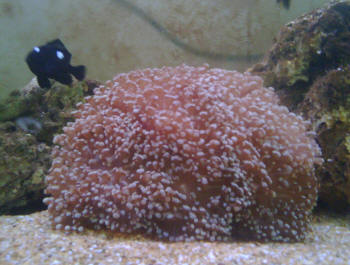
Anemone ID (not) 11/10/08 Hi dear,
<<Greetings>> I will not take much of your time.
<<Okay>> Can you please confirm the name of my
anemone? Its picture is attached. <<I see the
picture'¦ And this isn't an Anemone'¦ What
you have here is a Euphyllid. This looks like Euphyllia divisa to
me (Frogspawn Coral). See here:
http://www.wetwebmedia.com/caryoeuph2.htm >> Secondly what
is the way to find his mouth? <<Mmm, probably not easy to
do as any manipulation of the tentacles will cause the animal to
retract. But no worries, provide small meaty fare like mysis
shrimp, diced clam, Cyclops-Eeze, etc. and the coral will do the
rest>> I'll be highly obliged. Regards, Abdul Hadi Dar
<<Happy to share. EricR>>
|
 <<Hehe... um, yeah, NOT an anemone!...even better, a nice
Euphyllid. -Sara M.>>
<<Hehe... um, yeah, NOT an anemone!...even better, a nice
Euphyllid. -Sara M.>> |
| Mystery Anthozoans?
8/29/08 Hi Bob, I was wondering if those mystery
Anthozoans might be something in the genus Phyllangia? I've had
Phyllangia americana in my system for years now (from Gulf of
Mexico rock) - with the same distinctive tentacles and general
appearance. In this photo, the tentacles are fully extended, but
they're not that way all the time.
http://wetwebfotos.com/usermedia/high/0/2470_110.jpg Here's
another example of Phyllangia (P. mouchezzi??) from a French site.
http://dsabatier.free.fr/Planier0702/Phyllangia.jpg What do you
think? -Lynn <Hi there Lynn! Thanks for trying here... I
don't know, but did think these might be some species of
Caryophyllid/Astrangiid... but, have never seen them before this
last May at Interzoo... BobF> |
.JPG) |
|
Mystery Anthozoans... what are these?
<Mmm, Monomyces> Interzoo 08. 8/30/08
Dontcha think?
http://images.google.com/images?um=1&hl=en&safe=off&client=safari&rls=en&q=Monomyces&btnG=Search+Images
http://www.aquariumpros.ca/forums/showthread.php?p=263764
Monomyces sp. (species: pygmaea, rubrum, etc; aka 'cup
coral', 'Fire of Glory' coral) Not much is known
about this coral....I had the hardest time finding any
info...but, from what I've read, it's probably the
hardest coral to acquire out of all the species under
Flabellidae... found primarily in Japanese waters. Colours: pale
white, reddish/oranges, some with reddish markings Defining
traits: short tentacles, tentacles lack any colour and are
translucent, polyp is of an oval shape (some have an even more
elongated oval shape), small sized specimens are what you're
more than likely to find in the international coral
trade....larger specimens, if collected, are most likely reserved
for the (very) hungry Japanese coral market. <Well done
Michelle. BobF>
|
|
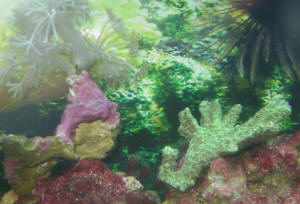
coral ID 8/18/08 Hi Again I am
not really sure what I have here. it is brilliant green with
small polyps on it. I found it in the discount tank at my LFS. It
looked healthy so I brought it home. Also, it is not attached to
any sort of base. Do you think I should attach it to something?
<Likely unnecessary... will attach itself here if this setting
is stable physically. However, there is likely to be trouble
twixt the Xeniid and Euphylliid visible in the upper left and
this Merulinid in time... I'd be reading on WWM re Cnidarian
compatibility> If so should the obvious end where it was
broken/cut off be the part glued down? Photo attached. Thanks
again Jim <A Hydnophora species... read here:
http://wetwebmedia.com/merulinidae.htm and the linked files
above. Bob Fenner>
|
|
Re: coral ID... Mmm, Merulinid/Scler. ID
f'... 8/20/08 Hi again, I have been
studying intensely however I find myself stuck again. In addition
to any advise could you please recommend some books on beginning
with corals. <Mmm, yes... though this is also posted on WWM
enough times, places. Anthony Calfo's "Book of Coral
Propagation" is a masterpiece (esp. the 2d ed.) of
useful/practical input on hobbyist husbandry or cnidarians> I
have been unable to find specific information on how and what to
feed my corals. The one I am currently concerned with is the
Hydnophora Bob helped ID. Also, working with Kalkwasser. I have
been lucky with my PH and DKH so far. <... lucky?> We all
know luck only goes so far. After reading an article on WWM I
believe Kalkwasser is the way for me to go but would like some
more information on the specific use. Thanks again Jim <Read
on!> P.S. I have made more progress with my aquarium in the
last few weeks than in the last 2 years. Thanks largely to
information found on WWM. Thank you all. <Welcome! Bob
Fenner>
|
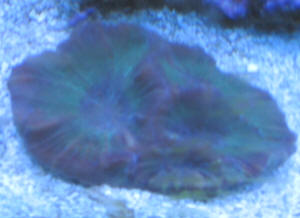
Identification of Coral 7/3/08 Hello
Crew, thanks again for everything. I picked up this coral the other
day, here are the best two I can take.
http://i242.photobucket.com/albums/ff274/pedanpedan/Tanks%206-29-08/IMG_0714.jpg
http://i242.photobucket.com/albums/ff274/pedanpedan/Tanks%206-29-08/IMG_0713.jpg
<Hmm... I could be wrong, but to me it looks like a malnourished
Trachyphylliidae.> Someone from Reef Central and my local club
helped my identify it as Moseleya latistellata. <Um, no... not
the right skeletal structure.> I can't seem to find any
information on keeping it. I looked through Borneman's Aquarium
Coral and couldn't find it there either. <Try looking under
Trachyphylliidae or Trachyphyllia instead.> I would love any
information you can help me out with over here. Right now I have it
positioned on the bottom of the tank, the coral does seem to be
producing small babies along the edge. Beautiful whatever it is
though, with greens and purples and blues and pinks. Thanks ahead
of time. Really just curious if the ID is correct and how to take
care of it. <De nada. Again I suspect it's a Trachyphyllia
sp. that has not been fed/cared for properly.> By the way if it
has a common name I might have better luck searching with I would
love to know that as well. <Trachyphyllia are often called
"lobed brain coral" or "open brain coral.">
Thanks Crew
Cheekymonkey
Sara M.> |
|
 Me too. RMF. Me too. RMF.
|
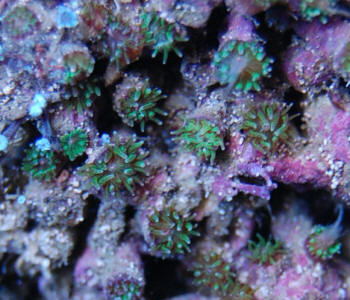
Coral ID -05/14/08 Crew,
I've looked high and low and I can't identify this coral.
Any ideas what it might be?
http://www.roesmarineworld.com/images/_93x2.jpg <Looks like
Galaxea sp (looks in bad shape though).
http://www.asira.org/galaxea> Steve Wright
<Best,
Sara M.> |
 |
LPS ID -hitchhiker coral
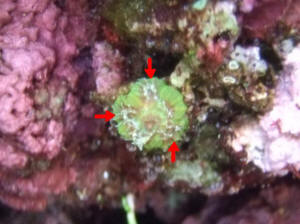
05/07/08 Hello Dedicated Crew Member, As I know you hear
all the time, (from examining all the archives), your site is an
excellent resource for any aquarist regardless of level. Thank you!
<Thanks> I was hoping for some assistance identifying a live
rock hitchhiker. I first noticed this guy about 5-6 months ago when
he was around the size of a pencil eraser; it is now approaching
the size of a quarter and seems to be doing quite well. My first
thought was that he was some sort of jewel anemone because of the
presence of an oral disc and "jeweled" looking tentacles.
I thought I'd give it a chance to develop into a pest or
whatever it was and have kept a close eye on it. It has since
changed drastically and looks more like some sort of LPS coral,
reminiscent of an open brain. It now has multiple orange mouths and
ruffled bright green flesh with the appearance of a stony skeleton
beneath. I think there are 5 mouths in total. The tentacles are in
a rough ring around each mouth. It happily eats any mysis shrimp
that floats by and retracts to consume it. I have attached a
picture (clear as I can get at this point) of the critter. I put in
a few arrows marking the location of other mouths that aren't
as easily discernable as the center mouth. <The pic is a little
blurry and so it's a hard to make out the underlying skeleton,
but it does look like a member of the Mussidae family.> You can
also see a couple stalks of Neomeris annulata growing in the bottom
of the picture. These grow regularly then end up breaking off and
floating away and growing back on the same rock. Out of curiosity
is this the typical life cycle of this alga? <I doubt it's
part of the normal life cycle, but it might be some kind of
survival mechanism.> The bottom begins to deteriorate and turn
whitish and eventually flake away while the top continues to grow
in length and remains the vibrant green color. Is this attributed
to fluctuating calcium levels? <Possibly... or maybe it's
due to a change in lighting, or perhaps even warfare with the
coral. It's hard to say for sure, but here's a good source
for more info on this algae:
http://www.algaebase.org/search/species/detail/?species_id=3736>
Any help would be greatly appreciated. Thanks! Thanks!
Sam Bernal
Sara M.> |
 |
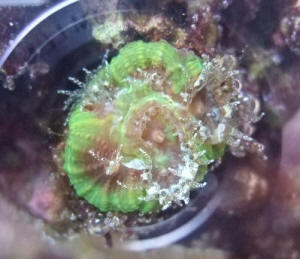
RE: LPS ID (ATTN: SARA M) 5/10/08 Sara, I was
able to get a couple of clearer pictures of this guy. What do you
think? <I'm sorry, it's just too hard to tell
specifically (beyond saying that it's a Mussid)... it will
probably be easier to tell once it grows. Do feed and care for it
well and it should grow.> In regards to the Neomeris annulata
the bottom actually becomes calcified hence the white coloration.
Thanks for the link! Thanks!
Sam B
<De nada,
Sara M.> |
|
|
|

