|
FAQs about Tobies, Sharpnose Puffers Behavior
Related Articles:
Tobies/Sharpnose Puffers,
Puffers in General,
Puffer Care and Information,
Pufferfish Dentistry By Kelly Jedlicki and Anthony Calfo,
True Puffers, Freshwater Puffers,
Burrfishes/Porcupinefishes,
Boxfishes, Puffer Care and Information by John
(Magnus) Champlin, Things That My Puffers
Have Told Me by Justin Petrey,
Related FAQs: Tobies 1,
Tobies 2, Toby Identification, Toby Compatibility, Toby Selection, Toby Systems, Toby Feeding, Toby Disease, Toby Reproduction, Puffers in General, Puffer
Identification, Puffer
Compatibility, Puffer
Selection, Puffer Behavior,
Puffer
Systems, Puffer
Feeding, Puffer
Disease, Puffer
Dentistry, True Puffers,
Freshwater
Puffers, Burrfishes/Porcupinefishes, Boxfishes,
|
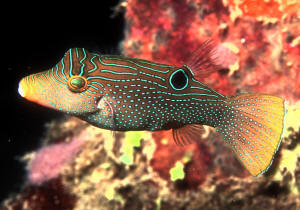 Canthigaster solandri.
N. Sulawesi pix. Canthigaster solandri.
N. Sulawesi pix.
|
Canthigaster solandri. question. Beh., Comp.
1/30/18
Hi guys,
I purchased a blue spotted puffer last friday and the first day he was
out and about and the second day was out and nibbling on the rocks. For
the past two days he has spent the day hiding vertically behind a rock.
<Happens; all puffers can be/are "moody" at times>
Yesterday, I did see him out in front and seemed fine and a few minutes
later went back to his hiding spot. I have had saltwater tanks for 15
years but never this variety of fish. There are two blue damsels and a
larger yellow damsel who is the dominant fish, but I have not seen much
harassment.
<Mmm>
All of the tank parameters are excellent ( ammonia, nitrate, nitrite 0)
and the tank has a great amount of live rock. Any ideas?
Best, Jody
<I'd not panic. Just be patient here; and this Toby will become more
outgoing w/ time. Bob Fenner>
Re: Canthigaster solandri. question 1/30/18
Thank you for the timely reply Bob, really appreciate that. Yeah, I'm
not going to panic--I have dealt with so many tragedies/learning
instances over the years. Not only 15 years of SW tanks but years of FW
as well, yet am still not an expert as yourself...and funny as I advise
people on their setups.
<Ahh... an expert... previously married and flow under pressure.>
BTW, I have your book which is so legendary and give a thank you for all
the dedication to you and your crew.....now, hoping my new little guy
comes out as he is really pretty and my 8-year old son is bummed that he
is not out. I have to show him the puffer is there, with a flashlight.
Take care, Jody
<Thank you Jody. BobF>
Re: Canthigaster solandri. question
2/4/18
Hi Bob, Just an update and still wondering--the Toby is still here but he
only comes out when the lights are off.
<Patience>
I have noticed him grazing on the rocks when it is dark--otherwise he just sits
on a cave-like rock in the back of the tank. Kind of bums me out because he is a
nice looking fish yet we never see him.
<Canthigasters are tougher than Damsels... just wait>
Just wondering if he is intimidated by the yellow damsel--kind of figured these
fish could hold their own. He is about the same size as the damsel and the
damsel kind of chases everyone around but I have not seen the damsel actually
attack him just brush up against him. Best, Jody
<See above. BobF>
Re: Canthigaster solandri. question
2/4/18
Ok, thanks for the support. The yellow damsel is a nice fish and very
active, but I was considering taking him out if he is the reason the Toby hides.
What a pain in the ass that would be with all the rocks. I will take your advice
and wait as we are only a week in and the Toby does come out when the actinic
lights are on but I have yet to see him eat Prime reef frozen food. Jody
<Have read back through your messages; you don't mention the size of this
system. If it's large enough, consider adding a couple more Damsels to dilute
the aggression here. B>
Re: Canthigaster solandri. question
2/4/18
Hi Bob,
Well, it's on the small side--30 gal.
<Ahh, too small for more damsels>
I know you are going to say a bit small for the Toby, however, before I ran a 60
gal with a porcupine puffer who was with me for more than 10 years. I will
confess I have always had undersized tanks but have mitigated
that by under stocking and providing ample hiding spots. Just don't have the
space for larger systems and plan on stocking small as I've started delving into
coral as well. That yellow guy has always been rambunctious as he would nip at
my hand when cleaning all the time. That guy chases those blue damsels all the
time--been this way for 5 years.
Jody
<Cheers, BobF>
Re: Canthigaster solandri. question 2/7/18
Hi Bob, Me again--so, yesterday I removed the yellow damsel and put him
in a small temporary tank I have to see if the Toby gains comfort and
comes out.
<A good experiment>
While I have seen him grazing on the rocks in the dark, I am worried
that he does not get any meaty food. He was out with the blue lights on
this morning but as soon as the white came on he retreated to his hiding
spot.
Tried putting Prime reef food and he did not budge. Wondering if it
might take a few days for him to gain comfort.
Jody
<Likely so... I'd wait the few days, to see. BobF>
Re: Canthigaster solandri. question
2/10/18
Hey Bob, Just an update on my Toby situation--it's been five days since
I have had the yellow damsel out and the Toby comes out a little more. I
did see him out yesterday for a half hour with all the lights on. But,
he still spends most of his time back behind the rocks though instead of
sticking on the rock he does swim there and look at me
<Progress>
I have tried daily to get him to eat frozen food to no avail but the
good news is, is that he did eat a little bit of fresh shrimp this
morning. The blue damsels don't seem to care about him, so I hardly
think there is any intimidation there. I guess you could say there is
progress but it is hard to be certain that it is because the damsel is
not there--guess if a day or so after the damsel was gone and the Toby
was out swimming all the time it would be certain.
So, my dilemma becomes the situation with the yellow damsel as in do I
wait and hope the Toby becomes outgoing and possibly put the damsel back
in or do I take him to the fish store?
<Might be worth trying putting it back in a couple weeks. The social
dynamic in the system has changed>
The yellow damsel is not too happy in his small tank as he just sits in
the corner, but he eats.
I'm not a fish psychologist so just don't know how long this Toby is
going to be a shy guy. My 8-year old son is kind of bummed the damsel is
stuck in this small tank and I would like to be able to have him in the
main tank as
he adds color and activity but would this be at the expense of the Toby
only hiding all day?
<Good lessons for your child to learn here. B>
Sorry to bother you with such an ongoing saga,
Jody
|
Toby puffer sleeping habit question 4/24/16
Hi Bob et al.
< Earl here.>
Apologies, it's been such a long time since I made contact. I just couldn't
remember where to post my question regarding: puffer sleeping habit.
<This is the place.>
Here it goes: I have just acquired a cute under two inch long Canthigaster
Solandri puffer. I have observed it closely. A couple of minutes after dimming
the lights, the puffer regularly heads for its favorite sleeping space and
anchors itself vertically onto the live rock. I would like to know how the
puffer performs this feat and is it for camouflage purpose?
<Protection, hiding, general shelter from the current, all you'd expect.
These fish are expert maneuvers and can position themselves any way they darn
well please and it seems like this guy have decided this is the way to go! I
think if you look at where it puts itself up for the night and the fins on its
underside all we become clear :) At any rate, business as usual and you seems to
have a nice, regular schedule it is used to and has settled in fine. I bet he
pops out pretty quickly once the lights come back on. You're using a timer on
the lights, right? You can see how they like a regular schedule (like children,
cats, and myself). Best, Earl>
Thank you so much for all the vital information that's continually generously
been poured into the site.
S.
Re: Toby puffer sleeping habit question 4/24/16
Ah brilliant! Thanks from Toby & I.
Keep it regular!
<No problemo, he looks like a healthy specimen in an appropriate environment.
Keep it up.>
|
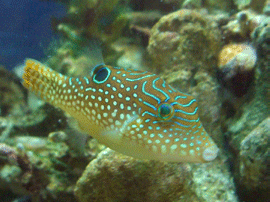
re: dimmer, Toby puffer sleeping habit question 4/25/16
Hi again Earl, I don't have a timer nor dimmer yet. Since I found the fish
to be quite timid and sensitive, for now am using basics, just three sheets
of blue tinted acetate and regularly starting at around 5:30 pm start to
slowly layering them up under the led bulb until it creates a moonlight
effect. Very relaxing process. Will try saving up for a dimmer!
<Heya. It doesn't matter as long as it's consistent i.e. the lights are on
and off at the same time every day, plus it's simply worlds of convenience
for the caretaker. Your plan seems ok although you do need to get it up to
full light around midday etc.. You mentioned that the fist is new to your
tank so he will likely get less timid regarding the light although as per
WWM/CMA leaving the lights off for a day or two is always a good idea. It's
the opinion of myself and also those worlds beyond my own expertise that
aquarium reef fish are not well off in total darkness so a moonlight style
lamp all night (VERY dim) rather than complete blackness is preferable.
I would suggest a simple controller if you plan to get into that level of
specificity as far as ramping up intensity, etc.. There are comparatively
cheap ones on the market now compared to a few years ago (I use a Reefkeeper
Lite on my fish-only tank). You can get them on the secondary market as they
are solid but simple entry-level controllers and aquarists tend to want the
"latest and greatest" and sell older gear as they upgrade to (IMO often
needlessly complex) gadgetry with computer-linked wireless control, apps,
and so on. This model has 4 outlets, I used one for the heater, 1 for a
halide that came on first and turned off last, and another outlet that
turned on 2 more lamps a few hours later for a "noon day" period and those
turned off after a few hours. I went a decade without a controller and now I
wonder how I lived without it! I have gone way off track here but the extra
security is invaluable imo besides the obvious other uses.
The $15 hardware store version in the meantime is: just use regular old
plug-in timers and use one per lamp. Say you have 2 separate fixtures. Just
time one to come on earlier, go off later, as per above, you get the idea.
Easy peasy! -Earl>
Re: dimmer, Toby puffer sleeping habit question
4/26/16
Thanks, this is more that I was hoping for. .blown away by the Crew as always :)
Final quick note: Near its bedtime, the puffer becomes quite defensive and does
the rounds to check if predators(including me) are in the area. And, regardless
whether or not the light is fully dimmed, by 8:30pm is anchored to its rock,
ready to doze off.
All the best to everyone, Stef
|
leopard Toby puff; beh. 10/27/13
I received a leopard Toby puffer a few days ago from LiveAquaria. He has
been in QT for 3 days now. Yesterday I did get him to eat some frozen
krill
but he spends 80% of his time hovering in the same spot. Is this normal
since he is new? Thanks!
<Ah yes; not to worry. Bob Fenner>
Re: leopard Toby puff, beh.
10/29/13
Thank you for the response! I have one more quick question regarding the
leopard Toby puffer. When eating food added to the tank, the puffer
bites the food then spits it back out. He does this over and over. Is
this normal?
<Yes... please search, read re Tobies on WWM; including the
foods/feeding FAQs. B>
Does he not like the food? I cant tell if he is eating any or spitting it
all back out. Thanks
Canthigaster Valentini / saddled Toby? Beh., ID 5/23/12
Dear crew,
<Hello Jennie>
I know you are told this all the time, but I wanted to tell you also, you
are brill,
<Not familiar with that term but thank you, I hope.>
I wrote to you around a year ago regarding a hitch hiker mantis shrimp
baby as I wanted to identify him as I wanted to keep him (in his own
setup, growing daily, now 2 1/2 inches long and a peacock, he is
stunning, we couldn't kill him as it wasn't his fault he was taken out
of the ocean)
<Wonderful, I'm quite the Stomatopod fan and I wish more had your point
of view.>
Sorry for waffling, now for my question. A few weeks a go we bought
a Saddled Toby, she is 1 inch in length and settled in very well, she
eats, plays (well she is a puppy) and just generally a very happy puffer
but I have never seen her puff up and I watch the tank all the time, I
know that this is a good sign as it means we have a happy puffer but I'm
now a bit worried that maybe we have a Saddled Filefish,
<I'd be much more concerned if it was "puffing". Easy to differentiate
by the number of dorsal fins.>
I've checked and checked and I'm 99% sure she is a puffer, so my question
is, is it normal for a Saddled Toby to be very happy and never puff up
as the only difference I can tell between the two is the dorsal fin, or
lack of in a puffer?
<"Normal" is a relative term but a happy/healthy puffer will rarely
inflate. The Paraluteres prionurus, or Mimic Filefish, will have
two dorsal fins and the Toby will just have the one. This is
the easiest way to tell them apart that I know of.>
I'm sorry for asking a dumb question.
<Not a dumb question but it did give a craving for some waffles.>
Kind regards Jenn Bailey
<Jordan>
Re: Canthigaster valentini / saddled Toby? 5/23/12
5/24/12
Dear Jordan,
<Hi Jennie>
thank you so much for your quick reply, firstly yep 'Brill' is a great
thing to be called, I'm a Brit so we like to shorten everything.
<I see, learn something new everyday.>
Secondly it's nice to hear from someone else that loves stomatopods,
they are so fascinating to watch, every time we sit at our dining room
table out he pops to show off, I've taken many videos of him as he is
such fun.
Thirdly, I'm right (due to your help) I do indeed have a happy puffer
fish not a filefish, I'm so happy, not that I would have sent her back
to my LFS as I've grown very attached to her, so cute.
<I'm glad you got the fish you wanted, I commonly see these two fish
mislabeled at my LFS.>
Well off I go to feed my crew (4 tanks of marines, 1 cold water tank,
and 2 ponds with sturgeon) (I won't bore you with my other pets, the
list is endless) I hope you enjoyed your waffles, urmmm my fav.
<The waffles were excellent, thank you for the steering me towards
them.>
Kind regards. Jennie Bailey
<Jordan>
Valentini Puffer Behavior
9/26/11
Greetings WWM Crew,
<Jenna>
I had just recently bought a tiny Valentini Puffer, and I've been
examining him for about a week now. I've done countless research on
his behavior so I could understand this little creature, but one
question still remains in my head that I cannot find the answer to: his
tail. He often keeps it closed, swimming around, swaying it left and
right every now and then... But every now and then, he opens it.
I'm not complaining though, because it is absolutely beautiful. But
what could this mean?
<Mmm, mainly a choice in means of locomotion... puffers, triggers
and other family members of their order (Tetraodontiformes) "get
around" principally by "undulating" their dorsal and
anal fins, utilizing the caudal more for steering and aiding in higher
speed movement... Tail displays might well "mean" a bit as
well in terms of communication; e.g. "Look, I'm too big to
swallow">
What does it mean for it to be closed, swaying around, and open?
I'm just wanting to understand. Thanks for all your help and
knowledge.
Much appreciated,
Jenna
<Welcome. Bob Fenner>
Q from a Scientist - Caribbean
Sharpnose Puffers Nipping Off Fish Spines?
8/22/11
Hi there,
<Hello Merritt here.>
I'm a graduate student doing some work on lionfish down in
the Caribbean and witnessed an unusual interaction between
invasive lionfish and a Caribbean Sharpnose Puffer
(Canthigaster rostrata) that I'd be curious to hear your
take on!
<Great! Helping with the lionfish invasion are you.>
During the capture, handling, and tagging of lionfish that makes up the
bulk of my project, the skin covering the venomous dorsal spines of
lionfish are often tugged down as they poke through the collection
nets. On one occasion, after one such fish was released from its bag
and was sitting on the reef recovering, a Sharpnose puffer came over
and began biting at the exposed portion of the dorsal spines. On fish
re-sighted after tagging, these exposed spines are often shorter and
blunted, as though the exposed end has been bitten off. I was just
wondering if your team has had any experiences with Sharpnose puffers
biting off fish spines in the past, and on what might cause this
behavior?
<Actually I have personally witnessed puffers of many species
exhibiting this behavior in an aquarium. I can only assume in an
aquarium that the behavior is either one of territory defense or two
them being typical puffers.>
I know they're known for biting in close quarters, but this
didn't look like a territorial encounter as the puffer looked more
like he was grazing or investigating a snack than trying to drive the
lionfish off. I wondered if there's any nutritional benefit to
puffers from nipping fins or spines that might explain this?
<None that I know of.>
I've benefited from the wisdom of WWM many times before, and
recognize that for many of the less-studied marine ornamentals,
hobbyists probably know more about behavior than academics, so I look
forward to hearing what you think. Thanks a million!
<From what I have seen puffers tend to be very curious creatures and
tend to bite things/objects to figure out what they are. Others will
just pick on tank mates (especially lionfish) by nipping their fins
and/or harassing them until the fish is removed or dies. I will assume
this observed behavior to be of curiosity and obnoxiousness that makes
up a puffer personality than for nutritional benefit. Good luck on your
research and hope that you find a solution to the lionfish invasion.
Merritt>
--
Natascia Tamburello
MSc Candidate
Tropical Marine Ecology Lab
Department of Biological Sciences
Simon Fraser University
Valentini puffer behaviour
4/15/11
Hi WWM Crew,
<Patricia>
Firstly, Thanks so much for the service you guys provide, I have
learned a lot from reading the WWM site and hope to keep doing so.
Ok, to my question/s, but first a little bit of history on my tank. I
have a 20g (approx 75L) tank that has around 10kg of LR (and associated
hitch-hikers such as a brittle star and possibly a snail), with
water
parameters being around: ammonia 0, nitrites 0 and nitrates approx
5-10ish, salinity is a touch high at 1028 <with a decimal point
behind the one hopefully!> and ph is around 8.2ish. Tank has
been
established (stable at these parameters) for around 3mths now.
I wanted to ask about the behaviour my Valentini (his name is Toby)
<Apt>
is exhibiting because I have no idea whether it is normal or not and
have not come across any info yet that helps to explain his behaviour.
He keeps getting these marks on his face, usually just between or
behind his eyes and I was watching him last night and I think I know
where the marks/injuries are coming from. There are plenty of holes in
the LR, all with openings about the size of a pea and he swims around
and looks into the holes and will then suddenly lunge into the holes
(to try to bite or eat something?)
<Yes. Likely hunting for food items/organisms>
and he hits his head and face on the LR. I'm sure he must be
damaging his eyes when he does it too. He does it every so often and I
have no idea if this is normal behaviour or not?
<Is normal>
I know this fish is intelligent because he knows when its food time and
also knows who to beg to get any extra tidbits and his charming ways
have even melted my dad's heart, something I thought would never
happen! Anyway, another quirk my little Toby has is he will swim around
normally but if I watch him for more than a couple of minutes, he will
swim up to the LR and then scrape his belly or sides along it and he
keeps doing it while I'm sitting in front of the tank. If I get up
and walk away, he goes back to normal, just chillin' with the
clownfish. He does not do this if anyone else watches the tank, just
me. Is this normal as well?
<Yes>
Or is my fish just attention seeking? [image: :-s]
<Possibly this too>
I've been keeping a close eye on him and everyone else in the tank,
but they all look healthy, are eating like little piggies and I cant
see any Ich or visible parasites and Toby has been doing this
strange
rubbing-against-the-LR-only-when-I'm-nearby since I got him.
Also, just a little side note, Toby likes to sleep in a vertical
position with his belly in the corner of the tank, using his fins to
hold himself there. I think it may just be his way of finding somewhere
safe to sleep so am not particularly worried about this, but thought I
would share. Also, the orange ocellaris, who has taken Toby as her role
model (apparently no one has told her things wont work out well between
them!), has also adopted this sleeping pattern after trying to perfect
it for the last month!
Anyway, thanks in advance, any help is much appreciated!
Regards,
Tricia
Sydney, Aust.
<And you, Bob Fenner, S. Cal., USA>
Re: Valentini puffer behaviour 4/15/11
Hi Bob,
<T!>
Thanks so much for the quick reply, I can relax knowing that he is
'normal'.
Thanks Again,
Tricia
<Welcome again, BobF>
Weird Puffer Behavior 10/24/10
I have a Blue Dot Puffer (*Canthigaster solandri) *in a 75 gallon tank
with approximately 50 pound of live rock, crushed coral substrate
2"-3" inches deep and he is living with two small damsels.
The tank has been up and cycled for about 6 months and the puffer has
lived in for about 4 months.
All water parameters fall with the normal range. Recently, he has begun
to exhibit a strange behavior. Starting from the lower front corner of
the tank, he partially inflates, expands all fins, positions himself at
a 45 degree angle (nose up), then zips across the bottom front of the
tank. He also gets a sort of crest at the top and bottom of his body.
He will do this back and forth for ten or fifteen minutes then just
swims off an acts normal. He shows no signs of any disease or problem
and he eats well. I was wondering if something is wrong with him or if
this is just goofy puffer behavior. Thanks in advance for any help you
can give me!
Laurel
<Have seen this sort of behavior before... Do the damsels seem to be
involved at all? I don't think/consider that this is
"trouble" per se, but an element of "jail fever" by
these intelligent (Tetraodontiform) fishes. Bob Fenner>
Re: Weird Puffer Behavior 10/24/10
The damsels don't seem to be involved at any point in this
behavior, before, during or after...Is there anything that I can do to
alleviate this "jail fever"?
<Mmm, yes... a few possibilities... The first, no joke... is to tape
a piece of paper on one end of the aquarium. Likely your little
Toby is reacting to its own (internal, you can't see
it/this from the outside) reflection. Cheers, BobF>
Valentini puffer, beh., sys.
10/17/09
Hi Crew,
<Nat>
I have a query about my valentini puffer; I have checked out lots and
lots of your pages and FAQs and haven't been able to find the
answer.
Hopefully you can help or shed some light on this issue.
We have a 35 gallon tank with live rock, coral (Zoanthus),
<Mmmm>
xenias, 2 percula clowns, 1 purple Dottyback, 1 watchman goby, a
cleaner shrimp (hanging in there but with seriously manicured antennae)
and our little valentini puffer.
<"that little nipper..."
We've had him about 6 months now.
I checked the parameters last night and everything seemed to be ok-ish,
nitrate is fine, nitrite 0.1, phosphate 0, pH between 8.1 and 8.3 and
ammonia ok.
The issue is that for the last week or so the puffer has been attacking
his reflection in the glass really often,
<Not atypical behavior>
approximately 10/15 times a day. This is a definite increase in his
usual amount of attacking. I don't know if this is normal behaviour
or not but he seems really aggressive and persistent,
<Is normal... I would coat the side panel with dark paper...>
and afterwards he seems really tired with rapid breathing. I am worried
that he may injure himself. He usually attacks his reflection in the
front glass panel and not really the sides.
Could this be a developmental thing? Moving from being a juvenile to an
adult?
<Yes; much more so with age>
He is eating fine and otherwise exhibits normal puffer behaviour. We
usually feed him defrosted mysis shrimp and krill soaked in
Lipovit.
Any advice and guidance would be much appreciated.
Thanks for all you help in the past.
Natalie
<This fish, all Canthigaster species do better in larger (volume)
settings.
Bob Fenner>
New Canthigaster Leoparda/Leopardus
8/1/09
Good morning crew,
<And you Greg>
Like most readers of your forums/library, I utilize your site as my
premier encyclopedia for all things marine.
<Glad to share>
I recently purchased a Leopard Toby Puffer (Canthigaster leoparda), as
I have a 34 gallon reef tank (a Solana, AIO, if you're familiar)
and this is the smallest puffer I could get my hands on (I know these
fish may eat inverts, but it's a risk I'm willing to take.
There isn't much literature about this species, so I thought it had
a better shot than most tobys to fare well in my reef, with its
diminutive size and smaller mouth hopefully deterring it from eating
too many critters). It is merely an inch long now, and I expect it
double in size one day. Upon acclimation 2 days ago, the little guy
seemed to be in shock, lying on its side for a couple hours).
<Happens>
It regained balance (maybe ammonia poisoning or something, there was a
ridiculous amount of poop in the bag for such a small guy - clearly a
testament to the large bioload of these puffers) and then moved to the
corner of the tank that is out of direct light and low in current. I
understand that these puffers are found deeper in the ocean, and my
thoughts are that mine may be adjusting to the lighting (250 watt MH)
as it is hiding either in the corner or behind the liverock.
<And Tobies are shy, retiring by nature, particularly when
new>
This fish is the last addition to the tank and most aggressive, with a
pair of very feisty Jans' pipefish (voracious eaters of frozen
mysis and other meaty offerings), a pair of black ocellaris clowns, and
a high finned goby. Is it common for these tobys to be very shy upon
arrival, or should I be alarmed?
<The former>
The leopard Toby is eating twice a day - I've fed him PE mysis
(largest and most nutritious, from what I gather)
<Ah yes... and friend Nuri Fisher of PE and co. is on hand here at
IMAC West currently...>
and enriched brine. I was just expecting a much more aggressive or
active fish and though it's too soon to tell his personality, want
to make sure this is a normal part of the acclimation process.
By the way, I will eventually be taking a photo and submitting to you,
as you do not have one in your Toby puffer faq.
Greg Sarkissian
<Thank you, Bob Fenner>
Valentini Puffer introduction... hlth.,
beh. 1/5/08 Hi guys <Wil> I just bought a new
valentini puffer.. and I picked it up yesterday... I did the usual
leave the bag in the tank.. put some tank water in the bag... (did not
quarantine). <You'll learn> It was swimming a bit yesterday
but has mostly stayed on the ground. <Not atypical behavior> This
morning I found it on the ground of the tank not moving. I poked it and
it moved but would not swim.. it looked like it would hop and
that's about it. Is it sleeping? And when it stays on the ground,
it looks like he's breathing heavily. <... could be trouble>
am worried that it is struggling to get used to the new tank
conditions. <What were "the old tank conditions?"> Tank
conditions: SG 1.023-1.025, Ammonia = 0 Nitrite = 0... How long does it
take for Valentinis to acclimate to its new surroundings, is it common
that they stay on the bottom for long periods of time.? <Usually
w/in a day or two...> What can I do to make the acclimatisation
smoother? Thanks guys. <At this point? Not much... keep an eye on
this fish... read re its care... Maybe on WWM! Bob
Fenner>
Valentini Puffer Personality
Question 8/23/07 Good Day Crew, <Hi Eric, Pufferpunk
here> I am interested in a Valentini puffer and have been doing
extensive research on this site, as well as The Puffer Forum,
Liveaquaria.com and some others. I know most everything I can think of,
in terms of care, adequate setup, companions, water quality,
temperament, food, etc, etc. I do have one remaining question.
<OK> One reason I like puffers so much is their intelligence and
"dog like personality"... as stated on this and other sites.
<Me too, exactly!> I know that varieties of the Dog Face, Spiny
Box, Porcupine, others normally develop a "personality" -
meaning they almost "beg" for food, respond to your proximity
and some have even been "trained" to respond to non-verbal
clues so they don't eat food meant for the eel. (Interesting point,
did read on this website, don't remember exact article). <Not
sure I believe that one.> My problem is that I'd LOVE a puffer
like the ones mentioned above, however my tank is much too small. (55
ga, 48 inches long) For this, I would like a Valentini but have not
found anything in regard to their personality ( I know they're
aggressive) -- meaning normally do these puffers exhibit similar
behavior/intelligence/begging/etc. as the previously mentioned puffers?
<Yes, yes & yes! All those things in a cute little package. I
have recently purchased one. It is in the tank behind me & I always
catch it looking at me over my shoulder, while I'm working on the
computer (when it's not looking for food). There is a gal, Bonnie,
at The Puffer Forum, that suggested the Valentini over other
sharp-nosed puffers, when I asked her about which one to get. She said
personality-wise, that species would be the best choice. I sure like my
lil fella! So far, he's left all the crabs & snails alone (each
puffer may be different though). He is very curious & never touched
any of the corals I have in there. I've got several kinds of
leathers, zoanthids, frogspawn, hammer, mushrooms, tube anemone &
plate coral. He also lives with a couple of damselfish. Good luck with
your puffer! ~PP> Thanks for all the help! Great site,
Eric
Valentini Puffer 8/23/06 Hello,
<Hello> I have a Valentini puffer in my 125 gal community / live
rock tank. He has been my 'anchor' resident for over eight
years (2 false Perculas and a Royal Gramma have been with me for nearly
eight years and a number of other critters for about two - four years.)
He has been a great host and hasn't nipped fins, but does
occasionally eat my frequently replenished snail
stock (he's definitely a male Valentini). <Mmmm>
He still looks healthy as a horse. How long
should I expect him to be around? Any ideas on the life span of the
Royal Gramma or False Perc's? Thanks, Craig Martin <If memory
serves, all three of these species have been known to approach twenty
years in captivity. Good on ya. Bob Fenner>
Valentini Puffer & Talbot's Damsel
9/27/05 Hi! <Hi There!> I have a Valentini Puffer.
We've had him (or her) for about 2 weeks. He lives in a 90L (Sorry
I'm from Australia!! I have no idea what it is in gallons... maybe
near 30 - 40g??) The tank is @ 24 degrees Celsius (again no idea ...
actually wait I converted it online and its 75.2F) The ammonia levels
are a little high (but we're doing water changes every 3 - 4 days
to correct it and it's lowering pretty well) We take the water for
a weekly water check at the LFS and they told us the water is great.
(Better than theirs), except the carbonate hardiness is too low, so we
are using Coral Success to fix this up). <The ammonia should be
zero, so a little high would not be considered great water quality. I
would like to see daily water changes until the ammonia is 0.> He is
kept with a Pajama Cardinal, Ocellaris Clown, Banded Damsel, Domino
Damsel, Green Chromis and 2 Talbot Damsels. He's very peaceful and
just seems to pick at the rocks very often, no worry to me, I don't
mind him doing it. We feed him a multi-vitamin frozen food and
sometimes frozen brine. He also gets fed live brine. <He needs a
variety of meaty seafood as well as some greens.> I have read your
Puffer dentistry article and could not see anything specific about
Valentini Puffer teeth. I have printed out your General Puffer info but
I haven't read it yet. (I will after writing this but its 17 pages
long!!) I was wondering how am I supposed to know when his teeth get
too big? <It would be preferable to prevent his teeth from over
growing by feeding him some seafood in the shell so he can keep them in
check himself.> I read your other responses about Puffers and
couldn't see anything specific to the Canthigaster Valentini.
<The information should be similar and applicable to your
puffer.> Also I read that some people are concerned about the size
of their puffers stomach. <Their bellies do have quite a capacity
for expansion, which can be witnessed after a good meal.> My puffer
has got a bit of a big tummy, but since we've had him he's only
puffed up once and eats all day long. <Most of them do like to
eat.> (The tank has only been set up with fish for about 4-6 weeks)
How will I know if its a fat stomach or an air filled stomach? <If
he has taken air into his stomach you may notice the pocket of air as a
bulge and his orientation in the water will be off, in other words he
most likely will be off balance and have difficulty remaining in his
normal swimming position. The area containing the air will be directed
towards the surface and he may possibly even be floating near the
surface if there is a good amount of air trapped. This is often
referred to as positive buoyancy.> Also he's very hard to catch
and the tank has a lot of live rock and coral that all the fishes have
hiding-holes and caves to jump in as soon as my hand goes in the tank.
So I can't really grab him to touch his stomach, (like you've
told others to do) how else would I know? And wouldn't it hurt him
if I were to press on his stomach? <This is really not necessary
unless you suspect that there is a problem. It is preferable to keep
your hands out of the tank and off the fish. Every time you touch your
fish you disturb their slime coat which serves a protective function
for the skin.> My puffer is so beautiful and loves to make faces at
the glass and run up and down to show off to me. <Yes they are very
pretty and have quite endearing personalities. I find them
irresistible to say the least. Puffers are one of my favorites.>
Thanks for all the great info, I've learned a lot about him, just
by reading some Q&A's on your site. <That's great keep
up the reading. Educating yourself is one of the best things you can do
for your fish!> Also I have 2 Talbot Damsels in the tank, they are
pretty aggressive towards all the other fish (except the Pajama
Cardinal and Valentini puffer, I think because they're bigger than
the Talbot's) <Very possibly. I am not familiar with that
particular Damsel species but the family as a whole is fairly
aggressive. The PJ Cardinalfish should really be kept in a peaceful
community tank. The Damsels and Puffer are really not appropriate
tankmates. Please do keep a close eye on these fish for any signs of
harassing the Cardinalfish.> If I took one of them out (if I can
catch them) would this fix the problem? <No I don't think
so.> My LFS said that if I keep my tank around 34C (75F) then it
will stop them being so aggressive because it will keep their
metabolism low, making them less hungry. Is this true? <In theory I
guess it is a possibility but my best guess is that it would not work
to your advantage. If it were my tank and fish I would not want to wait
to find out. I would remove the aggressors as soon as possible. The
fish that are being harassed are at risk for an injury and are
definitely being stressed. Stress is a precursor to
disease. Elevated ammonia levels are also stressful. Add the
stress of being harassed to the increased ammonia levels and you have a
recipe for sick fish. Please do consider removing the Talbot Damsels as
well as doing more frequent water changes. > Thanks for your help.
Sincerely, Sarah <You're most welcome! Best of luck with your
fish. HTH, Leslie>
Valentini Puffer 11/17/05 Hi!
I have a Valentini puffer (saddle back), I previously wrote (in about
end of Sept) to get some info and you guys were great! thanks. I
have a curved glass aquarium (the front corners are curved, and have no
joint, so that the only joining of glass is at the back of the tank,
where there are just normal right angle corners... I hope that makes
sense?) <Yep> Anyway my puffer is a bit of show off and she likes
to run up and down and up and down and up and down (for ages, sometimes
15 - 20 min.s, for about 3 or 4 times a day) the curved corners. I
don't know if she can see a reflection of herself or something like
that, <Or you... associated with food/feeding...> but I was
wondering if its healthy for her to be swimming up and down the curved
corners? <No worries> and if its not what can I do about
it? <Zip> And even if it is healthy Its kinda annoying. So how
can I stop it. <<This is not a domesticated animal whose
behavior you can modify at will. MH>> Just FYI,
he's very healthy otherwise (he is about 9 months old) and the tank
is very stable. We have 7 other fish (in a 90 litre tank) 3 x Green
Chromis, a domino damsel, a ocellaris clown, a pajama cardinal and a
sand sifter, all of whom are relatively healthy and generally not
aggressive. We feed them once a day, frozen green marine food
(vitamin stuff) and generally the tank is in good order. <Sounds
good> Also we have two (2 - 3cm's- around 1 inch) unwanted
crabs. they came with the live rocks. Any ideas of how to get rid of
them? <Could be baited, trapped out: http://www.wetwebmedia.com/swcrabcomp.htm>
Thanks for your help. Sincerely, Sarah <Welcome. Bob
Fenner>
My little fishy (puffers) I call him (or her) Baby.
Baby is a Valentini and only about one inch long. Baby is new to the
tank and only has to deal with a Figure 8 Puffer. I am wondering about
Baby's strange behavior. Baby pulls her/his tail close to the body
and starts going in circles and darting about. Is this a defense
mechanism? <Hmm, maybe... have only seen and heard of this
about Tobies, Sharpnose puffers (subfamily Canthigastrinae) a few
times.> Are they also unusually shy? The figure 8 (Fishhead is his
name) is not much bigger but was there first. This is my first tank,
first puffers, and I am having a great time. It is in my office and
everyone comes to visit Fishhead and Baby. Let me know what you think.
Thanks, Linda <Good names, good owner. Bob Fenner>
Puffer question Hello! <Hi! Ananda here today...>
I am new to the hobby and just got a 125g saltwater tank. Please excuse
me in advance if I am listing too much info! <Too much info?
Truthfully, more is better.> The setup has fish, live rock and live
sand. Wet/dry system w/ protein skimmer. There were 9
assorted fishes (yellow tang, a large Emp angel, yellow cow, powder
blue tang, 3 blue damsels, a percula clown, and a semi-large
maroon/gold clown) that came with the tank, all of which I had
quarantined at my LFS until my tank was ready. All of the
fish get along great and have been together for at least a year.
<Oh, my, that is a volatile mix. The cowfish will get huge. Do
research their special needs. The maroon clown is likely to get mean
and harm the percula clown -- you've got the most aggressive clown
(the maroon) in with one of the least aggressive clowns, and that's
a recipe for clown wars, which the percula is likely to lose. I'd
get the perc into a different tank.> I decided to pick up an
additional fish at the store which I thought was so cool- a rather
small Hawaiian blue puffer. <Canthigaster jactator, presumably.>
I had seen it in the store for at least 2 weeks and it looked rather
healthy w/ no signs of problems; it was isolated in a small tank of its
own. <Watching it for a while is a good idea.> The LFS is a very
well run/maintained, clean store. I decided to drop all the fish in my
tank simultaneously (after acclimating them) and they all immediately
were in heaven (my 9 were in a 20g QT at the store, so I'm sure
they were happy to be back in their 125). No signs of stress- all 10
immediately swimming about and eating well. <Yikes on several
fronts: the 20g QT, dropping all the fish in at once (which could lead
to a massive ammonia spike!), and adding the puffer along with
everything else without QTing it at home first -- and not having a QT
tank yourself! I'm amazed every fish is okay so far.> Later that
evening, I couldn't find the puffer anywhere- turns out it went
underneath a live rock and mounted itself upside down, belly flush rock
AND changed colors (maybe shape too?) to blend in perfectly w/ the
rock. It was like that again this morning only this time on top of a
rock. It eventually woke up and started swimming about and eating this
morning- colors are back to normal. <Surely, it was significantly
stressed by the introduction.> I couldn't find any listing of
this "camouflage" characteristic listed anywhere about this
fish. I didn't know if this was normal (if it is, how cool!), or if
it is sick? <I don't have experience with this species, but I
have known puffers to change color to blend in with their surroundings
and darken when stressed.> I also noticed a small blotch this
morning which looked like sand or salt on one side of it, but it seemed
to be gone an hour later, so I'm assuming that it was substrate.
<Maybe. Keep an eye on it.> Anyway, appreciate any 411 you can
give me on my new fish! <Start with the WWM site and info about
puffers, and with Fishbase, at http://www.fishbase.org > Thanks!
Sincerely, Michael Becker <You're quite welcome.
--Ananda>
Puffers sleeping nose-up! (02/23/04) Dear Ananda,
<Hi!> Hello, I was frequenting your Sharpnose puffer FAQs and
came across the attached question from Elizabeth Mackie, and would like
to contribute some info. <I'm including a snip from the post
you've mentioned: "...at night when he "sleeps," he
hangs vertically (nose-up) at the very top of one of the corners of the
tank. I have never seen a fish do that before." > I
have a Canthigaster compressa Sharpnose puffer, and he WILL sleep in
the vertical position if there is light bothering him. <Ah! Good to
know!> Sometimes he will go up in the corner vertically and sleep,
but usually he sleeps horizontally on top of a powerhead (for warmth
perhaps? Tank is around 78 degrees.) <For warmth, perhaps, and
there's the possibility he likes the massage action from the
powerhead. Your puffer is not unique in this, at least.> Anyway, I
often catch him sleeping vertically behind the powerhead, and my only
guess is because I have the lights in my room on past his bedtime when
this happens. He is the cutest fish! I have had him for several years,
and this seems to be normal behavior for him (well, his actual gender
unknown!) Hope I could help! Rob Lewis Long Beach, CA USA <Thank you
for the info. I ALWAYS appreciate getting more or better info relating
to puffers! --Ananda>
Puffed-Up Puffer 6/14/04 Hi, I'm really
needing some advice right now <Hi, Pufferpunk here.> My valentini
has been inflated on and off for over an hour. This happened after
feeding him a shrimp tail (his favorite). He's never puffed up like
this. <Something must have spooked him.> I put in a PolyFilter
just in case of unknown toxins. I also did a 50% water change even
though water levels were good: Ammonia, nitrite and nitrate zero,
salinity 1.019, temp 80. <SG sounds a little low. Better
at around 1.023.> He's really upset and jumpy (he's usually
very mellow) and is seems to be drifting like a balloon. <He sounds
like he must have swallowed some air.. Hold him vertically,
tail down, head under water & give him a few gentle shakes, until
he "burps" it out. He may inflate again while
you're doing this, but he'll be sucking in water, so it'll
be ok.> He uninflated a couple of times (very briefly) then puffed
up again. I didn't see him ingest any air but I guess it's a
possibility. He's in a 10g. QT and has been for 3
weeks. Poor little guy. I feel totally helpless:( Thanks
much -Angela <After burping him, I'd leave the lights off &
let him rest. Good luck with the little
fellow. ~PP>
|
|

