|
FAQs about Trachyphylliid Coral Disease/Health,
Parasites, Pests 1
FAQs on Open Brain Disease:
Trachyphyllia Disease 2,
Trachyphyllia Disease 3,
Trachyphyllia Disease 4,
Trachyphyllia Disease 5,
FAQs on Open Brain Disease by Category:
Diagnosing, Environmental (Pollution/Poisoning, Lighting...),
Nutritional,
Social (Allelopathy),
Trauma,
Pathogenic (Infectious, Parasitic, Viral)
Predatory/Pest,
Treatments
Related Articles: Coral Pests and Disease; pests, predators,
diseases and conditions by Sara Mavinkurve, Trachyphylliid Corals, Trachyphyllia Reproduction Report,
FAQs on Stony Coral Disease by Category: Diagnosing:
Environmental (Pollution/Poisoning, Lighting...),
Nutritional, Social (Allelopathy),
Trauma,
Pathogenic (Infectious, Parasitic, Viral)
Predatory/Pest,
Treatments
FAQs on Stony Coral Disease by Type: Brown Jelly Disease, RTN,
|
|
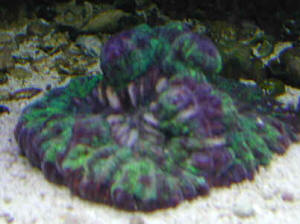
Bloated Open Brain (Trachyphyllia) 6/25/08 Hi WWM Crew,
<Hello Cindy!> I am very much hoping that you can alleviate my
worries about our open brain. <I hope so too!> We've had
'him' for about 4 weeks now and until recently it appeared as
though everything was going well. Until the past few days his tentacles
would come out every evening - dinner time for everyone else as he was
curious. Twice a week we feed him a small morsel of clam, muscle,
shrimp or octopus; which he accepts gladly. <Great! Glad to see you
must have researched husbandry a little. Too many of these starve to
death in aquariums.> There are never any leftovers and he hasn't
spewed anything back into the tank. The rest of the week he will get
left overs that may drift to the bottom once the fish have had their
fill. As far as I can tell he's well fed. Recently we have upgraded
our lighting and we are trying to acclimate everyone slowly to the
better lighting. Since we've changed the lighting though the open
brain coral has bloated and his tentacles are extended all the time.
Based on all the research I've done I was sure that his tentacles
were a sure sign of hunger and the bloating was generally reserved for
the day after meals; but for the past three days they are out almost
24/7 and his bloating is incredible; he expands by about 50%. He still
expands/retracts but the bloating is so much more than we've seen
in the past that I'm worried about the behaviour. Is he incredibly
hungry or just loving the new light? Do I step up the
feeding/reduce/change it?? <This is a stress response, most likely.
Expansion means more surface area, and therefore more passive
cooling/waste diffusion. Even if he isn't cooking, full of waste,
or wanting more light a coral only has so many responses to stress. If
something seems wrong and all you can do is puff up, you're going
to puff up- know what I mean?> Tank details: 6 months old, 45 gal
-corner tank, 40lbs live rock, 2" live crushed coral covered by
1" fine live sand. 2 percula clowns, 1 cleaner shrimp, one
engineer goby, 1 hammer coral, 1 bubble coral, 1 open brain :-), green
Zoanthid polyps, 1 doz. assorted snails, 3 red hermits, various blue
legged crabs, small refugium with 4 mangroves, Tunze 50 gal protein
skimmer, Fluval filter, 78 degrees, 8.2 ph, 0 ammonia, 0 nitrite, 20
nitrate??, 380 calcium. The calcium levels is slowly being increased
(over the course of 2 weeks) to 400. The nitrates are frustrating, they
are always there, we've tested the change water and the nitrates
are 0, but after 1 day they jump to 10, am hoping the new lighting will
increase the algae and that will help to take care of the nitrates.
<Well, to run the colloquialism through the nitrogen
cycle..."nitrate happens". It can be tough to control in
smaller tanks...but it sounds like you know how to stay on top of
it.> Change water 10% twice weekly. Old lighting: 2 x 18" 15w
fluorescent bulbs 1 x 10,000k (ocean sun), 1 x 20,000 (coral sun) - new
lighting: 1 250w 14,000k metal halide. <VERY good lighting! Keep an
eye on that 14k, I've heard sometimes they don't hold their
spectrum as long as the 10k or 20k flavor.> Thank you very much for
the hours upon hours of reading material that you have provided for us!
<You are very welcome! Thank you for reading them! I think your
brain should return to normal as he adjusts to the new lighting. If he
begins to bleach or show other signs of serious stress consider slower
acclimation to the light- and feel free to write in if problems
arise.> Cindy <Benjamin>
Green open brain not inflating 10/6/05 I enjoy your site and
find it very helpful. I have looked at many articles and Q & A on
open brain corals. I have some answers but was looking for more
specific suggestions. I have a 29 gallon tank. 135 watts power compact
lights. Ph=8.3, salinity is currently 1.026 (has fluctuated from
1.024-1.027 at times b/c of evaporation. Relatively stable though),
Nitrate 5-10, Nitrite 0, Ammonia 0, Calcium 480, KH 8, temp 78 degrees
(some fluctuations but relatively stable). Bak-Pak 2r Skimmer, Skilter
250 (don't use skimming aspect), and power sweep 212. I have had a
green open brain for two months. I purchased it from my LFS attached to
a small piece of rock. I have sat it on the bottom since I got it. It
seemed to be doing very well up until 2-3 days ago. It would
inflate/expand during the day while deflating and tentacles would come
out at night. Recently it does not inflate/expand like it
used to during the day. Also it has not opened its mouth during feeding
recently. Finally, I no longer see its tentacles at night. I have
historically feed a variety of frozen foods to the couple fish in my
tank including: Mysis, formula one, ocean plankton. I had not directly
feed this brain but always observed it opening its mouth during feeding
times and had visibly seen it eat small pieces of food that float into
its mouth in the past. Should I be concerned about this change? Any
advice its greatly appreciated. <Not a difficult coral to care
for. Your lighting is close to borderline for keeping
these. As far as food, they will produce most of their own
food but benefit from occasional plankton feeding such as
Cyclop-Eeze. You didn't state how long you have had
it. Is lighting on for 12
hours/day? Addition of strontium and other trace elements is
very helpful in maintaining this coral. Read here
Anthony...http://www.wetwebmedia.com/trachyphlliidae.htm James
(Salty Dog)> Thanks Anthony
Green open brain II 10/7/05 Thanks for your quick response.
<You're welcome> Yes, I do keep my lights on for 12
hours/day. I actually do dose with strontium and iodine. I also do 5
Gallon weekly water changes. My question is specifically does the lack
of inflating and currently no tentacles at night represent some kind of
specific problem? What can I do? It seems to be a negative change from
my observations. Is the green open brain dying? <Pretty tough
to answer that without observing. Couple of things to consider...How
old are the PC bulbs. Should be changed yearly. Might want to try
moving the coral. Do not keep it in direct current path from the
pump/powerhead. Do you have any fish that may be picking on it? Are
water changes done with Reef Crystals or a similarly reef enhanced
product? Other than that, just observe. You didn't mention how long
you've had it, short time/long time. James (Salty
Dog)>
Open Brain Coral. HELP!! - 08/20/05 Hi, <<Hello>>
I recently bought an open brain coral that is hot pink and green.
<<I love these!>> It has not opened up at all yet to
release its tentacles but it has opened and closed its
mouth. I am only feeding it oyster eggs and plankton at the
moment. <<Diced meaty foods please...>> My concern is that
the coral is starting to lose its color and the skeleton is starting
to show around the edges. <<A bad sign.>> I moved it into a
cave because I think the light was to strong. <<A common mistake
to put these corals in the top third of the tank believing the bright
colors indicate high light requirements...usually dooms the
coral. Should be on the bottom in the sand for most
(conical-shaped skeleton).>> Since then I have yet to see the
mouth close at all. Is this normal? <<No...another bad
sign.>> Now, the fleshy middle where the mouth is has been ripped
or detached from the outer skeleton. Will my coral make it
to see another day or is this a battle that's already been lost?
<<From your description I'm inclined to believe this coral is
doomed/lost. Do ensure your water parameters are up to par,
and have a good read through our FAQs re this
coral: http://www.wetwebmedia.com/trachyphyllidfaqs.htm Jessica
<<Regards, EricR>>
Trachyphyllia health mainly 7/19/05
Hello...Your site is wonderful! I have an open brain
(Trachyphyllia). I received many corals from a man who was going to
throw them away.... some were in great condition however my brain was
not too great. I've had it now for about a month. At
first it didn't go through a normal cycle, then for about a week it
started to... I had two large hermits <Predaceous...> (I took
them to a new home last week) that were picking on the brain, needless
to say the brain quit going through its cycles because these crabs were
picking at it. Now the brain's tissue is ripped, has
holes in it, and about half of it's skeleton is
visible. The color in the tissue is still good, there is
some algae growing on the outer rim of the skeleton. <Not good>
I'm very concerned, and I'm not too sure that it is
going to recoup. It hasn't been going through it's
cycles, it's like it can't because it is so filled with holes
(if that is a possible reasoning?), How do I go about making sure it is
getting food so it can regain it's life, etc? <Iodide
treatments, fine food offerings...> Is there anything
else I could do to help it's recovery move along quickly? Is it
possibly hurting anything in my tank by being so decrepit?
<Possibly... I would watch your water quality, other livestock>
Sorry for so many questions! I've searched your site and
you have so so much info on Trachyphyllia (so much wonderful info about
a lot of things!) but I can't seem to find what I should do about
my situation. Please help :) Thank you so much! Codie S.
<Keep reading my friend. Clarity is pleasurable. Bob Fenner>
Re: Trachyphyllia.. nutrition, health... RMF career
7/22/05 Good day Bob or whoever I may be speaking to today....I
hope all is going great today... I have several things to throw your
way today...I'm sorry if I've got a repeat question thrown in
here. In regards to my Trachyphyllia: When food is offered to it, the
mouths close up. Except when I offered plankton. I
haven't ever seen sweeper tentacles come out (even when it was
doing normal cycles), Do you think it may be getting the nutrients it
needs by me taking a plastic syringe and gently directing fine meaty
foods at it... even without the presence of the tentacles?
<Possibly, yes> The algae that is forming on small parts of the
skeleton... could I try to gently remove it somehow or would this be
advised against? <Directing a stream of water... as with a powerhead
or small submersible pump is all I would do... don't physically
touch> Is Iodide harmful to any marine animals or corals if used
properly (that you are aware of)? <Not unless overdosed> I've
got a rock that had several mushroom corals growing, a piece of the
rock broke off leaving one of the mushrooms attached to the original
rock as well as the broken off piece. Is it best to let it
be (it is hanging, I've propped it back up but it wont stay) or
someone recommended I should just tear it off the original rock :(
sounds painful but I'm not sure it feels pain like that? :) <I
would "tear it off", move it to someplace safe, stable>
Thank you in helping me on my journey, I swear I'm not trying to be
hand fed... I just need a little help with this predicament (the
brain). And the other questions are just thrown in there... my main
concern is my brain though! On a bit of a more social level...what is
your favorite dive location? <Mmm, there's a bunch... overall,
the Red Sea likely> Bob... do you go and speak at seminars
<Almost every month... for the last few decades... to hobby groups
mainly, in the pet-fish and dive/adventure interests> or am I
interpreting some info wrong.... at one point in one of your responses
to someone's questions it sounded like you do seminars, if you
do...have you ever found yourself in Indiana? <I think so...>
One more personal/social question... what is your career...
How do you make it possible to go on all these wonderful diving
journeys? Thanks guys!!! Codie S. <Good, friendly questions... I do
five "things" for money, including two that are petfish
related... am a content provider, selling writing and photography...
But really, am retired in terms of having to "do" work...
invested a part of what I earned, in stocks in good companies, real
property... so I can/do travel about half the year. And I do encourage
you to take up the dive, travel habit as well! Thank you for asking,
sharing. Bob Fenner>
| Sponge taking over open brain coral
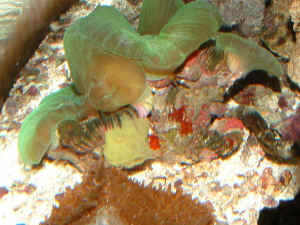
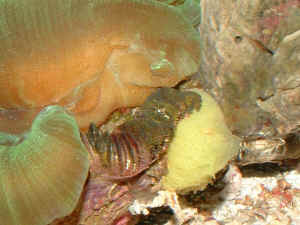
5/31/03 I have an open brain coral (Trachyphyllia geoffroyi)
that has a sponge grow on it. I first noticed the sponge
about 5-months ago and about 3-months ago it split into two
sponges. Both sponge are approximately equal size. I
left it alone as it was not hurting the open brain
coral. <actually, most all sponges are quite
noxious... the warfare between most invertebrates is slow
(weeks/months)> Recently, I noticed the open brain receding in
the area near the sponge, as the sponge is growing
larger. I have attached some picts. Do you
know what type of sponge this may be? <it appears to
be a common yellow/green calcareous species that we often see in
aquaria. Perhaps a Clathrina sp> Would it be possible to cut the
sponge off along with some of the skeleton of the
coral? <yes... very good> I really like the look
of the sponge and want to keep it, but I also don't want to
lose my open brain. Any other suggestions would be
appreciated. <you have the right idea, my friend> I have a
46-gallon bow front tank and the open brain is approximately
6" by 5" shape. All the water parameters are
good; ph 8.2, calcium ~430, phosphate 0.3, no detectable amounts of
ammonia, nitrite, and nitrate. Thanks, Alex <all good, best
regards, Anthony> |
|
|
|
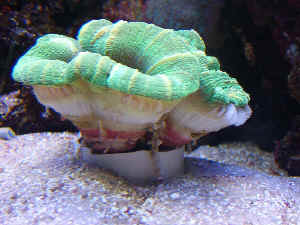
| Trachyphyllia gone wild!!!! - 6/23/03 My
favorite coral has not been doing well for a few weeks. <Sorry
to hear> This afternoon I took the turkey baster to blow off the
sand that the sand-sifting goby threw on top of the open brain.
<Not good, my friend> I was going to move the brain away from
the fish's den and when I lifted the brain to get a look at the
bottom of the brain I discovered that the skeleton was showing.
<I saw that in the picture. In need of TLC for sure> I
decided to lift it off the sand with a piece of PVC. <Very good
idea and I pray you moved it away from the goby's den?> I
also noticed that there are hard tubes growing on the sides of the
skeleton, like the ones that feather dusters build. <I have that
on mine as well. Normal.... and as far as I can see, no harm no
foul. Just opportunistic space requiring tube worms.> What
should I do to help my brain??? Well, first be sure to move it away
from the goby's den. Elevating is good. No algae blooms! Keep
water clean through a frequent water change regime. Feed the coral
if it will extend it's tentacles for feeding. Maybe even coax
it by spraying a little Mysid juice before feeding. If not already,
stabilize your lighting scheme, and lastly, be sure that if the
brain were to expand, that it does not scrape against rocks or
other corals. Even a healthy specimen can have a hard time with
that. Good luck> Thanks in advance. By the way, if this pictures
are helpful to you, you may keep and publish. <We'll do!
thanks> -RY |
|
|
Brain Bleaching? Hi I have a red brain coral I have had him
for about a year now. I have noticed that his color is fading and he is
turning a white color. He's not shrunken or shriveled, he just is
turning white like the color is fading out. Any suggestions? <Well,
there could be a number of factors at play. Check water quality,
lighting (are the bulbs getting old? Too much light?), feeding habits
(are you feeding the animal regularly?), current (excessive current?).
Any potential allelopathic competition (like from Sinularia or other
"noxious" soft corals). Is anyone in the tank
"sampling" the coral's tissue? These guys seem very
"tasty" to some fish...Lots of possible factors. Do a little
checking, and adjust conditions as needed. The answers are out there!
Good luck! Regards, Scott F>
The Tang That Ate His Brain! (Brain Coral In Trouble?) I have
a brain coral (Trachyphyllia) and over the last few days I have noticed
a white cotton like substance on it, a little smaller than the size of
a pencil eraser. It seems to be getting larger. The
interesting thing is that when the lights come on it seems to suck into
the brain coral and vanishes. Could there be a bite in the coral caused
by my yellow tang taking a nip at it once in awhile or is this some
sort of sponge? Thank you so much for your help! <Well, for whatever
reason, these corals seem to be especially "tasty" to many
fishes. I suspect that, as you surmised, this may be some localized
trauma to the coral as a result of someone "munching". The
abscess or traumatized area probably seems to "retract" into
the animal when the tissue expands in response to "lights
up"...Keep a close eye on the animal, and consider removing it if
it is continuously harassed by the tang, or declines in health...Good
luck! Regards, Scott F>
Burned Tissue hello crew, <Hi, Ryan with you> I have
this awesome green Trachyphyllia that was in contact with one of my
Favias sweeper tentacles, <Yikes> I have moved the two of them
further apart. The Trachyphillia's tissue is damaged in one area,
skeleton showing , about 1/4" on the bottom ridge. Is there any
thing I can do to prevent further loss and possibly help it grow back?
<A nice large water change of 20%. That's about it> I have
been feeding the other areas of the coral heavy with Selcon soaked
Mysis shrimp, I've been trying to get the damaged polyp to eat as
much as I can , the end mouth won't take in the food but the others
next to the damage will eat. <Leave him be, it will re-grow>
Iodine dip??? Coral dip??? <Nope> Kinda in a hurry , thanks a lot
all...<no problem! See ya, Ryan>
|
Trachyphyllia Health Hi Crew, (re-sending
without attachment. For some reason all my emails sent
to 'crew@wetwebmedia.com' bounce back if I include an
attachment -- even though the size is minimal [25kB]) I am a bit
concerned about my Trachyphyllia. I think I have a T.
Radiata but, from the attached photo, maybe you can help me to
verify this as well (it has a flat base -- not conical and it
does appear to have more 'folds' than what I have
observed in most photos of T. geoffroyi). My concern
is that I can see the skeleton nearly penetrating through the
coral's tissue in many places. This occurs during
the day but the coral inflates to nearly round after the lights
turn off and it appears 'normal' at this time. << I
wouldn't be surprised if it is eating at night, and therefore
expanding. >> I have had this coral for about a month now
and it does seem that the skeleton has become more visible during
this time. This coral sits on the aragonite substrate of my 180g
tank, with 520W of PC lighting (50% actinic / 50% 10,000K) and
3,000 gph flow (1,200 gph via alternating-flow
manifold). Water parameters: Temp=79-81 F, pH=8.1-8.2,
Alk=4meq, Ammonia=0, Nitrite=0, Nitrate<5ppm,
Ca=400ppm. I noticed my pygmy angel nipping at this
coral for the first several days after adding the Trachyphyllia
to the tank but, with over 200 pounds of live rock, I have been
unable to catch this fish (I am open to any
suggestions). I am moving in six weeks so I will
remove all such 'nuisance fish' when I drain the tank at
that time. I am just concerned that this coral might
not make it that long. My second concern is that I have never
been able to see any feeder tentacles or polyps on this
coral. I had read that these corals are very hardy and
that they require no external food so I had not been concerned
about feeding it. Tonight I read that these corals
require feedings about three times weekly, with meaty foods and
that they should only be fed when their tentacles are out.
<< The coral may not "need" to be fed, but
feeding can certainly help them grow. I would
recommend weekly feeding. >> So now I am worried that I
have been starving the coral and that I do not know how to feed
it (since there appear to be no tentacles). I have
used a dim flashlight to check for tentacles on several occasions
(after the tank lights have been out for a few hours and the
brain coral was inflated). << You can directly target feed
these types of corals. You can use any type of small
shrimp or even krill. Simply feed your tank (the coral
can tell when there is food around) and wait a few
minutes. Then, with your fingers take a piece of
shrimp and hold it on the coral (near any mouth
opening). It may take a few minutes, but it will open
up and ingest the food. Go to www.utahreefs.com and under
Presentations you will find a PowerPoint on Feeding A
Reef. It has video clips of feeding brain corals.
>> I have Eric Borneman's book 'Aquarium
Corals', in which I have read everything I could find about
this coral. Unfortunately, I feel that I am still
missing something. I have tried feeding zooplankton,
phytoplankton, marine snow and Mysids but I have never noticed
any feeding response from this coral. << They are not the
easiest corals to feed. Unfortunately indirect
feeding, and even semi direct feeding don't work well for
them. You really have to hold the food right on them.
>> I have even used a turkey baster to quirt
these foods directly onto the surface of the coral but my cleaner
shrimp always picks the food off the coral before the coral has a
chance to react. I have tried this during the day and
at night, with the same results. Please advise how I should
attempt to feed this coral and what might be causing the
appearance of the exposed skeleton. I am assuming this
is not health appearance. << I would also see what
other's are doing to keep these corals. You may be
able to pick up some advice from some friends in similar
situations. I for one like to have these corals in
areas of high lighting. >> Thank you, --Greg
<< Adam Blundell >>
|
|
|
| Follow-up: Trachyphyllia Health Adam (or crew member of
the day), <Hi Greg, MacL here> Since my emailed photos are no
longer being received via WWM email, I put the photo of my
Trachyphyllia on a web page for you to view ( http://home.comcast.net/~greg.wyatt/trachy.htm).
<Sorry you are having to do this. Some type of technical
difficulties.> Hopefully this will help to clear-up my concerns.
Since this is my first brain coral, I am unsure whether the white,
nearly exposed skeletal areas around the mouths should be
considered "normal". <Have you been to the website and
looked at the section on these types of corals? http://www.wetwebmedia.com/trachyphlliidae.htm.
This looks very similar to the ones pictured on this page. I
can't see very well around the mouth because of the angle but
you should be able to tell if its similar or not.> The pygmy
angel that appears to think this coral is an appetizer and the
apparent lack of feeder tentacles has me concerned. <I'm
sure and pygmy's can be terrible pests to this type of coral.
You might need to consider removing the pygmy. But let me ask? If
you haven't seen him nibble on it why do you think he's the
pest for it? Like Adam, I think you need to feed this coral. Is
there anyway to keep the shrimp off of it? Perhaps even putting it
in something to feed it? I hate to disturb them but I really feel
you need to feed it some. I am a bit concerned that you are seeing
through to the stony coral below. Although the fact that it is
swelling at night does mean usually that it is feeding. I know that
my brains feed much better at night.>If you have any additional
input after viewing this photo, please advise. Thank you! <Hope
this helped Greg, MacL.> --Greg |
| Trachyphyllia Problem II Hi MacL, <Hi Greg, got a
little help from a friend to help you as well.> I wish I could
remove the pygmy angel but, as I mentioned below, I have a 180
gallon tank with over 200 pounds of live rock. So, although I have
tried many methods of capturing this fish, I have had no
luck.<Well I know people who have gone so far as to try to catch
them with a hook.> I certainly welcome any suggestion you might
have for catching this fish! Otherwise, I do plan on removing it,
my damsels and an eyelash blenny when I move to my new house in six
weeks. I must drain the tank at that time so I should be
able to catch everything them. I am just concerned the
Trachyphyllia will not last that long. <Well I've heard of
an acrylic cage over them. With lots of openings that
water and light can go through but not the angel.> The reason I
am concerned about the pygmy angel is because it nips at the brain
coral daily. Although I have never noticed it removing
tissue from the coral directly, I am sure this nipping must cause
some amount of coral stress. <The Trachyphyllia is
pulling it's flesh in so often that it's exposing areas of
skeleton. Trachyphyllia retract due to declining water
parameters or some other form of irritation, usually nipping by
fish or chemical warfare from other organisms. Since
this coral is not in the close proximity to other corals and
(assumably) the water parameters are in check, the angel seems to
be the culprit.> I tried again to feed the coral
tonight. I soaked freeze-dried krill in tank water and
Selcon for 30 minutes. I then cut the softened krill
into small pieces and held one piece over the oral cavity of the
Trachyphyllia. The coral did expand slightly but, even after 20
minutes, sweeper tentacles never appeared and it never ate the
krill. <Maybe something smaller? like Mysis?> There are two
openings on this coral. I assumed both are oral
openings. Is this the case or is one an "entrance
and the other an "exit"? If so, I think I
might heed to apologize to my coral! ;-) Maybe
re-hydrated, freeze dried foods will not be consumed by corals. My
fish love them so I expected to at least get some response from the
Trachyphyllia. Do you have any other suggestions? <You have got
to find a way to protect that coral? or perhaps a friend
to keep it until you get the fish moved? Good luck Greg,
MacL> --Greg P.S. Please forward the issue about the file
attachment to your ISP. This was a problem a few weeks
ago also but I was eventually able to get an email
through. For the past week I have been unable to get any
email through if it contained attachments (even very small
attachments). <Done> |
| Follow-up on Trachyphyllia Hi Crew!<Hi Greg> Good
news today!!! Regarding the problem with my
Trachyphyllia, mentioned below - I moved this coral to my refugium
and in only one day it looks like a completely different coral!
<Wonderful to hear> It is now inflated at all
times, all tears appear to have mended and it has vibrant
color. [ I tried to attach "before" and
"after" photos to this email but, once again, WWM email
bounced the email with these small attachments. You can
view the photos at: http://home.comcast.net/~greg.wyatt/trachy.htm
] I guess the pygmy angel's nipping must have been irritating
the coral to the point where it was declining
rapidly. The refugium lighting is closer to the coral
and there is also an ample supply of Mysid shrimp, amphipods and
copepods in the refugium as well, so maybe the coral is finally
eating also. Whatever the cause, the Trachyphyllia has nearly made
an instant recovery. My plan now is to just wait-out the next six
weeks until I move to my new house. At that time I will
drain my 180g tank and remove the nuisance fish (the pygmy angel,
three damsels and an "attack" eyelash
blenny). Then I hope the Trachyphyllia will find the
tank a much better place to live. <Sounds like it!> Of
course, the move presents challenges of its own - having several
tangs, other fish, 200+ pounds of live rock, live sand and some
corals! Anyway, I just wanted to follow-up with the good
news! As always, thank you for maintaining such a truly
beneficial service in WetWebMedia.com! <Glad we could help.>
--Greg |
Brain Meltdown Hi, <Hello, Ryan Bowen with you today>
I'm sorry if I am bothering you. <Not at all> I can't
find the answer to this. I have a 46 bow, water, temp., etc.
good. I had a small pink and green brain in my tank for a
few days and it looked to be doing fine. I went out of town
for a few days and had a house sitter here taking care of
everything. When I got back, the brain was all white and a
hard coral. <Do you mean that his skeleton was exposed?> I
don't know what went wrong. I also have a colt coral and it's
fine. <A much hardier specimen> Tank mates include clown,
mandarin dragonet, Kole tang, humbug, coral beauty, emerald green crab,
blue legged crab, yellow tang,, and things growing on live
rock. All fish are small right now. <Yes, but they
grow!> If you can help me it would be great. Thank you.
<I'm not sure that you have adequate lighting for this
coral. What are you using? Also, the coral beauty
is a notorious nipper at clam and coral of this type. Other
than that, I'm going to need more specifics (Not just water's
good) to get to the root of this problem. Good luck,
Ryan.> Kris
Open brain question Hi WWM crew -- love your
website; what a wonderful resource of information! I have
searched the archives, FAQs, etc. but not found enough specific info to
answer my question . . . so here we go: I was recently (10 days ago)
given an open brain coral (Trachyphyllia geoffroyi) by a well-meaning
(but lacking any aquarium experience) friend. I have a 125 g reef
system, up and running for 18 months. Current creatures include: 4
clowns sharing 2 BTAs, 1 yellow tang, 1 royal Gramma, 1 cleaner shrimp,
1 coral banded shrimp, and usual assortment of snails. Corals include 1
hammerhead, 1 Galaxea, a small stalk of xenia, and 2 gorgonians
(Diodogorgia nodulifera & Swiftia exserta). The BTAs are on one
side of the tank, anchored mid-way up the rockwork and happy campers.
The hammerhead and Galaxea are on the other side of the tank, about a
foot apart and 8' from the top of the tank. The gorgonians are on
the sand, one at each end of the tank. I placed the open brain in
the sand at the front center of the tank, where it gets light and
low/moderate current. (current provided by 2 opposing MaxiJet 1200s in
the two back corners of the tank and inflow from a Rena XP3 (used for
mechanical filtration), a Mag3 and no-name powerhead rated at 500gph
also provide circulation (the Mag3 runs an Aqua C Remora protein
skimmer) (total circulation = 15x tank volume). Water parameters
all test fine (0 ammonia, nitrates, nitrites, phosphates) with Alk of
3.5 mEq and Ca 300-350ppm range, depending on water changes/bi-weekly
dosing. <Okay> Anyway, I didn't know anything about brain
corals before receiving this one, so read everything I could find about
them on your website. This coral doesn't have good polyp extension,
the swelling barely covered the skeleton when I got him, so I figured
he was probably hungry, and after several days to acclimate, I
attempted feeding him finely diced shrimp & mussels (same mixture I
feed the anemones). I have gotten him to eat twice, but he
doesn't have long or large feeding tentacles -- they only raise
like tiny bumps. It is a slow process that takes about 1 hour to
accomplish, and I have to fend off my cleaner shrimp to keep him from
trying to steal the food while the brain is working at engulfing it
with the polyps/tentacles. I was guessing that maybe he is just starved
and has tissue recession due to capture, lack of feeding, etc.
<This is my guess as well> But after the second feeding two days
ago, he seems to have gotten worse. The skin seems to be tearing and
ridges of the skeleton are poking through on two of the polyps. He is
not even swelling at all during the day. The polyps are deflated and
looking thin. Upon careful inspection I noticed that it appears he has
had a slow tissue regression for some time. Can it be saved?
<Yes> If so, what is the best approach? I have noticed what
appear to be grains of sand in the skeletal parts that are exposed. Any
suggestions? Thanks, Kevin <I do not see that you add iodine/ate
here... I would definitely dose this at near maximum... I would
re-direct your circulation to this animals vicinity and if possible
increase the lighting directed toward it... other than this, I would
not move it, would keep offering foods... Bob Fenner>
|
|
| Trachyphyllia Troubles I hope you can
answer this question, I have recently purchased a Trachyphyllia.
Below is a picture of the coral. As you will note from the photo
there are two open brains. The top coral seems to be doing very
well. Within a day or so of introducing it to the aquarium the
bottom brain has retracted from the skeleton. The edges of the soft
tissue appear to be melting away it's mouth is gaping. Is the
bottom brain dying and if so what should I do? The top brain is
doing ok. Will the bottom brain get better? Any help you can give
would be greatly appreciated? <John, the problem appears
to be that these corals are right next to each other. The one in
poor shape probably got stung by the other. Separate them and all
you can do is hope for the best. James (Salty Dog)> |
Open Brain Sliming Good Morning! <It's evening! Trying
to trick me, eh...> I purchased a green/red open brain a couple of
weeks ago. It looked good, has expanded more in my tank than in the
LFS, but yesterday morning I noticed a bit of a translucent slime
around one edge. This morning it had extended to enshroud approx.
½ the coral. There is a bit of skeleton exposed on the edge
that first exhibited the problem. The edge where this started is up
against some live rock (wasn't touching when I placed the coral,
but it has since expanded and now touches a bit -- is that a
problem???) <I would not allow the extended tissues to touch the
rock, as it will become abraded in the extensions and contractions
these animals perform day to day> Is there anything I should
be doing other than wait and watch? Tank param.s: 52 g -- 20 in.
tall Lighting: 2- 96w PC actinics, 2- 175W 20000k MH Ca/Alk: 405/2.9
Temp: 78 -- 78.5 pH: 8.2 NO2/NO3 both 0 <If you have a coral of the genus
'Trachyphyllia' then the "sliming" behavior is
perfectly natural. These corals excrete a mucus coating to trap
floating particulates, and then ingest the entire coating. Make sure
you keep it well fed - M. Maddox>
Re: Open Brain Sliming - Brown Jelly Disease Well, it turned
out to be brown jelly. By this afternoon there was very little living
tissue left - probably 2/3 of the skeleton was fully exposed and what
little live tissue was left was breaking down and melting away.
<Ack! Remove that coral ASAP! It may be possible to frag and save
the healthy parts of the coral, but you do NOT want the 'brown
jelly' (a protozoan) spreading!> Are any of the following
organisms at risk from loose "jelly" being blown around in
the tank (GSPs, mushrooms, hammer coral, trumpet coral, pearl bubble
coral)? If so, is there anything I can do to lessen the risk? <All
LPS are at risk - remove the coral ASAP. If you don't have a QT
tank, just ditch the entire coral> I've started running charcoal
- don't know if that will help, but I guess it couldn't hurt...
<Never a bad thing, but it won't kill Protozoans. Make sure to
remove it ASAP, and keep a very close eye on your other LPS. In the
meantime, set up a quarantine tank if you don't already have
one!> Thanks, -Brian <Good luck - M. Maddox>
Re: Open Brain sliming & Brown Jelly Disease Follow-up I
took it out a few hours after my last post - there was no healthy
tissue left, but some of that stuff did get loose in the tank, some
when I was removing it and some due to my peppermint shrimp slicing and
dicing at it, so ... <Too bad :\ Quarantine next time!> I found
an article that suggested as a follow up to dealing with an infection
adding Vitamin C to the tank for 14 days according to some instructions
but the link to said instructions was dead - how do I do this? How much
and what form? Ground up C from the health food store?? An additional
recommendation was good flow to reduce the chances of the jelly being
able to collect, which I have. <Do not add ascorbic acid directly
(i.e. don't use human pills) as it will drop your pH drastically.
Instead, use a liquid\buffered supplement that can be found on any
online retailer's site> Thanks, Brian. <Anytime - M.
Maddox>
Trachyphyllia geoffroyi with worms Dear Bob, I recently
received an open brain coral and noticed several small holes in the
skeleton. At night small worms emerge from these holes. The coral has
not expanded since it arrived a week ago. Are these worms damaging to
the coral? <Possibly... particularly if their other sources of foods
have been removed, and/or their host substrate damaged otherwise> I
have not seen holes in other LPS corals before and have several very
healthy ones. <This happens... some specimens, same species are very
different> I put the new coral in quarantine awaiting your response.
I have added the flame angel as the last fish in my 150 gallon system.
The community is doing very well: blue damsel, true percula clown,
yellow Hawaiian tang, royal Gramma, sleeper goby, 3 neon gobies, flame
angel, and 3 convicts. I plan (hope) <Me too... two nets... a friend
helping...> to remove one or two of the convicts as they are now
about 4 inches long. Both the show tank and refugium are loaded with
amphipods and copepods. I assume they provide a great deal of natural
food so I feed very little flake daily and live brine shrimp once a
week. <Yes> It has now been a year since I started into this
great hobby with the help of your book and website. <Ah, glad to
help> I guess that no matter how much macro algae and no matter how
"perfect" the water chemistry, filtration, and u/v are I
still have to clean the glass twice a week. Is this done so frequently
in the crystal clear tanks I see in restaurants, dealers, and city
aquariums? <Yes my friend... and/or the folks stoop to using
chemical filtrants, algae controls... which are destructive to the
livestock... Howard
Decline of open brain coral Dear Bob, I purchased two open
brain corals that looked in perfect health. After about 5 days one a
nice lime green variety began to decline. Tissue recession, eroding
flesh etc. I noticed a small worm(?) looking organism coming out of a
whole in the coral. The organism has a feathery looking head
(barnacle)? <More likely some sort of "feather duster
worm" (Sedentariate Polychaete, see here:
http://www.wetwebmedia.com/feather.htm) and not likely involved in the
loss of health of your coral> Could this be the reason for the
decline? <Probably not> Any help appreciated. All other corals
doing fine. Thanks, Mario <Five days is too short a period of time
to "judge" whether these corals are just suffering from
"moving shock"... do check you alkalinity, biomineral
concentrations... and consider an exceptional dose of iodide. Otherwise
I would wait, try a small "wash feeding". Bob Fenner>
Sudden decline of brain corals Dear Bob, I recently e mailed
you about a sudden decline of a newly purchased open brain. Not only
has it died but the other one is doing the same thing and my Candycanes
which were in close proximity to the first brain are dead. All smell
foul I removed all and did a 20% water change. So far the other corals
fish etc. are fine. Water parameters are fine. What did you think ?
<Yikes... think it's time to pay close attention to your water
quality... DO mix up, have more reserve synthetic water ready to go...
keep an eye on alkalinity, pH, biomineral content of your water...
perhaps render a dose of iodide. Do contact the supplier of the
Open-Brain/Trachyphyllia corals. Bob Fenner> Mario
Trachyphyllia geoffroyi in Distress Bob, <Steven Pro this
evening.> We've had a Trachyphyllia Geoffroyi for about 5 months
now. Up until a couple of weeks ago, it was doing great. Over the past
couple of weeks, it's been expanding less and less. At this point,
when the lights are on it's very shriveled up. Everything else in
the tank is doing fine. We've been putting phytoplankton in the
tank, <Of no use. RMF> but haven't been specifically feeding the Trachyphyllia until
the past couple of days. It's been expanding its feeders further at
night, so we thought it was possibly just hungry. We've been
defrosting frozen reef cubes (a mixture of different shell fish) and
placing it right on the feeders, but it's only taken the food
twice. The rest of the time, it eventually floats off or the shrimp
come and get it. We've also tried moving it up off the sand and
closer to the lights, but nothing seems to be helping. It's reached
the point where are tangs and damsels are starting to pick at it. Is
there something else we could be doing for it? <It sounds like a
nutrition/feeding problem. This coral does not eat phytoplankton nor
will it like big cubes of frozen foods. Try feeding defrosted, frozen
Mysis shrimp and/or plankton nightly. Also, you may want to soak this
food while defrosting in Selcon and Vita-Chem. Lastly, if this coral
appears to die, leave it in your tank for up to two months. I cannot go
into details until Anthony & I finish our article. -Steven Pro>
Thank so much for any help you can provide. Kathy Fielder
Re: Trachyphyllia geoffroyi in Distress Did Anthony mention
this to you? We are keeping it kind of secret. I made a big discovery,
anthocauli production in a "dead" Trachyphyllia one month
after "death". I have photos and we worked up an article for
publication. Every other source we could find says this only occurs in
the Fungiids. When we are finished, we will send to you for review,
editing, and possibly forwarding to your contacts at FAMA. <Sounds
great... and Steve, you (all) don't "need" my assistance
in editing, forwarding to editors... am glad to help in anyway I can
though. Bob F, who hopes to see your materials also running on our
sites... AND you referring people to the articles, accumulated FAQs
there more.> Thanks, Steven Pro
Red Open Brain being eaten Guys, My reef tank is just shy of
a year old. It is loaded with small gray shrimp-like
crustaceans. I call them "critters". About three
weeks ago some of these damned critters decided that my Red Open Brain
was an all night smorgasbord. They have eaten the red colored outer
flesh down to the skeleton on a section that is now fully 3/8"
wide. I am angry beyond words. I had an Eiblii
Angel do the same thing, but I simply removed him from the tank. I
can't remove hundreds upon hundreds of critters. I even
purchased a Mandarin Goby about a month ago to help control the
critters, but he can't eat all of them. The Red Open Brain, along
with my three other LPS's, all eat 4 times per week (clam, squid,
shrimp, krill). Before I lose this coral, what do I need to try?
<Time to "raise the bar". Will your system, other
livestock tolerate a small wrasse species? Please read through
www.WetWebMedia.com marine section re Pseudocheilinus choices: http://www.wetwebmedia.com/pseudocheilinus.htm
Bob Fenner> NOTE: The brain is located on the substrate
right in the middle of the tank. Sincerely, Mark Schwartz
Red Open Brain being eaten? Not by amphipods Mr. Fenner,
<Anthony Calfo with the follow-up> The tank also counts among its
inhabitants a 6 line wrasse. He has been there about 10
weeks. I have 13 fish total, all quite small, all about 1.75 - 2 inches
in length, except for the Mandarin, who is maybe 3 inches, and two
(Ptereleotris zebra) bar gobies who are about 2.5 inches long. 7
damsels, 2 clowns, 3 gobies, 1 wrasse. I have room for
more. <OK> If you have a "critter
eradicator" of choice you would like to see me try, please let me
know. <A Pseudochromis would work very well> This coral has
suffered enough. It is a beautiful pink/red color, which is
why it occupies the center position in my tank. I'll be
damned if I'm going to lose it to a bunch of micro-shrimp. <you
are very mistaken here Mark. The shrimp (amphipods) are not
carnivorous.. they are merely scavenging the dead and dying tissue...
and they are of tremendous benefit to the tank. People set up refugiums
to culture as many of these micro-crustaceans as possible, and there
are businesses dedicated to farming and selling these creatures to
aquarists! Your brain is dying for another reason and they are just
doing their job. Common causes of death with red open brains include
excess light (metal halides over this VERY deep water coral...
sometimes found at 80')... also feeding with chunks of food that
are too large and cause an internal tear (krill, chunk shrimp, etc)...
or a complete lack of feeding (this coral is one of the most food
dependant requiring feeding of 3-5 times weekly, and some need daily.
Dude... consider these possibilities and please enjoy or ignore the
natural plankton that you have been blessed with. They are partly food
for your other corals at night!> Thank you for your assistance.
Sincerely, Mark Schwartz <best regards, Anthony>
Red Open Brain being eaten Anthony, if the coral were dying
for another reason, wouldn't the flesh look necrotic in some way?
<not at all... if the coral was merely suffering from attrition
there would be no pathogenic species to create a necrotic symptom>
My lighting is PC fluorescent. <if that means normal
output... OK. Low light for most coral, but fine for the brain if the
tank is less than 20" deep> I feed all four LPS corals four
times per week. <excellent! Finely minced I hope
(nothing bigger than 1/4"? Else a tear is inevitable like with
anemones)> They all eat every time. (One red brain, one green brain,
one tongue, and one Favia brain). Oh yeah, I also want a red
lobo and a Favites brain. I like brain corals :-) The Favia
is well off by himself (10 inches to the nearest coral --
the tongue, plus, the Favia is up on a rock, while the brains and the
tongue are on the substrate). <all good> The red brain is
downstream from a tongue coral (6 inches separation). The
tongue has been in the tank the longest (10+ months). It has
also clearly grown (in width, anyway). Chemical warfare from the tongue
against the red brain? <possible... but not so severe as to be
primary. Bigger concerns would be a weak water change schedule (less
than 25% monthly), poor skimmer performance, lack of chemical media
(monthly carbon or better), aged lamps (over 6 months old)>
Sincerely, Mark Schwartz <Anthony>
Hurtin' brain - 2/25/03 Hi Gang! <Hi there, Paul
here> I have an open brain coral that
has some algae on the edges of it's skeleton.
<What?> Can I scrub this off with a soft toothbrush?
<Is there flesh there?> The edges of the skeleton are
bare, but the middle still expands.<Ahhhhh. I see. Well, a light
brushing might serve well. Have you checked our FAQs? See here:
http://www.wetwebmedia.com/trachyphyllidfaqs.htm
and here: http://www.wetwebmedia.com/trachyphlliidae.htm
Additionally look at this interesting article as well: http://www.wetwebmedia.com/trachyreproart.htm>
It looks a little rough, but I think with some better care, it will be
beautiful. <Feed it! Mysids and krill (frozen is fine) and keep the
water quality high i.e. water changes> Thanks for any suggestions.
<Thank you, and good luck> -Becky
LPS alert 2 - 2/8/03 Thanks for the info, Paul. <It is
truly my pleasure, Scott> I just moved the new piece onto the
substrate before I checked the email! <Very glad to here that.
Abrasions equal doom for most of the Open Brain species> Your right
I should've done some homework on this type of coral, but, as you
said- it's to cool. < So hard when in store and you see
something that is a must have. Just don't want to have to walk away
with the possibility of it not being there tomorrow. Even with good
intentions though, better to give it the best chance it could have by
doing a little research. I applaud the fact that you did find us and
seek our assistance. A first step at research and responsibility.> I
wasn't going to buy anything, just went to "check" out the
store..& next thing I know I'm taking it outta the store!
<Totally understand, and by the way, that is how I ended working
here. One step at a time, next thing you know your knowledge is being
put to the test for all to see and either benefit from or criticize.
Very scary but an honor just the same! Keep researching and learn all
you can, Scott. I applaud your efforts> Thanks for the info!!
<Any
time!>
Scott
Hermit Shell fell inside of Open Brain coral Anthony and or
Crew, <whassup> Sorry about using the old e-mail, but I could not
get my browser to work for some reason. <OK> I have
just started to read "Book of Coral Propagation" and both
this web site, Bob's, and yours books have been very helpful but I
have not found anything about this particular problem. I
just noticed after feeding the fish tonight that a hermit shell is
inside of my Rose Brain (Trachyphyllia geoffroyi), <Hmmm... minor
correction: a Rose Brain is an illegal Atlantic genus of Manicina...
you can a regular Open Brain Coral from Indo likely> I sure hope the
coral had a nice meal? <agreed... but more like an
appetizer> The hermit crab probably fell from the rock that is close
by into the coral if I take my best guess. My question is
should I go ahead an gently try and remove the shell <yes please...
it could hurt this LPS in time> or should I let the coral try and
push it out? <perhaps... try fresh figs> I know
Anthony I left the door open on that last part LOL. <took a soft
pass at it <G>> I have also attached two pictures for your
viewing pleasure. <thanks kindly... it is indeed the deepwater (as
red) Open Brain from Indonesia likely> Thanks for your help. be
Smiling <will do... I'm gassy> TTFN Sean <best regards,
Anthony>
Re: Hermit Shell inside of Rose Brain Thanks Anthony for the
reply, I put the gloves on and was able to remove it without any
problems. <did the coral sing "Lone River"?
Reminds me of a scene from "Fletch".> You can still tell
where the shell was, but everything looks closed up and on the mend.
<good to hear> Sorry about the wrong name on the open Brain
coral. <no worries at all... you did use the correct
scientific name which is all that matters!> I used Julian
Sprung's book "Corals a quick reference Guide" to ID this
guy, <understood... and Julian mentions it as a misnomer. Look on
the next page at the True Rose coral (Manicina)> It look like a 97%
match from the pictures. <agreed... it is simply a red
T. geoffroyi> The LFS recommended the book, nice coffee table
picture book, with some very abstract and general info on coral
husbandry. <correct... very fine as a quick reference as it was
intended. Do consider Eric Borneman's Aquarium Corals for a more
in depth coverage of corals> So a deep water Open Brain from
Indonesia. <yes... quite common. Keep on san bottom
only... and it needs to feed 3-5 times weekly on very finely minced
meats or it will die within a year or 2> I can't seem to find a
match in Sprung's books. <you were on the right page
the first time bud, for Trachyphyllia. See our coverage here at
WetWebMedia on Trachyphyllia too... I have a co-authored article posted
here about your coral budding asexually in an aquarium. Very cool>
Thanks for the help in correctly IDing this guy. Everyone
who sees the tank always ask what it is, and to think I have been
telling them I have a illegal coral. <again... not
correct bud. Your coral is beautiful, very legal, and rather common.
Retails for $30-50 across the country. It is the Atlantic Manicina that
is protected> I guess there is more to IDing a coral then a pretty
picture. Will continue to search to properly ID the
LPS. Any more clues would be great? Thanks again for your
help. TTFN, Sean
<best regards, bud. Anthony>
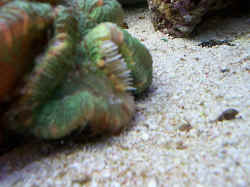
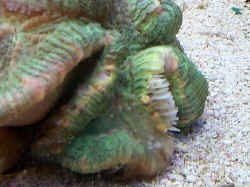
| Has He Lost His Brain? For the
last three days my open brain coral hasn't seemed to be opening
up very well. It seems like it has started to reseed on one lobe of
the coral. Tonight when I got home it had mostly white slime and a
little brown slime oozing off of it. The other 5 lobes seem to be
opening up a little bit. <Sounds like some form of infection. I
wonder if it was brought about by some injury. These corals are
often nibbled on by fishes, trampled on by crabs and shrimp, and
sometimes have difficulty removing sand that gets into them. All of
these things can lead to stress, and further decline> Is there a
way to help the coral heal itself? Should I do any dips? <Well,
you could try a 1 to 3 minute freshwater dip> Can feeding one
lobe of a open brain feed the coral as a whole? <I think that it
cannot hurt!> I think what happened is I didn't have it in
enough circulation due to a slight change in the rock structure.
Ever since I moved the rock around it wasn't happy. I have
attached some pictures so you can see the lobe. I hope you can help
me save this coral. <Well, moderate water flow is desirable for
these corals...Too much flow can damage the tissue and interfere
with their natural feeding processes. I'd try to increase the
feeding and see if this brings about a recovery. Also, make sure
that there are not tankmates "sampling" the coral...Once
injured, these corals are almost "irresistible" to
predators. Keep a close eye on your specimen. If you have further
concerns, let us know. I'm sure that Anthony might have some
more ideas if the coral does not seem to be improving. Good
luck!> Thanks, Ian Roff <And thanks for stopping by, Ian!
Regards, Scott F.> |
 |
 |
|
|

