|
FAQs about Trachyphylliid Coral Disease/Health,
Parasites, Pests 2
FAQs on Open Brain Disease:
Trachyphylliid Disease 1,
Trachyphyllia Disease 3,
Trachyphyllia Disease 4,
Trachyphyllia Disease 5,
FAQs on Open Brain Disease by Category:
Diagnosing, Environmental (Pollution/Poisoning, Lighting...),
Nutritional,
Social (Allelopathy),
Trauma,
Pathogenic (Infectious, Parasitic, Viral)
Predatory/Pest,
Treatments
Related Articles: Coral Pests and Disease; pests, predators,
diseases and conditions by Sara Mavinkurve, Trachyphylliid Corals, Trachyphyllia Reproduction Report,
FAQs on Stony Coral Disease by Category: Diagnosing:
Environmental (Pollution/Poisoning, Lighting...),
Nutritional, Social (Allelopathy),
Trauma,
Pathogenic (Infectious, Parasitic, Viral)
Predatory/Pest,
Treatments
FAQs on Stony Coral Disease by Type: Brown Jelly Disease, RTN,
|
 |
|
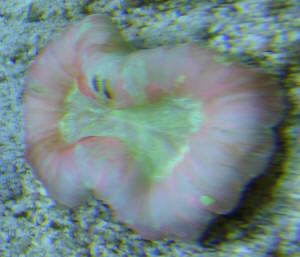
Feather-like Filaments on
Trachyphyllia 10/2/11
Hi WWM Crew! I have an Australian Trachyphyllia at the LFS I
currently work at which has some type of feather filaments
attached to the outer part of its tissue, toward the
skeleton.
<I see these... Hydrozoans/Hydropolyps>
I have never seen this before and would like some assistance in
identifying it. I believe it is some sort of worm or other
hitchhiker that extends feather-like tentacles for capturing
microfauna (similar to Feather Dusters and Porcelain Crabs).
<Similar, but more deadly... not just physical, but stinging,
agglutinant>
The long feathers stretch out then will quickly retract to its
point of origin and will then slowly extend again. I have
attached some pictures and a link to a short video to help
explain in better detail.
http://s351.photobucket.com/albums/q449/MarineScene/trachy%20video/?action=view¤t=MVI_9342.mp4,
sorry for having to turn your head to properly view the video, I
forgot that I can not rotate video from my PowerShot camera. Any
help is appreciated and thank you for a great and informative
website that I use quite frequently!
Thank you,
Melissa
<Let's have you start reading here:
http://wetwebmedia.com/hyzoancompfaq.htm
Perhaps the linked files above. Then write me/us back if you have
further concerns, questions. Bob Fenner>
|
|
|
|
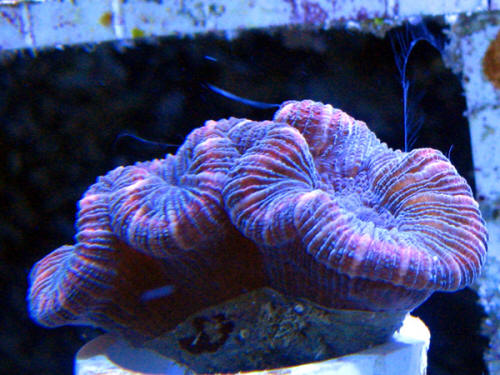
Receding Open Brain'¦ Feed Me Seymour --
09/13/07 Hey guys, Scott here. <Hi Scott, Mich here.> I
have two open brains <I wish I had two brains, the one I'm
using right now is a little tired.> in my 38-gallon tank. They
both sit on the bottom in about 15 inches of water. Lighting is
2x96-watt, including actinic. Between my hang-on-back filter and
my water pump, I turn over my water about 15 times an hour.
<In theory.> The brains are sitting about 10" apart.
One is thriving and has grown noticeably since I got it, the
other is receding. The one that is doing well is clearly a Trach.
I'm not clear on what the other one is -- it is flatter,
deeply lobed but the lobes do not touch, and when the flesh
retracts it has spikes coming out of it. It is a yellow/cream
color in the middle, and dark maroon around the edge. <Hard to
tell without a pic.> I purchased these two about a month and a
half apart. <OK.> Anyway, my LFS advised me they didn't
need anything special in the way of diet, just some DT's,
which I use every week. <I would offer meaty fresh
seafood's, Mysis shrimp here.> They both did well for a
while, but about a month ago I noticed that the one had its flesh
receding from the outer edge of the skeleton. LFS had no
particular advice, said it should come back, and to try moving it
out of the water flow a bit, which I did. No luck. <Manual
feedings may help.> So I started researching your site on what
to do, and found that I should probably be feeding it. <Yes.
Sounds like this brain would particularly benefit.> For the
past couple of weeks, I have been trying to feed it at night.
Some nights I use a soda bottle with the bottom cut out, and a
turkey baster to place some Mysis on top of the brain -- this
helps to keep the shrimp and crabs off it. <Yes.> Other
nights when I am feeling less ambitious, I throw some rotifers in
the tank about a half hour after the lights go out. The coral
still continues to recede, and is probably almost half gone now.
Is there anything I can do, <Yes. You will likely have to
increase the frequency and perhaps the quantity of your feedings.
These corals can take in surprisingly large pieces, but I would
recommend anything too large. I would soak any foods provided in
Selcon, a vitamin/HUFA supplement, and suggest diced shrimp,
scallops and the likes be offered.> or has this particular
specimen reached the end of its road? <No! Certainly not. With
aggressive feeding you very well may be able to bring this
specimen back. Good luck and happy meals! Mich>
Re: Receding Open Brain'¦ Feed Me Seymour --
09/19/07 <Hi Scott, Mich with you again.> Over the past
two nights I have offered frozen Mysis and fresh-diced scallops,
both soaked in Vita-Chem, <Glad to read you are using a
vitamin supplement. In the future you may want to consider Selcon
as it contains highly unsaturated fatty acids, that I believe
Vita-Chem is missing.> but it does not seem to be eating much.
I placed the food directly on it with the turkey baster and left
it covered with the soda bottle all night. Would it stress the
coral too much to take it out and put it in a dishpan filled with
aquarium water to feed it, so I can do a better job of placing
the food near its mouths? <Not at all. I think this is a good
idea. You can read how someone else did something similar here:
http://www.wetwebmedia.com/dendroreprofaqs.htme: The first couple
on this page start the story, but what you really want to read is
titled: Re: Feeding of Tubastrea.. Follow up to Baby Tubastrea
Timeline 8/7/07> At the rate it is receding, I may only have a
couple of weeks left. <I like your idea. It sounds like it is
time to be quite aggressive with your feedings, perhaps offering
multiple times per day. I wish you success here. Mich>
Re: Receding open brain 9/23/07 Hi Mich, <Hi
Scott!> Thanks for the Tubastrea link <Welcome!> (wow,
that's a pretty elaborate system). <Yep! Sure is. Now
that's commitment!> I'm doing something just slightly
less sophisticated. I take the brain out and put in a Cool Whip
container full of aquarium water, <Simple works!> and place
diced scallops on top of each mouth with a pair of tweezers.
I've had some initial success -- first two nights, two mouths
ate; last night none ate, but tonight three have eaten.
<Good!> I haven't caught it regurgitating, <Well it
will. The mouth functions as both intake and output! Aren't
you glad your mouth doesn't? Heehee!> so I hope I'm
dicing the stuff small enough. <tiny balls of finely minced
food is best.> I have been leaving the coral in the Cool Whip
container for 1-1/2 to 2 hours while trying to feed.
<Good.> My new question is, how long can I comfortably
leave it outside the aquarium to see if more mouths will feed,
assuming that room temperature is in the 70's? <I'd
try to keep the temperature as close to the tank temp as
possible. Perhaps there is a way to support the containers and
have them more or less floating inside the tank so the water temp
remains consistent. If you go this route you will likely have the
most success with feeding if the food is offered after the lights
are out.> Also, I have been reading the site tonight about
laminar water flow, which is exactly what I have. Do you think
this might have contributed to my problem at all? <If it is a
constant direct flow, it could be a problem.> I wish I had a
picture of the brain, but it is probably not healthy enough for
you to identify anymore. <Actually, sometime it is easier to
identify when skeletal structures are visible.> I can't
find a Google image that resembles mine at all. <Send in a pic
and we'll see if we can figure it out.> Anyway, I am
thinking about setting up another water pump on the opposite end
of the tank so that the two pumps would be facing each other, to
create more random flow <Would be better than have a constant
direct flow. Laminar flow is not bad onto itself. But constant
laminar flow can be a problem.> -- although I also have a
torch, branching hammer, branching frogspawn, and candy canes
that are happy and growing. <Yikes! This could be your
problem! That's a lot of Euphyllia and a lot of allelopathy!
This may very well be the cause of you brains suffering. I hope
you run carbon and change it frequently!> Thanks Again
<Welcome as always.> -- these kinds of details don't
always make it into the books, <Mmm, much of it is in the
books, you just need to put it all together. This can be the
challenge.> Scott <Cheers, Mich>
Re: Receding Open Brain'¦ Feed Me Seymour --
09/29/07 Hello again, Mich, <Hello again Scott!>
I'm attaching a pic this time; after reading some more I have
some suspicions about the identity of this thing, but tell me
what you think. Maybe if I know what it is, I'll know if
there's anything more I can do for it. <Is/was a
Trachyphyllia.> Like I said in my first e-mail, it sits about
9 inches from a Trach that's doing great. Every night this
one eats something, but it continues to recede. Will it tend to
do worse before it gets better? <AYE! This is in far worse
shape than I expected. I am very doubtful that you'll be able
to bring this guy back to health.> I added a second water
pump, perpendicular to the first. I tried facing them at each
other, but it was a little too turbulent. I did change the carbon
cartridge in my HOB filter, but maybe you can tell me what you
mean by "change it frequently" (it's a Cascade 300,
cartridges are about 7" square, half-inch thick, pumps
300gal/min). <Once a month, maybe even twice a month.>
Allelopathy is something I wasn't warned about while buying
all my corals at the same LFS; when I finally asked about it, the
advice I got was that allelopathy is somewhat overrated <I
would disagree, in fact, I think much the opposite.> (as far
as getting this info from books, check this out: in
Borneman's book, there's no entry for
"allelopathy" in the index). <Borneman covers it my
friend. Check out page 73, the section on Chemical Competition.
He mentions it through out the text in reference to specific
corals as well.> Should I step up water changes? <Likely it
wouldn't hurt, but I doubt that it will help this coral.
Though I hope I am wrong, I think this coral is just too far
gone.> If I didn't want to get rid of some of my corals,
could I group them together by type in opposite ends of the tank?
<Could help, but eventually it will be a matter of survival of
the fittest.> Also, I have not invested in a protein skimmer,
because I have never had any measurable nitrates/nitrites in the
tank, <Surprising.> and have read that over-filtering and
-skimming can strip out your water. I have been advised by two
different LFSs that I don't need a skimmer. Do you guys
consider them a given? <I do. I am currently running a tank
with out any fish and feed minimally and you would be surprised
by the skimmate that is produced. More here:
http://www.wetwebmedia.com/ca/volume_2/cav2i5/Filtration/Filtration.htm
> Thanks too much,
<Welcome! Mich>
Scott
|
|
|
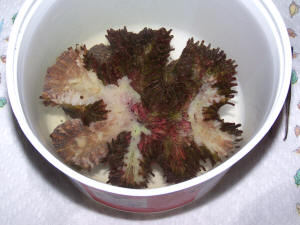
Sick Open Brain... -- 08/02/07 Hello Crew,
<Hi Thomas, Mich with you again. How is that goby of yours and
his little pail? Heehee!> I was given (more like took) <Heee!
I like honesty!> a bleached Open Brain. The person who I
received it from had given up and the Brain was the only thing
showing any sign of life. The next step was the dumpster
<Yikes!> for this guy so I took it home hopping <The brain
was hopping? Wow! Cool trick!> to do the right thing. When I
quarantined it there was no sign of color in the outer ridge and
the center had and still has a light fluorescent green glow under
the light. I think it is a Trachyphyllia geoffroyi but it is too
bleached to be positive. I quarantined it for two weeks and could
not get it to eat. I have since moved it to my nano tank in hopes
that it would find something in the water channel to eat. I have
noticed that the outer ring is showing signs of pink coloring
building up. This is a slow progression. <I hope you have strong
lighting on this nano system. Oh! I see you do!> I still have
not been able to feed it and have read that this is a must if this
guy is to recover. <Yes.> I have used a turkey baster to put
the food on the center section. <This is a good start.> The
meaty foods I have tried so far are clams, Mysis, and squid all
soaked in Selcon. <Good.> They all float away and do not
stick to the brain. <Here is the problem. You will need to stop
all circulation in your tank. Allow the food to sit on the center
of this brain. It may need to sit there for quite some time...
perhaps an hour or more. Hopefully you will see several small
mouths open... will look like slits in the center of the coral. Now
here's the challenge... during this time you will need to keep
all potential thieves away... i.e. fish, shrimp, crabs. Much easier
said than done. Plastic Strawberry baskets sometimes work or
perhaps cut apart a plastic two-liter bottle or gallon
container.> This assumption that the food is supposed to stick
may be incorrect on my end. <Yes. This coral basically needs to
be spoon fed at this point because it has been terribly
compromised. > I have also been adding Kent Phytoplex and Zoomax
to the water. <Mmm... not a fan.> My tank specs are as
follows. Ammonia = 0 Nitrite = 0 Nitrate = <10 Phosphate = 0
Alkaline = 4 meq/l PH = 8.3 Calcium = 360 SG = 1.024 Temp = 79 F
24-gallon tank Aqua-c Nano Remora protein skimmer 150 watt MH light
2.5" live sand <Over 3 or under a half is generally better
than this in between amount.> 35lbs of live rock The tank is
seven months old. I have gone through the FAQ's and read up on
open brains in two corral books <Hmm, cattle paddock?> trying
to find out what procedure I need to follow to bring this guy back
to good health. <See above.> I asked the LFS if they would
take him at first but they stated that it needed to go in the
trash. I don't believe this to be true. <Time will
ultimately tell.> If you could give me any advise and point me
in the right direction please. Thanks again for your help. <You
are most welcome! Mich>
Thomas |
|
|
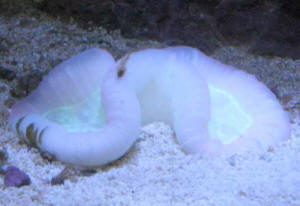
Wellsophyllia Brain Swelling/Compatibility Hello
Again, Happy 4th of July! <Hi, Pufferpunk here. Happy 4th to you
too!> I'll make it short and simple. 75 gal. reef tank. 100 lbs
of live rock. 390 watts of PCs (3 month old bulbs). Ammonia levels are
0, Nitrite 0, Phosphate 0, Nitrates barely detectable. I am
aggressively skimming and changing about 20% of the water every 4-5
days. I have a Green Wells Brain <Wellsophyllia> that is awfully
close to some silvertip Xenia. The brain eats every couple of days
...some Mysis, and Zooplankton. The Brain has grown excellent and has
doubled in size in the past 4 months. The brain is overall about
7" in diameter. However, today I noticed that it looks swollen or
"puffed up" and I was wondering if this is normal behavior.
<Mine shrinks & swells daily.> I also noticed that for a
short time today, the Xenia was closed. I placed them so close because
I was told that the "Chemical Warfare" would not be an issue.
<Agreed> The Brain is showing no skeleton and aside from being
swollen, it looks very healthy. Are these two species compatible?
<They should be fine. I run Purigen in my sump, just in case.> I
am supplementing Bio-Cal, Bio-Stront, Tech I, and Tech M. <Are you
testing for calcium & alkalinity?> P.S. Am I wasting my money
adding DT's Phytoplankton to a tank with Leathers, Xenia, a Wells
Brain and assorted zoos and Shrooms? <Not at all. There are tiny
creatures in your sand bed that need to eat too. They help keep your
tank healthy.> Just wondering... I am using HOB filters with
powerheads and Carbon. <Sounds like your tank is doing great. I had
issues though, with my brain not receiving enough light from PCs.
Eventually, I had to loan them out to someone that had more light over
their tank, until I upgraded to T5s. Good luck to you. I hope you
enjoyed fireworks somewhere! ~PP>
Please
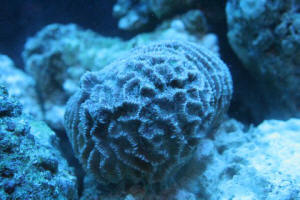
Help. Trachyphyllia 5/16/07 Hello
my name is Mike and I need help with my closed brain coral. <Hi
there Mike, Mich here with you and your brain.> I've
attached two pictures <The photos look as thought they were
taken several feet underwater... very blue.> of it and wanted to
know if it was dead, dying, or ok. <I think we can eliminate
OK.> And if there was something wrong is there something I can
do to fix it. <Hmm, I do not discern any tissue in the photo,
looks only skeletal to me, but the photo is so blue it is difficult
to tell.> When I got him he was bright green in the crevices and
now the green has all but gone away. Also the protruding tissue
around the crevices seems to be peeling away. <So there is
tissue remaining? Perhaps an iodine dip (5-10
drops of Lugol's per liter) might help if there is
tissue to treat. Some info here: http://www.wetwebmedia.com/corldisfaqs.htm >
It happened after 2 days. <After 2 days of
what? Caring for this coral?> Please help.
<Trying.>
Thank You.
<You're welcome, Mich> |
|
|
Open Brain Troubles 4/26/07 I recently purchased an
open brain coral from the local aquarium store. <Okay.> It was
very healthy at first and for the first week was swelling and acting
normally. I was told that every so often I could feed it a
piece or two of silverside feeder fish to help it grow. <Mmm...is
true that this animal should be fed but I would prefer something other
than silversides or at least something in addition. Go for some Mysis,
krill or even bivalve meat (scallop, clam, mussel).> After about a
week of acclimation to the tank I fed it two small
pieces. It immediately swelled around each piece and
ingested them. The next morning it was not swollen and I
assumed it was due to the digestion of the fish. I waited for a few
days and it still had not returned to normal. I asked the
store and they told me it may stay shrunk for a week or so and not to
worry. Well things have gotten a lot worse. It
had never returned to normal and now the "skin" has begun to
pull away from the skeleton and it looks like it is
dying. Is there any way to save it and what happened to make
it start dying? Was I not supposed to feed it? <A few
question from me first; what type of lighting was the animal in at the
store and what type of lighting are you providing now? How turbid id
the flow the animal is in...and...what are your water parameters?>
Thanks <Welcome.> Kevin <Adam J.>
Hitchhiking Polyps On Trachyphyllia Skeletal Base...Remove Or
Not? -- 04/11/07 Dear Crew, <<George>> Have had an open
brain Trachyphyllia for several weeks now. Feeding daily
finely minced fresh raw shrimp, clam, and oyster. Keeping
Alk and Ca2+ levels up without any hitches. No real
problems. But, I have just noticed 3-4 baby polyps, maybe an
eighth the size of an eraser head. Seems to me to be a Zoanthid or
Palythoa or similar polyp. <<Likely, yes>> They
are attached just underneath on the side of its base (and are barely
visible under Actinic, but fluoresces bright green-yellow when the
460nm night LEDs are on). I thought I heard/read someone
posting like this before, but can't seem to find it
again. <<Indeed, there is a very good possibility
someone has gone down this road before here...but it doesn't ring
any bells with me>> How should (or, should I not) remove these?
<<Well George, normally I would be inclined to say "leave
them be" until they pose an obvious problem...but, what will
become "obvious" will likely be tissue recession of the brain
coral in the vicinity of the polyps. Unfortunately, this
indicates the "beginning of the end" for these corals in most
captive systems. I recommend you use something like an old
carpenter's chisel and carefully "shave" these polyps off
the Trachyphillias base. Gently "touch" the
coral to make it recede before removing it from the water (doing so
helps prevent tearing the heavy water-filled flesh). Handle
the coral gingerly so as not to damage the tissue of the brain coral on
its own sharp skeletal structure, and be careful not to gouge the
skeleton (or yourself!) too deeply with the chisel. Once
you've removed the polyps give the spot a scrub with a small stiff
bristle-brush, give the coral a dunk and swirl in a container of clean
tank water (to be disposed of afterwards), and return the coral to the
display tank>> Best Regards! George <<Be
chatting. EricR>>
Re: Hitchhiking Polyps On Trachyphyllia Skeletal Base...Remove Or
Not? - 4/12/07 04/12/07 Hi Eric, <<Hello
George>> Thank you!! <<Quite welcome>> I think that
once I have a rested mind and am focused in another day or so, I'll
follow your suggestions and repost if I run into any issues, but I
think I can handle this OK. <<Ahh, excellent>>
Am I correct to assume that regardless of how easily/badly the
'surgery' goes that a local swab-like application of iodine or
dip is in order? <<Mmm, no...scraping the polyps from the brain
coral's exterior skeletal base won't require
treating/disinfecting the site afterwards. However, swabbing
the site with a strong iodine solution for a minute or two before
rinsing the coral prior to replacing in the tank may kill/prevent the
regeneration of any missed bits of polyp tissue left on the
skeleton>> I don't have Lugol's handy, but I do have OTC
surgical iodine and can look up recommended dilution for use in such a
case. <<The swabbing won't require any
dilution. The iodine you have will work just fine, and this
'surgical' iodine may well be Lugol's Solution (also known
as Iodine Potassium-Iodide; Iodine, Strong solution; and Aqueous Iodine
Solution)>> Thanks again for the fast advice. The forum is
probably more valuable to me than anything (and thankfully makes
lunchtime at the office more interesting and useful!) ;) Best Regards
George <<Happy to assist. Eric Russell>>
Green open brain coral (Trachyphyllia), hlth.
3/11/07 Ok, <Hello Jason.> I have a thiry <thirty> five
gallon tank and am currently changing into a reef setup from
FOWLR. I have taken an green open brain (Trachyphyllia)
<Trachyphyllia> from my mom's nano cube where it has steadily
declined to the point that over 1/3 of the skeleton is showing. <Not
good. I would assume that it is placed on the sand.?> It
is my mission to save this coral!! <Admirable. And it can
be done.> It has been in my tank for about a two weeks and will puff
during the day. I have yet to see any tentacles <tentacles> when
I attempt to feed it (and haven't ever seen any when it was in the
nano either). Is it too late to save this coral??
<No. Try adding a little bit of food before
feeding. They seem to be able to sense the
protein. Shortly after the tentacles should
emerge. If they don't try target feeding a little bit of
food. I had to do this for several days before I saw
tentacles on mine.> What is the best plan of action from here?
<Please see above.> My water parameters are all excellent,
<Please define excellent.> adequite <adequate> lighting,
intermediate flow (in that part of the tank), and there is nothing to
harm it in my aquarium (fish, other coral, etc), so I am hoping that I
<I> can bring it back. I want to know what the best feeding
stategy <strategy.> would be (and what exactly I could buy from
the LFS as far as food mixtures, or can I spot feed it with frozen fish
food). <Mysis, Blood Worms, etc. soaked in Selcon.> Finally, can
I use a toothbrush to keep the algae from growing in the abandoned part
of the skeleton? <I would not do this. Place it in the
tank in an area where the algae cannot get light, and it will start to
die off. After the die off, you can begin to re-acclimate it
to the light. I have used this method to clear mine of
algae. Using a toothbrush will cause you to have to move it
too often. It needs to be left alone for a while. Also
adding Iodine to the tank will help. Please remember that
regular water changes are a must here. 10% once a
week. You need the influx of new chemical nutrients here to
help. Add the I to the replacement water. For
more information see here, http://www.wetwebmedia.com/trachyphlliidae.htm.> (and on
the remaining coral?) I need help fast to keep this guy alive! Thanks
in advance! <You are welcome. Brandon.>
Re: green open brain coral (Trachyphyllia)
3/16/2007 Thanks for the response about the
Trachyphyllia!! <You are welcome! I take it that you got
it to eat.> You stated that I should place the coral where it will
not get light to kill off the algae, but I am wondering how long (as in
days) can I leave the coral in the shade without hurting it even more?
<It should be fine as long as you can get it to
feed. Feed it a little more than usual, about once every
other day. Do remember to use some Iodine
supplementation. Just don't overdo it. I left
mine in the shade until the algae died off.> Also, what is a good
schedule as far as re-acclimating it to direct light? Thanks again, you
guys are a life saver. <Use a piece of cardboard to create the
shade, and remove it in gradually increasing thirty minute
periods. Increase thirty minutes a day until you reach 8-10
hours. Brandon.>
Re: green open brain coral (Trachyphyllia), fdg.
3/16/2007 Update on the Trachyphyllia. So I have relocated the
brain coral to back of tank (in sand bed still) and made an arch of
rock to make shade. I have tried to feed the last couple days
<Cnidarians take time to acclimate to such moving...> with no
site of tentacles (even if I prime with juice before the feeding).
Where should I be placing the foodstuff, i.e. where would the tentacles
come out from. <The grooved areas...> The only thing that I have
seen are very small tentacle like things, but they are coming from the
underside (rock-like side, near the sand-line). So is this where I need
to place the food? <Possibly... if feeding a mash, I encourage you
to place a bowl, cover over the animal for ten, fifteen minutes...>
These tentacles are small and do not look like they could do much?
<May be "it" for now> I have revamped my
supplement addition (especially iodine), but promise not to
overdo it. <Mmmm, you have read here: http://www.wetwebmedia.com/trachyphlliidae.htm and the linked
files above? Please (re)do so. Bob Fenner>
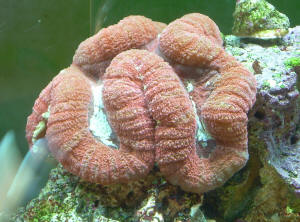
Coral bleaching? (Trachyphyllia) 2/20/07 <Hi, J &
S. GrahamT here.> Thank you for all your help. <Welcome.>
Bought a brain coral about 3 weeks ago. This white area was present
in just the lower left about 1 inch. It has progressed and now I am
worried. <See your picture, but I don't see the "white
area".> This coral is about 16in down from 80w power
compact light. <You do realize that that is the threshold for
light penetration through the water, right? > Nitrates 10,
nitrites 0, ca 420, pH 8.2, phos 0, kH 143ppm. I feed the coral
Mysis early am or night and he eats well with good polyp extension
every time. <Not everyday, I hope. ( http://www.wetwebmedia.com/trachyfdgfaqs.htm ) >
There is no other stuff next to him. Tankmates: 1 yellow tang, 2
striped damsels, 1 Firefish goby, 1 false clown, 1 coral banded
shrimp, 1 Condy anemone who stays under a rock 12in away (and does
not move.) <Would venture a few diff. hypotheses. PC lights may
be in need of changing, starving the symbiotic algae. The Condy
*may* be sending some chemicals his way that are affecting his
health. The Trach. may be responding to the difference in lighting
from where it was collected, stored in the interim, and placed in
your home-system. Which brings me to my last thought. Shipping
stresses in general. This is still a new coral in your system, and
has been moved around quite a bit in the past few weeks/months. Use
the Google tool here on WWM searching for anemones and corals,
light requirements, bleaching, etc. -GrahamT>
Thanks -JL |
|
|
Small Crabs Embedded in a Rose Trachyphyllia 2/1/07 Hi,
<Greetings Sai, Mich here.> I just purchased a rose
Trachyphyllia. <A beauty.> I noticed two small dark spots, 2-3
mm. Upon closer inspection at night with a flashlight, it
appears that the spots each house a tiny crab! <Cool!> During the
day, the coral tissue doe not fully expand to cover up the
spots. <OK, but the tissue does expand?.> The coral
is otherwise happy, with feeding tentacles fully out at night and
feeding. <Very good.> Any suggestions, should I dig
them out? <No. Would most likely do more harm than
good. As long as the flesh of the coral seems intact I would
allow this relationship to continue. Most likely both the
crab and the coral do or did benefit in someway.>
Thanks, <You're welcome, -Mich> Sai
Trachyphyllia hlth. 2/6/07 Hello to the
wonderful crew a Wet Web Media, <Brandon... so soon?> One of
these days when I am experienced enough I am going to ask you guys if I
can help out. <I look forward to this time> Good god
I hate being a newbie. I am also slightly retarded in my
selections of coral. I have apparently put two types of
Favia, Favites in the same tank. <Mmm, if there's room, likely
no problem> I can move them if I have
to. This will cost some money, but fortunately I am in a
position at the moment that cost is not an option. By the
way, (I know that I should have posted all of the original texts with
this) I have found a place to put the Tangs.
<"The" tangs... we have a bunch to recall... not even
including WWM... w/o prev. corr....> I have a person that has
adequate room, tank space for them. Please understand that I
acquired these creatures in the purchase of an aquarium. I
did not want to sentence these guys to an early
death. So I tried to the best of my abilities to keep
them happy. I cannot purchase another tank (Read wife
here. She was okay right up until the MH retro
purchase.) I have around five thousand USD into my
fish. That is saltwater and fresh. I feel that
this is a large enough commitment. My problem is that I have
too much trust in people that seem to have a good deal of
knowledge. <Trust yourself... accumulated
knowledge...> I purchased a Trachyphyllia from an LFS, and I have
had some issues. There is a section that is missing
tissue. About 1/8 the overall coral. I am feeding
when it will take food. If it will not I let the fishes eat
the food. The coral has green algae growing on the exposed
areas of the skeleton. Just regular green
algae. I am very concerned. There are a number of
things that could have caused the tissue loss. <Yes>
I am wondering though, can the coral recover from the tissue loss and
the green algae, or should I chalk this up to inverticideal stupidity.
<It can recover... I take it (for one) that this colony is placed on
the substrate... and for two, that you've read the postings on WWM
re this species> I am hoping that with regular (two to three times a
week) feedings that I can reverse this. I love these little
critters, and caring for them/watching them makes me think about my own
mortality less, <Interesting point> every time that I lose one, I
feel a great personal loss. I recently lost two Discus to a
bad product that was supposed to lower Ph, and I felt
horrible. To heck with the cost, ($150 USD apiece.) I
accidentally killed two fish that were so used to humans that they
would let me pet/move them around the tank with no stress. I
cried like a baby when they died. This taught me a very
important lesson, and I have tried to research specimens, and not use
chemicals when I can. I took someone's advice and now I
am in trouble. I do not think that this is allelopathy based
on previous responses, and other information that I have found on your
wonderful site. I think that I may have touched this coral improperly,
or photo-shocked it. I am really hoping that it can
recover. Thank you for all of your help. Just a thought but
perhaps, we should not pretend to be god, <Though indeed we are each
others?> and take all of the money that we spend on aquaria, and
instead spend it on visiting real "God made"
reefs. Perhaps the reason that we do this is because we love
to create like God. <Mmm... more likely transference from a fear of
death...> Again Thank you all so very much for your tireless effort,
I would like to help. Please let me know if I can, Brandon
R. Foster. <Study my friend... and in the meanwhile, draw
contentment from the realization that you're doing your best.
BobF>
| Black Slime and Sick Trachyphyllia
Geoffroyi 8/7/06 Thanks in advance for your
help. <Welcome in real time> My problem in my 55 gallon is
two fold: black slime algae and a sick Trachyphyllia
geoffroyi. I have been battling black slime for about 2 months now
and have done everything I know short of using some sort of
chemical. My water parameters are as follows: Ammonia
and nitrites are at 0 Salinity at 1.025 Temp ranges from 79 to 82
Nitrates range from 10 to 25 About 3 weeks ago, I added the largest
hang on refugium I had room for (only 2.5 gal) and started
with 2 lbs of Chaeto which seems to be growing well. I
have not noticed any drop in nitrates. <Good...
takes a while... weeks to a few months to really "kick
in"> I changed my actinic bulbs 3 days ago (they were 6
months old) but the slime still seems to be multiplying.
<Can be a real bug-a-boo> I use RO water and
Tropic Marine reef salt and do a 3 to 5 gallon water change
weekly. I have about 40 lbs live rock, 2 inches of live sand, a
sump/trickle filter (with bioballs), <Oh... I would ix-nay
on the bioballs nay... Please read here: http://wetwebmedia.com/bioballfaqs.htm and the
linked files above> and skimmer. My inhabitants are 3 Chromis 1
small yellow wrasse 1 black and white ocellaris 1 flame angel 1
scarlet skunk cleaner 1 peppermint various snails and hermits
<... how big is this system?> I have reduced feeding and now
alternate feeding small amounts of frozen or flake on
alternate days occasionally skipping a day. I am really getting
discouraged. My Trachyphyllia geoffroyi has
been slowing declining and fading in color, and now has
several black spots on the skeleton that are visible when it is all
shrunken up (which is has been doing a lot more lately).
<Yes... looks like Cyano growing on some portions of the exposed
septa... very bad> I have read your FAQs but nothing sounds like
my case. The coral is on the bottom away from other
corals and nothing has been picking on it. My ocellaris
hosts it, however, <Mmm, the likely original source of tissue
loss, septal exposure here> and I am wondering if his
sleeping in/wiggling on it may be the cause. <Initially, yes>
I have some Lugol's Iodine and wonder if an iodine
dip might be helpful. <I'd add this directly to the
water... weekly, with water changes> I usually do
not dose iodine because of the weekly water changes. <Mmm, best
to do immediately following> I have recently reduced my lighting
schedule to 8 hours actinic and 6 hours MH trying to get rid
of the slime. I have read that leaving the lights off for 3 days
with get rid of the slime, but I am afraid it would
mean the end for my Trachyphyllia geoffroyi. <Maybe so... there
are other avenues...> I would greatly appreciate any advice you
can give me. I am attaching 2 photos of the Trachyphyllia
geoffroyi. Thanks again, Angela Collison <Please read here:
http://www.wetwebmedia.com/nutrientcontrol.htm
and here: http://www.wetwebmedia.com/bluegralgae.htm
and the linked files above... and consider (seriously) removing
your bioballs, possibly modifying the wet-dry. Fix the environment
here and the Cyano will be gone, your Brain/s recovered. Bob
Fenner> |
|
|
Trachyphyllia worries 6/13/06 Dear crew,
<Andrea> Very sorry to bother you, but I need a bit of
professional advice. Last week I was away on work business,
when I retuned home it became apparent that my area received somewhat
of a heat wave, and my reef tank was running in its low
30,s!!!!! After the initial blind panic and setting up the
chiller I began to assess the damage which I might add was not good but
thankfully not as bad as it could have been. My tank is now running at
26 and my only concerns are the two Trachyphyllia, one red one green
that are situated on the fine substrate. They are not at
their best colour wise, the red specimen seems to have retained most of
its Zooxanthellae, however the greener specimen, looks some what
fleshy. (this particular specimen has never had the intense
green fluorescents of a Stichodactyla anemone, like some
Trachyphyllia). Anyway my point being, should I leave them both exactly
where they are or move them to the miracle mud sump where they is less
light intensity and more cover of Caulerpa, and Chaetomorpha? Best
wishes Andrea <That they did not perish is telling... I would not
move these specimens... in all likelihood they will recover, re-color
in your good care. Bob Fenner>
Brain Coral/Bleaching
4/14/06 Hi! <Hello.> I always seem to be able to
find the answers to my questions on your website. It is very
informative! However today my question is simple. If an open brain
coral is eating great, expanding most of the time and growing well
could it turning from a pinkish-red to white be a sign that it is
getting too much light? My tank gets direct sunlight from a patio door
for about three hours every day. This placement of the tank was very
purposeful to save electric and simulate as close to the wild as
possible for my corals. All my light loving corals are thriving. Could
too much light be killing my open brain? Or will it just fade to a
pinkish-white and thrive being a different color? Will moving the coral
to a darker location restore the original color or is it too late?
thanks for listening. <Bleaching generally refers to loss of
Zooxanthellae (symbiotic algae) which the coral needs to
survive. Since these corals require moderate to high levels
of lighting, it may be suffering from lack of light. You
didn't mention what type of lighting you have so I cannot comment
further. James (Salty Dog)>
Neuroscientist or Reef
Aquarist? - 03/29/06 Hello, <Hi Dan, Adam J. with you this
fine-afternoon.> I bought a "rare" Trachyphyllia from the
pet store about 2 weeks ago. <Okay.> It has a dark purple rim,
with a pinkish blue center. I haven't been able to find a picture
of one like it so I assume it is a bit rare... Anyways All of my tank
parameters are good, my lighting is 440 watts VHO on a 75 gal, and I
feed it Mysis every couple of nights. It has been getting better, but
there is an area near the rim where a piece of its skeleton has broke
off and it is just laying sideways in the tissue. I can see it in the
tissue because the area is bleached and it looks like it is slowly
dying there. It is a thin piece about the size and shape of a dime. My
question is, should I let it handle the problem itself or maybe try to
make a small incision with a razor and remove the broken piece of
skeleton. <If the 'dead' area does not appear to be
spreading I would leave it be for now'¦.continue to provide
optimal water quality and keep nutrients low, I have seen many a brain
perish because the owner allowed algae to colonize exposed skeletal
areas.> Thanks, Dan <Adam J.>
Trachyphyllia health question 3/10/06 I've
been reading, reading, reading (Aquarium Corals, Book of Coral
Propagation, and this great site!), and I've come to a dead
end. I'm learning a hard lesson about not quarantining
corals... <... no fun> Last week I received an order of corals,
including three Acropora frags. They were shedding quite a
bit of mucus from the stress of the trip. I placed them in
the bottom of the tank to acclimate, near my two open brains.
One of my brains has been having issues ever since - mucus,
and this deposit of white stuff on the brain. I've long
since moved the Acros to their final positions. From what I've read
I'm sure this is the result of the noxious mucus of the Acro, but
haven't found anything on what, if anything, should be done about
it. <Time going by, some addition of iodine/ide/ate...> Any
insight/suggestions would be greatly appreciated. Thanks much, your
fan, Kimberly <Bob Fenner>
Open brain unwanted growth 11/6/05 Hello. <Hi there> I
hope you can help with this one as you have in the past. I have a green
open brain coral that has grown green hair algae that has exposed some
of its skeleton. <Mmmm, what came first, the chicken/algae or the
egg/damage, conditions that induced this?> I have removed it
frequently but seems to grow back worse. Others have suggested that I
use a Dremel and drill out the algae like a tooth cavity. <Mmm,
better to seek out what is "too much" or "too
little" here and change the circumstances in the system to favor
the Trachyphyllia> Before taking such a drastic measure I wanted to
consult the pros. Your wisdom is eagerly anticipated by my coral and I.
Thank you for your time <Do a read over of our area covering the
species/family: http://www.wetwebmedia.com/trachyphlliidae.htm
and the linked files above... hopefully "something/s" will
"jump out" at you re husbandry... that will shift the balance
to the health of the specimen and away from the algae. Cheers, Bob
Fenner>
Trachyphyllia Confusion - 11/06/05 Hi Crew, <<Hello
Agnes>> I need your experience and knowledge. <<I shall try
to help.>> I have two Trachyphyllia corals, one is a red and the
other a green. They were placed about the same height in my tank so the
light and water movement was nearly identical. My tank is a 110 gal.
with a below tank refugium of about 25 or 30 gallons. The ammonia and
nitrites are zero and nitrates are below 40 <<Yikes!>>, I
know the nitrates need to be less and am working on it diligently.
<<5ppm or less>> I keep the sg at 1.024 to 1.025.
<<Very good>>> I have an RO/DI unit on order which
should have been here yesterday and didn't make it yet. I have well
water so no chlorine, it is a deep well and has less minerals than some
but can still have enough to cause problems. <<And possibly trace
amounts of pesticides, heavy metals, nitrates, etc..>> That's
the reason for the RO/DI unit. Several days ago I noticed that the
green coral was not opening very much, it has done so beautifully until
then. But my red coral is opening just as much as ever, maybe even more
so. <<You don't mention your lighting or "where" in
the tank these corals are placed. Tis possible they are getting too
much light, though honestly I would have thought the red brain to be
mal-affected first if this were the case.>> What is the
difference between these two besides the color which can cause one to
look so poorly, it may even be dying? <<It may be that the one
was in a more weakened state when acquired. For certain the high
nitrate levels are not doing any of them good.>> I'm doing
water changes as often as I can and really watching the pH, sg, temp
and nitrates. <<Good, keep it up.>> I appreciate your help
as always. Thank you. Agnes <<All things being equal, I think
your nitrates are probably at issue here (have you tested your well
water re?), hopefully the RO unit will arrive soon. I would also
recommend employing some Polyfilter in a canister filter if
possible...and have a read here: http://www.wetwebmedia.com/trachydisfaqs.htm.
Regards, EricR>>
Trachyphyllia Confusion 2 - 11/06/05 Thank you for your
reply. This seemed like a good way to answer your questions and give
you more information. <<Italicized is from previous
correspondence, hope it's not too confusing!
Marina>> "Trachyphyllia Confusion -
11/06/05 Hi Crew, <<Hello Agnes>> I need your
experience and knowledge. <<I shall try to help.>> I have
two Trachyphyllia corals, one is a red and the other a green. They were
placed about the same height in my tank so the light and water movement
was nearly identical. My tank is a 110 gal. with a below tank refugium
of about 25 or 30 gallons. The ammonia and nitrites are zero and
nitrates are below 40 <<Yikes!>> I know the nitrates
need to be less and am working on it diligently. <<5ppm or
less>> I keep the sg at 1.024 to 1.025. <<Very
good>>> I have an RO/DI unit on order which should have been
here yesterday and didn't make it yet. I have well water so no
chlorine, it is a deep well and has less minerals than some but can
still have enough to cause problems. <<And possibly trace amounts
of pesticides, heavy metals, nitrates, etc..>> That's the
reason for the RO/DI unit. Several days ago I noticed that the green
coral was not opening very much, it has done so beautifully until then.
But my red coral is opening just as much as ever, maybe even more so.
<<You don't mention your lighting or "where" in the
tank these corals are placed. Tis possible they are getting too much
light, though honestly I would have thought the red brain to be
mal-affected first if this were the case.>>" [You are
right, I forgot to mention the lighting. I have a fixture with 2 150W,
20000K, bulbs and 4 actinic blue lamps. <<Mmm, could be too
much light for the brain corals depending on their placement in the
water column.>> I turn the blue lamps on about 2 hours
before and off about 2 hours after the MH bulbs, and the MH are on for
about 8 hours a day. <<For overall health/natural lighting,
I would shoot for a MH photo-period of 10-12 hours.>> My
corals were about at the middle of the tank. <<Better
at/towards the bottom. Though they may be bright in color, most brain
corals don't require such intense lighting as you describe though
many can/will adapt, some of the "reds" will actually turn
brown and/or decline from such intense lighting.>>] What is
the difference between these two besides the color which can cause one
to look so poorly, it may even be dying? <<It may be that the
one was in a more weakened state when acquired. For certain the high
nitrate levels are not doing any of them good.>> [I got the
green brain first and it was doing beautifully, it would open at least
4 times it's closed size. I've had the green brain for about 6
months. <<OK...you have me thinking it is the nitrates
again...but these corals also need to be fed...feeding once or twice a
week with finely minced meaty foods is recommended.>> I got
the red brain about 4 months ago and it never has opened anywhere near
as fully as the green brain but it was doing better lately. And now it
looks great!] I'm doing water changes as often as I can and
really watching the pH, sg, temp and nitrates. <<Good, keep it
up.>> I appreciate your help as always. Thank you. Agnes
<<All things being equal, I think your nitrates are probably at
issue here (have you tested your well water re?), hopefully the RO unit
will arrive soon. I would also recommend employing some Polyfilter in a
canister filter if possible...and have a read here: http://www.wetwebmedia.com/trachydisfaqs.htm.
Regards, EricR>> [Yes, my well water tested zero nitrates and
very close to 7 pH. <<Be sure to buffer your makeup/salt
mix water to bring up the pH.>> Thank you again for your
help. It sounds like the red brain is actually more delicate of the two
so I am at even more of a loss as to why my green brain is looking so
poorly. I had not added anything to my tank before this happened. I
have since added some new live rock that just finished curing. Maybe
the extra rock will help with the nitrates. <<Maybe...but you
need to determine the source of the problem and address that as
well.>> I hope so, my green brain is still hanging in
there, it opened weakly today so it is trying. As always I am amazed at
the amount of help you offer folks. Agnes <<Very happy to
assist,
|
|

