
Pests and Predators:
Undesirable Flatworms
The vast majority of the flatworms you will see in your tank are beneficial, or at least harmless, to your tank "ecosystem." However, there are a few flatworms that some aquarists consider, rightly or wrongly, "pests." One of the most common types of such flatworms are the "brown rust flatworms." This is not an actual classification of worm, but a common collective term for a group of similar looking/behaving brown colored flat worms which some aquarists find annoying. The two most common genera finding their species in this group are Convolutriloba (also sometimes called "red flatworms") and Waminoa (both genera are Acoels). The Waminoa sp. tend to be commensal organisms that live only on corals while the Convolutriloba sp. will usually live and grow on just about every available surface. For some aquarists, these flatworms become a nuisance when they reproduce to the point that they cover every surface in the tank (including corals). Though they do not eat coral, at some point, it's possible that those growing on the corals could reduce available light to those corals. They're much more an aesthetic problem than anything else. They will take advantage of a tank with excess nutrients. And while not necessarily doing any real harm, massive numbers of them can become a bit unsightly.

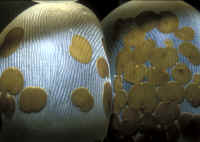
Waminoa sp. on a bubble coral
(photo by Bob Fenner)
If your flatworm population becomes intolerable, there are some products which are effective at killing these worms. However, mass dying off of the flatworms is likely to cause a toxicity problem. Not to mention, you might also kill off all your beneficial flatworms as well. Therefore, it's better to first try to control the problem with reduced feeding and manual removal. If you have a Convolutribola problem, cease any feeding of Artemia (brine shrimp). If you do use a product to kill the flat worms, it's a good idea to try to remove as many of the dead worms as possible.
The Acropora-eating flatworms (often abbreviated to "AEF") are more truly a pest by anyone's definition of the word. As the name implies, these flatworms prey on corals in the genus Acropora. They are generally a bit smaller than the brown rust flatworms and much more difficult to see. Sometimes the pattern of dying tissue is easier to identify than the actual worms. Their gold-ish colored eggs can usually be seen at the base of an infected coral.
Any coral you suspect to be infected with these flatworms should be quarantined IMMEDIATELY. Unfortunately, there's no known "cure" for these flatworms yet. However, some aquarists have been able to save their infected corals by quarantining them and doing everything possible to kill and manually remove as many of the eggs and worms as possible. Some aquarists experiment with different chemicals and products to try and kill the worms. If you do this, do so in a quarantine tank just in case something you try kills more than just flat worms. If the coral is otherwise healthy, sometimes it can overcome an infection with help.
Coral-Eating Nudibranchs
Many (but certainly not all) species of Nudibranchs and/or sea slugs eat coral. Most of these eat only one species (or a few similar species) of stony or soft coral. They come in all shapes and sizes and some are more annoying than others. To get an idea of just how diverse this group of animals is, visit The Slug Forum. Hermaphroditic, coral-eating Nudibranchs can quickly and easily multiply and destroy an entire coral colony. If you see a Nudibranch on your coral and you suspect it is eating the coral, remove it. Unfortunately, this may not be the end of your problem since there could be others (or there could be eggs). If possible, removing and quarantining the coral to watch for more slugs is usually a good idea.There's some thought that certain types of wrasses and other marine fish might eat some predatory Nudibranchs (and/or undesired flatworms). However, there's no guarantee that any one wrasse (or other fish) will eat the kind of Nudibranch (or worm) that might be bothering you. Or, even if it did, it might not eat enough of them to be effective.
Usually the only thing you
can do to get rid of undesired Nudibranchs is to quarantine the
affected coral and try to manually remove as many adults and eggs
as you can.
Montipora-eating Nudibranchs (never abbreviated to "MEN") can be
devastating to Montipora species. Any coral you suspect of
being infected with Montipora-eating Nudibranchs should be
IMMEDIATELY quarantined. Unfortunately, there's no known
cure. However, just recently, Mitch Carl reported to have had
some success using a Praziquantel bath to kill the adult
Nudibranchs. Praziquantel baths, along with quarantining and
diligent manual removal of eggs, might help save the
coral.
Red Bugs
Poor polyp extension, lose of coloration and over all coral decline may be signs of a red bug infection. When latched onto a coral, red bugs are extremely hard to remove. Iodine dips might help a little, but don't usually solve the problem.
The most effective known treatment for red
bugs is the use of Milbemycin oxime (many thanks to Dustin
Dorton). Milbemycin oxime is the active ingredient in a heart
worm medication for dogs called "Interceptor." To get
it, you will need a prescription from a veterinarian. The down
side is that it will indiscriminately kill any and all
crustaceans (including amphipods, copepods, crabs, etc.). More
bad news, since the red bugs (and their eggs) could be all over
your tank, you can't simply quarantine the affected coral and
only use Milbemycin oxime
in a quarantine system. Unfortunately, the whole tank must be
treated. Obviously, this is quite risky. You will most likely
kill off any (and possibly all) crustaceans left in the tank.
Also, the long term effects of treatment are largely unknown.
However, most the people who've had to suffer a red bug
infestation will tell you that it's worth the risk. So,
keeping all the warnings and disclaimers in mind, here are some
general, basic instructions:
1) First, quarantine all of your shrimps and
crustaceans. If you can, take out collections of amphipods as
well (but only if you can get them alone, i.e. not attached to
rocks or algae). Leave all your normal equipment on (i.e.
don't turn off any pumps or filters or disconnect any
refugiums or sumps). The only thing you'll want to turn off
and remove during treatment is any carbon filtration.
2) Each Interceptor pill
(for large dogs) contains approximately 23mg of
Milbemycin
oxime. The problem is that you only
want to dose about ~0.639mg of Milbemycin oxime per every 10g of
tank water. Therefore, each tablet would treat ~380g of tank
water. If you have one of those very expensive electronic scales
(the kind chemists and drug dealers use), then you could measure
out exactly 0.025g (or 25mg) of crushed pill powder which would
contain very nearly 0.639mg of Milbemycin oxime. This would be the safest way to go. However, if you
don't have such a scale, you could try to figure out the
total fraction of the pill you will need. For example, if you
have 190g of tank water, you would need half a pill, 95g of tank
water will need 1/4 a pill, etc. Since it's hard to halve
(and/or quarter) pills, measure out what you need after
you've crushed a whole pill to a fine
powder.
Note that your aquarium's actual volume of
water is different from the aquarium's size. Try to remember
how much live rock and sand you put in your tank and do your best
to determine their collective volume. Then subtract that from the
tank(s) size (in gallons). Remember to also consider all
connected tanks, refugiums, sumps, etc.
3) After 6 hours, change out AT LEAST 25% of the tank water and run as much new activated carbon as you possibly can. After 24 hours, do another 24% water change and change the carbon.
Note: There's no need to freak out if the
bugs are still clinging on to your coral after the first
treatment. They can cling onto surfaces for some time even after
they're dead.
5) You can reintroduce your crustaceans 24 hours after the last step of the last treatment (i.e. after you've done your last water change and carbon run). Remember not to add ANY of the water you saved them in. Add only them back to the treated tank. If you're not sure if it's safe yet, you could first add back one of the amphipods you saved as a test. That may sound a bit cruel, but just tell the little guy he's taking one for the team. Chances are, if you did everything went according to plan, he'll be fine and you can add all your crustaceans back safely.
WARNING: As previously mentioned, the use of
this drug in aquariums is a relatively new idea and is not fully
understood. The long term effects are unknown. The effects
(either short term or long term) of overdosing are also unknown.
The effects on other invertebrates is also largely unknown. Just
because it doesn't appear to kill snails and other inverts,
that doesn't mean it doesn't effect them in some way. It
could sterilize some invertebrates, shorten their life spans,
drive them mental... no one knows for sure. Or, it could have no
effect at all. We just don't know yet. Bottom line, this is
one of those things you do AT YOUR OWN RISK.
Predatory Snails
There are a few coral-eating snails commonly
appearing in aquariums. Most prey on soft corals. Probably the
most well know of these is the sundial snail (or
box snail) of the genus Heliacus.
These snails are notorious for feeding on Zoanthids. They
typically have pretty shells that are round and usually smaller
than a pea. They may or may not become a problem. Depending on
the snail species, number of snails and the corals involved,
predation can range in severity from hardly noticeable to
devastating. Quarantine of the coral and manual removal of the
snails is the best treatment (if the snails become a
problem).
Diseases:
Brown Jelly Disease
This is a coral disease that is almost exclusively found in aquariums. As its name suggests, this disease appears as a brown, jelly-like substance on the suffer of the coral. It's also described as a light-brown colored slim or ooze "floating" above or around the coral. The jelly is thought to be a mix of dying coral tissue, bacteria, Protozoans and possibly other things. The specific culprit is unknown. With so many different microbes present in the slime, it's hard to say which is "causing" the infection and which are just opportunists feeding on the already dying tissue. In any case, it is almost always caused by a physical injury to the coral. It moves quickly and can kill a coral with in a few days or weeks. Simply put, brown jelly disease for a coral is analogous to a badly infected wound in any other animal.
If the disease has just started and the
infection is small, the best treatment is high water flow and at
least daily cleaning of the infected area (usually done with a
turkey baster). If the disease is severe, the infected part of
the coral may need to be cut ("fragged") off of the
colony. The choice to quarantine is up to you, but brown jelly is
not usually contagious (unless you have other injured corals in
the tank). If your other corals are healthy, they will likely
resist infection even in the presence of an infected
coral.
Black Band Disease
This disease appears as a
black band of microbial mat. This microbial mat is a black,
mucus-like, about 1mm to 7cm wide and only approximately 1mm
thick. The band leaves behind an exposed, dead coral skeleton.
The microbial mat is actually a mix of synergistically
functioning bacteria. Basically, these bacteria work together to
suffocate, kill and consume the coral's tissue. Most
unfortunately, this disease progresses quite rapidly, progressing
up to 1 cm/day. If possible, an infected coral should be
fragmented immediately such that all of the dead coral and all of
the disease band (and probably ~1/4 inch of healthy tissue in
from the band) is removed. Fortunately, for whatever reason, it
doesn't seem to be all that common in aquariums. For more
information and photos, please visit NOAA's
webpage on black band disease.
Conditions:
RTN (Rapid Tissue Necrosis)
Though sometimes referred to as if it were a disease, RTN is not a disease. It is only what its name implies, rapid tissue death. This is when, for any variety of reasons, a coral's tissue begins to rapidly die off (usually leaving the entire coral dead within a few days if not a few hours). Once it starts, RTN is nearly impossible to stop, especially when the cause is unknown. Sometimes a sudden and drastic shift in tank parameters (such as temperature, salinity, pH, etc...) can cause RTN.
IMMEDIATELY remove any coral you suspect to be
suffering from RTN. Though it's not known what causes RTN, it
has been shown to spread to other corals. This could be because
it is caused by an infectious agent. Or, it could be that when
one coral dies so rapidly, a significant amount of toxic
chemicals are released into the water causing other corals to
start dying (a kind of chain reaction).
Starvation
Unfortunately, many aquarists do not properly feed their corals. Slow tissues recession/death is often a sign of starvation. If you suspect that your coral is starving, please see Coral Care for information on feeding your particular coral.
Stress
Most corals, particularly wild caught colonies, suffer considerable stress before arriving at your local aquarium store and into your tanks. Inappropriate and/or highly unstable tank parameters, excessive handling/falling/moving, and unfriendly tank neighbors are some common causes of stress. Stress can lead to slower tissue recession, poor polyp expansion, slowed growth or just an overall decline in coral health. When severe, stress can cause RTN.