|
FAQs about Trachyphylliid Coral Disease/Health,
Parasites, Pests 3
FAQs on Open Brain Disease:
Trachyphylliid Disease 1,
Trachyphyllia Disease 2,
Trachyphyllia Disease 4,
Trachyphyllia Disease 5,
FAQs on Open Brain Disease by Category:
Diagnosing,
Environmental (Pollution/Poisoning, Lighting...),
Nutritional,
Social (Allelopathy),
Trauma,
Pathogenic (Infectious, Parasitic, Viral)
Predatory/Pest,
Treatments
Related Articles: Coral Pests and Disease; pests,
predators, diseases and conditions by Sara Mavinkurve,
Trachyphylliid
Corals, Trachyphyllia Reproduction
Report,
Related FAQs: Open Brain Coral
1, Open Brain Coral
2, Trachyphylliid
Identification, Trachyphylliid Behavior,
Trachyphylliid
Selection, Trachyphylliid
Compatibility, Trachyphylliid Feeding,
Trachyphylliid
Systems, Trachyphylliid
Reproduction, Stony
Corals, Stonies 2,
Stonies 3, LPS Stony Corals, Coral System Set-Up, Coral System Lighting,
Stony Coral Selection,
Coral Placement,
Foods/Feeding/Nutrition,
Disease/Health,
Propagation,
Stony Coral
Behavior,
|
.JPG)
|
|
Bubbles in Open Brain 1/3/08 Hello WWM Crew,
<Paul> I recently purchased an open brain from my LFS. I
acclimated and placed it in QT, temperature is 80 degrees and
salinity is 1.026. <Good> During QT I spot fed with Mysid,
one piece of which had a small air bubble attached. A few days
later I noticed what looked like 2 small air bubbles under the
tissue near one of the mouths of the open brain. <Mmmm>
However, it disappeared a few days later, upon which I placed
into a separate stand alone refugium. This is lit with a 100W
daylight CLF bulb. It expanded normally and was doing fine until
I did a large 50% water change. The NSW was at a salinity of
1.026 at approx 80 Degrees F. However, during the water change I
thoroughly covered the open brain in sand. <Yikes> I then
forgot to plug the heater back in and the temperature dropped to
about 70 Degrees F before I noticed. The next morning the
"bubbles" had reappeared so I quickly removed it, did
an Iodine dip (10 drops to 1 gallon), and reacclimated it into
the QT tank. <Very good> It still goes through regular
expansion and shrinkage, but there appear to be more and more
bubbles under it's tissue. Please advise? I have attached
pictures. Thank you! Paul <I think you'll be okay here...
as will the specimen. Sometimes such gas accumulation does
occur... in moved specimens under "boosted" conditions
(mainly lighting), and rapid metabolism following challenges. Bob
Fenner>
Re: Bubbles in Open Brain 1/3/08 Mr.
Fenner, <Pablo> Thanks! The open brain is indeed slowly
recovering and the bubbles are receding. Another coral making it
safely from LFS to my tank. <Ah, congrats! BobF>
|
|
|
|
Pink Brain Coral -12/29/2007 Hello, I have my first huge
problem, by huge I mean the life safety of one of my inhabitants.
I'm really struggling on what the cause could be and was
hoping you guys may have an answer, or some direction on how to
correct the issue! I have included a photo of my pink brain coral
that was taken on Dec. 19th, it shows the coral nice and fleshy
and with some of the feeding tentacles out, and to what I have
taken to be a healthy specimen. I may have been fooling myself
though. Christmas morning (of all mornings) I woke up and did my
normal check on my animals and noticed some bleaching on the rim
of the brain. <Looks worse than bleaching... looks like tissue
recession.> I thought that maybe it had gotten blasted by sand
or irritated by a crab or something and decided to keep a close
eye on it for the next few days and see what happened. One thing
that comes to mind that happened a few days ago is that my
cleaner shrimp molted over night and my fiancé© found
the molt inside the brain corals mouth the next morning. <This
sounds normal. The coral was likely eating it (or trying to eat
it).> (This happened before any of the bleaching appeared).
Other than that the only other thing that comes to mind is that
one of my power heads came loose and dropped into the sand and I
awoke to the results of a sandstorm and a big "hole" in
my sand bed. (My tank did not have a good Christmas season.) This
powerhead was on the opposite side of the aquarium though and
I'm not sure that it would have had a significant effect
except for maybe a sand flurry or two onto the brain coral.
I'm at a loss to what could be going on and don't want to
see anything die under my care. <What do you feed this coral?
How much? when? and how often? These corals are voracious eaters.
It might be starving to death.> (Not to mention my
fiancé© would kill me if her favorite coral didn't
make it. It's funny how she doesn't lay a finger onto the
aquarium but she lays claim to the fish and coral and has VERY
outgoing opinions about things when they go the slightest bit
wrong... lol) If you guys can think of what may have caused the
problem and how I can correct it it would greatly be appreciated.
I began last night feeding the brain heavily with E.S.V. spray
dried phytoplankton <No good... they don't eat this.>
and frozen Mysis and brine shrimp. (I have listed my tank specs,
as of this morning below) <Meaty foods like this are good (be
sure to defrost first though).> 55 Gallon tank with about 60
lbs of live rock. and a 3-4 inch sand bed. (up and running since
May)55 gallon sump (1/2 dedicated to a refugium half to
filtration, used to be a trickle wet dry, but I have began to
slowly take the bio balls out and just go with a prefilter and
VERY aggressive Skimming) ASM G-3 Protein Skimmer Refugium has
Grape Caulerpa, a 2-3 inch sand bed and about 25 lbs of live rock
rubble. ( I plan to replace the Caulerpa with Gracilaria and
green Ulva and maybe some Chaetomorpha soon) The circulation in
the tank is provided through a Mag 7 return pump fed into a SCWD
that comes out at opposite ends of the tank. I have a Tunze
Stream 6101 that stays on its lowest setting except when the
Cyanobacteria starts to show on the sand and I turn it up for a
few hours. The Tunze is accompanied by a Maxi Jet 1200 (with the
1600 upgrade kit.. claims to put out 1600GPH of turbulent
circulation) the maxi jet is on the opposite side of the tank
blowing water across the back glass and back side of the rocks.
Tank Parameters Salinity 1.021 <Salinity should be closer to
1.025 to 1.026> Nitrites 0.00 Nitrates 0.00 Ammonia 0.00 PH
8.0 Calcium 310ppm Alkalinity 110 mg/L Inhabitants 1 yellow tang
1 zebra goby 2 green Chromis 1 pink and blue watchman goby paired
with a tiger pistol shrimp 1 lawnmower blenny (that I now have a
hard time keeping well fed because there is no algae in the tank,
I feed dried algae strips daily. Any suggestions?) 1 Cleaner
shrimp A huge clean up crew ( 3 Mithrax crabs, 20 scarlet
hermits, 20-30 blue hermits, 5 Nassarius snails, lots of Astrea
and cap snails, other creepy crawlies that go bump in the night
(bristle worms etc. .)) Green star polyps a large pink leather
(not sure the species. It can be seen in the photos) a huge xenia
colony (THAT WONT STOP GROWING!!!) two green Ricordea polyps a
frogspawn and a piece of moon coral?, The LFS sold it to me as
pineapple brain coral? The tank has 4 55 watt T5 (two actinic and
two 10K, as well as an Actinic VHO) (lights set on a 12 hour
cycle) Also I recently scraped off about half of the coralline
algae covering the side of the tank, about a week and a half ago.
I didn't want to scrape all of it at once but both sides are
covered and I'd like to be able to see in. I also attached a
picture of the coralline growth in the tank without any of the
aquarium lights on (flash only) does this look normal, I almost
feel as though it may be bleaching out also. <Looks normal to
me...> Again you guys have been a HUGE help to me thus far and
I am taking in as much information from you guys as I can as I
begin plans for the 280 gallon that is going into my basement!
<cool> Thanks, Adam <De nada, Sara>
Re: Pink Brain Coral 12/30/07 I feed the brain 2
- 3 times a week. Mostly the Spray dried phytoplankton,
that's what the LFS told me it needed. <Well, they
were/are wrong.> I guess as I and a friend are finding out
they provide A LOT of bad information despite their good
reputation. <::sigh:: This seems to be a common phenomenon,
unfortunately...> Every once in a while I would feed it
'shrimp' pellets, and chopped bits of frozen shelled
shrimp (thawed first), last night was the first time I had
directly fed it the Brine and Mysis shrimp. So should I up my
feeding with the shrimp? <If I were you, I'd feed it at
least 4 to 5 times a week until the tissue recession stops. After
that, you could feed it only every other day or so. But you
should target feed it good foods such as well-chopped fresh
seafood, scallops, shrimp, squid, clams, oysters, etc. (this
might help: http://www.asira.org/feedingyourtanks)> are the
shrimp pellets going to be digested? <Maybe to some extent,
but they're certainly not ideal. I personally would not feed
them to any of my corals.> Is there any other foods I should
try? <Yes, food you make yourself (please see the above link).
From your LFS; frozen Mysis, krill, chopped mussels are good.
Don't use stuff that has seaweed in it (corals won't
digest it). Also avoid products with a lot of fillers and
preservatives, etc. Have you heard of Rod's Food? This is
good stuff too.> The coral seems to take them in as food. but
it also seemed to take in the phytoplankton. <This doesn't
mean anything. It likely just spits it out later. And this
isn't good for the coral. There's a net metabolic loss
when it takes in food it doesn't derive much nutritional
value from.> Is there a chance for this guy to make it?
<Yes, of course... just be patient and feed it properly.
Things may get a little worse before they get better, but corals
can be tough animals. Raising your salinity should also help.>
How often should I be feeding him now that he is wasting away, I
am guessing several times a day ? <I'd say about once a
day (at night--after lights out, or whenever you notice the
tentacles peeking out). Just be careful not to spoil your water
(effective target feeding small amounts of food is the best way
to go).> If he pulls out what kind of feeding regime should he
be on? <Quality, target fed food 3 to 4 times a week (or about
every other day) is ideal (IMO).> I was also told that the
lighting in my tank may not be adequate is this true? <I doubt
it. They don't need intense light.> I don't want this
guy to waste away at my care! It especially bothers me to now
know that I haven't been taking proper care of him in the
first place. <No worries, you know now. It's a learning
process. Just keep at it, keep reading, etc. You'll get the
hang of it. ;-)> Thanks for all your help, Sara M.>
|
|
.JPG)
|
Re: Pink Brain Coral 1/5/08
Sara, I am displeased to say I think this will be my last
email re-guarding my pink brain coral. It has deteriorated
much more than the first few pictures I sent you a week ago
depicted. Despite my desperate attempts to feed it and keep
it alive. Several nights I woke up in the night to get a
drink or something and traveled into the living room to
check on it and would try to feed it. <::sigh:: Been
there myself... > I even went as far as to try to very
gently squirt pieces of chopped shrimp and squid into the
few mouths that were left. None of which worked. One night
it appeared as though the tissue was regrowing and I was
ecstatic, but alas, I went by the tank on one of my late
night strolls and noticed hermits devouring what appeared
to be the corals desperate attempt at regrowth. I gently
pulled the hermits from the coral and placed a plastic jug
I cut out over top of the brain to allow it to be left
alone. I fear this decision was too late. I have attached
an updated picture taken a few moments ago. My question is:
Should I still be trying to help this animal pull
through... or is it too late? <It's not too late. As
I warned (or should have if I didn't), things would get
much worse before they got better. If I were you, I would
1) use a powerhead and/or turkey baster to blow off any
dead tissue and opportunistic diatoms and such, 2) use the
plastic jug to help with target feeding, 3) don't be
too aggressive, don't try to inject the food into the
coral. I forget, do you have a lit refugium? In my
experience, sometimes moving a coral to a refugium can
really help. I noticed this after several times I would
give up on a coral and toss it into my refugium, thinking
it would soon die. Much too my surprise/delight some of
these corals no only recovered but became much healthier
than they ever were in the display. I'm not sure why
this is (though I have some theories). It's worth a try
at least (IMO).> If it is too late, should I remove the
animal from the tank? I know it is polluting my water due
to the outbreak of Cyanobacteria. My parameters are still
in check, and I would like to see the animal pull through
but my gut feeling is that it probably wont make it. Please
advise. <In theory, so long as there is even just a
"drop" of live coral tissue left, the coral can
recover. I won't lie to you, things don't look so
good. But I wouldn't say it's over just yet. The
coral appears to still has a fair amount of live tissue
left and I've seen even more "miraculous"
saves than this. All in all, I definitely think you should
keep trying to save it. If it doesn't make it, it will
at least be a valuable learning experience.> Adam
<Good luck!> If the animal is to be removed, what is
the most humane thing to do with it. I would like to keep
the skeleton, it was one of my first corals. <Let's
not give up on it just yet... if it does completely die, do
write back and I'll tell you what you can do with the
skeleton to preserve it. :-) Best, Sara M.>
Re: Pink Brain Coral -01/04/07 I do
have a refugium (or about half of my 55 gallon sump that is
being used for one. It has about 10 - 25 lbs of a mixture
of live rock, lava rock that the aquariums previous owner
was using, (one piece is covered in coralline), and dead
coral skeletons from yet another friends tank. (who gave up
after a tank disaster). It only has a 15 watt 6800K
fluorescent bulb over it. The grape Caulerpa thrives under
it and I have even seen some coralline algae start to grow
on the glass (not much due to the lack of lighting I'm
sure). Will this amount of light be ok for the brain!?
<Temporarily, yes, perhaps... I would give it a
shot.> Also this is normally where I pour in my
supplements and My top off water. After placing the brain
in the refugium should I try to top off and dose in the
other half of the aquarium after placing the brain in
there? ( I would expect so, as to keep from exposing it to
concentrated chemicals and drastic salinity changes)
<Yes, good idea. But I must tell you, moving the coral
to one's refugium as a "treatment" of sorts
is not the "standard" recommendation. This would
be a more "controversial/experimental" course of
action coming from mostly from me personally. So, it's
up to you... it might help, it might not. In any case, do
keep target feeding it (delicately).> Thanks for all
your help, Adam <De nada and good luck... please do keep
us updated! :-) Best, Sara M.>
Re: Pink Brain Coral 1/5/08
Sara, As I am still going over things in my head this came
to mind: The pink/blue brain that I have is a deep dwelling
species correct? <Um, not necessarily. Usually the
collectors stay more shallow I believe.> With this being
said should it be in the shaded portions of my tank? I ask
this because it was in the "shaded" area of my
tank, Until about a month ago. It was expanding and got
hung up on a rock. Because of this I moved him to one of
the few spaces on the sand where he would fit which is
directly under my lights with no shade. Could this have
been part of the problem? <Possibly... the sudden change
of light could have been detrimental.> I don't think
he would have experienced photo shock because he wasn't
completely covered in the shade in his last spot. It was
under a huge Xenia colony that due to its movements in the
current, provided it with partial shade and light. So
moving it out shouldn't have induced photo-shock should
it? <It's hard to say for sure, but it's
possible.> I have placed him back under the Xenia for
now and if conditions become worse I am going to move him
to the refugium as a last ditch effort. (I hate to keep him
from the light, but I guess this could also be beneficial
for short term?) <If it was "happy" under the
xenia, then that's where it should be. I think one of
the hardest things for reef aquarists to learn/accept is
that every coral is different and you shouldn't try to
"impose your will" on them. If a coral appears
healthy and growing in a spot that (according to your
sources) is totally wrong for it, so be it. I assure you
that the animal knows itself better than you do. So, maybe
we need a "Zen of Coral Care" article or
something... lol :-)> I hate sitting things out and
waiting with things like this, but it's all I can do.
<Haha, I know how you feel, but it's all you can
do.> My brain wanders too much in it's attempt to
figure out things. <No pun intended, right? j/k I really
am sorry for your struggle and I know how it feels.
I've even slept on the couch next to one of my corals
when I thought there was something wrong with it (I was
that worried/obsessed over it). But I've come to learn
that this hobby is just so uncertain. Even if we read all
we possibly can, it's still a lot of trial and error
(and may always be so). It does help for our trials and
errors to be well educated/informed though... so please do
keep reading/learning/sharing. :-)> Sara M.>
|
|
|
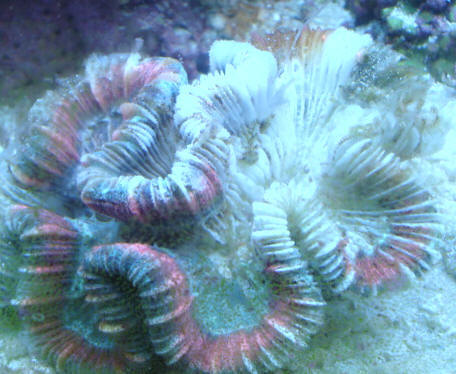
Re: Pink Brain Coral... death
1/10/08 Sara, <Hi, sorry for the late response...> My
brain is now completely white and most of the tissue is gone.
<:-( Sorry to hear that. At least you did all you could do.) I
have had a Cyano bloom on the sand. (nothing that the powerheads
can't clear up with a little adjusting but it is a nuisance)
The coral is still in the refugium. The reason I said most of the
tissue is gone is that two nights ago I figured it was probably
over for the little guy (it was completely bleached and smelled
like sulfur), so I pulled it out of the tank to notice that there
was still white fleshy tissue on the skeleton. I placed the coral
back into the refugium and blew some of the necrotic tissue of
with a turkey baster as well as removed some of the algae
accumulation off the skeleton. While doing this I notice I sucked
some of the white tissue off the skeleton. To my surprise tonight
while I was looking at it I noticed the white "tissue"
was back. Is this coral tissue or something else? <I can't
think of anything else it could be. But I don't know if this
tissue is still alive enough to be saved. When you're ready
to pull it out and clean/preserve the skeleton, you should boil
it for a half our or so, then soak it in 50/50 bleach/water.
Best, Sara M.>
|
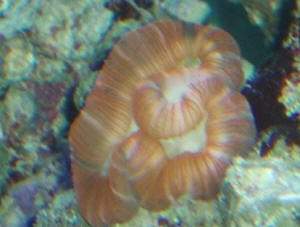
| Sick Elegance, Rose Brain health, & possible
Lithophyllum sp. ID 10/18/07 Hi Folks, I have been searching
your site for answers and with all the information I've read I
am less sure than I was before I started. <It happens to all of
us. :-)> I have a few questions and I am a recent student of
this hobby so please bear with me. I am running a 265 gallon, 32in
x 32in x 5ft, with a 29 gallon sump with skimmer, we don't do
anything small in this house. Currently, I am in the process of
slowly filling my tank, so I have started at one end with a 400W MH
and 4-40W fluorescent actinic. I will be adding another 400W MH at
the other end when I have life to put under it. First, I have
enclosed a few photos of my rose brain, elegance and an unknown.
The unknown was a skeleton covered in mushrooms that had a great
shape. When I got it in my tank a tiny portion of the skeleton was
still alive and started to regrow, recovering the skeleton with
life, any idea what this could be? <Very nice recovery. It looks
like some kind of Lithophyllum sp.> Under actinic only this
glows green, but with MH it looks a tan colour. The other 4 pics
are of my formerly healthy elegance and brain and their now sick
images. The elegance from what I read on your site looks like the
virus that Julian Sprung describes. Over the course of about a week
parts of it started to shrivel. Now it's been like this for
about 3 weeks. I am hoping for the best and just looking for
suggestions. <There's been some recent promising
investigation into the cause of (and possibly cure for) Elegance
coral disease. Please see here:
http://www.elegancecoral.org/Page_4.html > My brain on the other
hand had almost tripled in size from this healthy photo(daytime)
and now for about 5 days has continued to shrink. The colour is
still good but there is no puffiness to it at all. <Actually, it
looks a little bleached. You should move it to an area of less
intense light or raise your light. For general care of these
corals, please see here:
http://www.wetwebmedia.com/trachyphlliidae.htm > I have done a
partial water change and then today I noticed that the little
sponges that hitchhike on live rock, the one that look like cotton
balls, have all started to die off. I can't figure out what has
happened. My ammonia, nitrite and nitrate are all at 0 and the ph
is 8.4. <I think you probably have too much light over your
tank. Some sponges don't like a lot of light.> Also in this
tank, 130lbs live rock, Rhodactis mushrooms, 2 Fungia - green and
orange Platygyra, Blastomussa, lg coral covered in Christmas tree
worms, a Purple, a blue and a yellow tang, 2 small clownfish, a lg
orange and green BTA and a small rose BTA, a sm Xenia, a frogspawn,
chili sponge 3 cleaner shrimp, a debelius lobster, multiple
mushrooms, candy coral, green star polyp, a red and yellow feather
duster, many snails and hermit crabs, and of course anything that
hitch hiked in on the live rock. Everything else in this tank
appears healthy, eats normally and seems to be thriving. The only
thing that has changed since just before the brain started to
recede is the addition of 5 lbs of live rock, and the Rhodactis
mushrooms and a move of the purple tang in from the QT. Should I
just leave it or is there any suggestions about intervention? <I
don't think the new additions are causing your coral
troubles.> Thanks in advance for your help, us newbies really
appreciate your time and consideration. Sara M.> |
  |
|
|