 |
|
| Home | Marine Aquariums |
Freshwater Aquariums |
Planted Aquariums |
Brackish Systems |
Ponds,
lakes & fountains |
Turtles & Amphibians |
Aquatic Business |
Aquatic Science |
Ask the WWM Crew a Question |
| Please visit our Sponsors | ||||
Zoanthus vs. Palythoa vs. Protopalythoa: Palytoxin 07/07/08 Hi WWM crew, <Hello Brian! Sorry about the slow response, I was asleep at the wheel...> I'm writing you about palytoxin because I so far cannot find concrete answers about it anywhere and I have children and pets around my tanks. <Yes...many stories, few facts available to the hobbyist> This is my first letter to you all after many readings (including reading many of your letters on Zoanthidea and palytoxin). I have a few quick questions and I would appreciate any citations to additional resources you can give, the more scientific the better. I'm trying to get hold of the Book of Coral Propagation by Anthony and Corals and Coral Reefs by Eric Borneman since I hear they have good info on palytoxin but no luck so far (they're expensive!). <Calfo gives some anecdotal info that is helpful- cautionary - to the hobbyist. If you're interested in scientific texts on palytoxins you might try a local library or (preferably) a college library where you can gain access to scholarly journals. Perhaps a search of scholar.google.com or JSTOR would be fruitful in this area.> (1) How can you tell the difference between a Zoanthus, a Palythoa, and a Protopalythoa species of Zoanthidea? I would like to concretely identify what is in my tank and learn how to ID future specimens. <As I understand it, this largely relates to the common foot. As hobbyists Zoanthus are the smaller, more colorful polyps sharing a foot; Parazoanthus being larger, more distinctly carnivorous, and still sharing a common foot, and the Palythoa/Protopalythoa being colonies of unconnected large polyps> (2) Do all Zoanthidea species have palytoxin in them? I know that even within Palythoa, not all specimens have palytoxin in them, but I'm wondering here whether all 3 species have palytoxin or if, for example, Zoanthus are safe and do not have it. <All of these families may/do produce palytoxin and other organic poisons> (3) If not all Zoanthidea have palytoxin, which ones do not have it? <Can't be told based on appearance, unfortunately. We must suspect all...for safety reasons> (4) Where is the palytoxin actually "kept" in the Zoanthidea? Is it ever released other than when the specimen is damaged or cut? How is it released (I've read about it squirting out of Zoanthus but never seen anything on how they actually release it)? <It is held in the fluid of the mesophyl, exuded in mucous, as an allelopathic compound.> (5) Is palytoxin also harmful to other things in the tank (e.g. other corals, fish, inverts, macroalgae, etc.)? <Anything with nervous tissue, motor function> (6) I have two Zoanthidea in my tank now that I was told, when buying them, were Zoanthus. I knew nothing about palytoxins so didn't ask any questions beyond that identification. They have spread off the original frag/rock/disc they came on and some of the polyps are bridging the gap between the frag disc and the live rock. If it turns out these are a species that sometimes contains palytoxin I'll probably not keep them, the risk seems not worth it despite their beauty. How should I go about removing them from the tank to minimize the risk of palytoxin exposure? <The only way to eliminate exposure would be to take the polyps and the rocks they are on, bag them in garbage sacks, and dispose of them.> I've taken up a lot of your time already, so I'll stop here. Thank you again for your answers. <Unless these creatures are handled, palytoxin poisoning is unlikely. If you are concerned about colony size or a child reaching a hand in the tank, removing these is probably prudent. DO take care in handling them (gloves, goggles, etc.) especially if they have been severed or crushed.> Sincerely, Brian <Benjamin> Micro Brittle Stars? Zoa Woes 2/21/08 Hello, <Hi Kent, Mich here.> I have been having a problem with a colony of Zoanthids. I did a fresh water dip to remove any pest. I found what I thought was three (very small) spiders (also several polyps fell off like they had been eaten on). <OK.> But, after searching to ID the creature I believe they may be micro brittle stars or some other type of micro stars. Is it possible to have hundreds of these "micro stars" living in your live rock (you can see their legs sticking out of the live rock)? <Yes.> Is it likely that they would be harmful to my Zoanthids? <No.> If not, maybe it some other pest; <Is possible.> but I found nothing else in the water after the dip. <May not have been on the rock when you did the dip.> I don't remember if they had six legs or five. <Micro brittle stars can have either, more likely to see 6 legged ones if they reproduced by fission.> Do all micro stars have five legs? <No.> If they have six legs, are they likely spiders? <No.> They do not look like any of the Zoanthid Eating Spiders that I found on your site or anywhere on the web. <A good resource here: http://www.zoaid.com/index.php?module=Gallery2&g2_itemId=384 > Thanks, Kent <Welcome, Mich> Orange Zoanthids Closed Up 2/16/08 Hello Crew, <Dave> I have a small colony of bright orange Zoanthids that I have had in my tank for about four weeks now. This week they have been entirely closed up and look to be shrinking in on themselves. I am trying to find out the cause. Previously they were open with nice large polyps and doing well. They are placed in the sand bed in an area in with high water flow. The other Zoanthids in this area seem to grow the best here. <This is "it"> I have fifteen other different color Zoanthids and they are all doing extremely well. The rest of the reef tank is doing great as well. I have read the Zoanthid articles listed on your site, but none seem to help out. I was also thinking that it could possibly be allopathy, <Allelopathy> except all the other Zoanthids are doing great. I would really like to recover these Zoanthids since the orange ones seem to be rare and they cost me over $200 for just ten polyps. Would it be in my best interest to move them to another friend's reef tank? <Yes> There doesn't seem to be any foul play from snails or crabs, and I don't see why only this Zoanthid colony would be singled out. I also didn't want to move them around since they are already stressed. <Is just a "loser" under the conditions present... to the more vigorous Cnidarians present> About my tank: My 125 gallon reef has been established for almost eight years now. I have 6 six foot VHO bulbs. three actinic and three aqua suns. Two main pumps 1800 and 1200 gph. They are controlled via two SCWDs and four returns. The actinic lights come on an hour before and after the main lights. Temp is between 76 - 78 degrees. I have a wet dry sump, but have ordered a 45 gallon ADHI refugium. For the time being I have a small basket of Chaeto algae in the main tank for nutrient control. 15 gallon water changes are done weekly. I am using an AquaFX RO/DI system for RO water. Salinity level is at 1.025; PH 7.8; Nitrates and Nitrites are at 0. Alkalinity is a little on the low side. I am starting to use a buffer to bring it up. Let me know if there is anything I am overlooking. Thanks in advance! Dave <You might be able to "classically condition" these Zoanthids to "getting along with each other better". Read here: http://wetwebmedia.com/cnidcompppt.htm Bob Fenner> Re: DSB and new tank setup... Now: Zoanthid comp. mostly 2/4/08 Hi Bob, Thanks for the quick response. The rock is NOT placed on the bottom glass. The pit I dug was 1-2 inches deep (DSB is 4"). But, the sand was pretty firm at that level. Will this be stable? <Maybe... but I'd scoot the sand/gravel aside, re-set on the bottom, or place something like a sheet of louver down on the bottom and place the rock on this> I read the fragging material on WWM and was able to peel off a few "knots" of Zoanthid from the main rock and pushed then into crevices on the rock I want to have them grow on. Some of them I attached using super glue "Indian version". This thing does not cure underwater. Have to stick out of water and then put it in. Others I was able to get off with a centimeter of the rock as base so placed them directly. Each and every polyp opened up in an hour or two. Could I conclude that the fragging was successfully? Or are there possibilities of things going wrong yet?? <Is likely fine> I do know that they will take a week or two to attach themselves to the new rock. I have arranged the flow so they do not get blown away. Can't try the rubberband or net cover to hold them as the rock is huge (12"x18") anything else I need to do? <Mmm, no... be patient> The plan is for a Zoanthid plateau on the above mentioned flat rock. I want to plant Zoanthids of different morphs on this and let them grow to fill the spaces in between frags. <Mmm, different morphs? Many cnidarians "fight" close placement. These may> I read that this can have problems but nowhere in the FAQ links is it given why and most importantly, how to avoid them or compatibility chart of some kind. IS there some info on that? Can you give me some pointers or possibilities even? <Spottily... as such a construct would have to be large, complex... with many "if/then" exceptions. You have read here: http://wetwebmedia.com/cnidcompppt.htm and the linked files above on Cnidarian Compatibility?> Can I mix small button polyps with the large variety? Can I mix small button polyps with other button polyps? <Not likely to both> Also, I transferred a smallish cup coral from my Nano where it was being harassed and was closed for a month and more. This showed brilliant polyp extension immediately in an hour after the transfer. Guess the curing is done with? It has been 4 weeks after setup now. Pods are crawling all over the tank now. Fishless, so better I guess. <Yes> I saw the cup coral regurgitating the pieces of squid I fed it. Funny thing is that it was able to adapt to the same size before. Why the change? <Life, adaptation> It is difficult to check if it is regurgitating because it happens 4-5 hours after feeding. How can I be certain it is able to keep the food down? <Try it again... read re other foods> Ps: saw one of the Zoanthid squirt juice when I was fragging. Thanks to your site, I knew to keep my eyes and mouth far away. <Thank goodness!!! Very toxic> Thanks a TONNE :-) Cheers Ramjet <Bob Fenner> Random questions/reef tank... maint.,
crab comp., Zoanthid contr. 9/26/07 Hello all and thanks for
the great website! I hope this is not too annoying an e-mail, but I
have several somewhat unrelated questions that I hope I did not miss
the answer to in the FAQs. We have a 90 gallon reef, 4 inch DSB, 120
pounds live rock, with the following livestock: Naso tang (N.
lituratus), <This genus, species needs more room than this... as
stated on WWM...> pair of Clarkii clowns, mandarin Dragonette,
double-barred Rabbitfish, yellow tang, cleaner shrimp, peppermint
shrimp, and sally light foot crab. It's the dreaded "garden
reef" <Heee!> with predominately SPS in the upper third and
LPS in the bottom half. However, just to cause trouble, we have three
different types of Zoanthids and two types of mushrooms. We have a
protein skimmer and run carbon. No new fish or invertebrates have been
added in over six months. Thus far, all corals appear to be flourishing
and all fish are happily coexisting. Don't panic over the
stocking..... we are in the process of upgrading to a 220. The tank is
finally in and husband is installing the floor jacks tonight!
Parameters are: ammonia/nitrate/nitrite/phosphate-0, SG-1.025, pH-8.1,
temperature-81, calcium-450 mg/dl, and alkalinity-8.5 dKH. So, on to
the myriad of questions......1. The Rabbitfish has developed a pink hue
on both lateral sides just dorsal to his abdominal area. I have not
seen this in any picture of a Rabbitfish, but perhaps it's just too
subtle for pictures. Is this something to be concerned about? <Mmm,
yes... highly likely environmental/stress caused... will abate with the
move to larger, better setting> Fish is eating fine (varied diet of
Mysis and other frozen seafoods, Nori, flake, pellets, etc.) and acting
the same as always. 2. I inquired about a final fish to the stocking
plan and EricR had suggested a powder brown tang. We weren't crazy
about the tang when we looked, so what are your thoughts on a Sargassum
triggerfish? Do you think the odds are good that this would be a reef
safe fish (no guarantees we realize) and that this an appropriate
addition to a peaceful tank? <Are good animals for larger systems...
and not too adventitious as other Balistids... May still sample your
cnidarians> 3. The yellow Zoanthids (Parazoanthus gracilis I think)
have gone absolutely out of control. We started out with a small rock
with perhaps 5 polyps on it over a year ago and we know have hundreds
of polyps. They have grown through the rock to come out in different
areas. <... got to keep them isolated... on their own patch of
rock...> When we try to prune them, one polyp always seems to escape
and then a new colony starts wherever it lands! They are growing across
the sand bed, in the back of the tank, and even in the middle of other
Zoanthid colonies. Any suggestions for curbing their growth? <Remove
as much as you can in the move to the larger tank> The main polyp
area is on a huge rock that supports a lot of the other rock structure,
so removal is not possible....well not easy anyway. At first they were
quite pretty, now they remind me of dandelions on a manicured yard! 4.
Last question and most important....any hints for trapping the sally
light foot crab!?! <Box traps... you can buy as such or just the
plastic ones for small rodents (they're the same)...> Last month
I walked by the tank to see the crab eating one of the cleaner shrimp
(Arrgh, the horror...I tell myself the crab was merely scavenging,
but....). <Ah, no> Last week the yellow tang had a tear in the
caudal fin. The fin healed, but we are worried the crab is on the
prowl. We have tried physically grabbing the crab (yeah, no shock that
didn't work) and commercial traps which resulted in one trapped and
very stressed clownfish. When we put frozen fish in a jar or on a
string to bait the crab, all the other fish grab the treat. We have
tried feeding the fish on the other side of the tank at the same time,
but they are too clever for that! Assuming we catch the crab, can we
just place him in the fuge or would one crab defeat the purpose of the
fuge, especially since we rely on the pod production for the mandarin?
<Move, isolate, trade in with the move...> Thanks for the help as
always and sorry for the long e-mail. All of you do a great service to
us newbies out here! Michele <Congrats on the new, larger system.
Bob Fenner>
About Zoanthus Colony Polyp Corals 3/10/07 Hi, my name is Dan Zabler and I have had a salt-water tank since October 2006. The first step is admitting you have a problem...Oh wait, wrong place. Hi Dan! Mich here.> The main tank is a 29-gallon high. I recently add a 20-gallon long refugium to my system and I was looking at what types of fish to put in my refugium when I came across the Zoanthus Colony Polyp Corals. I was wondering what types of fish are safe to put with these polyps. I was doing some research and read that the polyps are poisonous and I don't want to put them in my tank and find my fish dead. <Can be toxic, but most fish have a natural aversion to eating things that might harm them.> Right now I have a Scooter Dragonet (Synchiropus ocellatus), <A real challenge to feed, often starve in captivity. Glad you have the refugium, do research their dietary needs. More here and links in blue: http://www.wetwebmedia.com/mandarins.htm> a Firefish (Nemateleotris magnifica), and two skunk cleaners (Lysmata sp.). I am going to get one or two more fish but I might change my decision on what fish to get depending on the effect of the polyps going into the tank. <I would be more concerned about the size of your tank. You need to choose any fish you add very carefully. You tank is quite small and psychological stress from over crowding is often a bigger issue than many appreciate. There are several options. A few you might consider may include your basic clownfish, Chromis and select damsels. Some other possibilities include: an Orchid Dottyback (Pseudochromis fridmani), a Royal Gramma (Gramma loreto), or possibly a jawfish (Opistognathus spp.). Only consider the jawfish if you have a deep sand bed in the display and your tank is completely covered, because they will find the smallest hole to escape from to go carpet surfing! But please only one more fish, two at the max.> If you could e-mail me back at this address that would be very much appreciated. <Will do!> Thanks, Dan Zabler <Welcome! -Mich> Zoanthids, Leathers, allelopathy - 1/22/07 Hey you guys are amazing. <Thank you for this, Kyle. Is greatly appreciated.> My Question is about Zoas. My 30-gallon tank has been running for about 3 years and I just started coral maybe 3 months ago. <Ok> I just started slowly with 2 small Acro frags and a small colony of green Zoas. <Acroporids are typically considered among the harder to care for, especially for coral beginners.> Everything was thriving the Zoas looked amazing. I since purchased 2 more colonies of Zoas and some leather. now its been 2 weeks and none of the Zoas will come out. <Allelopathy from your leathers, too likely. Most leathers are quite noxious. Have a look here: http://www.wetwebmedia.com/alcyoniids.htm and the linked files above.> They just stay tightened up all day. I have a 15 gallon sump, 250W Metal halide lights, and a run of the mill protein skimmer. My tanks stats are 8.4 PH, 310 cal (I know its low but I have been adding in Kent's calcium increaser 3 times a week and I can't get it to move). <You don't mention your alkalinity measurement here. Your calcium usage may be as high as you see, or it could be that threes a mild imbalance here. Read through here for more information: http://www.wetwebmedia.com/calcalkmar.htm > I use R.O water and nothing has changed sense I have put in the new coral. I am just wondering if this new coral could affect my exciting coral. If so ill just remove the new Zoas because the older ones are much nicer? Thanks VERY MUCH Kyle Banks <Well, Kyle, Zoanthids have been known to compete with each other on occasion as well, though when this is the case, it is typified by the winner being open and vibrant typically. I do believe your leathers are the cause here. -JustinN> Looking for a magic bullet! Unwanted Zoanthids on LR 1/12/06 Hi Crew and Happy New Year to you all, <And to you> OK I know this is a very long shot and I'm most likely spinning my tires, but........ My reef is being overrun by button polyps. I've taken rocks out and scrubbed numerous times, reduced and tried target feeding fish so no food blows into current. (these things sure can eat) I've turned rocks upside down in the sandbed to smother them and even tried the syringe with Kalkwasser technique, but I just can't seem to eradicate them. Replacing all my rocks is pretty much out of the question and I'm out of manual removal techniques, so I'm stuck and stumped on how to proceed. <Mmm...> Is there any chance of a reef critter in existence that might prefer button polyps over other food sources? <Yes, but this search/trial could be long indeed> I do have zoo's but would reluctantly give them up to get rid of this pandemic plethora of problematic polyps? (Say that 5 times fast!) <Too early for me> Thanks in advance, Ken <I'd consider selling/trading this rock into a dealer (for their resale) first and foremost... In exchange for non-infested rock... Lastly... "nuking" the rock (via bleach, freshwater baths, air-exposure...) and using it with some new live on top... as base-rock. Bob Fenner> Reef tank problem... Zoanthid incomp., Cnid. incomp....
sys. 9/5/06 Hi, this is Sameer from India. <Hello
this is Bob from S. Cal.> I have a 40gal tank with a sump. Now my
basic problem is upgrading my reef tank. All water parameter are as
they have to be in a reef tank. Good Coralline algae of different color
is growing on all live rocks. One Percula and a Purple Dotty back are
doing great. One sand shifting star, a Green Feather Duster are all
happy. Lots of tiny feather dusters have come own their own from the
live rocks. One small Carpet Anemone and a medium BTA are at two
corners of the tank. <Not enough room... trouble in the not-too
future> I have 2 rocks with Solitary Cup Corals growing on them, as
there were around 6 to 7 on each rock. But now they have become to 10
to 12 on each rock. Few green plants and Red Bamboo algae or Red
Balloon algae are growing well. Different Snails and few Chitons are
doing well, the Hermits are molting often. Two pistol shrimps which
came as hitchhikers on live rocks are there from long without any
criminal records yet. <Heeee!> 5 porcelain crabs a the happiest
as the molt often are always feeding on the invert food with their fans
open. One Sea Fan is doing ok, in the sense its surviving but not
thriving. Now all these life forms are in the tank for more than 9
months together. As I have not added any new animals. <I would
not> 20% water is changed every two weeks, all in one Additive by
Salifert is used every week, purple up is used every week, and calcium
is added as needed. There 4 inches of Live Sand with lots of live
rocks. There is one actinic tube with two 12K lights which are on
timers. All in the tank is as it is to be. Except for a protein
skimmer! Which I am to buy in some time. Now the main problem is three
times I added rocks with Zoanthids. <Not
compatible...> They never opened and just melted away in 10 days.
<Good> One rock with mushrooms just melted in 4 days. <Even
better> A soft finger coral also just did not open for two weeks and
the started flaking off and melted down. What could be the cause for
this? <In a word, allelopathy (the topic du jour...)> Is it lack
of a skimmer? <Would help> What are the signs of a failed tank?
<Mmm, a loss of life I guess...> I am too confused! Is it
chemical warfare with the anemones? <Ahh, yes... Principally so>
If yes, then how are the cup corals doing great? <Are more
resistant... their time will come though> I feel that may be because
of a deep sand bed, there is too much detritus build up. <Mmm, nope.
Unlikely> What do you feel? <Highly confident that this is an
incidence of chemical competition twixt large anemone species... taking
out other cnidarians> And the overflow to the sump is not that
powerful to suck up all debris. The overflow water falls 4 feet down to
the sump through a pipe and is send back up 4 feet. There are two power
heads in the tank for circulation. So I was thinking of resetting it as
a bare bottom with little sand for aesthetic value and some reflection
of light for the LR. What do you suggest? <That you read: http://www.wetwebmedia.com/cnidcompfaqs.htm and
the linked files above> It had a plenum under gravel filter which is
now not connected to the power head. Has that collected too much
organic material? <Doubtful this has any negative impact. Likely it
has helped forestall the coming crash> I am in a total confusion.
<You keep stating so> Another question, what if I use crushed
live rock as sand? <Nah> Is this tried before? <Many times>
As it would have good circulation, and give a more natural look. What
should be the size of the crushed pieces? <See WWM re> My basic
aim in the tank is to keep few Zoanthids and a few Soft Coral in this
tank. <It's not large enough, and the animals present are
incompatible> I am ready for any major changes u suggest in the
current system. <Get reading> The main causes according to me
are: No skimmer, <Some> To much organic matter in the sand,
<Nope> Chemical warfare, <Yes!> Improper acclimatizing
(using drip fro 1hr) Or improper lighting Or what else do u feel? This
tank has been there for more than a year! May be the anemone have to
go, but till I can at least have some reef invert in it. As nothing
else in the tank which looks amazingly beautiful. If I am to get these
guys out, at the cost of some soft corals is fine with me. Pls help!
Any drastic changes are welcome. <Remove the anemones, or all but
one of them in the way of cnidarians> Thanks in advanced. Cheers!
Sameer <Bob Fenner> 50 gallon Hagan Tank, lighting, SW, reading
8/25/06 I have a 50 gallon Hagen tank (it is 36 x 16 x 20 in
height). I have live rock, fish, anemone, mushroom,
leather, polyps. I would like to get a clam, bubble coral,
sun coral. <... trouble with this mix... Please search WWM re each
species System, Compatibility...> What type of lighting
should I get? <... Please read here: http://wetwebmedia.com/marsetupindex2.htm
Scroll down to the bottom, the tray with links to marine aquarium
lighting articles and FAQs> We have a canopy to house the lighting
system. We like the look of a finished top! <Me too> I
like the light that a metal halide emits. But I understand
they emit a great deal of heat and will cost us a small fortune in
electricity! <Possibly> We were debating getting a
power compact lighting system (2 x 96 watts plus 3 blue LEDs) or a 1 x
175 MH, 2 x 15w CF, 2 blue led. Which option should we
go with based on our wish list of clams, bubble coral and sun coral?
Thanks for the information! Kimberly <A few more factors to take
into consideration... as you'll soon know... Enjoy the reading. Bob
Fenner> Coral Toxicity/Mixed Reefs - 08/01/06 Hello to
all. <<Good Morning>> It's been a while since I
bothered the crew with a question, but here I am again. <<No
bother...is why we are here>> I am somewhat puzzled by issues
relating to the toxicity of leathers to other corals in the tank.
<<Nothing to be puzzled about...leather corals (Alcyoniids) are
some of the most noxious organisms on the reef>> As I understand
it, Sinularia is the culprit (or just main culprit?) here. <<Not
limited to just this species, most all leather corals should be
considered>> Is it correct to assume that Sarcophyton does not
cause the same harm? <<No...is also an Alcyoniid>> Are
stony corals the only type potentially harmed? <<No
again...cnidarians may possibly be more easily affected/less resistant
to the chemical poisoning, but leather corals can and do affect/kill
other leather corals>> And are all stony corals potentially
harmed or just certain ones? <<Potentially all>> We have a
40 gal. reef tank, and have both of the mentioned
leathers. We also have a bubble coral, a torch, and a button
coral, along with other polyps and various mushrooms. <<Don't
discount the potential for harm from the mushrooms and polyp
corals. Corallimorphs are right up there with the nastiest
leather corals in terms of toxicity/ability to "burn" stony
corals. And if the "polyps" are Palythoa, they
pose certain hazard to not only the corals but also to the aquarist
(try a Google search on the keyword 'Palytoxin')>> We do
a 4 gal. water change weekly and water parameters are fine. <<Ah
yes, the frequent (weekly) water changes are a good method for diluting
the chemicals released by the corals. Supplemental chemical
filtration in the form of carbon and/or Poly-Filter will also
help>> Within the tank the leathers are not close to the stony
corals, but obviously, it's a small tank. <<They know they
are there, yes. Anthony Calfo recommends a minimum spacing
of about 10" between corals, and even then "pruning"
will likely be required as the corals grow. But even then,
allelopathy (chemical warfare on the reef) is being waged>> Even
with the frequency of the water changes, is it just not possible to
keep everybody healthy? <<Mmm, can be done. How
successful you'll be depends on your stocking density and your
attention to good husbandry/maintenance>> I wish we had been more
aware of this issue before setting up the tank, but we understood (more
accurately, misunderstood) the problem to be more one of providing
adequate space between the corals within the tank. <<Indeed...the
challenges of keeping a "mixed garden variety" type reef
tank. Much better in my opinion for aquarists
to choose a particular niche on the reef to
replicate...keeping specimens of a particular species, or family of
corals even, greatly increases chances for "long term"
success>> If we were doing it over now, we would specialize in a
tank this small. In any event, now that we have what we
have, is it possible for everything to thrive if we're
conscientious about frequency of water changes? <<For a time, but
the leather corals will rapidly outgrow/outpace the stony
corals. You might be able to keep things in check by pruning
back the leathers, but eventually you may decide it's time to
"specialize">> Thanks so much for any
input/thoughts. This site is so unbelievably helpful. Laura
<<Happy to assist. Regards, EricR>> Re: Need Help With ID of Aiptasia / Featherduster 7/17/06 One more thing about these... Would you consider them a pest Zoanthid? <Mmm, only if "too much", stinging, poisoning, taking up space you would rather have used elsewise> I would like to keep more desirable types (layman - pretty) in the near future. Do you think I would have a problem with them competing? <If nearby, yes, definitely> I think I want to leave well enough alone now. Thanks again, Brett <I would as well. Bob Fenner> Awesome, Thanks! Brett <Welcome. BobF> Zoanthid Compatibility...Foxface And Tang 5/27/06 Hi boys and girls from fish heaven. <Bob is in fish heaven (Hawaii), I'm not.> This is Bernd from Honduras. Question: Between a Foxface and a pacific blue tang (hippo tang) which is the most likely to eat my Zoanthids. I haven't caught them in the act but one of the two or both must do it. <Sounds like the Foxface isn't getting enough food as they will nip on LPS and soft corals in this regard. Bring him to the supper table a little more often, they do enjoy algae, try adding that to his diet if you are not already doing so.> Thanks, Bernd <You're welcome. James (Salty Dog)> Button Polyp Issues ... comp., dis. 5/2/06 I hope you can steer me in the right direction as I have no idea what is going on with my Orange Button Polyps. Only half of the colony will open up, and I have no explanation for this. It is next to a purple ribbon Gorgonia and a yellow Sarcophyton, neither touching it. <Don't have to affect chemically...> I understand chemical warfare is a strong possibility but I always change my carbon and poly pads along with a 5 gallon water change every Sunday. My current setup is a 75 gallon tank with a 20 gallon sump. Been running for nearly 3 years, and the button polyps have been around since the start! My other tank inhabitants are as follows: Corals Colt 2 Sarcophyton elegans 1 Toadstool Brown Zoanthids Orange Button Polyps (Problem) Green Star Polyps Green Striped Mushrooms Hairy Mushrooms Neospongodes Kenya Tree Red Ricordea Montipora Capricornis Montipora Digita Montipora Encrusting Frogspawn Favia Hammer 2 purple Ribbon Gorgonia. Don't ask me how I stuffed these all in there but somehow I did it with out any of these corals touching each other. A lot of them are small colonies and frags. Fish Yellow Tang Perc Clown Springeri Pseudo Flame Angel (have not seen him picking) Mandarin Inverts Cleaner Shrimp Variety of Snails Variety of Hermits Filtration DSB and Refugium Coralife Superskimmer Lighting 384 watts of pc lighting Parameters Ammonia-0 Nitrite-0 Nitrate-2 SG- 1.025 Phosphate-0 Calcium- 430 Alkalinity- 9dkh I did see one of my Astrea snails hanging around the colony at night but they never opened back up and it has been three day's. Should I start to worry yet or just let things be. <I'd do the latter... if anything, be moving this colony elsewhere> They have never been touchy before so I have no idea why they would start now. I also don't understand if it is chemical warfare why would half the colony be open why the other remains closed. I also recently switched from B-ionic to C Balance about 5 days ago. Can this be the problem? Do you have any other recommendations other than waiting it out? Thanks Eric <This is a not-untypical "garden variety" result of such stocking... Please read here: http://wetwebmedia.com/zoanthid.htm and the linked files at top, particularly on Compatibility. Bob Fenner> Re: Question about Mineral Mud in a refugium... actually not reading WWM re Nudibranch/Zoanthid compatibility 4/25/06 Hello again, <Jason> Thanks for all your help so far. I have a Zoanthid colony that has been in the tank for about 1 month. Last night I noticed about 20 Nudis on the colony so I took it out and set a quarantine with a bucket and an airstone. I was going to do a freshwater dip for 45 seconds. Is this sufficient? What about potential Nudi eggs? Thanks, Jason <... Please read here: actually, please go through WWM's search tool and/or the indices and read re both these groups Compatibility, Quarantine... Bob Fenner> Coral and such incompatibility TGIF Crew Members, <Yay! Friday!> I was just a little curious about palytoxins. I have been reading for the last two hours about this. I recently touched my Zoanthids after a fall off a rock without any gloves although I usually use gloves for anything in my tank I saw them fall and quickly picked them up and placed them back on a rock my hand did touch some of them and I washed my hands after this. <I've done this too, as have most. Wash well.> My question is its been about 2 hours since this happened do I still need to be worried about this or is the reaction something that happens right away? <From what I understand it could take hours to take effect. However, unless you cut into one I'm sure you're fine. I know one of the first symptoms is a metal taste in your mouth.> I was also wondering why there is no such warning about this kind of thing in fish stores? <You and me both here. Not ALL Zoas have this toxin. I once watched a very green LFS employee rip apart of colony of Zoas. I cringed.> I understand that research is the best tool in a thriving safe aquarium, but I have to assume a lot of people go into this hobby blind. Is it just misinformed fish stores or a desire to make a buck is more important than a persons life!? <I completely understand you. I believe it is misinformation. Most time these employees are high schoolers who low paying jobs. They aren't seasoned and don't know enough. Plus I also believe sometimes its willingness to make a sale and laziness. Any good LFS will be able to tell you tons about this. Next time use gloves, but for now you're fine. Have a great one, Jen S.> Thanks, Homerj Palytoxin from Palythoa spp. in my eyes? Greetings to all the WWM Crew! <and to you!> I have a question regarding a very painful experience I am presently still experiencing. Two days ago while doing my regular weekly cleaning and water change,( I have a 50 gallon reef ), I noticed a few of my button polyps had detached from the main cluster. One small group of perhaps four were just an inch or so away from the main cluster, but I then noticed that a few had somehow become stuck in-between the slots at the input of my power head. So as is my custom when doing cleaning, I removed the syphon piece and went to the sink to clean it out. Then comes my big unknown mistake! As the button polyps were tightly fit between the syphon piece and would not come loose by rinsing with water, I pushed them through with my finger, which resulted in my getting a full strong squirt directly into my eyes. I was surprised at both the force and amount that had made direct contact into my eyes. I felt a slight sting but thought nothing of it so I just quickly splashed some tap water on my eyes and continued on with my water change. Soon after I went to bed. Upon waking up yesterday morning due to the pain in my eyes, I got up and proceeded to take a look at them and found they were almost completely swollen shut, with the whites of my eyes beet red and a burning pain I cannot put into words! I went to my local hospital where my eyes were examined for corneal damage,( Non had occurred), and they proceeded to flush my eyes with large amounts of saline. This is the first I was to hear about Palythoa / Palytoxin! The doctor had gotten the information through the poison center who had described my nights unfortunate encounter with my button polyp. I was told upon my leaving the hospital, that I could experience extreme swelling, redness, burning, etc. . for up to a week or even more. My question to you. The doctor made it clear he knew little of this toxin. Today my eyes are almost swollen shut, completely red, with a large amount of crusty discharge around the lids. My question to you is, Is this toxin known to cause permanent damage to the eyes? I know that in the bloodstream it can be extremely dangerous, but I would appreciate any input you might have regarding this mysterious and highly painful toxin. Especially as it relates to my experience? ( I realize you are not able to give me medical advise, but please provide me with some information, as even the doctor here seems to know little of it). Thanks WWM Crew ! I am looking forward to asking questions without the pain next time around! <Wow! I am glad you received medical attention here because it can be extremely serious! I feel your pain. You can read up on more here http://www.wetwebmedia.com/ca/cav1i1/blane-zoanthids/zoanthids.htm I haven't heard of permanent damage to eye per se, only when it enters the blood stream and then can interact with the heart/lungs and so on. It seems you may be having more of an allergic reaction here - did they put you on any antibiotics? Considering I'm not a medical doctor I really can't tell you what needs to be done. However I would go see a specialist (or your general for a reference first.) Hopefully he/she will be able to do more tests/prescribe more to help your situation. I am very sorry that you have to experience this and it is one of the worse encounters I've heard of. However it is your eyes, you can't be too careful. Good luck with this. Like I said check the link above, do more searches on here and the internet for more in-depth info on the toxin. Keep us updated! Jen S.> Sincerely, Trever. Siphoning... TGIF once again Crew, Assuming maybe Jen S. is still answering since I just got an email back from you. <I'm still here... wish I was on a tropical island somewhere, but hey. I have fun w/ this too!> I just wanted to share something I do for siphoning water since reading that a lot of people use there mouths. <Ick, not me... use an automatic syphon here. I could never understand why people used to siphon gas tanks with their mouth either. Ick.> I also use to do this but being paranoid I always thought "Hey is my mouth dry, arms a little shaky, little dizzy" so I decided to figure out another way. Many may use this same technique but from what I read a lot don't. Simply go to your local Wal-mart and buy a spare power head or use one if you have access to it in your fish tank. Stick the hose right in front of it and pump enough water to start the flow take away and your siphon has started. <Very cool!> Figured I would share this with people that may need a solution to using there mouth. Since finding out about palytoxin today and realizing there is a lot of dangerous stuff in there I am sure to be A LOT more careful in future handling of my aquarium. <Hahaha, yes you should! Don't want to inhale something that might bite, right?> Thanks for the time, Homerj <No, thank you for sharing! Excellent. Have a great night! Jen S.> Question on Zoanthus sociatus not opening 3/15/06 I have a new Zoanthus sociatus (metallic green variety) colony that has been in my tank for 3 days now, and doesn't seem to want to fully open. <Three days is not very long here> the polyps are mostly open but it is not fully extended. right now the colony is on top of my rock, about 4inches from the surface, and located between the water streams - a steady but not real strong flow over it <Please read here: http://wetwebmedia.com/ca/cav1i1/blane-zoanthids/zoanthids.htm and the files linked below> I have a 29g reef, Prizm skimmer and Marineland 200 bio-wheel filter, 105w fluorescent (1x65 CP and 2x20w fluorescent). I don't test my water :-( but I do have a anemone, Haitian pink-tip <... incompatible> I believe, and he has been doing just fine for a few months so I "assume" the water quality is fine. Question is, at what point should I be concerned about the colony not opening fully, as I know there can be some acclimation, and what water flow and light intensity is best for this colony??? Patrick <Do read where you've been directed. Zoanthids in such small systems are problematical... particularly where mis-matched with other Cnidarian life. Bob Fenner> Palytoxin Paranoia - 03/02/2006 Hello all, <Hello you.> I am a big fan of your site, and have been an avid aquarist for most of my life,....now being in my mid 30's, I feel I have a good deal of experience. <Glad you've stuck with it.> A few years ago, I started reefkeeping. I have kept away from Zoanthids, due to the horror stories of their inherent toxicity. I have searched a good deal on the web, through forums of which we are all familiar with, but keep hearing that "most Zoanthids/Palythoa in the hobby are not toxic varieties"....in a life threatening sense. <As far as life threatening, yes, quite uncommon.> Is this indeed true? I am concerned about this. I realize that people will have different physical reactions to different stimuli, but deadly is another set of rules. I have small children, that I enjoy sharing the wonders of my hobby with, and I would love to keep Zoanthids due their beauty, but have veered away from them at all costs because of what has been revealed about them, though to what extent of truth is now the concern. <Valid concern. Though, I believe, they are all toxic to some extent, not usually fatal. The thing to be most concerned with is open wounds and eye/mouth contact. Most risk associated with propagation> Of course I am concerned with my children's safety and my own. I have Anthony's books and have read of his mishaps,......would love to know more definitive info., if any of you could help. <It all comes down to responsibility and common sense when handling these. I don't think you should let it stop you from keeping them. Teach your children about them, I'm sure they'll find it fascinating. I think you'll be fine.> Thanks in advance. <Hope that helps. - Josh> Zoanthid toxicity - 02/27/06 Greetings to the best reef site on the net! As always when I have a question or concern I turn to WWM. The question/concern is in regard to Zoanthids. I seem to be finding many references as to the toxicity of Zoanthids. As I am just reef hobbyist I am in no way an expert on such matters. Can you give me and all of my fellow reefers some insight into just how dangerous Zoanthids are? <Toxic, painful to get "juice" into eyes, cuts, definitely into ones mouth> Are they potentially fatal? <I would say yes> What are the risks to us? <Mmm, not much, acceptable... just a few precautions to keep cut hands out of tanks, wear gear if/when cutting/fragging, take care when siphoning, keep pets away if animals are exposed> What special precautions are needed when handling zoos? Are all zoos venomous? Which types are the deadliest? Sorry to be alarmed or worried but I don't ever recall seeing any warnings posted in any LFS. Thanks again <Please see Zoanthid Compatibility and here: http://wetwebmedia.com/woundfaq.htm and Related FAQs 2 linked above. Bob Fenner> Re: Zoanthids use, dangers- 2/28/2006 Hello crew. <Hello Mark.> Thank you for the response to my question regarding Zoanthids. In a follow up to the earlier post may I ask the following? As not all of us are privy to the volumes of info available at WWM, <On the contrary, "all of us" do have access to the volumes of info all presented on the Wet Web.> what can be done to better inform our fellow reefers to the unforeseen dangers that can be lurking in our aquariums? <Do research animals on the Wet Web before you buy as to compatibility, requirements, etc.> As I said in the previous post I do not ever recall seeing anything about the possible, albeit minute dangers of Zoanthids posted in any LFS. Is it ethical to be offering potentially venomous creatures to the unknowing public without any type of warning at all? <Retailers my friend, retailers.> Just hoping that all of us will commit ourselves to be passing this info along to other hobbyists and our LFS. Thank you once again. <Thank you, James (Salty Dog)> Zoanthid toxicity... to aquarists 02/12/06 Greetings to the best reef site on the net! <Hello! John here this morning!> As always when I have a question or concern I turn to WWM. The question/concern is in regard to Zoanthids. I seem to be finding many references as to the toxicity of Zoanthids. As I am just reef hobbyist I am in no way an expert on such matters. <Me too.. but have read first-hand accounts of problems due to Palytoxin, the toxin responsible.> Can you give me and all of my fellow reefers some insight into just how dangerous Zoanthids are? Are they potentially fatal? <Very much so, although this appears to be uncommon> What are the risks to us? <Dizziness, Short-term paralysis, death. Eric Borneman's "Aquarium Corals" has a few accounts of Palytoxin poisoning by aquarists. Here is an account: http://www.browseatwork.com/nph-proxy.cgi/000110A/http/www.thepufferforum.com/forum/viewtopic.php=3ft=3d2729 . Another is here: http://www.reefpark.co.uk/bb/topic.asp?TOPIC_ID=703> What special precautions are needed when handling zos? <I would wear gloves, and wash hands/gloves thoroughly after use. If you don't have gloves, make sure you have no breaks in your skin when handling these corals. If fragging Zoanthids, definitely wear gloves, and consider eye protection.> Are all zos venomous? <Not sure... I believe Palythoa are the worst.> Which types are the deadliest? Sorry to be alarmed or worried but I don't ever recall seeing any warnings posted in any LFS. Thanks again <You're welcome... Best regards, John.> Hello first time question asker, very long time reader... Zoanthid negative reaction 12/22/2005 Dear Bob, <Scott> I can't believe that I am actually writing to you! I have been reading your stuff for over two years. Voyeur if you will. Finally time to ask you a real question. <Pleased to meet you Scotter> Having read some many of your responses, I have a pretty good idea of how you think ( in a sort of cumulative way). So please understand that I have broken some rules and followed most. <Of course> Space limitations have made it necessary for me to only have a 29 Gal with a 20 gal sump. Ironic, since money is not an issue. What this has done, has made me focus on optimization and quality. <Good adverbs> It turns out that this has had its benefits. As a result, I have been artificially forced to get away from the "great big tank" syndrome. This may have been a kind of strange blessing. My tank is about 2.5 years old (ancient history - I had a 150 gal marine tank for five years in the early 80s back when the idea of keeping live coral was impossible and the latest technology was putting powerheads on UG filter lift tubes). Water parameters all optimal. System has two urchin skimmers, wet / dry trickle ( home made with a few bioballs and more chunk coral), two power heads with foam filters, chiller / UV with 150 gph Mag pump, and last but not least, two of the hang on the back (can't remember the manuf.) larger box filters. Collectively, I have over killed the water movement and filtration. Lighting is 3 55/65 w power compacts. Finally, I regularly change carbon (two weeks) and use poly filters religiously (two weeks). <There are moments when I wish I owned Poly-Bio-Marine...> One of your best ideas, that I have incorporated into the system was to take the side of my 20L sump directly below the trickle and build a "one third of the way up" glass divider wall to create a 12" X 14" deep sand bed ( about 4" deep). When I did this, substantial drop in nitrates. I give you full credit for this. <Thanks. I give you at least partial credit for "doing it"> Finally, lots of live rock (can't tell you how much). Long and short, extremely stable system. I have raised and sold back to by LFS from this system a number of specimens ( I take a lot of pride in being able to bring things in, grow them up and pass them along) <An admirable action> So much for setting the stage. And finally to my question (whew! Bet you thought I would never get there). For many months, I have had a colony of Protopalythoa sp or thereabouts. These were thriving, growing, expanding looking really healthy for a long time. However, big change recently. We went from growing thriving, to barely making it ( looking closed up etc). Only two variables in the equation - 1. Introduction of a small colony of Goniopora on the other side of the tank (I know, I know but it was cheap, lime green, and really pretty), <This would do it...> and 2. I bought a small Imperator angel, who was very young ( maybe 1.5 inches at the time), who has since grown. Before you say it, the angel will either go back to the LFS or into a bigger tank next year. <Good> What's killing the coral - the angel or the Goniopora? <If of these two, the Poritid> I fully understand that it might be either, have seen the angel nipping, but not a lot. Your take??? <Is the Flower Pot> PS: also have frilly mushroom, large finger leather, mother and three kids BTAs and yellow polyps. No other known "coral eaters" in the system. <If you are keen to grow the other cnidarians... you already had/have... I would not attempt to add others here. Though you use chemical filtration, are likely rigorous in other maintenance, this allelopathy will be problematical. Bob Fenner> Zoanthus/Angels 12/16/05 Hi Crew, <Hello Steven> Quick question: I read on Mr. Fenner's article regarding Zoanthus that most living creatures give this species wide berth with the exception of a particular snail. I bought a couple of rocks containing Zoanthus polyps on them in hope of adding some color to my FOWLR aquarium. When I put the Zoanthids in the main display I saw my Chrysurus angel take a few "nips" off of the polyps. The polyps closed immediately when they were nipped by the angel and every now and then I see him taking a nip. In the article by Mr. Fenner he mentioned the toxic nature of the Zoanthus being the reason they are given their space, so my question has two parts. First: will my prize angel get sick or poisoned? Second: will my newly purchased Zoanthids become a treat for my angel fish? <Angels are not to be trusted with corals, etc. Your new zos will more than likely be a treat. As far as poisoning, I wouldn't worry about that, very unlikely that your angel will become sick. I've seen Korans plucking the tips off anemones with no ill effects to the fish. James (Salty Dog)> Your comments are greatly appreciated. <Thank you> Best Regards, Steven Zoanthids - 10/28/05 Hello, <Hi> Just a quick question... <I like that kind.> If Zoanthids die in my 75 gallon tank, will they release their toxins, killing tankmates? <Yes and No... They will release toxins and their decaying matter will also cause ammonia which is toxic. As long as you have a well established system with plenty of live rock and regular carbon usage you should not have an issue. If they die, make sure to do water changes and suck out the dying tissues.> Thanks for your help. <Thanks for your question.> <TravisM> Zoanthid removal - 10/27/2005 Hello, First of all, thank you for all of your fast responses to all of my questions. <Sorry for just now getting to it, slight computer problems at home.> My question is; is it possible to remove Zoanthids from my 75 gallon aquarium once they have already bonded to the rocks? <Yes, and possibly dangerous. Be very careful here.> I have many brown ones with no color <Oxymoron. Not you...I mean...> that are just taking up a lot of space that could be used for other corals. <Maybe a dumb question, but are you sure they aren't Aiptasia?> They have already spread to the large foundation pieces of my rockwork that has other corals on them so I can't simply remove the rock. <Unfortunately this operation should be preformed in a separate tank anyway.> The reason I'm asking is because I've read about how toxic they are. <Indeed. Good to be concerned.> Thanks for any help, please write back to XXXXX@hotmail.com. <Time for some major research friend. Absolutely not something to be taken lightly. Start here http://www.wetwebmedia.com/zoanthidreprfaqs.htm and enjoy. - Josh> Everything is Dying 9/5/05 Please help Crew! I have a 55 that had 4 different zoo colonies and one Ricordea. On a lark (uh oh) I bought a torch. I put the torch in the tank and after about a week I noticed two heads developed brown jelly disease. <... environmental... the Zoanthideans...> I fragged those two heads off (they went REAL bad REAL quick). A couple of days after that I developed the worst case of diatoms and Cyano. I have had diatoms before and I got through that pretty easily. I never had Cyano. I immediately started doing 10-15% water changes every few days. I cleaned all of my equipment, changed carbon weekly, etc. At this time amm=0, nitrite=0, nitrates=0, ph 8.2 and sg 1.023. For lights we use 4x65 PC. I don't test for phosphates, ca or Alk. So... long story short... my little zoo colonies all closed up and my Shrooms stopped opening. I long ago got rid of the torch. I tried dipping all of my guys in iodine. Everything is dying (dead). I am just not too sure why. <Please read here: http://www.wetwebmedia.com/zoanthidcompfaqs.htm What you have is a typical Cnidarian mis-mix situation... chemical warfare...> This morning we woke up to the clean up crew eating our coral beauty. So I am down to one small maroon clown and a fire shrimp. Everything else is down. What can be taking out my corals and fish? <Resultant "poor water quality"> Our parameters continue to be as above. I use distilled water. I mix and aerate my water for at least 24 hours. Any ideas? I shudder at the thought of putting anything else in my tank. <Me too... I would leave off with adding other stinging-celled life... look into adding a refugium and its contents to dilute such problems, give you more flexibility... Do take care with the number of Zoanthid colonies in such a small volume... Bob Fenner> Palytoxin poisoning? 8.15.05 I've got a very important question here. This morning 11 AM, I changed 30% of water in my 15 gallon reef tank. I also rearranged the live rocks. But I forgot that I have a wound on my finger. But it was already dry, a scab. I have a Zoanthid colony (cats eye polyp) in my tank and I also moved it with my hands and been in contact with it for about 5 minutes, also removing some of the polyps that had been detached from the colony. I worked in the tank for about 20 minutes so the dry wound became soft again because of being soaked by the sea water. And only about 10 min.s ago I was reading about the palytoxins that Zoanthid have. I'm really very concerned about this. Have I been poisoned? I'm not really feeling anything unusual up to now and its been 12 hrs since I've had contact with the polyps. Please advise. I'm really scared. <no worries my friend... as someone who has been poisoned... sigh (my stupidity), no less than three times, I can assure you that you'd know it by now. The sensation is almost instantaneous... starting with a metallic taste in the mouth. in severe cases/reactions, you will have difficulty breathing. A search of the big message boards will reveal other such stories.> I didn't know about the potential dangers of Zoanthids. I did some research about their care but haven't read about their toxicity. <Some species are fatally toxic. But you'd be amazed how many other organisms in your tank are also quite noxious to taste, touch, etc: sponges, tunicates, many snails, etc. The lesson here is to please(!) wear latex gloves - for your safety and for your corals safe(r) keeping. Anthony> Soft coral, Zoanthid compatibility 30 Jun 2005 Hello again. Thanks in advance for all of your support in my reef keeping. I have a colony of Zoanthid polyps that are absolutely exploding. I did not buy the colony, it grew on a piece of my Bali live rock. It definitely pays to buy quality LR! I have hundreds! I have been attempting to share my wealth with my reef friends by cutting the polyps and supergluing them to LR rubble with limited success. <It may be better to place a ring of rubble around the base for settlement> They seem to come unglued after a couple weeks. Placing small rocks next to the colony seems to be the way to go. My question is; I have placed a Kenya tree coral next to the colony and was worried about their compatibility. Will my thriving polyps overtake my Kenya? <They are very aggressive, they (Zoanthids) will likely destroy the Kenya tree eventually> Are there any corals that come to your mind that I should avoid attaching Zoanthids near? They are great for filling in bare spots in the tank! Thank you, Corey <best regards, Anthony> Nudibranch eggs vs. snail eggs Hi, <Hello> How do I tell the difference between Nudibranch eggs and snail eggs. <Mmm, hard to do... both are actually gastropod mollusks... most Nudi eggs are laid in bands/ribbons, attached to the substrate... some shelled snails are the same...> I've seen snail eggs and I just recently saw similar eggs on my Zoanthids. I immediately thought of Zoa eating Nudibranchs, but don't know how the eggs of Nudibranchs look like. Am I in for a Nudibranch war or my snails thought laying eggs on my Zoanthids would be a good idea? <If they are predaceous on the Zoanthids...> I dip my newly acquired Zoanthids with iodine and salt water, but I am afraid Nudibranchs have made it into my tank. I have not noticed any missing Zoas and all my Zoas open up. <If it were me, my system, I'd siphon out these eggs, and either toss them, or raise them in a separate system. Bob Fenner> BTA all balled up Good afternoon, <Hi there> Yesterday, I did an extensive search through the bubble tip anemones, only to not find exactly what I was looking for. Hopefully someone out there could shed some light on the subject, or at least put me at ease. Here goes: First the basic info - 37 gallon Fish: (2) ocellaris clowns, (1) 3 stripe (which will be on his way out soon enough), and a lawnmower blenny. Inverts: (1) peppermint shrimp, (1) emerald crab, various red & blue leg hermits, Mexican turbo snails, Astrea, Cerith and Nassarius snails. Corals: a few yellow polyps, brown buttons, white and green striped Palythoa, various colored Zoanthids, Ricordea, and mushrooms. Lighting: (3) 65 watt pc lighting (12 hrs on, 12 off) Filtration: (1) AquaClear 50 - sponge cleaned weekly, and carbon replaced every single month without exception. Skimmer: Excalibur hang-on Water movement: (1) Maxijet 1200, and the outputs from the skimmer (powered by a Rio 800) and the AquaClear keep things moving pretty good - I'm looking to add another Maxijet in the near future. All together, probably 60 lbs live rock, and a shallow sand bed. my BTA has been in the tank for almost a month, and the tank itself went through a cycle that seemed like no other! It has been stable for about the last 6 to 7 months. The tank is fed once a day with a mixture of Nori, raw shrimp, freeze dried brine, and formula 1 flake, (all soaked in Selcon), along with DT's phyto every other day. over the past weekend, I decided to add about another 10 lbs of base rock. <This is a small tank/volume, a bunch of life to be moving about, adding so much in such a short time span...> Of course when adding the rock, other things had to be moved around and re-stacked. I also looked at it as re-arranging things a bit to break up territorial issues between my clowns and my 3-stripe. <This aggression will only get worse in time...> Anyway, after adding the new base rock, and doing some scraping and cleaning, and so forth, I did my weekly water change. I specifically waited to the very end to do the water change. The rock my BTA attached itself to happens to be the back of the rock with all my Palythoa and Zoanthids. <Oh oh...> I had to move this rock up a little, and off to the side a little. The new location appears to have similar water movement, but it happens to be exposed more to the light. I specifically did not try to move the anemone itself, as I didn't want to tear it or stress it any further than what I had to. <Good> After the whole cloud of crap finally started to settle / filter out, I cleaned the sponge in the filter to remove excess garbage, and changed my carbon. All water parameters appear to be in good standing: pH - 8.2- 8.3, Alk - normal (Red Sea "generalized" test), temp 79º - 80º, specific gravity - 1.025, Ca - 460 (a little high), ammonia - 0, nitrites - 0, nitrates - <10. I don't test for anything else, and rarely test the amount shown here. usually only sg, pH and Alk. Now, the BTA has only opened up maybe halfway, but usually stays tightly balled up (looks like a purplish red onion). It still has all of its coloration (purple- maroonish colored base, very green tentacles with pink tips). When it is partly open, the mouth looks to be very tight, and I can't see any signs of decomposing. It's not expelling any waste that I can see. I know that they will move wherever they want to go when they want to, but this is the second day, and it appears that it hasn't moved an inch. Hopefully I'm right and everything will be ok within a couple of days. Should I attempt to feed it, or should I wait until it is fully open? <I'd definitely wait> Right now, my intentions are to just leave it alone. Any comments, suggestions, constructive criticisms? Hopefully I'm over-reacting. Sorry for the long winded message, but I wanted to put as much info out there as possible. Thanks. <IMO you are not over-reacting... There is a potential disaster brewing here... with the small volume, so much chemical change going on and trying to keep this anemone in the presence of the Zoanthids... Please read re these animals: http://www.wetwebmedia.com/marine/inverts/index.htm particularly their chemical incompatibility, danger to humans... In this tiny tank you will either have to be super-diligent in making water changes, checks on quality, use of chemical filtrants... perhaps add volume, filtration, other mediating influences through the addition of a refugium... or get rid of the Zoanthids... possibly the anemone in time. Small volumes are just inherently too unstable... to house mixed Cnidarian populations, particularly some groups. Bob Fenner> Eradicating Thriving Zoanthus I have an 80 gallon reef tank which has been set up for almost 4 years. I have both soft and hard corals in the tank and everything is doing very well. I am building a 150 gallon tank which I will be moving all of my hard corals into along will all of my live rock. My problem is that I would like to eliminate all of the brown button polyps on my live rock before making the move to new tank. Is there a predator of Zoanthus that I can add which will only eat the Zoanthus? <Mmm, not really... a bit dangerous (as in toxic to you... wear gloves, eye protection), but they might be best eliminated by scrubbing them off the rock with a stiff plastic brush... outdoors or in a bucket in a utility sink, with running water... then the rock put in a system w/o other livestock for a few weeks.> My LFS has an infestation of Nudibranchs in their Zoanthus tank which is eating and killing the Zoanthus. The Nudibranchs are brown in color and about a quarter of an inch long. They do not seem to be eating anything else other than the Zoanthus. I know that I have provided a minimal description of this Nudibranch, but based on the description are you familiar with it and would it attack only my brown button polyps? <Not familiar and though these sea slugs are notably singular in their feeding habits, I am skeptical of their use here... if nothing else, these predators will eat just most of the Zoanthus... not all, and they will come back> Any information and suggestions that you can provide to me to help eliminate the Zoanthus in my tank would be appreciated. Thanks in advance for your assistance. Regards, Jim <I would scrub-a-dub bub, Bob Fenner> Clams and dwarf angels? 11/26/04 Bob, <Anthony Calfo in his stead> How are Eibli angels with zoos? <dreadful... more risky than most other Centropyge angels> I just saw a thread and someone mentioned his Eibli giving trouble to the zoos in the tank...Thanks. <not a "reef-safe" fish by popular definition. Anthony> Zoanthid compatibility Hi, I recently purchased a very nice yellow polyp rock which is very densely populated with these beautiful Parazoanthus. But, I am very worried about them because there is a brown polyp reaching around from the underside of the rock which seems to have come in contact with a few of the yellow polyps, as they are remaining closed. Is there anything I can do to get rid of him? <Yes... most directly, chip off the base where this polyp is attached and either move or remove it> I'm extremely paranoid about the toxins produced by Zoanthids, as I have a heart condition and may not fare well if exposed to something so powerful. Do people die from this poison? <Mmm, some have gotten very sickened> I've been searching the web but I haven't found too much detail about these guys. I've read many books but I have never heard that these guys were poisonous until recently. thanks, Chris <Wear gloves while handling... wash them before removing... Bob Fenner> Yellow Polyp Invasion Tremendous Website guys! I have a colony of Yellow Polyps that have just about tripled in size in the past 5 months (which is faster than I expected) and I've started to get Polyps popping up on some of my large pieces of LR. I would like to relocate the original colony and place some frags around them so I can trade or give away as they spread but I'm a little worried about the current growth on some of my LR. At that rate they are growing/spreading they will be popping up in my front yard soon! Is there an easy way to remove/relocate the few polyps on my large LR? I have 85 gal tank with all corals (Green Stars, Flowerpot, Frogspawn, Asst. Mushrooms, Asst. Zoo's), fish and inverts doing well. James >>>Hello James, No easy way to remove polyps from rocks I'm afraid, you just have to scrape them off. Or, in order to avoid damaging as many of the polyps as possible, you can remove the rock and chip them off with a chisel. Congrats on your success! Good luck Jim>>> Zoanthids and algae with air bubbles Howdy Bob and crew! Thanks in advance for the fantastic site and all the time you guys put into helping people like me. ;) First off, my water: SG: 1.0245, PH: 8.2, Calc: ~430, dKH: 11 Alk: ~3 (I think, I can't recall exactly honestly), Nitrates: 0, Nitrites: 0, Ammonia: 0, Phosphates: 0.0-0.1, Temp: 79.4-80.2 (throughout the day). It is a 70 gallon tank (36 x 18 x 25; was limited by width where it was installed and figure the extra water volume would be a good thing) and currently I'm doing 20 gallon changes once a month with top off water from evaporation as needed (sometimes just a little every day; I top off in the sump). Large wet/dry (for a 150g system), with built-in skimmer (from ProClear), Eheim 700g/hr pump, 60lbs live sand (3-4" DSB), 90lbs premium live rock (gorgeous rock, 60lbs came out of a 4 year old 400gal reef that was taken apart and sold in pieces; all was cured and completely covered on coralline). 150w Ebo/Jager heater (in sump) and lastly the CurrentUSA Orbit 36" 2x96w PC fixture (10,000 and 6,700). << All sounds good, but the lighting seems a little low. >> Livestock: 2 Ocellaris Clowns, 1 Rainford's Goby, 1 Scooter Blenny, 3 Emerald Crabs, 1 Sally Lightfoot Crab, 2 Fire Shrimp, 8 or so Snails and 2 sand-sifting Starfish, some Bubble Caulerpa racemosa and Caulerpa mexicana. *whew!* Ok, my two questions! 1) I've got some Zoanthids (brown Button Polyps specifically, not sure on the exact name). They came attached to a nice piece of live rock but I've noticed some brown "sticks" protruding from the rock, almost pushing up the polyps. Tonight I observed what I thought to be tentacles coming out of the ends of the sticks (looked like 2 each). Could these be some form of worm? << Very good possibility. If so, I'll say they are beneficial. >> They are very thin, probably <1mm. I did not notice them originally when I brought the specimen home (they could've been there, I just didn't notice), but sine they've become more "prominent" the polyps seem to but suffering some; losing color and some are not quite opened all the way (though most are and are responding well to target feeding with a turkey baster). Just not sure what to do with these brown sticks! << I'd leave them be. If the polyps are large enough to cut, you could always propagate them onto other rocks. >> 2) I've got some hair algae in a few places (nothing overwhelming, just two parts on two pieces of rock). My Rainford's Goby and my Scooter Blenny seem to enjoy nibbling on it ( as do the Emerald Crabs, and as it wasn't much I just leave it alone. The Goby and Blenny primarily eat Emerald Entre and whatever 'pods are living in the Caulerpa (they police it pretty often; especially the Rainford's). Actually, the Blenny kind of nibbles everywhere; sand, rocks, frozen food. He seems very happy and well fed; both the Blenny and the Goby have noticeable belly's, I hope that's a good thing! If not, I have fat fish. ;) The question about the algae: It seems to be fairly consistently covered in small air bubbles (as is the Caulerpa actually). I figured it was either CO2 or O2, but was unsure of it and if it was something to be concerned about. I do have good circulation/aeration, but as far as I can tell it's not bubbles from that. << It's nothing to be overly concerned with, but usually the bubbles on algae is seen in unhealthy tanks. I'd watch the water motion and nutrient levels. >> Thanks in advance for all your time! :-) ~Jeff << Blundell >> Toxicity of Zoanthids? 8/2/04 Hi, please I need a lot of help, I bought a stone with soft corals, and the stone are full of Palythoa and Zoanthus, (I think), I know Palythoa and Zoanthus are poisonous, and can free in water palytoxin, but I see a lot of people have Palythoa and Zoanthus and don't die, <yes... true. It is a small concern. Ingestion is the big danger.> I heard in Hawaiian tribes use the poison of Palythoa toxica and Palythoa tuberculosa in mortal combat, is that true? <I have read the historical accounts of this too. Yes my friend> I wont have some corals but I don't know toxic they are, please can you tell me?, <actually... many reef invertebrates in our tanks have a wide range of toxins and noxious elements. If you wear latex gloves and do not ingest corals or get mucus near your eyes or membranes, you will be just fine. No worries> I want to know what you think about Palythoa in home aquariums. The smaller polyped species like Zoanthus tend to be quite manageable> Thanks, and sorry my English to bad. <its no trouble at all my friend> if you can please send me a picture of Palythoa tuberculosa and Palythoa toxica. <these cnidarians and so many more can easily be found with a search of "images" on the Google.com search engine. There is also some fine information and pictures on coralrealm.org Best regards, Anthony> Mixing Zoanthids with clams 5/10/04 Hello <howdy> I have had a 50 gallon clam tank for about 6 months before that I had a mixed reef for 2.5 years. My filtration includes a 50 gallon refugium, part one is Caulerpa and part 2 is xenia. <interesting> I want to introduce some zoos to the tank, but I am worried that the clams and zoos may not get along well. Is that true, will there be a chemical warfare in the tank? Thanks for your time, Zack Schwartz <no worries on mixing the clam with cnidarians like the Zoanthids. Tridacnids seem indifferent to most such neighbors. Your bigger risk by far is the noxious Caulerpa polluting the system if mismanaged. Do consider a more stable and better algae like Chaetomorpha or Gracilaria. Anthony> Heliacus Box snail eating invertebrates Hi Gentlemen: <none were available... I'll answer instead> I have been reading your site for months now. It is a font of helpful information. Thank all of you for your time and energy in helping to keep these beautiful creatures alive and happy. <thank you kindly> Generally, I find the answers to my questions or concerns among the FAQs and articles, but...We have a 21-gallon tank with about 30 #s of live rock that we are slowly working on as a mini reef. The only animals in there now are a true Perc, a few margarita and Nassarius snails, and a nice rock with some Parazoanthus gracilis and two species of what I believe are Protopalythoa spp. Yesterday, I found a snail that appears to be eating (?) the polyps. <very common. You have a Heliacus sp Box snail. I could not find a picture of one on WWM (will post one of ours shortly). I did a search on Google at large and found a many site hits ("search Heliacus picture" for image sites.) Here's the first one I followed with an image (please not the color is variable): http://reef.esmartweb.com/polyps.htm> He was attached to one of the yellow polyps and I had to pull him loose. I searched your site and others, but have not found any identification for him. The snail is perhaps 1/2 inch in diameter and is disk shaped (i.e., very flat). He is somewhat variegated in brown and white markings and has a notable spiral to his shell. (Sorry, I tried to take a photo but my camera is not up to the small scale of the creature!) I removed him to the sump of my larger aquarium, but now wonder if he might reproduce and become a menace later. Any help would be appreciated. Thanks again for all the hours that you guys give to all of us!!!! Greg Fickling Washington, DC <pull the bugger out soon... reproduction is possible. Spot check months after wards... little reason for concern though. And I noticed you are in DC... how about a road trip in May to NY when Bob speaks to Brooklyn or me at the Atlantis Aquarium (20,000 gallon reef tank!)? Rock on my brother. Anthony> Snail ID- spot on. Heliacus box snail Anthony: Thank you for the rapid response (are you guys chained to the table by the computer or what??). <Bob has us duct-taped to office chairs and he feeds us applesauce with a slingshot> You were exactly on the ball with the ID! <yeppers... been there, done that, bought the tee-shirt and cut the sleeves off to make it a muscle-tee (Italian heritage)> It is amazing what information you can get from the web once you know what you're looking for! <agreed... I have often thought that I could learn a new language on the web if I spend just half of my time on linguistics sites rather than browsing picture galleries of 'nekid women. But enough about me... you have another aquarium-related question?> Another interesting aside to my question...I labeled this query "Dangerous Looking" and then realized that I had not included the dangerous looking part of the critter. The snail that I found looks exactly like the darker versions of some of the Heliacus sp (I'm sure that is what it is), but it also has a "horn" covering its opening. <all in this genus do> That is what initially worried me about it. <and it should! That proboscis is the business end of the animal. Venomous in some other gastropods> It looks as if it could puncture the polyps (I was a little wary to pick it up even...please don't tell anyone that I was afraid of a snail <laugh>!!) <don't worry... we won't even post this for 7-10K people to read on the daily FAQ page tomorrow... or in the archives after that for the tens of thousands of readers in the future to see ;) Ahem... have you ever checked out this fascinating daily page?: http://www.wetwebmedia.com/daily_faqs.htm > Ever seen that? Thanks again for your help. G. <hmmm... yes, my friend. I must admit that I have. A few hundred times in fact :) There's a picture of that Heliacus "snout" on page 231 of my "Book of Coral Propagation". Wow... I wish everyone gave me such convenient segues to shamelessly plug my books <G>. With kind regards, Anthony> Amphipods are attacking my Zoanthids 1/2/04 Hi I've always heard that amphipods are desirable, but. I am returning to the hobby after 20 years, encouraged by new techniques. <Happy new year, Malcolm, and welcome back to the hobby!> I have a 125g tank with a 30 gallon home-made eco-system style sump (using Kent Marine bio-sediment and Caulerpa taxifolia) - the sump also has a Prizm pro skimmer at one end and a 9 watt UV hanging at the other. Between the pump and three powerheads (on a Red Sea Wavemaker) I have about 1200 gph total flow. 300 watts of compact pc lighting on 14 hours a day. 90 lbs of Aragamax plus 20 lbs live sand, 150 lbs of live rock. <All sounds good.> The tank has been up for two months. Temp 79; SG 1.024. After the water had settled down (zero ammonia, nitrites, nitrates) I added a cleaner crew (~25 assorted snails, a brittle starfish, six red and three blue-legged hermits) and 3 Lysmata wurdemanni. About two weeks ago I added a rock with a healthy colony of Zoanthids. A few days ago I added a Randall's Goby that had been in quarantine for three weeks. <All still sounds good. Kudos on your patience and quarantine practice!> All was going well until yesterday when I noticed that the rock with the Zoanthid colony was becoming infested with amphipods. Amphipods and other small invertebrates are plentiful in this tank. There is a lot of life in both the sump and the main tank, but so far I have not seen anything that I thought was harmful. The worst the amphipods have done up to now is occasionally to irritate the Astraea snails. <Lot's of life is the benefit of having the patience to let the tank stay fish free for a while. I am curious about the amphipods irritating Astrea snails. Might it be possible to get a pic of one of these 'pods? You may have to capture a couple and put them in a dish. Get as close up as possible.> I have attached a photo of the Zoanthids. Three days ago they were all wide open and bursting with health. Now I can see amphipods apparently eating tentacles - most of the polyps stay retracted most of the time. Some seem to be unable to protect themselves and amphipods appear to feed at their tips - these are the polyps that appear to have had their tentacles eaten. <I can't rule this out as impossible, but amphipods are generally vegetarians, and have mouth parts highly adapted to grazing algae. My hunch is that this would prevent them from being able to eat Zoanthid flesh.> I've moved the colony rock off its perch on a live rock shelf and onto sand - I tried to shoo the amphipods off with blasts from a baster (this may have worked partially). <It is possible that the 'pods are physically irritating the Zoanthids, but even this seems unlikely. They don't look too bad, and sometimes just need some time to settle in.> What can I do? <I would see if they improve on their own. Please do try to send a pic of one of the suspect amphipods. There is a possibility that you have some parasitic or predatory 'pod, but these are quite rare. Also, inspect the colony carefully for predatory snails. They would be turbinate with a cone shaped opercular cover.> This is my first question, but the advice I've read here has always been terrific. Thanks in advance and happy new year. Malcolm Young <Glad you have found the site helpful! Best of luck. Adam>
Re: Amphipods are attacking my Zoanthids Dear Adam et al: Thanks again for your spectacular help! Don't bother to reply to this, as I think I agree with all the advice I have gotten and things are getting under control. Just some further observations: I agree that it was only the larger pods (>1cm) that were seen eating tentacles on otherwise healthy looking polyps. The smaller pods have only been seen feeding on injured tissue. I agree that the population seemed to be a trigger - but there is always a supply of varied algae. On the other hand, they do go after any crumbs from feeding the 3 peppermint shrimp voraciously, so maybe they are extra-hungry. The only other suspect for initially injuring the Zoanthids is a pure white Bristleworm that I believe to be benign (.3-.4" diam; two inches of length has been visible three times in a month- never near the Zoanthids). Again, thanks for your help. You've put me on the way to a solution. Malcolm Young Star Polyps I have a 55 gallon tank that has been up for about 11/2 months. Everything in the tank is doing great (polyps, mushrooms, clownfish, Firefish, & different kinds of shrimp) except for one rock of star polyps. I've tried moving it around the tank and it doesn't seem to be helping. They used to come out. There are still about four stray polyps on the lower side of the rock that come out, but that's it. Do you know what could have happened and how to fix it? Nicki Kubes >> Hmm, might be a case of biochemical fighting between the Polypoid species... or maybe an iodine deficiency (do you add this as a supplement?)... If it were me, I'd keep them in a well lit, well circulated area away from the mushrooms, and add a unit of activated carbon in your filter flow path... to help in reducing metabolite poisoning. Otherwise... wait and watch... Bob Fenner Zoanthid-eating snail? To Mr. Fenner, I have a question that no one else seems to be able to answer. I am sure your are familiar with the snail that is parasitic to Zoanthids. I believe it sucks them dry. I have had these snails before come on colony rocks of Zoanthids so I am familiar with what they look like. I have a nocturnal snail in my tank which I believe to multiplying at a very fast rate. I originally saw 3 or 4 now I can easily count over a hundred. It has been several months since I have been trying to find out what they are. They only come out at night. The largest one being about a quarter inch long. They look extremely similar to the snail that attacks the Zoanthids except there have brown markings on their shell. I have been told that the Zoanthid snail will not multiply in the aquarium and I am almost certain this one is at a fairly fast rate. I also have many Zoanthids in my tank and theses snails only seem to forage amongst the rock and the glass. I even put several on my Zoanthid colonies only to watch the snail wonder away. Any help would be appreciated. In my tank I also have red footed snails, Turbos, some Chiton that have since multiplied, burrowing snails which have also multiplied. Thank you , Ryan Alexaki <Hmm, I do know that there are several species of snails that predate Zoanthids... and am way past due on updating, identifying and putting images to these parts of books in/to be in print and the www.WetWebMedia.com website. Don't know what species you may have here at this point... and in the updating process I'll hope to find out. Please keep reminding me if I don't get to this job in the next few weeks. Bob Fenner> The Fantastic Story of the Modern Discovery of Palytoxin This article was written by Professor Bob Williams of Colorado State University, for his publication: The Nerd Street Journal. Palytoxin was discovered by Professor Paul J. Scheuer at the University of Hawaii. The story of how this toxin, and its producing organism was found is quite interesting. Prof. Scheuer has made a hobby of reading ancient Hawaiian folklore through various library collections on the islands. He came across a reference to Limu make o Hana (deadly seaweed of Hana) in his readings. This is the Hawaiian phrase for a toxic organism which Malo (Hawaiian Antiquities, 1951) described as follows: "In Muolea, in the district of Hana (Maui), grew a poisonous moss in a certain pool or pond close to the ocean. It was used to smear on the spear points to make them fatal.....The moss is said to be of a reddish color and it is still to be found. It grows nowhere else than at that one spot." According to Hawaiian legend (manuscript notes by Katherine Livermore on file at B. P. Bishop Museum, Honolulu), there lived in the Hana district a man who always seemed to be busy planting and harvesting. Whenever the people in the neighborhood went fishing, upon their return, one of the group was missing. This went on for some time without the people having any explanation about the disappearances. At last the fishermen became suspicious of the man who tended his taro patch. They grabbed him, tore off his clothes and discovered on his back the mouth of a shark. They killed and burned him and threw the ashes into the sea. At the spot where this happened, so goes the legend, the Limu (moss) became toxic. The tidepool containing the poisonous Limu subsequently became kapu (taboo) to the Hawaiians. They would cover the Limu with stones and were very secretive about its location. They firmly believed that disaster would strike if anyone were to attempt to gather the toxic Limu (later named Palythoa). Prof. Scheuer collaborated with Professors A.H. Banner and P. Helfrich of the Hawaii Institute of Marine Biology, and through a very elaborate chain of local Hawaiian informers and several cases of beer to loosen (frightened) lips, the location of the fabled tidepool was reluctantly disclosed. The tidepool was located at the end of a lava flow at Muolea (Kanewai), south of Hana, Maui. Divers collected a small sample of the toxic Limu on December 31st, 1961. During the collection, local residents reminded the collection team of the kapu and the high probability of impending misfortune. Coincidentally, that same afternoon, a fire of unknown origin destroyed the main building of the Hawaii Marine Laboratory at Coconut Island, Oahu (the Institution of Drs Banner and Helfrich). Scuba divers have subsequently combed the surrounding ocean front near the tidal pool and did not find the Palythoa growing anywhere else except in the original location pointed out by local residents. The tide pool turned out to be just six feet long, two feet wide, and 20 inches deep at low tide. The crude ethanol extracts of the Palythoa toxica proved to be so toxic that an accurate LD50 was difficult to determine. More recently, the toxicity has been determined to be 50-100ng/kg i.p. in mice. The compound is an intense vasoconstrictor; in dogs, it causes death within 5 min at .06ug/kg. By extrapolation, a toxic dose in a human (obviously not determined) would be about 4 micrograms!!!. It is the most toxic organic substance known. Following the isolation of the crude toxin by Scheuer (reported in Science (1971) 172, p.495), it was nearly 11 years before the correct structure was unraveled. two research groups, one at the University of Hawaii (led by Prof. Richard Moore, a student of Scheuer's) and one at Nagoya University (led by Prof. Hirata) put together the correct chemical structure in late 1981. Following that, Prof. Yoshito Kishi at Harvard University decided to try the complete chemical synthesis of the Palytoxin molecule. This monumental task was completed in 1989. The Palytoxin molecule has the longest contiguous chain of carbon atoms known to exist in a natural product(115).The molecule has the formula C129H223N3O54 and contains 64 stereogenic centers. Adding this with the double bonds that can exhibit cis/trans isomerism means that Palytoxin can have more than one sextillion(1021) stereoisomers! This staggering molecular complexity should indicate the difficult nature of designing a stereocontrolled synthetic strategy that will produce just the one correct (natural) stereocenter out of >1021 possible stereoisomers (Kishi did). The Palythoa toxica species has more recently been found near Tahiti, but produces a slightly different compound. The Tahitian organism is not widely dispersed in the coral reefs off Tahiti, but does not appear to be as localized as it is on Maui (a single tidal pool). |
|

|
Features: |
|
| Featured Sponsors: |
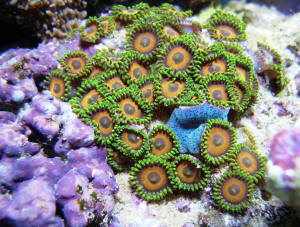

/Amphipods/amphipod_feeding_on_zoanthid.jpg)