|
FAQs on Controlling Cyano/Blue-Green Algae
17
Related FAQs: Control of Cyano/Blue-Green Algae 1,
Cyano Control 2, Cyano Control 3, Cyano
Control 4, Cyano Control 5,
Cyano Control 6, Cyano Control 7, Cyano Control 8, Cyano Control 9, Cyano Control 10, Cyano Control 11, BGA Control 12, BGA
Control 13, BGA Control 14,
BGA Control 15, BGA Control 16, BGA
Control 18, BGA Control 19,
BGA Control 20, & BGA Identification,
Algae Control, Marine Algicide Use, Nutrient Limitation, Marine Algae Eaters, Culturing Macro-Algae; Controlling: Red/Encrusting Algae, Green Algae, Brown/Diatom
Algae
Related Articles: Blue-Green
"Algae"/(Cyanobacteria), Algae Control, Marine Maintenance,
Nutrient Control and Export,
Marine Scavengers, Snails, Hermit
Crabs, Mithrax/Emerald
Green Crabs, Sea Urchins, Blennies, Algae
Filters, Ctenochaetus/Bristle Mouth
Tangs, Zebrasoma/Sailfin Tangs,
Skimmers, Skimmer Selection, Marine Algae, Coralline Algae, Green Algae, Brown
Algae, Diatoms, Brown Algae,
|
Cyan oh!
|
 |
New Print and
eBook on Amazon
Marine Aquarium Algae Control
by Robert (Bob) Fenner
|
Re: Cyanobacteria/BGA 3/26/09
Hello,
<Matthew.>
I'm still having Cyano outbreaks in my reef tank. Today I checked
Alk. and it was very low 5.8kH
Because it was so low, I'm thinking the Cyano had a chance to
colonize over the coralline within the tank. Even snail shells had
Cyano on them. I then checked my cal. reactor and realized the co2
input was too low and effluent was dripping too slow. Made changes and
hopefully with a more stable and higher kH (around 9.6-10kh) I will
avoid future Cyano. Does this theory sound right to you? Good algae vs.
bad and stability of parameters esp. kH values...??
<Instability in general does make it hard for the BGA's
competition to outcompete it. Having the KH constant is a definite step
towards overcoming.>
Thanks,
Matthew
<Welcome, Scott V.>
Re: Cyanobacteria/BGA 3/17/09
Hey Scott,
<Matthew.>
Apparently I may have discovered what has been causing areas of BGA in
my tank.
<Ahh, good.>
I thought this morning after diagnosing BGA, I'd give my tank a
little detritus cleanup... as I was siphoning underneath the back
layers of my live rocks, a rotting blue Linckia star stuck to my siphon
tube and I pulled its stinking rotting carcass out of there...
<A fueling force for sure...doubtful it is THE fueling factor
though.>
Being that this reddish algae is more of a "bacteria",
wouldn't it make sense that this stuff would appear from the
presence of a source of ammonia/rotting starfish?
<Yes, it does.>
I then added a bag of carbon, cleaned skimmer, replaced sock, did 10
gallon w/c. Hopefully the Cyano will go away in the next week or 2
right?
<With other proper practices it will diminish...don't expect it
to go away too fast. Generally the BGA will die off in good conditions,
re polluting the tank fueling more. It is best to keep up on the water
changes and siphon what you can of the BGA out.>
-Matthew
Re: Cyanobacteria/BGA 3/18/09
Which "other proper practices" might you be recommending in
preventing BGA?
<Proper feeding, maintenance, stocking and water flow.>
I forgot to mention I've been taking a powerhead and blowing off
detritus out of the holes/crevices around my reef to let the stuff go
to the overflows and be taken out from the sock. Furthermore I do not
have a sandbed in this tank, its a coralline bottom so detritus is at a
bare minimum within the tank. Tested phos between 0-0.1ppm &
Nitrate 0-2.5ppm
I had another small 1.5" red sea star die also about several weeks
ago which wasn't physically removed from the tank, which may also
have fueled the Cyano. That was a bad purchase of those starfish on my
behalf that day from the wholesaler, they were not in the healthiest
condition when I got them woops...
Now that there are no more rotting things in my tank I'm hoping
this Cyano goes away, I hate seeing bubbles & patches grow all over
my healthy purple rock. I got plenty of flow in there so that
shouldn't be an issue.
<Good.>
Its a little challenging to siphon this stuff off, it will not easily
come out, a tooth brush has been my best tool so far, but I guess the
Cyano is composed of toxins that physically need to come out directly
perhaps siphon if possible...
<Removing it is good practice.>
wouldn't the skimmer and filter sock remove remnants from
toothbrush removal?
<Yes, this is fine.>
-Matthew
<Scott V.>
Re: Cyanobacteria/BGA 3/26/09
Hey Scott,
<Matthew.>
I'm always finding something new...I overlooked my tank flow
situation. I've been using 2 Tunze streams and it occurred to me
that maybe the covers to the pumps were clogged and indeed they
were...this dramatically reduced the flow in my tank to almost half of
their capacity maybe less. After clearing them of algal clumps and
bubble algaes, the pumps were a lot more forceful moving much more
water. Because of this, the efficiency of my system is back to the way
it was and my skimmer is pulling much more stuff faster.
<Good.>
Probably THE reason for the gradual Cyano outbreak? more so than
calcium or kH issues....
<It is definitely a big factor. Without adequate flow detritus can
settle and basically rot in your tank rather than being pulled out by
the filtration system. You are well one your way here.>
-Matthew
Re: Cyanobacteria/BGA 3/30/09
Scott,
Despite fixing flow, performing 50% water change, power heading off
detritus and tooth brushing Cyano off, siphoning detritus from tank
bottom, cleaning skimmer, adding fresh PhosGuard to Phosban
reactor....still the stuff has not died out and continues to plague my
tank in certain areas.
<Hmmm, it will take some time.>
After talking with another fish service guy I know, he claims that
ChemiClean powder does the trick pretty good. You mentioned to me
before not to use Algicides and the manufacturer claims this isn't
an algaecide and that its reef safe, can be read on here:
http://www.marvelousproducts.com/Chemiclean-Red-Slime-Algae-Remover-p/chemiclean.htm
<It is not an algaecide...it is an antibiotic....>
What do you think about this? I have done great maintenance on my tank
as recommended and keep feeding down to a minimum. Still no luck and
maybe this is the answer?
<Nope, the start of a headache.>
I really have not discovered the true root cause of this continual
outbreak. Your thoughts on this appreciated.
-Matthew
<Do see WWM regarding what I and others have to say about the stuff
and it will all be clear. ScottV.>
Green Cyano -- 03/05/09
Hi,
<<Howdy JD>>
I brought about 50 pounds of live rock from a guy who was taking down
his salt water tank. The tank and rock was covered with what he called
green Cyano (it looked more yellow tan). When you picked up a rock and
moved it around some of this slime would come off. My question is, can
I do anything to this rock to clean it, treat it, to get rid of this
slime?
<<Likely, yes>>
I have it seating in a 32gal trash can with a heater and a power head
going in low light. Is there anything I can do to use this rock in my
show tank? Please advise.
Thanks,
JD
<<It will take a bit of effort, but you can salvage this rock.
Set up another trash can with fresh saltwater, a heater, and a
powerhead for circulation'¦then'¦using a smaller
container with more fresh saltwater, scrub and rinse the rock in the
small container and transfer to the fresh trash can. Once done, empty
the old trash can and remix new saltwater to cure for the next session.
After a few days, fill the smaller container with fresh saltwater again
and scrub/rinse the rock and transfer again to the 'fresh'
trash can of saltwater. Keep repeating this process every few days
(three or so) until the Cyanobacteria no longer manifests itself on the
rock between sessions (then give it another week in the trash can just
to be sure). Regards, EricR>>
Re: Green Cyano -- 03/07/09 Eric, <<Hello
Jeff>> One last couple of questions. <<Okay>> Can it
have any effect on the saltwater fish? <<It can (is
toxic)'¦though more often than not in my experience outbreaks
of Cyanobacteria are mainly just unsightly, or causing harm to sessile
invertebrates by covering/overgrowing rather causing problems with
fishes. At any rate it is best avoided'¦and introducing to
your system live rock which is infested/covered with Cyano is not
recommended>> What causes it and will it come back? <<It
can be fostered in a number of ways/by a number of factors (please read
here: http://www.wetwebmedia.com/bluegralgae.htm), and yes, given the
same favorable circumstances it will come back'¦time and
again>> Jeff <<EricR>>
Cyanobacteria (Red Slime algae) takeover, Sm. SW, reading --
02/28/09
Hi there. My tank is currently completely dominated by Cyanobacteria. I
have read the article about it on your site as well as others, and have
tried numerous measures to no avail (water changes, siphoning, feeding
less, no additives, etc.). I do not have any powerheads but have a
Koralia Nano fan that turns over 240gph (I've got a 15 gal. tank.)
Also, I do not have a protein skimmer; I only have a hang-on Aqueon 30
powerfilter. Would adding a powerhead or two make any major
difference
<No>
or do I need to invest in a protein skimmer?
<This latter...>
I have been reluctant to do so because most are so expensive and I have
only a 15gal set-up. What is my best option for knocking this stuff
out?
-Nick
<More reading evidently: http://wetwebmedia.com/bluegralgae.htm
and the linked files above. You have some other options you don't
mention
awareness of. Bob Fenner>
Salt Mix and Cyano/BGA -- 02/11/09
Hello Crew,
<<Hiya Mark>>
Love the site and use it often.
<<Me too!>>
I've been battling BGA in my 90 gal reef for about 4-6 months
now.
<<Not atypical mate'¦once entrenched it is very
difficult to eradicate>>
Tank was setup in April of 2008. I've written to you previously
about this and got some good advice.
<<Ah'¦good>>
After increasing the light over my refugium the Chaeto in my sump
finally started growing and the BGA subsided.
<<Excellent>>
In December I thought I had this stuff beat. I had also removed my
larger sized Aragonite and replaced it with the sugar fine sand.
<<Another good move'¦but do you also have lots of
vigorous water flow to help keep detritus in suspension?>>
I make my own RODI water, and do 10 gal changes every week.
<<Hmm'¦ I might consider increasing the time betwixt
changes (say 10% every two weeks or even 20% every month) to see if
unfinished chemical processes, or introduction of fuels/pollutants from
the salt mix, isn't causing the problem>>
Auto top-off is buffered RODI water. Tests 0 TDS. Well it subsided for
a while and is now back. I haven't changed anything other than
adding a few small coral frags which are doing well. I don't feel
like I'm overfeeding, none of the fish food ever hits the bottom,
and I feed my corals only once per week, less than an 1/8 tsp of Coral
Frenzy. I have a small Hammer & Torch, small frag of Zoanthids,
small frag of Blastomussa wellsi, an orange plate coral, and a couple
of Hawaiian Feather Dusters. All fish and corals are doing just fine.
Water Chemistry is just fine, I'm not registering any Nitrates
because it's bound up in the Chaeto and BGA,
<<Indeed'¦as is any Phosphate>>
Ammonia Nitrite, zeros. No measurable Phosphate. I do not have a
Magnesium test kit.
<<Get one (Seachem)'¦ Ensuring optimum water parameters
for your corals health/vitality/growth will help with battling the
BGA>>
Calcium 425, dKH 9, pH over 8 and steady. System set up in late April
2008: Tank: 90 gal acrylic, with 1 center overflow. I modified the
standard drain and increased it to 1.5" and made a stand-pipe for
noise reduction.
<<Ah!... Very good>>
Approx. 60-70 lbs of Live Rock, and less than an inch of aragonite
substrate, sugar fine.
<<Okay>>
Filtration: I built a 3 compartment acrylic sump, with dimensions of
30"x18"x18". Total volume of the sump under operation is
about 20 gal. A 6 gal Inlet area holds an AquaC EV-120 running on a Mag
5, produces well.
<<Indeed'¦a very good skimmer'¦and a great
company with excellent customer service>>
The 6 gal center compartment is for return via a MAG 7, and the 8 gal
right compartment serves as a refugium that over flows back to the
center for return. The tank drain is split off with most of the raw
water going to the Skimmer, and flow to the refugium is controlled with
a gate-valve. I have over 4" of aragonite (1-2mm size) in the
refugium along with a clump of Chaetomorpha. I'm running a bag of
carbon in the sump return area, as well as Seachem PhosGuard.
<<I'm a huge fan of Seachem's products'¦but for
this one (Aluminum is known to be harmful to corals/inverts). I suggest
you switch from this Aluminum/Alumina based Phosphate remover to an
Iron-based product'¦and utilize a fluidized reactor
re>>
There is no "filter media" in this system. None of the pumps
has the foam suction filter on it. The only Mechanical filtration is
the skimmer.
<<I see>>
Lighting:
Tank has (2) 150W 10K Coralife Metal Halide Fixtures (new bulbs in
October 08) and 2x55 watt PC Actinics for looks. Metal halides are on
for about 10 hrs, Actinics come on in the morning, go off, and come on
again in the evening.
<<Sounds fine>>
The question I have regards my salt mix.
<<Ahh'¦.>>
I use Reef Crystals and I just looked at the description of it on a web
site: "Formulated for reef aquarists. The first salt mix to
contain an extra measure of calcium, selected trace elements, and
vitamins to assure extended availability of substances that are
depleted very quickly in thriving reef aquariums. Also helps detoxify
harmful copper and other heavy metals often found in domestic water
supplies."
I noticed that the last time I did a water change after removing as
much BGA as I could by hand, that the BGA returned more quickly than
when it does if I don't do a water change and just remove the
BGA.
<<Mmm'¦>>
The description says something about vitamins. Was wondering if this
could be fueling the BGA?
<<Could be I suppose'¦ I too experienced a like incident
with this salt mix. In fact, I have a problem with Aquarium Systems
salt products altogether. I used Instant Ocean for more than 30 years
until the company went through an owner/management change which then
coincided with me receiving multiple batches of bad salt mix for months
(everything from not-before-seen inconsistencies in Alk and Calcium
levels between orders, to buckets coming to me as SOLID BLOCKS). This
went on for almost a year'¦it pained me to do so, but I have
moved on to another salt mix as a result>>
I also removed some of my LR and rinsed it in tank water during the
last change. Grasping at straws here?
<<Perhaps not>>
Should I look at another salt mix like Tropic Marin?
<<I LOVE Tropic Marin'¦but dang is it expensive! You
won't go wrong if you choose do so'¦but also have a look
at the excellent offerings from Seachem (is what I now use)>>
I don't want to spend more money on salt if it's not going to
help.
<<Understood'¦ But I do consider the Seachem salts to be
superior over what you are using now>>
This junk covers my substrate about every 3 days with a very thin film,
and is getting into my LR now.
<<I do think changing salt mixes is worth a try>>
Thanks,
Mark
<<Happy to share. EricR>>
Re: Salt Mix and Cyano/BGA - 02/12/09
Thanks EricR,
<<Welcome Mark>>
I forgot to mention that I also drilled the tank for a closed-loop.
<<Excellent>>
I have a MAG 18 running a loop around the top, with 4 outlets,
1/2" each.
<<Ah! Super>>
I'd say I have decent circulation in the tank, but it's not
excessive.
<<Okay>>
As far as testing for magnesium levels, I've read that as long as
you use a quality salt mix and do regular water changes that it should
the magnesium levels should remain in a good ratio with the
calcium.
<<Indeed, all things being perfect'¦but these small bits
of captive ocean we strive to keep are usually anything but. I by no
means want to dissuade you or anyone else from doing frequent partial
water changes as I think this IS the single best maintenance practice.
And it's very possible you are correct in your assumption re the
Magnesium levels'¦ But when things go awry'¦as has
happened with your Cyano outbreak'¦it's best to check/know
for certain what your water parameters truly are>>
Knowing what it is would be better, so I'll get a test kit.
<<Very good>>
I'll try cutting back on water changes and see what happens.
<<And just to be clear'¦ Not 'cut back' in the
literal sense, but rather try slightly larger volume changes a bit
further apart in frequency>>
I'll also get a bucket of Seachem Reef Salt and see what
happens.
<<Is good stuff>>
I haven't really noticed any inconsistency in the Reef Crystals,
and I pre-mix my salt immediately after a water change in prep for the
next one.
<<Ah good'¦ It is important to give the newly mixed
solution some time to 'mature'>>
I have a 29 gal tank in the closet next to the display with pre-mixed
salt water, and I use valves to pump the new water back through my
closed-loop during water changes.
<<Neat>>
The dKH and Calcium seem to be consistent from batch to batch and
bucket to bucket.
<<Perhaps Reef Crystals has remained more
consistent'¦though there is still the suspicion of something
feeding/fueling the BGA. Allowing the water more time to mature may
help if this is the case. And you might even consider adding a small
amount of tank water to the mixing container a few days after mixing a
new batch, to introduce microbes that might possibly reduce/consume any
'problematic' elements>>
Thanks again, I'll keep trying.
Mark Gustin
<<Happy to assist. Eric Russell>>
R2: Salt Mix and Cyano/BGA - 03/06/09 Hey crew.
<<Hiya Mark>> I'm following up on my BGA problem, which
EricR was helping with. <<Ah yes, I do recall>> I included
all previous correspondence below. <<Always helpful. Thank
you>> I've made the following changes since my last e-mail on
Feb 12. 1.) Removed Seachem PhosGuard from the sump and replaced with
carbon. Now I have two bags of carbon in the sump. 2.) Rinsed &
brushed some of the LR in tank water to remove detritus. 3.) Changed LR
structure to allow more circulation through and behind the LR. 4.) Used
a power head to blow off LR that I could not remove. 5.) Increased the
amount of buffer added to my RODI top-off water. 6.) Reduced water
changes to one 10-15 gal change per week. <<All good
strategies>> I still have the BGA but it's not as prolific as
it was. <<Can be slow? very slow? to conquer/eradicate a heavy
infestation (and I speak from experience)>> It is definitely
retreating again and has changed from an olive green/tan color to a
more yellowish rust color. <<Comes in many colors/strains?
perhaps this is an indication you are indeed making changes to the
environment that are ?less favorable? to the Cyano>> It also
isn't growing as much on the LR as it was. Most of it is on the
sand now in the front of the tank. Ironically, this is the higher flow
area, go figure? <<Hmm? Is this covering on the sand still in
?sheets??slimy to the touch? Considering the fore mentioned color
change, could the Cyano be gone and what you now see is
Diatoms?>> I have not switched salt brands from Reef Crystals to
Seachem yet, as I don't seem to be having any chemistry issues, and
I still have half a bucket of the Reef Crystals. <<Okay>>
As you suggested, I bought a Salifert Magnesium test kit (almost $50)
and my Mg measures 1470 with calcium at 425. Low Mg doesn't seem to
be a contributing issue to the BGA, would you agree?
<<Yes>> I know it's hard to answer this question. What
dKH should my top off water be as a rule of thumb? <<Generally,
about that of NSW (8 ? 12) or slightly above>> It seems as though
I have to buffer it to a fairly high value (above 12) to keep the tank
above 8. <<Mmm, then I suggest another form of
supplementation>> The tank probably uses about 1/2 gal per day of
top off water. It will increase to about 1 gal per day in a few months
when summer hits. Yet at times it wants to slip below 8 in the display
if I don't supplement it occasionally directly in the tank.
<<If you are looking for something more automated it may be time
to consider the addition of a Calcium Reactor? and/or the addition of a
Kalkwasser Reactor to your top-off system>> Either way, my dKH is
more stable than it was before I increased the buffer in the top-off.
<<You could also experiment more with this I think>>
Hopefully I've reached a tipping point with the BGA. <<My
fingers are crossed>> I've let the Chaeto grow in my refugium
to the point where it's filling about half the space. <<Ah
yes? more mass>> I'm afraid if I harvest some of it, the BGA
may regain strength. <<As long as there is space and the ball is
healthy you can continue to let it grow. This Macroalgae does tend to
grow in a very ?tight? configuration? Try spreading the mass apart a
bit to increase light to the interior (be mindful of
Bristleworms!)>> I also need to keep an eye on Phosphate levels
since I removed the PhosGuard. Will the Chaeto control Phosphate
levels? <<It will help? If Phosphate accumulation is a concern
then look in to one of the iron-based removers. Likely a surprisingly
small amount in a suitable reactor will suffice>> Any idea why
the BGA is now retreating with only the little adjustments made above?
<<You have affected a shift in balance away from whatever was
favoring the Cyano (perhaps a result of just one item you listed? or
the accumulated effect of all)?often it can be ?just the little
things?>> Thanks for the suggestions. I'm going to beat this
junk! I hate to lose! <<I wish you continued success!>>
Mark <<EricR>>
R3: Salt Mix and Cyano/BGA - 03/07/09 EricR
<<Mark>> Thanks for your input. <<Always
welcome>> I'm fairly confident it's still BGA, not
Diatoms. <<You're in the best position to tell>> Is
still slimy, easily pulled off the substrate in "sheets"
although reducing in size right now. <<Ah, okay>> I still
have some very small patches of the red junk too. I'm not up to
speed on the Calcium/Kalk Reactors. Have seen them, but haven't
educated myself on their application yet. <<Easy enough to
do'¦much info here, on the NET in general>> I hesitate
to add anything requiring another pump in my sump, due to temp
concerns. <<These units can be 'gravity' fed from the
tank, and then allowed to gravity drain to the sump'¦though
there is a small pump on the reactor to circulate water within. The
better units (in my opinion) utilize small Eheim pumps for this purpose
which aside from being extremely reliable offer very little (if any)
heat transfer>> In the summer my tank temp is in the 80-82 range
without a heater. During the winter it runs in the 78-80 range with the
heater coming on overnight to maintain. With M.H. lighting and 3 Mag
drives, I have enough heat. <<I do understand and share the same
issues as you on this. A couple things you can do to help (of which you
are probably already aware) is to add fans over both the sump and the
main display for some evaporative
cooling'¦and'¦switch out the warm running Mag-Drives
for a cooler running pump. I run a large in sump skimmer (ER CS12-3)
which I upgraded with Eheim pumps, as well as doing the same with two
sump return pumps'¦with these changes in pump type I realized
about a 2-degree drop in water temperature>> My cabinet is full
underneath as well, but I may be able to reconfigure to gain a little
more space for a reactor. I haven't used Kalk in my top off due to
the damage it can do to the little pump. <<Indeed'¦and I
don't recommend adding Kalkwasser powder to your top-off water
vessel>> Tunze didn't really recommend it for use in such a
caustic environment although I know people do it. They have to replace
their pumps annually from what I've read. <<Agreed'¦
These little pumps are short-lived enough as is, I would not use one in
a container with Kalkwasser. I use a Tunze Osmolator for top-off
(superb devices)'¦but have an in-line Kalkwasser reactor
through which the top-off water feeds on its way to my refugium>>
I use Seachem products for buffer and calcium.
<<Excellent'¦this is my fave company for such>> I
use the Reef Builder and Reef Buffer, as well as Reef Complete. Should
I consider something different? <<Nah'¦ The issue is not
the quality of the product (you won't go wrong using Seachem), but
rather I think it is that your tank/its inhabitants are consuming
bio-minerals faster than they are coming in. In other words, it's a
matter of finding the easiest methods and/or needed dosages to keep up
with consumption>> I only have to add calcium about once per
month. I use the buffer and builder in my top off. <<How you go
about it is much less important than ensuring you maintain a
'balance' to your water chemistry. Research the different
options and choose that which works best for you'¦and feel
free to come back and discuss>> Thanks again, Mark <<Happy
to share'¦ Eric Russell>>
|
Brown Stuff? More BGA 2/7/09
Hey guys,
<Don't forget the gals! Hello Josh.>
I am running a newly setup 90 gal salt tank with a DSB of about 4
inches of sugar fine sand. I have a BioWheel filter with just a
filter pad and a Poly A filter as well as a Remora hang-on
skimmer which pulls about a cup of stuff a day.
<Good.>
I recently upgraded from my 20 gal tank which I had running for
several years, and transferred the rock, fish and corals. In my
20 gal, I began to have this brown algae grow all over my rocks
and substrate very rapidly. I checked salinity, pH, nitrates,
nitrites and phosphorus levels and my salinity was perfectly
even, my pH 8.3 and all my NO3, NO4 and Phos. all were at zero,
but I could not get rid of the stuff. I siphoned daily and even
did a 80% water change twice but it didn't stop it at all. I
looked online and thought it might by Cyanobacteria <It
is.> so I bought some meds from my LFS that I trust
completely, and they had a similar problem that this product
fixed. Well, it did nothing.
<Despite the good reports sometimes heard, these treatments
really are a bad idea. See:
http://www.wetwebmedia.com/maralgcidefaqs.htm>
Out of desperation, I bleached out the whole tank except one rock
which had a coral on it, and rebuilt it from scratch. Being only
a 20 gal, it wasn't a big deal except loosing all my inverts
:(.
<'¦>
But it didn't really come back after that. Now that I have
started a new tank and moved all my stuff except substrate over,
it is back with a vengeance! I bought 7 pounds of Grunge from
GARF (highly debatable as far as live goes, but I figured rubble
would still come in handy) and I checked all of my levels, and
they are still at zero two days later.
<Being consumed as produced'¦a level of zero is
misleading.>
My sand sifting star is eating the brown junk but it comes back
within about 6-12 hours.
<In a 20? Please see
http://www.wetwebmedia.com/sndsftstrsysf.htm>
Help!!! What can I do to get my nice white sand back?
<So many factors: water flow, feeding, lighting, stocking,
source water, maintenance practices, additives'¦.the
list goes on and on. The best thing you can do is arm yourself
with the knowledge. See
http://www.wetwebmedia.com/bluegralgae.htm
and the linked files above and you will see all you will ever
need to know on the issue.>
I know that a new tank will probably have an algae outbreak, but
this I don't think is usual if it IS algae.
<Not technically, but the treatment, fueling sources are the
same.>
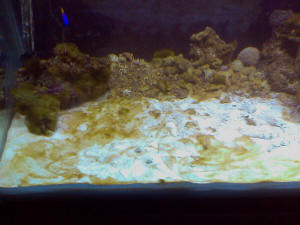
(Enclosed are some pics which show it, I'm sorry I know they
are large files, how do I save them as small for you?)
<Your files sizes are fine actually.>
Up close as the mat gets thicker it begins to conglomerate and
form dark lines...
Also, I decided to buy a sea cucumber (Holothuria leucospilota)
and take a chance, it even though I've moved it a couple
times, it hasn't eviscerated yet...yea. But it never comes
out to feed, even a couple hours after lights out. Any
suggestions?
<See http://www.wetwebmedia.com/cukefdgfaqs.htm, but the Cuke
will not work out long term in this new and small a
system.>
If I pull it out of the rocks, it does feed for a half hour or so
before it climbs back under a rock, but that's it... I just
want to make sure I'm caring for it the best I can.
<Read, do careful research, ideally before purchase.>
I appreciate you guys,
Josh
<Welcome, Scott V.>
|
 |
|
Re: Brown Stuff? More BGA
2/8/09
Thank you for the quick reply. Actually the problem tank is a 90
gal.
<I see this now, sorry for the mix-up.>
And for flow I am running two powerheads..I don't remember
the name but it is fairly strong and they point right at each
other at a crosswise angle to create a random current and is just
shy of moving the sand. I am running T5 lighting and I feed small
amounts of frozen mysis thawed in fresh water and then filtered
thru a coffee filter and paper towels. the only additive I am
using is calcium. My water supply is from a local dealer and I
check his levels with their pc once a month and its always near
zero if not zero.
<Should just be zero for what is of concern with newly
purchased water.>
I can't figure out where the excess nutrients are from and I
only have a small clown, royal gramma, sand star and the
cucumber..if I continue these practices should it die out? Thank
you!
<It is a phase that many new systems go through...keep up on
your water changes and give it time. Maybe also consider some
live rock or a refugium, both help immensely with marine systems.
I have no crystal ball or magical answer.>
Josh
<Scott V.>
|
Cyano? 1/26/09 Hello - <Andy.> I have some
Cyano (not quite overwhelming yet but very annoying) in my 150 gallon
tank of 3 months with 210 of live rock. I have been doing 20% water
changes for the last 3 weeks including vacuuming the gravel. The funny
part is that the Cyano is only one of my overflows and on the
substrate, on a couple of rocks, and is now starting to grow in the
sump (i.e.. filter sock, pump cord, macro, etc). I am using a 4 stage
Kent RO/DI filter, too. I have added 2 Hydor 4 PHs, changing out filter
socks, placed Polyfilter in my skimmer discharge, and feeding only
1x/day, including not feeding at all every 3rd or 4th day. I am also
employing an Aqua C EV-180 and getting some dark stuff out and cleaning
it out 2x/day (a little OC, but I don't want it to drip back in the
sump). I have also added some Chaeto in the fuge area to compete with
the micro. The top of the Chaeto is now getting the
"burgundy" Cyano on it. <Hmmm, maybe a small powerhead in
the refugium to keep the algae moving a bit.> Why does it still
exist? <The fueling factors are still there, not uncommon in a
system this age.> I am utilizing quite a few algae grazers, too.
<Little to no value with BGA.> I have recently decreased the
lighting (~ 500W of T5, 6 bulbs) to only 8 hrs/day instead of 10
hrs/day. I have also decreased my PC refugium lighting by 1 hr to only
9 hrs/day. Ammonia = 0; Nitrites = 0; Nitrates= 0; Ph = 8.2; Alk = 4
mEq/L; Phosphates = .05 on API, and 0 on Elos test kits. Salinity =
1.026 and temp is ~ 79. Fish include 1" - 2" of the
following: 1) Yellow Coris 2) Cherub Angel 3) Yellow Tail Damsel 4)
Midas Blenny 5) Ember Blenny 6) Randal Goby 7) Chromis 8) Diadema 9)
Purple serpent starfish 10) Clean up crew (snails, hermits, etc.) The
only thing left is maybe run some carbon in addition to the poly.
<Will have no effect on your issue.> I am feeding more Mysis than
Spectrum pellets now to try to reduce the Phosphates. <Be sure to
thaw, drain the liquid off. This can make a big difference.> Thanks,
Andy <At three months in some BGA is not uncommon. Keep up good
husbandry practices and give it time, siphoning off what you can with
the water changes. Steady course, you can beat this. It sounds like you
have educated yourself on the issue, but just in case check out
http://www.wetwebmedia.com/bluegralgae.htmand the linked files above.
Welcome, Scott V.>
Re: Cyano? 1/27/09 When I feed the frozen cubes, I
put one cube in a cup filled with aquarium water. Then I dump the
entire cup with Mysis in for feeding. Is this the wrong method? <Not
wrong per se, some argue the benefit of the juices too. The juices can
be a source of algae fuel. I have found that when frozen foods are used
frequently draining the food first can have a large impact.> Are you
saying I should thaw the frozen cube by itself in a cup (this could
take longer than in 80 degree water) and then drain the juice and just
feed the solid part? <Or even just thaw it in just a bit of aquarium
water/RO water, then drain the whole thing off.> Thanks, Andy
<Welcome, Scott V.>
Re: Cyano? 1/27/09
Thanks Scott. I will strain the juices first. So you think this is just
a phase because my aquarium is only ~ 3 months old and that with good
husbandry it will go subside.
<The age is a factor. Newer tanks tend to be unstable, lending to
BGA outbreaks.>
How exactly will the algae get eradicated? Will more beneficial
bacteria build up in my system over time and cause the BGA to diminish?
Or my macro will kick in and start competing with the BGA's food
source?
<Competition, stability, true rock curing/cycling, all of these play
factors here. In the end you deprive the BGA of what it needs to
survive, the environment it better suited to desirable growth.>
Thanks,
Andy
<Welcome, Scott V.>
BGA 1/19/09
Hi crew,
<Marc.>
I was hoping you could help me a problem I'm having with Cyano.
Also, if you could just give me an opinion on my overall tank care.
<Sure.>
I have a 75 gallon tank. For equipment I have a Remora Pro, an Emperor
400 running with just charcoal, 220 watts of t5 lighting ( two 18k
bulbs, one 10k and one 6500), two Hydor stage 4s, one Hydor stage 3, a
Maxijet 1200, and a stealth heater.
I have 80lbs of live rock, and about an 1.5 of live sand.
<Sounds fine so far.>
For live stock I have a Yellow Tang, Lawnmower Blenny, three Green
Chromis, two Lyretail Anthias, Chalk Bass, Sixline Wrasse, Feather
Duster, some Blue Legged Hermit Crabs, and Red Legged Hermit Crabs (not
many of either anymore, not replacing), assorted snails, a red
starfish, Sally Lightfoot and a Serpent Starfish.
For soft corals, I have a Toadstool, a Finger Leather, a Kenyan Tree
Coral, Daisy Polyps, a Cauliflower Coral and assorted Mushrooms.
I do about a 20% water change once a week with tap water and reef
crystals. I use an Iodine supplement once a week.
<You likely do not need this with a 20% weekly water change, do you
test for this?>
I also clean the pre filter to the Remora Pro twice a week.
My water parameters are at ph 8.2, salinity 1.25, temp 76, dKH 11, cal
420- 430 and nitrates under 1, close to 0.
I feed my fish a half a cube of frozen food twice a day. I rotate
between Formula One, Formula Two and Mysis Shrimp.
<Do be sure to thaw these and drain the liquid, this can be a
contributing source to your problem.>
About three weeks ago I started getting some red Cyano and green hair
algae. That's when I actually hooked up the Emperor 400, I started
upping the water change to 30%, I've been scrapping the Cyano off
the rocks and the sand. I also stopped adding zooplankton, I read
bottled invert food can contribute to Cyano.
<It can, pollution in a bottle if not careful.>
It was getting a lot better this week, than I came home tonight and
there was Cyano on the glass, and on the sand and predominately on one
rock. It was the first rock I noticed the Cyano on three weeks ago. So
I rubbed it off the sand and glass, then I took the rock out of the
tank and cleaned it all off.
Any other suggestions on how I could control this, and get rid of
this.
<Do modify your feeding as listed above. Also from the info given,
check your source water. It is entirely possible to be actually
introducing the BGA fueling nutrients into your system with the water
changes. Keep in mind that tap water can and will easily change in
composition throughout different periods of the year with rain runoff,
where it comes from, etc. Otherwise do read through
http://www.wetwebmedia.com/bluegralgae.htm and the linked files above
for more information.>
Also, is there anything that will eat the hair algae or Cyano?
<Not reliably, no.>
Any suggestions would be much appreciated.
Thanks,
Marc
<Welcome, Scott V.>
Re: BGA 1/21/09 Thanks for the help.
<Welcome.> Do you think using Prime water conditioner to treat my
tap water would help? <No, this may not even be your problem, just a
possibility. You need to actually test your tap water and see for
yourself.> Do you think the foods I use are sufficient, or is there
something else I should also be using? <There is nothing wrong with
frozen foods. I personally prefer Spectrum pellets for everyday
feeding, with frozen foods as "treats". It is just
easier!> And one last question, I leave my lights on for 13 hours a
day, does these seem like an acceptable length of time? <A little on
the long side, but acceptable. Ideally the photoperiod should mimic
that of where the corals originate. Generally accepted as 12 hours, but
do keep in mind that this includes twilight and dawn in that time
period.> Thanks again, I have done hours and hours of reading
through your FAQs, it's just some of this seems to be a matter of
opinion. <Many are in this hobby.> Marc <Welcome, Scott
V.>
Re: BGA 1/25/09
Thanks again for the help,
<Welcome.>
It seems to be getting worse. I am confident that it's my source
water.
<Easy enough to treat.>
My question is, as far as maintenance to get rid of it, is it ok to
just wipe it off all the rocks when I'm doing the water change, or
do you think that will only spread it?
<You can, usually it is best to just siphon off what Cyano you can
while doing the water change.>
Also, for my size tank, do you think it would be more beneficial to use
a hang on refugium, or the run charcoal?
<I am always an advocate for a refugium of any sort! Carbon is nice,
but a refugium will help you out with your issue and provide many other
benefits.>
Thanks,
Marc
<Welcome, Scott V.>
Re: BGA 1/26/09 I'm sorry for the back and
forth. I'm just curious about your comment of the source water
being an easy fix. Were you referring to using ro water, or something
else? <There are a few choices. Deionization units, buying water at
your LFS or grocery store. But having your own RO unit is usually far
easier, and cheaper in the long run.> By the way, when I got home
tonight, it looked a lot better, all I did was wipe if off last night.
If I take care of the issue causing the Cyano, will it go away itself?
<If the fueling factors are taken away it will die off in time. The
next problem is the dying off causes more pollution in your tank. That
is why siphoning out what you can is so beneficial.> Marc <Scott
V.>
Cyano, Algicides admonition 1/13/09
Hi Crew,
I have been battling red slime for a few months and made a lot of
progress but could not get it completely. It was contained in a few
spots that I would siphon. Every once in a while it would flare up and
I would have a real clean up to do. So I decided to try a product
despite the problems people have reported. UltraLife Red Slime
Control.
<Hmmm'¦.>
My tank is just a 10 gallon and I have Candycanes and some fish.
Instructions were to use one measure of the enclosed dispenser ( one
flat teaspoon full) for 15 gallons. I figure I have about 8 gallons so
I used half of that. I pre mixed it with tank water until completely
dissolved as instructed. And it did get rid of it. My tank always had a
reddish hue to it and now it actually looks very clean. The fish did
not seem to mind the treatment. I have a few snails and I did not
notice any adverse affects. The corals did not like it. It was nothing
major but I rarely see them with open mouths, usually just a few.
<I have seen this, a friend just wiped out his reef recently using a
similar antibiotic product.>
But during the treatment they were all open. I left it this way for 2
days. Then I put carbon back in my filter and did some water
changes and so far, after a week, all seems well and it has not
returned (yet).
<It will unless the fueling factor is addressed. These treatments
are a temporary fix and a poison to filtration. The tank inhabitants
are threatened initially by oxygen deprivation, followed by a hit to
the biofiltration. See the links below for more re this and the
BGA.>
Thanks,
Sam
<Welcome, Scott V.>
http://www.wetwebmedia.com/maralgcidefaqs.htm
http://www.wetwebmedia.com/bluegralgae.htm
Cyano Control 1/13/09
Hello Crew:
<Tom>
As Always I must say Great Site! Tons of information which I read
daily and then some.
<Great!>
My tank is a 3-1/2 year old 46 gallon bow with the following:
1-2" crushed coral (which I plan to create DSB 4-6" I have
the sugar sized sand but lack the confidence to create without killing
my tank family)
<Ah, just add a bit at a time over a couple of weeks and you will be
fine.>
50+ lbs of LR
Fluval 404 - took all components out and added Chemi-pure Elite and
charcoal
<Redundant, save yourself some cash and use one or the
other.>
Aqua C Roma w/Maxijet 1200 and drain hose (upgraded about 2 months ago
from Prizm)
<Good move!>
2 power heads for water movement
Coralife 36" compact fluorescent dual 96w (1-daylight,
1-Actinic)
Readings:
SG - 1.023
Phos 0-0.25 (color chart)
Cal - 300
KH - 7
PH - 8.2
Ammonia - 0
Nitrite - 0
Nitrate -10
Temp - 80 F
2 false clowns - had almost 3 years
Yellow Tan
g - 1-1/2 years
2 cleaner shrimp - 6 months
Several various hermits
Several various snails
Frogs spawn - 2 years (had 2 heads and now has 4)
Yellow Polyp - 1-1/2 years
Green Polyp - 2 years
Several Mushrooms - 2-1/2 years
1 Ricordea - 2-1/2 years
1 leather - 1 year
2 nice size pieces of candy cane - 1 year
I believe my tank has a Cyano problem. The back of my tank ended
up covered with dark maroon color algae which I scraped off like wall
paper. But it also covered much of my LR. How do I clean
the LR?
<Best to just scrub in the tank a bit, siphon off what you can with
water changes. Treating the cause is the real cure.>
Can I remove some LR to open up the tank a bit?
<You can.>
Should I be doing something different or in addition in order to remove
the Fluval 404 canister?
<Start here: http://www.wetwebmedia.com/bluegralgae.htm
Continuing through all the linked files above will tell you more than
you ever wish to know about your problem!>
Thanks,
Tom
<Welcome, Scott V.>
Re: Cyano Control 1/14/09
Hello Scott:
Thank you for the information.
<Happy to help out Tom.>
I will keep reading WWM & learning.
Do you think at some point I would remove my Fluval 404 completely and
relay on my LR & skimmer?
<I would, it is of little benefit with your other filtration in
place while just providing a possible detritus trap and extra
maintenance.>
Thanks,
Tom
<Welcome, Scott V.>
Re: Cyano Control... and Scler. hlth.
01/19/09
Hello Scott:
I seem to have a possible problem with my Candy Cane & Frogs Spawn
coals.
The Candy Cane always seemed to have plump looking heads and all of a
sudden they appear hard for at least a week. The Frogs Spawn for about
2 weeks has not been fully out the tentacles are very close to the
skeleton.
I kept thinking that they were disrupted yet its been a while. Water
has not changed as listed in earlier email.
<Hmm... I don't know, but it could be a reaction to the
Cyano.>
Not sure what's going on.
<When in doubt, do a water change.>
Regards,
Tom
<Best,
Sara M.>
Re: Cyano Control 01/19/09
Hello Sara:
Thanks for the response. That's exactly what I did tonight and will
keep doing them. Another thing I noticed is that my snails are not
acting right. Astraea & Margarita snails seem to have slowed down
and appear to be having trouble moving and some are extended. Another
thing I had been doing often was blowing off the LR with a turkey
baster and doing the same to the 1-2" crushed coral on the bottom
stirring it up. The reason I was doing that was to allow the protein
skimmer to clean the water. Is that ok?
<Yes, this is even recommended. However, if your tank is not
"used to" it, you might have stirred up too much too fast.
Again, the only really remedy for this is more water changes...>
Regards,
Tom
<Best,
Sara M.>
Re: Cyano Control 02/10/09
Hello:
I have been doing the water changes once a week & sometimes twice a
week (5-10 gallons). My corals are still shrinking I believe I lost my
2 pieces of candy cane since they are turning white and my frogs spawn
appears to be
still alive but has not extended out of its skeleton. I can see the
movement of soft tissue on the top of the buds and never extends. My
mushrooms are tiny and my Ricordeas shrinking. I continue to do water
changes and not add anything other then flake for the fish. I am not
sure what to do. All my snails are dead and only 2 hermits are
left.
My water readings are:
SG - 1.023
<You might want to raise your salinity to closer to 1.025 to
1.026.>
Phos -0.25
<a bad sign>
KH - 9
PH - 8.21
Ammonia - 0
Nitrite - 0
Nitrate -10
<not good>
Temp - 80 F
Cal - 300
46 Gallon Bow tank
Aqua C Roma w/Maxijet 1200 and drain hose (upgraded about 3 months ago
from Prizm)
2 power heads for water movement
Coralife 36" compact fluorescent dual 96w (1-daylight,
1-Actinic)
I still have Cyano on my LR and not sure if I should be scrubbing
it?
Before all this starting happening I was feeding my corals (or so I
thought) liquid PhytoPlex & ZooPlex
<I wouldn't recommend these... not that they do any harm, but I
don't think they help anything much either.>
about a tablespoon of each 2 or 3 times per week. And since then I have
read on WWM that could be a fuel source for Cyano. Still can't
figure out what might have caused my coral problem? The water source is
from a well
use DI (single cartridge) system and for the last 3 weeks have been
using RI/RO with a 4 stage unit. The tank is 3 + years old. Should I
start all over?
<I'm sorry, I don't recall what you have for filtration. Do
you have a good protein skimmer? Have you tried using activated carbon
filtration?
...and/or any chemical filtration (phosphate sponges and
such?).>
Tom
<Best,
Sara M.>
UV Filtration, and algae control f's 1/9/09
Hi all,
<Hello>
I've got a 60 gallon marine tank - not sure the terminology for my
tank design, but basically the 60 gallon tank itself is subdivided into
two sections - one for the marine life and the other which is an
enclosed ~15 gallon part full of bio balls and a wet-dry filter.
<Often referred to as all-in-ones.>
The water circulates into this chamber and then is pumped back to the
main part of the tank - but it is all enclosed in the 60 gallon acrylic
tank.
I've got a huge algae and Cyanobacteria problem thanks to a lunare
wrasse that has destroyed all of my cleanup crew.
<Actually large algae problems are indications of more problems than
just a missing clean-up crew. What are you phosphate and nitrate
levels? Do you have a skimmer? Is it producing good skimmate? How often
do you do water changes and what other livestock do you have.>
Despite that, we are trying to avoid parting with our little
pain-in-the-wrasse because he is one of the more entertaining fish that
we have.
<Topping out around 10 inches, the Thalassoma lunare will need a
larger tank as it grows.>
We are hoping that an UV sterilizer would help us with this - but all
the sterilizers I see use an additional pump to force water through a
small chamber that contains the UV light.
<Yes, is standard setup. However I do not believe a UV will help you
much with algae control. It does not do anything for most algaes since
they never pass through the filter.>
We already have this tank design that effectively cuts down our tank
capacity with this back chamber full of bio balls - so is it possible
to just set up a bare UV light inside of that chamber?
<No, not safe, recommended, or effective.>
It is completely enclosed from the rest of the tank with black plastic
- so no light should penetrate to the main tank.
<I would be more worried about it damaging your own eyes than the
tank, these bulbs and do serious and permanent damage to your eyesight.
Also the intense UV light would most likely negatively effect the
plastic or the filters.>
If there is something more to the filter than just the light, I suppose
this would not work?
<Would not, beyond the safety concerns these filters need specific
flow rates to work, which would not be able to be controlled without a
dedicated pump.>
Apologies if this is somewhere in the FAQ - I could not find it,
<No problem.>
presumably because I don't know the name of my particular tank
setup.
In general, is this tank setup reasonable?
<Not really, UVs need pretty specific conditions to be safe and
effective.>
It was a hand-me-down, and perhaps that is why...but despite the fact
that we lose a good amount of our tank capacity, it is a pretty simple
design and easy for a newbie like me to maintain...
Thanks very much for the help!
Glenn
<Unfortunately tank setups like you have are fairly limited in what
they can do, especially within an marine environment. But you can only
work with what you have.>
<Chris>
Re: UV Filtration, 1/9/09
According to the test
kit I have, the levels for phosphate and nitrate are within the desired
levels. Nitrate tends to be a little high, but still within what at
least my test kit calls desirable.
<Numbers here are everything, what the test kit considered desirable
may not be.,>
The tank came with a skimmer of sorts - there is basically an acrylic
chamber in the rear part of the tank (where the bioballs are) where the
water enters from the bottom and pours out near the top - at the top of
the chamber is a plastic piece with a cylindrical tube coming out of
the top - air is injected toward the bottom of this chamber and bubbles
out the top.
But don't think it is good for much other than making bubbles - I
don't see any scum collecting at the top of the tube.
<All too common with these style tanks.>
So would this be something to add?
<Absolutely, a quality skimmer will help immensely.>
I had heard these were vital for coral, but did not realize they would
help with our situation as well.
<I would personally not run any tank without a quality
skimmer.>
I change 10% of the water every week.
<Good>
And the two problems are green (hairless) algae (coming from the food I
feed my tang I think) and Cyanobacteria (goes rampant really fast).
<Is prone to do so, nutrient control is key here. If you have not
already please see here for more.
http://www.wetwebmedia.com/bluegralgae.htm .>
I have two small clowns (2-3 inches), one tiny damsel (1-2 inches), one
yellow tang (3-4 inches),
<Definitely will need a larger tank>
and the wrasse (maybe 4-5 inches). I think the latter is still a
juvenile based on the black spot on his fin. We also have a serpent
star.
<Perhaps not for long.>
> Despite that, we are trying to avoid parting with our little
> pain-in-the-wrasse because he is
> one of the more entertaining fish that we have.
> <Topping out around 10 inches, the Thalassoma lunare will need
a larger tank as it grows.>
At what point would he (and presumably the tang) outgrow this tank?
<The problem is that by the time you start seeing symptoms of
outgrowing the tank the damage is already done. I would consider moving
them sooner rather than later.>
> We are hoping that an UV sterilizer would help us with this - but
all the
> sterilizers I see use
> an additional pump to force water through a small chamber that
contains
> the UV light.
> <Yes, is standard setup. However I do not believe a UV will
help you much
> with algae control. It does not do anything for most algaes since
they
> never pass through the filter.>
> We already have this tank design that effectively cuts
> down our tank capacity with this back chamber full of bio balls -
so is
> it possible to just set up a bare UV light inside of that
chamber?
> <No, not safe, recommended, or effective.>
> It is completely enclosed from the rest of the tank with black
plastic - so
> no light should penetrate to the main tank.
> <I would be more worried about it damaging your own eyes than
the tank, > these bulbs and do serious and permanent damage to your
eyesight. Also the intense UV light would most likely negatively effect
the plastic or the filters.>
Ouch - thanks very much for the info then.
<Welcome>
We had the tank for about 5-6 months before getting the wrasse without
significant algae problems
- we had 6 turbo snails, 10 hermit crabs, and 10 marguerite snails -
but he has killed all but 1 turbo snail. I wish I could figure out why
he stopped at that one though - it is still doing an effective job on a
small part of the tank each night, but obviously cannot proceed
alone.
It was the smallest of the Turbos that we bought - but I don't see
why that would stop him.
<Who knows what goes on in the brains of fish, perhaps he has found
prepared food easier/tastier for the moment, but I would guess at some
point he'll go after the snail, its just what they do.>
We tried a serpent star, but it has proven useless (albeit interesting
to watch).
<They tend to go for meatier fair.>
I thought it would help clean the sand (also quickly infested with
Cyanobacteria even a day after I rake the sand), but I guess I was
misinformed about that too.
<Yep, very little eats Cyano.>
> If there is something more to the filter than just the light, I
suppose
> this would not work?
> <Would not, beyond the safety concerns these filters need
specific flow
> rates to work, which would not be able to be controlled without
a
dedicated
> pump.>
> Apologies if this is somewhere in the FAQ - I could not find
it,
> <No problem.>
> presumably because I don't know the name of my particular tank
setup.
> In general, is this tank setup reasonable?
> <Not really, UVs need pretty specific conditions to be safe
and
> effective.>
> It was a hand-me-down, and
> perhaps that is why...but despite the fact that we lose a good
amount of
> our tank capacity, it is a pretty simple design and easy for a
newbie
> like me to maintain...
> Thanks very much for the help!
> Glenn
> <Unfortunately tank setups like you have are fairly limited in
what they can do, especially within an marine environment. But you can
only work with what you have.>
Do you have any other suggestions for what we could do? Aside from our
enjoyment of the tank, we have a 5 month old boy and he calms down
quite a bit just watching the fish. :)
<For the time being set up the water changes, preferably with RO/DI
water, and syphon as much of the algae and Cyano you can. With time an
a bit of effort you will get it under control. Also try cutting back on
feeding, many people do not realize they are overfeeding their fish and
in the process adding excessive nutrients to the tank, which the algae
and Cyano happily use up.>
thanks again!
<Welcome>
<Chris>
|
Snail shell discoloring amongst other queries
Good evening all. I have searched the FAQ's as much as
possible today and I couldn't find an answer to my question.
I have a 29 gallon aquarium that has been running for about 2
years now. I have 10 hermit crabs, 11 or so Mexican turbo snails
I believe and a black and tan serpent star as my cleaning crew.
As for fish I have a small snowflake eel that is about 8 or 9
inches. <Mmm, needs more room than this> I have an Amiracle
H.O.T. protein skimmer/ wet dry filter, an aqua c remora skimmer,
a penguin 1100 power head and a Koralia 1200, I think. There is
approximately 40 lbs of sand and live rock in the tank. My levels
are as follows: pH 8.4, Nitrate 10 mg/l, Nitrite 0 mg/l, Ammonia
0 mg/l, salinity 1.022, and temp 78. I have recently noticed that
my snails have stopped moving around drastically and no longer
climb on the glass, also some have developed bluish green patches
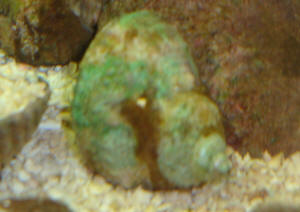
on their shells. <Good observation skills> I'm
concerned that they are ill. From what I've read I think it
could be that they have run out of food, and I plan on putting a
algae sheet in the tank tonight. <Mmm, not food...> Or, it
could be that there is some sort of magnesium poisoning which I
think is doubtful because I buy my saltwater from a very
reputable dealer who uses RO/DI water. <Possibly an imbalance
twixt calcium and Mg as you speculate, or alkalinity and
biomineral (common cause here), or... something even more
devious... BGA growth, its effect> I do about a 5 gallon
change every week. Lastly I thought it could be a lack or
overdose of calcium, I have never tested for it because I do not
have any corals at the moment but do plan on getting some once I
upgrade my tank in a year or so, assuming I can get things on the
right track. I don't think any of the snails have died but
like I said, I am worried that they are not active at all any
more. All the other livestock seems to be doing very well. I
should mention that up until a day or two ago I also had a
Dottyback in there also but the eel ate it while I was away on a
weekend trip. I feed the eel some scallops the night before I
left, then did a water change the next day right before I left in
the afternoon. When I returned 3 days later, the Dottyback was
gone and there was a large amount of what I believe to be
Cyanobacteria on the glass, which surprised me because of all the
skimming I have going on. I just installed the remora skimmer a
week prior and emptied about an inch of pretty much nasty water
when I returned. <The skimmer addition should help a great
deal> I understand that there is a break in period for the
skimmer but that was a lot more Cyano than I've seen in that
short amount of time. I've tried to attach a photo of the
snail's shell to help with the ID and any info on what I
should do or should have done different would be greatly
appreciated. Also, I use the Instant Ocean brand test kit, that
used to be fasTest or something like that, and I was wondering
what the ratio of mg/l that it gives me is compared to ppm that
other tests give. <Milligrams per liter is identical to parts
per million... they are the equivalencies> Thanks for all your
help and the great web site, sorry this was so long. <Mmm,
there are a few "standard" possibilities here, and
related "cures" to try... The first, as you state is
that something is off in water quality... most likely twixt the
common components of hardness and alkaline earth compounds...
Read here re: http://wetwebmedia.com/snaildisfaqs.htm That your
live rock is a bit olde may be a factor here... and you may want
to supplant, replace a bit of it per your reading here:
http://wetwebmedia.com/substrepl.htm and lastly (for now) from
your photo... there is likely a Cyanobacteria situation at play
here... Read: http://wetwebmedia.com/bluegralgae.htm and as much
of the linked BGA Control FAQs files above as it takes for you to
understand what is going on here... Other possibilities abound...
It might be that your supplementing practices themselves are
compounding the imbalance and BGA problem/s... These additions,
modifications should be done, esp. in/w/ such small volumes,
outside... via pre-made water change-outs. But do give the above
citations a bit of reading and we'll chat further. Bob
Fenner>
|
 |
|
Re: snail shell discoloring amongst other
queries 1/7/09 Hi Bob, Thank you so much for
the insight. From what I've read, and also something I just
noticed the other day myself, I do believe I have an idea of what
to do for my snails and health of my system in general. I
remembered the other day that I used to have a pretty deep sand
bed, about 2 or 3 inches in my tank and now its about 1 or 2 in
areas, so I will add some more sand after doing a bit more
research on the best way to tackle that. <Ah yes. Surprising
just how much dissolves with time, eh?> Also, I will be
purchasing a testing kit to check on my calcium, magnesium and
alkalinity levels. <Good> The other thing I have neglected
which may have been a factor with the Cyano, is I have never
replaced my bulbs so I will do that as well. <Ah, yes>
Another question I was wondering about, I am currently in the
process of removing the bio balls from my wet dry and wanted to
know, if I replace some of the live rock in my system, could I
just break the old stuff up and put it in my filter, or would
that be the same problem as the bio balls building up nitrate?
<Would, will be a tremendous improvement> My original plan
was to just put a bag of charcoal in their with a filter pad.
<The LR, old or new is far superior> Lastly, I thought I
would mention that while observing my tank late last night (the
best thing I can think of doing when I can't sleep), I
noticed that all of my snails had come out and although they
weren't super active they were moving around quite a bit.
There were about 4 that were all piled on top of one another and
I saw several of them excreting this brownish stuff into the
water. <Mmm, X-rated behavior> I figured that it was how
they pooped, but as I checked into it today I found that some are
possibly trying to reproduce, which I will take as a good sign
although I do still have some things to take care of. They are
much more active at night which I don't quite understand.
<Think about if you were very slow moving... a tasty bit...
when would you be more active... avoid predators?> Thank you
again for all your assistance and I apologize if my questions are
located in the FAQ's and I didn't see them. <No
worries... most all situations are a bit more complex,
multiple-input, possibilities than simple reading, reference can
address... Hence the need, benefit of individual nuancing,
syncretizing, synthesizing response. Cheers, BobF>
|
Re: Cyanobacteria explosion- need help!, 1/1/09
Dear WWM,
<Hi>
I recently got an ID from you guys on some red hairy algae-like growth
that has been dominating my tank (ID'd Cyanobacteria/ blue-green
algae). I've done pretty much everything the resource on your site
suggests for getting
rid of blue-green algae, but to no avail. I replaced the old filter
cartridge in my power filter, manually vacuumed out as much of the
growth as possible, did a 2/3 water change, and have been being
careful not to overfeed. I've just got a 15 gallon set-up and in
the last couple days added another old light to the tank as a temporary
measure (about 40 total watts now). This stuff is multiplying at an
extraordinary rate- I can spend over an hour manually vacuuming it up
every week, just to have it grown back completely and even worse the
next week. What can I do?
<Typically it takes time and continued maintenance and nutrient
control to limit Cyano. What are your phosphate and nitrate
levels?>
Are there filter pads or something I can put in my hang-on power filter
to kill this stuff?
<The use of carbon or PolyFilters may help limit available
nutrients, but are more of a band-aid than a long term
solution.>
It's covering my live rock and killing off the other stuff on it.
Here's the picture again if that helps.
Thanks,
Nick
<Time and diligent maintenance are about all you can do here. Adding
a refugium with competing macroalgaes may also help.>
<Chris>
Re: Coral Growth/BGA control 12/19/08
75 gall tank with 125 lbs of live rock, 30 gall sump with 3 baffles,
Grape Caulerpa and Chaetomorpha in sump, protein skimmer rated for a
150 gall tank, 5 power heads (1 400, 1 550, 1 650, 1 1200, and 1 600)
150 lbs of live sand, cabbage leather, xenias, green star polyp, some
zoo's, a frogspawn, and various mushrooms. Cleaner crew is about 20
blue legged hermits, a emerald crab, 6 Mexican turbo snails, 3
Nassarius snails and a serpent star. Nitrates are at .30 ppm and
phosphate is near zero, (not enough to register)
<Both consumed by the BGA as produced.>
ph is 8.2 and salinity is around 1.026. Lighting is a 150 watt metal
halide with 2 39 watt t-5 actinics and two 15 led clusters of moon
lights. Have a double t5 Coralife light on the sump. Problem I'm
having is with red Cyano covering my sand, It seems like it growing out
of the sand, however is pretty much staying there, not really getting
on my rocks. Trying to figure out what to do to cure this without
adding chemicals to my tank. Also getting a bit of green hair algae
also.
<The same fueling factors.>
I have a new 20000k bulb for the halide on order and just replaced the
t-5 actinics. Water param.s seem ok, what should I do?
<Feeding, bioload, maintenance practices, source water, filtration,
substrate, water flow, setup, lighting '¦.all become factors.
This is one of the most common queries here on WWM, covered very in
depth. See: http://www.wetwebmedia.com/bluegralgae.htm and the linked
files above, you will find all that you need here.>
Thanks, Devin Haney
<Welcome, Scott V.>
"Re: Coral Growth 8/6/08
Sorry, I have the aforementioned tank with some Xenia, a Goniopora,
some zoos, a Cabbage Leather coral and a Green Star polyp. What can I
give these guys to get them to start growing faster? Right now I'm
feeding Cyclopeeze and using Kent's Lugol's iodine at the rate
of two drops per week. My Xenia are getting taller stalks, but not
spreading or pulsing very well. I am also using B-Ionic for calcium and
Alkalinity.
What do you recommend for optimal growth?
<There are many factors, including lighting and water flow, in
addition to the feeding that will have an impact on your coral's
growth and
overall health. http://www.wetwebmedia.com/growingcorals.htm and linked
articles/FAQ's will give you some insight to your questions
above.>
Thanks, Devin Haney
<Welcome, Scott V.>"
Coralline or Red or Brown Algae Problem (None/ Is
Cyanobacteria) 12/11/08 Hello, <<Howdy>> I
have a 100g reef tank w/ 110 lbs live rock, as well as 2" live
sand. Tank has been set up for 6 months now. Mechanical filtration is
skimmer & Fluval canister (only using Purigen bags in it). Bioload
is low. My problem is a purple algae that is blanketing my entire tank.
Even my green polyp corals are covered by it. The algae presents itself
as a thin blanket. <<Mmm'¦>> It is easily
dislodged by a turkey baster (blows off instantly) but it is right back
the next day. None of this algae is attached to the glass - just on the
rocks & sand. <<This is not actually a true alga'¦
What you have is Cyanobacteria>> My problem is I don't know
if this is true coralline algae (it is purple in color) or a shade of
'red' or even 'brown' algae. <<Though referred to
as Blue-Green Algae, Cyanobacteria can manifest in an array of
colors>> This makes it difficult to do a Google search as I
don't know exactly what type of algae (purple, red or brown) I am
dealing with. <<Try searches on Cyanobacteria and Blue-Green
Algae>> My hunch is Coralline algae does not take the form of a
thin blanket that is easily dislodged & floats off still in blanket
form. <<Indeed>> But I am not sure. Based on my
description, any idea on which type algae this might be?
<<Yep'¦ As stated>> This algae has been present
now for approx 3 months - but it is getting worse. <<This is not
atypical with this nuisance organism. Eradication can be difficult...
You need to determine what is contributing to this outbreak. Look to
things like your source water and foods/feeding methods for possible
introduction of excess nutrients. Ensure the system is optimized (pH,
Salinity, chemical balance) for your desirable organisms to help them
outcompete the Cyanobacteria, and consider adding an in-line vegetable
refugium for this same purpose (among other benefits to your system).
You might also want to think about changing the depth, on way or the
other, of that 2-inch sand bed. 2-inches is not an optimum depth as it
is generally considered too shallow for proper denitrification
processes and too deep to prevent accumulation of nutrients (though
admittedly, some hobbyists do make such depths work). You should also
do some reading. Start here, and then follow the associated links in
blue at the tops of the pages:
http://www.wetwebmedia.com/bluegralgae.htm >> Thanks, bw
<<Happy to assist. EricR>>
Cyano Control 12/3/08
OK I've just about had it with brown algae on the substrate. I have
measured phosphate and silicate with a high dollar Salifert kit and
both are zero. I have no fish in this tank and feed a few corals very
sparingly. Water is crystal clear with a good protein skimmer and
activated carbon.
<What brand carbon are you using?>
But yet the brown algae continues to grow and grow. After I clean it
all out once a week, it starts back as a slight grown dusting (like
diatoms), then grows into strands with a mat formed in one week (like
Cyano).
<Sure sounds like Cyano.>
This stuff is indestructible. How do I get rid of this stuff as I
cannot keep battling it like this. I know about nutrient export, but
this is ridiculous. I'm ready to nuke the tank with something just
to get rid of this stuff.
<Reading here and related articles/FAQ's won't hurt you.
http://www.wetwebmedia.com/bluegralgae.htm>
What should I use, permanganate, erythromycin ???? Help!!!
<None of these should be used, can/will cause damage to your corals
and nitrogen cycle. If you must use a product, I'd go with
Boyd's Chemi-Clean.
I've heard favorable results from people who have used this product
with no ill after effects. Instructions must be followed to the letter
when using this.>
Thanks,
<You're welcome. James (Salty Dog)>
Greg?
Cyano From Salt Mix...Don't Think So
11/28/08
Hello Reef People,
<Hi Alan>
I just had a quick BGA question;
I have been battling this bacteria for over a month now.
<How can you be battling this for over a month when you state below,
the reef tank was set up on 11/18/08>
I believe it all started when I switched from one synthetic salt to
another that claimed to have "more trace elements and
nutrients" than my previous brand, I went from Coralife to Reef
Crystals. I have tried every technique I know of including the use of
Chemi-clean which worked wonders in the past, all with no results. I
have a 125g reef tank and change 15g a week, perhaps this is too much
to change at once,
<No problem here.>
especially with this new synthetic mix? I think I should go back to my
old mix
<No need to do this, Reef Crystals is a good salt mix.>
and get busy on a big water change, syphon out remaining Cyano over the
next weeks and see where that gets me? I will post tank parameters
below.
<I'm guessing the start up date is in error. Nonetheless, salt
mixes are not going to promote Cyano. The use of a good protein skimmer
will go a long way in removing nutrients that help promote Cyano. Your
fish load is a little on the high side but cannot comment much more
based on the information you provided, filter system, etc. Do read here
and related FAQ's.
http://www.wetwebmedia.com/bluegralgae.htm>
Thank You!
<You're welcome, James (Salty Dog)>
125g reef tank started 18 November, 2008
120+ lbs live rock
25g refugium
R/O water
ammonia-0
nitrate-0
nitrite-0
phosphate-0
KH-10
calcium-4251 Green Clown Goby - Gobiodon histrio
2 Pajama Cardinals - Sphaeramia nematoptera
2 Saddleback Clownfish - Amphiprion polymnus
1 Dusky Jawfish - Opistognathus whitehurstii
1Royal Gramma- Gramma loreto
1 Dejardin's Tang - Zebrasoma desjardinii
1 Yellow Tang - Zebrasoma flavescens
6 Lyretail Anthias - Pseudanthias squamipinnis
1 Randall's Goby - Amblyeleotris randalli
1 Midas Blenny - Ecsenius midas
----------
17 fish INVERTS
2 Scarlet Skunk Cleaner Shrimp - Lysmata amboinensis
3 Peppermint Shrimp - Lysmata wurdemanni
1 Red Banded Pistol Shrimp - Alpheus randalli
--------
6 shrimp
1 Blue Linckia Starfish - Linckia Laevigata
1 Sand Sifting Starfish - Astropecten Polyacanthus
-------
2 starfish
8 Scarlet Hermit Crabs - Paguristes Cadenati
3 Blue Knuckle Hermit Crabs - Calcinus Eleg
1 Emerald Crab - Mithrax Sculptus
--------
12 Crabs
Various corals Fish
Re: Cyano From Salt Mix...Don't Think So
12/1/08 Yes, my bad on the startup date. Tank ran on 11/18/07.
<Ah, thought so. James (Salty Dog)>
Re: Cyano From Salt Mix...Don't Think So
12/2/08
Thank you James,
<You're welcome.>
I was brainstorming and may have came up with the source of my Cyano
outbreak. I have been using the same phos-ban media for two months now
in my reactor, it is Two Little Fishies. I was under the impression
that this particular brand did not release excess nutrients after a
period of time and that you could run it for a few months with no harm
to the system.
<Yep, that's what they claim but it isn't going to do much
good leaving it in the system when it's capacity has been reached.
Use of a phosphate test kit would be helpful here.>
You also mentioned that I did not provide enough information on other
areas of tank maintenance. I add a shot glass of B-ionic two part each
morning, feed Cyclopeeze freeze dried in the am, Nori throughout the
day and a tablet of various frozen brands in the evening after thawing
them in a net under running water. I really think it may be the
phosmedia though.
<You have a pretty good fish load for the size of tank you have, and
in turn putting a good amount of food in the tank which contain
phosphates.>
My plan is to run Chemi-Clean for two days with the tank lights off,
remove phosmedia and then change 25% water. Also, my startup date was
incorrect, it is 11/18/07.
<I would cut down the portions of food, replace the Phosban with
Chemi-Pure Elite (an ion exchange resin combined with a very good grade
of carbon and a ferric oxide type phosphate remover) which will also
remove nitrogenous waste along with phosphate. A 10% weekly water
change would be the way I'd go using a gravel/sand type siphon.
When using Chemi-Clean, do not employ activated carbon/Chemi-Pure
and/or protein skimming as it will greatly reduce it's
effectiveness.>
I hope this help paint a better picture, thank you all for your
advice!
<Better. James (Salty Dog)>
Re: Cyano Control 2/11/09
I cut and paste the contents of my tank from another email I sent
earlier, so it might look familiar. It was in reference to Cyano. Good
news is, I don't have any more Cyano.
<Great.>
The problem is, I lost some fish, and I mean lost them. I couldn't
even find the bodies. I lost an Anthias, a Sixline Wrasse and a Sally
light Foot Crab. All I did was change my feeding habits. Instead of
feeding strictly frozen food, I was mostly feeding them pellets and
veggie flakes.
<What brand of pellets were you feeding?>
Do you think this is the problem, maybe they were not eating since they
were not used to the pellet and flake?
<You need to observe and verify all your fish are eating, difficult
to comment here.>
Or do you think I might have a something in my tank eating them?
<Possibly a Mantis Shrimp in your system?>
I also tested my water's nitrates again, and they were 0-.5.
<OK.>
Also, I wanted to fill my Emperor Filter will charcoal using larger all
purpose filter bags, are there any down sides to using so much
charcoal?
<No, but I feel it is better to use less and change more often, and
I only use carbon when necessary. Carbon will remove some trace
elements, but with regular water changes this should be
replenished.>
Here is what I have for a set up.
I have a 75 gallon tank. For equipment I have a Remora Pro, an Emperor
400 running with just charcoal, 220 watts of T5 lighting ( two 18k
bulbs, one 10k and one 6500), two Hydor stage 4s, one Hydor stage 3, a
Maxijet 1200, and a stealth heater.
I have 80lbs of live rock, and about an 1.5" of live sand.
For live stock I have a Yellow Tang, Lawnmower Blenny, three Green
Chromis, two Lyretail Anthias, Chalk Bass, Sixline Wrasse, Feather
Duster, some Blue Legged Hermit Crabs, and Red Legged Hermit Crabs (not
many of either
anymore, not replacing), assorted snails, a red starfish, Sally
Lightfoot and a Serpent Starfish.
For soft corals, I have a Toadstool, a Finger Leather, a Kenyon Tree
Coral, Daisy Polyps, a Cauliflower Coral and assorted Mushrooms.
I do about a 20% water change once a week with tap water and Reef
Crystals. I use an Iodine supplement once a week. I also clean the pre
filter to the Remora Pro twice a week.
<All sound good.>
My water parameters are at ph 8.2, salinity 1.025, temp 76, dKH 11, cal
420- 430 and nitrates under 1, close to 0.
<Good.>
I feed my fish a half a cube of frozen food twice a day. I rotate
between Formula One, Formula Two and Mysis Shrimp.
<A good diet.>
About three weeks ago I started getting some red Cyano and green hair
algae. That's when I actually hooked up the Emperor 400, I started
upping the water change to 30%, I've been scraping the Cyano off
the rocks and the sand.
<Is better to actually suck out the Cyano during water changes.
Scraping will just spread it around to other areas. You likely have a
dead fish under a rock or some inaccessible area which can lead to a
Cyano outbreak.
Has happened to me a few times.>
I also stopped adding zooplankton, I read bottled invert food can
contribute to Cyano.
<Yes, I would use with caution. I do not use these type products at
all, much prefer Cyclopeeze and live phytoplankton. Uneaten Cyclopeeze
will be consumed by some fish and the clean up crew.>
It was getting a lot better this week, than I came home tonight and
there was Cyano on the glass, and on the sand and predominantly on one
rock. It was the first rock I noticed the Cyano on three weeks ago. So
I rubbed it off the sand and glass, then I took the rock out of the
tank and cleaned it all off.
Any other suggestions on how I could control this, and get rid of
this.
Also, is there anything that will eat the hair algae or Cyano?
Any suggestions would be much appreciated.
<Marc, do read here and related articles/FAQ's.
http://www.wetwebmedia.com/bluegralgae.htm?
Thanks,
<You're welcome. James (Salty Dog)>
Marc
BGA, control 11/26/08
Hi guys, love the site. Thanks for all you do, it has helped me in my
endeavor to build a marine set up worthy of the efforts.
<Great!>
I have a BGA problem that won't go away. Let me describe my set up,
and then well take it from there. I have a 55 gallon main display,
draining to an 18 gallon Rubbermaid tub with skimmer in it. From there
it drains to a 75 gallon tank with a 10 gallon tank Siliconed in one
end. The 10 gallon tank is where my return pump is located, along with
the auto top off system. My auto top off is a 36 gallon Rubbermaid tub
mounted above the sump/fuge, and feeds the sump via gravity drain and a
toilet tank fill system. Works quite well, my water level in the sump
is always where it should be. My return pump is a Mag drive 9.5, and if
I calculated correctly I have about half or a bit better of it's
output after head loss.
In this 75 gallon tank is an 8 inch deep sand bed of oolitic type.
Covering one third of this is a mat 4 inches deep of Chaeto. The water
level in this sump/fuge is at the top of the 10 gallon tank. The water
level in the 10 gallon tank is 4 inches from the top if this 10 gallon
tank, so to clarify, there is about 4 inches of water over the deep
sand bed, draining into the sump for return to the main display. There
also resides in the fuge 3 stalks of pulsing xenia, which refuses to
tolerate the main display, but will live in the fuge. I also have lots
of Bristle worms and other little critters who's population seems
to wax and wane.
For my lighting, I have over the main display two 250w metal halides
(on for 10 hours), with two 96w CF 50/50 bulbs. These are on for 12
hours during the day time. At night, over the fuge/sump, I have two 96w
CF 50/50 lamps. These are on the other 12 hours.
<I would swap the refugium bulbs to 6500K to get better growth out
of the Chaeto.>
In the main display I have a close loop system using a Quite One pump
of unknown power. Probably not more than 500 gph. I also have 4 power
heads (yuck) at about 200 gph each, but not likely putting out that
much as they are old and encrusted etc. I will say, though, that it is
quite a hurricane if I stir up some sand. A deep sand bed of 3 to 4
inches is the substrate.
In the main display I have a Clarkii clown, Saddleback clown, Damsel,
some kind of black brittle star, a colony of about 15 or so mushrooms,
and a small colony of Zoanthids, and about 60lbs of rock.
Parameters: Ph 8.4 day time(pinpoint) dropping to around 8.2 at night,
Alk 2.0 milliequiivalents per liter. (best guess using Red Sea Marine
Lab),
<This is low.>
nitrate 20,
<Too high.>
nitrite 0, Ammonia 0, CA 370, SG 1.025, temp 77-78. My skimmer is a 5
gallon water jug from one of those office water coolers with a Sedra
3500 needle wheel pump. Produces about a quarter of a cup of dark a
day. Need a stronger pump for this size skimmer body?
<It could certainly handle a larger pump, but the proof is in the
skimmate.
I would likely just opt for a more appropriate sized body for the
Sedra.>
My top off water comes from an RO/DI system whose filters were given a
complete change three months ago. All six stages. I then have an air
stone in the reservoir to bring up the ph in the RO/DI water. It ages
for at least 48 hours before transfer to the top off reservoir. Water
changes occur about every two weeks consisting of 15 gallons of 4 to 7
day aged Instant Ocean mix.
Many of my ideas have come from reading this forum, and I have tried to
solve my algae problem on my own - with no luck. Any ideas?
<No magic bullet on this one Ken. You have read the fueling factors,
they are what they are. Do work on raising your alkalinity and lowering
the nitrate. With all the DSB you have, the nitrate should be easy to
control in time.>
Thanks, Ken.
<Welcome, Scott V>
Questions, Cyano/Carbon 11/17/08 Hi Crew,
<Hello> I have a 6 year old 10 gallon with live sand and rock, a
small filter and 65w PC with some fish and snails. I started to use
activated charcoal in the filter (about 4 teaspoons) and want to know
how often it should be changed. I change 1 gallon of water per week.
<The bulk of the carbon's absorbency is used up in a matter of
hours, but most people continue to run it for weeks up to a month. The
reality is that after the first day or so it is not really doing
much.> I have had a Cyano outbreak for about 6 months. Main changes
since it started was to cut lighting to 8 hours and feed only once a
day. It improved slightly but still needed a good siphoning once a
week. I would generally pick one area to clean. Then a couple weeks ago
I cleaned all the glass and siphoned whatever I could see on the rocks
and sand. Since then it is much improved. What are my chances of really
getting rid of it? Thanks <It will always come back if allowed,
continuing good nutrient control and water changes should help control
it long term.> <Chris>
Cyano driving me crazy 11/05/08 Hi crew. <Hey,
Jessy here> I've got a 135 gallon reef tank that's been up
and running for about a year (acquired from somebody else who had it
running for 4 years). I've had a Cyano problem for the last month
that I can't seem to get rid of. I've been siphoning it out and
doing 30 gallon water changes weekly for a month and it keeps coming
back. I've had my lights off for two days now without any visible
improvement. I've got Chaeto in the sump which isn't growing,
so I don't know where the Cyano gets it's nutrients. I use
RO/DI water with new filters (on this tank and my 55 gallon which has
no Cyano). Water tests as follows: Salinity=1.025, Nitrite=0,
Nitrate<5, Ph: 8.3, Alk=2.3, Ammonia=0. I'm at my wits end
and don't know what else to do. <Hi Matt, I feel your pain. The
only thing I would test for that you haven't is Phosphates. They
too can cause Cyano. You did well lowering your light cycle, but you
also should make sure to increase your flow in those areas that show
the Cyano. Even if it is just temporary point your powerheads directly
at that area for maximum flow. You can also use the produce Red Slime
Remover by ChemiClean without fear for your tank inhabitants. I've
used it many times effectively. Just follow the directions on the box.
By increasing the flow in those areas and using that product, I can
assure you your Cyano issues will be gone soon. Do check your
phosphates though, you may have an issue you aren't aware of
there.> Thanks for all the help you've provided me over the
years, <Hope that helps, Jessy> Matt
New Live Rock and Cyano 11/6/08 Crew - I have a 2
year old 65g with a 35g fuge run EcoSystem method. I run GFO, UV, 2
units of ChemiPure Elite and one unit of carbon. I change everything 2
months apart. I skim wet and do not over feed and have 7 small fish in
the tank with a standard clean up crew. I do 12g WC's with NSW
every week. About a month and a half ago I added some new Fiji live
rock (about 8lbs) that was cured. or so I was led to believe. All water
parameters are totally in line and my Phosphate readings are zero no
matter who measures it. Over the past couple of weeks one of the
new rocks developed some Cyano that while not totally out of control
really surprised me as the rock was cured. I figured it was leaching
something causing the Cyano so I blew it off when it appeared or my
clean up crew had a feast. On the new rock now it's all but
gone. But now I am noticing some small patches of it on other
parts of my mature rock. It's not a lot but when you have no
nuisance algae to speak for over 2 years of excellent system management
then this Cyano appears just a few weeks after I put in the new rock
and new GFO I am wondering if the new rock has caused a tiny cycle or
it leached some bacteria into the water causing the Cyano?
<Possibly> I buy my RO/DI from my LFS and they swear there is no
TDS in their water and I believe them as I have been buying it for
years from them and never once had a problem. Thoughts? <So far, I
think this is "normal." Every time you change something with
a system, it's bound to go through an adjustment period. For now I
wouldn't worry about it... just wait to see if it doesn't get
better on its own.> Many thanks on this historic election night in
this great land of ours:-) <Indeed!> Geno <Best, Sara
M.>
Cyano problem...can't figure out what I'm doing
wrong. 10/31/08
Hello Crew
<Mark.>
Happy Halloween!
<My least favorite of holidays/celebrations. I know, party
pooper.>
I'M FRUSTRATED! I have the BGA problem that I designed my system to
avoid. I've read all the WWM stuff, but can't figure out what
else to do. System set up in late April 2008: Tank: 90 gal acrylic,
with 1 center overflow. I modified the standard drain and increased it
to 1.5" and made a stand-pipe for noise reduction. Approx. 60-70
lbs of Live Rock, and less than an inch of aragonite substrate, but not
the sugar fine stuff slightly larger than that. Filtration: I built a 3
compartment acrylic sump, with dimensions of
30"x18"x18". Total volume of the sump under operation is
about 20 gal. A 6 gal Inlet area holds an Aqua C EV-120 running on a
Mag 5. The 6 gal center compartment is for return via a MAG 7, and the
8 gal right compartment serves as a refugium that over flows back to
the center for return. The tank drain is split off with most of the raw
water going to the Skimmer, and flow to the refugium is controlled with
a gate valve. I have over 4" of aragonite in the refugium (DSB)
along with a clump of Chaetomorpha. I'm running a bag of carbon in
the sump return area, as well as Sea Chem PhosGuard. There is no
"filter media" in this system. None of the pumps has the foam
suction filter on it. The only Mechanical filtration is the
skimmer.
<Sounds fine.>
Lighting: Tank has (2) 150W 10K Coral life Metal Halide Fixtures and
2x55 watt PC Actinics for looks. Metal halides are on for about 11.5
hrs, Actinics come on in the morning, go off, and come on again in the
evening. It's getting time probably to replace the MH bulbs, they
are 2 years old this month.
<Yes, definitely time to replace. This can be a source of nuisance
algae/BGA. The color shift over this amount of time makes the pests
more competitive. May very well be your big issue.>
Refugium has a 17W grow light on a reverse cycle to the tank.
<I would increase this also, to at least double. Many say their
macro grows great with such a low wattage, but more is better (within
reason, you don't want to fry the stuff either!). The idea is to
make any nutrients in your tank the limiting factor on the macro
growth, not the light.>
Circulation: I have a ¾" closed loop around the top
with (4) ½" outlets running on a MAG 18. Bio Load: (1)
Sail Fin Tang (2) Percula Clowns (1) 6-Line Wrasse (1) Coral Beauty (1)
Hammer Coral (small right now but growing well) (1) rock covered with
Star Polyps (4) Cortez Hermits (1) Blue leg Hermit (2) Peppermint
Shrimp Water Quality: I have a 5 stage RO/DI unit from Air Water and
Ice (Typhoon III). Water checks 0 TDS with a hand held meter. Water is
aerated for at least 24 hrs, most always more, prior to mixing with
salt, (Instant Ocean Reef Crystals). I do a minimum 10 gal change every
week, increased to 20 gal recently to try to eliminate the BGA.
<Of course you should continue this until the problem is
resolved.>
I use a Tunze Auto Top off system with the RO/DI water. I use Reef
Buffer in the Top Off water to help keep the dkH in the tank between 10
and 11. I clean my Skimmer cup 2 or 3 times per week. Water Chemistry:
s.g. 1.024-1.025 PH 8.3 dkH 11 Ammonia 0 Nitrite 0 Nitrate 0 (I've
never seen even a trace of Nitrate) Phosphate 0 (at least less than
.5ppm) Calcium 400 to 450 (supplement one per month with Sea Chem Reef
Complete Feeding: I feed once every morning, a mix of Formula 1 and 2
(small pellets). Occasionally (once per month) I feed some dry algae on
a clip. Occasionally I feed a small cube of frozen Mysis Shrimp to the
hammer coral, but the fish eat most if not all of it. I don't
believe that I'm "over" feeding. '¦None of
it hits the bottom before the fish eat it.
<Good.>
Problem: This stuff is growing all over the substrate. I've tried
physical removal by scooping substrate out and rinsing, I've
increase water changes, I've directed flow from the closed loop
directly down at the substrate. It just keeps coming back! It is
actually growing on the suction screen fitting for the closed loop pump
feed in the tank, which is odd because it is a high flow area. I'm
getting a little of it on the back wall as well. I just can't seem
to knock this stuff out. I really don't have any other
problem algae in the tank. I'm starting to get a nice Coralline
growth on the rock and back of the tank. I've had the hammer coral
for a short period, less than 8 weeks, but it is doing very well. I see
new growth starting on it in two places. It is getting bigger.
Everything in this tank is healthy. The only thing I can think of is
that the light on the sump isn't enough to get the Chaetomorpha to
grow and export nutrients. It hasn't grown since I put it in there
in June but it still looks healthy.
<Yep, more lighting will help. BGA outgrowing Chaeto, you need to
shift things about a bit to make the Chaeto outcompete the BGA.>
Also, I'm not exactly sure what type of "cleaning" I need
to do in the refugium. I pretty much just leave it alone. I have
no BGA in the sump at all.
<Same as the tank, a mostly just enough flow to keep things stirred
up, not settling.>
Any advice you could give me? What do I need to change?
<Start with the lighting, both above and below.>
I'm about ready to remove the substrate completely. If you want to
see the setup...go to my photo gallery at WWM. These pictures are old I
have much more live rock in the tank now.
http://bb.wetwebmedia.com/gallery/menu.php?gallery=members&album_id=10
<Very nice furniture grade setup!>
Thanks for the great site! Mark Gustin
<Thank you, Scott V.>
Re: Cyano problem...can't figure out what I'm doing
wrong. 11/2/08 Thanks for the reply Scott V.
<Welcome.> I suspected that the refugium light wasn't
adequate. There are so many different responses to this question in the
FAQ's......I was skeptical of the ones saying that a small grow
light was "plenty", but I had to try it. <It can grow it,
but why make lighting the limiting factor.> I also found that my
metal halide bulbs are actually marked 14K.....I'm going to replace
them with 10K's. They only had one 10K bulb in stock, and the
others were all 20K. So I bought the 10K bulb and installed it beside
the other 14K.....not a very big difference visually. I'll have to
order another bulb. <Likely close to the same given the age, but the
10000K will be more intense.> I expected the 14k bulb to have more
blue in it than the 10K....There is a visual difference but I think it
has more to do with age of the bulb than the temp. <Tis the
case.> I'm going to see if I can find a better light to put in
the cabinet. <Good, if you have a local Costco, do look for the
patio CF fixtures. Under $10 and a 65 watt quad compact 6500K (perfect
for Chaeto.) bulb.> Thanks again <My pleasure.>
Re: Cyano problem...can't figure out what I'm doing
wrong. 11/3/08 I have looked for those type fixtures....they
just aren't available around here. Seems like most of the
"outdoor" flood light fixtures are moving to the Halogen
bulbs....way to hot! <Yeah, stay away from those.> I just ordered
a 55 watt "bright" kit from AHSupply. It's only a few
bucks more than some of the 26 watt outdoor flood light fixtures at
Menards. I found a 65 watt fixture at Do It Best but they want $40, and
two weeks to order and deliver. I'll have this one before the end
of the week. I can build a housing for it and mount it easily. I
already have 2 of these fixtures above the tank for the actinics so I
can get the bulbs all at the same time from the same place. <Sounds
perfect.> Hopefully this will get the Chaeto. growing! <I am
confident, do let us know the difference.> It seems that many of the
pet stores are not carrying the fish supplies they used to. I can't
get the stuff I need without buying it on-line...even the salt water
only stores are not keeping the inventory, but instead are ordering it.
Even for items like salt in the 160 gal bucket, seems they want to sell
bags. I'm finding that even with shipping charges I can save a
little money ordering on-line. I'd rather buy it local, but if I
have to wait two weeks and make two trips to the store.....? <I will
restrain from ranting on this one, but I am in total agreement. If a
specialty store has to order basic items, I usually go somewhere else.
More and more that means online.> Thanks again Mark Gustin
<Welcome, good luck, Scott V.>
Re: Cyano problem...can't figure out what I'm doing
wrong. 11/26/08
Scott V.
<Hello Mark.>
Well it's been a few weeks since I made the changes you suggested.
I replaced the M.H. bulbs and installed a 55W 10K Power Compact over
the sump. The Chaeto is growing!
<Great!>
I had to leave town for a week....well...ok...I went on a Cruise of the
Southern Caribbean for 7 days. It was a rough life! Got to Scuba Dive
in Bonaire and Dominica......wish I could bring it all back and put it
in my tank! Sorry, don't mean to rub it in.
<Hmmm, working on it myself, have not quite made it out there
yet!>
My son fed the fish and kept the skimmer clean for me, but I didn't
want him performing water changes...so we got behind on those for a few
days. Upon my return I was amazed at how much the Chaeto had grown in
such a short time. The Cyano is still there, but it appears to be a
much lighter color. Instead of the rust brown color, it's now light
green and not as thick. I am noticing some Cyano showing up in the
refugium as well with the increased light. Overall, I think I'm
gaining on it due to the obvious change in color and consistency.
Considering I let it go for about 8 days, I expected the tank to be
worse than it was when I returned since I had been doing water changes
twice per week. The growth rate of the Cyano seems to be slowing. Time
will tell! At least the Chaeto is growing...let's hope it can out
compete the Cyano.
<Great! Do keep us posted on how this progresses.>
Thanks again
Mark Gustin
<Welcome, Scott V.>
Re: Cyano problem...can't figure out what I'm doing
wrong. 12/10/08 Scott V., <Hello again Mark!> Well,
it's been another two weeks and things are progressing well with
project Cyano eradication. A little over a week ago the algae was
showing signs of retreat. Since I had previously removed much of the
substrate, I decided to remove the remainder and switch to reef sand
instead. I wanted to use sand from the start, but couldn't find it
locally for a good price until now. I physically removed as much of the
remaining Cyano along with the substrate and then put 30# of rinsed
sand in the tank. After a short period, less than 24 hrs, of murky
water, the tank looks great after more than a week. The remaining Cyano
on the back walls is slowly going away. I think we've got this gunk
beat! <Awesome, good to hear of your success!> Thanks Scott for
pointing me in the right direction, or at least confirming what I
thought was going on! <My pleasure to help out a bit.> I've
read a lot of posts on Cyano/BGA and most do not report back with
progress. I just want to say to everyone having this problem that it
can be beat without Chemicals! I wasn't 100% sure it could be done,
but it can with a proper setup. <It sure can. Cheers.> Mark
Gustin
Norm-Defying Cyano...Actually Typical 10/30/08
Hello Crew! <Hello.> I am back at it again after this summers
disastrous crash (you may not know what I am talking about but it was a
terrible disaster while I was away- everything but everything died- I
wrote to you guys about it back then). <I do recall reading this,
vaguely.> I am giving it another go however and I wanted your
opinion on something. I have read your Cyano faqs and the Cyano page,
but my problem is perplexing and these pages don't seem to answer
the question... First the tank set up-40 gallon Breeder, Current Dual
Satellite 96 watt lamp (almost 10 months old), Aqua C Remora skimmer,
Millennium 3000 HOB filter, 2 Hydor Koralia powerheads. About 80 pounds
of live rock, 50 pounds of oolite and 1 Lamnalia, 2 Ocellaris, an Algae
Blenny and a Strawberry Basslet. Assorted snails and crabs. 0 Ammonia,
0 Nitrite/Nitrate, pH 8.2, Salinity 1.027, dKH 12, um, what else, oh
yeah R/O water with a cartridge that is 6 months old. The tank is fed
only every other night, and not with much. <Okay.> Here is the
issue. After the crash everything went normally in terms of a new
cycle. SO I started adding stuff. Then all of a sudden, 3 weeks ago out
of nowhere I get a crazy bad Cyano outbreak (the fish were in at this
point). But only on the substrate. The rest of the tank is so clean
that the Blenny needs to be supplemented feeding wise. But not the
substrate. At the time I also notice that there are weird air bubbles
forming under the surface of the sand (you can see where the sand meets
the glass). And oddly enough it is really only forming where there is
pretty good flow, like right in front of the front glass. Where there
is little or no flow, it isn't growing at all. And from what I have
read here the lights shouldn't be helping to grow it either. <Is
a factor.> I have tried everything, water changes, no water changes,
less light, less food. hand removal, Marine S.A.T. and nothing seems to
be working. Could this be something left over from the crash that is
lurking beneath the substrate and feeding the Cyano? <Possibly, but
you are basically experiencing the normal growing pains seen in new
setups, basically what you have on your hands.> It's terrible I
mean it looks like there is a brown carpet over the whole thing.
<This happens, and sucks!> How will I defeat this? Do I need to
remove all the substrate and start with fresh risking a new cycle?
<Was this rinsed after the crash? If not dead and decaying matter in
the substrate could be the cause, or at least a contributing factor. I
would not replace it, at the most rinse it. Although I would be
hesitant to do that at this point. With livestock in the tank just keep
sticking with your regimen, you will have to cure this much like the
rock.> My kids keep harassing me to get rid of it and all I can tell
them is 'I am trying'! Any insight you have would be
hugely helpful I feel like I am losing this war... Perhaps Neptune
doesn't want me to be an Aquarist... <Nah, normal stuff. Time,
patience and perseverance. Scott V.>
| Algae on Sand...BGA 10/28/08 Hello crew...In
the last couple of days I started to get some sort of algae on my
sand bed. <Annoying!> I have tried to suction it out with
some success, but it just continues to reappear. Please help me out
guys. I hardly ever have problems with my reef setup.
<Great.> Oh yeah, when I first noticed it I also did a 30%
water change. I noticed hardly any results but have included a
picture of my problem. Thanks, Stephen <This is a simple case of
BGA/diatoms. See http://www.wetwebmedia.com/bluegralgae.htm and the
above linked files for control protocol. Welcome, Scott V.> |
|
No question, Big Thanks 10/8/08
Hi Crew,
The red slime plague is gone thanks to you!
<Ahh!>
New lights, flow, and feeding really did the trick in about 4 weeks
along with other tips such as "suck as you brush" to prevent
further spread. I have spent hundreds of hours on your website learning
this new 9 month old hobby
(acquired 55 gallon reef) and preparation for new seahorse tank. OK, so
I'm retired and can spend the time. Most importantly I've
learned to "read before you leap". My mistakes are minimized
now with due diligence and patience.
So Thank you, Thank you! I know you're volunteers and I really
appreciate your dedication. Your humor cracks me up.
I look forward to seeing Bob & Scott in Colorado in April, 2009.
And I promise not to embarrass them with too much gushing.
Peg Hill
<See you there. BobF>
|
|
New Print and
eBook on Amazon
Marine Aquarium Algae Control
by Robert (Bob) Fenner
|
|
|