|
|
| Home | Marine Aquariums |
Freshwater Aquariums |
Planted Aquariums |
Brackish Systems |
Ponds,
lakes & fountains |
Turtles & Amphibians |
Aquatic Business |
Aquatic Science |
Ask the WWM Crew a Question |
| Please visit our Sponsors | ||||
|
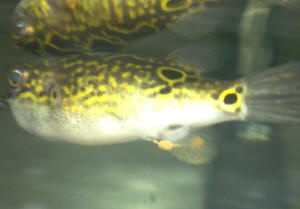
F8 puffer care 2/5/19 Re: Figure 8 puffer, please help! 4/7/18 F8 brackish water questions. Fig 8 sys; salinity... Artemia cult.
9/22/16 How do I acclimate my F8 from fresh to brackish
4/9/13
Stressed Figure 8 Puffer; beh., sys. 3/21/12 <These are fun Pufferfish, but can be very nippy, so watch your Mollies carefully. Expect to rehome them, and be pleasantly surprised if you don't.> The smaller of the two (approx 1 inch) Has 0 problems. Eats, sleeps, navigates etc. The larger Puffer (approx 1.5-1.7 inches) he's been stressed the whole three days I have had him. <Environment?> I read that having two puffers should be O.K. in a 20 Gallon but I cannot find anything on whether the Mollies could be adding the stress factor. <Can do. Although nippy, this Pufferfish species isn't especially aggressive, and very small specimens are easily spooked (they often go dark in colour when stressed). Male Mollies can be aggressive and may harass smaller fish. Watch them carefully, and see how the two species are interacting. In and of themselves the Mollies shouldn't scare the Puffers, but it _could_ happen.> My Ammonia and Nitrites are at 0. Nitrates at 5-10 mg/l And PH at about 7, maybe 7.2? <Way too low. These are BRACKISH water pufferfish, so you should be adding not less than 5 grammes marine aquarium salt mix per litre of water (about SG 1.003 at 25 C/77 F).> Was a little lighter than 7.4 rating on High Range PH Test Kit. I have a tall drift wood piece in the back right corner with a cave like rock set up against/next to it. In the front left I have 6 6in. grass weed and spiral grass as well as 2 10in spiral grass. I have one more rock with a hole in it looking as if it were some sort of entryway into the "Plant Field" if you will. I can send you a picture if you like. I am just wondering if it is too cramped for the larger puffer ATM. Will the 29G help? Do I need more plants for hiding? Should I get an even bigger tank? Will removing the Mollies help until I get the larger tank? Any information would be so greatly appreciated. Thanks you very much, Steve. <My assumption here is that the environment is wrong -- switch to brackish, and see what happens.> P.S. Don't be afraid to get very scientific/elaborate with descriptions. I live with a Marine Biologist and a former Aqua Culture Major. <Real good. Cheers, Neale.> Re: Stressed Figure 8 Puffer So I have been reading years worth of your answers the past few days for Fig.8 Puffers. You repetitively say "Use Marine Aquarium Salt" Is that different than just a regular Aquarium Salt? <Yes. Absolutely.> What I have consists of 1 ingredient, NaCl. <Correct. Sodium chloride, also known as table salt. This is not the same thing as the salts (plural) that make seawater or brackish water. While adding aquarium salt works in the short term, it lacks the full range of salts including those that raise hardness and pH, e.g., calcium carbonate, sodium bicarbonate, magnesium sulphate. So by all means use up your box of aquarium salt. But once it's done, switch to a marine aquarium salt -- the generic brands at your local big-box pet shop will be fine. Use just the same way, but in the knowledge that long term, your fish will be healthier.> Expect to rehome Mollies? Pleasantly Surprised if not? Elaborate if you don't mind? <You may get lucky. I'd guess that 1 in 4 of these Figure-8 Puffers turns out to be completely peaceful and ignores, for the most part, its tankmates. But the odds aren't in your favour, and some can be persistent fin-nippers, and a very few are outright psychotic.> From my observations, The Mollies aren't bugging the puffers at all when it comes to nipping. <Good.> the male Molly is constantly harassing my females but I don't see any nips on tails or anything as of now. <Sounds about typical.> It is a brackish water tank. SG is at 1.004 ATM. <Cool.> So I am not sure if that changes any opinions. ALSO. Was the PH too low or the NO3? <The pH. Ideally, and certainly if you'd used marine aquarium salt, the pH would be around 7.5, an ideal level for low-end brackish water fish such as Figure-8 Puffs.> You really seem to know your puffers so I am very grateful for you to be the respondent. I can send a picture if it will help. <Thanks for the kind words. Cheers, Neale.> Re: Stressed Figure 8 Puffer I also forgot to mention that I have about 75 snails. Not sure what specie they are but since I have added the puffers, most of them have retracted into their shell and move very little since the introduction of the puffers. <Well, yes! Snails aren't as stupid as they look. Often they become nocturnal in the presence of predators that nip them. Do also be aware that most snails will die in brackish water (though the Malayan Turret Snails, Melanoides spp., thrive in brackish water).> Also, since adding the deadwood this morning, The puffer seems to be less stressed over the past few hours. <Ah, now, is this bogwood from the pet shop or random wood from the garden? Both will lower the pH, and that WILL upset low-end brackish water fish. Again, higher carbonate hardness (measured with the KH, not GH, test kit) will prevent this, so that's another reason to favour marine aquarium salt. Plain sodium chloride doesn't affect the pH at all. On top of this, regular wood from the garden can carry across toxins like pesticides, and to my cost, I've seen what this can do, and very quickly.> So maybe I just need to go get a larger tank. ALSO I have a very large filter for my tank. So large that the lowest setting still causes somewhat strong current. Possible adding factors? <Brackish water fish generally enjoy strong water currents, being adapted to tidal habitats and all! Cheers, Neale.> Re: Stressed Figure 8 Puffer Pet shop Wood. It was my friends from a former tank of his. cleaned thoroughly with a tooth brush and very hot water. I also soaked it prior to that in practically boiling hot water. <Should be fine then. But do check pH. If it sinks below 7, you have a problem.> My girlfriend works at a local pet shop so I am going to have her pick up the Marine Aquarium Salt and a few more plants tonight. <Hmm… would skip the plants unless you're sure they're salt tolerant. Up to about SG 1.003 most hard water-tolerant plants (like Vallisneria, Amazon Swords, etc.) are fine; but above that, few do really well, and most just die.> So should I just keep an eye out for snails that haven't moved for several days and pitch them or should I thoroughly inspect them and assure they are living? <Yes.> What is the meaning of this statement "(measured with the KH, not GH, test kit)"? was it just a point of favoring marine aquarium salt or something I need to use for my tank? <Two kinds of test kits, carbonate hardness and general hardness. General hardness is measured in degrees dH or mg/l calcium oxide and is often called the "GH" test kit, e.g., by API. Carbonate hardness is measured in degrees KH or mg/l calcium carbonate and is often called the "KH" test kit. Both tell you something about the aquarium, but carbonate hardness is the best measurement of how well water buffers against pH changes. General hardness mineral salts have little impact on pH changes, so in this context, such a test kit is far less informative. Cheers, Neale.> Re: Stressed Figure 8 Puffer 3/21/12 Well I don't have any real plants. I was just thinking of adding 2-4 more taller types of fake grass and a few pieces of slate for proper caves and thick area for Mollies to hide and breed. <Sounds good. Do see some of my recent messages on decorating brackish water set-ups. http://www.wetwebmedia.com/brackishsubwebindex/brackishdailyfaqs.htm With care, you can create a unique style that doesn't look like a failed marine or freshwater system!> As well as the snails. How large are the few snails mentioned that thrive in brackish water? <Well, Nerite snails are often brackish-tolerant, but mostly small, at most an inch in shell width, though quite globular, so pretty chunky-looking. Clithon spp. for example are widely traded and do well in brackish water. Some of the Neritina species will do well too. Otherwise Melanoides spp. are good choices, but they breed very quickly, and can become pests.> If so could I probably acquire them from a local shop? Any suggestions on brackish water set ups? I potentially want to get a 40G+ and try to breed Puffers. Any pointers? <Breeding puffers is very difficult, and only one or two species do so even halfway readily under aquarium conditions. The best species for this are either Carinotetraodon lorteti or Tetraodon suvattii, both freshwater. Cheers, Neale.> Help with my figure 8 puffers 12/19/11 F8 Puffer with faded colors and sluggish... dis.,
env. Figure eight puffer=brackish troubles
3/26/10 Figure 8 Puffer in Brackish Problems
2/13/10 Re: Figure 8 Puffer in Brackish Problems
2/13/10 Fig 8 puff. Fresh or brackish? 1/25/2009 Puffer question, please help 5/28/2009 (Puffer question, please help) correction
5/28/2009 Figure Eight Puffer - new tank/tankmates 1/27/09 Hello, I have a 10g low salinity brackish tank with a year-old figure eight puffer and one bumblebee goby (I had two, but one recently died). My puffer is in need of a bigger tank, and I'm exploring new tank setups and new tankmates. I'm a college student and, when I'm not at home on breaks, my fish are in the capable care of my mom. With this in mind, I'm trying to figure out what filtration system would be the best balance of effectiveness and maintenance. I'm considering a tank size between 45g and 70g. What are your filtration suggestions for a tank like this, with fairly quick water turnover and 'mineral mud' or some sand-like equivalent? With a bump up in tank size, I'm also looking to add a few fish. I've been doing a bit of research on dusky panther gobies and knight gobies. Would these fish be compatible with my puffer (and with each other)? Aside from disc fish, which I'm not a big fan of, are there any other species that would live well with my puffer? It is fairly docile, showing no interest in the goby, and even allowed a fiddler crab to live in the tank unbothered for its lifespan. Thanks for your suggestions. With the sparse resources and controversy over brackish setups, all your help is greatly appreciated. -Ben <Hi Ben. Ten gallons is not a lot of space, and your decision to trade up is a wise one. Even switching to a 20 gallon system would make all the difference in the world! The bigger the tank, then the more stable the water chemistry and the less likely water quality problems will develop in between the times you're about to check on them. So having a bigger tank will make life easier for your mom during your absences. So whichever tank you get, I'd encourage you to under- rather than overstock it, so that its bigger size works in your favour. Beyond that, I don't really think it matters much what filtration system you use. Personally, I find canister filters require the least maintenance, and while external canister filters are certainly the best in terms of value, they're a hassle to maintain. On the plus side, if you're around every most weeks, and only gone for, say, 6-8 weeks at most, then a canister filter or two would surely be the best choice. Internal canisters are (by contrast) more expensive in terms of filtration capacity, but they're very easy to maintain, requiring little more than switching off, pulling out of the tank, and then the relevant media either replaced or rinsed. Otherwise, most any filter will do, provided you accept the pros and cons of each type and work around them. Now, "Dusky Panther Groupers" are, I assume, the Waspfish Neovespicula depressifrons. They're also sold as "Butterfly Gobies". Anyway, they're neither gobies nor groupers, but more closely related to things like stonefish and bullrouts. They are hardy and quite good community fish, provided they aren't kept with anything they can swallow. They are fine with Knight Gobies of equal size. Feeding them is a bit awkward though as they're a bit slow, but then so are the gobies. Both species are predators with a fondness for small invertebrates and fish. I wouldn't use feeder fish for either though, for all the usual reasons. River shrimp are readily taken though, and once settled, both take frozen foods. I wouldn't risk mixing either with Figure-8 puffers; puffers are just a bit too nippy, even this rather mild species. While the Knight goby might be active enough to avoid trouble, I can't help but feel the Waspfish would end up being bitten at some point. Figure-8s are best kept either alone or in groups of their own kind. They do mix quite well with Bumblebees as well as Orange Chromides, which seem to be punchy enough they avoid becoming targets. That's the problem with puffers. If your specimen happens to be mild, you might risk it, and see what happens. But certainly provide lots of hiding places for all concerned, in the form of empty oyster shells, barnacle clusters, plastic seaweed, and so on. There is quite a bit of stuff out there on brackish fish now. Besides the many resources on WWM, there's my own book from TFH as well as a book from Aqualog. Both books are entitled 'Brackish-Water Fishes'. They target somewhat different markets, the Aqualog book being smaller and more about identifying common and rare species and describing their basic needs, while my TFH book is a much bigger book that goes into a lot more detail, though primarily on species available in the US, Europe and Australia. Cheers, Neale.> F8 Puffer in F.W. 09/08/08 Hello, <Ave,> I have several tanks, one of them being a 30 gal brackish tank and another a hard water/ pH of 7.8 planted freshwater tank that has developed quite a snail problem. Our LFS just received F8 Puffers and GSP's, keeping them both in freshwater (and together!) in their store tanks. I know that F8's do best in a SG of 1.005 for long term health, but these guys are dwarf puffer size now and I was wondering if they would be ok short term (and if so for how long) in the freshwater tank, or at a lower SG that would not impair the plants? <The Figure-8 puffer Tetraodon biocellatus can be kept in freshwater a while, especially if the water is clean, hard, and alkaline. But they do live much longer and are much healthier in brackish water. It's impossible to give a definitive answer to this one, but I certainly wouldn't keep a Figure-8 in freshwater for more than a few months. In terms of optimal salinity, as low as SG 1.003 should be fine assuming the water is hard (15+ dH) and basic (7.5-8.2) and above all very clean (zero ammonia/nitrite; below 20 mg/l nitrate). That salinity would be tolerated by a variety of hardy plants. Genuinely brackish water plants will do well up to SG 1.005. I keep a list of recommended species on my Brackish FAQ, here: http://homepage.mac.com/nmonks/Projects/FAQ/2d.html > The Brackish tank I have is a bit higher SG (1.008) with mollies and a few BBG's. <That's a bit too saline for most plants. You could reduce the salinity a bit though, to SG 1.003-1.005 and the Mollies and gobies would be just fine. That might free up some options, for example adding plants to this tank, and then keeping the Figure-8. You could move the Figure-8 into the freshwater tank to eat the plants, and then move him out to the other tank after a few weeks. Doing this a few times per year would cause him no problems at all. Alternatively, there are some snail-eating snails in the trade (Clea helena) and these do an amazing job if purchased in sufficient numbers (I'd recommend four or five per 10 gallons). http://homepage.mac.com/nmonks/Projects/freshwaterreef.html They breed, but slowly, and rearing the babies to maturity is a triumph, not a nuisance. Other aquarists will happily take excess snails off your hands! Cheers, Neale.> Re: F8 Puffer in F.W. 09/08/08 Thank you for the reply. <You're welcome.> Is it true that most freshwater plants that do well in hard alkaline water usually do well in low end brackish (about 1.003) systems as long as they are gradually acclimated? <Up to a point it's true. Some species will object, but a lot of species seem to adapt, particularly if the lighting is strong and the substrate nutritious. Put it this way, if the plants are struggling before you add salt, then adding salt will likely push them over the edge. But if they're happy and growing fast, then slightly brackish water doesn't seem to cause problems for things like Amazon Swords, Vallisneria, hardy Cryptocorynes, etc.> I have a school of Pristella tetras in the planted freshwater tank now with a red tailed shark and an SAE, so I could move the 2 scavengers to a different tank and add the F8 and increase that tanks salinity, providing the plants would do ok at 1.003, they have all been thriving in my high pH, hard water setup thus far with about 2 watts a gallon of light. <Pristella maxillaris is one of the few tetras commonly occurring in (slightly) brackish water, at least in the wild. What it's precise tolerances are is unknown to me, but I'd expect them to handle SG 1.002, maybe 1.003, if acclimated to it slowly. I'd adjust the tank slowly, watching their behaviour and ensuring that they were feeding and breathing normally. The two shark-minnows are not salt tolerant (to the best of my knowledge) and shouldn't be exposed to brackish water for any length of time. Cheers, Neale> Re: F8 Puffer in F.W. 9/16/08 Thanks for the reply. What signs other than melt would indicate a plant might not be adaptable, ie leaves falling off, browning, lighter color leaves etc... I have Val.s, moneywort, crypts, giant Hygro, Anubias, a sword plant, some unknown Aponogeton and Ludwigia repens...the Ludwigia took quite some time to establish itself ANYWAY without the salt, but now it seems to have some yellow tipped leaves. <Essentially if the plant is sending up lots healthy growth at a normal rate, it hasn't adjusted to brackish water. Above SG 1.003 only a small subset of species will do well, and even up to SG 1.003 your options are limited mostly to hard water tolerant species. Anything that needs soft, acid conditions and/or CO2 fertilisation just isn't an option.> in the meantime I found out that my bulbs were very dim, being about 8 months old, they had really lost a lot of their output, so those were changed out as well. <Realistically, good tubes should be viable for a year, assuming you have enough light intensity to start with. It's a sad fact that the one or two full-length tubes supplied in most aquaria just ISN'T enough for anything other than shade-tolerant plants. In most situations, if you don't have 4 tubes in the hood, you don't have enough light. The old 2 to 3 watts per gallon rule has its limits, but as a basic guideline it works for plants that aren't too light hungry.> I wouldn't have even realized it if I wasn't testing out a hood that I got for my other 20 with a stock tube that had what I like to call "sterile light". I wanted to see the difference on how the tank would look with a better spectrum (my planted brackish twin tube hood) when I realized it was pretty darn dark...anyway....the mysterious algae growth I was wondering about now seems to, pardon the pun, shed some light. <Do take care not to muddle the colour temperature of the light with its intensity. A cool blue tube at 36 watts will appear much brighter than a warm pink tube at 36 watts, even though they're both pushing out about the same amount of light! It's a question of what wavelengths out eyes detect best. Do remember that plants respond to blue and red light the strongest, and bounce back the green light, which is why they're green. In general, swapping different colour tubes in the hood is rearranging deck-chairs on the Titanic: it is pretty pointless if you don't have enough watts to begin with. By all means optimise colour temperature (around 5500 to 6500 is ideal) but worry about the wattage first and foremost.> I have 2 watts per gallon on a 20 Long (30 inch long 12 high) tank (2x20 watt T8 in the 6700K range) and the SG is now at about 1.002 over this last week <Right; now, 2 watts per gallon is the low end. You're looking for dark green plants, such as Cryptocoryne spp. rather than light green or red plants. (Light green plants, and even more so red plants, need more light that dark green plants.) In a brackish tank hardy Cryptocoryne species like C. wendtii and C. ciliata would be great starting points, augmented with Crinum species, Vallisneria species, and of course Java fern and Java moss and Anubias. Amazon Swords sometimes do well under moderate light and in slightly brackish water, particularly the hard water-tolerant (or preferring) varieties like Echinodorus bleheri, a species that incidentally tends to put up with moderate light without complaint. It's kind of waste of time to struggle with plants that won't adapt, so if you have some species that look unhappy and aren't known to be brackish-tolerant, rip 'em out.> There is the F8, 2 BBG, a glassfish and 2 small mollies that I decided to put in there for awhile until I get the algae back under control as current tank inhabitants. I hand feed the F8 so the glassfish and the BBGS are pretty good about cleaning up the scraps when it's krill or clams or something other than snails...as well as the mollies., so there isn't a lot of excess food. <Sounds great.> I also add Flourish root tabs regularly to the bases of the plants an dose with flourish and potassium weekly. <All sounds good. By hook or by crook, I suspect you're going to wrangle this aquarium into shape. Just keep making small changes, look for plants that aren't adapting, and observe the rest for signs of new growth. Eventually things will settle down. Cheers, Neale.> Concerned about my puffer, Fig. 8 08/25/08 Ok I got my figure 8 about a year ago, and had no idea it was suppose to be in brackish conditions. I didn't do any research before I got him, until just now, because he is always sick. This time might be the last time, because I'm not sure he will make it. He was in a 55 gallon tank with a few other fish when my dad noticed he looked terrible. His very back fin is collapsed looking and discolored when my dad told me. He has had this problem before and it was ich, so I immediately started treating him for it. It had been about a week and he isnt looking any better and isnt really eating so it is getting me worried. A couple of days ago I found a smaller 5 gallon tank which I know is to small to house a puffer, but when I tested my parents water quality it was poor and I wanted to get him out of there and the other fish are doing fine. The 5 gallon tank is meant just as a temporary thing to get him back to health and until I get him his own larger tank. <Does this tank have a sufficient filter?> So 2 days ago I began setting up this new tank. I added the water to it conditioned it and let the water get to a sufficient temp, 79 degrees F. The nitrite level is 0 ppm, nitrate level is 10 ppm, ammonia level is .25 ppm, and the pH is 7.5. <This new tank is not completely cycled yet, beneficial bacteria will need more time to develop. You need to do daily water changes to ensure ammonia and nitrites stay 0 all the time.> I also decided it was best for him to be in brackish conditions like he was meant to be and added a tsp of aquarium salt. <Aquarium salt does not make brackish water, youll need a marine salt mix Please read these three pages: http://www.wetwebmedia.com/BrackishSubWebIndex/bracsystems.htm and http://www.thepufferforum.com/forum/ug.php/v/PufferPedia/Brackish/T_Biocellatus/ and http://www.thepufferforum.com/forum/library/puffers-in-focus/fig8/ .> In the 5 gallon tank I also added a live plant and some snails so maybe he would become interested in eating. How long do you think it will take him to get better if he will get better? <First the environment should be improved, then the possible finrot and/or Ich infection should heal up in a few weeks, if it is not too late to save this fish.> Do you have any idea as to what treatment I should continue for his fin? <Addition of a sufficient amount of marine salt should be treatment enough. If not, youll need an additional antibiotic finrot treatment like Maracyn.> Any information you can offer me because I am kind of new at this and trying to say a sick fish would be great even the simple information. <The links above should help.> Also I would like to know how you trim their beaks because I dont think he was receiving the proper diet with my parents. I thank you all for the information you have already posted but I need some help quick. <Lets first save this fish by reading the links above before thinking about teeth trimming. Buy marine salt mix, a hydrometer (or refractometer) and raise the specific gravity to 1.005 by no more than 0.002 per week. Do daily water changes to keep ammonia and nitrites at 0 ppm. Hopefully, the condition of the fish should improve in a few days. Snails should be sufficient to wear down the beak again, if he still can eat. If the teeth are really too long, have a look here: http://www.thepufferforum.com/forum/library/hospital/dentistry/ > Ashley {{ has a distressed and sick puffer}} Puffer swimming vertical... (Tetraodon biocellatus; env., hlth.) 8/14//08 I've had my Figure 8 Puffer for about 3 weeks now. A few days ago, I noticed he wasn't using one of his side fins very often and was somewhat bumping into objects. <Does sound odd. As ever, do water tests to check (at minimum) nitrite, pH and salinity. Puffers are extremely sensitive to declines in water quality, despite being (on the whole) pretty adaptable as far as water chemistry goes. But being a brackish water species, acidification would be very troublesome, and this is something that can happen "of a sudden" if the tank is overstocked/inadequately maintained.> All of a sudden yesterday, his tail started floating to the point that it was vertical, with his head looking straight down in the tank. He wasn't using his side fins, although he was using his top and bottom fins towards the tail, (but not actually using his tail to swim.) At one point, he propped his tail against an object to keep it from floating and just sat there. This continued and when I woke up last night, he was sucked against the filter and I figured he was dead, but when I came back with the net, he was swimming around again, but with the same symptoms. <Hmm...> I checked the water and ammonia levels were quite high so I went to the store and bought ammonia neutralizer. <Ah, there you go. Now, do understand that "ammonia neutraliser" has no impact on ammonia produced by the fish. That's the job of your biological filter. If you've suddenly got a spike in ammonia that wasn't there before, then you have either done something bad to the filter (e.g., over-cleaned the biological media) or else overstocked the tank and/or overfed the fish. Ammonia neutraliser is for removing ammonia from tap water. Nothing more. It makes tap water that has ammonia safe to use. It cannot be used to reverse ammonia problems caused by overstocking, overfeeding, under-filtering.> I cleaned the gravel and changed about 30% of the water and added store-bought spring water to replace it and cleaned the carbon filter, which was quite dirty. I added the ammonia neutralizer and also ph minus and also replaced a given amount of salt... <Hang on a second... First, under NO circumstances should you be using a "ph minus" product. Figure-8 puffers are brackish water fish and need a pH around about 7.5 to 8. The marine salt mix will be buffering the pH level nicely without any need for additional chemicals. Secondly, what's the "given amount of salt"? A lot of people mistakenly use aquarium salt or tonic salt with this species. What you MUST use is marine salt mix (Instant Ocean, Reef Crystals, etc.) at a dose of at least 6-9 grammes per litre so that you have a specific gravity not less than 1.003 and ideally around 1.005. You use a hydrometer to test the specific gravity. Thirdly, carbon isn't really of much use here, and certainly has NOTHING to do with an ammonia spike. Carbon removes dissolved organic chemicals from the water, and as you know ammonia isn't an organic chemical! Carbon (in my opinion) is redundant in a properly run freshwater or brackish water aquarium, and the space it uses would be better off stocked with more biological media (sponge, ceramic noodles).> After the change, he seemed to be doing better within a couple hours.. Using his side fins more often, not going vertical as much and I hoped all was well. <He was happier because the water change diluted the ammonia. Nothing more permanent than that.> But I just looked up and he was floating vertical at the top, not swimming at all, and its tail was curved to one side. I touched him with a net and now he's gone back to swimming, without using his side fins, having a tendency to go vertical. When he does swim, he slows down and then speeds up. <Because the ammonia has gone back up again. The ammonia neutraliser is of no use at all here, and you need to be addressing the actual problem, which is likely poor choice of filtration, overstocking, and/or overfeeding.> The 10 gallon freshwater tank (with partial salt) is only about a month old and went through it's "cycle" a while back, but 2 partial water changes have been made since then. <A 10-gallon tank is too small for Tetraodon biocellatus. Even if it wasn't, a tank one month old will not be cycled properly, and certainly won't be safe for a species as delicate as a puffer. I have no clue what "partial salt" means, and I suspect you don't know either: please understand, adding a teaspoon of aquarium salt isn't what this species needs and won't keep it alive. You need to be adding a significant amount of MARINE salt mix so that the pH, carbonate hardness, and salinity are all appropriate. De see here for the basics on brackish water aquaria: http://www.wetwebmedia.com/BrackishSubWebIndex/bracsystems.htm http://www.wetwebmedia.com/BrackishSubWebIndex/20qsbrmonks.htm And also here for more on this species of pufferfish: http://www.wetwebmedia.com/brackishsubwebindex/fig8pufsys.htm > His tankmates are 3 Danios 1 Cory catfish. It has a gravel bottom and he's been fed 1 cube of Redworms every day. <OK, the tankmates are completely inappropriate. As soon as the salinity goes high enough for the Puffer to be healthy, the other fish die. Move them out.> If he were dying, I'd think he'd be dead by now so I don't know what it could be. Help is appreciated. <I know precisely what's the matter: wrong environment, poor water quality, insufficient salinity. These are the things you need to fix, or yes, he'll die.> He has never inflated, "puffed", since I've owned him. <Not a problem; they don't usually puff unless they're stressed. Anyway, I hope this helps and you're able to secure a better environment for this fish. Good luck, Neale.> F8 Puffer fish, Inappropriate Environment 6/3/08 Dear Crew, <Hello> Firstly Great website - I have found this to be a great resource and, at the risk of perhaps asking a similar question to others previously, I need to know if my much liked little puffer is on its way out! <Lets hope not.> About 10 days ago I put a small (approx 1") F8 puffer into a hex tank of some 25 litres. <Way too small of a tank for a messy puffer. Start looking for a tank 5 times as large.> I happily chewed at the Siamese fighter a bit on the first day and then spent the next week happily ignoring the rainbow shark and sena catfish - all of which are not large specimens. <Way too much and incompatible life in this tank. All except the Betta need larger tanks, and hopefully you are aware the Figure Eight Puffer is a brackish fish, while the others are not. However, I am guessing the puffer will soon make sure it is the only fish in that tank.> After buzzing around happily devouring frozen bloodworms, he has spent the last three days almost floating around the tank in all manner of positions. He has laid upside down on plantation, floated vertically with face against gravel, rolled around almost with the flow of the water and generally looked ... well ... dead. <Not good.> Reading your forums I can see that emotional behaviour may well be a cause and he may just be having an 'off' period. <I would guess more likely that environmental issues at play here, check your water quality and start doing lots of water changes. Be aware that if the puffer dies in the tank it will most likely cause the death of all the other fish.> But, as a simpleton with a couple of tanks and trying to make sure that I don't have to explain to my daughter that the puffer has 'gone', it is tough to believe that nothing is up and it is just how it is for now. <Several problems brewing here unfortunately.> Temperature is around 25-27, nitrates at 0, PH around 7.5 to 8 water changed twice since he arrived and once a couple of days before. Some salt added - about a third to half an ounce. <The puffer does best at 1.005 Specific gravity, which needs to be measured with a hydrometer, however your other fish would not probably survive long in these water conditions.> Some very small snails added as a treat - ignored. I have acquired a range of frozen shrimp/Cyclops/bloodworm/cockles/muscles in anticipation and have encouraged my daughter to start small snailerie as an inexhaustible source of puffer-lunch! All other fish perfectly happy and perkily doing their own thing paying no attention to the F8. <If that puffer dies it will release a powerful toxin that will most likely poison the whole tank.> The F8 itself appears healthy in all other respects - not white blotches, no white clouding, colour slightly dulled but still definite, white belly looking OK with a slightly protruding bump - certainly not wasting away. But then I haven't really seen him eat in the last few days. The only thing left to me I can think of is constipation (Epsom Salts?) as I am sure that would be debilitating. His small side fins seem still to be buzzing and you can see his eyes moving around looking. There seems to be no difference between his performance in the tank with the light on or off (thinking nocturnal here) although I haven't seen him in sleeping hours of course. I have no illusions that he will benefit from a bigger tank in due course and have that in mind. But first I need him to live that long. My local aquatic centre has a group of similar F8s living in a tank no larger and although they are for sale, they have certainly been happy enough in there for a number of weeks. <Probably not the same fish in the tank for the whole time, which leads people to think it is ok. I keep our F8 puffer in a 29G (US) which I consider the bare minimum for this species of any size. They are very large and messy fish, and create a lot of waste. A 25L tank is just too small, especially with tankmates and I think you are seeing the result. Also these fish do poorly in freshwater, and really need a specialized brackish tank to do well. Please see here for a start http://www.wetwebmedia.com/ca/volume_2/cav2i6/lonely_puffer/lonely_puffer.htm .> Any help/advice/solutions/reassurance would be really welcome. Many thanks in advance, Doug Levey <Sorry to be the bearer of bad news, but in this tank, with these tankmates and water conditions, the puffer does not really have much of a chance. Best to return it if you can, or begin working on a more appropriate home.> <Chris>
Re: Converting water, BR, Figure 8 Puffers... 8/16/07 Thank you so much for your prompt response, I'm impressed. I have another question, when I bought the puffer fish the tank they were in was a freshwater tank. I think I should convert the water to Brackish. I don't know how I can do that without stressing my puffers. Should I just start adding salt little by little and monitoring the specific gravity or something? Thank you very much! K.B.D. <For figure-8 puffers there's no rush to change the salinity, so think more about the filter bacteria rather than the fish. Start by doing water changes that raise the salinity to SG 1.002, and let the thing settle at that level for a few weeks. Check the ammonia/nitrate level(s) are safe. If they are, then raise the salinity to SG 1.004. Figure-8 puffers aren't really fussy about the salinity, any anything between 1.003 to 1.010 is tolerable, though 1.004-1.006 is probably the ideal. What matters more is that pH and hardness are nice and high, and that the nitrate levels are very low. So choose a salinity level that isn't a financial burden. There's no point choosing a high salinity if that only means you "economise" on water changes. Your puffers would sooner have clean water at SG 1.003 than dirty water at SG 1.008. Incidentally, there's no harm to varying the salinity every couple of months; in fact, it's probably quite a good idea. No brackish water fish naturally experiences a constant salinity, and the species that breed in captivity (not puffers, sadly) mostly seem to do so when there are salinity changes. Plants generally don't like brackish water conditions, though a few do, so if you're using live plants, research this issue first. Java ferns and Java moss are two of the most reliable species in this regard. Finally, do not use "tonic salt" or "aquarium salt" -- what you want is marine salt mix of the kind used in reef tanks. If you happen to have a marine aquarium, "old" water from a reef tank can be diluted with freshwater and used in a brackish water tank perfectly safely, provided the nitrate levels are nice and low. Cheers, Neale>Figure 8 puffer in a marine tank? 5/19/07 Have had two F8, in a brackish tank for about three years now. Have always kept them lower end brackish with little to no issues. Happy, healthy, and maybe a little chubby. Anyway my question, I have recently began getting into SW tanks. A LFS has adult F8's in FULL salt water?! This has got me thinking about F8s in a reef tank. F8's are very hard if not impossible to breed in captivity, what if they need SW? <Possible, but improbable, since there are no reports at all of F8s from marine environments. Many yet unknown factors may be important to induce spawning.> Majority of experienced keepers say BW only, no ifs, ands or buts for long term care. Breanna. <It may be possible to keep them in a marine tank, but the F8 puffer is one of he few euryhaline puffers for which long term experience from many keepers exists (see http://www.thepufferforum.com for discussions). It can be called a euryhaline fish, but it is not known exactly, which salinities can be tolerated for how long, if there are long term damages, and, which other factors (e.g. nitrates) might be important. Lower end brackish water seems to be best so far. You have them successfully for three years, Id carry on. If you try putting them in marine water, be sure to move them back, if any signs of diseases or strange behaviour occur. Cheers, Marco.> How Many Puffers can a Pickled Person Pick? 1/6/05 Hi Guys, <Hi, Pufferpunk here> I was just wandering how many figure 8 puffers one can keep in a std 3 ft (about 90L) aquarium. Great Site. <Well, since I'm in the US, I've converted that to about 23 gallons. You can keep 2 figure 8s in there. Here's a great article on them: http://www.thepufferforum.com/articles/puffer/f8puffer.html ~PP> Howard Snoyman Care & Feeding of Figure 8 Puffers 2/19/06 Hi, <Hi, Pufferpunk here> I'm looking into getting figure eights but I want to make sure everything is right, like what kind of salt and to make sure I have set up my tank right. I have asked around at the LFS and they tell me to use aquarium salt, But other people say to use marine. The LFS said I should have about 1 teaspoon to every 5 gallon is this right? <You must use marine salt & measure with a hydrometer. After some experimentation, I have calculated I use around a cup of salt/5gal to make a SG (specific gravity) of 1.005 (rough estimate). That is where they seem to be most comfortable & live longest.> I have been looking info up on the F8s all night and just want to know how to start and maintain a brackish water tank. Thank you for your help. Love the site. <Check out this article on F8s: http://www.thepufferforum.com/articles/puffer/f8puffer.html. Check out the puffer site that article is in too! There is great info on the special food they need to eat to keep their teeth trimmed & plenty of folks to talk to about your puffer, before & after you purchase it. ~PP> Those Tetraodon corr.s Jen/PP, have made most of the suggested changes you sent along ayer, but am finding a conflict with T. biocellatus. Fishbase. org lists it as a FW species: http://www.fishbase.org/Summary/SpeciesSummary.cfm?ID=25175&genusname=Tetraodon&speciesname=biocellatus Can you find me a ref. to otherwise? Thank you, Bob Those Tetraodon corr.s Hi Bob, I thought there might be a conflict w/that one. I have a friend Robert T. Ricketts (perhaps you know him?) who has been keeping puffers for over 40 years. Almost everything I know about puffers I owe to him. Here is his article about F8s: FIGURE 8 Comments by RTR on the subject: Fishbase always cites their references. For the F8 and the GSP, the ecological info is from Rainboth, W.J. 1996. But I have not looked up the original citation. Fishbase is a compilation of data from any or all that site being the population center for that particular fish, or a stray from other habitats, or a fringe population with marginal survival prospects. The distribution and ecology of these fish has not been studied widely as they have no economic importance. Reports include them mostly as found here and there, but they are rarely key species in studies. Those indigenous groups using tropical fish collection as an income supplement are not literate populations. Collections tend to be seasonal (water and weather conditions permitting) and time-available from other activities. The collected specimens are pooled and later transported to a "wholesaler" or agent who arranges transport and handling to a population center or abroad. The paper trail, if any, is not detailed or particularly accurate. By the time the creature passes through an importer in the States or elsewhere, the a regional wholesale distributor, then the LFS, it is highly unlikely to have traceability back to even the country of origin, much less finer-grained data. Without some non-trivial economic importance, fieldwork is too expensive to be supported. What little information we have that is really useful tends to come from talented individuals, such as Dr. Ebert on puffers, who happens to have a personal affinity for a group or family of fish, and has made enough side notes and generated enough personal experience to compile some publication for hobbyists after years of field work on other topics. Several individuals have done similar works on Rift Lake fish, Rainbowfish, etc. Those reports are our only real and valuable ecological source data." Robert And again on the same subject: My personal experience with these fish is that they do best in light brackish water (~1.005) over aragonite substrates (to support the high pH), with no exposure to unoxidized metabolites, and minimal exposure to nitrate (<20ppm). Under such conditions I expect them to live 15-20 years. In FW conditions I have never had one survive more than a few years, and they have been subject to chronic or repeated cornea and skin problems. YMMV, but I would never put one of these fish under my care into FW. When Dr. Ebert's book came out, one of the things that delighted me most about it was that this fish, along with the GSP, were both noted as doing far better in brackish conditions. Both of those observations matched my own. I have no way of knowing whether or not the fish we see in the trade are collected from the inland areas reported on fishbase, or from coastal, estuarine, or mangrove areas and potentially represent different populations. My personal experience does not at all agree with the fishbase report. But then they list the fish as being an algae and plant eater as well (from stomach contents). Obviously they have missed the experience of seeing these fish feed in captivity - algae or plant material is ingested routinely, along with the mollusk or small crustacean feeding on it. So there they are not incorrect as much as they misunderstand and misinterpret, or simply have never observed either in the wild or captivity, the dynamics of feeding for the fish." Robert I completely agree w/RTR. I have read over & over, circumstances where a person's F8 was failing, only to be put into BW & start to thrive. I also wanted to remind you that the green spotted puffer (t nigroviridis) is a high-end BW puffer that prefers SW as an adult. There is also a t nigroviridis shown in the disease portion said to be a FW fluviatilis. It might also be a good idea to mention in that section, the high probability of puffers coming in w/internal parasites. I Usually wind up treating most of them w/Discomed. Jeni <Jen/PP & Robert, I will amend our brief information on this species to include this note, and post all for others edification. Thank you, Bob Fenner> F8 Tank-10/27/03 Jeni, <Hi Ryan> I want to do a tank centered on a Figure 8 puffer. <One of the prettiest puffers in my book!> Tell me what your model Figure 8 tank would be like. Size, substrate, tankmates if any, plants....as if you were starting from scratch. <Funny you asked. I just had a 29g tank open up & have been wanting F8s for a while. I have 3 F8s, 2 pairs of knight gobies & 6 bumblebee gobies. They all get along great. I use crushed coral for substrate & keep the S.G. at 1.008-10. I have it decorated w/lots of places to investigate & a tall mangrove root (fake) in the middle. I don't use live plants in BW tanks. They are usually decorated like SW tanks, w/fake corals, etc. You can see my F8 tank (& all the rest of them) here: http://wetwebfotos.com/Home?actionRequest=userview&userID=1918> On a side note, I think this would be a fun feature for WWM. Have the expert post there model tank idea for different biotypes. <Cool idea!> Thanks, Ryan <You're welcome, Jeni (Pufferpunk)> Puffer Tank Set Up Questions Jeni, <Sorry, Jeni's moving...Ananda here today...but I'll keep this around so she can answer it when she gets back.> I want to do a tank centered on a Figure 8 puffer. Tell me what your model Figure 8 tank would be like. Size, substrate, tankmates if any, plants....as if you were starting from scratch. <Hmmm. Probably a 75 or 90 gallon tank, for five Figure 8s. I would set up a modular, Habitrail-like system for them to explore and swim through, along with assorted rocky nooks and crannies for them to hide in (no sharp stuff in the tank). I'd want to be able to rearrange stuff pretty easily. Breaking up the sight lines is a key feature of this tank: the puffs should be able to swim into places where none of them can see any of the others. The substrate in the main tank is sand. Filtration is pretty heavy-duty: a wet/dry filter, which feeds into a refugium full of Vallisneria for nitrate reduction. The refugium is also the snail farm, with lots of pond snails for the puffers. The substrate in the refugium is Fluorite. The refugium is lit on a reverse light cycle with T5 lighting and good reflectors. I'd ask the people on the WetWeb chat forums for suggestions on pumps & stuff. I'd put SCWDs on the returns so the puffs can play in the outflow, and probably include a couple of powerheads, too, with the intake guards securely fastened on the powerheads.> On a side note, I think this would be a fun feature for WWM. Have the expert post there model tank idea for different biotypes. <That does sound like a cool idea. I'll pass it on and see what happens....> Thanks, Ryan <You're welcome! --Ananda> High dKH & dKH: effectively brackish? Hello there from Chicagoland, <And hello back from Chicagoland! Ananda here tonight, out in the burbs...> I have a 30l freshwater tank containing a knight goby, an emerald Cory, and a Kuhli loach. My water is as follows. Ammonia: 0 Nitrite: 0 Nitrate: very near 0 pH: 8.2 dGH: 26 deg. dKH: 12 deg. <Just for comparison, in the western burbs, I'm at pH 7.8, dGH 8, dKH 12. You're going to want to check your phosphates, too. Mine are 0.8 out of the tap according to the SeaTest kit.> I know it depends on what kind of fish you keep, but isn't this pH level generally a bit high? <Your goby will be fine in that. I have two knight gobies right now, both female, and I've had a pair that bred in these conditions. If you got the other fish locally, they should be fine, too.> What about the hardness, it seems like I'm keeping a brackish tank. <Close to it! That's why your knight goby is doing well. In acidic, soft water, these fish die. In hard, alkaline water, they do okay, even without salt.> My fish seem healthy, but I'm looking to get the tank as comfy as possible for them. Also, is it possible to keep figure 8, or spotted puffers in freshwater? My LFS who sells them says it's fine, but they are a brackish fish.. right? <Yup. Figure 8 puffers prefer lowish brackish levels, while spotted puffs prefer somewhat higher brackish levels. I'm concerned that Kuhli loach would look too much like lunch to a worm-loving puffer!> I really don't want to go brackish because of the limited selection of fish compatible. <That's actually the main reason I went brackish... I was so totally confused by the selection of fish! The "limited palette" of brackish fish isn't as small as you might think. It includes most rainbowfish and livebearers, for example.> I really love puffers, and I know they wouldn't get along with my current community, but I'm looking down the road a bit. Any help would be excellent. <Check out the WetWebMedia chat forums: http://wetwebfotos.com/talk. We've got more Chicago-area fish keepers and a thread or two about local fish stores on the boards.> Thanks for a great site. You make no money from us, yet you give us the absolute best advice. Our LFS makes tons of cash from its' customers, but will tell you anything to make the sale... Thank God for you guys. Dave A. <Thanks so much for the kind words! They are very much appreciated. --Ananda> Specific Gravity for a Figure 8 Puffer 4/5/05 Hi, <Hi, Pufferpunk here> I just found a LFS in the middle of know where that has figure 8 puffers!!! <Lucky you!> The thing is that they are in freshwater. I know that you need to make it .002 per week so you don't kill off the beneficial bacteria but do you possible know how much salt (tsp/tbs?) I need to add for a 20G to raise it .002 per week? <For a rough estimate: it takes around a cup of marine salt to raise the SG .002. You'll have to do some math, when you replace the salt from a water change & raise it another .002, a week later. You still need to check with a hydrometer to be sure. There are several threads on that in this forum: http://puffer.proboards2.com/index.cgi ~PP> Figure 8 Puffers--A Brackish Water Puffer 9/12/04 Dear Crew <Hi, Pufferpunk here> Over the past eight months, we had fish as pets, learning new stuff, and one day we finally found puffer fishes and we ended up setting up a new tank for them. So far so good, but we have three of them and one I guess, is trying to setup dominance over the others, so I called Petco, where I got them and they suggested feeding them everyday so they will stop nipping each other, but it seems like the dominant one always nip the others after feeding... :( I do not want them to keep getting stressed and die, so please help! <1st of all read this wonderful article on F8s: http://www.aaquaria.com/aquasource/8puffer.shtml This should answer all your questions on the care & feeding of these great pets. I am concerned that you said you set-up a new tank for your fish. Did you cycle it 1st? How large is the tank? F8 puffers require at least 10g/puffer. Puffers personality vary from fish to fish. Some may be very mild-mannered, while others may be killers. If you have a killer, it must be kept singly, or it will kill their tank mates. You just never know with puffers... ~PP> How Many Figure 8 Puffers in a Tank? 11/29/04 <Pufferpunk again> Thank you so much for your help - I wish I would have found you before I bought the 2 species -- that goes to show LFS are only out to make a buck .. so can I keep 2 F8 puffers together? and how big of a tank is needed to keep them happy? <1 F8/10g is the rule. It always pays to research a fish you are interested in, before buying it. ~PP> Figure 8 to Marine? 3/29/04 Hello, <Hi Dave, Pufferpunk here> I was wondering if I could acclimate a figure 8 to marine over the course of about a year. I currently have 3 F8's and 3 Green Spotteds, a shark cat and two mono argenteus in a 46 gal (to be moved to a 92 when they need it). They are all tiny right now, so I haven't brought up the gravity yet, but as they grew I wanted to bring it up to full strength marine so I can use live rock and add a few Saltwater fish, but I wanted to know how the figure 8's would react. I know the other fish are very tolerant and preferential of the higher salt as adults. I always read conflicting information about the figure 8's, and I read your site that says they prefer light brackish, but then I hear some people acclimate them to saltwater. Do you know of anyone who has done this? <Although I have heard of F8s doing fine for short term in SW, I'm not too sure about long term. I do know that a friend & puffer mentor, Robert T. Ricketts, has kept them successfully for 18+ years in light BW (1.005-8). No one has ever documented keeping them long term in SW, so I just can't tell you how they'd fare. Here is the article RTR wrote on them: http://www.aaquaria.com/aquasource/8puffer.shtml . Since F8s are only mildly aggressive, & grow to 3", while GSPs are extremely aggressive & grow to 6", I really don't recommend keeping them together as adults. Also, your tank won't be large enough for the Mono's, as they are schooling fish & would require around a 300g tank for a school of 1' fish.> If it is possible, I prefer to do this as there are a few marine fish (wrasses mostly) I would like to add with them, and I want nitrate control without needing to use mangroves. Thanks, Oh BTW, my gravity is at ~1.014 right now and everyone seems very happy, very active, and very bright and healthy. Dave Mencel <I am having great success keeping my GSPs in SW. Maybe you could keep some notes, if you do decide to go ahead with keeping your F8s in SW. ~PP> What Specific Gravity for a Figure 8 Puffer? 3/29/04 Figure 8 Puffer, what SG should I take the water to, and how big will it get? The SG should be less than for my GSP tank, right? <Yes, F8s seem to do best at a SG of around 1.005-8. I have brought mine up as high as 12, but usually I like to fluctuate it up & down a few points every weekly water change. Here's a great article on them: http://www.aaquaria.com/aquasource/8puffer.shtml ~PP> Figure 8 Puffer Problems 2/29/04 <Pufferpunk here again> Hello... The last water change I did was about 50%. I usually only do a 1/4 or so change, but I vacuumed a lot this time so it was more. I only have my Test strips here right now for testing the water. It comes back with these readings : pH - slightly acidic <What pH exactly? Puffers prefer a pH of around 8.0. Aragonite or crushed coral substrates are used to help maintain a stable alkaline pH of around 8.> KH - moderate GH - very hard ( try to use filtered water for the tanks, but live in FL) Nitrite - 1.0 or so <Should be 0 at all times!> Nitrate - very high, at least 200 <OMG!!! Nitrates should be under 20! You must be over feeding your fish. Continue doing 50% water changes/gravel cleaning daily until both of those (including ammonia at 0), are what is livable to a fish. All your levels are toxic! How much are you feeding your fish? Do they eat all the food within 5 minutes? How often are you doing water changes? 50% weekly is necessary for puffers. This is definitely the problem with your fish. Do you have salt in there? How much? You might want to buy some extra, because you are going to need to be replacing a lot over the next few days of water changes.> The tank has been set up since October and has had fish in it since then with little problems. What should I do now? thanks again JJ <Water changes, water changes, water changes!!! ~PP> Tap Water for Puffers? 3/1/04 The large puffers I feed every other day or so, as I read. The little guy eats once a day. They tend to sneak some of the food for the other fish but not much. After 5 minutes I clean out what I can with a net. <Try feeding less amounts, so none is left over. Pieces can still float into plants & between decor.> Ill do the water changes and keep you posted. Do you have any advice for an easier way to filter our tap water? I've been using a regular tap filter, but it takes ages for the water to go through. <I fill my tanks directly from the tap (no filter). I add drops of Dechlor directly to the tank before filling with 80 degree water. ~PP> F8s in SW? 2/03/04 <Hi, Pufferpunk here, remember me? I get all these Qs now.> Hi Crew. I've got a couple of vivacious F8's (Tetraodon biocellatus) in a 65 gallon brackish tank. SG is 1.010 and slowly increasing. Browsing around I saw the conventional wisdom here is that F8's do best in lower brackish (1.005). What sort of experience is this based on? <As you know, I'm all over the web. I have never seen anyone post that an F8 kept in SW has died because of it. I am not sure of the life expectancy in SW either. I know you wanted more factual info, but I don't think you are going to find it. Just practical experience. Mine are doing great at 1.008-10. My friend RTR, recommends keeping them in low-end BW & has kept his alive for 18+ years that way.> Have you experienced/heard of mortality or health problems in higher brackish/marine? <The biggest problem I see is keeping them with more aggressive SW fish. F8s are only mildly aggressive. Folks are always asking me about putting them (& green spotted puffers) in with their porcupine puffer. Bad idea, since the Porc will grow 12+".> Any studies on this? I ask because Dr. Klaus Ebert writes in his book, "The puffers of fresh and brackish waters," that F8's have "proved hardy and resilient in brackish and marine aquaria." I just wanted to hear how you feel about that statement. I want to convert to full marine over time. Will the F8's thrive in SW or merely tolerate it? <I always listen to Dr Ebert & RTR. Confusing & conflicting info, I know. Why don't you conduct a study yourself?> Thanks -- y'all are awesome as always. Nick (aka sixtyfivegallon) <Awwwww, shucks! You're alright yourself! ~PP> P.S. If you want any help on putting together a brackish book, my editorial services are available. I wouldn't be able to contribute much if any content (leave that to the experts), but I pride myself on a keen and experienced editorial eye and would love to help with such a project. <Thanks for the offer, I'll pass it on!> Puffers Hi, I have 5 Green Spotted Puffers, 2 1/2" long. and 1 Figure 8 Puffer, 3/4" How long do these kinds of Puffer live? <Years if/when kept under properly maintained conditions> and how big can they get? <Please see the coverage on WWM: http://www.wetwebmedia.com/fwpuffers.htm and the FAQs files beyond> I have them in a 77gal. I also read that they should be in 6.5 -7.0 Ph. water, Is that right? <Mmm, no... should be higher... see the brackish set-up, maintenance sections on WWM> I have kept mine in Brackish water at 81*F Ph: 8.0 for 2 years and they're doing great. Please e-mail me back, Thanks. <Be chatting. Bob Fenner> Setting up a brackish tank for a figure-8 puffer I have bought a 45 gallon tank for my figure-8 puffer. I am trying to set it up before moving him in. I have heard that sand bottom and plants would make this kind of fish happy. What kind of sand should I use? <Please see the WWM Brackish subweb. Index here: http://www.wetwebmedia.com/BrackishSubWebIndex/BrackishSubWebIndex.htm> What kind of plants should I use considering the brackish conditions (I don't think I can grow mangroves because my tank has a lid)? <Correct... unless the tank is very tall> I bought java fern, wisteria and hornwort. The hornwort is not doing well probably because it hasn't had enough light, but I'm concerned that if I add too much light, the java fern won't do well. <Plant the former above the latter> Should I just get rid of the hornwort? I am reluctant to do this because I read that this plant prevents algae. Paul <Bob Fenner> Figure 8 puffer Hello, I have a figure 8 puffer and had him in my African C. tank. He and my green spotted pufferfish did well in that tank for close to 6 months. They have gotten beat up quite a bit recently so I took them out. the Green spotted puffer I threw (adjusted the salinity for him in about 30 min before dumping him) into my salt water tank and he is doing great. <Yikes... this is a quick (and dangerous) transition... likely damaging to your puffer internally... these changes need to be made over a period of a few weeks to months> I then weeks later tried the same thing to my figure 8 and he has not fared as well. His eyes got extremely cloudy and his color faded. He was only in the saltwater for a night. I then saw my poor fish in the morning and put him in my molly (brackish) breeding tank to recover. <Good move... you likely saved its life> I added some Melafix to the tank and his eyes are clearing up slightly. What should I do to further his recovery? I also thought the figure 8 could go to full saltwater. <Please read over the brackish water articles posted here: http://www.wetwebmedia.com/BrackishSubWebIndex/BrackishSubWebIndex.htm The Figure Eight, Tetraodon biocellatus is actually a freshwater to brackish fish... not marine. Bob Fenner> Thanks, Chad Figure eight puffers HELP! I recently got 3 figure eight puffers and was told to add half a bag of Sea Salt (1 bag does a ten gallon tank, and I have them in a 5 gallon for now) for brackish water. After careful measuring, half a bag equaled two cups of sea salt. <I do hope you didn't add all this... unless the fish you bought were in the same specific gravity water...> From all the reading I have done in the past few days (the more information, the more confused I get), it seems this guy at the aquarium store was on crack! THAT'S A LOAD OF SALT for a small tank that's supposed to be brackish, not MARINE ! How do I fix this (even though my little guys seem fine for now, they are eating fine, maybe just not as active as they could/should be?). <I wouldn't change anything at this point. A good practice, especially when dealing with such small volumes is to pre-mix any/all new water... like for water changes... and use a hydrometer to match the spg...> I'm afraid to come home and find them belly up! One week and I'm already attached to Gholum, MeGosh and Abigor! <Hopefully the beneficial microbes necessary for filtration made the rapid ionic and osmotic transition. Bob Fenner> Sincerely, Jennifer Dixon 2 Gallon Tank for Puffers? 9/10/05 Hello, <Hi, Pufferpunk here> My mother was always very, very big into saltwater and brackish tanks. She always had amazing tanks with seahorses and puffers and such. Unfortunately, she isn't here to help me, now that I would like to start my own. I only have a small 2 gallon tank, previously with frogs and cichlids, but for now I only want to make it brackish to hold a figure 8 puffer or two. I have a few questions for you though. Is it possible to have a small brackish tank? <The only fish that you could possible keep in a 2g tank is a Betta. Nothing else would be comfortable in there. Even a Betta would prefer something larger. F8 puffers need at least 10g/fish.> Do I need to have a filter and thermometer with it? <Yes, puffers are messy eaters & produce a lot of waste. They need heavy filtration. In addition, they are tropical fish & do need temperatures around 78-80 degrees.> Also, can damsels also live in brackish water? Please let me know...thanks! <Damselfish need a specific gravity of at least 1.018. F8 puffers are best kept at 1.005. There's lots more info on puffers at: www.thepufferforum.org. Check it out! ~PP> -Jillian Brackish/ F-8 Puffers 10/4/05 Puffers were
mislabeled at my LFS, and I ended up getting a juvenile figure 8. Would
he be happy in a hexagon-shaped five gallon? <For its
entire Life? No not at all.> I heard they do okay in a
tall five gal., but all your forums said otherwise. <Yes
this puffer reaches a length of 3 and they like room to roam, a
30-gallon tank is suggested for an adult.> Hope you can
help. <Also please read the WWM FAQs for care as far as environment
(what salinity it should be kept at and how you should adjust him/her
to a new salinity) and diet is also very important as well. In the
future complete your research before purchase of livestock and not
after.> Thanks:) <No trouble, Adam J.> |
|

|
Features: |
|
| Featured Sponsors: |