|
FAQs on Cleaning Acrylic Aquariums,
Sheet
Related Articles: Cleaning Aquariums, Cleaning Decor, Marine
Maintenance,
Related FAQs: Acrylic Aquarium Repair, Acrylic Repair 2, & FAQs on
Acrylic: Design, Scratches & Crazing, Leaks, Drilling/Cutting, Construction, Solvents, & Glass
A quarium Repair, Cleaning Aquariums 1, Cleaning Aquariums 2,
|
|
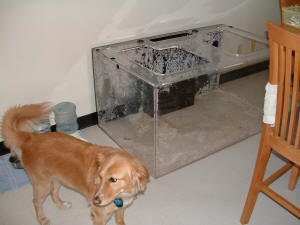
Disinfecting a Used Acrylic Tank
1/12/11
Hello, there! I wonder if you can provide me with some guidance on
disinfecting a used, acrylic tank and some other questions. I bought a
second-hand, 125G (tall) TruVu Aquasystem tank that was formerly a
marine tank, I think. I am going to use this as a freshwater tank for
fancy goldfish. What is the best way to disinfect it?
<Careful (so as not to scratch) light bleaching (outdoors) and soft
scrubbies of some sort... even just wet paper towels>
I have heard the bleach can etch acrylic,
<Mmm, not at household concentrations... but/and I'd dilute this
by about ten times>
so thought about using potassium permanganate.
<Not what I would use... too staining>
However, I was worried it would stain. I contacted TruVu and they could
not advise me and seemed completely unfamiliar with PP in any case.
<Unusual... the old partners who started, ran the co. were fine
fellows...>
Can I PP the tank?
<You could...>
Or, if it is really OK to use bleach with this tank, what proportion
bleach/water will do the job without damaging the acrylic?
<As stated... an order of magnitude is about what I'd use...
Rubber gloves, olde clothing...>
I did rinse the walls with white vinegar and then filled the tank with
a weak solution (about 5-6 G white vinegar in there), but I am
concerned it was not truly sterilized at that proportion.
<Likely is.>
What can I use/what is sufficient? Also, do you have any idea how
many/what volume bio-balls I need to buy for this size Aquasystem?
<Am not a fan. Please read here: http://wetwebmedia.com/bioballfaq2.htm
and look into other filtration moda>
I see that you used to sell these tanks, so perhaps you know;
<Ah yes>
strangely, TruVu's customer service, though quite pleasant, could
not tell me this, either..
<Geez; not helpful>
It is maddening, as I am all afire to get this tank up and running-but
I want it to be safe for my fish. Thanks so much for your help, once
again! Catherine
<Welcome! Bob Fenner>
Cleaning My Acrylic Tank – 04/07/10
Hello,
<<Hi Leah>>
I have been researching ways to best clean the inside of my acrylic
tank as it has some hard to remove algae on it.
<<Mmm, yes…I do understand. I too have an acrylic tank and
although I do like it very much it can be a bear to clean without
causing damage/scratches. The best “device” I have found for
removal of stubborn algae/Coralline algae is a scraper made from the
same material as the tank (i.e. – Acrylic). You can make your own
like I did if you’re handy/comfortable with cutting, bending, and
shaping ½” acrylic…or you can buy readymade scrapers here
(http://www.aquariumarts.com/acrylicscraper.html ). I have tried most
all of the other commonly available “hobby” devices for scraping
algae from acrylic tanks and they either don’t perform very well or
they just aren’t as “acrylic safe” as advertised. You still have
to be careful with anything you use, but these acrylic scrapers are the
best for removing tough algae deposits on acrylic tanks. I also want to
mention that your best defense in keeping an acrylic tank clean is a
“daily” wipe down of the panels with a quality “acrylic safe”
magnet cleaner like those offered by Algae Free and
Magnavore>>
I read online somewhere that Mr. Clean Magic Erasers work great and
don't harm reef tanks...do you know if this is true?
<<I haven’t heard this myself…and I would be reluctant to
give it a try as I suspect they may be too abrasive>>
I have a few soft corals, 2 Percs, a feather duster, a peppermint
shrimp, an anemone, and a couple snails. It sounds like it would work
great but I didn't know if there was any harmful materials in
it?
<<The material may well be “inert” enough…I’m just not
sure it is “acrylic safe”>>
Thanks for your time,
Leah
<<Happy to share… EricR>>
Re: please help with my sick loach and
suffocating fish... & Acrylic tank cleaning & &
& 1/10/2010
you guys rock! so quick to get back to a question! love it...
<I sensed the need to respond quickly>
wow, what a panic attach I hat at midnight! so, after I applied the
power head with air, and pointed the canister filter output nozzle
at the surface of the water, it is 7:47am the next morning. I think
I had nightmares about my poor fish.
<Not good to have such apprehension that one loses sleep>
everyone looks good. I lost two large green tiger barbs from the
high ammonia/nitrites and no oxygen but other than that, everyone
looks to be good. my loach in my sick tank is still acting funny.
not swimming properly, labored breathing, but will get a burst of
energy to flail around the tank and then lay on his side at the
bottom again.
<Patience here, and NO feeding, till the ammonia is below 1.0
ppm>
I'm monitoring the sick tank ammonia, nitrites and such and
they are good. because of my no oxygen scare I put a small air
bubble wand into my sick tank.
<Won't hurt, might help>
I figure I can wait a few days to see if the loach gets better but
the water quality is good. I will pick up ammonia stuff today but
last night was too late.
nothing was open but because of my water changes the ammonia is
down to 0.
<Very good>
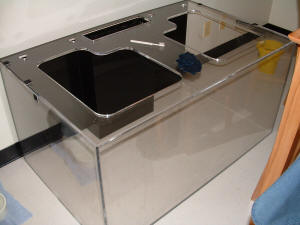
ok, second scenario...I have just purchased a used 150 gallon
acrylic custom tank from someone who was using it as saltwater. its
48" long, 24" tall, 30 wide. it took me three days to
clean the pink and white coral off but it looks great! (pics
attached).
<Good job!>
fyi, credit cards work good on acrylic (after I abused two of mine
on this project) but the plastic putty knives work even better.
<Thank you for this input>
I saw them after I was almost finished so I used them the last day
of cleaning. I have multiple questions I have been trying to find
an answer for:
1) the canister filter I just bought is intended for my 150 gallon.
it says it can filter up to 150 but is that always true?
<Mmm, best to think of such gauges as rough guidelines... there
are other "rules of thumb" re flow rate vs. volume of
system served, but obviously, more highly stocked, heavily fed
systems need more filtration, circulation, aeration...>
I have bought a second one thinking I would need it but do you
think I will?
<I'd put it on in any case. Better to have more than one
source of filtration>
it is a Marineland multi-stage canister filter c-530. I was told to
buy an Eheim.....
<Eheim's are superior, but...>
after I had already hooked this one up, but it hasn't gotten
bad reviews so I'm hoping it works out. this is the filter that
didn't come with any directions at all (actually very
disappointed about that),
<Write the manufacturer... they have a website...
http://www.unitedpetgroup.com/>
didn't come with information of how the full system works with
the bio balls, etc, or directions of where the impeller is, how to
open the lid without all the water from the tubes running out, etc.
simple stuff that a novice of canister filters woulnt know.
grrrr.
<I agrrrreee!>
2) if I should get a second one, should I just stay with the same
one as my first so I can utilize the same parts, filters, etc? or
would it behoove me to switch and go Eheim?
<IF money is not dear, I'd get/use Eheim... I have for
decades... though our businesses (retail and service) sold,
serviced other makes>
3) I am planning on doing a FW planted tank. so far I have one
plant left that my algae eater has not managed to fling out of its
corner with his tail. my questions is...since its 24" tall but
30" wide what type of lighting would be good?
<Please read here:
http://wetwebmedia.com/PlantedTksSubWebIndex/AquariumGardenSubWebIndex.html
the fourth tray down...>
everything is for coral with the actinic blue lights but I
don't need that. but because of the width and height I am
confused as to which light would be the best option. compact
fluorescent or High output lights?
<These could work... I'd look into T5 technology...>
I live in a HOT environment in the summer so I want to stay away
from metal halide (not to mention a bit out of my price range).
I'm also living overseas (husband is military) so getting items
can be a challenge. a chiller would be nice but out of the question
at this point in time.
4) with the acrylic tank, there was a cubbie hole in the back of
the tank to hide all the hoses and as a overflow for saltwater. is
it easier to keep it as a overflow and just figure a way to attach
my canister hoses to that so the holes in the bottom of the cubbie
hole (that the hoses come out of) don't leak water out of the
tank or should I find something that will seal the holes and use
the canister filter output and input tubes to hang over the side
like I do currently? not sure which is the best route to go.
<Either more plastic sheet cut to accommodate the hoses, or tape
or such over them to prevent jumping>
5) I mentioned the current freshwater plants that I do have, but
they are the same size I bought them a year ago. they don't die
but they don't grow.
not sure if its because I don't add fertilizer but with the
amount of fish I have it shouldn't be a problem. I have a
compact fluorescent tube light from the diy store which I thought
would be good but they just haven't thrived.
any ideas?
<Please read...>
I am wanting to do a planted tank but so far, I have failed at it.
my fish uproot them so they always float to the top or they just
stay stagnant....
I have more questions but this is all I can type for now. I
received my tank three weeks ago and these are the questions I have
been researching online but to no avail. people give me their ideas
on lighting but they come from a saltwater community so I don't
feel that they are fully knowledgeable...thank you so much for your
time with me! I
<Bob Fenner> |
 |
Acrylic and vinegar 4/16/09
Hello.
<Hi,>
A woman I know has a small acrylic aquarium and had 3 goldfish and what
looks like a Pleco of some type. She called me and told me that she
cleaned it out with vinegar water and rinsed really well, she told me
just the aquarium not the rocks or any thing else. She then put her
fish back in.
She told me the next day they all were dead except the Pleco.
<Oh!>
She asked me if she should get more fish. I would guess that may have
saved a few more fish. I have a small tank and I told her she could put
the 4 inch Pleco in it till she figures this out. Are acrylic aquariums
porous
and take in the vinegar to the point it can't be rinsed and if that
is not so than I am wondering if I didn't get the whole story.
<Vinegar is not toxic to fish, at least not in the trace amounts
likely to be left behind after cleaning the lime from an
aquarium.>
Either way I believe she is buying a new tank or planning on really
rinsing out the other one as of now. I also believe she uses distilled
water for her water changes and I though the fish needed the
minerals.
<Ah, this could easily be the reason the fish are dead. You cannot
keep fish in distilled water. You are absolutely correct about this.
While the need for minerals is vague (there's little evidence fish
absorb minerals they need like calcium and iron from the water) they do
need water to contain at least some minerals for reasons of
osmoregulation. This is the balance of salt and water in their tissues.
In distilled water they will be losing salts from their bodies at an
alarming rate. Even soft water fish will be living in water with at
least some, albeit small, amounts of minerals in the water. Moreover,
sudden changes in water chemistry can be lethal.>
Thanks for the answer. Maybe the last one will have a chance.
<Your friend needs to read a fish book. If she's keeping
Goldfish, they need hard, basic water. Regular tap water is usually
fine. Distilled water or water from a domestic water softener should
not be used (though for
different reasons, the first for reasons explained above, the second
because it contains too much salt). They also need big tanks; 30
gallons is about the minimum realistic size if you want healthy, happy
fish. Smaller
tanks just don't work and aren't fair on the Goldfish (akin to
keeping a dog in a closet). Have your friend look over the following
articles, one on Goldfish, one on stocking small tanks, and one on
water chemistry:
http://www.wetwebmedia.com/FWSubWebIndex/goldfish101art.htm
http://www.wetwebmedia.com/ca/volume_5/volume_5_3/stocking.htm
http://www.wetwebmedia.com/FWsubwebindex/fwh2oquality.htm
These should keep her going for a while *before* she buys any more
fish!>
Sherri
<Good luck educating your friend, and well done for helping out!
Cheers, Neale.>
Acrylic Magnet Cleaners 1/15/09
<Hello Ryan, Minh at your service.>
For my 180-gallon tank upgrade I went with acrylic since I live in CA
and you guys seem to recommend acrylic. My question is, what brand
magnet cleaner do you recommend for acrylic tanks? My tank has been up
and running a few days now and I need to get one soon.
<For larger and thicker acrylic aquariums, "Mighty
Magnets" are considered the best. These are often used by
professionals. More information can be found here:
http://www.mightymagnets.com/.>
Thanks you!
Ryan
<You're welcome. Cheers, Minh Huynh.>
Another Acrylic Woe 10/24
Hello
crew,
<Hi there Greg>
I have a six gallon (eclipse six, acrylic) tank. I also have a lot
of coralline algae on it. Now my question is, what's the
ideal scraper (money no object) for the job? I've looked
at a few from Kent and Aquarium Art. These seem good, but I
really can't tell. I'd love to get your opinion on
the matter. Thanks again for an incredible
web site, Greg
<Either is fine, but be aware that they still do scratch the
surface. You must be very careful to not get any sand in
between or so on. Unfortunately this is a big issue with
acrylic tanks! Jen S.>
Maintenance...Cleaning Coralline Deposits On
Acrylic - 10/15/06
Hello Crew,
<Hiya Dave>
I have a 300g. 7/8" thick acrylic tank. I had to be gone awhile
and my son took care of the tank. The fish and corals are just
fine. The water parameters are OK. The equipment is working fine. But
he didn't clean the algae, diatoms, etc. off the tank. Now
there are fairly large areas of gorgeous purple coralline algae on
the front panel of the tank. (The way the tank is placed, only the
front panel is an issue). I have a Magnavore 8 cleaner, a long
acrylic safe scraper, and a short hand scraper. Some of this stuff
is tough, tough, tough. I work with my hands and they are quite
strong, but this is ridiculous. Is there any other way to help
remove this stuff short of a jack-hammer?
<I do not believe you will find an easy way, Dave. The
tools you are using are norm for the problem. Read FAQ's
here re this subject for other suggestions. http://www.wetwebmedia.com/corlinecompfaqs.htm
Thanks in advance.
<You're welcome, James (Salty Dog)>
Dave Harvey
-Cleaning Acrylic- 8/28/06
Hello,
<Hola>
Read articles and FAQs, but couldn't find the answer...
Is there any safe cleaner I can use to clean adhesive from acrylic
pieces for a DIY fuge? I peeled an adhesive plastic lining of off them
and want to get any residue off and make them safe for my marine system
water. Is this possible? Rubbing alcohol/bleach?
Thanks,
Michael
<Rubbing alcohol works well, vinegar diluted in water works if the
acrylic is soaked in it, soap and water if you wash out the acrylic
well afterward, quite a few choices. I would not use bleach
though, may leave a residue if not cleaned off well, and a bit too
strong for a first use.>
<Justin>
Algae and acrylic
Hi Bob,
<Steen Erik>
I live in Thailand (Dane, retired).
A few years back I made an outdoor aquarium which, after 1 1/2 cm thick
glass exploded during filling, was empty for a couple of years.
I then had the glass replaced with 4 cm. thick acrylic and actually got
it to work. After a year or so it started leaking and I had the inside
coated with fiberglass. Unfortunately the people doing this also
damaged the acrylic and after one year the aquarium started leaking
again.
<No fun>
In the meantime I had started a 1,500 liter. aquascaping tank and found
it really beautiful. I consequently decided to have the big tank
repaired and prepared for aquascaping. The dimensions are 1,30 m deep x
3,60 m long x 1,65 m wide. Originally it is 2 m deep, but I have build
in a 'false' bottom at 1,3 m as I don't think any plants
can grow at this depth.
<Wowzah, this is a deep tank... usually I like ones I can stick my
arm in all the way to the bottom... this one I'd have to dive in
to!>
Water and plants came in on 1/29 this year with 50 Siamese algae-eaters
added a few days later. It took me a couple of weeks to get the CO2
system to work properly (self-constructed, but it works). I am using a
submerged pump (8,400 lit/h) and a sand filter in connection with an
Eheim 1000 lit/h filter connected to a C02 reactor. No noise and
absolutely no plastic, hoses or anything else visible in the tank.
<Outstanding>
Everything works fine now except for the algae on the acrylic. As you
can imagine I am actually in the water when cleaning,
<Yes, I can>
but even using all my power with a soft cotton cloth, I simply cannot
get the algae off. The first tank I had got a lot of scratches and
having spent another US$ 10,000 on this one I do not want a repeat.
<I understand>
The company installing the acrylic told me to use soft cotton cloth for
cleaning only, but having spent 5 hours in the water today, all muscles
in my arms hurting, and still algae on the acrylic I am getting a
little bit desperate.
<Yes>
Anything you can suggest would be highly appreciated.
Best regards,
Steen Jansen
<A few "things" come to mind... most importantly,
"just" waiting a few more weeks to a couple months may well
lead to succession of sorts with the harder, more resistant algae being
replaced with softer varieties your SAE's can/will be able to
remove. Besides that though, there are newer types of "algae
magnets" that are useful for acrylic tanks (won't scratch
unless you get gravel stuck between them) that I encourage you to look
into... the bigger size ones the better... and hopefully folks have
them there in Thailand for sale or you can find an etailer that
can/will ship them to you. Lastly, do look into Eheim's Ehfi-Grob
or Fein filter media... a one-time purchase of a bit of this
polyethylene canister filter "wool" will help you in your
scrubbing safely. This material is what our service companies mainly
employed as "scrubbers" for large (expensive) acrylic tanks.
Unfortunately, there are no useful "biological cleaners" or
chemical treatments to recommend. Bob Fenner>
Re: Algae and acrylic
Hi Bob,
Thank you for your quick response.
<Welcome>
I have a feeling that there are different kinds of acrylic, some more
soft than others.
<You are correct... even gauged by their percentage of water
content>
The first time I cleaned the tank, I used water and a (I thought) 100 %
cotton tea towel on the outside. That actually scratched the acrylic! I
am now using an extremely soft synthetic Chamois for outside
cleaning.
<I see>
The only kind of biological cleaner I know, and have used with success,
is Barley straw. That kills the algae (green water algae), but not the
algae growing on glass and acrylic. I have a garden pond with 6
Piranhas ( 35-40cm and weighs in at around 3-4 kg) and barley straw
keeps that pond crystal clear despite heavy algae growth on the walls.
The problem with Barley however is that it needs to be in direct light
and in big bags this is not a nice view in an aquarium!
<Yes... useful in ponds, but not aquariums>
I realize that the tank does need a break-in period and things may with
time change to the better. As an example the hardness started at 5 (my
water supply is 2) and then grew by 1 a day up to 12 KH. By cleaning
the tank every 4 to 5 days and change of 20% of the water KH is now 7
and only going up by 1/2 to 1 per day. I intend to run it at around 2
to 3 KH as the other tank I have.
<Good accounting>
I am protecting the tank from direct sun (one side covered during the
day).
The other side does not receive direct sun, but to avoid reflections it
is covered until around 11 AM. For lighting I am using 36 18w tubes
with reflectors, 50% 11 AM to 10 PM, 100% from 2 PM to 8 PM. Do you
think this is too much and could be the reason for the serious algae
growth and hardness of the algae?
<Not likely... due to the depth of the system. I do think your and
I's comment re "a break in period" is useful here. Over
time your live plants should sharply limit nutrient availability to the
algae and compete biochemically with it>
Unfortunately Thailand is a real 3rd World country if you need
something special (I had to import my C02 computers myself) and even if
I order and buy an algae cleaning tool with 100% no scratching effect,
I cannot depend on what the dealer tells me. I have looked at
Eheim's web pages, but cannot find the products you mention. The
wool I use in my Eheim filters seems very hard to me and I would be
afraid to use it on the acrylic.
<They are there: Ehfi-Grob and Ehfi-Fein>
I did find a Danish aquarium shop selling non-scratching brushes for
acrylic though, so I will email them to see what they can
guarantee.
Thanks again.
Best regards,
Steen
<Hope to see your system in person one day. Bob Fenner>
Cleaning Refugium
I just finished building a custom
acrylic sump/refugium. In the process I used some buffing compound and
polish both inside and out ( mostly outside). What should I use to
clean it with before using it? Rinse it with water, bleach, vinegar or
other?
<Just freshwater and paper towels>
PS Just ordered the new WWM Reef Inverts. book to read on vacation.
Thanks as always, Ken
<Know you will enjoy it. Bob Fenner>
Magnet Cleaners for Acrylic Aquariums
Do you recommend
using magnet cleaners for acrylic aquariums. I have a 160
gallon (only a few months old so we have lots of algae blooming!) and
it is killing me to clean the tank. Would a magnet
help? I have found one that I'm interested in getting
(see link below). Wanted to make sure you didn't see any
problem with using them. Thanks! http://www.reefgeek.com/products/categories/cleaning
equipment/103899.html
<I like credit cards for a first go at knocking off anything
"gritty" (like small encrusting worms, coralline algae), then
these "acrylic safe" floating magnets. Bob Fenner>
Magnet Cleaners for Acrylic Aquariums
credit cards will
definitely not scratch the acrylic?
<They never have when I've used them. Many types of scrubbers
work fine if regularly employed (once, twice weekly) with care to not
"pick up" gravel et al. material twixt the pad and the
acrylic. My all time fave material is the "Grob Flocken" of
Eheim.
Bob Fenner>
- Cleaning Acrylic Tanks -
credit cards will definitely not
scratch the acrylic? <Not in my experience. Cheers, J -- >
Magnet Cleaners for Acrylic Aquariums
Do you know where I
can get "Grob Flocken" of Eheim? Do places like
Marine Depot or somewhere else carry it? Thanks so much for
your help! :)
<Most all dealers of Eheim products sell their media. It's the
larger grade white one... comes in a couple size boxes... the small one
will do... the stuff lasts forever... or at least half this long. Bob
Fenner>
Is acrylic scratch remover safe for fish?
Hello Mr.
Fenner,
I just got finished putting my new tank together. I have the
powerheads, the heater, and the aragonite sand and water in. I have not
yet put it the salt. I'm just testing the components and letting
the sand dust settle. While inspecting my tank, I noticed in the light
that there seems to be a very slight haze in a couple upper corners of
the tank. I believe it might be from the TruVu SRK (scratch remover
kit).
<This may be so... or typical "stress fracturing" marks
from heat-bending in those areas>
I might of accidentally not rubbed off all of the scratch remover paste
thingy. The water has a oil spill type look when viewed at a lower
angle. Is this bad? Shall I take out the water and wash the tank again?
Please help. Thank You.
<Ahh, our businesses (retail and service) used to sell many
TruVu/Aquaplex tanks... and I've spent many hours with the green
and tan pastes you mention in their scratch removal kit. This material
is not toxic. I would not take the tank down, or worry. Bob
Fenner>
Stan
Re: Is acrylic scratch remover safe for fish?
Thank you
very much. That is what some people suggested on ReefCentral, but to
hear it from an expert like you makes me feel so much better.
Thank
you again and have a Happy New Year.
Stan
<You as well my friend. Be chatting. Bob Fenner>
Taking out scratches from the inside
Bob,
do you know of any acrylic scratch removal kit that works
underwater?
<No... all require draining the system at least down to the level of
the work. Bob Fenner> Thanks,
Lee
Used/Old 100 Gallon Acrylic Tank: DIY Cleaning\Maintenance
9/22/2009
Hello!
<Hi David, MikeV here.>
I recently acquired a *very used and dirty* 100 gallon (60 x 18 x 20)
acrylic aquarium tank.
<Congratulations.>
It's so dirty and scratched that I'm considering putting in a
bleach solution to sit over night (or longer) before cleaning it more.
Previously, it was sitting outside someone's house (unused) for 3-5
years and when I emptied out the dirt and leaves I also found a dead
bird's corpse as well.
Do you have any suggestions on how to clean this, more than a bleach
solution and lots of soft scrubbing? I'm told there are no leaks,
so if I can't get the scratches out, I want to use it as a sump for
a larger/future
system.
<The trick to cleaning it is to minimize any additional scratching.
Rinse it with lots of water, and let it soak full of water for a day or
so to loosen any dirt. Once the tank is clean, wipe the acrylic down
with vinegar That should remove any yellowing in the acrylic. You can
bleach it to sanitize after this.>
Thanks!
<MikeV>

