|
Related FAQs: Characoids/Tetras & Relatives,
Characoid Identification, Characoid Behavior, Characoid Compatibility, Characoid Selection, Characoid Systems, Characoid Feeding, Characoid Disease, Characoid Disease 2, Characoid Disease 3, & Characoid Reproduction,
Articles on Characiform families, subfamilies...:
The Larger Pencilfishes, Family
Anostomidae, Characid/Tetra
Fishes, Alestiine Characid
Fishes, Characinine/Tetra
Fishes, Piranhas and
Relatives, subfamily Serrasalminae, Tetragonopterine/Tetra Fishes,
Cardinal
Tetras, Distichodus and More,
Family Citharinidae, Pike-Characoids, Family Ctenoluciidae,
Curimatidae, Trahiras, Family Erythrinidae, Hatchetfishes, Family
Gasteropelecidae, Hemiodus
"Sharks" and More, Family
Hemiodontidae, The Pike-Like
Hepsetid, Family Hepsetidae, Smaller Pencilfishes, Splashing Tetras &
More, Family Lebiasinidae, Prochilodus/ontids,
Survey Articles on: Extreme Characins Part 1:
Hatchets, pikes, and other lethal weapons by Neale Monks,
Extreme
Characins Part 2: Wolves, vampires, and other
horrors by Neale Monks &
Freshwater
Fishes,
Characoids/Tetras &
Relatives
|
|
| Bob Fenner |
|
The Order Characiformes is characterized by "almost
always" characteristics: Most have well-developed teeth, and
adipose fin is usually present, their bodies are almost always scaled,
most have ctenoid ("Comb-like", interdigitating) scales,
their anal fins are short to moderately long, their upper jaws are
usually not protractile, most have pharyngeal teeth, they almost always
lack barbels...
The bulk of Characiforms are small (don't
tell this to a Pacu owner), many are colorful and popular aquarium
fishes. They (and other fish groups) are ostariophysians (SuperOrder
Ostariophysii... a group of fish families that all possess Weberian
apparatus, a series of small bones connecting the gas bladder and
middle ear... acting as an amplifier; goblet non-secretory cells...
other features) with catfishes, Cypriniiforms (minnows et al.)... Their
diversity as a group is astounding... some reproduce outside the water,
a few live on the scales of other fishes (lepidophagous), others are
fin feeders...
Their taxonomy is a confusing mess. We will stick
with Nelson here (3d ed. currently), but other folks raise and lower
different taxa to different rankings, add other groups from elsewhere,
subtract some that we have here to relocate elsewhere... Depending on
who you believe, there are just one to sixteen separate Characiform
families. For us here, we'll show, umm, ten families of about 237
genera and 1,343 species...
Geographic Range:
Most characiform fishes are found in South
America, with a scattering in Central America and handful in the
U.S.... about 208 species are found in Africa as well.
Size:
From full size Pacus at more than two feet long
and 25 kilograms to quarter inch jewels, most of the characiform fishes
are on the small side; a few inches in length.
Survey/Links to Families/Subfamilies of Characiform
Fishes:
|
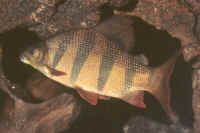
Family Citharinidae:
Includes Distichodus; African. Characterized by internal
characteristics and dentition. Twenty genera, about 100 species.
Two subfamilies (Distchodontinae, Citharinae), but almost all the
pet-fish trade sees in the West are a few members of the genus
Distichodus.
|
|
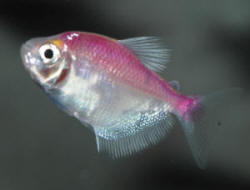
Family Characidae:
|
SubFamily
Tetragonopterine:
Small characin fishes of southern U.S. and South America.
Example genera: Astyanax, Byconamericus, Bryconops, Cheirodon,
Gymnocorymbus, Hemibrycon, Hemigrammus, Hyphessobrycon,
Inpaichthys, Megalamphodus, Moenkhausia, Oligosarcus,
Paracheirodon, Rachoviscus, Tetragonopterus,
Tyttobrycon.
Egads and little fishes!
|
|
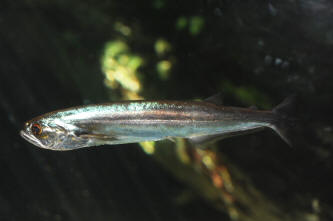
| Family Cynodontidae: Dogtooth Characins;
tropical S. America. Four described species. Here is Hydrolycus scomberoides
at the Steinhart Aq. 2015 |
|
|
Excerpted from: Forgotten Fish; Old-timers
with plenty to offer by Neale
Monks
Overlooked tetras
A handful of tetra species dominate the
hobby, things like neons, cardinals, and black widow tetras being
available in practically every aquarium store and pet shop. But
there are literally hundreds of tetras, and over the years many
of them have been kept as aquarium fish. Quite a few of the
species that became established early on in the hobby were fairly
large and silvery rather than brightly colored. While
unquestionably attractive, they were gradually supplanted by the
smaller, more colorful species.
One such fish is the silver tetra,
Ctenobrycon spilurus. This species gets to about 3"
in length and has a rhomboid shape, and its overall color is
silvery-grey. Hardy, omnivorous, and easy to breed, the silver
tetra is perhaps a bit too large for the average community tank
and certainly far too active to mix with gentle species of fish,
but these flaws become virtues when kept in a large tank with
robust animals like cichlids, barbs, and catfish that might
otherwise scare (or eat) smaller tetras. Like a lot of the fishes
covered in this article, the silver tetra is an adaptable fish,
and can even be kept in very hard, basic water without problems,
something that cannot be said for many of the more delicate
tetras. Very similar in terms of hardiness, but more brightly
colored, is another silver tetra, Tetragonopterus
argenteus. This fish has an almost circular body, a brilliant
silver sheen, and bright red ventral fins. A black spot on the
base of the tail matches its large black eye. Typically getting
to about 3" in aquaria but a little more the wild, this
omnivorous species is easy to keep and makes an excellent
alternative to the larger (and less plant friendly) silver
dollars.
It isn't just big fish on the list of
overlooked tetras; there are some lovely little species too. The
x-ray tetra, Pristella maxillaris, is one of the nicest.
Basically transparent except for a blood-red tail and brilliant
white, black, and yellow markings on its dorsal and anal fins, at
about an inch-and-a-half this vivacious, schooling tetra is a
durable species that will grace any community tank. Exceptionally
adaptable, the x-ray tetra makes an excellent choice for the
aquarist stuck with water that is too hard and basic for other
tetras to do well; in the wild, this fish is even found in
slightly brackish water! Another lovely tetra is the rosy tetra,
Hyphessobrycon rosaceus. Salmon-pink in color and barely
1.5" in length, its deep body and remarkably long red and
black fins give this fish much more presence than you might
imagine. They aren't compulsive schoolers like the x-ray
tetras, and instead sort of hang out in groups displaying to one
another, making them uncommonly entertaining fish. Perhaps their
biggest drawback is their lack of color when crowded into a
brightly lit aquarium at a tropical fish store; get them home to
a nicely planted aquarium and feed them a mixed diet with a
little color-enhancing flake thrown in and you'll soon get to
see the fish at their best! While hardy and adaptable, rosy
tetras do prefer slightly acidic water, preferably filtered
through peat or with blackwater extract added.
|
Bibliography/Further Reading:
General:
Gery, Jacques. 1977. Characoids of the World. T.F.H. Publications
NJ. 672pp.
Nelson, Joseph S. 1994. Fishes of the World. 3d
ed. John Wiley & Sons, NY. 600pp.
Distichodids
Castro, Al. 1998. Some are not nice (in answering a hobbyist's
queries re the genus Distichodus). AFM 9/98.
Lewis, Peter. 1996. The Distichodids; Experiences with a tribe of
the characin family. AFM 3/96.
Walker, Braz. 1969. The distant Distichodus. The Aquarium 10/69.
Piranhas, Silver Dollars, Pacus
Brandy, George and Douglas Campbell. 1984. Some notes on spawning
and rearing the Red-Bellied Piranha. FAMA 7/84.
Dunker, Toni. 1960. Catoprion mento, the Wimple Piranha. TFH
1/60.
Jennings, Ron. 1978. How to live with the Red Piranha. FAMA
6/78.
Meegaskumbura, Madhava P.B. 1999. Breeding and caring for Silver
Dollars. TFH 9/99.
Neal, Tom. The Pacu- A friendly giant. TFH 8/98.
Nico, Leo G. and Donald C. Taphorn. 1986. Those bitin' fish from
South America. TFH 2/86.
Quinn, John R. 1992. Piranhas. Fact and Fiction. T.F.H.
Publications, NJ. 128pp.
Schleser, David M. 1999. Piranhas. A bum rap. Finding the truth
about the misconceptions. AFM 3/99.
Schultz, Harald. 1960. Piranhas- Fact and fiction. TFH 9/60.
Vorderwinkler, William. 1960. The Piranha- a menace? TFH 2/60.
Walker, Braz. 1970. The colossal creampuff. The Aquarium
1&7/70.
|
|