|
FAQs About Clown Loach
Health/Disease
Related Articles: Loaches, Dojos/Weatherfish, A New Look At Loaches
By Neale Monks,
Related FAQs: Clown Loaches, Loach Disease, Clown Loach Identification, Clown Loach Behavior, Clown Loach Compatibility, Clown Loach Selection, Clown Loach Systems, Clown Loach Feeding, Clown Loach Reproduction, Loaches 1, Loaches
2, Loach Identification,
Loach Behavior, Loach Compatibility, Loach Selection, Loach Systems, Loach Feeding, Loach
Reproduction,
|
|
Clown Loach Choked To Death 10/31/19
Hi, I have a, hopefully, simple question. Unfortunately, I lost one of
my 15 clown loach school this evening. This clown loach was just over a
year old and apparently choked to death on one of the ghost shrimp added
to the tank several hours before. I know this to be true because by
penlight, magnifying glass and tweezers I pulled a deceased ghost shrimp
from the deceased clown loach's mouth. I've been stocking ghost shrimp
(30 to 50 at a time) into my tank for the past year or so to keep the
South American Puffers happy and entertained so they don't nip the
Cory's fins or attempt to pick on one of the clown loach (a dangerous
undertaking because if you pick on one, you pick on them all
apparently.) This has been working quite well and my tank has been
completely harmonious until the poor clown died
choked to death on a shrimp. So my question is: am I ok to continue with
adding ghost shrimp to the tank? Is this a freak 'just one of those
things' accidents or are clown loach choking on shrimp a more common
occurrence?
Thanks so much for any knowledge you can pass my way. Carolyn
<Hi Carolyn. This does sound like a freak misadventure, though I would
keep an open mind about the cause of death -- fish don't really 'choke'
because the place where food gets processed is in the throat (what we
call the pharyngeal jaws) which lie behind the gill openings. So the
gill cavity is really more of a big open space with the opercula on
either side, and while food may get stuck in the pharynx for a while, it
shouldn't interfere with the flow of water in through the mouth or out
through the opercula. This
isn't to say something like choking is impossible, but rather that it is
very rare, and requires the fish to do something very stupid, such as
consume dangerous prey (a spiny fish for example) or a solid lump too
big for its pharyngeal teeth to grind up. Now, there is a risk here with
perhaps adding too many shrimps, or shrimps that are too large to safely
process, as a way of getting your South American Puffers to behave. I'd
perhaps handle this a different way. SAPs are mostly surface explorers,
so floating plants are really good for this, and they appreciate ample
swimming space. In a sufficiently large tank for adult Clown Loaches, by
which I mean something like 100 gallons or so for a small group, and two
or three times that for 15 Clowns, I'd rely on depth and benthic hiding
places (such as hollow logs) to keep them safe. Clowns can easily swim
fast enough to avoid trouble, and in sufficient numbers, a small group
of SAPs shouldn't be persecuting any single specimen. I have kept SAPs
with Cherry Fin Loaches, without major problems, but hungry or bored
SAPs can be nippy, even if they lack the aggression of some pufferfish
species. Floating plant roots give the SAPs something to explore where
the Clowns don't go, so could help, especially alongside a floating
bloodworm dispenser or similar to occupy the SAPs throughout the day.
Cheers, Neale.>
Re: Clown Loach Choked To Death 11/1/19
Hi, again and thanks, Neale, for the quick response.
<Welcome.>
I had wondered about the fish's gill/throat/respiration anatomy and the
ability to literally choke to death. I did notice one of the deceased
clown's eye looked odd in death but didn't place any real importance on
it.
It is possible that it may have taken a spine to the eye if the group
was scrumming for that particular shrimp. I would assume an accidental
spine to the eye would usually result in rapid death?
<I would imagine so!>
The clowns and the SAP's are all young, just over a year old or so and
purchased at barely an inch. I ended up with so many clowns because they
were all together at the LFS and the way they shoaled was just amazing.
I had never seen shoaling clown loach before the way LFSs stock small
numbers of them. I figured I would have to deal with white spot (which,
luckily, I did not) and have some natural attrition (which I also did
not.) I'm quite fond of my clown school and a bit proud of the fact I've
had no fish loss
so the clown's death is distressing me. (Full disclosure, I lost one of
the SAP trio from banging into the tank lid chasing a Cory cat to the
surface.
That SAP was so mean and so predatory that I and the tank felt relieved
at the mishap and don't really count him in the numbers.)
<SAPs will nip at Corydoras, though genuinely aggressive SAPs are rare.
Will direct you to some reading, here:
http://www.wetwebmedia.com/fwsubwebindex/ColomesusartNeale.htm
Arguably, the species is best kept in groups but away from other
species. I kept mine with Carinotetraodon irrubesco, a similar-sized
pufferfish that stays close to the substrate. But the general advice,
and certainly the safest, is keep a group on their own.>
They are currently in a 55 gallon tank while I've been saving and
planning for a custom 150 gallon corner tank (due to room space
limitations) which I should have the beginning of the new year. Assuming
successful fish keeping over the next 10 years, I know I will need to
double that tank size.
<Understood.>
The tank is set up with plenty of driftwood, hollows, and hides, as well
as, live plants on the sand bottom and a large artificial floating plant
at the surface where the majority of the shrimp like to stay. Twice
weekly water changes keeps the nitrates in check for my currently
overstocked tank with 0 ammonia and 0 nitrites and I test at least twice
weekly. I will be relieved to move everyone into a larger, more
appropriate tank size.
<As will they!>
Anyway, the puffers definitely prefer to search for the shrimp at the
surface as you described.
<Yep. This can be useful for feeding them, e.g., with prawn or white
fish fillet smeared into pumice stones. The stones may even help to wear
their teeth down a bit.>
The puffers are certainly not predatory to the clowns or Cory cats in
the tank but will certainly attempt to fin nip any unsuspecting tank
mate when bored or move obsessively along the glass of the tank. I've
found that adding in only 10 shrimp creates a shrimp 'massacre.' I've
noticed that the large quantity of shrimp seems a little overwhelming
and distracting for the puffers (they scare me when they glut on so many
shrimp they are bloated and can only move listlessly along the bottom.)
The shrimp seem to
be helping to keep their teeth down as well as I've yet to do dentistry
and they're over a year old. I'm wondering why would adding too many
shrimp at one time not be ok? Is it a bio load issue?
<Yes; and in any case, shrimp (and mussels) should collectively make up
no more than one-third their diet. Shrimp, mussels, and a few other
commonly used foods contain a chemical called thiaminase that breaks
down vitamin B1. Over recent years, aquarists and reptile keepers have
become aware that
many mysterious failures with carnivorous fish and reptiles may be due
to thiaminase deficiency. So thiaminase-free foods should make up the
majority of the diet to avoid this; such foods as cockles, earthworms,
and most types of white fish fillet including Pollack and tilapia. Squid
may or may not be good depending on the species.
http://www.wetwebmedia.com/ca/volume_6/volume_6_1/thiaminase.htm
So while frozen shrimp are popular, they should be used sparingly. Live
shrimp are 'safe' if gut-loaded beforehand, but should otherwise be
treated like frozen shrimp and used as treats rather than staples.>
Thanks again, Neale! And sorry for the book! Carolyn
<Not a problem. Cheers, Neale.>
|
Clown loach coloration issue
3/29/19
Hi,
<Hello,>
I own one clown loach that has been living in my aquarium for the past 20yrs.
<Wow!>
Two month ago we relocated to a new house. I abandoned my old aquarium of 350L
and got a smaller one of 180L due to space restrictions. All the fish are fine
and had no issues until last week. I started noticing that the clown loach
behavior is not as usual, not eating and losing his colors pigmentation on his
body and fins.
I don't want to lose it after such a long time.
<Understood.>
I'm desperate for any help
Thanks
Nemer
<My instinctive reaction here is something like Hexamita, or some other
protozoan infection similar to Hole In The Head disease as seen in cichlids.
That being the case, a combination of Metronidazole alongside an antibiotic
(Nitrofurans are often recommended) would be the usual treatment. Any such
treatment would need to be alongside optimising living conditions. The smaller
size of your tank could easily be the problem here.
Clown Loaches react badly to high nitrate levels, and in a smaller tank nitrate
levels would rise quicker than in the bigger aquarium. Could I also suggest you
post at Loaches.com. They're a great place for loach-specific help, and have a
free online forum. Cheers, Neale.>
|
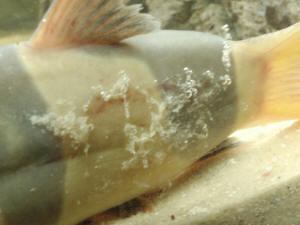
.jpg)
.jpg) |
Need advice for very old clown loach; HLLE?
2/25/17
I recently moved my 20 year old clown loach to a new larger aquarium. He
was healthy and happy in my 29 gallon ( I know, way too small for a
clown) I had hoped to rehome him as he is the lone survivor from a
larger tank many years ago.
<Understood.>
Because I could find no suitable home, I got a 55 gallon to give him and
his angelicas Botia buddies more room ( I do not have room for a larger
tank).
<Also understood. While not ideal, there are plenty of Clowns that have
lived good lives in 55-gallon tanks, provided water quality is good.>
The move was stressful for him and he does not look well. He would not
eat for the first two weeks and then looked like he had hole in head
disease with small pits on his face and lateral line. He appears to be
eating or at least dragging food into his cave.
<Good.>
This morning he looks like he is developing pop eye. I cannot quarantine
him as the stress of moving yet again would likely kill him.
<I agree; at least, it would be stressful and unlikely to help.>
My water parameters for the tank are: ammonia=0, nitrite=0,
nitrate=40ppm, ph=7.9.
<All sounds fine.>
I’ve done a small water change and am trying some medicated food, a mix
of SeaChem focus and Sulfaplex soaked in garlic guard. Any advice you
can give to help me save my fish would be greatly appreciated.
Thank you,
Gretchen
<I do think you need to treat as per Hole-in-the-Head and Hexamita.
Metronidazole is the drug of choice. Be sure to remove carbon and other
chemical media from the filter, if used (carbon removes medicine). The
pitting will heal over time, but you need to keep the fish free of
secondary infections, so ensure an optimal, vitamin-rich diet (fresh
greens, in particular, such as peas and Spirulina-enriched brine shrimp)
alongside top-notch, oxygen-rich water. Hope this helps, Neale.>
some clown loach wont eat 5/4/16
Hello, Apart from that gold Severum i ask you just now, two of my clown
loach wont eat after a few days of introducing that gold Severum.
<Usually these two species coexist well. Do review environmental conditions.
Severums and Clowns both want warm water (25-28 C/77-82 F) and neither do well
in especially hard water (1-15 degrees dH, pH 6.5-7.5 is fine). Clown Loaches
are especially intolerant of ammonia, nitrite and copper. Severums are, like all
cichlids, intolerant of ammonia and nitrite, but high nitrate levels cause
serious harm too. Both need plenty of space.
300 litres/75 US gallons would be barely adequate for a single Severum alongside
two or three Clowns; and realistically, 400 litres/106 US gallons is the minimum
for long-term success given the size of the adults. If
either species refused to eat, you can be 99% sure it's an environmental issue.
So review, and act accordingly.>
now i have remove that gold Severum but still the two clown loach wont eat, my
other fishes in that tank are fine, including the rest of the clown loaches,
four of them will eat and two wont eat.
<See above.>
thank you. my clown loach that wont eat has lighter dark stripes than those who
eat, is this cause by a disease? And one of it has a little red in its
nose, is it normal? thank you.
<Dark colouration on Clowns indicates stress. Red (abnormal) patches on fish
indicate injury and/or inflammation. Something is WRONG here; your job is to
determine/diagnose the problem. Obviously adding medication before
figuring out the problem would be pointless, and given the nature of Clown
Loaches, quite possibly lethal.
Cheers, Neale.>
Very sick clown loach
12/24/15
Hi Crew!
<Rhi>
I've just discovered one of my clown loaches is very sick. He looked fine
yesterday but tonight I found him wrapped around the filter intake.
<Oh; bad>
I've moved him away from it but he looks about to draw his final breath very
soon. I don't know if you can help shed any light on why.
<Let's see>
I have an established 150l tank with two other loaches, an angel, a Bristlenose
Pleco and 3 phantom glass catfish. Just tested the water parameters and ammonia
is 0, nitrite 0, nitrate a bit under 5ppm, ph 7.2.
Tank gets bi-weekly 25% water changes and parameters have been unchanged for
years (only test every 3-6 months now). I've not added new stock for a very long
time following a bad experience about 2 years ago where my tank inherited worms
from my lfs (my fault for not quarantining i know). I treated the tank
successfully (many thanks to the FAQs here) and the tank to my knowledge has
been disease free since.
The only change I've made was this week when i added a canister filter (its a
1000l/hr one, the other is about half that) alongside my little filter in the
tank. Im about to upgrade to a 250l tank and was hoping to speed up the cycling
process of that by giving it a week running on the established tank.
<A good move, action>
This feels like a silly question but is there any way this has negatively
affected my tank... is it possible to over-filter? Or is having the water
predominantly going through an unestablished filter causing a problem?
<Shouldn't be>
Is there anything else I've missed?
<Not from what you've listed. Would like/need to know the stocking, feeding,
water quality....>
Thanks for your incredible work here all. I hope you're all enjoying some quiet
time with family over the holiday season.
Kind regards,
Rhiannon
<The first guess that comes to mind is that the one loach is being bullied by
others of its own species, perhaps the Ancistrus.... getting weak from too
little nutrition. Bob Fenner>
Clown loach sick 11/18/14
Hi,
<Howdy Laura>
I have a 2 year old clown loach. I currently have 2 mature loaches and 2
new babies. I lost one loach a week ago - he jumped out of the tank.
<Aye ya; does happen with Cobitids>
Recently one of my mature clown has started to act weird, I found him
tonight on his side, breathing rapidly and acting weird. I know clowns
do like to sleep on their side but mine have never done this. He is
currently got part of his head in the gravel. I took 25% of the water
out and increased the oxygen.
There is no sign on his body that he is sick, his colours, gills and
fins are all looking normal.
<Mmm; have there been any new fish additions recently? Am wondering re
the poss. of a pathogen being introduced>
My fish tank is newish - I moved them in their about 5 months ago. It is
a 120LTR 4 ft tank.
I currently have an algae problem that I am trying to deal with but it
keeps coming back every couple of days.
<How are you "dealing" with this? Not a chemical algicide I hope/trust.
These are too toxic...>
Apart from one loach doing a leap of faith, the next day I found my 3
year old algae eater dead for no real reason - I put it down to old age.
<Mmmm; coincidence? What are your water test results? History?>
I have done all of the normal tests and they are in the normal ranges
and the temp is 25 degrees Celsius.
I don't want to lose this boy, so any advice you could give me would be
a lifesaver!
<Data please. Bob Fenner>
Clown loach sick /Neale
11/18/14
Hi,
<Salve!>
I have a 2 year old clown loach. I currently have 2 mature loaches and 2
new babies. I lost one loach a week ago - he jumped out of the tank.
<Oh dear.>
Recently one of my mature clown has started to act weird, I found him
tonight on his side, breathing rapidly and acting weird. I know clowns
do like to sleep on their side but mine have never done this. He is
currently got part of his head in the gravel. I took 25% of the water
out and increased the oxygen. There is no sign on his body that he is
sick, his colours, gills and fins are all looking normal.
<Clowns are social, so this could be some sort of social behaviour. If
it is, it should settle down. But also be aware of environmental changes
that might have caused problems. Not just the obvious ones, but also
things like
copper (in your tap water, even if you haven't used a medication in a
while) as these can affect Clowns.>
My fish tank is newish - I moved them in their about 5 months ago. It is
a 120LTR 4 ft tank.
<Will need a bigger tank; 120 litres (30 gal.) is fine for youngsters,
but adults will need 350-450 litres (90-120 gal.) at least. They get
huge! So while they grow slowly, don't underestimate their final size.>
I currently have an algae problem that I am trying to deal with but it
keeps coming back every couple of days.
<Do wonder if your tank is/has become unstable through
over-stocking/under-filtering. Do check nitrite for example, a few times
across the day, and likewise for pH. Unstable conditions frequently
prompt algae problems, especially blue-green algae and diatoms. Brush
algae and hair algae are more characteristic of chronic problems, such
as those caused by insufficient water changes. Either/both could affect
miners' canaries such as Clowns.>
Apart from one loach doing a leap of faith, the next day I found my 3
year old algae eater dead for no real reason - I put it doen to old age.
<Does depend on the age... Clowns should live at least 12-15 years, and
over 20 years is far from rare.>
I have done all of the normal tests and they are in the normal ranges
and the temp is 25 degrees Celsius.
<Going to direct you to some reading, here:
http://www.wetwebmedia.com/ca/volume_6/volume_6_2/loaches.htm
http://www.wetwebmedia.com/FWSubWebIndex/cobitids.htm
http://www.wetwebmedia.com/FWSubWebIndex/loachdisfaqs.htm
Clown Loaches, like most botiid loaches, are somewhat sensitive fish,
and most problems with them are linked to environment rather than diet,
genes or even bad luck.>
I don't want to lose this boy, so any advice you could give me would be
a lifesaver!
<Well, maybe the above will help. Cheers, Neale.>
Re: Clown loach sick /RMF
11/18/14
Hi,
<Hello again Laura>
Yes I have introduced some new fish - after the algae eater and the
loach died I decided to pick up some more clowns to keep the other two
busy and social. I picked two very good looking and healthy baby
loaches, the guy
at the shop through in an extra baby without me even knowing until I got
home. This one was weird looking, the body was hollow, and looked
stretched out, his gills were brown.
<Rats... too likely the source of your (Protozoan probably) issue>
I put him into isolation for a couple of days and then released him into
the main tank. He dies the next day
unfortunately and I didn't notice the body as it was under a rock for 2
days.
Im dealing with the algae by using API - algae fix,
<STOP! Search WWM, the Net re this product. Dangerously TOXIC>
only half does and not every three days as it recommends. I have asked
every shop owner around my area and they tell me it is safe to use on
loaches,
<They are wrong; I assure you>
haven't had a problem wit it in 5 yrs.
I also have Kuhlis in my tank, I have had them for over 3 years and they
are looking happy.
<Mmm; strange... they should be similarly affected>
I have looked for my clown but I am unable to find him.
History of the tank:
We I bought it over 8 months ago and slowly got it ready, let it mature
and 5 months ago I realsed ny fist lot of fish. I check the tanks PH,
nitrates, nitrites ect every week.
PH always stays around the 6 mark
<This is a bit low. Do you have another test kit you can check this
against? Barring that, I'd take a full small jar of your system
water to a shop and have them test it>
Hardness test is around the 30 mark nitrate and nitrite are
always zero.
<Zero NO3? Suspect>
I have a massive canister filter that is actually to big for this tank
<It's almost impossible to have no nitrate at all with the use of a
canister filter>
I do not have an overpopulation problem, I only have 10 fish in a four
ft tank Water gets changed every week, when the algae problem hit the
guy at the fish shop recommended to take 25% water out ever three days,
I did that for 1 week and saw how it was affecting my fish so I did not
continue.
The algae problem started about a month ago, I moved the tank to a new
home ( I use the exact same water as both homes are next to each other)
It is natural rain water that I have been using every since I have had
fish,
I live on a farm so no chlorine could have gotten in the water. I asked
the fish shop owner in my area what I could do to get rid of the algae,
he gave me this "Detox" stuff that is suppose to get rid of all the
toxins in the
water and introduce the right kind of bacteria into the water. I used it
once and saw no improvement after a month so I haven't used it since.
<... please learn to/use the search tool, indices on WWM. Can you find
the coverage on freshwater algae control?
READ there. Bob Fenner>
Re: Clown loach sick /Neale
11/18/14
Hi,
<Laura,>
Yes I have introduced some new fish - after the algae eater and the
loach died I decided to pick up some more clowns to keep the other two
busy and social. I picked two very good looking and healthy baby
loaches, the guy
at the shop through in an extra baby without me even knowing until I got
home. This one was weird looking, the body was hollow, and looked
stretched out, his gills were brown. I put him into isolation for a
couple
of days and then released him into the main tank. He dies the next day
unfortunately and I didn't notice the body as it was under a rock for 2
days.
<Oh dear.>
Im dealing with the algae by using API - algae fix, only half does and
not every three days as it recommends. I have asked every shop owner
around my area and they tell me it is safe to use on loaches, haven't
had a problem
wit it in 5 yrs.
<Chemicals to kill algae are largely pointless. If conditions suit the
algae, they WILL grow back. It's like using a herbicide to kill weeds in
your garden. Sure, they die. But they grow back in weeks, months. Better
to determine the reasons for the algae problem.
http://www.wetwebmedia.com/fwsubwebindex/fwalgcontrol.htm
http://www.wetwebmedia.com/ca/volume_6/volume_6_3/fwalgae.html
Fix the problem, and the algae becomes a minor irritant at best, easily
controlled with a few Nerites or similar.>
I also have Kuhlis in my tank, I have had them for over 3 years and they
are looking happy.
<Good.>
I have looked for my clown but I am unable to find him.
<Not good. Clowns are "jumpers" so check. Small Clowns sometimes swim
into caves, pipes, even filter inlets. They are also good at digging.
Dead fish can/will be eaten by scavengers, often very quickly by things
like Plecs
that aren't properly fed large portions of what they need, but are
expected to "eat the algae" as their main source of food.>
History of the tank:
We I bought it over 8 months ago and slowly got it ready, let it mature
and 5 months ago I realsed ny fist lot of fish. I check the tanks PH,
nitrates, nitrites ect every week.
PH always stays around the 6 mark
<Too low.>
Hardness test is around the 30 mark
<30 mg/l (or 30 ppm)? Far too low if it is.>
nitrate and nitrite are always zero.
<I don't believe nitrate is zero. Virtually impossible in a
freshwater aquarium containing large fish, unless the tank has insane
amounts of plants growing under brilliant lighting. Why am I skeptical?
Because nitrate is the end product of biological filtration. Nothing in
the tank, except plant growth, uses it up in appreciable quantities. So
it collects and collects and collects over the days between water
changes. 20, 30, 40 mg/l levels of nitrate are "normal" for aquaria kept
by casual but careful aquarists; in tanks that are heavily stocked
and/or receive water changes only every few weeks or months, nitrate
levels are much higher, 80, 100 or even more mg/l.>
I have a massive canister filter that is actually to big for
this tank
<This makes nitrate, but doesn't remove it.>
I do not have an overpopulation problem, I only have 10 fish in a four
ft tank
<Your 120 litre (30 US gallon) aquarium is "medium small" in the big
scheme of things. One Plec would overstock it, as would one adult Clown
Loach! So while the number of fish you have might seem low, the bulk of
those fish added together is not.>
Water gets changed every week, when the algae problem hit the guy at the
fish shop recommended to take 25% water out ever three days, I did that
for 1 week and saw how it was affecting my fish so I did not continue.
<The fact you (a) have an algae problem and (b) don't know your nitrate
level implies that doing a nitrate test would be a very good idea. High
nitrate levels are a common reason for algae problems.>
The algae problem started about a month ago, I moved the tank to a new
home ( I use the exact same water as both homes are next to each other)
It is natural rain water that I have been using every since I have had
fish, I
live on a farm so no chlorine could have gotten in the water.
<What do you mix with the rainwater? I too use rainwater, but 50/50 with
tap water, to get medium hard water ideal for community tanks. You must
never use plain rainwater on its own. It's too soft. No minerals, no
buffering potential. Explains your pH 6. Presumably you have some rocks,
sand or something in there that has dissolved slightly to have raised
the hardness to 30 mg/l. But it's still too low. Around 100 mg/l is
about right for communities of mixed species that don't need especially
soft or hard water. Remember, filters work best at neutral to basic pH
(7-8) in moderately hard water (100-200 mg/l general hardness). While
you can deviate from these levels for specific fish, you need to have a
reason why and an understanding of the risks involved.>
I asked the fish shop owner in my area what I could do to get rid of the
algae, he gave me this "Detox" stuff that is suppose to get rid of all
the toxins in the water and introduce the right kind of bacteria into
the water. I used it once and saw no improvement after a month so I
haven't used it since.
<Indeed. Nothing in a bottle magically fixes everything. You should
always use tap water dechlorinator. But you shouldn't expect any
products like these to cure diseases or stop algae. Not their job.
They're to remove
chlorine, chloramine, copper and ammonia from freshly drawn tap water.
That's all. They don't help with disease, algae, or poor water quality.
Cheers, Neale.>
Re: Clown loach sick 11/20/14
Hi
Yeah I only use rain water on its own. Any recommendations as to what I
should add to it?
<By default, simply mixing with tap water usually does the job. Do read:
http://www.wetwebmedia.com/fwsubwebindex/fwsoftness.htm
I use rainwater, and it's generally safe to do so, but over the next few
weeks I would strongly recommend raising the hardness at least a bit,
when you do the usual replacement of 20-25% of the water in the aquarium
each
weekend. Each time you add new water to the tank, instead of just
buckets of rainwater, add buckets of a rainwater/tap water mix, or
rainwater that has had some hardness added another way. By doing gradual
changes you won't stress/shock your fish. Doing that would be bad!>
How can I raise the PH? I know you can grab the ph raisers at any fish
shop but is that the best solutions or is there a natural way?
<Two approaches really. One is mixing with tap water. 20-25% hard tap
water and the rest rainwater should produce something that's moderately
soft and slightly above neutral in pH (likely around pH 7.2-7.5). For
soft water fish communities, this is fine. Rasboras, tetras, barbs,
loaches, etc. will all enjoy. For communities with livebearers and
rainbowfish, you'd up the ratio of tap water to maybe 50/50 for more
medium-hard conditions. The second approach is to buy what are called
Rift Valley or Cichlid Salts.
These aren't the same as aquarium salts or synthetic sea salts. Follow
the instructions on the packaging and they'll raise hardness and pH to
some level. You can make your own. Do read here:
http://www.wetwebmedia.com/fwsubwebindex/fwh2oquality.htm
There's a Rift Valley Salt Mix at the bottom. You wouldn't need to full
dose, but a half dose would make a good starting point. So for example
if you had a 5-gallon bucket handy, fill with rainwater, then stir in
0.5
teaspoon baking soda, 0.5 tablespoon Epsom salt, and 0.5 teaspoon marine
(or even old fashioned aquarium) salt mix. Wait 20 min.s for it to fully
dissolve if you can. Now use your pH and hardness test kits. With luck,
the
pH should be around 7.5, and the hardness around 10 degrees DH (= 120
mg/l, or simply described as, slightly hard on the general hardness
scale). This is fine for general fishkeeping. You can of course tweak
these chemicals up or down a bit. You can skip the marine salt entirely
without problems where you're keeping soft water fish (it's really there
for cichlids and livebearers who need a bit of extra oomph to their
hardness). Reducing the baking soda a bit will lower the carbonate
hardness, while reducing the Epsom salt will lower the general hardness.
Basically, have a bit of a play until you consistently get the sort of
hardness level you want. Write down that amount in teaspoons and
tablespoons, and from now on you can add that amount to each new bucket
of water. Cheap, effective!>
Baby clowns are fine, they were just hiding.
<Cool.>
A recommendation from another fish owner was to cover the tank in a
blanket for about 4 days, is that a good move or will that stress my
fish our to much?
<Often a good idea after introducing new fish. For sure, always leave
the lights off for a few hours on the day of purchase. Thereafter, use
lights as the situation demands. Fish are mostly indifferent to having
the lights
turned on, and most actually prefer the gloom, but your plants will want
lights, of course!>
My filter is a massive external filter with a charcoal base.
<Charcoal removes most fish medications, so bear that in mind when you
have sick fish. I recommend not using charcoal/activated carbon unless
the situation demands.>
How can I increase the hardness of the fish tank. I haven't re done this
test yet but I am planning to do a full re testing tonight with new
stuff (the tests I was using were a couple of years old).
<Ah, that makes sense.>
Thanks
<Cheers, Neale.>
Skinny clown loaches 7/27/14
Hi crew!
I'm writing today to get some advice about my clown loaches. I've been
trawling the web and especially your FAQ on loaches, but the more I read
the more confused I get.
<Oh dear!>
So quite some time ago (perhaps a year ago) I bought two more loaches
for my community tank. Both quickly got very thin and one died in a few
days.
<Not uncommon.>
I started reading up about loaches and worms and found lots of stuff
about loaches being very hard to treat and so on, so expected the other
guy to follow suit soon after. He never did and despite being virtually
skeletal is still holding on.
<Thank heavens for genetic variation, eh?>
I thought that maybe by keeping him in a healthy tank and feeding him
well he'd pick up, but he never has. And now one of my larger loaches is
starting to show signs of thinning along the dorsal side. My tank gets
weekly 25% water changes/gravel vac and my parameters are okay (ammonia
0, nitrite 0, nitrate always well under 20ppm). Temp fluctuates a few
degrees either side of 25℃ depending on whether it's winter or summer.
My pH is perhaps a little high (about 7.6) but I gave up trying to
chemically alter it years ago as my understanding is that it's better to
have a stable pH than to be constantly trying to mess with it.
<For sure, yes. Clown loaches aren't especially fussy about water
chemistry. They prefer soft water but can and do thrive in hard water.
Water quality and, as you say, water chemistry stability fare much more
important.>
I also don't think my loaches are malnourished. They get shrimp pellets
and love the algae pellets my Plecos get.
<Sounds good.>
They also eat all the floating food my top feeding fish get (flakes,
brine shrimp, shelled peas). I also drop in the raw vegetable off cuts
from dinner prep which they along with the Plecos always demolish.
<Also good.>
When they feed they get nice big pot bellies but those two don't seem to
be converting it to body fat.
<Well, the loaches aren't, anyway... but something inside the loaches
probably is.>
So unless there's something else I'm neglecting to consider, I'm
guessing they either have intestinal worms or something similar?
<Yes.>
Which brings me to my main question: is there anything I can do to treat
these loaches without hurting any other fish in my tank? Quarantining
them is sadly not an option for me so I'm wondering about medicated food
perhaps. Also, if you have any advice on specific types/brands available
here in Aus it would be much appreciated. I read in some of the answers
in the FAQ that some medications can harm loaches and to check with your
LFS, but all my LFSs are completely clueless and have given me some
pretty terrible and harmful advice in the past so I no longer trust
anything they tell me.
Thanks in advance,
Rhiannon
<Worms and/or Spironucleus-type Protozoans are very common in farmed
Clown Loaches resulting in the chronic wasting you describe. It's
sometimes called "Skinny Disease" and is treated with Levamisole
hydrochloride, widely sold as a dewormer for farm animals, ideally
alongside Metronidazole for the Protozoans. Neither are toxic to
Loaches; do read here:
http://www.practicalfishkeeping.co.uk/content.php?sid=5650
http://www.loaches.com/disease-treatment/levamisole-hydrochloride-1
Good luck, Neale.>
Re: Skinny clown loaches 7/31/14
Hi Neale,
Thank you so much for your advice. I've been trying to hunt down the
Levamisole here in Aus with little luck. I do keep coming across a
de-wormer for fish by the Blue Planet brand which says it's for fluke
and
tapeworm. It says the active ingredient is Praziquantel. Do you know if
this would be helpful or harmful? I spoke to a dozen LFSs and none of
them could tell me anything about the product.
Thanks again,
Rhiannon.
<Yes, you can use Praziquantel with loaches. Do follow the instructions,
and as always, remove carbon from the filter if used. Cheers, Neale.>
Re: Skinny clown loaches 7/31/14
P.S. Sorry to reply to my reply but I just got a call back from my local
pet store who called their supplier for me. They said they do have one
product with Levamisole in it, which is a bird wormer. It's called
Aristopet Worming Syrup for ornamental birds, and they said the
ingredients say 10mg/ml Levamisole and 2mg/ml Praziquantel. Does this
seem a better option? Or does that ring any alarm bells? Apologies for
the email barrage, I'm just paranoid about making a dumb decision!
<Again, both of these are safe with fish. Indeed, the 2-for-1 approach
might be worthwhile, as not all medications get all types of worms, so
using two kinds of med might provide a better outcome. Cheers, Neale.>
|
Clown loach eye 11/8/13
Hi guys,
<Howsit>
I have two 8" loaches in a 220 gal with a fx5 & an 8 watt
sterilizer.
The perimeter of the tank are good.0 ppm of ammonia, nitrite. 20 ppm of
nitrate. Ph are 7.0. Temp at 87°. There are about 13 other
fish including a 16" streams,
<?>
6" red spotted Severum, etc...all hi end odd balls. Nothing really
aggressive. I do 100 gal water changes every two weeks with r/o
and adjust the ph as needed.
<... what is the hardness (GH, KH) of the water here?>
I've been in the hobby for 25 years and own an aquarium service Co. I
put it in a qt tank 3 days ago when I noticed the
eye.
<It's just the one side, and the other loach unaffected I'll take it>
It was white so I put it in API fungus cure and it went away but now it
has something else on it. I enclosed a pic, plz help. Thanks
Phil
<Mmm, don't know that I'd move this fish, keep it out of the main
system; which is likely more stable. My bet if this is unilateral, is
that it's just a mechanical injury... that will heal on its own in time;
given good water quality and nutrition. Bob Fenner>
|
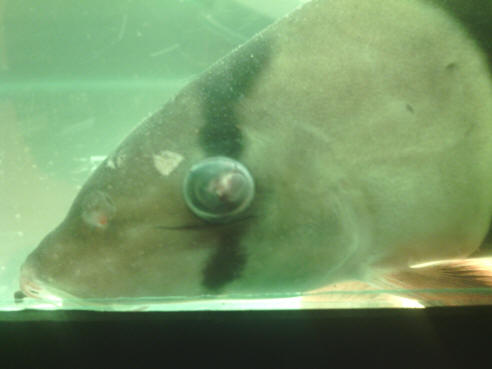 |
re: Clown loach eye... injury, env.
11/8/13
Thanks for ur input. I meant arowana after 16" and the hardness is
0.
<... not good. Do read re the needs of the life you're keeping and
adjust your water for all w/in range>
I keep it soft. Did u get the pic? It's no longer white obviously
and it's in a qt 15 gal tank.
<... move this fish>
With heater and air pump of course! Are there any other meds I could
try?
<.... see WWM re. B>
Thanks
Phil Clown loach eye; Neale's confirming
input 11/9/13
Hi guys,
<Phil,>
I have two 8" loaches in a 220 gal with a fx5 & an 8 watt sterilizer. The
perimeter of the tank are good.0 ppm of ammonia, nitrite. 20 ppm of nitrate.
pH are 7.0. Temp at 87°.
<Seems very high... do you really mean this? Few fish appreciate such warm
water. For Clowns, 28 C/82 F is ideal. Do remember that while warmer water
may be tolerated by this species, such water also contains less oxygen, and
that affects not just the fish but also the filter bacteria. Lower than
ideal oxygen levels will persistently stress the physiology of your fish,
and that in turn makes them more likely to become sick. It can also increase
certain behaviours (such as breeding-related or territorial aggression) and
increases appetite, both of which can cause problems.>
There are about 13 other fish including a 16" streams,
<What are "streams"?>
6" red spotted sevrum, etc...all hi end odd balls. Nothing really
aggressive.
<I see. But do be careful... this tank sounds quite generously stocked. Fish
may not be overtly aggressive, but they can still physically harm one
another if cramped or squabbling over hiding places. Catfish and loaches are
notoriously defensive about their caves, for example, but catfish tend to be
better armed and better protected, so frequently come off worse in such
arguments. Once they get scratched, loaches can easily become infected with
ambient bacteria, and these in turn can cause more serious problems.>
I do 100 gal water changes every two weeks with r/o and adjust the pH as
needed.
<Okay. Unless there's a good reason to do otherwise, I tend to recommend a
pH level a little above 7, somewhere between 7.2 and 7.5 being ideal for
filter bacteria. Also hardness, often overlooked, should not be
ridiculously low unless there's some darn good reason (i.e., you're keeping
blackwater fish). So something middling is ideal, between 8-12 degrees dH
being best. Again, this favours the filter bacteria, and it also helps to
moderate pH drops between water changes. Remember, the aim is to
keep a stable pH and hardness level between water changes, rather than to
aim for some nominal pH and hardness value you think your fish would like
best (and if you have a community of fishes, chances are there isn't one
"ideal" pH and hardness value for them anyway). With the exception of true
blackwater fish, most soft water fish will thrive in low to medium hard, pH
7-7.5 water, even if they can't breed successfully in it (and even this
generally only applies to the more picky tetras and rasboras). I know I'm
rambling a bit here, but experience has told me that when fish are kept in
soft water, they're often a little bit more difficult to keep healthy, and
opportunistic infections are a little bit more common. My assumption is that
this has something to do with the rate of biological filtration, which has
been comprehensively demonstrated to work better in alkaline rather than
acidic conditions.>
I've been in the hobby for 25 years and own an aquarium service Co.
<Ah, I may be teaching my grandmother to suck eggs then!>
I put it in a qt tank 3 days ago when I noticed the eye. It was white
so I put it in API fungus cure and it went away but now it has something
else on it. I enclosed a pic, plz help. Thanks
Phil
<I'm fairly sure this is an opportunistic infection of the eye
following some type of physical damage, e.g., a confrontation between the
Clown Loach and, for example, a Thorny Catfish or Plec. Perhaps even the two
Clowns. The cornea looks to have been damaged, and until it heals,
this Clown will suffer some type of bacterial infection. I'd treat
accordingly, using for example a Maracyn 1 and 2 combination (as you'd do
for Finrot) but I'd also use the Epsom Salt treatment (1-3 teaspoons per 5
gallons/20 litres) as this can often help reduce Popeye and other
fluid-retention problems. I will observe that severe damage to the eye often
never heals and the eye is eventually lost, but Clowns, being adapted to
murky water and largely nocturnal, don't rely on their eyes to any great
degree. Do also try contacting Loaches.com; they have a good forum and
generally offer very helpful, Loach-centric advice. Cheers, Neale.>
|
Clown Loach, hlth.; likely env. mostly
8/17/13
My Clown Loach of 2 1/2 years has been doing fine until yesterday. I got
home from work to find him swimming vertically in the corner of the tank
staying almost at the top. I did a 50% water change today since he was
still doing the same thing this morning. I feed my fish at night and
turn out the light cause they seem to eat better with the light off. I
have a 20
gallon tank with 4 fish, clown loach, angel, ghost knife and plecostomus
<Yeeikes... these fishes need more room. The issue here may simply be
low dissolved oxygen (the Loach is most sensitive) or poisoning from
metabolite (wastes) build-up... The real solution is to place them in a
more suitably large world>
all were bought at the same time so basic same age & size. All my other
fish seem fine. Can see any spots or anything on Loach, not sure what to
do.
<... The knife alone needs more... Bob Fenner>
Re: Clown Loach 8/17/13
Even with two aeration systems and the filtration system there would
still be an oxygen issue?
<Mmm...>
I do 10% - 25% water change weekly with a 50% once a month and I vacuum
the gravel with each water change. I have a 36 gallon bow front but am
having trouble finding a stand I can afford in order to set it up.
<Can it go on some other support?>
I use AquaSafe in my new water 24 hours before I do the change as well. Is
his death imminent at this point?
<... can't tell from the information provided. I would read through what
we have archived on loaches, environmental disease. BobF>
|
Favorite OLD Clown Loach needs help!
8/2/13
Hey,
<What?>
My Larry Loach is really sick. Pretty sure it started with Ich.
Been treating with Nox ICH for 3 days at half dose. I
think maybe a secondary fungal infection?
<... more like poisoning from the Malachite Green. MUCH better to treat
w/ simply elevated temperature (plus aeration). READ here re:
http://www.wetwebmedia.com/FWSubWebIndex/fwichremedyyes.htm
and the linked files above>
Wanted to give my loaches a bigger home, so I made the switch from a 60
gallon under gravel setup to a 120 filtered with a Rena xp3, and a
sponge with powerhead. I set the XP up on the old tank for 6 weeks to
establish it before i made the switch. Ammonia is 0. Had a nitrite spike
today to .25. Perhaps due to dead cherry barbs?
<Could well be>
PH is high at 7.8, though I had the old tank for years and never even
checked the PH. Our well water is good. Not too hard.
Anyways, tank has been up and running for a month or so now.
Any help would be awesome!!!!!
Tyson
PS I also had the temp up to 84 from our normal 80,but the fish seems to
be gilling hard, so I dropped it down to 80 again. Over the course of
the three days.
<I'd raise 86-88 F... increase aeration. READ. Bob Fenner>
|
 |
Re: Favorite OLD Clown Loach needs help!
8/2/13
WOW! Thanks a ton!
I was wondering about the malachite. Since this was an "off day" for the
meds anyway, do you think a 50% water change would be helpful to remove the
malachite, or maybe run some carbon?
<Either will "do it">
Will the high temps affect the cherry barbs, Cory cats, and Bala sharks
badly?
<Mid 80's should be fine for all; and eradicate the Ich>
Thanks again for the speedy, knowledgeable reply,
Sincerely,
Tyson
<Bob Fenner> |
|
Help with listless clown loach
6/29/13
Hi Crew,
<Jim>
I could really use some advice. The largest of my five clown
loaches (approaching 5") has been acting very strangely.
Initially, I just wrote it off as eccentric clown loach behavior.
I've seen them lay on the bottom of the tank or sleep in very strange
places. But this looks to be more
serious.
<Mmm>
Probably nine months ago, this loach evicted the Bristlenose Pleco from
the hollow resin driftwood in the tank and began sleeping in there.
I could always tell, because the end of his tale would hang out!
At the time he did this, I lost quite a few fish, including all but two
of my school of loaches, over the course of two weeks for no apparent
reason. Then it stopped. I had just purchased 10 baby
angelfish and placed them directly into the display tank (I know, I
know... setting up a QT was one of my first tasks after it was over).
Over the first three days, all but one of the angels died. Then
for days I'd wake up and find 1-2 fish floating dead. Fish I had
watched eat and behave normally the day before! I did water
changes and fresh charcoal. I couldn't think what else to do.
Medicating a 150 gallon just didn't seem like an option. Then,
after a little over 2 weeks, the deaths just stopped. Everything
has seemed fine since, except that the loaches both hid a lot,
especially the biggest one.
A couple months ago, I added 3 more loaches--quite small compared to the
two in there, but it seemed to work okay--and the two larger ones
started coming out and swimming around more. Then, a few days,
ago, I noticed the big loach sitting vertical in a plant in the corner
of the tank, just standing there on his tale. When I went over to
the tank, he swam away normally, so I didn't think much of it, but later
he was back again. He's been there more and more the last 2 days,
and today he's acting very lethargic. He still swims around the
tank if I do anything to pester him, but is quickly back to standing on
his tale, sometimes just drifting around the tank.
<Still; not unusual behavior for the species>
The fish is nice and plump, with very good color and no signs of
external distress anywhere. No damaged fins, no ulcers, no swollen
gills, nothing.
His respiration rate is high, but that's always been true of all my
clown loaches--I think that's normal, isn't it?
<It is>
Water parameters are normal--78F, no detectable ammonia or nitrite.
I don't know the nitrate level--my test kit expired long ago and I never
bought another. All the other fish, including the remaining four
loaches and two black ghost knives (which are getting along just fine,
thanks for the advice!) appear healthy and happy, eating readily and
swimming around normally. In short, the tank is great, except for
this one fish! And I don't know what to do about it. All I
can figure is that it is some sort of internal infection or parasite?
<Mmm, from the new Angels? Possibly>
I finally moved him downstairs to a 10 gallon and medicated with
tetracycline.
<Well; I wouldn't do this... and would the fish back to the 150>
I know it's a small tank, but it's cycled and stable--it's been a cichlid
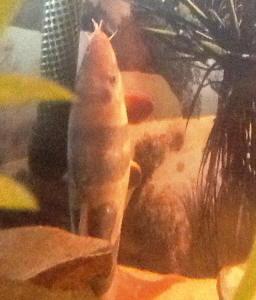
grow-out tank. I'm attaching a picture from before I moved him.
Any suggestions at all?
Jim
<Just hope and time going by. Bob Fenner>
|
 |
Clown loach, sliming beh. 6/15/13
Hi, We were recently given two clown loaches by a friend who was
shutting down her tank. We have had them for about 2 months. One is
about 5 inches long and the other about 4 inches. It is a 4 foot tank.
They seem to be going very well but the last couple of weeks we have
been getting a lot of floating material in the tank that we have not
been able to determine what it is. I am now thinking that it is slime
from the loaches body as they brush past the plants and rocks. It looks
like cob webs and when we remove it with the net there seems to be
nothing there. Would appreciate your opinion.
Thanks,
Sue
<Loaches can be quite slimy; particularly when "settling in" to new
circumstances, or if some aspect/s of their water aren't to their
liking.
Do review the latter here:
http://www.wetwebmedia.com/FWSubWebIndex/clnlchsys.htm
And perhaps go over the other Clown Loach files linked above. Bob
Fenner>
Re: Clown loach 6/16/13
Thanks for your help, Bob.
<Hope it helps Sue; am a huge fan of Clown Loaches. BobF>
dark clown loach 12/3/12
Hello everyone,
<Pat>
I've not been in contact with you in a very long time because I've not
had any aquarium health issue---until now.
<Long runs of healthy tanks are a good sign you are doing things right.
Everyone has issues from time to time.>
I have a 3+ year old clown loach (3+ inches) that has become quite dark,
with a black area at the bottom base of his tail. I've also noticed what
looks like some sort of black parasite or worm protruding from his gill
plate (one on each side) and there are 2 small black spots on his body
that weren't there before.
<Darkening of the skin can mean a number of things. Tumors, flagellate
infections, melanoma to name a few, but not an exhaustive list by any
means. That you see what appear to be parasites would lead one to
believe the dark patches are somehow related. Even the black spots and
parasites are kind of hard to nail down with the descriptions provided.>
There are 5 other clown loaches (various sizes, larger and smaller) in
the same tank that all appear fine (full of color). 16 discus, 5 bristle
nose albino Plecos, and one 24" retic ray in same tank, all appear fine.
The tank is a 240 gallon, temp is 86, water change is constant drip @ 80
gallons per day.
Any ideas?
<Quarantine the affected loach to minimize the risk to the rest of your
livestock, for sure. It's much better to lose one loach than risk all
those discus. Next, scour the WWM site to see if you can find
something that looks similar to what the sick loach has protruding from
the gills. Start here:
http://www.wetwebmedia.com/fwsubwebindex/fwfshparasites.htm
I personally keep a UV sterilizer in the closet that I bring out on
occasions like this. After removing the affected fish, I would put my
sterilizer into the tank and run it for two or three weeks. I
don't know of many other aquarists who do that, but it's something to
consider.>
Thank you,
Pat
<Good luck with this. - Rick>
Clown Loaches with ick
2/18/12
Hello WWM crew! Quite thankfully this is the first time I've needed
to contact you guys for any help, so I guess I've been doing things
right for a while! Down to the problem. I recently switched my 125
gallon aquarium over from saltwater to freshwater. Things have been
going well and looking good for the past month and it looks
spectacular. Current stock in the aquarium consist of nine Australian
Rainbowfish, four Bala sharks, a three spot gourami, a tiretrack eel,
an albino Senegal Bichir, and seven clown loaches (two along the three
inch mark and five at about an inch and a half, two inches). I try to
keep the diet offered as varied as possible, with more than half of
their meals being frozen foods (with vegetable matter being offered at
least once or twice a week), frequent feedings of live brine shrimp and
black worms, occasional offerings of dried seaweed, and when I flake
food I use a mixed preparation of Omega-One tropical flakes, a garlic
enhanced pellet food, and algae flake food. Anyways today I noticed
that one of the larger clown loaches had a few Ich spots on it, and I
wanted to really nip this in the bud, because it's the first time
I've been able to get a nice little group of clowns together. After
reading multiple sites online (yours included of course) and it seems
that the most commonly agreed upon ideas being that clown loaches are
sensitive to medications, and that salt and elevated temperatures seem
to be very helpful in these cases. I was planning on gradually upping
the temperature up to 85, and I have some salt that I can add to the
water but was unsure of the amount to use in this situation. Aside from
elevated temperature and salt, is there anything I can do to help aide
my squad of loaches? Thank you guys so much!
<Greetings. Salt + heat will be the best approach
here, and your fish shouldn't have any trouble tolerating
the 2 g/l required for success. Heat alone, ~30 C, can effect a cure
too, but I've never used this approach personally, though Bob F.
recommends it. Either way, you need to run the system thus for at least
a week. Medications containing copper and formalin are the ones most
likely to stress loaches; medications that don't contain either,
like eSHa EXIT, should be safer. Loaches.com is a good site to get
reports on specific brands/medications. Cheers, Neale.>
Re: Clown Loaches with ick 2/18/12
Just verifying, but 2 g/l would be 2 grams of salt per every one litre,
correct?
<Yes indeed. Do read:
http://www.wetwebmedia.com/fwsubwebindex/SaltUseFWArtNeale.htm
Cheers, Neale.>
Skinny Disease and Loaches
9/11/11
Hi Neale,
How are you doing today? I will soon post my pictures of my new 125
gallon on the forum for all to enjoy. Question, please! I have
purchased new fish, which are in quarantine. I have four new
clown loaches (to keep the one I have company), and three
Angelicas loaches (I plan on getting a couple more later). While I was
continuing my research on these fish, just to always learn more about
them, I came across many articles that say loaches are very susceptible
to "Skinny or Wasting Disease". Great, problem is these
specimen are so small, the clowns are about 1.5 inches, and the
Angelicas are about an inch. How on earth can I tell if they have this
disease when they are babies. They seem to have good muscle tone, and
they move so quickly I can't get a good view.
<Wasting Disease is difficult to pin down but likely some
sort of Mycobacteria infection. Fish with Wasting Disease
simply fail to thrive: over the weeks they get thinner and thinner, and
eventually die. Treatment is difficult, likely impossible, though the
right cocktail of antibiotics, administered by a vet for the weight of
the fish in question, could well work.>
I don't want to catch them individually and stress them out to get
a better look, I just got them in from mail yesterday. So, should I
assume they have parasites and treat them with Prazipro, or buy
Levamisole?
<Many loach-keepers do "worm" their loaches upon purchase.
By all means do so, but keep an eye out for abnormal reactions. Follow
instructions carefully, and remove carbon while medicating. Providing
extra oxygen is often helpful.>
I also have Jungle Bacteria Food, that says it treats wasting as well
as other bacteria, etc. Sites suggest using Maracyn I and II. However,
I don't want to mess up my good bacteria. What would you suggest?
Sometimes the more I read the more anxiety I get, and look at my fish
constantly trying to figure out if they are healthy. Thanks and have a
pleasant day. Lu<You're welcome, Neale.>
Clown Loaches Dying Mysteriously
9/7/11
Hello there, thanks in advanced for reading this. Right from the top,
my Ammonia is 0, Nitrates are 0, Nitrites are 0.25,
<Mmm, has to be 0.0>
Temp is 26c, Ph 6.9 and my tank is 64L,
<... less than 20 gal.s>
the 5 clowns (about 3cm long each) share a tank with 10 neon, 6
Glowlight and 1 blind cave tetra (all of which are under 2cm), 5
swordtail guppies (adult), one Bala shark
<Trouble>
about the size of three adult Neons from front to back in a line and an
angel that is a tiny bit smaller than that. The tank is two months old
and cycled, water is changed 10-20% every other week and they are fed
sachet Brine Shrimp, Tropical Flake food, Frozen Blood worms and ripe
bananas.
<Interesting>
I've searched everywhere for this problem and what it might be but
so far I've found nothing. I've lost 2 previous clowns and fear
I'll lose the rest.
The first one I bought with two other clowns simply resorted to hiding
on his own for 5 days after I purchased him until he came out, white as
a ghost only to stay on the bottom of the tank and then die the next
day.
The other one which died yesterday, I bought with another three but
this one appeared to have a problem from the start when I get them
three days ago. He never ate and never seemed to use his tail unless
absolutely necessary, only to go spinning and wind up on his side when
he did. He would lie on his belly on the bottom of the tank, completely
pale, whilst the others (minus the one I'll mention in a sec, he
started to refuse to swim now) whizzed around him playing and then he
was then seemed be pushed over by an invisible force onto his side,
only to get back onto his belly, and then to be "blown over"
again. My latest one has some colouration and this one I bought with
the first three, he shuffles around the bottom scavenging and then acts
exactly like the previous one did, flopping onto it's side, losing
all colour and then gets up and shuffles slowly around the tank
refusing to use his tail but when he does, doesn't wind up in a
heap like the last Loach, only just rises a bit above the sand only to
flop back down a distance away. He eats but within a few hours whilst
the others still have bumps the next day, he looks like he hasn't
eaten for weeks.
They don't seem bullied at all by any other fish and the other
Loaches are constantly going up to them as if asking for them to play.
Thanks for your help in advance!~Alex
<the nitrites... this system really isn't cycled... the pH a bit
low for Clown Loaches... Bob Fenner>
Helppppp !- 8/20/11
Hello Robert,
We bought a couple of Clown Loaches and a Pea
Puffer.
<Not compatible. Clown Loaches are big, schooling, sensitive but
messy fish that need a huge aquarium. Youngsters might be kept in
something around the 55 gallon mark up to about 15 cm/6 inches, but
subadults and adults need much bigger tanks, 100+ gallons. Pea Puffers
are tiny little things that would get lost in tanks that size, and even
though they might be happy enough in a big tank where you couldn't
see them, they're nippy and incompatible with almost
everything.>
I'm not for sure right now, but I think the Loaches have
Ick. They are in my 45 gal. Tank with other fish
<Treat with the usual heat/salt approach. Heat alone *may*
work.>
And a crayfish, my question is will the Ick medication
harm the crayfish if I have to treat the tank.
<Crayfish are Clown Loach food, so obviously you can't keep them
together anyway. But even so, formalin and copper are toxic to both
loaches and crayfish, and puffers as well!>
I also see that you mention marine salt on your site as a possible cure
for Ick, but I have read on another site, that loaches and crayfish are
salt intolerant.
<They tolerate this low concentration. But no one should be
keeping crayfish and Clown Loaches together. So this
shouldn't be an issue. Repeat after me: Crayfish are not kept with
fish, crayfish are not kept with fish, crayfish are not kept with fish.
Doing so is extremely risky for both fish and crustacean.>
I'm really in a quandary as to how to precede, any help would be
appreciated.
<Do try reading about the needs of livestock *before* buying them.
The three species you have here each needs it own aquarium.>
Thanks,
Wanda
<Cheers, Neale.>
re: Helppppp !- 8/20/11
I guess I should have been more clear. Two of the Clown Loaches are
less then 3 in. And are in the 45 gal. These are the ones I wasn't
sure of. The Pea Puffer was not in this tank. It did not survive, I am
pretty sure it was stress, because we live about 15 mi. from the
store.
<No, not the reason it died. Think about it: these fish have been
shipped 1000s of miles to get to the retailer. Done properly, taking
home fish shouldn't cause any problems at all, and I routinely
bring home fish by public transport in my backpack, the fish being
bagged up for hours at a time. More usually, fish die a day or two
after purchase because the purchaser failed to acclimate them
carefully, or worse, introduced them to an aquarium not suitable for
that fish species.>
The other 2 Loaches are in a separate tank and are about 1 in. long
they I know for sure have Ick'¦ all were
bought to control snails.
<Which they won't do. Snails are not solved by adding fish.
Retailers may tell you this, the same way they tell you that you need a
fish to deal with algae. But it's rubbish. Snails turn excess food
into baby snails. Keep the tank clean and remove solid waste, and you
have fewer snails. Add more fish, and you have to put more food in the
tank, and that means more food for the snails to eat. While some
loaches and puffers consume snails, they usually don't eat the pest
varieties with any real effectiveness. The Assassin Snail, Clea helena,
is rather better, but only as part of an overall improvement of
conditions in the aquarium.>
And the crayfish isn't interested in any of the fish, still have
the ones that Were in there when it was introduced.
<For now. But this is really, really risky. Crayfish view tankmates
as potential food. Yes, in the wild they mostly eat plants and carrion,
but in an aquarium they, and do, eat small fish. Conversely, after
moulting Crayfish are extremely vulnerable to damage from larger fish.
You also need to provide supplemental iodine to Crayfish (marine
aquarium iodine drops, at half dose) as well as calcium (unshelled
shrimp, for example) and in a smaller, Crayfish-specific aquarium this
is altogether easier and more economical.>
And far from being stupid as you imply, I do try to read up on my
livestock.
<I'm glad to hear that, I don't imply that you personally
are stupid. For all I know, you're smarter than me! But rather, you
have made a very ill-advised combination of livestock that no aquarium
book would ever recommend. Clown Loaches need one set of conditions,
Puffers another, and Crayfish a third. Keeping all three together makes
no sense at all. In any case, the salt/heat treatment should be
tolerated by all these species and would be the way forward. You should
remove the Crayfish in any event, and the Puffer is dead anyway, so
you're really just concentration on the Loaches. Generally,
it's the copper- and formalin-based medications that cause Loaches
harm; salt/heat is very safe to use.>
Thanks,
Wanda
<Most welcome, Neale.>
re: Helppppp !- 8/20/11
I'm going to answer here instead of in between you answers.
<Great! Makes things a lot easier to follow.>
I realize that some of the fish are shipped thousands of miles,
<Good.>
regardless the fishes were acclimated and the Puffer was put in a tank
alone... no other fish.
<Fair enough. But still, do be aware that puffers can be quite
sensitive, and you need to be double-careful when it comes to
acclimation to the new tank after purchase.>
A retailer is not the one that told me about the Loaches being snail
eaters, it was something I read or heard on one of these expert
websites (which is becoming more and more obvious is a crock, anybody
and everybody seems to be one).
<Perhaps. One reason we recommend books is that the people writing
them tend to be experts in some demonstrable way, whereas anyone can
say anything on a web page. On the other hand, there are some
outstanding websites out there, including loaches.com and
thepufferforum.com, both of which might provide useful reading for you.
The loaches/snail and puffer/snail "solutions" have been
around for years, and almost everyone mentions them, but in practise
neither is terribly reliable. In the case of puffers, they're
usually more trouble in community tanks than the snails, and loaches,
well, they can be aggressive and/or demanding animals, so hardly easy
to keep. Almost always, there are cheaper, easier, and more reliable
solutions.>
Anyway every snail they find they are making short work of, leaving the
empty shell behind.
<Yes indeed, loaches can be excellent snail-eaters.>
As for the crayfish, as I said he isn't interested in the fish. I
have had him for 2 years. There are no lg. fish in the tank to bother
it after molting and he stays in The cave he lives in most of the
time.
<As with many things in life, what works for some people might not
work for most everyone else. It's like when TV news people report
on the world's oldest man, and he lives in Siberia or somewhere
like that, and reckons a vodka with every meal is what's kept him
healthy. Maybe, but maybe not, and he's just lucky. What a doctor
would recommend for good health won't be what individuals think is
the key to their healthiness. Here at WWM we try to offer information
-- perhaps a bit conservative sometimes -- that will work in the
largest number of situations. In this case, not mixing crayfish with
fish is the recommendation. But if you trust your crayfish, and you
know what to look for in terms of potential trouble, then more power to
you. It's just not a "wise" approach.>
As for my smartness, that varies from day to day. I just didn't
like the implication.
<I can well imagine.>
All my tanks have a 50% water change weekly, unless I feel they need it
sooner. Also I use to do the salt Addition just for this reason,
everybody I talked to said I didn't need to.
<Well, routine addition of aquarium salt (not marine aquarium salt!)
to freshwater tanks is NOT recommended, and is considered rather old
school and potentially risky. On the other hand, short-term use of
aquarium salt to treat Whitespot is recognised as a low-risk, low-cost
treatment for Whitespot.>
As per your advise I am stopping the Ich med., doing a 100% water
change and adding the marine salt.
<Not marine aquarium salt! Plain vanilla aquarium salt, sometimes
called tonic salt or livebearer salt.>
In the 45 gal. tank I saw today that the other Loaches also have Ich,
so will do the same to it,
<Yes, can work well with loaches. Do adjust them slowly though. I
like to make up a brine solution in a jug that contains all the salt
needed for the whole tank, and then pour that into the tank in stages
across an hour. That allows the fish time to adjust.>
I do not plan on removing the Crayfish though, hoping he survives.
<Can't think why he wouldn't.>
Again Thanks,
Wanda
<Cheers, Neale.>
re: Helppppp ! 8/22/11
Thanks again for your help.
Wanda
<You're welcome. Cheers, Neale.>
clown loach with white spot like
dandruff 7/29/11
Hi I have 3 clown loaches and 3 neon tetras left in my tank after a bad
case of white spot that was brought in with the 3 new loaches that I
introduced to my existing 2 clown loaches and neon tetras. I first
treated with half dose of Protozin on day 1,2,3 and 6 as advised by
staff at shop
<Would not use medication with Clown Loaches, too many risks;
salt/heat tolerated much better.>
lost 2 of my clown loaches that I had for a year and now have 3 left
who came good but have now white spot again I think it seems like some
sort of dandruff coming off them when they flash over the driftwood and
it is all floating through the tank since I started salt treatment and
turned heat up to 86 degrees last night and will leave it like that for
two weeks as I read on one of the FAQ's.
<Clown Loaches are very sensitive to skin parasites, including
Whitespot and Velvet. It'd be good to assume they have Whitespot
and act accordingly.>
My questions are do I feed the clown loaches while treating them
<If you want, but only if water quality is perfect. Clowns are VERY
sensitive to ammonia and nitrite, so if these aren't zero, then one
reason your Clowns are getting sick could very easily be
stress.>
and do I do water changes and filter cleans. I have a 100ltr tank water
seem fine
<Much too small for this species; even 250 litres would be
tight!>
and loaches seem happy enough except for the flashing it looks
quite annoying to the poor little darlings your help and advice
would be great
thank you.
Regards Deborah
<Do read:
http://www.wetwebmedia.com/fwsubwebindex/SaltUseFWArtNeale.htm
http://www.wetwebmedia.com/fwsubwebindex/clnlchdis.htm
http://www.wetwebmedia.com/ca/volume_6/volume_6_2/loaches.htm
Cheers, Neale.>
Re: clown loach with white spot like dandruff
8/3/11
Great reading Neale! Sorry hadn't found that information myself,
not from lack of trying with four children screaming in my ear.
<Ah, yes, you'll see that I often recommend against people with
small children getting fish. Four children at home would do my head in!
I spend my working day teaching kids, and that's plenty enough
exposure to the little "darlings" for me'¦>
Thank you so much for your response to my email, it's been a week
now and I still have 3 clown loaches, (looking great no spots) and 2
(only) neon tetras. I still have the temp at 86 c and am treating with
salt, I found by changing at least 10% of the water every second day,
and doing gravel vacs there is less stuff?? floating around.. not any
actually.
<May help, but water changing is part of the way environmental
conditions are improved, rather than the whole story. The size of the
tank and adequate filtration are the other two parts.>
The plan is to leave things like this for a further 5-7 days, then
slowly return things to normal and fingers crossed all will be well. So
grateful for your wonderful educating site, and wish you all well.
Kindest Regards
Deborah
<Thanks for the kind words. Cheers, Neale.>
|
Clown Loach Problem
5/17/11
Hi
<Andy>
My clown loach fins have rotted away, could this be 'fin
rot'? (see pic)
<Is not... IS a loach that is very thin... history of mal- or
lack of nourishment, and has Ich, aka Whitespot disease...! You
need to ACT NOW.
Raise the temperature if the other life in this system can take
it...>
I don't think it is fin nippers because all the other fish in
the tank are tetra's and Siamese fighter. My loach
<... this Cobitid, like its family members is a strongly
social species. Does not do well singly>
is very lethargic, seems to be breathing heavier, hung around by
the filter for week or so! There is white spot on the fish at the
moment, but these symptoms appeared before the white spot.
<...>
My other smaller loach has white spot but his fins are fine and
still moving around the tank?
<No>
Have tested the water quality a number of times and seems
correct. Have also upped the temperature to help combat the white
spot.
<To how high?>
Any clues on what it could be and what I should do?
<Yes. Read: http://wetwebmedia.com/FWSubWebIndex/clnlchdis.htm
and the linked files above... Re Systems, Feeding
and: http://wetwebmedia.com/FWSubWebIndex/fwichsenslvstk.htm
Read, act... You're soon to lose these animals otherwise. Bob
Fenner>
Thanks
Andy
|
|
|
Re: Clown Loach Problem
5/17/11
Bob
<Andy... don't write w/o reading first>
Have raised my temperature to 82°F,
<Not high enough...>
have also added white pot treatment but have no yet cleared it!
There are two loaches in my tank and have been happy together for
over two years.
Will give more feed to them tonight, should I add things like slice
of cucumber as well?
<No.... B>
Thanks for your help.
Andy |
New Tank | Sick Clown Loach
4/26/11
Hi,
<Hello Michael>
Just performed a new tank setup after one of our Angel fish we had for
several years got mysteriously ill and could not be saved with
medication.
<Mmm, unusual... I take it you did move a good bit of the water from
the old system... nothing in the new was known to be outright
toxic>
After the new tank was set up, our clown loach, which we have had for
several years, began acting strangely.
After 24 hours, the loach was swimming constantly at the top of the
tank.
He has never exhibited this behavior before. Upon close examination, it
appears that his left eye is a little cloudy as compared to his right
eye.
Also, and more disturbing, he has string-like material, with air
bubbles, hanging from his fins and a little bit from his mouth. I
don't see any fungus patches on him. No open sores.
<Environmental something>
We did a 25% water change and treated the tank with Fungus Clear last
night. This has Nitrofurazone, Furazolidone, and potassium dichromate
as the ingredients.
<The last is too toxic for Cobitids (loaches)>
In the middle of the night the fish was on his back at the bottom of
the tank. I thought he was dead, but when I netted him, he started
swimming.
Now, he is straight up, actually held straight up by plants, and is
breathing heavier than normal.
The filter carbon has been removed.
<Do put it back in... to remove the Jungle product>
We have ammonia Sorb and nitrate Sorb material in the filter. pH is
good.
No indication of ammonia, but the tank is slightly cloudy (but it's
a new tank). Nitrate levels are very low.
Being a new tank, I am very concerned about dropping antibiotics like
erythromycin or Maracyn two into the tank.
<I would not>
Any suggestions?
<The carbon... time going by. Bob Fenner>
Re: New Tank | Sick Clown Loach 4/26/11
Thank you for your quick response.
<Felt it was... necessary>
Unfortunately, within hours of sending my request for help, the clown
loach died.
<Rats!>
Before he died, I noted a patch on his left side, looked slimy with air
bubbles. Still had string like strands hanging from his fins.
<Could be... many things>
The more I research it, and because of the rapidity of his decline and
subsequent death, it sounds and looks like columnaris might have been
the culprit.
<Dubious>
I read somewhere that in the last stages of columnaris they swim
erratically, which he was doing 24 hours prior to his death.
<Were other fishes similarly afflicted?>
Thank you again for your quick response. Too bad, things happened so
quickly.
Great website!
<Thank you, BobF>
Re: New Tank | Sick Clown Loach
4/26/11
For now, there are only 2 fish remaining. Over the course of the past 2
weeks we had an Angel fish die first, then a Japanese sucker fish was
found dead, then the Clown Loach.
<My bet/guess is still on some sort of toxin... There are a few
possibilities here; from the overt added poisonous ornament to the
innocuous bacterial overpopulation/war/wipe-out syndrome>
The Angel fish wasted away over about 10 days, went of his feed, and
sat on the bottom of the tank. Erythromycin, and Maracyn 2 had no
effect on him.
The remaining fish are a yellow tetra and a small bottom feeder. At
this point they are not symptomatic. I did a 25% water change, then
added Maracyn, Maracyn 2, and some Aquarium Salt (1 Tbsp/10gal). Will
continue the Maracyn/Maracyn 2 for a total of 5 days, then if no
symptoms will do a 25% water change and add carbon filter.
I noted in your previous email, that perhaps I added a good amount of
water from the old tank. We did not add any of the old water because we
had used so much medication, and the pH had become difficult to
maintain. So we started with fresh water adding Stress Coat, Stress
Zyme and Aquarium salt.
<Even more leaning toward a bacterial toxicity then. B>
Again, thank you for your help and insight.
Skirt tetra aren't schooling; clown loach look
malnourished 4/10/11
So I have a 50gal tank with a group of 5 skirts.
<Well, here's one problem: most fish won't school until
there's at least 6 specimens, and often 8-10 is the best number to
start with, especially in a medium-sized aquarium like yours.>
The aquarium is planted and has cave and has gravel/ aquarium sand
combination. The skirts seem to be hanging out on there own not
schooling.
<To be fair, this species is fairly bold and if just a few are kept,
they often do their own thing most of the time, ignoring one another.
The flip side though is that if there aren't enough of them, Black
Skirt Tetras (Gymnocorymbus ternetzi) are confirmed fin-nippers. They
aren't nearly as bad as Serpae Tetras or even Tiger Barbs, but they
do sometimes nip the fins of slow-moving tankmates like Angels and
Gouramis.>
The other fish in my aquarium are fine like my tiger barbs are
schooling and rainbow fish are too. And my cats are doing there own
thing. So why do u think the skirts are not schooling? The own big
change recently in my aquarium is taking out all my plastic plants and
swapping them out with real ones, and adding a co2 filter. This change
happened 3 weeks ago. They stopped schooling 5 days ago.
<Curious.>
My second question is that my two clown loaches are malnourished and
not eating.
<Unfortunately very common.>
Last week my clown loaches were schooling with my tiger barbs. This
week they stopped and started to hide. They have always been small so I
never suspected anything. Today I noticed one died and the other 2 were
almost skin and bone. When I caught them they were real slow. So I
moved them in my 20gal tank that is used for my babies and it is
planted. I did this so they didn't have to compete for food and I
could watch them eat. I threw in a couple bottom feeder tablets and
more flakes than usual in that tank.
They are usually outgoing when feeding time hits and get all the
flakes. So why are acting this way?
<Clown Loaches are prone to both intestinal worms and various
microbial parasites, and the use of both the antimicrobial
Metronidazole (Flagyl) and a dewormer such as Levamisole or
Praziquantel is highly recommended. These are safe with Clown Loaches.
In the US, you may be able to obtain these from your pet store;
elsewhere you'll need to get them from a vet. Cheers,
Neale.>
Sick clown loaches 11/13/10
Hi there . I bought some clown loaches and they have Ick ,
<Very susceptible>
( they looked fine when I bought them ) , I started them on a half dose
of copper safe
<Mmm, I would not treat Cobitids w/ Copper compounds... can be cured
with simple thermal manipulation. Read here: http://wetwebmedia.com/FWSubWebIndex/fwichremedyyes.htm
and the linked files above>
it got better and now it is three times worse than before is there
another thing I can add to the water to help ?
<... learn to search/use WWM>
They also have skinny fish disease also known as the virus that causes
the hole in head disease , I do not know what the scientific name is
,
<Octomita/Hexamita...>
I have started putting Epsom salt into the water ,
<? Not efficacious>
I read that it can completely cure the fish if it ingests some of the
Epsom salt (don't know how I'm going to do that lol ) and it
can really help if it is just in the tank it can even reverse it a
little , I put a tablespoon of it into a 5-1/2 gallon tank . Any tips
would be greatly appreciated ! Thanks .
Josh .
<Read on! Bob Fenner>
Clown loach disease? 8/24/10
I have 10 clown loaches. One of them is getting these spots that look
like air bubbles all over him. Any ideas what it may be?
<Clown Loaches are extremely prone to Whitespot, also known as
Ick/Ich. So start by making sure that this isn't what's
happening here. Whitespot looks like small specks, rather like
granulated sugar, usually on the fins as well as the body. Affected
fish often flick against solid objects.
Whitespot is very contagious, and before long most if not all the fish
in the tank will have the disease. Because Clown Loaches react poorly
to copper and formalin, you can't use standard medications. Instead
use the old salt/heat method. Raise the temperature to 86 F, and then
make up a brine solution in a jug of warm water containing 2 to 3
teaspoons of salt per US gallon of water in the aquarium. When
you're done, pour the brine into the aquarium in stages, perhaps
3-4 portions across a couple of hours. Leave the tank running thus for
at least two weeks, and then do water changes as per normal to remove
the salt. With luck, the Whitespot will be gone. Actual bubbles on the
skin are rarely seen on fish unless those fish are producing a lot of
mucous, in which case you will probably find silt stuck to the fish as
well. Fish produce some mucous on their skin all the time, but
excessive amounts tend to imply poor environmental conditions or
parasites such as "Costia", or more properly Ichthyobodo, the
parasite responsible for Slime Disease. But as I say, Whitespot is most
likely, so check that first, and if that isn't the issue, write
back, preferably with a photo up to 500 KB in size.
Cheers, Neale.>
Clown loach disease 8/25/10
If my tank is 40 gallon us then use 80 tsp of salt in the brine
solution?
<2 to 3 teaspoons of salt per US gallon, so 2 x 40 to 3 x 40 = 80 to
120 level teaspoons.>
Sent from my iPod
<Actually, a "thank you" would be nicer than a statement
about what kind of music player you own. Good manners cost nothing,
unlike an iPod! Cheers, Neale.>
|
Skinny Clown Loach 4/6/10
WWM crew,
<Hello,>
I have three clown loaches in my 55 gallon planted tank
(eventually to be moved to a 125). As you can see in the photo,
the main other tankmates are giant Danios.
<I see. Do be aware Danios prefer somewhat cooler conditions
to Clown Loaches, or are at least more sensitive to low oxygen
levels.>
Two of the three loaches are doing fine, but one seems to be
getting too skinny (the one at the bottom). I see him eating, he
has no external signs of disease I've spotted. He's
looking nearly skeletal...especially compared to the other two
loaches.
<Likely some sort of "wasting disease", but may be
worms of some sort, since both of these are issues with Clown
Loaches.>
The Danios ignore them and I haven't spotted any stressful
behavior (other than being so active). They all have very good
color as well. The loaches have a ton of hiding spots,
they'll slide into holes in the driftwood or vanish into the
moss when they want solitude.
<Good.>
I'd appreciate any ideas. I could quickly set up a 29 gallon
isolation tank for him, but that's not a long term home.
<Generally quarantining schooling fish does more harm than
good, but isolating this fish so you can see precisely how much
it eats without competition is a good idea. Treating with
Praziquantel or Levamisole, perhaps alongside a general
antibiotic, would be necessary to effect a recovery. Under
community tank conditions, sick Clown Loaches rarely get better
under their own steam. Remember to avoid copper-based medications
when medicating Loaches.>
Any ideas on what might be causing the weight loss?
<Do read here:
http://www.wetwebmedia.com/FWSubWebIndex/clnlchdis.htm
>
Matt
<Cheers, Neale.>
|
 |
Imported clown loach with parasites
3/26/10
hi all greetings from not so sunny England,
<Bet you it's even sunnier here in S. Cal. currently>
I need serious help, this sounds really bad but I work for a tropical
fish wholesalers but have no training or qualifications for dealing
with all the fish especially on such a large scale. I usually am able
to find all the information I need on WWM.
Anyway to the problem at hand we have several hundred clown loach in
stock at the moment and most of them are dropping like flies,
<Mmm, I've worked in the import/wholesale livestock trade...
fresh and marine... Have seen this Cobitid have such massive die-offs.
Rapid reaction to the present situation is absolutely critical (hence
my immediate resp.), do "bubble in oxygen" or barring this
poss., increase aeration... to raise RedOx, supply maximum oxygen here.
Dosing with Furan compounds (250 mg./10 gal.s) may be
efficacious>
I did a skin scrape on them today and found a parasite/disease I have
never come across before. I would post a picture but it cant be seen
with the naked eye.
<I suggest your outfit/business purchase an inexpensive pair of
microscopes... See WWM re>
It did look to have a similar body structure to Argulus but it sort of
looked squidgier for lack of a better word.
<? http://en.wikipedia.org/wiki/Squidgy>
sorry I cant describe it any better.
My question is do you know of any websites with decent pictures of more
unusual diseases rather than the usual white spot, flukes etc.
I would greatly appreciate any help you can give me
Thank you
Azzieria
<There is an assortment of in-print works of worth on fish diseases,
materia medica... See the names Ed Noga, Nelson Herwig... on WWM. Bob
Fenner>
Re: clown loach with parasites 3/26/10
hi Bob
thank you for your swift reply
I apologise for my British tongue
<No need, though I would remind you that proper nouns, like
people's names, are capitalized>
I possibly should have used a phrase like "doesn't appear to
be as solid as an Argulus" we do have a microscope that is the
only way I could see the organism. I showed the slide to almost
everyone I work with and even the boss looked confused by it, and she
has been in the business for around 20 years.
<Please send this image along. BobF><<RMF realizes fully
that he has NOT addressed the possible crustacean parasite problem
here... It has been my consistent experience that "dumping an
organophosphate" on Cobitids who are already dying is
counterproductive. Very necessary to first arrest other stressors, stop
the mass die-off>
Re: clown loach with parasites
4/2/10
Hi again Bob,
<Azz>
I have good news and bad news, I was instructed by my boss to treat the
Loaches with the only safe treatment we have for them,
<Which was?>
and it would appear to have gotten rid of the UFO (Unidentified Fishy
Organism) so I cannot send a picture of it, however they now appear to
be suffering from the 'Skinny Disease' so I am in the process
of tracking down the correct treatment as we don't have it in
stock.
<Mmm, likely a combination, one time treatment with the
anti-protozoal Metronidazole and anthelminthic Praziquantel will
"do it" here... IF these fish are eating. See WWM re the use
of these compounds>
Unfortunately I can't seem to find the article which had
suggestions for what to use. I am almost certain it is skinny
disease
<... this is actually a symptom... not a disease per se... Like
there is no "high body temperature" disease of humans..., nor
"skinny disease" for that matter!>
as they have a very varied diet of bloodworm, flake, mini pellets,
cucumber, lettuce and they have some plants in the tank which they
graze on if they feel like it (I think these guys have a better diet
than me and my own tank at home),
<Heee heee, me too>
I dont feed them all these things at the same time but they eat then
have nice big bellies but the rest of their bodies are really skinny.
Would you be able to point me in the direction of the appropriate
treatment for this?
<Yes... on this page:
http://wetwebmedia.com/FWSubWebIndex/fwmaintindex.htm
scroll down...>
Thank you again for all your help
Azz
<Very glad to help, aid your efforts, understanding>
Ps. I managed to track down the book by Ed Noga but unfortunately my
boss thinks it is too expensive so I will be adding it to my own
private collection on my next payday
<Ahh! I do wish this work was lower-priced... I have spoken w/ the
author re... Perhaps a new edition will be so popular that a larger
press-run will drive the purchase price down. BobF>
Re: clown loach with parasites 4/2/10
Hi again,
The treatment I used was Sera Protazol.
<Mmm, this is Malachite Green... rather dangerous to use on/with
scaleless fishes like Loaches: http://www.sera.de/index.php?id=347&L=1>
It can be a bit hit and miss as to whether it works or not but I'm
told its the only safe thing to use that we have.
<Not safe... see WWM re the active ingredient>
I do have a couple of personal questions about my own tank.
1. How long can my fish last without a light as it is having technical
difficulties (although they do get quite a bit of sun through the
window in the afternoon)?
<Indefinitely. Fishes don't "need" light>
2. I have an Angel that I rescued from work as it was unsalable because
of a deformity (missing gill cover), Could this deformity shorten its
life span?
<Perhaps>
I asked at my local Waterstones bookstore and they said there will be
an updated version of Ed Noga's book out soon. It will be nice to
read something on the subject that was published since 1988.
Thanks again Bob
<Thank you Azz. BobF>
Sick Clown Loach 3/19/10
Hi,
<Hi, Jan. Melinda with you here today.>
My husband introduced a new Clown Loach about three weeks ago, and
things look like they were going good until it died a few days ago.
Not only did the new fish die but so did my catfish and one other Clown
Loach. It appears that they had Ick.
<Ohh... is really best to QT new clown loaches... they tend to be
more susceptible to ich than other fish, in my experience.>
My question is that my husbands Clown Loach that he has had for around
10 years is sick and we are afraid of losing him as well.
<Of course -- that would be awful.>
We have done the salt and water treatment with water changes and
keeping the water temperature at a higher level.
<So, how much salt are you using? What temp is the water at? I tend
to use the following treatment for ich: Day one: Add one tablespoon of
salt per gallon of water. Day two: Add one teaspoon of
salt per gallon of water. Day three: Add one teaspoon
of salt per gallon of water. Then, let the tank sit, with the total
amount of salt of three teaspoons per gallon, and temp
around 83 degrees, for at least a week, even if you no longer see signs
of ich. Then do a large water change. I don't do water changes
within these ten or so days because to do so would remove the salt, and
it really needs to stay in the tank in order to achieve the high level
needed to kill the ich.>
Mr. Loach is still sick and just laying on his side and breathing
heavily. Is their anything else we can do? He look
better yesterday but then again today he looks worse.
<Assuming water quality is good (Ammonia and Nitrite at zero,
Nitrate below 20), and you're properly diagnosing the problem, the
above is what I recommend. Often, folks just don't add enough salt,
or wait long enough for it to work.>
HELP!!
<Please let me know if you have any other questions, or if this is
something you've already tried with no results.>
Thanks Desperate
Jan
<You're welcome.
--Melinda>
Re Help! FW Ich resp. amendment -- 03/19/10
Hi Bob--
Earlier today I answered a question and provided my method for treating
for ich. However, I mis-spoke and stated that one tablespoon of salt
should be administered daily, for three days. I re-read the e-mail
after you posted them on WWM and realized I said "tablespoon"
when I meant "teaspoon!" I'd like to let the querier
know; however, I have deleted that query from my folder. Can you either
forward this to that person or send me their e-mail so that I can
correct my statement to them? Thanks!
--Melinda
<Aye yi yi! Sorry I didn't catch this either... as you might
guess, I really don't read through all... And... to save space and
as part of my routine daily, I delete the original msg.s, including
all's email addresses... So... I don't think the cumulative
salt will hurt in this case... and I'll amend your post with this
input. Okay? BobF>
Clown Loaches, beh., hlth. 2/18/10
Hello,
<Hi, Amanda! Melinda with you here tonight.>
I have 2 Clown Loaches and one of them has began to fade and is
practically a ghost at this point.
<Firstly, how long have you had these fish? Clown Loaches can take
some time to "settle in," and just because one has,
doesn't mean the other one is! What size system? Clown Loaches
really do better in schools of at least five. Please read here:
http://www.wetwebmedia.com/fwsubwebindex/clownloachfaqs.htm, as well as
the linked files above. They're really great fish, and are so much
fun to watch, but really do need buddies to feel comfortable. Also,
they can grow quite large (twelve inches, sometimes more), but grow
very slowly. Still, something to keep in mind, especially with a
schooling fish. The bioload gets to be quite a bit when multiplied by
five or six. Also, Clown Loaches do fade at times (I'll discuss
below).>
I have not seen him eat and he is in the corner of the tank and near
the surface.
<Do you offer hiding places in this tank? I have a large piece of
driftwood in my tank that I've deemed the "loach den."
When kept in adequate numbers (I have six), Loaches are really all over
the tank -- at the top, the bottom, and everywhere in between! However,
they do need time to rest, and get away from the direct lighting we
tend to subject our fishes to in home aquaria. This is where hiding
places come into play.
When the Loaches are in their den, they tend to pile up and look
ridiculously cute. When they emerge, they do not exhibit the dark
coloration which is typical of the fish. Their oranges and blacks are
much paler after they've been in hiding, and gradually darken as
they move about the aquarium. On the other hand, color changes in any
fish can indicate stress, and if you're seeing pale coloration for
extended periods of time, this could be the culprit. Now, the thing is
to figure out the cause of the stress. What are these fishes' tank
mates? Could they feel predated by any fish in the tank? Are you
feeding them adequately? Loaches enjoy the heck out of wet-frozen
bloodworms, brine shrimp, daphnia, and other meaty fare, but also have
no qualms about demolishing a slice of cucumber overnight. So, they
need vegetable matter, and if your aquarium doesn't have palatable
live plants, they may be suffering. In addition to the wet-frozen
foods, which I consider really important to any fish's digestive
health, they also love Spirulina wafers and shrimp pellets, Spirulina
strips, as well as carnivore pellets and pretty much anything else
that
goes into the tank. In addition, Loaches need a lot of oxygen in the
place they inhabit most (the bottom of the aquarium), and if the
fishkeeper has not provided adequate filtration (eight to ten times the
tank's volume per
hour), then this can be a problem. I mention this because of your
observation that he spends a lot of time at the top of the aquarium,
where more oxygen is present, due to gas exchange which occurs there.
What type of filtration are you offering, and are you sure that the
water is well-oxygenated? Clown Loaches typically have very adorable
whiskers, or barbels, near their vacuum-cleaner-like mouths. Are these
whiskers present on your fish (both the sick one, and the other one)?
Absence of these can indicate stress, dirty tank conditions, poor
choice of substrate, etc. >
I do not see any specks that could relate to ich or diseases.
<Okay.>
I have tried every possible sight and pet store and no one seems to
know the answer to my question. This is my last hope. Please help!
<Again, I'm wondering how long you've had these fish,
whether the system is of a size to hold a group of them for at least a
few years, what you're feeding, water quality, oxygenation, and
whether you're offering hiding places. There is also an illness in
Loaches commonly called "skinny disease," or "wasting
disease." This is caused by an internal parasite.
There is some information available about the condition on WWM, and you
can find it by using the search bar on our home page. I'd also
recommend doing research on this condition wherever else you can find
information!
Ultimately, this may be the cause of your fish's problem. However,
there are a lot of other factors which could be to blame. At the very
basic level, please review water quality, and ensure that Ammonia and
Nitrite are at zero, and Nitrate stays below twenty with regular
maintenance. This can be done through regular, weekly testing. The
thing is, Loaches can be very difficult to treat, because they're
what the hobby refers to as "scaleless fishes" (not actually
scaleless, I don't believe, just have very small scales), so
it's easier to rule out these other factors than try to begin
to treat for this internal parasite, because so many medications harm
Loaches that wouldn't affect other fish negatively. If you can
remedy his problem through other means, it would be better for him, and
easier for you.>
Sincerely,
Amanda Strauss
<Amanda, I think the key here is a lot of research on these fish.
They're really wonderful, and so rewarding to keep, but even as
small guys, do have specific needs, like any fish. If you feel that you
don't have the room to add more, or are startled by their ultimate
size, perhaps it's better that you return them and find more
suitable fish. In any case, as I said, the first thing that comes to
mind for many when they hear of a Loach that's not eating is
"wasting disease;" however, I have found that by working to
suit the fish's needs, the fish begins to eat and gain weight, and
in the six Loaches that I have, I haven't seen this disease become
evident. I hope the case is the same for you, and you have the chance
to enjoy your Loaches, in a larger, well cared-for group, for many
years. I know I've asked a lot of questions here, and I only mean
to help you understand that a fish's health is in direct reference
to every other aspect of his life!
So much has to be considered when a fish starts to exhibit strange
symptoms -- it can be confusing. If you have further questions after
reading, please feel free to write back.
--Melinda><<Excellent Melinda. B>>
Re: Clown Loaches 2/20/10
Hello Melinda,
<Hi!>
My Clown Loach actually died last night sadly.
<I am so sorry to hear.>
I check the water parameters and everything seems to be right on
spot.
<What numbers?>
I have many hiding places in my tank including large drift wood,
plants, and such. I also turn off my light for a good 10 hours for the
night right on schedule daily so they have some "down time"
and have a filter that can do up to 80 gallons when I have a 42 gallon
tank so I believe it is strong enough.
<Okay. The way you determine whether or not your filtration is
strong enough is to take what the manufacturer says the filter's
gallons per hour is, and divide that number the number of gallons your
tank holds. Don't pay much attention to what they rate the filter
for (for example, yours is supposedly for an 80 gallon tank), but
instead, use this method. You're looking for turnover per hour of
about 6 to 8 times. So, for a 42 gallon tank, you'd want a filter
that handles at least 252 gallons per hour.
Depending on how you've stocked this tank, you may even want to go
as high as turnover of ten times per hour. So, there are some
variables, but knowing how much water filter is moving is a good step
towards determining
if filtration is adequate.>
I am not sure about what happened but when I went to take him out of
the tank his skin started to fall off.
<This sounds like he was just in the water for a while after he
died, and began to break down.>
What cause of death would that point to?
<I don't think it's something which can be connected to the
reason he died.
Did you see any red spots/lesions/etc? This wasn't a symptom you
listed for me while he was still alive, so I wouldn't attribute it
to what was wrong with him. However, please see the link I'm
providing below for photos of "slime disease," which somewhat
similar to what you describe.>
I've had him for about 3 months and he's always acted a bit
different then a usual fish aside from the acting dead (which scares me
half to death every time) but now I'm not quite sure how to treat
my water or if it could possibly effect my other fish.
<Since you're not providing numbers on your water quality, I
can't say for sure whether or not this is an issue. However, if the
fish was in the tank for an extended period of time after death, then
the tank could experience
an ammonia spike, so it's important to be testing regularly right
now. I wouldn't try and treat the water, since we're still not
sure what was happening to him. It could have been that he just never
acclimated to the tank from his move, or it could be something
more.>
My other Loach I know may have "skinny disease" and I do not
know how to treat that either but on top of that now he or she is the
only Loach in my tank. should I be buying more loaches?
<He'll be miserable alone. Yes, either return him to the store,
or purchase a few more... but, as I said, this can seriously increase
bioload, especially as these fish grow, and so this may not be the best
option, due to this being a relatively small aquarium. There are still
some things that haven't been addressed, such as what you're
feeding. As I said before, it's best to cover all of the bases
before jumping to that conclusion. The mere fact that this fish is
living singly could stress him to the point of not eating.>
How should I treat both my tank water to get rid of any disease and my
other Loach who may have "skinny disease"?
<I wouldn't treat, because we still don't know what
happened. By the time you e-mailed, he was in pretty bad shape, and I
addressed a lot of issues which I think are going to seriously affect
the remaining fish if you're
not providing those conditions. The feeding and filtration are still
question marks to me, as is water quality, and the fact that this fish
is alone now is going to stress him more. I would just do a really
large water change, and watch the fish for any signs of illness. The
fact that you believe the remaining fish has skinny disease means that
he either does have it, or he's not being properly provided for,
and as a result, isn't gaining weight and growing properly. So,
please review the needs I addressed in my first e-mail, and read here
on skinny disease:
http://www.wetwebmedia.com/FWSubWebIndex/clnlchdis.htm. The treatment
for the condition is listed on this page, as well as a photo with some
information on "slime disease." The reason I mention this is
that you did
say he lost skin, or scales, when you took him out, and I don't
think this is related to cause of death, but the fact that his body was
in the water for a little while and began to decay, but I wanted you to
see those photos, in case it jogs your memory as to whether you saw
anything like this prior to his death.>
- Amanda Strauss
<--Melinda>
Re: Clown Loaches 2/22/10
<Hello.>
The water was at Ammonia 0, Nitrites 0, Nitrate Round 20 PPM.
<Okay, so that sounds good.>
I him or her freeze dried shrimp and basic bottom feeder wafers.
<This is a diet which I would augment with wet-frozen foods and some
other vegetable matter, such as cucumber slices and Nori strips. Dry
diets can cause problems with constipation, and we've already
discussed these fishes'
need for vegetable matter. Despite being called "algae
wafers," if you'll look at the ingredients on most
bottom-feeder wafers, they contain a lot of fish meal. This means that
the fish has to eat a lot more of it to get the vegetable matter he
needs. Feeding vegetable-matter only foods in addition to these will
help him get what he needs.>
The filter turn over is about 7 per hour.
<Okay, good to know.>
And if you believe that it might not be such a good idea for me to get
more clown loaches to make my surviving one more comfortable, is there
no other option other then to return it or watch it be miserable and
ultimately die?
<I don't know what your plans are with fishkeeping in general,
really, so I'm just trying to make sure you realize what you're
getting into if you do up the numbers of loaches to five or six.
Without knowing how heavily-stocked this tank is, it's hard to
tell, but since, from my observation, these fish grow about an inch per
year, I think you'd run into trouble in three years or so, if the
rest of the tank is very lightly stocked. The good news is, it's
not difficult to get rid of large clown loaches, and in fact, they
fetch quite a bit of money (since they do grow so slowly). However, I
know that in the time I've been fishkeeping, I've never been
able to bring myself to either give away or sell a fish, because I get
so attached. This is why, at this point, my house looks more like
public aquaria than a house. But, if you don't have the ability to,
in a couple of years, upgrade this system for their sakes, or are
worried about finding them a new, proper home, then I would not
increase numbers.>
I do not think the store will take him back without just disregarding
him since I've had him for 3 months already and he has been in a
tank with a possibly but not known to be sick fish.
<I think they would take him back, but there's no way to know
unless you ask. Another option is to get on some fishkeeping forums and
try to find someone near you who already has a group of loaches and
wouldn't mind adding another. Craigslist is another option, and you
could insist on a home check prior to giving him to someone to make
sure they've got what this fish needs to thrive. Anyone who takes
him has the opportunity to quarantine him to make sure he's not
sick, so don't worry about that part.>
I love my fish. I just don't want to return him if there is a
possibility they might throw him out or something.
<Then do try the other methods I mention above.>
I do not think they resell fish.
<Do... this is how I have found many of my fish -- full-grown or
half-grown fish which are brought back to the store by hobbyists. I
cannot say whether your store does, for example, I doubt a lot of the
chain stores do this, but I know many of the more independent stores in
my area commonly do this.>
And the link to the photos did not work and google doesn't bring
anything up. Just healthy fish.
<The link should have been to a whole page with photos on it. If it
doesn't show up as "link," you can copy and paste that
into your browser.
If all else fails, use our google search bar and enter "skinny
disease." When deciding what to do about this fish, I'd first
look at the following:
Do I plan on getting a larger tank within a couple of years? Are other
tankmates truly compatible with loaches to begin with? Am I willing to
do the work it takes to improve diet to ensure health and long life for
these loaches? Please write back if you've got any more questions,
or if you can find that page I linked you to with the search bar.
--Melinda>
Re: Clown Loaches -- 2/23/10
<Hi, Amanda!>
Okay. Thank you so much for your help Melinda. It is greatly
appreciated.
<You're very welcome!>
I will take into account all the space issues and food changes.
<I can see you care a lot about your fish, and you're weighing
all of the choices here. That's really great.>
It is good to know I have options and that someone was out there to
help me see the many details of this rewarding hobby.
<I totally agree with you -- it's a very rewarding hobby. If it
didn't take the work that it does, it wouldn't be so
rewarding!>
If I do have more questions would I be able to email you in the
future?
<Yeah, absolutely. If, for some reason, I am unavailable, there are
plenty of other folks here who can help, as well.>
You are the best, by far, assistance that I have had since starting my
many aquariums and I am very grateful to have been in contact with
you.
<I am so glad to hear I've been of help. Since we spoke, I
remembered there was an article on Clown Loaches in one of the
fishkeeping magazines a few months ago which I found to be excellent.
Though which one it was still isn't coming to mind, if I can find
it, I'll save your e-mail here and let you know which one it was.
Or, perhaps someone else (many of the folks on this great crew write
articles for the same magazines I excitedly grab from the mailbox and
read cover-to-cover each month!) saw that article and knows where it
was can either forward that info to you or to me. In any case, I am
glad to have spoken with you, as well, and though I know you have room
in your heart for these spectacular fish, I hope you'll find room
in an aquarium, as well -- they're such great characters and really
a joy to keep. Talk to you soon!>
-Amanda
<--Melinda>
Clown Loaches, prob.s 12/20/09
Hi there.
We've got some problems with our clown loaches rather suddenly.
We came home to find our tank slightly cloudy & two of our three
loaches having difficulty breathing - laying on their sides (as they
do) but breathing very quickly.
<Do a 50% water change immediately, and another 50% within 6-12
hours. This is the best way to flush out any potential toxins. Do of
course take care to keep water chemistry and temperature about the same
as they should be.>
When my fiance nudged the one out in the open (the other was
in a barrel) to see if he would respond, he just floated away. He had
no control over his movements & just floated, landed on his tail
for a bit before laying
back down on his side.
<Sounds like a water quality problem. These fish are extremely
sensitive to non-zero levels of nitrite and ammonia. Because Clown
Loaches are so big, they rarely do well in small tanks with poky
filters. For a trio of Clown Loaches, we're talking about a 75
gallon/300 litre minimum. The filter needs to be a heavy duty, high
turnover system. A big canister filter with a turnover rate at least 6,
and preferably 8, times the volume of the tank
is essential; i.e., for a 75 gallon tank, a filter at least 6 x 75 =
450 gallons/hour.>
They look perfectly healthy, but we changed the water & pumped the
gravel, although that wasn't a huge problem as we do so regularly
& all the other fish in our tank are absolutely fine.
<Clown Loaches are much more sensitive than most other fish. They
are also intolerant of copper and formalin-based medications, so are
very easy to poison.>
One of our two poorly loaches managed to get himself wedged in by the
pump because he had no control over his movements & unfortunately
burnt himself severely, thus leaving us with two of our three loaches -
but we still have
one poorly one sitting in the barrel.
<Never, ever put a Clown Loach in a tank with a heater that
isn't protected with a heater guard. What you report is sadly all
too common.>
Any idea what has caused this sudden illness?
<Likely water quality.>
Can we save our other little loach?
<Sure.>
It strange because the third seems perfectly normal & all our other
fish are fine too. Why should two clown loaches, out of three, suddenly
have problems breathing & being seriously lethargic &
'floaty'?
<Much the same reason not everyone comes down the 'flu every
time it comes around.>
We've had the loaches for nearly 4 years; keep them with a Pleco,
some Dalmatian mollies & sunset wagtails, & at a temperature of
25oC, with regular water changes.
<Cheers, Neale.>
Unknown disease... Poisoning Botias
11/9/09
I have 3 clown loaches that have lesions on them, some are quite large.
The first one that got sick, it began with his eye swelling and
becoming cloudy.
<Mmmm, summat wrong here environmentally>
The swelling has gone down, but I do not know if he is blind in that
eye or not, and then I noticed these raw spots/wounds on them. They are
not eating and laying on the bottom of the tank. I thought that they
were dead several times, but they are just hanging on. This has been
going on for about a month. I have done several water changes, the
temperature has fluctuated a few degrees, I use cycle
<The Hagen product... not necessary in an established (biological
filtration cycled) system>
in my tank and add aquarium salt occasionally.
<Also a poor idea>
. I have been treating the tank with Binox,
<http://www.thatpetplace.com/pet/group/11027/product.web
Too general a "cure"... I would NOT use this product>
for fungus and bacteria, and also using Maracyn-Two, but am not getting
any results.
<Actually, you are... you're poisoning your loaches>
I also have 2 beautiful severins that seem to be fine, but I am
concerned that they could also become sick. Or the loaches beyond
treatment? Should I remove them from the tank? Please help, haven't
encountered this problem before.
Thanks,
Shawn
<... what re water quality? The issue here is very likely
poisoning... from? Please read here:
http://wetwebmedia.com/FWSubWebIndex/clnlchsys.htm
and the linked files above. Akin to "what's wrong with me in
the West vs. oriental philosophy/"religion"... you really are
perfect, you just need to stop doing what you're about. Bob
Fenner>
My clown loaches still have severe ick! --
09/08/09
Hi,
I have read many articles on your website about ick and have followed
them, however my clown loaches still have severe ick!
<This species is an "Ick magnet"!>
I have done the salt and raised the temp to 84. I lost one catfish and
my two loaches have lost their color and still look very ill.
<Hmm... Ick usually doesn't kill fish, at least not quickly, so
do review other possible problems. Fish die because the Ick parasite
damages the skin, allowing secondary infections to set in. It's
these secondary
infections, coupled with stress and quite possibly problems breathing
(Ick parasites attack the gills as well as the skin) that lead to
death. But since Ick usually turns up when new fish have been added to
the tank,
review things like quarantining procedures and whether the water
quality is still as good as you think within the aquarium.>
What do I do now? I have groumis and leaf fish in my tank too. It is
day three of treatment.
<Do understand the salt/heat method (and indeed ALL Ick medications)
kill ONLY the free-living parasites, not the ones on the fish. What
happens is this: You cannot do anything about the Ick spots on your
fish. By heating up the water, you speed up their life cycle, so they
burst more quickly. At that point, those spots die. But they throw out
"baby" parasites, the free-living stage, that swim about for
24-48 hours to find a host. If they can't find a host, they die.
For that period of time, and ONLY for that period of time, medications
and salt are able to kill the parasites. Copper kills the parasites,
while salt stresses the parasite and essentially draws all the water
out from its cell, killing it. You MUST use the right amount of salt
for this, otherwise it won't work. Too little, and the free-living
cell will survive, and settle onto a fish, to start the next generation
of white spots. You need to use 2 to 3 teaspoons of salt per gallon of
water.
That sounds a lot, but it's actually a trivial amount in terms of
what freshwater fish can tolerate. It's like chemotherapy: the idea
is it kills the disease before it kills the fish. Leave the water
"salty" for about 2
weeks at this temperature, and you should find the Ick vanishes. After
that time, just do regular water changes to slowly flush out the salt.
Your Loaches and catfish will tolerate this much better than
copper/formalin.>
Can the other fish tolerate the high temps!
<Yes, but add additional aeration if they are breathing heavily, and
certainly ensure filtration (water circulation) is good.>
I am very frustrated! Please help-I don't think one will make it
thru the night. Thanks Jill
<Cheers, Neale.>
Re: Ick
Neale,
Thank you for all your help!
Jill
<You are most welcome. Cheers, Neale.>
Re: Ick 9/11/09
Neale,
I have other questions for you.
<Fire away.>
It has been a week since I did the salt and temp change for the ick. I
lost one catfish and one clown loach.
<Not because of the salt, if you did things right. But Ick does make
fish vulnerable to secondary infections, and other Ick medications
(with copper or formalin) are especially toxic to Loaches and some
catfish.>
The other loach had a fungus so I put fungus clear and stress coat in
also.
It has been 5 days and the clown loach is still holding on, not eating
and laying around. His fungus has cleared. All the other fish are doing
fine, no Ick seen. Do you think the high water temp (82) is making
him
uncomfortable?
<Not directly; Clown Loaches can do well in very warm water. But
lack of oxygen will stress any fish. When you raise the temperature,
you decrease the amount of oxygen in the water. Furthermore, fish at
the bottom of the tank (like loaches) will be getting less oxygen
anyway than fish at the top of the tank. So you do need to be very
careful that [a] there's good water circulation from top to bottom;
and [b] your tank isn't overstocked. Adding another filter, an
airstone, or a powerhead could all be useful additions to your system
if you're concerned oxygen might be an issue.>
How long do I have to keep the temp up?
<About two weeks. You need to mature ALL the Ick parasites on the
fish, and this can take about a week under tropical conditions. You
warm the water to speed things up, and in theory, at 82 F they should
mature within about 3-4 days. If you honestly can't spot a single
Ick anywhere, then you can lower the temperature. It won't stop the
salt working. With luck, all the Ick parasites have matured already,
and there's nothing to lose.>
Thank you so much! You have been a great help.
Jill
<Good luck! Neale.>
Velvet help (orig thread 6/06) 5/16/09
Hello Folks, I am back again (original post, same issue, "Need
help with velvet, please!! 6/06) in search of any understanding you may
be able to shed on my continuing situation with my 7 clown loaches. I
have believed this to be velvet. Tiny dots over top of fish's
heads, no spots on body,
<Mmm, not Velvet/Oodinium... your fish/es would be dead...>
absolutely impossible to get rid of. There is one fish in particular
that never seems to be spot-free. These clown loaches have been
quarantined at least 3 times for months at a time and medicated in
every possible way imaginable over this time, including long term salt,
salt dips, acriflavine/salt/dark, methylene blue dips, raised temps
(low 90's), velvet guard, rounds of Maracide, Coppersafe,
Cupramine..
<Yikes... I'd stay away from copper containing treatments with
Cobitids... too toxic>
there might be more, I can't quite remember at this point. Had I
known this would go on for so long, I most certainly would've kept
a notebook!
<Ahh, a good idea>
Each time, fish are quarantined, treated, observed closely, moved back
to main tank (after minimum of 3 months at a time in QT-main tank left
to go fallow during these times). Under the lighting in my QT tank
(29g) they can appear to be spot-free, I move them back into main tank,
then again see dots.
There is one main fish that always seems to have spots, while others
will appear "clear" in main tank after treatments.
Most recently (January 2009), I noticed that not only the main fish had
the dots again, but that they seemed to be spreading to the other
loaches heads again, they were hiding more, etc. After attempting to
treat this seemingly same "disease" since 2006, I was feeling
skeptical about my chances of curing it once and for all. Pulled all
fish out of main tank (2/09), back into fully cycled 29g. QT. It was
then I proceeded to treat with Cupramine full strength as I'd read
others having good luck with it. Didn't seem to work so after
carbon in filter and waiting a couple of weeks, I did 2 back-to-back
full- strength treatments of Maracide. Again, all fish appeared
dot-free except one large loach (always the same fish). Afraid of
dosing them again so soon, I waited a bit and ordered some ESHa Exit,
hearing good things from loach owners with ick and velvet. I went ahead
and did the extended treatment described in the directions. I even went
5 full days just to try to push it a little as this obviously isn't
going away easily and because I would have no idea what additional
medications to try after that didn't work. During the months the
loaches were in QT, I converted their 120 gallon main tank into a river
tank (with under-sand pvc river tank manifold). The tank is
consistently PH 7, nitrates 20-30ish, nitrites 0, ammonia 0, filtered
by 2 Eheim 2217 canister filters and now 2 Maxi jet 1200 powerheads for
current. Fish again "appeared" spot free for weeks after last
QT ESHa Exit treatment, and were returned to newly designed 120g. river
tank approx. 2 weeks ago. They do seem to love the current in the new
tank and have fun playing in it all day long. I got a close look at the
main problem fish this morning though, and it's head is getting
covered again in dots, however the dots appear somewhat larger to me
now. I have no idea what to even think about trying at this point and
am hoping you can offer some sort of wisdom here? It would seem that
having the tank salted for such a long time has held off the parasite
somewhat, though it appears to never be completely eradicated. Where
none of the medications have worked over such a long period of time, I
suspected some sort of water problem, but honestly I have no idea what
to think or do at this point.
<Nor any real idea of what you're treating... A shame you
didn't defer to using a microscope to examine what this might
actually be here... But if you elect to continue your blind treatment,
look into Levamisole here... as I suspect "flukes" of some
sort... rather than a Protozoan complaint... Or best, a QX series
scope... Instructions on use are archived on WWM. BobF>
Many, many thanks again for any advice you can offer!
Sondra
|
The Bloated Clown Loach and the Gluttonous Neon Tetras, env.
dis. 6/18/08 Hello, <Ave Maria>
I've read related posts, and I did see something about
separating the loach and feeding him frozen or fresh foods to
correct the problem, but I'd just like to make sure that this
is correct for my situation, and to ask about another problem
with our tank population. <Ok> To give a bit of background,
we are currently recovering from a HUGE nitrate spike and
battling high temperatures. Our nitrate level has gone from just
over 100 to around 30. We know this is still way too high, but
it's taking time to get it down with water changes. I'm
so afraid we'll shock the fish. This is a 160L tank with
quite a few plants, 5 angelfish, 15 neon tetras, 1 Hillstream
loach, 1 rainbow shark, 1 plecostomus, and 4 clown loaches. We
had 5, but one got very listless and soon died. Our tank stats
currently are: pH: 6 KH: 5 GH: 14 NO2: 0 NO3: 30 <Still a bit
too high> The current problem loach became very bloated
overnight. The other three will cuddle with him from time to
time, but when they go off to play, he just stays on his side in
a little cave or next to a wall. He is breathing rapidly, and his
gills seem a bit red. <Good description, clues> We
don't have money for a quarantine tank right now,
<Don't need this... just to fix the one they're in
now> but we did put him in a clear plastic container with
water from the tank. He was difficult to catch. We've also
given him some thawed bloodworms. He looks healthy, aside from
the bloating, which makes him look kind of pregnant. We've
just noticed that he seems to have a little hole in his side,
too. Is this the right treatment, or is he lost? <Not lost...
not really a treatment... I'd return this fish to the main
tank. Being in the container is worse> The other issue
involves our neon tetras. We were told that our loaches would
benefit from getting some frozen food once a week. My husband
thaws the block in warm water, then adds it to the tank. The
problem is that our loaches get none of it, since the tetras eat
it ALL. Every single one ends up looking impossibly bloated and
like they might explode. We've tried adding a bit more, but
they just keep eating! Any ideas? <Try other sinking type
foods, or placing in an inverted "blackworms feeder" on
the bottom> Thanks for taking the time to read this. You guys
are always so informative and quick to respond. Thank you! Maria
and Ola <Fix the nitrates... the process of doing so will save
your loach and other livestock. Read here:
http://wetwebmedia.com/FWSubWebIndex/fwnitrates.htm and the
linked files above. Bob Fenner>
Re: The Bloated Clown Loach and the Gluttonous Neon
Tetras 6/18/08 Thanks! We were very
worried about the little guy. We'll keep up our dilution plan
until we get to an acceptable nitrate level, and then stick to a
schedule of weekly quarter changes. The fish seem so much happier
and more active after them. Thanks again! <Dilution is not the
only, even likely best route to go. Please read where you were
referred to. RMF> Re: The Bloated Clown Loach and the
Gluttonous Neon Tetras 6/19/08 We've
already adjusted food amounts and begun vacuuming more often as
well. We have a lot of plant life. We'll get to the LFS this
weekend and see what we can do to implement the other recommended
methods. Thanks again! <Ahh, welcome! Do please make it known
how you progress here. Bob Fenner>
Re: The Bloated Clown Loach and the Gluttonous Neon Tetras
-- 06/28/08 Hi, Just an update. I've been sick, so there
was a bit of a delay in going to the LFS. We have started
treating with Tetra's Nitrate Minus, and more importantly, we
bought and set up an external filtration system that has five
stages of filter media. The fish are already looking more lively.
Sadly, Bloaty didn't make it. We should know how well this is
working by Monday. <Thank you for this update. Do take care.
BobF>
|
Clown loach hlth -04/11/08 Hi crew, today I
bought five clown loaches. <ok> I saw them in my LFS for about
three weeks, and I got them today because they looked healthy. However
when I got home, and I was inspecting them I realized two of the
loaches had one white spot each on their tails. Should I start to treat
this with eSHa exit? I am not sure whether I have carbon in my Juwel
Rio 400 - I looked inside, all I could see was a black hard sponge, and
one green one, one blue one and white sponges. Should I remove the
black one before starting the eSHa exit or wait to see if the whitespot
goes away on its own? <The black one is a "carbon sponge."
So yes, you should remove that before treating with any medications.
However, I would wait just a day or two and just observe. Are the spots
raised? Please see here:
http://www.wetwebmedia.com/FWsubwebindex/fwich.htm> I have five
small angels, five guppies and one small bronze Cory also in this tank.
Many thanks, Neervana <De nada and good luck, Sara M.>
Fungused clown loach 1/25/08 Hi I
have two Clown Loaches and today I saw they seem to have white mold
growing on them am not Sure whats happening but they still seem to be
active like usual. I was wondering if its the water or do they have an
infection. thank you <Mold on fish is extremely bad. It's likely
a Fungal infection if it looks like fluffy white threads, or Finrot if
the white stuff is dead tissue and you (usually) see some bloody tissue
nearby. In either case, early treatment is ESSENTIAL. Furthermore, both
of these diseases are 99% of the time related to either poor water
quality or physical damage. So you need to check the living conditions
of your Loaches before doing anything else. Two Clowns will need a tank
well in excess of 200 litres/55 gallons after they are anything more
than pups, given that this species is both [a] big and [b] sensitive to
poor water quality. Secondly, they are very intolerant of dissolved
metabolites in the water. At the very least, check the nitrite level.
If you detect any nitrite at all, that's too much, and it means you
have insufficient filtration, an overstocked tank, or are drastically
overfeeding the fish. Now, treating Clown loaches is complicated by the
fact that many off-the-shelf medications will kill them as easily as
they'll cure them, so you have to do your research before dumping
any old potion into the fish tank. Do read the FAQs on the Clown Loach
disease, here: http://www.wetwebmedia.com/FWSubWebIndex/clnlchdis.htm
|
Emergency with clown loach 1-11-2008 Hello, <Hello
Katey,> I have an emergency with my favorite fish, an 11 year
old 9 inch clown loach named Mr. Whiskers. He has resided in his
75 gallon with no problems for over a year. I do weekly water
changes, no major changes lately (all I can think of is the
addition of a large piece of Mopani wood), all other
residents look and act healthy. Nitrates are in safe range (under
40ppm), nitrites 0, water is neutral. <All sounds good.> On
to the problem - yesterday (Wednesday) I noticed what looked like
a little bit of sand was stuck to one of his sides, but nothing
major. Now, tonight he has what looks like slimy, bubble-laced
goo patches on both his sides. Strands of this bubble goo trail
off as well. This covers a large area on both his sides, with a
couple tendrils trailing from his gills. The color of his fins
seems a bit washed out, and he is breathing very rapidly. In
spots under the slime, and a bit on his head, there are red
streaks or spots, like a rash, under his skin. I have attached a
couple pictures of him which I think show the slime and red areas
pretty well. I am not sure if this is a fungus, or a parasite, or
what. <Looks like the sort of thing often called "slime
disease" -- a catch-all name for protozoan or bacterial
infections that result in excess slime production. The slime can
indeed collect bubbles and silt. It is often associated with
grayness, and as the situation gets worse with inflamed or dead
skin. Can be treated using anti-Finrot/Fungus medications as well
as dips. See here for some options:
http://www.wetwebmedia.com/FWSubWebIndex/fwfishmeds.htm Do bear
in mind Clown Loaches react badly to medications of some types,
so half-doses and close observation would perhaps be the order of
the day, at least to begin with, coupled with extra oxygen to
compensate for irritation of the gills. I've also found
saltwater dips very effective for treating slime disease.>
Now, the major problem is that I am going out of town for a week
on Saturday, leaving me just Friday and half of Saturday to
treat. I will be back next Sunday the 20th. The medicine I have
on hand is Coppersafe and Maracide. Please, what can I do to save
Mr. Whiskers? <Not 100% sure either of these will help here,
but worth a shot. If the parasite Costia is to blame, then either
could help. But there are other types of Slime Disease that seem
to need antibacterial medications.> I am not sure if I can get
someone to come over during the week to give medicine, but
I'll see what I can do. Mr. Whiskers is VERY precious to me
and it kills me that this happened right before leaving town.
Does it look like a fungus, or parasite, or something else? I
will do whatever is in my power to help my little charge.
<Very good.> I just noticed that the other clown loach in
the tank (he is 3.5 inches) has the start of a few bubble trails
off his body and fins, and is swimming somewhat strangely. The
other fish, Severums, Leporinus, Firemouths, all seem fine still.
<Hmm... bit worried about the Leporinus -- some specimens are
very nasty animals, and bite the scales and fins from large fish.
Do watch for this.> Thank you so much!!! Katey <Cheers,
Neale.>
Re: Emergency with clown
loach 01/13/2008 Hi Neale, Thanks so much
for your response. Unfortunately, Mr. Whiskers was gone this
morning. He was cocooned in a thick coat of slime from barbels to
tail. I also discovered the problem...when I reached in to get
him, the water was so hot a human would be uncomfortable in a
bath of that temp. Apparently the heater malfunctioned and super
heated the water overnight. It must have started glitching the
day before when Mr. Whiskers had just a little slime reaction;
just a few degrees hot enough to affect a delicate clown loach
but not enough to tell anything was amiss. Then over last night
it went wild and...my favorite, most personable fish gone. What
is so frustrating is I always went the extra mile doing
everything right for such a special specimen...weekly changes,
constant testing...but everything can be wiped away with just a
malfunctioning heater. I assume the little loach died too;
I'm going to search the tank for his body. All the cichlids
and Plecos seem okay, so far...I had unplugged the heater and
threw in some ice packs. It took hours for the temperature reader
to register upper nineties, so my guess is the temp went up past
100. A horrible way to go. Again, thanks for your quick response,
I just wish I had caught the problem before it was too late. Take
care, Katey <Hello Katey. A horrible story, and you have my
commiserations. Let me share a useful tip though: with valuable
collections of fish (and which collection of fish isn't
valuable?) use two too-small heaters instead of one adequate one.
So suppose your tank needs 100 W of heating. Don't use a
single 100 W heater but instead two 75 W heaters. Why? Because if
one heater jams, it won't have enough power to boil your fish
(at least, not quickly, giving you time to notice the problem).
Conversely, if one heater fails, the other one will still be
powerful enough to slow down the heat loss enough for you to
notice the problem in time, and the tank certainly won't get
so cold the fish freeze. You still need to check the heaters from
time to time, but at least you'll have the peace of mind of
knowing that either way, your fish will be safe. Hope everyone
else in the tank settles back down, Neale.>
|
|
.jpg)
Great pix. RMF
|
Ich, FW, Botia macracantha... no reading
12/12/07 Hi, I have a clown loach that recently got ich. <...
this is a social species. Should be kept in a shoal...> But I am not
entirely sure. He has like white air bubbles on his tail and on his
fin. <Mmmm, could you send along a pic?> Is this ick or not?
Also, is there a very accurate and easy way to tell if your fish is
healing from ick? Last, how much salt should I use and how often? I
have a fifty gallon freshwater tank. Thanks for all your help.
~concerned owner... Oh, and how do I feed frozen bloodworms to my
bottom feeders? Thanks once again <How is it you managed to skip
over our instructions for writing us w/o reviewing what is posted?
Please read here: http://www.wetwebmedia.com/FWSubWebIndex/fwich.htm
and here: http://www.wetwebmedia.com/FWSubWebIndex/clnlchfdg.htm and
the linked files above. There is just too much that is necessary,
related to your general questions to answer succinctly. What you need
to know en toto is posted. Go and read it. Bob Fenner>
Rail-thin clown loaches 8/24/07 Hi
Guys, Tried to post my question on your forums but got a 'servlet
error' I think was what it said. I think you have a very
informative website which I enjoy and I'm hoping you can shed some
light on this problem with my loaches. I can't believe I've
found almost nothing written about this problem. On another website, I
found one other person who had posted the same question and no one had
an answer for her. Here's what I'm experiencing: I'm losing
about 1 clown loach every 2 months. They get VERY skinny and bony.
I'll probably lose my 3rd one tomorrow and he is paper thin all the
way up to the back of his head! Until today, he's acted perfectly
normal except for the skinniness, now he is laying on his side moving
infrequently just as the other two I lost had done. I've always had
3 loaches at a time and whenever I've lost one, the other two had
looked perfectly healthy. There doesn't seem to be any pattern with
length of time in my tank before they get paper thin and die. It seems
to strike randomly. One thing I've noticed is that within a couple
weeks introduction into my tank, my loaches seem to darken and maybe
lose just a little fullness in their body. They seem to go from the
typical dark gray stripes you see in pet stores to jet black stripes.
55 gallon tank 20 community fish Temp: 77 ph usually about 7.2 I do 15%
water changes every two weeks and my water has been perfect (0 ammonia,
0 nitrites and nitrates) every time I test it. I have a variety of 15
live plants and I feed once/day - usually a combination of flake food
and frozen blood worms. I'd appreciate any ideas you may have!
Unless I can correct this, I don't think I'll buy anymore
loaches and will just wait for the 2 remaining healthy ones to die.
Paul <Hello Paul. Clown loaches aren't hardy fish and don't
prosper many retailers' tank, and my guess is that they have what
hobbyists call "wasting disease". This is caused either by an
internal bacterial infection or else gut parasites of some sort, such
as worms or flukes. Either way, it won't get better by itself. The
problem for you is that Clown loaches respond rather badly to
medications, so you need to approach treatment somewhat gingerly,
keeping an eye out for unusual behaviours such as gasping at the
surface and if required acting accordingly. Ideally, confirm with the
manufacturer that whatever drug you are using is Clown loach safe.
Antibiotics should be fine, but things with copper and formalin tend to
be tricky. Anyway, in this instance I'd treat first for internal
bacteria, and once that's done, treat for worms (on the rationale
that bacterial infections tend to be more immediately life threatening
than parasites). Make sure you remove carbon from the filter while
treating the fish. Also, step up your water changes (once the courses
of medications are done). 50% weekly is about right for Clown loaches.
More broadly, keep in mind all the basic things about Clowns:
they're schooling fish, they like water a bit on the warm side
(25-30C). They're substantially herbivorous, and so you need to
provide things like tinned peas, spinach, algae wafers, Sushi Nori and
so on rather than just meaty foods. Like all loaches, lots of oxygen is
essential. One last thing: if you find the Clown loaches from one
retailer keep dying on you, it might be a "bad batch". Buy
them from another retailer next time. Not all retailers are equal when
it comes to caring for their livestock. Cheers, Neale.>
Poorly Clown Loach, no useful data 2/14/07 Hi
there, <Rob> I have read over the FAQ for articles concerning
sick Clown Loach and it seems many people are having similar
experiences to mine, however I have already tried some of the
treatments you guys have suggested, seemingly with no result.
<Cobitids are easily over-mis-treated... as you likely know... Our
advice tends toward the end of conservancy... on the Net> Please
allow me to explain the situation, just in case anything differs for
what is happening to my fish. <Good, please do> I've had the
Clowns (and a selection of other fish) for some time now and a couple
of months ago I upgraded to a larger tank. I never experienced any
problems whilst they were in the smaller tank, and not for the first
month of them being in their new home. They had spent a lot of time
hiding in the tunnel and laying on their sides, <What they do...>
but having researched I know that this is usual behavior. I then
noticed, a few weeks back now, what seemed to be small spots towards
the back of the Clowns. I assumed that this was just sand which had
attached to them as a result of them laying down. <Mmmm> However,
they began to start rubbing themselves quite aggressively against the
bottom of the tank (along with one of my Denisoni Barbs) <Beautiful
species, eh?> which I know is a sign of irritation. I have performed
several and frequent water changes, and also tested the water for all
chemicals, and all levels seem to be normal, or in no way near
dangerous level. <Numbers please...> The spots developed and grew
at which point I assumed that it was in fact white spot. <...
okay> I used a treatment of eSHa Exit, having removed all carbon
from my filters, which doesn't seem to have achieved anything.
Their condition seems to be slowly deteriorating and the spots have now
turned into patches, their fins almost seem to be "rotting",
<... not ich... Perhaps the medicine... or maybe whatever was
irritating these fish before...> and one of them looks a little
"bruised". I went back to my local fish shop and was
instructed to use a treatment of eSHa 2000 in case the patches were
excess mucus, but again seems to have had no obvious result.
<...> I am becoming very concerned now, as I fear they are
rapidly reaching their end. I also don't want to overload them with
antibiotics and fear I already may have done so. <Yes> All of my
other fish seem perfectly healthy, no sign of spotting or rubbing (even
the Denisoni Barb has stopped now) so I am unsure what the problem
could be. The only thing I I haven't tried is raising the
temperature which I will do now. Any other help of advice you could
give would be much appreciated, and thanks in advance. Regards Rob
<Can only guess... as you have provided little real data, just your
subjective evaluations... I would elevate temperature, use some salt...
Per what is posted on WWM. Bob Fenner>
Re: Poorly Clown Loach - 02/15/07 Hello, <Hello
again Rob> I have tested the water again and the results are as
follows: pH is in the region of 7.2 / 7.3 Ammonia is zero Nitrite is
0.1 / less Nitrate is in the region of 20-30 (which admittedly is a
little high). <Mmm, yes. I'd strive to keep these below 20
ppm> I change the water regularly, although I think my tap water has
a bit of nitrate in it to start with. I try to do a larger water change
at least once a month if not more regularly with reverse osmosis
water... <I'd change a bit once a week... actually, I DO change
about 20% a week in my FW tanks> I have increased the temperature of
the tank (gradually) to in the region of 84 degrees. <Good> It
has been kept previously at a steady 79. I am yet to add salt, but will
look into that later this evening. To further complicate things, when
adjusting the heater I discovered 4 baby fry swimming in the corner
near the surface! I have never had fry before so I will be spending
today researching this on your website!! <Congrats!> Thanks again
Rob <Thank you for this follow-up. BobF>
Clown loach skinny disease - 11/09/06 First off, thanks
for the wonderful website, I love reading it! I lost a clown
loach that I have had for several months to what I believe was skinny
disease last week. Another, possibly 2, have it
now. From what I understand this is a fast paced bacterial
disease. <Yes, most likely> Would Maracyn be OK to
use? <Erythromycin, the active ingredient in Maracyn (1), is fine to
try first> Should I move the loaches to the 10g hospital tank or
will that stress them further? <Too likely so... I'd treat them
in place> Should I treat all the clown loaches in the small tank, or
just treat the entire 55g tank? <The latter> The 55g has
undergravel filter with power heads, and an outside power
filter. Water parameters are off a bit due to the ever
changing and now poor quality of the local water. We live in
a rural area, and I am trying to rectify the water situation by getting
water at the LFS. I also switched my water conditioner from
Amquel to Prime at the advice of another LFS, but have seen no
difference in nitrates. It is very frustrating never being
able to get them below 20ppm. <Perhaps a reverse osmosis filter for
your tanks and cooking, drinking use> Any info on the clown loaches
malady or the nitrate issue is greatly appreciated! Thanks
in advance. Sarah W. <High/er metabolite levels are a contributing
mal-influence. Bob Fenner>
Clown loach wasting away 10/6/06 Hi from
Prescott AZ! <Howdy from S. Cal> I have a 39 gallon Eclipse 3
community freshwater planted tank stocked with 1 male 3 inch gourami, 2
fancy guppies, 3 5-inch clown loaches, 6 2 inch praecox rainbowfish, 3
white clouds, 1 peppered Cory, 2 Kribs and 2 pygmy
cories. This tank has been up and running great without a
loss for about a year, with twice weekly 30% water
changes. The rainbow fish and Kribs were the last addition
about 6 months ago. Food Tetra color max flake, brine shrimp
blood worm artemia glass worm (frozen Hikari), fresh BBS (any extra
leftovers after feeding my killifish), and zucchini/sweet
potato. Ammonia, nitrite are 0, nitrate is 20 or
less. Hardness 180, buffer 120-180, pH 6.8 to
7.0. Temp 74 to 80 degrees. I lost a female pygmy Cory and 2
guppies for unexplained? <Never fun> reasons 5 months
ago. The fancy guppies just seemed to thin, then flounder at
the bottom of the tank for a day then belly up. <Perhaps bacterial
("wasting disease", Mycobacterial... and/or protozoan...
Hexamitiasis?) I tried frozen, supposedly "safe" Hikari
Tubifex exactly once before the fish began dying. <Very likely
unrelated> I ran a UV sterilizer for 2 weeks, blasted the tank with
Quick Cure <Toxic...> for 10 days with Maracide 1 and 2 for 5
days. <These antibiotics won't treat for the root causes here
either> I then restarted the biofilter with BioSpira
(great stuff - too expensive though). The tank has been
stable for a month, and I bumped up the water changes to 50% twice a
week to help keep the chemistry good. Now a clown loach that had been
very active, fat and quite dominant has thinned down dramatically, wont
"play" with the other loaches, seems to eat only slightly,
while every body else in the tank is getting fatter (other loaches) or
breeding (the neon rainbows and white clouds). He has been
thinning for the last 3 weeks dramatically and seems only a shell of
his former glory. He has no white spots on him, no velvet or
other ich like changes in his skin tone, is very orange and dark black
with very dark red fins. I noticed two small bumps on his
sides today. One is just above his left anal fin on his side
with no changes in color of the skin. The other is on his
front right side above his left pectoral fin with two small white spots
along the lateral line. I cannot find anything hanging from
his vent (must be a female! LOL), and I haven't seen any discolored
feces...I've not seen any feces hanging off any of the loaches for
that matter. He does swim around somewhat, and seems
interested in the artemia I place in the tank but doesn't eat much.
I've considered that the tank picked up a parasite from the Tubifex
worms I put in the tank.... dumb I know, but it said "safe and
pure" on the package. I have to remember that bags of
manure also say "safe and pure" on them! Any hope for the
clown loach, or should I euthanize it to spare the tank? Any
meds to "nuke" the tank with that will prevent further
losses? Thanks Brian <Mmm, I would try (sequentially) a
gram-negative laced dried food (if the fishes are all eating) that you
can buy expressly made, or DIY, and a course of Metronidazole/Flagyl
here. Both can be searched for, found on the indices on WWM. Bob
Fenner>
Clown Loaches - Diseased, or Clownin' Around? -
08/12/2005 We have had 2 clown loaches in a 240 litre community
tank for 8 months. They are in with two small eels (7inch) two angel
two gourami and some pleco's. <Some.... How many?>
Only two small Plecos have been introduced recently.
<Not much space for several territorial bottom-dwellers....> Over
the last 24 - 48 hours one clown loach has stayed at the bottom often
falling over on his side, <Can be quite normal.... Try a
google search with "clown loach playing dead".> and his
colouring have gone very dark (like bruising but all over)?
<Possibly a problem....> The other clown loach is desperately
trying to help him but I don't what it is or how to treat him?
<First, test your water for ammonia, nitrite, and
nitrate. Be certain ammonia and nitrite are always
ZERO. Maintain nitrate at 20ppm or less. If your
water is not within this range, do water changes to correct
it. If all checks out, and you see no other behaviour issues
with this fish, all may indeed be quite well. I would
"wait and see" for now, and keep a close eye on the fish.>
Please help, -Karen <Wishing you and your fishes
well, -Sabrina>
Clown Loach I have 2 loaches, 2 black tipped sharks(?), and
have just added 2 Oscars. I only mention all of the above because I do
not remember seeing this problem before the Oscars were added. One of
my loaches is constantly swimming at the surface with his mouth wide
open, never closing it. He is seriously faded and seems to have red
cheeks (I know that is silly but really what it looks like). The sharks
are very worried about him and so am I. Can you help me? Kim <Sounds
like this fish is extremely stressed... by? I would check your water
quality... for ammonia and nitrite at least... Has this tank been
set-up long? Is it big enough for these fishes? How is it filtered? Is
it cycled? Please read here: http://www.wetwebmedia.com/FWSubWebIndex/fwmaintindex.htm
- scroll down to Environmental Disease and read the Related FAQs files.
Bob Fenner>
HLLE on Clown Loach Greetings, all. I have a 180 gal FW tank.
<!> I keep it at about 80F. I have two 13 year old clown loaches
<!!>(8+ inches) and two smaller ones (3-4 inches). I also have 9
ghost catfish, 1 black skirt tetra, three hatchetfish and two large-ish
Plecos. <!!!> I wrote awhile back about one of the smaller
loaches having nibbled fins. Now, I notice that one of the larger
clowns (the largest, in fact) has three, almost regularly-spaced
craters or lesions (bites?) on his dorsum, just behind the
"head". They do not look infected, and he still eats
voraciously. The tank is very clean, with bio-ball sump-based
filtration and a 40W UV light. 40 gallon water changes
weekly. Could this be hole in head? No white/slimy fecal
matter and he acts healthy. The marks are in a row, all inside one of
his dark stripes. <It does not sound like the few fish I have seen
with hole in the head (HLLE) but it sure is possible. The fact that the
holes are "clean" and in a row makes me think it is not HLLE.
Although not directly fatal, it can lead to secondary infections that
are. Watch for redness or a white pus. I found a good link for you to
read up on. See: http://www.masla.com/fish/hlle.html.
BTW Great job on keeping your fish! 180 gallons and a rather light bio
load! Big fish in there though. Make sure you check the nitrates and
try to keep them below 20ppm. Don> Thanks! <No, Thank YOU!>
Tom <Don>
Lumpy Loach -- Mycobacterium Infection? -- 01/11/2005 Hi,
<Hello!> I have a 75-gallon tank with three 14 year-old clown
loaches and two large green kissing fish. <Must be some
pretty large loaches, at that age! It wouldn't be a
terrible idea to try for a larger tank, if possible.> One of the
loaches has large lumps all over his body under the skin, appears to be
very swollen -- even his eyes appear to be bulging. He is
hiding in the back of the tank and will not come out to eat; he just
stays in the same place breathing very rapidly, in an upright position,
leaning on tubing. He has been like this for about a month
and I really didn't expect him to be alive this long since I just
noticed his illness right before I went out of town. I
assumed that he had an age related problem since a couple of his tank
mates have passed on over the past couple of years. I
haven't been able to find out anything about this particular
illness. <To be quite honest, this sounds to me like a
very good indication of mycobacteriosis. The swelling,
pop-eye, and lumps/tumors/granulomas are very strong symptoms of this
myxosporidian bacterial infection. It's really quite a
good thing that the critter did not die while you were gone -- a dead
fish can release literally millions of 'spores' that can infect
other fish in the tank!> The nitrates in this tank stay fairly high
even with frequent water changes and Poly-filters in the
filters. <Yes.... These are very large fish
in a (comparatively) small tank; increased water volume would really be
a good idea.> There are no indications (redness, etc) on his outward
appearance that would suggest a bacterial or fungal
condition. I would try to treat him in a separate tank if I
knew what to try, or at this point would it be better to euthanize
him? <Sadly, mycobacteriosis is essentially
incurable. There is some indication that Kanamycin sulfate
may have some effect, but recovery is unlikely, I'm so sorry to
say. Either way, should you choose to medicate or not,
definitely remove the fish as soon as possible from the healthy animals
-- I can assure you, you do not want this to spread, if that is, in
fact, what it is. Also, PLEASE read the following link, so
you can understand what risk this illness might pose to
you: http://reefkeeping.com/issues/2003-07/sp/feature/index.htm
. Do please understand that without seeing the fish for
myself, I cannot guarantee that this is an accurate diagnosis -- but
based on the symptoms you describe, it is my best
guess. Gah, I hate being the bearer of bad news.> I
appreciate your consideration. Thank you, Karen Chaney <Wishing you
and your loach the best, -Sabrina>
Clown loach FAQ, actually petfish hypochondria
Hi, I have a 75 gallon tank with 5 clown loaches (approx. 5 inches
long), 2 catfishes, and 2 discus. After cleaning the filter
in my Fluval 304, I noticed 1 of my clownloaches developed partial eye
cloudiness in one eye and another clown loach developed what started
looking like a small 1mm x 5mm whitish bump turned into a round
pimple-like bump. <Good observations> They have a great
appetite. What can I use to treat them? <Mmm, I
prescribe nothing... just time going by... the markings are/were due to
abrupt chemical changes in your system... not a pathogen... and
besides, even mild medications will harm your other fishes> Do they
need to be separated in a "sick" tank? <No> You have
mentioned for other internal bacteria diseases or infections to use
Flagyl, but how much ? <None> Let say I have Flagyl 500 mg tablet
form. <... this material, Metronidazole is quite
toxic... kills the kidneys of fishes easily... Do NOT use it in this
instance> Would I go by the approximate weight of the fish
? What is the weight of a 6 inch 15 year old clown loach
? Can I crush up the Flagyl tablet and dilute it with tank
water then soak it in Tubifex worms ? Will it further harm
the rest of the healthy fish or will the antibiotic make the other
fishes bigger and healthier ? I've heard of using
Methylene blue approximately 6 drops per gallon on the entire
tank. What is your feelings on this and where would I buy
Methylene blue ? 15 years ago, when I bought the tiny little
babies, one of them would not eat and was wasting away. At
that time I didn't have my heart and soul invested in them because
I just bought them. So I figured I would
experiment. I had left over amoxicillin (from my sick
cat). If memories serves me correctly, I crushed up a
tablet, separated it to approximately 1 mg, dilute it with water,
soaked it with Tubifex (the worms died instantly), then fed it to the
sick fish, which was in a breeder tank inside the 75 gallon
tank. So the sick wasting fish would accidentally have to
suck and antibiotic soaked worm. A week later, he was
swimming with the rest of the fishes. The rest of the other
fishes ate whatever antibiotic soaked worms floated out of the breeder
tank. And they all lived !! 15 years later they are XXL and
were healthy until now. But now I don't want to
experiment. Please advise. Thank you for your
time. Tammy <Tam... don't fall prey to the
"pill" mentality... these are not "safe" to just
add... and there is no need to generally add any of them to otherwise
well-maintained systems. I would add nothing here. Bob Fenner>
Clown Loaches with white spots laying on the bottom of the tank
I have a new 90L tank (just over a month old). I have slowly introduced
8 Neon Tetras, 1 Siamese Fighting Fish, 2 Plecostomus, 2 Clown Loaches
and a growing snail infestation. <Suspect these last two are
related> I am a complete beginner here as this is my first ever
tank, I have read some books and many web pages but none seem to answer
specifically my question. Please let me explain a little first before
asking yourselves. After introducing the Clowns they seemed to hide
behind plants and rocks for the most part of the day, I hardly ever saw
them. <This is normal behavior... they're new.> This did not
worry me as they appeared to be doing their job (the snail population
dropped dramatically). The Fighting Fish never seemed to display his
colours as he did in the shop, this was solved by adding a mirror to
the side of the tank. One day after adding the mirror I noticed a
little white spot on one of the loaches on the rare occasions I saw
them, by the evening it was covered and the other fish started
developing it. By the second day I had added Interpret White Spot Plus
No6. Over the next few days the spots diminished on all the fish except
the loaches, after the second dose the other fish seemed clear and the
loaches if not clear at least diminished. The loaches however are no
longer hiding in the back of the tank where I can't see them, they
are laying one on top of the other huddled up next to they mirror and
barely moving. Every now and then they will dart into the middle of the
tank for a few minutes then return and lay still for ages. My question
is are they still suffering from the White Spot, are they suffering
from something else or is this normal behavior? <Likely just the
white spot/ich> Please excuse any ignorance here but I really am
beginning to worry about them as it says on many pages white spot can
be lethal, while on just as many it says it can be easily cured. Tony
Robertson <Ignorance is acceptable... we're here to diminish
this... Your fish, indeed your tank "has ich"... Please read
here: http://www.wetwebmedia.com/FWSubWebIndex/fwich.htm
Re: the medication, did you remove all chemical filtration (e.g.
carbon) from your filters? This will remove the med. Did you raise the
tank temperature? I would... all the livestock you list can easily
tolerate the mid 80's F... but not the ich. Know that the loaches
are "ich magnets" (i.e. very susceptible to this parasite),
AND sensitive to ich medications... you will want to check the label,
what you can re the med... and likely use half doses... Don't add
any more livestock for a few weeks till after this problem is solved.
Bob Fenner>
Re: Clown Loaches with white spots laying on the
bottom of the tank. Dear Mr. Fenner <Tony> May I say thank
you very much for you advice, it has helped to belay my fears quite a
bit. <Glad we have helped you> You asked if I had removed the
carbon filters, I had as that was an instruction with the white spot
medication although I must admit I was unsure as to why I had to do it
but my guess matched your reason. You also suggested raising the
temperature, this I had not done as the instruction suggested raising
it to 26c while I have had my tank at a constant 27c since the second
day after installation. <I might raise it as much as 29C...
the rationale: the causative organism (Ichthyophthirius multifilius)
cannot tolerate heat as well as its fish hosts> It is now two days
since I first wrote and things have improved a great deal with the
Clown Loaches. All signs of ich appear to have left all the fish, the
loaches (the ones I was worried about the most) seem a tad paler than I
recall but they do seem a bit more active. They are not laying on top
of one another anymore but rather moving around on the bottom of the
tank. I definitely believe they are going to live, which was not my
belief a couple of days ago. <Do understand the general life cycle
of the protozoan...> I had planned on adding a few more fish later
this week but I think now I will wait a week longer. <Yes! At least
a few weeks... you may well simply be in "mid cycle">
I'm hoping to add some Angelfish, Red-tailed sharks and some small
striped ones I saw in the shop last time I was there but unfortunately
don't recall what they were called. I will seek advice from the
shop before making any purchases as they did seem very knowledgeable
last time. I had been blaming them for the ich in my tank but I now
realize and understand that it is extremely common so I'll forgive
them, but it won't stop me asking for a discount. Again let
me repeat my thanks as your advice and web pages were deeply
appreciated. Tony Robertson <You are welcome. Bob
Fenner>
Clown loaches 'n' columnaris Hi - I purchased 3 clown
loaches about 3 or 4 weeks ago. They've seemed fine until about 3
days ago. 1 of them has white around his mouth. Could it be
cotton mouth? How would I treat this? <This
sounds like columnaris (mouth fungus, mouth rot, other
names). I would treat with a broad spectrum antibiotic like
Oxytetracycline, preferably in a medicated food, if possible.> I had
something similar about a year ago that started with a Dojo and 14 of
my 19 fish perished. I treated it with Penicillin upon
advice from a local fish store. I have a 29 gal tank.
Testing yesterday showed everything was fine. <What were your test
results? Usually this bacterial illness is brought on by
high nitrates, perhaps a pH other than what the fish prefer, low oxygen
concentrations, etc.> Thanks SG <Wishing your fish a swift
recovery, -Sabrina>
Treating clown loaches for Ich (10/14/03) <Hi! Ananda the
clown loach nut here tonight...> After a 35% water change, my 5
clown loaches developed ick. <Uh-oh.> No fish had
been added to my tank in months so I'm pretty sure it was caused by
the water change. I use Reverse Osmosis water and there is no control
of temperature. <Yep, that'll do it. You need to get
a container big enough to hold all your water-change water and get a
heater for it.> I introduce it a gallon every 30 to 45
min.s or so so the tank has a chance to heat keep up.
<The initial temperature shock is enough to trigger the ich.>
ANYWAY, after the loaches developed ick, I tried Ick Away for several
days (with charcoal filters removed and temperature up to 82) which did
nothing to help. <Argh. I have yet to hear anything good about
"Ick Away".> I then went to CopperSafe before leaving for
the weekend. <Never use copper with loaches! They're
just too susceptible to it.> When I returned, 3 of the 5 were dead
and the other 2 were covered in Ick. Within a couple hours,
they died too. <Sorry to hear that... hopefully
you've done another water change to take care of the probable
ammonia and nitrate spike?> None of my other fish have
ick. <Clown loaches are ich magnets, so I'm not
surprised to hear they got it bad but nothing else did...> My tank
is a 30 gallon with an Emperor 400. <That's what I
use on my 30 gallon tank. But...with copper added to the tank, the
bio-wheels have been sterilized and are going to be ineffective until
the tank re-cycles. You're going to have to do more frequent water
changes for a while. Your other option is to get some Bio-Spira, which
must be refrigerated until you use it, as it contains live nitrifying
bacteria.> Fish are 3 Rummy Nose Tetras, 2 Corys, 2 Rosey Reds, 3
Red Platy's, 3 Black Molly's, and 3 Otocinclus.
<You're almost at the maximum fish capacity this tank can hold.
With the loaches, I would characterize that tank as overcrowded. I keep
my loaches in a 55 gallon tank -- they're still fairly small, about
3" long -- with the knowledge that they're going to need at
least a 90 gallon tank in a couple of years.> What is
the BEST way to cure Clown Loaches of ICK. <Many people
use their ich medication of choice at half-strength, for twice as long
as is generally recommended. That, and they crank the tank temp up.
Personally, I'm a bit paranoid when it comes to my clown loaches.
I've used "FW Ecolibrium" when they had ich -- it's
more expensive than most ich meds, but it's completely safe for
scaleless fish. I have a couple of bottles around, though I've been
able to avoid ich since the first time they got it by carefully
matching new water to tank water for water changes and by quarantining
any new fish that get added to their tank. I got the Ecolibrium through
Drs. Foster & Smith (they're a WetWebMedia sponsor, so you can
get to their web site from the banner at the top of the Daily FAQ
page).> And while I'm at it, what's the best way to cure
most fish of ICK? <Increased temperature: 86 degrees or
higher for 10 days. And salt -- "freshwater" salt, not marine
salt, since you don't want to change the pH. Your mollies and
platies won't mind salt at all (mollies actually prefer some salt
in the water). The rest of your fish should be able to tolerate a bit
of it for a while. The level you need is 2 ppt salinity, which
generally works out to a specific gravity of 1.002-1.003. Get the
Aquarium Systems SeaTest hydrometer to check the specific gravity
(it's the only one that measures low levels, except for the glass
thermometer/hydrometers -- which are pretty easy to break). You'll
need to find a temp. vs. s.g. chart to convert the actual s.g., since
the SeaTest is calibrated for 76 degrees and your tank will probably
have a higher temperature than that.> I've been searching the
web high and low and I've seen nothing definite on the cure for ICK
that seems to work. <One person's experiences with ich and her
clown loaches: http://wetwebfotos.com/talk/thread.jsp?forum=3&thread=11808
> Thanks for a great website. <You're welcome -- check out
our forums, too!> -Mike P.s. GO CUBS!!!!! <Ah, they
lost tonight. :-( Maybe tomorrow night... --Ananda>
Re: Ich on clown loaches (10/16/03) Ananda, thanks for the
great info. <You're welcome!> I'll check out
Drs. Foster & Smith for proper medication (by the way, their
catalog is almost a quick guide to proper fish and tank
care. It's indispensable.) <I use it a
lot, too, but more for finding out which things are supposed to do
what! But do compare their information to others' -- you may find
that a phrase can be misinterpreted, or someone else's version may
make more sense, etc.> My LFS told me that CopperSafe was the *BEST*
way to cure ick for Loaches. <Ack! Sounds like someone
was seriously mis-informed....> I prefer the method of Sea Salt and
raised temperatures to any medication. Not because of the
cost, but because I hate adding any chemicals. Is there a
salt level/temp setting I can use all the time that would be
preventative against ick? <Hmmm. Any increased
temperature for long periods is going to speed the metabolism of the
fish as well as any parasites -- and speeding the fishes'
metabolism will shorten their lifespan.> Just curious. Or
after the 10 days at 86 degrees should I just bring it back down to 78?
<That would be my recommendation.> Thanks again for the help and
a big thank you to the team for such an informative
website. -Mike <Thanks for the kind words. --Ananda>
P.s. Go CUBS - Game 7! :) <*grumble* There
were no fireworks in Chi-town last night....>
- Skinny Disease? - I just lost one of my clown
loaches... had 2, he got real skinny within 2-3 days... he just stayed
on the bottom... would come up and try to eat but looked like he did
not get much. Someone said it might be "skinny disease" what
is this... <Caused by bacteria.> how do you treat it...
<Antibiotics - erythromycin in the food.> And how do you prevent
it. <Keep on top of water quality issues - most often, disease
susceptibility is directly related to water quality.> Had added a
dwarf gourami recently but had been QT'ed for 3 weeks... and looked
fine. Please help... don't want to loose anymore clowns. <Please
tell more about your husbandry - water change regimen, what you feed,
water parameters, etc.> Thanks in advance, Monica <Cheers, J --
>
Dead clown loach - 'skinny disease', or
worms? me again.... <Sabrina, here> answers to your
questions....I do a 20%-30% water change once a month...ph 6.6, no
ammonia, no nitrites, <Excellent.> I feed them a variety of
things...zooplankton, Tubifex worms, <Tubifex - live, frozen, or
freeze-dried? Live Tubifex are pretty well known for their
tendency to transmit disease; probably not the best option....>
shrimp pellets, tropical flake food, gammarus...frozen shrimp....a good
mix of things I thought. <Yes.> Like I said in my previous
email...everyone seems to think it was skinny disease....a parasite
that they say can be in the loach already and 6 months to a year or
more kill them.... <I've found some conflicting information on
this - some sources say 'skinny disease' is a bacteria, as
Jason said previously, and some say it's a Microsporidean - a
protozoan parasite - and is difficult to
treat. However.... As I read this, I'm rather
certain that, whichever way it is, you're not looking at this
'skinny disease', but at an internal large-type parasite
(rather than a protozoa or a bacteria), like nematodes. This
is common in wild fish.> because they come from the wild....I had
read that you can treat prophylactically with Levamisole
hydrochloride to keep this from happening...but did not find out where
to get it or how much..... is this true? <I would agree with this
advice - Levamisole or Piperazine are the route to take for internal
wormies. Look into "Discomed" or, if you can find
it, "Dewormer", both by Aquatronics. The former is
administered via food, and contains Levamisole. The former
is already *in* food, and contains Piperazine. Either route
should do the trick.> You had mentioned medicated pellets with
erythromycin....I have medicated pellets but it is tetracycline...for
bacteria...would that be sufficient if this happens again? <I'm
rather convinced that you're dealing with a parasite, not a
bacteria. I'd suggest, if you're considering getting
in more wild-caught fish, first and foremost set up a quarantine tank
so you can nail illnesses before they get into the main
system. Secondly, keep good antibacterial meds on hand, as
well as anthelminthic (worm killin') meds on
hand. Medicated food is probably the best route.> In
regards to that, I read that loaches with skinny disease do not always
eat and by feeding with the pellets it might do more harm than good by
damaging bacteria in filter and gravel... throwing ammonia and nitrites
up therefore hurting other fish........ <Unlikely. If the
loaches don't eat the food, the other fish will, most
likely. I don't see much likelihood at all of causing
harm to the tank going this route.> Sorry so many questions...
<Don't apologies - it's totally understandable.> I always
find conflicting info on the net....& never know what to
believe.... <Conflicting info - yes, indeed. And there
are many ways to skin a cat - and everyone you talk to will give you a
different way. -Sabrina> any help would be greatly
appreciated. Thanks in
advance, Monica
Skinny-wormy-loach follow-up I feed freeze dried
Tubifex. <Great.> Thanks for all of the info. <You
betcha. -Sabrina> Monica
Black Spots <Hello! Ryan here> I was researching your
site but I couldn't find much on Black Spot on clown loaches. I had
just transfer my clown loaches to a new 55 gallon, that was set up for
8 months. Few days later so far what I can see 2 of them developed
black spots on their bodies and fins. Please help, I heard that loaches
are very sensitive to medications because they don't have scales.
Any recommendations? This is already 3 days later, hope I don't
loose them. Thank you, hope to hear from you soon. Iveta . <1 drop
per 2 gallons of Maracide should be fine. This can be
increased to 1 drop per gallon if needed. Please do this in
a quarantine to be safe. Clown loaches can be on the
sensitive side- so add the Maracide gradually. It's the
sudden change in aquarium conditions that are deadly. Best
of luck! Ryan>
Clown Loach with Distended Stomach (05/29/03) <Hi! Ananda
here this morning...> One of my clown loaches, "he's"
only about 2.5" so still young, suddenly developed a heavily
distended belly. The fish is otherwise healthy and has been,
swimming around, eating voraciously. I did drop a pea in the
tank earlier in the day. <One of my clown loaches got rather
bloated-looking once. I tried peas, but they weren't interested. I
did some reading and found that it might have been their diet of mostly
dry (and freeze-dried) foods. I took my bloated clown loach and put him
in a hospital tank with one teaspoon of Epsom salts per five gallons of
tank water. The next two days, I added another teaspoon each day, so I
had a tablespoon of the Epsom salts per five gallons of tank water. I
then fed the clown loach treats like frozen/thawed bloodworms, live
blackworms, and even a few Mysis shrimp. In about a week, my clown
loach looked like his more slender self. I did do a daily 5%-10% water
change, adding back enough Epsom salt to keep the level up.> But I
also removed another clown loach from the tank that hadn't eaten in
at least a week or two, and was "wasting away". <What are
you feeding them?> All other parameters in the 30G tank are fine:
ammo, nitrite, nitrate all at 0. UV sterilizer running
fine. Other mates are 3 male rainbows not quite full grown,
6 cardinal tetras, 3 albino pristellas, a Rubbernose pleco and two baby
dwarf Bristlenose (both under 2"). <Hmmmm. Depending on what
kind of rainbows you have, I think you are either pushing the
limits or passing them on stocking this tank.> Any idea
what is with my clown loach's tummy and if I should be worried?
<If it isn't just bloat, it may be parasites. If that's the
case, I'd suggest Metronidazole, at half dosage for double the
duration.> Or did he just swallow half of the pea (it broke in half
upon entering the tank) and it is showing (seems unlikely to me)?
<If the swelling is visible for more than a few hours, it's not
just an undigested pea... --Ananda >
Re: Clown Loach with Distended Stomach (05/30/03) <Ananda
here again> Thanks. I think it was something
"he" ate! Looks fine now (and did yesterday
too). Probably, he can't believe he ate the WHOLE THING!
<In other words, "Clown loach go >burp!<"
... Thanks for following up with the good news...
--Ananda>
Clown Loach Question About two months ago I purchased a large
(4-5") Clown Loach to add to my 72 gal bowfront aquarium. About
2-3 weeks ago he developed black spots over his body?
<Don't know, does it?> None of the other fish (5 Gouramis/5
Corys/1 pictus cat/2 balas) developed black spots. All the fish,
including the loach continue to eat fine (dry flakes/fresh
worms). <I see> The water is clear, the ammonia and nitrate
are basically nil. The water is 6.7ph. I do about 15% water changes
every two weeks and vacuum the bottom. The live plants are not only
doing well, I have a great crop of baby plants coming up.
<Sounds good> But I have a black spotted clown loach? The spots
do not look like any type of parasite. Once in a while the loach will
rub against some sandstone rocks, but its very infrequent (almost only
for a couple of days after I change the water)? <Nothing to
worry about in my estimation. This fish species does
"scratch" quite a bit... and I've seen these
"melanin" markings in them as well> So are the black spots
dangerous to the other fish? Is there anything I should do?
<Enjoy your fish/es... Perhaps get it a pal... they are social
animals... maybe a nice "castle" or other dark hiding, fun
place for it to hang... Bob Fenner> I appreciate any information you
can provide me. Thanks - Mark Corrinet.
Sick clown loach Hi I have two clown loaches in my aquarium
for the last 2 weeks. Today I found him lying on the bottom of the tank
and the colour in his stripes are slowly fading. I know clown loaches
are prone to lying on the bottom of the tank looking dead but it is the
fading colour that is worrying me. Do you have any idea what may be
wrong with my loach?? <Very very likely nothing is wrong at all...
Clown Loaches are notorious/well-known for both their brilliant,
delightful coloring, markings AND clown-like behavior... Do check your
water quality, perhaps offer some favorite food (like blood worms,
tubificids...) and don't worry. If the other loach looks fine, and
neither have symptoms of outright disease, they're likely fine. Am
sending your note to our resident loach-man, Jeff, for his input. Bob
Fenner> Thanks Lisa
Re: sick clown loach Hi Robert My clown loach died today
however the other one is still healthy and swimming around normally so
hopefully it will stay healthy. The one that died seemed to be smaller
and had lost weight since we bought it. Lisa <Sorry to read of your
loss. Have witnessed these mortalities in newly acquired Clown
Loaches... consider that "something", likely parasitic or
infectious, is wrong internally... not catching in most all cases. Bob
Fenner>
Sick Fish????? Robert (Bob), I have two fish now that seem to
have the same problem... From what I can figure out, it seems to be
swim bladder disease. <Mmm, but what is the cause/s of the swim
bladder anomalies?> Here are the symptoms.... The first fish, (Red
Platy) I noticed about two weeks ago. He would seem to rest on the
bottom of the tank and occasionally make a swim to the surface of the
tank. After closer observation I noticed that he wasn't just
resting on the bottom, but seem to be having trouble swimming. By which
I mean, that it seem to take great effort to move from any given spot.
Seem to move in place. After keeping close eye on the little guy for
about a week I decided he wasn't getting any better. If anything it
was worse. So at this time I place him in a 5 gal. quarantine tank. I
added 1 tsp. of Aquarium salt and 1 tsp. of Fungus Eliminator by Jungle
Labs. He's been in the quarantine for approx. 4 days now with no
visible improvement, (doesn't seem to be getting worse either). Now
I've noticed my second victim to this.... Prob. my favorite little
guy in the whole tank. It's a beautifully colored clown loach.
I've been watching him for the past two days in which he seem to
rest on the bottom with very little movement and what seem to be heavy
breathing with his mouth acting like it was gasping for air. He then
decided to hide in one of the caves I have setup. He finally came out
this evening and just sat there showing the same signs as when I saw
him a couple of days earlier. I continued to watch him through the
evening and he finally came to a resting point on the bottom against
the front of the tank, ( kinda leaning toward one side... almost laying
on one side.) At this point I placed him in the quarantine tank as
well. Now for my question.... Am I correct in the diagnosis??
<Mmm, you are to be commended for your keen interest, careful
observations...> Is there anything I'm doing wrong?? ( by the
way, the tank does have a few live plants, and PH and Nitrate/Nitrite
levels are all right on target) What can I do to correct this problem??
and get my little buddies feeling well again. <I do believe the
Platy is suffering more from "genetic" causes than anything
else (not infectious, parasitic disease, nutritional deficiencies...
and that it will get better or not... of its own accord (nothing more
you can really do for it)... This livebearer does just "have
problems" of this sort nowadays... sometimes, large numbers of
imported livebearers show this symptomology. And the Clown Loach is
really just doing "what Clown Loaches do"... in resting at
odd angles, breathing hard at times, hiding in castles... Not to worry
here. If you want to see it out more often, do consider adding one or
two more. I would place it/him back in his main tank. Sincerely,
John R. Aulgur <I am sending your note to a friend, Jeff, who is
also a Clown Loach keeper. For his comments, input. Bob Fenner>
Re: Sick Fish????? Clown Loach Just wanted to update you on
the Clown Loach situation. Unfortunately he passed away sometime last
night. I found him on his side, not breathing, and the color in his
stripes slowly fading. Checked the chemistry of the tank and all seems
fine...,(within required levels). Not sure as to what or why he ended
up this way, but as soon as I can find some more I will try again....
(of course after doing a little more research/reading). Thank you once
again for the help. <Ahh, sorry to hear of your loss... this does
happen with Clown Loaches at times... unfortunately. Less when
they're in a group... and ones kept for months tend to live for
years... sometimes many. My thoughts are with you. Bob Fenner>
Sincerely, John R. Aulgur
Re: Sick Fish????? Clown Loach Jeff I concur. The Clown
loaches do rest at odd angles, sometimes on their backs or upside down!
This is perfectly normal. So is the appearance of heavy breathing.
I've had three loaches for quite some time and they have always
exhibited this behavior. Bob's right about getting more, the
loaches love to school and chase each other around all day long. We
started with one and he was pretty sedentary until we added another.
Our single loach would hide in a small flower pot almost constantly
until we got another. He's now grown from 1.5 inches to over six
inches, so its impossible for him/her to fit through the opening now.
<Ah, as good a response as I had hoped for> As far as the platys,
we have platys with our loaches as well and they seem to fall ill after
6 months to a year and gradually darken, start breathing hard and then
die. No other fish in this tank seem affected. Various attempts at
treatments including salt and antibiotics in quarantine tanks have
failed to help. I have noticed that the pH can hasten this. A pH drop
to below 6.8 for more than a couple of weeks will generally result in a
fatality or two. Since you are keeping plants, your pH is probably near
neutral or slightly acidic. This might be something to look into.
<Thank you Jeff. See you soon. Bob Fenner/Dogfish>
Re: Sick Fish????? Clown Loach Jeff Thank you for you quick
response. Really helped to have someone who is more knowledgeable put
my mind at easy quickly. Once again, thank you for your help and quick
response. Sincerely, John R. Aulgur <A pleasure. And you did receive
the response from Jeff? I cut/pasted it below. Bob Fenner>
Clown loach no info. 2/10/06 I have a community
tank consisting of tetras, a pleco, and recently the addition of 4
clown loaches in an attempt to look after a snail problem....three of
the loaches are doing well, good colour, active, etc. However the third
has lost colour, is very faded, and spends much of it's time away
from his peers, often at the top of the tank swimming erratically.
I'd read that the ammonia could be the issue however have tested
and they are 0%, like wise the ph is good. what now? help Rebekah
<... water quality? Temperature? See WWM re requirements, ranges.
Bob Fenner>
Clown Loaches sick or need therapy? 2/9/06 Hi-
<Hello there> I bought six clown loaches this past fall (lost one
right away but still have 5). For the first few months they
were very visible in the tank and quite active; even clicking excitedly
over their algae chips. <Ah, yes> But for the past few months,
they spend almost all of their time hiding behind a few pieces of slate
that I have in the tank. Nothing has changed in the
tank - not inhabitants or decor or plants (or outside the
tank for that matter). Except that I did have 4 Rosy Barbs when I
brought them home. I'm down to one now so I'm
wondering if a lack of dither fish could be the problem? <Yes, could
be... or perhaps whatever led to their loss> The one Rosy
doesn't seem to be as active as he was either. The Corys
and Gouramis behave the same and in fact the Gouramis may be more
active than they were. The loaches don't have visible
signs of Ich but could a behavior change be a symptom? <Yes, but you
would see the spots... and quickly> I'm especially wondering
about the dither fish because I don't really want any more fish in
the tank but I would get small active fish if you think that could be
the problem. Thanks for all your help solving puzzling fish problems!
Holli <I would be changing more water, more frequently, checking
your temperature, water quality... to suit these fishes. Bob Fenner>
Re: Clown Loaches sick or need therapy? 2/10/06
Thanks for the speedy reply. Actually after I lost the
Rosies, I increased my water changes to at least 90% once a
week. <This is too much at one time...> Sometimes
twice. My water is too hard but it was hard for the first
few months too. I'll try the dither fish and see how they like
that. Holli <Real good. Bob Fenner>
Freshwater
Clowns? Uhh, Clown Loaches? - 11/25/2005 I do hope you
can give me some insight as to what may be going on with my clowns....
<Clowns.... Freshwater.... I'm going to
have to assume you mean clown *loaches* here, yes?> I have a 35gal
tank and I have 4 clowns aging from 6 yrs to 12 yrs old <These are
slow growing animals, but by 12 years of age, under proper care, they
should be nearing a foot in length. These animals should be
in a much, much larger system, if this is the case.> and I have
never had any problems with them. Last night at feeding no one came out
they all are staying in there hiding spot inside an urn. Now tonight I
have lost one of my guys and I notice on him that the tips of his tail
are white and a few spots. <Not quite enough description,
here.... If these are white spots like grains of salt,
please read here: http://www.wetwebmedia.com/FWSubWebIndex/fwich.htm and the
files linked at the top of that page.> I still have 3 that don't
seem to have the spots but once again no one came out to eat. <A bad
sign.> Also in the tank is an angel that does not seem to have any
problems, so it is confined to my clowns. <Mm, if it is ich, it is
the entire tank that is infected. But again, there's
just not enough information to go off, here.> Where do I start and
what can I do??? <Start by testing your water for ammonia, nitrite,
and nitrate. Ammonia and nitrite must be maintained at ZERO,
nitrate less than 20ppm. If these are not so, fix them with
water changes. Beyond that, please read about health and
disease here: http://www.wetwebmedia.com/FWSubWebIndex/fwmaintindex.htm
.> Any help in this will be great. Thank
you, -Dawn Tweedy <Wishing you
well, -Sabrina>
|
|

