|
FAQs on Dwarf South American
Cichlids
Related Articles: Dwarf South American Cichlids, Rams, Discus,
Juraparoids, Neotropical Cichlids, African Cichlids, Asian Cichlids, Cichlid Fishes in General,
Related FAQs:
Rams, Ram Identification, Ram Behavior, Ram
Compatibility, Ram Selection,
Ram Systems, Ram Feeding, Ram
Disease, Ram
Reproduction, & FAQs on:
Bolivian Rams,
Cichlids of the World,
Cichlid Systems, Cichlid Identification, Cichlid Behavior, Cichlid Compatibility, Cichlid Selection, Cichlid Feeding, Cichlid Disease,
Cichlid
Reproduction,
|
|
|
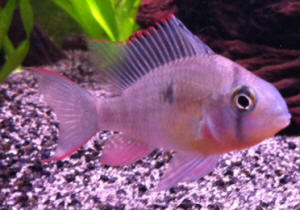
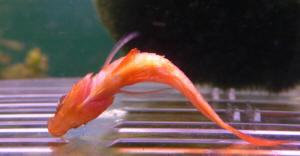
Apistogramma; head down 9/17/18
I have a dwarf cockatoo cichlid that has been breeding recently the last batch
of fry were about 2-4 weeks ago but on the last week he has been acting strange
by going vertical as the picture shows Amy ideas why he is behaving like this.
<I'm surprised if this fish is still alive by the time you get my message, to be
honest. Usually this darkening colour and spiraling loss of control implies
severe stress, if not imminent death. If the fish is still alive, I'd be doing
the following: First, isolate from the other fish (probably best to remove that
one, rather than stress the sick fish; if all else fails, a floating breeding
trap can be used to confine the healthy fish for a few days). Second, ensure
water quality excellent, with low nitrate and generous oxygenation. Thirdly, if
after a few hours of improved conditions, the fish becomes more active and shows
some signs of looking better, then medicating with Metronidazole would probably
be a good idea. It's as close to a cure-all as there is for cichlids, covering a
variety of possible problems.>
Thank you
From Josh
<Dwarf cichlids can be easily stressed, often by increasing temperatures,
dropping oxygen, and/or elevated nitrate level. In addition, any sort of
accidentally dissolved toxins, such as household solvents and aerosol sprays,
including things like insecticide, can cause immediate stress and/or death. I've
seen this myself with Nanochromis when placing a small piece wood into their
tank that came from a garden that had, without my knowledge, been recently
sprayed with weed killer. The pair of cichlids were dead within 20 minutes. If
just the one fish is sick, and the other fine, then still keep an open mind, but
do review environment, and think about how/why this particular fish might be
stressed. Let me make an additional point -- Apistogramma aren't really
"pairing" fish in the wild, most, perhaps all, are harem spawners to some
degree. Usually the female guards the fry, while the male will defend a
territory containing the smaller territories of one or several females. The
upshot of this is that female sometimes decide the male is a threat, and will
shoo him away. In a big tank, or the wild, that's fine, and he'll scoot off; but
in small tanks, say, a 10 gallon breeding tank, she might decide that the male
is still too close to her brood. She can then become very aggressive, harassing,
even killing, the male. Review, an act accordingly. Cheers, Neale.>
|
 |
|
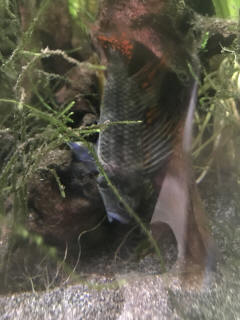
Re: Apistogramma 9/17/18
I am putting the fish in a breeding net as instructed, u said would die soon the
fish has been like this and it’s colours for a while on further inspection it is
the behind of the fish floating up causing him to be vertical
From Josh
<Obviously such behaviour is not normal, and must have some underlying cause.
Constipation can cause fish to lose balance, but their colours generally remain
normal and their behaviour doesn't change otherwise. So review my last message
as a starting point, and act accordingly. Cheers, Neale.>
|
Dwarf cichlid fry 6/21/18
In my tank my 2 Apistogramma/ dwarf cockatoo cichlids have just had
baby’s under a rock so I was unable to catch the female before or see
the eggs, I can now see the fry swimming around they female has spawned
before when I got her and i couldn’t catch the fry I have a mesh cage
and fine net how do you recommend catching them without hearting them or
them swimming under the rock or should I just leave them.
Thank you for any help it’s much appreciated
From Josh
<Hi Josh, well done with your spawning here! I'd leave the fry be unless
it was trivially easy to capture them and remove them to a breeding tank
or perhaps a large breeding trap. Removing and rearranging all the rocks
and plants to try to find a batch of fry is likely to stress the cichlid
pair. If the fry are actively swimming about and feeding they're
probably big enough the parents will ignore them provided there's space
enough the fry can avoid interfering with subsequent batches of fry.
It's probably best to remove the adult pair to a Spartan tank if you're
serious about rearing big batches of fry. Basically, heater, simple cave
(like a flowerpot) and a filter -- you can then remove the flowerpot
with the eggs into a rearing tank, replace with another flowerpot, and
let the process start over. Apistogramma are usually pretty good parents
though, so it's well worth leaving them with their fry for something
like 3-4 weeks, by which point the fry will be easily big enough to move
to another tank without disturbing the adults. Make sense? Indeed,
unless a given pair of cichlids are actually consuming their eggs or fry
(as happens with Angels a lot) it's better to leave the parents with the
eggs and fry because they'll do a better job than most aquarists! So
most casual breeders give their cichlid pairs 3-4 'attempts' at breeding
first, and only if they completely fail, think about rearing the fry
themselves. If you must capture fry from the existing tank, the easiest
approach is to use a net (square, not round) to drive the fry into a
plastic container (like a cup of some kind) so that the fry can be
corralled and removed without stressing them to much. Trying to capture
them with a single net is often frustrating for you and stressful for
the fish. Cheers, Neale.>
Re: Dwarf cichlid fry <Video>
6/22/18
Thank you for your help I will leave them as this time she has a male to
help her protect ( last time male died a few days after being bought and
the new male was what I think is called a sneaker male so thought was
female) this is a video I got of them.
<Neat! Among Apistogramma it's pretty common for the females to look
after the fry and the males to guard a territory that includes one *or
more* females. It's called the 'harem' style of breeding. While that
doesn't rule out keeping a pair, it can happen that the female becomes
defensive at times, driving off, even harassing the male. A rule of
thumb with cichlids is that if the male and female look identical (as
with Angels and Discus) then they look after the fry equally and in the
same way. The more different the two sexes look, the more differentiated
their roles will be in reproduction.>
From Josh
<Cheers, Neale.>
|
Re: Choosing a S. American Exotic 1/15/18
I finally got some Uaupesi Apistogramma.
<Nice! Apistogramma uaupesi is, I believe, the Apistogramma 'rotkeil' that had
some popularity a few years ago. Do bear in mind this is a true soft water
species (Rio Negro habitat) and a bit of a 'hothouse flower' so a Discus-style
environment is what you need for success. As with any dwarf cichlid, so watch
your water quality, including nitrate. Any nitrite or ammonia will kill them,
but even moderate levels of nitrate, 20 mg/l, are enough to cause serious health
issues in the long term. In other words:
don't skip water changes, and don't overstock the tank! If you have a pair, you
do want them breeding, but ensure plenty of caves, including some only the
female can enter. Otherwise, the male can be a bit hard on her, and you
don't want to be stuck with a lone male! On the plus side, once they're breeding
you should be able to sell the youngsters easily -- these are very desirable
fish! Cheers, Neale.>
|
 |
Re: Gourami compatibility question , Apistogrammas are known
to blind Corys? 6/29/16
Eeek, I just read that Apistogrammas are known to blind Corys?
<Yep. Never seen it myself, but Paul Loiselle describes it in his book,
'The Cichlid Aquarium'.>
So perhaps this is after all not a good addition?
<I'm wary about cichlids and Corys, yes. Can work depending on the
species, especially the bigger Corydoras being more durable than little
species. Similarly some cichlids are worse than others. Review.>
Sorry for the multiple questions. I want to be extra cautious about
compatibility as it's much easier to choose carefully than to take fish
back.
Thanks,
SP
<Welcome. Neale.>
Trying new dwarf cichlids.... half dead already.
4/25/16
Greetings, crew. Im sorry to bother you so much lately. This particular
time i just want an opinion on my course of action.
<Okay>
So the lfs brought in a shipment of dwarf cichlids of which i had none
of those species: Dicrossus sp (filamentosus likely), Apistogramma
borelli, viejita and what they have labeled as diplotaenia.
<Mmm; I do hope they quarantined them for a good two weeks... many "just
imported" South Americans die easily. I worked for importers... we had
these come in as contaminants... >
I should have known better or rather, waited out longer before buying. I
noticed they were all very small... probably ranging from 1 to 2.5 cm.
without any apparent colors except for a few... that coupled with
shipping stress and possible starvation these fish were in bad
condition, i figure now.
<Yes>
But at the moment i only thought of bringing the guys home, and so did i
and put them in a 10 gallon bare bottom tank, a few Anubias and rocks
for them to hide and so, cycled media and such. Parameters have been
around 0,0,0.5 (0.5 nitrates is what the tap comes out like, also). i
figured i could grow these guys since i have bred and raised dwarves
before with high success (rams and macmasteri), but i didn't take in
account possible sickness and shipment.
<The ones you had before... were likely tank-bred for several
generations. An "entirely different kettle of fish" hardiness-wise.>
So fast forward the long period of 2 days, i come home and find half of
them dead (8 originally, two of each). Only ones left are the two
Dicrossus which are hanging near the surface (they did so from the
beginning), 1 borelli and 1 viejita. The viejita looks like its about to
die too and the Dicrossus aren't moving much (they still react to my
presence though).
Ph is 6.7, tap mixed with ro/di. temp is 81 F.
<pH likely needed to be much lower, temp. higher; almost no hardness...
look up these species natural environments. On FishBase.org>
Did these guys die from stress and weakening due to shipment or could
there be an error in my part?
<Both>
i figured i could wait a week more and go get the remnants at the lfs (a
lot of people went crazy over the dwarves... pretty rare over here) and
hope those are healthier? i also was considering parasites or any
sickness they could bring along, but i cant notice anything out of the
normal... do you think it would be good to use preemptive medicine for
parasites and such or are they too young to get through that?
Thanks, crew, hopefully the rest survive, im at a loss on what to do.
<Read, study... be more patient; provide a more suitable habitat. Bob
Fenner>
|
Sick Macmasteri cichlid
1/31/16
Hello crew.
<Hola!>
I am writing you because as the title implies i have a sick female macmasteri
cichlid. She is in a 25 gal low tech planted aquarium with 7 threadfin rainbow
fish and two female guppies. Parameters are : 0 ammonia, 0 nitrites, 20
nitrates. Ph is 7.4. temperature is 28C (naturally, non heated aquarium)
<Sounds fine.>
they have been doing great up until now. Average temperature across the year is
around 25-26C but this last month has been a bit hot, however, there were two
days last week that were particularly cold, where water temperature dropped to
22-23C. then it slowly rose back to 26-28 C across the day.
<The high temperature "spike" can cause problems with low oxygen level. Cichlids
are sensitive to this. Even though many live in water that can get as warm as
28-32 C, in the wild there will be more oxygen than in an aquarium. Apistogramma
species generally are not hardy fish, and Apistogramma macmasteri is no
exception. They will not tolerate stress for very long.>
The macmasteri cichlid started flashing against the substrate, darting and has
clamped fins since two days ago. The first two days i figured anything she had i
would better just wait and put a heater at 28C to keep the temperature stable
across day and night. i haven't treated the tank with anything. She is not
eating flakes as usual but is still taking bloodworms and Tubifex.
<Don't worry about the fish no eating.>
Today i noticed she has what looks like a swollen gill, and that area looks sort
of pale. She still has colored fins but her color is starting to wash around the
head, she looks stressed and has clamped fins and darts a lot then decides to
just rest being a clump of java moss (she rests upright, not on her side). Im
not really sure what this could be, but i have avoided treating with anything
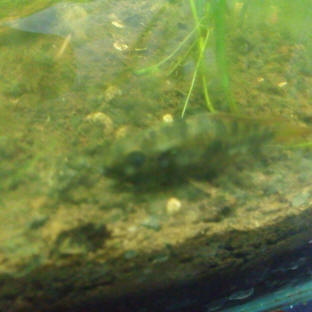
before being certain... i finally managed to take some pictures of her (
although bad quality) also i noticed she had a small growth on her upper lip,
sort of like a spider web strand, and very small white dot-like growths on her
right side near her eye. They are so small they are unnoticeable on the photos,
although the washing is visible on her left side. You can also see the white
patch and swollen gill on her left.
Thanks again, for all your help.
<The photos aren't clear enough to be sure. But assuming you're in Spain, as
suggested by your email address, you will only be able to get antibiotics from a
vet. Normally WWM recommends Metronidazole alongside an antibiotic for treating
sick cichlids. This combination works well against a wide range of problems.
However, if you can't get to a vet, you'll need some other options. I'd be
medicating using eSHa 2000 (excellent against early-stage external bacterial and
fungal infections) while maintaining perfect water quality. I'd not bother
feeding this fish while it's off-colour. I don't think Hexamita is the issue,
but look closely at your fish and compare the symptoms against those described
on the eSHa website (I've linked to the Spanish language pages, but there are
others elsewhere on the site)...
http://www.eshalabs.eu/espanol/products/hexamita.html
http://www.eshalabs.eu/espanol/products/esha-2000supregsup.html
http://www.eshalabs.eu
eSHa products generally have low toxicity, are inexpensive, and widely sold
across the EU. Cheers, Neale.>
|
 |
|
Re: Sick Macmasteri cichlid 2/1/16
The medicines i have always used to treat anything fish related have always been
Metronidazole, Methylene blue and malachite green (i know, very toxic!). I
actually live in El Salvador, and there are very few fish-related products over
here... so its not possible to get eSHa 2000 for me at the moment.
<Understood.>
What other antibiotics can i use? amoxicilin? (he!) metro comes in tablets, i
have always mixed a dissolved tablet with food, but that could be a bit harder
now... anything else?
<Well, we go back to Plan A... in other words, Metronidazole plus something like
a Nitrofuran antibiotic. This combination is quite reliable, and treats a wide
range of microbes including many fungi, Protozoans and bacteria.>
i have been looking at pictures of sick Apistos... it looks like a fungus, and
im paranoid it could be columnaris due to the white growth on the mouth (the
threadfin rainbows that are with her used to have columnaris back when i bought
them some 3 months ago, though i quarantined them).
<Columnaris is, of course, a bacterial infection, and treated in the same way as
Finrot. It does tend to be rather more stubborn though. Columnaris typically has
a grey, slimy appearance on infected fish, but really, you can't be sure without
examining samples under a microscope. So if in doubt, treat for fungi and
bacteria together. Cheers, Neale.>
Re: Sick Macmasteri cichlid 2/1/16
Alright, got it. Would Nitrofurazone work? it comes in tablets, do i just
dissolve it in the water even if the fish doesn't eat?
Thank you, for your time Neale.
<Getting fish to eat the medication is better, if you can get the dose right
(it's worked out going by the mass/weight of the fish). But otherwise: yes,
Nitrofurazone is a good choice and can be dissolved in the water. Follow the
instructions on the packaging, or else, the instructions given on line by
companies like API that produce the stuff for aquaria. Do monitor ammonia and/or
nitrite levels because these medications can be hard on biological filter
bacteria. Cheers, Neale.>
Re: Sick Macmasteri cichlid 2/15/16
Fast forward two weeks, my Apisto didn't make it. She seemed to recover but then
suddenly just died. She had been with me quite a while and was a very peaceful
cichlid...
<Sorry this didn't work out.>
Anyway, it is to note that the two females guppies ( and also three more guppies
that just seemed to appear... Out of nowhere... Im guessing they were spawned by
the females when i moved them here 2 months ago) all got the same kind of
infection, but on their fins.... Each day after my Apisto died i would find one
of the guppies also dead... Medication didn't seem to work. I had a slight
ammonia spike due to the several deaths but i continued 40% water change daily
and then did a 100% for two days ( in two 50% changes) only two guppies have
remained, they are still showing signs of infection but i has stopped
spreading... Fish are active... I don't know what else to do really but to keep
good water quality. The last death was about a week ago and the fish seem to be
recovering. No threadfin rainbow is infected, they are all feeding and acting
normally.
<All sounds very depressing. FWIW, my approach would be this: maintain good
water quality, removing any ailing fish and either move to a hospital tank or
destroy them humanely in the hope of preventing further reinfection. Wait for
whatever the problem is to work its way through the tank. Then, after no more
sickness, wait a solid 6 weeks, if not longer, before adding anything else. It's
very odd that the Rainbows are doing well, because they're fairly sensitive
fish, so it is possible that your Guppies and Apistogramma were simply sick when
you bought them, both species being intensively and cheaply farmed, unlike the
Rainbows. I'd be minded to avoid farmed fish if possible, and certainly
quarantine anything new before adding to this tank.>
On a side question, i am setting up a 150 gal. I plan on moving my pair of
German blue rams there but also want to get other small cichlids. I already have
spawning pairs of other Apistogramma species but i don't really want to deal
with fry in this new 150 tank. I was considering either Herotilapia multispinosa
or Pelvicachromis pulcher. No f/m pair but probably two same sex of each species
( e.g. two male kribs and two male rainbows) the tank will be moderately planted
with some river rocks and driftwood, it is a 60'24'24' tank, could this work ?
<Should do, but I'd honestly keep two females of either species. Less chance of
problems, and in the case of Kribs, the females are the pretty sex.>
As always thank you very much, for your help.
<Cheers, Neale.>
Re: Sick Macmasteri cichlid 2/16/16
Thank you, i just wanted to mention that my macmasteri Apisto had been with
about a year with me, and even bred once!( i separated the pair as i dealing
with other fry at the moment) and the guppies ( even the two female) were
spawned in my tanks with different bloodlines... That's what concerns me, these
fish have had very healthy lives but all of a sudden they just got whatever they
got... The rainbows are fairly recent though, 3 months or so... It is all very
weird.
<Agreed; nothing obviously amiss, but would keep an open mind and see what
happens. Regardless, leave the tank be for a good long while before adding
anything new. Cheers, Neale.>
|
|
dwarf cichlid identification
7/25/15
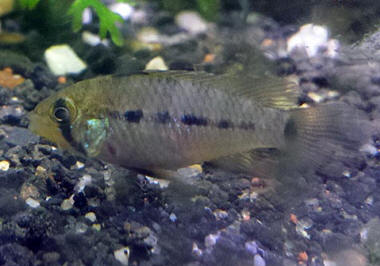
Can you help me to identify this one? It was bought (online) as being an
Apistogramma agassizii male, but it doesn't look like one at all...
<Indeed not.>
it seems that it's a female of some kind,
<Yes, but your guess is as good as mine. Female Apistogramma are fairly
similar. While there are some differences, your problem as an aquarist is
that while relatively few are sold regularly, Apistogramma cacatuoides and
Apistogramma agassizii spring to mind, artificial varieties are quite
common, and these might not match the photos in your fish books. On top of
this, as you're probably aware, there are "species groups" within the
genus, and members of species groups will interbreed given the chance.
While expert aquarists usually don't allow this to happen, casual aquarists
might, especially if the pet store had a tank of "mixed Apistogramma" for
sale, and it's certainly happening deliberately on some Southeast Asian
fish farms.>
but it doesn't look like the agassizii female as well.
<Agreed, not enough red on the fins, but could simply be too young or just
lacks those genes.>
This same store is known to mix up their fish a lot and send wrong species
here and there (happened with me more than once...).
<Ah, yes, see above.>
To me it looks a bit like the A. borellii female but I'm not so sure yet.
<Nor am I; seems to lack the classic "speckled" appearance of the typical
female Apistogramma borellii.>
Unless it's a very pale male of some (ugly and uncommon in the hobby)
species, I think it's a female.
<Almost certainly a female.>
It's not too small to not being able to display some more colours if it was
actually a male plus it doesn't seem to have some basic male cichlid
characteristics (pointed fins for example).
<Quite so. Behaviour should also be an indicator at this stage. Females
being less territorial, and often more concerned with food than putting on
displays than the males.>
It has no other colour so far than this faint blue on its head. It's in my
tank now for about 2 weeks, so I think it has already adapted enough to
show its real colour. At first I thought it could be a cacatuoides female,
but these are way more yellow even without a male around.
<True, but Apistogramma cacatuoides has been bred into various colour
forms, "Super Red", "Gold", and so on that aren't similar to the standard
sort in appearance, even among the females. Since Apistogramma cacatuoides
is the default Apistogramma at the moment (with good reason, it's an
excellent fish) this is a sensible starting point when identifying mystery
Apistogramma. I'd also look at Apistogramma macmasteri, the females of
which have plenty of blue on their gill covers and around the eye, but
often not much colour elsewhere (though some do have red on their unpaired
fins).>
TIA,
Marcos
<You're welcome, Neale.>
|
 |
|
Re: dwarf cichlid identification 7/26/15
Thanks, your answers were quite what was I expecting, actually... it's a
hard guy to identify. I am thinking about buying a cacatuoides, to see if
it can "trigger" her female colours, as to me it is what she looks like
the most.
<Understood.>
Mcmasteris aren't very common here (even though I live in Brazil!), I'm not
sure if it's one.
<Curious. It is a Colombian species though, and exports of Colombian fish
are patchy, at best.>
Once I got (from this same store) some varieties like mamore and some other
I can't remember right now but they were more like the bitaeniatas (thin
body) and were definitely males. If I had to bet, I'd bet on it being a
cacatuoides without any colour, but all the females I got had some colour,
from yellow to orange, plus a bit of pattern on the tail, this one is
pretty clear. But at the same time, all these females I got were bought as
a pair, so they probably had their "female" colour evident because of the
male being present.
<Makes sense. But if this was me, and I was serious about breeding
Apistogramma, I'd not breed from this female. I'd keep her in a quiet
community tank by herself (or even other surplus females). Breeding two
different species will result in hybrids, and these cause problems down the
line for the people who get them. Just like you, they'd be "What are these
fish?" Much better to breed exclusively from known species that are clearly
recognisable as healthy, normal members of their type.>
I have 4 ramirezis and this one likes to tease them a bit, but I guess it
doesn't make it a "him".
<Ah, do be aware that Mikrogeophagus ramirezi has different requirements to
Apistogramma, and it's hard to keep them both - properly - in the same
aquarium. Mikrogeophagus need warmer water than some Apistogramma and are
more dedicated sand-sifters than micro-predators on invertebrates. Cheers,
Neale.>
Re: dwarf cichlid identification 7/26/15
Could it be a hybrid female already?
<Always a possibility, even with wild-caught fish, but very much more
likely if this fish was brought in from a local breeder.>
I considered this possibility, but as I haven't heard of dwarf hybrids that
much let alone of them being sold, I thought it would be not much the case,
but at the same time, when they make a female Apisto available so easily
(i.e. not listing it specifically as a female and - of course - charging more
for it) it's something to be suspicious about...
<Agreed.>
I'm not sure about their sources, if it's collected or from a commercial
breeder, but if I was sure they were somehow collected (and sold by a
general supplier, not a breeder) it could have a chance of having some odd
species here and there in a batch.
<For sure. Safest bet would be to keep it away from males, let it mature
another couple months, provide optimal diet/water chemistry, and see what
happens. There are various cichlid-oriented forums online; you might try
positing a photo on one of those.>
Some similar species they had for sale (out of stock for a long time now in
their site) is the A. gephyra, which I also considered and the A.
taeniata... they also have listed a very generic "Apistogramma sp." but
it's also out of stock for a long time.
<Some undescribed species exist in the genus, the "A Numbers" for example,
and the ones traded under make-do names like Apistogramma sp. "Steel Blue".
So simply because an Apistogramma is traded as "sp." doesn't mean it's a
hybrid, it could be something as yet undescribed.>
They all are in a community planted tank (250L, 55G?) along with some
tetras and discus, and I'm not actually planning to breed it unless it
happens by accident, and if it does I'll not be passing the fry along. The
temp in the tank is now at 29C (I used to keep it a bit lower in the past
but didn't like the results... fish were getting too lethargic, not eating
well etc.),
<Interesting. My previous comment on temperature was meant to contrast (for
example) Apistogramma borellii, which really does best between 22-24 C, and
Mikrogeophagus ramirezi, best kept at 28 C. Not much overlap between them
in terms of habitat or distribution!>
pH 6.4, very soft water.
<Sounds good. Cheers, Neale.>
|
All female cichlids
1/30/15
Hi all, hope things are going well. Please tell me a dwarf cichlid that
I can keep a pair of without a female that will also get along in a
community tank with livebearers. thank you.
Lucv Hall
<Have you searched WWM? Bob Fenner> Dwarf Cichlids; sel.
1/24/15
Hi, Could you please tell me a very easy to keep dwarf cichlid that will be OK
in a community tank as well as able to be kept in a group or pair of the same
sex? I have been doing so much reading and I have starting confusing myself.
Thank you for your time. James
<Your best bets are: any of the Pelvicachromis species; the Bolivian Ram
(Mikrogeophagus ramirezi); one particular Apistogramma species, Apistogramma
cacatuoides; and the Rainbow Cichlid (Herotilapia multispinosa). These are the
easiest Dwarfs you'll see traded, anyway. In terms of water chemistry, the
Bolivian Ram, Apistogramma cacatuoides and
Pelvicachromis spp all do best in softish sort of water, 2-12 degrees dH, pH
6-7. By contrast Herotilapia multispinosa is a true hard water fish and will not
do well in soft water; 10-20 degrees dH, pH 7-8. To be fair, Pelvicachromis
pulcher will live in hard water as well, and do just fine, but when it breeds it
produces batches of only male fry, which is useless.
To get balanced males/females in your broods, you'll want pH 6.5-7 when breeding
Pelvicachromis pulcher. Other Pelvicachromis are fussier, and pH 6-6.5 is better
for them, and all Pelvicachromis do best in moderately soft, slightly acidic
conditions. There are of course other small cichlids that are quite easy to
keep, such as Neolamprologus "shell dwellers" and
the smaller Julidochromis, but these aren't really community fish and need
rather special aquaria. In hard water you might also consider Etroplus
maculatus. Besides the wild-type (which is greenish, but changes to orange and
black when spawning) here's a very pretty bright orange form created in
captivity that's widely sold, and despite its reputation as a brackish water
fish, Etroplus maculatus lives perfectly well in hard freshwater too.
Either way though, it's a little more bolshy than the species mentioned already,
so tankmates would need to be fairly robust animals that swim in the upper
levels only, for example Mollies, Swordtails, Barbs, Danios, etc. Such fish
would act as dither fish without triggering the territorial behaviours these
fish show towards catfish and loaches. Hope this helps.
Neale.>
Re: Dwarf Cichlids 1/25/15
Thank you Neale, I have been reading about the African Butterfly
Cichlid.
From what I have read it seems to be fairly easy to keep and won't
uproot plants.
<Outside of spawning, yes, that's true. Anomalochromis thomasi is much
like Pelvicachromis spp in terms of behaviour and care, though less
colourful, particularly when young, and consequently not widely traded.
Spawning adults colour up nicely though. Not fussy about water
chemistry, and generally tolerant of midwater dither fish and sensible
catfish or loaches that keep out of their way.>
What is your opinion on these?
<Nice fish, but sensitive to nitrate, and youngsters are a bit dull and
shy. Males get to about 10 cm, females a bit less, making them rather
bigger than true dwarfs.>
Thanks again. James
<Cheers, Neale.>
Re: Dwarf Cichlids 1/25/15
Thank you again Neale. Please give me your opinion,,,,,,,,,,, My tank is
30 gallons, 36 inches long. My PH is 8.0 out of the tap; I know it can
be adjusted.
<As I'm sure we've discussed James, fish care less about pH than
hardness.
What's the hardness? pH 8 is quite basic, which suggests high hardness.
How do you plan to soften the water? That's your challenge if you want
to keep soft water dwarf cichlids. I mix my hard tap water 50/50 with
rainwater.
What's your strategy?>
I have some driftwood and some lava rock with a sand substrate and
several artificial plants. Please tell me which cichlid is pretty, would
be easy to keep in this environment with other community fish, and I
would be able to keep 2 males or 2 females. If you were making this
choice for me what would it be please?
<If hard water was what I was stuck with, a pair of Rainbow Cichlids
would probably be my first choice. They're hardy, pretty, easy to breed,
and generally very peaceful. In a tank as big as 30 gallon, the
potential to keep a variety of Central American livebearers alongside
them as dither fish would add to their charm. Green Swordtails would be
the low effort
choice, but if you hunted around, there's all sorts of nifty livebearers
out there, Limia nigrofasciata being among my favouritest. I'd add a
clump or two of Vallisneria as well, as these grow happily in virtually
any substrate and under all kinds of light, and would make an authentic
addition to a Central American themed aquarium.>
Many thanks again.. James
<Welcome. Neale.>
Re: Dwarf Cichlids 1/26/15
Thank you Neale. The only way I know of for now to soften the water is
with a buffer.
<Which as we've discussed isn't softening water. It's
changing the pH by adding yet more chemicals. Might work fine for the
hardier Pelvicachromis (where pH 6.5-7 is key to successful breeding)
and Bolivian Rams, but wouldn't be my choice for Pelvicachromis
subocellatus for example, or Apistogramma cacatuoides.>
Would you recommend that or just go with hard water and the rainbows?
<If you have hard water, they're an obvious choice for life alongside
livebearers, rainbows, and the less fussy barbs and tetras.>
And what do you mean by "dither" fish?
<Hmm...
do read
Loiselle for more, but basically, surface swimmers that
benthic fish use as "look outs". When swimming in the open, dither fish
give bottom dwelling fish a sense of confidence that there are no
predators about, so such bottom dwellers swim about in the open. Such
dither fish need to be small, peaceful, schooling, and confident.
Danios, minnows,
various small livebearers have all been used as such. Avoid anything big
and threatening as these have the opposite effect.>
I will start reading up on the rainbow cichlids. If I do not want them
to breed and get a pair of the same sex, which sex would be less
aggressive?
James
<Singletons are the safest approach with cichlids, generally causing the
least harm. Pairs of females will generally do little harm too. Pairs of
males sometimes get cranky and territorial. Proper pairs (male and
female fish) will become territorial while spawning. Rainbow Cichlids
are not at all nasty, and provided they have a cave to call home, they
usually ignore
surface swimming fish. Cheers, Neale.>
Re: Dwarf Cichlids... blather
1/27/15
Thank you Neale, so for the livebearers it is OK to use swords and
platies
and leave out mollies because of their size?
<Pretty much. You want species about one-third to one-half the size of
the
dwarf cichlids being kept. Any smaller and they might end up prey, any
bigger and they're likely to be viewed as threats. So for the smaller
dwarf
cichlids, Limia, Merry Widows and so on make ideal dither fish; with
larger
dwarfs, Platies, possibly Swordtails if the tank is big enough the
Swords
can spread out a bit without becoming aggressive (something males are
prone
to do if frustrated). Swords would be ideal for Rainbows, and can work
with
the pushier Krib species too, such as the Common Krib. But probably a
bit
too pushy for life with Apistogramma, for example. Mollies are a wild
card
because of their sensitivity to water quality when kept in fresh, rather
than brackish, water. But they make very good dither fish for Etroplus
maculatus. Just the right amount of "nous" to get along with these
sometimes aggressive, salt-preferring dwarf cichlids.>
Also, what is the best way to sex the rainbow cichlids please?
<No 100% sure-fire as they look very similar, but generally males have
noticeably longer fins, and also tend to be bigger. Watch a group and it
should become obvious which are males, and you may also find a pair
defending a cave or corner. Lovely fish. Do check out images online to
know
what good ones look like.>
James
<Cheers, Neale.>
Re: Dwarf Cichlids
Thanks Neale, So just to verify if I go with the rainbows I could have 1
male and 2 female swords or platies with 2 rainbow cichlids in a 30
gallon
tank 36 inches long?
<I would think so; indeed, adding a couple more female livebearers
wouldn't
be a bad idea. Since female and male Platies are equally nicely
coloured,
they'd be an obvious choice.>
Could I add a single angel and/or a pair of pearl gouramis?
<I would not, though in theory they'd both be compatible in a large,
planted aquarium. But optimising the tank for Central American fish,
i.e.,
hard water and a brisk current for Swordtails at least, wouldn't suit
Gouramis or Angels.>
And if I can go with the gouramis I assume it would be better to get 1
male
or 2 females instead of a male and a female? James
<Cheers, Neale.>
Re: Dwarf Cichlids 1/28/15
Thanks again Neale, last question please. Do I get a
male and female, all
males or all females of the rainbows?
<Male Rainbowfish can be surprisingly aggressive towards each other. I
once
ended up keeping a single male Melanotaenia trifasciata (or something
like
it) in a low-end brackish system where it even sparred with a male
Sailfin
Molly! But normally, get a fair sized group, six or more, with more
females
than males. Should work, and the more the safer. Alternatively, a single
male and two females can work two, especially in quiet tanks alongside
species that don't interact with them (catfish, for example, or dwarf
cichlids). Sometimes mixing dissimilar species can diffuse tensions
further, e.g., a blue species with a red species.>
James
<Cheers, Neale.>
Re: Dwarf Cichlids
Neale, jut to make sure we are on the same page, by rainbowfish we are
talking about the dwarf rainbow cichlid, correct? James
<I was talking about Rainbowfish. Rainbow cichlids are best kept singly
or
in mated pairs, or even harems, as with most dwarf cichlids. Cheers,
Neale.>
|
Apistogramma issues 9/15/14
Hello crew,
<Duncan,>
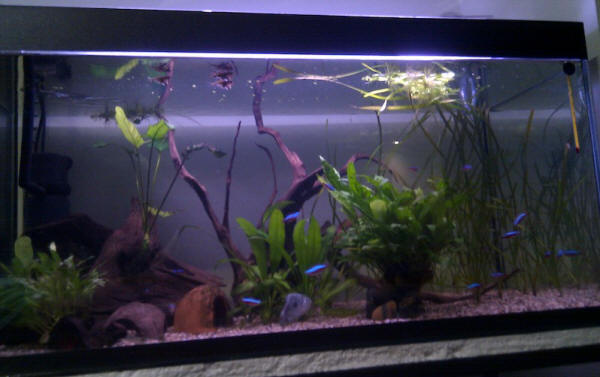
I have a 180L 90cmX45cmX45cm fish tank (28degC, pH 7.2, NH3 0, NO2 0,
NO3 10, GH 2-3 - tap water) here in Singapore. The tank is at room temp
and covered, though the internal filter seems to elevate the temp by a
degree or two.
<That, and the lights.>
See attached picture.
<Looks nice.>
On Friday I added two female A. trifasciata and a male and female A.
borellii (all approx 2cm) to the tank which already contained:
18x Cardinal tetras
1x 3-spot Gourami (female)
3x Marbled Hatchetfish
3x Amano shrimp
1x A. trifasciata male (3.5cm, reared in this tank from fry stage)
<All sounds okay, though the Gourami doesn't really fit in with a South
American theme!>
There has been significant squabbling between the Apistos, especially
the existing larger male who chased and harassed the others equally to
the point where he has been separated and will remain so for a few days
at least (reminded me of when I kept a fairly vicious pair of P. pulcher
in a 4ft tank - great breeders but nasty to everyone including each
other).
<Yes and no. Kribs are naturally harem spawners. We sell them as pairs,
but that's not really how they're "wired" mentally. Ditto Apistogramma.
The ideal for both types is one male with a largish territory and
several females within that territory. As you may have seen, females and
males are territorial, females to one another *and* to unwanted males,
and males to one another and potentially females that don't play ball
when it comes to mating behaviour. Adding more hiding places (halved
coconuts are ideal, with a mouse hole cut into the edge for in/out
access) helps, since these fish tend to operate on an "out of sight, out
of mind" basis.>
Subsequently, one of the new A. trifasciata females is now pushing the
other Apistos around, though not to the degree that the larger male was.
The other A. trifasciata female in turn seems to be above the A.
borellii pair in rank.
<Yes.>
I have observed no other issues between or involving the other tank
inhabitants.
<Indeed. These dwarf cichlids will be directing their territorial
behaviours towards each other.>
I understand the larger male A. trifasciata would have been defending
his territory and acting accordingly, but have I overstocked this tank
with Apistos (there are at least 5 separate 'caves' on the bottom of my
tank)?
<Should be okay, given time; do try removing all the cichlids, moving
one set of caves to one end of the tank, another set to the other end,
placing line-of-sight barriers between the two ends, and then
reintroduce the cichlids *with the lights out* for the rest of the day.
This should reset the territories and give them more time to come up
with some degree of coexistence.>
Or will it just take time for things to settle down and all stake out
their territories, and then a little more time before the larger A.
trifasciata male can be re-introduced to the fray? I would love to have
all five Apistos cohabitating in this tank if possible, with both species
breeding...
<Indeed.>
Cheers and thanks for your help,
Duncan.
<Welcome, Neale.>
|
 |
|
Re: Apistogramma issues 10/7/14
Hey Neale,
Just thought I'd give you an update.
The large male A. trifasciata continued to push the other cichlids
around, so I moved him to a larger system until they all settle in and
he can then be hopefully moved back in.
The day before I moved him, the A. borellii pair spawned!
<Yay!>
Days later, the female seemed to injure/eat the babies in trying to move
them around the tank.
<Can happen. As you're seeing, the female takes a large part of the
childcare duties. She doesn't always get it right first time. Don't
worry, she will eventually, even if she loses a brood or two. On the
other hand,
even a good female will "recycle" the nutrients in her brood of babies
if she thinks she won't be able to rear them, e.g., by being scared or
harassed. Peace and quiet is critical.>
A week later, they seem to have spawned again (female yellow, hiding in
cave, aggressive to tank mates that come too close, etc.). I am somewhat
surprised, considering how small these fish are...
<Oh boy, yes, like all cichlids, they punch above their weight when
breeding.>
One last thing if that's alright. Having moved the three-spot gourami
out of this tank, I am lacking a 'centre-piece' fish. I am keen for a
singleton angelfish, but am conflicted. Lots of FAQs on this website
suggest this could/should work, though Bob's article on angelfish say
singletons can wipe out the rest of a community tank if the mood takes
them. What would you advise?
<Angels are predatory (towards small fish like Neons) and potentially
(though rarely) aggressive to anything that doesn't look like another
Angel. There are more docile cichlids, such as Altum Angels (very quiet
fish), Festivums (a personal favourite) and even Discus, that you might
consider though. Possibly also things like Keyhole Acaras and Port
Acaras, though Keyholes especially tend to be rather shy. Problem with
any cichlid is that there's always the risk of conflict between your
centrepiece cichlid and the dwarfs breeding away at the bottom.>
Thanks so much Neale/crew,
Duncan.
<Cheers, Neale.>
Re: Apistogramma issues 10/9/14
Hi Neale,
Thanks so much for your reply and suggestions. Wow, I could really keep
a single discus in this system (180L, 3ftx1.5ftx1.5ft, soft but slightly
alkaline water, 28degC)?
<Probably. Farmed Discus are really so much easier to keep nowadays than
they used to be. I'd argue a better investment than either Neons or
Guppies, let alone disease-prone Dwarf Gouramis!>
That would be my DREAM, though I had always discounted it thinking a)
Discus needed to be kept in groups of 6 or more and b) Discus required a
4ft tank at a minimum. If not on a) and b), that'll be my plan!
<Discus in groups need to be 6+ specimens, else bullying tends to occur
unless you keep a mated pair. But a singleton can be kept in 180
litres/50 US gallons without much trouble, providing tankmates are as
peaceful as the Discus. Wild Discus are a whole other ball game, and are
very nervous and intensely social. But the farmed ones, much like farmed
Angels, have come from generations of fish kept as breeding pairs in
small tanks, and have become rather more robust in terms of personality.
Choose dither fish tankmates such as Silver Hatchets that swim at the
top and make the Discus feel secure. Get a youngster that's bold in the
fish shop, but not too small, around the 8-10 cm size range if possible.
Introduce him to a nice aquarium with peaceful tankmates and plenty of
shade. Get him socialised with you in terms of feeding, via frequent
small meals of yummy foods, so he's more interested in scrounging meals
than his predicament. With luck, he'll settle right in. Avoid adding
fish thereafter, at least for a few months so you can be 100% sure he's
settled. Don't add anything fast-moving or similar in size that will
spook him. While farmed Discus are more phlegmatic compared to their
wilder cousins, they're still Discus!>
Also, when I said I was surprised that the A. borellii were breeding so
well so quickly, it was more because they are no-where near close to
full adult size - the male is only around 2cm long, the female barely
that.
<Not uncommon with cichlids, and not necessarily a plus. When fish breed
at a small size, we don't know if the parents are passing on "dwarf"
genes or regular size genes, hence the tendency of many farmed fish to
be smaller than the wild sort. Mollies for example can be really big
fish in the wild, 15 cm or more, but you rarely see such monsters in
fish shops! So ideally, we hold back breeding until we're fairly sure
the adults are a proper size, and also by delaying, we can see if there
are any other genetic abnormalities showing up too.>
The female is now protecting the small (~10 fry) brood better second
time around, and also seems to be allowing the male to 'work the
boundaries' of the territory in defense of the fry, as opposed to
chasing him away like the rest of the fish in the tank.
<Yes, pretty much what happens. Where cichlids look identical (e.g.,
Discus and Angels) males and females share tasks equally, but the more
they look different, the more often they do different jobs, in extreme
cases, one or other sex might not even be involved at all (e.g., as with
maternal mouthbrooders such as Haplochromis).>
All very impressive, especially for a dwarf cichlid that is supposedly
more suited to more middling tropical tank temps.
<And not really compatible with Discus unless you're super careful. Do
review their temperature requirements. 28 C/82 F is about right for
Discus, but a bit warm for some, but not all, tropical community fish.>
Thanks and cheers,
Duncan.
<Most welcome, Neale.>
Re: Apistogramma issues
10/10/14
Hey Neale.
Thanks again for taking the time for such detailed replies to my emails.
<Most welcome.>
I think given all you've said, I'll give the Discus a miss. I'm really a
'hobbyist' fishkeeper at best, and I don't think I would/could give this
beautiful fish the proper care it requires.
<Understood. Don't be too scared off them though. They're always worth
considering, and provided you avoid the really inbred and delicate
varieties, the farmed fish aren't especially delicate. Your standard
issue farmed Brown Discus (so named for the brownish-yellow-green
background against which the blue, green and red stripes are set) is
fairly sturdy once settled into an aquarium and feeding well. If there's
a Discus club or breeder nearby, that'd be a great place to "chew the
fat" as we say here, i.e., to discuss Discus with a local perspective --
what's good, who breeds nice stock, what you can/should expect to pay.>
So I'm thinking I'll roll the dice with an Angel and be ready to move it
if things go pear-shaped.
<Cool. Angels are generally a step up in hardiness above Discus, but
also a step up in aggression. They also tend to be bred to a price
rather than a quality, so are also more likely to carry parasites or
diseases (one reason farmed Angels aren't mixed with Discus). Bear that
in mind, shop accordingly, and quarantine if you can.>
Really would love a Festivum, but they seem to be hard to come by here
in Singapore, plus I've read elsewhere that a) they nibble/shred plants
and that b) they do much better in pairs/groups. As a bit of a Festivum
aficionado, would you give any credence to a) or b)?
<Most cichlids will nibble tasty soft-leaved plants (such as floating
Indian Fern) without doing any serious damage. Festivums are no
different. But they don't damage anything more sturdy, and will be just
fine with Java fern, Anubias, Amazon Swords, Vallisneria, hardy
Cryptocoryne and so on.
They love planted tanks, and really should be kept thusly. If all else
fails, stock fast-growing floating plants such as Indian Fern to provide
both shade and occasional green food. As for behaviour, I kept mine
singly,
alongside a variety of gouramis (Pearl and Moonlight Gouramis). She/he
seemed just fine and dandy. As with a lot of cichlids, these fish are
social when young, then form pairs as adults. Outside of the breeding
season adults might group together for protection, but to call them
"schooling fish" is over-egging the pudding. What they don't like is to
be kept with bigger, more aggressive fish -- in the wild, this would
indeed drive Festivums, Angels and so on into groups for mutual
protection. But in a quiet tank alongside smaller (but not bite-sized)
companions they're perfectly happy on their own.>
On the concerns you raised with the A. borellii breeding at such a small
size, should I separate them and let them grow up before bringing them
back together again?
<Well, you could I suppose, if you had the time and space. If nothing
else, giving females some time to put on bulk tends to help with their
overall health (spawning seems to be especially taxing on female fish).
On the other hand, if your fish are happy, maybe just carry on what
you're doing and see what happens. Separating them now, then
reintroducing them a month or two later, risks problems with aggression
if they don't take to each other. So swings and roundabouts! If it were
me, I'd leave things be, and remember for next time there's some mileage
to letting fish mature before introducing them.>
Also, I realize my tank is warm, but this is unheated room temperature
in Singapore! Short of using a chiller, I can't actually bring the
temperature down.
<Probably no need. I assume temperatures go down a bit at night, and if
you're in the tropics, tropical fish should be pretty happy! A fan to
encourage evaporation can be a plus, or else some folks freeze blocks of
ice then dump them in the tank to cool things down. Amazingly, many
tropical fish quite happily dart in and out of the cold water -- Danios
are famous for loving this!>
Cheers and thanks again,
Duncan.
<Most welcome. Neale.>
|
|
Trouble (?) with an Apistogramma trifasciata female?
1/20/14
Hi crew,
<Dunc>
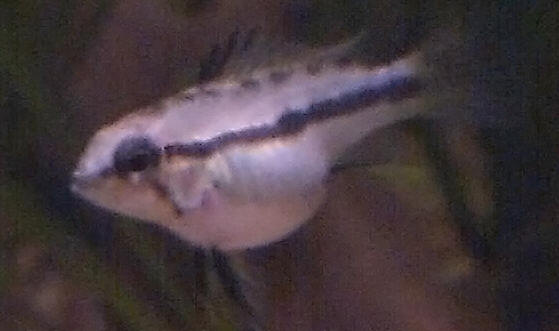
Attached is a photo of an approximately 1cm-long A. trifasciata female.
I have raised this fish, plus 4 males (3 of which were moved to another
tank 4 days ago), since they were little fry. Despite the appearance,
the fish feeds vigorously on flake and brine shrimp and generally
behaves as expected. Only a week or so ago it was seen displaying in
front of the male (see below) and trying to lure it into a cave.
<Mmm>
This fish and an approx. 2cm long male share a 180L, 3ft tank with a
female 3 spot gourami, 16 cardinal tetras, 1 bristle nose catfish and 3
Amano shrimp. There is no obvious aggression within the tank -
occasionally one of the tetras has a nip at the gourami but her fins are
in great shape and there are no outward signs of trauma.
Tank parameters are: pH 7.2, Ammonia and Nitrite 0, Nitrate <20ppm, GH
and KH 3.
Is this fish sick or just egg-bound (too young for this?).
<Might be a tumor, some sort of internal blockage... or simply the egg
binding... I'd have you read and try using Epsom:
http://www.wetwebmedia.com/FWSubWebIndex/SaltUseFWArtNeale.htm
and a laxative food/s... more Artemia, perhaps Daphnia... As the one
fish is only affected, am discounting the likelihood of lumenal worms
(and suggestion of vermifuge med.s)...>
Cheers and thanks for your help,
Duncan.
<Welcome. Bob Fenner>
|
Re: Trouble (?) with an Apistogramma trifasciata female?
1/20/14
Thanks a lot Bob,
<Welcome Mr. D>
Can I treat the whole tank, or must I remove this fish and treat separately?
I don't have a spare tank lying around right now...
<All can be treated together with this amount of salt/s>
Cheers,.
Duncan.
<Ta ra. BobF>
|
Mixing a Bolivian Ram and Apistogramma 10/5/13
Hi crew,
<Dunc>
Thanks for reading my email.
<Sure>
Is ridiculous to think that a single, reasonably-tempered Bolivian Ram
could share a 3ft, 180L community tank with 1m and 2f Apistogramma
agassizi, assuming enough hiding spots (caves, wood), moderate planting
(Vallisneria, java fern, Amazon sword and floating Frogbit), temp 28 deg
C, GH/KH 3-4, pH 7.2ish and Nitrogenous waste where it should be (0, 0,
<20)?
<Not ridiculous. I'd bet they'd cohabitate>
One 20% water change per week/week and a half is carried out.
<Mmm, every week if you have the water>
There's a male Apisto in there as of today - a bit of ram chasing Apisto
but nothing serious yet - I will monitor.
I'd love the look of the bulky Ram co-habitating with the dainty Apistos
if possible.
I have removed a male P. taeniatus already, as though he went pretty
easy on the ram for a year, I think I'd be pushing it with anything
else.
Other tank inhabitants are:
- 19 x Cardinal Tetra (who fin-nipped my Pearl Gourami into another
tank!)
- 1 x Bristlenose Ancistrus (a bit feisty) - would this eat eggs/fry of
the proposed cichlid harem?
<Might>
- 1 x female 3-spot Gourami (generally well-behaved)
- 3 x Amano shrimp (big, healthy)
On another note, could two pairs of different Apisto species (agassizi
and
trifasciatus) share this space - a possible future project.
<Should be able to fit in two pair of this genus in this size, shape
tank>
Cheers and thanks!
Duncan.
<Welcome, Bob Fenner>
Mixing a Bolivian Ram and Apistogramma 10/5/13
Hey crew, not sure if the below made it through from Thurs night., so
I've included it below.
<Ah, did. I just "saved" overnight, hoping Neale (in the UK) would pick
up.
BobF>
Thanks!
Duncan.
Re: Mixing a Bolivian Ram and Apistogramma /Neale's further
input
10/5/13
<<I don't disagree with Bob, but would caution you that -- as
always with cichlids -- there are no guarantees so far as social
behaviour goes!
Despite being much bigger, a single female Bolivian Ram should not be
much of a threat to a pair of robust Apistogramma such as A.
cacatuoides, but a male (or worse, a pair) of Bolivian Rams might be a
"real and present danger" to any Apistogramma kept with them in a small
aquarium. On the whole Apistogramma tend to occupy smaller territories
towards the back of the tank, while Bolivian Rams are much bolder fish
that hang about at the front of the aquarium, so with luck they'll
largely ignore each other if the tank is adequately large and well
decorated with things to break up lines of sight. Mixing Apistogramma
species works well, assuming the species chosen share similar
requirements (there is some variation re: temperature for example) but
you do of course run the risk of hybridisation. Finally, I would not mix
any dwarf cichlid with Loricariid catfish if my goal was rearing fry.
While cichlids generally make excellent guardians by day, they are
almost blind at night, and that is when catfish will view their nests as
prime feeding grounds! There's a suggestion that some cichlid species
move eggs from one nest to another precisely because this makes it
harder for catfish to find their eggs, and it's only a small step from
moving eggs by mouth to become true mouthbrooders, which is an even
better way to keep their eggs safe. Cheers, Neale.>>
Leaf litter 8/11/13
Hey Crew
How are you all doing? I have just returned from a trip in which I was
lucky to observe south American dwarf cichlids in their natural
habitat. Most of them live in black water pools or stream
littered with leaf litter.
My question is what can I use for leaf litter? I live in Zimbabwe and
have access to maple trees, acacias Mopani trees mainly, can I use any
of these?
Regards
Yasfir
<Hello Yasfir. The answer is yes, you can use leaf litter, but with some
caution. Leaves fall apart quickly underwater, and create a lot of muck
that can block the filter. Such decay can also cause the pH to drop.
Some leaves are also toxic, so obviously you don't want to use those and
poison your fish. So basically some leaves are better than others. Here
in England, Indian Almond Leaves (Catappa spp.) are actually imported
and sold at the equivalent of about US$2 for just THREE leaves!!! But
these leaves decay slowly, and they also seem to improve water chemistry
a bit, encouraging many fish to breed more readily. At a fraction of the
cost, some British aquarists use Beech and Oak leaves instead (Fagus and
Quercus spp.) and these seem to work almost as well, and obviously cost
nothing
because you can collect them yourself. So what about native leaves in
Zimbabwe? Well, Maple leaves (Acer spp.) have been used with success,
but Acacia spp. are reported, in some cases, to be toxic, so I'd avoid
those.
I'm not aware of Mopani (Colophospermum Mopani) being toxic, but you
will have to research that. So bottom line, provided the leaf is
non-toxic, its leaves should be safe. But even if safe, you may find the
leaves fall apart after a few weeks, or may cause the pH to drop very
rapidly, especially in soft water. Some leaves last longer than others.
Experiment with a few leaves from one species of tree at a time, monitor
water quality and pH, and see what works! Cheers, Neale.>
Re: Leaf litter
Thanks Neale :)
<Welcome, Neale.>
Apistogrammas spawning 7/6/13
Hi,
You helped my wife and I out recently when we had some problems with our
Apistogramma agassizi dying suddenly, which we managed to resolve with
your great help. As we mentioned before, we bought a couple of females
and added them to our QT, before adding to the main tank around 14 days
later after treating for parasites & bacterial infection using eSHa
products.
<Glad to be of help.>
It seems we were MUCH more successful than we expected to be and now
have a male & 2 females merrily taking over our community tank and
behaving/surviving brilliantly.
<Excellent.>
So brilliantly in fact, 1 female and the male have paired up and spawned
inside our shrimp tubes (which our shrimp never touch!!) and are
diligently protecting the area - but what now - we have no idea what we
should do.
We'd love to have some baby Apistos, some to keep for ourselves and some
to sell to our LFS.
<It's often fun to leave the pair alone for the first few broods.
Cichlids tend to make mistakes first time, and hardly any survive, but
the practice will improve the parents' care, each time they get better
and better, until eventually they get everything right: picking out
infertile eggs, removing fungus, moving the fry, finding food for the
fry, defending the fry, etc.
It's a real treat to watch. Since these fish will spawn more or less
monthly given the chance, you will still end up with lots of offspring
after a few months.>
Should we separate them from the community, leave them be, remove the
babies once they hatch?
<The easiest approach if you want lots of fry is to remove the eggs
rather than the fry. You can remove eggs from water for a few moments,
carry them to another tank, and put them close to an airstone to ensure
a gentle water current that stops debris settling on the eggs. Adding a
half-dose of Methylene Blue is a good way to prevent fungal infections
of the eggs. Aim
to get something like a 30 litre aquarium for the eggs so you can rear
the fry in it; a common mistake is to overstock cichlid fry, in which
case you end up with half a dozen (often the faster-growing males)
because water quality just isn't good enough. Feeding can be tricky
because baby cichlids need tiny foods, with newly hatched brine shrimp
and Microworms being a favourite, but in my experience you can get
reasonably good results from Hikari First Bites (which I keep in the
freezer between uses to keep fresh). If you can get them to lay eggs on
something solid and removable like a flat pebble or the inside of a clay
flowerpot, that's the easiest
approach. Moving fry is possible (a turkey baster works well) but fiddly
and likely more traumatic. If you remove the eggs, they simply spawn
again after a few days, so no harm done.>
Remove the other fish?
<That is, indeed, the alternative, but clearly more hassle.>
Also, what's the behaviour of the female, where she keeps moving the
eggs with her mouth (or is she eating them)?
<Often inexperienced cichlids do eat their eggs. But cichlids will also
eat their eggs if they decide for some reason the eggs are at great
risk, effectively recycling the energy so they can spawn somewhere
safer.
Finally, cichlids are meant to move the eggs with their mouths at some
point to remove infertile ones and any with fungal threads on.
Experience makes a world of difference here, and it is far from uncommon
for cichlids to eat early batches but look after later batches extremely
well.>
We have a 125l tank and our other fish consist of:
Neon/black neon/Glowlight tetras x6
Harlequin Rasbora x3
Zebra Danio x1
Ghost widow tetra x3 (you mentioned previously that these were a
boisterous fish, but ours are very timid and hide pretty much all the
time)
Striatum Killifish x2 females
Rachovi killifish x2 (1 male and 1 female - these are beautiful and
entertaining fish)
Rock Shrimp x2
Rabbit snail x1
Assassins snail x1
<Snails and shrimps will eat eggs given the chance, and obviously small
fish eat fish fry if they can.>
We've not been able to find much information on the web or in the dwarf
cichlid books we have, so we really have no idea what to do to ensure
survival of as many baby Apistogrammas as possible. Can you offer some
advice?
Many thanks
Damian
<See above; hope this helps! Neale.>
Apistogrammas spawning 7/24/13
Hi, I hope you can help me,
You (I think it was Neale) responded to this e-mail (below) early in
July and I read it, I've now looked back to reference it again, as we
have yet another spawning from our Apisto's... but your reply has
vanished. I think it might have been cleared as junk by my new e-mail
software - weirdly, though, I've looked through your website and cannot
find it there either.
Would you be able to re-send me your original reply, point me to the
location of it on the website, or respond again?
Many thanks
Damian
<Hello Damian; do see here:
http://www.wetwebmedia.com/fwsubwebindex/fwdailyfaqs.htm
It's towards the bottom of the page, but if you search for Apistogramma,
it's there!
Cheers, Neale.>
Re: Apistogrammas spawning 7/25/13
Brilliant, I found it, thanks... but Aaaaarrrrggghhhhh, what the heck is
going on now? Our male Apisto has spent the last 2 days hiding in a cave
(since spawning basically) and is now dead.
<Oh.>
The female with the eggs was chasing him after they had spawned,
was he bullied to death?
<Maybe.>
He's died with very similar symptoms to those I described in a previous
question, they suddenly go really thin, hide and then die - all's been
perfect for a while, and now this problem again, and we've made no
changes to the tank other than routine maintenance (no new living
additions)!
<Apistogramma are not necessarily pair-forming fish, and in the wild the
male may patrol an area within which several females will be rearing his
offspring. So, there's not a strong evolutionary pressure for good pair
behaviour if male and female are stuck together in a small tank. Usually
they're fine, but not always, and it's possible that one fish pestered,
harassed or otherwise bullied the other to death. That said, you may
simply have had bad luck or the male died for some other reason. Because
Apistogramma are typical South American fish they do need soft, slightly
acidic water to do well, and except for one or two hardy species, they
fare poorly in anything above, say, 10 degrees dH. You're aiming for
around 2-5 degrees dH, pH 6-7.>
Our nitrogen cycle conditions are basically fine (0 ammonia, 0 nitrite,
20ppm Nitrate). Having investigated a little, I have discovered our pH
is very high - somewhere between 7.6 and 8.0.
<Find out what your hardness is. Much more important than the pH.>
This is a new thing which we think is caused by our tap water which I've
just tested and is also around the same level (it used to be around
7.2), it may also have been aided by our current weather conditions
pushing our tanks to around 28°C (82°F), I'm now trying to slowly reduce
the pH with Seachem Discus buffer and am replacing some of the water
with RO (not much I can do about the heat until the weather cools down a
bit!).
<Indeed.>
I know they prefer pH between 6 and 7, is it possible that the high pH
would cause these types of symptoms (though our females, for the moment,
are doing fine!)? Would the �blackwater� additives help too or are they
not worth the money?
<Not especially helpful, no. Focus on hardness above all else, as
outlined above, and a steady pH after that, the precise value being less
important than its stability between water changes.>
We have now removed the female and the eggs and she's in a tank of about
90% RO, 10% tap water (to get the temperature right) and they seem to be
doing OK at the moment - although it looks like she may be eating the
eggs again.
<Which is far from unlikely if she's stressed. Basically cichlids eat
their eggs to recycle the energy for a new batch if they believe that
rearing fry right now would be impossible.>
Please help,
<Are you aware of Apistogramma.com? They have a forum and could be very
helpful.>
(sorry to keep asking you, but you really seem to have the best
knowledge of all this stuff of everyone (we have no local network for
this type of fish, books are vague and our lfs's are pretty useless when
it comes to support with anything more complicate than a neon tetra).
<Ironically one fish I've never had any success keeping for long!>
Thanks
Damian
<Welcome, Neale.>
|
Help - Tropical fish die suddenly (RMF?) <<Agree w/ you>>
6/7/13
Hi,
<Hello,>
You helped me with a problem I had last year and I've suddenly started
having another serious problem in my tank. I have a 125 litre tank, with
moderate planting, an air stone for oxygen and with readings of:
Ammonia = 0
Nitrite = 0
Nitrate = generally 10-20ppm (I never let it go above 40ppm)
pH = 7.4, GH = 12°D, KH = 5°D
<All sounds fine for a typical mix of community fish.>
I perform weekly or fortnightly water changes (depending on Nitrate reading
and general tank inspection) of around 25% and always use Seachem Prime to
treat the water before adding. Until recently, I had:
3 Ghost widow tetras
<The albino form of Gymnocorymbus ternetzi, a robust but sometimes nippy and
certainly boisterous species.>
3 Neon tetras
2 Female Platies
3 Harlequin Rasbora
3 Yoyo loach
3 Corydoras (not sure of variety).
1 male & 1 female Apistogramma (sold as A. cacatuoides, but we think they're
A. agassizi)
<I see.>
All was happy in the tank for well over 6 months with no problems and no
deaths and as the wife and I loved the Apistogrammas, we decided we wanted
to breed them, so added a second pair. This worked really well, with no
fighting and generally a happy tank. Then suddenly after about 3 weeks, we
lost the new female Apistogramma, then a replacement female Apistogramma we
bought before realising we had a problem, then the 2 platies and our
original male Apistogramma. They all died within a few days of each other
and all with EXACTLY the same symptoms:
They seemed fine, swimming around normally, then suddenly, for a few days
start looking very thin.
<May have been sickly right out of the box… sadly all too
common with farmed (especially inexpensive) Apistogramma and other dwarf
cichlids. Do bear in mind that these fish are somewhat delicate animals
compared to generic community fish… well worth quarantining for 4-6 weeks,
deworming, and (in the UK at least) treating preemptively with something
like eSHa HEXAMITA to shift any intestinal parasites.>
Then within a day, they hide and can't swim upright properly. Within another
day, they float around the tank unable to swim but still able to breath.
Then they die. On most of them, we noticed a small red blotch on their
underside.
<Ah now, if they react like this within a day or two of purchase, ask
yourself what stressed them. How does your water chemistry, temperature
compare to that of the retailers? What about water quality? How did you
acclimate them to their new aquarium?>
We thought this was parasites so treated the whole tank with both Waterlife
Sterazin (10 day course) and Waterlife Parazin,
<Not a huge fan of either of these medications… but if you understand how to
use them, and follow the instructions, they should work reasonably well. Do
remember to remove carbon, if used in the filter.>
then with eSHa2000 just in case it was Bacterial.
<eSHa 2000 is strictly for external bacteria in particular Finrot, and won't
treat internal parasites of any sort. eSHa HEXAMITA is much better for
those.>
All appeared fine and we thought we'd cracked it, but then, immediately
after finishing these treatments, we lost our original female Apistogramma
in exactly the same way, just today. At the same time as getting the 2nd
pair of Apistogrammas, we started cycling a breeding tank for them -
planning to move them into it once it was ready - it's never been populated
- it's just now ready for them and they've all died except 1 male - who's
now not looking too good! I'm worried that we're going to lose more to this
horrible affliction and am getting nervous about the prospect of getting
more Apistogrammas to breed until we understand what's going on.
I've attached a photo of the last female Apistogramma to go this way, just
before she died. Can you offer any suggestions or ideas - we've lost some
expensive (and our favourite) fish, and it's heart-breaking to watch this
happen to them. I would really really appreciate your help or advice!
Thank you
Damian
<Do suspect these fish were ailing when you bought them, they do look very
underweight, and if in this condition within a day or two of purchase, I'd
be asking the retailer for an explanation. If plump and healthy when you buy
them, but gaunt and sickly a month or two later, then the problem is more
likely yours… with dwarf cichlids, do review (especially) water quality,
including nitrate, as well as oxygenation and water movement at the *bottom*
of the tank. Do review diet, social interactions (such as bullying) and
other causes of stress. If only the females are dying, not the males, then
territorial aggression by the males towards the females may be an issue…
adjust stocking density, sex ratio, and availability of hiding places
accordingly. Dwarf cichlids are almost never "easy" fish, and quarantining
them beforehand is practically essential, especially where farmed, Southeast
Asian species are concerned. Hope this helps, Neale.>
|
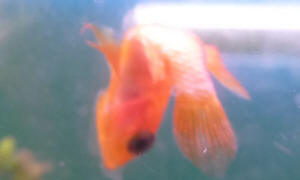
 |
|
Re: Help - Tropical fish die suddenly (RMF?)
6/9/13
Thanks ever so much for your help Neale,
<Welcome.>
I have a few additional questions after reading your response, if I may?
<Sure!>
eSHa HEXAMITA reads like its for Discuss, is this definitely the right
thing to use? Or have I found the wrong version of this product?
<Yes, it's the right thing to use. It's marketed for the Discus folks,
but it's an anti-Hexamita medication that should work on any cichlid (or
for that matter, any other fish). To quote from their advertising: "What
fish can I treat with HEXAMITA? HEXAMITA is specially formulated for use
with discus and cichlids (and is especially good with discus and
angelfish).
However, it can be used with all freshwater tropical and coldwater fish.
HEXAMITA is well tolerated by fish, plants and filters.">
If eSHa HEXAMITA is right (from the last question), would you recommend
treating the whole tank (is that safe with the fish we have?) or
isolating the final Apistogramma and just treating him with the eSHa
HEXAMITA?
<I would treat all the cichlids, ideally in a quarantine tank, but
treating them all in the main aquarium should be fine. If you have
medication left over (and generally eSHa products are very economical)
then do quarantine any new dwarf cichlids, medicate them in the
quarantine tank, and only once medicated and feeding well add them to
the main tank.>
We plan to review our tank setup, based on your suggestions of tank
layout and bottom level movement, plus quarantine for new Apistogramma
before adding. At the moment, our QT is only 10 litres, so we don't
leave fish in it for long.
<Ah, this is fine for 2-3 Apistogramma for a few weeks.>
What do you recommend as a minimum QT size for a male/female pair of
Apistogramma? (FYI, they are generally sold as a m/f pair around us, so
figured the QT needs to accommodate them both - unless we can find a
good and trustworthy local breeder!)
<Indeed. Do put lots of caves in the tank though, preferably with
no/subdued lighting. Try using halved coconut shells, each with a
"mouse-hole" cut at the rim, placed downwards so they look like igloos;
these are favoured hiding places for Apistogramma and very easy to make
and replace.>
I think you're right, our first pair of Apistogramma were fine (they did
great for 6 months), but I think that the second lot were ailing when we
bought them, and I think one sick fish probably contaminated the rest,
causing most of them to die. I don't think the water or bullying had any
part to play - our water is consistently good now and we never witnessed
bullying after the first couple of days once the pecking order was
established.
<One of the things about Apistogramma often overlooked is that most are
harem spawners -- including Apistogramma cacatuoides and Apistogramma
agassizi -- so in the wild males hold a big territory that includes
smaller territories of more than one female. Only a few species are true
pair formers. If you can keep multiple females per male, your results
will usually be better. Even if they don't fight when kept as a pair,
having multiple females per male means each female is less stressed
because it interacts with the male less frequently, so overall does
better.>
It's a shame, as these are amazing and entertaining fish. Hopefully we
can learn from this with your advice, and get it right next time.
Many thanks for all your help.
Damian
<Most welcome, Neale.>
Re: Help - Tropical fish die suddenly 6/19/2013
Neale,
Thank you so much for all your great help and advice - Following your
suggestions, we tried eSHa Hexamita and instantly all our problems
stopped and our surviving Apistogramma has regained weight and looks
much healthier.
<Glad to help, and glad the eSHa product worked well. I like their
products and appreciate the fact they're good value too.>
We've now bought a couple of female Apistogrammas, currently in a QT and
having just completed a course of the eSHa Hexamita treatment as
recommended, both females look healthy and are eating well after 5 days.
<Good.>
How long would you suggest we continue to keep these isolated?
<2-4 weeks would be ideal. In theory, if they've finished the treatment
and are clearly eating and putting on weight, you could move them
immediately, but you may want to hold off for a while if you've been
"messing around" with the display tank -- give it time for the filter to
recover, remaining fish to settle back and for any symptoms of any other
diseases to surface.>
Would you recommend to also precautionary treat with an anti-bacterial
treatment before adding to the main tank?
<No harm if done sensibly.>
And if so, what's a good treatment to try (UK available!)?
<Again, I've found the eSHa product, eSHa 2000, is tolerated well by
fish and filters.>
Do we need to clear out the QT of all traces of the Hexamita
anti-parasite before treating, or should this be OK?
<Should be fine, but as ever, do one or two substantial water changes
(25-50%, keeping water chemistry and temperature steady) just to freshen
things up, and allow a couple days at least after the last treatment for
any remaining chemicals to be metabolised by the filter bacteria. In
reality, medicines don't linger for long because bacteria quickly break
them down, so the main thing is to make sure you don't use medicines
simultaneously (unless the manufacturer says it is safe to do so).>
We really appreciate all your help and sorry for asking so many
questions.
Thanks
Damian
<Most welcome, Neale.>
|
Display instead of breeding.
Adding Apisto's-Chuck's Take 2/27/13
I'm going to be taking on a lot of projects this year, a community
garden, a new job and now the Aquarium. I was wondering if two male
Apistogramma with a school of marbled hatchets would be a good idea
instead of breeding Apistogramma cacatuoides? Would two males live in
mutual respect in my tank size or would it be a bad idea?
< Most dwarf cichlids including Apistogrammas like to hang around the
bottom of the tank. The hatchet fish stay close to the surface so they
would be safe. Two males would square off over territory but would be OK
as long as they were both pretty close to being the same size. A
breeding pair can be tricky. Before the spawn the male would be trying
to court the female and could get rough if she is not ready. After the
spawn the male is pushed away even though he tries to help. The hatchet
fish would pose no threat to the fry or eggs. If you have never bred
Apisto's before then I would give it a try. They are definitely fun to
watch.-Chuck>
Which Apistogramma? 2/18/13
Apistogramma Choices <and sys.> (Chuck's Take)
A. Borelli i
A. cacatuoides
or A macmasteri
I was wondering out of the 3 species which would do the best in my water
in a 20 gallon planted tank. I personally like A. Cacatuoides.
< The A. borelli is the smallest of the group with males maybe getting
up to 2" TL. They come from the southern part of South America and like
cooler water temperature. The A. cacatuoides is the biggest of the group
and may get over 3"TL. This one is the most tolerant of a wide variation
in water parameters. This fish also comes in a variety of designer
colors. Watch for deformed ventral fins in some of the color morphs. The
MacMasteri is actually named after Mark MacMaster who was in charge of
the Apistogramma Study Group back in the 1970's. This fish has a many
geographic color variants. Your choice can be based on personal
preference and the A. cacatuoides would do fine in your tank,-Chuck>
Re: Which Apistogramma? 2/18/13
thanks I think I'll go with the A. cacatuoides
<Good call.>
I already got a sponge filter, pump and tubing. Along with a glass top
and test kit, net, aquarium plant substrate, and dechlorinator. I just
need the light- a 24 inch coral sun lighting fixture for $73 at a world
of fish.
<Don't overdo lighting if keeping Apistogramma… shade-tolerant plants
plus floating Indian Fern what you want. These fish dislike bright
overhead lighting.>
and a 45.99 syphon at PetSmart.
<Python tank cleaner far from essential!>
Then I'm all set to start cycling the tank, which should take about 8
weeks or so, right?
<Yes.>
Whats the best product to help a tank cycle. do you know where I can
find ammonia to seed the tank? Would world of fish/Aqualand carry
ammonia. Should I use some zebra danios to start the cycle.
<I would not… Danios would be too boisterous for Apistogramma… would
choose something much more docile that swims in the middle to upper
levels… Ember Tetras, Marble Hatchets, that sort of thing.>
I'm probably not going to be able to set up this tank until April or mid
march. PS Do you know of any good local Apistogramma breeders?
<Local to where? Do try your local tropical fish club, or the cichlid
association native to your country… Cheers, Neale.>
Re: Which Apistogramma? 2/18/13
Okay then what lighting would you subject. I want it to be high enough
to grow plants
<Between 1-1.5 watts/gallon will be ample for a few Cryptocoryne wendtii
and Anubias, plus some floating Indian Fern; otherwise, choose lighting
according to the plant species being kept, with the proviso that your
Apistogramma will expect a shady area somewhere in the tank. They like
caves, coconut shells being ideal, cut in half with a "mouse hole" on
the side for them to swim through. Java Moss grows well on coconut
shells.>
yet not too high for the fish.
<Cheers, Neale.>
Re: Which Apistogramma? 2/22/13
Discus Origins, advertized on Apistograma.com - a forum I'm a part of
now,. a new shipment of Apistogramma cichlids came in, and while I
cannot get any at the moment ( tank isn't set up and I don't have the
money). I was wondering if any of them would do well in my 20 gallon
tank with the water I have explained to you. These are all wild
collected BTW. Here is the shipment list.
A. mendezi Santa Isabel
A. paucisquamis Santa Isabel
A. mamore
A. uaupesi
A. agassizi Tefe
A. stacki Ro negro
<All of these will expect quite soft water, say, 1-5 degrees dH, and a
pH between 5 and 6. Wild-caught Apistogramma are a substantially harder
to keep than farmed ones. Farmed Apistogramma agassizi for example is a
pretty adaptable fish. >
Some of these fish are very expensive which is why I decided to see if
they can live in my ph, etc.. before placing a request for them at a
later date once I see pictures of course.
<I would not expect any of these wild-caught Apistogramma to do well in
anything other than soft, fairly acidic water. Your friends on the
Apistogramma forum should be able to provide specific details for each
species. Do look for farmed Apistogramma cacatuoides; it really is the
most straightforward and rewarding species for aquarists with "ordinary"
water conditions. Cheers, Neale.>
Re: Which Apistogramma? 2/22/13
Thank you so much for your help, I'll go with captive bred fish. But now
where to get them when the time comes?
<Apistogramma cacatuoides are widely sold here in the UK; places like
Wildwoods and the larger Maidenhead Aquatics routinely have them in
stock.
Wildwoods does mail order, so they're a good place to start. In your own
country things may be different, but your local fish club and/or
national cichlid association should be able to help.>
Do you think A world of fish has/can get me some good ones. Or do you
think I should go the breeder route.
<There are pros and cons to buying locally-bred fish. If you buy
locally, you'll be able to talk to the breeder about water chemistry,
feeding and so on, making your odds of success much better. There's also
less chance of bringing along diseases ubiquitous to fish farms and
tropical fish shops, such as Whitespot. But on the downside,
locally-bred fish may well be siblings, so if you get a pair, you'll run
a major risk of inbreeding, and that means reduced fertility and less
robust offspring.>
I did post an ad on the buy- sell section for a breeder in my area will
see what comes of it. Do you think Aqualands any better. both are kinda
far but will go if must.
<Hope this helps, Neale.>
Re Apistogramma sel. – 2/24/13
I was lost now I'm found
Well After much looking and some help from Angelfish forums I was able
to locate an Apistogramma Cacatuoides breeder in the us.
<Cool.>
He bids on Aquabid I know he does Triple red I don't know about
Sunburst. I also do not know how much he will charge or if he has fish
available when I need them. He's called Apistodave. I was getting rather
frustrated with myself but I'm glad I found it finely.
<Indeed. A. cacatuoides is such an adaptable species (by Apistogramma
standards) it's worth taking a little time to hunt down. There are only
a very few other Apistogramma that are as tolerant of medium-hard water
and pH levels up to 7.5; Apistogramma steindachneri is one, Apistogramma
hongsloi is another, but most of the others are picky about water
chemistry, and do need soft, acidic conditions to do well. Apistogramma
are rewarding fish though, so I hope you enjoy them. Cheers, Neale.>
Apistogramma; dwarf cichlid sel.
10/20/12
Hi WWM,
Are cockatoo cichlids relatively hardy
<Yes, with "relatively" being the operative word. They're not as hardy
as, say, Corydoras, but they're among the best Dwarf Cichlids for
beginners.
They'll forgive things that other Apistogramma won't, which is why
they're ideal for those starting out with Dwarf Cichlids.>
I liked the idea of Bolivian rams but I understand after reading on WWM
these can be a bit prone to stress if water conditions are not optimal.
<As are virtually all Dwarf Cichlids.>
My tap water has naturally high nitrates above 20ppm with API test.
Would a cockatoo cichlid put up with this better than a Bolivian ram?
<Both should do fine with this. 20 mg/l is a good, conservative estimate
of where nitrate should be kept at or below. But cichlids can and do
tolerate much higher levels -- they're just that bit more disease-prone
if other factors aren't good (such as suitable diet and regular water
changes). In a clean, well-maintained tank you tap water is probably
just fine, and I'd
certainly buy some Apistogramma cacatuoides without reservation --
assuming of course all other factors are good!>
Thanks
Andy
<Most welcome, Neale.>
|
Bolivian or blue ram
10/21/12
Hi
Please could you help is this a blue ram or Bolivian ram?
Thanks
Andy
<The former. Bob Fenner>
|
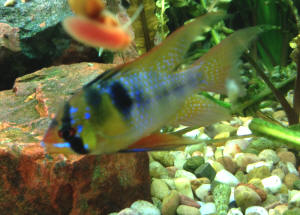 |
Nannacara anomala gender issues
8/5/12
Hi crew,
<Duncan>
Hope all are well and thanks again for this wonderful service that you all
provide.
<Ah, welcome>
I'm after some gender reassurance regarding my Nannacara anomala pair if
that's O.K. I have a sub-adult pair I believe (part of a 3ft, 180L community
tank), but the supposed male spends much of his time looking like a female
(as in 95% of the time). See my first two photos attached. I'm aware males
who are juveniles, sub-adults or non-dominant adopt this colouration all the
time, and occasionally my male drops his black line and looks like a subdued
version of the lovely pictures of male Nannacara anomala you can find on
Google pictures.
<Should be "more male" with the development of the smaller individual>
The male is about 1.5 inches not including tail, and his female companion is
tiny, only just an inch or so (3rd pic attached). I guess I'm just hoping
that my N. anomala male will end up growing into something lovely like most
males apparently do. As a side issue, the male seems to have a deformed tip
to his dorsal fin (see circled photos). I'm guessing this is genetic as he
appears to be thriving otherwise.
<Genetic or ontogenetic (developmental)>
On another issue, the foam base which separates my stand and tank appears to
be shedding somewhat (see pics). Should be concerned and replace it or is
this O.K.? The foam was recycled from a school classroom and I don't know
its age.
<No images of this attached>
Finally, is there any reason why fresh activated carbon would not remove the
yellow-brown tint from the water caused by the copious driftwood in my tank,
at least to some degree?
<Only if the carbon were of "low quality" or exhausted. See WWM re use...
some types (shiny) are of limited capacity>
Thanks a lot crew,
Duncan.
<Welcome. Bob Fenner>
P.S. I recently spent 8 days in the Maldives, 170km-odd north of Male. I
used a Dicapac waterproof bag to take lots of photos of fish with an older
DSLR, of which I've attached a few (thought you guys would appreciate!).
Unfortunately I only made it 20m max offshore (2 kids so no 4-hour
snorkeling safaris for me!), but I still found it amazing. Sorry for any
naming errors - marine fish are NOT my area of knowledge!
<Ahh! Wondered why these were here. Thank you for sharing. B> |
.jpg)
.jpg) |
South American Dwarf Cichlid crossbreeding 6/12/12
So I have a female Apistogramma bitaeniata and a male Nannacara anomala
in a 12G overfiltered (30G HOB filter) heated (78-82F) with 6 dwarf
Corydoras (habrosus and hastatus), 3 guppies(1M2F) and a zebra
Hillstream loach.
<Mmm, these last two are misplaced here... need cooler, hard, alkaline
water... the loach much more water movement...>
There are 3 hidey holes (terra cotta pot, barrel decoration and a half log
propped on a flat piece of slate), sparse live plants (dwarf chain
sword, Ludwigia, hydrophilia, water wisteria) and a piece of cactus wood
on a play sand substrate. Regular T8 lights and I dose daily with
Flourish (Seachem) and have a 4" air rock providing extra aeration.
<Ah good>
My readings are GH 180ppm, KH 40ppm, PH 6.5-7, NO2 0.5ppm,
<Should be 0.0... I'd increase bio-filtration, cut feeding>
NO3 20-30ppm,
<Too high... I'd keep under 10 ppm>
and ammonia 0-0.5 (test strips),
<See WWM re these strips... inaccurate, imprecise>
readings taken before my maintenance and tonight is when I do the weekly
maintenance (vacuum, 25% water change, and filter rinse).
<Good>
Now my question is will these two south American dwarves crossbreed?
<Not as far as I'm aware... many Cichlids can/do cross... typically
limited to congeners (species of the same genus)>
I haven't conditioned the female but when I added him to the tank she went
from her drab olive coloring to bright yellow, has repeatedly tail
slapped him and does this maneuver where she winds her body into an S
and springs straight and looks like she is biting him but there is no
damage to his body or fins. I'm not sure if the male is interested or
not, he has some greening but still has the horizontal black stripe down
the middle of his body. I'm not a purist so don't mind if they do but if
they don't it's no big deal as long as they aren't trying to kill each
other. So should I be watching for eggs or just smile and admire the
pretty fish?
<There may not be enough space in this system for much of this
behavior... in other words, the interaction may express itself in damage
to tankmates.
I'd keep an eye out, oh, and read re the differing water quality needs
of what you have stocked here... And separate the players accordingly.
Bob Fenner>
Thank you Jenn
Single specimen cichlids, stkg./sel... dwarf neotropicals 4/16/12
Hello, WWM crew. I'd like to start out by saying how impressed I am.
It seems like no matter what fish-keeping query I type into the search engine,
one of your pages pops up. I can't imagine how much time and effort must have
gone into all of this.
<Mmm, thanks... much time, effort>
I kept expecting to see some hidden advertising (such as certain products being
recommended) and was pleasantly surprised.
<Would (indeed) dilute the "power" of our influence/wishes/direction>
I've spent endless hours reading, and I think I've learned more here than on
all other fish websites I've visited put together. Way to go!
My question is about keeping single specimens of cichlids. I am interested in
trying out these guys in a future tank, but I don't feel comfortable with the
idea of keeping a breeding pair. This is partly because I don't like the idea of
bringing large numbers of fish into the world without already having a plan for
finding them homes, and also because from the accounts I've read online, it
seems to me that lots of people have had their so-called peaceful fish turn into
psychotic killers when breeding.
<Can/does happen>
So, I've been trying to find out if a single cichlid (I'd really like some sort
of Apistogramma, I love the look of a. Agassizi) would be okay in a community
tank.
<Mmm, yes; most Dwarf Cichlids, as species, specimens do fine as singlets...
Perhaps not as interesting behaviorally, or colour-wise, but fine biologically>
I can't find much info on this. I've read lots of website claiming that cichlids
must be kept in pairs or multiples or they will suffer from loneliness. Is that
true?
<Some species are quite social; not so much the S. American dwarves>
I read on a wwm page that female/male pairs are best, but wasn't sure if that
was meant as opposed to a single or male/male or female/female.
<Either/all>
Thanks! -George
<Welcome. Bob Fenner>
Re: Single specimen cichlids, stkg. 4/16/12
Fantastic! Just the answer I was hoping for. Yes, I had read that the colour
could be less brilliant if kept alone. I was hoping to find out if that is a
very significant difference. I saw two pictures of the same fish, one in threat
mode and one normal. Is the normal colouration about what a could expect from a
solo fish?
<Yes>
Also, is there some way to 'trick' it into displaying, such as holding up a
hand mirror?
<Not continuously, no>
Would the bottom swimmers be likely to attack bottom dwellers such as Corydoras
for invading territory or is that strictly a breeding behaviour? (do males even
have territories when there are no females present?)
<Not likely if the cats are of size, armored or venomous>
I'm also curious about mixing two single specimens. Again, territory issues, or
would they ignore each other?
<Would not>
Any tips on avoiding conflict such as staying away from similar-looking fish? In
cases where it's hard to determine sex of one or both, how can I tell if two
different species be at risk of hybridizing, would choosing from different genus
(genuses?)<genera> be a safe way to ensure that they would not breed?
<Mmm, more reading... BobF>
Re: Single specimen cichlids 4/16/12
I've actually been pondering this idea for some time now. I prefer to do my own
research and I've read a lot, but all information I find tends to be about
keeping breeding pairs or keeping single large, very aggressive fish.
<Ahh!>
About the hybrid issue, I ask because I've read that Apistogramma do not
hybridize, and I've also read that there's an Apistogramma mariae which is a
hybrid, and something called a ''steel blue Apistogramma'' which may or may not
be a hybrid...
<I do think I recall a scientific paper stating there hybridiz/sation did occur,
or could>
It would be nice to get some real info for a change ha-ha, that's why I'm
asking you guys.
<Mmm, we don't "do" original science, though a few of us here have science
degrees>
It's my understanding that Apisto are easy to sex,
<When mature>
however, I may go with another genus of SA, in which case I could end up with a
problem. I should have asked rather, in general if you wanted to
have a community of cichlids, how would you prevent hybridization?
<Different genera are best>
Cross reference each with each other to see if it's been done? Or is that what
you meant by ''more reading''?
<A bit more delving into the (scientific) literature. Read here:
http://www.wetwebmedia.com/litsrchart.htm
To clarify, you are saying that two different, single dwarf cichlids will not
ignore each other. Will they fight/maim/kill, is my real question I guess. So,
yea or nay?
<They should not fight, kill each other>
I suppose if they can't be housed together then the above question is moot.
The more important question is if a (''peaceful'' dwarf cichlid) male will be
territorial with no females around, (to the extent of harming other fish) and
no, my community aquarium will not have anything venomous in it.
<Even a peaceful cichlid species (of all types) will become overtly aggressive
and territorial when engaged in breeding/brooding>
Thank you, Mr. Fenner! :)
<Welcome George. Bob Fenner>
Re: Single specimen cichlids 4/16/12
Excellent, that's just what I've been trying to find out. Thank you very much.
Keep up the great work!
-George
<Will do, B>
Chichlid
Environment 12/30/11
Hello! I am in the process of completing my 20 gallon
tall freshwater tank.
<Good. Now, do be aware that "tall" 20 gallon tanks are
difficult to stock. They're great for those aquarists who are into
plants, and only want to add a few small tetras or perhaps a pair of
Angelfish. But if the fish interest you rather than the plants, and you
don't want to use the tank for a breeding project, you will have
problems.>
The cycling process took about a month after which I added 6 zebra
Danios that have been in the tank for about 3 weeks now.
<Okay.>
Everything seems stable: Ammonia, Nitrite, Nitrate all 0. The
tank is stocked with java fern and Anubias (both on separate pieces of
Malaysian driftwood), java moss, and corkscrew Vallisneria.
<All easy-going plants. One problem with "tall" tanks is
the extra depth combined with the smaller surface area, and this means
you have less light getting to the plants despite the need for more
light because of the depth. Again, not a problem for dedicated
aquarists able to invest in high performance lighting. But the average
"tall" tank bought from an ordinary pet store will have
problems growing all but easy-going plants like the ones you've
just named.>
Until today it also had Anacharis, banana plants, and dwarf
hairgrass,
<I'd be very surprised if any of these thrived in this tank,
unless you happen to have high intensity lighting, i.e., 3-4
watts/gallon.>
but I did a 40% water change and some redecorating and these plants are
waiting to be reintroduced as needed (also need some suction cups to
keep the floating Anacharis in place). As this is my first real
attempt at a community tank I want to make sure I have everything right
before I add more fish.
<Do read books on plants before spending more money on them. Plants
can be a total waste of money if you don't do things right in terms
of light intensity.>
Originally, I planned to have a school of Danios and a school of
barbs.
<Quite possibly too many fish for this tank, unless you chose
wisely. E.g., your Zebras alongside half a dozen Puntius pentazona or
some other small Puntius species. If you keep the tank cool, around
20-22 C, then Puntius gelius, the Dwarf Golden Barb, would be an
excellent companion for Zebra Danios.>
However, I decided I would like to have a slightly larger school of
Danios (as I have grown increasingly fond of them) and a
'centerpiece' fish. I read your article on stocking small
tanks ('Stocking 5, 10, and 20 Gallon Freshwater Aquaria' --
great article) and liked the idea of a pair of Bolivian
Rams. I have been reading more about these fish and want
to make sure I have things straight. It seems they will adapt to
a range of conditions, unlike most cichlids, and are a decent fish for
the newer aquarist (at least someone who is willing to dedicate time
and attention? I am a stay at home mom and have a decent amount
of time for my tank)?
<Right, now, here's the thing. Your "tall" tank has a
limited surface area. It might not be big enough for two Bolivian Rams
if they don't get on. Get a pair, and you might be okay. The same
holds true for Apistogramma cacatuoides, a slightly more difficult soft
water cichlid.>
I have been researching GH and KH as my tests have been confusing
me. Upon further reading I believe the confusion is that my tests
measure in mg/l instead of the degree values I have seen associated
with those ppm mg/l. My GH is about 120 mg/l (12 I assume) and my
KH is about 80 mg/l (somewhere in the 'soft,' 2-5, range).
<Hmm'¦ do read here to understand the conversions between
mg/l and degrees dH/degrees KH:
http://www.wetwebmedia.com/fwsubwebindex/fwh2oquality.htm
Actually, the units don't matter, provided your test kit lets you
determine "soft", "middling", and
"hard".>
Is this safe for Bolivian Rams? PH is acidic to neutral (normally
tests at 7, tested 6.5 six hours after water change today).
<Yes, your water sounds fine. Not too much of anything in any
direction, which is okay for them.>
I also have a plant substrate and recently read that sand is best for
Rams as they sift food from sand. Would my more gravely substrate
eliminate the possibility of keeping Rams?
<Should be okay.>
I am working on the layout of my tank to accommodate the caves and
darker lighting that rams need (hence the suction cups for floating
plants and possible purchase of more plants) and would like your input
regarding caves. I have two pieces of driftwood that crop out
from the glass, creating two 'v' areas (sorry, I couldn't
get a pic within the memory constraints). Would this suffice as a
cave for the rams or do I need something more specific and/or bigger--
plant pots, rock caves, etc.?
<Actually, Bolivian Rams are open spawners and not too bothered
about caves, though they'll certainly use them. What they like are
flat rocks or sandy areas underneath shady plants.>
Also, my Danios currently explore the whole tank instead of being just
'surface' fish. Will their behavior change when other
fish occupy the bottom or will this be an issue when it comes to
aggression?
<Danios will swim less in the bottom once the cichlids are there,
but yes, they do tend to swim in the middle and upper levels given the
chance. If you look, you'll see they have short whiskers, and like
catfish, they can and do use these to feed from the bottom. If they see
predators though, which is what they'll consider the cichlids,
they'll be less keen on swimming at the bottom.>
I am considering buying larger driftwood to add to the environment of
the 'upper reaches' of the tank.
<Hmm'¦ no, not such a good idea. Danios need lots of open
space. Floating plants, e.g., Indian Fern or Amazon Frogbit, would be
much better choices, plus they remove nitrate and thereby improve
cichlid health (cichlids are super-sensitive to nitrate levels above 20
mg/l.>
I assume if I have a centerpiece fish I would not be able to have a
much larger school of Danios than the one I have now. Maybe only
an addition of one or two more Danios?
<Sure.>
I don't need a lot more, but I know the larger the school, the more
secure the fish feel and the better behavior they will have.
<Oh yes, and also, the male Danios will be less likely to turn
aggressive.>
I think that is all. Also sending an email about my corkscrew
Val.s.
Thanks so much from an excited aquarist!
<No problem.>
Teresa
<Cheers, Neale.>
Re: Chichlid Environment 12/30/11
Hi Neale,
<Teresa,>
Thanks for the response.
<Most welcome.>
I knew that 20 talls can be problematic, but didn't know all the
details.
Good points for me to keep in mind as I move forwards. When we move out
of our apartment (hopefully this year) I will be on the market for a
bigger/better tank. I actually had this tank sitting in my
parents'
basement from my middle school years when I had a couple
goldfish. :D
<Fair enough!>
Would it be too much of a risk to try a pair of chichlids?
<Cichlids (pronounced "sick-lids", not
"chick-lids") are always a gamble as pairs. Typically, males
are more aggressive than the females (though this isn't always the
case) and if you have a male and female who won't pair off for some
reason, the female can end up being harmed, even killed. Some species
are very peaceful and rarely cause problems, Keyhole Cichlids for
example, but most, even Angelfish, can be a gamble.>
I would have to order the rams from my LFS as they don't stock them
so I'm not sure they would take them back in the case of a
problem. And I don't want to count on getting a bigger tank
because that wouldn't be for months at least. I considered
getting a bigger school of Danios and keeping it at that, but would
like to get a bigger fish that my 5 month old could watch.
I assume the limited surface area is a territory issue, not an O2
issue?
<Both. Lack of surface area at the top means there's less oxygen
coming into contact with the water, while lack of surface area at the
bottom means those fish that "stake claims" to real estate,
like cichlids, aren't easy to house. These "tall" tanks
used to be called "breeder" tanks because they're mostly
of use to breeders who wanted the biggest tank they could fit into the
smallest space. Given they'd be keeping just a pair of Angels or
something, the surface area issue wasn't a big deal. But as
community tanks, "tall" tanks aren't the best choice for
beginners.>
If I can go for the chichlids I would need to create a couple good
areas for them (hopefully they will pair off and it won't be a
problem)?
<Given each cichlid could easily claim an area 24 x 24 inches with
its home in the centre, adding caves or whatnot won't make a huge
difference. If one decide to drive the other one away from its
territory, the weaker one will likely spend all the time hiding in the
top corner of the tank, as far away from the other cichlid as
possible.>
While still keeping as much swimming space as possible (in a 20 tall it
isn't a lot to start with)?
<The habitat in the bottom half of the tank needs to be complex,
with a mix of shady areas and open areas. The habitat on the top half
needs to be essentially open, except perhaps for tall plants or
floating plants.>
Thanks so much! This is a huge help and gives me peace of mind
moving forward.
Teresa
<Good luck, Neale.>
Pelvicachromis Pulcher or
Apistogramma agassizii in community tank?
11/13/11
Hi crew,
After much reading on WWM and more than a few emails, my 4ft,
220L community tank is starting to come together. Thanks for
all you've done to make it happen.
I've got the choice to add either Pelvicachromis pulcher or
Apistogramma agassizii to the following water parameters/stock - does
one suit better than another? I'm going for a breeding pair if
possible.
Water:
- 28 deg Celsius.
- pH 7.2 (afternoon) - 7.6 (morning).
- ammonia 0 ppm
- nitrite 0 ppm
- nitrate 10 ppm
- GH 4 deg
- KH 3 deg
- 20% water change and gravel vac every 1.5 weeks
Stock:
- 5x Melanotaenia praecox (1m, 4f)
- 1x Aplocheilus Lineatus
- 9x Hyphessobrycon pulchripinnis
- 5x Crossocheilus siamensis (juveniles at the moment)
- 4x Colisa fasciata (juveniles, out of quarantine and into main tank
tomorrow)
To add:
- 2x Ctenopoma acutirostre (2" juveniles)
- A pair of either Pelvicachromis Pulcher or Apistogramma agassizii
I realise any fry I get from the cichlids may well be eaten by
Aplocheilus Lineatus or Ctenopoma acutirostre after the parents give up
parental care.
I have no issue with this - should I?
<No, not really.>
So what do you think? Please critique any other parts of my set up as
you see fit.
<I'd go with the Apistogramma. Fewer fry, and generally a less
boisterous species. But with this said, very small specimens might be
just about big enough for your Ctenopoma to view as prey, so introduce
specimens of similar size to the climbing perch.>
Thanks a lot crew, as always,
Duncan.
<Cheers, Neale.>
"alarm
substance" freaking out my fish? 7/28/11
Hello Crew,
<Hello,>
I've been raising 7 juvenile 1" Bolivian
Rams, all healthy and feisty, but a week ago one stayed in the
corner by himself, breathing heavily, and wouldn't eat. Tested the
water (with a liquid kit) and it was good:
Ammonia, NO2, NO3 - 0,0,5. By morning he was laying on his side and
drifting around with the current so I gently removed and euthanized
him, and did another water change. The 6 remaining have been freaked
out ever since, and taken to hiding. A few would eat a bit, but nothing
like before.
They seemed listless and frightened.
<Dwarf cichlids tend to be spooked in tanks that feel too small, so
as/when you upgrade tank you should find they settle down. Furthermore,
they dislike bright light and open, plant-free tanks, so do bear in
mind they want a shady, gloomy tank.>
Tank - 10 gallon cycled
Stock - 7 juvenile 1" Bolivian Rams. Will soon be moved to a 20
long.
(Hoping for a pair to form)
Feed - high quality crushed flake, occasional wet-frozen treats
Twice weekly water changes of 30%
Ammonia, NO2, NO3 - 0,0,5
Temp 79* F.
KH - 280 ppm
GH - 300 ppm
pH - 8.3 (a bit high, but it never fluctuates. I've been keeping
adult BRs and tetras with no problems).
<Does sound a bit hard, alkaline. Any chance of lowering this?
Mixing your tap water with rainwater or RO water, at a 50/50
ratio?>
I've been reading the WWM site for answers and came across the
"alarm substance" article. This made a lot of sense.
<Except that, to my knowledge, cichlids don't produce
Schreckstoff; it's primarily found among Ostariophysi, i.e., carps,
minnows, characins, etc.>
A previous water change didn't help but I did another last night
and added a bag of charcoal in the filter. Lo and behold, this morning
they were all back to their old selves, eating heartily and not
hiding.
<Good.>
In your opinion, is that what happened to them? If so, this phenomenon
is remarkable, and the substances released must be quite strong if
water change alone isn't enough to remove them.
<Do beware that post hoc, ergo propter hoc isn't always
true.>
Also, is this substance species-specific? I don't believe I've
seen it in community tanks, but it seems to make a case for early
removal of injured fish, at any rate.
<I would agree.>
Thanks so much for your work and a great site!
JM
<Cheers, Neale.>
Apistogramma cacatuoides
tankmates -- 06/18/11
Hi Neale,
<Rick,>
I finally settled on Apistogramma cacatuoides for my vacant 29 gallon
tank.
<A superb species.>
I had a lot of trouble finding small Tanganyikans at a reasonable
price, plus I didn't want a lot of rock weight on the upper tank of
a double stand, so I went in a different direction.
Anyway, I'd like to have a school of dither tetras that can
tolerate slightly alkaline water with a bit of hardness. I've had
black skirts live in my tap water for several years, but they are too
nippy (and maybe get too big) for the Apistos. I'm not especially
fond of lemons or head-and-taillights, and the water is too hard for
Neons or embers. Any suggestions? (Blind cave tetras need a permit
where I live.)
<Two species stand-out as being tolerant of alkaline conditions and
small enough to work well here. The first is the X-Ray Tetra, Pristella
maxillaris. This species is extremely tolerant of hard water
(supposedly up to 30 degrees dH!) and naturally comes from a wide range
of habitats, from blackwater rivers to slightly brackish coastal
streams. It is extremely peaceful and never nippy. The second obvious
species is the False Penguin Tetra, Thayeria boehlkei. Despite the
"false" part of the name, this is by far the commonest
Penguin in the trade. It is easily recognised by the fact the black
marking goes up the tail and along the body, whereas the black marking
on the true Penguin Tetra, Thayeria obliqua, only goes up the tail.
Again, this is an excellent, if slightly boisterous, schooling fish
that works well with dwarf cichlids. If you're happy to try
non-South American stuff, then other small, schooling fish that enjoy
or tolerate slightly alkaline water include Norman's Lampeyes,
Ricefish, Celestial Danios and Threadfin Rainbowfish.>
As an aside, I finally managed to get my hands on a trio of juvenile
desert gobies!
<Cool! Keep the tank covered though; these fish are real jumpers. Do
also keep them relatively cool. They're easy to breed, so
you'll want them breeding in your tank because they don't live
for more than a year or so.
If you keep them too warm, they'll "burn out" before you
get sufficient offspring.>
Rick
<Cheers, Neale.>
|
Next step for Bolivian Rams (Microgeophagus
Altispinosa), comp., repro. 4/1/11
Hey Neale/crew,
<Hello Susie,>
Further to recent correspondence with my personal guru to all
things aquatic, I've now had my two adult-ish Microgeophagus
Altispinosa for 2 weeks. There was some chasing in the beginning
and they were both very shy, but then there were signs of them
getting along a little better, and coming out to feed quite
enthusiastically. However, relations are now a little strained
between them.
<Welcome to the world of cichlid-keeping.>
After Neale's very enlightening explanation of how to sex
them, they both appear to be male, based on the backward
pointing, sharp spawning tube they each display. I've
attached a couple of pics, and the clearer one (Bolivian2) is of
the one who will happily come to the front, which has a slightly
rounder shape and yellowy hue than the other, with fairly
distinct black markings, and which is the more aggressive of the
two. The second (Bolivian4) is of what now appears to be a
somewhat stressed fish, who is a uniform dark grey - the pic is
blurry because he won't come to the front when I'm there,
I had to zoom in on him. He has a more angular shape, is slightly
larger, and is very much hounded by the other one.
<Would indeed agree, these may both be males. Behaviour is
often as good a key as any, and when shopping, I like to pick two
cichlids that seem to be getting along. Watch for signs of
chasing. While not foolproof, two specimens that seem happy in
one another's company in the retailer's tank will likely
be a pair.>
Perhaps these two are not destined to get along...should I find a
female, and switch out one of the males?
<Ideally, remove one of the two males. If you can, remove the
more aggressive of the two, so that when you add a female,
neither she nor the remaining male are territory-holders.
Sometimes males can bully females, simply because they view them
as interlopers.>
It seems that such an exercise would be more successful if I add
a couple of females temporarily, allow them to pair off, then
remove one pair - I doubt 23 gallons is enough for two pairs long
term.
<Agreed.>
But in spite of a fairly exhaustive search and ring around -
including online suppliers - there are a) none to be found or b)
a few around but no guarantees of getting females, as those
available for sale are juveniles and very hard to sex.
<Indeed, a common problem.>
I did find a few at a local store (not one I would usually
frequent), but they were very young, small and extremely skinny.
And had stringy white faeces.
<Not good.>
I gave them a miss, but have bought some more bogwood and will
try to better divide the tank and create more hiding places for
now (moving the Vallisneria AGAIN, it will die surely!) - but
other than that, what do you think would be my best move? Due to
their small size, would it be feasible to add, say 3 juveniles
(when I can get some from a reputable source) and see what
happens, removing the surplus fish once I have a good pairing.
then again, maybe mixing adults with juveniles is unwise and
won't work.
What to do?
<If the two males aren't tolerating one another, the best
approach is remove one male and be done with it. He'll be
fine for months or years on his own. Add a female as/when.
I'd suggest taking the male out when that happens, put him in
a bucket, put the female in the tank, let her settle down, and an
hour or two later, return the male, ideally after having moved
some rocks or caves around. With luck, they'll both feel like
strangers rather than the male feeling he's "in
charge" and they'll get along fine.>
Thanks very much, as ever...having trouble getting any good
advice on this, even from MA, who are generally fantastic...
Susie
<Glad to help, Neale.>
|
|
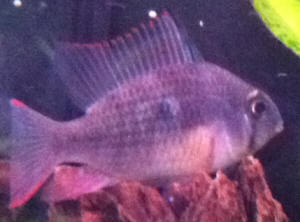
|
|
Re: Mystery fish + Microgeophagus
altispinosa..., barb ID, 5/9/11
Hi Neale,
<Susie,>
Brilliant, thanks very much for identifying it - Barbus
fasciolatus, that's the very fish! Having read up on the
species I hesitate to rush out and get a replacement for his lost
companion, he might be happier by himself after all.
<Okay.>
In the meantime, something is afoot with the rams (Mikrogeophagus
altispinosa). From the attached, you'll see that one of the
three has dug quite a significant pit in the substrate this
afternoon. He (I'm hoping he is a male) is guarding it to a
point, shooing away all the fish that like to nose around in it,
and doing quite a bit of flaring and chasing and posturing with
one of the other rams (which I'm hoping is the female). Pic
of the supposed "pair" attached, not really good enough
pictures to know for sure, but fingers crossed. He keeps making
way for her to come and have a little look around his pit, then
chases her away again.
<Is what they do. She won't be accepted into a male's
territory until she's ripe with eggs. To some degree, females
are merely chased away, while rival males are attacked more
aggressively, "with extreme prejudice" as our American
cousins would say.>
If I do finally have a pair, I'll be dead excited.....but
whilst I had planned on removing the Ancistrus and Corys from
this tank, I hadn't planned on doing it this soon - the new
tank is showing no ammonia or nitrite, but precious little
nitrate, so I think it needs a bit longer to mature. Plus the
banded barb in there is still very nervous.
<Indeed.>
Apart from that I'm also worried that in order to catch and
move the disruptive fish from my planned breeding tank, I'll
have to take the tank apart, and then re-plant and re-scape (all
of which I love doing of course), which is going to disturb the
rams and ruin the carefully built spawning area. If they do spawn
in the meantime (I don't think they have already), the
Ancistrus will surely eat the eggs instantly, having no fear of
the rams attacks.
<Indeed, this is typical for the genus, family; cichlids and
catfish have worked this way against each other since time
immemorial. Still, a healthy, well-matched pair of cichlids
should be able to keep their nest reasonably safe, and if you
want, you can always isolate the catfish.>
AND.....will the big bossy Ancistrus terrify the nervous Barbus
fasciolatus in the new tank?!!
<Hmm'¦ shouldn't do.>
The Ancistrus needs her own special ASBO.
Thanks Neale
Susie
<Cheers, Neale.
Re: Mystery fish + Microgeophagus altispinosa
5/10/11
Evening, thanks for the reply. As it turns out, I felt that my
hand was forced tonight....I spotted one of the julii Corys in a
peculiar position (standing on it's tail), and inspected to
find that he had been stripped of his entire tail fin. He's
been left with a raw looking stump and some chewed up rays.
<Ah, well, as I think I've mentioned before, these Dwarf
Cichlids can be hard on Corydoras. On the whole Bolivian Rams are
acceptably well-behaved community fish, but sometimes they cause
problems. Be sensitive to the risk, and plan your community
accordingly. This is a topic discussed in Paul Loiselle's
"The Cichlid Aquarium", a book that really is worth
reading when dealing with cichlids. Contrary to popular
misconception, no cichlid is 100% peaceful, and none of them make
perfect community fish.>
I hurriedly set up a little QT for him, but I don't fancy his
chances of recovering.
<We'll see.>
I suspect the big bolshy male cichlid of an attack, as he has
been more aggressive to the other species in the tank since he
built his nest. So I've charged ahead and moved the other
Corys and the Ancistrus to the new tank - I'll just have to
be very vigilant in testing the water and doing changes while the
filter catches up.
<All sounds wise. Ancistrus generally hold their own with
Dwarf Cichlids without problems.>
Thanks for all the help, I'll soldier on and see how things
work out'¦..
Susie
<Cheers, Neale.>
|
|
Re: Next step for Bolivian Rams (Microgeophagus
altispinosa) 4/4/2011
Thanks Neale...but hold the phone. There's been a
development.
<Ah!>
Since late on Friday night, these two have settled their
differences and are currently swimming around as a pair.
<Cool. But do be aware that homosexual pairs are not uncommon
among cichlids. Sometimes you see two females laying eggs
together! It's quite bizarre.>
Obviously I'm now utterly transfixed and can't stop
watching them, waiting to see what happens.
<I bet. This is where cichlid-keeping becomes fun. Once you
set aside (grow beyond?) simply shopping for bright colours, and
then choose a species that should work in your aquarium and water
chemistry, you get to switch gears to the slow but satisfying
pleasure of breeding behaviour. Even if you never raise any of
the fry, watching them spawn is fun. Watching the parents guard
their eggs and then eventually (and apparently proudly!) leading
their offspring around the tank is even more than fun, it's a
privilege!>
They follow one another everywhere and often swim close enough to
be virtually touching. I've seen some head shaking from both
of them..substrate picking from both of them...and a peculiar
kind of gentle "revolving" up and down around one
another. There's been no lip-locking, and no obvious flirting
- apart from when one seemed to be rubbing itself against the
driftwood in view of the other, I just hoped he wasn't
flashing haha. Oops, no pun intended.
<All sounds promising.>
I've looked long and hard and it is possible that now they
are getting along, one is showing more signs of a blunt
ovipositor than was really visible before...but it's still
not 100% clear.
<The female's ovipositor appears within a few hours of
breeding, usually within a day. So this is very exciting!>
I've tried a zoom lens to get pictures, but the zoom is not
strong enough to show sufficient details. There are subtle
differences between the two fish - one is certainly slimmer than
the other, with extensions on the tail fin and extending second
and third dorsal fin rays, which the larger fish lacks, but I
still couldn't say for sure. The parts of the fish which tell
the real story remain stubbornly ambiguous, but is the behaviour
giving them away?
<Could be.>
Feed time still results in squabbling and they do feed apart,
although the rest of the time they appear to be
inseparable......I'm saying a small prayer that they are in
fact one of each after all. Maybe in other circumstances they
wouldn't have chosen one another as a mate, but they are
making the best of being thrown together!
<Ah yes, as so many of us seem to do; cue the music to
Casablanca'¦ "Of all the gin joints in all the
world'¦">
I know it's hard to be sure without clearer pics, but what do
you think, would 2 males (or even 2 females) behave like
this?
<Does happen, but infrequently. Males rarely tolerate each
other for long, so a pair is more likely, else, in the
off-chance, a pair of females.>
Susie
<Cheers, Neale.>
Re: Next step for Bolivian Rams (Microgeophagus
Altispinosa) 4/6/11
You bet I'm excited, ridiculously so.....and I'm even
more excited that YOU think it's exciting! I'm a bit
inclined to get deeply involved in things and keeping fish is no
exception - it was unlikely to remain just a passing interest, or
just something nice to look at, for long. I thought breeding
might be best left to more experienced aquarists, but I've
definitely been swept away by the fascination of a potential
breeding pair, I'm hooked!
<Cool! Many good books on cichlids out there; "The
Cichlid Aquarium" by Paul Loiselle is the classic and can be
picked up used for not much money. It's semi-scientific, but
accessible, and will massively deepen your understanding of these
fish and why people study them in laboratories all around the
world. "Fish Behaviour" by Stephan Reebs is another
good book; it's not entirely about cichlids, but they're
certainly centre-stage throughout. As you'll learn, cichlids
are THE classic fish type for scientists, with much pioneering
work being done on them by the likes of Niko Tinbergen (as
outlined in his famous and extremely entertaining book on animal
behaviour, "King Solomon's Ring". Cichlids have
behaviour comparable to birds in terms of complexity, but are
much easier to maintain, and so they're perfect animals for
studying complex behaviour and animal intelligence.>
Having picked myself up from the shock of learning that
homosexuality exists among fish, I was slightly disappointed last
night - after tearing home at top speed - to find that they'd
had another tiff and were at opposing ends of the tank, barely
speaking let alone courting. *fade out Casablanca music*.
They're still apart this morning. I've stared rudely at
their respective vents and have now convinced myself that they
are both females.
<I see'¦ I guess you'll have to call them Ellen
and Portia.>
There are a number of factors going against breeding (apart from
the obvious one of not knowing if these two are Arthur or Martha,
although the signs are not great), one being that my pH is
inclined to be slightly high at 8.....although I gather that
spawning is not unheard of in these parameters?
<Indeed; with cichlids spawning often happens at any pH, but
the eggs might not hatch, or you just get one sex rather than
both. It's always worth a shot, but don't be surprised if
nothing happens.>
I have added plenty of bogwood and the water is nicely
tea-stained at the moment, plus the tank is half
planted.....I'll get the water properly tested by MA
tomorrow, as I want to be 100% sure of the general and carbonate
hardness as well. My testing kit is a bit vague on those aspects,
although with your help on interpretation previously, I think we
established around 5 kH and 10 dH.
<That should be fine.>
I also only have them in 23 gallons/90 litres with plenty of
other community fish, including Corydoras...might it be a bit too
busy for breeding? I have, somewhat optimistically, added some
flat stones in a couple of sheltered spots.....
<Corydoras are liable to be attacked by breeding cichlids, but
midwater fish should be ignored if it isn't wildly busy. In
any case, you're seeing what we call "new tank
syndrome" -- the need to buy just one more tank so you can
try out something new! Cichlid-keepers often end up with dozens
of tanks, each with a single pair of a particular species. Once
you've bred a fish and sold on some 3-4 month old youngsters,
it can become addictive. It's an object test of your skill,
because if you can get an animal to breed successfully, you must
be doing everything right.>
Even assuming I can get past these factors, I'm not sure how
much longer to leave these two to it before deciding that love
ain't coming to town, and I try to add or replace a fish to
see if I can't generate a bit of interest. Guildford branch
of MA are getting some of these rams in this week, but
they're bound to be juveniles. I guess I'm back to where
I started with my initial question about what to do next, only
keeping a single male is no longer on the agenda!??
<Indeed. Nothing wrong with keeping a lone male.>
Susie
<Cheers, Neale.>
Re: Next step for Bolivian Rams (Microgeophagus
Altispinosa) 4/12/11
Hi Neale,
Thanks for the book suggestions, I will endeavour to get both of
those!
<Cool.>
Dwarf Cichlid update. Arthur and Martha were, as suspected by the
LFS yet severely doubted by moi, Arthur and Arthur. All semblance
of friendship (and advances by one confused male) were abandoned
and it was carnage. I took BOTH of them back, to perhaps find
larger, separate homes, and exchanged them (at the suggestion of
MA) for 3 fairly juvenile specimens (each about 1 inch long).
<I see.>
The young chap at this branch of MA kindly spent a looong time
studying them, and picked me out 3 which were round, healthy,
starting to colour up, and of these 3, he felt that 2 were
definitely male and a female (usual caveat of no guarantees). The
third he picked as a wildcard, with the view that eventually, one
should materialise as the "odd one out", and I can take
him/her back to the store. I just hope I haven't got 2 males
and a female'¦'¦
<Indeed!>
These 3 are remarkably more sprightly, inquisitive and sociable
than my last 2. They're into everything, and this morning
appeared to be experimenting with "being" another
species - watching a ram playing in the bubble stream with the
Corys, or solemnly schooling amidst the pygmy barbs, is an
amusing sight to behold. They are hilarious, but they're
terrible timewasters (like kittens, puppies and foals) - I lost
an hour gazing at them last night. Can't wait to order the
books.
<Juvenile cichlids are often quite gregarious, and raising
them in groups and then removing pairs is the standard way
advanced aquarists maintain them.>
Oh, sad news.....I lost that last panda Corydoras from the
original batch of 5, unfortunately. He had been feeding ok and
was even schooling a bit with the other 2, but he just faded
away. I found him one evening last week white as a ghost and
barely moving or breathing. When the Amano shrimps tried to drag
him under the bogwood as a snack, and he barely had the strength
to fight them, I gently fished him out and sent him on his way.
He had a big "dent" in his belly? I guess he wasn't
feeding as well as he appeared to be. Poor old Sicknote. I'm
down to 5 Corydoras, 3 Julii's and 2 pandas, and they often
school together.
<Nice to know these ones are forming a group. Yes, dying
Corydoras often look hollow-bellied.>
Hopefully our next discussion will be around how I go about
raising my new Bolivian Ram fry and what size tank I have to
buy.....??
<Oh, the cichlids will likely take care of the fry as/when
they appear. All you need to is remove a few, put them in a
rearing tank. Something around 8-15 gallons is usually ample.
Cichlids will crank out fry given the chance, so don't feel
like you have to rear them. A good fry predator can be very
helpful!>
You never know, especially as my pH now seems to be down to 7.5
with the bogwood?? :o)
Susie
<Cheers, Neale.>
Re: Next step for Bolivian Rams (Microgeophagus
Altispinosa) 4/12/11
Wow you're fast today. Week off??
<Yes. School's out. Catching up on my writing.>
I'm at the offices of a client but trying to distract myself
from the prospect of huge exam on Thurs.
<Oh.>
Ok.....obviously speaking way, way in advance as I don't have
a pair yet and I may not even get any fry, but let's be
optimistic.....do you remove the fry once they're free
swimming?
<You can. There are really two ways forward. One is to remove
the eggs, and hatch them yourself. That's good if you want
lots of fry, and a good mix of males and females. The other is to
remove the fry once the parents start badgering them, usually a
couple of weeks after they become free swimming (i.e., about 3-4
weeks after spawning). The downside is you'll likely have
fewer fry, and since male fry grow faster, you tend to get more
males than females.>
And what kind of fry predator do I have room for?!! I've got
cories, Neons, pygmy barbs, Amano shrimps, a tiny bumblebee goby
and a female Ancistrus...'¦.
<I see. Well, some sort of bottom-dwelling predator like a
Spiny Eel or Pimelodus Catfish would be the obvious choice for
catching fry, while Ancistrus spp. will usually eat any eggs they
can find. I keep my Ameca splendens with Ctenolucius hujeta
precisely because the Ctenolucius eat all the fry, so I don't
have to deal with them!>
Susie
<Cheers, Neale.>
Microgeophagus Altispinosa - continuing aggression
problems 4/26/11
Hey Neale,
<Susie,>
Sorry to bother you yet again, hope you had a great Easter break
and got fully caught up on your writing!
<Somewhat'¦>
The three young Bolivians I got for my 20 gallon tank, in the
hope of creating a pair, have settled in very well, and are full
of life and colour and youthful exuberance. They are still very
curious and not in the least shy, and feed very enthusiastically,
so that's all good.
<Indeed.>
After the first week I wondered if my worst fears had been
realised, as I seemed to have 2 males and a female.
<Ah'¦>
One kept a very low profile and the other two spent a lot of time
sparring over food and territory.
<Yes.>
If the peacemaker (who sometimes got between the sparring pair)
was indeed the female, she was being overlooked by the males as
they were too busy scrapping to notice her.
<Is often the case if she isn't "ripe" in the
sense of being old enough to produce eggs *and* filled with eggs.
Females tend to come into breeding condition at intervals of
several weeks, and may only do so after being fed profusely on
especially tasty treats such as bloodworms.>
The fighting has now become quite intense, there is a bit of gill
flaring going on and the "peacemaker" (the smaller and
least yellow of the three) has ended up with a split tail - is
there anything I can do to help that heal and avoid infection..at
the risk of adding pointless things like salt and Melafix? Both
of which *cough* I do have kicking around?
<Melafix does have its place as a pre-emptive medication prior
to a fish getting sick, so if you have a bottle, sure, feel free
to use. If you think of Melafix as the fish equivalent of an
antiseptic ointment of the sort you'd dab on a knee of a
child that fell over, you have the basic idea right. It's not
terribly useful once a fish gets seriously infected, but it can
probably help at keeping a wound clean and healthy, and may even
speed up healing.>
I have rearranged the tank, adding three clay caves and
additional live plants (Cabomba caroliliana, I think), and moved
the bogwood around to see if the Rams can better agree on
territories. It hasn't quite been 24 hrs so I don't know
who has claimed what, or if it has worked yet, but there has
always been plenty of hiding places and secluded areas to go
around. They all seem to want to claim the whole open swimming
area at the front.
<Is often the case. Rams are open spawners, but they do like
flat rocks. Try pressing a few flat rocks into the sand/gravel at
various places in the tank, and if you can, arrange plants or
bogwood roots so each flat rock is hidden from the others.
Hopefully, it'll be out of sight, out of mind.>
It's been nearly 3 weeks, they all seem to fight with one
another in turn, and I am no nearer to knowing what mix of sexes
there are. I'm all for leaving well alone and letting them
sort themselves out, but I don't want three miserable
fighting cichlids with tattered fins...can I do anything
more?
<Not really.>
Perhaps I should move one of the aggressors out temporarily...but
my emergency "hospital tank" is too small. It was
bought for the shrimp and snails when I was going to treat the
whole tank for fungus, its only about 4 gals if that, so no good
for a dwarf cichlid even temporarily. I've got an old 3 foot
glass tank, but as my beloved thinks it's hideous and
won't let me have it in the house, I don't suppose I can
keep it in the greenhouse with no power supply, haha. :o)
<Nope!>
Even the handful of forums I frequent do not have any suggestions
for my Rams, hence my billionth email to you (sorry). Any ideas?
I know it hasn't been all that long, but this is attempt
#2!
Thanks very much
Susie
<Do try and track down "The Cichlid Aquarium" by
Paul Loiselle, often accessible via a library loan if you want to
try before you buy. It won't necessarily let you fix every
problem with cichlids, but you will at least understand
what's going on. It's also a great read and full of
lovely photos. Cheers, Neale.>
Re: Microgeophagus Altispinosa - continuing aggression
problems 4/28/11
Hi Neale,
<Susie,>
Thank so much for that typically rapid reply......I located and
order a copy of The Cichlid Aquarium straight away so I
wouldn't forget! I did get myself a Cichlid book after our
last conversation, but it was "lighter" than I really
wanted and didn't go into much detail.
<Cool.>
Okay, so I guess it's a question of patience then.....they
might well go on to pair up and spawn in their own time. They are
still small so presumably still a bit young. I have various
pieces of slate and smooth stones pressed into the sand around
the tank, in all the hiding spots where a stone will fit!
<Sounds like a good plan.>
I tend to feed some frozen bloodworms, plus a bit of daphnia and
brine shrimp, every night, and New Life Spectrum cichlid pellets
of a morning. Is this enough, bearing in mind they have to share
it with the rest of the community?
<It's difficult to judge "enough" but provided
the fish look healthy and there's no sign of a pinched-in or
knife-edge belly, and the eyes are bright rather than sunken, and
the fish is active and moving about normally, it's unlikely
that fish is underfed. As a ball-park figure, a portion about
twice the size of the eye is ample for most fish all day
long.>
Its normally all gone within 4-5 minutes, but the Neons love
bloodworms'¦.
<Yes, they do, but the thing with bloodworms is they're
not terribly nutritious, so should be part of their diet rather
than the bulk.>
The split tail of the "peacemaker" has already started
to heal, and in in fact he/she (she by the dorsal spines, but
vent not visible so who knows) has successfully claimed a new
prestigious cave formed by bogwood and plants, and is cheerfully
seeing off the other two who previously picked on her.
<I see.>
In the meantime, I have fluttered my eyelashes winningly at my
dear husband, who has grudgingly succumbed (having been reminded
of his 5 tents, 2 canoes and 35 varieties of torch languishing in
the shed) to my getting a 2nd tank. *jumps around with
excitement*.
<Oooh!>
Assuming they ever get as far as a spawn and some hatched eggs
(I'm sure they'll be a few failed spawns even once they
get started), presumably I can use the pathetic 3 gallon tank for
a small batch of free swimming fry for 2-4 weeks with a heater
and a sponge filter, before moving them into a new 10-15 gallon
tank to mature for another 8-12 weeks.
<Or else, raise some of the eggs in a floating breeding trap
until they hatch, and then rear some of the fry there until
they're about half an inch or so long.>
I'll set up both small tanks in advance so they are cycled
obviously. Does that sound like a realistic (if optimistic)
plan?
<Yes.>
Haven't worked out how I'll feed tiny fry 4-7 times a day
whilst out all day yet, but I'll think of
something'¦'¦
<With most of the cichlids, powdered flake food such as Hikari
First Bites is adequate. Do close this tightly once opened,
otherwise it'll go stale. Otherwise, it's a very good
baby fish food. Perhaps not *quite* as good as Microworms or
whatever, but easier to use.>
Thanks!
Susie
<Cheers, Neale.>
Re: Microgeophagus Altispinosa
4/28/11
Ok, thanks for those replies....will give it some more thought
and devour the contents of Loiselle's book when it turns
up.
Forgive me, but when you say use the breeding trap to hatch the
eggs, then raise the fry to half an inch long - do you mean, all
in the 3 gal? And then move the half inch fry to the 15 gal?
Sorry to be dim, I've read so much on it I've lost the
plot somewhere......can't remember what I'm supposed to
be doing with each tank now.
<Ah, no; rather, put breeding trap in main aquarium with the
adults, and just lift some/all of the eggs/fry out into the trap
as needs be. If you have a mature aquarium to rear eggs, then do
use that; but using a breeding trap in the main aquarium can be a
safer fix than putting the eggs/fry in an immature
aquarium.>
I'm also distracted because I lost another panda Corydoras.
I've only had these two about 6 -7 weeks, they formed a
little group with the Julii's and were both okay yesterday -
one seemed a little lethargic but was feeding.
You previously said that 25 C is their max preferred temp, so I
resisted the temptation to increase the temp for the
Bolivians....I've changed the sharp sand for something
softer, kept good water quality, got the pH down to 7.5, there
are no fish left to bully them (unless they got caught up with
the Rams fighting) and I made sure they got plenty of food.
Perhaps I just can't keep them?
<Well, on the whole Corydoras are hardy and easy to keep. But
they are bullied by Dwarf Cichlids, so mixing them isn't
recommended. If you do try to do so, then a larger, more robust
variety might be a better bet, perhaps plain vanilla Bronze
Corydoras or even the slightly larger Brochis species like
Brochis splendens that look like Corydoras on steroids. But if
all else fails, switch to a small group of Synodontis
nigriventris. These are comical, extremely hardy, and once
settled down, will swim about during the daytime if there's
adequate shade. They do well in water across a broad temperature
and water chemistry range, and like most Synodontis, they are
well able to return any aggression offered them by
similarly-sized cichlids. Loiselle rather charmingly compares
Synodontis to the prophet Moses, in the sense that any harm
cichlids send their way gets visited upon those cichlids with
interest! On the other hand, these little Synodontis aren't
aggressive in themselves, so don't cause problems, except
insofar as they are very effective egg-eaters, but then, so are
most catfish and loaches.>
It's dented my confidence a bit, I hate losing fish. I was
thinking of setting up the grow-out tank and putting the
remaining Corys in there with the Ancistrus, to see how they
fare, and perhaps give the Rams a fighting chance with spawning
in the main tank.
<Certainly, if you want the Rams to raise at least one batch
of fry, you will need to remove catfish of all sorts. Cichlids
have a sort of arms race going with catfish, and many behaviours
they exhibit are specifically about keeping catfish away from
their nests, eggs and fry. This is usually why cichlids bully
small catfish in a way that they don't bully midwater dither
fish such as Danios.>
Anyway, lets hope the rest of the Corys don't follow suit. If
they do, I'll make that my last attempt to keep them!
Thanks for all your help as always.
Susie
<Cheers, Neale.>
Re: Microgeophagus Altispinosa/injured neon tetra,
chatting 5/3/11
Afternoon Neale, happy Tuesday.
<Hello Susie,>
Ok, understood re breeding trap etc, thank you!
<Cool.>
The remaining Corydoras seem fit enough.....I'm thinking that
I'll move the 4 catfish and the Ancistrus, and a few Neons,
out into the 15 gallon tank, and leave the M. altispinosa in the
20 gallon with the rest of the Neons and the pygmy barbs, in the
hope that one day something akin to pairing off and breeding will
occur.
<Sounds worth trying out.>
May have to add a few more specimens to get a pair though. If I
have any success, and I manage to grow a few fry to a quarter
inch in with the parents in the 20 gal, where can they go after
that.....will the 15 gal with the few catfish in be large enough
to grow them to a size suitable for the LFS? Assuming I'll
only grow or succeed with 10-15 at a time?
<Yes, should be fine. But keep up with water changes! Juvenile
fish are very sensitive to "old" water (presumably
nitrate levels).>
Mikrogeophagus Altispinosa breeding
update 6/8/11
Hey Neale,
Hope you are well...further to your helpful responses to my
endless questions about Bolivian Rams in weeks gone by, I thought
I'd bring you up to speed with the breeding project.
<Sure thing!>
Suffice to say, there isn't one. I've added a further
three specimens to the tank (from the same batch and same branch
of MA)...removed all other bottom dwellers...created extra
territories with larger smooth stones and extra bog
wood..fattened them all up with an array of wet frozen
bloodworms, brine shrimp, daphnia, and live red
wrigglers...increased the temperature..let the Vallisneria and
green Cabomba go wild and form a heavily planted backdrop..made
large, cool water changes....but nothing, nada.
<Oh.>
I have a beautiful, crystal clear, planted tank with six big fat
fully coloured up Rams - one is surely a female, as the blunt
ovipositor is visible - yet none of them are showing the
slightest inclination to spawn. They've all selected a
territory, there's a bit of sparring but they are amiable
enough with one another. They even feed as a group!
<And may still be two young to spawn. Or not settled. Or
spawning but eating their fry (or else other fish, including
other Bolivian Rams, are eating their fry).>
I'm a bit stumped now. I don't want to keep six of them
in 20 gallons indefinitely, it was only ever supposed to be
temporary and the tank is not big enough. It's been about 6
weeks since I added and fattened up the smaller specimens, am I
being too impatient?
<Possibly.>
Can the six of them manage alright in such a small space for
another few weeks while I hope for some spawning action?
<Do-able, but not ideal, I admit.>
I'm starting to wonder if it's the cramped conditions
which are putting them off.
<Possibly.>
I could rotate and experiment with a few variations of pairs by
using the other tank, but that would be a bit hit and miss and
would also be rather stressful for them'¦.
<Agreed. I'd tend to wait until I'd found a pair, and
then remove the others. Research spawning triggers. For example,
pouring colder water than normal into the tank at a water change
to drop the temperature down to, say, 18 C, can mimic rainfall,
and that's a common trigger. Direct sunlight in the morning
is another. Providing live foods is a third. Females typically
take longer to get into "condition", at which point
they'll be obviously swollen around the abdomen, and may even
solicit attention from males.>
Many thanks for any advice you may have'¦.
Susie
<Cheers, Neale.>
Re: Mikrogeophagus Altispinosa breeding update
6/9/11
Hi Neale, thank you for the reply!
<Susie,>
Well I have experimented with a lower temperature water change,
but.....18 C??!!!
<Indeed. But I was talking about general fish breeding here,
and yes, that sort of temperature change is exactly what
you'd do when triggering spawning in Corydoras. You might try
a smaller water temperature change first time around, say, 20 C,
for this particular cichlid species. You leave the heater where
it should be, and what you'll find is the tank warms up
quickly, and no harm will be done. Keeping cichlids colder than
18 C for extended periods (days, weeks) can indeed cause them
serious health problems, and will ultimately kill them. But
that's not what spawning triggers are about. Do research
them! Essentially you're causing a brief change that makes
the species of fish think it's the breeding season. That may
be rainfall, or a rise or fall in temperature, or extended day
length, or too much food'¦ all sorts of things.>
I've been far too careful not to change the temperature by
more than a few degrees, I thought it would kill 'em!!
I've been lowering it to about 24 C from 28 C, and that made
me wring my hands anxiously (as I do). I'm obviously going to
have to be a bit more mercenary with my tactics.
<It's wise to be careful. But do also understand that
freshwater fish are adapted to experiencing quite rapid
environmental changes. In this they're much different to
marine fish. If you look at a pond for example, the pH will rise
and fall dramatically during the day, and water temperature can
fluctuate a lot, too. Rainfall rapidly cools streams and rivers,
and dry periods can cause temperature to rise rapidly as the
water volume decreases. Each fish species has its tolerances, and
to a degree, they'll adapt to changes within them. Constant
changes may be harmful to some species, while others,
particularly things like killifish, resist changes so well they
can live in habitats other fish can't accept. Read, research,
experiment.>
There is plenty of bright sunlight in that room in the morning,
although technically not falling directly on the
tank...'¦
<Oddly enough, it's the direct sunlight that helps
most.>
Funnily enough, the large female and one of the biggest
probable-males were swimming around together and huddling by a
stone this morning, so you never know. I guess being away at work
for 11 hours is long enough for them to pair, spawn, and eat the
eggs before I even knew they existed? Same with 9 hrs
overnight?
<Yes.>
I suppose I assumed that if a pair HAD spawned, it would still be
obvious that they were a pair even if they ate the
eggs/fry........
<Yes.>
Anyway, thanks again.....will update as and
when...'¦.!
Susie
<Do try to get hold of Loiselle's "Cichlid
Aquarium" book for more data and science on cichlids.
Cheers, Neale.>
Re: Mikrogeophagus Altispinosa breeding update
6-10-11
Afternoon.....oh, I HAVE got Loiselle's book, I've read
it cover to cover, but it is extremely broad in its reference. I
do like to ask questions, but Mr. Loiselle is regrettably
unavailable for comment! I have fund some little nuggets of
intriguing info in there, especially that it's a myth that
rinsing your filter sponges in tap water will destroy every last
one of your nitrifying bacteria.....
<Quite so. But it's good advice to give to beginners
who're likely to wash their sponges with washing up liquid if
you don't warn them first! So the "wash in a bucket of
aquarium water" advice is meant to provide a cushion
that'll keep beginners from doing anything too serious.
Still, I have to admit to preferring to clean sponges in aquarium
water given the chance.>
Anyway, somebody call Reuters. I have a PAIR. The large fat
female with the visible ovipositor is staying near a stone in a
little clearing under the plants and heater (and unfortunately,
the filter intake), and the large male she has chosen has dug a
little pit just alongside the stone. They are spending a lot of
time in the corner together, coming out for food, and
occasionally they take it turns to have a swim around.....the
male is wisely maintaining a little territory of his own nearby.
I guess she's been fickle before. Or maybe she's just a
nagging witch?
<Could be either. If you have just the one pair in the tank,
neither fish knows that another member of its species isn't
going to turn up. So the female may well wait for a better male
if she thinks the present male isn't what she likes. At some
point she may get less picky, but it's hard to
predict.>
So, it appears that asking an aquatics expert why you are failing
to achieve a pairing also works as a trigger - for encouraging
courtship, anyway?? Bet Loiselle hasn't got THAT in his book
has he??
<Indeed not!>
They're not cleaning the stone yet and are being very
tolerant of the others for now, but I'll let you know when to
pace a corridor smoking a cigar.
<Quite. Often with the Ram cichlids generally spawning occurs
quite readily, but it'll take a few attempts before you
actually get some fry.>
Seriously, thanks for all your help, I'll try to get
pictures'¦..
Susie
<Glad for the good news. Do consider visiting the WWM Forum to
start up a breeding diary thread, onto which you can paste or
link images as you go along. That way you can share what you
learn with others. Here on the Daily FAQ we tend to trim down
images as far as possible, so it's not the best place for
this sort of thing. Cheers, Neale.>
|
New 55 gallon set-up, Dwarf
Apisto Cacatuoides 5/31/2010
Hello,
I have been devouring your website since finding it about 2 months ago.
There is so, so much excellent information. It is wonderful to have a
website I can go to and trust the information that is found there.
<Thanks for the kind words.>
I have wanted to set up a dwarf cichlid tank for a few years now. I had
a goldfish tank set up for the last 7 years and just recently lost my
last one. I completely tore down my tank in readiness for a move and
have decided now would be a good time to try the cichlid tank. We are
on a well now and had it tested before buying the house. I'm not
sure what all I should be looking for, but they tested for chromium,
arsenic 0.006, selenium, silver, cadmium, barium 0.030, lead, mercury,
sodium 5.42, fluoride and nitrate-N. All were ND, except the three I
listed results for. I tested our water from the faucet after letting it
sit for 12 hours. The parameters are pH 7.6, dGH 5, kH 4-5
(varies).
<Sounds fine for South American fish.>
I have a 55 gallon tank with a XP2 Filstar Rena (300 gph) and a
Marineland Bio-wheel Power filter (280 gph). I also have set up a
rainwater keeper if I need to mix it with our tap water and have a tap
water filter that I bought from Foster and Smith.
<OK.>
The substrate in the front of the aquarium is silica sand, about
one-half inch. I then used an acrylic sheet and hard plastic canvas,
the kind crafters use, to make a curved bank divider, about 1
½' tall with small-size gravel in the back half of the
tank. I have a few live plants in pots in the back half and the rest of
the plants are plastic. I have Frogbit floating on the top of the
water. I have caves made out of coconut shells, flower pots and some
ready-made cichlid caves. I also have a few bogwood stumps. I have been
trying to come up with a list of inhabitants for my tank.
<Oh?>
The tank has been set-up for two weeks now. I used Tetra SafeStart in
it after a week and have been putting fish food in daily-flakes,
bloodworms, shrimp pellets and algae wafers. I also put a large shrimp
in a week ago (which is quite yucky now). My water parameters have been
fairly consistent for the last week, since I put the SafeStart in.
Nitrite and ammonia have never been above 0 and my nitrate is at 5.0. I
did add in 9 gallons of rainwater when I filled the tank and about 40
gallons of tap water. The pH in this tank has fluctuated between 7.2
and 7.4 when I have tested over the past two weeks.
<This is fine. If you have live plants in the tank, pH will vary
somewhat through the day as photosynthesis removes CO2, allowing pH to
go up; the reverse happens at night when photosynthesis stops and CO2
is allowed to accumulate again.>
The temp has been steady at 78 degrees. I put in the additive for
blackwater this morning. I took the old shrimp out and put my two
Bristlenose Plecos and 3 Rummynose tetras in the tank. The water
parameters are the same as what is in my 10 gallon that they have been
in since the move a month ago. The Bristlenose Plecos are both young
and about 2' in size. I have only had them for two weeks, the
Rummynose tetras for 2 months.
<Very good.>
My problem is deciding what else I want to put in the tank and making
sure that my water will be okay for them. I definitely want Dwarf
Apistogramma Cacatuoides, 1 male and 2-3 females.
<These will be fine in there. A good, adaptable species.>
I had thought about getting angelfish, but think I have decided against
them.
<Probably wise.>
I want to get at least 6 more Rummynose Tetras.
<Yes, by all means; in fact, I'd argue you need at least a dozen
for them to be worthwhile.>
The other fish I have been considering are Rosy Tetra, Lemon Tetra,
Bleeding Heart Tetra or Black Skirt Tetra.
<All good fish, but Black Skirt Tetras are somewhat nippy, so I tend
to recommend against them. Bleeding Heart and Black Skirt Tetras may
also be too large and boisterous to allow the Apistogramma to settle
down nicely. Lemon Tetras on the other hand should be fine. They do
need dark, preferably tannin-stained water to look their best though,
so allow the plants to grow over the surface, and add some bogwood to
the system if you haven't got some there already. Your carbonate
hardness is high enough tannins shouldn't mess the pH too
much.>
I have also been looking at Melanotaenia Boesemanni Rainbowfish, but
I'm not sure if they would work with any of the tetras I have
listed or if the tetras are too small.
<These Rainbowfish need hard, basic water, so wouldn't be a good
choice at all.>
Also I think my tank might be too small with having to have a minimum
of 6 Rainbowfish. Would any of the Tetras I named work with my mix of
Dwarf Cacatuoides, Rummynose and Bristlenose, my water parameters and
with the tank being blackwater mix?
<Yes indeed. Do also look at Diamond Tetras, X-ray Tetras and
especially Emperor Tetras and Blue Emperor Tetras, two wonderful and
very different species.>
If so how many fish would I be able to add?
<With fish this small, the inch per gallon rule is workable.>
With my tap water pH being 7.6 do I need to add the rainwater to bring
it down a few points or would my choice of fish be okay with water
straight from the tap?
<Will be fine; pH is much less important than hardness.>
One last question I have is about cherry shrimp. Would they be okay
with the Dwarf Cacatuoides and the Bristlenose Plecos or would they get
eaten?
<The Apistogramma may eat them, but they're inexpensive, so you
might try them out and see what happens.>
I appreciate any answers you can give me and thank you for your time.
Linda
<Cheers, Neale.>
Re: Parasite problems (Bob F.,
comments would be welcome here)<<>>
4/6/10
Hi Neale, I hope you had a good Easter
<Yes, thank you.>
If I may I will provide you with an update, and also news of what for
me is a shocking discovery, in the hope that we might move closer
towards a diagnosis for my fish.
<OK.>
Firstly, I have treated the whole system with salt as per your article,
as if for velvet. The Otocinclus were the only ones to react negatively
(a bit of swimming up and down against the glass), but they settled
after only a few hours. In terms of what effect the salt is having,
after five days I believe that the overall rate of flashing may have
lessened. Perhaps there was/is a low level of velvet in the system,
which is beginning to be curtailed. Nonetheless, I intend to keep it
salty for the full 14 days as you direct.
<Very good.>
However, what has not changed is the ram's behaviour -- in fact
this fish is now displaying some disturbingly frantic flashing
behaviour, as if something is driving it crazy. It will now only eat
one type of food (where before it would take anything), prefers to stay
in darkness at the rear of the tank, and while it has not lost weight
or its equilibrium, I am increasingly worried for it. Whatever it has,
it is worsening.
<Oh.>
But the most shocking discovery is that the white, bean/rice shapes
that I described to you on the sides of the tetras -- well -- to my
horror I have found that they move. I singled out one of the older male
cardinals for study and noticed that his 'blemished scales'
appeared to change position. I thought it might be my eyes/mind playing
tricks, but then when the fish was still for a fair period, I actually
saw a blemish slither from a particular position to another. On another
occasion, I saw one of these things actually raise or wiggle either a
head or a tail. I think they are clearly some sort of flatworm.
<Could be, or some type of crustacean parasite. Both
"worms" and crustaceans can seem very flatworm like, but the
medications required for these are very different. Dipping in seawater
can sometimes help shift them; do see WWM re:.>
Do these observations of mobility and large size (2mm long) narrow down
exactly what it is?
<Not really, without determining whether they're crustacean
parasites like lice (in which case an insecticide is required) or worms
such as flukes (in which case an antihelminthic like Praziquantel can
help).>
Is it time for Praziquantel, and if so, can you give recommendations or
further reading for the treatment procedure?
<Not used this myself since in the UK it's a prescription-only
medication and the vet will tell you the dose. But do read here:
http://www.wetwebmedia.com/vermifugefaqs.htm
I will make the observation that Ram Cichlids, Mikrogeophagus ramirezi,
are pretty poor quality these days and notoriously prone to disease.
There's also no reason to discount the possibility that what's
affecting this cichlid is not the same thing that's affecting the
other fish. Mikrogeophagus ramirezi needs very warm, very soft water to
live well. Hexamita infections appear to be endemic amongst farmed Ram
Cichlids.>
But in an attempt to rationalise the behaviour of the ram (and the
similarly unmarked Corydoras and Apistogramma) with the observation
that there is a definite (and very visible) parasite in the tank, is it
possible that these 'flukes' begin life on the gills, then
migrate out onto the skin?
<Could happen I suppose, though gill parasites tend to be very
specific in attaching to the gills.>
Thus: could it be possible that the reason the ram has no external sign
of these 'flukes' is because it is a large enough fish for them
to remain attached to the more profitable gill area?
<Possibly, but doesn't sound very likely.>
Similarly, might it also be possible that the reason the micro-Rasboras
are unaffected is that they are simply too small for such a large
parasite, and richer pickings are available in other parts of the
tank?
<No, doesn't work this way.>
Although I have not had time to research this sufficiently, I am also
worried that it may not be one of the two 'standard' flukes,
but a digenean trematode, which uses snails in its lifecycle. I
mentioned to you that I have numerous snails (including some sort of
pond snail species that hitch-hiked in to the tank) and when I treated
the fish for this condition before, I am certain there were no snails
in the treatment tank. As you pointed out, it could have been the
change of tank (from one with snails, to one without) rather than the
copper and formalin treatment that knocked this condition on the head
the last time around. If it is the digenean, can I use Praziquantel in
the same way, or do the snails have to go? <<They do have to be
moved. RMF>>
<Snails can carry parasites to be sure, including parasites ones
that parasitise humans, but ONLY if those snails were collected from
the wild. Farmed snails and those that were born in fish tanks are very
unlikely to carry serious parasites because the hosts those parasites
need, typically water birds, are lacking. In other words, this
isn't likely. It's more probable the parasites infected your
fish prior to purchase, or else were introduced via something brought
in from the wild, like live food.>
Following on from this, is it likely just the pond snails that are the
problem? With a soil substrate it is preferable to have burrowing
snails, and so I would not wish for a blanket elimination of molluscs
(equally my Nerites are both aged and prized). As a course of action I
can foresee a successful (if prolonged) physical management/removal of
the small pond snail species.
<Not really viable or even worthwhile, in my opinion.>
At present my overall thinking is as follows:
1) the tank has collected several pathogens along the way through a
lack of quarantine, including velvet, invisible and visible parasites.
This would explain the lessening of flashing (velvet exiting), but the
remaining presence of a visible parasite, and the increased discomfort
of the ram
<Perhaps.>
2) the tank is suffering from a single parasite with different
manifestations
<Also possible.>
On the evidence, which do you think is more likely?
<Impossible to say without microscope work. Most of our diagnoses
via e-mail come down to probabilities, and the fact that certain
mistakes (like adding fish to immature aquaria) lead to particular
health problems (such as Finrot). In the situation you have here,
consulting a vet and/or performing an examination of a dead fish under
a microscope would be the only reliable way to identify the flukes,
worms or lice your fish have.>
As an aside, I am still testing and not detecting anything amiss in the
water -- likewise I have checked my water conditioners and they all
remove chlorine, chloramine, copper etc.
<Good.>
Once again I apologise for the length of my correspondence, and the
high amount of questions put to you above. I do feel that I am slowly
cornering this problem, and your continued help would be both
invaluable and highly appreciated.
Yours
Joe
<Cheers, Neale.><<RMF would treat (either successively or
concomitantly) for both "worm" and crustacean possibilities:
i.e. w/ an anthelminthic and an organophosphate, barring, as Neale
states microscopic discerning of infectious agent/s here.>>
Re: More Re: Parasite problems, Bolivian
Rams 4/7/10
Dear Neale and Bob
Many thanks for your further inputs.
<Happy to help.>
Neale - I must point out that the ram in question is a
'Bolivian': M. altispinosus. But I totally agree with what you
say about M. ramirezi - to be frank I am sick to death of seeing
deformed, weak, washed out, in-bred specimens in the shops.
<A real problem with cichlids generally, whether Ram Cichlids,
Mbuna, Jewel Cichlids, Firemouths, and a host of other species.>
Responsible managers should not take them from the wholesalers, who
should not import them. Unfortunately, M. altispinosus does not fare
much better in the deformity stakes, which is a shame, because a good
Bolivian is a
fine fish indeed.
<Agreed. It's a shame that careless inbreeding has led to this
situation. Unfortunately, many cichlids breed so readily in aquaria
that inbreeding becomes the norm rather than the exception. I can think
of few common
cichlids that have maintained a steady level of quality over the
decades, and highly recommend people seek out wild-caught or F1
specimens if they can.>
Following from your guidance, and the information/options it has
spawned, I am going to seek further guidance from a vet who treats
fish, with the view to obtaining an anthelminthic, if this is deemed
the correct course following consultation. If it would be welcome, I
will inform you of the outcome.
<I'd certainly be interested to hear what the vet says.>
Thanks and all the best
Joe
<Good luck, Neale.>
Dwarf Cichlids in a 75g / other
75g set-up questions
Dwarf Cichlid Tank 2/16/10
Crew: Thanks for helping me with my water chemistry a little while
ago.
With the help of a little bit of Rift Valley salt mix, I am now keeping
my existing tanks at a very consistent pH of about 7.0 (I say
'about' only because I have a hard time seeing the exact color
match on my tests, despite having never been accused of being color
blind in the past) and hardness of 4 degrees KH / 6 degrees dH,
temperature 76 degrees (24.5 C).
Now I am getting ready to upgrade from my Eclipse 37g to a regular 75g
(Yay), but have a few more questions:
1) Does the bottom of a regular 75g have enough room for 2 Bolivian
rams, 3 Apistogramma cacatuoides (1m, 2f), and a pair of either
Pelvicachromis Pulcher (maybe taeniatus if I can find them), keyholes,
or Laetacara Curviceps (so 7 in total), provided I have enough hiding
places?
<Plenty of room.>
Chuck seems to have thought so in response to others asking similar
questions, but since I am still planning this tank, I want to make sure
I get this right the first time.
2) I plan on using four 48" T5's (6,700k and 10,000k) and go
for the "medium-planted" look (no CO2 added). Will some
floating plants provide enough shade for those dwarves, or will this be
too bright?
< Depends on the depth of the tank. Deep tank need brighter light to
penetrate the water. Tannins from driftwood darken the water and also
cut down on the brightness of the light. Bright lights can cause algae
problems.>
3) With more space, I want to complete my school of Boesemanni (should
be one 'n', right?
http://www.fishbase.org/summary/SpeciesSummary.php?id=10489
). My water is obviously a little soft for them, but my existing ones
seem to be doing great, and despite being in an incomplete shoal are as
nicely colored as any I have seen (pics are not doing them full
justice). Is it irresponsible to keep them in 6 degree dH water?
< Just make sure that you give them a varied diet to make up for the
lack of minerals available in the water.>
4) I was thinking Eheim Pro 3E 2078 for filtration (490gph max
output).
Would that be sufficient, or should I add a sponge filter, too
(don't really want to have to deal with servicing 2 canisters if I
can help it)
< One canister will be fine if you keep it serviced. I would have a
small sponge filter on a powerhead in the tank for a backup in case
anything happened to the main filter.>
5) Would you agree that a singleton Hypselecara temporalis is too big
for this tank/would stress the dwarfs?
<That are a great fish but would get way too bigs to keep with
smaller fish.-Chuck>
Thank you so much for you help and being the only truly reliable source
out there!
John < Thank you for your kind words.>
Cichlid hybrids, Neotrop.s,
Dwarf S. Am. 2/5/10
Hi guys,
<Hello,>
First off thanks again for all of your help. You have really given me
some great direction. I have a question that is unrelated to my
previous threads but I cannot seem to find species specific examples
anywhere so I will bring my question to the cichlid gods. Keep in mind
that I am trying to AVOID any hybrids. I have been looking into Apistos
and their make ups (families, groups, complexes). Supposedly
cacatuoides, agassizi, and borelli are all in different families and
therefore should not be able to hybridize.
<No, they're all in the same family, Cichlidae. Indeed,
they're all in the same genus too, Apistogramma. Within that genus
there are what biologists call "species groups", which are
groups of species more closely related to one another than they are to
any other species in the genus. Depending on whether you're a
lumper or a splitter, a species group is just that, a group of species
within a genus, or else a subgenus. Some splitters may even go so far
as to create an entirely new genus just for that group. It's
important to remember this is all artificial, purely to make it easier
to understand evolution, and means very little to the fish
themselves.
Certainly won't stop a male from one species in a species group
trying to mate with a female from another species in another species
group.>
I realize that they may pair off but in theory shouldn't have
fertile eggs.
<It's a poor theory. In general, cichlids hybridise readily, and
anything in the same genus may (and probably will) hybridise with other
things in the genus. Ergo, mixing Apistogramma species in one tank
would be bad.>
However nijsseni seems to be in the same group as cacatuoides but a
different complex so they can hybridize.
<There you go. My point made.>
How accurate is this and if not which off these can actually form
hybrids?
<It's wildly inaccurate.>
Also I know that convicts can hybridize with Severums and
Firemouths.
<Indeed, and behold such hybrids as Blood Parrots, Flowerhorns, and
any number of farmed Tilapia hybrids.>
So does that also apply to Honduran Red Points? Can any of the
following form hybrids as well: Severums, Firemouths, and rainbows?
<HRPs and ordinary Convicts certainly will hybridise, and it's
very likely the quality of HRPs will plummet precisely because of this.
As I've mentioned many times on WWM, careless breeding of cichlids
ruins the hobby for everyone, because you end up with, for example,
HRPs in shops that don't have anything like the bright colours
their wild ancestors had. In short, the safest approach is to mix
species from different genera, so your example of Severums, Firemouths,
and Rainbow cichlids (Hero spp., Thorichthys meeki, and Herotilapia
multispinosa) should be fine. It's also safe to mix species with
very different breeding methods. A mouthbrooder for example isn't
likely to hybridise with a nest spawning species. Fish with different
shapes and sizes are also unlikely to view one another as potential
partners, e.g., Angels and Kribs. The problems come when you have two
species with similar behaviour, size, and breeding methods. If
they're in the same genus, then they very likely share the same
"language" in terms of colours and movements, so
hybridisation becomes more likely.>
Thanks guys.
Phill
<Cheers, Neale.>
Cichlid comp, lack of detail --
11/16/2009
Can I put a pair of ram Bolivian cichlids with a pair of convict
<cichlids>?
<Short answer is...maybe. If you had a fairly spacious tank with
plenty of hiding spaces and broken sightlines, with a pH of 6.5-7.0, it
might be possible. Of course, all bets are totally off if the convicts
decide to breed. Overall, I wouldn't risk it. Convicts are not on
the more aggressive side for cichlids, but rams would nonetheless not
be a match for an angry or spawning convict.>
<Will N.>
New FW Tank
Bolivian Rams Stocking Question -- 10/20/09
Hi, quick (hopefully easy!) question, how many Bolivian rams would be
happy in a 60 gal corner tank? There will be rainbow fish, Corys,
tetras as company.
Cheers
< Go with at least six. This will almost guarantee you a pair. If
conditions are right they will spawn and you will get to enjoy one of
the best things about keeping cichlids.-Chuck>
Re: New FW Tank
Rams In A 60 Gallon Tank 10/22/09
6? Really? Wow, that is more than I was expecting. Is there anything I
need to think about with a group like this? Can I expect much
aggression between them? If a pair forms will they beat up the
others?
< Rams are really more about display that with actual aggression and
damage. Once a pair form they will push and chase all other fish away.
They hardly ever kill anything.-Chuck>
Re: New FW Tank
Dwarf Cichlids In A 60G FW Tank 10/25/09
Hi again. If I were to go with Apistos instead of Bolivian rams how
many would be happy in a 60 gal? What sex ratios should I keep and
could I mix different species?
< You could still go with 6. If you were not interested in breeding
them then go with 6 males of different species. They will set up
territories and defend their space. Very entertaining to watch. You
could go with three different pairs too.-Chuck>
Re: New FW Tank
Apistos In a 60G 10/26/09
Hi Chuck, You have advised me that I could have six Apistos in my 60
gallon.
You've suggested 6 males of mixed species or 3 pairs. Do I take it
from this variety of options that I basically have 6 Apisto
'slots' that I can fill as I wish? I have done some research
and have settled on the following as an attractive assortment of 6
Apistos, could you let me know if they'd work in my 60gal?
1 Male Ap. Cacatuoides
1 Male Ap. Baenschi 'Inka'
2 Female Ap. Baenschi 'Inka'
1 Male Ap. Borellii
I really like the females of Baenschi 'Inka'. Their colours
remind me of certain rift valley cichlids. I think the combination of
the yellow and black striped female Inkas with the
blue-bodied/yellow-faced Borellii would
create an effect not unlike the colourful Malawi set ups (with only a
fraction of the aggression I hope!) Do Apistos get on ok with Corys? I
hope to have a school of six (bandit, panda or sterbai). I've heard
some
cichlids take offense at them and bite out their eyes! Thanks again.
Keep up the good work!
< The cacatuoides is one of the largest Apisto while the borellii is
one of the smallest. The borellii will probably hide most of the time
while the cacatuoides is going to be the dominant cichlid and out most
of the time.
Almost all female Apistos will turn yellow when they breed. The
Cory's will stumble into the Apistos territory and be chased away.
The Apistos may occasionally nip a fin or two on the
Cory's.-Chuck>
Apistogramma double red
breeding!? Umm, Colisa input 1/4/2010
hello WetWebMedia crew! it's Michael again.
<Hello Michael Again>
Doubt you remember me. I had the "undead Gourami" e-mail that
my Bolivian Ram got strange mother hen protection syndrome over as it
became unable to swim. Sorry it's been so long but wanted to update
you. Sunshine never did recover and got worse and worse until she was
no longer able to eat. In the end I decided to euthanize her in the
freezer :( My Bolivian ram never did seem to recover emotionally in the
community tank. I know I know fish don't have emotions
<Actually, I suspect, sense that at least some do>
(I'm sure some science dude is determined to prove otherwise
somewhere) but I don't know how else to describe it. After sunshine
was removed (and put to rest) my Bolivian never was the same. She
became very aggressive and agitated overall. She got so aggressive as
to not let any fish swim around-attacking them, swimming hard into the
glass, would hardly eat, upturned all my fake plants endlessly (my
fiancé©' swears she was looking for sunshine lol), and
even started attacking the bubbles from my diffuser once the other fish
got smart and hid all day. I decided to move her to a 10 gallon breeder
tank I was building up (I removed the Platies I got that were building
up the tank bacteria and mulm out of sympathy). She still would hardly
eat and proceeded to ram the glass until I got her another sunset honey
hybrid for company. after a week she calmed down, hung close to the
sunset, and began to eat like a pig. I been talking to the owner of a
LFS to find her a home with a breeder, I think she really needs a mate
her own species.
Tank water parameters-
ammonia:0, Nitrite:0, Nitrate:10, moderately soft PH: 6.5, temperature
82 degrees Fahrenheit, Culligan filtered water- not the super
chlorinated home delivered stuff. 20% water change every 2 weeks. water
seems to hold steady with the PH buffer 6.5 with no ammonia or nitrite
spike what so ever even with lax water changes.
filter- Marineland penguin 350 with BioWheel.
Tank- 39 US gallon tall, established 8 months
plants- fake, some moss from a former moss ball, green algae on
ornaments, some diatoms on the back glass.
substrate- 3/4" of black and blue gravel.
Inhabitants- 1 Trichogaster chuna hybrid sunset, 10 neon tetra (6 were
previously in quarantine and added 2 months ago?), 2 celestial pearl
Danios/galaxy rasbora,1 Adolfo Cory cat.
<Mmm, like most Corydoras species, this fish lives in
groups...>
newly added (over time with quarantine in order added)-2 High Fin neon
gobies?(unsure exact species can't find much info on freshwater
gobies- got them for free, they were in with feeder fish!) about
2-2.5" long, 1 juvenile pearl Gourami, 3 Apisto cacatuoides double
red (2 male 1 female.
was suppose to be 2 female but one was a sneaker male) 4 pygmy cories
(about .5"), 4 dwarf neon rainbows (1 male) all about 1.5", 2
bumblebee gobies (was given to me-didn't know they need brackish.
Will they adapt?
<Not really, no>
I keep reading mixed messages-some say brackish only. Some say they
will be okay in fresh soft water-very confused). And lastly another
honey hybrid called a copperfire Gourami.
<Likely another Colisa lalia sport>
I'm sure you will start getting waves of e-mails about them asking
what they are. So here's what I can share about them. They seem
more close to original honeys.
<C. chuna? Perhaps>
They share the same shape and temperament as wild honeys and are
probably only a color morph. There <their> breeding male pigments
seem to have been brought out (reddish brown),compared to the oddball
sunset honey hybrid which does seem a lalia or labiosa hybrid.
Copperfire also have a more flowing and less spiky ventral fin
resembling the wild honey I had. The Sunset gouramis also seem
sterile
<Might well have been sterilized... a common practice in the far
east in the trade w/ valuable strains>
and display no signs of even trying to mate, I could be wrong on this
any conformation? Copperfires also seem even less aggressive than the
sunsets and more like a wild Honey-VERY timid.
<Thank you for this. Bob Fenner>
Compatibility: Bolivian Ram and
Rainbowfish 10/12/09
We are commencing to re-stock a 30 gallon community aquarium. It's
been stable with a few fancy goldfish for a couple of years, but we are
wanting to convert this aquarium to a tropical community. All residents
of this tank have now been moved to new homes.
<Very good.>
We are in the habit of regular water changes. We live in the Seattle
area of Washington, USA. Our water tends towards softness, I
believe.
<Soft can be good for South American and Southeast Asian fish in
particular, but you do want a steady pH. A little information here in
terms of water chemistry would be useful. But assuming something like
pH 6.5-7.5, 5-15 degrees dH, then most community tropicals should do
fine, with the obvious exceptions of livebearers, which prefer hard
water.>
We have identified Bolivian Rams and Rainbowfish (Red, turquoise,
emerald, etc.) as 2 types of fish that we'd definitely like to keep
in this
aquarium.
<Rainbows are schooling fish, so keep at least six per species, and
preferably equal numbers of males and females to ensure optimal
colouration (if you don't have equal numbers of males and females,
the males have no reason to colour up properly!). You usually can't
sex most Melanotaenia species when young, but some foolish aquarists
keeping Glossolepis incisus try to keep just males, and wonder why
their fish don't look happy. In any even, a 30-gallon tank will be
too small for most Rainbows, the only exceptions commonly traded would
be Melanotaenia praecox (the Dwarf Rainbow) and perhaps the
Telmatherina ladigesi (Celebes Rainbowfish). This latter species needs
neutral, moderately hard water and doesn't like pH levels below 7,
so it might not even be an option.>
Are these compatible in the same community?
<Yes. Most Rainbows like neutral, moderately hard water that
isn't too warm, and this is optimal for Bolivian Rams,
Mikrogeophagus altispinosus.>
If so, what conditions (temperature, PH, etc.) would be best for
them?
<7.0-7.5, 10 degrees dH; 24-26 degrees C.>
Also, how many of each of these should we limit ourselves to?
<A pair of Mikrogeophagus altispinosus plus 6-8 Melanotaenia praecox
would work fine in a decent length 30 gallon tank (i.e., not some daft
hexagon or something, but a long, shallow rectangular tank).>
Can you please recommend other compatible tankmates for this
community?
<Wouldn't add anything more to begin with. Possibly some Cherry
Shrimps and Nerite Snails as scavengers/algae-eaters, but that's
about it. Catfish tend to be harassed in small tanks when kept with
Dwarf Cichlids. So while you could certainly add a school of Corydoras
aeneus or similar if this was a 55-gallon tank or even perhaps a
40-gallon tank, a 30-gallon system is just too risky. Dwarf cichlids
chase the catfish, nip them, even blind them. Not nice. If the tank was
properly maintained for six months and there was enough light to get
some green algae growing, a school of Otocinclus might be an option,
but they're such sensitive fish I'd not recommend them.
Shrimps and Nerite snails are safer, much more effective
algae-eaters.>
Thank you,
Jeff
<Cheers, Neale.>
Re: Bolivian Ram and Rainbowfish
10/13/09
Thank you very much for your prompt and highly informative response to
my previous questions.
<Most welcome.>
According to the test run at our local aquarium shop, our water has a
pH of 7.1 and hardness of 2 degrees dH. Will this be a problem for
Bolivian Rams and Rainbowfish?
<Yes. Water this soft, assuming it has a comparatively low carbonate
hardness as well, less than 3 degrees KH, tends to be unstable. Do test
the carbonate hardness, because this really is critical. Read here:
http://www.wetwebmedia.com/FWsubwebindex/fwsoftness.htm
I don't recommend relying on shops to do your water tests, by the
way. It's a good habit to get a few basic test kits of your own, so
you can keep track of water chemistry and water quality.>
Is there anything we need to do to condition our water?
<Quite possibly. If your water has low general hardness (measured in
degrees dH) and low carbonate hardness (measured in degrees KH), it
will likely be too soft to keep these fish comfortably. One approach is
to add limited amounts of Rift Valley Cichlid Salt mix, as described
here:
http://www.wetwebmedia.com/FWsubwebindex/fwh2oquality.htm
You wouldn't use the full dose, but around a quarter to a half the
dose.
Let's say you started with a quarter dose, that'd be 1 teaspoon
baking soda, 1 tablespoon Epsom salt, and 1 teaspoon marine salt mix
per 20 US gallons.>
Our tank is the long, rectangular 30 gallon variety. We like your
suggestion of a pair of Bolivian Rams and 3 pair of Neon Dwarf Rainbows
to begin with. Can we add more fish than this eventually?
<Sure.>
If so, would you suggest more Rams or more of the Dwarf Rainbows, or
could we add another variety of fish?
<I'd not add more Rams, or they're likely to fight.
Certainly, not more males anyway! As for Dwarf Rainbows, yes, a few
more is always a plus. The bigger the group, the prettier they look,
because they school nicely and show better colours (they're
happier!). You might add some Silver Hatchetfish, Pearl Danios or
Halfbeaks at the top of the tank.
Alternatively, you could add a retiring catfish like a Bristlenose
Plec, but the problem here might be if your cichlids spawn. The catfish
would likely be harassed if it didn't have a suitable cave, and
conversely, it would eat any eggs.>
Our next questions regard diet and habitat. Are there any special
dietary and feeding requirements for either of these 2 species?
<A mix. You can't go far wrong with this: A good quality staple
flake or pellet, regular offerings of wet-frozen bloodworms, and
occasional treats of things like live daphnia and live brine
shrimp.>
For instance, I read somewhere that Rainbows should have some fresh
greens such as duckweed occasionally.
<No, not necessary. For one thing, duckweed can easily become a
pest.
Rainbows feed primarily on insects that fall onto the surface of the
water, as well as zooplankton and small crustaceans.>
Also, I understand that in the wild, most of their diet is live food,
so do we need to supplement their flakes with something else?
<I don't recommend you use flake exclusively, if for no other
reason than fish get bored with it. All dried foods, whether flakes,
pellets, or freeze-dried foods, are also more likely to cause
constipation (imagine what would happen if humans just ate beef jerky
all the time...).
Wet-frozen foods tend to have a high "ash" content, and this
works like fibre.>
And speaking of flakes, I understand that rainbows are surface feeders,
so flakes or something that does not sink immediately is best. Is that
true?
<They certainly don't want foods that sink right down to the
bottom. But they will take food from the surface and from midwater
equally happily. If all else fails, ask the retailer to feed the fish
in front of you. Whatever they're eating, buy some of that!>
On the other hand, I read that the Bolivian Rams need to be fed a
special Cichlid formula. Is this the case?
<Cichlids certainly need a varied diet otherwise become prone to
various health issues including Hexamita, Hole-in-the-head,
constipation, bloating, and perhaps other things too. Wild Bolivian
Rams are substrate sifters -- their Latin name Mikrogeophagus means
"little earth eater" -- so what they would do in the wild is
take mouthfuls of sand, sift it across their gill rakers, and extract
small invertebrates, algae, and bits of organic detritus. In captivity
they happily do this, and it's charming to watch. I tend to give my
cichlids wet-frozen rather than flake foods, and enjoy watching them
sift out the bloodworms or whatever from the sand. It's fun to see.
Of course, you might only want to do this a couple times a week, in
which case a good quality sinking pellet such as Tetra Min or Hikari
Micro Pellet would be a good place to start.>
Will they come up and eat the flakes or do we need to feed some sort of
sinking food to the Rams? If so, what do you suggest?
<They won't feed from the surface, no. But they may well eat
uneaten flakes that float down to the bottom.>
Regarding habitat, we have 2 or 3 plastic plants and a small cave
formed out of a few rocks. We read that the Rams don't like bright
light and should have some shade. Will the single cave be enough for
the 2 Rams or will they each need their own?
<At least a cave each, ideally more than one.>
Or should there be some sort of special style of plant (such as
floating plants) that we need to provide?
<Start with some Java fern and/or Anubias on bogwood roots, and
throw some in some Indian Fern and Amazon Frogbit for the floating
plants. Easy plants to keep, no need for a substrate (so cheap to
grow!), and these will, together, provide plenty of shade.>
Finally, (for now at least) are there any other considerations that we
should be made aware of regarding our setup?
<Consider using a thin layer of _smooth_ silica sand (from the
garden centre, very cheap) about 1-2 cm deep for the bottom. You'll
love watching your cichlids behave naturally, and they'll keep the
sand nicely sifted and clean as a bonus. Much prettier than gravel,
too.>
Thanks, Jeff
<Cheers, Neale.>
Bolivian Ram compatibility
9/26/09
Hi! Let me just say that all of your advice has been absolutely great!
I plan to set up a 16 gallon bow front aquarium with Java fern and
Amazon sword plants, along with a small driftwood centerpiece. For
lighting, I
will be using A) the light that came with the tank, and B) a full
spectrum lamp that will be shining in on an angle (it was not
specifically designed for aquariums - will it work?).
<The light shining through the glass? If that's the case, I
wouldn't bank on it working: glass cuts out a lot of the light
energy.>
They will be on a ten hour timer. My P.h is around 7.5 (I think). I
plan on stocking it with fifteen Cardinal tetras, three silver
Hatchetfish (moved from another tank), and a Kuhli loach. Is it
possible to add a Bolivian Ram (Mikrogeophagus altispinosus) to this
set up?
<In theory, yes. The tank is a bit small though. I assume these are
16 US gallons rather than Imperial gallons, so we're talking 60
litres here.
Bolivian Rams are fairly chunky fish. If this was me, I'd perhaps
skip them in favour of something smaller but almost as hardy, such as
Apistogramma cacatuoides.>
I have this tank specifically for the Cardinals, because my Cardinals
always seem to disappear in my 125 gallon tank- Possibly neon tetra
syndrome, possibly bullied to death by a convict cichlid defending his
territory (Yeah, I know it was a disaster waiting to happen).
<Would put my money on the cichlid, or something else, simply eating
them.>
I am determined to keep them alive, so if the Ram will bully them, I
can go without it.
<The thing with Cardinals is they swim close to the substrate, and
that brings them into the firing line of any territorial cichlids. So
while tetras that stay in the top half of the tank make great dither
fish for dwarf cichlids, tetras at the bottom of the tank can get into
trouble.>
If it would be overcrowded, the Hatchets can be moved into a different
tank.
<On the contrary, Marble Hatchets are a good size for this aquarium
(Silver Hatchets not so much) and because they stay resolutely at the
top of the tank, would be good dither fish.>
Any help would be greatly appreciated! Thanks! -Jack P.S.- I've
looked at quite a few online aquarium supply stores, but can find no
Iron for aquarium plants. Any recommendations?
<Wouldn't worry about iron too much. Most any plant fertiliser
will contain iron, and used as directed, should ensure good plant
growth. Laterite was the classic "iron-rich substrate", mixed
with pea gravel, held in place with a gravel tidy, and then topped with
a layer of sand for the fish to root about in. It does indeed work
extremely well. But Java fern take nutrients from the water, and Amazon
Swords can be kept in pots and fed pellet fertilisers as required.
I'd add some floating plants, such as Indian Fern, for nutrient and
algae control. Like Java fern, they take nutrients from the water, not
the substrate. Cheers, Neale.>
New Apisto might be sick?
8/13/09
I recently purchased four Apistogramma borellii from my LFS to add to
my 30 gallon (36 in. long) tank that already contains three yo-yo
loaches (Botia almorhae, full grown) and a clown Pleco (I forget what
"L #" it is).
<The little Panaque should be fine, but the Botia are a bit
boisterous for this community, to be honest. Apistos are odd fish. On
the one hand, they'll hammer Corydoras, reputedly biting out their
eyes. But on the other hand they're small enough that fish of
similar or larger size can terrorise them. I'd not keep them with
bottom feeders other than the Panaque, and instead use shrimps and
snails for algae control (should you need them) and choose suitable
mid-to-upper water fish to act as dither fish. Apistos really come into
their own with dither fish, things like Hatchets having the right
combination of open water swimming-ness together with not being
frenetically active (like Danios) in a way that might scare the
Apistos.
Funnily enough, Guppies can also work rather well, assuming water
chemistry suits. For this, avoid Fancy Guppies and go with the hardier
"Feeder", wild-caught, or Endler's.>
My LFS advertised the Apistos as borellis, but looking at the pictures
on your Dwarf South American Cichlid page, I think they may be
Apistogramma macmasteri.
<Apistogramma macmasteri and Apistogramma borellii are fairly
closely related, and they can be easily confused. Hybridisation can
cause further problems. But assuming you have good specimens, male
Apistogramma macmasteri should have much less blue on the flanks than
Apistogramma borellii, and whereas Apistogramma borellii have yellow
tail fins, those on Apistogramma macmasteri tend towards red.>
I tried to get 1 male and 3 females because of their social/mating
dynamic.
<Good.>
Within a day, three of the Apistos seemed to be settling nicely into
their new home. They come to the front of the tank when I am in the
room and you can easily tell that there is one male and two females.
The male is larger and has a deep bronze color with shiny blue specks
near his gills. Three days later I still did not seen the 4th Apisto. I
was concerned so I moved some stuff around in the tank and found the
4th one under the base of a fake plant. When I put the fake plant back,
it immediately retreated back under. I removed the plant to get a
better look at it and it appeared sick.
It was a very pale reddish color and seemed to be gilling heavy. I
can't tell if it is a male or female.
<May be a male, and consequently being bullied by the dominant male.
If you can, remove to another tank and see if it perks up. If it does,
that's your answer.>
My water parameters are: 0 ammonia, 0 nitrite, <5 nitrate, 7.0 pH.
I'm not sure of the exact hardness, but it's the same tap water
as my LFS and they said it would be fine; the pH in our tap water was
their only concern (I lowered mine to 7.0 with 2 pieces of driftwood -
on the high side for Apistos, but again, LFS said they would be
fine).
<Neutral, slightly soft to moderately hard water suits most
Apistogramma very well. Make sure the tank isn't too warm though;
unlike Ram cichlids, Apistogramma often enjoy fairly middling
temperatures; 24-25 C suits most species well.>
My tank has lots of hiding places: 2 large pieces of driftwood with
nooks and crannies, a 'fake' decor log, 2.5 flower pots, and a
handful of fake plants.
<Coconut shells are the bee's knees here. Halve them, scoop out
the flesh, use pliers to crack a "mouse hole" around the
edge, and then cover with Java moss. Nothing works as well.>
For food, the Apistos seem to like bloodworms the best, but
occasionally will eat flakes or leftovers from the loaches' shrimp
pellets.
<I'd agree with this. These cichlids are, to be fair, omnivores
in the wild that sift the sediment for insect larvae and organic
detritus, so they're fairly adaptable given the motivation. A lot
of fish will become addicted to bloodworms, so do rotate the foods
through the week.>
Does the 4th Apisto seem like a 'clunker?' How long should I
wait before returning him?
<Well, you may decide to simply take him/her back now, and pick a
definite female. Won't do any harm. Ideally, a female from another
batch of fish in another store, so you have a mixture of genes. Batches
of cichlids in pet stores are often siblings from a single local
breeder, and that'll cause obvious genetic problems with
inbreeding.>
Is it possible he is just a submissive male (I have not observed any
aggression among the Apistos)?
<Yes.>
Any other suggestions for my tank that I may have overlooked? Thanks
and keep up the great advice on your site!
<Hope this helps, Neale.>
Stocking suggestions Dwarf
Cichlid Recommendations -- 03/07/09 Dear Crew, Thanks for
producing one of the most interesting sources of information in the
world. I completed a fishless cycle in a 200-litre tank five weeks ago.
Initial stock living healthily for five weeks: 10 red phantom tetras
and five bronze Corydoras. Water: 25.5-26 deg C, pH = 6.5-6.7
(morning-evening), KH = 4, GH = 11, zero ammonia and nitrite. 20%
weekly water change, co2 injection using bubble counter connected to
sugar, yeast, bicarb potion. Substrate: river sand mixed with aquarium
humus, covered with pea gravel plus patches of pure river sand for
Corys to play in Decor: well planted, two coconut-shell
caves, tallish rock arrangement (with caves) in middle aimed at
dividing tank into two territories. My initial aim was to stock with
harem of Apistogramma cacatuoides. For reassurance, would above plus
another school of Corys and tetras be compatible with Apistogramma
cacatuoides? If so, could you please suggest a tetra species? < Most
soft water dwarf cichlids hang around the bottom of the tank.
Cory's stumble into their territories and are chased away. They
don't really cause much damage.> My main problem is that
Apistogramma cacatuoides, particularly females, are proving difficult
to source in South Africa. For some reason they and other South
American dwarf cichlids (apart from rams) have become rare. I have my
heart set on a South American tank and was wondering if you could
suggest other South American cichlids that would be compatible with my
system (I am able to transfer the Corys and/or red phantoms to another
tank if necessary) but would like the tank to remain well planted.
Please note that I am reluctant to invest in an RO system. <Other
dwarfs like Nannacara and Laetacara would work and are usually readily
available.> I have done some research and angle fish and red
phantoms don't appear compatible. Do you agree with this? If so,
why? < Veiltail angels might get their fins nipped. Regular angels
should do fine.> Please could you also give me advice on adding
black water extract. Is my KH too low for this. If so, what is an
appropriate KH? Should one add black water extract slowly of time or
all at once? < Instead of the extract try using a buffer. Add it to
the water outside the aquarium. When it is stabilized at where you want
it, you can add it to the water when you do water changes.> Thanking
you in advance, Clifford, South Africa < Their are some great West
African dwarfs that are worth checking out.-Chuck>
|
Apistogramma ID and comp., esp. with Corydoras
02/08/09 Hi I have a 40 gallon community tank Corys, Gourami,
Rasbora. I went to one of my local fish store and saw a fish that I
thought looked pretty cool was told it was an Apistos cichlid
(didn't expand on the name. From what I can find on youtube.com he
LOOKS like "cacatuoides" (I know nothing about any types of
these fish) except what I found AFTER I bought him since LFS said he
would do good in community tank. It has black horizontal line through
center of body a black line vertically under eye and very light black
vertical lines on body. Tail is bright yellow outlined with black. Only
difference (that makes me not sure from what I found on youtube.com if
it is cacatuoides) is the yellow/black coloring is nowhere else. The
dorsal fin only has one thin vertical black stripe at the front. My
question(s) because if first question is negative answer then the rest
of questions is none issue --to me anyway. 1 My online research
concluded (again, after buying with OK from LFS) that Apistogramma are
for tanks ph 6.5 to 7.0. LFS says their ph for their fish is 7.8 red
flag???????? My tanks ph is 7.4 do I need to return the fish or will he
adapt? He doesn't seem to look stressed or breathing hard so
clamped fins etc. 2. From the description above are you able to give me
an idea of WHICH Apistogramma this might be, and if the lack of
coloration anywhere besides the tail means its a female or can still
possibly be male but still young to have more color. 3.Depending on
what type of Apistogramma it is what is the common name e.g. cockatoo
thank you <Hello. It's not a good idea to buy any fish before
confirming the identity of the species, and looking up its basic needs
in a book. Cichlids are a particular problem because many species look
similar but turn out to have differing needs or behaviours.
Apistogramma are notoriously difficult to name. For one thing, the
females are all virtually identical, but even the males can be
extremely similar. Within species such as Apistogramma cacatuoides
there are also distinct varieties. There's no way to name your fish
without (at least) a photo, and to be honest even then there's room
for error. This said, the majority of Apistogramma are fairly similar
in needs: moderate temperature, soft water, low to neutral pH. Social
behaviour is almost always polygamous, with one male needing to be kept
with 2+ females to avoid bullying. Assuming this was an inexpensive
fish, the chances are good that it was Apistogramma cacatuoides simply
because that's the species most easily bred. There are numerous
artificially bred forms about. It's fairly tolerant of moderately
hard, slightly alkaline water. Assuming the hardness is no more than,
say, 10 degrees dH and the pH no higher than 7.5, you should be fine.
The major killer with these dwarf cichlids is nitrate, and you
absolutely must keep the nitrate level below 20 mg/l to have any chance
of long-term maintenance. Finally, most cichlids don't have common
names, and those that do, the common names are often misleading, being
used for other species as well. For example, the "Parrot
Cichlid" isn't just that hideous hybrid, but was originally
the name of a South American species, Hoplarchus psittacus. So the
sooner you get comfortable with scientific names, the easier you'll
find navigating the world of cichlids. By the way, do watch the
Apistogramma/Corydoras mix: Apistogrammas have been known to attack and
blind Corydoras catfish. Cheers, Neale.>
Re: Apistogramma and 02/08/09 Hi Thank you
for the fast reply. Yeah, I know it was a bad move buying a fish
without knowing about it. I usually do a lot of research on the
internet before getting something. I had just gone to guy some fish
food and it became an "impulse buy" and I have gotten fish
here before and this was someone new there. So I can only blame myself.
The ratio for male to females is that for multiple cichlids for the
bullying? because this is the only cichlid I have. Or is that ratio for
just having a cichlid in a tank period? Here is a pic sorry that its
not a great one. Hopefully this will help in a possibility identifying
the fish. <Hello. The ratio of one male Apistogramma to 2+ females
is to do with their social/breeding behaviour; if you have equal
numbers of males and females, things don't always work out right,
and sometimes the male bullies the female. With more females, he'll
be moving between temporary associations with different females, so
while mating with one female, the other will get a rest. If a single
female has to put up with the constant attention of the male,
she'll get exhausted. As she weakens, he'll get frustrated, and
he'll try to drive her out of his territory. (Polygamous male
cichlids can be "wife beaters"...) In any case, the picture
does look a lot like Apistogramma cacatuoides, going by the
orange/black flecks on the caudal fin and the long black bar along the
midline of the flank. This is lucky, because as I think I mentioned
last time, it's one of the best "beginner" Apistogramma.
It'll put up with more mistakes than most any other member of the
genus. Cheers, Neale.>
|
 |
Adding fish to existing fish
tank (Ram/Cichlid compatibility) 01/19/09 Hi, I now have two
Bolivian Tigers, and I would like to add some smaller fish to my
aquarium, what kinds of fish should I consider? <Do you mean
Bolivian Rams (i.e. Mikrogeophagus altispinosus)? If so, you need to
know, these are South American dwarf cichlids. Please do your own
research re what fish you can house with them. I don't know enough
about your system to help you. These links might be helpful:
http://www.wetwebmedia.com/fwsubwebindex/dwfsamcichlids.htm
http://www.wetwebmedia.com/fwsubwebindex/rams.htm
http://www.wetwebmedia.com/fwsubwebindex/ramcompfaqs.htm > Malwina
<Best, Sara M.>
Freshwater Sump??? 7/10/08
Hello...I feel like I should know all y'all on a first name basis,
I read constantly on your awesome site and have learned sooo much...I
work in the fish department of my LFS and take my laptop to work with
me so if a customer has questions I cannot answer, I can immediately go
to wwm to look for the correct solution for them. I have recently
bought a 125 All-Glass system and am planning on setting it up as a
planted tank for Dwarf SA Cichlids, such as Apistogrammas, Borleyii
(sp?) and German Rams. From what I have read and understood, these
species should get along well in a tank of this size with lots of
plants and bogwood and rock. Ok, my concern is this... This tank is
pre-drilled as I had originally purchased it to set up as a reef tank,
but have since changed my mind since I already have a 90 gal reef. Can
a sump be utilized with a planted tank? I looked and looked in your
freshwater filtration section and either overlooked it or overlooked
it. I can think of no reason not to use the sump but then I don't
have the answers...I am one of those misleading LFS people, you know!!!
Eagerly await your reply, Thanks in advance for being there and making
your site and yourselves available to all of us, I have typed up sheets
of paper with wetwebmedia.com on it and cut it up into slips that I
give to customers so they can have access to your wonderful site.
Thanks again for being there. Rj <Greetings, and thanks for the kind
words. There is nothing wrong with use sump-equipped tanks in
freshwater aquaria. Works very well in fact, providing more space for
biological filtration or the use of calcareous rubble to raise
carbonate hardness required for Rift Valley cichlids. The only real
issue is that the more splashing there is, the more CO2 is driven off,
and this can cause you problems if you are using CO2 in a planted tank.
Now, one observation I will make is that Mikrogeophagus ramirezi (such
as "German Blue Rams") are not compatible with Apistogramma.
There are several issues, but the two most important are differences in
preferred temperature and differences in water chemistry. Apistogramma
prefer moderate temperature (around 24-26 C) and slightly acidic to
neutral, soft to moderately hard water depending on the species. By
contrast Mikrogeophagus ramirezi does not do well in anything other
than hot (around 28 C) water that is very soft and acidic. The
mortality rate of Mikrogeophagus ramirezi is incredibly high in
captivity, and I simply don't recommend them any more unless you
have a special "hot" aquarium for them and can source locally
bred or wild-caught stock. So either stick with your Apistogramma, or
else add something like the wonderfully reliable Bolivian Ram
Mikrogeophagus altispinosus. Cheers, Neale.>
Rams in a hard water area --
1/28/08 Hi guys, <Hello.> First off, great site. As a
relative newcomer to all this, I've learnt a lot from your site,
but there are some specific questions I had regarding my slightly shaky
knowledge of water chemistry! <Please have a read of these articles
on water chemistry:
http://www.wetwebmedia.com/FWSubWebIndex/fwsoftness.htm
http://www.wetwebmedia.com/FWSubWebIndex/fwhardness.htm A lot of the
problems aquarists have with keeping fish alive come down to keeping
the wrong sorts of fish in their local water chemistry conditions. By
default, beginners should first find out their water chemistry, and
then select fish that do well in such conditions. Randomly buying fish
and hoping they'll adapt sometimes works, but often
doesn't.> I live in an area with quite alkaline water coming out
of the taps, with a pH of about 7.5 - 8, and I know the water is also
very hard, although I haven't tested it for an exact figure. <Do
test, or at least get a sample tested at the fish shop. In Southern
England for example, the water often has a pH around 8 and a hardness
around 20 degrees dH -- this is harder and more alkaline than the water
in Lake Tanganyika! Consequently, many soft water fish DO NOT do
well.> I have recently purchased a Juwel Rio 125, which as yet is
totally empty, no water, plants or substrate, although I have purchased
some soil and lime-free substrate. <Rio tanks are nicely made, so
good choice.> I hope to eventually keep a pair of rams, a few Corys
and a school of Glowlight, cardinal or black phantom tetras, as yet
undecided. <Back to the drawing board, please. Do research the
requirements of each of these species and you'll see there
isn't much overlap. Rams need very warm water to do well, at least
28 C, which is far too warm for many Corydoras and the Black Phantoms.
On the other hand, while Corydoras will tolerate hard, alkaline water
well, Cardinals and Rams generally do not.> First off, is this a
good selection? <No.> Obviously I am aware that these fish prefer
slightly acidic soft water conditions to thrive, so here is where my
main question arises. I have read a little about RO water, and so I
know that at some stage this is going to have to be involved in my tank
setup, and is available from my LFS, but I'm unsure as to the best
way to use it to get to the conditions I require for these fish, which
I have researched and seem to be around a pH of 6.5 and a hardness of
6-10 dH (does this sound right to you?). <Do read the article on
soft water aquaria in particular. I keep soft water fish in a hard
water area, and do so by mixing rainwater with tap water, typically at
a 50:50 mix to keep things simple. I'd personally forget about
Rams; the quality of commercial stock is extremely poor and riddled
with disease by the time you buy them because they get weakened by
being kept at standard temperatures. Bolivian Rams, Flag Acara and
Keyhole Cichlids are much better community tank South American
cichlids, and infinitely easier to keep. Do pay close attention to the
temperature requirements of the fish too. South America is a big place,
and many fish from the continent, such as Neons and Peppered Corydoras,
want cooler water than those from warmer waters. Mix the two together
and someone will be unhappy.> Sorry if this question is a little
broad, if you require any more information I'll do my best to
supply it, and keep up the good work! Phil P.S. Please bear in mind I
live in the UK, so if you are going to recommend any products those
available here would be useful! <Cheers, Neale.>
Apistogramma Sp. Galaxy Info
1/12/2008 Hello , I have recently come about a dwarf cichlid at one
of my LFS .I was told is an Apistogramma galaxia ( aka steel blue? ),
however I can not find any information on any fish with that name. I am
guessing galaxia is a not so common name. They don't stay still
long enough to get a good picture of them. The male is gray with a dark
horizontal band running from his eye to just at the tail and a vertical
band through the eye. The tail is yellow and the dorsal is a light blue
tipped with a very thin edge of red. There is also pale blue and red
tiny speckles on the cheeks. The females have the same horizontal band
but also have vertical ones as well that aren't as visible in the
male. They also have the same coloration on the dorsal and cheeks but
not as strong as in the male. They are just over an inch long at this
time. If you could please help or point me in the right direction it
would be much appreciated. Thank You JP < Exporters from Peru come
across many unusual Apistogramma species. Anytime there is a slight
variation in the color they call the same fish a different name. This
same fish has been imported under the name Apisto. sp.( parrot, algodon
1, rio algodon, papagien, galaxy, galaxia and galaxis). It is a dwarf
cichlid that gets a little over 2 inches with the females staying much
smaller. They tend to like soft acidic clean water. Females turn yellow
when getting ready to breed. After spawning in a cave she turns a
bright yellow and chase all the other fish away. At 80 F the eggs hatch
in about three days. The fry become free swimming in another three days
and then need to be fed baby brine shrimp, micro worms and finely
crushed flake food. The males don't develop any fin ray extensions
on the dorsal or caudal fin. Looks to be a very nice fish when it
matures.-Chuck>
Re: Apistogramma Galaxia Dither Fish
Recommendations For Apistogrammas 01/13/2008 Hi,
Thanks for the reply Chuck. I'm very excited to see them mature now
as they are already really pretty. They are in a 10 gallon as of now
temp is 80 F and ph is 6.5 with weekly water changes of 30% .I will be
moving them into a 20 long sort so they can have more space. It will
have a sand substrate lots of wood and planted with java ferns and
mosses. Any suggestions for a dither or top dwelling tank mate maybe
even from the same area? I read keeping Corys or other bottom fishes
would not be so good. Thanks again. JP < Hatchet fish, splashing
tetras or pencil fish would leave the Apistos as the dominant fish in
the tank. Dwarf Corys would probably be killed by a brooding
female.-Chuck>
Sick Bolivian Ram... mis-stocked,
salt use, env. dis. 12/7/07 Hi - <Hello Laura> I have
an 80 gallon FW tank that cycled for 6 weeks prior to adding fish. I
added one tablespoon of aquarium salt per gallon of water when I set up
the tank <Why? That is, for what purpose?> and continue to add
salt at the same rate when I do water changes. <Again, your
rationale?> The LFS suggested I try 3 Bolivian Rams, 2 Rubber Nose
Plecos, 2 Botia Angelicus, 3 Kribensis, and 3 Neolamprologus
Sexfasciatus. <... suggested? Mmm, these fishes "like"
quite different water conditions... some soft/acidic, others
hard/alkaline... Mmm, maybe see all these species ranges for such
posted on Fishbase.org> They told me the fish would be OK together
in an 80 gallon tank with plenty of rocks and plants so I created 3
separate groupings of rocks/caves and plants then added all the fish to
the tank at the same time. They were doing great the last 3 months
until now. <Okay> The female Ram stopped eating 2 weeks ago. She
hides in the plants or hovers near the heater, she doesn't seem to
be eating and is getting thinner, her feces are thin and pale, looking
more like empty casings than anything else. She doesn't swim with
the other Rams the way she used to. Also, today her breathing seems to
be more labored and I thought I saw some swelling inside her gills.
<Mmmm, could be internal parasite issue... perhaps (a smaller
likelihood) the water conditions, salt catching up with it
metabolically... even psychological reaction to hassling... by the
Botias or African Cichlids...> The only other sick fish is one of
the Plecos - it has a strange looking spot on it's tail that looks
like a chunky ball right on the middle edge of the tail fin. Could that
be a fungus? He seems healthy otherwise - swimming and feeding as
usual. <Seem WWM re funguses/infectious disease of FW fishes... and
of Loricariids... True fungus is rare... very much more likely here is
trouble with your water quality... Again, the salt, too hard
water...> I'm sure these problems were created by poor water
conditions <Oh, I agree> and overfeeding which I have hopefully
rectified. I fell behind on water changes and the nitrates spiked to
almost 80. I've been doing small water changes every 2 days for the
last 10 days. <Mmm, this may be too much... what percentage are you
changing out?> Water quality seems to be ok now - nitrites and
ammonia are zero, nitrates are down to 15, temp. is 81 degrees F. I
will be maintaining the tank with a weekly schedule of small water
changes from now on. <Good> Is there anything else I can do to
make the Ram healthy again or is it too late? <Never too late as
long as the animals are alive...> What do you suggest for the
Pleco's tail? <The same as for the Rams...> Should I treat
all the fish at the same time in the 80 gallon tank? <Mmm, no> If
I need to move the Ram and Pleco to a hospital tank, can they be in the
same tank for treatment? Thanks, in advance, for your advice! Laura
<Not advice per se... but systematically this is what I would
consider: Moving the soft/acidic animals (the Rams and Plecos) into
another system, or the hard/alkaline water (the Africans and Botias)...
into another system (they're not compatible physically or
psychologically)... Next, giving up on salt... See NealeM's input
here: http://wetwebmedia.com/FWSubWebIndex/saltusefaqs.htm Reading
before taking anyone's advice (mine, ours inclusive)... The mix you
have now, salt use are untenable... won't work. Bob
Fenner>
12 G Eclipse Stock up, Dwarf Cichlid
sel. 10/29/07 Hello. I bought 12 G Marineland with the heater
today. I will plant it. I would like to keep a pair of dwarf cichlids
in it. Possible, or not? Any suggestions? You are my favorite website.
Thank you, Tanya <Mmm, there are some of the smaller Apistogramma,
Nannacaras that might fit here... However, if they or you intend to
breed them... you'll need more room. I would take a look on the
Net, library re these genera. Bob Fenner>
Re: 12 G Eclipse Stock up... Dwarf
Cichlids 10/29/07 Wow!!! This is exactly what I was planning
to buy after the research. Cockatoo cichlid. My PH is 7 from tap, 7.4
in not densely planted 3G Eclipse w/Betta and cherry shrimp. I
don't have a hardness kit as of yet, but I see some mineral
deposits on the equipment. I'll buy the hardness kit in the end of
this week. Any luck for me w/blue rams? Couple of them, and couple or 3
panda Cory? Overstocking or not? The tank will be densely planted This
is the planning stage of the project and your opinion is very
important. Ammonia = 0 Nitrites = 0 Nitrates = .5 Aquarium
Pharmaceutical Tests Thank you, Tanya <Tanya, your message arrived
somewhat mangled. I've hopefully fixed it, but if not, please
re-send. Anyway, The water should be fine for Apistogramma cacatuoides
(Cockatoo cichlid). Provided the water is not very hard, these fish
seem to adapt quite well to a range of conditions. The ideal is fairly
soft, slightly acidic water but neutral to slightly alkaline,
moderately hard water is fine. The problem when breeding them in the
"wrong" water chemistry is bias in the sex ration. In this
case, alkaline pH causes an excess of males, whereas strongly acidic
(pH 5.5) conditions results in mostly females. The ideal is around 6.5
to 7. Temperature also seems to be a factor. The cooler the water (low
20s C) the more females, the warmer the water (high 20s) the more
males. So you need to play around with temperature as well as water
chemistry to get it "just right" for equal numbers of male
and female fry. Aiming for slightly soft to moderately hard water at pH
7 and at 25 C should work well. Mixing Apistogramma with Mikrogeophagus
isn't recommended, for several reasons. For a start, Mikrogeophagus
are apt to be bullies. They are larger than the Apistogramma and will
fight over the same resources (food, nesting sites). Apistogramma also
don't want the same very high temperatures as Mikrogeophagus
ramirezi (which is what you Blue Ram is). Apistogramma are best at
24-26 C, while Mikrogeophagus ramirezi need very warm water, around
28-30 C, to survive for any length of time. Keep Apistogramma too warm,
and they will be even shorter lived than otherwise; keep Mikrogeophagus
ramirezi too cold and they'll be subject to disease and exhibit
poor overall condition. Both species can work well with Corydoras,
though again, the high temperatures required by Mikrogeophagus ramirezi
will stress many Corydoras species in the long term. Corydoras panda
for example want something in the range 20-25 C; in warmer water they
may survive, but you'll notice them breathing heavily and making
frequent dashes to the surface to compensate for the insufficient
oxygen in the water. Not ideal. Apistogramma cacatuoides on the other
hand will do well at 24-25 C, and so will the Corydoras panda. However,
both Apistogramma and Mikrogeophagus have been known to damage
Corydoras catfish when breeding: to the point where the poor little
Corydoras have their eyes bitten off! This can be avoided by not
overcrowding the fish, but still, there's always a risk when mixing
them. What matters rather more with either dwarf cichlid is dither
fish. Tetras or Danios are ideal. You need these to make the cichlids
comfortable. Also do try and keep multiple female Apistogramma per
male; none of the Apistogramma are really "pair forming"
fish, and the males behave themselves rather better when given a harem.
This is somewhat less true for Mikrogeophagus, which tends to behave
fine as a pair. One last thing: a 3 gallon tank of any sort is simply
not viable for any of these fish. A trio of Apistogramma would work in
a 10 gallon tank, as would a pair of Mikrogeophagus, perhaps with a few
Danios for the Apistogramma and some sort of warm water tetra for the
Mikrogeophagus, such as Cardinals. Overcrowding cichlids is never a
good idea: they not only beat one another up if they feel boxed in, but
they're also very sensitive to poor water quality. Dwarf cichlids,
doubly so. Cheers, Neale.>
Apistos and Shrimp
5/21/07 Hello, I was wondering if it would be ok to keep
Apistogramma and Caridina serrata together. I have plenty of room for
them and they would be going into a planted aquarium. I'm just
worried that the Apistos would eat the shrimp. Thank you, CJ <
Apistogramma cacatuoides have a pretty good sized mouth. If the shrimp
will not fit in their mouths then they will probably leave them alone
until the shrimp moult. When the shrimp moult their skin is very soft
and leaves them vulnerable to be eaten by fish. If there are plenty of
places for them to hide they will be fine.-Chuck>
Dwarf Cichlid
Availability 5/20/07 Dear Crew, I found the WetWebMedia
site and see that people are active on a chat. I am
wondering if there is a fee/joint protocol? < No fee, just follow
the leads of the others on the chat room.> I've had tanks for
years, though I still consider myself a novice. < An expert is a
person that realizes how little they know.> Currently, I have a 75
gallon tank and am starting with new fish (my Oscar
died). I have 2 Plecos, one albino and one
Bristlenose, 2 bottom feeding cats (can't remember name, not like a
Cory, more like a catfish body shape, dark with spots, they are an inch
long) and 10 Keyholes. I would like to keep a dwarf cichlid
tank. The pet store told me that the pH for
Rams needs to be higher than for the Keyholes, is that
correct? Also, how common are Cockatoo Dwarfs? Thank
you so much, Karla McCoy <Rams need a higher water temp than the
keyholes. Rams come from open marshy areas where the water temp gets
quite high. They need to be kept at a minimum of 82-84 F. They both
prefer soft acidic water. Apistogramma cacatuoides are actually quite
common on Aquabid.com. There are now many different color varieties
that are easy to keep and spawn.-Chuck>
Setting Up A Tall FW Tank, Dwarf S.
Am. Cichlid Sys. 2/22/07 Hi Bob/Crew, thanks so
much for the advice so far. After doing some more research I
have a couple specific questions. Again, my tank is a
20Lx18Wx30H 47G tall tank. I've decided on a 1-2mm sand
substrate (Carib-sea Torpedo Beach sand - tan in color) and I've
found and ordered the rock I'm going to use to build up a roughly
20" - 25" structure or so - plenty of
caves/crevices/swim-throughs (resin lace rock - but looks great, as
natural as resin can get). I plan on having a few live
plants, a couple on the bottom and maybe a couple attached to various
spots on the rock if I can manage it. In researching what fish I'd
like to keep, I think I'd really like to have some Blue Rams, and
maybe other dwarf cichlid species. You mentioned angelfish
and gouramis as an idea in your response to my original email, and I
read those will do well with peaceful rams, along with danios, loaches,
rainbowfish, tetras, and Plecos/catfish. Given the fact that
this is a tall tank, which reduces the number of fish I can keep anyway
(compared to an equal size long tank), and only has a 20x18 bottom, how
many Rams/dwarf cichlids can I realistically expect to keep in this
tank (I'm assuming the limited bottom dimensions will determine the
number I can keep, based on territorial space needed)? < Dwarf
cichlids are territorial and love tank bottoms. If you get six then
they will set up their own little territories.> Ideally, for sure I
think I would like to have some Blue Rams and some other dwarf cichlids
of some type, along with 2 angelfish. Then to fill out the
tank, however many gouramis (or maybe rainbowfish), tetras, loaches I
can add (plus maybe a small Pleco/catfish. I just don't
know how many of each species I can safely add with this tall
tank. So, given the cichlids and angelfish, and then the
other fish types I listed (or others if you have any better ideas), and
assuming they all can co-exist realistically together, what
combinations and numbers would you suggest for my tank? (i.e. 2 Blue
Rams, 2 Cockatoo Cichlids, 2 angelfish, 2 gouramis, 8 tetras,
....). Also, my goal is to get a good distribution of fish
at all levels of the tank (bottom/middle/top), so if you don't
think my current thinking will achieve that, please let me know. <
Six dwarf cichlids for the bottom. The loaches and Plecos will most
likely take up most of the bottom too. The angelfish will be found in
the midwater area. Big round bodied tetras like rosy tetras will also
be found in the mid water area. Most gourami types stay
pretty close to the surface. Start out slow and add fish later
depending on your water changes. Keep the nitrates under 20 ppm.>
Oh, one last question (I promise!). With this tall tank, if
I have plants on the very bottom, I'm assuming the standard cheapo
fluorescent light that came with the tank won't be enough light for
the plants on the bottom? Would a Power Compact fixture work
here, or would that be overkill? Cichlids and angelfish
don't like a ton of light, right? Would this be too much
for them? What do you suggest? Thanks again guys!!! Jeff
< If you want to grow any plants at all then the will need light.
Try species like Cryptocorynes, java fern and Anubias for now. Add the
compact florescent later if more light is needed.-Chuck>
Rainbow Sharks, comp. with dwarf
Cichlids sel. 02/17/07 Hi, I have a single
rainbow shark living in a 23g, he's (definitely a male) currently
living with two dwarf gouramis and a Sailfin Molly, the gouramis and
the sailfin molly will be moved out within the next few days, as I
finally managed to fix their tank, and set it up and plant it. Anyway
I've been trying to find a new tank mate for Kelvin my shark, there
are plans in place to move him into either a 4 foot or 3 foot tank when
he gets bigger but so far he's all of 5cm long. So I'm after a
single fish with personality and was interested in cichlids, but I
can't find any conclusive info on the net about any dwarf cichlids
that'll live in a 23g and live with a rainbow shark. Any help'd
be appreciated. <Mmm... should be of the more "feisty"
variety... not the real small Apistogrammas, Nannacaras... Maybe
something like the Bolivian Ram...> Oh and the tanks currently got a
couple of caves and some plastic plants, I'm going to break up some
pots to add more caves and add a few more decorations/caves from the
pet store in there too. <Sounds good> Thanks Emma <Do take a
look see on the mega-site Fishbase.org using the search term
"dwarf cichlid"... and then a cursive look/see on the Net,
your Stockists re what they can get from this sub-set. Bob
Fenner>
| Sick Bolivian Ram 2/16/07
You folks have been so helpful to me in the past. I am
one of those people that has not quarantined new arrivals, and
after playing with fire for 2 years, I've finally been
burnt. I brought home a Bolivian ram on
Saturday. It looked like a female and I wanted to have a
male/female pair in my 55 gallon community tank. I have
had a male that I absolutely adore for the past year and a half,
and wanted a second one so bad. When the fella was
catching the fish I thought I saw a fish come whirling out of the
plants, but he assured me that there were no sick fish in the
tank. This fish looked good, so I figured I was
mistaken, and I took it home acclimated and released
it. It had a hard time at first because it wanted to
hang in the same area as Yellowbelly, my resident male, but he
didn't take to kindly too that and kept on nipping it away from
his territory. But nothing severe. After
pretty much staying out of sight for a day, I saw her swimming in a
spastic uncontrollable spinning motion and then just laying limp on
the gravel. I immediately put her into a 2.5 gallon quarantine
tank, at which time she got worse very quickly and developed Popeye
and cloudy eye, along with the spastic bursts of
swimming. Everything I have read points to this type of
thing being a viral disease or infection, because it affects the
neurological system, and that there is no cure for fish with
viruses. Now to the question I'm dreading... How
contagious is something like this? I know I'm going
to have to euthanize the poor thing. But I am so scared
that my beloved pets are all going to get this incurable thing
now. Is there anything I can do? Can you help
me conclusively diagnose what it has? I am enclosing a
short clip of the fish's behaviour last night and three
pictures of how it looks. Colors look okay, and no other
visible evidence of illness except for the Popeye, cloudy eyes, and
a slightly sunken belly. I feel absolutely sick about
this. Thanks, and take care, Mary. < This may be a virus but I
think it is probably a bacterial infection. Keep the water quality
up in your aquarium and watch the other fish carefully for signs of
problems. You could try and save the fish by treating him/her in a
hospital tank with a combination Metronidazole and
Nitrofurazone. If your fish are healthy they should have a pretty
good resistance to all diseases.-Chuck> |
|
|
Seeing Red Apistogramma cacatuoides
1/7/07 Hi, my Cacatuoides just recently had a batch of fry, and, do
to past failures on account of the female, I wanted to check in on her
at night. I had a moon light for my saltwater and figured that would
work as well as anything. The first female I saw in the tank, three in
total, had a slight blue tint as I would expect under a moon light, but
when I found the mother I was surprised to discover that she was a deep
red except around the eyes. The male too, was red around his stomach.
When I turned on the tank light, however, these areas were their usual
yellow that appears when breeding. I guess my question is; are moon
lights a similar spectrum to black lights? I also wonder if the fry or
the male can see in this spectrum, and if it serves a purpose in their
communication. I know the male respects her now when she chases him out
of her territory where he never did before. <Saltwater lighting does
funny things to freshwater fish. At night it is common for sleeping
fish to take on a different color pattern. This usually allows them to
blend in with their surroundings. Moonlighting may be similar to a
blacklight. When the female shows that black and yellow coloration she
is sending a message to all other fish to stay away. Cichlids are
pretty smart and the male catches on very quickly that if he comes
close to the fry that they will be defended by the female.-Chuck>
Updated Stocking Question For a 75 Gal Dwarf Cichlid Tank -
10/14/06 Hi, Thanks for the earlier response. If I
don't keep any discus, how is this modified stocking list? I am
working on a stocking plan for my 75. How does this look?: Apistogramma
(1 male +2-3 females)--maybe agassizi, Apistogramma (1 male +2-3
females)--maybe cacatuoides, [the mix of Apistos depends on what's
available at the LFS], German Blue Ram (1 male + 1-2 females, Flag
Cichlid (Laetacara Curviceps--1 pair) --Is that too many dwarf cichlids
for a 75? < All your dwarf cichlids look good.> For companions:
lemon tetras (dozen), cardinal tetras (2 dozen), cories (half dozen),
coolie loaches (3-4)--not South American fish, but cool. Maybe a few
Otos and maybe a half dozen hatchet fish.--Is that my bioload too
heavy? Thanks again, Nate < The dwarf cichlids will hang out at the
bottom of the tank. When a Cory or coolie loach comes by they will be
chased away by the cichlids. The hatched fish are notorious jumpers so
keep the top well covered. check the nitrates. With these fish try to
keep them under 20 ppm. If you cannot maintain this level then increase
your water changes or reduce the number of fish.-Chuck>
Apistogramma with Infected Nostril 10/10/06 Hi
Crew. I have an Apistogramma cacatuoides which has a white spot in one
of its nostrils. Since it is where the nostril is supposed to be, I
don't think the hole is due to "hole in the head" but
rather it is the nostril itself. Moreover, it doesn't seem to look
like "cotton wool" so it probably isn't "cotton
wool" disease. The white condition looks like it is pus. This fish
is quite new. When I first bought it, I noticed that it had a red rash
(not a red spot per say) at and around the nostril area. Ammonia and
Nitrite at 0, Nitrate at 5 ppm. pH at around 6.6. I treated with a
combination of Pimafix and Melafix for 3 days, then continued with only
Melafix for the next 2 days. When I was treating with Pimafix, the
whiteness seemed to have subsided. However, it has gone bigger since I
stopped dosing with Pimafix and only had Melafix. I would appreciate
any "educated guesses" as to what this condition/disease may
be. Thanks Tim <Apistogrammas make a living by foraging through the
gravel and sand for little critters to eat. Sometimes the substrate is
a little too coarse and abrasive. As the cichlid pushes his face into
the sand it irritates the face and nasal cavities. Something has
scratched the internal nasal cavity of your Apistogramma and it is
infected. The white is a secondary fungal infection. Treat in a
hospital tank with Nitrofurazone. Follow the directions on the
package.-Chuck>
Apistogramma With Nostril Infection, Follow-up -
10/11/06 Hi Chuck, thanks so much for your reply. Since I have
Triple Sulfa at home, I was wondering if I could use this instead of
Nitrofurazone as you suggested. < It is worth a try but the
Nitrofurazone has antifungal properties too.> By the way, you
suggested in response to an earlier email from me (if you remember) to
try some L. curviceps in the same 50 gallon tank together with my
Apistos. I now have a pair, and they are indeed a great addition to the
tank. < Glad to hear that you like them too.-Chuck> Thanks again,
Tim
Discus Tank Stocking 8/14/06 Dear
Crew, <Eric> Thank you for the wonderful resource you provide,
and for answering my questions in the past. I have recently moved into
a new apt. and have taken the opportunity to redo my
tank. Previously it was a planted community, but I would
like to give a shot to discus. I do have about 10 years of experience
with fish and have done much research but I would like to get some
outside opinions on my plans. <Okay> I donated all of the fish
and kept the plants, which are an assortment consisting mostly of
various swords, java moss, java fern, and Val.s. The only other
livestock in the tank are some mystery snails, as well as what I
believe are small Ramshorn ( though I am not positive ). I don't
mind the snails because as long as I feed them once in a while they
leave the plants alone. <A good technique> The tank
itself is a 72 gallon ( nominal ) bowfront. The filter is an Aquaclear
500 ( though I believe their model numbers have changed ) using a
sponge, carbon and zeolite bags. Lighting consists of 220w PC (I
don't recall the temperature offhand ). The substrate consists of
regular gravel mixed with Eco-Complete ( I don't have it in front
of me but that's what I believe it is called ) topped off with a
thin layer of Tahitian Black Moon Sand for effect. There is rockwork
and bogwood as well. Thankfully NYC tap water is good so I don't
have to add much in terms of chemicals besides fertilizer which is
dosed every few days ( I use Seachem Flourish and Flourish tabs ). Once
the plants have taken hold, I am currently planning on stocking the
tank as follows ( after proper quarantine ): 3-5 discus bought from a
breeder ( who preferably uses tap water so that they are conditioned to
my water supply ) <Good> 2 or 3 Bristlenose Plecs ( 1 male ) 1 or
2 pairs of Rams ( are the German and Bolivian Rams different species or
breeds ? ) <Please see here: http://www.wetwebmedia.com/FWSubWebIndex/dwfsamcichlids.htm
and the FAQs file linked above. Different species unless the common
names are getting switched> I would like to have a group of a small
schooling or shoaling dither fish but haven't decided on which. I
will probably go for 10 or so cardinal tetras to keep with the biotype.
<Of good starting size> 5 Hatchetfish ( I have a cover ) My main
concern is the stocking density as I like to keep away from the crowded
tank look because I feel it takes away from the natural behavior of the
fish. <You are wise here. It does> I am very open to suggestions
both as to species and stocking numbers. While I am not setting this up
with any species breeding in mind, I do like to see the fish interact
and behave as naturally as possible under the circumstances which is
why I tried to pair certain fish. Thanks again for your help, Eric
<Unless you have plans to move out some of them, I would stick with
no more than three discus here. Bob Fenner>
Re: Discus/FW (Rams,
Pleco...) Tank Stocking 8/16/06 Dear Mr. Fenner,
<Eric> Thanks for your quick reply. I choose to go with 3-5
discus because I have read that they better in schools <If not too
crowded...> of at least 5 but I was worried that it would be too
many. I think that I will get 5 small discus and wait a few months to
see if any pair off, then return or sell the 1 or 2 that are at the
bottom of the pecking order. <A workable plan> In regards to the
rams, I have been told on a yahoo group, and read elsewhere, that the
German rams are a breed of rams (I recall it being Bolivian ) <Mmm,
no... are the same Microgeophagus... ramirezi, vs. altispinosa... The
Bolivian Ram is a different species... http://fishbase.sinica.edu.tw/Summary/speciesSummary.php?ID=15902&genusname=Mikrogeophagus&speciesname=altispinosus>
that were developed in Germany to exhibit the better coloration. If I
decide to not go with the rams, would a pair or two of another dwarf
cichlid do well in this tank, or should I stick with the rams?
<Possibly... there are quite a few species... some too shy,
easygoing...> Is the proper stocking of Bristlenose Plecs 1 male to
2 females? Should there be any specific order of stocking? Thanks
again, Eric <Best to place whatever sex ratio here, and keep an eye
out for possible pairing, remove others if they're being beaten.
Bob Fenner>
Adding More Dwarf Cichlids 07/04/06 Hello Crew.
One of my tanks is 55 gallons, 39 inches long x 18 inches wide. I
currently already have two pairs of dwarf cichlids (1 pair of blue rams
and 1 pair of Apistogramma cacatuoides) in a community tank with silver
dollars, dwarf gouramis, panda Corys and live bearers. Assuming that
bioload is not a problem, do you think that I could add more dwarf
cichlids (of different types to what I already have) into this tank for
a territorial perspective? Thanks! Tim <Plenty of room. Look at
something different like Laetacara curviceps or
dorsigera.-Chuck>
Sexing Bolivian Rams 4/30/06 WWM crew,
I've had a pair of Bolivian rams (Microgeophagus altispinosa) for
several months now alone in a 10G tank. The tank was cycled
before adding them, and they've been the only
inhabitants. I got them when both were fairly young and
small, definitely not close to full-grown. Their tank has a
~2 inch gravel substrate (natural, pebbles somewhere 1/8-1/4"
diameter) and a crypt. wendtii and java fern. They've
been peaceful the whole time, but lately one has started bothering the
other. From watching other types of New World cichlids, it
seems to me like it could be pre-spawning (occasional chasing, never in
the same territory, staring at each other and displaying fins, one
turning away from the other after they stare and
display). Anyhow, I've looked for reliable information
about sexing these rams, but can't find a
lot. There's plenty of info about for the blue rams, but
I'm still a little murky about these guys. Since shortly
before they started this behavior, one of them started to have his/her
darker markings get a lot darker. The other is still mostly
paler in the general body area, but this one looks a little more like
this http://img89.exs.cx/img89/7272/bolivianram15ed.jpg,
except the dorsal spines aren't that dark. I know to
look for the first few dorsal spines, but both of them seem to still be
developing some. Is there any other good, reliable way to
sex them besides the dorsal spines, like shape, spots of color, etc
while they are still fairly young? If needed I can get
pictures of mine, the above link is just a similarly colored body. I
would like to have a pair that could breed at some point, so here's
my current thinking. I'll wait for a while longer to see
if any more differences manifest themselves, physically or
behaviorally. If not, I get several other rams and see if a
pair forms, then bring the others back to the LFS. Does this
sound like a good course of action? Also, if I do end up
with a pair, would it be a good idea to keep a small school of neon or
cardinal tetras as dithers, or best to just have the
two? Thanks for your help! Alex < Larger males are more
intensely colored, have longer fins and are somewhat larger than the
females. Males have extended rays in the top and bottom of the tail
fin.-Chuck>
Breeding Dwarf Cichlids 4/29/06 Within the
next month or two I'm planning on buying a 20 gallon long tank for
a freshwater dwarf cichlid setup. There are three basic
routes I am thinking of taking: Number 1 - Microgeophagus Ramirezi
breeding pair, school of Cardinal Tetras in a planted
tank. Not sure what type of plant, probably mostly
Cryptocoryne wendtii. If not that, some type of Anubias
sp. Also considering, thinking it wouldn't be a good
idea to add a small school (~3-4) Corys of some type. Would
you go with the Corys, or just the rams and tetras? < Dwarf cichlids
tend to occupy the same areas as the Cory's so I would leave them
out.> Also, for the planted aspect, would a layer of ~1-2 inches red
fluorite underneath a layer of about 1.5 inches gravel be fine as a
substrate, or should I go with some mud? < The Fluorite will work
just fine. No mud required.> I'm aiming for close to the max
plant population I can have without adding extra
CO2. Approximately how many crypts would that be with a pair
of the rams and about 6-10 tetras? < Start with just one. If
conditions are right you will have more crypts than you can handle.>
Number 2 - Trio of "Lamprologus" ocellatus golds,
1M/2F. Approximately 2 inch off-white or black sand bottom,
maybe 6-10 shells scattered, possibly some lace rock or "Texas
Holey" rock. Would it be a good idea to put anything
else in with these guys in only a 20G, maybe a Synodontis of some
species or two? < Go with the dwarf Synodontis petricola if any.
They will feed on baby cichlids. The lamps may end up picking on them
the entire time while protecting their fry.> Number 3 - Pair of
Rainbow Kribensis in a planted tank. Would it be smart to go
with anything else in a 20G, or just let the pair breed and raise the
fry? I know the Kribs can tolerate brackish, but freshwater
throughout their lives should be fine, especially with breeding, right?
<Pelvicachromis pulcher (Kribs) are actually fairly easy to breed
and raise the fry. The sex ratio of the fry may be biased by the pH
they can easily be bred in tap water as long as it is not too hard.>
I'm leaning towards the second option, I have one tank already with
a pair of Microgeophagus altispinosa in it and the little yellow guys
are just fascinating. For the l. ocellatus, do they do well
with just any male/2 females, or should I get an assortment and let
them sort it out for themselves, returning the others? < One male
per tank if fine. If you get an extra male he will get his own
territory on opposite end of the tank.> I'm looking towards
eventually breeding them for selling, but not for a while at least
(hence all the breeding combinations). I should be able to
get the equipment within about 3 weeks, but from there there's no
rush for getting the rest of the setup (LFS is having a 20G long
sale). Thanks for the book, the website, and the help! Alex
< For breeding purposes get as many females as you can with a couple
of males. Skip the catfish. Use lots of shells.-Chuck>
Bolivian
Rams not eating 4/12/06 I am sorry to ask more
questions but this is important and kind of urgent. I am writing down
all of my questions and will put them all in one big email and that
should be it. But for now... I just got 2 Bolivian Rams on Saturday
from PetSmart. I feed twice a day, flakes <Won't likely accept
prepared foods till trained on them> at about 6pm after school, and
then bloodworms at about 8:30 - 8:45 pm. The lights are on a timer and
I am gone for school before they even turn on in the morning and I
figured it's better not to disrupt the light for the fish. But my
rams have not eaten in 3 days. They have takes little bites of flakes,
chew them, but then spit them out. They also taste the bloodworms but
then also spit them out. My neons and danios in the same tank have
gotten HUGE because all of the food I have been trying to get to the
rams. Is there anything that a normal household would have that my rams
might eat? <... what re this tank temp., water chemistry? Please see
here: http://filaman.ifm-geomar.de/Summary/speciesSummary.php?ID=15902&genusname=Mikrogeophagus&speciesname=altispinosus>
The neons and danios eat almost everything before it can get to the
bottom, which is where the rams are, and they never go higher than
about half way up the side of the tank. I don't know what to do for
them because they have to be hungry by now. My pH is about 8.2, <Way
too high...> may that have an effect on their eating? <Oh yes...
and tank temperature? Bob Fenner> Thanks - Marc
More Questions About Bolivian Ram
Care 4/14/06 1. I have a pH of about 8.2 and I
have neons, danios, and a pair of Bolivian Rams. <Too high for
the Rams, Neons...> I know that neons like it at a lower pH and so
do rams. The neons seem very happy and are actively eating
and
swimming so... to keep the rams happy, is it a good idea to lower
my pH? <Yes> If so, I did a little reading on your website -
which is very helpful by the way - and I discovered that bogwood
combined with peat moss in a filter, should keep it stable and at
a comfortable level, is this correct? <Generally so, but I
would adjust new water, store same ahead of time, outside the
system...> Would driftwood do the trick? <Perhaps> PetSmart
does not carry any bogwood or peat moss so do you have any web
sites or online stores where I can purchase it because no one
around me carries it. <See etailers on the Net re> If I do find
peat moss and bogwood, would it be too big of
a shock for any fish in my tank to have
the pH be lowered quickly? <Not likely, through this method>
If so, how could I
make it less stressful, and still keep them happy? <Adjust the pH,
hardness outside the system in their change water... starting with
filtered water (many methods) and using acidifiers...> 2. I talked
to someone about my rams having "egg spots." I
learned that they do not get them, so could they be something to
worry about? <Not likely> They are a light blue color. Also
about the rams' color, I may have asked this but what types of
already frozen foods could I give them to make their colors glow?
<See WWM re Dwarf S. American Cichlids, Microgeophagus...> 3. I
talked to Bob previously about feeding my rams flakes. He said
they "won't likely eat flakes till trained on them."
How would I train them if they don't touch them. <Mix
a bit with other palatable foods... slowly increase the percentage>
I am sure that's what they were fed at PetSmart because they
are not to nutritious there. 4. I was looking over articles about rams
and now I cannot find it, but someone from your site said that it
might not be a good idea (I think) if you but stem plants
with rams. Why and also, what are stem plants like so I can maybe
replace the ones I have already. <See here: http://wetwebmedia.com/FWSubWebIndex/fwlvstkind2.htm scroll
down...> 5. Again about my rams. They look pretty young and really
haven't developed their colors yet. One is about 2 inches and
the other has to be around.... I'd say about 1.25 inches. The
smaller one has more of a yellow red belly and the big one just
has yellow. It's hard to tell since
they have almost no color! May the smaller one be a female?
<Might be> It has darker black lines and spots and again... I
cannot really see
any metallic scales over the black spot... or anywhere
else on it's body.
-Sorry
for such a long email... it's just the people at PetSmart just try
to make you buy stuff, regardless of anything. I thought it would
be better to make one big email than, about 16 every time I came
up with one! Your site is really helpful and you guys do a nice
job of keeping up with the waves of emails and post them the next
day! 20* out of 10* -Marc <Keep reading and
thinking, questioning Marc. You'll do fine. Bob Fenner>
Lowering pH or rams - 15/4/06 For some more
questions on pH for my rams.... - 04/14/2006 <OK. First
question: Are you sure you need to do this? Stable conditions are
always my first preference.> <<Does need... 8.4 for Bolivians
is too high. RMF>> I thought I just might buy either reverse
osmosis water or... get gallons of distilled water. <I'd opt for
the former, given the choice.> If I use reverse osmosis water,
everything in it is gone right? so would I have to add more nutrients
or chemicals to keep my plants alive? <To keep you fish alive,
even.> I thought if I mix prepared distilled water along with some
tap water every water change about every 2 weeks, then it might lower
my pH. Do you think this idea might work? <Yes, but I would use RO
water, and do *not* chase pH here. KH and GH should be the parameters
you are trying to control here. For breeding rams, I would shoot for a
*stable* KH of around 4 dKH, and a *stable* GH of around 5 (or measured
with a conductivity/TDS meter to be under 100 ppm). Aerate/store the
mixture for several hours to a day before testing.> I will just have
to find the right amount of distilled water to put in to keep my pH
stable. <Easier said than done. Remember to leave the water
standing, and don't expect changes to be apparent in KH/GH tests
immediately.> Thanks
Apistogramma With Prolapsed
Colon - 03/25/2006 Hi, thanks for all the great information
your site provides for the people like myself, it is much appreciated!
I have the above mentioned fish in a 55 gallon, with an Apistogramma
agazzi, 9 gold tetra's & 3 zebra loaches. All my levels are
good, I do approximately 1/2 water changes every 2-3 weeks. I have
noticed that the cacatuoides has somewhat stringy feces (not white but
normal coloration) in the last few days and also has a reddish colored
spiky looking protrusion from the anus (just slightly sticking
out). The behaviour of the fish seems the same, still
swimming around like normal, energetic, good appetite, color is good. I
want to make sure if there could be a problem I treat it right away,
unfortunately I have not been able to find any information on this
specific problem anywhere. Any help you could provide would
be very much appreciated. Troy < The colon has been pushed out
during a bowel movement. Watch so it doesn't get infected. Keep the
water clean and place him in a hospital tank it get fungused and treat
with Nitrofuranace. Try feeding smaller portions or a food with more
fiber in it to make the event less traumatic.-Chuck>
Breeding Apistogramma cacatuoides
12/1/05 I have a 20G tank with 3 females and 1 male. It is planted,
ph is around 6.2. Water hardness is around 4 kH. There are also 6
Flame tetras in the tank. I have tried but cannot get the Apisto's
to breed. Also the temp is around 76f and they are fed a variety of
frozen foods (Bloodworms, Brine Shrimp, White Mosquito Larvae). I
also use a Hagen CO2 system and nitrates run
around 10 to 15 ppm. Is there anything else that might encourage
them ? Thanks Dean Smith < Raise the water temp to 80 F. Provide
numerous small caves at scattered locations throughout the bottom of
the tank. These little cave spawners spawn in rolled up dead leaves in
the wild. When they spawn the female will turn bright yellow and be
guarding the area.-Chuck>
Ram Cichlid Not Happy 9/25/05 HI
there. I have been searching your site to answers to my
problem but can't find any. A little background, I
have 45 gal tank with a ram, brichardi cichlid (3 in), and 6
tiny fish that I believe are Scissortails? They are silver
with a black stripe and their tails look like they
are pinching (make sense?) My problem is
that the ram is hanging out at the top of the tank, he has lost a great
deal of color, he used to be very vibrant, now he is just dull and
colorless looking. Also his breathing seems to be somewhat
labored and he is not eating. He also has some white
spotting behind his eyes, (definitely doesn't look like ich) that
actually seems to look better after last nights water change
25%. This has been going on for about 2 weeks or so. I am
not sure what if any meds to give, or possibly he is just lonely (his
female died 2 months ago when we introduced the
brichardi. Can you please help???? He was so
beautiful and fun to watch now he looks so pitiful! The
brichardi and the other small fish seem to be perfectly
healthy. Thank you so much! Kay < Your poor
little ram is a dwarf cichlid from NW South America. They come from
warm soft waters with temps in the mid to low 80's. They defend
their territories with little threat displays that are more bark than
bite. There are many cichlids named after the famous
exporter Pierre Brichard. Chances are you have Neolamprologus brichardi
from Lake Tanganyika. These fish come from hard alkaline waters. They
are almost all bite with little bark. They have four canine-like teeth
that they use without hesitation. Your poor little ram has been
stressed to the point that he has probably developed an internal
bacterial infection. Put the ram in his own hospital tank with clean
warm soft water and treat him with Metronidazole for the infection. Use
Nitrofurazone to treat the bite marks behind the eyes. The key to a
complete recovery is early treatment.-Chuck>
Setting Up a Dwarf Cichlid Tank 9/7/05
Hi there, (I'm not entirely sure who to send this to, and yours is
the only email address I found on the site) I have a 40 gallon
hexagonal tank, and I'd like to turn it into a dwarf cichlid tank
if I can. The inhabitants are currently: (1) African butterfly fish (1)
Small (inch and a half long, 2 inches tall) angelfish (1) Honey dwarf
gourami (1) Dwarf gourami (1) Female blue ram, her mate died yesterday
(3) Oto's (1) Common Pleco, about 4 inches long (1) Large apple
snail I'm heading back to the LFS later today to pick up a mate for
my female ram, and possibly a second pair. Also, last time I was there,
the LFS had cockatoo cichlids for sale, and I'm intrigued by them.
Nothing I've read online says anything about how rams get along,
and I'm lost as to what to do. I'd love to get a pair of
cockatoo's, but on the other hand I don't want to damage the
well established hierarchy in my tank. If I need to, I also have a 10
gallon guppy tank for my younger siblings, which I could move the
gouramis into. Thanks! < Apistogramma cacatuoides is found through
out NW South America. Males get about 3 inches and the female gets
about half that. Not too fussy about water as long as it is clean and
the pH isn't too high. They will establish a territory on the
bottom of the tank and square off with the rams. The common Pleco will
eat any spawns if your dwarfs try to breed. There are many man made
variants around these days. A double red refers to a red color on the
dorsal and the anal fin. A triple red has red on the anal fin too.
Check Aquabid for other Apistos or go to Apistogramma.com to find out
about all kinds of other Apistos.-Chuck>>
Dwarf Cichlids
without "A Wee Bit of Power" Hello, I have a 55 gallon
tank and I am in the process of selecting which fish I
should buy. I am interesting in the
cockatoo cichlids, do you know how many I could have in the
tank and what other fish they would be compatible with?
<Apistogramma cacatuoides is a great little dwarf cichlid from South
America. It will go great with any small tetra, Rasbora or small Danio.
Go a little light on bottom dwelling fish like Cory cats. Small algae
eaters like Otocinclus will also do fine. You could easily keep a dozen
and watch them breed.> I read that zebra danios,
harlequin Rasbora, and Corydoras catfish are compatible, is
this true? < The Cory cats hang around the bottom like the Apistos
and are sometimes pushed around. The others are fine.> Can fish like
guppies or neon tetras be compatible? < Guppies like their water a
little brackish. The Apisto's can handle it but the cats and tetras
don't like it.> Also, I live in Florida and with the
start of hurricane season, I wonder if we have another power
outage for a week or two if this will most certainly kill my
fish. Do you know of things I could do to prevent
a deadly outcome. < With a power outage comes a couple of
problems. The first is aeration. You need to keep the water
circulating. Remove any canister filter. The bacteria will die in it
and pollute the tank. Do water changes as need for filtration. Battery
operated air pumps are available online and will keep you fish alive.
The second problem is heat. It will be all right to let the water cool
to the low 70's but then when you change the water add water around
80 to warm things back up. Ultimately you could buy a backup generator
from Home Depot to keep things up and going.> Or if I have
to worry if it is only out for 3 days? < The bacteria in
a canister filter would die for sure. The fish you will have to watch
for stress like breathing hard at the top of the water
line.-Chuck> (Any links on any of this
information would be great too!!) Thank so very very much,
Cheraton
MAKING A NEW APISTOGRAMMA I would like to breed a few
different color varieties of Apistogramma species together. Do you
think I could cross-breed with them an Apistogramma trifasciata, they
look almost identical! The reason I ask this is because I know some
people do not approve of cross-breeding different species. <With
close to 100+ species of Apistogramma already I am not sure what kind
of fish you want to end up with. You could line breed certain species
and develop new colors. There are already double and triple red
cacatuoides and agassizii. These are being mass produced in Asia. I
have never heard of a hybrid between two different Apistogramma species
but I suppose it is possible. Check with Neil at Apistogramma.com.-Chuck>
A question about tank size for 4-5 pair of SA
dwarf cichlids Hello! <Hi Sane, MacL here with you
tonight> I'd like to start a new tank for south
American dwarf cichlids. <Ahhh some of my very favorites.> I plan
to have: 1 pair of blue ram 1 pair of A. agassizii 1 pair of A.
cacatuoides 1 pair of either A. nijsseni (if I could find them in
store) or red ram Since some are suggesting that 20g is needed for one
pair, I wonder, would a 75g/80g do for the 4 pairs? <Provide lots of
hiding places and separate areas for the pairs.> Would they fight
each other in the same tank? <I've kept most of what you mention
together but it was a larger tank. Each group had their own area though
and I think that's important.> Other fishes in the tank would
only be groups of small tetras, like rummy-nose and black neon. Could
you give some advice on how many tetras altogether should I keep with
the cichlids? <I'd run odd numbers of tetras and get enough that
they will school. Say nine of each and add them very
slowly.> Thank you, Sane
In search of the Golden eye Do you know where I
can purchase golden eye cichlids? <Sure do. Nannacara
anomala, or the Golden eye Cichlid is a rare and wonderful
find. You'll see them from time to time, but most mail
order them from a cichlid specific source such as http://www.fishhead.com/. If
they're not in stock at this time of year, most e-tailers will hold
one for you when it arrives. Best of luck finding one!
Ryan> Teri Lutz
South American cichlid tank Hello, Would like to
get advice: <Great! That's why were here
:) > Just recently bought a 20 gallon fish tank and would like to
have South American Cichlids. Can you please tell me how
many of them I can keep in such a small tank? <Well,
that really depends on what, specifically, you want. For
example, Oscars are SA cichlids, but I don't think you could fit
one in a 20g with a shoehorn in one hand and a plunger in the
other. You've got lots and lots of options, though, as
there are many SA cichlids that do stay quite small.> And what kind
do you think I should invest in. <My personal favorites
are Apistogramma agassizii, A. cacatuoides, and Papilochromis (or is it
Microgeophagus?) ramirezi (ram cichlids). You could easily
keep one breeding pair of dwarf cichlids in the 20g. Which
species you keep is largely a matter of your own personal taste.>
Also, what community fish can I keep? <With the pair of cichlids,
you could probably keep a very small handful of small schooling fish,
something like neons, white clouds, or Hatchetfish.> Thank you a
lot. Claudia Cavazos <Sure thing! -Sabrina>
Sick Ram I know this fish is very sensitive so do
you think the pea method will work with a blue ram? Tonight
when I came home I noticed my blue ram bloated and looking distressed
(dark in color) he was held down from the top of the tank by
sitting under the leaves of my artificial plant and he was leaning to
one side. I have isolated him in a holding tank within the
same tank. I did not want to move him because I did not want
to cause him more distress. I also do not have another tank
to move him to. I just lost my female Kribensis to swim
bladder a week ago. My water quality is good and my ph is
7.0. He is my favorite fish and I also lost my female ram
last week to a fungus on the mouth. What a bad week to lose
another fish. My tank water has been good for a
week. I do not have tank problems of these
types. Unfortunately a busy week away left my ph level at
6.0 and I did do a 1/2 a tank water change 6 days ago and everything
had been fine until tonight. Any help would be sooo
appreciated. Thank you,
Debbie <Hi Debbie, sorry about your losses. I think your
fish have problems that the pea method is not going to be able to fix,
peas will help constipated fish get things moving again, but this
sounds more serious. We need to know your waters Ammonia,
Nitrite, and Nitrate levels. If the other fish in your tank
are being affected by the same problem I think it is related to either
the PH swing that had occurred (6.0 to 7.0 is a big change),
or excess nitrites or nitrates. I would go with small
frequent water changes, no more than 1/3 of the tank volume, ever few
days, and treatment with an antibiotic like Kanacyn, or
Spectrogram. Best of Luck, Gage>
Apistos, water chemistry, and leaf litter Hello,
<Hi there, Sabrina here, today> Recently I've read through
articles dealing with the natural habitats of Apistos and such. they
talk about how they more commonly live in dead leaf litters on the
rivers bottoms. Is there anyway to artificially recreate these leaf
litters? Most the articles I read dealt with using real leafs, while
this sounded to be the best idea, it did sound as it would foul up the
water chemistry quite a bit and make the tank a pain to clean
regularly. <As for fouling water chemistry, about the only thing
that they will do is lower the pH - which would be desirable to
Apistos. As long as you boil the leaves before putting them
in the tank, they should be okay. But
maintenance.... yeah, I can see where that would be a
pain.> I thought maybe using artificial leaves that you see around
in the fall would work but I don't know if they would be
safe. Thank You. <Check out the silk flower area of a
craft store, see if they have any there. it should be fine
as long as there's no metal in the 'leaves', and the rest
of it is inert, too. I've known folks to make their own
fake aquarium plants using silk plants from the craft
store. I still think it'd be tough to vacuum your
gravel, though.>
Dwarf Cichlid aquarium I'm soon
going to start a Dwarf cichlid tank in a 30 long aquarium. My question
has to deal with substrate, I want to use a sand, preferably Black
Tahitian Moon, but I also want to do most live plants in the
tank,<Honestly. sand is a real hassle, especially with fish that
will be moving around quite a bit. (they will stir it up and it will be
a huge mess). I prefer a stony substrate when dealing with cichlids>
is this this a good idea?<nope> Also about how much sand is it
going to take to cover and fill the tank to the proper depth (tank is a
freebie from my brother, he wasn't sure on the dimensions) also if
I needed to could I "cut" the black moon with sand from a
saltwater tank (which would be another freebie, but the tank had a
fluorescent bulb break in it during transport, so it'd need to be
cleaned). <I wouldn't go with the sand, Good luck with
everything,
IanB>
Thanks for your help
Dwarf Cichlids in a like-sized system hey, it
could always be worse, I dreamt last night that I was lying awake in
bed and couldn't get to sleep... <Seems reasonable> besides,
I wouldn't dream of stepping into Dr. Roy's shoes, he's
only got about a 30 year leg up on me, besides being a TV star and all.
;) the BBC's doing another series that he'll be in, so when do
we get to see you on the boob tube? <I was on "People's
Court" once. Lost> on a different subject...I've decided
against doing a nano tank at work but I'd still like something
better to look at than the White Stucco Wall of Doom (since my request
to move to a window seat was $^!# canned...). So, I have a spare 5.5g
AGA bow front at home that I've equipped w/a 23w power fluorescent
bulb in the 5000K color range. I was planning on doing a nano FW tank
(now there's a switch) that's heavily planted. From what I
understand my cousin wasn't able to maintain my old FW setup, and
I'd like to rebuild the glory that was in miniature. I've been
looking at the info onsite about dwarf cichlids and it's kind of
slim pickings. <I encourage you to write up your endeavor,
experiences for others, publish in the hobby 'zines, perhaps on WWM
after> I was thinking about a pair of Ram's or the Cockatoo
Cichlids shown on the web page. Any advice on plants, livestock, etc.
more than welcome. filtration would be one of the small HOT filters and
regular water changes. <Take a look on Dennerle, esp. here:
http://www.dennerle.de/ENGLISCH/e_frameset.htm re South American Tetra
Tanks... and Tropica's http://www.tropica.com/default.asp listings
of plants, requirements... Many ideas. I would use either the small
Eheim hang-on, or the smallest Hagen HO power filter... possibly just a
small inside power filter... Bob Fenner> thanks again! Mike
Re: Dwarf Cichlids in a like-sized system Hi Bob,
PF here. I believe it was some months ago that you mentioned a
friend/business acquaintance/some guy off the street (I can't
remember) was going to do something involving injection molded plastic
to manufacture filters of an Ecosystemish nature. Any word on that?
<Was likely none other than Leng Sy, Ecosystem Aquarium of
"Miracle Mud" fame. Was diving with him a couple weeks back
in the Red Sea, and last month in Australia... and he did mention he
was still investigating this hugely money-saving (in large volume piece
manufacturing) possibility. I'll cc him here and see if he has an
update. Bob Fenner, who had a daydream that you wrote a/the series
monograph on the seven hundred plus species of stomatopods! Man, I used
to dream about money and wimmen... oh well.> Thanks Bob! PF
Homemade Food Anthony or Steve: I have a pair of
Bolivian rams (Microgeophagus altisponsa) in a heavily planted ten
gallon with a pair of pygmy Corys (Corydoras pygmaeus). I will
hopefully add another 4-6 pygmy Corys in the next few weeks, but no
other fish. I have had the male Bolivian ram for about a year but I
just purchased the female. She is pretty skinny (I think they had
forgotten she was in the tank at the LFS; they certainly didn't
know what she was) and he is just recovering from a bout of HITH (I
have learned my lesson about going to college and leaving my fish at
home). Anyways, I hope to eventually breed the Bolivians, so I want to
get their weights back up over the next few months. Right now they are
eating Omega One Natural Protein Formula in the AM and vitamin-soaked
(Zoe and Zoecon) bloodworms, brine shrimp, and Whiteworms in the
PM. <the Whiteworms will fatten them up quick, the brine
shrimp is useless, and some more larvae would be nice for roe
production in the female like frozen glassworms> The female eats
really well, but the male and the Corys are more reluctant. I make
homemade mouse food so recently I decided I would like to try doing the
same for the fish so I will have a good fresh food to use in addition
to prepared foods. I checked out the recipe in TCMA, but it is for SW
fish. Would it still be adequate for FW fish? <yes... very
much so. Just adjust for your specific fishes needs (like adding more
bloodworms, Daphnia, glassworms, etc)> Is there a recipe for
homemade food that would be healthy for both FW and SW fish?
<its not FW vs. SW, but rather herbivore, omnivore and planktivore
(or piscivore for the predators <wink>)> For that matter, my
fiancé© and I use a vitamin supplement for the FW and SW
fish, do we need to buy one for the FW tank and one for the SW (i.e.,
is there really any difference between FW Zoe and SW Zoe)?
<little or none as I understand it> Also, is there anything
special I can do to encourage pair-bonding in the Bolivians?
<yes... play Luther Vandross music by candle light> Thank you so
much! <best regards, Anthony Calfo>
Cichlids and Aquarium Set-up Dear Bob, I actually
have several questions. First, I want to set up a cichlid tank. (I have
done this before, but I experienced a few complications.) I have a 55
gallon tank and, since I live near a beach, I went out and collected my
own driftwood for the tank. Now, I know I have to first boil the
driftwood before placing it in the tank. <Maybe more than
this... I see you are considering South American, maybe just Dwarf
Cichlids below...> But I wanted to know how I could go about
anchoring the driftwood into the bottom of the tank, since it
floats. <A few ways... the simplest is to secure it (the
driftwood) to something heavy and dense enough (like slate, shale...
)drilled through and fitted with a brass screw... A good idea to really
soak the wood... Please see:
http://www.wetwebmedia.com/FWSubWebIndex/rkwduseaq.htm> Second, I
really am interested in maybe using South American Cichlids (especially
the Rams) instead of the African cichlids I had used before. But I
really haven't seen many around here. Any suggestions for finding
them? <Yes. Ask your local fish stores to special order them
for you, and let them "harden" them by keeping them at the
shop for a good week or two... Barring this, contact the etailers of
such livestock (some are listed on the WetWebMedia.com Links Pages).
Lastly, but not least importantly, do contact the American Cichlid
Association (on the Net if you'd like) and their affiliate Clubs,
possibly/hopefully in your region, and ask for their input,
assistance> I also wanted to know if locating the tank by a heater
would be a problem if the ambient temperature of my apartment is kept
lower than the desired temperature of the tank. <Mmm, only way to
really tell is to set up the system (w/o livestock) and experiment
here. The temperature should not vacillate more than a couple of
degrees Fahrenheit in a day/night. Bob Fenner> Mel
|
|


