|
FAQs on Freshwater Angelfish Disease/Health 3
FAQs on Angelfish Disease:
Angelfish Disease 1,
Freshwater Angel Disease 2,
FW Angel Health 4, FW Angel Health 5, FW Angel Health 6,
FW Angel Health 7,
FW Angel Health 8,
FW Angel Health 9,
FAQs on Angelfish Disease by Category:
Diagnosis,
Environmental,
Nutritional (e.g. HLLE),
Social,
Infectious (Virus, Bacterial,
Fungal), Parasitic (Ich, Velvet...),
Genetic,
Treatments,
Related Articles: Freshwater Angels, Discus, Juraparoids, Neotropical Cichlids, African Cichlids, Dwarf South American Cichlids, Asian Cichlids, Cichlid Fishes in General,
Related FAQs:
Angels 1, Angels
2, Angelfish Identification, Angelfish Behavior, Angelfish Compatibility, Angelfish Selection, Angelfish Systems, Angelfish Feeding, Angelfish Reproduction, & FAQs on:
Wild Angels (P. altum),
Cichlids of the
World, Cichlid Systems,
Cichlid Identification, Cichlid Behavior, Cichlid Compatibility, Cichlid Selection, Cichlid Feeding, Cichlid Disease, Cichlid Reproduction,
|

|
Angelfish listless, stares and won't eat
5/29/08 Hi folks. I recently bought 4 medium sized angelfish from a
highly reputable LFS. Put them in a 125 gallon tank. One of them
disappeared within 2 days and showed up dead about a week later. Two of
them are fine and doing great. The final one stays in the back of the
tank near the filter and just stares at the glass all day. He will not
eat, even if the food comes right near him. Every now and them
he'll venture away from the filter, but not go far, and then come
back. Otherwise, he looks in generally good health...no spots, slime,
etc... No idea what to do with him, but please see the following for an
interesting side note... <Angelfish, and indeed cichlids generally,
are sensitive to water conditions, and one of the first things that
happens when they become sick is their appetite drops. Nitrate for
example is relatively harmless to most community fish, but cichlids
become distinctly stressed by levels as "low" as 50 mg/l, and
in most cases 20 mg/l should be considered the maximum safe
concentration. Nitrate provokes a variety of sicknesses, but Hexamita
infections are particularly common. Alongside loss of appetite,
Hexamita infections often cause changes in colouration, listlessness,
stringy faeces, and eventually death. Odd blisters ("holes in the
head") are also commonly associated with this disease and/or high
nitrate concentrations.> About three months ago, I bought another
three angels from the same store. Two are fine. The third also started
staring off into space, and eventually got what "looked like"
ich and some slime on his body. I quarantined him and tried various
medications (fungus, parasite, ich out, etc), but nothing worked. After
a couple of weeks, he eventually died. <This could easily be
Hexamita or some other bacterial/protozoan infection.> I have been
reading something about a new angel disease called "Siamese
Angelfish Disease" with symptoms similar to what I am seeing.
<Never heard of this, I'm afraid.> Can you tell me what's
going on here, and what I might do for this new Angel before he
progresses to the point of the dead one? <Do review water
conditions, particularly nitrite and nitrate. Also try the obvious
thing: change the food. Not all fish like flake, and most of mine
ignore it. Live foods are risky, but wet frozen foods should be safe.
Frozen bloodworms for example are loved by Angelfish. Live brine shrimp
are safe of course, but their nutritional value is nil.> Thanks!
Larry <Cheers, Neale.>
Really fast mysterious
angel fish death 5/29/08 Hi, Really
good web site (and large)! Tons of information, maybe to <too>
much. I think it's hard on my brain bucket to try an stuff it all
in there. Please keep up the good work! <Okay... but this will make
the site larger...> On to my story. 180 gallon tank, partially
planted, sand substrate 3", huge trickle filter with 30 gallons
bio balls, 1000 gph flow rate. Cycled three months ago. It had three
angles, two 5 year olds and one about 3/4 grown, 1 Bristlenose Pleco
The 3/4 grown one was the best I had ever seen, vibrant color half
black smoky. I think it could have won a best of show some where.
Fish are fed 4 or 5 times a day, tropical flake, frozen blood worms,
frozen brine shrimp. I don't do scheduled water changes, but change
when it needs it every other day or every other week what ever it takes
to keep crystal clear. <Sounds good> PH 7.6 Nitrite 0 Ammonia 0
Hardness 6 dKH 106 GH Nitrate Less than 10 Temperature 80 deg I've
been keeping fish for more than 45 years. I have raised just about
everything that I have wanted to. So I decide must be time to try some
angels. I went to the LFS and got 5 Silvers half dollar size and put
them in a 55gal tank to raise up and look for a pair. After about a
week one gets sick, gasping at the surface, not eating. I treated with
Clout and Jungle medicated fish food <Good... these have
Metronidazole...> for a week the one that was sick died in less than
24 hours. It is a community tank with 6 Cory's, 5 neon's, 4
guppy's and the 5 angels. Nobody else gets sick. Three weeks later
another angel goes down same thing. This time I treat with Jungle
Parasite Clear nobody else gets sick two months later all fine. The
remaining angel fish pair off and now I have at least 1,000 babies.
I'm running out of room.. Ya know what happens when you go to the
LFS. There's these 1/2 black smoky 50 centers oh so cool looking
got to have some. So 2 months ago I buy 2 and put them in quarantine.
In one week one comes down the same thing I treat with the jungle
Parasite stuff, the one dies, one makes it. I moved the one that lived
to the 180 gal tank after 5 weeks its in there 10 days maybe. I feed it
frozen blood worms at 9:30 pm,,,. 9:00 am hanging at the surface
gasping and the only other sign of anything wrong (and the other two
did not show this symptom) the fish looked like it didn't have a
slime coat, it was kind of dull looking and dead by noon. LFS says oh
angel fish just fall over dead sometimes (yeah right!!) <Mmmm> I
searched the internet and WWM till my head hurts and didn't really
get a good answer. Is there a treatment that should or could be given
to new arrivals that would stop this? <This IS the bazillion dollar
(about a tank of gas nowadays...) question... My answer: unfortunately
yes... see below> You can bet your very last $1.00 bill somebody
knows what this is, and what to do about it, all we got to do is get
them to share!!! I have been referred to (in the local area) as the
Fish Doctor but this is beyond me. Well I've ranted on long enough,
again keep up the good work!!!! Later, JR, <I would (if I were still
"really" in the trade, run all incoming Pterophyllum/Angels
(and some other groups/families of fishes) through a routine of
ingestible/food delivered Metronidazole/Flagyl (for Protozoans, in
part. Octomita/Hexamita) and a vermifuge (Levamisole or Praziquantel
likely) for worms... Too many sudden death syndromes as you've
experienced are directly imported with the fishes from the Far East.
Bob Fenner>
|
Sick angelfish... FW... mixed
with goldfish... 4/18/08 I am hoping you can help
me with this poor little angelfish. I am relatively new at
keeping fish and have been learning things as I go. <Mmm,
better to read, study up ahead of actions> I have a 65 gallon
freshwater tank. In it I have 3 small goldfish, 3 larger fancy
goldfish, 2 pond comets, <Will get too large for this volume
eventually... and...> 2 fancy catfish and an angelfish <...
not compatible. Had you read... tropicals and goldfish don't
mix... In this case they're more than behaviorally
incompatible... the angel not only needs much warmer water, but
more soft, acidic than goldfish...> (I don't know what
kind, but it is white in color). I now know this combination of
tank mates is probably not the best, but did not know it at the
time. Anyway everyone has been living together without a problem
for close to a year so I have left them together. My angelfish
seemed to get sick close to a month ago. She has been lying on
the bottom of the tank, not eating. I did everything I could
think of at the time. Treated the tank with medicine, frequent
water changes, different food, but nothing seemed to help. She
does not seem to be getting worse but is not getting better
either. At first I really thought I was going to lose her but she
just keeps hanging on. But it is so sad to see her just lying on
the bottom of the tank. I don't understand this, none of my
other fish are sick, the water quality is good and nothing is
helping her to get better. Is there anything you can suggest? She
has been this way for quite a while. I really appreciate any
advice you can offer. Thanks, Penny <Have just skipped down.
Read on WWM re the needs of the life you present... These two
disparate groups of organisms need two different settings. Bob
Fenner>
Re: sick angelfish
4/19/08 should I take her out of the tank and put her in a
tank of her own? I had suspected that maybe the water temperature
might be the problem, but since she did so well for so long ,
before this, I was afraid to take her out of the tank she was
used to. I was afraid of stressing her further. But if you think
a tank of her own will help I will start up a small one just for
her. Any suggestions on how to do this? Should I leave her by
herself or give her a companion. Also what about plants?
<Please read here:
http://wetwebmedia.com/FWSubWebIndex/fwangelfishes.htm and the
linked files above. BobF>
|
|
Angelfish... with lips!
4/1/08 Hello, we currently have a 100 gal tank with 4 angels
and a couple other fish. One of the angels has developed over the
last few weeks very defined lips. The fish is fine otherwise. We
are just trying to see if there is anything wrong with this fish.
The other fish haven't developed anything. The lips are
rather large like its puckering up to put lip stick on. Thanks,
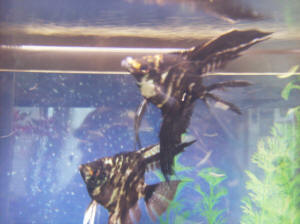
Cenneidigh <Difficult to know without a picture. Mouth Fungus
can cause the mouth to become inflamed and swollen, so that's
one thing to consider. When cichlids fight (and Angels are
cichlids) they bite, and that means they can be at risk of skin
damage (which leads to Finrot) or dislocating their jaws. So we
really need a photo to take this forward. Cheers,
Neale.> Re: angel fish - 4/3/08 I've
attached two pictures of the specific angel. Hope this helps.
Cenneidigh <Too blurry to be sure, but I'd guess either
Finrot or Mouth Fungus. Both will be fixed by a suitable
antibacterial (e.g., eSHa 2000) or antibiotic (e.g.,
Erythromycin/Maracyn) treatment. Don't waste your time with
tea tree oil or tonic salt or any of that sort of stuff. Use the
medication promptly, and always remember to remove carbon from
the filter. Mouth Fungus is, despite its name, a bacterial
infection, also known as Flexibacter columnaris. It is, like
Finrot, ultimately caused by poor water quality, even if the
triggering factor could be something else such as physical
damage. Cheers, Neale.>
|
|
|
Sick angel fish -- 03/10/08 Hi. We have a 20
gallon tank, which we set up at the end of November 2007. We have one
angel fish, one Botia, one algae eater (not sure of type), two Serpae
(sp?) tetras, three painted skirt tetras, five neon tetras, and three
Danios. <Serpae Tetras (Hyphessobrycon callistus) and Painted Skirt
Tetras (Gymnocorymbus ternetzi) are both incompatible with Angelfish --
they are notorious fin nippers. In addition, please do not buy painted
fish -- this an incredibly cruel practise where paint is injected into
the muscle blocks without anaesthetic. Many fish die in the process,
and their immune system is measurably compromised. All vets and animal
welfare groups are against it, but the Asian fish farms will keep
performing this sadistic process as long as people keep buying
them.> The tank is lightly planted, with gravel. We feed the fish in
the morning with flakes, some/most evenings with pellets. Once per week
we give them bloodworms. We keep the temperature of the tank at
76F-78F. We do monthly water changes (approximately 25 percent). We
check pH, nitrate, nitrite, and ammonia monthly. <Fine.> About
four or five nights ago, we noticed that for the first time ever, the
tank was crystal clear - it had usually been a little cloudy.
<Sometimes happens. Do a 50% water change, and check the mechanical
filter media isn't due for replacement.> We tested the water
last night. pH was 6.0, ammonia 0, nitrite 0, nitrate 5. Historically,
the pH was at 7.2, and the nitrate was between 5 and 10. We also did
the 25 percent water change last night. Water out of the tap is 7.2; we
usually let the water sit for at least 24 hours, if not three or four
days, before adding it to the tank. <Letting water sit isn't
usually necessary. A good dechlorinator does the job in minutes. Also
remember NEVER use water from a domestic water softener. It is not
acceptable for use in fish tanks (too much sodium).> We are not sure
what caused the pH to drop from 7.2 to 6.0. We plan on checking the pH
again tonight. <OK.> As for the angel fish... we have had the
angel fish for about two months. Two nights ago I noticed that the
angel fish was having trouble defecating (long string that would not
come out all the way). The next morning (yesterday), I found it on its
side near the bottom of the tank. I turned on the light, and it started
swimming again. However, I also noticed that its body was slightly
bent/curved. <Not good.> All yesterday and today, the angel fish
is swimming/floating at a slight angle (maybe 5 to 10 degrees from
vertical), sometimes starts swimming in circles (always in the
direction it is bent/curved) and is bumping into the glass a lot. Will
also go to the top of the tank on occasion, something I never saw
before. I have not seen it on its side, or at the bottom, since
yesterday morning. The condition of the angel fish does not seem to
have gotten worse over the last 24 hours. <Hmm... could be a variety
of things. Difficult to say. Toxins like paint fumes and insect sprays
can cause things like this, but so can ammonia in the water or sudden
changes in pH.> Physically, I do not see anything else wrong with
the fish. Stomach does not appear bloated. No change in coloration.
Eyes appear normal. Any ideas what might be wrong with the fish? Any
ideas what we can do for him? Thanks for any ideas!!! David H. <No
firm ideas... not enough data. My main fear will be that the Serpae
tetras especially will turn on this fish in its weakened state --
Serpae tetras have a "feeding frenzy" behaviour. I'm also
concerned by your mystery "algae eater" -- if this is
Gyrinocheilus aymonieri, this is a fish notorious for its bad temper
and bad habits. It will, for example, suck on the side of Angelfish and
eat their skin! In the meantime, I'd check water chemistry, paying
particular attention to whether or not it varies through the day (e.g.,
do a pH test in the morning and another in the evening). If you can
send a photo some time, that would helps. Cheers, Neale.>
Angelfish Plague? New Angelfish Causes death And
Destruction 3/2/08 Hello Crew, I'm Missi Blue and I contacted
you about 1 1/2 years ago with some odd angelfish behavior and your
advise was very helpful. Things have been great in the tank up until
now. I gave away a couple of fish 6 months ago that were too big for my
55 gal tank and I thought were possibly crowding the angels. I'm
embarrassed to say that I caved while buying some filter supplies at
PetSmart (the 4 LFS closed since PetSmart opened) and bought a juvenile
angelfish that was above average looking, brought him home and
introduced him to my tank with my other angels. I am aware and learned
a valuable lesson about not having a quarantine tank and buying fish
from PetSmart but I can't change what has already happened.
You've probably heard it a million times but I'm not writing to
bore you with my idiocy! After one of my angels dropped dead on Feb 27,
he had a whitish slime coating that prompted me to use
"Lifeguard" (probably another bad move) because I thought the
new fish had just introduced some funk into the tank. To get to the
point one more dead on the 28th and now the third of four dead today, I
expect the fourth to follow tomorrow. Yesterday I got online and tried
to find some information and read about angel "aids" or the
plague and it sounds spookily like what I have been dealing with.
-Introduced new fish -Within a week fish were gathered at back of tank
gasping for air, one with whitish slime -introduced fish perfectly
healthy and zipping around eating -other non angels in tank perfectly
normal also -10 days later first fish drops and promptly followed by
other All of the angels I have had for about 6 years so I am pretty
bummed but more worried that PetSmart is selling fish capable of
devastating an entire fish population in 10-15 days! If you do think it
is possible I have something on the order of Angel aids how do I go
about cleaning my tank and starting over? Should I contact the pet
store or send one of my fish somewhere? I'm just not sure if this
is a big deal besides to me so I would appreciate your input. Thanks
again all of WWM! Take care, Sincerely, Missi Blue < Your new
angelfish may have carried a disease that it was already resistant too.
When introduced to your old angelfish they may have never encountered
this disease and had no built up immunity. It could have been a new
strain of an existing disease or a virus. There is no cure for viruses.
Some aquarists have tried to heat the water up to 90 F like for discus.
This seems to work while the water is warm. When the water cools back
down to a normal temperature the disease continues to progress. If the
disease has not attacked the other fish I would recommend leaving the
tank alone for a few weeks. Place any new fish in a quarantine tank for
at lest three weeks and treat as needed.-Chuck>
|
Fresh water angle trouble 2/24/08 I have a
Koi angle fish . It is about 4 inches from top to bottom . Here
is my problem he is laying at the bottom of my tank for the last
three days some times upside down . When I nudge him with my hand
he will swim around for a while right side up then go right back
to behind the plant and turn upside down . there are nothing
else's wrong with him . He will not eat and the water quality
is fine .when I first discovered this I did a 25% water change
and changed my filter cartridge. This did not help him though any
suggestions Thanks Tom <Hi Tom. Without knowing anything else,
I'd say this fish is dying. When cichlids behave thus, it is
normally a sign of serious water quality or chemistry issues, or
possibly environmental shock, e.g., a sudden change in
temperature. Your assurances that the water is "fine"
doesn't inspire much confidence in me I'm afraid; you may
well be correct, but most people who give their own judgment
calls on this sort of thing haven't got a clue what
they're talking about. So please, tell me AT MINIMUM, the
following data: temperature, aquarium volume, pH, and nitrite (as
opposed to nitrate). Ideally, I'd like to know the hardness
of the water as well, even in general terms (i.e., is it
"hard" or "soft" water). Changing filter
cartridges can make things worse if you change all of them at
once: filters work because they support bacteria, so at most, you
should only change 50% of the filter media at any one time. Do
understand that Angelfish are NOT 'hardy' and can't
be used in brand new tanks. Cheers, Neale.>
Re: Fresh water angle trouble sorry for the
lack of information it was late last night and I was not
thinking. I tested the water here are the results as followed ph
7.4 ammonia 0 nitrate is very high though and nitrite is zero . I
did not check it the last time is tested because I had no ammonia
or nitrite. <When fish get sick, pH and nitrite should be your
first thing, even before e-mailing WWM! If the pH has changed
from normal, then you have a water chemistry problem; if the
nitrite isn't zero, you have a water quality problem.
That's why these two test kits are, in my opinion,
essential.> Last night I did a 25% water change and today I
did a 50% water change . <Good call.> The tank is a 20
long, temp is around 77 F the tank is a moderately planted tank
with Anubias nana, java fern plants and some micro swords. I am
running two filters on it one is a marine land bio wheel up to 20
gallons and a Eheim ecco2231 which is rated up to 35 gallons I am
well aware that angle fish are not very hardy but the tank is
well over a year old and there are also another angle in there
who is doing fine along with 4 Corys and four phantom tetras
which are eating and acting normal. <That all sounds fine. To
be honest, I don't know why your Angelfish isn't healthy.
When small cichlids can't swim and have lost their appetite,
it really isn't a very good sign. But it is difficult to pin
things down. I'd start by running down the usual list: Any
signs of Finrot? What about Hole-in-the-Head or Lateral Line
Erosion? Is the fish noticeably emaciated or abnormally swollen
and suggestive of internal parasites or worms? Beyond these
things, without a photo, it's difficult to say much more.
Cheers, Neale.>
|
| Diseased angel fish? 1/31/08 I just purchased
this angel fish. When I got home I noticed this reddish spot above
his gill. <Hmm... not obvious in the image (despite its size; do
note we specifically ask for *small* or *cropped* images, not full
size ones 1.5 MB in size).> I recently got my aquarium reset up
from a horrible ice storm that killed all my fish, and have been
waiting for it to cycle before adding any. <Empty tanks
don't cycle; unless you're adding ammonia, the bacteria are
dying.> Is this something I should worry about & not
introduce into my aquarium? I found something about blood spots on
a www search, but no pictures to know exactly what it looks like.
<No idea what "blood spots" are. Fancy Angelfish are
very inbred and often have things like malformed gill covers, as
with the so-called "blushing Angelfish" which lack
pigment on the gill covers. You also see gill covers that are
twisted or incomplete, exposing the red filaments underneath. So do
check this. If the red spot is obviously a wound, i.e., a cut or
ulcer, then treat proactively with a Finrot remedy to prevent
secondary infection.> What do you think & can you give me
any suggestions on what I should do? Thank you. <Cheers,
Neale.> |
|
 The red area of the operculum is
genetic. RMF. The red area of the operculum is
genetic. RMF.
|
Angelfish Help 1/17/08 Hi WWM Crew. <Hello,>
I bough a bumblebee cat for my 20L South Am. set up <Which
"Bumblebee Cat" -- there are several species sold under this
name, not all of them are good community fish.> and a week after (I
don't have a hospital tank..) the cat had ick and so did my angel
so I tried to treat but the plants absorbed it like sponges. <Hmm...
no. Plants don't "absorb" medications.><<Mmm,
can absorb... remove. RMF>> So I put him in my in my 47C with my
rainbows b/c I have a 14 African with all scaleless fish. <Let me
get this straight... you had a catfish with Ick, and before it was
cured you moved it into ANOTHER tank...? Sounds a great way to give the
Rainbowfish Ick as well as the catfish.> A week later it finally
cleared up but during the process he became timid and always hid in the
20 and 47. <It's a catfish. This is what they do. Most catfish
are nocturnal; ergo, most catfish hide. If you want fish that move
about during the day, get something else.> The only strong current
was in the 47 but its deep so he stayed @ the bottom. Hasn't been
the same since. His eyes are kind of cloudy and is shedding mucus.
<Doesn't sound promising. Check the water chemistry and water
quality. Let's assume this catfish is Microglanis iheringi. It
wants spotlessly clean water that is neutral to slightly acidic, with
relatively low (but not zero) hardness. Cloudy eyes are often caused by
mechanical damage: clumsy netting for example, or swimming into
scratchy objects. Microglanis iheringi is a social species and should
be kept in groups of at least three specimens. If yours is a singleton,
the stress of being moved to a new tank may have made it distinctly
unhappy. Adding some pals would help.> He would always wait for me
and watch what I was doing now he hides in corners and in plants. He
was one of my very first fish and is about 1 1/2-2 yrs old. <Check
water quality and chemistry first. Look at the fish for signs of Finrot
and/or Fungus. Act accordingly. All else being equal he should settle
down in time.> Thanks, Dan <Cheers, Neale.>
Re:: Angelfish Help 1/17/08 Sorry if I threw you
off. Everything was about the angel. <Ah, wasn't at all clear in
your letter. Regardless, the advice still stands: check water quality,
chemistry. Look for potential sources of mechanical damage. Observe for
Fungus/Finrot. Act accordingly. Angelfish are super-sensitive to poor
water quality, including nitrate. I'd likely treat a fish with
cloudy eyes in a quarantine tank with anti-Fungus/anti-Finrot
medication such as Maracyn or eSHa 2000 proactively. Won't do any
harm, and could help. Cheers, Neale>
Orange Spotting and Fin Rot on Angelfish 12/30/07
Thank you in advance for your expert advice. <Hmm... let's see
if we can help first!> Summary: I have two full-grown Marble
Angelfish, both of which have developed irregular, orange spotting on
their crowns and dorsal fins. Also, one of them appears to have
developed a secondary infection resulting in a ragging rotting of the
caudal fin. At the suggestion of two local fish stores, I treated the
tank for two weeks with the natural fish medications, Melafix and
Pimafix, however, the situation has not improved. I think the hard,
alkaline water at our new home may have stressed the Angelfish and made
them susceptible to an unknown disease. <Hard, alkaline water
couldn't matter less to artificial hybrid Angelfish of the sort you
have here. These strains have been crossbred and deliberately selected
so often now that they are quite easy to maintain in hard and alkaline
water up to at least pH 8, 20 degrees dH.> Background: The Angelfish
are about four years old and share a 20-gallon freshwater tank
(equipped with a Tetra Water Wonders filtration system, Tetra Whisper
20 air pump and All-Glass Aquarium 100W heater set at 75 degrees
Fahrenheit) with two Plecos. <Your tank is too small for this amount
of livestock, and quite likely water quality is less than perfect. Do
bear in mind that Plecs of the standard sort (Pterygoplichthys spp.)
require tanks around the 55 gallon mark EACH just for themselves, let
alone when cohabiting.> Note: Just prior to the appearance of this
unknown disease, I was planning to move them to a larger tank because
they seemed to be outgrowing the 20-gallon tank. Their diet has
consisted of a few pinches of tropical fish flake food twice a day. To
care for the tank, I did the following: 1-Replaced water as necessary
(using tap water treated with Tetra AquaSafe) <Define "as
necessary". If less than 50% per week, then not enough.>
2-Changed the filter every month or so (using Tetra Bio-Bag disposable
filter cartridges with activated carbon) <Carbon is a WASTE of space
in this sort of aquarium, and of course removes medication before said
medication has a chance to cure diseases. Much better to give over that
space to more biological filter media.> 3-Cleaned the tank
thoroughly every couple of months (using Lee's Ultra GravelVac)
4-Tested the aquarium conditions occasionally (using API 5 in 1
Aquarium Test Strips), today's measurements are: KH 180-240, GH
60-120, pH 7.0-7.5, Nitrite 0, Nitrate 20-40 <The water is basically
fine for these fish. The nitrate is a little high though, and long-term
nitrate is definitely something that reduces the health of
Cichlids.> A final note regarding their environment: We moved to
different city in August 2007 and the fish did not appear to be
stressed due to the move. However, the tap water in this new city is
extremely hard and alkaline. Could this have stressed the Angelfish?
<Unlikely.> Current Situation: On December 11, 2007, I noticed
that both of the Angelfish had developed irregular, orange spotting on
their crowns and dorsal fins (see image). I called a local fish store
and they said to bring one or both of them into the store, which I did.
They said it looked like a bacterial infection and advised me to treat
the tank with Seachem Stability and Melafix for 7 days, do a 50% water
replacement on the 7th day and then, treat with Melafix for another 7
days. <Melafix is of marginal value in situations like this. Time to
"get real" and use suitable combination Finrot/Fungus
treatment such as Maracyn or eSHa 2000.> They also advised me to
switch to a pellet food (New Life Spectrum all-purpose food) and raise
the temperature of the tank to 80 degrees Fahrenheit. Note: Their
appetite has been consistent (even, voracious) and they seem to like
the new pellet food fine. <Diet shouldn't be a factor here,
beyond basically keeping them healthy. Yet to see Finrot or Fungus
caused by fish getting flake instead of pellets!> As of December 25,
2007, the situation had not improved so I consulted a different local
fish store. They advised to continue treating the tank with Melafix for
another seven days and to add Pimafix as well, then, to do a 50% water
replacement on the 7th day and continue treating with Melafix and
Pimafix for another seven days. <Melafix and Pimafix are tea-tree
oils, and don't really do much.> This morning, I noticed that
one of Angelfish has developed a secondary infection resulting in a
ragging rotting of the caudal fin. <Get into gear and use a REAL
medication ASAP!> I am concerned that these natural treatments are
not aggressive enough and/or are not treating the actual problem.
<Quite so.> Also, I searched WetWebMedia.com and found two
related posts but neither situation is exactly the same as mine: New
Angel- Old Problem? (Encouraging A New Fish To Feed)
http://www.wetwebmedia.com/dwafangdisfaq2.htm Orange spots on edge of
angel fish fin 10/23/07
http://www.wetwebmedia.com/FWSubWebIndex/fwangdisfaq3.htm Question: Do
you have any suggestions that might improve the situation by
strengthening their immune system, perhaps a more aggressive treatment
(such as introducing a food supplement treated with a broad spectrum
antibiotic) and/or an environmental change (such as using distilled or
deionized water)? <Promise me you won't start messing about with
water chemistry! That's the last thing these fish need to deal with
right now. Just use Finrot/Fungus medication as instructed (disposing
of the carbon at least while treating).> Again, many, many thanks
for your help. Kind regards, Aida <Cheers, Neale.>
Fixing Up My Grandparents Tank... FW Angel sys.,
hlth. 12/25/07 Hello WWM, <Joe> Recently, on Christmas
day, I visited my Grandparents and it was sad to find out that the
Angelfish I had bought them 6 years ago passed away. I set the tank up
for them when I was in 7th grade, about the time when I was getting
into the hobby. I didn't know a lot, and I set up a 6 gallon
eclipse tank with some tetras, the angelfish, and an anubis (sp?)
<Anubias> plant. The tetras never made it, but the plant and
angelfish did. <Needs more room...> The anubis plant is still
around, and has grown well and green. The angel grew very large in the
small tank, reaching about 4 inches in length, not having a lot of room
to swim. It was until a year or two ago I realized the tank was too
small, and was surprised how he was still alive and well. <Might
have lived much longer, better in a bigger volume> Getting them a
larger tank would be hard, since they don't know a lot on how to
keep the tank. <What other possibilities are there Joe? Patterns...
consequences> I considered taking him and placing him in my larger
freshwater tank, but it would have caused problems in my tank, and yet
the angel provided my grandparents with company. They loved the fish,
<... not by my def.. If/when something is "loved" the
folks involved do their best to provide what is "positive to the
nature" of the other/s...> and were pretty sad to see him
go. I couldn't tell what was wrong with him, couldn't see any
markings, but I did notice his eye was a little red in one spot for a
while, and when he died that his mouth was a little chopped up looking.
My cousin said it was fungus, but I am not sure. It looked like he had
"chin hairs' or something. Now we need to decide what to do
with the tank. Its been established for 6 years, and I don't know
if it is a good idea to dump it, do some serious cleaning, take out the
rocks, etc. I figured I would clean half the tank water out and wait a
few weeks in case there were diseases. <Environmental only
likely> Here are the parameters. Temp 79, Ph. 6.8, Nitrate 35. I
need your advice on what to do. Should I get a new tank, do some
cleaning, dump it. Also, a suggestion on what fish would do well in the
tank and some plants that can also cope with the low lighting the tank
has. Thank you Joe <All posted on our site, "waiting" for
your perusal... Including FW Angelfish Systems if you'll look. Bob
Fenner>
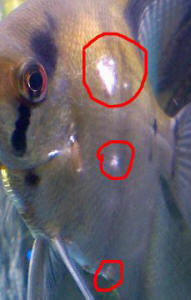
| Help! FW Angels, hlth. 12/25/07
Hello all, Searched the sight to no avail this is my problem, I
have a 55 gal fresh water tank with 4 angle fish now its down to 3
The problem started about 2 weeks ago. The one angle
<Angel...> the larges of the 3 started to get a small spot on
its side just under the line on its side all the scales are missing
then the same happened with 2 of the other ones, I did a water
change and at the time the ph was around a 6 and zero for the
ammonia those have not changed after a 25% water change a few days
after that they began to develop small white spots "not ick
spots" just 1 or 2 on the upper fin close to the body they
look like small pimples and almost looked like ph burn along with
time where the scales where missing along with a large hole in the
top of their heads about the size of a bb right above the nostril,
I started treating them with Melafix stuff <Worthless> as
directed then the pimples where gone but left a hole where they
where from one side of the body to the other, it almost looks like
something bit chunks out of them in places, there is no loss in
feeding no odd swimming and no odd behavior I don't understand
what is going on, I tried to get a photo of the one larger angles
problems but it is kind of hard to see and I apologize. Any help
would be great, Thank you, Ryan NY. <Do you have access to a
microscope? These marks could be something resultant from a
chemical insult of some sort, but might be parasitic... Look like
injury sites as well... what other livestock is present, have you
seen them fighting? Have you introduced new life, live foods...
Read here: http://wetwebmedia.com/FWSubWebIndex/fwangdisfaq3.htm
and the linked files above for more roundabout input. Bob
Fenner> |
|
|
|
Sudden FW angelfish death... & Epistylis/Protozoan
f' 11/25/2007 Hi, <Hello.> I've been
reading and reading your site looking for answers to the sudden
death of one of my Leopard Angelfish. <Hmm... sudden deaths
are always signals to check aquarium conditions: water chemistry,
water quality, correct functioning of heaters, filters.>
I've had these 5 Leopards ( none larger than half dollar size
and most between half dollar and quarter in size) for about 4
weeks in a 12 gal QT. <Quite a small tank even for juvenile
Angels, and small Angelfish do not, in my experience, always
travel well. I recommend people buy them around half-size, say,
5-6 cm.> The fish arrived just after an outbreak of ich in my
55 gallon cycled tank and so I had to move the worst victims of
ich into the hospital tank leaving the 12 as my only resource and
not cycled. I have been doing twice weekly 25% water changes ever
since to the 12 gal QT and checking the levels of ammonia, PH 7-
7.2 , nitrites and nitrates and all were kept at zero or nearly
so. <When it comes to nitrite, "nearly zero"
isn't good enough. Cichlids generally, and Angelfish
especially, are sensitive to dissolved metabolites.> The
nitrate being the only one ever over 0 and not over .25. <0.25
mg/l of nitrate is safe. But do you really mean this? Not many
test kits are this accurate! Most seem to measure on a scale of
0-100 mg/l. Nitrite, on the other hand, is commonly measured
between 0 and 1 mg/l.> Is this enough of percentage of a water
change each time? <No. 50% per week, minimum.> This tank
also has a Bio Wheel and I added a small pouch of charcoal-
ammonia absorbent in addition to it's regular filter
material. <Well, bin the charcoal for a start. If this is an
uncycled tank, then you may as well use Zeolite (ammonia remover)
exclusively. I'd personally skip any sort of fancy filter for
this. Just go with a plain vanilla bubble-up box filter stuffed
with Zeolite. Replace the Zeolite every week. You can usually
recharge Zeolite, so get two "batches", and use one
batch while recharging the other. There's absolutely no point
cycling a tank with Angelfish -- they will die long before the
filter bacteria come on-line.> They've been healthy and
lively and voracious eaters, but not overfed I think. This
morning I noticed one of the larger angels staying low in the
water near the heater. Tank heat is kept at 80 degrees. I have
just seen on your site that I should probably vary their diet
more than I have been doing. They've mostly been on flakes
and freeze dried worms. They ignored my attempts at adding an
algae pellet though. <Angels will eat anything... if hungry
enough. They are easily overfed. I'd use a mix of plain
flake, Spirulina flake, and live/frozen/freeze-dried insect
larvae. Because they willingly gorge themselves, you have to be
careful not to put too much food in the tank. One or two flakes
per day is plenty for Angelfish this size. Since they're
young, feed perhaps twice per day. Do watch the nitrates though,
and try to keep below 20 mg/l and certainly no more than 50
mg/l.> I went ahead did my regular 20-25% water change this
morning, and by this evening the lethargic angel was worse, lying
or hovering near the bottom seeming to gasp for air. The other
fish were fine, acting normally and active except for one other
large angel that seemed to be chasing the other three away from
the sick fish. <Indeed. Angelfish are schooling animals when
young, but become territorial as they mature. All too often
people end up with a single big Angel that rules the tank.> I
did another water test and the levels were the same, Ammonia 0,
Ph around 7- 7.2 and the nitrates and nitrites 0. At about
midnight my poor angelfish died. <Oh.> There were no signs
of any battering, discoloration in fins, skin, not a mark, but I
did notice a tiny speck of red near the outer edge of the eyeball
on both eyes, but in different placements. I'm totally
baffled as these fish were tank raised and extremely healthy from
the minute they arrived and showed no signs of any distress or
illness whatsoever. I've grown quite attached to them to the
extent that I don't even want to put them into the now
healthy 55 community tank and would like to upgrade to a 30
gallon tank for just them. I considered them so
"pristine" and didn't want to take any chances on
them being exposed to diseases. <Quarantining new stock is
always a good idea.> What do you think happened? The only
thing I can think of after all the reading I've done is water
quality and ammonia, nitrate or nitrite poisoning, but that
doesn't make sense with the readings I took. The kit is
fairly new, but I'm not exactly sure of the expiration date
since it was marked on the covering of the kit which I threw out
a while ago. I hope this is enough information. <To be honest,
I have no idea what precisely happened here. Sometimes very young
fish don't travel well, and one or two in the batch will die.
This is less of a problem with big fish because people tend to
bag them up sensibly. Profit margins on big fish are
proportionally smaller, so everyone along the distribution chain
takes more care. But small fish are often overcrowded.
Individually each fish makes a proportionally larger profit, so
if a few die, it doesn't matter. Mass-produced fish also tend
to be produced for a quick sale rather than quality, and
there's free use of antibiotics by the farmers and
wholesalers, and by the time they arrive at your house these
drugs have worn off and the results of overcrowding become
apparent. For now, I'd not blame yourself, but simply focus
on water quality and correct diet.> Thanks for your wonderful
site. It has the best tips, help and advice I've found
anywhere on the internet. <Thanks!> Thanks you in advance
for any insight you can give me. Polly <Good luck, Neale.>
Re: Sudden angelfish death 11/25/2007 Neale,
<Polly,> thanks for some answers to water quality, tank
size and feeding. Good advise. <Cool.> This morning the
remaining 4 Leopards are still fine and looking unaffected by
whatever killed the other one. These fish came from a very small
breeder in Michigan and I was worried about them travelling when
I bought them via Aquabid, but they were well packed, double
bagged and in Styrofoam qt. size cups, with oxygen, a mild
sedative and an ammonia blocker and when I acclimated them to the
QT they moved in and bounced back like champs almost immediately.
I think I was very lucky there. The breeder/seller communicated
with me and wanted to know how they arrived, talked me through
any questions about acclimation and general appearance, behavior,
etc. A good man who was into his fish, which he bred himself,
rather than the moola, I think. <This is indeed the best way
to buy Angels, and it sounds like you've dealt with a very
decent supplier. My comments were really more about the mass
produced fish farmed in Florida and Southeast Asia, primarily for
the low end of the market.> So you think a 50% WC once a week
is better than 25% twice a week? <Yes.> Not to sound dumb
here, but why is it better? <Many reasons. Primarily a
question of dilution and reducing the effect of acidification.
So, your filter removes certain pollutants, but does nothing
about nitrate, phosphate, organic acids. These accumulate.
Nitrate is a known toxin to cichlids generally, being at least
one of the factors behind hole-in-the-head as well as a general
lack of vigour. Diluting by 50% each week is the cheapest,
easiest way to get good water quality. Works better than carbon
for a fraction of the cost. Acidification is something that
happens in all aquaria. The longer the interval between water
changes, and the smaller those water changes are, the more
acidification takes place. This is one of the reasons why new
fishes put into an old tank sometimes fail: the existing fish
have adapted to the sub-optimal conditions, but the new livestock
are shocked. Again, water changes are the cheapest, easiest way
to maintain a steady pH.> I never intended to use the
angelfish to cycle the QT tank, just got stuck because of the Ich
in the 55. I've been looking around for a good price on a 30
gal for them, but since I'm running a 30 with 7 female Bettas
and 5 Corys, the 55 community and two 10 gal with guppies in one
and 6 baby Pearl Gouramis in the other and three 5 gals with
single male Bettas I have to tread softly with my husband who is
strictly a dog person! lol <Indeed! Perhaps keep Dogfish, so
you'll both be happy. (Note to Americans: a Dogfish is
British vernacular for small sharks, particularly Scyliorhinus
spp., which for some bizarre reason Americans called
Cat-sharks!> Also, do you think I should switch over to a
sponge filter in the 12 QT instead of the Bio Wheel? I have one
spare hanging around. <If both are being used as purely
biological filters, then stick with the one that is most mature.
But in quarantine tanks, using a box filter filled with Zeolite
is invariably easier, cheaper, and more reliable than any
biological filter. You have a zero run-in time, and you can
sterilise it between uses.> Thanks again, Polly <Good luck,
Neale.>
Re: Sudden angelfish death 11/25/2007 Neale,
<Polly,> all makes perfectly good sense to me and thanks
for the answers to my questions. <Good-oh.> We always
called those small sharks, Dogfish around here in Maine too and
they are nasty guys. Like to go for the bait in the lobster traps
and will follow the traps up while they are being hauled. Just
hoping for the bait or a nice fat Lobster to fall out I suspect.
VBG <Ah, I guess that's why they call New England 'New
England'... because you speak English rather than
Americanese! And yes, ours steal food from Lobster Pots too.
They're actually pretty amazing animals. Live for at least 30
years, and perhaps as many as 100 years. The eggs take 2 years to
hatch. Not something for the impatient aquarist!> I will
switch to a 50% WC in my tanks once a week from now on and just
rotate the days when each tank is scheduled, add to the diet for
the angels and follow your advise. <Sounds good.> I'm
going to look into the Zeolite too. <Yes, Zeolite is
definitely a good idea in temporary tanks or any sort of tank
where you don't have time to mature the filter. Cheap and
effective, provided you start off with enough to deal with the
ammonia produced by your livestock.> Thanks, Polly <Cheers,
Neale.>
Re: Sudden angelfish death 11/26/07 Neale,
<Paula,> when it rains, it pours! <Indeed?> The
Leopard Angelfish are still fine, but when I was doing the WC in
the Betta/Cory tank, I noticed that my largest Cory had some
spots on him, def. not ich or velvet. They appear to be oval-ish
and are concentrated on his spine and the base of the dorsal fin
and tip of dorsal. <Hmm... sure this isn't Ick? Do also
cross off silt particles and air bubbles. Both of these can stick
to fish and be mistaken for parasites.> I QT'ed him in the
hospital/baby tank, promptly discovered that the Gold Platy was
starting to give birth, moved her into a breeding/bearing net
hung over the side of the community tank where she lives and went
to do some research on the internet to see what was up with the
Cory. <Not a great fan of breeding traps, so do take care not
to stress her. I prefer to use floating plants, and then remove
the fry as they're discovered hidden among the plants, either
to a trap or to another tank.> It sounds like Epistylis from
the descriptions given. Can't seem to find any pictures that
show it though. I went back and took a magnifying glass and
flashlight and checked him out and the spots are not ich-like in
appearance at all, not moving and one spot, near the end of the
dorsal fin, is tufted a bit. The other spots are oval,
greyish-white in color as well and as I said, concentrated in two
or three areas. He has a space missing on his tail fin, but no
growth or spots on that area. <Does indeed sound like
Epistylis.> If indeed it is Epistylis, do I treat him in the
2.5 gal tank with something like Jungle fungus meds? <I'd
treat the tank with the anti-fungus medication of your choice.
Corydoras generally tolerate these medications well.> Do I
treat the Betta/Cory tank as well or just keep and eye on the
others and see if something develops? <Treat the tank.> I
did noticed that some of the other Corys have a few ragged fins!
<Fins sometimes get ragged when Corydoras are mixed with
aggressive or nippy fish; otherwise can be a prelude to
Finrot.> I try and spend time each day sitting and closely
looking over each fish to see if there is anything different in
their physical appearance or behavior. Yesterday this sick Cory
was just a tad underactive. Think it's a female from the size
and width of the body, but not positive. I didn't notice any
ragged fins on the others until today either. You must think
I'm a bad fish mamma at this point. Sorry to keep bothering
you. <Don't worry about that.> thanks, Polly
<You're welcome, Neale.> BTW, the Platy has had three
babies since I moved her and then stopped giving birth. Stress
from the move most likely. Babies look good. <Good-oh.>
Re: Sudden angelfish death -11/27/2007
Neale, <Paula,> Just went and looked at the Cory in the QT
and the lesions/spots have reduced in number, but some are still
present. Are they going into another reproductive phase,
something like the ich spores do? <No, I don't think so.
Epistylis is a ciliate protozoan that mostly just sits there on a
fish. It's not a parasite as such; as I understand it,
it's more a fouling organism than anything else (i.e., like
barnacles on a boat).> That brings up lots of questions in my
mind, secondary infections etc. but .... I then checked the
Betta/Cory tank and three of the Corys have no signs of fin
damage, color good, very active and looking for food. The fourth
is looking a little lethargic, fins ragged and no spots or
lesions, nada, just out of sorts and not active or looking for
food, similar to how it started with the sick Cory. Should I haul
him out into the QT with the sick Cory and still treat the
Betta/Cory tank as well as the QT tank? <Definitely treat both
tanks with anti-Fungus/anti-Finrot. Trying to target one
particular fish is probably a waste of time here because the
pathogens are in the aquaria generally.> BTW, Bettas are fine
and active, eating, clear of anything on their skin.
<Good.> As of midnight last night, I did another 25% WC on
the Betta/Cory tank, bringing the total WC for yesterday to 50%
on that tank. There was some uneaten stuff and crud underneath an
aquarium decoration and around the roots of some of the heavier
planted sections of the tank . I removed the large
decoration and tried to really clean up the crud, for lack of a
better description, and left the decoration out afterward to make
it easier to do WC in the event of doing treatments to the tank
for any length of time. Did a 50% WC to the QT tank as well.
<Good.> As for the weapon of choice in treatment.
Here's what I have in house right this minute. Will any of
these do any good? I have been trying to buy meds every time I go
to the LFS to have them on hand, but as you can see I am still
way under stocked on what I imagine are all the basics. Ich
Attack by Kordon, for ich, fungus, Protozoans, and
dinoflagellates <Might work; Epistylis is apparently sensitive
to Formalin and Malachite Green.> Ick Guard II by Jungle
<Ditto.> Fungus Clear Tank Buddies by Jungle (tablets, 1
tab per 10 gallons) <Won't fix the Epistylis, but will
help with the ragged fins.> Pimafix <Useless.> Melafix
<Useless.> Bettafix <Useless.> Aquarium Salt
<Might help if used in the same way as for treating Ick, but
not my weapon of choice here.> Erythromycin and another
antibiotic...it's downstairs at the moment and I forget, but
I tried to get one gram positive and one gram negative when I
bought them. <Useless. Antibiotics are for bacterial
infections only.> I do live on an actual island. No bridge,
and therefore can't just pop into town willy nilly. My
husband is going to go over to the mainland this afternoon and if
there is anything he could pick up this would be a good time.
What meds should I have him get if none on hand are appropriate?
<See above; you may already have the tools required. Check the
ingredients lists on the medications, or simply test them out.
Epistylis isn't doing the fish any direct harm -- the problem
is that they open a wound that can become infected, and
furthermore that they occur at all is a sign of middling to poor
water quality.> To sum up, still treat the Betta/Cory tank as
well as the QT with a fungus med? Move the second Cory exhibiting
signs of Epistylis to the QT , OR treat him in the Betta/Cory
tank? <Treat both tanks. There's no mileage in isolating
diseases caused by environmental issues, since all fish are
likely subject. So treat all fish up front to prevent further
infections.> Much thanks once again. You are very patient with
all the questions and problems I've thrown at you in just two
days time. Let's hope the rain stops pouring ASAP. <It
will.> BTW Angelfish still fine. <Double-plus good.>
Thanks, Polly <Cheers, Neale.>
Re: Sudden angelfish death 11/28/2007
Hi Neale, <Polly,> well, I lost the first sick Cory in the
QT . <Too bad.> I had started treating both tanks with the
Jungle Tank Buddies for Fungus as I hadn't heard from you and
I thought I needed to do something quick. (The time difference
between us. ) I didn't go with the Kordon Ich Attack as it
doesn't contain anything but botanicals, no chemicals like
formalin or malachite green. <This is a somewhat unwelcome
trend: eschewing proven pharmaceuticals in favour of ingredients
that may be safer and less toxic if overdosed, but are of
questionable usefulness in some cases.> I probably waited too
long for the first sick Cory or he was traumatized by the move
and being alone as well. You know how Corys are. They look like
little tanks that can take anything, but they are so social.
<Indeed. With schooling fish it is normally best to treat the
tank rather than individual fish. Lone Corydoras don't
necessarily die, but it is one more stress factor on an already
sick fish.> I did a water test before I did anything to treat
the 30 gal tank or do the WC that brought me up to the 50% WC
total, forgot to mention this last post. Everything read as it
should. Ph was between 7.2 and 7.6, I have high PH normally from
the well water, the ammonia was 0, nitrites and nitrate 0 as
well. <All sounds fine. Corydoras are relatively indifferent
to water chemistry, and tolerate hard, alkaline water just as
readily as soft, acidic water. What matters to them is stability
and quality more than anything else.> That didn't make
sense to me since the problem is an environmental one, so I did a
test on the 55 and got the same results except the PH being
different from the 30. The 55 gal was at PH 7-7.2 and nitrate and
nitrite 0. Could the test kit be getting old and need to be
replaced? <Possibly. But it also important to remember that
aquaria have a background acidification process. So as soon as
you put water into any aquarium, it gradually becomes more acidic
unless something acts to stop that. The key factor is decay of
organic material, which produces organic acids, and these lower
the pH. The speed with which the tank acidifies depends on its
size, its loading of fish, the amount of organic matter
(including plants and algae), the presence of alkaline buffers
such as tufa rock, the nitrate level, the ammonia level, the
amount of carbon dioxide, aeration, and the frequency of water
changes. In other words, no two fish tanks will acidify at the
same rate, so it is entirely possible that these two tanks will
have very different environmental conditions despite receiving
the same type of "new" water each water change.> I
bought it within the last month, but it was the last one for FW
on the shelf at the LFS and didn't know about expiration
dates for tests. Didn't check to see what the date might be
and it was apparently on the outer clear packaging cause I
can't find it anywhere in the actual test kit. <Test kits
can and do go "bad", but this is rare unless the kit is
extremely old. The chemicals are largely inert, and provided they
are stored somewhere cool and dark they should be stable for many
years.> Since I wasn't sure of the test kit's
accuracy, I did a 50% WC on all the other tanks that hadn't
been done over the weekend, except the guppy and baby tank (did
20% on that ) because that tank seems to always be fine, totally
knackered me, but done. I'm so completely paranoid now about
the other tanks that I see cilia and parasites in my sleep. lol
<Ah, the joys of fishkeeping.> Obviously, my problems are
directly linked to poor water quality and my husbandry. My
question ( will they ever stop you think?) is... are water
parameters not always linked with cleanliness, are the two not
one and the same? <Interesting question. Most disease is
directly or indirectly linked to water quality and water
chemistry. Provided those two factors are appropriate to the fish
being kept, the incidence of disease should be very low. While
disease can sometimes happen for other reasons, such as genetics
or the introduction of unquarantined livestock, at a first-pass
there's a lot of wisdom in assuming any unexplainable
sickness was caused by water quality and/or chemistry issues.
Now, cleanliness can be looked at two ways. Oddly enough, visible
waste tends not to be a major problem. Yes, decaying plant
material and fish faeces contribute to acidification, but
"the wild" is full of decaying material that the fish
don't seem to be harmed by. Indeed, many fish, such as
catfish and loaches and cichlids, positively revel in the stuff,
extracting significant parts of their diet from the decaying
material or micro-organisms living therein. Invisible waste, on
the other hand, is the killer: nitrite and ammonia in the first
league of dangers, and then nitrate somewhere below them. On the
other hand, regular water changes undertaken to remove solid
wastes in the tank invariably dilute the invisible wastes, and a
good mechanical filter with plenty of current will not only
remove solid wastes but like have plenty of space for a good
biological filter as well. So while the two things are not
identical, they do tend to go hand-in-hand as far as
practicalities are concerned. It's too simplistic to say a
clean tank is a healthy tank: after all, a brand new aquarium may
look spotless and yet have high levels of ammonia and nitrite
because the filter isn't mature. But established aquaria that
are kept clean through water changes and adequate filtration tend
to have zero/low levels of ammonia, nitrite, and nitrate as
well.> Can there be too much goop or pollution in the bottom
of the tank that never show up on a test kit's results and
should water from testing be from the lower regions of the tank?
(why the Corys were the first affected?) <Not normally, no.
But if the sediment at the bottom of the tank becomes anoxic
because it isn't regularly cleaned somehow, it can house
bacteria that can, in theory, cause problems. In practise this is
an easy fix. If you're using sand, for example, keep it thin
and install some burrowing snails (such as Malayan livebearing
snails) which will aerate the sand in the same way as earthworms
on land. Catfish and loaches generally like to dig and will keep
sand very clean anyway. Gravel can be more of a problem to keep
clean (surprisingly to some) but when stirred once a week at
water change time cleaning gravel shouldn't be too
difficult.> Hypothetical question.....say the second sick Cory
makes it and has some open wounds from the Epistylis. Should I
then treat the tank for possible secondary bacterial infection
problems? <Yes.> What would be the med of choice? If
antibiotics, gram positive or negative? <I can't really
answer this from experience, since antibiotics aren't
available to aquarists in the UK. But my expectation would be a
product such as Maracyn would be appropriate. Really anything to
treat Finrot, as that will get the Aeromonas/Pseudomonas bacteria
likely the problem here.> The more I write, the more questions
I have and the guiltier, to the fish and you I feel. Is there a
book you can recommend that I should buy that you consider the
best reference for fish disease and treatment? <Many, many
choices. I happen to like the 'Manual of Fish Health' by
Chris Andrews et al.> Thanks Neale, You Da' Man, Polly
<You're welcome.> Angel fish fine, mother Platy ate the
3 babies, you are right about breeding nets! <Indeed. Trust
me: floating plants work much better. Simply check the tank once
or twice a day and scoop out the babies as you see them. Any
floating plants will do. Even bunches of pondweed or algae.
Plastic plants even. The baby fish instinctively go into them,
and the parents tend not to notice them.>
Re: Sudden angelfish death 11/28/07 Once
again, thank you Neale for the detailed answers to my
questions. They are extremely helpful and make me want to
do more reading on water chemistry, acidification, substrates,
different types of filtrations systems, aeration, etc. Lots more
reading! VBG <Very good! Once you understand the basics of
water management, everything else in fishkeeping is easy. But if
you're muddled about water management, then things become
more dicey. An hour or two spent reading around this topic is
time very well spent.> The second Cory is still with us and
shows improvement. He never developed the full blown growths on
his body and after spending most of yesterday on the bottom
hiding in some plants, came out in the early evening to hang out
with the other three and actually start to actively ferret around
on the gravel for food. <Good stuff. I find that once a sick
fish starts feeding again, you're almost always home
free.> On further examination of the hype on the Jungle Fungus
Tank Buddies box, it states that it also contains something to
fight secondary bacterial infections, but I will probably also
treat with something else for the fin damage that he displays.
The other three Corys still seem unaffected. <I have never
used that medication so can't speak from experience.> The
substrate in this tank is a combination of an under layer of
Fluorite with some gravel over it to keep the fluorite in place
and make cleaning easier. The fluorite is great for the plants,
but I've found it hard to deeply vacuum without causing major
cloudiness. <A problem with sand. The trick is not to vacuum.
Instead, let the catfish and plants and Malayan livebearing
snails do the hard work for you. Also lower the sand on one
corner so detritus collects there. You can then siphon or even
pipette waste as required. Much easier.> There is probably an
inch of Fluorite and a 1/2" of gravel over it. In our LFS
it's is very hard to find small/ medium uncoated gravel for
our FW tanks. <I sympathise. I tend to buy my substrates from
garden centres. Easier and cheaper, provided you choose smooth,
lime-free sand or gravel rather than, say, sharp sand.> I like
the Fluorite for the plants, but am not too sure I like the
substrate for the fish. I have just Fluorite in the 55 gal tank ,
about 1" deep. The Betta/Cory tank is running a Bio Wheel
filter, minus the media right now. I will be adding Zeolite,
which my husband found for me on his mainland trip the other day,
to all the tanks. <Zeolite is completely redundant on tanks
that have biological filters. Serves no purpose whatsoever other
than wasting your money in these cases. Zeolite is exclusively
for tanks with no biological filter, e.g., quarantine tanks or
tanks with strongly acid pH.> I love planted tanks, but have
decided that too many decorations such as rocks, caves,
artificial tree trunks, etc. are too hard to clean around if not
lifted at least every other time I do a WC, so have removed quite
a bit of the aquascaping add ons and will try letting the plants
and maybe one cave for the shy fish, suffice. If you're
finding too much silt and detritus, it is likely you have
insufficient water movements and/or mechanical filtration. In a
tank with complete circulation, there shouldn't be any solid
waste on the plants or gravel. Well, maybe a bit, but not enough
to be unsightly. So, do check water currents around the tank, and
if required, add another filter. If the bottom of the tank has
poor water flow, this will mean higher levels of ammonia and
nitrite down there, and this could be a factor for your
catfish's ill health.> I went to amazon.com to see if the
Manual of Fish Health was available and found there seems to be a
revised edition. The Interpet Manual of Fish Health by Andrews! I
assume it is a revised edition anyway, and will order it. <My
copy is from '88. It's a good book. Good level of
science, but lots of photos and charts explaining what's
going on.> As for snails......I had one hitchhiker on a plant
and now have what seems to be a million in the Baby/guppy tank,
Yikes! No sure I want to introduce them on purpose as I'm
sure they will appear, as if by magic in due time in the tanks
they haven't yet. LOL <Snails can be a mixed blessing, but
do remember they turn waste into snails. In a clean tank, their
numbers tend to be very steady, and removing them by hand works
fine. Snail plagues almost always follow over-feeding and
under-cleaning.> I'm cultivating a Java Moss like type
plant in the baby tank and will move some of it into a birthing
tank. Will save those breeding traps for brief isolation and
examination purposes. VBG <Enjoy the babies! Best bit of the
hobby, I think.> Thanks again, Polly <Bon chance,
Neale.>
|
Constipated angelfish (severe), FW -
11/20/07 HI Bob, Your site is awesome! I've taken the advise of
using Epsom salts @1tablespoon per 10 gal. in order to free up the
blueberry sized intestine of my 8 yr. old, 5 ½' black
angelfish. It's a 20 gal. tank shared with 2 very small catfish and
one large plant. I've had the angel and the plant for 2
½ years, there have been no sudden changes to the tank. The
water condition is fine. I use TetraMin pro, but noticed the worm and
shrimp diet recommended on the site. However, today I'm going to
stop putting any food at all in the tank until this fish relieves
itself. The problem looks severe, the anal is so swollen that it's
becoming slightly red. All the fish behave normally except that
yesterday I saw the angelfish twitching its 2 lowest fins and making
small jerking motions with it's body. I've tried different
things with a skinless smashed green pea, but the fish won't eat.
It still rushes to the top of the tank always anxious to eat whenever I
approach the tank though. Today I'm going to begin slowly upping
the dose of salt. Any other suggestions? Thank you! <Greetings.
Constipation in cichlids is very common, much more common than people
might think. Pellet and flake food is especially bad at causing this,
as will freeze-dried foods. The best foods for clearing up constipation
are peas, algae, live Daphnia, and live brine shrimp. It does sound as
if your fish has developed a prolapsed anus. This will heal by itself
once the infection caused by the constipation subsides. Not feeding the
fish at all for a couple of weeks will do no harm whatsoever, and if
you starve the fish a bit, it might eat the tinned peas more readily.
Alternatively you may want to provide live Daphnia or brine shrimps
every day or two, as few angelfish turn their snouts up at these.
Raising the Epsom salt concentration will also help. Cheers,
Neale.>
|
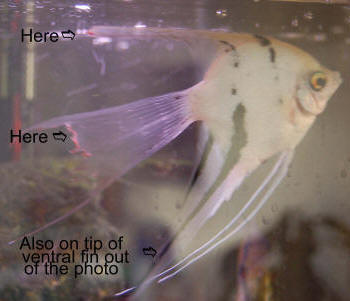
Orange spots on edge of angel fish fin
10/23/07 Good Day, I have asked my local aquarium store fish
specialist and used numerous web databases to try and find out
what the orange spots on edge of my angel fish fins are. They
just appeared yesterday (see attached photo). There doesn't
seem to be any fin deterioration or rot, and no white fungal
growths. There are two angel fish in the tank (20 gallon) and
only one is affected by the orange spots so far. I have a
20-gallon octagon tank with a Pelican bio wheel filtration
system. A brief history of recent events in the 20-gallon tank:
1. Three weeks ago: I noticed that the male angel was getting a
bit of white growth on the bottom of his mouth but none on the
female angel. He has had this occur periodically over the last
three years - so I treated the tank with Furan-2 as this usually
takes care of the problem. I followed the directions of the
Furan-2 package for dosing and water changes. After the treatment
was finished, I did the final 25% water change and put in a new
carbon filter. 2. The male seemed recovered but the female was
beginning to shoe signs of distress. Her abdomen was swollen,
"panting" when breathing; she wasn't eating - just
hanging out in the back of the tank. I talked to my local
aquarium store fish specialist and he suggested that I switch to
Maracyn-Two. So, I treated the tank for the recommended five
days. The female began eating some and seemed to be recovering.
3. Then the tank took a bad turn. Seems the Maracyn-Two killed
all of my good bacteria. Water quality: ph was about 7, ammonia
was zero, but the nitrate was high. The tank clouded up, so I
began dosing the tank daily with Cycle to rebuild the nitrifying
bacteria population. The tank cleared in about four days. 4. The
female was still swimming around and more active but still not
feeding very well. The local aquarium store fish specialist
suggested that the female might be egg bound. So, I looked this
up on a web database and the suggestion was 1 tablespoon of Epson
salt per 10 gallons of water. I treated the tank once and the
female seemed to perk up a bit more. But was still not very
interested in eating. These angels usually eat right away and I
feed them twice a day. So, here we are now with the orange spots
on the edge of the females fins. She is not eating when I observe
at feeding time, but both of these angels have the habit of
grazing on bits of food that they miss that settles on the bottom
of the tank; maybe she is eating that way. The water quality
today is: was about 7.2, ammonia was zero, but the nitrate was
still high. My local aquarium store fish specialist today
suggested the Nitra-Zorb filter media to rebalance the water
quality. I bought one this afternoon and have removed my charcoal
filter and installed the Nitra-Zorb. Any ideas on what is causing
these orange spots? Joyce <Hi Joyce. At first glance, my guess
here would be that these are Finrot, and should be treated as
such. They might be some other bacterial infection (such as Mouth
Fungus) but most of these external bacterial infections will be
treated by anti-Finrot medication anyway. Don't waste time
with salt, Melafix, etc. Go straight for the antibacterial
medications. Do be sure to remove carbon from the filter if used.
Carbon not only removes medications before they do any good, but
they're also a waste of time and money. Far better to replace
with real biological media that will do something useful. Hope
this helps, Neale>
|
|
|
FW Angel... plague return? 10/2/07 I cannot
find what may be causing EVERY single angelfish that I put into my tank
to die. <... Is this a pandemic of Octomita?> I had 2 very
healthy ones for about a year in my 46 bow, I got a new 125 gallon tank
and transferred them to that. Water conditions excellent, no
ammonia/nitrites/nitrates to speak of, runs crystal clear. Every other
fish in the tank is thriving, however I bought a few baby angelfish and
put them in, they died within a few days. I got bigger ones, they died
within a couple days. Then my older ones died after about 3 weeks of
doing well in the tank. I have 22 other fish living in the tank, which
include 1 Giant Green Terror <Yikes... not compatible> 2 Flame
Dwarf Gouramis 2 Neon Blue Dwarf Gouramis 3 Blue Gouramis 2 Gold
Gouramis 2 Large Bala Sharks 2 Boesemanni Rainbows 2 Ornate Rainbows 1
Turquoise Rainbow 3 Clown Loaches 1 Small Black Tiger Oscar
<Ditto... will consume most of the other fishes in time...> 1
Albino Cory Cat The old angelfish lived with the Green terror and Bala
sharks and turquoise rainbow and loaches in my 46 gallon, and all the
other fish were added later. They weren't being harassed by
anything, my Oscar is very friendly and keeps to himself all of the
time. It has 2 Whisper HOB 60 filters, a Fluval 304 canister run inline
to UV sterilizer, and undergravel filtration as well. The
decor is currently minimal, with just a couple large slate
caves. Is it possible that there is some sort of disease that is
transferred only between angelfish? It all seemed to happen after I put
the first couple small ones in there <Would you had read... here:
http://www.wetwebmedia.com/FWSubWebIndex/fwangdisfaq3.htm and the
linked files above. Bob Fenner>
Angelfish Die Off, FW comm. 9/27/07 Hello
<Hi there> I own a live tropical fish store in Michigan and
within the past six months, I have not been able to keep freshwater
angelfish alive. Is there a problem that you know of that is causing
these poor creatures to perish after 72 to 96 hours of arrival?
<Yes... a couple in particular... One, an older plaque of Octomita
that was the causative organism of "Angelfish Disease" years
back... can/should be treated with treatment of existing systems (with
Metronidazole/Flagyl), and strict quarantine and treatment with same
for all questionable/Far East imported angels or angels that may have
come in contact with... The second syndrome is "just
exhaustion/stress" from import... Both situations can/are best
remedied by buying your Angels from local, or as local as you can find,
breeder/s> My suppliers out west will not ship to anyone via plane
because they have had other customers complaining of the same problem.
Six months prior, angels were great, healthy, and eating. Now they come
in looking healthy but within a couple of days, perish. Could it be the
same as with the piranha deal? <Mmm, yes> Thank you! Sincerely,
W.L. <Try the Metronidazole... get folks about you to breed/supply
you... Bob Fenner>
Freshwater angel fish... sys., hlth.
9/25/07 hello crew, <Hello.> greetings and thank you in
advance, I will describe the problems I have been having with
freshwater angels. I have only been trying plain Jane pet store angels,
not wild types etc. I have had success with convict cichlids, breeding
and rearing the young no problem, and my nano reef tank is doing just
fine, right now still just "easy" animals, Zoanthids and
parazos and a three stripe damsel, and "utility" species, so
I have a decent amount of experience keeping fish, my Malawian tank is
doing fine, not breeding yet but giving it time, so enough back-story.
<OK.> I have recently purchased a few angel fish, one whose body
was roughly the size of a half dollar, and 5 the size of a nickle, I
watched the tank as best I could. The large fish is still alive and
swimming, but the small guys have all perished. <Very small angels
do not travel well. Also, angels are bullies, and big ones pick on
small ones. Contrary to popular myth, they aren't really schooling
fish. Juveniles congregate in groups, it is true, but adults form
territorial pairs. So, the classic way to start with angels is buy a
group of 6 identically sized angels, rear them together, and then
remove the excess fish once a stable pair has formed.> There are not
detectable levels of ammonia or nitrite, the nitrates are a bit higher
than i realized, the tank had previously been the home of my breeding
pair of convicts, as well as some tiger barbs and a guppy, the guppy
being the only one still in there. <Angels, like all cichlids, are
intolerant of nitrate. The goal is less than 50 mg/l, and ideally less
than 20 mg.l.> I had tried angles before, prior to the convicts, and
failed then, i then tried the convicts and right away, in the same tank
they did just fine. <Convicts and angels are very different fish in
terms of hardiness. This is especially true with "fancy"
angels, which are the ones most commonly sold. These have been selected
for looks, not hardiness or behaviour, with the net result that many
fancy angels are very unpredictable in terms of maximum size, disease
resistance, hardiness, and aggression.> ok on to the questions, I
apologize for the long story before the question. Just how sensitive to
hardness, nitrates, and PH are domesticated angels? <Varies, but as
a baseline, tank-bred angels are indifferent to pH and hardness within
a range of around 5-20 degrees dH, pH 6-8. Nitrates as mentioned can be
more of an issue.> Am I likely to have better luck starting with
slightly larger angels? <Quite possibly. But the main thing is to
ensure your water chemistry is similar to that of the breeder. As with
any fish, changes in water chemistry are more of a deal than what
precisely the water chemistry values are. Also, try and avoid the very
fancy varieties, things like veil-tails and koi angles. Ideally, pick
wild-type angels, as these have been messed about with the least. They
will have three or four vertical bands on the flanks and red eyes.
Marble angels seem to be reasonably robust, too. Gold angels are less
so, and black angels significantly less so.> oh sorry, the tank is a
55. <Should be fine for 6 angels while they're young, but a
breeding pair could easily dominate it.> I did massive water
changes, using a API tap water filter prior to angel fish introduction,
like 13 gallons changed out, current filtration is the H.O.B. filter I
had in with the convicts, as well as new Zeolite, (fear of overwhelming
the system) and a recently added Fluval 303 which I had not been using,
but has carbon in it as well. <OK. Here's some comments on your
filtration system. For angelfish (and cichlids in general) you need a
filtration system that provides at least 6 times the volume of the tank
in turnover per hour. The Fluval 303 has a turnover of about 220
gallons per hour, to which you should add the turnover of your second
filter. You're looking for a total of at least 6 x 55, i.e., 330
gallons per hour. But this also depends on how well the filter is
maintained, and also on what media you use. Zeolite and carbon are both
redundant in a well maintained aquarium. Zeolite isn't very useful.
It needs frequent replacing (weekly, really) and isn't as effective
or economical as a biological filter. Zeolite is really only for
hospital tanks and very acidic tanks where filter bacteria will not
grow. Carbon is even less useful. It serves no useful purpose at all in
a properly maintained freshwater aquarium. Doing 50% weekly water
changes will dilute dissolved organics in the water much more
effectively than adsorption by the carbon. Moreover, carbon removes
medication from the water, making it impossible to treat your fish. So
remove both the carbon and the zeolite. Instead, invest in biological
filtration. Pack both filters with a bit of mechanical filter media
(perhaps 1/3rd) and the rest biological filter media (the remaining
(2/3rd). the water I have is very hard, i don't have to add
anything for the Malawis. <Shouldn't be a problem. People
routinely keep and breed angels here in England where the water is
harder than Lake Malawi.> I am at a loss, and i need to know what I
am doing wrong. please help, I desperately wan to have success with
angels, and eventually Discus. <Whoa... get the angels right, and
then move to discus. If you can't keep angels, you have no chance
at all with discus.> I am at the point of all but giving up on any
soft water species and sticking to the African rift lakes, central
America and salt water creatures. <That's certainly a viable
approach to take. Fishkeeping is a whole lot easier when you choose
fish that like your local water conditions. But in this instance,
I'm not sure water chemistry is the critical factor.> Also at
some point, after moving to my own house rather than apt. I wish to try
native fish, so albeit yes I have "Great Expectations" I am
trying to progress in a logical sort of manner. again Thank you for
your help, Forrest P.S. have tried to eliminate any typos, spelling
errors or grammatical errors. <Well, I hope this helps!
Neale>
Re: freshwater angel fish -- 09/25/07 thanks again. will add
up on the biological filtration more, and get the nitrates down ASAP,
and yeah the Discus are quite a ways off, figure it's always good
to have a goal though, I am not thinking of discus in less than 3
years. Thanks again, Forrest <Very good. I'm not sure it takes 3
years to get up to speed for keeping discus, but definitely keeping and
breeding angels for a year or so will teach you all the basics. Modern
discus are really not all that difficult to keep, especially compared
to wild discus. But they ARE less forgiving of mistakes than angels.
Once you're happy you can handle angels and get them to breed
successfully, there's no reason to feel nervous about discus. As
ever read, learn, and be patient while your skills improve. Cheers,
Neale>
Re: FW Angelfish, Stocking plan, planted tank start up. --
09/25/07 Hey Andrea, <Hi Terri!> Its me again! Thank you very
much for your wise ways, I am now completely obsessed with organizing
this new tank...its sort of funny and very neurotic;) <It gets that
way ;-). Beware of MTS (Multiple Tank Syndrome.)> Anyway, due to
various reasons, things have really changed and we've decided that
we should go with a smaller 20 gallon tank. <Bummer. I usually try
to get the biggest I can. I never hear anyone say "I wish I went
smaller."> Now we have to learn about new compatibility setups.
I have some questions; please advise.. <I'll do my best.>
Planned setup is now 20 gallon planted tank: 2 Apistogramma <Ok.>
5 neon dwarf rainbows <Ok.> 3 zebra loaches <Ok. Sounds
good!> 1) Could I fit another small school of tetras in here? If so,
which compatible species do you recommend? <Hmm...I'd say really
that this is pretty stocked the way it is. I suggest you start with
what you have picked out, the least aggressive (rainbows, then loaches)
to most aggressive (Apistos) and do more learning and research. This is
a hobby of patience. Get these, and enjoy them over time (start slowly,
stock this over about 3-4 months) and do some extra learning. Subscribe
to one of the many aquarium forums out there, and start making some
friends. It will help TONS, and you will learn a lot of tricks of the
trade, that will help you decide if or whether to stock anything else,
and what to add.> 2) I read that dwarf or chain loaches are very
inbred and tends towards aggression. Is this true? I think they would
be a better match for my setup since they are smaller, but not sure if
I can get them here where I live. <I think that Botia Striata (zebra
loaches) are a fantastic choice. I have not heard the same inbreeding
information as you, but that does not mean it does not exist. I suggest
doing a search for chain loach on the WetWebMedia site and online for
more information.> 3) Would the zebras loaches be ok with the
Apistos? <Yes, I believe so, but again, search on WetWebMedia is
your friend here ;-).> 4) Would yo yo loaches really be unsuitable
for a 20 gallon setup? <My feelings are yes. They can get pretty
large. Also, they really like to dig, so they might really disrupt your
plans for a planted tank.> 5) Is there a personality difference in
general between Apisto. bitaeniata and Apisto. agassazi? I'm having
trouble finding information on the former. <As far as I am aware,
there is not much of a difference personality-wise, no. You might try
searching on Google.com proper for Apistogramma dedicated sites, which
might have more species specific information. Breeders, and breeding
registries for specific cichlids generally keep up on a lot of species
specifics. You might also try the local library, for books on South
American Cichlidae.> 6) Would the loaches be ok in a heavily planted
aquarium? I know they have a tendency to move stuff around, but was
wondering if you ever heard of it being a major issue with this
species. <Some are ok, others can be a real pain. Kuhli loaches like
to bury themselves in the substrate. Clown loaches get very large and
can knock over rocks and driftwood. However, I have kept skunk Botia
and zebra loaches and even clowns in planted aquaria. Much of it
depends on a few factors: Your determination and tolerance of their
tendency to move things/dig and whether or not you want to keep
substrate stirring snails. Snails are a natural part of loach diets.
Many planted tank keepers are huge advocates of Malaysian Trumpet
Snails and other decorative snails and shrimp. The two do not mix.
Loaches will eat them. So, it is one of those compromise things, where
you will have to research and decide for yourself.> 7) I live in
Yellowknife, Northwest Territories Canada and the pet store here really
doesn't have a good selection of fishes. I sort of have to wait for
whatever to come in and then get it then. Are you aware of any good
online stores that ship to Canada? Do you think online purchasing and
shipping of fish is safe? <I think it is safe, as I have done it
many times. I have both sold and purchased fish online. The key is to
do so from reputable sellers and buyers. Try checking out some of the
sponsor sites on wetwebmedia.com. They are ALL reputable online fish
retailers, and I am sure many service Canada. Also, there is a site
specifically for fish that is similar to eBay called Aquabid.Com that
you could look into; many Canadian sellers on there.> 8) Do you
think Apistos are a better choice compared to (German Blue) rams? <I
think both fish are fantastic fish. It is personal preference.>
Thanks so much for your time, it is so greatly appreciated as I am
starting to feel slightly overwhelmed by all the options. You guys are
a life saver! <You are most welcome. Anytime. Get yourself an
account on an aquarium message board, they are a huge help. I really
love the one here on wetwebmedia.com and aquariumadvice.com.>
Cheers, Terri
White protrusion on Angelfish... HLLE?,
FW 9/2/07 Hello, <Hi there> My large male
angelfish has several areas around his eye, nose and head that look
like white shreds. From one of these areas, there is a white
protrusion, like the tip of a worm, but from what I've seen
described it's too big to be an Anchorworm. <Ah... not likely...
instead... this sounds like "neuromast destruction"... aka as
Head and Lateral Line Erosion... the white "worm" is mucus
from the fish... maybe accompanied by a good deal of the Protist
Octomita... formerly Hexamita ... necatrix mostly> I also have
discus, <Mmm... much to relate here... by and large I am NOT a fan
of mixing Pterophyllum and Symphysodon...> and in the past two of
them have gotten this same symptom. <Yes... way too often such
parasitic (and infectious) diseases "ping pong" twixt these
genera> The first one I treated with a parasite medication (I think
it was the jungle one that fizzes) <Actually, there are a few...>
and also an antibiotic because the area where the protrusion was coming
out from looked infected. He survived. When the second discus got this,
however, I did the same treatment but she did not survive. Now the
angel seems to have the same thing, only with his there are several
shredded areas (the discus only had one) and the shreds seem to be
coming out from around his eye as well. When I look closely, he also
has a number of very small areas where the scales seem a little popped
out. The protrusion itself is pretty big...about an eighth of an inch
long and wide. These 3 fish have not gotten this one after the
other....there was probably about a 2-3 month span from the first
discus to the second one, and it's now been over 6 months since the
second one died. I can't find anything in the various fish disease
descriptions that matches this. I did notice when I was looking thru
your FAQ's on discus that someone else had written about the same
thing with his discus, and you advised to treat by dabbing
Merthiolate/iodine on it. <Sometimes works> Is this even
available in the U.S.? <Mmm, if not... easily mixed, made-up...>
I thought it was banned because of containing mercury. <Maybe...>
Is there any other treatment for this? <Yes... likely the symptoms
can be cleared by a one-time use of Metronidazole/Flagyl. Please read
here: http://www.wetwebmedia.com/metranidazole.htm and the linked files
above... ... but the root cause... By improving water quality and
separating the Angel/s and Discus...> Have you had anyone else
describe this type of disease? <Oh yes> Thanks so much for your
help. I really don't want to lose this angel, but I'm afraid I
may have discovered it too late, since he has so many areas affected.
P.S. he lives in a well established 60 gallon tank I've had for
over 2 years with various other community fish, including other angels
(his children actually), discus, Congos, Rasboras, rummies, threadfins,
Plecos, catfish, and a black ghost knife fish. Everyone else seems
healthy and happy, and the water tests out fine. Jaz <Well... quite
a mix... Please take the time to read up re each species here... in
terms of water chemistry and temperature ranges... Along with space
issues, you really need two tanks here. Bob Fenner>
Re: White protrusion on Angelfish 9/2/07
Thanks so much for your prompt reply. Unfortunately, he died overnight.
I was afraid he would, given the advanced state of his condition. When
I removed him from the tank, he had several holes where the protrusion
and shreds had been coming out of. The shreds and protrusion were gone.
Before reading your email this morning, I saw that and was thinking it
might be HLLE. I've researched this on the web and there seems to
be varied opinion on whether this disease is contagious, some saying
it's opportunistic towards stressed fish; others saying it's
more genetic. <Agreed on/with all... In addition, does appear that
protozoan involvement might be either a cause or net effect
proposition... IF the conditions are present (stress from various
sources, dietary...) AND coupled with genetic/developmental
allowance... can be or at least appear to be "catching">
I'm concerned now for my other fish in the tank. We are doing a
major water change today and I intend to watch the others closely for
signs, but in your experience is this a contagious disease? <Can be,
yes...> Should I be concerned that my angel released organisms in
the tank that will now attack my other fish? <These "other
organisms" were likely present before... at issue is the entire
equation of initial health, suitability of the environment... AS WELL
as presence and pathogenicity of disease causing organisms> So far
everyone else seems very healthy. Thanks again for responding so
quickly. Like most hobbyists in this field, I love each of my fish just
like I would a cat or a dog, and I hate losing them or seeing them
suffer, so it's great to know that your staff is so prompt in
responding even on a holiday weekend! :) Jaz <Thank you my friend...
I am not advocating the pre-emptive use of Flagyl here... I would try
spiffing up the environment, and bolstering the livestocks' immune
systems through vitamin/HUFA supplementation of foods. BobF>
My Angel fish... beh., hlth. -- 07/08/07
Hello! <Ave!> I've found your website very interesting and
appreciate the knowledge you are sharing with us!! My question seems to
be a difficult one, since I've been searching for an answer for 3
days online now. <Okeley dokeley.> I noticed on Friday evening
that my angel keeps shaking her head, her feelers and her fins. The
shaking is random, not all at once, but it is very fast and vigorous.
<Often irritation, e.g., from ammonia/nitrite, or else an early sign
of whitespot, which irritates the gills before anything else.> It is
a fairly young angel, and on the smaller side. I've had my aquarium
for about a month now, and she is the only angel that has survived.
<Ah, angelfish are among the worst fish to start with. They are
very, very sensitive to ammonia and nitrite. So I'm guessing water
quality issues are at work here. What's the nitrite and/or ammonia
level in the tank?> So far, she has been very resilient to anything
and everything; swimming fast and eating well. She is still eating, but
seems as if she's hungry all the time. <Angels are constantly
hungry. Pretty typical of cichlids generally. Do watch what you give
them though. Angels respond to extra effort in their diet. Frozen (wet,
not dried) bloodworms are the absolute ideal.> I watch them and she
gets her fair share. I also have freeze dried brine shrimp and frozen
food that I supplement 3 times a week. <Sounds okay, but brine
shrimp are the fish-food equivalent of iceberg lettuce or celery -- no
nutritional value at all. Fine as a treat, but not a stable. Good
quality flake and pellets are the way to go, ideally
"vegetarian" flake and "regular" pellets, since
most of your fish are herbivores/omnivores (Plec, shark, loach, silver
dollars, platies.> I have a 30 gallon tank with 2 silver dollars, 2
black fin tetras, 1 Plecostomus, 1 red fin shark, 1 catfish and a clown
loach. There is no stress, they all seem to co exist peacefully...
<Famous last words. Your red tail shark will OWN that 30 gallon tank
by the time it is mature and everyone else will be living only for as
long as he lets them. The catfish -- I'm assuming a Corydoras --
should be in a group. They're not happy kept alone. The Plecostomus
is almost certainly not that at all, but a species of Pterygoplichthys
that will grow to around 45 cm long at which point it physically
won't fit in the tank. Silver dollars can (will) get large and are
far too big/active for a 30 gallon tank. Even a 60 gallon tank would be
a tight fit for them. Clown loaches are also schooling fish, and get to
30 cm long when mature, and routinely require tanks around the 100
gallon mark to do well. But apart from the fact most of your fish
won't fit in the tank you have, they're *almost* all nice
community species. Who's the odd man out? The Black Fin Tetra,
which I'm assuming is our old friend Gymnocorymbus ternetzi. This
fish looks a bit like a mini-angelfish with a greyish body and black
vertical stripes. Lovely animal, but A NOTORIOUS FIN-NIPPER! One of the
classic species NEVER to keep with angelfish. To Gymnocorymbus
ternetzi, an angelfish is a swimming buffet, to nibble on at leisure.
When kept in groups of a dozen, they're sometimes fine, but when
kept as just two, they are not only nippy towards their tankmates,
they're also deeply unhappy.> ...so I cannot figure out what the
problem is. <Likely water quality issues and/or fin-nipping.> Any
and all advice is most appreciated. I thank you for your time and hope
you all have a great day! Kristi <You're welcome! I hope
you're able to sort things out, but even in the short term this
community is unlikely to work out. Be sure and buy an aquarium book (or
borrow from the library) and read up on maximum size, social behaviour
before purchasing! Good luck, Neale>
FW angels lying on bottom, precious little
data 6/20/07 I have three angels. The first started
lying on the bottom, breathing heavy and stopped eating. <Very bad
signs> Now and then he would start to swim as if nothing was wrong,
but eventually would go back to the bottom. About 2 weeks later, the
second angel started doing the same. The other fish (third angel,
sharks and algae eater) are doing fine. What could be the problem
Debbie Ferack <Likely either low dissolved oxygen and/or too much
accumulated CO2... No info. offered re the system, maintenance, water
quality tests, foods/feeding... Please read here:
http://www.wetwebmedia.com/FWSubWebIndex/fwangeldisfaqs.htm and the
linked files above. Bob Fenner>
|
Angelfish behavior 6/18/07 Hello
Crew, <Hello.> Thank you so much for your speedy reply. I
am disappointed to say that I have new developments with the
angels. <Oh dear.> The bubble swimming continues with no
change and they are swimming up stream toward the power head) but
one of my angels has a few other symptoms now and I would like
your personal opinion on which medication to try next, I hate to
put them through more than one due to the unnecessary stress it
causes. <OK.> So last time (5 weeks ago) I used Maracyn-Two
and that was when only one fish was showing symptoms and they
weren't that clear. <Wouldn't have been my response.
Antibiotics are potent tools and used improperly cause more harm
than good. If used at all, they're used last of all. It's
also axiomatic of good medicine that you don't use a
treatment until you've identified the problem.> Now
another angel has some "stuff" (pictures attached)
around base of his left pectoral fin. <At first glance I'd
have said it looks like fin rot. The odd thing is that the fin
membrane itself looks fine, it's the base of the fin that is
infected. Typically, fin rot works from the distal end of the fin
(the "fringe") inwards to the base.> This has been
there for the duration of the problems but was much smaller and
was hard to tell if it was just an imperfection. Now it is very
obvious it is nothing of the kind and needs attention; could this
also be what is making the bunch swim crooked from time to time?
<Hard to see how or why, except this: when fish find
themselves in the wrong water conditions, their instinct is to
swim out of them. In the aquarium, this manifests itself by
swimming into the current. Now, couple this was Finrot (or
possibly Columnaris (a Flexibacter infection) and you have two
signs indicating that not all is well in the aquarium. Not proof,
but an indication. At the very least, check ammonia or nitrite,
nitrate, and pH as these will give you a good handle on the
environment. Fin rot is definitely associated with high levels of
nitrite and ammonia, and Columnaris tends to be common in
overstocked tanks or tanks where water changes are infrequent
enough, and the nitrates will indicate this nicely. You're
aiming for ZERO nitrite and ammonia, and under 50 mg/l nitrate
(ideally under 20 mg/l). The pH for tank-bred angels should be
around 6.5-7.5.> In my past experience with infections they
have progressed so much faster than this so I am in new
territory. <Depends on the infection. Viral infections like
Lymphocystis take quite literally years to develop and then fade
away, while other infections go from nothing to life threatening
in days, as with whitespot.> All the descriptions for
treatments I have looked at describe the cotton-like stuff and I
have seen that many times and this looks different. <The three
"fin" infections are Finrot, fungus, and Columnaris
(sometimes, but inaccurately, called "mouth fungus",
even though it can occur on more than the mouth and isn't
caused by a fungus). Fin rot is usually a pink infection where
the fin membrane dissolves but the bones are left behind,
creating a ragged appearance. Fungus looks like off-white threads
and almost always is associated with mechanical damage such as
fin-nipping or poor handling. Mouth fungus is usually a greyish
slime with a texture like short tufts or threads. Commonly on the
mouth (hence the name) but can occur elsewhere. Almost always
occurs on fish kept in fetid, poorly maintained aquaria.> It
is light peach colored and more dense and localized. <I agree,
it is odd. But I'd assume it is fin rot and treat
accordingly.> Hopefully you can see this from the pictures.
Also I attached another picture showing the "hair like"
extensions you were wondering about. Hope I was right in thinking
they were a good sign. <Just the style of fancy angelfish you
own. Wild angels don't have these threads, but some of the
artificial varieties do.> Thanks again and I will be awaiting
your reply. <Cheers, Neale>
|
|
.JPG)
|
FW Angel with "pop eye"
6/13/07 I have exhausted all resources and cannot find a diagnosis,
treatment or answer to my problem, so you are my last hope/resort. I
have a 40 gallon tank with 2 Bala Sharks, 3 Angels and 1 plecostomus. I
have had the tank and all of the fish for close to 5 years and have
never had a problem until about 3 months ago. One of my angels had an
eye problem, it was protruding, looked like a big bubble but there was
also white strands coming out of the side of the bubble. After research
and talking to my LFS, angel was diagnosed with "pop eye" and
I was told that it was probably due to poor water conditions.
<Mmm... if so, the other fishes would show discernible behavioral
changes...> Which I could understand as I had not changed the water
in some time. I was advised by my LFS that Maracyn-Two would be the
most effective treatment and after medicating, to remove and rinse all
the gravel. <No...> I did, and angel was fine. Twelve days ago,
its' other eye popped out. Again, it almost looked as though it had
a big zit behind the eye because there was a white stand coming out of
it. Went back to LFS and bought more Maracyn-Two and after 5 days of
treatment angels eye had still not fully "deflated" so did
another 2 days of treatment, then another 2 days of treatment. Looked
as though almost back to normal and was going to do a water change the
next day and wow, angels eye is bigger than I have ever seen it! Angel
is still eating okay, just has to lean to one side to see the food and
spends most of the time in one corner of the tank. My LFS thinks
I'm crazy for the amount of money I have spent on medication but
I'm not too sure if I'm even using the right medication. Again,
your help is greatly appreciated. Kindest regards, Liz Smigel <There
are a few possibilities here in terms of probable collateral
"cause"... Perhaps water quality is/was an issue... I would
NOT continue adding Minocycline or other antibiotic... Perhaps the one
angel is "getting old", has some predisposing
genetic/developmental issue... That the other angels are not-affected
leads me to consider that they may be somehow playing a role here... as
aggressors... If it were me/mine, and I had facilities to do so, I
would move this one affected specimen elsewhere. Bob Fenner>
Re: angel with "pop eye" -- 06/16/07 Hi
Bob - thanks for your advice - unfortunately I don't have the
facilities to move my poor angel elsewhere. But you got me thinking
when you mentioned the other angels possibly being aggressors - I think
that it might be the Bala sharks. <Could be... Balantiocheilus get
very large...> I've been concentrating on my poor sick angel and
water conditions but never thought that it might be due to injury. My
Bala have grown bigger than I thought they would and they are very
active, always have been but now they are a 1/3 the size of the tank
and they rule. <Yikes... need more space> I have been watching
more closely for the last couple of days and they definitely seem to
pick on the injured one. So, I have now finished the last of the
medication and am going to clean the tank and see what happens. I might
just have to face the fact that "angel" is getting old - I
don't know what the lifespan of angelfish is but "angel"
is now going on 6 years. <Can live for a few decades...> Anyway,
thank you again for your time and reply. <Welcome... Thank you for
this update... I do think aggression is the root problem here.
BobF>
Re: angel with "pop eye"... Bala shark
deaths 6/21/07 Hi Bob - last night while I was at
work I got a call from my son at 7:30 saying that one of the sharks was
lying upside down in the tank - he was dead by midnight. I did a lot of
research on the internet as to "sudden death of Bala sharks"
and the common answer was that because they are very active they can
injure themselves so assumed that was the cause. <Is a common
problem, yes> Today I went to my LFS to see what they had to say and
they concluded that it was probably self injury or old age <Mmm,
Balantiocheilus live a good long while... get surprisingly large... a
foot and a half long... Not likely the source of mortality here> or
natural causes - heart attack, stroke, along those lines. When I got
home this afternoon, my other shark was lying upside down! His eyes are
very cloudy! <Environmental...> I keep turning him over but I
don't think he's going to survive much longer. Very sad!! Good
news is my angels eye has almost returned to normal. Any suggestions?
PH is fine. Thanks again for your help. <A bigger system really.
Live, tall plants for psychological comfort... Bob Fenner>
Blind angelfish - help! - 05/26/07 Hi! I never
received a reply to this email. Please respond. Thanks so
much! <Mmm, okay... have you read here?: http://www.wetwebmedia.com/FWSubWebIndex/fwangelfishes.htm
and the linked files above?> Hi WWM Crew! I have a freshwater
tank with one beautiful angelfish in it. He became very sick
a in early April with what I think was either a severe
bacterial infection or parasites that led to cloudy eye, fin
rot and maybe even hemorrhagic septicemia as his one fin
became blood red throughout and very ragged, and he had bloody spots on
the long trailing fins beneath him that caused them to fall off below
the bloody spots. I treated him with Tetracycline for a few days but
discovered it was expired and wasn't strong enough. He
continued to decline to the point that he was circling on his side at
the top of the tank and then crashing to the bottom in a death
spiral. In a panic, I immediately changed over to
Erythromycin and after two 4-day courses of treatment, he started
swimming upright and got better (believe it or not). However, he
is now blind! Have you heard of this? <Oh yes> Is
there any chance of him recovering his eyesight? <Some, not much...
but, can live a good life as is> I have to feed him by hand
each day (which is quite labor intensive as you can imagine!), as he
can't see the food to eat it off the bottom or even if it floats
down right in front of his face. But if I put it in his mouth, he
gobbles it down. It is so heartbreaking. Any
suggestions? <Time going by, vitamin supplementation,
hope...> At this point, he is swimming and eating well (when I
feed him by hand), and his ragged fins have completely grown
back. His eye has cleared up as well. And so other than being
blind, he is doing very good. Any advice you can give me
would be most appreciated. My local pet store can't believe
he had such a strong will to survive and is still with me!!!
Neither can I, and I am grateful. Thanks! Shrek's Mom
:-) <Welcome. Bob Fenner>
|
|

