|
FAQs on Freshwater Velvet Parasite
Disease
Related Articles: FW Velvet, Freshwater Fish Diseases, Freshwater Diseases, FW Disease Troubleshooting, Ich/White Spot Disease, Choose Your
Weapon: Freshwater Fish Disease Treatment Options
by Neale Monks, Formalin/Formaldehyde,
Malachite Green,
Related FAQs: FW
Fish Parasitic Disease 1, Ich/White
Spot Disease, Worm Diseases,
Cichlid Disease, African Cichlid Disease, Aquarium
Maintenance, FW Infectious
Disease, Freshwater
Medications, African
Cichlid Disease 1, Cichlid
Disease, Betta Disease
1,
|
|
Glofish coloring problems. Velvet? 11/3/17
Hello to the crew. I have searched for an answer all over the web and
WWM, but nothing has fit my question or problem. So I would like to
apologize ahead of time if this has been previously discussed.
<Okay!>
I have 6 Glofish Tiger Barbs in a 24 gal. AquaPod. The tank was cycled
before they were put into the tank. The tank has now been running for
about 4 months. My readings are 0 ammonia, 0 nitrite, 10 nitrate, and
the pH is
7.0. I have a Fluval 204 external canister filter. I normally do water
changes one time per week at 25%.
<A good regimen>
I clean the filter once a month and replenish the charcoal. I feed them
a small variety of foods such as Omega
One brine shrimp, Omega One bloodworms, Omega One freshwater community
squares, Fluval's Bug Bites, and once in a while if I am in a super
hurry some tropical flake. I keep the tank at 76 degrees Fahrenheit
normally. I
used to have gravel on the bottom but since the problem started I have
removed it.
<Sounds/reads good thus far>
About 10 weeks ago one of my fish died, but he was the runt and I always
had a feeling like he was going to perish. Due to the other picking on
him always. So like a moron I went and bought one to replace him,
because I
have read that they like to be in a group of 6 or more. I did not
quarantine him. I know, shame on me. I am not sure if it came from him
or not, but still shame on me. A few days after putting him in there I
noticed that one of the others was glancing off of the air stone hose.
Then I noticed that one of them began to act like the one who died,
hiding all the time and only coming out for feeding time. I started to
check out my fish more closely but could not see any visible parasites,
and the symptoms were like Ich but no white dots. I read somewhere to
take a light and shine it on the fish to check for Velvet. That Velvet
would have a shiny, gold appearance on the fish. Well, lo and behold, my
fish looked like they were dipped in gold with the light on them. I
researched what methods work the best to cure it, and chose CopperSafe.
I used the CopperSafe for about 5-7 days with the tank covered and
temperature up to 82 degrees and did not notice any difference. I asked
the LFS what was I doing wrong and how to cure it. They said keep in the
CopperSafe but also add in Rid Ich and that should work. I waited
another week with that treatment, still no improvement (meaning the gold
was all still there).
<Mmm; I'd like to have you take your light and visit the pet
store, shine the light on the Glofish barbs there. The dust you see may
not be Velvet; some glancing behavior is natural, not indicative of
disease>
I began my research again committed to helping cure my babies. I did 3
Methylene Blue dips, and nothing. I put the fish in another tank
without gravel and everything all new so I could clean their tank &
hopefully remove the Velvet. I know I killed my biofilter but I have
other tanks that I borrowed media from to help with cycling. I chose to
give my babies a break from the treatments until I found the for sure
cure.
<Again.... Does your fish store have a microscope; offer
services to look at samples? I'd ask about and have them take a look on
a fish you bring in>
After a week and a half I bought a medicated Wonder Shell from American
Aquarium Products that states it kills Velvet in all forms. I did a 25%
water change before I put it in the tank. That has now been in the tank
for 1 week. The directions say to keep it in there for 3 weeks
preferably without water changes because it would lessen the strength of
the medication. Tonight, I decided to get out my flashlight and check
out my fish. It's still there. It has not lessened at all.
<... am pretty to very sure at this point that there is no
Velvet present here>
So now I am starting to wonder if at all possible that this golden sheen
on them is the results of them being genetically altered.
<Ahh! Yes>
The gold does not look like dust on them. It is more like how goldfish
have that opalescent look to their scales. Is this a possibility that
this is their coloring and the glancing could have been due to some
other problem,
<Or nothing; really. The same as you and I scratching at times>
that mostly has been cure with everything I have done to them. Any help
or advice or just words of wisdom would be appreciated so much. Thank
you,
Sincerely desperate,.
Debra
<I would cease treatments, resume water change regimens, and slowly
lower the temperature back down.
Bob Fenner>
Re: Glofish coloring problems 11/4/17
To Bob,
<Deb>
Thank you so much for getting back to me. I was thinking the same thing
you suggested, about ceasing treatment.
<Yes I would>
I am also going to go to the LFS and bring my flashlight to check it
out, just to see if we are right. Your website is a blessing and very
much appreciated. If there is some link you could give me I would like
to donate to WWM.
<Ahh:
https://www.paypal.com/donate/?token=u5YSaty1lBF486Gv6F1mpqupCKpDRuImZ-nXzndjbDAuXL_uHU40krHWf5BJkQUFHy6oC0&country.x=US&locale.x=US
You and the crew are so worth it. Thank you again.
Best regards and blessings to you , the crew and your families,
Debra
<And you and yours. BobF>
Glofish coloring problems /Neale
11/6/17
Hello to the crew. I have searched for an answer all over the web and
WWM, but nothing has fit my question or problem. So I would like to
apologize ahead of time if this has been previously discussed.
<No problem.>
I have 6 Glofish Tiger Barbs in a 24 gal. AquaPod. The
tank was cycled before they were put into the tank. The tank has now
been running for about 4 months. My readings are 0 ammonia, 0 nitrite,
10 nitrate, and the pH is 7.0. I have a Fluval 204 external canister
filter. I normally do water changes one time per week at 25%. I clean
the filter once a month and replenish the charcoal. I feed them a small
variety of foods such as Omega One brine shrimp, Omega One bloodworms,
Omega One freshwater community squares, Fluval's Bug Bites, and once in
a while if I am in a super hurry some tropical flake. I keep the tank at
76 degrees Fahrenheit normally. I used to have gravel on the bottom but
since the problem started I have removed it.
<All sounds fine, though a little warm for Danios; ideally, keep them at
24C/74F, with plenty of oxygen above all else.>
About 10 weeks ago one of my fish died, but he was the runt and I always
had a feeling like he was going to perish.
<Indeed.>
Due to the other picking on him always. So like a moron I went and
bought one to replace him, because I have read that they like to be in a
group of 6 or more.
<They do. Or more specifically, in smaller groups, males can become
bullies, harassing the other Danios, even to the point of killing them.>
I did not quarantine him. I know, shame on me. I am not sure if it came
from him or not, but still shame on me.
<Quarantining is certainly the ideal, but I do accept that if you have
just the one tank, it isn't practical, and we just have to trust our
retailer has quarantined the fish for us. Sadly, not all of them do.>
A few days after putting him in there I noticed that one of the others
was glancing off of the air stone hose.
<A good first sign of either Velvet or Whitespot.>
Then I noticed that one of them began to act like the one who died,
hiding all the time and only coming out for feeding time. I started to
check out my fish more closely but could not see any visible parasites,
and the symptoms were like Ich but no white dots. I read somewhere to
take a light and shine it on the fish to check for Velvet. That Velvet
would have a shiny, gold appearance on the fish. Well, low and behold,
my fish looked like they were dipped in gold with the light on them.
<Plus, Velvet is notorious for getting at the gills before it infests
the skin.>
I researched what methods work the best to cure it, and chose
CopperSafe. I used the CopperSafe for about 5-7 days with the tank
covered and temperature up to 82 degrees and did not notice any
difference. I asked the LFS what was I doing wrong and how to cure it.
They said keep in the CopperSafe but also add in Rid Ich and that should
work.
<Did your aquarium have carbon in the filter? As a reminder: carbon will
remove most medicines, preventing a cure. If used correctly, however,
CopperSafe, and indeed any commercial anti-Velvet medication, should
work well. Some people do prefer the old heat/salt method, which has the
advantage of being cheap and less toxic.>
I waited another week with that treatment, still no improvement (meaning
the gold was all still there). I began my research again committed to
helping cure my babies. I did 3 Methylene Blue dips, and nothing.
<Methylene Blue is pretty much only useful for Fungus.>
I put the fish in another tank without gravel and everything all new so
I could clean their tank & hopefully remove the Velvet.
<Possibly...>
I know I killed my biofilter but I have other tanks that I borrowed
media from to help with cycling. I chose to give my babies a break from
the treatments until I found the for sure cure. After a week and a half
I bought a medicated Wonder Shell from American Aquarium Products that
states it kills Velvet in all forms.
<Medicated Wonder Shells contain malachite green, Acriflavine, copper
sulphate, and Methylene blue. Should work, but I'm not a huge fan of
these soluble shells because they ALSO raise the pH and hardness. If the
tank is empty, you may as well use bleach to kill everything. Obviously
rinse thoroughly. Once done, set back up like a new aquarium, cycling
the tank if necessary. Meantime, the quarantined fish can be medicated
with something effective; perhaps salt/heat, or else something
copper-based, as copper really is the best anti-protozoan medication out
there. Copper is very toxic though, so use as directed, especially with
regard to dosages.>
I did a 25% water change before I put it in the tank. That has now been
in the tank for 1 week. The directions say to keep it in there for 3
weeks preferably without water changes because it would lessen the
strength of the medication.
<Indeed.>
Tonight, I decided to get out my flashlight and check out my fish. It's
still there. It has not lessened at all. So now I am starting to wonder
if at all possible that this golden sheen on them is the results of them
being genetically altered.
<Good question. There are fish -- like the Golden Tetra, Hemigrammus
rodwayi -- that have specific colouration precisely because an infection
has damaged their scales. I don't know enough about GloFish to be sure
in your case, but if the fish is healthy now, but the colouration has
changed, it's not beyond the realms of possibility that the scales may
well be "off colour" until they are repaired or replaced. Unfortunately,
fish don't normally replace scales like we shed hair, but as the fish
grows, the damaged scales will become proportionally less obvious, new
scales being added as the fish gets bigger.>
The gold does not look like dust on them. It is more like how goldfish
have that opalescent look to their scales. Is this a possibility that
this is their coloring and the glancing could have been due to some
other problem, that mostly has been cure with everything I have done to
them. Any help or advice or just words of wisdom would be appreciated so
much. Thank you,
Sincerely desperate,.
Debra
<Most welcome. Neale.>
x 4/2/17
<Hi Donald, Earl here.>
I need a shoulder to cry on. I have freshwater velvet
that I have been trying to get rid of for a LONG TIME. Velvet has killed
everything in my tank AGAIN, nothing has ever worked. I have spent a
fortune on medication.
I am in your forum, I wrote to you two stories ago. This time after all
my angels have been killed again= no fish no nothing alive in my tank.
<This sort of thing can be soul-crushing but you just have to be calm,
act methodically and patiently and don't do anything drastic or
knee-jerk.
Having said that, if literally nothing is left in your tank, there is no
reason to bang your head against this particular wall. I would just nuke
it with bleach. WWM has more info on this but simply out, tear down all
decor, remove gravel, filters, plumbing, and use heavily diluted bleach
to exterminate everything in there. Sterilize. Again, please use the WWM
Google search, this is covered in how-to terms but you get the just. It
sucks to have to re-cycle but you did so once, right? Second time will
be easier...a hard lesson many of us face in aquaria. In my opinion you
have
been using a ton of effort and time and cash (and fishes lives) to bail
out a sinking ship, as it were. Consider this to be a chance to perfect
things like decor, perhaps plumbing, stuff you may not otherwise have
disturbed in an established tank. A few weeks to re-establish a cycle is
far preferable to trying to fight this losing battle.>
I thought I would OVERDOSE my tank BIG TIME, this would surely kill them
all off. I did the following for 35 days. I raised the temp on my
thermostat all the way as high as it would go to 88 degrees. I put 35
lbs of rock salt in. I completely covered my tank with tin foil so no
light would get in and then I put in enough CopperSafe not Cupramine in
to treat a 472 gallon tank I have a 72 bow. I kept it this way for 35
days. After this I replaced the water two times and threw out the
substrate=aquarium sand (not gravel). Got the water ready, I then got
three new angels from a friend to be used as TEST fish. About two weeks
later they started scraping their gills, I couldn't believe what I was
seeing. How could the velvet survived through all that, I am losing my
mind and sleep over this. I have never ever been able to see the velvet
, I have never saw any gold on the bodies. I have only ever saw scraping
of the gills. Some friends decided it was velvet. I could see it getting
worse and worse till everything is
gone, No medication has EVER killed it in its free swimming stage it has
always kept spreading to the other fish. What can I do now. Thanks for
letting me cry on your shoulder. Will be waiting for your answer again.
Thanks, Don
<Check out WWM, I know Bob and crew have covered how to hit the reset
button this way and also easier, better ways to establish a stable,
habitable tank most easily. Golden rule here is to *religiously*
screen/quarantine all new (used) gear and animals. Those disease
"patient 0" fishes, even wet nets or gravel can bring it in. Be the CDC
of the fish hobby until you are sure you're in the clear, and quarantine
all new specimens. Skip the pet store cure-alls and such in favor of
sterilized gear and screened animals. I hope this helps! -Earl>
x
I need a shoulder to cry on. I have freshwater velvet
/RMF 4/2/17
that I have been trying to get rid of for a LONG TIME. Velvet has killed
everything in my tank AGAIN, nothing has ever worked. I have spent a
fortune on medication. I am in your forum, I wrote to you two stories
ago.
This time after all my angels have been killed again= no fish no nothing
alive in my tank. I thought I would OVERDOSE my tank BIG TIME, this
would surely kill them all off. I did the following for 35 days. I
raised the
temp on my thermostat all the way as high as it would go to 88 degrees.
I put 35 lbs of rock salt in. I completely covered my tank with tin foil
so no light would get in and then I put in enough CopperSafe not
Cupramine in to treat a 472 gallon tank I have a 72 bow. I kept it this
way for 35 days.
After this I replaced the water two times and threw out the
substrate=aquarium sand (not gravel). Got the water ready, I then got
three new angels from a friend to be used as TEST fish. About two weeks
later they started scraping their gills, I couldn't believe what I was
seeing. How could the velvet survived through all that, I am losing my
mind and sleep over this.
<Mmm; are you absolutely certain this is Velvet? Have you confirmed this
by microscopic examination?>
I have never ever been able to see the velvet , I have never saw any
gold on the bodies. I have only ever saw scraping of the gills. Some
friends decided it was velvet. I could see it getting worse and worse
till everything is gone, No medication has EVER killed it in its free
swimming stage it has always kept spreading to the other fish. What can
I do now.
<I'd bleach/nuke the system. See/search WWM re the SOP for same>
Thanks for letting me cry on your shoulder. Will be waiting for your
answer again. Thanks, Don
<When in doubt... Bob Fenner>
Re: x.... Not a reader 4/4/17
I am not the one that decided it was velvet. Some fish guys who are
friends of mine decided it was. Like I said, I never could see anything
on the body itself , no gold no nothing. All I could ever see is gill
scraping. It just
keeps getting worse and worse. The fish suffer terrible They even shake
there heads and it looks like there is something bothering there mouth,
they suffer terribly. Formalin-malachite green did not even kill them.
<... this issue is environmental, not pathogenic. READ on WWM re Velvet>
And no, I never did have them examined under a microscope. Whatever
parasite I got this treatment should of killed it no mater what kind of
parasite I have. I also tried other meds too. How much bleach should I
use,
<... please don't write. Learn to/USE WWM. Your answers are archived
there.
B>
I can overdose it BIG TIME. Where can I get an examination from a
microscope. Thanks for the reply. Don
Donald Krechel
|
Re: Lone Protomelas taeniolatus 2/7/17
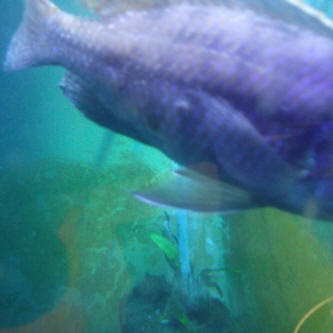
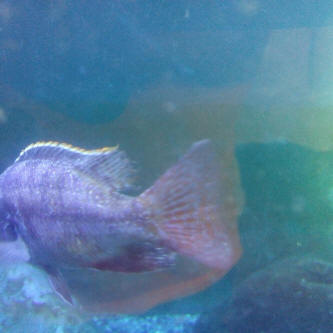
Hello crew, it is 4 am in the morning, trying to save the fish from something I
wasn't really expecting.
<Oh? You've sent the same image files thrice>
See the Protomelas had been coming out more, but started staying near the
surface, so I watched him closely and noticed yesterday it was developing what I
identified as oodinium infestation.
<Mmm; no... something larger; likely Ich>
Now, no other of my fish tanks has this, and I have only encountered it once as
an aquarist. I also noticed its dorsal fin was damaged,
<And this likely by other factors.>
only rays intact. I forgot the basic principle of bacteria growth and turned up
the temp to eliminate the oodinium while performing big water changes. I went to
sleep but got up due to reasons. Decided to check on the fish and its looking
horribly bad. Color faded, lots of white, scaly bits coming off from head and
body, the damage to the fin has increases and it now has yellow and red patches
on its body. The yellow patches definitely look wrong. I read up and realized
the heat helped the bacteria grow faster. Big mistake. I conducted several water
changes in order to bring the temp back down from 30 to 25 c in a lapse of 3
hours, probably too fast but the fish was swimming erratically.
I also added Methylene blue and malachite green in order to try to thwart some
of the infestation and avoid fungus. The fish is now swimming relatively
normally. It is responding to my hand but it definitely looks weak.
I have included pics of the fish.
Right now I have Metronidazole tablets, and have access to Nitrofurantoin (
Nitrofuran?) and probably erythromycin in a few hours when the drug store
opens... What can I do?
<Nothing more than you've done; which, by the way, is about what I would have
done as well: Elevated temperature, tried the Malachite and Meth. Blue...>
This has taken me horribly by surprise. I added a picture from yesterdays
morning of what I thought was oodinium, and the update from right now. I am
here, next to him, watching him closely.
In the last picture you can slightly see the white blotch, it has one on each
side of its body on the same place. Also red dots surrounding, which I assume is
blood.
The tank has river sand and rocks, a sponge and a hang on back filter. I do have
a quarantine 5 gallon tank but I'm not sure I want to put him in there... after all
the fish is in this 40 gallon all by himself...
Thanks crew, I apologize for errors and the size of pics but I'm a bit desperate,
texting from phone.
<I would keep the temperature in the mid 80's F. And NOT use any further
medication/s at this point.
Bob Fenner>
|
 |
|
Re: Lone Protomelas taeniolatus 2/7/17
For clarifying. I thought it was oodinium yesterday, but I also noticed the fin
damage and realize it was also suffering a bacterial infection... so I forgot
about heat and bacteria... I now realize it probably was not oodinium to start
with...
<I agree. BobF>
Re: Lone Protomelas taeniolatus 2/7/17
So far my research has brought me to various antimicrobials like erythromycin,
Clarithronycin, Ciprofloxacin, potassium permanganate, biomicyn which should
pretty much cover any bacteria genus I may encounter, but obviously I cant try
them all... what do you suggest?... lastly there is this AZoo magic treatment
which apparently treats ulcers and bacterial skin damage... I'm not particularly
fond of AZoo, but as this point maybe they have it figured out?... thank you...
<As I've stated Roberto. Just the temp. at this point. B>
|
velvet parasite 1/28/17
I have read several times that the velvet parasite can encyst itself
under unfavorable conditions, how long can they stay in a cyst this way,
can they hide from a medication this way. What else can a velvet
parasite feed on. = I was thinking about trying to use a "bait" to
"catch them", they could attach themselves to the bait to eat it, them I
would remove the bait after a few days along with the attached velvet !
Donald
<Nice idea but won't work. Assuming you're talking about Piscinoodinium,
it only infects fish. So whatever bait you used, it would have to be a
live fish, which obviously defeats the exercise. You'd just be swapping
one sick fish for another. The old school approach was to combine
slightly saline conditions (2-5 gram/litre) with complete darkness for a
week or two. The idea here is that the free-living Tomite stages are
stressed by slightly brackish conditions, reducing significantly the
chance of them surviving long enough to re-infect the fish. Darkness
helps because the Tomite stages
require light to carry out photosynthesis, and without light they
effectively starve. So taken together these will usually reduce Velvet
infections sufficiently that the immune system of the fish can take
over.
The Tomite stage can only survive for a limited period of time (a few
days, though the colder it is, the longer they can survive). Raising the
temperature shortens the life cycle of the Velvet parasite, so aquarists
often do this to get the cysts to burst so that they quickly release
tomites. The Tomite stage is, you see, the ONLY vulnerable part of the
life cycle (which including the cyst stage, takes 6-7 days at 25 C, but
easily double that at room temperature). Once in the fish, it is
effectively sealed off from waterborne chemicals (medications) by the
host's tissues.
Fortunately, a wide range of medications will kill Piscinoodinium during
the Tomite stage. My personal pick is eSHa EXIT, but there are others.
Provided it is caught early on, Velvet can be eliminated without undue
difficulty, but heavy infections are commonly lethal because of the
damage done to the gill tissue. On the other hand, being
salt-intolerant, it is especially easily managed among fish that
tolerate brackish conditions for extended periods, including virtually
all livebearers and many cichlids and Killies. Cheers, Neale.>
|
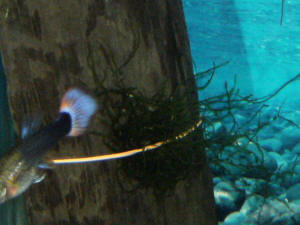
Re: Velvet? Or something else?
11/12/11
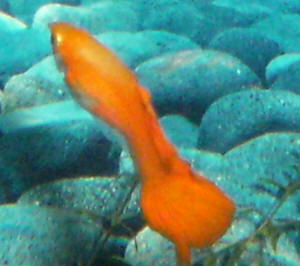
Hello Bob, I was hoping you could help me once again, this time I
was able to send a few pics (sorry they aren't that great but
it was the best I could do) After doing some water changes and
adding a small amount of baking soda, epson <Epsom, not the
electronics firm> salt and aquarium salt (about a tablespoon
in a 33g) the fish have stopped flashing. I did have 1 death (a
female guppy) but she was given too <to> me from a friend
that was in a less then ideal environment for an undetermined
amount of time coupled with me adding copper I wasn't
surprised. The 3 guppies that I got from my Local fish store have
never looked healthy to me, which is why I thought they had
velvet or some other disease.
<Not Velvet, Oodinium... all would be dead if so, I assure
you>
I'm still not convinced that they aren't suffering from
something like a fungus or bacteria.
<Very likely... most all "commercial" guppies (at
stores, not private breeders) have a few such complaints... IF
and when imported, ALL should be prophylactically treated for
worms of all sorts and Protozoans... my choice? Praziquantel and
Metronidazole>
One of my females has a gold dust appearance,
<Again, just coloration... all would be quickly
dead...>
the other has a grey color to her scales and the male has a pale
area all on the top of them and the females fins look like they
may be getting a slight amount of milkiness close to their
bodies. The female with the orange tail has always hung around
the top of the tank since day one and she is the one that the
male hounds endlessly.
Ammonia 0, Nitrites 0, Nitrates under 10, ph 7.6, kH 2.
<Mmm, a bit low... I'd raise... read here: http://www.chelonia.org/articles/waterchemistry.htm>
33gallon with 3 guppies (1m 2f) 3 Dalmatian mollies (all female)
4 Kuhli loaches (juvies about 2.5inches), 3 albino bristle nose
pleco's (juvies about 2 inches) and about 15 guppy fry. The
fish all seem healthy although the mollies occasionally go to the
top and seem like they are gasping for air.
<See WWM re: http://wetwebmedia.com/FWSubWebIndex/mollies.htm
trouble w/ their env.>
I hope it's nothing but I also want to have healthy fish and
they don't look healthy at all. Any thoughts or ideas are
greatly appreciated. Thank you so much for your time.
Sincerely,
Debi
<Read the above... write back after if you're not clear
here. Bob Fenner>
|
|
|
Velvet? Or something
else? 10/4/11
A few months ago I was given a very small 6gallon
<Mmm, actually all six gallon systems are the same volume... Heeeee!
Oh>
tank that only had on fish (green fire tetra) It was in a horrible
state of neglect. Green water, hair algae, hadn't been cleaned in 7
months, only water top ups. I cleaned it up and bought 3 guppies to add
to it. They seemed happy, but after about a months time they started
occasionally flashing on the decor. I searched for spots with a
flashlight and no lights on and saw nothing. Added a small amount of
salt and all was well again. Later I got another 6 gallon tank and got
another guppy and a few albino bn Plecos.
<Next time... larger>
About a month ago, I set up a 33 gal tank
<Oh!>
with a 60 gal rated hob filter. I put a sponge filter in one of my 6g
tanks for a week to help with seeding it and inserted the sponge from
the other into the hob filter. I added 3 Rosey minnows and began my
cycle. After 2 weeks the tank had fully cycled, no ammonia after the
first week and never showed nitrites at all.
I slowly added the 4 guppies and 2 of the bn Plecos (they are juvies)
and I soon noticed that the guppies bellies where shiny yellow. I
assumed it was Velvet disease because it was a gold color.
<Mmm, no>
It is only on their bellies. It looks like they've been dipped in
glitter.
I added 1 tbsp of salt per gallon as well as the recommended does of
copper safe. I gave them all
a salt bath with 2 tbsp per gallon for 1hr. That was 10 days ago and
I'm not seeing much change, they are all eating and swimming about
scavenging for food, but occasionally will sit at the top. I've
done 2 10% water changes. When I syphon the substrate the water looks
like it is full of sparkles.
<Scales that have fallen off from the copper exposure>
No ammonia or Nitrites less the 10 nitrates since I set it up. Ph
around 6.8 KH 1. I have young java fern, Indian fern, crypt, java moss
and a few stems of repens.
<Your plants won't like the copper>
1 chunk and 2 branches of driftwood and a few sea shells.
<Oh, these will have absorbed much/most of the medication>
I did buy some rid ich plus, but I'm not sure what my next step
should be, can I add rid ich over top of copper safe, should I just
wait it out. Do I need to do more water changes etc. I'm at a
loss.
<I'd stop treating period. If this were Velvet, your fishes
would all be dead. See WWM re. Bob Fenner>
Re: Velvet? Or something else? 10/5/11
Sweet, glad to hear it's not velvet. I am wondering what caused the
yellowness of the belly and the flashing to begin with.
<Could be water quality, lighting...>
It was not the nice glow of the scales, it could possibly be something
between the scales or on them. I tried to take a picture, but no matter
how hard I tried, I couldn't get a good enough picture to send.
<Thanks for trying>
A few more things, if the driftwood was absorbing the copper (which
makes sense because it didn't affect my snails or plants in the
least bit) then why would the scales still be falling off?
<Perhaps initial poisoning... perhaps the flecks were/are something
else>
And if it's affecting them this way, should I do a large water
change or stick with the 10% changes and change one of the filter pads
in the Topfin 60. (it has 2 complete filter bags that is filter floss
with a small amount of carbon inside)
<"When/where in doubt, water change"... is one of my
several mantras>
Sorry, I'm a newbie and quite nervous about the whole thing,
<No worries>
I feel like I'm always messing it up. Thank you for not scolding me
for treating without a confirmed diagnoses.
<This is the all-too usual course... and a greater source of
morbidity, mortality than actual diseases I'd wager>
I did talk to others about it and they agreed that it sounded like
velvet, but the more research I did the less it sounded like Velvet,
but couldn't find any other explanation for the weird color. Hence
my email.
<Mmm, well, you can read on WWM re... re diagnosis, treatment. Your
Symptomology is a non-fit>
Thanks again for your time and feedback and for making me smile with
your cheeky comments. lol
\<Welcome! BobF>
BGK velvet disease
9/20/22
Hello, my wife and I are aquarium enthusiasts and have many tanks set
up.
In one of our tanks we have a 5" BGK. This tank has recently
experienced a plague of sorts of what I believe to be velvet disease.
The symptoms are as follows; the fish with scales have developed a
thick mucosal coating which seems to be of a fungal/bacterial nature
and is eating away at their fins.
They struggle to the surface to gasp for air before falling to the
bottom of the aquarium. The BGK and our Pleco, as well as a small algae
eater ( 2") have seemed to escape unscathed until today when I
noticed that the BGK's white areas around the face and back have
turned a pinkish red color, the under belly is still white. I would
like to treat the tank and save the few scaled fish that are left and
at the same time prevent the BGK and Pleco for getting ill either from
the pathogen or from the treatment.
What should I do to treat this ???
-Matt
<Mmm, well; first off, the symptoms you list... could be due to some
sorts of environmental stress... poisoning of various kinds. I would
first be testing for, doing what you can to improve water quality.
Second, IF you have access to a microscope, you might well take a skin
scraping and look at what might be the cause here biologically (if
any)... You might have an infestation of Velvet... or Costia... or
other agent. Please read re:
http://wetwebmedia.com/FWSubWebIndex/fwparasitdiagf.htm
http://wetwebmedia.com/FWSubWebIndex/fwprotozdiagf.htm
http://wetwebmedia.com/FWSubWebIndex/CostiaF.htm
and http://wetwebmedia.com/FWSubWebIndex/fwvelvetfaqs.htm
Bob Fenner>
BGK velvet disease, found as old draft file
11/13/11
Hello, my wife and I are aquarium enthusiasts and have many tanks set
up.
In one of our tanks we have a 5" BGK. This tank has recently
experienced a plague of sorts of what I believe to be velvet disease.
The symptoms are as follows; the fish with scales have developed a
thick mucosal coating which seems to be of a fungal/bacterial nature
and is eating away at their fins.
They struggle to the surface to gasp for air before falling to the
bottom of the aquarium. The BGK and our Pleco, as well as a small algae
eater ( 2") have seemed to escape unscathed until today when I
noticed that the BGK's white areas around the face and back have
turned a pinkish red color, the under belly is still white. I would
like to treat the tank and save the few scaled fish that are left and
at the same time prevent the BGK and Pleco for getting ill either from
the pathogen or from the treatment.
What should I do to treat this ???
-Matt
<Mmm, well; first off, the symptoms you list... could be due to some
sorts of environmental stress... poisoning of various kinds. I would
first be testing for, doing what you can to improve water quality.
Second, IF you have access to a microscope, you might well take a skin
scraping and look at what might be the cause here biologically (if
any)... You might have an infestation of Velvet... or Costia... or
other agent. Please read re: http://wetwebmedia.com/FWSubWebIndex/fwparasitdiagf.htm
http://wetwebmedia.com/FWSubWebIndex/fwprotozdiagf.htm
Was this ever received? BobF
Re: BGK velvet disease 11/13/11
Yes it was, however we ended up losing the entire tank, the Pleco and
BGK both died the same day I got this, it didn't take long for them
to succumb.
Thank you for the advice, I am keeping printouts for reference incase
we have similar problems with other tanks in the future.
<Sorry to hear/realize your losses. BobF>
Hey all.....
1/27/11
Under the Velvet/disease section on WWM.com it states
that one of the ways to speed up the life cycle of Velvet was to
increase the temp to 95 degrees
during the "fallow" period. Wont this kill or at
least harm beneficial bacteria?
<Generally (almost never) not>
I went ahead and followed that particular advice and my tank is on for
lol. Just want to make sure that this is indeed, ok.
<Is indeed>
And btw, my display has no fish or inverts at this time.
Thanks
<Welcome! Bob Fenner>
|
Molly with Velvet?? 5/26/2010
Hi I have a 26 gallon brackish water
<How brackish? Velvet, freshwater velvet at least, is not
especially salt-tolerant, though more so than Ick, and above SG
1.005 it is relatively rare. So one thing to check/do is raise
the salinity to SG 1.005 (9 grammes marine salt mix/litre) and
see what happens. Otherwise you'll have to use the standard
copper-based Velvet medications.>
tank with 1 full grown black male molly and about 20 fry. I also
have a 10g brackish quarantine tank that has a female black
lyretail molly (she is the mother of all the fry in both tanks)
and her 6 new born fry. I decided to separate the female because
I know she still has more babies to give birth to and the male
was chasing her and stressing her out.
<Keep at least 2 females per male.>
I had no choice but to put her in my q-tank, which now leaves me
no place to treat sick fish. Two days ago, I noticed my female
molly in the 10 g tank covered in gold. The fry seem fine and
have only the usual gold
coloring under their belly (they were born that way). I am
assuming it's velvet that has infected my female molly.. What
do you think?
<Velvet should be distinctive. Look for fine, icing sugar
particles, golden tint, heavy breathing because of gill
damage/infection, and periodic "flashing" as fish
scratch themselves against solid objects.>
She is still very active and eating well. I have no idea how this
happened...Anyways, I did a 50% water change, added Aquarisol to
treat for velvet, removed carbon, raised temperature to 84
degrees, and added extra salt.
<How much salt? And for what it's worth, there are strains
of Oodinium that are more tolerant of salt than others, and of
course there is a marine version of the disease that exists from
about SG 1.012 through to 1.025.>
She has shown no signs of progress. I am not experienced on
handling disease when it comes to fry. Is there anything else I
can do that will be safe for the pregnant molly & the fry?
Also, is it possible that this color
change could be a normal part of aging? Any input would be
appreciated!
Please help, I don't want to lose any of my fish. Thanks.
<Cheers, Neale.>
Re: Molly with Velvet??
5/27/10
Hi Neale,
Thanks for the info. Ok, I originally had 1table spoon of instant
ocean marine salt (not sure if this contains Oodinium) per gal
and now bumped it up to 2.
<Tablespoons per what? Cup of water? Pint? Litre? Gallon?
Barrel? It makes a difference! One level TEASPOON is about 6
grammes, so 1.5 level teaspoons should be 9 grammes, and
that's how much you want to add per litre of water. If you
use gallons, there's 3.78 US gallons per litre.>
She does dart quickly; however, I removed all objects to avoid
injury from scraping up against anything.
<Hmm...>
Is Aquari-sol an adequate copper based treatment?
<Contains copper sulphate, so should be, if used
correctly.>
Also, the gold is not like a fine dust particle or crystal but
more like the scale color.
<Sounds like velvet.>
I've attached several photos since they may be able to give
you a better description of what I'm working with here.
<Too small to tell. Cell phones really aren't suited to
photographing microscopic organisms!>
Prior to 3 days ago, the female was solid black. Although, when I
first got her, I put her in a freshwater tank (ignorant to
brackish systems and so forth and she began having the symptom of
white spots) I moved her into the
10g and made that completely brackish and her symptoms subsided.
She has been in a brackish system now for about 2.5 months and
has been thriving.
This came up out of no where!
<My guess is that this system isn't as brackish as you
think, and that's allowed the Velvet to become established.
Ensure the salinity is 9 grammes per litre and see what happens.
Cheers, Neale.>
Re: Molly with Velvet?? 5/27/10
Alrighty, I put 1 tablespoon per gallon,
<One LEVEL tablespoon is three LEVEL teaspoons, i.e., about 3
x 6 = 18 grammes. One gallon is 3.78 litres, so that's a dose
of 4.8 grammes per litre, about half as much as you need to treat
Velvet reliably.>
I thought I previously mentioned that, sorry.
<No problem.>
Now, I have it at 2 table spoons per gallon.
<Closer to the mark. Honestly, this is easier in metric. So
can we do this in grammes per litre? There's a reason
scientists use the metric system!
It's easy! When you say spoonfuls, I have no idea if
you're using actual measuring spoons or mere cutlery, or
whether you're using them heaped or level. These things make
a difference!>
I would think this is sufficient for brackish systems??? Maybe
not.
<For a brackish water system you'd be using marine salt
mix at a dose of between 6-9 grammes per litre, i.e., SG 1.003 to
1.005.>
I took the pics with a camera and uploaded them, I made them
small so that I could send all of them. I will try again now, so
that you can see
<You seem to have send 24 images. I don't have that kind
of time, and least not if I want to help other people here at WWM
as well, so I looked at the first two. Didn't really show me
clearly anything. It isn't obvious that this velvet from
those images, so do take some time to look at photos of Velvet
online, and compare against, for example, Slime Disease,
Whitespot, ammonia burns, and genetic changes in the colouration
of fish. Cheers, Neale.>
Molly with Velvet??? 5/27/10
Hi Neale,
<Hello again,>
Total of 37.85 litres (10g)
Total of 28.4 grams of salt (in the 10g tank)
37.85/28.4 =
approximately 1.33 grams of salt per litre.
<Not nearly enough to deal with Velvet, if that's the
problem here.>
These pics should show you more...sorry to waste your time and
I'm not trying to take time away from others.
<Not a problem. But one or two good images around 500 KB in
size is what we do specifically ask for. This time you sent 20 MB
of images! Apart from taking forever to download -- I gave up --
that blocks up our limited
e-mail mailbox space. Please, we have these very minor rules in
place for a reason, and not to be awkward.>
I'm just wanting to get a professional opinion. I'm
sending this to you from another email to see if this will do the
trick with viewing the pictures!
<See above. It's gone 10 PM here in England, and I'm
about ready for bed. Downloading just one of your 4 MB images was
taking forever, so I gave up. I'm not about to wait 10
minutes waiting for them to download... Forgive me.>
Thanks for the info.
<Glad to help. Cheers, Neale.>
|
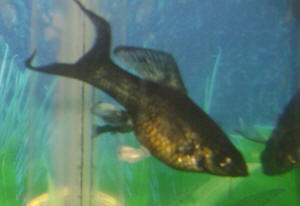 |
Treating Velvet and Mouth Fungus with Lace
Synodontis in the tank -- 09/08/09
Hi there,
<Hello,>
My son pushed too fast to set up his tank and now has problems with
velvet and mouth fungus, and possibly some ich. There are three Danios
that definitely show signs of both the velvet and mouth fungus.
<I see.>
The problem is complicated by the fact that he also has a very sweet
and lovely large lace Synodontis catfish who we have totally fallen in
love with and she seems very sensitive to medication.
<Yes, this species (genus, family) can be. Removing to a quarantine
tank would be one solution.>
The tank is 50 gallons and these are all the inhabitants: 5 small green
tiger barbs, 3 large Danios, the lace Synodontis, a small bristle nose
catfish, a small clown loach, an ngara, a blue dwarf Gourami, and an
algae
eating shark. It is a planted tank, but the plants can be replaced if
they don't survive treatment.
<Bit of a mixed collection! Not entirely convinced this selection of
fish will work in the long term. Ngara, for example, are Aulonocara
cichlids, and semi-aggressive, as well as fussy about water chemistry.
Clown Loaches don't stay small for long; adults are some 11
inches/27 cm long. And so on.>
Do you have any suggestions for how we can eliminate the mouth fungus
and the velvet? We tried Rid Ich+, but the Synodontis seemed very
bothered by it.
<Various catfish are indeed sensitive to copper and formalin, so
that limits the range of options. Ordinarily, you'd treat Ick and
Velvet using a salt/heat method (raise temperature to around 82-86 F,
add 2-3 level
teaspoons of tonic salt per US gallon of water. Run thus for about two
weeks. Keeping the tank dark (cover with a blanket) also helps, since
the free-living stage needs light.>
We have also used Melafix, which keeps the mouth fungus down, but does
not seem strong enough to totally cure it (and doesn't seem to do
much, if anything, for the velvet).
<Mouth Fungus is bacterial, and Melafix is a weak bactericide, at
best. Use a proper antibiotic such as Maracyn if you can, or else an
antibacterial based on an organic dye if antibiotics aren't easily
available in your region. I happen to like eSHa 2000, but there are
numerous other brands, such as Seachem Paraguard that work well too.
Read the instructions, and don't forget to remove carbon (if used)
when necessary. Don't mix medications, although you can use *one*
medication alongside salt without problems.>
Thanks very much for any help you can provide.
<While Velvet comes in with new fish, Mouth Fungus is triggered by
environmental issues, and this is something you must review. You can
keep treating the fish as much as you want, but if the underlying
causes
(typically poor filtration, overfeeding, and/or overstocking) are
present, the problem will keep coming back. Cheers,
Neale.>
Re: Treating Velvet and Mouth Fungus with
Lace Synodontis in the tank 9/9/09
Neale,
<Constance,>
Thank you so very much for your advice and for responding so
quickly.
<My pleasure.>
We'll get on it today. This is a fairly new project and my kid was
not properly changing the water and filter at first, which is a big
part of the problem we are dealing with now. We are on top of the water
quality now.
<Good stuff.>
We'll start cycling a sick tank, but in the meantime we'll try
the aquarium salt treatment and antibiotic. (And maybe we'll move
Ngara into the second tank after it is cycled and when it isn't
being used as a hospital because you are right that s/he is
aggressive.)
<Indeed; a nice species, a very nice species in fact, but does need
a Malawi community setting really, perhaps mixed with the superb
Labidochromis caeruleus "Yellow Lab" for a nice
contrast.>
I just want to double check that adding this much aquarium salt will
likely be tolerated by the lace Synodontis and bristle nose catfish. I
have read that some catfish cannot deal with salt.
<It's a misunderstanding about the salt. For a start, at least
two families of catfish live in the sea! Several other families have
species that enter brackish water. In any case, the amount of salt you
are adding is trivially low. Let's say you add 3 level tsp of salt.
It's a little under 0.25 oz per tsp, so that's about 0.75 tsp
per US gallon. Normal seawater contains about 4.75 ounces of salt per
US gallon, so what you're adding to your aquarium is actually about
one-twentieth the salinity of normal seawater. There's probably
more salt in a can of soda pop than that! It's really a very, very
harmless dosage. While you wouldn't want to use this addition of
salt on a permanent basis, for a couple of weeks it's a safer way
to treat against Ick and Velvet that copper- and formalin-based
medications.>
With gratitude,
Constance
<Good luck, Neale.>
Re: Treating Velvet and Mouth Fungus with
Lace Synodontis in the tank 9/9/09
great! any place I can order the eSHa 2000 in the US? Or should I just
settle for Seachem ParaGuard?
<So far as I know, eSHa products are exclusively sold in Europe.
Seachem Paraguard is at least as good, and while it doesn't contain
copper or formalin, it does contain malachite green, so if you do
decide to use it,
watch your catfish carefully. Malachite green isn't copper (despite
the name) but an organic dye, and while these should be harmless, you
never know.
http://www.seachem.com/Products/product_pages/ParaGuard.html
eSHa 2000 contains a different organic dye, and while my Synodontis
(and pufferfish) never complained, as always, your own mileage may
vary. You might decide to opt for Maracyn or a similar antibiotic
because of this.
Cheers, Neale.>
Betta with Velvet - almost out of ideas,
very worried 9/2/09
Hi guys,
<Hello,>
I have been treating a Betta for Velvet for several months. I started
with CopperSafe, carefully measured in a medical syringe. That seemed
to be working at first, but after weeks of gradual improvement he would
suddenly have a relapse, and it would start over again -- improvement
followed by relapse. Eventually, by reading your site and a few others,
I got wise to raising the temperature, treating him in a hospital tank,
and turning off/blocking out any lights. But the pattern continued.
<Do you use carbon in the filter? Remember to remove this when
treating fish.>
In desperation, I switched to Rid-Ich. This seemed to be working --
steady, slow improvement with no major relapses. But it's been over
a month now, and the improvement is very, very slow. So slow that
I'm no longer sure if he's getting better or staying the same.
He's been almost recovered for a over week now, but it's still
on his head and faintly visible on his body.
<I see.>
He's in a five-gallon tank, kept at 84-85 degrees. The carbon
filter has been removed, along with everything else. I'm feeding
him daily, pre-soaking his food and giving him a variety. The towel is
only off his tank for about 15 minutes per day, and the rest of the
time he just has a small opening in the front to see if it's day or
night (thought that might be important). If there's anything else
relevant about his environment I forgot to mention please let me
know.
<Velvet (Piscinoodinium pillulare) is a disease that usually gets
into aquaria. It doesn't, so far as is known, lurk in tanks for
years at a time, waiting to jump onto unsuspecting fish. In fact the
free-living stage must
find a host within ~48 hours or it dies. So, the first thing to figure
out is [a] if this really is Velvet, and [b] how it got into your
aquarium.>
In addition to the medication and darkness, I've also been adding
1/2 teaspoon of salt per gallon.
<Do need rather more salt than this... at least 10 grammes per 45
litres (about one teaspoon per 5 US gallons). Possibly more, up to 2-3
teaspoons per US gallon may be necessary.>
I cannot find an answer as to how much is best, that seemed like a good
guess, can't seem to find a saline test in any LFS. As I understood
the Rid-Ich instructions, the idea is to keep the concentration the
same (.5mL per gallon) while changing 1/4 of the water daily. I have
been doing this, but when his improvement slowed to a near-stop I went
to 1/2 daily water changes, again maintaining the concentrations of
salt and Rid-Ich. I even suction the water from the bottom of the tank,
imagining that I am vacuuming reproductive cysts in the process. I
don't know if this is helping.
<Marginally, to be honest.>
I don't know if anything is helping. I don't know why he
wasn't better a long, long time ago.
<Are you sure this is Velvet?>
He's still active, eating and trying to get attention, but I'm
starting to wonder if the poor guy is going to have to live what's
left of his life in the dark, in poisonous blue water. His fins have
started getting a little
ragged, too. I don't know what to make of this, but from what
I've read it doesn't seem like any fungal or bacterial fin rot
could survive in there, so I'm wondering if the Rid-Ich is causing
it somehow. I'm very concerned in any case, I know this stuff is
poisonous and I want out of his tank ASAP, but I'm afraid without
it the bugs would overrun him in a few days. I'm afraid to
experiment, terrified of another relapse. Please help, what else can I
do? And why is this taking so long?
Thanks,
Milo
<I'm concerned that you're actually looking at something
else, e.g., a "slime disease" type thing, where there's a
bacterial infection of the skin, resulting in excess production of
off-white slime on the body. This
can (usually) be fixed with antibiotics or suitable
anti-bacterials.
Cheers, Neale.>
Re: Betta with Velvet - almost out of
ideas, very worried 9/2/09
Thanks for the quick response, Neale.
<You're welcome.>
I have wondered too how Velvet got introduced. Some time ago I gave
away the fish that lived in another aquarium, and the folks who took
them used their own net. Even though it was a different tank, there may
have been some accidental contamination. That was shortly before my
Betta got sick.
<Sounds possible.>
As to whether or not it is really Velvet, I've never been 100%
sure. It doesn't look like "dust," as it is so often
described. I don't see individual particles, but it's a coating
that is thicker when viewed at an angle and thinner viewed in profile.
It is a brown, rusty color, not "off-white."
<Velvet is usually a distinctive metallic sheen, hence the name, and
tends to attack the gills first, so you usually see heavy (or rapid)
breathing alongside the other symptoms. It's actually pretty rare,
in the UK at
least, when compared to Whitespot/Ick -- in 25 years of keeping fish,
I've never seen it!>
To keep things short, I didn't mention that at first I only noticed
swollen gills and eyes and treated him with a course of Maracyn,
followed by Maracyn II. Neither had any effect. I began treating with
CopperSafe when I noticed the rust coloring, and he improved
immediately although, as I explained, he has never made a full
recovery. Also, if it was a bacterial infection, wouldn't the
Rid-Ich kill it regardless?
<No, anti-Ick medications treat against specific Protozoans, not
bacteria.>
How do I determine if this is or is not Velvet? I need to be sure
before I change course.
<I agree, diagnosis is important. Any chance of a photo? A
reasonably sharp one, please! In the meantime, both Ick and Velvet
should be cured by appropriate use of heat and salt, so increase the
salinity as mentioned earlier, and see what happens. At the least, this
won't harm your fish. If that doesn't work, and the fish
continues to develop ragged fins, then treat for Finrot. I'd try
something a little more general purpose than Maracyn, perhaps Something
like Seachem ParaGuard for example.>
Thanks again,
Milo
<Cheers, Neale.>
Velvet help (orig thread 6/06)
5/16/09
Hello Folks, I am back again (original post, same issue, "Need
help with velvet, please!! 6/06) in search of any understanding you may
be able to shed on my continuing situation with my 7 clown loaches. I
have believed this to be velvet. Tiny dots over top of fish's
heads, no spots on body,
<Mmm, not Velvet/Oodinium... your fish/es would be dead...>
absolutely impossible to get rid of. There is one fish in particular
that never seems to be spot-free. These clown loaches have been
quarantined at least 3 times for months at a time and medicated in
every possible way imaginable over this time, including long term salt,
salt dips, acriflavine/salt/dark, methylene blue dips, raised temps
(low 90's), velvet guard, rounds of Maracide, Coppersafe,
Cupramine..
<Yikes... I'd stay away from copper containing treatments with
Cobitids... too toxic>
there might be more, I can't quite remember at this point. Had I
known this would go on for so long, I most certainly would've kept
a notebook!
<Ahh, a good idea>
Each time, fish are quarantined, treated, observed closely, moved back
to main tank (after minimum of 3 months at a time in QT-main tank left
to go fallow during these times). Under the lighting in my QT tank
(29g) they can appear to be spot-free, I move them back into main tank,
then again see dots.
There is one main fish that always seems to have spots, while others
will appear "clear" in main tank after treatments.
Most recently (January 2009), I noticed that not only the main fish had
the dots again, but that they seemed to be spreading to the other
loaches heads again, they were hiding more, etc. After attempting to
treat this seemingly same "disease" since 2006, I was feeling
skeptical about my chances of curing it once and for all. Pulled all
fish out of main tank (2/09), back into fully cycled 29g. QT. It was
then I proceeded to treat with Cupramine full strength as I'd read
others having good luck with it. Didn't seem to work so after
carbon in filter and waiting a couple of weeks, I did 2 back-to-back
full- strength treatments of Maracide. Again, all fish appeared
dot-free except one large loach (always the same fish). Afraid of
dosing them again so soon, I waited a bit and ordered some ESHa Exit,
hearing good things from loach owners with ick and velvet. I went ahead
and did the extended treatment described in the directions. I even went
5 full days just to try to push it a little as this obviously isn't
going away easily and because I would have no idea what additional
medications to try after that didn't work. During the months the
loaches were in QT, I converted their 120 gallon main tank into a river
tank (with under-sand pvc river tank manifold). The tank is
consistently PH 7, nitrates 20-30ish, nitrites 0, ammonia 0, filtered
by 2 Eheim 2217 canister filters and now 2 Maxi jet 1200 powerheads for
current. Fish again "appeared" spot free for weeks after last
QT ESHa Exit treatment, and were returned to newly designed 120g. river
tank approx. 2 weeks ago. They do seem to love the current in the new
tank and have fun playing in it all day long. I got a close look at the
main problem fish this morning though, and it's head is getting
covered again in dots, however the dots appear somewhat larger to me
now. I have no idea what to even think about trying at this point and
am hoping you can offer some sort of wisdom here? It would seem that
having the tank salted for such a long time has held off the parasite
somewhat, though it appears to never be completely eradicated. Where
none of the medications have worked over such a long period of time, I
suspected some sort of water problem, but honestly I have no idea what
to think or do at this point.
<Nor any real idea of what you're treating... A shame you
didn't defer to using a microscope to examine what this might
actually be here... But if you elect to continue your blind treatment,
look into Levamisole here... as I suspect "flukes" of some
sort... rather than a Protozoan complaint... Or best, a QX series
scope... Instructions on use are archived on WWM. BobF>
Many, many thanks again for any advice you can offer!
Sondra
Freshwater velvet : the clean-up
5/10/09
Hi all -
I just need a bit of advice - I don't know anyone who keeps fish
that I can talk this over with. I've read the FAQs, and have used
your best advice so far (thank you for a wealth of help over the
years!), and am now left with a quandary.
<Oh?>
I have a 250l fw tank that is at the end of a 7 day treatment for
velvet.
I've lost 26 lovely fishies... I'd like to move the five I have
left into a smaller tank (the one I used to use as a
quarantine/hospital tank) but am unsure how best to do this. Shall I
fill it with new water - is that any worse than parasite riddled water
from the big tank?
<If you've treated with a standard formalin/copper Velvet/Ick
medication, any free-living parasites will be dead by now. So there
shouldn't be any difference.>
The filter for the small tank usually lives in the big one to keep it
cycled. Is it now "poisoned" with velvet and meds?
<Not as such, no.>
If I bleach/scald the casing so that the spongy bit inside maintains
it's bacteria, will I transfer velvet into the new set-up?
<The Velvet parasites are dead. Nothing to transfer!>
I can easily clean a couple of handfuls of gravel and a heater, but
what about the plants and the heavily planted bogwood? Are they
"poisoned" too, or will a saltwater soak solve this? Or will
that kill the plants? Have I got time to set the small tank up "as
new" - will the remaining fish suffer any more for staying in the
big tank? Or is it better to just get them out of there asap?
<Your fish should be parasite-free and the water
parasite-clear.>
My head is full of questions, and I really don't want the fish to
suffer any more than they already have.
Many thanks again -
Melinda
<Good luck, Neale.>
Re: freshwater velvet : the clean-up
You're amazing. Thank you so much.
<Happy to help! Cheers, Neale.>
Velvet Not Shifting, FW
8/13/08 Hi Crew, I have a case of velvet in my 125 gallon tank. I
quarantined some new mollies but obviously a week was not long enough!
I added some treatment called Protozin (not sure if they sell this in
Canada but it's a well known and popular protozoacide fungicide in
the UK). <Yes, I know the product but have to confess to not having
had 100% success using it. I find eSHa Exit better for Ick/Velvet.>
My water temperature was 25 degrees but I have raised the temperature
to 28 degrees and turned off the light. I have lost 3 of my 12 dwarf
neon rainbowfish and the remaining rainbows are still showing gold
areas between their scales. The treatment instructions advised to add
on days 1, 2, 3, and 6 but as there are still signs of the disease I
have added some more on day 8. <You have removed carbon from the
filter? A common mistake...> I am concerned how long this disease is
taking to go. Is it possible that I have misdiagnosed this disease and
it is not velvet?? <Most Velvet medications treat Ick, so that sort
of misdiagnosis isn't a problem. Do be aware than Mollies are very
prone to sickness when kept in freshwater. I don't consider them
freshwater fish at all, at least not freshwater *aquarium* fish. Do see
here: http://www.wetwebmedia.com/FWSubWebIndex/mollies.htm > My
pearl gouramis both have shiny goldness around the gills and lower half
of their bodies. The Betta, Swordtail and Pentazona Barbs seem
unaffected. The mollies show a small amount of goldness but this
doesn't seem to be getting better or worse since treatment. Any
advice you may have would be greatly appreciated. <My
recommendation: switch medications.> Many thanks Brian <Cheers,
Neale.>
Understanding freshwater velvet
12/31/07 Hello! <Eryn> I've done a thorough search of
your site, so I'm fairly certain I'm not duplicating any
answers you've already given. I'm looking for hard facts about
all the different things that can kill Oodinium on equipment. I know
bleach is best, but I'm still curious about Oodinium's other
tolerances. - Is a quick in-out submersion at 1 part bleach to 20 parts
water enough, or does a piece of equipment have to soak for any length
of time? <Sometimes has to soak for five-ten minutes...> - Is
there any temperature that is certain to kill velvet at all its stages?
How long does the temperature need to stay that high? <Realistic
temperature elevation will only speed up the life cycle, shorten
resting stages... in order to kill the water has to be dangerously
hot> - Do you think a typical dishwasher would reliably disinfect a
piece of equipment? <Yes> - How long can the cysts survive being
dried out (you mentioned in one FAQ that it's longer than 3 days,
but you didn't say how long is reliably long enough)? <Can be
dried in a few ways... last for at least months> - Is there a
fish-safe net dip (other than bleach then dechlorinator) that will
reliably disinfect nets? What concentration should it be used at?
<... see WWM re... some folks use formalin, KMnO3... other
materials... with moderate success. One needs to be careful re
poisoning, staining... rinsing off residual. There is much known
(rather than hobbyist re-hashed) re this causative
organism/dinoflagellate... in the sciences, in print books, journals...
IF you really want to know, I'd make a pilgrimage to a
large/college library> Thank you tremendously for your answers. Eryn
<Welcome. Bob Fenner>
Velvet, FW 5/18/07
Hello, <<Hello, Wendy. Tom here.>> We have just noticed
some shiny gold spots on our 2 black skirt tetras and would like to
know if we treat them with the copper treatment will it harm our three
peppered Cory that are also in the tank? <<If the 'gold
spots' appear like gold 'dust' there's a good chance
this is, in fact, Velvet. I'd prescribe a bit of caution here only
because my Black Skirt Tetras also display some 'shiny gold
spots' depending on the lighting and angle of view. Are the fish
'flashing', i.e. scratching their bodies on decorations or the
substrate? Are their fins clamped close to their bodies? Are they
showing increased signs of having difficulty breathing? These can be
additional signs of an infestation. You must be the best judge, of
course, but with other fish in the picture a little caution is prudent
here. Provided that you choose to go ahead with a treatment and the
Tetras can't be isolated from the main tank, I'd encourage you
to look at treating with Acriflavine rather than the copper. There are
minimal, if any, side effects involved with its use and it has proved
quite effective in treating this infestation. Without
'promoting' the manufacturer, Kordon's makes an Acriflavine
treatment that can also be removed with its NovAqua water treatment
rather than relying on activated carbon in your filter. Just throwing
it out for what it's worth.>> Thanks Wendy <<Good luck
to you, Wendy. Tom>>
Velvet and a pregnant molly, copper FW
trtmt. 2/28/07 I love your website and refer to it often when
I have questions or more often just looking for entertainment. It has
been a great resource over the years. Thanks for all the time put into
making such a great information source. <Welcome!> I recently
added a new silver lyretail molly to my community aquarium, but two
days later it started to show signs of velvet and died pretty quickly.
I didn't quarantine this fish (stupid, I know), and it spread to
several other fish, including all of the mollies and swordtails. I
removed my live plants and added CopperSafe by Mardel, and am keeping
the tank well oxygenated with a air pump since the plants are no longer
there to do this. I am also doing partial water changes (about 15%)
every other day to keep nitrate levels down as the plants (again) are
no longer there to take care of this. I also have one tablespoon of
aquarium salt for every 5 gallons of water and have raised the
temperature of the tank to 84 degrees. <All good moves...> One of
my black mollies is pregnant, and I expect her to give birth within a
day or two, but I know mollies often do not release their babies under
stressful conditions. As she is so far into her pregnancy I have been
reluctant to move her to another tank, but I am worried the stress in
this tank could be enough to keep her from releasing the fry anyway. I
am not terribly concerned about the fry surviving at this point, I just
want to give the mother the best possible chance. Do you have any
suggestions? It is a fully cycled tank that has been set up for about
14 years, with ammonia and nitrites both at 0 and nitrates at between 5
and 10 ppm. The other fish in the tank currently are two dwarf gouramis
and a small pleco. Beth <... Really... to continue doing what
you're doing... maybe with (you're likely doing this but
didn't mention it) testing for ammonia... A test kit for FW copper
use would also be a good idea... as with all such treatments, should
the effective/concentration drop too low... and this happens very
easily in established systems... mulm/other absorption... there is no
treatment. Bob Fenner>
Re: Need help with velvet, please!! FW
9/27/06 Hello again, <Sondra> I am writing again, in hopes of
further help with persistent velvet. Here I am over 3 months later,
still battling velvet in my hospital tank. <!> I've lost a
couple of yo yos loaches since my last post. All clown loaches still
accounted for, but fins looking rough. Still eating well. Per your
suggestion, tried Maracide for weeks to no avail. Temp has been settled
at 78 degrees F for months now since I became concerned about further
stress due to fluctuation. PH 7.8, nitrites 0, nitrates 10. After
trying Velvet Guard for weeks, I was completely out of ideas so I
decided to try Coppersafe. Had problems with erroneous readings from
the Seachem copper test kit I was using. Contacted them, they sent
another kit. The 2nd test kit and sample they provided also proved
inaccurate. I switched to an Aquarium Pharmaceuticals copper test kit,
even though my LFS says they pulled them all from their shelves due to
problems with inaccurate readings. I simply could not locate another
freshwater copper test kit that would work for chelated copper.
Currently maintaining a reading of 2.0-ish (hard to tell for sure with
this kit). Honestly, all I seem to be killing with copper is fish (as
expected). Loach with the most noticeable velvet spots has slowly been
becoming more and more covered again. No idea what to do at this point.
I have honestly tried seemingly everything available, some medications
multiple times and for weeks at a time. One "new" thing
available at LFS now available over the counter, Parasite Clear from
Jungle Labs (Praziquantel; Diflubenzuron; Metronidazole; acriflavine).
<Not useful against Oodinium> Experienced guy at store had no
idea what to tell me. Says they use regular copper (not chelated) for
these kinds of things, but suggested perhaps I try this Parasite Clear
as it was something the parasite may not have yet been exposed to.
Neither one of us seemed too confident it would actually work.
Haven't tried it yet. Didn't want to add anything with copper
in the tank. This is the only tank I am running at the moment. The
original tank has been completely broken down. Would you have any ideas
for me at this point? I'm running out of hope for these fish.
Thanks so much again, Sondra <Mmm, for the fishes (cobitids) listed
I would try prolonged or higher concentration salt immersion... 1 tsp
per five gallons of water indefinitely, or 1-3 minutes in
"full-strength" seawater (35 ppt). Dipped fishes (whose
trophonts have been removed) need to be moved to dinospore-free
settings to avoid re-infection. This should do it... is about the
safest, most sure treatment. I would avoid copper use in soft acidic
freshwater... too likely to prove toxic, hard to control dosage.
Placing dark paper around the tank, leaving the lights off also is of
use, as the causative organism is photosynthetic/autotrophic. Bob
Fenner>
Is there any real way to rid a 10 gallon system of Ich
or Velvet? 9/5/06 <Yes> The more
I read the more confused I become. Everything
seams geared towards a very large system. I am
not sure how this started, but I noticed tiny white spots on
my two clown loaches 24 hours after treating the tank (sans
Kuhlis-they got moved into a temporary 3 gallon quarantine)
with Maracyn for a danio with "cotton mouth".
<Mmm, I would have treated all in place... the system itself is
infested> Is there any correlation between the 2
diseases? <Quite possibly yes> Did the E-mycin treatment cause
the Ich to get out of hand and start munching my
fish? <Mmm, much less likely> So far I see no other
inhabitants with any spots, but I am not sure how to treat,
or what to treat with. <Elevated temperature and... Posted... Please
read: http://www.wetwebmedia.com/FWSubWebIndex/fwich.htm and
the linked files above> I am waiting on a 55 gallon to
cycle, and was hoping to move everyone in there, but not
with an outbreak of Ich. My water parameters have
all been stable and ideal, so I am not sure how this all got
started unless I got an infected fish to begin with,
<Initially, yes> and the 10 gallon being the only system cycled,
there was no where to quarantine. <No need to
quarantine... need to treat...> I also am feeling stupid right now
for placing part of my biofilter from the outside power
filter into the new system to help it cycle, and am fearful
I just infected it with Ich. The biofilter chunk was
the only thing transferred to the new system. I
am hoping this will be OK because the cysts are in the
gravel, and the tomites don't live for more than a few
days at 78 degrees. Should I raise the uninhabited 55 gallon
to 86 degrees? <Yes, I would> Mostly I want to know
how and if I can rid my small system of Ich without killing
the fish, and if I have possibly infected the new
system. I really don't want to start over after
taking this hobby up again after 20 years! Sarah W. <Mmm,
do read... silver salt, other medications (read re dosing with
loaches... likely half concentration) and elevated temperature, careful
monitoring of water quality/changes... should do it. Bob Fenner>
Is it velvet? stress? or something else? 7/14/06 Hello,
<Hi there> I will
make this brief as I know you are all busy. I apologize if this is
covered somewhere but I have read all morning and I'm still not
sure what to do! <Oooh, I can't wait, literally, for the vocal
interface twixt these devices... To heck with keyboards... and much
more intuitive "search tools"... can you?>
Set up
is 29g freshwater
whisper
30 power filter
temp
usually 78 to 80F (82F now)
salted
minimally (about 2 tablespoons) <? For what reason, purpose?>
running
with fish for 8 weeks
ammonia 0
nitrite 0
nitrate
barely 20
GH 150
KH 120
pH 7.8
1
female rainbow platy, 2 (1M 1F) pot bellied mollies, 2 Cory cats, 3
white skirt tetras <These last don't "like" salts>
3
weeks ago we lost a female platy to dropsy. <Symptom... what
cause?> That was when I added the salt and started presoaking the
food. <Ahh, I see> I have never added anything except that salt
and Cycle <Not a big fan of this Hagen product... almost never
functional> to my tank. The tank has been cleaned and had 40%
<Mmm, too much/%... Please read here: http://www.wetwebmedia.com/FWSubWebIndex/fwh2ochgs.htm
"and the linked files above".> water changes weekly since
the cycle completed...last time was yesterday.
Finally
to my problem. My platy is glancing on the substrate and plants and
this morning I noticed her rubbing against the mollies as well. I
can't see anything on her but she does have a slight gold cast. I
noticed that weeks ago and thought it was just her coloring. She is
mostly white with black fins and tail and a small amount of red orange
on her tail. The white part of her body shows blue green iridescence in
the light and has a yellow cast otherwise. My point being that I
can't tell if she has this "dusting of gold" that
indicates velvet. She defiantly <And definitely?> has no white
spots and she is eating and acting normally other than the glancing and
I've noticed that she has spent a little more time than usual very
near the top of the tank just hanging out, not gasping or anything. The
tetras are fairly new and frisky and I thought she may have just been a
little stressed by them... though it seems they were trying to school
with her more than harm her. They really only nip each other. Also she
dropped some fry about 2 weeks ago. I found 9 so far, 8 are
in a small plastic breeder that floats in the tank and the other I
found yesterday when cleaning and couldn't catch the little bugger!
There could be more I seem to find some every time I vac. I'm not
sure how many she had we were away when she had them. Interestingly,
the 2 I found yesterday that have been in the tank are almost twice the
size of the ones in the breeder tank...which brings me to the second
part of my problem. I set up a tank yesterday for the fry. A 6g Eclipse
carbon pad, bio wheel, etc. I figured I'd put the fry in it when it
was finished cycling and later use it for a QT / hospital tank. I added
Cycle, <Sub BioSpira for this... trust me> a silk plant, a small
cave, and a few handfuls of substrate from my main tank to get it
started. <Oooh, good move> When I noticed the platy glancing last
night I raised the temp in the small tank to 84F and figured I'd
watch her for more symptoms thinking, I could always put her in the new
tank if things got bad for her. It is not ideal I know, but at least I
could protect the other fish and the fry. I'm sorry I'm not
keeping to my promise of being brief. I will conclude. <Let's
wrap this sucker up!>
This
morning, when I noticed her rubbing against the mollies I got nervous
and salted the small tank excessively ( 2 tablespoons) and put her in
it. I am monitoring her closely as well as the water chemistry( right
now it is the same as the large tank). She seems very relaxed now,
swimming regularly and checking everything out. Also she has not
glanced once since she was put into this tank!!! So, what is the
problem? <Mmm... very likely "environmental stress"... too
much change... too often...> With no other symptoms I don't want
to medicate and wouldn't anyway until I know for sure what the deal
is. Could it be velvet? <Could, but highly unlikely... This
protozoan really "whacks 'em" if present... all would be
dead within a few hours to days> Is the goldish yellow cast normal
for her coloring or is that velvet? <Much more likely the former>
Could she just be recovering from the stress of birthing or the tetras?
<Yep> Does glancing always mean a problem? <Nope. Some is
"natural"... to be expected... akin to our scratching...>
She has been in the small tank for about 6 hours and has eaten and is
acting normally now... no clamped fins, no rapid breathing. I first
noticed the glancing right after the water change could that be what
caused it? <Oh yes!> My inclination is to keep her in the small
tank and watch her to see if anything develops but I am very concerned
that it is not cycled. <Mmm, the moved gravel should "do
it"... along with careful, low feeding> I don't want the
stress of bad water chemistry to make her sicker, but I also don't
want to risk losing all of my fish. She is a beautiful fish and one of
my first, losing her would be awful but to lose her and all her fry
much worse.
The
only other thing is that I noticed some small white buggy things
swimming near the bottom of the small tank. <Don't worry re
these either> They are the size of a pin head. I noticed them
because this tank is mostly bare and I was looking so hard at my platy
they caught my eye. They could be in the large tank too but would be
much harder to see on the substrate. I read somewhere that they are
copepods (sorry not sure of that spelling) and actually good for the
tank as they eat brown algae and fish like to eat them. They sure make
good fry food anyway. So, maybe they are not what I think they are and
worthy of note. <Are worthwhile to mention, and no problem> My
longwinded brief problem may be nothing more than me being paranoid,
but I just would rather be safe than sorry. Thank you in advance for
any help/ info you can give, Heidi <Bob Fenner>
Need help with velvet, please!! Need for
WWM article, FAQs f' for, place in FW medications FAQs
f' 6/12/06 Hello, <Hi there> I apologize in
advance for the size of this message. I have been battling a persistent
case of freshwater velvet in my 55 gallon, PH 7.1, ammonia-0,
nitrites-0, nitrates-10, temp 83 degrees F for past week or so, and am
desperate for help! Posting on the loach forum hasn't helped as it
seems not many people have had this experience. At this point,
remembering the exact duration of the medications I've used could
be a bit sketchy. Residents of the tank include 5 clown loaches, 3 yo
yo loaches, 3 harlequin rasboras, one stray cardinal tetra and one
black phantom tetra (both leftover from an older setup). I was planning
a larger tank with additional tetras, more room for my loaches, etc
when this struck. The tank has been running for approximately 3 years
seemingly disease free. Tank originally had a Home Depot play sand
substrate. Just prior to the velvet outbreak, I had converted this to a
planted tank with eco-complete/Tahitian moon sand substrate
(wouldn't do Tahitian moon sand again, tough on impellers). Most of
the plants by this time have been destroyed/eaten by the loaches.
Surviving plants have since been moved to a small 5 gallon tank with no
fish, except for one hunk of java moss, attached to some bogwood.
<Okay> First off, in hindsight I have to say that one of the yo
yos (in the tank for approximately a year or so) had been flashing on
and off since its addition to the tank. I'd see it for a bit, then
it would seem to stop. I originally thought the velvet came with the
live plants <Unusual, but possibly carried...> I added approx. 2
or so months ago, <Mmm, not likely if for this long> but now I
wonder if the yo yos have had it the whole time. <Also not
typical... there are "velvet free systems" (as opposed to
"residual" Ichthyophthirius> At first I wasn't sure if
it was ich or velvet. No experience with velvet and only had ich years
ago in my first tank. Largest loach's whole head was covered in
very fine dots and eventually a dusty gold coloring, <More like
velvet> paler than usual, a bit more skittish and hiding more. No
spots on body or fins, but you could see exactly how far back on his
body his slime coat was affected. For awhile, that was the only
noticeable fish with spots, though I thought one of the yo yo's
color had changed to a more yellowish, kind of sickly color. Also
noticed then that they (yo yos) seemed sort of "bottomed
out". They would swim a bit, sink to the bottom, sit for awhile,
swim a bit more, stop suddenly and just sit. Jerky movements, behavior
different than before. First treatment started April 31, 2006-10 days
of Rid Ich by Kordon. Had had great results with this in the past for
ich. <If this was ich... I would have first tried Mardel's
"Maracide" given the make-up of what you list here as
livestock> There were 20-40%ish water changes in between each type
of medicine/treatment that I used here, always with thorough gravel
vac. <Oh! And this in your main tank? Likely the Malachite Green was
immediately absorbed by the substrate> When the Rid Ich didn't
seem to work, I went to an old (original loach-safe-at-full-strength
formula) of Maracide until that ran out after 5 days. Tried raising
temps up to 88 degrees F <Both good> at one point for about 10
days or so, I believe, with 2 Coralife UV sterilizers hooked up in
tandem (9w and 18w), until I got nervous having heat so high with no
meds. <!?> I originally bought the larger UV sterilizer for the
larger tank I was planning. <Ultraviolet light won't effect such
cures...> Read good things about Seachem Paraguard. Used that for
appox. 10 days or so. Somewhere around this time, I noticed my nitrates
slowly disappearing. Then checked for nitrites and was getting a
reading of 2.5ppm. <Yeeikes!> Controlled that via water changes
over a few days, ended up back at 0ppm. Nitrates seem fine now (about
10-15ppm). Just before the spike, I had removed an Emperor 400 filter
from the tank (was running with an Eheim 2213) for months. The Tahitian
moon sand had damaged 2 Emperor filters over the months after I had
changed the substrate. Tried replacing the impellers, to no avail. The
filter was just so noisy I couldn't stand it anymore. Also, at the
same time, I covered my eco-complete/Tahitian moon sand substrate with
gravel to help keep it out of the water column. Thus the nitrite spike,
I believe. I turned off the UV sterilizers at this point, thinking
perhaps they may some slight affect on the rebuilding of the nitrates.
Also I wasn't sure about the UVs possible affect on any meds.
<Can "plate out" some formulations of copper compounds...
You haven't used these from what you've listed> Right around
this time was when I noticed many of the fish had much more rapid
gilling. Added an airstone, and that has helped a lot. Read good things
about Jungle Ich Guard. Tried that for 1 week, once at full dose out of
desperation. Recently read on loach forum to add salt to 2.75
tsps/gallon over a few days as a general treatment for parasites. Not
sure if this is enough to eliminate velvet? <Not generally
effective> I am at that level now (over 4 day period) with Aquatrol
Acriflavine dosed per directions, 2 drops/gallon and replaced with
water changes. Acriflavine in tank now for 3 days. Should I dose the
whole tank again at 2 drops/gallon as per directions? <... You
shouldn't be treating the main tank period...> Loaches appear
mostly the same but are definitely more stressed, one a bit more pale,
one now with a torn fin. Lights have been off/tank covered for
approximately 1 week, prior to that, lights were mostly on. Largest,
most heavily covered loach, still looks about the same, as do the
others. All fish still eating, though the largest loach not quite as
hungrily, haven't lost any fish yet. Been vaccing gravel/changing
water approx every 2 days except during earlier treatments of Rid Ich
and Maracide. I have wanted to dip the largest loach, but there is no
way to catch this fish. I can't even follow him with my eyes! I
have no idea what else to do at this point. I'm feeling drained,
but trying not to give up. I bought some Coppersafe and a copper test
kit. I know alot of people advise against it and I'm afraid to use
it as I have no experience, but I will be officially out of ideas
when/if this salt/acriflavine treatment doesn't work. Would you
please have any advice to offer? Again, so sorry for the long post,
it's been a long road. Once again, it's the quarantine lesson
learned the hard way. Thank you kindly for your help! I always enjoy
your advice to others, Sondra <Sondra... whatever treatment regimen
you settle on, the medication needs to occur outside the system... too
much of what is there will interfere, absorb the treatment
chemical/s... I'd go back with Maracide, elevated temperature... in
a hospital tank... monitoring water quality... allowing the main tank
(with a thorough gravel vacuuming to remove mulm, etc....) to go
"fallow" (sans fish hosts) for a month or more... Please read
here: http://www.wetwebmedia.com/FWSubWebIndex/fwfishmedfaqs.htm
for ancillary background. Bob Fenner>
Re: Need help with velvet, please!!
6/15/06 Hi Bob, <Sondra> Thanks so much for your reply!
Correction to my original email. My nitrite reading was .25, not 2.5.
Sorry about that! <No worries> Ok, per your suggestion, got all
fish from main tank. Now settled into 29g quarantine tank (because it
was handy). Temp is currently at 83 degrees F. You recommended
Maracide. The new formula is said to be not completely "loach
safe". Are you recommending I use that at half dose or full dose
with 5 clown loaches, 3 yo yo loaches, 3 harlequin rasboras, and two
tetras? <If these cobitids/loaches are "pretty plump", in
otherwise good shape, and your water isn't "totally"
soft, I would use the full recommended dose> Also, would it be
advisable to raise temp further to treat velvet? <If you otherwise
have good "enough" circulation/aeration, the animals
don't seem otherwise overly taxed, yes... 85-88... F.> Thanks so
much again for your help, you guys are the best! Sondra <We try.
Good luck, life my friend. Bob Fenner>
Velvet 1/21/06 Hey there! It's me
again! The blue crown tail that I
previously asked about has an update!
Remember I said he was listless? well... a few days ago, I
noticed he had this fine golden dust-y looking stuff on him. Now,
growing up with fish, I knew EXACTLY what my betta (and the betta next
to it, unfortunately) had. VELVET!!! <Mmmm>
so, i put some Meth Blue in the water... (don't worry,
i followed directions!) and gave them a PROMPT water change.
my questions are this: 1) How
long does/will Velvet last? <Days to a couple weeks... if treated
properly> 2) Is Meth Blue okay to use on my fish? <Yes> 3) My
red betta that has Velvet is peeling. It looks like he is shedding a
few scales. Is this normal? What is this? <Mucus,
body slime> THANKS A LOT!!! <No
such word as alot. Bob Fenner> Renee
|
Endler's Game - 10/28/2005 Hi, how are
you? <Beat, pooped, exhausted, drained - and soooo ready for a
quick hike before bed! Woo-hoo!> I searched the site up and
down before emailing and I can't find the questions and
answers that I am looking for. So here I am emailing you.
:) <And here I am answering. Oh, Sabrina with you this
evening.> I have been raising fish for about 2 years now and I
have been having some problems with one of my tanks. I invested
in some Endler's (total Endler's - 12). I cycled the
water before purchasing these little guys. The pH, Ammonia,
Alkalinity, Nitrates and Nitrites matched the water from the pet
gallery almost down to the T. <Hopefully ammonia and nitrite
are zero, nitrate less than 20ppm....?> I added them to the
tank about 1 1/2 months ago and when I added them some were a
little stressed out, but slowly got better. Well, about 2 weeks
ago I lost 1 female and 1 male. The girl looked like she was
gasping for air and her fins were almost all clamped up, the pH
is always 7.0, and all nitrates, nitrites, ammonia, etc... Is
always where it should be. <Hopefully as above....> Then
the male he would just float at the bottom of the tank
"almost look like he was relaxing" but I guess that
wasn't the case, he relaxed one last time and died.
<Yikes! Bummer.> Well, I have some other females and one
has her fins so clamped together she almost looks numb, her top
and bottom fins look like they are almost gone, and her tail fin
is almost white transparent looking and it's totally clamped
together and the white translucent color travels up to the middle
of her stomach. <Does NOT sound good. My first guess here is
toward "velvet"/Oodinium.... I've seen this in
livebearers, guppies especially, many times.... is often fatal,
but can be treated. Many folks recommend "Clout" for
this.... I have used Metronidazole in food with some success.>
This is what she looked like when I first got her.
<Beautiful.> I wish I still had a cam so you could see what
she looks like now. HUGE DIFFERENCE NOW! <Again, bummer. So
sorry to hear this.> I moved her alone, because she started
floating to the top with her mouth at the surface of the water
and the bottom of her body was moving all ways, but with a stiff
look. Like if you moved side to side with no flexibility.
<My guess is still toward Oodinium.> Then my guppy had some
fry and out of 8 of them, 3 of them are having almost the same
exact symptoms, they were in the Endler's' tank in a
breeding net, but I removed them into another 10 gallon tank of
mine and its to is totally cycled "Been cycled for about 1
year" and I noticed on all of them it looks like their fins
have been almost chomped on, but I haven't had any of the fry
together with any other type fish. I've been watching them
for about 4 days for about 1 hr at a time, then decided to put
the camera on them for 24 hours and they are not nipping at one
another. One of the fry back fin it's so gone it can't
even swim and the other 3 have no top fins, its almost like their
fins just flaked/chomped off. <I think I'd try
Metronidazole on these guys.... ASAP.... or Clout (though
that's a much stronger/harsher med).> They all eat really
well and are growing really fast. And another thing that the
guppies and the Endler's have been doing "Only the ones
with clamped fins" they back up into one another. And like
lets say one of the guppies with clammed fins back up into one
without clamped fins, the one without clamped fins will clamp its
tail fin up. I even went as far as taking the water to the
gallery where I purchase all my fish and they put samples from
all of my tanks under a telescope <Microscope?> and they
didn't see any deadly or harmful parasites in the water.
<Mm, the parasites will be on the fish, not in the water....
If one of these fish dies, bring the body in and see if
they'll have a look.> The only thing that was in all the
water samples was plant eating nematodes. <Probably not
a problem in the least.> I have never ever had this problem, I
breed rainbow fish "some only mate once a year, very
rare" and almost all of my discus have had fry. In the past
my guppies have had babies just fine without any problems. This
same exact guppy has had fry 3 times and ALL of them lived,
except this last batch, they have been clamped all up. Any help
will help me! <Just as above.... I would seriously consider
medicating ASAP.> If there is more information that you need
to know to determine what the problem is, please let me know.
Thank you in advance! -Jasmine. <Wishing you well,
-Sabrina>
|
|
|
| Endler's Game - II - 10/29/2005 <Hey
hon, looks like someone may have already replied to ask you this,
but could you please re-send this not in all caps? We really
don't have the time or manpower to re-type these.... Thanks!
-Sabrina> All re-typed now. <Ahh, delightful. Thank you
kindly.> I just wanted to say, Thank You! I looked up the
"velvet"/Oodinium and I took a look at a bunch of
pictures and it seems to be just that! The only thing that I cannot
find is some pictures of fry with the velvet parasite infecting
them. I was wondering if you have any pictures with fry infected
with this parasite? <I do not, nor do I know of a site
that does. As I recall, fry with this would tend to keep their fins
very tightly clamped, look kind of universally grayish, and would
not live long after exhibiting symptoms.> Now I search around
the Internet and I can't find anything with
"understanding" details about velvet, people just say
"Oh you don't want this in your tank" and "They
are goners once they have it." How does this parasite work? Is
it that its free swimming at first then attaches itself to the
fish, then that fish becomes a host for the velvet parasite and
then the velvet parasite goes from one fish to another? <It can
pass fish-to-fish, and I believe does have a "free
swimming" (or maybe more accurately "floating"
stage. In any case, it is easily communicable - though I have had
occasions where only one or two guppies would contract it and it
wouldn't spread.> Today my other Endler's just passed
and she was pregnant - "I'm sad now." <So very
sorry to hear this.> Also, once the fish dies do the parasites
leave the host to look for another one? <Umm, I'm not
so sure its life cycle is long enough for 'em to care that
much. I think they just continue with their life cycle.> And
about my baby fry, I want to treat them all. Do you think I should
flush the ones that I can tell that something is seriously wrong
with, or should I try treating them all at once and see what the
outcome is? <Flush them? Certainly not. If you do choose
to euthanize them, do a quick search on our site using our Google
search tool on the home page, and look for "clove oil". I
would consider treating all the fish.> The Clout medications
that you told me about, would you happen to know where I could but
it? <Might try a search on http://www.froogle.com .> I
took a look at PetCo and Petsmart.com and didn't see it there.
And would you recommend treating the fry with it, like with smaller
dosages? <Umm. Risky at best. I would try first to find a food
with Metronidazole in it.... Jungle now makes such a product which
can be found at PetSmart.> Also, my other female Endler's
are pregnant, would you recommend me treating them with that
medication or with any other medication? <I would be concerned
that this might affect their young - but I would be more concerned
for the adults' lives right now.> I just don't want the
little ones to die too. <I understand.> I looked on the
Internet and found a medications for fish called CopperSafe, do you
think that will work? <Likely, but I would be very
hesitant to use this on the fry. Be very cautious with it if you do
use it, and do most certainly NOT overdose with it.> I just want
to say, what you are doing to help others is just wonderful! I
really appreciate all of your help and valuable time! <You are
so kind.... thank you for these words!> I know how it is
answering 1,000's of emails a day! <Oh, not thousands,
fortunately! Though we have over 10,000 visitors to the site every
day, only a few dozens write in. I can only hope that the others
are finding their answers - I'm sure we don't have the
ability to answer thousands a day!> Just wanted to say Thank
you, thank you, and thank you again! <And thank you, deeply, for
your kind words.> Have a wonderful weekend and thank you
Sabrina! ~JASMINE. You as well, Jasmine! All the best,
-Sabrina> |
Velvet and Sensitive fish Dear Crew,
<Erica> Thanks for a fabulous site. It's great to
get polite, professional and accurate help. Currently our
tank has a persistent case of Velvet. Our tank inhabitants
include: 1 Striped Peacock Eel, 1 South American Dragon Fish (Violet
Gobi), 1 Bala Shark, 2 Algae Eaters, 2 Red Glass Barbs, 2 Glass
Catfish, 3 Pineapple Swordtails, 5 Neon Tetra's and 6 Black Neon
Tetra's. The tank is salted. <I hope/trust not very
salted... as the Tetra's really don't like this> On the web
and even in your own site postings I have found conflicting
info. I read that all of these are unsafe for our sensitive
fish: formalin, Acriflavine, copper, all dyes like: malachite green,
Victoria green, and Methylene blue. However all treatment
options recommend one of these. <Both correct, and yes,
conflicting> Half doses of formalin have been tried, bio filter was
ruined, between constant water changes and the harsh medication the
fish became stressed and ended up with several other
problems. All have been corrected and we are down to only
velvet again. Less traumatic treatment would be greatly
appreciated. Appreciate All Your Help Erica <I would go the
Acriflavine route here... possibly with turning the lights out,
covering the aquarium with dark paper as well. Here's Novalek's
go at describing this use: http://www.petsforum.com/novalek/kpd29.htm Likely you
don't need to worry re the below 7.0 pH issue, but I would monitor
this and ammonia. Bob Fenner>
SICK TANK Hi! I have a 29 gal. freshwater
tank with 4 platys, 5 Neons, 1 skirted tetra and a Pleco. I have been
treating for ich & velvet for 1 month now. (Ich is gone) I am still
seeing "gold dust" on my Pleco. I have been using CopperSafe
and covering up the tank. I was also using Maracyn 2 for fin rot and
any secondary infections that might crop up. Now last night the ammonia
levels jumped up to 4.0! Did water change and added AmmoLock. I now
have cloudy water with a film on top. I did a 40% water change and now
I am not sure what to do. I did not add any more CopperSafe because I
bet that is what has killed my bio. filter. How do I treat the
remaining velvet, get my bio filter back and at the same time try to
save my fish? < Remove the Pleco to a small bare hospital tank and
treat him there. Do a 30% water change and vacuum the gravel. Service
the filter and add carbon to remove some of the medication. Check the
ammonia and nitrites. Both should be zero. The nitrates should be under
25 ppm. Add Bio-Spira from Marineland. Feed sparingly until things
settle down.> My QT is in the 3rd week of cycling and the ammonia
levels are way high! I have Rid Ich Plus and Ick Guard Two. Can I use
the Rid Ich Plus while doing water changes to get the copper out?
<No, won't do any good.> Or is that hard on my fish?
Whew! I am new at this and this has been stressing me out! Please
respond. I have looked through hours of info on the website and never
found exactly what I was looking for. Thank you so much for any help!!!
Holley < Velvet is actually pretty rare on most tropical fish except
some killies. While treating the ich the medication has severely
affected the good bacteria needed to break down the fish waste. The
Bio-Spira will help, it just needs some time.-Chuck>
Question about Betta behavior and velvet Hi,
I just bought my Betta about two weeks ago. He is very colorful and
active. Lately, however, I've spotted several small areas on him
that look a little discolored. There wouldn't be a whole spot, just
like two scales. I did shine a flashlight on him and thought that
perhaps he had velvet, so I treated him with Maracyn-Two (given to me
by the pet store). <Mmm, Minocycline? Antibiotics are useful here
only for secondary effects
http://groups.msn.com/TheBettaObsession/bettaillnessandtreatment.msnw
> I followed the instructions as well as given him a salt bath. The
spots disappeared, but he sometimes starts swimming up and down in the
corner of the tank and kind of jerks about and I don't see him
scratching against the decorations. I change the water very often, so I
don't think it's the water or poisoning. He doesn't stay on
the bottom neither nor is there a lack of appetite and he acts pretty
normal. Sometimes he does open his mouth wide, but that is rare. Is
this behavior normal? or is he sick? Thanks for the help! LST <Hard
to say... is the fish's tank/container heated? Lethargy is pretty
much a normal state with Bettas... more so at lower temperatures. Bob
Fenner>
Velvet disease Hi there. I had a
Blood Red Parrot Cichlid for about 6 years. Recently I
introduced two algae eaters into the tank (55 gallon), but I didn't
quarantine them like I should have. About two weeks later,
my Blood Red Parrot fish was showing signs of velvet disease (white
spots, lethargy, rubbing on rocks, etc.) I did some research
to find out what to do, and I treated the tank with copper sulfate,
aquarium salt, and raising the temp. to 82
degrees. Unfortunately, he still died about 3 days after
beginning to notice symptoms and treating him. I still have
the two algae eaters in the tank alone, and I have thoroughly cleaned
the tank, replaced filter cartridges, etc. The algae eaters
are not showing any signs of the disease, and I'm beginning to
think that maybe they weren't the cause of my fish's death
after all. My question is, could they still be carrying the
disease but just not showing signs of it? < Absolutely. You probably
have ich or some other protozoa disease. The medication may have killed
the parasite or it may not have. The algae eaters could still be
hosting the parasite without showing any symptoms.> I
have other fish that I would like to add to the tank, but I don't
want to put them in danger of becoming sick. < Remove all the fish
in the tank for one week. The parasites in the tank will starve to
death. The tank will be free of parasites but the fish may still be
carrying it. You should look into a quarantine tank to prevent further
costly outbreaks.-Chuck> Thank you for your help. Laura
Hash Freshwater Oodinium/Velvet, Flukes Dear Crew, Finally got a
diagnosis of Oodinium and flukes in my tank (three
goldfish). On recommendation by vet, have been treating both
main tank and QT with copper/malachite green
combination. The sick fish in QT died first day of
treatment. As I was worried about toxicity and also about
the precipitation of copper compounds, I halved the dose of medication
but increased the frequency of doses to double the recommended
frequency. Praziquantel was used for the flukes - two
treatments, one week apart. Vet claimed that these two
treatments would not interact badly. My question is about my
other equipment - QT, buckets, etc. I've looked through the FAQs
but I can't seem to figure out how to best clean it. I see that for
marine velvet, a 4-6 week fallow period is recommended to eradicate the
tank. However, it's not clear whether freshwater Oodinium is
photosynthetic or not - if it is, surely no fallow period will work?
< It is.> The QT was also treated for flukes, but has been broken
down - all parts are now dry. I'm worried about eggs and
cysts surviving to attack new fish in my QT (obviously there's no
point in quarantining them in an infected tank). Can they
survive on dry surfaces? Do I need to use any other cleaning
substances? (I'm reluctant to use bleach but will if I have to.)
Thanks for all your help over the last couple of months. < I
don't like to use bleach either so I use a heavy brine solution. It
does not sterilize everything but it gets rid of most everything. I get
a 5 gallon bucket and fill it with hot water and get as much rock salt
as I can to dissolve in it. I then soak the equipment and whatever,
take it out and rinse it and let it dry. I wipe down tanks pretty good
with the solution and then do the same thing.-Chuck> Melissa
Treating velvet Hi, <Hello, Sabrina with you today> We are
complete novices at this, we have a 55 gal aquarium, what is the best
treatment for ick and velvet, a third of the fish are infected with
what appears to be velvet. We are currently treating with Mardel's
Coppersafe, but does not seem to be doing any good, we do not have a
sick tank. So far the Bala Sharks have it and a neon
tetra. Hoping you can help us. Larry and Maggie
Fleming <Well, first off, a proper treatment is going to depend on
what fish are in the tank you're treating. Copper should
be effective against velvet, but neon tetras are really quite
sensitive, and probably shouldn't be treated with copper, so
I'd stop with that immediately. A better route for you
is probably to treat with quinine (I believe Aquatronics offers this as
"Quinsulfex"), add aquarium salt at 1-2 tablespoons per ten
gallons, and (unless the outbreak is very severe) raising the
temperature to 82 degrees F or so, provided you have no fish that will
be intolerant of that. It'd also be a good idea to keep
the tank lights off until you've completed treatment as the
protozoa are photosynthetic. I will caution you, however, to
watch very closely to be sure that none of your fish are overly
sensitive to the quinine; I'm not sure how the Neons will fare with
it, and I also don't know what other fish are in your system; you
only mentioned Bala sharks and neon tetras. Be sure to read
all details on the box to see if there are any warnings against use
with any of the fish that you keep. Wishing you and your
fish well, -Sabrina>
Velvet?? Hello to all, <Hello there> Sorry
to be such a bother. I did the number 1 no no when adding
new fish I didn't qt them. I have a 10g tank that
originally had 3 Neons. I added 3 more Neons 1 mystery snail
and an African dwarf frog. Also added 2 live plants. Over
the past couple of weeks I have lost the new Neons and now one of my
original has died the only thing I have noticed is rapid breathing.
Still eating and otherwise acting normal. Also the snail has
died. I checked my water ammonia-0 nit-0 ph 7.6
(I know this is high for the Neons but it has been in this range since
I've had them) temp 78. I just wonder if you have any idea what
this might be. <Because Neons are so small they will
often die from a disease before any symptoms become visible. You might
take a look at http://www.wetwebmedia.com/FWSubWebIndex/fwfshparasites.htm
but it's probably going to be pretty tough to pinpoint the exact
cause.> And if I have to start over with my tank what is the best
way to go about this because I have read that the frog needs and
established tank. And also if I do should I treat the tank with
anything or just wash it really good with bleach. I'm
getting another tank to make a hospital tank because I feel really bad
about what I did. Thank You so much for your help. Amy <I
would leave the tank with just the frog in it for at least a month
before adding anything new. If you do tear the tank down, you can wash
it with bleach and make sure to rinse it very well. Ronni>
|
|