|
|
| Home | Marine Aquariums |
Freshwater Aquariums |
Planted Aquariums |
Brackish Systems |
Ponds,
lakes & fountains |
Turtles & Amphibians |
Aquatic Business |
Aquatic Science |
Ask the WWM Crew a Question |
| Please visit our Sponsors | ||||
|
With careful selection, quarantine and acclimation procedures most instances of fish parasite problems can be outright avoided. However, all aquarists should be aware of the most common types of disease, including parasitic. There are several species of protozoans and larger (bacteria, fungi complaints are called infectious) animals, mainly worms and crustaceans, that infest freshwater fishes. Some of these have direct (no intermediate host) while others have complex (having one or more intermediary hosts) relations. Wild-caught livestock is especially prone to such troubles, and without adequate precautions (mainly isolation, quarantine) their problems can run rampant in our aquariums. Below is a list of what the most commonly encountered species of freshwater fish parasites are, what they look like grossly (w/o the use of a microscope) on fishes, and the most established means of their eradication. Parasites/Description, Name/Symptoms, Cures: Virus:
Funguses:
Bacteria:
Protozoans:
Flatworms; Platyhelminthes
Crustaceans:
Environmental:
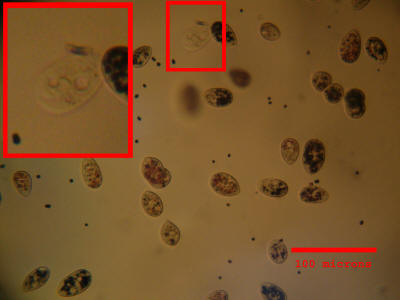
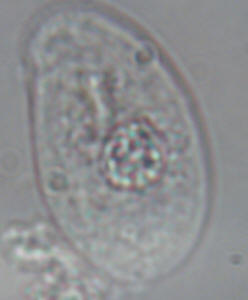
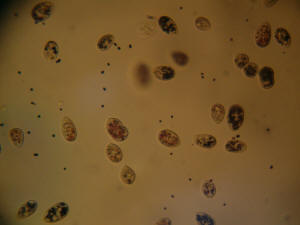
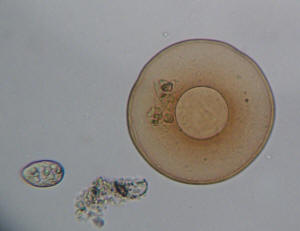
About Prevention: As the saying goes... "an ounce... is worth a pound of cure". There are three sets of factors that determine livestock health and its reciprocal disease. Of these the elements that are prevention: livestock selection, proper environment, and not allowing the introduction of pathogenic (disease inducing) organisms are germinal. About Suitable, Stable Environment: All diseases are to some degree environmentally mediated... some caused directly as a consequence of too inappropriate circumstances, or too variable of ones. Much goes into defining an environment. Water quality, foods/feeding/nutrition, the role of tankmates, physical make-up... And these factors are species specific; different for different types of life. And may be age/size specific as well; with individuals living in another set of circumstances preferable with growth. About Quarantine: Not many people do so, but having a separate system, placing new livestock there for a couple of weeks for quarantine is one of the best practices you can engage in to assure your success. Quarantining newbies does a few important things for you. It gives the new livestock a chance to "rest up" before becoming embroiled in a new social dynamic. Most importantly for or topic here, this time allows for the development and possible treatment for infectious and parasitic disease... without it spreading to your main/display system. Bibliography/Further Reading: Freshwater Infectious and Parasitic Disease 7/28/07 Hi Bob! Thanks for adding me to the WWM Crew. If there is anything I can do beyond answering queries, let me know. I'll do my best to help out in any way I can. I DO have a couple suggestions. I think that this page: http://www.wetwebmedia.com/FWSubWebIndex/fwfshparasites.htm needs a couple additions and subtractions. Tetrahymena needs to be added to the ciliated protozoans section alongside Chilodonella, Trichodina and Costia. I've personally battled this nasty and it really IS a fish killer in closed systems. Copper should be removed from all corresponding treatment columns as it shouldn't be on the freshwater page for obvious toxicological complications when using it in freshwater species of fish. In my opinion, there is too thin of a line between the levels needed for effective treatment and an overdose. Regardless, Copper is so far down the hierarchal list of chemicals for treating freshwater protozoans that it really should be relegated to a strictly saltwater treatment. Just a thought.... The BEST suggested treatment for the Platyhelminthes/flatworms section is by far and hands down, Praziquantel (AKA, Droncit or Biltricide). It is 100% nontoxic to humans, fish, crustaceans and biofilter. I would seriously consider adding this to the list as the first choice in treatment. It can and will reduce a lot of mortalities due to the other, more toxic remedies such as Potassium Permanganate, Formalin/Malachite Green and organophosphates (fluke tabs?). For the crustacean parasites, Dimilin is my favorite as it too is nontoxic to the bio-filter and fish. Please consider adding this to the treatment column as the first choice. Thanks for looking into this Bob. Do you have any input on my thoughts outlined above? <Am in agreement entirely, will addend. Cheers, Bob/Chuang Tzu/Fenner> Twothless (Paul) Re: Some contributions 7/28/07 Once again, Hi Bob! <Pablo> I swear this is the last time I'll pester you.... <Never a bother> At least for a while.... I have several good videos and some great photos of the following: Tetrahymena Pyriformis, Chilodonella (Cyprini/Piscicola and Uncinata, both facultative) as well as a species of Dactylogyrus. I've searched and found no place where there's a compilation of photos regarding disease or parasites. If there is such a place, can I donate my media? <I will gladly help you find such... or aid us in putting them on WWM with an offer to others there> Also, should I be making general queries such as these to Sabrina instead of bogging you down? <I do wish Sab had enough time to help us> I know your already inundated with "Dear Bobs"..... Thanks again, Paul <Might I ask, where did you make these images? BobF> |
|
|||||||||||||||||||||||||||||||||||||||||||||||||||||||||||||||||||||||||

|
Features: |
|
| Featured Sponsors: |
.JPG)