FAQs on Freshwater Fish Parasite Diseases:Diagnosis/Identification
Related Articles:
Freshwater Fish Diseases,
Freshwater Diseases,
FW Disease Troubleshooting,
Ich/White Spot Disease,
Choose Your Weapon: Freshwater Fish Disease Treatment Options by Neale Monks,
Formalin/Formaldehyde,
Malachite Green,
Related FAQs: FW Fish Parasitic Disease 1, &
FAQs on: Internal Parasites,
FW Parasite Treatments,
Freshwater Protozoan Parasite
Diseases, Diagnosing/Identifying
FW Protozoan Diseases, ( Ich/White Spot
Disease, Freshwater Velvet,
Sporozoan Parasites, Whirling Disease, Hexamita/Octomita in Freshwater Systems,)
Worm Diseases, Cichlid Disease, African Cichlid Disease, Aquarium
Maintenance, FW Infectious
Disease, Freshwater
Medications, African
Cichlid Disease 1, Cichlid
Disease, Betta Disease
1,
|
|
Anchor worm? Recurring fin rot?
Please help diagnose.. 9/22/13
You folks helped me tremendously a few months back with my angelfish. I'm
hoping you can assist me again. I have a 55 gallon tank with 5
adolescent angelfish, 4 blue rams, 2 Denison barbs and a Bala shark.
<This last will get very large... might prove to be trouble for the
other fishes; with its nervous, "jumpy" behavior>
All of them together are about 17 inches of fish. They don't seem
over-crowded yet, but if you tell me that's my issue, I will fix the
situation.
<Will be an issue w/ the Bala in time>
I am trying to let them pair, and then rehoming them. I recently had to
treat for Camallanus worms with Levamisole. These worms didn't show up until
2 months after the fish was added, and I have added no new fish, plants, etc
since. The Levamisole seems to have worked, but I will still administer the
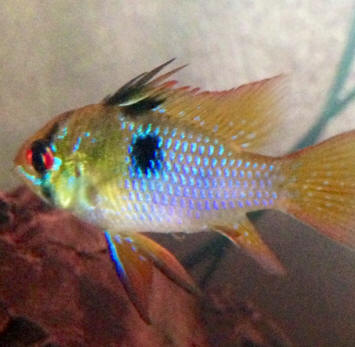
second dose next week. My biggest problem now is a blue ram with a
red thing sticking out near his anal fin.
<I see this>
It is bigger than the Camallanus worms, and there is only 1 It looks like
a piece of red toothpick stuck in his side normally. However, when he gets
angry, or during feeding time, it appears more like the "thing" comes out of
him, then loops back up in him. It comes out if his side, not the anus.
He is very aggressive at meal time also. I have (in a QT tank) tried
Metronidazole, Praziquantel, CopperSafe, Methylene blue, salt baths/dips,
Nitrofurazadone, and he was in the main tank for the Levamisole treatment.
<None of these will treat for Anchorworm>
I have not seen anything like this on any other fish, and I can't diagnose.
I've researched and looked at so many pictures and descriptions, my brain is
scrambled. I keep thinking it's an anchor worm, but no new ones have
appeared, and it doesn't fork at the end.
<May in time or not. Still could be Lernaea... I'd catch this fish now, hold
gently but firmly, and pull this out carefully with a tweezers>
It looks like "color", until he swims away from you, and the anal fin moves,
but the "thing" doesn't. I would be so grateful for your opinion on what
this could be. I'm going to ask a few other questions, because I wonder if
all my problems aren't related. Two of the angelfish keep getting pinholes
in their dorsal fins, and the dorsal looks raggedy.
<... this could be "nothing" disease wise. Would NOT treat for>
They also have missing scales, or little indents in their sides, that I
thought were the result of pecking, but I never see pecking, and now I
wonder if it's not bacterial!
<More likely the Bala Minnow Shark or medicine exposure; can't see much in
your images here>
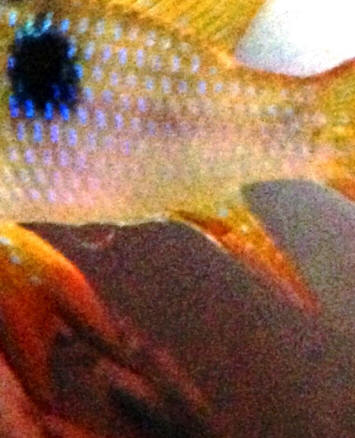
I've attached a picture of my black angel, who looked like he scraped a
piece off his side near his dorsal fin. It looked like mowed grass. It
looked that way on both sides. These things keep happening. The indents and
patches go away on their own, but it keeps happening. My parameters are
good, but I try water changes anyways. Then, I treat with KanaPlex.
<A poor idea to keep pouring in such>
The fins get better, but it keeps coming back. Another odd symptom is that
ALL the fish seem to tap their bellies with their ventral fins, as if trying
to get something off. I've even seen a ram rub his belly in the gravel (not
during breeding). I'm sorry for throwing so much information at you, but no
one seems to have any idea why I keep having problems. I medicate (except
for the Levamisole) in a QT tank. I only use medication when I fear the fish
is dying. I try everything else first. The blue ram is a part of a pair that
has laid eggs twice. I'm really hoping to diagnose and treat him. I would
also like to keep the angelfish healthy, as they seem to be starting to swim
in "twos", so any suggestions on their care is appreciated. I do weekly
water changes with prime. My tank cycled 3 months ago. Readings- ammonia,
nitrites: 0. Nitrates: never over 20. Ph: 7.2. GH: 7-8, KH: 5-6. I use 2
filters, a Purigen, sponges, and a nitra-zorb. No carbon. I mix 1/4 tap with
3/4 RO water. I was wondering if this might be making the ph shift, causing
the fish to stress, and causing my problems.
<Not likely; no>
I test replacement water for kH, gH, ph and temperature. But, I don't add
buffers or other chemicals. Does RO water need trace elements replaced
and/or something added to keep ph stable?
<Not if made up some other way; in this case mostly by the 1/4 tap>
Or is the tap water enough of a buffer?
<According to your test results, yes>
One last question: can a fish KEEP getting the same illnesses, or do they
build immunities?
<Some acquired immunity for some infectious, parasitic diseases has been
demonstrated/observed in many fishes>
I feed them blood worms
<Stop! Do search the net re these Chironomid sewer worm larvae. I would NOT
use them, or restrict their use>
or brine shrimp soaked in vita-chem in the morning, and omega flakes at
night (all eaten in 3 minutes). Any help is greatly appreciated, as I'm
really hoping to breed these fish.
Thank you,
Kelly
<Thank you for sharing. Bob Fenner> |
 |
parasites
7/6/11
I have numerous tiny white things swimming around in my tank.
<In the water? On the gravel? On the surface of the water?>
they look like tiny tadpoles. They burrow into the fish eventually
killing them.
<I doubt that.>
what are these and how do I get rid of them?
<Most of the visible "critters" in freshwater aquaria are
harmless, but they can feed and grow because the tank is dirty, perhaps
because it's overstocked or you overfeed or you simply don't
clean in regularly enough. Keep the tank hygienic and most of these
little life forms will die back to unnoticeable levels. Cheers,
Neale.>
Columnaris treatment; no, I think you're dealing
with Costia! 11/04/10
Hi Neale,
<Kara,>
I have been scrolling through pages and pages of previously submitted
questions, and doing a lot of research and I was hoping you could
assist me with a problem I'm having in my 5 foot (100 gallon)
tank.
<I'll try.>
Tank is a low tech heavily planted tank, stocked with 10 Rummynose, 4
Sterbai Corys, 6 Kuhli loaches, 3 x true SAE's and 5 half grown
angelfish. The tank is stable, with no water quality issues ever
experienced, and has been set up for 6 months. It is well filtered with
a large canister filter (2400lph), and the tank has good water
flow/current. I have had the Rummynose for 4 months - when they arrived
(mail order) they had ich, so these are survivors of that and have been
super healthy and eating like pigs since. The Cory's and sterbais
I've had for about 3 months, the 5 angels about 6 weeks. All went
through a quarantine period in a bare, cycled tank. When I got the
angels, one had a white pimple by his mouth, it never changed
throughout quarantine, and seemed to fade, so I assumed it was just an
innocent pimple. I recently went away for a week and left the house
sitter to feed the fish. Everything was fine, water parameters
excellent. I did notice that one Rummynose looked as though it might
have had a slightly foggy eye, at the time I thought it was a trick of
the light.
<Most often caused by physical damage if just one eye; if both eyes,
environmental issues become more likely.>
When I got home, I discovered the majority of the Rummynose had pale
patches on their backs around the dorsal fin, no evident signs of
Finrot, but some had white patches on their eyes. After some research I
found this to be a possible classic sign of the start of a Columnaris
infection.
<Don't agree at all. Columnaris, also known as Mouth Fungus, is
a fairly distinctive disease. As its name suggests, it's most often
found around the mouth, and the lumps have a thready texture similar to
that of fungus. It is usually some shade of grey though, so while
similar looking to fungus, should be fairly easily distinguished from
the white threads typical of fungus. Are you sure you are not confusing
Columnaris with Costia? Costia, also known as Slime Disease, is a skin
parasite that causes patches of grey on the body. It is readily treated
if caught early.>
I immediately tested the water and found: Ammonia: 0 Nitrite: 0
Nitrate: 10 - this raised my eyebrows because I have NEVER had a
nitrate reading in this tank due to the abundance of plants. I feel
that to have suddenly had the level rise to 10 in spite of all the
plants, there may have been an ammonia/nitrite spike preceding this
possibly due to the house sitter overfeeding? - Hard to say anything
factually as I wasn't here. The stress of an ammonia/nitrite spike
could have triggered the start of the problems.
<10 mg/l isn't all that high, so if this is the worst your house
sitter did, you were lucky. Generally, if you're gone for less than
10 days, skip feeding altogether; for longer periods, leave enough food
in individual envelopes for one or two meals per week. Hide all the
rest!>
PH - 8 (Usually sits at 7.8 - the addition of extra black gravel raised
the ph a little more than I'd expected.) GH - 8 KH - 7 I also found
the light had been left on 24/7 while I was away due to a timer
malfunction - which may have further stressed the fish and certainly
affected the plants.
<Possibly, but not seriously. I routinely do this when away on
vacations, and the plants are fine. A bit overgrown sometimes, but
nothing serious.>
I immediately did a 25% water change despite the ok readings, and fixed
the light. Everything I read on Columnaris said that it thrives in
hard, warm water, and can overcome fish when they are stressed, injured
or subjected to unsuitable conditions. Treatment widely recommended was
Tetracycline - which is basically ineffective with a PH as high as
mine. The next recommendation was Oxytetracycline in their food - I was
unable to acquire any despite talking to 3 different vets. While I was
trying to get hold of treatment, I began dosing Pimafix on the advice
of a vet, but I believe this was ineffective, so after 4 days I
eventually got a bottle of Tri-Sulfa tablets, and after another water
change began dosing at the recommended 1 tablet per 40 liters, which
for my tank is about 9 tablets. My bottle says repeat in 3 days if
necessary. So I did another water change, and dosed again on the 3rd
day. Tomorrow they will be due for a 3rd dose if you think it wise to
continue. I have found the saddleback lesions on the tetras to be not
as grey/white as they were, it's fading back to normal colour,
however 2 still have distinct white patches on their eyes. The
kuhlis/Corys have never displayed symptoms and still look fine. One of
the SAE's was pale, but now looks completely normal. The angels on
the other hand are a different story. The pimple that had been on the
one angel had flared up again and was a little woolly, it is no longer
woolly, but it's still present despite treatment with tri-sulfa,
and a few of the other angelfish have developed ragged fins with milky
spots on the ends that do not seem to be improving ( 2 are particularly
aggro with each other, so injuries to the fins may be allowing the
bacteria to gain a hold). Should I continue treatment with the
tri-sulfa? It says in severe cases that you can double the dose to 1
tablet per 20litres, however I'm not sure if my Corys, kuhlis and
tetras will cope with the higher dose. Do I need to allow the tri-sulfa
longer to take effect, or should I conclude that it is not working
efficiently and try something else? Water parameters as at this morning
are Amm/Nitrite 0, Nitrate less than 5ppm, PH steady at 7.9. So far I
have not lost any fish, and all are still active and eating despite
symptoms. However I am very eager to be rid of this once and for all
and would like to know how much longer I should continue treating with
the tri-sulfa. Any help you can give me would be much appreciated.
Sorry for the long email. Regards, Kara
<Kara, the bottom line is I suspect you're treating for the
wrong thing. Costia (strictly speaking, Ichthyobodo) symptoms include
excess mucous production leading to grey patches, and in serious cases,
bloody sores on the body. Affected fish often breathe heavily, become
lethargic, and go off their food. Treatment typically involves the use
of formalin-based medications, but these can be a bit hard on catfish
and loaches, so use judiciously. Brackish water is very good for
dealing with Costia, but obviously only suitable for those species
tolerant of brackish conditions and periodic seawater dips, such as
livebearers. Cheers, Neale.>
Re: Parasite problems (Bob F., comments would be welcome
here)<<>> 4/6/10
Hi Neale, I hope you had a good Easter
<Yes, thank you.>
If I may I will provide you with an update, and also news of what for
me is a shocking discovery, in the hope that we might move closer
towards a diagnosis for my fish.
<OK.>
Firstly, I have treated the whole system with salt as per your article,
as if for velvet. The Otocinclus were the only ones to react negatively
(a bit of swimming up and down against the glass), but they settled
after only a few hours. In terms of what effect the salt is having,
after five days I believe that the overall rate of flashing may have
lessened. Perhaps there was/is a low level of velvet in the system,
which is beginning to be curtailed. Nonetheless, I intend to keep it
salty for the full 14 days as you direct.
<Very good.>
However, what has not changed is the ram's behaviour -- in fact
this fish is now displaying some disturbingly frantic flashing
behaviour, as if something is driving it crazy. It will now only eat
one type of food (where before it would take anything), prefers to stay
in darkness at the rear of the tank, and while it has not lost weight
or its equilibrium, I am increasingly worried for it. Whatever it has,
it is worsening.
<Oh.>
But the most shocking discovery is that the white, bean/rice shapes
that I described to you on the sides of the tetras -- well -- to my
horror I have found that they move. I singled out one of the older male
cardinals for study and noticed that his 'blemished scales'
appeared to change position. I thought it might be my eyes/mind playing
tricks, but then when the fish was still for a fair period, I actually
saw a blemish slither from a particular position to another. On another
occasion, I saw one of these things actually raise or wiggle either a
head or a tail. I think they are clearly some sort of flatworm.
<Could be, or some type of crustacean parasite. Both
"worms" and crustaceans can seem very flatworm like, but the
medications required for these are very different. Dipping in seawater
can sometimes help shift them; do see WWM re:.>
Do these observations of mobility and large size (2mm long) narrow down
exactly what it is?
<Not really, without determining whether they're crustacean
parasites like lice (in which case an insecticide is required) or worms
such as flukes (in which case an antihelminthic like Praziquantel can
help).>
Is it time for Praziquantel, and if so, can you give recommendations or
further reading for the treatment procedure?
<Not used this myself since in the UK it's a prescription-only
medication and the vet will tell you the dose. But do read here:
http://www.wetwebmedia.com/vermifugefaqs.htm
I will make the observation that Ram Cichlids, Mikrogeophagus ramirezi,
are pretty poor quality these days and notoriously prone to disease.
There's also no reason to discount the possibility that what's
affecting this cichlid is not the same thing that's affecting the
other fish. Mikrogeophagus ramirezi needs very warm, very soft water to
live well. Hexamita infections appear to be endemic amongst farmed Ram
Cichlids.>
But in an attempt to rationalise the behaviour of the ram (and the
similarly unmarked Corydoras and Apistogramma) with the observation
that there is a definite (and very visible) parasite in the tank, is it
possible that these 'flukes' begin life on the gills, then
migrate out onto the skin?
<Could happen I suppose, though gill parasites tend to be very
specific in attaching to the gills.>
Thus: could it be possible that the reason the ram has no external sign
of these 'flukes' is because it is a large enough fish for them
to remain attached to the more profitable gill area?
<Possibly, but doesn't sound very likely.>
Similarly, might it also be possible that the reason the micro-Rasboras
are unaffected is that they are simply too small for such a large
parasite, and richer pickings are available in other parts of the
tank?
<No, doesn't work this way.>
Although I have not had time to research this sufficiently, I am also
worried that it may not be one of the two 'standard' flukes,
but a digenean trematode, which uses snails in its lifecycle. I
mentioned to you that I have numerous snails (including some sort of
pond snail species that hitch-hiked in to the tank) and when I treated
the fish for this condition before, I am certain there were no snails
in the treatment tank. As you pointed out, it could have been the
change of tank (from one with snails, to one without) rather than the
copper and formalin treatment that knocked this condition on the head
the last time around. If it is the digenean, can I use Praziquantel in
the same way, or do the snails have to go? <<They do have to be
moved. RMF>>
<Snails can carry parasites to be sure, including parasites ones
that parasitise humans, but ONLY if those snails were collected from
the wild. Farmed snails and those that were born in fish tanks are very
unlikely to carry serious parasites because the hosts those parasites
need, typically water birds, are lacking. In other words, this
isn't likely. It's more probable the parasites infected your
fish prior to purchase, or else were introduced via something brought
in from the wild, like live food.>
Following on from this, is it likely just the pond snails that are the
problem? With a soil substrate it is preferable to have burrowing
snails, and so I would not wish for a blanket elimination of molluscs
(equally my Nerites are both aged and prized). As a course of action I
can foresee a successful (if prolonged) physical management/removal of
the small pond snail species.
<Not really viable or even worthwhile, in my opinion.>
At present my overall thinking is as follows:
1) the tank has collected several pathogens along the way through a
lack of quarantine, including velvet, invisible and visible parasites.
This would explain the lessening of flashing (velvet exiting), but the
remaining presence of a visible parasite, and the increased discomfort
of the ram
<Perhaps.>
2) the tank is suffering from a single parasite with different
manifestations
<Also possible.>
On the evidence, which do you think is more likely?
<Impossible to say without microscope work. Most of our diagnoses
via e-mail come down to probabilities, and the fact that certain
mistakes (like adding fish to immature aquaria) lead to particular
health problems (such as Finrot). In the situation you have here,
consulting a vet and/or performing an examination of a dead fish under
a microscope would be the only reliable way to identify the flukes,
worms or lice your fish have.>
As an aside, I am still testing and not detecting anything amiss in the
water -- likewise I have checked my water conditioners and they all
remove chlorine, chloramine, copper etc.
<Good.>
Once again I apologise for the length of my correspondence, and the
high amount of questions put to you above. I do feel that I am slowly
cornering this problem, and your continued help would be both
invaluable and highly appreciated.
Yours
Joe
<Cheers, Neale.><<RMF would treat (either successively or
concomitantly) for both "worm" and crustacean possibilities:
i.e. w/ an anthelminthic and an organophosphate, barring, as Neale
states microscopic discerning of infectious agent/s here.>>
Re: More Re: Parasite problems, Bolivian
Rams 4/7/10
Dear Neale and Bob
Many thanks for your further inputs.
<Happy to help.>
Neale - I must point out that the ram in question is a
'Bolivian': M. altispinosus. But I totally agree with what you
say about M. ramirezi - to be frank I am sick to death of seeing
deformed, weak, washed out, in-bred specimens in the shops.
<A real problem with cichlids generally, whether Ram Cichlids,
Mbuna, Jewel Cichlids, Firemouths, and a host of other species.>
Responsible managers should not take them from the wholesalers, who
should not import them. Unfortunately, M. altispinosus does not fare
much better in the deformity stakes, which is a shame, because a good
Bolivian is a
fine fish indeed.
<Agreed. It's a shame that careless inbreeding has led to this
situation. Unfortunately, many cichlids breed so readily in aquaria
that inbreeding becomes the norm rather than the exception. I can think
of few common
cichlids that have maintained a steady level of quality over the
decades, and highly recommend people seek out wild-caught or F1
specimens if they can.>
Following from your guidance, and the information/options it has
spawned, I am going to seek further guidance from a vet who treats
fish, with the view to obtaining an anthelminthic, if this is deemed
the correct course following consultation. If it would be welcome, I
will inform you of the outcome.
<I'd certainly be interested to hear what the vet says.>
Thanks and all the best
Joe
<Good luck, Neale.>
Parasites..? in pond fish, Gambusia to be precise
-12/14/07 Hello Crew, <Nicole> I am writing this in a bit of
a hurry, so my apologies if this sounds disjointed. I'm at work and
it's just about time to lock up. <Okay... similarly, please make
allowance for my incoherency... am just waking up> I was visiting my
friend today, and he pointed out something very odd in his pond. Three
fish were covered with what looked like tumors at first. The affected
fish were mosquitofish. Upon netting one and observing it more closely,
by putting it in a glass and holding it up to the window, it became
apparent that these fleshy growths were not subcutaneous but loosely
attached to the skin. Some of them fell right off while the fish was
swimming in the glass. I don't know how to describe the growths,
except to say that they are light brown gelatinous blobs, slimy and
mucus like, oval shaped, and they appear to cover the fish from head to
tail, including near the gill area. The affected fish are moving slowly
and seem emaciated, perhaps just from being too slow to get food
amongst all of the competition. <Good descriptions> This pond is
stocked with native FL fish that he's collected from various bodies
of water and populated his pond with over the years. Mosquitofish
primarily, but it seems some minnows and killifish too. More recently,
a few bass and the fry of what appear to be bluegills, have been
discovered in there. <I see... possibility of contamination from
vectors> This is a very basic round pond, maybe 15-20 feet in
diameter, which started as a hole dug in the clay and filled with water
with plants of all sorts added over the years. It's about 10 years
old, in case that matters. Recently he let it "go wild" and
it became overrun with cattails, duck potato, pickerel weed, etc.
Finally this winter, he drained it, moved all of the fish to other
ponds (he has 3-4 other small ponds, which he digs himself with a
backhoe) and removed most of the plants, leaving only a few huge root
balls in the mud which will probably take hold again. I just thought I
would mention this in case this gives any clue as to why these
parasites (I am assuming that's what these are?) would suddenly
appear, after 10 years of having small pond fish without any signs of
such trouble. <Many possibilities... could even have been
"something" brought in via waterfowl...> Incidentally, I
don't have any idea what the water quality is like in the pond,
except the water does seem very tannic (lots of acorns falling in and
such) and is unfiltered, but regularly topped off. Lately the water has
turned green sometimes, but it seems to come and go. The clay soil
around the pond makes the water rather turbid anyhow. I'm sorry, I
wish I could be more scientific, but I know next to nothing about
ponds! I'm just trying to help him find out more about this, as he
is sort of a backwoods guy and not computer literate. <No
worries> I know this is almost impossible to comment upon without a
picture ID, and next time I see him I will bring my digital camera.
However, in the meantime, is there anything you can recommend? <Mmm,
yes... some water changes mostly... perhaps even just water addition;
if the system is "percolating" as many such ponds do in
FLA... adding a slow running hose pipe to dilute the acorn et al.
effects> Any clue as to what this might be? <Likely
"just" environmental in cause... the result of "dead sea
effect"... cumulative metabolic accumulation... Though could be
pathogenic (trematodes, other possibilities), even idiopathic
tumour...> Or perhaps you could point me to a resource, either
online or in print (as I work at a library, and could probably have a
book interlibrary loaned if need be) that could show me pictures of
diseased fish to compare to? <There are several Ed Noga, "Fish
Disease, Diagnosis and Treatment" I especially like...> I have
looked a bit online and have found excellent websites with lots of
written description, but the pictures, if any, are microscopic images.
What I was hoping to find was pictures of diseased fish, or a picture
of the parasites as they are seen by the naked eye. If there is
anything obvious that I am missing here or failing to see? <Mmm, not
likely. There are no good to great works of this kind online as far as
I'm aware> Sorry, this email did get a bid wordy after all. In
any case, if anyone could help, I would be most grateful! Thanks so
much, Nicole <For now, the simple water changes... Is what I would
do. Testing for quality next... Bob Fenner>
Unwelcome Hitchers (External Parasites?), FW
11/9/07 I found what sounds exactly like what seems to be my issue.
However, I do not see a clear answer. The question was named Unwelcome
Hitchers (External Parasites?). I found it here
http://www.wetwebmedia.com/fshwrmdisfaq2.htm FAQs on Parasitic Worm
Diseases 2 Just wondering what it could be. I have noticed these things
for some time. Like the previous person said, it does not seem to
bother the fish. They must fall off in after feeding because when I am
cleaning the tank I find these little thingies. <... a drawing,
photo?> Normally just one or two. The last time I found several. I
just want to get rid of them. I do recall once that it may have been
just attaching itself to the fish and it was like a clear round small
bubble? (best way to describe it right now). I treated it with Quick
cure and it kind of released itself soon after (not sure if it was the
med or the life cycle). <The former... has formaldehyde in it...
just get the open bottle near your eyes... wait, don't!> I saw
it floating through the water and it appeared to have a tiny red dot in
the center. A few days later, I was cleaning the tank and found this
little disc, but hardened. Like a contact lens. Please, help. You may
not have the answer, but seeing how this seems to be common in my tank
for right now, if I find a treatment that gets rid of it (and it stays
away for longer than a few weeks). I will let you know. <Sounds like
Flukes... I'd try a dewormer... Prazi-Pro, Praziquantel... Bob
Fenner>
| Help me with my goldfish... Error in placing
"feeders" in a tank... 10/24/07 Hi,
my nephew won these fish at a carnival and I just so happened to
have started a tank about a month prior with only a algae eater in
it <I hope not a CAE... please see the Net, WWM re Gyrinocheilus
aymonieri> and he asked if I could add these two fish to my
tank. So I did, <A mistake... such "feeder, comets"
are notoriously unhealthy... invariably infested with a few types
of parasites, infectious agents... now your system is as well>
and now the one fish has black spots on him and is losing all of
his fins, they are deteriorating. And as of this morning, he is
getting a white egg textured film on top of his head and off the
back of his tail. I am new to the whole goldfish thing, so could
you help me find a cure. thanks so much!! Amber <Much to relate
to you re developing a course of treatment here... As stated, your
whole tank, all the fishes there... are subject to a myriad of
pathogens... Best for you to start reading... Here:
http://www.wetwebmedia.com/FWSubWebIndex/gldfshdisease.htm and the
linked files above... till you understand what you've done,
what you're up against... You will need to sequentially treat
the system, all fishes for bacterial, protozoan, worm et al.
diseases... Bob Fenner> |
|
|
Question on white spots 12/16/06 Hello sir,
I'm brand new to owning fish and have bought a Red Swordtail female
and a Red Platy male. I've had the fish for about 2
weeks, and the night I bought them the Female gave birth to several
fry. Well tonight I was watching the fish swim around as I was feeding
them and I noticed that the Female had 2 White Spots on her. I've
been searching sites looking for diseases and most point to ICH, but
with the pictures I've seen of ICH it doesn't look like it. The
2 spots are approx. the size of the head of a nail. I'd say maybe
1/8th of an inch or so in diameter. Any suggestions would be wonderful.
<Mmm... well, there are other such appearances other than parasites
that this might be... and the presence of the young fish makes any sort
of chemical treatment impractical... And two weeks is a good long time
if indeed this were something pathogenic to evidence itself... If it
were me, mine, I'd hold off at this point, and just keep a close
eye on your livestock... Perhaps making preparation to isolate one,
some, if indeed this does become an infectious issue. Bob
Fenner>
Possible FW Parasite? 5/31/06 I need some serious help?
<Yikes!> I often find myself turning to your site and have always
found it helpful but I have searched your entire website under
parasites internal and external and found a lot of useful info on
treatment but still don't know what exactly I would treat. Since
what I think might be a parasite or lice is too small to truly tell
exactly what it may be to treat. I have a 55 gal FW tank that I have
had now for 9 months. As of a month ago I had a Pleco, 5 neon tetras, 3
zebra danios, 3 diamond tetras, 2 pineapple swordtails, 4 various
platys, 2 black mollies and 9 fry in breeder (about 2 months old/
inside same tank). I have also noticed now a couple of
snails in there shortly after I had added a couple of the female
platys. In the last 1 1/2 weeks I have had 1 platy, 1 molly
and 2 fry die on me. The black molly that died looked like
he had a worm coming from the gills (not moving) but since it took me
about a day to notice he was missing I figured he was just
decomposing. A female platy did not show any signs of stress
before she passed and the fry got bloated bellies and became really
lethargic. My remaining black molly has had a cloudy looking
film on her left eye and mouth that is subsiding on it s own. <Mmm,
well mollies do "like" hard, alkaline water... often people
put salt in their water... but your other fishes don't all like
this...> I tested the water and ammonia, nitrate and nitrite levels
were zero or what appeared as zero since the test kit I own
is not strips but droplets and compare tubes to a color
chart. pH is consistent and staying at 7.4 and did a 30%
water change 2 weeks ago, I added a small container with 2
oz of aquarium salt and gravel on top to slowly disseminate through out
the tank 2 days ago. I sat and examined the fish behavior
(eating and social) when I noticed a lot of what appeared to look like
lint (very thin and poss. white in color) about 1/8 inch long in my
tank but upon a closer look at those on the glass I noticed they were
moving (slowly like worms). From most of the articles I have read on
your postings I still don't know if these are flukes,
internal/external parasites looking to attach, lice or what. <Most
likely either worms of some sort...> Did these come from those
snails? <Not unlikely> I have seen some slimy patches
with white dots on my plants but are gone by the next day and have also
cleaned it off the breeder the fry are in. <Mmm, maybe snail
eggs> Please help! I don't know how to treat if I don't know
what I'm treating before the rest go fatal. There was so
much in regard to so many kinds of remedies for different parasites.
I'm sorry to have given such a lengthy explanation but knew from
reading prior postings too little information is not very
helpful. Especially when explaining something like this in
such a distant forum. Thanks in advance for any help you may
be able to offer!!!! Angie <The only assured way to "tell"
what you might have here is microscopic examination... of the affected
(live or freshly dead) fish... There are some "general"
treatments folks can try... If it were me/mine here I'd start with
Praziquantel (sold under a few names)... and see if this brings relief.
Bob Fenner> Fish Scratching on Rocks and Agitated Fins... Worms
likely Ok I found a few things out about what I think may be
wrong with my tank, read below, sent in earlier. I had a
snail in my tank that I believe brought in yellow grub/black spot
parasite. One of my fish has it pretty bad, little black
dots on body and in the eye. I got rid of the snail, most
info I read said to get rid of birds flying around and or snails,
obvious which problem I had. Snails gone. Was
wondering though if my fresh water crabs could keep the cycle going
also or if I should be ok on this end. Please let me know
ASAP. Thank you so much. < To get rid of external
parasites it is hard to beat formalin. Add a teaspoon of rock salt per
ten gallons of water and try treating with formalin or rid-ich for the
parasites. You might have to move out the crab for awhile until
treatment is complete.-Chuck> Jeff Fortier
|
Parasite??? Hey All, I seem to have a serious
problem and I can not get rid of it. I have a 75 gal
tank with a bunch of cichlids in it. I have 13
cichlids, 1 Synodontis multiplisomething catfish, Pleco and 2
Thai crabs. A few of my fish seem very agitated and
are scratching constantly, darting and flicking there fins a
lot. I have treated the tank several times with quick
cure, raised the temp to mid 80's and put a good dose of salt
in the tank. The last treatment I ran was for 7 days
straight, adding quick cure daily as described on the
package. The fish seemed to get better when added then
the next day were rubbing again. Some even seemed to
stop rubbing completely. Then one fish really began rubbing even
after tank was dosed. I also have 2 Emperor 400
filters going and I did remove the carbon and I added a bubble
wand to help add a little aeration to the system
also. Some fish seem to have heavy breathing going
on. Can you recommend anything here? I am
so frustrated, should I try a copper solution? Should
I have kept the Quick Cure treatment up longer? This
was like the third time I have treated the tank this way for
about as long, 6 days. Please let me know your
thoughts. < Check the nitrates and make sure that they are
under 25 ppm. Clean the filters and do a 30% water change. Vacuum
the gravel to remove any sludge that has accumulated there. Now
that the tank is nice and clean you need to remove the BioWheels
from your filter. Place them in a bucket with some of the
aquarium water and make sure that they are always moist. Check
the pH as it should be at least 7.5 or higher. Add a teaspoon of
rock salt for every 10 gallons of water. Remove the filter
cartridges because they contain carbon and will remove any
medication. Treat the tank with clout as per the directions on
the package. This should take care of the protozoans attacking
your fish. After the treatment is complete, then add the
cartridges back into the filter to remove any medication still in
the water. After a couple of hours you can put the BioWheels back
in the filter and your filter will pick right back up where it
left off without having to recycle.-Chuck> Jeff
Parasite??? Ok I did everything you said below actually
gave them 2 treatments of clout, they seem to get better then
they start scratching again. I removed the filters but
put back in just the flossing part, no carbon. Also I
forgot to mention a green algae I have growing in the tank, there
was some brown but it slowly turned to green, did not know if
this had any effect in the fish. I have not touched the water
since last treatment, just wondering if there is still enough of
a trace amount in the water to keep killing what ever is
irritating my fish. Some one suggested using copper
safe since copper stays in the water for like a
month. Let me know what you suggest. < Copper
levels that kill parasites are very close to the lethal levels
that will kill fish too. Copper will work but you need to follow
the directions very carefully. Some fish cannot handle the levels
recommended so you will need to watch them carefully for signs of
stress. I would recommend either Kordon's formalin or
Kordon's Rid-ich+. If these don't work then it may be
bacterial. I would try Nitrofuranace or Kanamycin. For any of
these medications to be effective the water must be clean. The
algae problem suggests high levels of nitrogenous wastes that
need to be addressed.-Chuck> Jeff
Re: Parasite??? So far so good with the copper, the
only mistake I made was putting in
cleanfilters. Coppersafe says filters must be 5 days
old not to affect the treatment. Seemed great at first
but since I put those filters in copper levels must be
diluted. I am waiting on a copper test kit to get here
Friday before adding any more. I guess one question I
have is, one fish seems really effected by all this, it looks
like he is being drained of color. Would a bacterial
infection do this if it was bacterial? < Sick fish may have
initially been affected by the Protozoans and a secondary
bacterial infection may be taking place.> Also
would the fish seem to get better and stop scratching after
medicating, would this also occur if it was
bacterial. Just bouncing my thoughts around. < To
be sure you must run the treatment through the recommended length
of time. If the fish stop scratching then the copper worked and
it probably was a protozoan infection. I don't think copper
works too well on bacterial infections.-Chuck> Jeff
Re: Parasite??? So far so good with the copper, the
only mistake I made was putting in clean
filters. CopperSafe says filters must be 5 days old
not to affect the treatment. Seemed great at first but
since I put those filters in copper levels must be
diluted. I am waiting on a copper test kit to get here
Friday before adding any more. I guess one question I
have is, one fish seems really effected by all this, it looks
like he is being drained of color. Would a bacterial
infection do this if it was bacterial? < Sick fish may have
initially been affected by the Protozoans and a secondary
bacterial infection may be taking place.> Also
would the fish seem to get better and stop scratching after
medicating, would this also occur if it was
bacterial. Just bouncing my thoughts around. < To
be sure you must run the treatment through the recommended length
of time. If the fish stop scratching then the copper worked and
it probably was a protozoan infection. I don't think copper
works too well on bacterial infections.-Chuck> Jeff You have
been very helpful in all this and have helped me from getting too
frustrated and I really appreciate your time. I am
sure you get the same questions over and over and it must get a
little mundane, but thank you. Hope you have a wonderful
Thanksgiving and I will let you know how it goes. At least in all
this I have not lost a single fish yet (crosses fingers). <
Thank you for you kind words and hope you have a happy
Thanksgiving too.-Chuck> Jeff
|
Sick guppies Hello,
I'm having a problem with guppies dying. They are in a community
tank (20 gal) with a couple mollies, two white clouds, a SAE, and a
1-inch FW puffer (adult size, no worries, he doesn't even try to
eat the baby guppies). >>Hello :D I think will eventually have a
problem with keeping puffers and guppies together. Puffers are
notoriously aggressive fin nippers, and will start shredding tails at
some point. The mollies can also be quite aggressive. What is the
scientific name of the puffer? (Tetraodon travancorius?) These are two
species that I would NEVER recommend to put with guppies, as generally,
guppies should be only kept with non-aggressive fish.<< Oh, and
there are currently two adult male and two adult female guppies (the
number of small guppies varies with time, of course... maybe three tiny
guys right now). This problem has been going on for a couple of months,
and I'm at the end of my rope trying to figure it out/solve it. The
symptoms are rapid breathing and progressive loss of energy, and a
decreased interest in food. Some of the fish occasionally flick against
the bottom. Only the guppies show symptoms/die. >>Normal, since
guppies are the least resilient fish you have in the tank.<<
I've treated the tank with Maracyn and Maracyn 2, thinking that
this is an infection of the gills, but no success in eradicating it-
every few weeks another fish starts having breathing problems. I have
added aquarium salts to the tank (tsp/gal), having read that that will
help with the breathing and should make an inhospitable environment for
the infecting agent... not inhospitable enough, apparently! I have
checked my water quality for pH and ammonia- 7.4 and 0 ppm (comes out
of the tap at 7.2ish). I change the water regularly (every 1 to 2
weeks). >>You will need to treat with an anti-parasitic
medication, like Super Ich Cure, or Quick Cure. I like Quick Cure
because the Formalin in it helps against gill flukes. Remove your
carbon, of course. Your pH is a tad low for mollies, and perhaps the
puffer, too, depending on the species of puffer you are keeping. You
have tested ammonia, but what about nitrite and nitrate? We really need
to know this. Nitrite is just as toxic as ammonia, and a nitrite spike
can last quite a long time. How much water do you change? What
percentage, that is..<< Part of the reason that this has gone on
so long is that only one fish at a time ever shows symptoms then dies,
so I've thought that I had cleared up the problem previously, only
to go through the same agonizing process a week or so later. Also, a
friend who has many years of fish experience told me not to worry, that
the guppies that were dying were probably just old... >>I
doubt this.<< I won't take advice like that again from anyone
who regards my fish as just a food source for bigger fish! It's now
affecting fish that I know are only 7 months old. Please help if you
can! I feel so awful watching them get sicker and sicker, not knowing
what else I can do for them! Thank you! Sarah O PS I think I comb
through your site about once a week, learning a bit more about aquaria
and fish each time. It's a great resource, thank you for providing
it! >>As I mentioned, go to your local fish store and buy an
anti-parasitic medication. Your fish have gill flukes, a parasite.
-Gwen
Sick Goldfish with Odd Behavior >I hope I am addressing my
question to the correct place. >>We hope so, too.
;) Marina today. >I think my goldfish has some sort of
disease, but the symptoms don't exactly match anything that
I've found in my many hours of searching the
web. Ok, the fish is young--about 1 year
old. It was a fairly pale orange and seemingly healthy and
active. Then I noticed that only his head was turning
a milky white color. The white color is becoming whiter by
the day. It spends most of it's time down on the bottom
corner of the tank pushing itself between the side and the air tube
like it's trying to swim right through the glass.
>>This is very odd... >It has done this so much, it is wearing
the scales off of that side that it is rubbing. Its
respiration is also faster than the other two goldfish that are in the
tank with it. The other two fish are perfectly healthy,
active, and hungry. The sick fish is not eating and it kinda
looks like it cannot open its mouth. About 1 week
ago, I tried separating the sick fish and treating it with
salt. This did not help---I put it back in the main tank.
The sick fish is beginning to look emaciated in the head
area. The rest of it's body and fins look fine.
>>Decidedly strange. >Do you have any
ideas? Thank you very much for any help you may
be able to give me. Jody Louis
>>This is SO odd that I'm putting my money on a parasitic
infection. I would suggest putting it in a separate system
and treating with Hex-a-mit, see if that garners any
results. This sounds like NOTHING I have ever encountered,
though, so I am sort of shooting in the dark. I think we can
easily rule out the more common diseases; ich, furunculosis/ulcers, or
the usual internal parasites that tend to lodge in the
gut. This is why I'm suggesting the Hexamit
first. If anyone else on the crew has any ideas and reads
this, PLEASE chime in! Sorry to hear of this, Jody, and
let's hope this treatment works. Marina
Mysterious freshwater parasitic disease? >Hello Marina -
>>Hello Bill! >Not so long ago, you helped me with a question,
and while I hate to impose and become a nuisance, I have another one I
hope you might have some thoughts on. >>Not to worry, Bill,
"nuisance" away my friend. >Not too long ago, a white
angelfish that I have in a 55 gallon tank with several other fish,
including a clown loach and a Bala cat, developed what I interpreted to
be ich. A white spot that indeed resembled the proverbial grain of salt
appeared on each of her front flippers. Because of the presence of the
clown and the Bala cat, I treated the tank with only a half-doze of
"Ick Away" for about a week. At the end of that time, I
detected nothing similar on any of the other fish, including the clown
loach and the Bala cat, but the salt-grain-like things persisted on the
angel. So I moved the clown and the Bala into another tank, and have
since been treating the 55 with a full dose - for five days now.
>>Interesting that the Bala and loach haven't expressed any
symptoms, especially being scale less. >The salt grain like things
persist on the angel, the other fish remain symptom less. From what I
read, I understand that those salt-like things ought to break open and
spread their young about every three days, and that is when the ick
medicine attacks and kills them, so, as nothing seems to be happening
either on removing the grains from the angel (who, in all other
respects, seems fine and healthy) and nothing similar has appeared on
any of her tank mates, I am wondering if this is ich at all. >>In
my opinion it probably speaks more the efficacy (or lack thereof) of
the IckAway. It seems to me that the prudent course of
action would be to add salt, starting the angel off with a saltwater
dip (yes, just like seawater). Purchase a small amount of
salt mix, or if your LFS carries it, you can use real
seawater. Dip the fish for several minutes (till fins are
erect with the fish losing equilibrium). I am going to link
you to two articles, with other links within for more specific
treatment information (and options). http://www.wetwebmedia.com/FWSubWebIndex/fwich.htm
http://www.wetwebmedia.com/FWSubWebIndex/fwfshparasites.htm
>It presents me with a bit of a quandary, as I do not want to
continue subjecting the fish to the medication if it is not ich, yet,
if it is, I do not want to stop prematurely. >>Indeed, a prudent
caution, but you also cannot allow the infection to continue this
way. Read the articles, I'm sure they'll give you a
good overview of treatment and future prevention. >Worse yet, I
travel frequently and when I am gone my wife feeds the fish, but it
will be asking a lot of her to medicate and change the water (I have
not yet done a water change but have one planned for tomorrow). I leave
for about 10 days Friday. >>If utilizing salt to treat, she
won't have to do anything other than the usual
feeding. Neat how some stuff works, eh? ;) >Any thoughts?
Could this be something other than ich? >>As above, I
believe that this information will help you greatly. Best of
luck to you, Marina
Unknown Disease Killing Fish First, thanks for
your swift reply. <You're welcome.> Second, I read that one
inch of tropical water fish requires twelve square inches of surface
area. My tank has 200 square inches available and with all the original
fish it still came under my tank limit of 16 inches of fish. Is that
right? <Yes, some people do measure this way and your
calculations are correct for this method. I always go with just the
basic rule of 1' per gallon, this way I know the fish aren't
overcrowded.> I think my ammonia was high because I had switched to
a new type of food that the fish couldn't eat so the pellets just
floated around in the tank. <Very possible. Now that you've
switched back, has the ammonia dropped?> Also will Organophosphates
affect aquarium plants? And is there a cure all for parasite infection?
<Shouldn't. Most medications that are safe (and I use that term
loosely!) for fish are safe for plants. There are a few exceptions to
this of course.> There are some other parasites that cause some of
the symptoms that I have seen, but I won't know for sure unless I
take the dead fish to a vet, which I would rather not do. <Not
really a 'cure all' but there are several medications that
treat multiple parasites. Check at your LFS to see what they have
available.> Thanks again. <You're welcome. Ronni>
Re: Spotted Rafael Catfish Blisters <Ananda
here, fielding the freshwater fish questions...> Hello
Again! I wrote in a week or two ago about a Spotted Rafael
that had blisters and I was directed to your freshwater FAQs which I
read through, but what I found was just a massive amount of letters
about ich, and some other random things that didn't seem to match
at all what I have been seeing on my fish. <Most of the freshwater
disease questions we get are about ich.> <<And a
huge gap of "need to be written" areas on all but our marine
section on WWM>> I have been watching him very closely and
calling a couple local and not-so-local fish stores looking for a
definitive answer on what my fish is ill with and what I can do to fix
it and all I have gotten is a consensus that this IS some sort of
parasite. What my fish has is something I have never seen
before, I have kept aquarium and pond fish for 13 years and never come
across this. I am by no means an expert on fish disease, all
I have ever seen really are Popeye, ich and anchor worm, so I am
stumped by this one. He has blisters, they are about half
the size of a pencil eraser and after a few days away I came home to
check on him and, looking closely at the blisters, saw a tiny tiny
worm, like a nematode, in each blister. <Yep, it's a
parasite...though of course that's the easy part. I have been
reading up on stuff for a couple of days, and am not finding much on
skin-based blisters containing worms. It seems most worm infestations
are more internal if they are not in the gills.> I don't even
know where to start, I bought the medicine that the fish store handed
me -- something I have never used and never heard of, it's
"General Cure" for parasites by Aquarium Pharmaceuticals.
<I have no familiarity with that one, either.> Of course, none of
the pictures they show on the front match what my fish has <That
would make it too easy....> but the particular LFS said that was the
answer. I was also suggested to use Paragon (spelling??) and
Maracyn 2, among others I cannot remember...I did not however pick up
anything but the general cure because the store nearest to me only
carried the general cure (and I didn't recognize any of the names
except Maracyn 2 and the particular LFS assured me it was not what I
wanted anyway,) <I think I agree with that part of it.>
<<This is likely some sort of "worm" parasite (more
likely a digenean trematode/fluke but maybe a nematode) that is
erupting from your Rafael... not too rare in wild-collected South
American catfishes. The Paragon might help... there are other
vermicides... Levamisole, Fenbendazole, Piperazine... that might be
tried. These are all administered orally... via food if nematodes are
involved here. Praziquantel (as a bath/dip, injected or orally) would
be my choice of therapeutic, assuming this is (most likely) a fluke
infestation>> so away I went to treat my fish and nothing has
happened, it's an every-other day medication and it seems
(understandably) that my fish has gotten worse instead of
better. Five days later, he developed a blister on his belly
-- his blisters disappear and reappear at random, and leave very little
evidence of where they used to be, they do not seem to explode or
anything of that type. <Very odd.> But since adding the
medication he has grown somewhat listless, although he still
eats. I'm so sorry of the incessant
rambling! I'm very fond of this fish and I don't
want to lose him! <Understandable.> I have
heard a lot about using saltwater dips and the like, but I don't
know if that would be appropriate in his case or if the fish itself
would handle it well. <I do not think the fish would tolerate it
particularly well, and am not sure it would help, as these seem to be
somewhat internal in nature.> <<I concur>> I have been
trying to figure this out for two weeks without any clues so ANY
advice/help/clues/suggestions would be wonderful.
<I would start on an anti-parasitic food, if you can find such. How
do the fish's feces look? This may help diagnose the problem.
Additionally, can you get a copy of Dieter Untergasser's
"Handbook of Fish Diseases"? There is one treatment method
suggested in there that sounds like it should work (method C6) -- if
you do not have this book please let me know and I will provide
details....> Again, I'm so sorry for this long email! <No
problem.> Thank you for your time and great advice! Rachael
<You're welcome...this has been somewhat of a stumper for me,
too, so I am passing it along to the head "pet-fish boy" for
further comment. --Ananda> <<Bob Fenner, who
encourages you to seek out a copy of Edward J. Noga's Fish Disease,
Diagnosis and Treatment.>>
|
|

