|
FAQs on Neotropical Cichlid
Foods/Feeding/Nutrition
Related Articles: Neotropical Cichlids, Central American
Cichlids by Neale Monks, African
Cichlids, Dwarf South American
Cichlids, Cichlid Fishes in
General,
Related FAQs: Neotropical Cichlids 1, Neotropical Cichlids 2,
Neotropical
Cichlids 3, Neotropical Cichlid
Identification, Neotropical
Cichlid Behavior, Neotropical Cichlid Compatibility,
Neotropical Cichlid
Selection, Neotropical
Cichlid Systems, Neotropical
Cichlid Disease, Neotropical Cichlid Reproduction,
Convicts, Oscars, Firemouths, Texas Cichlids, Severums, Triangle
Cichlids, Cichlids of the
World, Cichlid Systems,
Cichlid Identification, Cichlid Behavior, Cichlid Compatibility, Cichlid Selection, Cichlid Feeding, Cichlid Disease, Cichlid
Reproduction,
|
|
|
Hoplarchus psittacus not feeding
1/22/19
Greetings crew. I hope you are doing well.
<And you Robert>
Im happy to say I've kept my aquariums in check for some time now. Im writing to
you today due to a rehome i accepted.
<Okay>
An adult Hoplarchus psittacus. Owner didn't say much why he was getting rid of
many of his fish. When it got home i noticed maybe why:
<... an unusual cichlid; mostly out of the Rio Negro>
Cloudy eyes and bloody dorsal fin, hole in the head ( mildly) and severe stress,
although, i guess any fish as big would also be very stressed. A week in
observation in a 60 gal just for him, everything cleared. Good color, no blood,
nothing. I received him well fed though, he's around 24 cm, maybe more. After 4
weeks i moved him to the 150 gal south American planted tank: Festivums, yellow
acara, fancy Plecs, some unidentified species of big Pencilfish ( 9 cm each).
<These last can be troublesome... mean toward other fishes>
Problem is, while i saw him take bites out of food in the 60 gal, he never
showed much enthusiasm for food, but was very active and colorful. He devoured
plants massively though.
Now, in the 150, he's become skittish, duller colored, and is not eating,
clearly he's beginning to become skinny, you can see a sunken stomach and skinny
areas around the dorsal/anal fins.
<I'd move this fish back to the sixty>
Its been 2 weeks in the 150 and still nothing. Tank parameters are ph
7.8,
<This is way too high... this fish needs soft, acidic water conditions>
gh 10 , kh 14, temp is 25 c. These psittacus were brought a year ago by a store
and were considerably smaller, so these have grown here. Water is changed weekly
( 75%) properly treated. Water service has been cut for quite a while, so im due
1 week of maintenance ( never been a problem, have gone even 3 weeks, since its
not overly stocked and there it is full of plants). I tried soaking the food in
garlic but nothing works, he does show interest and sometimes takes bites but
spits it out.
<I'd try a good pelleted food (Hikari, Spectrum), and live insect larvae if you
can get them>
A lot of the time is scared by other fish splashing water while feeding
furiously. He's at least 2.5 times bigger than the biggest fish, how is he
scared?
<Strange setting, being moved....>
I have medicine for internal parasites ( Levamisole) and can quarantine again if
need be, but i would really like to know if i can try anything else beforehand (
moving a 24 cm fish is stressful for both him and me).
<I would treat this fish with both Levamisole and Metronidazole for possible
lumenal issues. IN the sixty>
Food used so far is flake, granules, pellets ( 5 mm size) crumbles. Maybe try a
bigger food? I breed roaches for my frogs, but he isnt interested in that
either. Problem is he shows interest but most of the time he gets scared, or
just spits the food.
The other day i saw him poop and it was a normal, thick poop. Nothing unusual.
But, lately ( 4 days ago) he's started twitching his fins, caudal and dorsal, in
a way which made me reminisce of mix of shimmies with flaring. He's also started
darting, although pretty unusual. Fins are normally extended and he moves around
the whole tank, but is skittish to me and active fish.
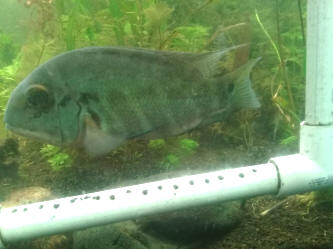
I link a photo of him currently, i hope you can see it.
https://scontent.fsal1-1.fna.fbcdn.net/v/t1.0-9/fr/cp0/e15/q65/50927156_10217745459924010_4535587938200715264_o.jpg?_nc_cat=111&efg=eyJpIjoidCJ9&_nc_ht=scontent.fsal1-1.fna&oh=5f55ffb1488e99f27eb520fe3e77fd10&oe=5CFF0E2A
Thanks, again.
<Thank you for sharing. Bob Fenner>
|
 |
|
Hoplarchus psittacus not feeding /Neale
1/23/19
Greetings crew. I hope you are doing well.
<All good, thanks.>
Im happy to say I've kept my aquariums in check for some time now. Im
writing to you today due to a rehome i accepted.
<Okeley dokeley.>
An adult Hoplarchus psittacus.
<Nice! Not a common fish at all.>
Owner didn't say much why he was getting rid of many of his fish. When it
got home i noticed maybe why:
Cloudy eyes and bloody dorsal fin, hole in the head ( mildly) and severe
stress, although, i guess any fish as big would also be very stressed. A
week in observation in a 60 gal just for him, everything cleared. Good
color, no blood, nothing. I received him well fed though, he's around 24 cm,
maybe more. After 4 weeks i moved him to the 150 gal south American planted
tank: Festivums, yellow acara, fancy Plecs, some unidentified species of big
Pencilfish ( 9 cm each).
<A better home. Sounds about right in terms of tankmates. Can't imagine your
Pencilfish are really Pencilfish at that size -- seems more likely they're
Anostomus spp.>
Problem is, while i saw him take bites out of food in the 60 gal, he never
showed much enthusiasm for food, but was very active and colorful. He
devoured plants massively though.
<Correct. They are very much like Severums in terms of diet. Omnivores, but
appreciate fresh greens. Do also try cooked peas, as well as Spirulina-based
flake foods or pellets. They should take good quality cichlid pellets too,
such as Hikari Cichlid Gold.>
Now, in the 150, he's become skittish, duller colored, and is not eating,
clearly he's beginning to become skinny, you can see a sunken stomach and
skinny areas around the dorsal/anal fins.
<One thing is to offer the fish equivalent of crack cocaine, also known as
earthworms. Most fish go wild for these, and they are both safe and nutrient
rich. Do check the tankmates too. If this fish is being bullied, he may be
off his food.>
Its been 2 weeks in the 150 and still nothing. Tank parameters are ph 7.8,
gh 10 , kh 14, temp is 25 c.
<These are soft water that probably won't be completely happy in hard
water.>
These psittacus were brought a year ago by a store and were considerably
smaller, so these have grown here.
<Good!>
Water is changed weekly ( 75%) properly treated. Water service has been cut
for quite a while, so im due 1 week of maintenance ( never been a problem,
have gone even 3 weeks, since its not overly stocked and there it is full of
plants). I tried soaking the food in garlic but nothing works, he does show
interest and sometimes takes bites but spits it out.
<Cichlids will often eat anything when happy, but nothing when stressed. So
review the environment before worrying about him being picky. Chances are
that he'll eat more readily once you figure out what's going on.>
A lot of the time is scared by other fish splashing water while feeding
furiously.
<A-ha! He's not going to like that. Green foods that he can graze at a
leisurely pace may help here, because the other fish will calm down and
leave him alone.>
He's at least 2.5 times bigger than the biggest fish, how is he scared?
<He's a fish! Not that bright! Or put another way, he isn't as confident as
you about his ability to take down the opposition.>
I have medicine for internal parasites ( Levamisole) and can quarantine
again if need be, but i would really like to know if i can try anything else
beforehand ( moving a 24 cm fish is stressful for both him and me).
<See above.>
Food used so far is flake, granules, pellets ( 5 mm size) crumbles. Maybe
try a bigger food?
<See above.>
I breed roaches for my frogs, but he isnt interested in that either. Problem
is he shows interest but most of the time he gets scared, or just spits the
food.
<Indeed.>
The other day i saw him poop and it was a normal, thick poop. Nothing
unusual. But, lately ( 4 days ago) he's started twitching his fins, caudal
and dorsal, in a way which made me reminisce of mix of shimmies with
flaring. He's also started darting, although pretty unusual. Fins are
normally extended and he moves around the whole tank, but is skittish to me
and active fish.
I link a photo of him currently, i hope you can see it.
<Nice!>
https://scontent.fsal1-1.fna.fbcdn.net/v/t1.0-9/fr/cp0/e15/q65/50927156_10217745459924010_4535587938200715264_o.jpg?_nc_cat=111&efg=eyJpIjoidCJ9&_nc_ht=scontent.fsal1-1.fna&oh=5f55ffb1488e99f27eb520fe3e77fd10&oe=5CFF0E2A
Thanks, again.
<Hope this helps. cheers, Neale.>
Re: Hoplarchus psittacus not feeding
1/23/19
Yeah, they are Anostomus now i think about it. No red fins
whatsoever though, so unknown id.
<Anostomus Anostomus and Anostomus ternetzi are the two "common" species in
the trade. If you send a photo along, I can try and ID the fish for you.
They're nice fish of course, but can be territorial, so one to watch if
you're dealing with some social issue.>
Regarding the hard water. I stay away from obligate soft water fish ( wild
discus, altums, chocolate gouramies) but i thought the psittacus would be
fine since theyve been growing in these waters for over a year, although, to
be honest, the store brought 10 of them, but i only know of 3 of them that
are still alive, we are a small community of hobbyists.
<Understood..
Do you think it is imperative to ro/ di the tank?
<No. It'll help, but good water quality is usually more important for
cichlids than the precise pH and hardness. Large cichlids are often nitrate
sensitive, so that's the thing to watch. Oh, and oxygen level.>
I have severam pieces of driftwood leaching tannins. Not sure if that helps.
This guy was in a community of big cichlids ( bocourty, vieja spp, Oscars) i
figured he would be better with me.
<Almost certainly, but still, something sounds "off" here, so would be
watching feeding behaviour closely, and adapting feeding accordingly. Cooked
peas and stuff like that can be left in the tank for longer, and shy
cichlids will slowly graze on them, even when they're otherwise being pushed
around at feeding time.>
Thanks, again, Neale.
<Most welcome!>
Re: Hoplarchus psittacus not feeding /RMF
1/23/19
Thank you for your response. Ill see to move him to the 60, but i
guess once he's fine he can be moved back to the 150? He just looked to
cramped in the 60, really.
<Yes and yes>
Regarding the hard water. Normally i stay away from obligate soft water fish
( wild discus, altums, chocolate gouramies). I thought rehoming the
psittacus would be alright since theyve been in the country living in these
waters for a little over a year and even grown. I am 100% sure nobody has
given their psittacus soft water, nobody does that here for freshwater,
although to be honest, approximately 10 psittacus were brought by the store,
and i only know of 3 of them to be still alive. Figures, hoo?
<Might be the cumulative effects of high pH....>
He was kept in a community of big cichlids ( bocourty, Oscars, vieja spp) so
i figured he would have it easier with me. Before turning another tank into
ro/di, do you think a lot of driftwood/leaves would help as much? I have
several pieces still leaching a lot of tannins.
<Yes they would help some; not as much as mixing, blending RO/DI>
Thanks, again.
<Welcome. BobF>
|
Re: Hoplarchus psittacus not feeding
1/24/19
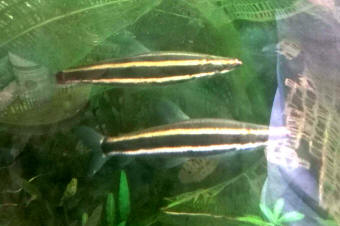
Im send you the link of the Anostomus. They are boisterous among themselves but
are oblivious to any other fish.
<I bet! Anostomus are notoriously cranky in home aquaria. They sometimes chase
similar-looking fish, but otherwise make good aquarium residents with robust
community species.>
They dont look too big in the photo, but they are. Theyve been here for over 4
years. I guess they dont have much longer? :(out of a group of 8 I've only lost
one so far.
<They live a while. My singleton has to be a good 8 years old by now.>
Update on psittacus. I did a deep substrate cleaning ( quite hard to reach every
area in such a densely planted tank). I also remembered what used to happen with
discus and low temperatures. The tank stays at 25 during the day, i raised the
temp to 28 over night. The psittacus has fed all day!
<Nice!>
Not as much as the rest but he's definitely bolder and swallowing food. No
spitting. He has taken tablets and pellets so far. Im making some room to add
driftwood right now. Lets see if he keeps eating.
<Indeed; do watch oxygen levels as you warm the water up.>
In 5-6 years this aquarium has suffered quite a few plagues due to inexperience.
Last two years have been pretty stable. Since its a planted tank it will
naturally tend to accumulate detritus and an increasing amount of decayed mulm.
I guess it would be a good idea to restart the tank?
<Not necessarily. To a degree, fish consume the decaying organic material,
particularly Anostomus, which seem to be as much detritus and algae eaters as
anything else. Rebuilding a tank can make sense, but it's not something to
undertake lightly, and does lead to stress for the fish. Of course the main
thing is that the filter is happy, so keep that running in a bucket of water so
that the bacteria aren't stressed.>
If i miss maintenance for more than 3 weeks fish start to get sick, something
which does not happen in my other tanks which are relatively more stocked. Is
there such a thing as a "sick" substrate? Holding opportunistic pathogens?
<Not really. Pathogenic bacteria are all over the tank already -- Aeromonas in
particular. Mature, deep substrates have anaerobic conditions that hold the
bacteria that get rid of nitrate. That's a good thing. When you rip up the
substrate, most of those bacteria will die, so nitrate can accumulate faster
between water changes. That's a bad thing! Another risk is you suddenly expose
hydrogen sulphide produced by anaerobic decay into the water. Assuming you
remove all the fish first, this shouldn't be a danger to them. But if you leave
the fish in the tank while removing the substrate, it's a potential danger,
especially if water circulation is poor. Cheers, Neale.>
Re: Hoplarchus psittacus not feeding 1/24/19
<These certainly look like Anostomus ternetzi to me! Nice fish, a little smaller
than Anostomus Anostomus, and generally a bit less aggressive. Neale.>
<<RMF, have attached the photo.>>
|
 |
?... Convict, Dempseys... cichlid... fdg.
4/27/12
One more thing I've been feeding my convicts With Hikari cichlid pellets
so I thought my JD's will also eat it but it seems like they are not
interested in that food so I'm thinking to buy the Hikari golden. I'm
trying to look for a type of food that the two kind of fish will eat.
What do you recommend me to buy them? Is it right if I buy them the
Hikari golden pellets ?
<I'd try Spectrum pelleted food... of a size appropriate to your fishes
sizes. Bob Fenner>
Feeding neotrop. cichlids... child
4/29/12
Hello I have a question a week ago I bought a pair of jack Dempsey I
have them in a 60 gallon tank and in another tank I have convicts . I've
been feeding my convicts with Hikari staples but when I gave that food
to the JD's they ignored soo was thinking if I can feed them with
Hikari
gold pellets?
<Yes.>
Cuz I want to buy a type of food which both fish will eat. is it fine if
I get the Hikari gold pellets or what other type of food should I buy
for them ? A food that both kinds enjoy?
<Both cichlids are omnivores, so the more variety, the better. Hikari
Cichlid Gold is an excellent staple, but you could add some meaty foods
(like prawn, bloodworms, brine shrimp, earthworms, squid, tilapia
fillet) as well as some occasional green foods to prevent bloating and
enhance their colours (cooked peas and cooked spinach are both taken,
especially if
the fish are starved for a few days before hand). Cheers, Neale.>
blue Acara feeding 3/28/10
Hi, I have 3 juvi blue Acara sharing a tank with 2 julii cories.
<Mmm, the Acaras might... in time, grow to cause troubles for the
Corydoras>
I've had them just under a week now and the two smaller ones are
eating everything I give them but the larger one is not interested in
food. He has tried flake and bloodworm once and spit them back out
right away. I don't think any food has been swallowed. He poop
looks empty and pale. This particular fish is very coloured compared to
the other two that are eating very well.
<Mmm... this raises a question re the system itself... perhaps
it's too small... the two fish being fine there, the highly
coloured one too stressed. Write back re the physical dimensions of
this tank, these fishes>
The blue on his body is always vibrant and the bars are dark. He is
somewhat shier than the other two. The tank's temperature is 80 F,
pH 6.6, natural "blackwater" from tannins in Mopani
driftwood, sand bottom, live plants, and large rocks. Any suggestions
to get this fish to eat?
<I would try some live foods... if the Acaras are big enough, simple
earthworms of appropriate size... perhaps cut into sections right
before feeding if the worms are too big. Oh... and what species of
Corydoras is this? Many prefer cooler (temperature) water...>
How long before he starves?
<Could be days more>
Your experience is appreciated.
Edey
Re: blue Acara feeding - 03/28/10
They are in a 36" long 30 gallon tank. The two smaller acara's
are 1.5" and the larger is almost 2" (and he did eat some
bloodworms today - swallowed them too).
<Ah good>
I am picking up a 100 g (6 foot) tank today and will be setting it up
for Severums. Is it advisable to put the acara's in the 100 g tank
too?
<If they're about the same size this should be fine>
The Corys were sold as Juliis. I can leave them in the 30g and lower
the temperature to 78 F if that's advisable.
Edey
<http://www.planetcatfish.com/catelog/species.php?species_id=378
Very good. Bob Fenner>
Food for green terror -- 11/03/09
Hi,
This is Pavan again from India. I have green terror juveniles.
<These are pretty fish, but they do become very aggressive when
sexually mature!>
I give them pellets, frozen prawn, dried earth worms.
<Why dried earthworms? Fresh (or live) earthworms are better -- less
chance of causing constipation.>
But I would like to give them good food so that I can watch them
growing well.
<A good quality pellet or flake, such as Hikari Cichlid Gold, should
ensure perfect health. Augment with cooked peas and spinach (for fibre)
and live earthworms and mosquito larvae (for a treat!). No need for
anything else.>
Please tell the information about what type of other food they accept.
in our place we don't have good pet stores.
<These fish are omnivores, and in the wild eat algae, organic
detritus, and small invertebrates. So you have plenty of scope to
experiment! The main thing is to avoid too many foods that are fatty or
contain thiaminase.
http://www.wetwebmedia.com/ca/volume_6/volume_6_1/thiaminase.htm
http://www.wetwebmedia.com/fwsubwebindex/fdgfdrartneale.htm
Don't take live food from ponds or streams with fish in them.
There's a risk of introducing parasites from the wild into your
aquarium. But mosquito larvae collected from a rainwater butt, for
example, is perfectly safe if there aren't any fish in
there.>
If there is something that I can prepare at home, provide it.
<Many options here:
http://www.wetwebmedia.com/ca/volume_6/volume_6_2/food.htm
http://www.wetwebmedia.com/ca/volume_1/cav1i3/Progressive_Recipe/Progressive
_Recipe.htm
>
Thank you.
<You are welcome. Cheers, Neale.>
|
Re: T-Bar Cichlid, hlth., sys., fdg....
English? 8/16/08 Hello, You told me to
raise my water temperature he seems to be a little better, like
him chasing other tank mates around. When I give him frozen brine
shrimp he tres to eat it then spits it back out. He seems to be
completely black in colour, really skinny and gets tired really
easily. What could I do to help him? Thank you for your time.
< Frozen brine shrimp has almost no nutritional value, so I
would recommend a high quality pellet food instead.-Chuck>
Re: T-bar cichlid problem thank you for your
email so what type of pellet would you recommend thank you again
for your help <Ditto this one! Please, use capital letters at
the beginnings of sentences, full stops (periods) where they
should be, and what the heck push the boat out and use commas if
you want. Cheers, Neale.>
Re: T-bar cichlid problem What type of
pellet should I get? Thank you. <There are many good foods for
Central American cichlids. Since they're most omnivores,
using a mixed diet is best. But as a staple pellet, try something
like Hikari Gold. Augment with feedings of chopped mussels (good
combo of meat and algae), tinned peas, cooked spinach and frozen
bloodworms. Live brine shrimp are fine as treats, and provide
useful fibre, but not much else. Once a week would be fine. Do
remember not to overfeed your cichlids: they will always *seem*
hungry, but they don't need as much food as they'll eat!
Overfeeding, and consequent water quality problems, especially
re: nitrate, are much more serious, leading to things like
Hole-in-the-Head. Cheers, Neale.>
Re: T-bar cichlid problem Thank you for your
email. <Happy to help.> Well I bought Hikari cichlid gold
today and I have JMC high protein fish food an frozen brine
shrimp. <Very good.> Do I need to get any other foods
because they all seam protein foods? <As mentioned before:
greens! These cichlids are all more or less omnivorous, which
means they MUST have plant food as well as meaty foods. This is
easy to cater for, as described earlier.> Thanks <Cheers,
Neale.>
Re: T-bar cichlid problem Thanks for your
email. Do t-bars eat lettuce and cucumber? Thanks <If
they're hungry, cichlids will eat anything! But lettuce
isn't recommended; it contains no nutrition at all. Much
better to go with tinned peas, or better still, strips of Sushi
Nori. You can buy Sushi Nori in bags of 10 sheets for about 1 UK
Pound (convert to your local currency) and that'll last you
months. Tear off small pieces, and attach to a lettuce clip or
use a rubber band to attach to a stone. Both Sushi Nori and
tinned peas are nutritious, safe, and very cheap (you can freeze
any tinned peas you don't use, and just defrost a few
whenever you need them). Sometimes cichlids will ignore plant
foods: don't give in! Let them starve a day or two; it'll
do them no harm and much good. Cheers, Neale.>
Re: T-bar cichlid problem 8/16/08 Thanks for
your help I will get peas because if I got the sushi Nori my Uaru
would eat it all and gard the place I put it (which it used to do
with the lettuce). <So offer both! The Uaru is a very
herbivorous cichlid, and does need regular feedings of green
foods. If you must use lettuce, don't use iceberg or anything
red or funky; use old fashioned green, curly lettuce.> How
often should I feed them peas? <As often and as much as they
want. Squishing the peas helps the cichlids figure out what they
are. Green foods do little to no harm to water quality.>
Thanks for all your help. <Cheers, Neale.> Thank you for
your help. You have helped me a lot. Thanks again!! <You are
most welcome. Cheers, Neale.>
|
Cichlid Mystery... Neotrop., sys., hlth., fdg.,
beh. 8/6/08 Re: Cichlid Mystery Wild Florida Cichlid
Problems (Chuck's Second Opinion) 8/6/08 Hello Crew, hope you
have some insight for me, for I am mystified. I have a 20 gal tank with
a single specimen Mayan Cichlid (False Red Terror). <Are we talking
about Cichlasoma urophthalmus here? Obviously this species, getting to
40 cm in the wild, is far too large for a 20 gallon tank.> < This
fish is commonly found in Florida,-Chuck> I've had it since it
was the size of a penny; he (theoretical; only going from how bright
salmon red he gets when showing off) was netted out of the actual
Everglades (where they are an invasive species), and he is now about a
year and a half old, and about 5-6 inches long. He is fed a variety of
foods: Hikari Gold cichlid pellets, dried Gammarus shrimp, dried
bloodworms, live Ramshorn snails and occasionally, live Gambusia and
Mollies from a large 65 gal Everglades tank I have in the Florida room,
also the source of the snails (and home to a 8-inch Orinoco Sailfin
Catfish that I thought was a tadpole once.) ALL his live foods are
grown by me, so I have no fear of contamination that way. <Still,
I'm leery of using wild-caught fish as food because you're
running the risk of introducing parasites that don't normally occur
in aquaria and so end up being difficult to treat. As you may/may not
know, many parasites pass through multiple hosts, for example a small
fish, then a bigger fish, and then a predator bird, then out with the
birds faeces into the pond and back to the small fish. Because this
cycle can't occur in aquaria or fish farms, these parasites
don't normally occur in tropical fish tanks. If you have a fish
that happily eats prepared and frozen foods, why take the risk?> So
far he is the textbook definition of a Mayan, charging the side of the
tank anytime you walk by, and sometimes attacking his own reflection
for hours at a time, unless he is hiding behind the huge water sprite
planted in there. <OK. These are nice fish; kept one in a high-end
brackish aquarium for a long time. They thrive in brackish/marine
conditions, and are arguably more mangrove swamp cichlids than anything
else.> I went away for 5 days for vacation, so I stuffed his tank
with snails and food fish, and had someone feed him some of his pellets
about two days before I came back so he wouldn't starve. <OK,
here's the first problem. NEVER, EVER "stock up" a tank
with food. A healthy small fish like a Neon can go a week without food
NO PROBLEMS. A big healthy fish like a cichlid can go two weeks or more
without food, and in the wild would have to periodically anyway. In
other words: it is better to leave your fish hungry during vacations
than the alternative, which is to risk overfeeding them (or having them
overfed). Too much food = too much ammonia/nitrite, and that leads to
stress.> I came back only to find him lying on the bottom of his
tank, in a hole he'd cleared out, looking the palest I've ever
seen... his eye-spot was white, and he was still for hours. He had
re-arranged his pea gravel extensively, which makes me think he might
have been looking for snails. <Hmm... more likely displacement
activity. When animals can't do one thing, because of stress or
some other factor, they will sometimes do some other, unrelated
activity. Humans biting their nails is the classic example: nothing to
do with being hungry for protein!> Much testing of water ensued, to
no answers... pH is 7.2, ammonia 0, nitrites 0, nitrates under 20 ppm,
tank temp is 78, water is general hard, absolutely nothing happening
there. <Ah, but you misunderstand. The nitrite/ammonia spike could
have easily occurred day 1 after you left, and by now the filter has
removed them both from the water, but the fish remains stressed.>
The tank is acrylic 20 gal, has an Eclipse 2 (capacity much higher than
20 gal) filter top with bio-wheel in perfect working order and seeded
with my own bacteria from other tanks., and there's plenty of
aeration in the tank. The tank water gets changed weekly along with all
the other tanks. <Still too small. These novelty filters that fit
the hood are maybe fine for small tropicals like Neons but have no
place in the cichlid aquarium. Too much space is given over to compact
cartridges contains junk you don't need like carbon and Zeolite.
Not enough space is given over to mechanical media and especially high
performance biological media (ceramic noodles). Complete waste of space
if you ask me. You should be using a decent canister filter rated at 6x
the volume of the tank in turnover per hour. For this species of
cichlid a 20 gallon tank makes no sense at all, and long term
you're going to find this fish increasingly difficult to keep
healthy.> After testing and re-testing and finding nothing to
correct, I went and fished out a few snails and threw them in, in hopes
that he'd become more animated. <No, doesn't work this way.
When fish are sick or off-colour, you don't feed them. You run the
risk of making a bad situation worse. A healthy fish -- particularly a
cichlid! -- will be begging for food once hungry.> After a few hours
and his lights turned off (on a timer, mind you), I could hear the
clicking of snail shells against the tank, so I knew he must be feeling
better. The next day, after the snails had been eaten, I tossed a few
Gambusia in there. It's been 2 days, and he is back to normal,
charging the side of the tank every time someone walks by, attacking
his food and patrolling his tank, flashing his stripes when he's
aggressive or just turning brilliant salmon if I get near... What do
you guys think happened? My theory is he might have knocked himself out
charging his own reflection, but any and all advice is greatly
welcomed. Maybe he missed me? <Suspect a water quality crisis in
your absence.> Carol <Hope this helps. Have cc'ed Chuck, our
cichlid guru, for a second opinion. Cheers, Neale.> < Sometimes
in the dark, fish get spooked by shadows. In a small tank where there
is no place to hide it could have damaged himself on an object or on
the tank himself. As per Neale's recommendation a larger tank is in
order for the best concerns of your Mayan Cichlid.-Chuck>
|
Feeding, FW 4/7/08 Hello Neale,
how are you today? I have a question for you. Is it okay to feed
my fishes every other day, or is it best to feed it everyday? I
don't want them to starve but my tank has been very dirty
lately, which means...i have to clean it :( . Anyway, thanks for
all your help. <Hi there. What are the fish? If we're
talking small tetras, Danios and the like, they should really be
fed daily, though you can safely skip one day a week. Larger
fish, particularly predators like big catfish and Oscars, can
easily get by on reasonably large meals every other day, and some
would suggest that for inactive predators (catfish, lurking
pufferfish) that this is indeed recommended. That said, I'm
not a big fan of feeding large fish big meals infrequently. I
can't help but feel that water quality is better maintained
by feeding more frequent but smaller meals (snacks, if you like).
Less protein is dumped into the aquarium at any given instant,
and therefore the resulting ammonia spike is smaller. For short
periods (up to one week for small fish, over two weeks for big
predators) most fish can go without food completely. If
you're holidaying or find yourself having to deal with
filtration problems, then not feeding at all for a while is
therefore a perfectly viable course of action. Cheers,
Neale.>
Re: feeding 4/8/08 Hi again, i have medium
sized cichlids, like firemouths and convicts. Will it still be
okay to feed it "snacks" every other day or is it best
to just feed it "snacks" everyday. Last, when you say
"snacks" how much exactly do you mean? Thanks so much
for your previous answer. <Medium sized cichlids like these
can/should be given one reasonable sized meal per day. The
standard advice holds here as in other situations: you want fish
that have gently rounded abdomens but shouldn't look swollen.
Stop feeding when the fish are still alert and looking for more,
not when they are lethargic and obviously satiated or
"full". All the food should be gone within a minute or
two. Err on the side of underfeeding. Cheers, Neale.>
|
|
Jaguar Cichlid... gen., sys.,
food 03/04/2008 Hello, I have recently acquired a
jaguar cichlid. I'm not sure how old he is, but he's
about 10 to 11 inches long. I think he is male. <Lovely fish;
difficult to sex.> The lady I bought him from said he had
killed his mate, and had been off his food for a week or so. She
thinks he killed her because up until that time, the tank had
been quite algae-filled, and the female was able to hide. The
owner decided to scrub the tank down, and that is when the female
became more visible and was killed. <Doesn't really sound
very likely, unless the algae were huge kelp-like things!> The
owner was an experienced fish hobbyist - in fact, I bought her
entire collection: 25 years worth, mostly of African cichlids,
along with a community tank and some South American cichlids. I
have them in five tanks. <Sounds nice.> My jaguar cichlid
is in a 35 gallon tank, with a little driftwood and a rock cave
which he sometimes hides in. Tank dimensions are 3 foot by 1 and
1/2 foot by 1 foot. (This is the same size he was used to before
I purchased him.) <Ah, the plot thinnens. Simply too small.
When I kept this species, it was in a 200 gallon system, and
realistically you need to be keeping them in something
"jumbo" sized, i.e., 75 gallons upwards; these are BIG,
TERRITORIAL fish.> Once he gets better I am looking to move
him to a larger tank, but don't want to risk stressing him
any further by moving him at present. <Quite the reverse is
likely to be true. Provided water chemistry is constant, and he
isn't placed in a tank with a larger, territorial cichlid --
moving him is a great idea.> I have had him for a couple of
weeks now, and have offered him all kinds of food: frozen fish
food that she had been giving him before he went off his food,
freeze dried blood worms, flakes, pellets, ground beef, raw fish,
live fish, but so far he has eaten nothing. <Well, for a
start, stop with the live feeder fish. Live foods generally, and
feeder fish especially, appear to bring out aggressive tendencies
in fish. Live fish are also parasite time bombs, unless
you're breeding your own. One of the most idiotic things in
the hobby is the use of Minnows and Goldfish as feeder fish. They
are far to high in fat and contain lots of the Vitamin
B1-destroying chemical Thiaminase. Bob Fenner (who runs WWM) has
made the point in print and elsewhere that Goldfish are then #1
cause of mortality in captive Lionfish! The ONLY safe fish
species that can be used as feeders are gut-loaded, home-bred
livebearers. Anyway, Parachromis managuensis will eat pretty much
anything when settled. Earthworms are a favourite. My specimen
enjoyed squid and other types of seafood. Oily fish was enjoyed,
by this wrecks water quality, so use sparingly and just before
doing a massive water change. Once settled down they eat pellets,
and these are truly the ideal staple, being safe and
nutritionally balanced.> I had a couple of smaller problem
fish - a minnow that was killing its tank mates and a barb that
was chewing the fins off its tank mate. I put them in with my
jaguar cichlid, hoping he might be tempted to eat them. He does
dart at them occasionally, but until this morning he hasn't
killed them. Today I found the small barb dead, floating around
the tank. The jaguar will look at it and just swim away. He might
have killed him, but it's more likely that the barb died of
stress. <More than likely territorial aggression. In any case,
this ISN'T how you solve aggression problems in community
tanks. Tiger barbs for example become nippy when they're kept
in too small a group. "Punishing" a specimen because it
is doing what its genes are telling it to do is just plain dumb.
It's a fish, not a naughty child. So, look at how many Tiger
Barbs you have, and if there's less than six, add some more.
Do also remember that Tiger Barbs are NOT GOOD COMMUNITY FISH.
This is made plain again and again in the fishkeeping press, so
there's no excuse for not being aware of this. You simply
don't keep them in [a] small tanks and [b] with slow moving
or long-finned tankmates. Fine with barbs and tetras, not fine
with Gouramis and angels.> The PH is 7.7; nitrites close to
zero, ammonia close to zero, the water is not very hard (just
above the 'soft' line when I tested it.) He has oxygen
(bubbler stone), low lighting, the temperature is around 73
degrees. <Parachromis managuensis needs hard to very hard
water with a basic pH and LOTS of carbonate hardness. I'm
guessing he's off colour and not eating because the water is
all wrong. This is non-negotiable. The pH should be 7.5-8.5,
general hardness around 15+ degrees dH, and carbonate hardness
upwards of 7 degrees KH. Adding salt and other Mickey-mouse quick
fixes are not an option. Raise the KH by incorporating lots of
calcareous media in the filter. You can also add tufa rock and
other calcareous rocks to the aquarium, but by themselves these
have a marginal effect on KH. Crushed coral or crushed oyster
shell in a nice big canister filter is the way to go. Water
changes need to be generous: these are heavily polluting fish,
and this means they produce the chemicals that acidify the water.
See here:
http://www.wetwebmedia.com/FWSubWebIndex/fwh2oquality.htm > He
seems very shy - not at all the aggressive guy I was told I was
getting. He shies away from the walls of the tank if anyone comes
near, if I stick my hand in he'll swim away, and he backs
away from any food that is dropped into the tank. <Wrong water
chemistry, and absolutely normal behaviour under the
circumstances.> I've put salt in the tank and have done a
20% water change, but so far nothing has helped. <For the
seven billionth time for people who haven't learned this yet:
aquarium salt doesn't raise hardness or pH. It is of no damn
use in a freshwater tank! Carbonate hardness comes from carbonate
and bicarbonate salts, and these are not to be found in boxes of
sodium chloride! Also, water changes should be around the 50%
mark, weekly.> His water also stinks like dead fish, not
strongly but it is there. <Sounds like too much food, not
removed quickly; perhaps under-filtered too and certainly not
enough water changes.> I'm concerned he is starving
himself to death. <He is.> He seems quite active, swimming
around and occasionally darting to the surface. <Darting
behaviour in stressed cichlids is a very bad sign.> Do you
have any suggestions about what I could do to get him eating
again? <Many many things. Please read my advice carefully, and
then sit back and read the article about water chemistry. It is
absolutely critical you understand this, because right now this
fish doomed with a capital D.> Thanks very, very much for your
help and advice! Dana <Happy to help. These are gorgeous fish,
and my specimen was a real show-stopper, but they are not
"easy" fish, and Central American cichlids generally
need very specific water chemistry conditions to do well. Cheers,
Neale.>
Re: Jaguar Cichlid, sys.
03/04/2008 Thanks for your help! I'll get him in a bigger
tank right away. I have a couple of empty tanks sitting around: a
70 and a 100 gallon, so that shouldn't be a problem. I'll
get the water hardness fixed right away too. The jag is such a
gorgeous fish, I'd have hated to have him die on me, so
I'll be onto this today. Thank you! Dana <Dana, all sounds
promising. I hope things get fixed, and you enjoy many happy
years with this wonderful fish. Mine was a sweetie, and in the
200 gallon tank not at all aggressive. Possibly was a female
though. So difficult to sex. Cheers, Neale.>
Re: Jaguar Cichlid, sys.,
food 3/6/08 Hi again, Neale, Well, I've got my
jaguar moved to a larger tank (70 gallon), with plenty of crushed
coral. The water has tested quite hard - we may need to dilute it
just a bit but it's much better. <Wouldn't worry about
diluting the water to make it less hard. Central American
cichlids like their water to be "liquid rock"! The
other thing is that messing about with RO water or whatever adds
to the effort and expense of water changes. Central Americans
really want big water changes, and that being the case, YOU want
things as cheap and easy as possible!> Nitrites, etc. are all
low. Ammonia is zero, Ph is 7.8 . Water temperature is 75
degrees. <Perfect.> Today he is moving gravel all over the
place, rearranging his aquascape to his own liking, I guess. He
hadn't been doing this for quite a long time, so I think
that's a healthy sign. <It is indeed! Well done. A happy
cichlid is a digging cichlid, that's what I always say.>
I've offered him all kinds of delicacies: frozen bloodworms,
dried bloodworms, (so far I haven't been able to find any
live bloodworms), cichlid pellets (large and small), brine shrimp
flakes, tropical fish flakes, frozen cocktail shrimp... He STILL
won't eat a thing. <Give it time. Hunger makes the best
sauce. Do try earthworms though: they're used as bait in
fishing for a darned good reason -- NOTHING is as yummy to a
predatory fish as a nice juicy earthworm. So grab a hand shovel,
go to the yard, and have a root about.> He just watches the
bits of food float around the tank, then turns away and ignores
them or swims into his rock cave. He seems active and curious:
watches people as they walk past his tank, but quickly backs away
if anyone actually approaches him. <The curiousness is
excellent and precisely typical of happy Guapote cichlids.>
What can I do to interest him in eating again? Why would he be
starving himself when he seems otherwise healthy and active,
though maybe a bit timid for a jaguar? <Jags are timid;
it's a myth I think that predatory cichlids are aggressive
cichlids -- quite the reverse in fact. Predatory fish need to go
about their business unnoticed, or their prey would see them.
Worse, if they got into a fight, their delicate jaws would be
damaged. So predatory fish tend to back off rather than go
looking for fights. This holds for Guapote (what yours is), for
Pike Cichlids and of course for Oscars. Compare with omnivorous
or even herbivorous cichlids like Tilapia and Mbuna or even Kribs
-- for their size, these fish can be incredibly punchy. In any
case, make sure you have lots of hiding places (remember the
Golden Rule: the more a fish can hide, the less often it will
choose to do so). Floating plants such as Indian fern will also
make a big difference, though those big 36" plastic plants
are probably going to be easier to use in a large tank with a
strong filter.> I really appreciate all your help and
suggestions. I'm very new to the whole cichlid scene, though
I've done community tanks for a few years. <Ah, welcome to
the Cichlid Club! Cichlids really are fish that become members of
the family; they're smart and they become tame. When I looked
after my Jag it was in a display tank in a lobby area, and
we'd arranged some chairs nearby. People would go get coffee
from a machine in another room and then come sit by the tank so
they could spend a couple minutes "chatting" with the
Jaguar and the Midas Cichlid that also lived in there. The two
cichlids would go to the ends of the tank and hang out quite
contentedly, apparently enjoying the attention (or perhaps trying
to get out and kill the big gangly apes threatening their
territories!). Anyway, do try the earthworm trick, and also
remember these fish hunt at dusk and dawn, so feed first thing in
the morning or last thing at night.> Dana <Cheers,
Neale.>
Re: Jaguar Cichlid
Earthworms? Umm... This is Canada: the frozen North! To reach an
earthworm, I would have to hire a bulldozer. I'll look up
fishing stores and see if they have any. Thanks again!! Dana
<Hello Dana. Surely you're can't be much further north
than I am here in the UK? But I guess those darned polar winds
make a difference. In any case, yes, earthworms should be
available from a bait shop. And you can actually grow your own!
Earthworm "farming" is a hobby of sorts here in
England. There's an excellent little book called "The
Earth Moved: On the Remarkable Achievements of Earthworms"
by Amy Stewart all about what earthworms do, why they matter, and
at the end of the book, how to care for them. Fascinating stuff!
Cheers, Neale.>
Re: Jaguar Cichlid 3/7/08
Hi Neale, I don't know whether or not we're further North
than you are, but the ground is frozen solid and we're
expecting another 60 cm. of snow over the next 36 hours.
<Yikes!> Happily, there are bait and tackle stores that
sell worms for people who brave the elements and go ice fishing,
so I'll be headed out there after work this afternoon.
<Very good.> The jag is still digging and digging and
attacking his bubbler. He sure doesn't look sick, though he
is much thinner than when we got him. I have no idea how he stays
alive after a month without food. <He's a fish, and in the
"dry season" likely has to make do with very little
food.> I'll let you know whether the earthworms do the
trick. <Yes, please do.> Thanks again, Dana <Cheers,
Neale.>
Re: Jaguar Cichlid --
03/10/08 Hi again Neale, Here's the jaguar's dietary
report: he pays no attention to food whatsoever, including
earthworms. I tossed one of his rejects into a different tank for
my smaller cichlids and almost started a war. The worm was gone
in seconds. I have a fresh one hanging from a suction cup at the
side of the jaguar's tank, but he ignores it completely. I
thought if I hung it from the wall of his tank, he might notice
it more, rather than having it hide in the gravel like the last
ones did. He is still moving a lot of rock, swimming around and
investigating everything, and ducking into his cave regularly,
but he's just not going to eat. If you think of anything else
that might help, I'm very open to suggestions. Thanks, Dana
<Hello Dana. I can't think of any "quick fix"
here except to try as many different things as you can. If the
fish is otherwise behaving normally, there may be something
sapping his appetite. Bloating, constipation and Hole-in-the-Head
all start with a loss of appetite, so consider those options,
since all are quite common in cichlids. I'd perhaps treat for
Hexamita/Hole-in-the-Head proactively, just in case. This disease
is much easier to treat before the symptoms become established
and obvious. I'd then run something laxative through the
system, such as Epsom salts (see elsewhere on WWM for the
details). If these don't help, then something systemically
anti-bacterial like Maracyn would be a good idea. All this said,
he may simply [a] not be settled and [b] not wild about the foods
being offered. Time and variety will fix this. A risky option
might be to introduce some other fish of comparable size but
sufficiently durable they won't be harmed. Often fish that
are reticent about feeding become bolder when they see other fish
"take the bait". This is standard practise in marine
communities for example, where damselfish fulfill this role
admirably. Cheers, Neale.>
|
Tips For Keeping Large Cichlids 2/16/07 I
received your last e-mail and was a little disappointed that the answer
I was looking for could not be found. I understand that I
placed a new Green Terror in with highly aggressive fish, but I also
heard that Green Terrors knew how to fend for themselves. I
named mine Wimpy. When I first placed my Pike in with the Jaguar, Red
Devil, Jack Dempsey, and Convicts, the Pike (being of similar size)
made it perfectly clear that he was not scared of jack %$#&! Sorry
if that is not acceptable on your web page, but it's the truth. I
assumed things would be similar with the Green Terror, but no such
luck. So here's the thing. I already asked this question
but received no clear answer. If I trade in my Green Terror
for another fish, what types of fish should I consider, that are
aggressive enough to protect themselves. Oh, and I'm not quite sure
what size my tank is, it's actually my boyfriends (he's in jail
so I can't ask him either), but it's really big, and there are
alot of plants and rocks to hide in. In fact, I think there is too much
extra space and I should buy more fish. Will ponder this idea a little
longer though. Also, you said that it was a bad idea to feed
them feeder fish...I don't quite understand
why. I've read that those types of fish ~love~live food.
I've also been feeding them Tubifex worms, and cichlid pellets, is
this wrong as well? Please educate me on what is appropriate food for
my cichlids. Thank you. -Marie < All cichlids are
territorial to some degree. When ever you add a new fish to a cichlid
tank he needs to be big and strong enough to establish a territory.
Sometimes this means he needs to take one away from another fish. Most
of the time the fish that already in the tank will be the winner. The
loser new fish is soon pushed around by all the fish and gets beaten up
in the meantime. The best way is to start with a group of smaller fish
and try to raise them all together. Smaller fish can inflict less
damage and they soon establish a pecking order and the tank stays
relatively peaceful. Older fish are already set in their ways and have
teeth that can inflict damage. It is much more difficult to mix bigger
and older cichlids. Larger fish are usually offered as trade-ins to
fish stores so you will probably have fish like Oscars as the most
common choices. The green terror was not a bad choice. It just needs to
be bigger than the other fish. Next time when you add a new fish you
need to move all the rocks and ornaments around, add the new fish and
turn off the lights for the night. In the morning all the fish will be
busy trying to establish territories and the new fish will have a
chance as all the fish compete with one another. You have a very large
tank. Feeder fish carry diseases that can be transmitted to your
aquarium. To successfully treat your aquarium could cost you
40$/50$/60$ on medications depending on its size. Feeder
fish are a disposable commodity and are fed just enough food to barely
keep them alive. They have very little nutritional value. A better
choice would be a good quality sinking pellet. Live foods such as
earthworms, crickets, mealworms, waxworms and kingworms probably would
all be relished by your fish. Just feed once a day and make sure that
all of it is eaten in a couple of minutes.-Chuck>
Jack Dempsey Hooked On Blood Worms 11/27/06
I have a 2 inch electric blue jack Dempsey and he is in a 60 gallon
tank. He has been pooping stringy white for several days. He is eating
fine (although he refuses to eat anything but bloodworms) and moving
around fine. Water tests all measure zero for ammonia, nitrites, and
nitrates. No signs of ick on him or other fish in the tank, and the
others poop the normal brown/black poop. Is the poop from eating only
bloodworms or is it reason to be concerned about something else? Thanks
for your help, Kelly < Don't feed him for three days then offer
a few blood worms with some other foods like Spectrum pellets. Over
time his blood worm only diet will cause problems.-Chuck>
Cichlids not eating 11/21/06 Hello, I
have a 75 gallon tank which houses a 10 inch Oscar, 7
inch Jack Dempsey, and 6 inch Jaguar cichlid. The
past three days both the Jack Dempsey and Jaguar Cichlid
have been acting weird. When I go to feed them both of
them and the Oscar get excited and come to the top of the
tank. However when I drop the food in both
the Dempsey and the Jaguar eat and then spit out the
pellets. It seems as if they don't want the
food. I've been feeding them Hikari
gold pellets and freeze dried krill. They usually
love both types of food until the past few
days. I waited a couple of days in hope that they
would take the food from hunger, however they have
not. The Oscar is acting fine and eating well and not
bullying the other two. All of my water levels are
fine. There are no other signs of problems with
the fish and they are swimming around
just fine. What could have cause both of these
fish to suddenly dislike their food? Thank you
for your help. Jim <Mmmm, good reporting of
your observed facts... It may be that there is more bullying going on
than you realize... The fact that the Oscar itself is still feeding
leads me to believe it is not the food itself that has become
unpalatable... I suggest you separate the Oscar to check the aggression
hypothesis. Oh, and just in case there is some sort of non-measured
metabolite anomaly at play here, I would do some good-sized water
changes (25%) or so, every few days. Bob Fenner> Loui, the
Red Devil... not feeding 11/14/06 Hi: <<Hi,
Daniella. Tom here.>> I'm wondering if you can help
me. <<I'll give it my best effort.>> Loui
Lucifer is our red deviled cichlid. <<Red Devil Cichlid. Just a
little help. :) >>>> He is a 10' male in 47 gallon
tank. <<10' (inch), not 10' (feet). My apologies,
again.>> He used to have a lot of energy and was very
temperamental. (I couldn't keep anything in my tank or else he
would kill and eat it). <<Definitely a Red Devil
Cichlid! Not unusual for this fish at all.>> Within the last week
he has changed. He does not eat and he stays in one corner
in the side of his tank. He hasn't touched his feeder
fish. <<Too many feeder fish isn't recommended.
They're not a good part of a Cichlid's diet. They're not
nutritious and can introduce disease(s) into the tank. Yes, Cichlids do
feed on fish in their natural habitat but these aren't the same
fish we buy at the store.>> I can't notice anything unusual
about his appearance except he has turned a much brighter range in
comparison to before. He's much paler. We have tried
feeding him blood worms thinking that he might need a change in diet.
<<A variation in diet is excellent but I don't
think this is the problem.>> He hardly swims and appears
extremely depressed. We have done a 25% water
change. The pH level is about 8 and I'm not sure what
the nitrites are but am taking a sample in. <<Very
good! Ask them to check ALL of the parameters including ammonia,
nitrite and, particularly, nitrate levels. Cichlids are not very
tolerant of nitrate levels over 20 ppm (parts per million). We, in the
hobby, think of levels up to 40 ppm as being 'safe' but this
isn't necessarily true for Cichlids. The lower the levels are, the
better.>> The feeder fish we bought 2 weeks ago are still alive
and had appeared to have ich on them. Would this have an effect on Lou
and why he is not eating? <<Hopefully, Lou will not
eat a fish infested with Ich. (I wouldn't!) Unfortunately, the fact
that the 'feeders' have Ich means that Lou is liable to get it,
especially in the state that he's in. Please, research our site
regarding the use of aquarium salt for treating Ich. Much as it bothers
me to say this, your Cichlid comes first. Treat your tank with Lou in
mind and forget the feeders.>> Could he have an internal
infection from these fish? <<Again, Daniella, this is
entirely possible. Without more information, it's very hard to say
what might be wrong with him. There are many good foods available for
your fish. Stay away from 'feeder fish' for the time being.
There are just too many problems associated with them.>> Help. We
are really worried and don't feel he's going to make it.
<<Keep doing regular water changes to reduce possible high
nitrate levels. Use aquarium salt and heat to get rid of the Ich
problem. Make sure that you vacuum the bottom of the tank, or
substrate, during water changes. This will help in ridding the tank of
Ich and nitrates. It sounds like Lou is big and, otherwise, healthy.
Hopefully, what I've suggested will bring him back to his
'usual' self. Good luck, Tom>>
Jaguar feeding question
5/28/06 Crew, First off, many thanks for this great site. It's
helpful in more ways than you know! My question: I have a 12"
Managuense. I have fed it feeder fish although I know I'm not
supposed to because of the dangers. I did a search on the site and
couldn't find anything about what to feed it. I have read large
sticks and things like worms and stuff but do you have a more precise
diet? <Mmm, "cichlid" et al. pelleted and stick foods,
earthworms, mealworms, cut meat in moderation, fish flesh...> It is
becoming quite expensive to feed him feeders so your expertise is
appreciated. Thanks much, Matt <I'd cease with the feeders...
Bob Fenner> Gold Severum Not Eating
2/17/06 Hello, I have a large Golden Severum in a 55 gallon tank
with a Smaller Green Severum and a few other fish, 5 other fish to be
exact. My Golden has stopped eating and his fins are a bit clamped, but
shows no other sign of stress. All the other fish are fine and seem to
be getting along well. The only thing I did notice is that the Green
Severums markings have become much more pronounced. This has been going
on for about a week now, and I am becoming a bit worried about his
health. Once again he does not look to be "sick" just not
eating. One more thing, I have tested the water, and done a partial
water change, but there doesn't seem to be any water quality
problems. Thank you Guy Clemency < I think your gold severum has
been sick for a week and the smaller severum is becoming more dominant
as the larger one has become sicker. Not eating and clamped fins are
not good. I would recommend isolating the fish in a hospital tank and
treating with a combination of Metronidazole for internal infections,
and Nitrofuranace for external infections. Follow the instructions on
the packages.-Chuck>
Red Devil, refusing to eat We have a Red Devil ..it is pink.
it use to eat real good with the pellets we fed it and some worms once
in awhile ..but now it will not eat and it has become more aggressive.
we have this big rock in the tank with the fish and it has become so
obsessive of it.. <The aggression and territoriality are normal;
this fish did not earn the name red 'devil' for
nothing. How big is the tank? What are its
tankmates?> can't get it to eat at all ..we drained the tank
half way and put clean water in thinking that might be it but no
change.. <Even better than that (well, nothing's better than a
good water change, really), please do test your water for ammonia,
nitrite, nitrate, and pH. More than likely, something's
out of whack and making him not feel well. Also, did you
dechlorinate your tapwater before putting it in the
tank? Did you match the temperature in the
tank? How often do you do water changes, and vacuum the
gravel? What kind/how much filtration?> We need some help
...we need to know what we can do to make it eat. it wont have anything
to do with goldfish either ..chase it and that's about it..
<Well, first off, goldfish aren't a very good food choice, and
pelleted foods aren't the best, either. Try tempting him
with some frozen meaty foods, like bloodworms, or Formula One
food. Perhaps try bits of cocktail shrimp, as
well. Failing that, try soaking any of those foods in garlic
juice (McCormick makes a water-based garlic extract that you can find
in the spice rack at the grocery store, or you could also use garlic
gel caps from the vitamin aisle - poke a hole in one end with a needle,
and squeeze the oil onto the food, let it soak in). This may
help entice him to eat.> Hope you can help Marilyn <Hope so,
too. -Sabrina>
Colombian Acara not eating Hi guys, I'd like to say
thanks to Chuck for his advise on stocking!! I have a new question
about an unpleasant situation concerning my gorgeous new Colombian
Acara and his loss of appetite. Here's my set-up: 75
gallon(48x18) - Fluval 404 - PH 7.4(straight from the tap - I don't
adjust it) -TEMP 77F Lots of rock and wood for caves and territories
Fish: Blood Parrot - 4" Gold Severum - 4" 4 Penguin tetras 4
Giant Danios Red-Tail Shark -2 1/2" New additions(9 days ago):
Green Severum - 2" Convict - 2" Colombian Blue Acara - 3
1/2" Here's what's happening: I moved from a 30gal to this
75 and waited for it to cycle (with the fish from the first group). I
seeded the tank with stuff from the 30, so it only took a week. But the
nitrites didn't rise more than 1ppm, so I think I wasn't
stocked heavy enough for a good cycle. Anyway, after waiting to be sure
of stable conditions, I then added the Acara, green Severum and convict
together all at once(9 days ago) so as to divert aggression from my
larger gold sev. and parrot. The convict harasses the green Severum a
bit, but the green sev. still eats and hides with the bigger guys who
tolerate him, and will grow big enough to stand his ground. My problem
is with the blue Acara. During the last 3 days, I noticed that he
isn't eating (rejects whatever he takes in his mouth), and is
starting to get harassed from the convict, who must sense that he is
sick, because the Acara used to chase him and is much bigger. He
doesn't seem very active, except when the convict is chasing him.
The Acara was bold and hungry for the first 4-5 days or so. The
following is noteworthy: 1) I noticed ich on the green sev on the 3rd
day, so I medicated with Quick Cure for 3 days (removed my penguin
tetras to a smaller tank and half-dosed them) until the signs went
away. If I'm right, I should do another 2 or 3 day cycle after
waiting 5 or 6 days? < If you really have ich in your tank, then
that could be a problem. While looking for little white spots on the
fish you must realize that the parasites are attacking the gills too.
Some other symptoms would be fishes dashing against a rock or sand too.
What for the white spots at treat accordingly.> 2) increased the
temp from 77 to 80F to speed up the ich, which is now back down to 77(I
thought that maybe the higher temp was making my Acara uncomfortable?)
< All your fish could easily handle 80 degrees. This would help
combat the ich too.> 3) the tank had a mini cycle after the
additions which ended yesterday after nitrites reaching 1ppm(I have
done 25% water changes for the past 2 days and now my amm. and nitrites
are zero) So, I'm hoping that one of the above is the cause. Maybe
sensitivity to the Quick Cure? < The Acara may have been weakened by
the ich but usually they are not too sensitive to the medication. Watch
out for the medication affecting the bacteria bed. Check ammonia for
spikes.> Maybe acara's are really sensitive to nitrites? <Not
really> Or maybe a parasite from the beginning? the Acara ate just
fine for at least a couple of days though). Your advice would be
greatly appreciated. I was told that acara's would be okay with a
convict. This Acara has the most colourful finnage. I'd hate to
lose him. If it's a case of not being able to live with a convict,
I'll take the con back even though he is really cool eats up every
scrap). What can I do to assess the acara's condition? <
Seperate the Acara from the rest of the tank. Keep him at 80 degrees.
Offer him some small washed earthworms. If he doesn't eat them then
there is a problem. Watch for additional problems and stay in touch. If
he eats the earthworm then fatten him up for a couple of days. Before
you put him back into the main tank you can rearrange the decorations
add the fish back into the tank and turn off the lights for the night.
In the morning all the fish will be busy trying to establish new
territories and may not pick exclusively on the new guy. You convict
comes from Central America and is well known for being aggressive. If
the problem persists then either the Acara needs to toughen up or you
will need to get rid of the convict. maybe more decorations are needed
in the way of rocks or driftwood.> And should I add aquarium salt
for stress relief? < Salt will increase that slime on the fish and
not much else> I must apologize that most of my info has come from
research on the net - I still lack the knowledge of experience!!
(I'm definitely over-sensitive). I've only been at this for 6
months. Should I just wait it out? < Your blue Acara can only take
so much abuse. They can go a week without eating but damaged fins
don't grow back nearly as nice. -Chuck> Thanks again for your
advice! Corey Cormier
Frelling Red Devil! Hi! I was wondering if you could
help me with an issue that I am having with my Red Devil. He is an
adult male, and approximately 10 inches in length. About a week ago I
put him in a new 60 gallon aquarium and now he has not eaten in a week.
The pH is set proper and so is the temp. I have tried all the foods he
normally eats and then some. He still won't eat. I thought that it
may be because he is still getting acquainted with his new
surroundings but I don't feel like it should take this long. What
do you think and do you have any answers that may help me save my fish?
He is active and still moves his gravel around. How long can he go
without eating? < Cichlids in general are territorial and seem
to be more shaken up by a change in surroundings then most other fish.
A couple of things come to mind. If the tank is in a new location then
additional foot traffic may make him more reluctant to come out.
Brighter colored gravel may make him more obvious and once again more
reluctant to come out. Try some washed earthworms to get him going. If
the temperature is around 80 then he can probably go a couple of weeks
without too much suffering.-Chuck> Ron Sankary
Jaguar Cichlid Hi. I just recently purchased a very large,
I'd say about 9 inches long, African Managuense. I have never seen
one this big before that's what tempted me towards the purchase! I
am not sure though how much and how often I should feed this species
especially considering this size? His second day at home in his new 45
gallon tank he ate all 10 large goldfish that I brought home! Is 10
goldfish in one hour too much? When do you suppose I feed him a gain?
He is a monster but I don't want to under or over feed based on his
size. Any suggestions on the frequency and amounts for feeding? Thanks!
Chris <Hi Chris, Don here. Please make every attempt to get him off
feeder fish. Sooner, NOT later you will bring in Ick or worse. You can
feed him garden worms as a treat. Many good pellets and sticks out
there for large cichlids. Cheaper than feeders, far safer and better
food value. But I'd wait three or four days before feeding him
again. After ten goldfish he needs a break. Get him good and hungry
then try the sticks. Feed as much as he will eat in five to ten
minutes. You should feed a fish this size every other day. Siphon out
any leftovers and test the water. He will foul it quickly. This fish
can hit sixteen inches, you will need a much bigger tank for him in the
future. BTW, he's not African but from Central America. Read here
http://fish.mongabay.com/species/Cichlasoma_managuense.html
Don>
Green Terror Growing Up 8/31/05 My baby terror has a
faint red outline on its tail fin, does that mean its a male? < The
red may be based on genetic factors as well as environmental factors
too. I have seen no reliable indication that a tail color indicates the
sex of the green terror.> What kinds of foods do you recommend so
that my terror will grow big and beautiful? < Spectrum pellets,
Marineland pellets, OSI flake, and some earthworms when he gets
larger.-Chuck>
Pleco feeding Hi, Thanks for your help. I took your advice
and got two pleco's to go in my tank with my Oscars and Severums.
Everyone is still quite small ( Oscars are already bigger than the rest
). I never see the pleco's eating ( one is Gibbiceps Pleco and the
other is a Gold Nugget ), so at night night I place some algae wafers
and cucumber slices in the tank. <Good idea. Do you have a bit of
sunken "driftwood" in the tank? A very useful adjunct to
these Suckermouth South American Catfishes nutrition.> I noticed the
Oscars and Severums like these foods as well and my question is : Am I
over feeding the Oscars and Severums by leaving large pieces vegetables
in tank overnight ? <No worries... these materials won't cause
them trouble (unless there's so much in the system that it
rots)> I know about the 5 minute rule...but Am worried about the
pleco's not having a chance to eat if I don't leave the food in
overnight. The tank is a newly cycled tank and is very clean. Thanks,
Adam <Do keep an eye on ammonia for a few weeks more... and start in
with regular (weekly, biweekly...) gravel vacuum, water changing, etc.
Bob Fenner>
Jack Dempsey that won't eat <<Greetings, JasonC
here...>> I've got a 5.5" Jack Dempsey Cichlid that
I've had for nearly four years that won't eat and exhibits a
disturbing reaction when offered food. He will go up to the food, look
like he's going to bite it, and then back up and shake his head. He
also scratches himself on the gravel sometimes. He's never been
anything but a voracious eater in the past and has been growing like
crazy since I moved him into a decent sized tank (he grew an entire
inch in last month). His colors are brilliant and he looks perfectly
healthy, though is very shy (used to eat from my hand, now hides behind
rocks). <<How long has it been in this new tank... could just be
making the adjustment, or perhaps doesn't have sufficient places to
hide.>> I've tried everything I could think of: flakes,
pellets, chicken, beef, tuna, bloodworms, live fish. The only thing
he's shown any interest in was a baby puffer fish that was in a
temporary tank with him for a few hours, and luckily my girlfriend
pointed out that puffers are poisonous. <<Lucky is right.>>
He shares the tank with a baby Managuense Cichlid that is behaving
normally, though they both have decided to move most of the gravel to
one side of the tank. <<Any chance of separating these two? Just
on the odd chance that the Dempsey doesn't want to share, or
perhaps feels a threat from the smaller fish.>> I've been
cycling the water very frequently (every four or five days) in case
water quality has been lacking. I've also examined him for external
signs of disease and even peer down his throat, nothing looks awry.
<<Do check your water chemistry... make sure the pH isn't
off. You just want to make sure you aren't introducing the problems
in your source water.>> It's been about three weeks since
he's eaten and I'm pretty stumped, any ideas would be much
appreciated. <<You might also try some live bait food, like night
crawlers, ghost shrimp, or perhaps even a crayfish. Something to
attract interest.>> If there's any information I left out
I'll eagerly supply it. Thanks, Nathan French <<Cheers, J --
>>
Re: Jack Dempsey that won't eat Wow, thanks for the
speedy response. <<You are quite welcome.>> Answers to your
questions: 1. He's been in the tank for about five months. It used
to have a small firemouth, juvenile green terror, and jewel cichlid
(the first two are currently recuperating elsewhere, the jewel
committed suicide but that's another story) but now it's just
him and the Managuense. I will try adding some more things to hide
behind, I removed a large lava rock when he started getting shy in
hopes he'd stop being a "rockfish." 2. I don't
believe he's threatened by the Managuense, it's half his size
and he routinely bullies it. If they weren't separate species
you'd think they are a mated pair, they stay together and attack
other fish together. The Managuense has never once attacked him so
I'm not worried about it. 3. I haven't tested the water quality
and I probably should. <<I agree.>> I've never worried
about it in the past because I keep mostly cichlids and they tend to do
well in the local water supply (medium-hard, fairly neutral).
<<Ever test for chlorine/amine? Do you let your water sit for a
couple of days before adding?>> I've been picking up some
non-cichlids lately though so it may be time to get a little more
serious about water quality. Also you didn't touch on the
gravel-scratching behaviour. <<No, I didn't... you mentioned
in your previous email that you had checked it over and all seemed
well.>> He seems irritated, which is why I suspected parasites
early on but just haven't found any. <<Well, you could still
treat as if there are parasites.>> I've been thinking of
giving him a salt bath, is there any risk to this? <<You mean
like the opposite of a freshwater bath for a saltwater fish? I'm
not familiar with the procedure for freshwater fish. It would
'seem' like it might work, but I'm not at all sure what the
affect would be on your fish. I'll do some more checking around...
in the meanwhile, keep up the observation and perhaps consider
quarantine and treatment with other treatments if a parasite shows
itself.>> Thanks, Nathan French PS: It turns out the (dwarf)
freshwater puffers I have aren't poisonous, but still they're
too cute to become feeder sacrifices. <<Good enough. Cheers, J --
>>
|
|