|
FAQs on Neotropical Cichlid
Identification
Related Articles: Neotropical Cichlids, Central American
Cichlids by Neale Monks, African
Cichlids, Dwarf South American
Cichlids, Cichlid Fishes in
General,
Related FAQs: Cichlid Identification, & Neotropical Cichlids 1, Neotropical Cichlids 2,
Neotropical
Cichlids 3, Neotropical Cichlid
Behavior, Neotropical
Cichlid Compatibility, Neotropical Cichlid Selection,
Neotropical Cichlid Systems,
Neotropical Cichlid Feeding,
Neotropical Cichlid Disease,
Neotropical Cichlid
Reproduction, Convicts,
Oscars, Firemouths, Texas Cichlids, Severums, Triangle
Cichlids, & Cichlids of the
World, Cichlid Systems,
Cichlid Identification, Cichlid Behavior, Cichlid Compatibility, Cichlid Selection, Cichlid Feeding, Cichlid Disease, Cichlid
Reproduction,
|
|
|
Help identifying my fish 6/13/18
Hi,
Could you please help me identify this fish? I’m thinking cichlid but what kind?
Any help is much appreciated!!
Veronika
<Hello Veronika. I thought it had a vaguely Neotropical, even Geophagine aspect
to it, but when I showed your photo to cichlid expert Mary Bailey, she wasn't
convinced! I think it's too young and generic-looking to be easily identifiable.
Many cichlids have this sort of shape and colouration when small, and there's a
lot of convergence, with cichlids from one part of the world looking a lot like
cichlids from someplace else. On top of that, there are so many hybrids in the
trade, some fish are truly un-identifiable -- at least, not without a DNA
analysis. So yes, it's a cichlid, but beyond that, who knows? Sorry can't be
more useful than that. Cheers, Neale.>
|
.jpeg) |
|
cichlid identification /RMF 3/29/15
hello,
<?>
can you identify this cichlid, when I purchased it, it was listed under the
scientific name and I don't remember what it was, it was also the only one in
the tank, it's about 2.5 inches
thanks,
Curtis
<My man! Perhaps you should look under "Acara". Bob Fenner>
cichlid identification /Neale 3/29/15
hello,
can you identify this cichlid, when I purchased it, it was listed under the
scientific name and I don't remember what it was, it was also the only one in
the tank, it's about 2.5 inches
thanks,
Curtis
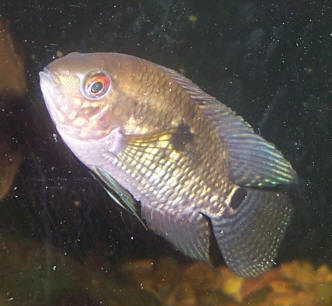
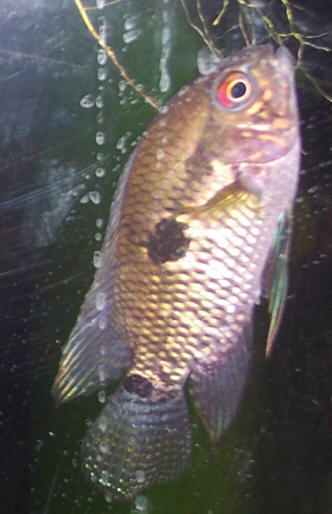
<It looks like a young Cichlasoma portalegrensis, often Aequidens portalegrensis
in older aquarium books. But it might also be Cichlasoma bimaculatum, a
similar-looking species, at least when young. Telling the two of them apart is
difficult, and they're both frequently sold as "Port Cichlids" or "Port Acaras",
and aquarium hybrids probably exist as well, not to mention a slew of lookalike
species that aren't deliberately imported but probably do turn up from time to
time as contaminants in South American fish shipments. But let's try and tease
the two main species apart a bit. True Cichlasoma portalegrensis have iridescent
scales on their brownish flanks, yellow/orange pectoral fins, lots of blue on
their pelvics and unpaired fins, and two distinct eyespots, one midway along the
body and the other on the caudal peduncle. Cichlasoma bimaculatum are similar,
but
much less iridescent on the flanks. So some folks would say of the two,
Cichlasoma portalegrensis is the pretty one, while Cichlasoma bimaculatum is the
plain one. Even so, the most reliable way to tell them apart though is counting
the anal fin spines: only 3 on Cichlasoma portalegrensis, but at least 4 on
Cichlasoma bimaculatum. Anal fin spines are the hard spines
at the front of the anal fin, different from the softer rays that support the
majority of the fin membrane. Yours would appear to have 3 from the photos, but
it's hard to tell for sure, so I'll leave you to figure this one out. In any
event: both fish are not very big (15-20 cm under aquarium conditions) and tend
to be pretty easy going outside of spawning. They're good choices for
rough-and-tumble community tanks, and Cichlasoma portalegrensis in particular
was a real old-timey favourite in Europe until the 1970s, when more colourful
and delicate species became established. I'm cc'ing this to our cichlid expert
Chuck in case he has any better ideas.
Cheers, Neale.> |
 |
|
Re: cichlid identification
3/30/15
thanks guys
<Welcome. NM.> |
|
Neotropical Cichlid ID
9/24/14
Hi,
This is my unknown fish, can somebody please help me indentify
him.
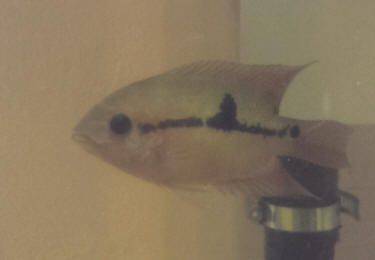
<... appears to be Hypselecara temporalis. Chocolate Cichlid.>
It was sold to me as a Firemouth, as it started to grow I started to
doubt it because its so different from the others.
Really appreciate any help given.
Tks
<B>
|
 |
|
Questions regarding type of cichlids
8/18/12
Hi
<Hello,>
I was hoping you could help me identify these two cichlids I recently
purchased. They were labeled as convicts in the store but clearly seem to be
different species.
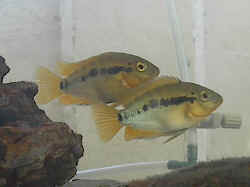
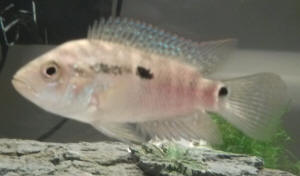
<You are right, neither of these are Convicts. The dark-grey one with the
blue spots is a Jack Dempsey (Rocio octofasciata). It's a waspish,
territorial species that develops beautiful colours and gets to around 20
cm/8 inches in length. The lighter coloured one is a "Cichlasoma" of some
sort, I'm tempted to say "Cichlasoma" trimaculatum but it could be something
else. I'm bcc'ing Bob and Chuck here so they can chime in with any better
ideas. One problem is that there's a lot of hybridising in the US hobby
especially, where aquarists keep "one of everything" with the end result
that any fry they take to the pet store are all hybrid offspring. Some of
these hybrids, like Flowerhorns, have become popular in their own right, but
then again, hybrids aren't what you want if you're after predictable sizes,
coloration and behaviour.>
The first picture was first one in the tank and then once the other one went
in they started fighting.
<I bet. How large is the aquarium? I hope 100+ gallons, because these two
won't place nicely. Indeed, apart from one or two docile species (Rainbow
Cichlids in particular) most Central American cichlids are somewhere on the
"psychopathic" scale of aggression, and must be given space. Successful CA
cichlid communities tend to be very large; my collection lived in a
200-gallon system with an external sump and filter.>
I am very new to having cichlids
<Now, while Central Americans are tough, hardy fish, and potentially
suitable for beginners, you do need to understand their needs for space and
reasonably hard, alkaline water. Furthermore, like all cichlids, they are
acutely sensitive to dissolved metabolites, not just ammonia and nitrite,
but nitrate as well. When nitrate levels rise above 20 mg/l, which is easily
done when keeping big, greedy fish, their immune system seems to weaken -- a
lot -- and problems with Hexamita and Hole-in-the-Head are very common.>
and separated them after a few days once one of them seemed to have been
wounded. Now that they are apart one seems much happier and is swimming
normally. The other though, the one who was not injured and seemed to be the
aggressor, is now hiding behind a rock and will not come out. He was so
aggressive when with the other one but now seems depressed. I was
hoping you could help identify what they actually are and what other kinds
would be compatible, if any. Thank you!!!
<Most welcome, Neale.>
Sent via the LG Nitro™ HD, an AT&T 4G LTE smartphone
<Jeez, as if the "from my iPhone" thing wasn't annoying enough!!!>
|
 |
|
Fish ID Help!!! Guapote
6/3/2011
We had this fish come in with the feeder goldfish a few months
ago, and I noticed immediately that it was Not a feeder goldfish.
I placed him in our quarantine system, and he has grown
substantially. I was wondering if any of you guys had seen one
before, or had an indication of what species it is. I have
searched through all of my books as well as online. Thanks for
your help!
<Hello Mitchell. Assuming you're keeping this chap in
coldwater, and that you're in North America, my first guess
here would be that this is one of the Centrarchidae.
http://64.95.130.5/identification/specieslist.php?famcode=302&areacode=The
genus Micropterus, which Americans often call "Bass",
look rather similar to this fish. But to my eye, the dorsal fin
is wrong; on Micropterus the first and second dorsals are clearly
separate, but this chap seems to have them fused together, more
like what you see on cichlids, where the first dorsal is the
spiny bit and the second dorsal the soft bit.
So perhaps it's a cichlid, but a cichlid wouldn't be
thriving in water below 18 C/64 F, and most need substantially
warmer water than that to remain healthy. Still, it does resemble
the Central American predatory cichlids known as
"Guapote", for example, Petenia splendida, a species
famed for its astonishingly expandable mouth capable of
swallowing quite large prey in one suck. The other Guapote genera
are Parapetenia and Parachromis. Hybrids between these are common
and so colouration on your
specimen may be misleading. Cichlids do have a give-away feature
though -- the lateral line on the flank is divided into obviously
two sections, an upwards-curved bit on the front half of the
flank, and a straight section closer to the caudal peduncle. They
also have a single pair of nostrils -- most other Perciform fish
have two pairs. I'm sorry I can't be 100% sure either way
here -- your fish just doesn't obviously resemble any single
species I'm familiar with. Cheers, Neale.>
|
|
|
|
Fish Identification, Neale 12/27/10
Good morning to whom read this,
I have had this fish (attached) for approximately 8 years and
unfortunately lost the receipt with the type of fish he is. I
believe he is a Chiclid but what species I am completely at a
lost. I have reviewed thousands of
photos but just cant seem to narrow down the type. I know he has
changed colors / patterns as well but have no images from the
younger years.
He has grown over the years to about 8-9 inches in length. He was
a bit aggressive but I suspect it is from too small of a tank.
Now he is in a 60 gallon and he has calmed down a bit.
Any help would be great. Thank you and happy holidays.
Emiliano
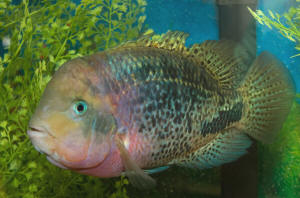
<This chap is Vieja synspila (formerly known as Cichlasoma
synspilum and Paratheraps synspilum). Although aggressive
compared with, say, Angelfish or Oscars, Vieja synspila is
actually quite mild by Central American cichlid standards and
works well in big, robust community tanks with large
barbs, jumbo characins, and armoured catfish. Pairs will of
course be extremely aggressive and territorial when spawning.
They are, as you've seen, beautifully coloured fish, and
they're sometimes called Quetzal
Cichlids after a particularly colourful tropical bird. Because
they hybridise quite readily in captivity it's more than
possible your specimen isn't 100% pure Vieja synspila, but I
think he's close enough.
Hope this
helps. Cheers, Neale.>
Re: Fish Identification 12/27/10
Thank u so much Neale. He is a unique fish with a personality to
bat.
Would you happen to have some general tank condition such as
water hardness and ph levels?
Thanks again and happy new year.
Emiliano
<Glad to help. Vieja synspila requires much the same as any
other Central American cichlid. Moderately hard to hard water
with a slightly basic pH; aim for 10-20 degrees dH, pH 7.5-8.0.
Water temperature should be middling, 25 C/77 F is about right
(excessively warm water tends to reduce lifespan and increase
aggression). Vieja synspila does occur in brackish water but
doesn't need brackish water conditions, though the use of
slightly saline conditions, around SG 1.002-1.003, can be useful
if you're having trouble with Finrot or Whitespot. As with
other Vieja species, it's diet is primarily vegetarian in the
wild -- algae, decaying plant matter, etc. So cooked peas and
spinach would make fine additions to a diet based around good
quality cichlid pellets. Vieja synspila used to be quite popular
in the hobby, but alas, like a lot of the Central American
cichlids, it's kind of fallen off the radar over the last
twenty years. It's large size and somewhat aggressive
personality are factors in this. Hope this is useful.
Cheers, Neale.>
Fish Identification, BobF 12/28/10
Good morning to whom read this,
<And to you Emiliano>
I have had this fish (attached) for approximately 8 years and
unfortunately lost the receipt with the type of fish he is. I
believe he is a Chiclid but what species I am completely at a
lost.
<Mmm, Theraps bifasciatum>
I have reviewed thousands of photos but just cant seem to narrow
down the type. I know he has changed colors / patterns as well
but have no images from the younger years.
He has grown over the years to about 8-9 inches in length. He was
a bit aggressive but I suspect it is from too small of a tank.
Now he is in a 60 gallon and he has calmed down a bit.
Any help would be great. Thank you and happy holidays.
Emiliano Brooks
<And to you and yours. Bob Fenner>
|
|
|
|
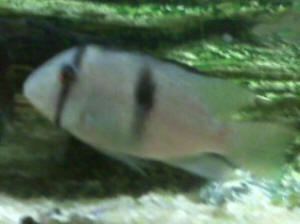
South American Cichlid ID 2/12/09 Hi
Crew, Please help me identify this chappie..? Cleithracara
maronii (key hole?) from South America? Thanks! Gail. < The
photo you submitted is actually Guianacara geayi. It gets to be
about 10 inches, twice the size of the keyhole.-Chuck>
|
 |
|
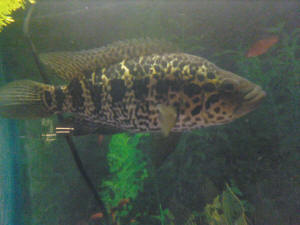
Central American Cichlid ID. -- 10/10/08
My LFS cannot tell me what kind of cichlid this is, nor can
anyone I know. I was wondering if you guys could help me out!
Thank you again
< You cichlid looks like a type of Parachromis managuensis.
The are a few geographic variants in the hobby but this looks
like this is probably the fish.-Chuck>
|
 |
|
Identification? TX cichlid
7/29/08 Hi Neale, Do you know by chance the identity of this
fish? <Hmm... looks like Herichthys cyanoguttatus, one of the
two "Texas Cichlids" of the hobby. Fairly sure it's
a Herichthys species anyway, but there are quite a few in the
genus that look alike (to me at least).> Is it a South or
Central American cichlid? <Oh, definitely Central
American.> I will continue to research it... Thank you. Lisa.
<Cheers, Neale.>
Re: Identification? (Chuck, second opinion?)
You're expertise amazes me. Thank you!!! <Don't know
that I'm right yet! Cheers, Neale.>
Re: Identification? (Chuck, second opinion?)
I checked out the pics and I think you hit the nail on the head.
<Cool. Nice looking fish by the way. All the Herichthys are
lovely pets, but fairly aggressive though intelligent and very
adaptable (some species are said to be able to breed in
seawater!). Cheers, Neale.>
Cichlid ID Sorry guys, I didn't get a
photo to check out the fish. If the fish has large greenish spots
then it is a H. carpinte. If the fish has smaller whitish spots
then it is a H. cyanoguttatus. Unfortunately recent water
projects in northern Mexico have disrupted the natural waterways
and certain geographic populations of both species are now able
in cross in the wild. A species with only a few dots is H.
tamasopoensis. Do a google search on all three and see which one
matches the closes to the fish you are trying to identify. When
all else fails I would go with Neale's ID since he has seen
the photo and he is one of the best in the business.-Chuck
Re: Identification? (Chuck, second
opinion?) 7/29/08 Cichlid ID Sorry guys, I didn't
get a photo to check out the fish. If the fish has large greenish
spots then it is a H. carpinte. If the fish has smaller whitish
spots then it is a H. cyanoguttatus. Unfortunately recent water
projects in northern Mexico have disrupted the natural waterways
and certain geographic populations of both species are now able
in cross in the wild. A species with only a few dots is H.
tamasopoensis. Do a google search on all three and see which one
matches the closes to the fish you are trying to identify. When
all else fails I would go with Neale's ID since he has seen
the photo and he is one of the best in the business.-Chuck
<Chuck, sorry, I didn't mention that the image is in the
'Emails with Images' mailbox, subject line
"Identification". From your comments though, the spots
are green rather than white, so maybe Herichthys carpintis is the
way to go? But the spots are small rather than large! Cheers,
Neale.>
|
|
 TX, RMF TX, RMF
Cichlid ID II 7/29/08 Neale, Couldn't find it in
the email with images file but did find it on the WWM website. It
is definitely H. cyanoguttatum.-Chuck>
|
Jack Dempsey not a jewel cichlid:(
Cichlid sel... 2/9/08 I am so upset. Yesterday I went to my
LFS and I wanted a jewel cichlid. Not knowing they gave me a jack
Dempsey instead. Now here is the problem. I have a 40 gallon tank and
it is too small for a jack Dempsey. <Indeed.> I do like the fish
but I know it is too small for it. I tried returning it but they said I
wasn't allowed because they were afraid it might have a disease and
infect their tanks. <Certainly they are at liberty to take this
attitude.> So do you think it will be fine to leave it in a 40
gallon tank or no. <Are we talking those paltry little US gallons or
the nice big and beefy Imperial gallons? 40 Imperial gallons is about
48 US gallons, and that would be fine for a single adult JD. But forget
about tankmates! 40 US gallons is a mere 33 Imperial gallons and too
small for an adult JD. A juvenile would be fine for a while, but once
it tops about 5", it'll need rehoming.> I will keep up with
the water changes every week. What do you think? Thank you so much for
your response. <Please do remember our mantra -- read about a fish
before buying it. There is no way anyone who has seen a picture of
either a Jewel Cichlid or a JD could confuse them: one is bright red,
the other steely blue. It's hard for me to grasp how the store
could trick you here if you had actually read anything about these
fish, and moreover if you couldn't tell they were hoodwinking you,
you probably weren't adequately informed to be keeping them anyway.
So do look for a nice cichlid book, sit down, have a read, and then
enjoy what is actually a very pretty, if aggressive, Central American
cichlid. Do note that this species has entirely different water
chemistry needs to a Jewel, and set up its quarters accordingly.
http://www.wetwebmedia.com/FWSubWebIndex/dempseyfaqs.htm Hope this
helps, Neale.>
|
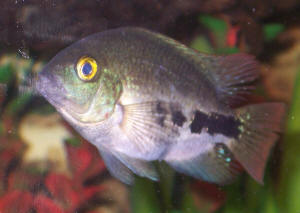
Fish Identification 1-11-2008 Hello <Yunachin here>
Any help you can give in this Fishes identity is greatly
appreciated!! Thanks for all your help. <This is in fact a
Vieja hartwegi or more commonly known as a Tailbar Cichlid or
Black Belt Cichlid. Yunachin> Christie
Re: Fish Identity 1-11-2008 <Yunachin
here> Is there another Cichlid that has the common name Black
Belt? I have a different fish with a bar doing vertically ( like
a belt) that seems to have diff. coloring... he was sold to me as
a black belt. Are they the same fish? <Cichlasoma maculicauda
is the Black Belt Cichlid that you own. It is not the same as the
Vieja maculicauda. Sometimes the most accurate way to determine a
species is to go by the Latin name so there is no getting
confused.> Thanks!! Christine
|
|
|
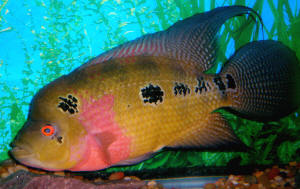
| Confused, Neotrop. Cichlid ID
8/13/07 I am really having problems identifying my fish and
really hoping you can help me clear things up! I thought he/she was
a Flowerhorn but cannot seem to find a pic that looks like him.
them I came across a pic of a Trimac and they look very similar.
<Yes... the Flowerhorn is a cross, a hybrid...> I know some
Flowerhorns are bred thru trimacs but this one looks way more
Trimac I think than Flowerhorn.. Last is that most male Flowerhorn
have large heads this one does not but is very large, about 12
inches and body is very muscular with beautiful long fins. Any help
is greatly appreciated!! Patty <Is a nice specimen indeed. I do
believe this is Amphilophus trimaculatus due to a lack of the
crosses apparent characteristics (e.g. the "spangled"
look of the flanks scales...), but it could easily be a "throw
back" of sorts of the Flowerhorn cross. Bob Fenner> |
|
|
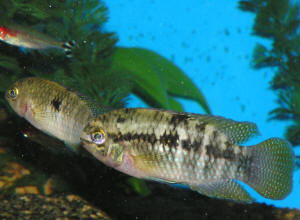
| Cichlid ID and Questions -- 5/13/07 I
purchased these guys about a year ago under the name port
cichlid. I have been looking to add something
new/different to my 150 gallon
cichlid community. The more research I have done,
the more I think that they are not port cichlids
(Aequidens portalegrensis) but rather flag cichlids
(Laetacara curviceps). They have not grown much
since I purchased them. What do you
think? They seem to have maxed out at about 3 inches.
< You were very close. They are L. dorsigera from the Rio Parana
area of Northern Argentina. Treat them the same way as curviceps
except they prefer the water a little cooler.> I am looking to
add a few rainbow cichlids (Herotilapia multispinosa) and some
T-bar cichlids (Archocentrus sajica) to my collection of keyhole
cichlids, a couple of severums and a
Geophagus. Is it true that rainbow
cichlids will help to control filament algae in my fish
tank? < While they may nip at the algae occasionally I would not
count on them to be efficient algae eaters.> Also, I have
been trying to get my local fish store to get me a few
T-bar cichlids, but have had no luck. Any
suggestions as to were I could buy some on the net? < Google for
Archocentrus sajica or Cryptoheros sajica. T-bar cichlid is not
recognized by advanced cichlid aquarists that may have this fish
for sale.-Chuck> Thank you \Linda |
|
|
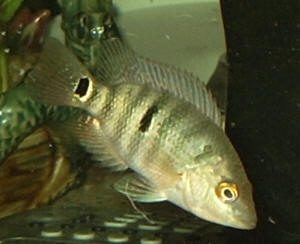
| Could this be my fish??
11/4/06 I caught two of these in a stream behind my
house. I question if they are Texas Cichlid because they do not
have spots, just stripes but they are very young. The stripes
darken or fade due to there mood. <Is another neotropical
cichlid species or cross... Perhaps a part of the
"Chanchito" complex> They stay at the top of my tank
under some floating fake grass I have. I have two but they stay at
separate ends of the tank. I have had several mysterious deaths
since there arrival but I have NEVER seen any aggression from them
towards any other fish in the tank. All three fatalities were large
Tiger Barbs about twice the size of these guys. I know a little bit
about Cichlids and I know size is no indication. I have seen a
4" Jack Dempsey slowly kill a HUGE Oscar so if these guys are
killing my Barbs I would not be surprised. <Me neither...
you'll likely need to separate these> <Bob
Fenner> |
|
|
Texas Cichlid Probably Something
Else 9/12/06 Hello Bob! I was hoping you could
help me identify my new cichlid. I just bought a cichlid and
was informed by the people at the store that it's a 'Texas
cichlid'. My new cichlid however, doesn't look
anything like the Texas cichlids on this site. In fact, it
doesn't look like any of the cichlids I've seen on your site at
all, or any other sites for that matter. It has a dark gray
body with some shiny green scales on its head. The most
obvious feature my fish has that Texas cichlids don't is orange all
along the edge of it's tailfin and at the end of it's top
fin. It's only 5-6 inches at the moment, so is this
really a Texas cichlid that's just going to change colors as it
grows, or another fish entirely? Thanks for the help! Kim
< Check out red terrors or jack Dempseys.-Chuck>
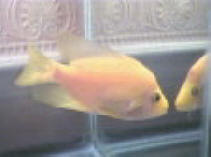
| Identifying an albino ... actually a Xanthic
variety... 7/28/06 <<Hello, David.
Tom>> A fellow co-worker got married and this killed all her
fish. <<Had to re-read this sentence a couple of times,
David. I thought you were suggesting that the marriage killed her
fish. :)>> He brought it to work to flush. (Wife wouldn't
let him flush it in house.) <<I won't even go into the
abominable practice of putting fish down by flushing them.>>
I adopted the fish and put it in a 39 gallon tank that had three
guppies. (Not anymore). <<My hat's off to you for saving
the fish, David, though your Guppies wouldn't concur.>> I
was very heavy into Africans in the past but have not seen this
fish. Please help to identify.... <<Based on your photo (very
nice) and this animal's aggressive/murderous behavior, I'd
say you've got a Red Devil Cichlid (Cichlasoma labiatus) on
your hands. I'll let Bob take a look at the photo for
confirmation, though.>> <I concur Tom. RMF> Thank you
very much <<You're welcome, David. Tom>> |
|
|
Pike Cichlid ID/Info - 3/16/2006 My
husband and I recently purchased a Crenicichla xingu 2 and we are
having a hard time finding information on this particular
species. I have found 2 pictures online, both of which are
completely different from one another. I wanted to see if
you know any information on this species and if you know what exactly
they will look like when full grown. Thank you. David
Fillmore < Crenicichla sp. Xingu II comes from the Rio Xingu river
in Brazil. These are one of the big ones and can get close to 18 inches
when full grown. They prefer water in the mid 70's F. A pH of
around 7 is fine. It is a meat eater that will take small fish as well
as worms and frozen food too. It likes a tank that is not too bright
that is decorated with stones roots and caves. The male is overall a
faint steel blue color with the top of his head being an olive color
and the bottom of the head being an off white. The female is the pretty
one. She has an olive brown body with a rosy pink belly. Her fins are
red and edged in white and then black. The top of the head is an olive
brown but the bottom is a bright yellow gold color. This is a pretty
rare species in the hobby. Most of the time the Crenicichla species
Xingu I or better known as the orange pike is offered for sale. The big
problem with pike is that they need clean water or they start to get
sick.-Chuck> Blue Acara Revisited Hello, Ryan (or anyone if
Ryan is not available) - <I'm here! Morning> Perhaps you will
recall me. You answered a query of mine regarding a blue Acara that I
had recently purchased and put in a 90 gallon tank with three juvenile
Oscars, the largest about six inches at the time (about 9 now, and so
beautiful), which the Acara quickly began to terrorize,
despite their superior sized. I removed the Acara and put him in a 10
gallon tank for temporary purposes, and, believing that I was not ready
for so fine a fish as a blue Acara, you recommended that I return it to
the fish store but I did not, for I had already fallen in love with it.
<Yes, I remember. I wasn't crazy about the space you
had for this fish- How goes it?> A while back, I moved the blue
Acara into a 55 gallon tank, by himself. Tomorrow, I am headed to town
and I thought I would bring back a tankmate for him - probably another
Acara, female if I can find one, for I believe this one to be male. My
plan was also to bring back a tank divider so that I could keep the
fish separate until they get used to each other and the new one had a
chance to grow. I wanted to at least consider the possibility of a tank
mate other than an Acara, so I popped on the web to do some research.
<Great> Now, after surfing through all kinds of sights and
finding a bunch of green terrors that look just like my blue Acara, but
no blue Acara that does (although some do bear a distinct resemblance)
I am wondering if my blue Acara is a blue Acara at all. As you are a
person who has raised blue Acaras of your own, perhaps you know.
<Yes, I'd be happy to ID him> Here is a picture of him. What
do you think? Is he a blue Acara, or a green terror? At the time of
this picture (October 7) he was about five inches in length. <This
is certainly Aequidens rivulatus, The Green
Terror. Beautiful fish, but a 55 gallon tank will be more
suited for just one. The Aequidens Pulcher, or Blue Acara,
is rarely as colorful as your GT! Best of luck! Ryan> Thanks,
Bill
Blue Acara or Green Terror pt. 3 Thanks,
Ryan <Surely> - Yesterday, I went back to the store where I
purchased him and they had some small ones that looked just like he did
when I got him and when I questioned whether or not they were really
blue Acaras, they insisted they were! <These fish look similar when
young, distinctly different when older.> I will tell them about
this. I guess that might explain why he was so hard on the Oscars.
<Yes, my Blues have been much more permissive of tankmates than what
you experienced.> Anyway, I am very happy with him, green terror
though he be. In the event that I move him into a bigger tank, is there
a fish I might put in with him? <Possible, but always potential for
war.> A female green terror, if nothing else? <Most people who
breed Green Terrors simply bring the pair together to breed, then
separate them. The larger your system is, the better a
chance for another fish to happily co-exist with a GT> Or would he
be too hard on her except during mating times? <Certainly>
Actually, though, I do kind of enjoy watching him with a whole tank to
himself. From what I have read, I gather that green terrors do fine by
themselves. Is that your experience? <Yes, and many feel that
keeping a single specimen can drastically change the way that he
interacts with YOU as well. Best of luck! Ryan>
Bill
Texas cichlids my query for u guys is i have
a Texas cichlid and his colors half black and half white my friends
keys telling me that its not a Texas cichlid do they change
colors like that is it a Texas cichlid or is it some thing
else hope to hear from u guys soon u
can e mail me back at elmo01830 @aol .com <There
are really two different species of cichlids commonly referred to as
Texas Cichlids.. "Cichlasoma" carpinte is a fish with large
greenish spots on a dark grey body. The other Texas Cichlid is
"Cichlasoma" cyanoguttatum. This one has smaller white spots
on a lite grey body. When either one becomes dominant or decides it
wants to breed the lower half becomes black while the upper half can
become a very light grey almost white.-Chuck>
Blood Parrot (cichlid) Hello, I
have two parrot fish yellow and red. they are about 2.5 in. they are
with electric blue cichlid and a lemon yellow cichlid, and 3 clown
loaches. my question is my yellow parrot fish was a pretty yellow but
is getting black on his fins and under his head. is this something I
should be concerned about? thank you, Darci < Parrot fish
are a hybrid between a few different species of cichlids. Color changes
are not unheard of. If the fish look and act OK then I think the color
change is most likely from the fishes genetics rather than
environmental conditions or diseases.-Chuck>
Nomenclature question Hello - For many
decades, I have always kept Red Devil's and was familiar with the
scientific names. In fact, back in the mid to early 80's, I had
several questions answered by Aquarium Fish Magazine regarding the
possibility of breeding my large male. In each of these
correspondences, the scientific name was always printed with the
response, in fact one of the questions I posed dealt with a particular
name change which occurred back then. When I first started rearing Red
Devils, the scientific name was Heros labius or Heros labiatus. Several
years later, they started changing the name from Heros to Cichlidae
labius and/or Cichlasoma labiatus. Today, I have noted that they are
also using the name Amphilophus labiatus. I remember that the
original name change from Heros to Cichlidae was an effort to properly
show the familial relations as well as reduce the number of animals
that had multiple names as a result of different scientist describing
the same species. Thus, what is the current/proper name of the Red
Devil? Furthermore, what have all of the different versions been and
why are they constantly revising the name? Thanks. Art <<Hello
Art, The name Amphilophus is current and should be final. The genus
Cichlasoma was an umbrella for all cichlids from Central America until
things got sorted out. Today it has been split into a whole bunch of
new genera according to morphological characteristics, so the fish
eaters for example are Parapetenia (i.e. friedrichstahli), the
rheophile cichlids are Tomocichla (i.e. tuba), the group around the red
devil are now Amphilophus. There are still some fish that have not been
placed in any of the groups including the salvini and the Jack Dempsey
(C. octofasciatum). The genus Heros is now reserved for the fish we
know as the severum (now Heros severus), and includes around a half
dozen species. To check on current names you can go to http://www.fishbase.org - this site is
pretty current with what is happening in nomenclature. Hope this helps,
Oliver >>
Parachromis motaguensis 9/5/05 My name is
Christine, and I have heard about a fish - the Red Tiger
Motaguense or Parachromis motoguensis - and could not
find much about it online. I've used your site before
and its really great. So I thought that you guys (and girls)
could help me out on this. Thanks so much! Christine <Hi
Christine, Parachromis anything is going to be a big mean fish eating
cichlid from Central America. P. Dovii and P. Managuensis
are the two bad boys that come to mind. P. Motaguensis is smaller
coming in at just under a foot. There is a good article on
these fish at the link below. Best Regards, Gage http://www.aquarticles.com/articles/breeding/Kutty_P_motaguensis.html
> Bubblegum Parrot Fish. <taste nothing like bubble
gum.> A couple of years ago I purchase 3 small (3-inch now) fish and
was told they were called bubble gum parrot fish. They have the
distinctive parrot fish shape with the "bump on the head"
look. I can't seem to find any pictures or information on these
little semi-aggressive individually colored purple, orange and pink
fish. Can you direct me to a site where I can find information or was I
given a bogus name when I bought them. Thanks, Staci <No bogus
names, what you have is a parrot cichlid, possibly dyed to make them
"cute, attractive, big sellers, etc". Check out
the link below, and treat them well, chances are they had a rough life
before they met you. Best Regards, Gage http://www.geocities.com/parrotcichlid/main.html>
| Identification of Species <Cichlid>
Hi, I have a 4 week old tank 150cmx48x48. I put the
attached species and a pair of Firemouths in the tank to run in the
tank. I have 4 of the attached unknown species to me in the
tank. Two days ago I noticed a pair had turned black at
the bottom and then I noticed that they were aggressively
protecting a batch of fry!! 1. Can you please identify
the fish 2. Refer me to a website that can provide me
with information on keeping this species. <Mmm, this looks like
Cichlasoma salvini (Please see note below: Herotilapia
multispinosa). You can find numerous references to this species by
inserting the name in your search engines. Congratulations! Bob
Fenner> Kind Regards, GRAHAM LIGHT SOUTH
AFRICA |
|
|
| Species ID Correction For what it's
worth........ Noticed on your site at this address:
http://www.wetwebmedia.com/FWSubWebIndex/neotropcicfaqs.htm
that the fish in the photo had been identified as 'C'
(Nandopsis) salvini. It is actually Herotilapia multispinosa.
<Thank you for this. Will correct. Bob Fenner> |
|
|