|
FAQs on Neotropical Cichlids
3
Related Articles: Neotropical Cichlids, Central American
Cichlids by Neale Monks, African
Cichlids, Dwarf South American
Cichlids, Cichlid Fishes in
General,
Related FAQs: Neotropical Cichlids 1, Neotropical Cichlids 2,
Neotropical Cichlids 3, Neotropical Cichlid Identification,
Neotropical Cichlid
Behavior, Neotropical
Cichlid Compatibility, Neotropical Cichlid Selection,
Neotropical Cichlid Systems,
Neotropical Cichlid Feeding,
Neotropical Cichlid Disease,
Neotropical Cichlid
Reproduction, Convicts,
Oscars, Firemouths, Texas Cichlids, Severums, Triangle
Cichlids, & Cichlids of the
World, Cichlid Systems,
Cichlid Identification, Cichlid Behavior, Cichlid Compatibility, Cichlid Selection, Cichlid Feeding, Cichlid Disease, Cichlid
Reproduction,
|
|
Care on Thorichthys helleri? 10/16/17
Hello, crew.
<Hello again Roberto,>
Last time I contacted you about my Uaru, I guess an updated is needed. He didn't
make it lamentably, so this is a lesson for me on keeping delicate soft water
species, and staying away from unnecessarily small fish (I got him at probably
less than 3 cm). The bigger Uaru (19-20 cm) is as lively as ever. I do in fact
keep him in warmer water and gets his share of greens.
<Lesson learned, I guess!>
Anyway, on a new topic, a local hobbyist has brought in what supposedly are wild
caught Thorichthys helleri, but as far as I know its way more possible for them
to be aureus. They are from rio Izabal, Guatemala. They range from 4 to 6 cm.
<There are several Thorichthys species, and identifying juveniles is very hard.
Will direct you here, to Fishbase:
http://www.fishbase.org/identification/SpeciesList.php?genus=Thorichthys
According to Fishbase at least, the only Thorichthys species in Guatemala are
Thorichthys affinis, Thorichthys aureus, Thorichthys meeki, and Thorichthys
pasionis.>
I've read conflicting information about them. Fish base cites them as hard,
alkaline water fish, in the range of 23 to 26C, but a couple other sources cites
them at the upper ranges, 28, 29 C. which doesn't sound quite right to me,
Guatemala is quite cool.
<Indeed, but often the temperature is more to do with the immediate environment.
Shallow, still pools in grasslands tend to get hot, while shaded rainforest
streams are cooler, and fast water upland streams will be cooler still.>
There is not much information about these guys online, could you shed some
light?
<So far as temperature goes, 25 C will be a useful default. All Thorichthys
species are sand-sifters, so a tank with a soft substrate rather than gravel is
required. Their tall body shape is indicative of slower to still water, so avoid
turbulent currents, but as with all cichlids, decent turnover is required to
manage the nitrogen cycle properly and ensure there's lots of oxygen. The diet
in the wild of all Thorichthys is a mix of algae, organic detritus, and small
benthic invertebrates such as insect larvae and worms, so structure their diet
accordingly. Because of their delicate sand-sifting jaw structures, do not mix
with other cichlids likely to pick fights. Dwarf cichlids are usually fine
though.>
I have a spare 45 gal where I might try a small group for breeding purposes, but
not sure if these are alike their cousins the meeki. We catch wild meeki, not
hard at all to keep, but I've heard the other, rarer species are more delicate.
<The Thorichthys meeki are only hardier because they've been bred for so many
generations. Otherwise Thorichthys are much of a muchness: sensitive to nitrate,
but not especially delicate.>
Thanks, as always.
Roberto
<Welcome. Neale.>
Red terror cichlid and red tiger Montaguense cichlid
hobbyists vs. vieja cichlid an Paratheraps cichlids hobbyists.
9/18/17
I'm John I'm a red terror cichlid and red tiger Montaguense cichlid
hobbyist. I heve beef with a vieja cichlid do hobbyist named pun ashby on
YouTube he has a video of a black belt cichlid beating up a red terror
cichlid
<Mmm>
I was angry when I saw that but it's ok that's why I'm breeding a male
red tiger Montaguense and a female red terror cichlid and when the
babies come they will grow up to 32 inches and beat every vieja cichlid
and Paratheraps cichlid there is��
<May be. Bob Fenner>
Re: Macaw cichlid, neotrop. cichlid f'
10/31/12
Well, a few additions to the cichlid fish family since last I posted on
WetWebMedia. The 2 Firemouth cichlids are doing well enough in the 50g.
along with their Swordtail and dwarf neon rainbowfish pals, which for
the most part are just ignored. I also have a soft spot for Rummynose
tetras so I added 1/2 dozen as well.
<Nice fish, but can be difficult to keep without soft water. Given
Swordtails and Firemouths prefer hard water, and the Swordtails cooler
water than the Rummynose Tetras, I'm not really clear that this tank
will work in the long term. Might do if water isn't too hard or too
soft, and the water isn't too hot or too cold… but oftentimes these
"happy medium" tanks don't ever really thrive. In other words, see what
happens, but don't be surprised if you have to change things around.>
I have acquired another aquarium from classified listings since my last
posting, this time ~ 75 gallon (much less $ than retail). I have 3
Hypsophrys nicaraguensis (Macaw, Moogi): 3.5", 3", 1 3/4". Boy, are they
ever nifty fish. What a load of personality. One is definitely male,
another female and the 3rd one is juvenile so could go either way. Just
got them 4 days ago from 2 different pet stores. The lights just went
out on the aquarium and for the first time, I noticed the female
following the male, rather than the male harassing her into the foliage
during the day. The smallest is still just staying put in the plastic
floating foliage for now, sneaking a pellet or 2 during feeding time.
Substrate is sand, rock caves, driftwood pile and a couple of pvc pipes
as well.
<Now, Hypsophrys nicaraguensis is a stunning fish, especially when
fully-grown, but it does have many of the usual Central American cichlid
traits. It's a biggish fish (expect at least 20 cm/8 inches) and though
not aggressive, it's still territorial. Like most Central American fish
it prefers hard water rather than soft, but it is also fairly sensitive
to low oxygen levels, and does best in a tank with a brisk current and
perhaps even a little extra oxygenation during summer.>
Question: From your experience, would you recommend adding more females?
Providing I can find another mature one to properly sex.
<Actually, no, this species does best as pairs. The two fish are
generally quite loyal to each other, and because they're fairly easy to
sex (at least as adults) that's the way most people keep them. Females
are smaller than males, less robust in shape, and oddly enough, often
the ones with the best colours. Like many other cichlids, males tend to
have longer tips to their fins, but this isn't always obvious. In a
large tank surplus females will be tolerated fairly well, but there's no
real reason to add an extra female. If the third fish is a male though,
you will probably end up removing it, but a lot depends on your aquarium
and your particular pair of fish. Hypsophrys nicaraguensis is quite
tolerant of conspecifics given adequate space.>
Note: I also bought a fish without researching it first. Caquetaia
myersi. He or she is ~ 2.5", yet I'm starting to wonder if it's basket
mouth may find it's way over to the Macaws. Besides, I believe it's
total length will eventually be a problem.
<For sure. On the other hand, these big predatory cichlids aren't
especially aggressive, and singletons can work find in jumbo communities
with tankmates too large to swallow. Anything deep bodies and bigger
than, say, two-thirds its size should be fine.>
cheers,
Mike
<Glad to help, Neale.>
|
Jaguar Cichlid... gen., sys.,
food 03/04/2008 Hello, I have recently acquired a
jaguar cichlid. I'm not sure how old he is, but he's
about 10 to 11 inches long. I think he is male. <Lovely fish;
difficult to sex.> The lady I bought him from said he had
killed his mate, and had been off his food for a week or so. She
thinks he killed her because up until that time, the tank had
been quite algae-filled, and the female was able to hide. The
owner decided to scrub the tank down, and that is when the female
became more visible and was killed. <Doesn't really sound
very likely, unless the algae were huge kelp-like things!> The
owner was an experienced fish hobbyist - in fact, I bought her
entire collection: 25 years worth, mostly of African cichlids,
along with a community tank and some South American cichlids. I
have them in five tanks. <Sounds nice.> My jaguar cichlid
is in a 35 gallon tank, with a little driftwood and a rock cave
which he sometimes hides in. Tank dimensions are 3 foot by 1 and
1/2 foot by 1 foot. (This is the same size he was used to before
I purchased him.) <Ah, the plot thinnens. Simply too small.
When I kept this species, it was in a 200 gallon system, and
realistically you need to be keeping them in something
"jumbo" sized, i.e., 75 gallons upwards; these are BIG,
TERRITORIAL fish.> Once he gets better I am looking to move
him to a larger tank, but don't want to risk stressing him
any further by moving him at present. <Quite the reverse is
likely to be true. Provided water chemistry is constant, and he
isn't placed in a tank with a larger, territorial cichlid --
moving him is a great idea.> I have had him for a couple of
weeks now, and have offered him all kinds of food: frozen fish
food that she had been giving him before he went off his food,
freeze dried blood worms, flakes, pellets, ground beef, raw fish,
live fish, but so far he has eaten nothing. <Well, for a
start, stop with the live feeder fish. Live foods generally, and
feeder fish especially, appear to bring out aggressive tendencies
in fish. Live fish are also parasite time bombs, unless
you're breeding your own. One of the most idiotic things in
the hobby is the use of Minnows and Goldfish as feeder fish. They
are far to high in fat and contain lots of the Vitamin
B1-destroying chemical Thiaminase. Bob Fenner (who runs WWM) has
made the point in print and elsewhere that Goldfish are then #1
cause of mortality in captive Lionfish! The ONLY safe fish
species that can be used as feeders are gut-loaded, home-bred
livebearers. Anyway, Parachromis managuensis will eat pretty much
anything when settled. Earthworms are a favourite. My specimen
enjoyed squid and other types of seafood. Oily fish was enjoyed,
by this wrecks water quality, so use sparingly and just before
doing a massive water change. Once settled down they eat pellets,
and these are truly the ideal staple, being safe and
nutritionally balanced.> I had a couple of smaller problem
fish - a minnow that was killing its tank mates and a barb that
was chewing the fins off its tank mate. I put them in with my
jaguar cichlid, hoping he might be tempted to eat them. He does
dart at them occasionally, but until this morning he hasn't
killed them. Today I found the small barb dead, floating around
the tank. The jaguar will look at it and just swim away. He might
have killed him, but it's more likely that the barb died of
stress. <More than likely territorial aggression. In any case,
this ISN'T how you solve aggression problems in community
tanks. Tiger barbs for example become nippy when they're kept
in too small a group. "Punishing" a specimen because it
is doing what its genes are telling it to do is just plain dumb.
It's a fish, not a naughty child. So, look at how many Tiger
Barbs you have, and if there's less than six, add some more.
Do also remember that Tiger Barbs are NOT GOOD COMMUNITY FISH.
This is made plain again and again in the fishkeeping press, so
there's no excuse for not being aware of this. You simply
don't keep them in [a] small tanks and [b] with slow moving
or long-finned tankmates. Fine with barbs and tetras, not fine
with Gouramis and angels.> The PH is 7.7; nitrites close to
zero, ammonia close to zero, the water is not very hard (just
above the 'soft' line when I tested it.) He has oxygen
(bubbler stone), low lighting, the temperature is around 73
degrees. <Parachromis managuensis needs hard to very hard
water with a basic pH and LOTS of carbonate hardness. I'm
guessing he's off colour and not eating because the water is
all wrong. This is non-negotiable. The pH should be 7.5-8.5,
general hardness around 15+ degrees dH, and carbonate hardness
upwards of 7 degrees KH. Adding salt and other Mickey-mouse quick
fixes are not an option. Raise the KH by incorporating lots of
calcareous media in the filter. You can also add tufa rock and
other calcareous rocks to the aquarium, but by themselves these
have a marginal effect on KH. Crushed coral or crushed oyster
shell in a nice big canister filter is the way to go. Water
changes need to be generous: these are heavily polluting fish,
and this means they produce the chemicals that acidify the water.
See here:
http://www.wetwebmedia.com/FWSubWebIndex/fwh2oquality.htm > He
seems very shy - not at all the aggressive guy I was told I was
getting. He shies away from the walls of the tank if anyone comes
near, if I stick my hand in he'll swim away, and he backs
away from any food that is dropped into the tank. <Wrong water
chemistry, and absolutely normal behaviour under the
circumstances.> I've put salt in the tank and have done a
20% water change, but so far nothing has helped. <For the
seven billionth time for people who haven't learned this yet:
aquarium salt doesn't raise hardness or pH. It is of no damn
use in a freshwater tank! Carbonate hardness comes from carbonate
and bicarbonate salts, and these are not to be found in boxes of
sodium chloride! Also, water changes should be around the 50%
mark, weekly.> His water also stinks like dead fish, not
strongly but it is there. <Sounds like too much food, not
removed quickly; perhaps under-filtered too and certainly not
enough water changes.> I'm concerned he is starving
himself to death. <He is.> He seems quite active, swimming
around and occasionally darting to the surface. <Darting
behaviour in stressed cichlids is a very bad sign.> Do you
have any suggestions about what I could do to get him eating
again? <Many many things. Please read my advice carefully, and
then sit back and read the article about water chemistry. It is
absolutely critical you understand this, because right now this
fish doomed with a capital D.> Thanks very, very much for your
help and advice! Dana <Happy to help. These are gorgeous fish,
and my specimen was a real show-stopper, but they are not
"easy" fish, and Central American cichlids generally
need very specific water chemistry conditions to do well. Cheers,
Neale.>
Re: Jaguar Cichlid, sys.
03/04/2008 Thanks for your help! I'll get him in a bigger
tank right away. I have a couple of empty tanks sitting around: a
70 and a 100 gallon, so that shouldn't be a problem. I'll
get the water hardness fixed right away too. The jag is such a
gorgeous fish, I'd have hated to have him die on me, so
I'll be onto this today. Thank you! Dana <Dana, all sounds
promising. I hope things get fixed, and you enjoy many happy
years with this wonderful fish. Mine was a sweetie, and in the
200 gallon tank not at all aggressive. Possibly was a female
though. So difficult to sex. Cheers, Neale.>
Re: Jaguar Cichlid, sys.,
food 3/6/08 Hi again, Neale, Well, I've got my
jaguar moved to a larger tank (70 gallon), with plenty of crushed
coral. The water has tested quite hard - we may need to dilute it
just a bit but it's much better. <Wouldn't worry about
diluting the water to make it less hard. Central American
cichlids like their water to be "liquid rock"! The
other thing is that messing about with RO water or whatever adds
to the effort and expense of water changes. Central Americans
really want big water changes, and that being the case, YOU want
things as cheap and easy as possible!> Nitrites, etc. are all
low. Ammonia is zero, Ph is 7.8 . Water temperature is 75
degrees. <Perfect.> Today he is moving gravel all over the
place, rearranging his aquascape to his own liking, I guess. He
hadn't been doing this for quite a long time, so I think
that's a healthy sign. <It is indeed! Well done. A happy
cichlid is a digging cichlid, that's what I always say.>
I've offered him all kinds of delicacies: frozen bloodworms,
dried bloodworms, (so far I haven't been able to find any
live bloodworms), cichlid pellets (large and small), brine shrimp
flakes, tropical fish flakes, frozen cocktail shrimp... He STILL
won't eat a thing. <Give it time. Hunger makes the best
sauce. Do try earthworms though: they're used as bait in
fishing for a darned good reason -- NOTHING is as yummy to a
predatory fish as a nice juicy earthworm. So grab a hand shovel,
go to the yard, and have a root about.> He just watches the
bits of food float around the tank, then turns away and ignores
them or swims into his rock cave. He seems active and curious:
watches people as they walk past his tank, but quickly backs away
if anyone actually approaches him. <The curiousness is
excellent and precisely typical of happy Guapote cichlids.>
What can I do to interest him in eating again? Why would he be
starving himself when he seems otherwise healthy and active,
though maybe a bit timid for a jaguar? <Jags are timid;
it's a myth I think that predatory cichlids are aggressive
cichlids -- quite the reverse in fact. Predatory fish need to go
about their business unnoticed, or their prey would see them.
Worse, if they got into a fight, their delicate jaws would be
damaged. So predatory fish tend to back off rather than go
looking for fights. This holds for Guapote (what yours is), for
Pike Cichlids and of course for Oscars. Compare with omnivorous
or even herbivorous cichlids like Tilapia and Mbuna or even Kribs
-- for their size, these fish can be incredibly punchy. In any
case, make sure you have lots of hiding places (remember the
Golden Rule: the more a fish can hide, the less often it will
choose to do so). Floating plants such as Indian fern will also
make a big difference, though those big 36" plastic plants
are probably going to be easier to use in a large tank with a
strong filter.> I really appreciate all your help and
suggestions. I'm very new to the whole cichlid scene, though
I've done community tanks for a few years. <Ah, welcome to
the Cichlid Club! Cichlids really are fish that become members of
the family; they're smart and they become tame. When I looked
after my Jag it was in a display tank in a lobby area, and
we'd arranged some chairs nearby. People would go get coffee
from a machine in another room and then come sit by the tank so
they could spend a couple minutes "chatting" with the
Jaguar and the Midas Cichlid that also lived in there. The two
cichlids would go to the ends of the tank and hang out quite
contentedly, apparently enjoying the attention (or perhaps trying
to get out and kill the big gangly apes threatening their
territories!). Anyway, do try the earthworm trick, and also
remember these fish hunt at dusk and dawn, so feed first thing in
the morning or last thing at night.> Dana <Cheers,
Neale.>
Re: Jaguar Cichlid
Earthworms? Umm... This is Canada: the frozen North! To reach an
earthworm, I would have to hire a bulldozer. I'll look up
fishing stores and see if they have any. Thanks again!! Dana
<Hello Dana. Surely you're can't be much further north
than I am here in the UK? But I guess those darned polar winds
make a difference. In any case, yes, earthworms should be
available from a bait shop. And you can actually grow your own!
Earthworm "farming" is a hobby of sorts here in
England. There's an excellent little book called "The
Earth Moved: On the Remarkable Achievements of Earthworms"
by Amy Stewart all about what earthworms do, why they matter, and
at the end of the book, how to care for them. Fascinating stuff!
Cheers, Neale.>
Re: Jaguar Cichlid 3/7/08
Hi Neale, I don't know whether or not we're further North
than you are, but the ground is frozen solid and we're
expecting another 60 cm. of snow over the next 36 hours.
<Yikes!> Happily, there are bait and tackle stores that
sell worms for people who brave the elements and go ice fishing,
so I'll be headed out there after work this afternoon.
<Very good.> The jag is still digging and digging and
attacking his bubbler. He sure doesn't look sick, though he
is much thinner than when we got him. I have no idea how he stays
alive after a month without food. <He's a fish, and in the
"dry season" likely has to make do with very little
food.> I'll let you know whether the earthworms do the
trick. <Yes, please do.> Thanks again, Dana <Cheers,
Neale.>
Re: Jaguar Cichlid --
03/10/08 Hi again Neale, Here's the jaguar's dietary
report: he pays no attention to food whatsoever, including
earthworms. I tossed one of his rejects into a different tank for
my smaller cichlids and almost started a war. The worm was gone
in seconds. I have a fresh one hanging from a suction cup at the
side of the jaguar's tank, but he ignores it completely. I
thought if I hung it from the wall of his tank, he might notice
it more, rather than having it hide in the gravel like the last
ones did. He is still moving a lot of rock, swimming around and
investigating everything, and ducking into his cave regularly,
but he's just not going to eat. If you think of anything else
that might help, I'm very open to suggestions. Thanks, Dana
<Hello Dana. I can't think of any "quick fix"
here except to try as many different things as you can. If the
fish is otherwise behaving normally, there may be something
sapping his appetite. Bloating, constipation and Hole-in-the-Head
all start with a loss of appetite, so consider those options,
since all are quite common in cichlids. I'd perhaps treat for
Hexamita/Hole-in-the-Head proactively, just in case. This disease
is much easier to treat before the symptoms become established
and obvious. I'd then run something laxative through the
system, such as Epsom salts (see elsewhere on WWM for the
details). If these don't help, then something systemically
anti-bacterial like Maracyn would be a good idea. All this said,
he may simply [a] not be settled and [b] not wild about the foods
being offered. Time and variety will fix this. A risky option
might be to introduce some other fish of comparable size but
sufficiently durable they won't be harmed. Often fish that
are reticent about feeding become bolder when they see other fish
"take the bait". This is standard practise in marine
communities for example, where damselfish fulfill this role
admirably. Cheers, Neale.>
|
Neotrop. Cichlid tanks... reading --
09/29/07 Hello, I am considering setting up a tank around 100
gallons containing a combination of Oscars and jack Dempsey cichlids
along with a Pleco. Or a tank containing 5 to 7 parrots (not blood),
along with some Plecos. I would like to seek some advise on doing so to
find out what would be okay to do so. Could you please send me
something in return about advise regarding this matter. Thank you.
<Sure... read here:
http://www.wetwebmedia.com/FWSubWebIndex/fwlvstkind2.htm the third tray
down. Bob Fenner>
55 Gallon Advice, continuous salt use, neotropical
cichlid stocking, 3 ppm NO2 8/4/06 Bob, The
website is great and I've learned a ton from it! I have
a few questions for you if you have a moment. I have a 55 gallon
aquarium that is about 2 months old. It is a freshwater tank
(but has 1 tablespoon of aquarium salt per 5 gallons added to improve
quality of water-at the advice of LFS)- <Permanently? Not likely a
good idea> I have 4 fish. One 2" tiger Oscar, one
2" Jack Dempsey, one 3.5" Blood Parrot and a Pl*co of about
the same size. After reading from your site, I am worried
that I will have an overstocked tank within a few months and don't
want to lose any fish because of it. Do you think it is
safe/smart for these fish to grow up together in this tank (LFS said I
would end up with just one Oscar within 6 months)? <Would be better
if the tank was larger... but...> should I try to find a
better home for the Oscar? <I would, yes> What would
be a good match to add to this setup if the Oscar is traded out?
<Another neotropical cichlid of some
species...> Filtration is a 30-60 AquaTech along with a
Whisper 60. Can't afford a canister filter yet, but am
hoping these two will suffice. They eat Omega One cichlid
pellets and flakes once a day (with a home grown guppy or three thrown
in once a week). <Do keep up with regular/weekly
gravel vacuuming and water changes> All of the fish are
very active and seem healthy right now even though I am having a
nitrite problem. <?!> They are at 3.0 on the test strip
(dangerous level), <Extremely. I would cease feeding till this is
under 1.0... Look for Bio-Spira...> so I have been doing regular
water changes and only feed a few flakes per day. Any advice
to make my tank safe for these guys other than what I'm already
doing? (also added the new Whisper filter to help balance things
because the Aqua-Tech 30-60 didn't seem to be handling it by
itself). Thank you in advance,
Ross Wakefield <Please read here: http://www.wetwebmedia.com/FWSubWebIndex/fwestcycling.htm
here: http://www.wetwebmedia.com/FWSubWebIndex/neotropcichlids.htm
and the linked files above. Bob Fenner>
| Cichlids With new Owner And New Problems I just had
another rescue project dumped on my hands: an old 55 gallon with
over 16 cichlids in it. Two 6 inch green Severums, three 3 inch
green Severums, about eight flag cichlids, some unIDed cichlids
that remind me of earth eaters but aren't, and 3 un IDed
Geophagus. But two of the smaller Sevs are sick. One is injured,
both noggin and mouth (mouth doesn't seem to close right and is
white) and the other has pop eye and mouth fungus. Currently in a
hospital tank being treated with Furanace (following instructions
on bottle), but your site says to use Epsom salt for the pop eye (I
was looking at the parasite page). Is this the same stuff as under
my parents counter in the bathroom? Magnesium sulphate plus seven
waters? is this alright to use? I just want to make sure before I
go putting these wonderful and gentle fish in danger. <Your
South American Cichlid Tank probably was in desperate need of
attention before you got it. A 55 gallon is too small for all of
these fish. I suspect that the water quality was pretty poor and
this definitely contributed to the problems you are now facing.
Make sure you have a good filter that pumps at least 200 gph. Check
the nitrates. Anything above 20 ppm will mean trouble soon.
Nitrofuranace is good for external bacterial infections. Epsom
salts help change the osmotic balance in the water and deter
bacterial growth. I would also use Metronidazole for anaerobic
bacteria that are causing the Popeye.-Chuck> |
| New Tank New Owner New Problem II Thanks chuck I will
get something with Metronidazole in it either tonight or tomorrow,
as soon as I can. Yes the tank was in horrid need of help when I
got it, that's why I said it was a rescue project. He had a
penguin 170 on her with even more fish than its got now (I just
couldn't take all of them) It now has a magnum 350 (currently
with micron cartridge) that has no BioWheels. But I also put a
fully cultured penguin 330 that was running on my 80 just to keep
the bacteria culture going. The nitrates dropped from some 25 ppm
down to 12 over night. The fish are swimming around and look
absolutely great (except for a cloudy eye here and there and plenty
of fin rot. The tank was also completely coated in algae and after
I moved it I spent hours cleaning it. I'm currently treating
the main tank with rid ich for the cloudy eyes on one of the 6 inch
green Severums. I have access to four or five 55 gallon tanks with
biology teachers I trust at my high school and I can thin out the
heard quite a bit after break ends and I get them in health. There
was actually black mold on the light fixtures. Thanks for getting
back to me, its always greatly appreciated. Mind if I include some
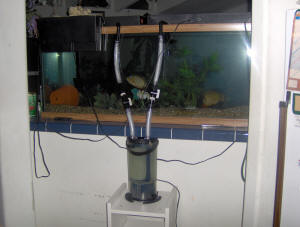
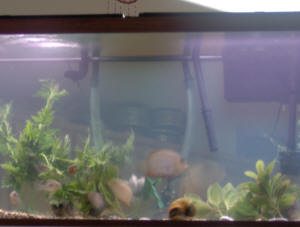
pics? < Go ahead.> The tank in my house after being cleaned.
The light bulbs are horribly dim, I'm getting new ones today.
Its funny, he never had a good place for the flags to hide (there
are 7 of them I believe, hard to count) so when I put that flower
pot in there from one of my other tanks, they all crammed in there.
The largest of the Severums. You can see the fin rot and cloudy
eyes, not as bad as the pic makes the eyes look though. This was
from yesterday, looks much much better today, and he's getting
more friendly like the other Sevs are. The two sick Sevs in
quarantine. I know I know, there's algae on the glass, but this
is a really old tank and the scratches make it nearly impossible to
get it off. The water quality is perfect, I promise. The water is
yellow colored from the meds. The one in the front is the one with
the bad lips. Can you see it? any suggestions? I don't think
they are infected, perhaps injured? malformed? < Sorry,
didn't get the photos. Sometimes injuries get infected and
fungus. When this happens the tissue usually doesn't grow
back.-Chuck> |
| New Tank New Owner New Problem III & Sending
Photos TO The Crew Thanks for getting back so soon. I had copy
pasted the photos into the email, and I guess this didn't work.
Is there a proper way to send them to you? < Try sending them as
an attachment. Check the WWM homepage for tips on sending
photos.> If I sent them even one as an attachment the file would
be over 900 kb. Is this ok? < Not shrink it down. Check the
website for size.> I figure I might as well learn how to send
you pics so I can do it better next time. You guys always provide
me with the best help. < We have nothing to sell but the
truth.> <<Whoa! Scarce can I name salvation but fearful
thunder echoes in mine ears... I don't use words/concepts I
don't understand... RMF>> If this is the case with the
Sev's mouth, should there be any measures taken? < Watch it
closely to see if it starts to grow back. Redness means an
infection. White stingy matter means its growing back.> It seems
to have a little bit of a hard time eating, though it is eating
plenty, picking at the decoration too. < This is a good
sign.-Chuck> |
  |
|
|