|
FAQs on Oscar Environmental
Disease/Health
Related Articles: Freshwater
Diseases, Ich/White
Spot Disease, Freshwater
Medications, Oscars, Neotropical Cichlids,
African Cichlids,
Dwarf South American
Cichlids, Cichlid Fishes
in General,
Related FAQs: Oscar Disease 1, Oscar Disease 2, Oscar Disease 3, Oscar Disease 4, Oscar Disease 5, Oscar Disease 6, Oscar Disease 7, Oscar Disease 8, Oscar Disease 9, Oscar Disease 10, Oscar Disease 11,
FAQs on Oscar Disease by Category: Nutritional, Social, Infectious, Parasitic, Genetic, Treatments, & Cichlid Disease 1,
Cichlid Disease 2,
Oscars 1, Oscars 2, Oscar
Identification, Oscar Selection, Oscar Compatibility,
Oscar Behavior,
Oscar Systems,
Oscar Feeding,
Oscar
Reproduction, Neotropical Cichlids 1,
Cichlids of the
World, Cichlid
Systems, Cichlid
Identification, Cichlid Behavior, Cichlid Compatibility,
Cichlid Selection,
Cichlid Feeding,
Cichlid
Reproduction,
|
By far, environmental issues are the principal
cause of Oscar Health troubles:
General malaise, hole in the head and body,
wasted appearance, worn fins... From too high metabolites like
Nitrate.
Oscars need space... 55 gallons for one, at
least 75 for two. And redundant, doubled filtration and weekly
water changes w/ gravel vacuuming.
|
Oscar health concerns
MOV
2/24/19
Hi WWM,
<Hello Sean,>
I have a 125 gallon aquarium with two 10"+ Oscars, one 12" fire eel, and
a jack Dempsey. For their filtration, I use an aqua clear 110 and two 60
gallon sponge filters. Maintenance includes weekly 50% water changes,
vacuuming, etc. Lastly, my water parameters show no sign of any nitrate
or ammonia and is set at 78 F.
<I'm always skeptical of zero nitrate readings. Are you really sure your
nitrate test kit is working properly? Or being used correctly? Zero
nitrate is virtually impossible in an aquarium. You'd need to have zero
nitrate in the tap water -- which is unlikely if you're using standard
tap water in most cities, towns or anywhere near farmland. Pristine well
water might have zero nitrate though. Anyway, most tap water has nitrate
levels somewhere between 10-40 mg/l, and since the filter doesn't remove
nitrate,
it'll only ever go up thanks to the biological filtration process that
turns ammonia into nitrite and then into nitrate. Water changes dilute
nitrate, of course, but that'll half (or whatever) the nitrate level in
the
tank, not zero it. Furiously rapid plant growth can remove nitrate at
appreciable levels, but you'd need intense lighting and would literally
be cropping the plants back weekly if this was the case. Given your
selection of fish, the idea you have rapid plant growth seems unlikely.
So we come back to the original point, the nitrate surely can't be zero.
Why harp on about nitrate? Because it's the silent killer for cichlids!
Anything above 20 mg/l seems to stress them, and above 40 mg/l there
will be increased
mortality, particularly with the more sensitive species (such as dwarf
cichlids, Tanganyikans, and so forth). Oscars are among the more nitrate
tolerant species, but prolonged exposure does lead to issues such as
Hexamita infection and Hole in the Head disease.>
Overall, I think we have a happy and healthy tank, fish included.
<Good.>
However, I'm concerned with the looks of my butterfly Oscar. Now, he's
always been an ugly boy with his lumps and bumps, but the amount of
slime that covers his body has been progressively increasing.
<Slime generally represents the first line of defence against skin
infections. Assuming no fish have been added recently that might have
introduced, say, Costia, I'd be thinking about Hexamita infections,
HITH,
and HLLE.>
I'm worried that it may be in response to something more serious. I've
attached the following video.
<He looks chirpy enough, which is good.>
In general, he seems healthy - eats well (if not the most), swims around
his companions, and has minimal instances of aggressive behavior
(although, he is the moodiest). It's just the looks of him, like a kid
with acne.
<Indeed. While I'm not seeing the classic pitting you associate with
HITH and HLLE -- yet -- that would be my worry here. The classic
combination of Metronidazole alongside a suitable antibiotic would be my
recommendation if you have access to these. Certainly review nitrate
levels, and if you can,
oxygen levels (high nitrate and low oxygen cause particular stress to
cichlids). While your tank is reasonably large, you've got some big-ass
fish in there, and since they're all carnivores, the sheer volume of
ammonia being excreted will put a lot of pressure on any filtration
system.>
Do you know what this might be? Our appreciation goes out to you and WWM
in advance. Thank you!
Kindly,
Sean and Lumpy (the butterfly Oscar)
<Hope this helps. Cheers, Neale.>
Re: Oscar health concerns
3/3/19
Hi Neale,
<Sean,>
A little update for you, because hell, this is what it's all about
right?
<Something like that, yes!>
Now, I was mistaken when I said my nitrate levels were zero -- I didn't
even have a test for nitrate, it was nitrite! Which, were indeed *near*
zero.
<Good-ish. You do indeed want zero nitrite, and anything above that can
honestly be a stress factor for many fish, even below 0.5 mg/l. Cichlids
are notoriously sensitive to ammonia and nitrite compared with, say,
Danios or Corydoras, which is why the latter have been used to mature
new tanks, whereas cichlids almost never are. If you're detecting any
nitrite at all, you probably need to decrease stocking, decreasing
feeding, or increasing filtration, because the filter isn't keeping up
with the amount of ammonia excreted by your fish. The backlog, so to
speak, is the nitrite you detect.
The only exception here might be if the tank is relatively new, with a
filter less than 6 weeks old, in which case the nitrite part of the
biological filtration maturing process might not be completed yet.>
Having to get a test for nitrate, I bought some 5 in 1 API test strips
and found the following: GH 0 mg/L, KH 0 mg/L, pH 6.0, nitrite 0-0.5
mg/L, and nitrate 80+ mg/L.
<Yikes!>
Immediately, I knew it was time for a water change and I even fasted
them for a few days in hopes of mitigating the amount of ammonia they
might produce until the situation was under control.
<Part of the solution, yes; but more frequent or more substantial water
changes are the usual way of minimising nitrate.>
Taking your advice, I did a full Metronidazole treatment and the results
couldn't of been better!
<Good oh!>
Whether this was the solution to my problem or not -- I know it is not
the magic formula in having long term success. Unfortunately, I don't
have the equipment to test the oxygen in the tank, but with tons of
surface agitation and very few "dead spots," I don't see this as being a
problem.
<Indeed.>
Having been about a week, everything looks great and I couldn't thank
you enough.
<Glad to help.>
However, my waters nitrate levels still seem to be considerably high
based on your suggestions -- that is, somewhere between 20 and 40 mg/L
in the tank and nearly 20 mg/L out the tap.
<So this is, realistically, the minimum nitrate level you'll have in
your aquarium. Not the end of the world, but you have to accept that
this is not ideal for cichlids. Frequent water changes, light stocking,
and minimal food input are the main things you can do here. In other
words, ensuring the nitrate creeps up as slowly as possible. Oscars are
greedy, but they're also omnivores, so with luck you can offer bulky,
but less protein-rich, foods that will result in less ammonia. Many will
eat peas and other vegetables, which is a good start. Otherwise, just be
really, really careful not to overfeed.>
Is there anything I can really do here? Or is it time to enjoy the fish?
<A little from column A, a little from column B. Yes, you should be
trying to manage the nitrate, but yes, if the fish has perked up, and
you can keep nitrate below 40 mg/l, you should be fine. If practical,
'cutting' tap water with deionised water or rainwater will obviously
reduce the nitrate a lot. Nice Fire Eel, by the way! Cheers, Neale.>
|
Kinda Critical Problem; Oscar env. trouble
3/24/18
Hello Crew, it's Renee from Idaho. I've "stepped in it", no, I've jumped
in it again with both feet and I'm hoping you can help me help this
fish.
<Fire away.>
First things first though - I found the two Oscars that were dumped on
me by more former moving friends another home.
<Difficult fish to rehome, it has to be said.>
They are now luxuriating, just the two of them, in a 300 gallon tank
with a lady who has kept Oscars all her life.
<Nice!>
Second, I gave all of my Dojo Loaches to a friend who has a pond and I
was getting ready to move my BGK into the 125 gallon tank when I got a
call from a friend about an adult Oscar (about 4 years old) who is kept
at her
office that she told me was "in trouble." They didn't want me to help
them help the fish, they just wanted it out of there.
<Oh dear.>
So again, I jumped in. I found the fish in a 55 gallon tank with a foot
long Pleco.
<I've seen worse, but no, not ideal.>
I couldn't see either fish very well because the tank was in a very dark
corner of the office with no lights, but I could smell the tank. I just
scooped out enough water into two buckets, grabbed both fish, and ran
for home. When I put them in the 125, I could see the Oscar is covered
with ammonia burns (I tested the water I brought them home in and it
showed 4 ppm ammonia, 5 ppm nitrite, and the nitrate was a darker red
than the darkest on the chart - I have no idea how those fish survived 4
years with these people).
<Fortune not only favours the brave, but also the stupid, perhaps?>
The Pleco has a few, but got off relatively unscathed.
<They are very tough animals, adapted to living in muddy burrows at
times, so can put up with poor conditions for extended periods.>
Apparently when I netted the Oscar to bring him home, the net peeled off
a lot of his poor burned skin and he showed had several large bleeding
wounds and he has hole-in-the-head disease.
<I bet.>
He just sank to the bottom of my tank and lay there and I was sure he
wasn't going to make it. But he did. Within 24 hours, the open burns
were no longer bleeding and now (three days later), they are showing
kind of a gray color that makes me believe the wounds are healing.
<Absolutely.>
But he still stays on the bottom of the tank and doesn't move around too
much. His skin is improving daily, but what's bothering me is that he's
not eating - nothing in 5 days.
<Moving adult fish to a new home will certainly startle them. So even if
physically recovering, it may take a bit more time before this fish is
psychologically settled once more. So long as he's active, healing,
interested in your behaviour, e.g., watching you, I'd not be over
concerned. Offer something really tasty once a day, like a live
earthworm, but otherwise don't feed. An adult Oscar will be fine living
off his fat for a month, if not longer.>
I didn't think that was possible for an Oscar.
<Indeed. Cichlids will eat when healthy, but don't when they're not.
Trying to get them to feed if they're not ready is usually pointless.
Hold back, and once he starts begging for food, that's your moment.>
So I went back over to this office and was met with a great deal of
disdain and hostility.
<No good deed goes unpunished.>
But I did get them to tell me that all they have fed this fish for the
past 4 years in grocery store shrimp pellets for fish. They gave me the
can of the stuff. I instantly thought thiamine deficiency from the
thiaminase in shrimp - not to mention probably a host of other
nutritional deficiencies.
<Indeed.>
But I know that thiamine deficiency causes Beriberi in humans, and
causes loss of appetite, among other problems, in aquarium fish. So I
did some research and discovered Boyd's Vita Chem which is a vitamin
supplement that fish can absorb from the water (since I can't get him to
eat). But none of the stores in my area carry it and it would take days
to get some shipped to my house.
<I would not worry too much here. Simply offering a varied diet will
undo any damage that can be undone. Gut-loaded earthworms are great
(plenty of half-digested plant material!) but also try good quality
cichlid pellets
(offering 100% of what the fish needs). Vitamin supplements, while nice,
aren't really essential for freshwater fish. Perhaps more so for
marines, where we can't so easily replicate their complete diet.>
So I started rummaging through my supplies and found some API Stress
Coat which contains Aloe which is high in thiamine. I can only hope that
transdermal absorption in fish is as fast and effective as it is in
people
<Seems unlikely either way, to be honest. That's not really how vitamin
transport in humans, let alone fish, works. It's more a "new age"
idea/gimmick than rock-solid science.>
Anyway, I had another idea that I wanted to ask you about. Would it help
this fish, and be safe, if I went to my local drug store, bought some
thiamine, crushed up the tablets and dissolved them in the tank water?
<I would not do this.>
I know thiamine (B1) is a water soluble vitamin, but I'm concerned about
the other ingredients that might be used to bind the vitamin into tablet
form.
<Water soluble vitamins are once the body cannot store, because they're
excreted more or less continually, and only the tiny amount needed at a
given moment will actually be used. Everything else is lost via the
kidneys. As Sheldon Cooper elegantly put it, vitamin supplements are
mostly expensive urine! Much better to simply provide small amounts in
the diet via green foods, gut-loaded prey, etc., so that water soluble
vitamins are absorbed and lost in real time, as the fish uses/loses
them. Fat soluble vitamins can be stored, of course, because they're not
soluble and don't leak out of the body, but the flip side here is that
overdosing some of these can be harmful. Unless you're a dietician,
diddling around with vitamin intake, whether for man or beast, is
usually pointless. A varied, balanced diet is the best way to cover the
bases here, and even better, Hikari and other high-end food
manufacturers have taken the stress out of this, via good quality
staples such as Cichlid Gold pellets.>
But in a 125 gallon tank and with the minimal amount of these additional
ingredients, I would think it wouldn't have any impact. What do you
think?
<See above. Hope this helps, Neale.>
Re: Kinda Critical Problem 3/25/18
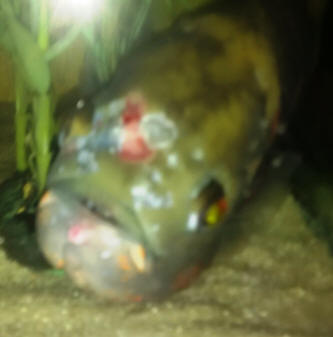
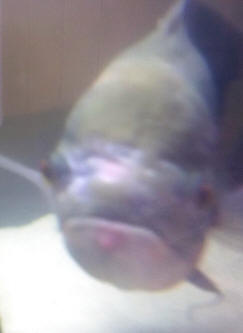
Thank you for responding so quickly! I meant to send the attached picture with
my original e-mail, but something went wrong. This picture was taken about 10
minutes after I got the Oscar home (this past Tuesday). The second was taken
this morning (sorry about the pictures, but that's the best my phone can do.
<Certainly looks better...>
I just hope I got them small enough that you can open them).
<Perfect!>
Ok, NO thiamine tablets, just clean water and tough love!
<I would do this, yes.>
I tried to get him to eat a small piece of grocery store tilapia this morning
with no luck.
<Good idea though.>
But I did notice that every single ornament in the tank had been moved since
last night.
<Ah! A very good sign. He's treating the new tank as home.>
A couple of the lighter ornaments were moved quite a distance and all of the
sand has been relocated in some way. Since I've heard this is a normal behavior
of an adult Oscar, I'm taking it as a good sign.
<100%, yes. Cheers, Neale.>
|
  |
|
Re: Kinda Critical Problem 3/25/18
Thank you so much!
<You're welcome and good luck. Neale.>
Re: Kinda Critical Problem 3/25/18
Neale, is it possible that the Oscar has ammonia burns on the inside of his
mouth and throat like he does on the outside of his body and that's why he won't
eat?
<It's surely possible. But inside the mouth heals quickly (fast dividing cells)
compared with the skin and scales, so shouldn't be a major problem.
If the fish is swimming and behaving otherwise normally, I would not worry about
eating just yet. Wait a few days, then offer something irresistible, like an
earthworm. Cheers, Neale.>
Re: Kinda Critical Problem 3/26/18
I'm sorry! (laughing) You know how all children go through that stage in life
where every word out of their mouths is "why?" Well, I never outgrew that!
<A good trait.>
I'm about to turn 55 in a month or so and still I have to relentlessly pursue
the "why" of everything I don't understand. I tried to give the Oscar another
piece of tilapia last night - small piece, about the size of a dime. He showed
real interest for the first time, even a little enthusiasm, but when he took the
piece of fish in his mouth, he just rolled it around for a few seconds and spat
it out. Once it hit the floor of the tank he nosed it a few times and then
slowly meandered off looking back at it as if he was debating whether he wanted
to try again. I thought he
looked like someone with a bad tooth or sore throat. That's what raised my
latest round of "why".
<Understood. Now, to be clear, fish cichlids process relatively little food in
their mouths. The jaws are mostly for capturing prey and evaluating its
edibility; the grinding and slicing tends to happen further down, in the throat
really, using things called pharyngeal teeth. When fish like cichlids mouth
food, then spit it out, it usually means they've evaluated it and decided they
don't want to eat it. It's definitely worth persisting, but I'd wait at least a
day, if not longer, between each 'offering' -- as a wise man once said, hunger
makes the best sauce!>
Anyway, I'll keep doing as you suggested and I'm sure he's going to be fine and
eating soon. Thank you for your patience! Have a wonderful day!
<Thanks for the kind words, and good luck. Neale.>
|
Sick 9 year old Oscar
12/21/16
We've had our miracle Oscar about 9 years. 10 days ago he
developed a cloudy eye and within 12 hours most of his body was covered
with white cloudy slime. In 24 hours, his other eye was cloudy as well.
<.... a water quality issue almost certainly here. With this fast issues
of these sorts. Water tests, changes stat.!>
We tested his water, which was a bit high in nitrates, but within
normal*.
<Mmm; how much and indicating what? Ammonia, nitrite?>
We did a 50% water change
<Ah, good>
in addition to our usual weekly 25%; we found the temperature was too
low, just below 70 degrees, so we heated the tank up. His tank mates
were much happier (i.e. more active). But Oscar now floats on his side
and has done for 10 days.
<Not good>
The white slime became more gunky and has not left him, he barely eats.
He seems to attempt to swim at feeding times and periodically, but with
great effort, like he is having a problem with his swim bladder and
cannot stop floating?
<.... Uhh, how large a system is this? What are the tankmates?
Foods/feeding filtration, aeration spec.s please>
I do not think his belly looks swollen, no protruding anus, I don't
think he's constipated. However, my husband did dose the tank with
aquarium salt 6 days ago (1 teaspoon/5 gallons, dissolved in the new
water during a water change) and started feeding him peas. He is not
interested in the peas, as far as we can tell. Tonight, after re-reading
many posts, we fed him brine shrimp. He flopped about a lot and seemed
to be trying to eat or seemed excited about the shrimp, but really hard
to tell, poor sideways sick guy!
*tank stats: 55 gallon tank, tonight the tank tests pH 7.0, alkalinity
80, chlorine 0, hardness 75, nitrite 0, nitrate 40, sitting at about 77
degrees; we routinely perform weekly water changes of 25-30% and new
filter cartridges as needed, usually every week or two; running two
filters, Tetra Whisper EX30 and Tetra Whisper EX70 plus Whisper30-60 air
pump.
<This is all fine...>
We had him in a 29 gallon tank for 7 years,
<MUCH too small... even just for this one fish>
with many African Cichlids, Bala sharks, cat fish, loaches and Plecos,
wherein he occasionally but predictably suffered HITH.
<Environmental stress. This fish has had its life shortened by being
too-confined and poisoned by its own metabolites>
We were thrilled to move him to a.55 gallon tank this last year. Took
the time to cycle it, transfer him safely. He looked strong and healthy
for several months, with the exception of his regular scrapes from
flipping out & swimming violently around the tank. In the *55 gallon
tank currently, we have a 12" Pleco, a 4" lemon yellow African Cichlid,
a 2" Cory cat
(Corydoras) and 2 clown loaches (Chromobotia macracanthus) about 3.5"
and one 3.5" Striped Raphael Catfish. From reading your many entries, I
gather this is an overcrowded situation for Oscar.
<Yes... but mainly due to that Pleco. HUGE waste producers>
I can't believe he's lived so long in a much smaller more crowded tank.
Given the grim state of Oscar and all I've read in your forum, I can
only take consolation in the facts we've never fed him feeder fish or
treated the tank with Melafix, and that he is currently in the largest
tank with the fewest mates in his life. Please advise...Jungle fungal
remedy? Epsom Salt every 3 days??
<I'd just keep the system water quality up and hope. No remedies
will cure this fish>
Oh, we call him miracle Oscar because when he was a wee 3", the African
Cichlids went through a ferocious breeding season and tore his side open
one night. We quickly rescued him, but we could see ribs, he was missing
most of his tail and right fin. In a safe space, he made an amazing
recovery and grew to his impressive stature to become the terror of the
African Cichlids who now hide from him. Hoping for another miracle in
Oregon, Amy
<Thank you for writing completely and thoroughly Amy. Again, if this
were my fish, system, I'd trade in the too-large Pleco (for a smaller
species, specimen) and otherwise, continue your stated maintenance,
offering of favored foods. I am a BIG fan of pellet staples for such
fishes (Hikari, Spectrum are two favored makes).
Wishing your fish health and you and yours happy holidays. Bob Fenner>
Oscar; algicide poisoned, then "Fix"ed...
8/16/16
Hello,
I hope you can help me. I have a large Oscar who up until recently has
been very healthy and a good eater. A couple of weeks ago I
treated my tank for an algae problem
<Treated? As in what? Used an algicide? I hope not>
which I think originated from a faulty heater which made the tank too
warm. I have since replaced the heater and keep the tank at 82degrees.
<Too high for an Oscar. I'd set the heater for the mid 70's F.>
I used an algaecide as directed.
<Toxic... Please read here re:
http://www.wetwebmedia.com/fwsubwebindex/fwalgicidefaqs.htm
My tank is a 75 gallon and my fish is about 9-10 inches long. One
morning I saw that he had an injury on his head. His only tank mates are
a couple of housekeepers, also large but there has never been fighting
among them.
<Oscars are forever "jumping", bumping into things>
When I researched the injury it looked whitish and like bites had been
taken out. I ruled out hole in the head because it just didn't look like
it nor did it seem to bother my fish, Big Red. I treated the tank with a
bacterial medication (Melafix) for a week.
<Of no beneficial use. Search/READ on WWM re this sham>
During this time Big Red stopped eating, or when he did try to eat he
would spit out whatever it was and with it came what looked like little
white particles.
<Smell the API product.... >
He is still not eating and usually loved frozen peas, romaine lettuce,
meal worms and shrimp also the cichlid pellets. I have offered
everything and he appears to be hungry but the food comes out almost as
soon as it is taken in.
Two days ago I did a 25% water change out which was recommended after
the bacterial medicine regime. No change in his eating habits.
Can you help me?
<Yes... change out about 25% of the water, lower the temperature, add a
pound or so of activated carbon to the filter and try offering food
everyday>
Thanks,
Courtney Ashbrook
<Just need to clear out the mal-influences here. Bob Fenner>
Re: Oscar
Oh thanks. I am so grateful for your help. Just tonight I got
him to eat a little.
<Ah, good>
Some nibbling at the Romaine a few Cichlid pellets and a couple of giant
meal worms. I am optimistic he is going to survive this.
<Yes>
You were such a wonderful recommendation from the aquarium guy at my
PetSmart. Thank you!
<Cheers Court. BobF>
|
911 help my Oscar fish please
7/30/16
<9 megs....>
I recently purchased a 50 gallon tank for my Oscar
and catfish, they were in a 20 gallon tank. I transferred 3 gallons of water
from the 20 gallon to the 50 gallon tank and then filled the 50 gallon up
with fresh water treated. I replaced the 20 gallon with new water
as I always do and treat it. The Oscar usually is upset for the day/night
and then things are normal the next day. I was told not to transfer the fish
into the new tank for a few hours,
<.... how was the system cycled?>
so I instead wanted to wait until the following morning.
When I woke up, the catfish was dead and my Oscar had cloudy eyes and was
very pale in color and had white stuff all over her body.
<Poisoned>
I transferred her immediately to new tank and rushed to the pet store for
API TC Tetracycline
<Of no use here>
and put the suggested amount in the tank. 5-hours later she was swimming
around and looking lively again. 24-hours from putting the TC in I took out
13-gallons of water as suggested and put new treated water back in along
with the remaining 5 packets of TC. The water turned a dark orange and
developed a layer of gunk on the top of the tank.
<Is the TC HCl>
I had a sample of the tank water tested today and it had high amount
of ammonia
<The root cause here... NOT cycled>
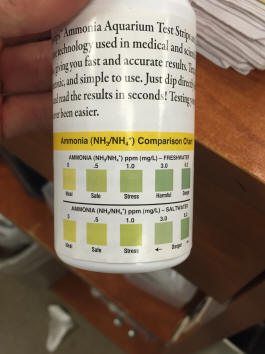
so I drained about 1/2 of the tank and treated it with API Ammo Lock
and the water is registering between "safe .5" and "stress 1.0"
<Won't cycle the system>
Now my Oscar is looking like she's gasping for air. What can I do?
<See above... better, READ here:
http://www.wetwebmedia.com/fwsubwebindex/fwestcycling.htm
and the linked files above... Let's see; you can/could move more of the olde
system to the new, buy/use a cycling product.... Just READ>
ATTACHED FILES:
video of Oscar gasping for air
photos of the tank
*Christopher
<NO FEEDING, just reading. Bob Fenner>
|
 |
|
911 help my Oscar fish please Neale's go 7/31/16
I recently purchased a 50 gallon tank for my Oscar and
catfish, they were in a 20 gallon tank.
<Certainly an improvement, but still far too little for an Oscar above, say, 5
inches/12 cm, and I'm assuming this catfish is some type of Plec, in which case
these need upwards of 55 gallons just for themselves. Both these species are
very heavy polluters, so aquarium volume and filtration are paramount, and water
changes the key to long-term success.>
I transferred 3 gallons of water from the 20 gallon to the 50 gallon tank and
then filled the 50 gallon up with fresh water treated. I replaced the 20 gallon
with new water as I always do and treat it. The Oscar usually is upset for the
day/night and then things are normal the next day. I was told not to transfer
the fish into the new tank for a few hours, so I instead wanted to wait until
the following morning.
<How was the new aquarium going to be filtered? Here's the deal: when upgrading
fish from an old tank to a new tank, all that matters is that the biological
filter is transferred across successfully. Moving gravel across is largely
pointless (unless you're using an undergravel filter, of course) and likewise
moving across "old" water to the new tank achieves very little because the
filter bacteria don't live in the water but on solid surfaces, i.e., filter
media. So, what you should do in a situation like this is take the biological
media from inside the filter belong to the 20 gallon tank, stuff that live media
inside the filter attached to the 50 gallon tank, and then switch the filter on.
Provided the new aquarium water is approximately the same temperature and water
chemistry as the old tank (doesn't have to 100% spot-on) the bacteria will adapt
and your new tank will be instantly mature. You can then move the fish from the
20 gallon to the 50 gallon without problems. If you don't do this, and you
simply add the cichlid and catfish to a brand new 50 gallon tank with brand new
filter media, you'll get a massive ammonia spike, followed within a few days by
a massive nitrite spike, while the filter media goes through it's cycling
process. Adding gravel or water from the old tank will have hardly any affect on
this because, as I mentioned, these don't carry across many bacteria. For sure
there'll be a few bacteria jumping across to the new tank, but only enough to
reduce the cycling process from 6 weeks to a few days less than that. So for all
practical purposes, no benefit worth speaking of.>
When I woke up, the catfish was dead and my Oscar had cloudy eyes and was very
pale in color and had white stuff all over her body. I transferred her
immediately to new tank and rushed to the pet store for API TC Tetracycline and
put the suggested amount in the tank.
<Did you do a water quality test at any point before adding medication? To
summarise: if ammonia or nitrite are not zero, your fish will become sick or die
because of poisoning. While bacteria will take advantage of that, leading to
Finrot, treating the bacteria will not fix the underlying problem, so the fish
will stay sick or keep getting sick.>
5-hours later she was swimming around and looking lively again. 24-hours from
putting the TC in I took out 13-gallons of water as suggested and put new
treated water back in along with the remaining 5 packets of TC. The water turned
a dark orange and developed a layer of gunk on the top of the tank.
<Yuk.>
I had a sample of the tank water tested today and it had high amount of ammonia
so I drained about 1/2 of the tank and treated it with API Ammo Lock and the
water is registering between "safe .5" and "stress 1.0"
<Anything above zero is NOT safe, no matter what API say! If their test kit
cannot register a zero level, it's not worth owning.>
Now my Oscar is looking like she's gasping for air. What can I do?
<See above. Pretty sure you're dealing with "New Tank Syndrome" going by what
you've said. Substantial (i.e., 50%) water changes daily for the next 2-3 weeks
are surely essential, though do them before adding any medication for that
particular day. While you may be dealing with Finrot as well, it's likely caused
by environmental stress, so fix the environment first. Maturing the filter is
what's needed. Do you have another tank you can donate some live media from?
Established tanks can donate 50% of the biological media without problems.
Cheers, Neale.>
|
Rescued Oscar (any thoughts, Chuck?)
4/21/16
Hello! My husband and I have rescued a tiger Oscar from a young couple
who had him in a tank with NO filter. We put him in an immediate
quarantine tank when we got him home. His story... He is about 10 inches
long and the
couple had him in a 55 gallon that was only filled about 50% (again with
NO FILTER.) The water looked like watered down milk. To top it off, they
had McDonald's happy meal toys as decorations in the tank. While we were
there,
their children were chucking random things into the tank! Food, sippy
cups, toys... Seriously... you name it, it was in there.
<Poor guy; thanks for "doing God's work" as some folks would say,
helping out an unfortunate animal that can't help itself.>
This guy is in bad shape. His gills and mouth are swollen and he can
only open one side of his mouth.. And as you know, these guys are
supposed to be black and orange. He is a very pale grey and his orange
is an off white color. His poop is clear and stringy. We have tried API
salt, slight water changes, and we have just started running an
antibiotic in the tank.
But we still cant get him to eat, he barely swims or moves around. He
has sever indents on his head (no holes) and one side of his face is
distended (the same side that he cant open). The spines on his dorsal
fin are also exposed, and he has some slight tail rot. We have done
everything we can think of to try to bring this guy back to being
healthy.
Any help or ideas would be grateful Thank you for you time.
<Sounds like this guy has, among other things, Finrot and "Hole in the
Head". Finrot is treated, usually very successfully, with antibiotics.
Hole in the Head is trickier, and requires something specific:
Metronidazole.
You can use the two medicines together, though the Nitrofuran group of
antibiotics works especially well with Metronidazole, so if you can use
these two together, do so. Don't forget to remove carbon from the
filter, if you use it (carbon removes medicines as well as things that
colour the water). Do remember to provide optimal conditions in the
tank, especially oxygenation. In the short term, food isn't that
important, and if he can't eat, don't worry about it for now. He can go
several weeks on his body fat.
Short term, it's all about stabilisation. Get the fins healing and the
lesions on his flanks healing. I've cc'ed out cichlid expert, Chuck, for
anything else he might add or anything I might have got wrong. Good
luck, Neale.>
Re: Rescued Oscar (any thoughts, Chuck?)
4/22/16
Thank you so much for your swift reply. We will be getting that in the
morning! We will keep you updated as to what happens, if there is any
developments and if we have any further questions! Thank you again.
<Glad to help, and good luck. Neale.>
Re: Rescued Oscar (any thoughts, Chuck?) 4/23/16
I wanted to let you know that I discovered a hole right above his eye,
it looks like someone had thrown a dart at him. It's extremely deep, but
small in diameter. I went to the store and bought some Metronidazole.
<That's the ticket!>
We have started that process, hopefully he pulls through! Thank you
again for the advice! I'll keep you updated.
<Does sound like typical damage to the sensory pores caused by Hexamita
infections and/or Hole-in-the-Head more generally. Do read up on these.
While Hexamita is treated with Metronidazole, it's a pathogen that seems
to work alongside other problems, specifically poor diet (i.e., lack of
green foods/vitamins) and high nitrates (i.e., lack of water changes).
Obviously your fish is a rescued fish, so the causes aren't your fault,
but going forwards, you will need to keep these two in mind in the long
term. Good luck, Neale.>
Sick 7 yr. Tiger Oscar, HITH
4/7/16
My 12 in. 7 yr. Old Tiger Oscar lives in 75 gal tank with 2 306 Fluval
canister filter a 400 mainland hob. He developed hth. from over feeding
!
<Hole-in-the-Head? Rest assured that this is treatable, though you do
need very specific medications, and need to medicate promptly.>
I treated with MelaFix and then Ali general cure as directed.
<Both useless for this. Hole-in-the-Head is partly related to diet,
partly to water quality, and partly to a parasitic protozoan called
Hexamita.
Which is the most important of these remains a matter of debate! But you
need to consider, and tackle, all three. First, diet. Stop
feeding if water quality isn't good. When you do start feeding again,
you need to ensure plenty of fresh greens. Oscars are often overfed junk
food, most dangerously of all, goldfish and other live foods. When
hungry, they will eat plant foods, and these provide essential vitamins.
Grapes, melon and other soft fruit are all worth a shot. Cooked peas are
generally taken without fuss. Feel free to starve an adult for a week or
more to get them
interested! Secondly, check water quality. Ammonia and nitrite MUST be
zero, and don't feed if they're not. But crucially, nitrate must be low
as well, 20 mg/l is the upper limit for good health; even 40 mg/l is
stressful in the long term. So, a spacious tank, minimal food given to
the fish, and lots of water changes are usually the key to success when
it comes to nitrate. Finally, medication. For Hexamita, you need
Metronidazole. Often used alongside an antibiotic, but Metronidazole is
the silver bullet here.
Nothing else works. Be sure to remove carbon, if used, from the filter
during medication.>
Every spot cleared except 2 holes near his eye that still look pink. He
won't eat his works or any thing ! Does he need antibiotics ? Please
help .
I'm disabled he's my therapy pet and friend .
<Well, I hope all of the above helps get him back into shape! Good luck,
Neale.>
|
5yr old Oscar; Dis.; env. 1/27/16
My Oscar has been struggling for q month.
<"q" month???>
I have tried to get the water balanced but one nitrate is 80mmg and the
ph is low still...
<You must keep nitrate below 40 mg/l with Oscars. Above this and they are VERY
prone to health issues... Hole-in-the-head for example. If you have zero ammonia
and nitrite, that's good. It means your filtration is adequate. But nitrate at
80 mg/l is very worrying. High nitrate means a combination of overstocking,
overfeeding, and insufficient water changes.
To recap: Oscars need big tanks (75 US gallons minimum) and should substantial
(25-50%) receive water changes weekly. Feeding should be extremely moderate.
Oscars will easily eat far too much. Portions about the size of the eyeball are
a good start, no more than one meal per day.
Skipping meals once or twice a week is a good idea, too.>
He now has a fuzzy white growth on his eye and white stuff on his fins and body.
<Finrot and/or fungus; fix water quality problems, and treat accordingly with a
reliable medication. Not Melafix and other tea-tree oil products; something like
Kanaplex for example.>
He looks almost like he blowing water out his mouth with white stuff in it.
I can see the ragged looking skin in his mouth. I did notice the heater isn't
working properly also.
<Anything below 18 C/64 F is lethal to Oscars; between that and, say, 24 C/75 F
will be stressful. These are tropical fish, and hothouse flowers at that! You
need a reliable heater, probably outside the aquarium because Oscars can/will
destroy glass heaters in the tank. Eheim make an excellent range of combination
heater/filters that work great with Oscars, but there
are nice "inline" heaters from Hydor, among others, that you can connect to the
outflow from the external canister filter. External canisters are pretty much
the only option for keeping Oscars on a budget because you need a BUCKET of
biological media, so using inline filters isn't a major ask.
Even better are sump-type systems (as used for marine tanks) where a glass
heater can be put in the sump instead of in the main tank.>
The temp is fluctuating a lot.
<Killing your fish, alongside the high nitrate.>
Please help he has eaten in at least 5 days
<Least of your problems. Oscars will literally beg for food when healthy.
Any Oscar that doesn't is, at best, stressed; at worst, sick/dying. Review,
quickly, and act accordingly. Hmm... let me direct you to some reading...
http://www.wetwebmedia.com/fwsubwebindex/oscars.htm
Oscars are easy fish to keep if you have "all your ducks in a row", but if you
try to cut corners, they'll quickly get sick. So: giant aquarium, massive
filtration, external heater of some sort, cautious feeding. Sound good? Cheers,
Neale.>
RE: 5yr old Oscar 1/27/16
I am going to have my water checked and get a new heater and
meds....with the water change do you recommend. He's obviously stressed.
<Indeed. You're aiming for:
0 ammonia;
0 nitrite;
average 0-20 mg/l nitrate; certainly no more than 40 mg/l before you do a water
change;
stable pH around 7, but anywhere between 6 and 8 is fine so long as it doesn't
vary much, though bear in mind below pH 7 biological filtration works less well;
water chemistry soft to medium hard;
temperature 25-28 C/77-82 F.
Cheers, Neale.>
RE: 5yr old Oscar 1/27/16
And also how do you remove the high nitrates?
<Three steps. First, understock the tank so nitrate builds up slowly. Don't try
and keep an Oscar in 55 gallons, and don't keep them with other fish unless the
tank is huge (I'd reckon at least 100 gallons before I thought about adding a
catfish for example). Secondly, don't overfeed; again, so nitrate builds up
slowly. Finally, do frequent, substantial water changes.
Up to 50% every week would be about right, but even better is frequent smaller
water changes, say, 20-25% every couple of days. Of course this assumes your tap
water has low nitrate. The higher the nitrate in your tap water, the more often
you need to do water changes. If you have high nitrate tap water, you may prefer
to use RO water buffered using commercial
Discus Buffer; do read up on this approach carefully though because very soft
water can cause problems if incorrectly buffered and prepared for use.
Cheers, Neale.>
RE: 5yr old Oscar 1/27/16
I just don't get how he's been fine 5 yrs then all of a sudden he's sick and
dying...
<Sometimes the question is not "why's he sick now" but "how come he was healthy
for so long"? The answer can be simple luck. But do understand fish get bigger
as they age, filters clog up over time, jaded fishkeepers do fewer water
changes... eventually a tipping point can be reached, after years of success,
and a big, old fish can get sick.>
i lost a algae eater a few months ago and he must've kept it pretty clean...
<Algae eaters remove algae, a bit, but don't keep the tank clean. By definition,
every extra fish makes water quality WORSE. More ammonia excreted, more nitrate
building up between water changes. How big's this aquarium? What sort of filter?
Cheers, Neale.>Gobiosoma
genie Bohlke & Robins 1968,
Cleaner Goby. Western Central Atlantic: Bahamas and Grand Cayman Island. To 4.5
cm. Bahamas and Grand Turks images. Bold yellow V marking on head trails into
pale band along sides. St
Thomas 2014.
RE: 5yr old Oscar 1/28/16
Its a 30 gallon and the filter that came with the tank.
<Well, and Oscar in 30 gallons is rather like keeping a horse in a shed.
The filter is probably coping if it's a decent size and been there for years,
but the tank really is too small, and upgrading the tank to at least 55 gallons
is the priority. Upgrading the filter is worth doing, but the tank is the first
issue to deal with.>
I never expected to have such a large fish he was only about 3 inches when we
got him.
<Oscars grow very fast!>
Im going to get a new filter\pump today. I got the fungus medicine. And treated
last night.
<Anti-fungus won't treat bacterial infections. So can be a waste of money.
Fungus is distinctive: looks like cotton wool growing from the fish. Long,
off-white threads. Bacterial infections look different, usually.>
But it says treat again in 48 hrs then do a water change after 48 more. I think
he'll die before then if i don't change the water first and then do the
medicine. They didn't have the kind you recommended KanaPlex. But had API brand.
I hope that's ok.
<Can't tell if you don't tell me API "what" medication. You need something that
treats fungus and bacteria if you can't tell them apart. In the UK, I
use/recommend eSHa 2000.>
It turned my water green.
<Sounds like it contains Malachite Green, but tell me what the medication is
called and we can help further.>
I went to pet supermarket and they were absolutely no help. So I'm on my own. I
had my water tested there thinking it was a different test but it was the same
strips! That was a waste of time. He told me what I already knew and no one
there knew anything on how to help. The only help I've gotten figuring this out
is you. Ph is low alkalinity is low, water is hard, nitrite is 0 and the
nitrates if off the charts.
<Low nitrite suggests the filter is basically okay, or you'd detect nitrite (and
ammonia). But nitrate is produced by a filter, and removed by water changes, and
accumulates faster the bigger the fish and the smaller the tank. Make sense? So
"off the charts" nitrate suggests a big fish, a small tank, too much food, not
enough water changes... some combination of those
anyway. Nitrate is a slow killer. It stresses fish, but short term spikes aren't
a problem. Long term exposure makes them sensitive to other problems and
diseases.>
I've done 2 water changes in 2 weeks. Im scared of putting to many chemicals at
once that one will mess with the other. Im so lost.....i feel as if he's going
to die because of my ignorance....
<Here's what I'd do. Most medications work for a few hours after use, then fade
away in the tank. So I'd add the medicine first thing in the morning. I'd go to
work, come home, have my dinner, and then, say, 8 or 10 hours after the medicine
was put in, I'd do a 25% water change. I'd repeat this process for as long as it
takes. When the medicine is done, I'd still keep
up with the water changes, if not daily, then every 2-3 days. I'd feed
minimally. On top of this, I'd be looking at a bigger tank. Finally, do remember
to remove carbon from the filter if you add medicine. Carbon removes medicine
from the water. In fact I'd not buy carbon or use carbon at all! Cheers, Neale.>
RE: 5yr old Oscar 1/28/16
He does have the white furry fungus on his eye and the white stringy stuff on
his body a little bit not much.
<Good. There's hope then!>
As far as the tank foes my other half (husband) was suppose to be taking care if
the tank....im supper ticked at him!
<I bet. Oscars are easily overfed. They actively beg for food, and worse still,
some people feed them live goldfish and other very unhealthy foods.
So it's super-easy for them to become sick if you aren't careful. Feed small
meals, skipping the odd day.>
When I realized he was feeding him too much and not properly doing water changes
I have taken over!! Now he's my fish! I will do what I can to save him! Thanks
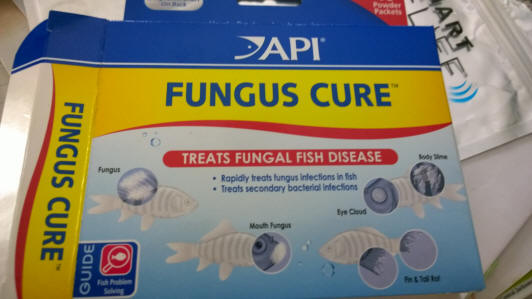
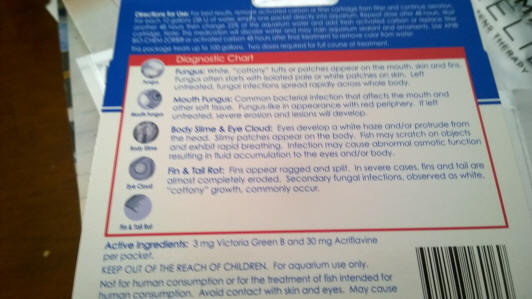
for all your help! I put in the meds last night. I attached a pic of the front
and back of the medication box.
<Looks promising. "Secondary bacterial infection" is very likely what you have
here along with the fungus, so with luck, you'll be fine with this.>
His tank is proper heated now. I am doing a water change today! What type of
filter do you recommend if not carbon?
<Just remove the carbon. If you can, replace that segment of the filter with
biological media, even filter floss, which can buy loose in bags. If you can't,
just leave that compartment empty for now. Carbon is a menace if you're trying
to heal a sick fish! Cheers, Neale.>
RE: 5yr old Oscar 1/28/16
How do I get water that is ok to put in there every couple of days?
<Assuming your water chemistry is reasonably stable, you can buy the quite handy
"automatic" water changers -- the "25ft Python No Spill Clean And Fill", for
example. Drain out 25% of the water from the tank, add dechlorinator, then use
the Python to take water straight from the tap to the aquarium. Alternatively, 3
to 5 gallon buckets are cheap and obviously
work great, they're just harder work. Don't change more than 25% of the tank at
any one time unless it's an emergency because it's hard to keep water chemistry
and temperature constant. Now, if your water chemistry varies (often the case
with well water for example) you might want to draw the water into a bucket, and
let it stand overnight before use.>
I have 5-1 gallon jugs I use. But that is clearly not enough! Any suggestions??
Thanks
<Cheers, Neale.>
5yr old Oscar 1/28/16
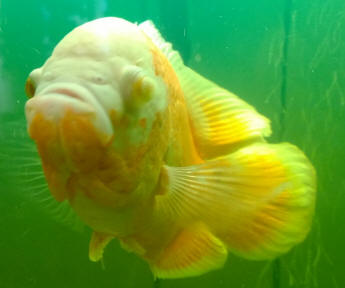
Figured I send a pic so you can be introduced...this is Sushi.... And his sick
pitiful self.❤
<Doesn't look too far gone, but yes, a bit rough, that's for sure. The eye looks
swollen... would use Epsom salt alongside other medications... do read:
http://www.wetwebmedia.com/fwsubwebindex/SaltUseFWArtNeale.htm
And also...
http://www.wetwebmedia.com/fwsubwebindex/fwpopeyefaqs.htm
Hope this helps, Neale.>
|
 |
|
RE: 5yr old Oscar.... 1/29/16
Lol im sorry but I could not understand ALL the info on the salt. I don't have a
problem doing it. I would think it would hurt him a lot to have the salt burning
his eye?
<Tears are salty, are they not? Eyes are meant to have salty water around them.
So don't fret.>
Just a question. How much can I use? And how often?
<Dosages all in the article...
http://www.wetwebmedia.com/fwsubwebindex/SaltUseFWArtNeale.htm
2 gram/litre for the aquarium salt; for Epsom salt, 1-3 teaspoons per 5
gallons/20 litres. As always, dissolve thoroughly in a jug of water before
adding to the tank. Also, remember that if you do a water change, add the
appropriate dose to any new water on a per-bucket basis. So if you replace 5
gallons of water, the new 5 gallons of water has to have 1-3 teaspoons of
Epsom salt added. Don't make the mistake of adding the amount needed for the
WHOLE tank per water change otherwise you'll make a right mess and probably kill
your fish. Do read, digest, reflect. One of those times basic
maths is important! Cheers, Neale.>
RE: 5yr old Oscar 1/29/16
1-3? So do I start with like 1.5 teaspoon s per 5 gallons to be safe or 1?
<Choose something between 1 and 3, less for safety, more for serious situations.
But even 3 teaspoons of Epsom salt per 5 gallons/20 litres of water is safe with
cichlids. DO UNDERSTAND this is for Epsom salt (magnesium sulphate), not
aquarium/table salt. For aquarium/table salt (sodium chloride) I'd weigh out the
salt using kitchen scales if at all
possible, so you can keep to the 2 gram per litre of water amount. Google will
tell you how many litres your aquarium has if you're used to gallons... for
example 30 US gallons is 113 litres. Multiple the 2 gram by 113 to get a total
of 226 gram per 113 litres (or 30 US gallons) and weigh that amount out
carefully. Or don't use salt at all if this is all too terrifying.>
I. Sorry I've just don't been trying to save his life and im scared of
overloading him...thank you so much....hr ate a little this morning...
<A good sign. Neale.>
|
RE: 5yr old Oscar 1/30/16
I fear he will loose his eye though...
<Definite possibility. FWIW, fish can manage just fine with one eye. But fingers
crossed! Neale.>
5 yr old Oscar 1/30/16
I am so discouraged. I have bought
a $ 100 worth of stuff and CANNOT get the nitrates down. And he isn't getting
better... I have changed 25% of the water 3 times in 5 days..... I don't know
what else to do but drain the whole tank and start over....i could choke my
husband! Sushi's eye looks horrible also......
<Nitrate won't go down immediately. It'll be diluted by each water change
though. So if you have 100 mg/l, do a 25% using water with zero nitrate, it'll
go down to 75 mg/l. Your test kit may not even register the change.
Furthermore, your water probably has some nitrate, so the reduction will be even
less, and on top of that, the fish is excreting ammonia and that means the
filter will be producing nitrate! Bottom line: stop feeding, do 25% water
changes each day, perhaps twice a day if you can with a few hours between them,
and after a week or so you should find nitrate lower. Make
sense? You're learning now while nitrate is harder to "cure" than "prevent" via
water changes, under-stocking, and not feeding too much. Neale.>
5yr old Oscar 1/30/16
So last night I did a water change and medicated him this morning. He did eat
this morning. I assume that's a good sign.
<Yes, but I wouldn't go crazy. A little treat of a snack, that's all!>
However the nitrates are still high. Another water change tonight. But his eyes
still looks bad. I know you said something about aquarium salt but im kinda
scared of that
<Don't be.>
Ali BG
<????>
with everything else im doing to his poor soul! I tested the water I had sitting
in jugs and it was perfect. But this morning the ph is below 6.2 so is the
alkalinity. The water is still hard and the nitrates are still high....not
giving up yet.....just curious about adding salt. I don't want to overload him
and stress him put more. Another thing...he keeps like coughing out white stuff
since I started the meds is that normal?
<Not abnormal, anyway.>
Thanks again
<Cheers, Neale.>
|
 |
5 yr old Oscar. Reading... PLEASE!
1/31/16
Thank you so much for corresponding. My water that im putting in doesn't have
nitrates I checked. However today the nitrites is a lil high along with the
nitrates.
<Please read here:
http://www.wetwebmedia.com/fwsubwebindex/fwno2faqs.htm
and the linked files above>
So far there were 0 nitrites. It was a little last night but a little higher
this morning.....poor fellow I am slowly killing him I
believe.....he still has a little bit of the stringy stuff (not alot)
<No such word. It's a lot>
but some. His eyes is still in rough shape. I guess I will change it this
morning but do I put salt in the new water every time?
<Just the amount, percentage removed>
And also what about the temp fluctuating so much with all the changing of the
water will that make him worse? One more...sorry do I keep putting fungus meds
in it?
<The same as the salt; per the API instructions. Bob Fenner>
5yr old Oscar 1/31/16
Im sorry to say but Sushi is not doing well... I changed his water again today
25% and added salt to the new water which was 2.5 tsp to 5 gallons and water
conditioner, and fungus meds. I gave No food today. He acts like he has no
balance.....staying in one place most of the day and going nuts when im doing
anything to the tank..... I don't know what else to do.....now the nitrites are
showing up.....Uggghhhh
<What are your water quality readings? Ammonia, nitrite, nitrate? Hardness, pH?
BobF>
RE: 5yr old Oscar 1/31/16
Well I have the dip sticks.
<Neither accurate nor precise. See WWM re>
The nitrates haven't changed In over 2 weeks they are still 100+
<ppm? Waaaay too high. DID you read where Neale referred you? High [NO3] is a
function of:
1) Too small a volume, tank size relative to:
2) Biomass (stocking), and
3) Foods, feeding, along with:
4) Capacity of ones filtration (mainly bio. and chem.) AND
5) Maintenance practices...
Your Oscar IS (?) in at least a 55 gallon?
No other animal livestock present?
You're scarcely feeding proteinaceous foods?
You've added to filtration PER YOUR READING to enhance bio. (and poss. chem.)
processes?>
the nitrites are .5- 1
<Deadly toxic at high pHs... again, ARE YOU READING?>
where they were 0..... my sticks do not have the ammonia readings......I don't
know what else to do for him
<Less feeling and more understanding what is going on here. READ the items above
and respond honestly>
.....and his eye still looks band.....no better at all....i just checked on him
and he is still alive but just hanging in there.....�� I feel horrible for him!
<... What are you going to do? B>
RE: 5yr old Oscar..... reading for comprehension, or at all. Env. dis.
2/1/16
Im sorry but I have read ALL the info that Neale referred me too.
<Ah good. We have some 30k users per day... WWM is a reference site, not a
hobbyist bb>
I don't quite understand all of it but I do some of it. Im writing you back with
the info to what I've done so far that Neale has educated me on what to do.
However I am not a expert by any means and I don't really appreciate all the
unnecessary comments like did I read anything!
<Sorry to state; but this is how it appears... w/ your writing back that you
don't know what to do. Had you read clearly you'd understand>
Yes I have and I know these things are toxic but I have done everything Neale
told me to do on top of spending alot
<.... again; no such word>
of money. I have really been trying but everything I have done and its only
worse. The water doesn't even look healthy. Its orange looking brown on the
bottom half of the tank and green from the meds on the top half. He is so
stressed from all the water changing and cleaning his tank everyday. He cant see
out of one eye so he's even more stressed.......so frustrated....
<Go back and re-read where you're been referred to. You fail yet again
to answer my direct questions. Your statements tell me/us little of substance;
comments re your feelings are of no use. B>
RE: 5yr old Oscar 2/1/16
<Don't write: READ>
Don't get me wrong please I am very thankful for all the advice......I just
don't know what else to do but drain like 50% of the water.....if I don't do
something drastic he is going to perish from not being educated. I really want
to choke my husband because he was not doing it correct this while time or even
at all. yher is no other fish in a 39 gallon tank....hes been the dame size for
2 yrs but my heater had stopped working properly and u didn't realize till it
got very cold last week is when he started showing signs..his eye which is lost
im sure by now and the clear stringy stuff on his body which he doesn't have
anymore as far as can see... His eye and the water so toxic is what im concerned
for. I cannot by a new tank at this moment. I just spent $100 this past week on chemicals,medicine, new water conditioner that reduces nitrates and nitrites and
new filter with no carbon, new air pun for more ariation and Epsom salt. I've
changed the water 3 times in 6 days actually 4 because im about to do it again.
My tap water does not have either nitrates it nitrites in it...so im stumped aa
to why it doesn't lower and now the other nitrites are showing. I just feel he
needs new water maybe.....im no expert for sure but the water looks old and
stinks of old water...
RE: 5yr old Oscar 2/1/16
Thanks for all your help but I do have to say I really appreciated
Neale's help ALOT <sigh> more than yours. I am truly sorry for
expressing any "feelings" about my pet that you have no use for or agree with.
Apparently I cant read nor do I know what a real words! Havea good evening Bob.
<And you>
|
My Oscar.. hlth. issue.... env.
1/11/16
Hello!
<Hi there>
I'm in need of immediate fish assistance..
My Oscar is hardly holding on.
He's in a 50gal tank. He grew up in it with a few other non-bitey fish. I was
getting ready to move him to his own tank, but I cleaned the 50gal and moved a
few of the decor around first. I filled the tank and added a few drops
to keep levels good.
<Drops of what? What levels?>
I went to get his tank ready and found a fat crack in the side of it. I was
going to go to the store today and get a new one..
The bubbler was busted so I replaced it. Cleaned the filter, but it's tricky so
I'm having issues turning it on. Its off for now but later today it will be
running.
My Oscar, Bitey-snappy, was pale, and at the bottom of the tank last night.
I looked up everything I could to see what I could do to fix him. All I found
was, he's probably being temperamental.
<? Is this a joke?>
Fast forward to about ten min.s ago. He's upside down in a decor plant, pale,
and hardly breathing. Please, tell me how to fix him, and quick, if you can. I
don't want Bitey to die, he's my buddy :(
<Do you have another system that you could move this fish to? Some friend, or
friendly fish store that will take him temporarily? I suspect that wherever this
fish is currently is trouble. Bob Fenner>
I'm sorry he's not an Oscar. 1/11/16
He's a cichlid. I keep messing the two up.
<... Oscars are cichlids. B>
Oscar; hlth... env.
6/30/15
I have a Red Oscar in a 125 gallon tank that has been running
for several months. There are other cichlids in the tank and a Pleco. Total of 6
fish. I have a Filstar XL filter that I think can handle up to
a 300 gallon tank. My pH is about 7.2 and I do regular 15-25 gallon changes with
a gravel vac.
<Every week? I would>
The Oscar looks and acts normal. <ly> He’s(she’s) very active and always wants
food. I have to fake him out when feeding live food, mostly worms, so he doesn’t
eat all of it. Here’s what I’ve noticed. When he moves very fast, spooked or
getting food, brown chunks almost like big wet mushed cichlid pellets come off
him.
<?!>
At first I had no idea where these were coming from but then I became more
convinced that they came from the Oscar. It doesn’t seem to always happen so
maybe it’s a normal thing?
<Not normal....>
I haven’t seen anything online reporting any similar issues which is why I’m a
bit concerned. Thanks for any information on this.
Dave W.
<Something strange going on here... I do think you need much more filtration and
circulation than the Filstar provides. I'd look into a large hang-on power
filter, and possibly a couple of in-tank pumps or powerheads. Bob Fenner>
Oscar /Neale 6/30/15
I have a Red Oscar in a 125 gallon tank that has been running for several
months. There are other cichlids in the tank and a Pleco. Total of 6 fish. I
have a Filstar XL filter that I think can handle up to a 300 gallon tank. My pH
is about 7.2 and I do regular 15-25 gallon changes with a gravel vac. The Oscar
looks and acts normal. He’s(she’s) very active and always wants food. I have to
fake him out when feeding live food, mostly worms, so he doesn’t eat all of it.
Here’s what I’ve noticed. When he moves very fast, spooked or getting food,
brown chunks almost like big wet mushed cichlid pellets come off him. At first I
had no idea where these were coming from but then I became more convinced that
they came from the Oscar. It doesn’t seem to always happen so maybe it’s a
normal thing? I haven’t seen anything online reporting any similar issues which
is why I’m a bit concerned. Thanks for any information on this.
Dave W.
<Probably faeces; as with humans, to some degree physical
activity helps to move things along the colon. It's also true that rapid
swimming creates currents that can cause faeces on the substrate to lift back up
into the water. Observe your fish, and provided there aren't obvious chunks of
Oscar missing, he's probably fine. One last thing: the Filstar XP-XL has a water
turnover rate of 450 US gal/hour. For Oscars, you want a water turnover rate of
at least 6 and preferably 8 times the volume of the tank per hour. Since your
tank measures 125 US gallons, 6 x 125 = 750, so your present filter is not
providing optimal water quality. Remember that water quality isn't just removing
ammonia and nitrite, but also removing physical solid wastes (such as faeces)
and ensuring adequate water turnover (and thereby oxygenating all levels of the
tank). Review, and act accordingly. Cheers, Neale.>
|
Can I save my tiger Oscar; env.
6/23/15
Hello. So I have a seriously neglected Oscar. I have had him for 6 years.
His tank has gone thru all types of changes and he always seemed healthy.
3 weeks ago he stopped eating and had problems swimming upright.
<When, where in doubt: Water changes!>
Now he stays at the bottom of the tank, still has not eaten, is in a curled
position, and his breathing is slower and deeper. When I realized all of this, I
took immediate action but I am unsure of weather or not I can bring him back. I
put a heater in there, do water changes weekly. He has a few small holes by his
eyes which I assume is hith. I ordered some antibiotics, will that help?
<See WWM re Hole in the Head/HLLE... antibiotics not a good idea>
How can I get him back to normal. He is 8 years old and in a 55 gallon tank by
himself.
<Water quality tests show what? What have you been feeding this animal?
Any chance of outside poisoning, decor issues?
Bob Fenner>
re: Can I save my tiger Oscar 6/23/15
I do not or have ever checked the water. Never knew how. He just kind of got
dumped on me and I got no instructions. Until he got sick I didn't even know he
needed a heater
<Yikes>
. I also tried MelaFix
<... of no use whatsoever>
for the time said on the bottle. I removed all of the decor in his tank. Just
him and the heater.
I've been feeding him tetra JumboMin sticks.
<.... needs to have more nutrition than these>
Nothing else. He still gets
excited to see us walk in the room, so I don't think he has given up yet.
I can try to get a pic
re: Can I save my tiger Oscar 6/23/15
The antibiotic that I ordered is METRONIDAZOLE.
<.... this is not an antibiotic. Let me stop here and again, encourage you to
READ.... on WWM... re the care of this animal. BobF>
Also I have a couple pics.
The first one is him from the bottom so you can see the curl. The second is how
he looks the majority of the time. Today I took out his last decoration and
behind it and under it was what I would describe as smudge. That is why the tank
is dirty looking now. Will that go away with small water changes or should I do
a complete water change?
|
.jpg)
.jpg) |
|
Re: Can I save my tiger Oscar 6/23/15
Ugh... OK. I have been reading on WWM.. It just seems that the causes
and treatment seems to be up in the air.
<No Nickie... the root causes here are poor environment and lack of nutrition>
I'm going to buy the water test kit,
<Yay!>
continue doing water changes... Is there anything else that could possibly help?
And also is it a good idea or not to give the METRONIDAZOLE??
<Please... READ before writing. Do you see the search tool... on every page? B>
Re: Can I save my tiger Oscar /Neale 6/23/15
Great.. Couple last questions..... First of all what are the correct water
readings?
<For Oscars: at least 55 gallons, and recommended 75+ gallons of water with
zero
ammonia, zero nitrite, and nitrate that is as low as practical (ideally less
than 20 mg/l, and certainly well below 50 mg/l). Water chemistry is as you'd
expect for an Amazonian cichlid: ideally soft, slightly acidic to neutral but
farmed varieties are reasonably tolerant of hard water. Essentially 2-12 degrees
dH, pH 6-7.5 is the ideal, but up to 20 degrees dH, pH 8 will be tolerated by
farmed Oscars without problems.>
And since he is not eating, will the right water help get him back to eating?
<Yes. Cichlids stop eating when sick or stressed. They will eat again when
happy.>
I have even tried to put it in his mouth but he spits it back out???
<Do not force feed your fish. More harm than good. Cheers, Neale.>
Re: Can I save my tiger Oscar... starting too far back...
6/23/15
My ammonia levels are .5
<Deadly toxic>
how can I get them down
<? Read here:
http://wetwebmedia.com/FWSubWebIndex/NH3TrbFixF.htm
and the linked files above. Bob Fenner>
|
Oscars from Wal-Mart 11/30/13
Today I went into Wal-Mart for stress coat to find myself walking out w
6 tiger Oscars and tears down my cheeks! ! That was the saddest
conditions I've ever seen! 5-10-15 or more dead fish in each
holding tank!
<Unfortunately by buying them, the Wal-Mart company will see sales, and
order some more. Though it's painful to watch, the best approach here is
to not buy the fish, and when you get home, write to your local/city
government, specifically, to the department that issues licenses for
selling pet animals. Assuming your part of the world is similar to mine,
egregious disregard for animal welfare carries not just fines but also
the potential to lose that license to sell per animals.>
They had been dead for wk or more by the way they looked! The
Oscar tank had 1 dead and 1 suffering barley breathing! ! The only tank
w no dead fish was the angel fish? Weird?
<Not really; Angels are small fish that are easily kept in "average"
conditions. Oscars are substantially more demanding in terms of
filtration, swimming space and diet.>
Anyways I went mad and when the manager came over, I let them have it
and I grabbed a test kit off the shelf and tested the water. The phone
was off the chart basically all areas were bad.
<Good for you. This is the sort of thing people should do more often!>
So I had them bag me up the 6 Oscars and I bought them.
<He should have given them to you for free, given what happens next. But
anyway, this is where things get complicated. For one thing, how will
you house them? Six Oscars will need 200 gallons or more.>
I got them home and slowly introduces them to my tank. Prob is that my
tank has been high in nitrites and I've been doin water changes 2x;s a
day and it's Barley helping.
<I can imagine. Daily water changes is definitely helpful. Don't feed
them either. Biggest possible tank. Short term -- look online for your
local tropical fish club. There are many of them, particularly in big
cities.
Some have online forums, others Facebook pages. Explain what you're
trying to do. They may be able to help. Failing that, if there's a
*good* aquarium shop in your area, again, give them a call or visit in
person, and see if they can help out. Oscars are valuable fish, so if
they're reared back to good health, you should at least cover your
costs.>
What can I do to help the Oscars cuz a few of them are not doin well.
<I bet.>
They are breathing slow not fast.
<That's a good sign, to some degree, provided they're not "gasping" at
the top (which would usually mean poor water quality).>
And they show hole in the head and fuzzy looking air bubbles on there
mouths and eyes. They act like they are gonna eat then stop. Few are
doin each thing. Will a salt dip or Methylene blue dip.
<Neither. Here and now, I'd do nothing more than treat as per Finrot
using something relatively non-toxic such as Maracyn, but given you're
doing daily water changes, medicines will need to be used carefully, at
least a few hours before each water changes. Do remove carbon from the
filter if used. Do add additional filters if possible (a big canister
would be ideal).>
Plz help
thank you. LaTisha
<Good luck, Neale.>
Oscars from Wal-Mart 11/30/13
Today I went into Wal-Mart for stress coat to find myself walking out w
6 tiger Oscars and tears down my cheeks! ! That was the saddest
conditions I've ever seen! 5-10-15 or more dead fish in each
holding tank! They had been dead for wk or more by the way they
looked! The Oscar tank had 1 dead and 1 suffering barley
breathing! ! The only tank w no dead fish was the angel fish?
Weird? Anyways I went mad and when the manager came over, I let
them have it and I grabbed a test kit off the shelf and tested the
water. The phone was off the chart basically all areas were bad. So I
had them bag me up the 6 Oscars and I bought them. I got them home and
slowly introduces them to my tank. Prob is that my tank has been high in
nitrites and I've been doin water changes 2x;s a day and it's Barley
helping. What can I do to help the Oscars cuz a few of them are
not doin well. They are breathing slow not fast. And they show
hole in the head and fuzzy lookin air bubbles on there mouths and eyes.
They act like they are gonna eat then stop. Few are doin each thing.
Will a salt dip or Methylene blue dip. Plz help
thank you. LaTisha Groves-Kleider
<<Have already replied to this, LaTisha... check your spam folder
perhaps?
Cheers, Neale.>>
Re: re: Oscasrs from Wal-Mart 11/2/13
Thnk u for ur response! I'm doin the water changes but can't seem
to get my alkalinity and nitrites down.
<Why do you want to change the alkalinity? Leave it alone. Unless your
tap water is very hard there's no reason to fiddle with it. Steady water
chemistry is the aim. As for nitrite, you'll never get that to zero
(where it must be, long term) if the filter isn't big enough (or mature
enough) for the number/size fish being kept.>
I'm removing about 5gl every few hrs so I hope that helps. When I tested
there tank at Wal-Mart, during my tyrant due to there living conditions,
it was off the charts. So I am concerned my tank is shocking
them in someway.
<Likely so. But there's no magic bullets here. The Oscars will pump out
ammonia at a more or less steady rate, no matter what. If one adult
Oscar needs the equivalent of, say, an Eheim 2217 filter to remove all
the ammonia it produces per hour, then two Oscars will need two such
filters, three Oscars three such filters, and so on. If you have more
Oscars than filter capacity (e.g., three Oscars but only two Eheim 2217
filters) then you'll always have some ammonia "left over" and over time
that ammonia builds up and up, like a debt that can't ever be paid off.
Nitrite works in just the same way, though the filters generate the
nitrite themselves, and if you don't have enough filtration, then some
of the nitrite is left over, building up and up. There are only two real
solutions (assuming your filters are properly set up and mature). One is
to remove some of the fish, the other is to add more filtration. By
analogy with a debt that can't be paid off, you can either spend less (=
keep fewer fish) or earn more (= add more filters). Make sense? In all
honest, my recommendation here is you try, urgently, to rehome these
Oscars as soon as you can. A few days of poor conditions might not kill
them, but weeks, months will.>
thank you. LaTisha
<Most welcome, Neale.>
Oscars Dropping dead! - 12/18/2012
Howdy!
<Hello!>
I hope this gets to the right desk,
<It's on my desk tonight - Sabrina with you this chilly evening.>
and hope this letter finds all in great standings or better.
<Thanks.>
I am floored with the events of the last few days. My boyfriend and
myself have an aquarium that we set up earlier last summer. We got 4
young Oscars (two albino, two regular tigers) and put them into the
50gallon tank -
<This is too small by far to house four adult Oscars. Young Oscars
grow up, not slowly either, and are very "messy" fish - i.e., consume a
lot of food and produce a lot of waste, thereby fouling the water
quality impressively. I would not house more than one adult in a
50 gallon tank, and even that might eventually be just too much work for
my lazy self to keep up with the waste production.>
They where about 3 inches each. Today the remaining two are a good 6-7
inches,
<This is about the largest I would be inclined to keep in a 50g; if it
is possible for you to consider a larger tank, please do so.
Otherwise, be prepared to consider more/stronger filtration and more
frequent water changes. Weekly wouldn't be overkill.>
but two have recently died.
<How unfortunate; my sympathies. Hopefully we can help you turn
things around for the remaining two....>
I know your going to want to know the water stuff,
<Yes>
however, I don't have a kit yet (I know, bad fish owner),
<You said it, not me. Get test kits as soon as you reasonably can
for Ammonia, Nitrite, Nitrate, and pH. These are not just "nice to
have", but "urgent". Since we can't physically see or sense
(beyond making guesses based upon scent, color, clarity, etc., which is
entirely unreliable and inaccurate) these properties of the water, the
only way we can really know what is the status of the environment is by
using a reliable test kit.
These measures aren't just for having fun playing with science at home
(even though it is fun anyway), they're crucially important because the
water is what the fish are living in full time. They're not moving
around in the air, like you and me, or mice, or cats, or dogs, they're
immersed full time in a medium in which you and I don't live.
Control that environment, and you control the health of the animals.>
but these guys have been thriving so nicely in this tank until now!
<The exceedingly precarious balance of too much fish in too small a
space finally tipped. It was inevitable, without constant checking
of water quality and large frequent water changes. Get those test
kits.... and change water. A lot of water. Like,
yesterday.>
Night before last we looked in the tank and noticed that one of the
tiger Oscar's scales had seemed to liquefy, some where still hanging on
but they where not hard scales - I am having trouble explaining what
they look like, but liquefied is my best description - And where hanging
off waving in the water like tirn flesh with no hardness or shape like a
scale should have.
The flesh between the fins just sort of evaporated on the pectoral fins.
Death came very quick after that.
<Your descriptions are very clear, and almost certainly symptoms of poor
water quality. Perhaps very, very poor water quality.>
We have 2 left, scared to death they will die of this disease.
<They will, if you do not correct this environment as soon as possible.
Minutes matter right now. If you can do a water change the moment
you get this email, do so. If you can properly match for
temperature and pH and use a good quality Chloramine remover (Jungle
brand ACE, Seachem's Prime, or really any other commercially available
product that removes Chlorine and neutralizes Chloramine), then I would
seriously consider changing 50% of the water or more. Even if you
can't match for pH (since you lack a kit), I would probably still do
it.>
We use distilled water because the local water has TONS of chlorine and
other chemicals (you can smell it in the water).
<Yikes! Do not use distilled water! There is no buffering
capacity in distilled water at all, and as soon as waste and dissolved
organic "stuff" builds up, carbonic acid builds too, and the distilled
water with no buffering capacity drops in pH rapidly - a "pH crash".
This alone can kill fish, very very rapidly, and also with the symptoms
you describe. You would be better off to do a major water change -
right now if possible - with tap water treated with the Chloramine
remover mentioned above. If this is what has happened (and I would
bet a fair amount of money on it), then you're not going to be able to
match for pH, and frankly, what the fish are going through right now is
probably worse than the shock of bringing the pH back up with a large
water change. To be safe, perhaps you could try a 25% water
change, see how they fare for a couple of hours, and then do another,
perhaps larger, water change.>
Is there any hints or tips you could pass along to save the remaining
Oscars?
<As above. And act quickly. Even minutes are important right
now.>
Or have you heard of this before?
<Oh yes. And seen it. Environmental disease - reaction,
sudden or otherwise, to adverse water quality or other problem(s) in the
environment - is probably the "number one" killer in pet fish. And
what makes this most unfortunate is that, once we're all properly
educated about it, how easy it is to simply test water, observe water
quality, and maintain with simple water changes....>
Thank you for your time
-Sara
<And thank you for your interest in fixing this problem. I do hope
you are able to do so in time. My best wishes to you and your
remaining Oscars,
-Sabrina>
Oscars Dropping dead! - II - 12/19/2012
You responded so quickly I truly do appreciate it!
<Glad to be of service, Sara!>
I have ordered a test kit that covers all the things listed as of last
night.
<Great.>
The other 2 Oscars appear as frisky as ever right now.
<Then let's keep our fingers crossed that we're not too late.>
I am going to do the water changes as suggested getting rid of the
distilled, but is it safe to use tap water, conditioned of course?
<Conditioned, yes. It is possible, of course, that you're in an
area with water that's just too "bad", but most places in the U.S.
(assuming that's where you are) are "okay" enough to say so.
Oscars are very, very tolerant of a very wide range of pH and hardness,
and as long as the water is treated for chlorine and chloramine, chances
are it'll be okay.>
Or should I use that filtered/artesian stuff?
<You could use filtered water, spring water, etc., just NOT distilled
water. And be aware that some/many "filtered" waters may need some
additional buffering capacity added - something like Kent's "R/O Right"
product, or other similar options. You can also use half tapwater
and half filtered/R/O water, which will give you perhaps the best
results. Oh, and as far as "spring" water is concerned....
One of the best road trips I ever had took me through the Owens valley
in California, and south toward the Mojave desert. Somewhere in
that saltpan-riddled territory was the headquarters and bottling
facilities of one of the major spring water producers. They're
just starting with what I'd call some of the worst water in the nation,
and filtering it to what I'd call passably drinkable.
Filtering your tapwater or purchasing water cheaply at a water filtering
facility in your general area (or even from one of those dispenser-type
machines outside of supermarkets) is as good.>
I will have my guy go out and get whatever needed for it to be started
soon as we know what to do over it. I do have to let you know we are
very rural, so zipping out to buy something fish-specific isn't exactly
easy (closest Petco is oh, 126 miles off down a snowy highway).
<Ah, I do sincerely understand. I used to live in Bonner's Ferry,
ID, nearest Petco was that far I'm sure - though there was a little
mom'n'pop spot outside of Sandpoint, ID, and they got all my
business.
Good folks, and only maybe 40 miles away. I do miss living up
there.>
We don't want to lose these fish (I am particularly fond of the last
living albino we call "runt" - almost solid white still, no orange, but
his fin tips and edges are black). Again, thank you for the quick
response!
<My very best wishes to you and your Oscars, Sara.>
-Sara
<-Sabrina>
Oscars Dropping dead! - III - 12/21/2012
Howdy my new bestest Oscar buddy (Lol, don't worry, not some freak, just
always appreciate help)...
<No worries. I'm freaky enough for the both of us anyway!>
I started conditioning a good bit of water last night (tap water) so it
has plenty of time to be just right.
<It should (hopefully) not require much time.... That said, water
districts are not created equally. My own tapwater has a pH in the
summer of 9.5-ish, but after neutralizing Chloramine and aerating
overnight, the pH plummets to around 6.0! I'm sure you begin to
understand how important those test kits are. I'm glad they're on
their way.>
We plan on doing the change out slow, about 10 gallons at a time with
what I have for safely holding water.
<Do be observing those animals closely. I fear that you're up
against time, and moving too slowly might not be in the interest of
their health.... You'll just have to find a balance between moving
quickly enough to reverse whatever problems are in their environment
(Ammonia, Nitrite, perhaps a drastically low pH, maybe other completely
different factors) and watching to see if they are adversely affected by
the crappy tapwater.>
Yes, I am in a rural area where water is just "off." it IS drinkable,
but the chemical content is high here because of our supply's issue with
what we call "shrimp." Bugs basically.
<That's.... neat. Creepy.>
I looked up different colors, I think "Runt" is one of those lutinos?
I found 2 tiny orange spots by his/her tail, but other then that the
only colors are the black on the fins (which goes to clear further out
on the dorsal fin, with a bit of orange growing along the edge). Rainbow
fins!
<Sounds pretty! Lutino Oscars typically have normal eye color (as
opposed to the blazing red of an Albino Oscar's eyes), but can sport
even vivid red coloration like the Albinos often have. The black
edge to the fins is not uncommon in Lutino Oscars, as well.>
Thanks! And I'll let you know what happens!
-Sara
<Sounds good. Take care, -Sabrina>
question about my Oscar Fish. Polluted, too small world
10/29/12
Hi, my name is Jennifer I am concerned about my Tiger Oscar, I have read
through many of the posted questions and answers, and I realize a few
things I obviously need to change. I see I need a bigger tank. But this
is what is going on. I have had my Oscar for over 2 years. He has never
been sick, or acted strange in any way. I feed him all types of
different food.
Mostly chichlid <Cichlid> pellets, sometimes big tropical flakes since
he likes them
occasionally, and I switch from baby freeze dried fish to blood-worms
<See WWM re these sewer fly larvae; implicated in disease>
and I recently he has freeze dried Plankton to give him a variety of
things since he gets bored sometimes on his food. I change his water
mostly regularly, but honestly there have been times that I haven't
changed it, only used a suction tube thing for tanks to clean out the
waste....but he has never been any different before. He is about
12 inches give or take. His tank is only a 29 gallon.
<Much too small... living in their own waste leads easily to disease,
behavioral issues>
He has a friend in the tank, a tetra shark that he grew up with. The
tetra is acting fine. A couple weeks ago I noticed my Oscar had ICK or
ICH whatever it is called, but I treated him and checked the water and
found that the nitrate level was in the stress zone, which I have never
even checked the water since I first started the tank. I normally just
put the water treatments in every change I do in the water
<Not a good idea; too toxic>
when cleaning and such. He has stopped eating and its been almost 2
weeks and I'm not sure what to do next or what I should try. I went to
the pet store and they said to try a more better treatment medication
<...>
which treated for more than just ICK (like other parasites as well)and I
cleaned the tank and changed about 50% of the water before adding the
treatment. I bought test strips and more water treatment things, one for
ph nitrate and such and a tank starter one for chlorine and water
softening. The test strips show that the nitrate level hasn't come down
yet, although I added more treatment two more times since I checking and
there seems to be no change in the nitrate level.
<The treatments/poisoning may well be adding to the nitrate
accumulation>
Not sure what is going on. he was hanging out at the bottom of the tank
till the last medication treatment but now is hanging out at the top of
the tank. He seems to be breathing a bit heavy, not too heavy but from
what I see it seems like his mouth opening to breath is more wider than
I am used to noticing. he looks healthy, no marks or cotton like stuff
on him or white spots. No hole in the head or anything I have read he
could have. I am confused if he is ok or not. Him not eating or acting
his normal self worries me. He usually sees me and does a little dance
for me to feed him or looks me over. now he will come to address me but
turn away and go to the top of the tank in the same spot. Not interested
in any type of food I give him. I have tried pellets, plankton, and
flakes so far. Is there something I am missing? I see he needs a larger
tank, but do I have enough time to get money for another tank...or
anything you can tell me is helpful I am wondering if he is slowly
suffering and I can't tell, or what is happening. Also, I have a filter
for a 45 gallon tank I use that says it flows 200 gallons per hour. and
I have to air bubble things for him in the tank that give out a lot of
air. He had a bubble curtain but kept breaking it. He has a floating
underwater heater that heats the tank to the normal level that I can't
adjust. (temp) The person at the pet store who helped me said it may
take a couple days for him to get back to normal but it has been quite a
few since that treatment. I hope I have remember everything important to
tell you about my Oscar, named Oscar. Please help! Thank you very much!
<The principal "cause" of the disease here is environmental... the too
small, polluted world these fishes are in... This is really what needs
addressing... Using NO3 as a guide, providing sufficient filtration,
maintenance to keep it below 20 percent... Medications will not solve
this issue... only make it worse. Bob Fenner>
Re: question about my Oscar Fish 10/29/12
thank you for responding. I didn't know what to do to save him in time.
If I even could. Was it too late? was he already poisoned and going to
die anyways? Or could I have saved him?
<The last... if the fish, any fish, any life is ongoing...>
I know now what to do if I ever decide to get another fish. Sadly My Oscar
acted much weirder today... I watched him closely, I had a feeling he
was going to die...and he did :( I need to know please if my other fish
the Tetra Shark will be ok in the same tank, and should I treat or
change the water again, since he seems fine and his normal self. I don't
want to lose him too. Thank you very much. I wish I would've found your
site sooner. I feel horrible about poor Oscar.
<... no sense "treating" or killing other animals w/o knowing what
you're about. The onus is upon you... to investigate, ahead of purchase,
the needs of the life in your care; and to provide it. BobF>
My Lovely Fury, Or How I
Fell In Love With An Oscar, hlth.
3/15/12
Hi All, first I would like to say I come here first to get questions
answered, but this is my first time directly asking one. Okay, system
info,
I have a standard 100 gallon tank that has been up and running for well
over a year.
Filtration:
Cascade 1000 Canister filter
Aquaclear 70
Marineland 350 bio-wheel-run with bio-wheel only.
<Good to have all three here>
And a medium sized powerhead pointed down to push all that lovely large
Oscar poop into the filters.
<Hope no one's eating while reading>
Current Water Parameters:
Ammonia: 0
Nitrite: 0
Nitrate: 5
PH: 7.8
Fury's Tankmates:
Diesel-4 and half inch Jack Dempsey
Daisy- 4" Green Terror
Mo and Curlie- 5" Bala Sharks
Moose and Minnie- 10" and 4" Plec and Gibbi respectively
Ein and Stein- 4" Clown Loaches
Okay, now on to the actual question! I have batting an unknown pathogen
for the past couple of weeks and have done two MASSIVE water changes to
combat it. The first was 90% and the second was 98%. I noticed a raised
disk of white on Diesel, and a lot of scratching and hiding. I also
noticed white stringy poo on everybody, so my first line of treatment
was Tetra Parasite Guard, Which also has metrodonozole to prevent
secondary infections. So I treated and also salt-dipped Diesel, and the
whole tank minus the clowns and Fury, my sweet baby. 48 hours later,
first massive water change.
Armageddon!
Everyone is on the floor, covered in the disks of white, Fury is
floating on the surface almost dead, I am in tears, thinking I have
nuked my whole tank.
Waited 2 hours and tested my water, and SURPRISE! Ammonia is
5ppm!
<Yeeikes!>
So I tested my tap and it is 2ppm ammo. Okay, so time for a mad
dash to the PETCo for some Safestart. Got it, added it, plus triple
dose of Prime, ammo came down to zero. Whew! Disaster averted! Fish are
STILL covered in white disks and now, white strings. Fury, my poor
sweet baby, is scraping her skin off.
So, screw the fancy stuff, back to the basics! Quick Cure. I am still
using it up to this morning and am only seeming to control the
parasites, because if I do a water change and remove it, the parasites
pop back on the fish. Learned that after the second, larger change with
RO/DI water . And when I do a water change, I do a complete system
break down. Gravel vac, filter clean in tank water, ornament scrub. I
have tried soaking my ornaments in a concentrated solution of the Quick
Cure all to no avail.
What should I do?
<I really don't know... W/o microscopic examination of the
feces, the white disc area/slime... there's no way to determine
what the root cause/s may be here. I would (re) administer the
Metronidazole (orally)... see WWM re... and likely add an Anthelminthic
(my choice, Prazi/quantel)... for whatever worm-wise this might be. Do
keep us abreast of events, your efforts. Bob Fenner>
Re: My Lovely Fury, Or How I Fell In Love With An
Oscar 3/16/12
Thanks for the quick reply! Things are getting better, as long as I
keep the Quick Cure in the system, everything seems to be alright. The
clowns have recovered and everyone is again eating, and fecal material
is slowly returning to normal. I might also add that my local
area is experiencing an extreme drought and my lake has experienced an
80% native fish and fishery fish loss due to a blue-green algae
outbreak,
<Worrisome... some can exude very toxic chemicals>
and we are under a boil water order.
<I'd be storing... perhaps bleaching and dechlorinating water
ahead of use>
I am trying to feed really small, frequent meals to help everyone
build their strength back up. I feed Hikari Cichlid gold, New Life
Spectrum, Tetra Cichlid sticks, and freeze dried river shrimp. I have
no idea where this problem came from, but it is killing me to see my
babies suffering.
<Almost assuredly environmental...>
I change 50% at least once a week, and test all parameters twice
a month. I have not added a new fish in almost six months. If this
continues, I may have to sacrifice a specimen to find out a root cause
to be able to save my lovely fire Oscar, Fury. Her flank patterning
really looks like fire, and she has the personality to match.
Praziquantel is the active ingredient in Tetra Parasite Guard, by the
way, and I soaked their food in it as well as treated the water.
<Again, I doubt if this problem is pathogenic, biological... I'd
use carbon, perhaps PolyFilter in your circulation pathway. Bob
Fenner>
Re: My Lovely Fury, Or How I Fell In Love With An Oscar
3/19/12
I am so sorry to bother you guys again, but my situation is taking a
tailspin. I added carbon to pull any toxins and took a water sample to
my local college bio lab, tank and tap, and I have a nightmare. My
nitrate is coming out of the tap at 75ppm, Ammonia at 3ppm ,
nitrite at 4 ppm.
<Woe, woe, woe, whoa! Not safe to drink let alone pet
fish>
My tank is testing at- ammonia-0, nitrite-0,
nitrate-80.
<Much too much NO3>
I am in tears because I can afford an RO/DI unit to bring my tap down
to make an effective water change.
<I think you mean/t can't>
What do you think is the smallest water change I could make
with distilled water from Wal-mart,
<Nah, much too expensive>
that would make the biggest punch?
<Chemical contactors... media to remove. See WWM re... the search
tool>
Also, of course, with nitrates this high, my fight against my Protozoal
parasite isn't going well, so I pulled out the big guns and added
250mg of metro per ten gallons this morning and re-dosed the malachite
green and formalin as the carbon had pulled it all out. I removed the
carbon as well, of course. Daisy, my green terror, is now taking
potshots at Fury when she is scratching, literally pinging her off the
glass. I have never been so heartbroken.......
<... these need to be separated. Now.
BobF>
|
Oscar breathing
problems 2/22/12
Hello, my Oscar is has labored breathing. This all started about
three weeks ago. First, he started eating much less than normal.
Oh, details, 55 gal tank, three fish. An
Oscar, Pleco, and a Jack Dempsey. Have had
them
all for about five years. I use a whisper 60 gal filter and a
whisper 20 gal filter as well. I usually do a 50% water
change every three weeks.
<I'd change about 30% every week>
I feed once a day in the evenings with large floating stick
food. I break it in half for the jack, the Oscar eats them whole.
About a month ago he started eating less, so I supplemented his
diet with dried shrimp. Then about two weeks ago he started
eating almost nothing, until three days ago he stopped all
together. The jack has been fine until yesterday he stopped
eating too. I did a 60% water change yesterday, and changed all
the filters. Oscars breathing has gone from a little labored to
pretty bad today. I bought some Melafix
<Of no use ever>
today and put the recommended amount in. I brought a water sample
into the aquarium store, and the Ph was 7.5, ammonia was 0,
nitrites 0, but the nitrates were high.
<Ahh! The likely source. Has be kept under 20 ppm. See WWM
re:
http://www.wetwebmedia.com/FWSubWebIndex/NO3ContrF.htm
and the linked files above>
When I change the water I always use prime, I don't
know if that information helps. Also, these tests were done with
test strips, not exact.
The Oscar has a slightly large stomach. He is about 12"
long. Hope this helps.
<Learn to/use the search tool (on every page) on WWM. Bob
Fenner>
|
|
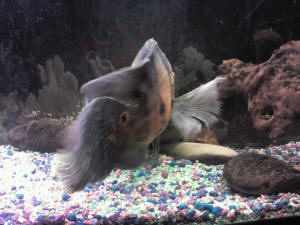
|
Oscar fish 8/21/11
My Oscar's eyes are sticking out of his head more than
normal, is this a disease.
<Yes. Pop-eye is a related condition where the eye
has been sufficiently damaged that infection behind the eyeball causes
swelling. Treatment is largely "wait and see" plus the use of
Epsom salt, and optionally,
antibiotics. See here: http://www.wetwebmedia.com/fwsubwebindex/fwpopeyefaqs.htm
If one eye is damaged or popping, that's commonly physical damage,
e.g., by clumsy netting or a frightened fish bumping into the walls of
the tank. If both eyes are damaged or popping, that's often to do
with poor water quality. Either way, Pop-eye is extremely common when
Oscars are kept in poor conditions, typically tanks that are too small,
too few water changes, poor filtration. Do read:
http://www.wetwebmedia.com/fwsubwebindex/oscars.htm
Cheers, Neale.>
Re: Oscar fish 8/21/11
Is popping eye a deadly disease?
<As stated in my last message, in Oscars, it is usually an
indication of chronically poor environmental conditions. Without
knowing anything else about your aquarium, that would be assumption
here. So yes, it's a sign the Oscar is in very poor health, and
without fixing both the environment AND treating the symptoms, the
Oscar could well die. Not from the Popeye, but from other infections
and stresses brought on by the poor environmental conditions. Sadly,
this is all too common with Oscars because people keep
them in tanks that are too small, feed them too much, feed them the
wrong foods (e.g., "feeder fish", Thiaminase-rich foods, not
enough green foods), don't supply enough oxygen, don't do
enough water changes. Cheers,
Neale.>
Oscar
fish... distressed in uncycled system
1/11/12
My fish is going crazy when i get close to the tank. He haven't
eaten in 8 days. The levels or fine we put him in a 55
gal 8 days ago.
<... this system isn't cycled. The chemistry here is the likely
cause of this fish's troubles, troubled behavior>
He cut himself going crazy on side of face. I don't
know what to do please help me.
Thank you.
<Read here: http://www.wetwebmedia.com/FWSubWebIndex/fwbiofltfaqs.htm
and the linked files above. Bob Fenner>
Re: Oscar resurrection! 1/21/12
Hey thanks for the help my Oscar is back to healthy in fact i
hadn't seen it so active in a while :-)
<Glad you had such success! Cheers,
Neale.>
Oscars... hlth., sys., – 4/4/10
Hello,
<Hello.>
I have tried everything but I am at a loss.
<I hope to help.>
I have two tiger Oscars they are about 4 or 5 years old now, one has
always been very healthy and strong the larger of the two, the other
has not.
<Is this a mated pair? Especially if it's not, there's a
good possibility that the larger and stronger one is larger and
stronger due to beating up the smaller, weaker one, who remains smaller
and weaker because he's constantly stressed and beaten up.
Especially in the small tank you had them in (way too small for two
adult Oscars), the chances of one bullying the other are very
strong.>
I had them in a 200 litre tank, which I cleaned 30% twice a week, the
weaker one got HITH but I changed their diet ( I feed them a tablet
cichlid food, shelled peas, greens, frozen shrimp/ bloodworm etc) and
treated the tank and it went away. I have moved them both to a 360
Litre tank,
<Still really is marginal for two adult Oscars... I would hope to
see two adults in something around 125 gallons, both for the volume it
offers, and therefore, better dilution of waste, and for each to be
able to establish a territory and lessen problems with
fighting.>
I feed them the same way, I clean the tank 30% once to twice a week (is
this enough?) I am treating the tank with my usual water conditioner
and now a nitrate reducer as they are quite high.
<If you're using a Nitrate reducer, then you're not cleaning
enough. You should augment your maintenance in such a way that Nitrate
is below 20 at all times. This is where a larger tank would come into
play -- more volume means less concentrated waste, lower Nitrates.
Bigger, more frequent water changes would lower Nitrate.>
The weaker Oscar seems to be sick again! His ribs on one side are
poking out, it doesn't look like swim bladder ,
<Are you sure it is his ribs? Could it possibly be some sort of
obstruction which has caused food to "build up" in the
digestive tract, creating a lump? Can you provide numbers on Ammonia,
Nitrite, and Nitrate in the tank? You're feeding a good variety of
dried and wet foods, so I'm not thinking this issue is due to
feeding, but could very well be due to water quality. I would get
Nitrate to where it should be (mentioned above), and then add Epsom
Salt to the tank in the amount of two tablespoons for every twenty
gallons. This will aid in digestion and help with constipation, if
that's what's going on. Overall, a system for two Oscars would
be in the range of 125 gallons, employ filtration which turns the
tank's volume over 8-10 times per hour, and large water changes
would keep Nitrate below 20.>
he is swimming fine and eating fine, other than the one lumpy side he
looks and acts like a healthy fish. Any ideas?
<I hope this helps. Please do write back if you have further
questions.
If you do write back, would you mind attaching a photo of his "bad
side?"
In any case, if this is swelling due to some sort of obstruction,
hopefully the Epsom Salt will help him pass it. I would feed only the
wet foods, and avoid feeding the dry foods, until this problem
subsides. I'm sort of ruling out the idea that this lump is his
ribs, but a photo would obviously help. What type of substrate are you
using? I'm hoping this is just food, and not gravel.>
Tank you for your time
<Either a typo, or a funny pun! Either way, I'll leave it in...
again, please write back if you have any more questions.
--Melinda>
|
Oscar with Swim
Bladder problem 4/27/10
Hi,
<Hi Stephan. Melinda with you here today.>
I have a 3 year old, 8 inch Oscar
<Should be larger by now, at least twelve inches. Can you
please give details on this system? Tank size, stocking,
filtration, and water parameters? When I read that the fish has
failed to properly develop, I begin to worry about environment.
Often, fish can deal with a poor environment for a long time, and
then eventually succumb to its effects.>
that I found standing on his head 2 days ago.
<He certainly is in bad shape.>
I came across your site in the course of my research about his
ailment.
From what I can discern it appears that he is having problems
with his swim bladder, most likely caused by an obstruction in
his stomach.
<"Swim bladder," as you will see by reading on WWM,
is a name for a group of symptoms often stemming from poor
environment. An obstruction is one possible cause of his illness,
but, also, without knowing details of this environment (Ammonia,
Nitrite, Nitrate levels, for sure) an obstruction isn't the
only possibility -- more information is needed here in order to
determine the cause of his problem.>
What started out as head standing has now gone into full on
laying on his back. His stomach is even more swollen.
<I see that he has an Oscar buddy. This makes me even more
curious as to what Nitrate levels are in this tank.>
I initially changed his water and added a little more salt. Then
after reading your questions and answers went to the fish store
and purchased Metro+ (Metronidazole) and have added it to the
tank per instructions (1 capful per 10 gallons after a water
change).
<I would not use regular salt, because it's probably not
going to help here. Epsom Salt might. I'd start with a
tablespoon per five gallons to hopefully reduce swelling and
clear any blockages in the digestive tract.
The Metro is a good idea if you can determine that what's
going on here is as a result of bacterial infection, but I always
like to start with environment and work my way up to diagnoses
which require strong medications.>
I have also stopped feeding (he can't eat in his condition
anyway, but his buddy still gets hungry).
I'm on my second day of the Metro+ treatment. He seems
better, but his stomach looks even more swollen. I've tried
to massage his stomach in the hopes that it would help pass the
obstruction but to no avail (he does seem to like the
massage).
<I would stop applying pressure to this area and administer
the Epsom Salt.
I would continue the Metro since you've begun using it. Do
test daily to ensure your biological filter is not negatively
affected. If you find that it is (Ammonia or Nitrite spikes will
indicate this), then you'll need to do extra work to keep
levels where they should be.>
I can turn him upright and if I hold him he appears fine, but
then when left on his own he turns back over.
Can you recommend any other treatment?
<Treatment and possible causes included above. Please do read
on WWM re: Oscar care, and if you have any other questions, feel
free to write back, and do make sure and include the information
I requested.>
Thank you,
<You're welcome. Please do note on the page where you
found our e-mail address, there is a list of the things we ask
those writing in to do. One of them is to send small photos, no
more than a few hundred KB, because large photos take up a lot of
room in our inbox, potentially causing others' emails to be
bounced back. If you do need to send more photos, please do limit
their sizes.>
Stephan
<--Melinda>
|
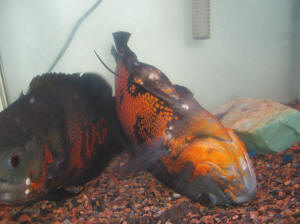 |
|
Re:
Oscar with Swim Bladder problem 4/28/10
Hi Melinda,
<Hi Stephan.>
Thank you for your help.
<You're welcome.>
I put in the Epsom salt (1 tablespoon per 5 gallons). I also took
his buddy and moved him to a different tank. I've continued
the Metro+ treatment as well.
<Okay.>
I changed out 1/3 of the water again today and put in more Epson
salt to keep the ratio at the 1 tablespoon per 5 gallons. Was I
supposed to put in more Epson salt on the second day or just keep
the ratio consistent?
<Nope, it can stay the same, unless you don't see
improvement in a couple of days. If this is the case, I'd add
extra -- another tablespoon per five gallons. However, I have
read ahead in this e-mail, and I'm beginning to doubt this
fish will improve without some major changes.>
He seems a little better, but his stomach is still swollen. He
still wants to lay on his back, but if I turn him over he's
good for about 5 minutes before he goes on his back again.
Should I be worried about his lack of eating? I don't see how
I could get him to eat unless I forced something down his
throat.
<Don't worry about it right now. Fish can go quite a
while.>
The water is good, lots of filtration (a 60 gal filter system on
a 30 gal tank).
<You're not giving me the specific information I hoped
for, but without knowing that information, I can still
definitively state the following:
One, this tank is WAY too small. Your Nitrate levels are likely
through the roof. For two Oscars, 90 gallons would be the minimum
I would recommend, with 125 gallons being ideal. Two, the reason
your fish is smaller than he should be is definitely due to the
system you've chosen for him, which is too small. He should
be, as I stated before, anywhere from twelve to fourteen inches
long. Three, filtration should be turning your tank's volume
over eight to ten times per hour, so this filter probably
isn't keeping up with the huge bioload two Oscars represent,
especially two Oscars stuffed in a tiny tank. Lastly, the
fish's condition probably will not improve, no matter what
you add to the water (Epsom Salt, Metro, etc.) until you fix
environment. Please read, as I asked you to do before, on WWM re:
Oscar care. These fish need much more than you're offering,
and if you choose not to fix environment, the other will soon be
sick, as well.
Oscars aren't an easy fish to care for -- not because they
have crazy nutritional needs, or are finicky about water
chemistry, or anything, but simply because they grow so large and
do require quite a large investment, a lot of space, and a good
deal of electricity to properly house and care for. Oscars who
don't receive proper care die very early, and even if they
pull through for a good length of time, often exhibit the
symptoms you're describing, along with the Hole-In-The-Head
your Oscar's buddy seems to be exhibiting. Please do research
HITH on WWM.><<Melinda... pls provide links/URLs...
RMF>>
Do you have any other treatment suggestions?
<Not treatment, per se, but my suggestions are above.>
Thank you,
<You're welcome.>
Stephan
<--Melinda>
|
Oscar Fish Sick :( 6/2/10
Hi there, I'm Ashlea!
<Hello Ashlea,>
Our family has two Oscar fish.
<And a big aquarium, I hope. Oscars don't "share"
nicely, and even a singleton needs a big aquarium.>
We bought the smaller one who is about 4inches long first and then
another one which is about 6inches long. We have had them for only a
few months now and have had issues the entire time.
<Almost certainly down to lack of planning. Let's be clear here.
Oscars are NOT friends towards one another and they MUST have a big
aquarium with a very robust filtration system. Yours are big enough now
that they're starting to exhibit their social behaviour, and if you
have two males, you'll get trouble.>
The smaller fish (Charlie) got fin rot which was medicated and
treated
<Now, the Finrot is certainly down to poor water conditions; likely
a too-small aquarium or too-weak filtration. Overfeeding and irregular
water changes will also make things worse.>
and when we first got our bigger one (Grumpy) he would never move. They
started in separate tanks but we put them together in a larger tank (
250L approx ) about 2 weeks ago.
<250 litres IS NOT big enough for two Oscars. Indeed, it isn't
enough for one Oscar. A single Oscar needs about 350 litres, and if you
have a mated pair, you'd still need about 500 litres. Oscars are
very difficult to sex, and it's entirely possible you don't
have a pair.>
They haven't been fighting really, sometimes the bigger one with
snap at the little one but that is all we have seen. Recently Charlie
has been laying on the bottom of our tank on his side, he is breathing
heavy, only moves when Grumpy comes near him, isn't eating and
seems to be doing the tail shake to tell Grumpy to go away.
<Difficult to say precisely what's the matter here, but a
combination of aggression and environmental stress is likely the
issue.>
We have just noticed a little white thing on his head, we aren't
sure if this is hole in the head or another infection or what.....I am
the eldest and have younger brothers who are all very attached to our
fish.
<Cool.>
We do weekly water changes usually between 25-30% our pH level is 7.2
ammonia is at 0 nitrite is 0 nitrate is about 10
<Okay.>
Please help us, we have been reading the website all day and finding
similar problems but it always seems to be older fish or poor water
quality issues which we don't have either of because we test it
twice a week
Thank you in advance!
<Something is amiss here. Frankly, I think you won't be able to
keep two Oscars in an aquarium this small, and long-term, you're
going to need a much bigger aquarium even for one specimen. Cheers,
Neale.>
Dying tiger Oscar -- 01/12/2010
I've had my Oscar for about 2.5 years, for some reason his tank
became overwhelmed with algae,
<Blue-green algae by any chance? Or hair algae? Either way, almost
certainly down to marginal water quality, insufficient water changes,
and inadequate water turnover.>
I tried using some Algicide-RX,
<Toxic... even though sold as safe, shouldn't really be used in
tanks while the fish are in them.>
(because he keeps killing the algae eaters)
<These don't fix algae problems.>
and it seemed to get worse. Since yesterday he hasn't been acting
right, now he has something like blood on the inside of his body
building up around his fins and tail and he can't move his
tail.
<Sounds like he's reacting badly to environmental conditions.
Would do a 50% water change immediately, taking care not to expose the
fish to dramatic changes in pH or temperature. Make sure the new water
has water conditioner added to remove chlorine, chloramine, and copper
(and ammonia, if there's some in your water supply).>
He has a little bit of a milky film on parts of him also.
<Mucous appears when fish are irritated; it's the equivalent of
a rash on human skin.>
I have completely drained and clean the tank to start it over (as
recommended by the local pet store).
<While a big water change is good, this assumes the filter isn't
disturbed, and it's almost never a good idea to take a whole
aquarium apart if you have fish already. At best, put some tank water
in a bucket and keep the filter running -- once switched off, the
filter bacteria can start to die in as little as 20 minutes if they
don't get enough oxygen (canister filters are very bad in this
regard).>
I don't know what to do and I really don't want him to die.
<Do review the basic needs of Astronotus ocellatus, here:
http://www.wetwebmedia.com/FWSubWebindex/oscars.htm
Most premature deaths come down to tanks that are too small, badly
filtered, and improperly maintained. Poor diet is another key issue
(avoid Goldfish and other feeders, unless you deliberately want to make
your Oscar sick).>
Any help will be GREATLY APPRECIATED. thanks.
<Cheers, Neale.>
Re: dying tiger Oscars -- 01/12/2010
he should be back in his tank by the end of the night,
<Good.>
I added stress coat+ and dechlor.
<Ok. But do check if you have chloramine, and if so, use a
dechlorinator that removes it: not all do.>
I also added some to the temporary tank. once the regular tank is up to
temp then I'll put him in.
<Fine. By all means use hot water from the hot water tap, and mix
with cold water. A good dechlorinator should remove copper, the only
possible reason not to use hot water. Using hot and cold water speeds
up bringing the tank temperature to the correct 25-28 C required by
this species.>
What's his survival chance?
<No idea. Depends on how sick he is, whether he's been poisoned
by the Algicide or stressed by the sudden change in environmental
parameters.
Consider: when you suddenly kill all the algae in a tank, you suddenly
load the filter with a lot of dead stuff to clean, and the decaying
algae uses up oxygen as it rots. This is why you should NEVER use any
kind of "killing potion" in an aquarium, whether for snails
or algae. Much better to fix the underlying problems, and let algae and
snail numbers decline naturally.>
the filter will have new filters also.
<But you won't be throwing out the cycled, mature biological
filter media, will you? That would be mad. By all means replace
mechanical media (e.g., filter floss) used to trap silt as often as you
want, but biological media (e.g., sponges, ceramic noodles) should be
used carefully, replacing no more than 50% within a 6 week period. If
you think you've poisoned your tank, then this is one of the VERY
FEW situations where using activated carbon alongside biological
filtration makes sense.>
I have 10 gallons of the old water that he is in now, should I add that
into the new water?
<Water carries little/no useful bacteria. So use, don't use, as
you prefer.
Makes no difference at all. Actually, I'd throw ALL the old water
out, and use completely new water, and then acclimate the Oscar to the
new aquarium just as if you'd just purchased him. In other words,
stick him in a bucket with just enough old water to cover him, and then
add a cup or two of water from the tank every 5-10 minutes until the
bucket is filled. I'd then half empty the bucket, and repeat the
process. Once you're done, and this should take an hour or so, lift
the fish and put it into the aquarium. Throw the old water away. Only
LIVE FILTER MEDIA matters so far as restarting your aquarium goes,
i.e., the sponges, ceramic noodles, or whatever used in your filtration
system. Keep these alive by connecting the filter to bucket of aquarium
water, and don't switch the filter off for more than 20
minutes.
Reconnect the filter to the aquarium ASAP.>
Thanks again. Louis
<Cheers, Neale.>
Scales are missing on Red Tiger Oscars 2/1/2010
Hi:
<Hello Denise,>
My son and daughter each have a small Red Tiger Oscar.
<Bad choices as pets for children. These are very difficult fish to
keep properly.>
The Oscars are kept in separate 5 gallon tanks with filters.
<Insane. Make that 55 gallons for each tank, and we're
talking.
http://www.wetwebmedia.com/FWSubWebindex/oscars.htm
Five gallons is barely enough for a Betta, let alone an Oscar. Did you
tell the pet store you were doing this? If they told you that was fine,
then they're idiots. If it was your idea, and somehow you though
they'd be fine for a while, then, well...>
They are fed 2 small gold fish feeders every other day and flakes on
the other days.
<Did you read ANYTHING about Oscars before purchase? If you did,
you'd known feeder Goldfish are a VERY BAD food item for Oscars.
Not only are they a major source of parasites, they're also loaded
with fat and Thiaminase.
http://www.wetwebmedia.com/fwsubwebindex/fdgfdrartneale.htm
http://www.wetwebmedia.com/ca/volume_6/volume_6_1/thiaminase.htm
>
We have done the water changes and de-chlorinated the water. Lately we
have been noticing that each of the Oscars seem to have white spots,
but more like the scales are missing, not like Ick. I thought they may
be scraping themselves on the gravel but we never see them do that and
it is getting worse. Any ideas?
<Yes. You're killing these fish. Whether deliberately or through
sheer ignorance, you've stuck two perfectly nice animals in
enclosures they cannot possibly be maintained in, and then fed them the
worst possible diet. So these lovely, intelligent animals are being
poisoned to death.>
Thanks,
Denise F
<Denise, I really, really do not like yelling at people. And when
people write back that their feelings are hurt because I've yelled
at them, that's sad. I volunteer here precisely because I like fish
and I like people. But
when I get messages like this, it's hard for me to return a
measured, let alone kind, response. Not one aquarium book ever written
would ever suggest keeping Oscars this way, so my only conclusion has
to be you read nothing
at all before buying these animals. Given you haven't said anything
about water quality, I have to assume you didn't cycle the tank for
6 weeks before adding the fish. So essentially everything that you
could do wrong, you have done wrong. It's not the fish's fault,
it's not the retailer's fault, and it's certainly not my
fault; it's your fault. Time to read what I've sent you to,
think about what you've done, and react accordingly.
These fish aren't going to survive these tanks, let alone get
better.
Either return them or euthanise them.
http://www.wetwebmedia.com/euthanasia.htm
If you want to keep them, you're going to need a 55 gallon tank for
each one, or a 75-100 gallon tank for the two of them. Don't delude
yourself into getting a 20 gallon tank now, and then saying you're
going to upgrade in a couple months. These fish grow EXTREMELY fast
when kept properly, and will need that 55 gallon tank within 6-9 months
of hatching. So get real, focus on what needs to be done, and move on.
Feel free to write back and
yell at me for being rude if that makes you feed better. But my concern
here is for your fish, and the bad example it's setting your kids.
Cheers, Neale.>
Re: scales are missing on Red Tiger Oscars, hlth., nutr. –
02/02/10
Hello Neale:
<Hello Denise,>
My apologies for my ignorance. I did tell the pet store exactly my
plans and purchased the Oscars at the same place. The same place I buy
the feeders. Obviously they were either only concerned with the sale or
they had less knowledge than I did.
<Well, you do have to treat advice from store clerks with caution.
Some specialist retailers are staffed by outstanding fishkeepers, and
I've learned a lot by listening to them. But all too often the
generic pet stores employ staff who know little to nothing about fish.
In general, take the advice, but double check against a book or a web
site you can really trust.>
Many years ago, I too had an Oscar for many years, fed him feeder fish
and never had a problem.
<It's like the old maxim, "playing Russian Roulette once
and surviving doesn't make it safe". Work on predatory fish
has demonstrated without any ambiguity that diets high in Thiaminase
lead to ill health and premature mortality. Do read Marco
Lichtenberger's piece here at WWM on this topic.
The incidence of parasite infections following the use of cheaply
produced feeder fish is very high. Furthermore, goldfish and minnows
are rich in both fat and Thiaminase, and Bob Fenner believes, after
autopsies of numerous fish, that these feeder fish are the #1 cause of
premature death of Lionfish. The #1 cause! These feeders are killing
more Lionfish than bad water quality! Thankfully, feeder fish simply
aren't sold in the UK, so this isn't an issue here. The hobby
has moved on, and aquarists switched to safer, cheaper, and less
expensive foods. But for whatever reason, the US market has changed
yet.>
Never did the pet store say anything about having a 55 gallon tank, nor
did they tell me about feeder fish being bad for them to eat.
<Not impressed by them, I have to say.>
Once we started noticing the problem. We immediately began the water
changes every 3 days between 25 - 30%. We are now feeding them frozen,
thawed shrimp and peas.
<Again, do go back and read about Thiaminase. Shrimp contains a lot
of Thiaminase, and over time, over-use will lead to vitamin B1
deficiency. I'm sure you already know about how the Royal Navy was
plagued with the problem
of scurvy back in the 18th century. The sailors were getting lots of
calories, but for some reason would get sick within a few months of
leaving harbour. The problem was that their diet, while adequate in
other ways, lacked vitamin C. Over time this meant they became sick.
Only with the introduction of citrus fruits into the sailors'
rations did things improve (from whence comes the nickname for the
British around the former Empire, "Limeys"). It's
precisely the same thing here: shrimp, mussels, clams, squid and other
Thiaminase-rich fish and seafood may contain lots of calories and
protein, but they also contain Thiaminase, and over time, you're
creating problems by using them. Restrict Thiaminase-rich foods to once
or twice per week. The rest of the week should be made up of foods
that lack Thiaminase. These include good quality pellets (e.g., Hikari
Cichlid Gold), earthworms, snails, fresh or frozen cockles, fresh or
frozen tilapia fillet, and of course plant foods like cooked peas.
Indeed, a perfectly adequate diet could be based around just good
quality pellets plus the cooked peas to ensure adequate fibre.>
I have done a lot of reading over the past few days and the Oscars seem
to be improving dramatically.
<Good.>
In addition we are currently looking into a 55 gal tank.
<That's fine for one Oscar; two will eventually fight in that
space, unless by some miracle you have two females, or else a pair that
get along from the word go.>
I thank you and appreciate your advice no matter how loud you were
yelling.
<Glad to have helped. Good luck. Cheers, Neale.>
Please help me, help my mother's fish. Oscar hlth.
2/22/10
Hello,
<Hi,>
I have an issue, obviously considering if I didn't I wouldn't
be writing.
<Well, you're honest at least!>
My mother has an aquarium which I believe to be a 75-90 or so gallons.
She has two large Oscars (one is 11 1/2 inches and the second is
smaller at 8 1/2) And a Plecostomus that's over a foot long.
<Yikes, that's a busy aquarium. Marginal water quality, I'm
sure.>
That is all she has in the tank other her filter then decorations which
she uses real stones, although they are large stones she uses smaller
ones for the gravel and a few large ones for the decorations, no fake
plants.
<That's fine - Oscars will uproot stuff, and Plecs aren't
precisely delicate in their swimming movements. Large flowerpots are
cheap and cheerful "caves" for fish like these.>
One is what I believe (thru research) to be an Albino Tiger Oscar (the
larger one who is sick right now), breed from an Albino and a Tiger
Oscar, the other I believe to be a Tiger Oscar (the smaller not sick
one). My mother has had these fish for 5-6 years, and they have only
grown about 2 inches in this period of time, so I am not sure how old
they are.
<Size is about the going rate for these species.>
She got them from a friend who didn't want them any longer. She has
had them in this specific tank for 4 years.
<OK.>
She doesn't use live or frozen foods, just pellets.
<Fine.>
She also never has to do water changes or treatments her tank is that
healthy (well besides this issue).
<Never does water changes? How bizarre. You should be doing 25%
water changes every week or two.>
And we are not sure of the sexes since they are hard to determine.
<You can't sex Oscars outside of breeding anyway.>
Just today she noticed her larger fish is sick, he/she has a swollen
belly on both sides, and has a white/ clear sac looking thing coming
out of the anus.
<Prolapse. Very common when cichlids are maintained in poor
conditions.>
I've researched on your website and came to the conclusion to use
Epsom salts for use of a treatment.
<It's not so much a treatment as something that minimises the
symptoms. The digestive tract becomes swollen with bacteria or
Protozoans, expands, and pushes out the anus. So while Epsom salts
relax the muscles and allow the Prolapse to reduce somewhat, this
doesn't fix the problem. You need the right medication, and then
must also improve the water quality. So it's a two-step thing.
http://www.wetwebmedia.com/metranidazole.htm
http://www.wetwebmedia.com/FWsubwebindex/OscarDisF8.htm
http://www.wetwebmedia.com/FWsubwebindex/oscars.htm
>
I called her to tell her this and how to do this (by your instructions)
but then she was looking at the fish and its changing colors, its head
is turning a greyish color and its fins are turning color from white to
a vibrant yellow color!
<Likely some sort of systemic infection.>
They are not upside down, he isn't swimming sideways, he just sits
with his face in the corner towards the top. The other fish is acting
and eating normally. I noticed months ago that the fish had holes in
there head (right off the bat thinking hole-in-head) but I read on it
and these fish apparently do have holes in there head so we waited to
see if I over-reacted.
<Oscars very, VERY commonly get Hole-in-the-Head, and it's
related to poor water quality, especially non-zero nitrate levels. Any
nitrate level above 20 mg/l will severely stress cichlids including
Oscars.>
These holes haven't changed since then, which has been months. So
now that it is changing colors I thought best to contact you. I know
you have many people writing in about swelling bellies and things
coming out of there anus, but not all of that and color changes!!
<Perhaps, but taken together this does strongly suggest poor water
quality.>
There's bloat, but that's just the belly swelling, so I
didn't think it was this. Then I was thinking prolapsed rectum,
from reading the letter with the lady with a Oscar that had swollen
belly and the anal issue, and color fading, but not changing color such
as my issue. I'm really starting to get nervous, these fish mean a
lot to me (although they are my mom's fish) they are what made me
love fish and aquariums, I could stare at them for hours and not get
bored. I almost think I love them more then my mother does.
<Despite what The Beatles said, Love is *not* all you need. Oscars
need good water quality.>
So if you can help me please do. I appreciate you taking the time to
read this. Also, not sure if this will get posted on the site or just
an e-mail back please let me know. Thank you.
-Jennifer
<Happy to help. Cheers, Neale.>
Extremely Sick Oscar, env. - 7/20/07
Hi!
I have read through pages and pages of the forum to find out what I can
do for my Oscar. I am new to the Oscar world so bare with me.
<Heeee! Depends on how attractive you are>
I recently took over a tank with three Oscars in them. I have a 55
gallon tank with three Oscars. One is about 6 inches, the other two are
8 inches...big I know!
<Too large for this small volume...>
Okay this is where I am getting confused. Two of them are bright
orange.. tiger Oscar? The biggest one...the sick one is mostly black
but has orange on him. After reading the forums I am assuming he was
once upon a time all orange.
<Mmm, not necessarily>
Now he is mostly black.
He has started laying on the bottom doing nothing and he can not swim
up right at all. He is also developing white scales one side and
whitish holes on his head. I can't get him to eat at all. He tries
to swim to the top of the tank every once and a while to get food but
can't make it up there. I have been feeding with Cichlid Staple
floating pellets.
Others in the office I work with have been giving feeder fish to them
as well but not all the time. Is this bad?
<Not a good idea. Please read here:
http://wetwebmedia.com/goldfshfd.htm>
Another problem I am treating right now is I have a sucker fish that
has fungus on his belly. I have started treating for the fungus using
Pimafix. The pet store also gave Melafix.
<Worthless>
I was reading in the forum that others have tried using
Metronidazole?
<I would not use this protozoacide for anything but...>
Should I use this instead?
<No... you should read... On WWM, elsewhere re infectious disease...
and most importantly, environmental issues>
I just want to see them feel better. It is said that the people before
me let the tank get this bad. HELP!
Thanks so much
Andrea
<Likely the trouble is to a large extent an issue of the size of
this system... a 55 is not large enough for just the two large
Oscars... so the "odd fish out" is malaffected
behaviorally... And physiologically... such a volume of water is hard
to maintain health-wise with such large, messy fish... Likely your
nitrates (see WWM re) are sky high... and this is a contributing cause
to the Oscars beh. and the Pleco's "fungus"... Medicine
won't help here... water changes, more filtration, and most
importantly, a much larger system are needed. Bob Fenner>
Oscar Being Eaten Alive, env.
dis. 2/20/07
Hi, I have searched the site for
any reference to the problems our Oscar has been experiencing and found
some answers that might be relevant (re lying on his side, eye problem
etc) but nothing referring to the biggest issue that we are worried
about - his flesh on his gill seems to be rotting away on the
outside.
We live in England (just telling you this in case it's relevant for
water purposes - our water isn't chlorinated in our
area). We have an Oscar we got about 4 months ago from a
really good fish specialist locally. He was about 4 inches
long when we got him and is now about 7.5 inches long, which is about
right based on the 1 inch growth per month ratio. Anyway, he is
currently in a holding tank whilst we cycle the purpose built tank we
have had made for him - the new tank is 6ft length x 2.5 ft high x 2ft
wide. So lots of space for Brian (as he is known) to swim. We regularly
change the water, have two filters and an air ball in the tank he is
currently holding in (about 55/60 UK gal.). He has a varied diet (never
feeder fish - Oscar pellets, krill, shrimp), a couple of toys & we
try to interact with him as much as possible. He has always
been lively, coming to the tank for my boyfriend and I - he recognizes
us that's for sure - doing his happy dance thing (e.g. begging for
food!) and pottering about around the high part of the tank.
He did develop a problem with his eye - it got swollen and covered in a
white film. We tried to treat lots of ways - with
medication, and adding aquarium salt to the water, which seems to have
finally cleared it up and it is now getting better. However,
a few weeks back he got a hole in one of his outer gills and that has
just grown in the last few days so now you can see the gill bits inside
clearly - this has got to be affecting him surely e.g. his ability to
'breathe', it's like it is rotting away but we can't
stop it. The people in the fish tank said to keep trying
different medications/methods with big water changes which we have been
doing. So, last week was the aquarium salt method, which has
worked on the eye and we did a 50% water change following that
treatment on Friday. Then we fed him and he seemed totally
normal - snatching food from the top of the tank and swimming around
for us, We went out of the room for a while then when I went
in to turn off the tank lights for the night (as we always do) he was
lying at the bottom of the tank, looking like he was
dying. Since then he has been very immobile, he seems like
he can't move the fin on the side of the rotting gill very well and
he's been lying at the bottom of the tank only moving briefly and
facing into the glass, seeming to struggle to move around.
He seems very sensitive to light all of a sudden so we have mostly kept
the tank lights off over the weekend.
We have really thought he was dying and were all ready to find a way to
euthanize him as painlessly as possible because we don't want him
to suffer but he's such a brilliant fish we want to keep trying as
long as possible, so long as he isn't in pain or
suffering. However, having watched him struggle about on the
bottom of the tank for 2 days, I went into the room he is currently in
last night late and without thinking switched the overhead light on
only to see him swimming around at the top of the tank, promptly
dropping to the bottom when I went in.... so now I think we have a
combination of a fish hat is poorly (because of the gill situation) and
a drama queen who is having a tantrum about something (as Oscars do!) -
possibly both things are connected. This morning I looked in on him
before I went to work without putting the lights on and he was up and
about again, albeit in the dark.
For info, he fed on Friday, we didn't feed him on Saturday because
he looked so poorly but tried a bit of food yesterday and he made some
effort to get it but I don't know that he ate much at
all. I know they can survive a while without feed, just the
current combination of problems is worrying me and my
partner. There are two silver dollars in with him awaiting
transfer into the new tank too - they are about 2.5" diameter each
- and a small Corydoras cat fish that cleans the bottom of the
tank. Yesterday I checked the water and the PH/nitrites were
normal the nitrate was quite high so we did another water change of
20%. I want to do another 30% tonight or
tomorrow.
If anyway can help with this gill rot situation we'd really
appreciate it, because we are not sure what to try next but don't
want to lose this fish unless we absolutely cannot do anything to help
him.
Thanks, Giovanna Giovanna Ashcroft
< The problem is the high nitrates. Check the well water. Wells that
draw from shallow aquifers often have high nitrates due to agricultural
run off. These high nitrates stress the fish and feed the bacteria that
cause the flesh to be eaten away. This is a common problem in
agricultural areas. To remove the nitrates is not that easy. Reverse
osmosis, deionization and distillation will reduce or remove nitrates.
Plants are very effective at doing this too. Get the nitrates to under
20 ppm and treat with Nitrofurazone. This will stop the bacteria and
the areas affected may grow back.-Chuck>
Oscar Problem.... No Idea What It
Is 10/3/06
My Oscar is 12cm and has a
hole like thing just behind his head.
<I see it... Ow!>
He is in a 5" tank with a Polleni, Flowerhorn, two trimacs, a
silver dollar, and two gibbiceps.
<Wowzah... I hope this tank is huge>
He has had this hole for about a month now and it looks like
it's very slowly getting better. Can you please give me some
further information on what it is and what i could do? Thanks.
<To me this looks like a too-neat cut/gouge... likely from the
fish jumping, running/swimming into something sharp... If it were
me/mine, I'd do "nothing" in the way of actually
adding chemicals to the water here... Simply keep up with water
quality... Do keep an eye out for overt aggression with this mix...
Bob Fenner> |
|
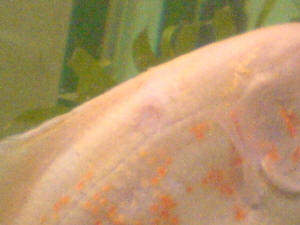
|
Oscars and a Lack of Input - 10/14/2005
My Oscars started
getting a whitish build up on their bodies and then developed eye
cloud. I've never dealt with this before.
<Clouded eyes are usually related to poor environmental
conditions.... Be testing your water quality, changing
water....>
4 of my favorites have died. I've been treating them by increasing
the aquatic salt level to 150%,
<150% of....?>
using MelaFix for 6 days,
<Unlikely to be of help - and certainly not of help if the root
cause is environmental.>
and gave them their 2nd dose of Binox.
<Learn what you are treating before you treat.... Throwing
medications at systems without knowing what they are or what you are
medicating for is quite dangerous. Binox is sodium chloride (salt) and
Nitrofurazone (an antibiotic). Do you have reason to believe there is a
bacterial infection that can be treated by this? If not, why are you
medicating? Have you tested your water?>
My two large Oscars' eyes don't seem to be getting any better,
but they're swimming around more and color has gotten better.
However, no appetite. Do you have any suggestions?
<Yes, test your water for pH, ammonia, nitrite, nitrate.... Maintain
ammonia and nitrite at ZERO, nitrate less than 20ppm, with water
changes.... Look for the root cause of the problem (likely water
quality) and begin rectifying it.>
I don't want to lose them or have them go blind. Thank-you
<All the best, -Sabrina>
Oscar and environmental disease
my Oscar is fairly good
size, he has been swimming frantically across the tank slamming into
the sides and everything else in the tank. When he is not doing that he
floats almost as if he is dead. I have him in a 55 gal tank. he has a
yellow coloring along his belly and gills. There is also marks on his
face from slamming into the rocks on the bottom and turning in circles.
He acts as if he is going crazy..
>>Hello. Sorry to hear about your fish. We need to ask you some
questions to help us help you. How many inches long is your Oscar? Are
there any other fish in with him? Can you please give us some water
test results. what are your ammonia, nitrite, and nitrate levels?
Please be precise. This is important.
Also, how often to you do partial water changes? What exactly do you
feed him, and how often do you vacuum the gravel? -Gwen
he is approx. 10-11 inches long, 6-8 inches tall, there are other fish
in the tank and they all seem to be doing fine. I had my water tested
at the nitrate level was off the chart within a few seconds. So will
the changing of say 50% of the water for the next 4 days be
sufficient?
< Change enough of the water to bring the nitrates down to 25
ppm>
Will he beat this problem, or is he to far gone already?
< Cichlids , like Oscars are pretty tough customers. Get the
nitrates down, service your filter and add some salt to the water to
increase the slime coat on the fish. If he is still having problems
then he may be suffering from a bacterial attack on his skin and gills.
Look at a Furanace type of medication for treatment but watch out. It
will probably kill the good bacteria in your filter too.>
I usually change 25% of the water once a month,
and the same goes with gravel vacuuming.
<Obviously this is not enough because your nitrate readings are off
the chart. Get a good nitrate test kit and change enough water to keep
the nitrates around 25 ppm. Don't let them get any higher than 50
ppm. This will help you determine how much water to change and how
often. Don't forget to service your filter or your nitrates will
come right back. -Chuck>
Saving poisoned Oscars
Hello WWM Crew,
I have a good sized pond in my garden where I have 4 good sized Oscars.
I should say I HAD 4 Oscars. 3 were Tiger and 1 was Albino.
Last Sunday during the dressing of our garden, we moved our Christmas
tree close to the pond.
As the pot in which the Christmas tree was very heavy, my family folks
kept it on the pond sill. As it was a transplant from a smaller pot, we
put anti weed in the pot and watered it.
<Oh oh...>
The next day, I was shocked to see that all my Oscars lying on their
side on the pond floor. After quick investigation I realized that the
anti-weed which is poisonous has flowed in the pond from the pot
overflow. I immediately started adding fresh water to the pond. I
was able to save 2 Oscars but 2 died even before I realized the
accident. One tiger and one albino are alive but still quite
sick. The tiger was lying on his side for a few hours but then started
swimming. However at the end of the day, it sort of struggled and again
went on its side as if it died. This continued for a few days but now
he is back to swimming. The albino was on his side for almost 4-5 days
and just breathing. He started swimming just a couple of days ago.
however today he parked himself near one side of the pond and then
slipped on his side. I thought he died too. But he is alive as he is
slowly breathing. Both of them refuse to eat and so I guess they
have become too weak from the poisoning. I do not know how to recover
them. Please help. I may lose these two too if I continue in the
present way.
<Don't worry re: feeding them... they won't starve... and
will hopefully recover. There is nothing else that I'd suggest to
"withdraw" the poison (now likely metabolized)>
I have been adding fresh water regularly everyday in an effort to
dilute the poison which might have got into the pond from the Christmas
tree pot. We have also shifted the Christmas tree away from the
pond. Your expert advice ASAP would be highly appreciated.
Ranjit.
<Am hesitant to suggest adding salt at this point... as your fish
may be so weakened that this will only harm them further. Bob
Fenner>
FUZZY OSCAR
Hi, After a 75% water change and clean, my
Oscar's eyes both became clouded (about of each eye surface). Can I
treat this? What is it? He does not appear to be blind. He still
follows my fingers. He is eating normally and acting fine. Thanks for
your input. Please email your response. Kelley
< Many fish don't appreciate big water changes. Especially if
the chemistry of the water is very different. The new water may have
also been cooler too. Either way you Oscar has been infected with a
bacterial infection. Oscars are pretty tough and many times this goes
away on its own within a few days. If not then treat with erythromycin.
This is a pretty powerful anti biotic and may affect your good bacteria
that break down the fish waste. Check for ammonia spikes after
treatment.-Chuck>
Oscar Going Black
Hello, I have an 8 inch albino Oscar,
his name is Humberto, in a 100 gallon tank. Almost three weeks ago he
started developing black along the edges of his fins. I assumed it was
fin-rot and treated it as such, but alas it continued to spread. His
anal and pectoral fins are now half black and his top fin is black
along the back part of it. I've doubled the filtration (I'm
currently using a 200 gallon filter) and increased the aeration. He is
still as feisty as ever and it hasn't seemed to effect his health.
He still acts exactly the same as he did before the black started
developing, but I'm still extremely worried about my little (but
getting larger) Humberto. I would sincerely appreciate any, ANY,
information you might have about this.
< I would be concerned too. Check the nitrate levels. They should be
under 25 ppm. Do a 30% water change , vacuum the gravel and clean the
filters. Black usually indicates neurological damage. I would initially
though that the problem was bacterial and treated just like you did. It
may be a kind of protozoa so I would try Clout this time around. Check
the food too. Color foods may add ingredients to their food to bring
out pigments that some fish just don't have.-Chuck>
Tiger Oscars
We have 2 tiger Oscars that have grown very large. They are in a 20
gallon tank that is way too small. We are going to get a 100 gallon
tank within the next week. One of our fish has what I believe to be
"hole in head disease or HLLE".
< Your Oscars are in too small a tank and the fitter cannot keep up
with the excess waste. The hole in the head is caused from poor water
quality and poor diet. The new tank will definitely help.>
I came to this conclusion from your website, which is wonderful.
<Thanks>
The other fish had it, but it seems to be healing. Our biggest one has
2 of the wounds. I sent 2 pictures for you to see. I want to know what
I should do when I get the bigger aquarium in the next few days.
<Make sure you get a filter that will move at least 300 gallons of
water an hour, has a wet dry component to it and is easy to maintain.
It will be expensive but worth it in the long run. Take some of the
gravel out of the 20 gallon and add it to the 100 gallon after it is
set up. There are beneficial bacteria in the gravel that will be needed
in the big tank. Use a good water conditioner when adding water. Get
some test kits that check for ammonia , nitrite and nitrate. After your
tank is established then the nitrate kit will be needed to help
determine when you will have to do water changes.>
What should I get to treat them.
< Do not treat at this time. As conditions improve you should see an
improvement in the fish but you may have to be patient.>
I feed them only the dried pellets. This is all they have ever had. I
feed them twice a day. They are eating fine.
<Buying in bulk makes sense but can have its drawbacks. Fish food
tends to lose its vitamin and mineral content quickly after it is
opened and exposed to the air. After a container is opened it should be
kept in the freezer. A smaller amount can be kept out in an airtight
container and replenished after a week or so.>
Can you please just give me a rundown on medication and what I should
have for my aquarium.
< More fish are probably killed from improper use of medications
then by the diseases they are trying to cure. Keep the 20 gallon as a
quarantine tank or a sick tank. Do all you medicating in there if
possible. Don't buy any medications until they are needed. Some of
them have a short shelf life and degrade quickly and become ineffective
over time. Keep up on your water changes and check the filter often.
Never feed you Oscars live feeder goldfish. The goldfish are treated
poorly and carry numerous diseases that can be added to the tank when
feeding them. Try washed earthworms instead as a treat. Not too often
or they may become imprinted on them and refuse to eat anything else.
Try not too over feed either. I know it is tempting because these fish
end up being pro beggars. -Chuck>
I know this is asking a lot. When we first got the
fish we did not realize how big they would get. However, they are
family and we don't want to get rid of them, we want to
do what is necessary for their health and happiness. Thank you for any
information you can assist me with.
Kim Gullett
Oscar disease? Potential
electrocution
My Oscar is fairly good size, he has been swimming frantically
across the tank slamming into the sides and everything else in the
tank. When he is not doing that he floats almost as if he is dead.
I have him in a 55 gal tank. he has a yellow coloring along his
belly and gills. There is also marks on his face from slamming into
the rocks on the bottom and turning in circles. He acts as if he is
going crazy..
< Carefully unplug all electrical devices going to this tank,
NOW! Heater, and pumps and lights, Everything! After a
few minutes and everything has cooled down I would inspect all the
wires and devices for damage such as frayed wires, cracked housings
and or leaks around seals. An electrical short such as in a heater
that may have been cracked may be adding current to the tank every
time it tries to turn on. This would account for the Oscar wildly
dashing around every time the heater is turned on and acting half
dead when the heater goes off. If you find any damage do not try
and repair it. Instead head down to your local store and get a new
and hopefully high quality heater for your tank. I would not try
and skimp on price here. The are some models currently on the
market that are very durable. As you Oscar chases
feeders around the tank he may have inadvertently cracked or
damaged it. This can be a very dangerous situation so I would not
put my hands in the water until everything is checked out. If
everything checks out OK then check the water temperature and make
sure it is around 80 degrees. Give your Oscar a large piece of PVC
pipe that he can hide in it like a cave. This should help him
settle down and give him some refuge from a tank that may be in a
high traffic area and stressing him from all the outside
activities. Check for infections on the open wounds and watch the
fish closely. Do a 30 percent water change and check on the filters
to make sure they are operating at full capacity. When you add new
treated water to your tank, try and find a water conditioner with
some wound control medication included. -Chuck> |
 |
 |
|
Oscar trouble - Gwen's Response
My Oscar is fairly good size, he has been swimming frantically
across the tank slamming into the sides and everything else in
the tank. When he is not doing that he floats almost as if he is
dead. I have him in a 55 gal tank. He has a yellow coloring along
his belly and gills. There is also marks on his face from
slamming into the rocks on the bottom and turning in circles. He
acts as if he is going crazy..
>>Hello. Sorry to hear about your fish. We need to ask you
some questions to help us help you. How many inches long is your
Oscar? Are there any other fish in with him? Can you please give
us some water test results. what are your ammonia, nitrite, and
nitrate levels? Please be precise. This is important. Also, how
often to you do partial water changes? What exactly do you feed
him, and how often do you vacuum the gravel? -Gwen
|
Oscar problems
I was reading the articles listed. I am
having a problem with one of my tigers. First I have them in
a 55 gallon tank they are both only about 6 inches each, they were
bought at the same time and have been together.
<Okay>
Recently we had gotten some bad spring water which caused an
algae growth. I have been doing tank changes of at
least 50% every other day and it is pretty much under
control. But now one of my guys is laying around and his
sides look as though the other has been pecking at it. I do
not know if I have males or females or one of each. I did go
to my local pet store to see if they new anything that I could
do. They had the usual round of questions did I test the
water if they are eating etc. Water is at normal levels
<Normal being what? What are your readings for ammonia,
nitrite, nitrate, and pH? You mentioned spring water - what
are you using for these large water changes?>
and no they are not eating for at least 3 days now.
<*Neither* of them are eating? I would have suspected
aggression above all things, but this does throw in a
twist. Most likely this is an environmental issue - with the
massive water changes especially; what is your current pH, and has it
changed at all since before the water changes? Bottled
spring water may very well not always have the same pH, other
parameters. Is there any reason you don't use
(dechlorinated) tapwater?>
Any information you can offer greatly appreciated. Karen
<I do hope we can be of service, and help you figure out what's
going on.... -Sabrina>
- Re: Oscar Problems -
Thanks for the advice. I tried the Epsom
salt (One tablespoon per five gallons the first day, and then half the
dose the second) and it didn't work. Some days his bubble is
smaller, but the next it's back to it's large size. He has been
making a little progress b/c he's swimming now, but he hasn't
eaten in about 3-4 weeks. Any other suggestions? It looks so
painful!
Thanks.
-Mia
<This will take several weeks to heal up. Two days with Epsom salts
isn't going to do much/enough. Please continue the treatment and be
patient.
Cheers, J -- >
Oscar problems - II
The normal levels are according to my test
kits. Off hand I could not tell you the actual numbers I can
tell you they were all 1 level low during the algae growth time period
but now that there is a faint green tone yet the levels have come back
up. (not sure that this helps any)
<Well, I'm not quite understanding what you mean, I'm
afraid; it does sound, from what I can figure, that you've had some
issues with water parameters fluctuating. If possible, do
please re-test your water, check for ammonia, nitrite, nitrate, and pH,
jot down the values, and let us know; I'm leaning towards something
here being out of whack.>
Yes I only use the spring water. For these last string of
water changes I bought new jugs with seals and all. Normally
I go to the local store with the system out front that you fill your
own for .25 per gallon.
<Seals 'n' all or from the spigot - the water may still
differ significantly on certain things (pH especially, also mineral
content). The fact that you got a 'bad' batch that
led to an algae bloom (high phosphate levels), in and of itself
confirms that the spring water (well, from the spigot, basically just
reverse osmosis water) is definitely fluctuating in
quality. If the pH in the water that you've recently
changed is different from what the fish are used to, it will definitely
cause serious problems - and I think that's what you're dealing
with, though without test results (and knowing what it's supposed
to be, normally), can not say for certain.>
This morning I got the healthier one to eat some brine shrimp pellets
but the other is still not eating. As far as the tap water I
don't use it anymore due to having lost a whole tank of fish
because our levels were too far off. that was over 1 1/2
years ago and I have never had any problems till now.
<Well, depending upon what you're starting out with (tap water,
what parameters there; dechlorinator, etc.), it really, really might be
a better idea to switch back to tap water (slowly, of course) once
you've gotten everything settled. Reason being, at least
you know what you have to work with, and know where you need to go with
it - spring/drinking/bottled water is always a mystery, and may lack
things the fish need, etc.>
Now to add to everything.... I did move the other into a (I know this
is not the best but..) 10 gallon tank, this is my feeder tank and it
had no problems with the water. This is the ill
one. It is now at least swimming around still not eating but
swimming at least.
<This makes me feel even more strongly that there's some
environmental issue in the main tank - most likely pH.>
I am looking to move it back within next 24 hours don't like having
it in such a small tank.
<I would not - not yet. Let him heal up first, start
eating again. A six-inch Oscar can sit in a 10 gallon
hospital tank for a few days without problems - provided water quality
is watched closely. Be certain that water you use for water
changes in this temporary tank is of the same pH as the water
that's currently in there - this is crucial right now; a roller
coaster with pH levels is one sure way to make fish sick(er).>
I have been told to put Epsom salt in the water of the 55 to help heal
the scales. Is that good for it??
<Might help, yes>
See I am also trying to figure out why Archie would have pecked at it
so bad. they did this when I first got them Archie would put
bites in the head and actually I had figured that was a territorial
thing but as time went on and Archie got bigger then Jughead (the ill
one) he got nicer. if the comets were to big Archie took
bites out of it and "shared"
<Likely they will never be utterly peaceful with one another -
ultimately, you may have some serious aggression, unless they are
male/female and decide they like each other.>
But if you look at Jughead sides you would be able to understand a
little more. He is slimy and all but it looks like he had
rubbed up against something and sheared the scales off which is why I
am so worried its not consistent with the bites from when they were
younger.
<Again, sounds like issues with water parameters, perhaps>
On your site I was reading the other posts and there was a person with
a similar problem but there were not replies to her
question. she was thinking hers could have been
pregnant?
<?? hmm, that's very odd.... wonder what happened....
I can't seem to find that particular FAQ>
I am hoping this is not what this is since I have basically messed
things up worse by moving the one out of tank but could that be a
possibility here???
<This definitely is not pregnancy, from what I can figure so far -
and I feel that you've done good by moving the sick(er) fish out,
especially since you're seeing improvement, that's always a
good sign.>
these guys are my babies I play games with them even I don't want
any thing to happen to them and if I loose Jughead I really cant
replace him because of Archie's size he would just end up eating
the new ones......
<I do understand your connection with your fish. Please
check your water, also test the bottled water, and the water that you
usually get from the store so we can compare and find out what's
gone wrong; while you're at it, you might go ahead and test your
tapwater, too, just for future reference. Perhaps we can
figure out if pH is the issue, or rule that out and move on.>
Thank you for all your help so far
<Glad to be of service. -Sabrina>
Oscar Problems - III
OK Now unfortunately I had moved Jughead
back into the 55 after treating with salt water. Archie
immediately went after it. put net in and that
kept Archie at bay as I sent my husband to the store for a
divider.
<I'm sorry to hear that, though not surprised. Oscars
generally do not play well together, in many
circumstances. Your guys are still small, but if they're
feeling cramped in that 55 (which, if not now, they will sooner or
later), that'll definitely make them aggressive toward one
another.>
Unfortunately they gave him an empty box with some of the
pieces to one.
<Oi. Anything that can go wrong....>
put Archie in the other tank both are doing good now, swimming and such
though Jughead still not eating. tested my waters
tank water is in the normal range on all (as far as my test kit NH3/NH4
was 0, NO2 was between the levels of .03 and .08 and "normal"
is about .08,
<A nitrite reading this high is not 'normal' or safe at all
- this is *toxic* - nitrite should absolutely be zero. I
assume the tank is cycling again after the massive water changes,
cleaning, etc; you'll probably have to change water to keep nitrite
levels manageable while the cycle completes (do not clean gravel or
filter during this time; the biological filtration needs a chance to
reestablish). What about
ammonia? nitrate?>
and my ph is at about 6.5 to 7 and that is about
"normal"
<Between 6.5 and 7.0 is a pretty large difference; could cause pH
shock, etc. What did you keep the pH at before the massive
cleaning? We'll call that 'normal' - if the pH
in the bottled water is different, that is not normal. If
the pH in the bottled water is different from the pH in the source
water you usually use (the water dispenser at the store, right?),
that's also not normal. The only way you can safely know
what's in the bottled water or coming from the spigot, is to test
the water. The reason you got an algae problem from the
'bad' batch of water from the store was likely from a filter
that was past its prime, leaving the water with high phosphate levels
(which fed the algae). The point that I'm trying to make
here is that with store-bought water, you're playing liquid Russian
roulette, unless you test the water before using it, so you know what
you've got to work with. At the very least, test the
water you use for pH - if it's not the *same* as the water in the
tank, then it is cause for concern, when changing water - especially in
large quantities.>
my tap water after I tested per your suggestion has a ph of 8 to 8.5
and right there is where I stopped. I don't trust this
tap water at all.
<I'm rather curious what test kits you're using - between
6.5 and 7.0, and between 8.0 and 8.5 is *extremely* vague - a 0.5
difference might mean life or death to very sensitive fish
(fortunately, Oscars aren't terribly sensitive, but this
significant a change will still harm them). Also, I'm
very concerned about the nitrite test, as well - between .03 and .08 is
also very vague; and again, any nitrite above zero is
toxic. Anyhow, a high pH out of the tap is fixable - mine is
horribly high in the summer (for instance, it is now *down* to 8.9,
coming into fall), but it is still quite manageable with peat and
bogwood to bring the pH down naturally. 'Course, there
are plenty of other factors at play with tap water, and I do agree that
some is *not* desirable to use - just please, if you're going to
use store-bought water, at least test the pH before using, so you have
half an idea what you're putting into the tank.>
Unfortunately now I am getting really discouraged!
<Nah, don't let that happen! You can get this squared
away, one way or another.>
I am either being told to invest another 300 on an other tank,
<In the long run, if not quite soon, the two Oscars will be
essentially incompatible in a 55 gallon tank, so I understand where
this statement is coming from.>
stop feeding the feeder fish to them,
<Ooh. Didn't realize you were using
feeders.... I very much, wholeheartedly agree that you
should wean them off these! Feeder fish can (and do) bring
in disease to fish being fed - if the feeder has something nasty, the
fish that eats it runs quite a risk of catching it.>
let nature take its course, and not too worry because I have enough
other animals why should I worry over one.
<Hey, I'm with ya all the way, here - *every* animal under our
care deserves equal treatment, care, respect....>
I will admit I do have a lot of animals between me and my family but I
don't want to loose any (other then feeders) and I have
had these fish toooooo long not to worry.
<Agreed, one hundred percent.>
The water is not the issue here.
<Perhaps not *the* issue, but certainly *an* issue.>
the only thing that this could be anymore is territorial or they are
attempting to mate and not to go against your judgment (you do know
more of this subject then me) but once Jughead heals I will have to put
them back in the tank together.
<This is not going to work out, at least in the long
run. Trying to keep them together if they're fighting is
going to result in illness or death. Even if it is an
attempt at breeding (which I *highly* doubt), it shouldn't be
attempted in the small confines of a 55g....>
Unfortunately I have consulted a number of people on this problem and
I'm afraid you are getting the butt-end of it all. I am
just overly upset when I am told to not worry because I have enough
animals already. Sorry that gets me!!!!
<No sorry about it - I totally agree.>
I don't buy my feeders from the stores anymore I breed on my
own. except for the feeder fish and that's because they
do eat a lot. and now I am being told to either let the
feeder fish sit for 2 weeks or not buy from a pet store. I
am not understanding this I let the feeder sit about 2-3 days because
most die off in that time.
<Umm, I'm confused. Are you buying feeder fish from
the store, or are you breeding your own feeder
fish? Breeding your own is safe; you know if the fish are
sick, etc. Purchasing feeders is a major gamble - you say
they're dying off in two or three days, so obviously there's
something wrong with them - you don't want your Oscars eating
diseased food, right?>
I don't add new until the old is gone and it is hard to get food
Archie and Jughead will eat in between. they both do not eat
floating things. so flakes are out, I bought them cichlid
pellets they wont eat them cause the float and when they were little I
could get granules that sank they ate those. they are now
toooooo big for those. the brine shrimp is the only thing I
can feed them that they will eat that's not alive. and then its
hard. they have to catch it so it takes me 20 minutes to
feed them!
<There are lots of food options. Please look into frozen
foods - I'd most strongly suggest Ocean Nutrition's frozen
"Formula One", which is marketed for saltwater fish, but is
excellent fare for freshwater dudes, as well - you might have to mush
it up a bit to get it to sink, but eventually the Oscar's catch on
and love it. Frozen bloodworms, bits of frozen shrimp or
prawn (the people-food kind), lots and lots of options beyond live
feeder fish. Hey, even earthworms.>
Now I seem to be ranting I apologize about this I just hate that people
can sell these fish and then not know anything about them
<Agreed>
and the one person I trust (small family owned store) she is tooo busy
complaining cause I breed rodents for food to take the time to
help.
<Yum, rodents! The scaly pals have got to eat,
too....>
I think I am done ranting----How long should I expect if this if a
mating issue for this to last?
<I very seriously doubt this is courtship. The female
shouldn't be *that* badly beaten up.>
Or should I just let Jughead heal and let nature take its course?
<Not what I'd do.... But then, you're about to
hate what I'd do.... Your best bet is to find one Oscar
a new home (either a new tank, or with someone else). The
territoriality will only get worse, and the loser will, well,
lose. *If* you try to reintroduce Jughead, first change
around all the decorations, make it look totally different to
Archie. This *might* buy you some time. Certainly
do not try to reintroduce Jughead until he/she has completely
healed. Please do read through this
link: http://www.wetwebmedia.com/FWSubWebIndex/oscars.htm
. Lots of good info, there; and please do browse through the
freshwater articles for more info on water, treating,
etc. Hope everything works out for
you. -Sabrina>
Karen
Open Mouth Albino Oscar
Hi,
<Hello>
One of my Albino Oscar's has been having an open mouth for almost a
month now. At first, I thought it was a fighting injury and thought it
would go away. However, it does not seem to be going away and is
starting to concern me.
<What size tank and how many fish?>
My water parameters seem to be OK (pH ~ 6.7, NH4+ < 1 mg/l, NH3 0.01
mg/l, NO2- < 0.8 mg/l). However I don't test for NO3- though
(LFS was out of stock when I got the other kits).
<Actually, your water parameters are not OK at all. NH3 (ammonia),
NH4 (ammonium), and NO2 (nitrites) should all be at 0ppm, anything
above this is harmful to your fish. Ammonium is less harmful than
ammonia but it’s still not desirable in your tank. You need to do
water changes to get these levels down to 0 and to keep them there.
Once you get them down I think you’ll see an improvement in your
fish.>
Would appreciate any experience/advice you may have on this. Thanks in
advance & Best Regards, KC Somaratne
<You're welcome! Ronni>
Re: Open Mouth Albino Oscar
Howdy,
Thanks for your input. However, I am not sure how to measure the
ammonia, ammonium and nitrite to such precise levels to be able to say
it is "0". I use the Sera (GmbH) Test Kits and what they have
is a color chart that predicts what the approximate levels are. Well
how you interpret it is subjective. They have 5 colors (say 1,2,3,4,5
from better to worse), and mine are usually within 1st - 2nd closer to
the 1st. For the nitrite test kit they don't have a zero at all. It
starts from < 0.1 mg/l. In their guide if you are at 1st or near 1st
they mention the water quality being unquestionable. However for pH, I
can be absolutely sure as I am using a pH pen (+/- 0.1 accuracy) for
that.
Well I did make mistakes in my previous mail when specifying the levels
for each of the substances. The values I quoted are the upper limits of
what I've maintained and the ammonia should have been actually
"< 0.01 mg/l" (NOT "0.01 mg/l", as I mentioned).
The average values for the last month would be pH 6.7, ammonium <
0.3 mg/l, ammonia < 0.002 mg/l, nitrite < 0.3 mg/l. The values I
quoted earlier were including the occasional spikes (mainly due to
occasional over-feeding). Well my tank is a 55 gal with an Eheim Pro II
2026 external filter and a medium sized gravel substrate with a few
Amazon swords planted in a corner. I have two Oscars (both ~ 3 in), two
knife fish (both ~ 4 in) and a silver aro (~ 9 in) and one Pleco (~3
in). Hope this is helpful in trying to identify the situation.
Actually, one more thing I forgot to mention in the earlier mail. The
gaping open mouth of this Oscar almost looks as if there's as jaw
dislocation. One side of his mouths underside also has a visible bent
mark. Thanks again in advance & Best Regards, KC.
<OK, this isn’t quite as worrisome then but I would recommend
getting some new kits that give more detailed readings. That way you
know without a doubt on the water quality. The open mouth of the Oscar
may indeed be an injury from a fight (as you originally thought) and it
may not ever close. If it was a break or a dislocation that healed
incorrectly then it will always appear gaping. As long as the fish is
able to eat and does not show signs of distress I wouldn’t worry
about it. Ronni>
Oscar with Popeye
I Have an Oscar which appears to have
Popeye. By the advise of the first Pet Store I treated the tank with a
partial water change, aquarium salt and tetracycline tabs for six
days....The fish still had Popeye. So by the advise of a second pet
store I again treated the tank with a partial water change 50%,
aquarium salt and penicillin every other day for three treatments.
Still the fish has Popeye. what else can or should I do. I
have had aquariums for 15 years or better and never had a fish with
Popeye.
I would be appreciative of any advice. You can e-mail me at
<Thank you for writing. Popeye (fancy name exophthalmia) is a hard
condition to cure... when "one sided" (unilateral) the cause
is typically "mechanical injury" (a bump in the night)...
Treatments per se are not necessary... but does take a good long time
for the bulging to subside (weeks to months). Keep the system clean,
maintenance up and you should see improvement in a few weeks. Please
read here: http://www.WetWebMedia.com/popeyefaqs.htm and possibly the
"Neotropical Cichlid FAQs" posted on WetWebMedia.com
Bob Fenner>
THANK YOU,
K. JACKSON
Re: Oscar with Popeye
Since I received your information on the
subject of Popeye with my Oscar. I have kept a good watch on the tank
and Oscar for any changes. My Oscar originally had her eye popping out
and another bump on the upper back of the eye. Since I stopped treating
the tank with antibiotics the bump has gone and another one has
appeared her eye is still popping out and there is now blood in the eye
chamber. What should I do if anything? And If there is no treatment
will her eye eventually hemorrhage or will it go down. Any information
you have will be helpful.
<Do your best to keep the system optimized and stable... and the
fish fed with nutritious foods... This and patience is all that is
needed, desired. The eye will improve or not otherwise. Bob
Fenner>
Thank you,
Kelly
Pop Eye
I have a 14 inch Oscar that suddenly has a
bulging eye. I'm told it's "Pop Eye" by a respected
aquarium store. After starting treatment of 1/3 water change every two
days, erythromycin on the change, using a different conditioner, I
found some of your FAQ answers.
It's on the right side only. Still eats well, food limited to
pellets and angle worms. He does move rocks around and bangs around in
the tank once and a while. Had a few whitish spots (maybe from
hits?)
<Maybe>
that quickly cleared up.
Still sees well with one eye (will quickly open his mouth if I do).
Water tests OK and is kept at 78 degrees.
Looks like a wait and see for a couple of weeks?
<Yes... this is what I would do... keep up on maintenance, water
quality... should show improvement by then. Service, life to you my
friend. Bob Fenner>
Thanks,
John
Oscar health
>C.J. Moody
>CASA
>Kitsap County Juvenile Court Services
><Is this the same town with the Kitsap County Aquarium Society?
I used to "scan" your periodical back in the seventies
for the local SDTFS...
>Bob Fenner>
Yes, it is. I didn't realize that it was such an older club:)
<Yikes... I took over after Guy Jordan's passing back in the
early seventies...>
But...
I need help. I mean I really need help. My Golds [Oscars] are looking
really horrible. One of them now looks like his fins are rotting off.
They have that cottony cloudy fungal look to them, but they seem to be
rotting away. He is missing a huge chunk of his side fin, and his tail
has *holes* in it that are getting bigger.
<...!>
I am giving them vitamins, Vitahex, with their food. I am putting about
four drops of the baby vitamins a week into the water. I found some
potassium iodide and followed the directions to the letter.
I removed the heater and bought a new one [the only piece of electrical
equipment in the tank].
I did a 50 percent water change, and then a week later, a quarter tank
water change. I am continuing that schedule of water changes [my magnum
is not working as well as it should].
<What? How long has this been going on? What other livestock
affected? What water tests have you been doing?>
What else can I do??? I am really getting stressed over this. I know my
fish is going to die, one at a time, if this continues to degenerate
like this, and at this rate. As it is one will be *horribly* scarred. I
can live
with that, but am unsure I can live with all my fish dead.
Is there any thing else I can do? I read about something called
Hexamita "Synonym Octomitus" as being one of the causes of
this type of disease.
Is this true, and if so, what can I do for that?
cj.
<Hexamita (formerly of the genus Octamita) necatrix is almost for
sure not the causative mechanism here... Water quality is very likely
the prima facie cause. Arresting the necrosis is all-important at this
point, as is "solving" by correcting the poor water quality.
Again, please answer the above questions... I would be changing massive
amounts of water and likely applying furan compounds. Please place
any/all terms above in your search engines and study NOW and act NOW to
save your livestock. Bob Fenner>
Re: Ongoing Oscar Disease Problem
>I did a 50 percent water
change, and then a week later, a quarter tank
>water change. I am continuing that schedule of water changes
[my magnum is
>not working as well as it should].
><What? How long has this been going on? What other
livestock affected?
>What water tests have you been doing?>
This is the same problem that I have had for the last few months. It
just seems to have gotten really worse over the last week. After I
started treatments with vitamins and stuff, it seemed to improve, then
this big
crash all of a sudden.
I haven't done any water tests. To be frank, the expense I am
running into with the vitamins, the new heaters, the other medications,
along with other household expenses is stretching me thin between
paychecks.
<I do understand this believe me. Do look for other ways to save
money (for instance cheaper pelleted foods, cut beef heart...) for your
Oscars, and get test kits for pH, ammonia, nitrite, nitrate at ASAP.
Stop with the treatments for Hexamita... these are quite toxic, and I
strongly doubt that they are/have been doing you (or your fishes) any
good>
The water test kit was pricey, as was the *only* bottle of iodide I
could find [it was huge]. Mind you, this is a 150 tank. I will take a
sample into my fish store today and have them test it. I already have
new 2 new magnums on order.
>Is there any thing else I can do? I read about something
called Hexamita
>"Synonym Octomitus" as being one of the causes of this
type of disease.
>Is this true, and if so, what can I do for that?
><Hexamita (formerly of the genus Octamita) necatrix is almost
for sure notthe causative mechanism here... Water quality is very
likely the prima facie cause. Arresting the necrosis is
all-important at this point, as is "solving" by
correcting the poor water quality. Again, please answer the above
questions... I would be changing massive amounts of water
and likely applying furan compounds. Please place any/all terms
above in your search engines and study NOW and act NOW to save
your livestock.
Bob Fenner>
Ok, I have no idea what your talking about furan compounds.
I will do so on the search engine right this minute.
<Very good my friend. These are anti-microbials like Nitrofurazone,
as you will know. Bob Fenner>
cj.
Re: Ongoing Oscar Disease Problem
>>above questions... I
would be changing massive amounts of water and likely
>>applying furan compounds. Please place any/all terms above in
your search
>>engines and study NOW and act NOW to save your livestock.
Bob Fenner>
>Ok, I have no idea what your talking about furan compounds.
>I will do so on the search engine right this minute.
><Very good my friend. These are anti-microbials like
Nitrofurazone, as you will know. Bob Fenner>
All my searches are turning up using those words are chemical compound
information texts, and chemical/pharmaceutical companies. Nothing that
even relates to aquatics.
<You may need to consult actual books on fish disease.>
The good news is that they still eat ravenously, and there bottom fins
are still out and set straight as if they were healthy...
I will wait and see if you can give me anything else on the furan stuff
to look for, and then will bottle some water and start another water
change.
What is so frustrating is that all these fish lived in a 55 gallon,
over crowded, and stayed fairly healthy. A few problems with ick and
aggression, and the start of the HLLE. About two months ago I pulled
the money together to get the 150 tank. The HLLE was just starting when
I did the tank change.
<You can, will defeat this problem.... with improvement in water
quality, stability of same, and use of vitamins and iodide>
It just seems to keep going downhill.
I used the water from the 55, I did everything as normal as I would
have done if I moved them to any other tank. I have shifted tanks many
times over the years. I thought the 150 would make them happy,
alleviate the overcrowding, and be wonderful. And it seems that it just
keeps going downhill.
I have four other tanks of beautiful healthy fish, not a problem with
any of them, and they are all cichlid tanks with the exception of one
which is Gouramis and tetras.
I am really frustrated and broke [brokenhearted] now.
<Please don't give up. Persistence pays my friend. Bob Fenner,
who suggests logging onto one of the cichlid chatforums for consolation
and other input.>
cj.
Oscars, Velvet Cichlids
I have two Oscars about six
inches, I've had them for several months now but it seem one is
sick. The larger of the two has gotten sluggish and tends to lie on the
bottom or top of the tank. He has a few dimples or slight holes around
the front of his head so I've started treatment for hole in the
head but know I've noticed a slight film over one of his eyes. Is
there something else I should be treating him for? John Wissler
<It sounds like you may have some water quality issues. These big,
messy eaters require frequent large water changes and a large tank to
remain happy and healthy. Twenty five percent per week and housing two
in at least 75 gallons of water would be good. Also, try adding 1
tablespoon of Epson salt per 5 gallons until the eye clears up. -Steven
Pro>
Sick Oscars
Mr. Fenner,
<Anthony Calfo here in your service>
I have two Oscars that have some kind of parasite or disease that I and
my fish store can not seem to identify and cure. Both of the Oscars are
scratching their entire bodies against the rocks and gravel in my
aquarium. They almost seem to "freak out" before doing this
by starting to wiggle a little and then go spastic and swim blindly
into things or scratch themselves on purpose. They have large patches
of scales
missing. I can not see anything wrong with them. Their eyes are clear,
no visible parasites, and they breath at a normal rate.
<could just be (common with big messy fish) a water chemistry
problem that irritates the gills like high nitrates or extreme
pH...test and report. May not be a disease at all>
First I tried an antibiotic than helps with loss of scales and fungal,
internal, and bacterial infections.
<safe move, but if pathogenic, scratching is more indicative of a
parasite>
It had no effect. Next I tried copper. Their appetite returned, but
they are still getting worse because they do not stop scratching.
<sounding more like a water quality problem>
Their tankmates (a jack Dempsey, a Pleco, and a red devil) are
unaffected by this.
<different species have different tolerances>
I have been doing large water changes ritualistically in this tank
since these fish produce a lot of waste, so I doubt it has anything to
do with water quality.
<never assume that ...especially with messy fish>
<good>
I also added aquarium salt at one tablespoon per gallon and a product
that helps coat the fish's scales and reduce stress to try and help
relieve some of their discomfort. Thank you for your help. I am afraid
if I do not cure this soon, they will die.
<have no fear...they are very hardy fish. Do a full chemistry test
and report back. Anthony>
Help, something is wrong
My tank has been set up for 5
days, we tested for nitrates - 0, ph 7.0 and I used a product called
Cycle (which is supposed to add friendly bacteria) I also used a water
conditioner with aloe. The 4 Oscars I first wrote to you about were
sucking air pretty heavily earlier today, and have not eaten all
day.
<You placed these fish a bit soon... are you testing for ammonia,
nitrite? Do not feed them anything...>
Tonight they are mostly down the bottom and their mouths and gills are
moving constantly. I introduced some tinfoil barbs and they immediately
went to the top -- it looks like they are trying to suck air. I ended
up getting a Armoured catfish (our aquarium store has not any much luck
with the vampires they have
gotten recently so they are reluctant to order any. We also added an
additional "quick filter" tonight. Any suggestions on what
the problem may be?
<Likely a oh-too typical "run-in" period bottle-neck...
New systems need/take time to "settle in", particularly with
essential bacteria populations for "cycling"... conversion of
the principal waste product of fishes, invertebrates (ammonia) to less
noxious nitrate (through an intermediate series of toxic nitrite)...
Hence the suggestion to not feed at this point... Stop adding
livestock, increase aeration and if possible add some used filter
media, substrate... Please read here: http://www.WetWebMedia.com/estbiofiltmar.htm
This piece on marine systems... principles apply to all aquatic
systems. Bob Fenner>
Thanks so much for your help.
Linda
Re: Help, something is wrong
Thanks again, I'll keep you
posted. All the best for the new year.
Linda
<Thank you my friend. And to you. Bob Fenner>
Re: Help, something is wrong
Hi, me again. I read through your
articles, and should have done so before getting my fish. We were told
3-5 days set up is all we needed with Oscars and add from there.
<Yikes!>
Wow, not too accurate. We added the aeration filter and some more Cycle
and everyone seems happy right now. Ammonia, Nitrate, pH, and Nitrite
are okay.
<Ahh, thank you for this news>
How long do you figure I should wait to feed?
<At least a day. Do test your water on the morrow>
Thanks for your helpful advice, my poor fish could have suffered more,
even died without it.
Linda
<Ah, a pleasure my friend. Life to you. Bob Fenner>
Update
Dear Bob,
I thought I'd let you know that Oscars et al are doing well. We
have been testing the water daily - everything coming up normal, and
doing a 20% water change every other day. I would once again like to
thank you for your help (my fish thank you too).
<Great to hear of the improvement>
We set up a 40 gallon tank yesterday and will follow your advice and
let it cycle for a few weeks before adding livestock. That will give us
time to plan what goes in and keep the stress level to a minimum. I
am
thinking of putting a couple of crayfish (Astacus) in (cause I like to
watch them)
<Very interesting animals... I had Procambarus clarkii (the most
common "crawdad"... used as "ditch bugs" in
Louisiana, Texas, and California when I could get enough of them...)
for years>
and need to figure out what to add with them. I haven't had an
aquarium since I was very young (too young to know how to look after
them) and I had forgotten how enjoyable and relaxing it is to watch
them.
<Look for livestock that's fast, aware, large enough... but not
too susceptible to crayfish dinners!>
Thanks again for your help and do/will keep in touch.
Linda
<Do so. Be chatting. Bob Fenner>
Lethargic Oscar
I have an 80 gal tank with 2
Oscars and a bunch of other fish (13 fish total 3" -
8") A magnum 250 and a penguin 330, 2 power heads w/
undergravel filter and lots of structures. The problem is
one of the Oscars is acting dormant. lying on his side with
somewhat labored breathing. He is still eating when fed and
pretty much defending himself, but this is not normal
behavior. We've had him and another one for over a year
( not much bigger than a goldfish) and the other one did this and died
a couple of days later. Now I'm worried this one will do
the same. His gills seem to functioning correctly, we never
feed him live food, all levels (nitrites, ammonia, pH, and temp) are
excellent. A 30 percent or so water change has been being
done every 4-6 weeks. There are no visible signs of disease
or wounds. He has lightened colors. When the
other Oscar died we got an albino Oscar (same size as the one we had)
they fought, we separated them, let them out, now they are fighting a
little but not much and now he is acting this way.
<This sounds like a water quality issue, what were the results of
the water tests? Test for nitrate as well. What
types of food are you feeding? I would increase the water
change routine to 30% every week. Best Regards,
Gage>
Re: lethargic Oscar
All levels in the tank are exactly were the are supposed to be
according to a Fresh Water Master Test Kit made by aquarium
pharmaceuticals, inc. We feed them Hikari Cichlid Gold
pellets. By the way, one of the original jack Dempsey fish
has died in the meantime. Same sort of symptoms, but
they've gone on and off again several times. Is there
some kind of a disease that
slowly kills the fish with no visible (i.e.: sores or
streaks) signs?
<Hello, I'm still thinking it is a water quality issue, 13 fish
in the 80gal is a little crowded, it is really only big enough for 2
Oscars. I would take a water sample down to the local fish
store to confirm that your tests are correct. It could also
be internal parasites, or just stress from "defending
himself". Oscars are extremely sensitive fish, it is
not hard to hurt their feelings. After I moved mine to his
new home he would not come near me for a month. It would not
hurt to move him to a separate tank until he has recovered from
what's ailing him. -Gage>
- Oscar with Dirty Pores -
<Hi, JasonC here...>
Hi, I have a 4 year old Oscar who has developed these holes on both
sides of his head. He also has a large red blotch on the front of
his head, which is indented and looks like a scrap, but it
isn't a scrap because it would have healed by
now. He has had both of these symptom for at least two
weeks. I thought he had the hole in the head disease
which would explain the holes, but I don't think that would
also cause the red spot. But I treated him for it
anyway. I used clout last week for 3 days. Then this week I used
this "Parasite clear" by "jungle" for 8 days,
but it doesn't seem to be helping and the holes are getting
larger and I think more are starting to form on his
face. His behavior is normal. I attached 2 pictures of
the marks on him which hopefully will be able to help you. So if
you can tell me what you think it is and what I can do, I will
appreciate it very much.
<Unfortunately, this condition is very common with Oscars, and
it comes from the condition of the water they are living in.
Essentially, these fish can dirty their water beyond what most
people expect, can see, or have placed equipment for. For the most
part, this is very hard to reverse. You're best bet is to apply
all your energies to keeping the water as pristine as possible. To
do this you should at least double your filter cleaning efforts,
and probably add a second filter as well.>
Thank you
Chris
<Cheers, J -- > |
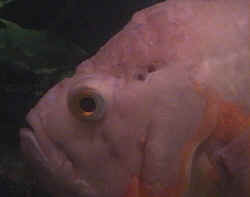 |
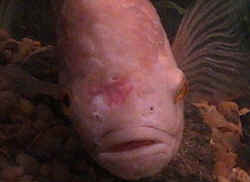 |
Sick Oscar sick
I have a 6yr old Oscar who has had hole in the head since he was 2yrs.
Recently he has developed cloudy pectoral fins with red streaks in the
vein of one side. The tank is a 55gl he is about 12" filtration is
a 350 magnum,400 Emperor 280 Emp he is the only fish in it. water
changes are done weekly. filters changed about evert 2 weeks
alternating .Change water consist of, ro/di add SeaChem cichlid salt
and Alk buffer and cycle to tank each water change test for
GH 7 KH 3 ammonia 0 nitrite 0 nitrate 60ppm I have been dosing
Metronidazole last three water changes it seems to help some
but at each new water change he seems to do worse again. He acts like
he is having a hard time seeing his food which all he will eat is tetra
food sticks Half the tank has about a 1/4" of small gravel the
other side he stays at the most is ,bare .PH is 6.9 to 7.1 Not sure why
he seems to do worse after water change it does look like he has some
Ich also temp is 79 would be very thankful for any help
Thanks Jeff. He has had a good appetite until having trouble seeing
< The nitrates are too high making him susceptible to diseases.
Nitrate levels should be under 25 ppm. This is partially the reason for
the hole in the head. So here is what is going on and here is how to
fix it. You have lots of filtration which is good , but you are not
changing them often enough. I know the canister filter is a pain to
deal with but you need to change all the filters at the same time and
at least once a week. The filters take the waste out of the tank but do
not remove it from the system. So the bacteria continues to break down
the ammonia and nitrites into nitrates. That is good and that is what
is supposed to happen . The problem then is removing the nitrates.
Nitrates are removed by changing the water to dilute them to under 25
ppm. You can change all the filters at once because the bacteria are
living on the BioWheels. Do a 30% water change and clean all the
filters. Vacuum the gravel to get rid of all the crude that has
accumulated there. Once the tank is clean we can begin treatment.
Organics in the water will absorb fish medication making them
unavailable for treating the diseases. Remove the BioWheels and any
carbon in the filters. Place the BioWheels in a container with water
from the tank and let them sit in a cool dark place for a time. You
Oscar has developed a bacteria infection and needs to be treated with a
Nitrofuranace type drug. If he has Ich too then treat it at the same
time with rid-Ich. Change 30% of the water before repeating the
medication. Try and get the water temp. up to 80 to 82 degrees F. Once
the fish is cured try to get him to eat with washed earthworms. The
additional live food should bring him around quickly. Once he is eating
then change some water and put the carbon back into the filters. When
the medication has been removed and the green colored water is gone,
you could then put the BioWheels back on the filters. Watch for ammonia
spike because the medication may affect the good bacteria needed to
break down the fish waste. So more water changes may be needed under
the tank stabilizes again. If you Oscar is strong enough then he can
handle the changes. Hopefully you have caught it in time.-Chuck>
Oscar
Hello, My name is Bill Holland. I have an Oscar that has been laying on
his side at the bottom of the tank. I read some of the FAQ and advice,
and notice you advice Epsom salt and medicated food. Could you please
give me a dosage for both, and a brand food you would advice. Thank
you.
< Do a 30% water change and service the filter. Make sure the water
temp is up around 80 degrees F. Try and get him some washed earthworms.
Once he eats a couple of these he should be up and about. Try and get
him to eat some pellets by Spectrum, Marineland or Hikari.
-Chuck>
Bill
Re: Oscar
I've done the water change and filter change. I put in salt this
evening, as well as a treatment for ick. Should I keep going with the
salt, or just go with the food?
< I think you need to get him up and build up his strength, so I
would start getting him the food.-Chuck>
|
|

