|
FAQs on Environmental Pondfish Disease, Diagnosis
Related Articles:
Environmental Pond Disease,
Koi/Pond Fish Disease,
Gas Bubble Disease/Emphysematosis,
Pond Parasite Control with
DTHP, Hole in the Side Disease/Furunculosis,
Goldfish Disease,
Related FAQs:
Pond Environmental Disease 1,
Pond
Environmental Disease 2, Pond
Environmental Disease 3, & FAQs on Pond Environmental
Disease: Prevention, Causes:
Cumulative Stress, Predation, Low/no Oxygen, Poisoning (Algicides, Metals,
Pesticides...), Metabolite
Accumulation, Physical
Trauma/Damage, Electrical,
Troubleshooting/Fixing,
&
Pond Fish
Disease,
Pondfish Disease 2,
Pondfish Disease 3,
Goldfish
Disease,
|
 |
 |
Aquatic Gardens
Ponds, Streams, Waterfalls & Fountains:
Volume 1. Design & Construction
Volume 2. Maintenance, Stocking, Examples
V. 1
Print and
eBook on Amazon
V. 2
Print and
eBook on Amazon
by Robert (Bob) Fenner |
 |
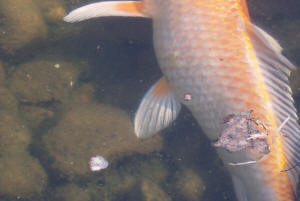
2 male koi found dead in pond in the AM the rest (6) are healthy
9/1/17
Can’t figure out the cause for 2 of my male Koi dying. One I have had for 25
years and weighed close to 6# and 2 ft long.. The other was a 4 year old about
10 inches long. All the fish were fine the night before. ( I did a 1/6 water
exchange for my 2800 gal pond) I found them dead in the AM. All the rest (6 koi
and 5 goldfish) are totally normal with no signs of stress. What could have
happened?
Thanks for your time
Elaine Brown
<Can only speculate, but have seen occasional anomalous deaths (male and female)
from no apparent cause. Have you inspected the bodies thoroughly? No predators
at play here? Could be simple coincidence that you lost two (and males);
differing sizes imply varying tolerances to such phenomena as dissolved
oxygen... and sexual behavior? Doesn't really occur in the dark with these
minnow fishes. Did the water change somehow induce some overwhelming stress
here? Bob Fenner>
Re: 2 male koi found dead in pond in the AM the rest (6) are healthy
9/1/17
After eliminating several causes, I believe it was caused by them eating the
roots of a Calla Lily plant that has been in the pond for years, but the roots
were exposed when a large rock surrounding them fell in the pond a few days
before, and when I added the water they were assessable to them. Thinking they
were poisoned...
<Interesting. But not the other koi and goldfish? BobF>
|
Is this baby goldfish ok?
7/13/14
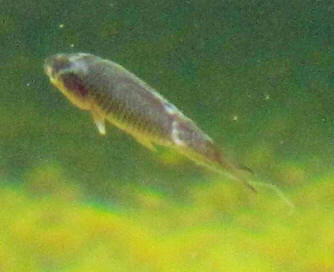
I took a picture of my smallest baby goldfish today. This is what I got.
It looks like the baby is scarred, sick, or hurt. It appears healthy and
active otherwise and the other fish are not afflicted with the
condition.
Is this baby ok?
Thank you.
<Looks sickly; heavy mucous production. Could be all kinds of reasons.
Ideally, rear indoors, optimise water conditions, perhaps use an
antibiotic if the fish doesn't respond positively. But as I've said a
few times, some mortality among Goldfish fry is normal, perhaps
inescapable. But do of course provide the best possible conditions that
you can. Bear in mind predators like Diving Beetles can cause serious
harm to fish fry in ponds, and even if these attacks fail to kill the
Goldfish, you could end up with scarred or damaged fish. Cheers, Neale.>
|
Re: Is this baby
goldfish ok? 7/14/14
Thank you Neale! :)
<You're welcome!>
|
Re: (RMF, need some help with pond Q at the end) Re: Angelfish
Repro./ Synodontis eupterusHLLE,
Bacterial or Fungal/ Mystery Spiny Eel ID 7/9/14
<<Bob, can you look at the Pond question at the end?>>
<Yes; certainly. BobF>
I do have one more unrelated matter. In an outside 300g res.
with a school of marigold lyretail, filtered by an
aquaponic growbed with 55g of media and plants. Nitrate is zero, water
is "hard", diet of TetraMin once a day and Hikari algae wafer once a
week plus natural foods(being outdoors). One fish has something
hanging from bottom side, looks to be connected to digestive tract.
It's white and starts skinny and gets wide at end, like a balloon. It
has been trailing for 2 days. Any thoughts on course of
action.
<Not sure what this might be. A photo would really help. Have asked Bob
F for his thoughts. Would suggest you review the likely candidates as
they seem to me: heron/cat attack/damage; Anchor worm; leeches.>
>>I concur w/ Neale's statements and request for a clear image. RMF<<
Sarasa comet goldfish with problems
8/27/12
Hi there,
I have a Sarasa comet goldfish, Goldie, who started behaving very
strangely today. He is at the top of the pond, opening and
closing his mouth, but is still horizontal. I noticed he wasn’t
moving while feeding and the top of his fin was out of the water, and
seems to have some dryness and damage from doing this all day. I reached
in the water to check on him, and he did slowly swim away and go
underwater, but he was very listless. He is opening his mouth and
closing it all the time, and ignored food. He did a few laps of the pond
and then returned near the reeds and has remained stationary over there,
just opening and closing his mouth, and not moving. I’ve checked the
water, (ammonia, nitrate, nitrite, pH) all of which I do monthly. They
are all perfect, apart from the pH which is about 9,
<Yowzah, MUCH too high. What is the source of this alkalinity?>
although it has always sat at this level for the eighteen months since we
moved to the house, despite efforts to bring it down.
<Again how, or better still, search on WWM re pond pH>
His back fin is out of the water again, and I honestly don’t see him
making it through the night if I don’t do something. Any ideas would be
amazing. He’s our biggest goldfish (about 9 inches) and the only one who
really stands out colour wise, so I’d be so sad to lose him.
Thanks
Gemma
<Could be just low dissolved oxygen, some form of poisoning (perhaps an
errant bug it ingested)... the larger the fish is, the less percentage
gill surface area... I'd be changing a significant part of the water,
shading the pond, increasing aeration/water movement... and reading. Bob
Fenner>
Bubbles - 12/20/11
Fish gurus-
<Sadie>
Your website is fantastic! It is so informative. Thanks for
creating such a useful resource.
<Welcome>
Here's my situation: I have a small outdoor pond.
<Size, shape depth please>
There are about 20 Comets and 1 Red Oranda in the pond.
This will be the 6th winter most of the fish have spent in the
pond. I recently discovered one of the comets "dead" on
the bottom of the pond. When I netted him out,
he was actually still alive. I put him in a bucket of
pond water and brought him in to defrost. When the water warmed
up to about 68 F he was totally back to normal.
<Mmm, a valuable clue>
I hurried and set up a 10 gallon tank (I know a 10 gallon tank is
not adequate for a 4 inch goldfish... but it's all I have and it
was kind of an emergency). Other than wishing he was in his pond,
this fish seems to be back to normal. Then I discovered the
Oranda (2 inches) outside floating upside down. I brought the
fish inside, let it come up to the inside temperature, Googled all I
could on swim bladder problems, and fed both fish (who are now stuck in
the same tank) a bunch of shelled peas.
Eventually both fish seemed normal. Unfortunately the
Oranda's swim bladder issues returned 2 weeks later. The fish
went back on peas and the problem seemed righted again over
night. My local fish store recommended sinking pellets to prevent
future swim bladder problems. I'm hoping that with frequent
partial water changes I can keep the fish happy and healthy until I can
reintroduce them to the pond in a few months.
Here's my problem: The Oranda suddenly spends a lot
of time at the surface blowing bubbles. He just started doing
this after the last bout with his swim bladder. I'm confident the
water is well oxygenated. The peas make the water very murky, so
I just did a 30% water change. He was blowing bubbles before and
after the water change--so I'm even more sure it's not
oxygen. He doesn't act stressed and the comet isn't
acting strange at all.
I haven't tested the water for nitrates/ites... I'm not a
real aquarium enthusiast, so I don't have a test kit and I
haven't been back to the fish store since the bubbles
started. I read another post where it's possible that two
fish can have different oxygen needs or tolerances of water
imbalances. Is the smaller Oranda suffocating while the larger
Comet isn't? Could the bubble blowing have anything to do with the
swim bladder issues (cause or effect?)? I'm not really in a
position to upgrade all of my indoor fish equipment, but if the small
tank isn't going to cut it for this winter I guess I'll have to
figure something out. Any insight into this sudden bubble blowing would
be very helpful.
Thanks, Sadie
<What first comes to mind is "gas-bubble disease",
emphysematosis... Do you have a pressurized pump here? The gas could
also come from super-saturated source/tap water as well. Please read
here:
http://wetwebmedia.com/PondSubWebIndex/PdBblDisease.htm
and the linked FAQs file above. Bob Fenner>
Advice needed.... Pond... env. issues... high pH, what
else? 5/25/10
Hi - moved into house in dec-09 - came with pond 2700 litres / 600
gallon, UV & filtration - 2x air stone, although I put them
stones' & new UV bulb a month or so ago.
There are 10x fish, one of which being a lovely one foot long Ghost
Kio.
Since arriving the ghost has always sat on the top ledge of the pond
& took a swim every now and again just under the surface, taking
gulps of air & sometime jumping up, all seemed well. In March with
weather improving I
decided to give the pond a clean out, lots of dead leaves & stuff @
bottom & in cleaning out I drained out 2/3 of the water &
topped up from tap, introduced some lily's & other plants (as
pond had nothing when we moved in). I also put in 3x bags of aqua
stones from local garden centre on the bottom & various flat ledges
in the pond. Not long after this I notice the ghost Koi never seemed to
close his mouth & his body was developing a slimly surface. Worried
I spoke to fish shop, took down a sample of the water & determined
PH levels were too high @ 9.5%.
<Yikes! What is the cause here?>
Treated water & PH level dropped to. 8% for which the testing kit
said was ok, nitrates ok . The slime on fish cleared after a day or
two, but still not 100% happy with it's mouth I kept an eye the
fish for a couple of weeks, it carried on as usual, but still not
taking food off the top & with mouth wide open. @ this point (10
days ago) I decided to have the fish out a get a mate (carp fisherman
with big net) round to assist. Upon having the fish out it bleed
slightly from mouth as it knocks into sides of pond, but I noticed min
bleeding from fins & rectum. Had a look down the fishes mouth &
could see a round fleshy / red / sore looking lump (size of a marble)
1.5 inches down it throat, determined it was part of the fish & not
a stone. Put fish back in & thought I'd see how it got on. Over
the past couple of days it's slowed right down, constantly sat on
ledge under water wall. Had it out tonight & looked back down
mouth, the lump looks like it's popped / deflated, with some little
white patches (poor fish) Been looking on net for what this lump could
be & why it's mouth is always open, but nothing that I'm
sure it correct. I spoke to chap I bought house off, he claims the fish
is 40 yrs old, but doesn't think the fishes mouth was always
open,
PLEASE HELP - get the feeling fish doesn't have long to go &
I'll be truly sad to lose it, can't help but think it's
something I have done to the pond.
Has been hot over the past week, but pump & both stones have been
on. All other fish ok
Look forward to hearing back from you.
Best Regards
Kevin J
<Mmm, not much to go on here... I suspect you need more filtration,
perhaps aeration... Please take the long read, perusal here:
http://wetwebmedia.com/PondSubWebIndex/Pond%20Sub%20Web.htm
particularly the sections on disease...
Bob Fenner>
Re: Advice needed. 5/25/10
Any thought's as to lump in fishes throat could be, I think this is
preventing it from eating, but why the open mouth??
Thanks
Kevin J
<Mmm, best guesses are either a tumour of some sort or gout... a
deficiency of iodine (actually iodide/ate)... I would try supplementing
the fish's foods (immediately before offering) with Lugol's
Solution or such. Bob Fenner>
Scales, poor English, no data or reading
5/10/10
hi guys I have a 2000 gallon Koi pond in my garden the with about 15
good size Koi and about 20 gold fish which have been in there since I
started I have one mirror carp in my pond but all of a sudden he seems
to be losing some scales just on his right side fins are all good and
gills ok eating fine to I'm a carp angler so I love my fish just
wondered if you could help with what it mite be thanks
john roper
<... could be "environmental"... summat water quality
wise... Need data re... Likely predatory... Read here:
http://wetwebmedia.com/PondSubWebIndex/Pond%20Sub%20Web.htm
scroll down to Env. Dis. of Pondfishes, Predators...>
also I'm having trouble keeping my water crystal clear.
<And water quality. Bob Fenner>
Swim Bladder Disease in Koi
Hi,
<Hello Don,>
I have a rather large Koi...approximately 18 inches long, and around 4
pounds in weight.
<Good size.>
He appears to have swim bladder disease and can use some help. I have
read several articles about this over the past 4-5 days and still
remain confused about what I can do to try and bring him out of
this.
<Hmm... do understand that most swim bladder disorders (I don't
like the word "disease" in this context) are more to do with
other issues, particularly constipation. See here:
http://www.wetwebmedia.com/FWsubwebindex/gldfshmalnut.htm
>
He began irregular swimming about 5-6 days ago. I live in an area where
the outside temperature has been fluctuating ranging from moderately
cool nights 40's and 50's to warmer daytime temps in the
50's to low 70's.
<Take care not feed these fish while it's cold; here in England
at least, Koi aren't fed between late October and the beginning of
March.
Temperatures below 10 C (about 50 F) prevent their digestive systems
from working properly, and any food in the gut rots and promotes the
growth of bacteria.>
My pond has been established for 8 years, and I have never lost a
fish.
<Great!>
The other 5 fish in the pond are smaller, no larger than 9-10 inches in
length and no more than 1 pound in weight. None of the smaller fish are
experiencing any problems.
<May be a clue... bigger fish eat more, have longer digestive
tracts, are perhaps more sensitive to water temperature/digestion
issues?>
On the warmer days, I have lightly fed the fish (a high quality Koi
staple food), but not on a daily basis.
<Good.>
Over the past few days, the evening temps have fallen into the high
30's, but still warming during the daytime into the 60's on
occasion.
<Much too cold for feeding.>
With the exception of an elevated Ph level, all water conditions are
excellent. I have slowly reduced the Ph level to normal about 6.4.
<That's actually pretty low for carp. A neutral to basic pH is
optimal; aim for 7.5.>
I have also been treating the pond with Tetra Pond Treatment which
contains Quinine Hydrochloride.
<Do be careful not to use a "scattergun" approach:
medications are poisons, and if used without reason, can end up causing
even more problems. Always identify the problem first, and then
medicate. Medicating first, and hoping that cures something tends not
to be a viable approach.>
I am not sure that my Koi is not simply constipated or really does have
swim bladder disease, and I realize from reading it isn't always
easy to distinguish one from the other.
<Quite so; but if the fish is defecating (easiest seen in a holding
tank) then constipation is unlikely.>
My fish has a swollen abdomen, and there are some slight areas of blood
streaks on the swollen area, and also on one dorsal fin.
<Ah, I see. Again, cold can cause problems, especially if you have
any water features running (these cool the water further). Frost damage
in the fins leads to inflammation and eventually Finrot-type
infections.>
He remains mostly laying on his side and does not move much at all.
<Yikes!>
He has not been feed for the last 5 days, and I have to tried to get
him to eat any peas, which I understand could relieve the constipation,
if that is the problem.
<Do also add Epsom salt to the water, as indicated in the above
article and associated FAQ. Epsom salt relaxes the muscles, allowing
blockages to pass out more easily. Possibly easier to do if the fish
can be moved to an aquarium or holding tank.>
Is there a water treatment I can try that may kill a bacteria
infection, if that is what is causing the problem.
<Generally, adding antibiotics to ponds isn't practical or
especially effective. There's just too much "ecology"
going on there for such drugs to work. Antibiotic foods can be better,
since they're going into the fish, but for things as big (and as
valuable!) as Koi you need a vet to comment on this. He/she will either
calculate the appropriate food dosage, or else inject the fish
directly. If there is one fish on the planet that veterinarian science
has a good handle on, it's the Koi, so finding a vet able to do
this shouldn't be too hard.>
Something that I can use in the pond along with the other fish?? I do
not have a hospital tank (but could set up something if it may help).
Also, with a hospital tank, how much trouble will this cause give the
change in water temp.
<Don't expose the fish to massive temperature changes, but by
all means fill the tank with water from the pond, and let it warm up
slowly as needs be.>
The pond water temp has to be around the mid to high 40's or low
50's at this point, and I don't want to traumatize the fish
with a large temp change to warmer water.
<Indeed.>
Any assistance you can give me with this would be greatly appreciated,
as I do not want to lose my prize Koi.
<I bet. These are lovely fish, and worth going the extra mile
for.>
Thanks
Don
<Cheers, Neale.>
Re: Swim Bladder Disease in Koi (RMF?)<<You're
spot on>> - 11/07/09
Neale,
<Don,>
Thanks so much for the reply.
<My pleasure.>
I agree that "disorder" is a better term when talking about
swim bladder issues. Your comments have caused me to think more about
my Koi's problem.
<Very good.>
I realize there are a number is things that can cause the swim bladder
to malfunction, such as constipation, a tumor, a bacterial infection,
injury, genetic defect, just to name the most obvious.
<Indeed. A vet can narrow these down some more, but from my vantage
point on the other side of the Atlantic from you, the best I can do is
mention some of the possibilities.>
I have to some degree examined my Koi's abdomen and it feels
pliable, no hard spots that may indicate some sort of injury or
tumor.
<That's good to know.>
I believe I am ruling out a bacterial infection, since the other fish
in the pond show no signs of any issues.
<Hmm... would be careful about this. Genetic variation in fish, as
in humans, does affect predisposition to disease.>
Unless the large one's immune system was somehow depleted, I would
think if it is bacterial, viral, or some other organism causing the
problem, the other fish would also be effected.
<Perhaps. Broadly, yes, it's true that if water quality was bad,
several fish would show signs of a suppressed immune system (e.g.,
Finrot). But this doesn't have to be the case.>
I have also looked at some different pictures of examples of
Dropsy....and my Koi doesn't look like any that I have seen. There
is no overall swelling of the body, and only a very few scales that are
slightly protruding on his abdomen where the swelling is located, but
not to any degree it gives the appearance of Dropsy.
<This is also good news. Dropsy tends to be difficult to treat,
since by the time it appears (it's a symptom rather than a disease)
whatever disease is at work has progressed a very long way. Again, vets
can help, particularly where Koi are concerned since they're big
enough to treat. But even with Koi, the prognosis is mixed, at
best.>
This brings me back to the constipation, and since I had given then
food during more colder weather than I normally do (on those warm days)
when they were swimming around giving me that look like, don't just
stand there give us a bite to eat!!
<Resist! Or at least, provide high-fibre foods that'll get
shifted through the gut quickly. Plant material is the obvious thing,
and a clump of Elodea thrown into the pond would make a find snack for
them.>
If I create a hospital tank using the colder pond water...would it be
ok to bring in side and allow to warm to room temp?
<Yes, this is fine. Do put the tank somewhere cold though, like a
garage, shed or basement. Or even an unheated spare bedroom (which is
where, funnily enough, I overwinter my carnivorous plants that, like
Koi, need a cool winter).>
Or should I be more gradual than that?
<The more gradual the better, but don't get paranoid about this.
Provided filtration and if necessary aeration are adequate to the size
of the fish and the aquarium being used, Koi handle this sort of thing
just fine.>
I will have to figure something out as far as filtration and
circulation....and I think I have enough resources to get the proper
amount of Epsom salt in the water.
<You certainly can add Epsom salt to ponds, but you'd need an
awful lot, and getting it out again afterwards would mean changing all
the water, and that really isn't practical with most ponds.
That's why it's better to do this using by moving the fish to a
hospital tank. Good luck, Neale.>
| Container Pond, Unhappy Fish? 03/07/2006 Hi
Bob, <Actually, Sabrina here tonight. We had some
technical difficulties; turns out my laptop at home has a
configuration that allows us to read and respond to your query.>
I found your website through Google and I sincerely hope you can
help! I purchased a glazed water bowl (very large) on
the weekend and have filled it with water, placed 4 goldfish and a
water lily plant in a tub in the base of the bowl. It
sits outside and is about 1 metre in circumference. I
have feed the little fish each morning, however it doesn't seem
like they are eating. They certainly do not respond at
all when I place the food in the water. They float at
the base of the bowl and rarely move. I must say I am
very concerned for them!!! I bought the fish from a
brilliant pet shop and requested the most hardy fish possible for
outdoor ponds. No other information or recommendations
were provided. Can you please help? <Very
much to learn, here.... First and foremost, the basics
of keeping fish.... Cycling the "tank" (pond,
in this case), maintaining the system, caring for a
pond.... As for why the animals are listless at the
bottom of the container, this could be anything as simple as a very
low water temperature to something as deadly as high
ammonia. Please read the following link, and the other
pages linked at the top: http://www.wetwebmedia.com/FWSubWebIndex/fwestcycling.htm
, and the applicable sections here: http://www.wetwebmedia.com/PondSubWebIndex/Pond%20Sub%20Web.htm
.> Look forward to hearing from you. Yours
sincerely, -Peta Donaldson <I do hope this is the
beginning of an exciting learning experience for
you! Container ponds are great fun. Wishing
you well, -Sabrina> Container Pond, Unhappy Fish?
- II - 03/07/2006 Sabrina, <Hello again.> Thanks for your
reply. However, a little too late... the fish
all died two days after I sent you the email. I
contacted the pet shop from which I purchased the fish and told
them how bitterly disappointed I was. <Very sorry to hear
this.> Fish abuse at its best. Very upsetting.
<Indeed.> That is definitely the first and last time I
purchase fish. <Do please take some time to read, research,
perhaps invest in a couple good books (or even borrow from a local
library) and look around on WetWebMedia - and once you have a
better understanding of the animals you wish to care for, try
again.> Best regards, -Peta <All the best to
you, -Sabrina> |
|
Sick pond Goldfish. Koi ... no useful data or
reading 04/22/08 I hope you can help because we have
already lost 1 fish to what ever this is. Charlie is 9 inches
long and resides in our 10 x14' pond with 7 other fish in
approximately 1600 gallons of water. He has started to swim in
spirals recently and lies bent over rocks or floating at the top
of the water. He also has much more vibrant color on the side of
his body that is facing down. His appetite is pretty good but he
grows increasingly lethargic. I filled or 10 gallon aquarium with
water from the pond & placed an aerator in the tank. He is
now inside where we can watch him closer till I know if this
could be contagious. I can't find anything like this on the
internet. Hope you can figure this out. <Something amiss
here... with the environment itself... Need data on the history
of water quality, including how much the temperature vacillates
here, DO... I suspect it's the largest animals that have
died, been mal-affected first... Have you read through the Pond
Fish Disease FAQs on WWM? Please see here:
http://wetwebmedia.com/PondSubWebIndex/Pond%20Sub%20Web.htm Read
re others experience to give you an idea of what sorts of info.
we're looking for/need to help you. Bob Fenner>
|
|
|
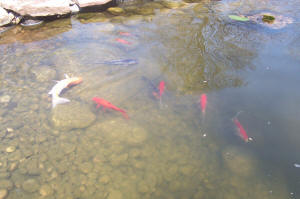
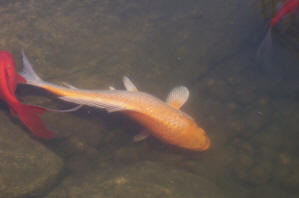
Koi Problems Hi There, I am not a novice. But I would take
any advice about my Koi. The Problem is one of my prize Koi is listing
a little on his side. But when I go to feed them he perks up. Should I
be alarmed? <I would be.> I know my fish and this is not normal.
<Agreed.> Here are the stats. 150 gal tank inside. Good
filtration, did water change yesterday and do regularly. Have 10 or so
med to large Koi with, plus 20 or so small ones. <That is an awful
lot of fish for that tank.> All other fish doing fine. Should I
separate and try some meds or what do you think? <I would first
examine water quality (this is my first reaction to anything abnormal);
pH, ammonia, nitrite, nitrate, and particularly oxygen concentration.
It is not unusual for the largest fish to show signs of distress when
oxygen levels are depressed. -Steven Pro> Please help, Thank you
Clark R. Puyallup Wa
Hemorrhage (In My Pond) - Just Poor Water
Quality? - 08/19/2004
Last Saturday I added some common goldfish
and 4 Koi (the Koi are only about 4" long) to my
backyard pond/waterfall. The water has been circulating
almost continually since the addition of the fish to provide oxygen and
help prevent the growth of algae. <Almost
continually? Not constant?> I have not tested, at this
time, the condition of the water to make sure all the levels are within
fish tolerance. This morning I ended up removing a dead
goldfish that appears to have had some hemorrhaging around the eyes and
scales, nothing around the gills however. <I would *immediately*
test ammonia, nitrite, and nitrate, also pH (if you can, compare your
pond's pH with that of the store where you got them).> Prior to
the fish dying, I noticed that his movement in the pond seemed
lethargic and he was having some difficulty maintaining his
equilibrium. I recently went and checked the pond again and
am seeing yet another goldfish with similar symptoms as the
first. I checked for any signs of hemorrhaging and see small
red spots under both eyes but nothing like the first
one. Any suggestions? <First and foremost, with so much
life added at once - and you only say 'some' common goldfish, I
assume this is a higher number than the 4 Koi - I would not be at all
surprised if ammonia and nitrite are, or at least have been, highly
toxic. Please test these values - without knowing them,
there's no further I can recommend. If ammonia or
nitrite are not *zero*, you'll have to do some hefty water changes
(a PITA in a pond - yikes!) to bring them back down. Please
do keep us updated, and we'll try to be of more service, once a
problem/solution can be had. Wishing you
well, -Sabrina>
Koi dying with no physical signs 6/29/05
Hi
<Hello
there> I have been searching your site for possible causes for the
death of my fish. I have lost one a day for the last seven days. The
pond is new (about 6500 litres). I left the pond for a couple of weeks
before putting the fish (15 small Koi up to 7") into it. The
filter and fountain were running for the entire period since the pond
was filled. I had read quite a few of your responses to other owners
with similar problems (fish dying with no outward signs). The fish that
have died became loaners, not feeding and began swimming at a very
shallow depth and would die within 24 to 48 hours of showing these
symptoms. Whilst reading one of your replies about possible deaths
caused by poisoning by weed killers/pesticides etc. <Or the system
just not being cycled... the root cause here is almost assuredly
environmental> it suddenly dawned on me that my pond design may
actually be poisoning my fish. The pond is part dug and part raised and
lined (not a problem). However the top edge of the pond was finished
with 6" wide decking timbers. I realized, whilst reading your
replies, they were made from tanalised timber (for those who may make
the same mistake as me but are unaware of what tanalised timbers are,
they are timbers treated with cyanide). I have made a presumption that
when it is raining the cyanide is possibly getting into the water (not
100% but I think it is a strong possibility). Of course I immediately
went out and took these timbers off my pond and will drain it first
thing in the morning. <Yikes!> Could you please let me know your
views on this? If you think I am right then I hope this information may
help others who have made (or might make) a similar oversight to mine!!
Ps. Great site!!! Regards Stephen Robbins <You are correct in that
treated lumber can be real trouble... A sample of the water might be
taken to a quality assurance or college laboratory for analysis...
Perhaps the timber can be sealed with something making it impervious to
water... like polyurethane... Or it can be moved, the pond modified
such that water that does come in contact does not wash into the basin.
I wish you well. Bob Fenner>
|
|
Aquatic Garden
s
Ponds, Streams, Waterfalls & Fountains:
Volume 1. Design & Construction
Volume 2. Maintenance, Stocking, Examples
V. 1 Print and
eBook on Amazon
V. 2
Print and
eBook on Amazon
by Robert (Bob) Fenner |
|
|
|

