|
FAQs on Environmental Pondfish Disease 3
Related Articles: Environmental Pond Disease,
Koi/Pond Fish Disease, Gas Bubble Disease/Emphysematosis,
Pond Parasite Control with DTHP,
Hole in the Side
Disease/Furunculosis, Goldfish
Disease,
Related FAQs: Pond Environmental Disease 1,
Pond Environmental Disease 2, &
FAQs on Pond Environmental Disease: Prevention, Diagnosis, Causes: Cumulative Stress, Predation, Low/no Oxygen, Poisoning (Algicides, Metals,
Pesticides...), Metabolite
Accumulation, Physical
Trauma/Damage, Electrical,
Troubleshooting/Fixing,
& Pond Fish
Disease, Pondfish Disease 2,
Pondfish Disease
3, Goldfish
Disease,
|
|
 |
Aquatic Gardens
Ponds, Streams, Waterfalls
&
Fountains:
Volume 1. Design & Construction
Volume 2. Maintenance, Stocking, Examples
V. 1
Print and
eBook on Amazon
V. 2
Print and
eBook on Amazon
by Robert (Bob) Fenner |
 |
Please help. GF dis., pond 8/16/18
Dear WWM Crew
<Nat>
Can you please help me? I rescued 60 goldfishes 2 weeks ago at the time of
rescuing they suffered extremely bad stress then I just got one day to set
up the new pond.
<Mmm; how was the water, filter "conditioned"?>
Now all fine but one poorly sick, it sinks at the bottom of the pond, I
quarantined it indoor, used Interpet First Aid salt and API Pimafix, the
black border alongside the body faded after 7 days treatment so I placed it
back to the pond then next day the black border comes back again and it
seems has new wound. I tested the water it shows medium high NO2 and
NO3 which I immediately change 50% water, bought it down to normal level now
but the question is SHOULD I USE THE SAME MEDICINE AGAIN or should I try
something different?
BEFORE
<Mmm; actually, no medication needed or advised, BUT you need to step up the
biological filtration here. Let me have you read here:
http://www.wetwebmedia.com/fwsubwebindex/fwno2faqs.htm
STOP feeding period; the fish won't starve, but driving the nitrite up
higher may well kill all.
DO look for Dr. Tim's products: GET "One & Only Live Nitrifying
Bacteria"
ASAPractical.
Bob Fenner> |
.jpeg)
Hopefully not viremia, pox, or furunculosis... |
Small Pond Goldfish Pond Survival
9/25/14
I have a 765 gallon, irregular shaped, sunken pond. It is a 45 mil. EPDM
liner pond. It is a few weeks over 1 year old. It has a pH of about 8.
It has a uv, a fountain, and a submersible filter with a water pump of
about 625 gph. 2 of my adult fish died about 2 days ago. A calico
Shubunkin goldfish and a big white comet. They got gill damage. They got
it from being cooped up with 11 other goldfish. They were in a way too
small 50 gallon tank, with no filter or aeration. They stayed in there
for a day and overnight. My fault entirely. I should have known better.
I got 2 new replacement fish for them today. A little yellow comet and
another redheaded Shubunkin. They are both about 2 inches long. I live
in the Arizona desert. Will the 2 new fish have time to build up their
size and reserves before it gets too cold?
<Should do, but depends on how mild your autumns are and how cold it
actually gets in your winters. Remember, Goldfish can feed and
metabolise down to 10-12 degrees C, using low protein foods such as
wheat germ, but below that they shouldn't be fed anything at all until
springtime rolls round and it warms up above 10-12 C. Very small
Goldfish may do better overwintered indoors, and your 50 gallon tank
should be ample for that.
Mortality of yearling Goldfish can be quite high in cold climates where
ice forms over the pond, but Arizona might well be mild enough for yours
to do okay.>
Thank you.
<Welcome, Neale (in the UK). Have cc'ed RMF to add a more Southwestern
USA perspective.>
<<IF the pond is large enough, deep enough, protected by structure from
much influence of (weather) elements... to not vacillate much thermally
(see WWM re as always); the biota should be fine here. RMF>>
Re: Small Pond Goldfish Pond Survival
09/25/14
Thank you Neale! :)
<Most welcome.>
|
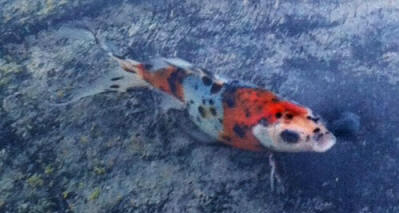
Help! My Shubunkin is not acting right.
9/21/14
My pH is around 8. I have a 625 GPH submersible filter with a uv
sterilizer and a fountain attachment. I just cleaned my 765
gallon pond. I started yesterday afternoon and finished this
morning. I had to put my Shubunkin in a 50 gallon container with 11
other comet goldfish overnight. I about lost one of my comets. But that
fish recovered and is doing fine. Now this one is acting strange. It is
gasping at the surface of the water and darting around. The other fish
are hiding in their fish shelters during the heat of the day. This is
normal. Usually my Shubunkin hides with them. Not so today.
I used a new type of pond bacterial additive too.
<Why? What additive? To fix what problem with the pond?>
It keeps coming up to me as if asking for help. Is my fish stressed
because of the water change?
<Fish can react to sudden changes in pH and temperature by swimming
oddly, but typically most/all the fish will react, particularly within a
single species (in this case, Carassius auratus). So if just one
Goldfish is acting odd, then there may be something else going on.
Examine the fish carefully for signs of physical damage (cats, leeches)
or external parasites (anchor worms are not uncommon). Your photos don't
really show me anything of significance, but capturing the fish with a
net, removing to a white container, and then examining it yourself could
be the next step for you.>
Does it have gill damage? Is it just hungry? No red areas or streets
that I can see. Some photos are provided below.
Thank you.
<Most welcome, Neale.>
|
 |
|
Help#2!
9/21/14
In my last letter to you, do you recall me telling you about the comet
goldfish I about lost? Well, turns out now that one is suffering from the
same ailment as the Shubunkin. I am almost certain now these two suffered
some sort of gill damage from their overnight stay in the 50 gallon tank
with the other fish. What should I do with them? Do I humanely kill them?
Or should I just wait and see? Thank you.
<The latter. Damage to the gill filaments -- if not fatal or so severe the
underlying bones are damaged -- usually will recover in time. Upping the
aeration and/or use of water features to ensure oxygen levels are good will
be helpful for this fish of "diminished capacity" at the moment. In fact you
may prefer to hold them in a cycled hospital tank where you can keep them
out of direct sunshine and excessive warmth (warm water contains less
oxygen) so that they heal more comfortably. Should be back to normal within
a month. Cheers, Neale.>
Help #3
9/21/14
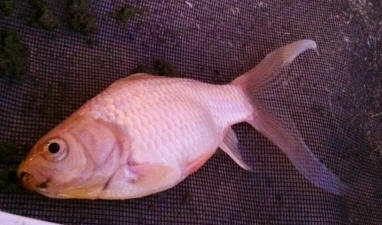
The fish I wrote about in my 2nd email to you has died. Found her floating
in the pond. Checked her gills before disposing of the body. They were a
dark blood red. Is this a sign of gill damage?
<Nope. It's a sign of a dead fish. Haemoglobin, once blood flow and gill (or
lung) ventilation stops, turns dark red.>
A photo of the dead fish is below. The 2nd fish was having the same symptoms
as this poor fish. Will it die too?
<I hope not. Do see previous emails.>
Thank you.
<Most welcome, Neale.>
|
 |
|
re: Help #3
9/21/14
Thank you so much for all your help Neal. All my remaining fish are hiding
this morning. Do you think it is due to stress from the pond cleaning? The
Shubunkin is still alive as well. Thank you.
<Most welcome and good luck. Neale.>
Help! #4 Update
9/23/14
I got an update for you on my sick Shubunkin. Found my poor Shubunkin dead
today. It was up in one of the folds of EPDM liner I have in my pond.
<Oh dear!>
Looked like it had been there a day or two. The other fish seem healthy and
active. I have 8 to 7 goldfish now. Hard lesson learned though. No overnight
housing in a 50 gallon tank without aeration and filtration. Poor fish! :(
<Indeed. Good luck with the remaining fish/pond. Cheers, Neale.>
|
HELP NEEDED SOON! Pondfish; killing them env. 7/15/14
To whom ever can offer help that I desperately need!
<Let's see>
I have a 4'W X 3'L and 26"D pond, that I have just had resurfaced ,
<With what?>
after 6 of my fish died one Butterfly Koi who committed suicide jumped out
of pond , 5 plane Goldfish. I know have 2 Butterfly Koi and 5
Goldfish left, in a small 20 gal tank that are being treated for
bacterial infections with E.M. erythromycin tabs, Melafix
<Garbage>
2 teaspoon,
and 2 teaspoons salt according to directions. They are currently alive and
seem a bit better. Now I need to get them home again.
<Is this pond cycled?>
How and what do I treat the size pond now that it is refilled? I have on
hand correct pH fizz tabs.
<... what is the make up of your source water?>
Start Right and salt. My fountain pond filter is Beckett for 200
gal. Do I need a bigger one?
<What filter is this pump driving?>
These are my readings as of yesterday;
Ammonia 2.0
<DEADLY TOXIC>
pH low 7.6
pH high 8.4
<.... WAY TOO much vacillation... Also deadly toxic>
NP2 0
NO3 0
Don't know how to test for hardness, pond was filled with house salt
softened water has been re circulating without the filter part in place just
the fountain pump. Nervous to put filter material ( bio balls and
sponge material) back in pond as could be infected. Bio balls just cleaned
and left in clean water in sun bucket. What would you recommend for
filtering?
<Posted.... here's the indices:
http://wetwebmedia.com/PondSubWebIndex/Pond%20Sub%20Web.htm
Food used for feeding is Tetra Pond Variety blend and Goldfish Crisps,
should I be feeding anything different?
<... I would not feed anything under the current water conditions>
Today's readings are as follows;
Ammonia 0.50
pH low 7.6
pH high 8.3 - 8.4
NO 2 0.
NO 3 0.
P.S. It rained hard overnight. Last ? do barley balls really do what they
say they will do?
<Can>
Thanks in advance for any and all help!
<Help yourself; read... send along specific questions. You must get the
ammonia to zero, have some alkaline reserve...>
Shavana Abel
<Cheers, Bob Fenner>
Questionable Water Supply? 4/24/14
Greetings WetWebMedia Crew, I have a peculiar incident to report. I
did a water change three days ago, ended being about 60%, which
is larger than I normally change. This tank is my Shubunkin goldfish
tank and holds 65g and
filtered by wet/dry filter(this tank has always been bullet proof for
me).
I hold these goldfish in here to establish breeding pairs or trios then
relocate to outer pond.
<Good practice>
There are 4 fish and are about 4 inches in length, I've had for 5
months.
Tank has been running for two years ammonia>0, nitrite>0,nitrate >10
before water change. These were fish healthy with a diet high in
vegetables and algae. Now two days after change I noticed, my fish had
what looked like fin rot completely covering edge of fins. Two fish
dead, two very weak. I performed a immediate water change of 50%,
without testing water
parameters. The following day the remaining fish died. The fish actually
looked as if they lost weight in the 48hours as well.
<Yeeikes>
Not quite sure what to make of this. Only thing I can think of, is my
county water line was being worked on that day, a block or two away and
my water supply was interrupted briefly that day. I did attempt to flush
my line(by running water for 5mins or so) and water looked and smelt OK.
Do you think a water additive being run thru the line killed these fish?
<Could be... I'd contact the water district; ask re; and see if they'll
test a bit of your extant mixed water. In future, I'd do what I advise
re new water treatment, changes... Store it for a week ahead of time;
make only 20-30% changes if poss. Bob Fenner>
Thanks for the great site. Aloha Brandon
<A hu'i hou!>
Sandpaper skin on my Shubunkin 12/27/11
Hi there, I'm so grateful to you guys, the site is fantastic. I
should have written and asked for advice before. I also apologise in
advance for this long email. And for the fact that I still don't
have a proper testing kit for nitrate and ammonia. I've ordered one
online and it should arrive in the next couple of days.
<Ok>
Just as an introduction, I have eight goldfish in a 400 litre
pond, ph 7.0.
Its in my tiny front yard, taking up most of the garden, the fish are
sheltered by water lilies and overhanging ferns. Its very popular with
the neighbourhood kids who all stop and admire the fish every chance
they can get. Another of my fish, a male Shubunkin, is
currently in a separate hospital tub of 200litres, ph 7.4.
<All right>
I've had three of my fish, two comets and the Shubunkin, maybe four
or five years, all bought from my local pet shop when they were tiny.
These are the ones that had the other 'babies', but of course
the babies are now huge.
The two original female comets are about 30cms long (12inches),
the Shubunkin and a couple of the Shubunkin x comet 'babies'
are around 10inches.
<Mmm, need more room...>
The rest are about 8inches minimum, except for one 4inch
fantail (which I suspect came in on some plants I bought on
eBay). When I got the original three they were so small, and I'm
ashamed to say, but I had a small bowl with no filtration. My current
400litre pond is the third, and I now have a huge ClariTec 15000
biofilter, hooked up to a Stingray 7000 Pond Filtration Pump. I bought
the current pond two years ago, and the goldfish grew dramatically
after I bought it. It was astonishing how much they grew. I feed them
floating pellets and peas. I do 30-40% water changes once every week or
so, using various water conditioners, currently Prime.
<Good>
The fish are really tame and swim between my hands. They're lovely
fish.
I'd hate to lose any of them. The thing is, the current
pond is now too small, and I suspect this may be one cause of my
current problems. I want to get them a bigger pond, but at the moment I
don't have anywhere to put it.
<Then some of the fish need to be moved elsewhere>
About six months ago I noticed my original Shubunkin had
developed skin that felt like sandpaper. My first thought was
white spot, and I took him out and tried a ten day salt
treatment to no avail. (Epsom salt, rock salt, baking soda and
Melafix.) None of the others had sandpaper skin or any visible
spots. I know this is silly but he seemed quite upset about being
separate so put him back with the others. (I know this is incredibly
silly but I wasn't thinking straight due to various other things
that were happening at the time). He was swimming around rapidly by
himself and calmed when I put him back. Anyway, I then tried
Aqua Master Rapid White Spot Remedy on the whole pond to no
avail. I used up 2 lots of 500ml of the stuff, as per the instructions,
so its not as though I didn't try for long enough.
<The issue here is environmental..., not a biological disease
agent>
I later tried paracide and paragone. Nothing got rid
of his sandpaper skin. I've read about the dangers of over
medicating and this all happened over a 4mth period, which yes, is
probably way too much medication over that time.
<Yes>
The other fish seemed fine while this was going on and I was desperate.
Of course I was asking the advice of people in a few different fish
shops and they just kept flogging me different treatments. In the
meantime I was searching the web and couldn't find any symptoms
similar.
The only information I did find said 'sandpaper skin' meant the
fish had 'had it', or referred to some obscure incurable
disease in wild fish which once you saw this on their skin meant it had
already got into all their internal organs and caused irreparable
damage.
It was when the Shubunkin started swimming frantically up and down the
pond one day that I finally put him in a separate 200litre outdoor
tank, 2mths ago now. He was really going psycho. At this point I was
really desperate and was convinced he was going to die in the next few
days. He'd become very thin, especially compared to the others.
I then tried Waterlife Protozin and later Sterazin on
him to no avail. Even just writing this I'm horrified at the
medication I've inflicted on him, but I was desperate and
didn't know what else to do.
<A better world... not toxic medications>
My Shubunkin didn't die however, and he's been in the 200litre
tub about 2mths now, with a biofilter and a 3500 litre per hour pump.
(This tub has algae that just won't go, which I realise after
looking more at your site is probably because I've been
overfeeding.) Anyway, after I tried the Parazin my
fish's symptoms started to change. (I don't know whether these
changes really had any connection to the Parazin, the weather in Sydney
was really hot around that time too.) What happened was that my fish
started to get white raised skin, like healed raised scar tissue, where
his dorsal fin joins his body. White spots up to 1mm diameter started
to appear and slowly erupt from that tissue, not as a cyst, but in a
long white thread.
(Sorry I know this is gross.) The sand paper skin on the rest of his
body didn't change. During the Parazin treatment the
erupting white spots just kept appearing and the raised scar tissue
like skin just got worse.
I think it was just under a month ago I decided to give my fish
a salt bath and finally I found this seemed to have some
effect. What looked like little black worms and longer white worms came
out of his body. He seemed calmer after it was over though he really
hated it at the time. His swimming around frantically became less
frequent afterwards too.
I've given him a few salt baths since and am worried about over
salting him. Unfortunately the salt baths haven't fully
eradicated the sand paper skin or the raised scar tissue, or the white
spots which still appear every few days in the scar tissue along the
base of his dorsal fin, although the scar tissue is getting much
smaller, and his skin seems to be becoming less 'sandpaper
like' (although I may be imagining this). When he does swim around
frantically its usually in the morning, or when another white spot has
appeared and looks like its going to erupt.... gross... :-(
No more black worms have come out since the first salt bath I gave
him.
What still appears to erupt from his skin during the salt baths are the
long white threads - from the white spots, as well as the rest of his
body.
I've since realised it may not be a worm - I've copied a gross
close up photo to this site so you can see for yourself and decide:
http://www.flickr.com/photos/72753075@N05/with/6567359111/
If you look at the edge of the black cardboard you should just be able
to make out little black spots in the white. The white thread shown
here is about 1cm long. (I've also taken a photo of an insect
that's been appearing out of nowhere in his pond and which always
appears the day after the salt bath in the container I've used. Its
white or grey, about 1mm, and jumps like a flea. I don't know if
this is connected to whatever might be in his body.)
<Can't make this out, but not likely a factor here>
I just don't know if I can keep doing the salt baths, how long it
will take to finally work and if it eventually will.
<Just good conditions, nutrition and time going by>
What really scares me is that over the last few days I've seen
white threads coming out of one of my fish in the front pond too. I
couldn't bear to go through this with all of them. I've tried
to take photos of the affected goldfish, copied into the above link.
The white threads are circled in red, but you can't really see
them. The other fish's scales appear whiter too. (If I hadn't
seen the white stuff I would've thought it was because she was
breeding - there are eggs and small fry in the pond, which hopefully
the rest of them will eat. I definitely don't want any more
fish.)
I feel so sorry for my poor fish, the Shubunkin. He's such a
beautiful fish with a lovely long tail and I hate doing all this to
him, its like torture, I can't believe he's survived the whole
process to this point.
Plus I know goldfish are social and I don't like leaving him by
himself.
Yet throughout most of this time his appetite has been good, and since
I separated him I've been spoiling him by giving him frozen brine
shrimp mixed with Spirulina (too much obviously). He loves that and
devours it.
Unbelievably he's now looks like he putting on a little bit of
weight.
<Should as the weather cools>
If you could please let me know your thoughts on all this it would be
so much appreciated. The whole process has been horrible. I've been
doing as much reading about fish diseases as I can and I've not
come across anything like the symptoms my fish is exhibiting. And thank
you for your patience with this long essay, and for all the time and
care you've put into this site.
Best wishes,
Catherine
<This issue is often attributed to a viral involvement, but
always environmentally mediated. STOP all medications, including
salts... Bob Fenner>
Fish Dying....
Hi I have a fairly new pond, 4 weeks old.
6/9/11
<Mmm, very new... How was the surface treated? What had/have you
done to cycle it biologically?>
The pond is aprox 1400 gallons. I have a top notch filtration system
with a bottom drain
<Best not to draw water from the bottom for filtration, or
circulation>
that is rated for 2000 gallons. The water fall has excellent flow and
creates plenty of oxygen. I started the pond and treated the water with
dechlorinator, water conditioner and a bio agent
<Which product?>
to get the good bacteria to grow. The pond store told me I could put
fish in right away
<An exceedingly poor idea>
but I waited another week. I purchased 5 small Koi
from the pond store and introduced them to pond after acclimating them.
Unfortunately I lost two fish because the were sucked into the bottom
drain.
<...>
I fixed that problem and added two more fish a few days later. One of
those fish died within a couple of days, but we weren't sure if a
predator had gotten in the pond and injured it. Everything was fine for
a few days, except I couldn't get the fish to feed. They were
hiding in the rocks and staying near the bottom. In the last few days
they have become more brave and have been swimming around, but still
not coming to the surface to feed.
I have checked the water quality almost everyday and with the exception
of hard water, everything else is good. the PH avg. is around 7.5. The
nitrate/nitrite readings are 0.
<... if this system is cycled there should be accumulating
NO3>
I have a few marginal plants and one water lily. Lately I have been
losing a fish every 3 days or so. They seem to go from behaving
normally to becoming lethargic and the soon after dead.
<Indicative of environmental issue/s>
I can't find any visible damage on them when I pull them from the
water.
I am down to only two fish now, although they seem quite normal at the
moment. Any advice...
<Yes; stop stocking>
should I remove these fish from the water and do a large water
change??
<I'd wait a month or so... drain half the water out,
replace...>
I also have a couple of tadpoles in the pond. I don't see them
much, but I did spy one swimming around and feeding the other day. He
looked fine.
<Too many possibilities to re-key... Read here: http://wetwebmedia.com/PondSubWebIndex/pdenvdisfaqs.htm
and the linked files above... Best to take your time here. Bob
Fenner>
|
Goldfish Issues, pond, comm. svc. acct.
4/19/11
Bob,
I have a client with a pond, who has some goldfish that need your
help!
The fish are between 3-5 years old. Two are bloated (thought to
be from improper nutrition/environment/husbandry) and one I am
unsure what to think could be the problem. Possibly an infection
of the liver? Or gases built up around the intestines from
improper diet?
<Likely the latter, along w/ aspects of the
environment>
I have attached pictures to this email, these are the only three
out of 8 fish to be affected in a 350 gallon pond.
Any suggestions on what to do would be greatly appreciated.
So far, here is what has rolled out since I took over the pond.
After the consultation, I immediately came up with an action
plan, and cross-referenced it through your site ( as I do when I
am uncertain in the least! ). I tested the pond's water and
the only issue was mild ammonia,
<Trouble>
which alleviated after the water change/debris removal. This was
2 weeks ago. The water is still testing zero ammonia, zero
nitrites, 15ppm nitrates, and the pH is stable around 7.3-7.5. I
added magnesium sulfate at the rate of 1 g/L directly following
the water change, and after a week of no feeding I bumped the
level to around 2.0-2.3 g/L based on my calculations (hard to say
due to a storm we had during the first week, the pond had
overflowed some, so I dosed enough to bring the level from 1 to
2.5 g/L) I also started feeding a few peas every few days at the
second visit. Still no results in the affected fish.
<These will take months>
I am also having issues obtaining pond plants that the fish will
find palatable, as the owner agreed to have plants in the pond
for proper nutrition. The reason I am having issues is the plants
that are suggested on WWM are either illegal in South Carolina
(Egeria sp., Pistia sp.) or are not being carried yet by my local
nurseries, as it is still early in the pond season here. Do you
have any other suggestions for palatable pond plants (palatable
to the goldfish, of course!)?
<What do you have available?>
And do you have any suggestions for a quality commercial goldfish
diet?
<Mmm, yes... low protein... no more than 20%... ten would be
better>
My client loves to feed his fish, and has been asking me when he
can resume feeding, and what (although he does understand he
cannot feed the fish until they are in better condition.)
<Emphasize this every time you're there. He needs to
MINIMALLY feed these fish/es>
He is a busy man, so I don't see him preparing peas and the
like for his fish. He just wants a bag/container that he can pick
up when relaxing in his backyard and feed a handful to his
aquatic buddies.
Should I tell him to stick to a spring/fall diet, and only to
feed sparingly (as long as I can find suitable plants for the
fish to eat on a daily basis?)
<Yes>
A couple of questions:
What is the highest/most effective concentration of Epsom Salt
for bloat/dropsy? Would the affected fish benefit more from a
1-hour high-concentration bath?
<Possibly. Please read here:
http://wetwebmedia.com/FWSubWebIndex/SaltUseFWArtNeale.htm
and the linked FAQs file above labeled MgSO4>
Please let me know what direction I should take, I want to help
my client's goldfish live happy lives! I thank you in advance
for all of your help!
P.S.: Sorry about the glare in the pictures, it was the best
quality I could get out of my travel camera.
*Mitchell Downs*
*Ebb and Flow Aquatics*
<Really only improved and diminished nutrition, sustained high
water quality and time will improve these fish's health.
Cheers, Bob Fenner>
Re: Goldfish Issues 4/19/11
Thank you for the info Bob,
What would you suggest I offer the customer? Weekly/Bi-weekly
water changes with debris removal and cleaning of filters?
<Weekly>
Feeding schedule/guidelines along with this?
<As posted on WWM... none, once, twice per day depending on
temp.>
Or should I feed once per week if we choose to go with a weekly
maintenance schedule? The customer wants some sort of time frame,
is there no real reliable way to estimate this?
<... please refer him to WWM is you don't care to look
this up:
http://wetwebmedia.com/PondSubWebIndex/Pond%20Sub%20Web.htm>
I am not as much concerned with short-term revenue, as with long
term contracts.
<You are wise here>
The customer has indicated that a routine maintenance contract is
viable as long as I can fix this problem. Should I tell him the
only way to fix the problem is through a maintenance
contract?
<My stock statement here: I would NOT do any work nowadays w/
out a signed, written contract>
I pride myself in honest, excellent customer service at a price
that is better than my competition as well as a superior quality
of service.
<Good>
I normally maintain aquariums, and my background is heavily in
reefs and tropicals (where most issues I have either dealt with
personally, or researched and assisted customers in resolving). I
have been drawn more and more to ponds for various reasons ( both
personal attraction as well as business reasons $$$) I want to
keep this customer! I don't want to scare him off, resulting
in another company immediately dosing the pond with loads of
antibacterials before looking into the problem thoroughly
(potentially causing more issues than before). The only reason I
could think of to use antibacterials would be on the food
(Kanamycin possibly?), after 2-3 months of consistent, optimal
water quality and nutrition. Do you agree?
<Mmm, at times/places, injectibles are of use... Definitely
NOT poured into the water>
I have been in the hobby for almost 16 years, 7 of which have
been in the service/retail industries. Any insight from someone
with much more experience than myself is always appreciated.
<Oh, do also peruse our Business SubWeb when you have
time:
http://wetwebmedia.com/AqBizSubWebIndex/Biz%20Index/Biz%20index.htm
Also, did the pictures indicate nutritional issues?
<Possibly, along w/ env.>
The two that are bloated seem to be, but the one with the lump
under the skin I am curious about.
Thanks as always,
Mitchell Downs
<Certainly welcome. BobF>
|
|
|
Gold Koi swimming on its side at the surface after winter
1/15/11
Hi,
<Hello Dale>
I have an outside pond which has been in existence for at least ten
years and has a pump with a filter, last year in June after a water
change I purchased a number of fish two Gold Koi, one Red and a Ghost
Carp.
During Autumn I cleared the pond of all leaves with a net, the fish
have survived this harsh winter but recently one Gold Koi died after
floating on the surface of the pond on its side, followed a few weeks
after by the Ghost Carp which simply died no sign of floating on its
side. Now the remaining Gold Koi has been swimming at the surface on
its side for 3 days, it is still strong and seems determined to dive
and is able to straighten out for a few seconds before returning to
swim on its side at the surface.
I suspected it has swim bladder problems maybe brought on by
acclimatising to the changing water temperature,
<Mmm, no>
and I have read about the use of defrosted peas to help cure this
ailment, which I'm a bit doubtful of, will this help?
<Won't>
The Red Koi is fine and has always been fond of this last remaining
Gold Koi, so it would be a shame if it is left on its own ha-ha.
I'd be grateful of any further information you could give me to
help rectify the problem.
Thanks
Dale.
<I don't know with any real certainty what the exact cause of
this fish's odd behavior actually is... but I fully suspect
"something" re the environment. It is quite common through
seasonal changes that simple stress, changes in the chemical/physical
make up of pond water brings about such anomalous losses. I urge you to
take care (small, gradual changes) in your upkeep. Please read here
re:
http://wetwebmedia.com/PondSubWebIndex/pdspgmaint.htm
Bob Fenner>
Re: Gold Koi swimming on its side at the surface after winter,
1/16/11
Unfortunately it died, but thanks for the advice.
Dale
<I would (still) be looking for root cause/s here. Something is not
right w/ the system/water. BobF>
|
Goldfish Problems 5/13/10
Hello,
I need some help with my sick Goldfish, I live in NE Ohio and I
have ten -7 inch Goldfish in my outdoor pond. The other day when
I went out to feed them I noticed that they were losing their
color or maybe scales losing pigment. They were staying still at
the bottom. I took one of the fish to the local fish store and
the man told me that it was a bacterial infection
<? from what cause/s?>
so he told me to use the T.C Tetracycline. So I set up a 20
gallon tank
<Too small>
inside the house and brought them all in and using a 50/50 of
water from the pond and fresh water and the suggested medication.
As soon as I put them in there with the medication they are
gasping at the surface, some on their side. I don't know if
the Tetracycline is making them worst?
<Possibly... but lack of oxygen, the sudden increase in
temperature... will kill them>
I have attached some pictures hoping that someone can help me?
Thanks for any help that you
can give. Mike
<... read here: http://wetwebmedia.com/PondSubWebIndex/pdenvdisfaqs.htm
and the linked files above. Bob Fenner>
Re: Goldfish Problems
Bob, Could you make out anything from the pictures? Should I
continue the Tetracycline?
<Not much and no. B>
|
|
Swim Bladder Disease in Koi
Hi,
<Hello Don,>
I have a rather large Koi...approximately 18 inches long, and around 4
pounds in weight.
<Good size.>
He appears to have swim bladder disease and can use some help. I have
read several articles about this over the past 4-5 days and still
remain confused about what I can do to try and bring him out of
this.
<Hmm... do understand that most swim bladder disorders (I don't
like the word "disease" in this context) are more to do with
other issues, particularly constipation. See here:
http://www.wetwebmedia.com/FWsubwebindex/gldfshmalnut.htm
>
He began irregular swimming about 5-6 days ago. I live in an area where
the outside temperature has been fluctuating ranging from moderately
cool nights 40's and 50's to warmer daytime temps in the
50's to low 70's.
<Take care not feed these fish while it's cold; here in England
at least, Koi aren't fed between late October and the beginning of
March.
Temperatures below 10 C (about 50 F) prevent their digestive systems
from working properly, and any food in the gut rots and promotes the
growth of bacteria.>
My pond has been established for 8 years, and I have never lost a
fish.
<Great!>
The other 5 fish in the pond are smaller, no larger than 9-10 inches in
length and no more than 1 pound in weight. None of the smaller fish are
experiencing any problems.
<May be a clue... bigger fish eat more, have longer digestive
tracts, are perhaps more sensitive to water temperature/digestion
issues?>
On the warmer days, I have lightly fed the fish (a high quality Koi
staple food), but not on a daily basis.
<Good.>
Over the past few days, the evening temps have fallen into the high
30's, but still warming during the daytime into the 60's on
occasion.
<Much too cold for feeding.>
With the exception of an elevated Ph level, all water conditions are
excellent. I have slowly reduced the Ph level to normal about 6.4.
<That's actually pretty low for carp. A neutral to basic pH is
optimal; aim for 7.5.>
I have also been treating the pond with Tetra Pond Treatment which
contains Quinine Hydrochloride.
<Do be careful not to use a "scattergun" approach:
medications are poisons, and if used without reason, can end up causing
even more problems. Always identify the problem first, and then
medicate. Medicating first, and hoping that cures something tends not
to be a viable approach.>
I am not sure that my Koi is not simply constipated or really does have
swim bladder disease, and I realize from reading it isn't always
easy to distinguish one from the other.
<Quite so; but if the fish is defecating (easiest seen in a holding
tank) then constipation is unlikely.>
My fish has a swollen abdomen, and there are some slight areas of blood
streaks on the swollen area, and also on one dorsal fin.
<Ah, I see. Again, cold can cause problems, especially if you have
any water features running (these cool the water further). Frost damage
in the fins leads to inflammation and eventually Finrot-type
infections.>
He remains mostly laying on his side and does not move much at all.
<Yikes!>
He has not been feed for the last 5 days, and I have to tried to get
him to eat any peas, which I understand could relieve the constipation,
if that is the problem.
<Do also add Epsom salt to the water, as indicated in the above
article and associated FAQ. Epsom salt relaxes the muscles, allowing
blockages to pass out more easily. Possibly easier to do if the fish
can be moved to an aquarium or holding tank.>
Is there a water treatment I can try that may kill a bacteria
infection, if that is what is causing the problem.
<Generally, adding antibiotics to ponds isn't practical or
especially effective. There's just too much "ecology"
going on there for such drugs to work. Antibiotic foods can be better,
since they're going into the fish, but for things as big (and as
valuable!) as Koi you need a vet to comment on this. He/she will either
calculate the appropriate food dosage, or else inject the fish
directly. If there is one fish on the planet that veterinarian science
has a good handle on, it's the Koi, so finding a vet able to do
this shouldn't be too hard.>
Something that I can use in the pond along with the other fish?? I do
not have a hospital tank (but could set up something if it may help).
Also, with a hospital tank, how much trouble will this cause give the
change in water temp.
<Don't expose the fish to massive temperature changes, but by
all means fill the tank with water from the pond, and let it warm up
slowly as needs be.>
The pond water temp has to be around the mid to high 40's or low
50's at this point, and I don't want to traumatize the fish
with a large temp change to warmer water.
<Indeed.>
Any assistance you can give me with this would be greatly appreciated,
as I do not want to lose my prize Koi.
<I bet. These are lovely fish, and worth going the extra mile
for.>
Thanks
Don
<Cheers, Neale.>
Re: Swim Bladder Disease in Koi (RMF?)<<You're
spot on>> - 11/07/09
Neale,
<Don,>
Thanks so much for the reply.
<My pleasure.>
I agree that "disorder" is a better term when talking about
swim bladder issues. Your comments have caused me to think more about
my Koi's problem.
<Very good.>
I realize there are a number is things that can cause the swim bladder
to malfunction, such as constipation, a tumor, a bacterial infection,
injury, genetic defect, just to name the most obvious.
<Indeed. A vet can narrow these down some more, but from my vantage
point on the other side of the Atlantic from you, the best I can do is
mention some of the possibilities.>
I have to some degree examined my Koi's abdomen and it feels
pliable, no hard spots that may indicate some sort of injury or
tumor.
<That's good to know.>
I believe I am ruling out a bacterial infection, since the other fish
in the pond show no signs of any issues.
<Hmm... would be careful about this. Genetic variation in fish, as
in humans, does affect predisposition to disease.>
Unless the large one's immune system was somehow depleted, I would
think if it is bacterial, viral, or some other organism causing the
problem, the other fish would also be effected.
<Perhaps. Broadly, yes, it's true that if water quality was bad,
several fish would show signs of a suppressed immune system (e.g.,
Finrot). But this doesn't have to be the case.>
I have also looked at some different pictures of examples of
Dropsy....and my Koi doesn't look like any that I have seen. There
is no overall swelling of the body, and only a very few scales that are
slightly protruding on his abdomen where the swelling is located, but
not to any degree it gives the appearance of Dropsy.
<This is also good news. Dropsy tends to be difficult to treat,
since by the time it appears (it's a symptom rather than a disease)
whatever disease is at work has progressed a very long way. Again, vets
can help, particularly where Koi are concerned since they're big
enough to treat. But even with Koi, the prognosis is mixed, at
best.>
This brings me back to the constipation, and since I had given then
food during more colder weather than I normally do (on those warm days)
when they were swimming around giving me that look like, don't just
stand there give us a bite to eat!!
<Resist! Or at least, provide high-fibre foods that'll get
shifted through the gut quickly. Plant material is the obvious thing,
and a clump of Elodea thrown into the pond would make a find snack for
them.>
If I create a hospital tank using the colder pond water...would it be
ok to bring in side and allow to warm to room temp?
<Yes, this is fine. Do put the tank somewhere cold though, like a
garage, shed or basement. Or even an unheated spare bedroom (which is
where, funnily enough, I overwinter my carnivorous plants that, like
Koi, need a cool winter).>
Or should I be more gradual than that?
<The more gradual the better, but don't get paranoid about this.
Provided filtration and if necessary aeration are adequate to the size
of the fish and the aquarium being used, Koi handle this sort of thing
just fine.>
I will have to figure something out as far as filtration and
circulation....and I think I have enough resources to get the proper
amount of Epsom salt in the water.
<You certainly can add Epsom salt to ponds, but you'd need an
awful lot, and getting it out again afterwards would mean changing all
the water, and that really isn't practical with most ponds.
That's why it's better to do this using by moving the fish to a
hospital tank. Good luck, Neale.>
|
|
Aquatic Gardens
Ponds, Streams, Waterfalls
& Fountains:
Volume 1. Design & Construction
Volume 2. Maintenance, Stocking, Examples
V. 1
Print and
eBook on Amazon
V. 2
Print and
eBook on Amazon
by Robert (Bob) Fenner |
|
|
|

